






Abstract

The Elusive Theory of Everything
Jüri Allik1,2 and Anu Realo1,3
1 Department of Psychology, University of Tartu
2 Estonian Academy of Sciences; 3 Department of Psychology, University of Warwick
Without doubt, the article by Baumert and colleagues is an ambitious attempt to integrate personality processes, structure, and development into a single general theory with the aim of fully understanding personality and people's “concrete behavior in concrete situations” (p. 503). Because personality processes, structure, and development are all inherently intertwined, the overarching conclusion of the paper is that we must “identify the intra–individual psychological processes that explain variation of behavior across situations as well as the systematic inter–individual differences in those processes that explain variation in behavior across individuals” (p. 515). Even in physics, building a single and coherent theoretical framework that fully explains and links together all physical aspects of the universe—Theory of Everything—has not been very successful so far. Similarly, a general theory of personality is not an easy, or perhaps even entirely meaningful, task.
Several decades ago, Endel Tulving (1983) wrote about building general theories of memory and compared these attempts to a general theory of locomotion. There are many different forms of locomotion, Tulving argued, such as swimming, crawling, walking, running, flying, jumping, wiggling, and gliding, but what do all these nearly endless forms of locomotion have in common, except for the fact that locomotion transfers a living creature from one location to another? Analogously, one may ask if it is really necessary, or even feasible, to develop an elaborated theory of behavior, which, according to the working definition given at the end of the article, is just “everything an organism does?” (p. 525). Just as in Tulving's (1983) example of locomotion, an organism (or at least a human organism) can and does do a lot of different things, such as growing, moving, eating, hiccupping, and dying, but many of these behaviors have nothing to do with what we usually call personality, that is, “enduring tendencies to think, feel, and behave in consistent ways” (Allik & McCrae, 2002, p. 304). For example, it would be neither possible nor meaningful to explain a patellar reflex (also known as a knee jerk) as a complex interplay of cognitive, affective, and motivational processes.
Upon closer reading of the article, it becomes clear that, despite Baumert and colleagues’ best intentions, a new general theory of personality did not materialize. Instead of offering a body of plausible or scientifically acceptable general principles to explain how an integrated personality system functions, the article mostly provides descriptions of how some personality processes can be responsible for a variation in behavior not even mentioning some other factors (e.g., biological) that have already proven their relevance. Laws of science are often understood as fundamental limits that nature cannot surpass. For example, the Law of Conservation tells us that something cannot occur from nothing. The meaning of Special Relativity is that no material particle can move faster than the speed of light. Very little, however, seems to be prohibited in the integrated framework of personality, except for one principle: that is, that people's personality and behavior can be characterized by qualities that are relatively invariant across situations and time (Shoda & Mischel, 2000). This is a strange prohibition, because it contradicts Baumert and colleagues’ intention to build a general theory of behavior. In other words, if Galileo dropped objects of different materials and weight from the Leaning Tower of Pisa and looked for a property that is common to all matter (cf. Allik & Realo, 2017), then social–cognitive theorists, along Baumert and colleagues, only believe in contextualized laws. Instead of the universal Law of Gravitation, physicists like to talk about specialized mechanisms for different materials, shapes, and weights. For example, when discussing possible explanations for changes in personality structure, Baumert and colleagues argue that these changes may be due to changes in reward structures. Namely, that if different kinds of conscientious behavior are intra–individually differently rewarded, e.g., “some being rewarded for conscientiousness only at home, others only at work, others both at work and at home, others neither at work nor at home” (p. 515), inter–individual correlation between behaviors will decline over time, and alas, the personality structure will change. This may well be how the change happens, but it fails to explain why some people are sensitive to reward only at home, others both at work and home, and yet others only at work or in some other context. In other words, we would have to dig deeper and come up with a yet another theory of personality in order to explain the intra–individual differences in reward structures.
In sum, Baumert and colleagues touch upon a number of important issues related to how to improve our current understanding of human personality. Nonetheless, we remain skeptical of the underlying assumption of the article that there are no independent factors that can operate unconditionally outside of the given context and that a person's behavior cannot be consistent across diverse situations and time (Mendoza–Denton, Ayduk, Mischel, Shoda, & Testa, 2001; Shoda & Mischel, 2000). From a technical point of view, this idea presumes that moderator effects and interactions are always more powerful than the main effects themselves. However, the relevant literature demonstrates exactly the opposite—moderator and interaction effects are extremely difficult to establish, and even more difficult to replicate (Allik, de Vries, & Realo, 2016; Baron & Kenny, 1986; Chaplin, 1991; McClelland & Judd, 1993). This is probably the reason why a generalized approach has produced many important results for consequential outcomes (e.g. educational attainment, health, life expectancy, or a tendency to be involved in accidents) of personality (Ozer & Benet–Martinez, 2006), while contextualized or “If … then …” approaches have produced very few. The core assumption that individuals are characterized by qualities that are relatively invariant across situations and time is not only the most plausible but also one that has been very productive so far.
The Search for a Bridge: Idiographic Personality Networks
Emorie D. Beck and Joshua J. Jackson
Department of Psychological and Brain Sciences, Washington University in St. Louis
We agree with Baumert and colleagues that the future of personality science is the integration of research on personality structure, processes, and development. However, we found their discussion on how this can be achieved was frustratingly vague. Specifically, although the authors discussed the costs of aggregation across different levels of Cattell's data box and the importance of intraindividual processes in understanding personality structure and development, they offered few specific ways for how to move such intraindividual research forward. We believe that the future of such research lies within an idiographic—person centered—framework. There have been many calls for increased research in intraindividual personality processes (Cervone, 2005; Molenaar, 2004), as well as agreement that the identification of these patterns cannot be captured using simple interindividual designs. However, how to select what is measured, how often (when) to measure it, where to measure it, and how to model it once data are collected are often not discussed.
We feel that idiographic approaches to personality assessment can facilitate the integration of structure, process, and development. The current article only hinted at these techniques, which we remedy this by providing a brief example on how idiographic analysis can inform studies of intraindividual processes. We argue that such an approach allows for minimal aggregation of the data box while retaining a degree of parsimony and conclude with the implications of idiographic techniques in the study of personality processes, structure, and development.
Idiographic personality networks provide a way to assess how personality variables are related to one another within a person. Consider the personality networks in Figure 1 for two subjects, assessed at two time points across two years. 1 Each network is built using Experience Sampling (ESM; Larson & Csikszentmihalyi, 1983) data collected on a single individual across a two–week period. Network nodes represent self–reported behavioral, emotional, motivational, and situational states. The colored nodes are personality items, while the white nodes are other emotional, motivational, or situational states. The edges (or paths) between nodes are regularized partial contemporaneous correlations (Epskamp, Waldorp, Mõttus, & Borsboom, 2016; Wild et al., 2010), which signify concurrent patterns in the participants’ responses—the tendency for states to occur together. Together, this means that each network aggregates across occasions and time but not behaviors or people.
What can idiographic networks say about personality processes? First, these networks provide a direct indicator of correspondences between behaviors and underlying mechanisms (Epskamp et al., 2016). For example, in Subject 1's personality network, we see strong associations between feelings of connection to others and other states, including emotions (e.g., “happy”), behaviors (e.g., “outgoing”), and motivations (e.g., “around others”). Second, networks highlight interindividual differences in intraindividual personality structure. Subject 2's motivation to work on academics repels feelings of connectedness to others, while Subject 1's network suggests no such tension. Thus, Subject 2 may struggle to balance academic and social commitments. Subject 1's academic motivation is related only to being more quiet and relaxed, while Subject 2's academic motivation is related to increased worry and decreased kindness. This opens up new sets of questions: are specific motivational–behavioral links related to positive or negative outcomes? Does the relationship between psychological states change when in different situations (e.g. academic) for different people?
For personality structure, idiographic networks underscore how interindividual differences in intraindividual personality structure may explain interindividual structure. Comparing the congruence of idiographic networks with a population network model reproduces a well–known observation: population models may have little bearing on the individual (i.e. not all people evidence a Big Five structure). In our sample, congruence between idiographic networks and the population network was sizeable (M = 0.54). For wave 1, Subjects 1 (r = 0.61) and 2 (r = 0.64) in Figure 1 both exhibit strong congruence, but there are also considerable individual differences in congruence across all of our sample (SD = 0.26, range –0.28 to 0.81). Together, such interindividual differences in intraindividual personality structure evidence what Baumert and colleagues termed “weak emergence”—macroscopic patterns that emerge out of microscopic processes. But there are substantial individual differences in idiographic structure, which opens new avenues for exploration. Who are the people who fit the population model well and who are those that do not?
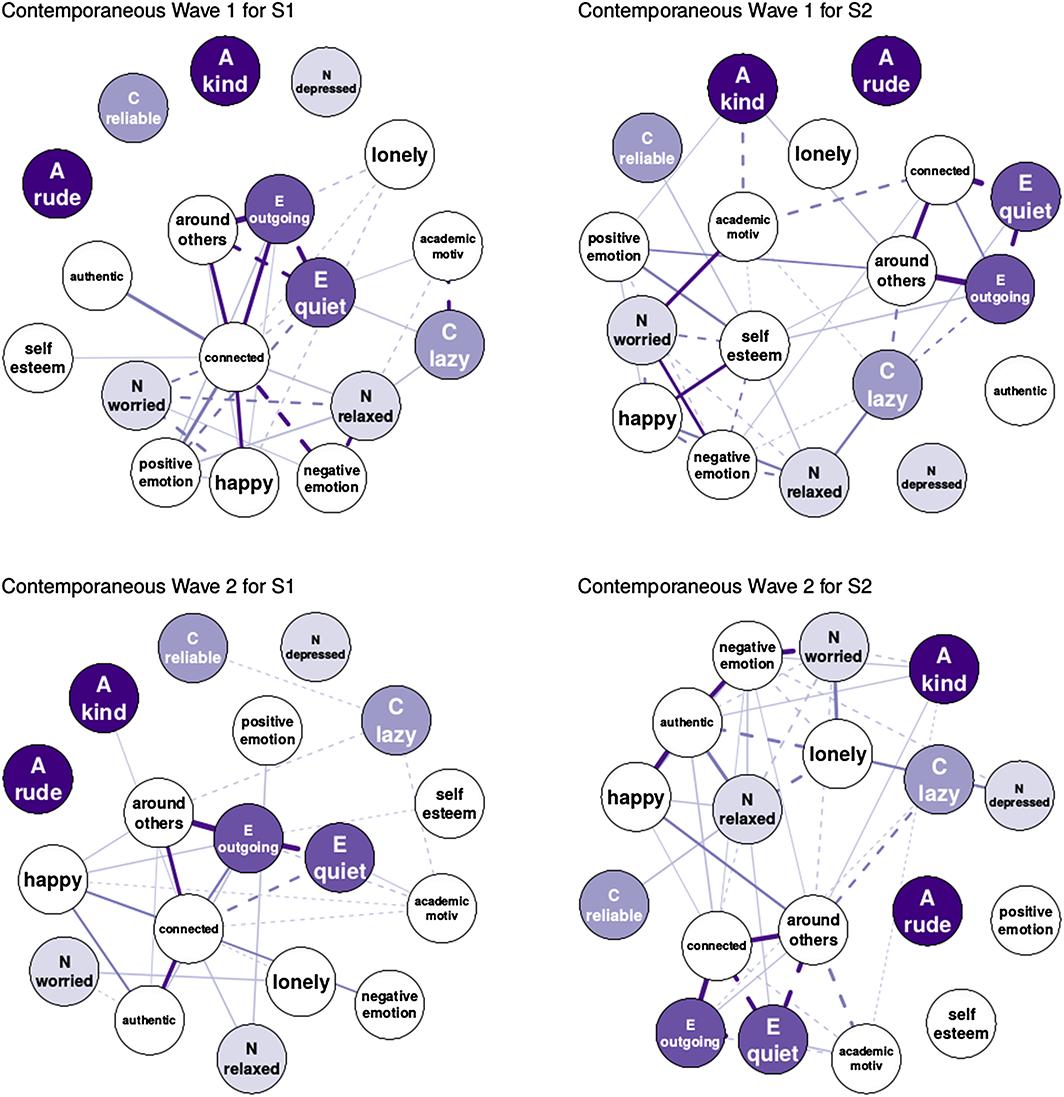
Contemporaneous personality networks for two subjects’ ESM responses collected one year apart. The colored nodes represent personality items, while the white nodes represent behavioral, emotional, and motivational states. Positive associations (edges) are solid lines, while negative associations are dashed lines. [Colour figure can be viewed at wileyonlinelibrary.com]
For personality development, personality networks can track changes in intraindividual personality structure that may not be picked up by typical nomothetic measures of personality (c.f. Beck & Jackson, 2017b). For example, both Subjects profiles of ESM composite scores were stable over 2 years (rS1 = 0.75; rS2 = 0.65), but only Subject 1's personality network (rS1 = 0.66; rS2 = 0.32) was stable over the same time period—that is, Subject 1's (but not Subject 2's) stability was reflected both in the network and the aggregate of their behavior. This observation generates new questions about the processes of development. What differentiates people with different patterns of behavioral and network stability? These findings index changes in the relationship among variables, a type of change that is rarely explored in personality development (see Beck, Jackson, and Condon (2017) for an exception).
In sum, we agree with Baumert and colleagues that networks are valuable tools for personality scientists, perhaps particularly in the generation of hypotheses in the empirical study of personality processes, structure, and development. Moreover, we agree that there is opportunity to examine these three pillars of research simultaneously. A network perspective personality does not mean throwing out decades of personality research on nomothetic approaches but does mean reframing the language we use to talk about personality traits as well as the explanations of why they occur. We challenge personality researchers to go beyond Baumert and colleagues’ theoretical review and implement designs capable of tackling personality structure, processes, and development simultaneously.
Profitable Interplay between the Study of Human and Nonhuman Personality
Alison M. Bell and Julia B. Saltz
Our goals in this brief commentary are to explain why researchers studying non–human animal behavior are interested in personality and to convince you that viewing the topics covered by Baumert and colleagues from our perspective might have some unexpected insights for researchers studying personality in humans.
The growing literature on “animal personality” is interested in the underlying mechanisms and consequences of behavioral variation among individuals of the same species. Whatever the particular phenomena being investigated (behavioral syndromes, coping styles, etc.), it is appreciated that individuals behave differently from each other and that individuals often retain their behavioral type over time, even after controlling for other factors we know influence behavior such as sex and age.
Within–individual consistency and among–individual variation in behavior raise deep questions for the study of behavior from an evolutionary perspective, such as the factors that limit behavioral plasticity and the evolutionary forces that maintain heritable behavioral variation within populations. Other questions pertain to the ecological and evolutionary consequences of consistent behavioral variation—e.g., for biological invasions, speciation, predator–prey dynamics—because these topics were traditionally studied by assuming that individuals of the same species were pretty much interchangeable (Sih, Bell, & Johnson, 2004; Sih, Bell, Johnson, & Ziemba, 2004).
The phenomena are studied by presenting individual animals with a stimulus (e.g., a potential mate or a competitor) and recording their behavioral responses. After a few hours, days, or weeks, we measure that same individuals’ behavior again, either in response to the same or a different stimulus, and repeat this procedure on as many subjects as we can get our hands on. The observed behavioral variation is partitioned into its within– and among–individual components. We are often interested in whether between–individual behavioral variation is correlated with putative underlying mechanisms (e.g., hormones or genetic polymorphisms) or fitness (e.g., survival or mating success).
This approach differs substantially from the analysis of human personality structure, as reviewed by Baumert and colleagues, because we typically focus on only one or a few behaviors at a time, instead of comprehensively describing differences among individuals. Our investigations are also limited to externally observable behaviors, and we typically lack information about internal subjective experiences (thoughts and feelings) that are important in human personality research. Despite this, there are some interesting points of contact between human and animal personality research. For example, the functionalist approaches described by Baumert and colleagues are a core component of animal personality (and other behavioral ecology) research, except that instead of asking how individuals’ behavior allows them to “maximize their most valued outcomes,” we focus on how individuals can maximize their fitness. The concept that “the environment is the ultimate arbiter of a trait's functionality” is also widely recognized.
Baumert and colleagues point out that, to integrate our knowledge of structure, process, and development, experimental manipulation of putatively causal environmental factors is critical. This is where animal personality research really shines! For example, we might place different individuals in different physical or social environments or otherwise manipulate their experiences to test the hypotheses that some environments produce more pronounced personality differences than others, or influence individuals’ development, behaviour, or fitness (Stein, Trapp, & Bell, 2016; Laskowski & Bell, 2014; Pruitt & Goodnight, 2014).
Another area of potentially, mutually insightful study—surprisingly absent from Baumert and colleagues—has to do with the bidirectional interplay between individuals and their environments. While Baumert and colleagues clearly appreciate the important role of environmental factors in causing personality development and structure, it has long been known that the causal arrow can also go the other way: the environment that individuals experience can be caused by individuals’ own behavior (Eaves, Last, Martin, & Jinks, 1977; Plomin, DeFries, & Loehlin, 1977). For example, children with different personalities are treated differently by their parents (Hanscombe, Haworth, Davis, Jaffee, & Plomin, 2010; Hayden, et al., 2010; Plomin, Asbury, & Dunn, 2001), and individuals tend to choose friends with similar personalities and viewpoints (McPherson, Smith–Lovin, & Cook, 2001).
While psychologists have long known about the ways in which individuals choose, inherit, and create their own environments (Eaves, et al., 1977; Plomin, et al., 1977), they've mostly documented this phenomenon indirectly—i.e., they observe that individuals with different personalities experience different environments, but it's often unclear how or why (Jaffee & Price, 2012). Animal personality researchers can close this gap by directly documenting how individual differences in behavior cause social or other experiences. For example, many studies have documented individual differences in habitat choice (e.g., Jaenike & Holt, 1991), where “habitat” refers to the environment in which individuals live, eat, interact socially, and reproduce. Similarly, we now know that individuals differ in the types of social groups they choose (Brown & Brown, 2000; Julia B. Saltz, 2011) and the types of behavioral interactions they elicit from others (Lea, Blumstein, Wey, & Martin, 2010; Moore, Brodie, & Wolf, 1997; Saltz, 2013). In male fruit flies (Drosophila melanogaster), a male's choice of social group feeds back to influence how often he is attacked by other males, and his own later aggressive behavior. These results suggest that the interplay between individuals and their environments can be important to personality development and may serve as a nexus of integration between structure, process, and mechanism questions in personality psychology.
We think that trying to understand the ways in which traits both vary among individuals and change within individuals (Dingemanse, Kazem, Reale, & Wright, 2009) provides opportunities for mutually beneficial interactions between colleagues studying human and animal personality. Animal personality researchers are relative newbies to the study of individual variation, so we have a lot to learn from the methods and useful frameworks already commonplace in psychology. At the same time, we can do experiments and manipulate environments and experiences in powerful ways that simply are not available when studying humans, which can allow us to test many of the intriguing hypotheses in Baumert and colleagues.
The Case for Multiple Perspectives in Personality Psychology
Wiebke Bleidorn and Christopher J. Hopwood
University of California, Davis
In this thoughtful and stimulating paper, Baumert and colleagues argue for the integration of trait structure, process, and development in personality theory and research. We especially value the authors’ systematic articulation of three specific areas of research that could move the field forward. Regarding their main thesis, however, we would suggest that the field is not ready for a comprehensive integration. Room must be left for scholars pursuing the questions they value regardless of how their methods and concepts tie to those of other personality researchers (Feyerabend, 2010; Markon, 2013).
Every generation of psychologists has witnessed calls to integrate disparate theoretical approaches and research paradigms into a comprehensive model (Calkins, 1906; Craik, 1986; Cronbach, 1957). We sympathize with this integrative impulse but cannot help noticing that, so far, none of these calls have been effectively answered (Loevinger, 1987; Yanchar & Slife, 1997). We think it is still too soon.
The risk is that efforts to integrate diverse perspectives can constrain personality research (Markon, 2013). Different lines of personality research and models of personality are incommensurable because each has a different focus, and there is some value in the plurality of focus (Funder, 2001) that we are not prepared to lose. As Baumert and colleagues point out, research on the structure of phenotypic aspects of personality helps consolidate nomothetic features into systematic models that permit the assessment of the variables to be measured in the first place. In contrast, research on processes focuses on the factors that give rise to those features in interaction with the environment across situations. Developmental research focuses on how those factors interact with life course factors to contribute to different levels of adaptation over long periods of time. While these questions interface (e.g., the constructs identified in structural research become the dependent variables in developmental studies), the focus of each of these areas of study are sufficiently different that they necessarily operate, to a certain degree, independently.
The construction of the argument in Baumert and colleagues’ article implies a tacit acknowledgement of this issue. First, the authors begin their paper by excluding interpersonal, psychodynamic, and humanistic approaches to personality outright. Two of these perspectives explicitly attempt to integrate structure, process, and development (e.g., Pincus & Ansell, 2003; Brenner; 1973), and all three attempt to be comprehensive and integrative. Whatever one thinks of these approaches, the presence of at least three alternative frameworks implies that the neo–behavioral model proposed by Baumert and colleagues cannot be consensually comprehensive.
Second, early in the paper Baumert and colleagues establish an emphasis on behavior as the most important domain of psychological functioning with which personality researchers should be concerned. Specific examples of this emphasis are their parenthetical presentation of thoughts and feelings, their use of the adjective “concrete” when describing measurement, and their definition of motivation in terms of behavioral approach and avoidance. There are clear advantages to prioritizing behavior, not the least of which is measurement reliability. However, the prioritization of behavior is problematic as evidenced by the consequences of mainstream psychiatry's decision to define personality disorders behaviorally in the Diagnostic and Statistical Manual of Mental Disorders (American Psychiatric Association, 1980). This definition led to two generations of confusion and dissension that are still evident in research on constructs such as narcissism (Cain, Pincus, & Ansell, 2008) and psychopathy (Miller et al., 2010). Inner experiences are more difficult to measure than behaviors. Nevertheless, our view is that personality is inferential by definition, and the psychiatric example is sufficient to caution against elevating behavior to any special status when it comes to conceptualizing personality.
In Baumert and colleagues’ defense, they really had no choice but to constrain themselves from the beginning. Incompatible alternatives (e.g., interpersonal, psychoanalytic, and humanistic theories) had to be excluded, and the domain to be explained (behavior) had to be circumscribed; otherwise, their argument could not be coherent. That is our point. The current state of research forces scholars to choose for either a complete or a coherent conceptual framework.
In conclusion, there is value in efforts to integrate different streams of personality psychology. Baumert and colleagues, and their articulation of intersections at which different approaches to personality can be linked, offer a valuable contribution toward this goal. However, it is too soon to argue for a single, consensual, coherent, and complete model. There needs to be some room for perspectives that are not overly concerned with integration, because different perspectives are needed for different kinds of questions.
Let's Connect
Daniel Cervone
University of Illinois at Chicago, USA
Integrated study of inter–individual differences, intra–individual processes, and development—who could disagree with that?
Hey, it says I disagreed. Right in the second sentence of the article of Baumert and colleagues! I'd better check my back pages (Cervone, 1991).
In 1991, I wrote that “natural–language dispositional units”:
“[do] not provide ... an explanation” of behavior (p. 374) may not “necessarily correspond to a taxonomy of psychological processes and structures” (p. 376) may not be “adequate to describe the personality of any and all individuals” (p. 376) (The descriptors were aggregate means; the article predated contemporary study of variability in behavior across situations.)
Baumert and colleagues write that:
“broad traits cannot serve as explanations” (p. 505) “the intra–individual organization of mental representations does not necessarily correspond to the structures observed at the population–level” (p. 511) “We need to ... explain variation of behavior across situations” (which implies that aggregate means are insufficient; p. 515)
The differences are, um, subtle. What explains my role as rhetorical counter–point?
One possibility is inadequate acknowledgement of a distinction between types of “integration.” Should Copernicus have integrated with Ptolemy? If one means theoretical integration (integrating claims about causally influential entities), no; if empirical integration (using one system to explain phenomena identified by another), yes. Dispositional constructs are not “adequate elements for a theory of personality” (Cervone, 1991, p. 375) argued against theoretical integration in which inter–individual descriptors are treated as intra–individual forces (McCrae & Costa, 1996). Empirical integration of social–cognitive mechanisms and inter–individual differences was, and is, an established fact. 2
A second possibility was my writing that social–cognitive research identifies individual differences not captured by the era's trait constructs, which muddies a simple description/explanation division–of–labor. My example was social intelligence. Individual differences are explicable in terms of underlying mental representations (Cantor & Kihlstrom, 1987) and foster behavioral variations at some life points—life transitions (Cantor & Langston, 1989)—but not others. Did such research programs not already integrate social–cognitive mechanisms and individual differences (also see Little, Lecci, & Watkinson, 1992)?
Baumert and colleagues may note that past research did not integrate with “personality structure.” One then asks, what is the personality structure with which one should integrate? There appear to be so many. Questions:
When “patterns of covariation in behavior, including thoughts and feelings” (p. 503) vary systematically across contexts (see Bandura & Cervone, 1983; Cervone, Jiwani, & Wood, 1991), does each context have its own personality structure?
If patterns of covariation differ across cultures (Gurven, von Rueden, Massenkoff, Kaplan, & Vie, 2013; Singh, Misra, & De Raad, 2013), does each culture have its own personality structure?
If “intra– and inter–individual personality structures may differ” (p. 507), might each individual (in principle) have his or her own personality structure?
If researchers obtain “different structures” depending on “how cells of the data space are aggregated” (p. 507), is each a personality structure? If so, is “personality structure” observer–independent or observer–dependent (Searle, 1998)? What if “correlations found … are simply built into the questionnaire” and thus potentially “an artifact of the way personality tests are constructed” (Costantini et al., 2015a, p. 26)?
Investigators inspired by Baumert and colleagues’ compelling call to travel up to personality structure may benefit from clearer sense of where they are going.
Consider three features in Baumert and colleagues’ article:
By MS Word count, “cognitive structures” appears zero times. (Google Scholar counts 150,000+ appearances in the literature.)
Baumert and colleagues (p. 504) articulate two questions about causal systems and personality functioning—why “individuals with different trait levels behave differently in the same situation” and “an individual with some trait level behaves differently in different situations”—but not a third: why an individual [with any trait level] behaves similarly in different situations. The third question references Allport's (1937, p. 330) evidentiary criterion for traits.
Psychological mechanisms explain behavioral “patterns of variation across situations” (p. 503). What, then, explains consistency across situations? It can't be broad traits; we've abandoned that traits–as–explanations ship.
The features are related. Baumert and colleagues discuss cognitive structures (“mental representations, schemas and scripts,” p. 510) but do not fully exploit their potential for identifying “social cognitive operations” (p. 507) that explain traits.
Potential operations:
Some enduring cognitive structures (e.g., schemas; Beck, 1991; Markus, 1977) are so accessible that they become activated in multiple situations. In any given situation, cognitive structures influence dynamic processing (Higgins, 1996, 1999). Highly accessible structures therefore foster similar processing across different situations. Because the processing dynamics are “driving forces that influence … behaviors” (p. 505), the cognitive structures–to–processes link fosters behavioral consistency.
This three–step path is the integration of social–cognitive structures, processes, and behavioral coherence—patterns of consistency and meaningful variability—advanced in the KAPA model of personality architecture (Cervone, 2004). Its assessment principles (Cervone, Shadel, & Jencius, 2001) facilitate identification of these patterns and their underlying causes (reviewed in Cervone, 2008; Cervone & Quirin, 2017). Researchers have employed KAPA–model theoretical principles and assessment methods to advance three other goals discussed by Baumert and colleagues: testing causal processes experimentally (Artistico & Rothenberg, 2013; Cervone et al., 2008), intervening for behavioral change (Scott & Cervone, 2016), and accounting for within–person variability while empirically integrating between–person and within–person methods (Di Blas, Grassi, Carnaghi, Ferrante, & Calarco, 2017).
KAPA–model efforts may not achieve the “complete integration” (p. 504) Baumert and colleagues desire. But the big picture is this: Their call for explaining individual differences through bottom–up explanatory strategies that reference causal systems that are conceptually distinct from qualities to be explained is a breath of fresh air—or one might say, a much–appreciated second wind (cf. Cervone, 1997, 1999). If this perspective is now consensus, we finally have one less discipline of personality psychology than we used to (cf. Cervone, 1991). That's good news. Everyone else is living in a world of “bottom–up innovation” where “everything connects” (Hoque & Baer, 2014, pp. 21 and 1). Why not us?
Integration in Personality Research: Evolution is the Missing Catalyst
Marco Del Giudice
University of New Mexico, Albuquerque, New Mexico, USA
In the article, Baumert and colleagues review three domains of personality research—structure, process, and development—and make a compelling case that the discipline needs to make a major step toward integration. Despite the authors’ remarkable effort, the research program that emerges from the paper is unconvincing; the proposed directions are largely methodological, and it is hard to see how they would lead to an integrated understanding of personality rather than just more of the same. Reading the paper felt like watching a chemical experiment where something critical is missing. The authors do a great job of laying down the components and mixing them together; but as much as they keep stirring and shaking, the elements fail to react and combine as expected.
I surmise that evolution is the missing catalyst of integration. While Baumert and colleagues do not dismiss the biological aspects of personality as unimportant, in practice they treat them as optional—something that can be added at a later time to complete the picture. But what if evolutionary concepts are foundational rather than peripheral? The structure of personality traits, their development, and the underlying cognitive/motivational processes are all products of our species’ history and have been shaped and refined by millions of years of selection across countless generations. If this is the case, successful integration may only be achieved within a broader evolutionary framework—a metatheory that enables a truly functional understanding of personality and behavior (Durrant & Ellis, 2003; Tooby & Cosmides, 2015). In a recent chapter, I showed how such an integrative approach can be applied to personality development (Del Giudice, in press). For broader surveys, see the volumes by Buss and Hawley (2011) and Carere and Maestripieri (2103). To readers unfamiliar with evolutionary psychology, I recommend the introduction by Tooby and Cosmides (2015), which also touches on issues of motivation, emotion, and individual differences.
In the remainder, I illustrate the potential of this approach by focusing on motivation, one of the key topics of Baumert and colleagues’ article. The authors define motivation generically as selective approach/avoidance and distinguish between “biological drives” such as hunger and “socialized motivations” such as status seeking. Recasting motivational processes in a modern evolutionary perspective affords a wealth of integrative insights that cut across process, development, and structure. The mechanisms that underlie motivation are best understood as specialized goal–directed systems with access to both innate and learned knowledge (Cosmides & Tooby, 2013; Del Giudice, in press; Tooby & Cosmides, 2015). While approach and avoidance are important, motivational regulation involves much more—from context–sensitive switching between alternative goals and strategies, to coordination of multiple cognitive and physiological processes through emotions (e.g., Al–Shawaf, Conroy–Beam, Asao, & Buss, 2016).
Crucially, evolutionary theory illuminates the deep hierarchical structure of motivational goals. Genetic replication (achieved either by reproducing directly or by favoring related individuals) is the ultimate, overarching function of all living organisms. Life history theory shows how this meta–goal can be decomposed into a number of broad tasks—including survival, growth, learning and body maintenance, mating, and parenting—and how the balance between competing tasks is adjusted depending on the characteristics of the individual and its environment (see Del Giudice, Kaplan, & Gangestad, 2015). On a finer scale, life history tasks are accomplished by a large number of overlapping but functionally specialized mechanisms that deal with specific problems, from choosing food and avoiding pathogens to finding and attracting mates, maintaining beneficial cooperative relationships, increasing one's status and social influence, acquiring and transmitting knowledge, and so forth. All these motivations are equally “biological” and linked to reproductive fitness within the ecological niche of our species. The resulting model of motivation is remarkably rich, and—in contrast with abstract functionalist models that do not consider the fitness costs and benefits of behavior—implies a complex but non–arbitrary structure of partially conflicting goals (e.g., Aunger & Curtis, 2013; Del Giudice, in press; Kenrick, Griskevicius, Neuberg, & Schaller, 2010).
This approach helps with the daunting task of identifying which of the potentially infinite dimensions of the environment are most likely to be relevant to a given individual and gives deeper meaning to the phrase “the mind has the structure it has because the world has the structure it has” (Anderson, 1991). While Baumert and colleagues limit their analysis to the regularities of the present environment as experienced by a single individual, an evolutionary perspective suggests that the present structure of the mind also embodies the regularities of the ancestral environment and its statistical structure across multiple generations (Tooby & Cosmides, 2015). If so, understanding the nature of our ancestral environment is a precondition for understanding the structure of personality. Of course, evolved developmental programs interact with present ecological conditions; for example, there is fascinating evidence that recent increases in the complexity of human societies may have lessened the strength of trait covariation, leading to greater differentiation of individual personalities (Lukaszewski, Gurven, von Rueden, & Schmitt, 2017).
The preceding paragraphs barely scratch the surface. While there is no room to present them even cursorily, other exciting contributions include the concept of internal regulatory variables as sources of behavioral covariation and coherence across multiple systems (Cosmides & Tooby, 2013); life history models that track the emergence and change of motivational priorities across the life span (e.g., Del Giudice, in press; Kenrick et al., 2010); and novel insights into the nature of developmental plasticity, sensitive periods, and transitions between the major life stages (e.g., Del Giudice, 2014a, 2014b; Frankenhuis & Fraley, in press; Frankenhuis, Panchanathan, & Nettle, 2016). Besides reframing and integrating existing knowledge, evolutionary models can reveal phenomena that are invisible from other perspectives. For example, parent–offspring conflict theory (Trivers, 1974; see Schlomer, Del Giudice, & Ellis, 2011) shows that parental influences are only partially in the biological interest of children and may explain why family experiences have surprisingly little systematic effects on adult personality (Del Giudice, 2009, in press). Keeping personality research insulated from the broader evolutionary paradigm can only delay integration further and prevent the discipline from achieving its full potential.
A Cybernetic Perspective on Integrating Personality Structure, Personality Process, and Personality Development
Colin G. DeYoung
University of Minnesota
Baumert and colleagues argue that “personality processes, personality structure, and personality development have to be understood and investigated in integrated ways in order to provide comprehensive responses to the key questions of personality psychology.” I agree wholeheartedly and recently published a theory that attempts such an integration. Cybernetic Big Five Theory (CB5T) largely focuses on linking the Big Five structural model to underlying processes that govern behavior, but it also provides a theoretical framework for describing the development of personality in terms of the influences of genetics, environment, and internal dynamics on personality over time (DeYoung, 2015).
Cybernetics is the study of principles governing goal–directed systems that self–regulate via feedback, and it is largely synonymous with what Baumert and colleagues describe as “self–regulatory perspectives.” Because human beings (like all living things) are cybernetic systems, cybernetics is the right kind of framework to produce the sort integrative mechanistic theories for which the article calls. CB5T describes the sources of personality traits as variations in parameters of the evolved mechanisms that allow human beings to pursue their goals.
However, Baumert and colleagues’ definition of “trait” is broader than what CB5T means by “trait.” In CB5T, personality encompasses all reasonably enduring psychological individual differences, but these are divided into “traits” and “characteristic adaptations.” Baumert and colleagues state that “traits include all psychological dimensions of stable individual differences regardless of their content (personality, temperament, ability, attitude, value, belief, motive, emotion) and their width (habits, facets, domains, types).” For them, personality is nothing more than the set of all traits. Thus, ability to throw a Frisbee is a trait; degree of liking for Starbucks coffee is a trait. Although it is not impossible to define such stable individual differences as “traits,” it does not seem consistent with common usage in psychology, and it obscures an important distinction within personality.
In CB5T “trait” refers only to those patterns of behavior, motivation, emotion, and cognition that are responses to classes of stimuli that have been present in human environments over evolutionary time (such as threats, distractions, and other people). Traits reflect parameters of mechanisms that are present in every intact human brain. Thus, any trait construct should be applicable to any person anywhere, and every person exhibits some level of every trait. In contrast, individual–difference constructs that require reference to a person's specific cultural or personal circumstances (e.g., those involving Frisbees or Starbucks) are characteristic adaptations. These are the learned and updateable memory contents of the human cybernetic system, which fall into the three categories of information that every cybernetic system must contain: goals (desired future states), interpretations of the current state, and strategies that can be used to transform the current state into the goal state. Most of one's characteristic adaptations will be congruent with one's traits (of necessity, because traits describe probable behavior in general), but some are likely to be incongruent, as people sometimes overcome their general tendencies in order to adapt to specific situations.
Separating traits from characteristic adaptations makes it easier to develop a compromise between the options of “emergence” and “correspondence” that Baumert and colleagues posit in response to their question, “What mechanisms and processes can explain occurrence of population–level covariation of inter–individual differences in behavior?” Only emergence views are endorsed in the article, perhaps because the two options are set up as an overly sharp binary, in which they want to determine “whether patterns of covariation of behavior reveal its common causes or instead emerge from underlying processes that do not themselves correspond to the observed structures.” The article implies that the only alternative to emergence theories is “assuming that broad personality factors reflect specific and unitary psychobiological or causal entities, ” but this is a false dichotomy. CB5T does not view personality traits as internal causes of behavior (DeYoung, 2017), but it nonetheless recognizes the possibility of identifying coherent psychological functions that account for the covariance pattern described by the Big Five (e.g., sensitivity to threat for neuroticism). Further, in explaining the sources of these psychological functions, it draws on the concept of MIMIC models (multiple indicators, multiple causes), in which variations in many neurobiological parameters produce variation in a particular psychological function, which then influences a variety of more specific behaviors. Because one brain system is involved in responding defensively to any threat, for example (although other systems are additionally recruited for different kinds of threat), this system is a good candidate for a cause of neuroticism, despite the facts that variation in threat sensitivity (and hence neuroticism) is probably due to variation in hundreds of specific neural and molecular parameters that influence this system and that some of these parameters will influence other brain systems as well (Allen & DeYoung, 2016).
Cybernetic function requires a limited number of core processes (being motivated to pursue goals, interpreting the current state of the world, etc.), which will be augmented by many more specific processes differing across species and individuals. CB5T posits that the Big Five represent variation in these core processes, thus explaining why there are a few very broad dimensions of covariation in personality (in addition to many more specific patterns of covariation). Given the nature of complex dynamic systems, in which miniscule variations in starting conditions can lead to substantially different outcomes, it seems highly unlikely that similarity in situations and causal interactions among specific behaviors is the whole explanation for the remarkable similarity of personality structure across cultures. No doubt causal interactions among narrow elements of personality contribute to personality structure, but we must also acknowledge the cybernetic architecture of the brain and recognize the existence of some broader causes as well. Mõttus and Allerhand (in press) have developed a mathematical framework for modelling broad and narrow influences on personality structure simultaneously, which exemplifies the only plausible type of comprehensive structural account of personality, given what is known about brain function. Once we distinguish traits from characteristic adaptations, we can better distinguish universal causes of trait structure from person–specific and culture–specific causes of behavioral regularities.
The Broad Importance of Integration: Psychopathology Research and Hierarchy as Construct
Nicholas R. Eaton
Department of Psychology, Stony Brook University
The article by Baumert and colleagues lays out clearly the individual importance of personality structures, processes, and development and effectively argues why their integration is both necessary and intellectually profitable. Siloed lines of research inquiry can produce excellent science; they can also obscure the presence of notable blind spots. Rather than attempting to adjudicate which of these perspectives is somehow optimal, Baumert and colleagues articulate clearly how these three key framings have unique merit and, upon integration, can be mutually informative rather than necessarily competitive. The contribution of Baumert and colleagues is not limited to personality research, and I briefly outline how such integration appears prescient for psychopathology research as well. Further, while the authors primarily discuss integration between research perspectives, I discuss a supplementary approach: the integration within research perspectives through focus on hierarchy as construct.
Baumert and colleagues’ coverage is focused on personality, but their ideas have broad implications beyond personality science. Indeed, the article brings to mind numerous similarities to psychopathology research; however, as is often the case, personality researchers appear to be ahead of the game. Personality and psychopathology are closely related (Clark, 2005; Griffith et al., 2010; Krueger & Tackett, 2006; Rodriguez–Seijas, Eaton, & Krueger, 2015). This is obvious for personality disorders, but personality plays a role in (or manifests as) a wide variety of mental disorders (e.g., Barlow et al., 2014; Lahey, 2009; South, Eaton, & Krueger, 2010). These links suggest that movement toward integration within personality psychology could be beneficially mirrored by clinical psychology and related disciplines, in hopes of producing a deeper understanding of psychopathology.
Psychopathology research, like personality, has distinct, unintegrated lines of inquiry. Like structural personality approaches, classification research produces descriptive psychopathology models. Advances in the area of quantitative classification, typically based on factor analytic models of diagnoses or symptoms and inspired by structural personality research, have converged on a number of latent dimensions that can be used to describe the structure of many forms of mental disorder, such as transdiagnostic factors of internalizing (e.g., mood and anxiety disorders), externalizing (e.g., disorders of oppositionality, impulsivity, and substance use), thought disorder (e.g., schizophrenia spectrum disorders). This emerging structural model (Kotov et al., 2017) has recently spurred the development of the Hierarchical Taxonomy of Psychopathology (HiTOP) consortium, a large group of classification scholars focused on using data–driven approaches to delineate evidence–based fundamental building blocks of mental disorder. While this represents an importance advance, Baumert and colleagues’ points about the circularity of explaining indicator aggregates (e.g., transdiagnostic factors) by the processes used to define them is a critical one for psychopathologists to keep in mind, as is the notion that different structures are obtained from different data aggregates (e.g., aggregating across time) and that these structures are not necessarily in close correspondence.
Process research is ongoing in psychopathology research. For instance, an explosion of network analyses of mental disorders and comorbidity has occurred in the past decade (e.g., Cramer et al., 2010; Fried et al., 2017). Network studies will likely continue to generate great excitement, particularly as temporally informed network studies proliferate. Baumert and colleagues’ discussion of the importance of experimental manipulation to perturb these networks to better understand processes highlights the potential integration of network and experimental psychopathology perspectives. Similarly, while sometimes pitted against one another due to differing assumptions and foci, there also appears to be a growing understanding—as noted by authors—that these approaches can provide complementary information and that the factor analytic approaches of many classification structuralists need not be in competition with the network analytic approaches of process researchers (e.g., Eaton, 2015; Molenaar, 2010).
In terms of development research, an entire field of developmental psychopathology has grown in prominence. Developmental psychopathology has emerged to the extent that it has dedicated journals and graduate training concentrations. While there have been some integrations of developmental psychopathology with structural and process approaches, Baumert and colleagues’ advocacy of the need to understand all three perspectives, in tandem, rings true.
In summary, the state of psychopathology research conceptually mirrors that of personality research. It would benefit from a similar integration as articulated by Baumert and colleagues, although, in many ways, it may be somewhat behind in terms of transformative, cross–cutting ideas and studies that serve as preliminary bridges for integration efforts. Nevertheless, personality research has provided roadmaps for clinical psychology before. More broadly, increasing integration between personality and psychopathology research seems particularly beneficial.
Baumert and colleagues discuss various means of integration across personality research between perspectives—for instance, how process can inform structure. However, within perspectives, there is a similar need to integrate. That is, competing models emerge within perspectives, such as alternative structural models of the same personality indicators. While one approach is to pit competing models against one another, there is often good reason to believe that different models are nested within one another and reflect different levels of empirical resolution. For instance, research indicates how different structural models (e.g., two–, three–, five–factor models) can be integrated into a single hierarchy (e.g., Markon, Krueger, & Watson, 2005). As Baumert and colleagues discuss, micro– and macro–level process can be integrated, with different levels of aggregation highlighting important processes. While certain levels of resolution within a hierarchy may be optimal for a particular purpose (X), this is an empirical question, and the recognition of levels of resolution facilitates consideration of hierarchy as construct (Forbes et al., in press; Kim & Eaton, 2015, in press).
Integration within personality (and psychopathology) research perspectives seems as important a goal as integration between perspectives. Methods exist for such an undertaking, such as Goldberg's (2006) bass–ackwards method. Similarly, integration of findings from multiple levels of resolution can be pursued through simultaneous top–down and bottom–up approaches (Forbes et al., in press). In sum, multiple conceptual and statistical approaches now exist to address hierarchy as construct, allowing for sophisticated integration of findings both within and between personality research perspectives.
What is the Integrative Model of Personality?
Małgorzata Fajkowska and Ewa Domaradzka
Institute of Psychology, Polish Academy of Sciences
This article was supported by a grant from the National Science Centre, Poland (2012/07/E/HS6/)
We admire Baumert and colleagues’ effort to integrate previous research traditions on personality processes, structure, and development. We doubt the extent to which the presented framework succeeds in being ‘integrative’. We will briefly sketch what we think are necessary features of an integrative approach and discuss them in relation to the proposal of Baumert and colleagues.
The idea of building an integrative framework for understanding the whole person has a rich legacy (e.g. Allport, 1937; Bandura, 1977; Cattell, 1943; Eysenck, 1970; Fajkowska & DeYoung, 2015b). Although each is being incomplete in some ways, these existing frameworks share a focus on the individual as a (coherent) whole (cf. Fajkowska & DeYoung, 2015a; Hall & Lindzey, 1957; McAdams, 2006; Stern, 1935). Such a whole–person focus is fundamental for integration within personality psychology. Even though Baumert and colleagues explicitly committed to comprehensiveness in personality psychology, a detailed analysis of their text did not provide evidence that they generated a theoretical candidate for understanding a whole person (cf. McAdams & Pals, 2006).
If personality psychology really is a natural home for generalists in psychology (cf. Revelle, 2008a), it seems that what advances this integrative capacity might be a conceptual overarching framework and an analytical unit/tool. Precisely, one or more of the following categories can characterize the integrative personality models: (1) metatheory, and (2) integrative explanatory theory, integrating knowledge on the basis of (a) units of analysis and (b) formal methods (cf. Fajkowska & DeYoung, 2015a).
By employing a meta–theoretical perspective in a specific model of personality, we gain a specialized language and tools that one can use to address specific scientific problems of personality psychology. This opens a possibility to identify the universal principles, mechanisms, and processes that remain constant and explain basic, parallel personality characteristics, and its fundamental functions. For example, the general system theory (e.g., von Bertalanffy, 1968) or the social cybernetic model (Weiner, 1988) form the basis of the integrative approaches of personality proposed by Mayer (2015) or DeYoung (2015), respectively. It seems that the model of Baumert and colleagues does not aim in this direction. Although the authors rely on terms borrowed from different overarching theories, such as ‘weak emergence’ (cf. network approaches) or ‘correspondence’ (cf. systemic theories), they do not refer to one general theory that is important as a cohesive force. Metatheory is not a condicio sine qua non of any model aspiring to be ‘integrative’. And a focus on metatheory is beneficial exactly to the extent that it allows the development of specific integrative explanatory theories (e.g., Fajkowska, 2013, 2015). If the authors do not apply metatheory, how do they form their personality model into an integrative approach?
Generally, we believe that three important features can describe the integrative explanatory theory of personality. First, the integrative personality theory does not need to be complete or even fully accurate. However, it should fit well enough to a sufficient portion of all the existing knowledge and observations to be useful in understanding a target issue (e.g., personality trait) or target phenomenon (e.g., personality change). A complete explanation is impossible as all integrative explanatory models of personality to some extent depend on axioms (e.g., levels/layers of personality integrate processes and traits). Even so, the models can provide explanatory power by being logically coherent with a minimum of assumptions.
In our opinion, the proposed model relates to the above description. It logically and coherently shows the interdependences of personality processes, structure (which is not a new idea, e.g., Allport, 1968; Fajkowska, 2013; Fleeson, 2012), and development (which is a new idea) involved in explanation of inter–individual differences and causes of covariations among behaviors and intra–individual variations in behavior across situations. However, the question remains: what sticks these pieces together, what is the ‘glue’?
This question reminds us Allport's (1958) strong claim for the choice of unit of analysis (‘glue’ in our terminology) as a critical factor in the development and elaboration of personality theories. Among these units he considered the nomothetic (e.g., temperament, expressive, and stylistic traits) and idiographic (personal constructs or projects; e.g., Kelly, 1955; Little, 2015) ones. We cannot identify any unit of analysis merging process, structure, and development in the proposed model; without such a unit a theory of personality seems to be more eclectic than integrative.
The second important feature of integrative personality models is that they are coherently tied by the analytical unit/tool. The integrative personality theory cannot be a multiplication of different entities. Here, important is to propose a model where the various and disparate parts of the theory must all fit together coherently. This can be achieved with a unit of analysis as defined by Allport (1958) or with integrative, formal analytical tools (another ‘glue’ cf. a Cronbach's generalizability theory; Poropat & Corr, 2015).
We believe that the model discussed by Baumert and colleagues does not meet the second requirement of integrative personality models. Having an analytical unit/tool would have allowed authors to demonstrate the relation among the terms (e.g., how behavior relates to trait) and to avoid confusions (e.g., one can assume that ‘trait’ can be substituted for ‘behavior’).
The third feature of the integrative personality theory is general—causal and organizing—mechanisms. Causal mechanisms provide a possible causal explanation of the nature and function of personality and its elements (e.g., cybernetic functional mechanisms underlying personality traits; cf. DeYoung, 2015). Organizing mechanisms inform about what processes maintain the stability of personality and allow for the optimal level of personality variability (e.g., physiological mechanisms of temperament determining one's need for stimulation, cf. Eliasz, 1981), and about what the inner and outer mechanisms of control are (e.g., automatic or self–governed; Corr, Fajkowska, Eysenck, & Wytykowska 2015). Although Baumert and colleagues focus on a reasonably comprehensive set of mechanisms, they do not organize the building elements of their framework—behavior, structure, and development—into one whole.
Baumert and colleagues’ proposal relatively comprehensively addresses the core concerns of personality psychology, including structure and process, change, and stability. However, to integratively answer these concerns, one may need to go further.
Personality Research is Going to Get Harder
Katherine M. Finnigan and Simine Vazire
University of California, Davis
We agree with Baumert and colleagues that modes of research on personality structure, process, and development have been conducted in isolation for far too long. In order to fully integrate these highly related research areas, future researchers will need to conduct studies with both multiple methods and measurement burst designs (e.g., repeated waves of intensive within–person assessment), such as multiple waves of experience sampling methodology (ESM; Larson & Csikszentmihalyi, 1983), daily diary studies, or Electronically Activated Recorder (EAR; Mehl et al., 2001). We will first discuss why these two characteristics of study designs are important. Then we will describe our experiences with coordinating a study that meets these criteria and follow with recommendations for this kind of research.
Why are measurement burst designs necessary? Personality processes are revealed in both short–term fluctuations of personality states (Fleeson & Jayawickreme, 2015) and long–term changes in traits. To examine both of these processes simultaneously, we must examine behavior at a finer–grained level (e.g., hours between measurement points at any given wave) and long–term or longitudinal level (e.g., years between measurement waves).
Why are multiple methods necessary? One early criticism of personality research was its focus on self–reports. To gain a fuller understanding of one's personality, we must also examine personality from other perspectives (Back & Vazire, 2012). Thus, to get a comprehensive assessment of personality states and traits, we must obtain observer– and/or peer–reports of short– and long–term changes in personality.
Multi–method measurement burst design studies are relatively rare, but our lab has recently attempted to conduct such a study. Using a convenience sample of college students, we ran a seven–wave longitudinal study over two years, with three measurement waves that included intensive within–person measures using both self–reports (ESM) and observer–reports (EAR). Due to a host of issues—including attrition and inadequate resources—we ended up with a moderate sample size at the first wave (N = 434) but less than a quarter of that sample at the last wave. This study is ongoing—behavioral coding has taken a particularly long time and will likely not be finished for several years—but we have two recommendations after having finished primary data collection.
First, we believe that this type of research should be conducted by large research teams at multiple sites. Our lab currently has about 50 research assistants at any given point during the school year. These research assistants are (as of 2017) still coding EAR data from the first wave of the study. Given the significant resources required to conduct such a study, we suggest that future researchers in this domain form collaborations with other researchers.
Second, we believe that this type of research should sample from a diverse population rather than only college students or other convenience samples. For example, these questions should be examined cross–culturally with participants outside of WEIRD (western, educated, industrialized, rich, democratic; Henrich, Heine, & Norenzayan, 2010) countries. As we move to more comprehensive explanations or models for human behavior and personality, we need to understand the extent to which models based on WEIRD participants generalize to other populations, and to various ages and cohorts.
In sum, we believe that an integrative model of personality research—such as the one proposed by Baumert and colleagues—is the way forward for personality psychology as a discipline. In order to fully explain the relationships between characteristics of the person and their behavior, we must delve deep into daily life and broadly across the life span (via measurement burst designs), look across different modes of assessment (via informant and observer reports), and examine cross–cultural and age differences in personality structure, process, and development.
The type of study we have described is expensive, resource–intensive, and time–consuming to conduct. Researchers and funding sources may understandably question if it is worth it to conduct such a study. Luckily for us, Baumert and colleagues lay out the importance of such studies, namely, that they can (1) illuminate many of the key questions that personality psychologists have be striving to answer for several decades and (2) unite the distinct but related research areas of personality structure, process, and development.
Despite the clear scientific value of the collaborative, large–scale study we outline here, we recognize that there are few (if any) practical incentives for social and personality psychologists to collaborate on such a project. Many researchers have called for changes in the incentive structure in science (especially psychological science) to not only facilitate but encourage participation in these projects. Some recent work suggests that these projects are more impactful than individual lab projects, despite the norms for solo author or solo lab–based projects (Uzzi, Mukherjee, Stringer, & Jones, 2013).
Overall, we hope this call for integration of the three disparate areas of personality research described by Baumert and colleagues results in greater emphasis on collaborative, intensive studies of personality across diverse samples, and that academic culture changes to reward such efforts.
Towards a Process–Based Understanding of Personality Structure, Development, Consequences, and Assessment: Systemizing Personality Processes into State Domains and Sequences
Katharina Geukes and Mitja D. Back
University of Münster, Germany
Baumert and colleagues propose that research on personality processes, structure, and development should be integrated to better understand core questions of personality psychology. A selective overview on process–oriented research is provided and definitional complexities are highlighted. We applaud the authors for this ambitious undertaking and for emphasizing an issue that is indeed of utmost importance for the future of personality psychology. To capture the full range of relevant phenomena and provide clear guidance for future research, we argue that the current summary needs to be extended by (a) a wider range of personality processes including social–behavioural and narrative processes and (b) a less insular systematisation of the whole range of processes into specified state domains and sequences.
Recently, we provided one such perspective in the context of personality development (Geukes, van Zalk, & Back, 2017, in press) that can be equally applied to personality structure, consequences, and assessment. This state process model of personality borrows from the CAPS (Mischel & Shoda, 1995, 1999), the TESSERA (Wrzus & Roberts, 2017), and the PERSOC (Back et al., 2011) frameworks, behavior–/self–regulatory models (Carver & Scheier, 1981; Gollwitzer, 1990; Gross & Thompson, 2007; Heckhausen, 1991), individual network (Cramer et al., 2012) and functionalistic approaches (Wood, & Denissen, 2015; Wood, Gardner, & Harms, 2015). We sort state processes into temporal sequences of three consecutive process domains: (1) Goals and Strategies (pre–action phase), (2) Actions and Experiences (action phase), and (3) Evaluations and Reflections (post–action phase; see Figure 1). Within each phase, individual differences are reflected in expressed levels of and in contingencies between state processes.
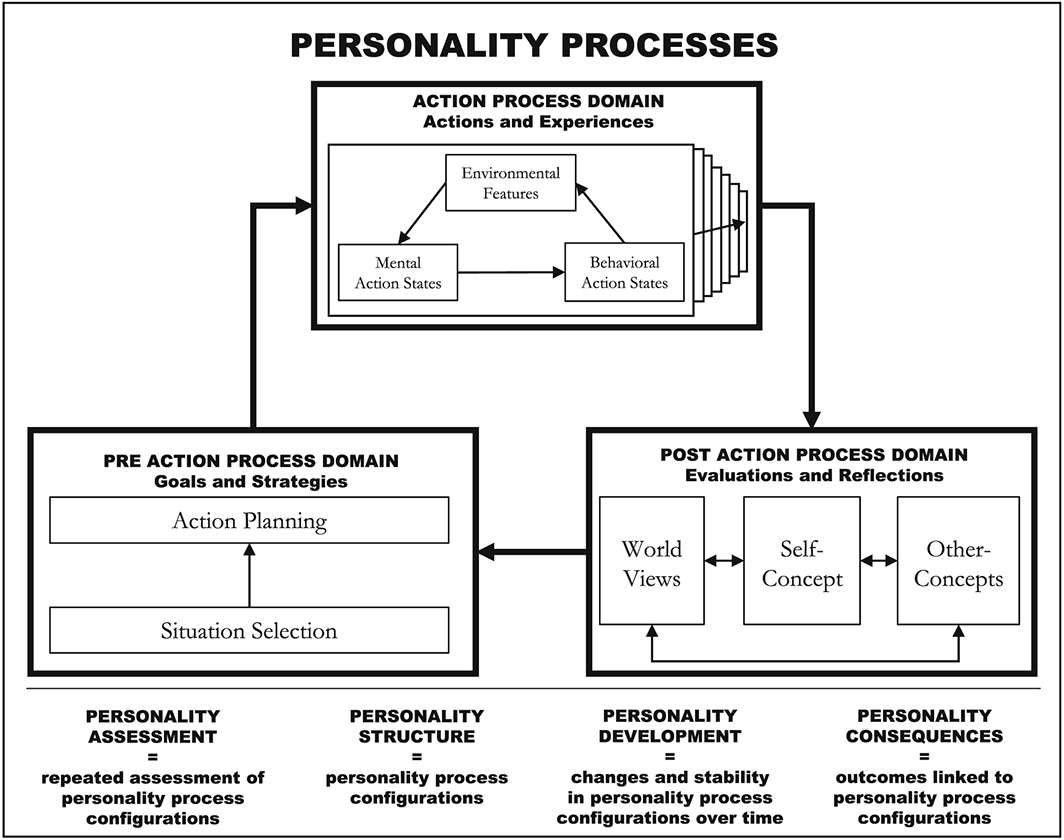
A state process model of personality: Three domains of personality processes. Figure adapted from Geukes et al., 2017; see Geukes et al., 2017—especially Figure 1—for more details within each process domain and for their relations to macro–level factors influencing stability and change of these state processes. Personality process configurations include expressed levels of states and state contingencies in all three process domains. They can pertain to individual differences on the intraindividual and the interindividual level.
Goals and Strategies reflect individual differences in the (i) selection of situations and (ii) creation of action plans for a given situational choice (see Wood & Denissen, 2015). Individuals choose those situations that they assume to promise desired outcomes through actions that they feel capable of performing. Once a situation is selected, individuals create corresponding action plans involving goal setting and the selection of strategies to achieve these goals. They differ (intra– and interindividually) in how much motivational states are evoked (state level expression; e.g., strength of expectation of success) and in how strong they are connected (state contingencies; e.g., how rigid certain strategies are chosen in a selected situation).
Actions and Experiences reflect individual differences in processes regarding three mutually dependent components: (i) environmental features of the selected situation, (ii) mental action states, and (iii) behavioral action states. This includes, for instance, social processes such as the expression of social behaviour, the perception of interaction partner characteristics and perceptions (i.e. metaperceptions), the evaluation of those, the evoked social affect, and the expression of social feedback (Back, et al., 2011; Back & Nestler, 2016; Back & Vazire, 2012; Leckelt, Küfner, Nestler, & Back, 2015). Individual differences again pertain to state levels (e.g., expressiveness of one's nonverbal behaviour) and state contingencies (e.g., the degree to which an angry face evokes nervousness).
Within post–action phases, individuals evaluate and reflect on action experiences and outcomes with respect to (i) themselves (self–concept; e.g., goal attainment, self–narration), (ii) their social counterparts (other concept; e.g., reputations, relationship potential), and (iii) their environment (world–views; e.g., situational norms, values). Again, individuals can differ in the extent they experience certain evaluations and reflections (e.g., how much they frame an outcome as a personal victory) and in contingencies between them (e.g., how much a perceived failure is linked to devaluations of others). These three process domains build a continuous sequence, with state processes in each phase guiding state processes in the next phase.
This integrative state process perspective on personality has important implications for the understanding of personality structure, development, consequences, and assessment. First, personality structure can be understood as (intra– and inter–)individual differences in the configuration of within–person state networks (Bringmann et al., 2016; Cramer et al. 2012; Schmittmann et al., 2013) in three consecutive process domains. These differences pertain to the level of state expressions (i.e., the activity of network nodes; e.g., how strong a happy feeling is) and to contingencies of state expressions (i.e., the strength of network ties; e.g., how strongly perceived positive feedback relates to happiness). When strictly following this perspective, it goes along with a deconstruction of latent traits: Personality characteristics (e.g., goals, behavioural traits, self–narratives/–concepts) are thought to be composed of these process differences instead of being independent entities that cause or are caused by them.
Second, when applying this perspective to personality development, temporal stability of personality is understood as states tending to develop into stable configurations (i.e., state network equilibria) within individuals. Momentary personality fluctuations or persistent personality change, in contrast, is suggested to occur when components of the state system (levels or contingencies) deviate from this balanced configuration, leading to momentary or systemic change of the interconnected components until the old or a new homeostatic equilibrium is found. Importantly, the influence of macro–level factors such as biological and environmental structures, social roles, age, and life events can be systematically explained via the outlined process domains (see Geukes et al., 2017, in press for details).
Third, the application of this perspective to the investigation of personality consequences offers a more differentiated understanding of how individual differences translate into (mal–) adaptive or (dys–) functional intrapersonal, interpersonal, and institutional outcomes—because it necessarily implies that one specifies the concrete process chains that define personality and its links to outcomes.
Finally, fourth, implementing such a perspective calls for a radical change in how personality is assessed; away from eclectic proxy measures that make mostly sense from a prediction perspective, towards repeated assessments of specified state levels and contingencies that might inform research more profoundly from an explanatory perspective.
In sum, we wholeheartedly agree with the call for an integrative process approach and hope that our suggested extensions regarding (a) the inclusion of a wider range of important personality processes, and (b) the specification and systemizing of within–person state networks organized in sequences of three consecutive process domains will provide a further fruitful basis for a process–oriented personality science.
Emergent Personality Development—The Interplay of Adaptation and History
Werner Greve and Cathleen Kappes
University of Hildesheim
The attempt to integrate divergent areas of personality research, as proposed by Baumert and colleagues, is long overdue and, thus, most welcome. Moreover, the general line of argument presented by Baumert and colleagues is convincing in many respects.
It is tempting to delve into a fine–grained discussion of some aspects of Baumert and colleagues’ proposal. For instance, the explanation of action by referring to the actor's intention (and/or his or her expectancies and evaluations) presupposes that actions and their intentions can be conceptualized as logically independent. However, if action is behavior performed with a particular intention, ‘action’ has to be seen on a higher conceptual level as intention, hence, as constituted (not caused) by intentions (among other components). While this particular position (objection) certainly can be disputed, it points to a general problem that has to be regarded carefully: the logical relationships between concepts on various (hierarchical) levels. For instance, neurophysiological processes and psychological processes are certainly not at the same conceptual level since psychological processes can be realized through (in a certain way: consist in) neurophysiological processes (not vice versa). Again, the nature of this relationship is far from clear: It seems possible to argue in favor both of a conceptual relationship (e.g., a certain kind of information processing is (reducible to) a certain neurophysiological process) and of a causal relationship 3 (neurophysiological processes cause a certain way of information processing). However, empirical prediction is blind to this difference. As a consequence, the conceptual nature of the relation between psychological processes and behavioral traits (i.e., frequencies) is difficult to determine: empirical data, even experimental data, cannot always disentangle conceptual and causal relations.
This very problem (of interrelation of conceptual layers) applies in particular to the relation of the three concepts Baumert and colleagues focus on as the central concepts for integration: How are these concepts related to each other? The most successful developmental theory, the theory of evolution, rests on two concepts: Adaptation and history (Maynard Smith, 1993). ‘Adaptation’ refers to the process that shapes evolution: “selective retention of fitness–enhancing variants” (Campbell, 1960). This entails the interaction between the evolving system's present state (i.e., its structure) and the constellation of surrounding conditions. “History” refers to the limiting boundaries for this process set by the present state of affairs of the developing unit (which for the evolutionary theory is the species, but might be another unit for another developmental theory). Given the circumstances, the present constellation of attributes cannot change in any direction (at any celerity). At the individual level, this is exactly how (and why) personality “works”: At any given point of time in the development of an individual (i.e., a developing unit), its state of affairs (i.e., its current structure) limits—and thus “shapes”—the corridor of opportunities for (the next possible steps of) its further development. The present structure of the individual, in turn, has been brought about by (earlier) adaptation. Thus, both the present structure and its development (up to and from now) result from adaptation (i.e., a process of selective retention; this is a core process Baumert and colleagues have in mind).
Hence, the three concepts Baumert and colleagues propose as the organizing foci for their envisioned project of integration are merely two: Structure and Process. Development results—emerges—from their mutual interaction: Development is the sequence of structural states (which includes both their stability and change between two points of time) produced by the (processes guiding the) interaction between this structure with surrounding conditions (i.e., systems within systems—this view can of course be extended to intraindividual interactions in a multi–level perspective). In other words, Development results from (or: consists of) adaptation given certain structural (including surrounding) conditions. It seems worth mentioning that adaptation is a two–way road that alters the interactors on both sides. Evolution theory has proposed the concept of “niche” (Odling–Smee, Laland & Feldman, 2003) to denote this idea of a “responsive” surrounding system (aka “environment”). A niche (i.e., the structure of “the” environment) is as dynamical as the developing unit interacting with it (from within). This continuous dynamic multi–level interplay is the basic idea of the concept of “developmental systems” (Ford & Lerner, 1992; Oyama, 1985; Qyama, Griffith & Gray, 2001). Baumert and colleagues’ approach might finally lead to a complex theory equivalent to this concept.
Viewed from this angle, then, a new perspective on personality is carefully, humbly perhaps, lurking behind the forceful plea presented by Baumert and her colleagues: Personality is, foremost and importantly, a dependent variable, not an independent one. Actually, to explain stability is a task for developmental psychology as central as to explain change. Moreover, the identification of stability or change depends itself on the level of description (analysis). For instance, the stability of a person's self–concept on a certain level is maintained by self–regulative processes that adjust (i.e., change) the structure of the self–concept on lower levels (Greve, 2005). Again, the person's history (i.e., biography), that has brought about its present structure (i.e., its personality) certainly is an INUS–condition for the further development. Yet the structure's stability remains to be explained—and this explanation (referring to the interaction of process and structure) will be part of the explanation of its development.
They Have Shown Us the Way, Now We Must Follow
Brian M. Hicks1 and C. Emily Durbin2
1 University of Michigan;
2 Michigan State University
In calling for an integration of structure, processes, and development in personality, Baumert and colleagues have provided a cogent articulation of the essential tasks and ultimate goals that lay before the field of personality research. Our own opinion is that for too long there has been a disproportionate emphasis on structure, a consequence of which has been a misunderstanding of the relevance of such work for informing causal processes, and a misallocation of efforts away from work that would inform causal processes on personality. We therefore applaud Baumert and colleagues in pointing out the limitations of structural analyses and the need for integration with processes and development to understand the nature of personality, and see their prescription as an important intellectual step for the field to take in order to maintain a vibrant science of personality.
Given the scope of the topic, Baumert and colleagues’ discussion of some topics is necessarily limited, and it is left to others to follow and fill in these gaps. Here, we note a few areas for additional emphasis. First, the structure of personality measures can differ not only across development, but also across informants. For example, we recently reported on personality in pre–adolescence (10 to 12 years old) finding differences in structure across parents, teachers, and child self–reports (Clark et al., 2017). Each informant demonstrated validity as evidenced by cross–sectional and prospective associations with several criterion variables (e.g., academic achievement, psychopathology, environmental context), suggesting the structural differences were not simply an artifact of measurement differences. For most outcomes, at least one informant also exhibited incremental validity over the others, indicating different informants carry unique information about the relevance of personality processes (and potentially different processes) to the outcomes rather than tapping a common process across informants, as would be implied by some core structure reflecting ‘the’ underlying causal mechanisms. There are many similar examples of either different informants or different measurement approaches to personality (e.g., objective coding of lab tasks, observer reports, and self–reports) exhibiting both validity and incremental validity over other methods. We take this as further evidence that structure per se provides almost no information about causal processes. Rather, structure is an outcome that must be explained by processes that can differ across development and informants. Further, if one makes the mistaken assumption that structure = cause, substantial effort may be spent on constructing measures that exhibit similar structure (or ‘bending’ them to approach a ‘consensus’ structure) rather than on delineating the nomological networks of structural elements across age or informants to understand processes and why structure might differ.
We also want to highlight the importance of biological processes for future work, particularly the role of neurobiological development in helping to understand personality development and change. For example, Baumert and colleagues highlight individual differences in the evaluation of aversive and positive stimuli, but did not discuss the role of neurobiological influences on these psychological processes. Similarly, researchers working on maturational changes in personality (i.e., increases in emotional and behavioral control) typically observed during young adulthood have sometimes ascribed these changes to ‘intrinsic’ change towards psychological maturity. But intrinsic change is not an explanation at all; it merely describes change that covaries with age. What are needed instead are explanations of neurobiological processes that can also be linked to developmental contexts that have psychological meaning.
A feature of Baumert and colleagues’ paper is a consistent emphasis on goals and strivings (psychological level constructs) to explain behavior, and why trait–relevant behaviors and outcomes are linked. Intervention techniques (e.g., psychotherapy) are also discussed at multiple points as exemplars of processes of trait change. This leaves the impression that much of trait changes—especially change toward maturation—is top–down, planful, strategic, and executed with relatively self–aware motivations and goal structure. While this may be the case for some personality change, we think it represents only a small minority of personality change. Rather, most personality change is likely the result of a confluence of various factors that are both implicit and explicit, and which can be elicited by environmental and developmental contexts even without explicit effortful attempts at change. These implicit change processes may operate via neurobiological processes that result from environmental exposures, the accumulation of learning processes, and the ability of recurrent stimuli and situations to shape patterns of behavior outside of conscious awareness. Many people change, particularly when they experience these influences in the context of new social roles, role transitions, and environmental change.
We have used the term developmental press to refer to socio–cultural and biological influences particular to different parts of the lifespan that are colored by the relevant psychological tasks and challenges of each period. Influences of developmental press are sometimes explicit (i.e., a new spouse can insist that you behave in a more conscientious manner or risk marital discord), but many are implicit (Durbin & Hicks, 2014). For example, changes in behavior can be due to adapting to new norms and incentives in the context of work, residential, leisure, and interpersonal environments that afford new patterns of behavior and make others less relevant. Much of the change that results is likely not as agentic as it is sometimes depicted; such depictions may say more about our bias towards seeing human behavior patterns as resulting from rational choices emerging from desires and goals. Furthermore, personality change can run counter to people's stated goals or to what seems strategically unwise, and people may adopt norms or goals that are not consistent with a more mature personality structure. Finally, the emphasis on top–down personality change and individual efforts at change left little room for discussing other causal pathways for change. For example, manipulating the environment (e.g., changes in school, work, peer groups, and romantic partners) or biological intervention (e.g., pharmacotherapy) can also result in personality change. Baumert and colleagues mention the usefulness of experimental approaches to test these ideas, and we strongly agree that this is a productive avenue. Finally, new contexts can also engender new desires and goals, and these likely change in important ways across development that need to be explored.
Who is Pulling the Strings?
Bertus F. Jeronimus1,2, Johan Ormel2 and Harriette Riese2
1 University of Groningen, Department of Developmental Psychology, The Netherlands
2 University of Groningen, University Medical Center Groningen, Department of Psychiatry, Interdisciplinary Center Psychopathology and Emotion Regulation (ICPE), The Netherlands
Baumert and colleagues provided an informative and thoughtful review of the cognitive personality literature. However, after reading we remain somewhat worried about the implications of their review for theory development and research. The authors plea to integrate (a) the structure of between–person differences (trait–covariation) with (b) individual differences in personality processes and (c) differences in personality expression in different contexts and social roles (which they described as “situational affordances and regularities” on pages 504 and 506). However, this plea shall not spark much debate. Cattell's (1946) data box (see pages 507 and 516) was meant to integrate associations between people, variables, and occasions across time (i.e., developmental processes), which is a convention for almost 70 years. Cattell believed that “source traits” underlie the observable “surface” behaviors in specific situations (often described as personality). Moreover, Cattell pointed out that research should reveal how different levels of organization relate to each another (cf. “causal and functional relations” on page 517). This makes the first part of Baumert and colleagues’ article feel a bit like good old wine in new bottles.
In this comment, we want to point out six suggestions which we consider to be important for future research. First, in part I of their article when focusing on developmental processes, Baumert and colleagues remain remarkably unspecific about the underlying mechanisms (how) and their timing (when), or what differentiates states from traits (e.g., pages 504, 508, 515, and 517); while such definitions are essential to describe why and when personalities change (e.g., Ormel et al., 2012, 2017; Jeronimus et al., 2014). Researchers have to choose the optimal time interval for data collection to be able to reveal the timescale of the process under investigation (Dorman et al., 2015, Luhmann et al., 2014; Riese et al., 2014).
Second, there was no discussion of the co–development of general personality differences and specific disorder states (see Durbin & Hicks, 2014). Impairments in personality functioning are nowadays a key part of psychiatric diagnostics (DSM–5, APA, 2013), and much can be learned about personality processes from disorder states (e.g., depression, dementia). Also the feasibility of the treatment of personality (Roberts et al., 2017) to influence downstream consequences of personality vulnerabilities suggests a prominent role for personality in mental health care practices (Caspi et al., 2016; Jeronimus et al., 2016).
Third, the authors of the article stipulate that information processing patterns such as selective perception, attention, interpretation, and memory recall, are likely to be trait specific (Part II). This may cause people with different personality profiles to react in different ways in different situations, and to select themselves into personalized developmental niches. Although interesting and of major importance, their review does not lead to new insights into why this is the case, or how this should be investigated. To our opinion the next step forward would be to first establish theories about personality developmental processes, followed by an exploration of how within–subject patterns can differ, and which processes work for whom.
Fourth, Baumert and colleagues acknowledge (page 507) that population level personality processes (Big Five) and individual level processes are likely to be non–ergodic (Molenaar, 2004). However, they missed this opportunity to claim that personality researchers should prove ergodicity before they make inferences from the between– to the within–subject level (e.g., Fisher et al., submitted). Moreover, causal inferences at the within–individual level require experimental manipulations in which occasions are randomly assigned to different experimental conditions (outside of the lab) to surpass prediction and description (Hamaker & Wichers, 2017).
Fifth, personality is nowadays often framed as a “complex dynamic system in which higher–order trait structures emerge from complex causal processes” (see pages 505 and 509). Alas, their article does not explain how this emergence occurs, or how these self–organizing personality processes should be tested. Their dynamic system theory language suggests that personality traits may be understood as attractor states. Moreover, developmental trajectories are almost never linear—but rather irregular, with fluctuations followed by periods of stability—which also favours the implementation of dynamic system approaches (cf. De Ruiter et al., 2017). Personality systems develop over time in mutual accommodation with changing environments that are characterized by complex interactions within and between individuals—and should be studied as such. Similar phenomena are studied and discussed in psychiatry (e.g., Kendler et al., 2011; Wichers et al., 2015; Kotov et al., 2017).
Sixth, to establish progression in the field, personality psychologists could further enrich our discussions with literatures from related fields. Sociology can provide us with the Social Production Function theory, for example, to explain behaviors as investments to reach desired end states (such as subjective well–being), which could be easily incorporated into the motivational personality literature (Ormel et al., 2017). Capabilities theory could help to objectify the “affordances” (mentioned at pages 504 and 506) by assessing the substantive opportunities people have to achieve their goals (e.g., Nussbaum, 2004; Jeronimus et al., submitted). Behavioral ecologists theorized on niche selection—which Baumert and colleagues assume to underlie the stabilization of traits with age (on page 513)—which may propel our emerging understanding of motivation and selective investment to reach desired end states (e.g., Wolf & Weising, 2012; Reale et al., 2007; Shackman et al., 2016). Baumert and colleagues largely excluded biosocial–evolutionary perspectives, even though these approaches may be most likely to yield a rationale for the observed spectrum of personality processes and differences. After all, Galton's (1884) sedimentation hypothesis (which holds that the structure of personality can be found in natural language) is an evolutionary approach par example, which catapulted personality theory out of centuries of stasis (Dumont, 2010). Life–history theory may help us to understand normative development of personality (as outlined on page 514) and age–related changes in reward structures (Wrzus et al., 2015). Given the prominence of this article and the list of esteemed authors, we hope for a fruitful debate in which the points raised above could contribute meaningfully.
Personality Traits and States: Vague Dimensional Differentiation or Genuine Integration
Christian Kandler
Department of Psychology, MSB Medical School Berlin, Berlin, Germany
The science of personality psychology has to be based on a solid definition of personality, because the progress in understanding personality differences and development as well as underlying processes without a common definition “of personality is just as unavailing as […] writing the biography of a stranger” (Kandler, Zimmermann, & McAdams, 2014, p. 231). All too often the term “personality” has been used in a very narrow sense. Confusing uses of the term personality in frequently cited papers have pushed this very narrow and misleading understanding of personality, such as “personality correlates of self–esteem” (Robins, Tracy, Trzesniewski, Potter, & Gosling, 2001). Does this mean that an individual's self–esteem is associated with but distinct from his or her personality? The article by Baumert and colleagues provides a solid ground to answer this and related questions.
Baumert and colleagues offer definitions of personality and its elements that are necessary to promote a sufficiently explicit insight into their proposed integral perspective. They define personality as an individual's characteristic pattern of (re)actions, cognitions, motivations, and emotions that are relatively stable across time and useful to distinguish this individual from others. Thus, the term personality encompasses all characteristics (or dimensions of characteristics) that are essential to describe recurring intraindividual states and relatively enduring patterns of interindividual differences in feeling, thinking, striving, and (re)acting. I strongly support this broad–sense definition of personality, which has clear consequences for the differentiation and integration of the concepts psychological trait and state.
According to Baumert and colleagues’ definitions, each psychological trait level can provide information on an individual's personality, whereas individual state levels do not or to a very limited extent. Consequently, the authors correctly avoid the often used but contradictory term personality states. In their article, the differentiation of traits from states is based on a continuum of cross–time consistency, with traits to be more stable and states to be less stable. From an abstract theoretical point of view, there is no problem with this continuous differentiation. However, the problem manifests itself as soon as one wants to empirically study the dynamics of trait change, the intraindividual state variability, and the interrelations between states and traits, because this endeavour requires good measures of both traits and states at the individual level, in particular when the content of states (e.g., momentary fear or hunger) is identical to the content of traits (e.g., anxiety or hungriness).
Baumert and colleagues’ differentiation of trait levels as individual scores on a scale measuring a trait from state levels as individual momentary scores on a scale measuring a state is rather vague and inevitably leads to the question: At what level of (differential or individual) stability can we treat a measure of an individual's characteristic as stable enough over what time span to call it trait? The authors are silent in this regard. Needless to say, the answer is not easy, because cross–time stability of psychological characteristics does depend not only on the time span but also on the accuracy of the measurement. Moreover, the cross–time stability/variability differentiation between traits and states does not differentiate between characteristics, which are stable across time and situations (e.g., shyness in different social situations), and those, which are rather consistent over time but only under the same conditions, such as context–dependent habits (e.g., speaking dialect at home, but not at work) or role–dependent patterns of behaviour (e.g., being a loving mother, but a harsh chief).
Although originally designed as extension of the classical test theory, Steyer, Schmitt, and Eid (1999) provided a helpful theoretical and methodological distinction between individual state and trait levels in their latent state–trait approach: Each observation/measure of an individual's characteristic at one point is defined as state, irrespective of (1) the level of aggregation at which patterns of personality/behavioural differences can be assessed, such as broad descriptive dimensions or behaviour–related nuances (Mõttus, Kandler, Bleidorn, Riemann, & McCrae, 2017), and (2) whether the used measurement method was designed to capture a state or a trait (e.g., rating of whether someone is currently shy or often shy in different situations). Interindividual differences in states can be decomposed into stable trait and occasion–specific state–residual components at micro– and macro–level assessments (Schermelleh–Engel, Keith, Moosbrugger, Hodapp, 2004) beyond systematic method components and unsystematic error of measurement (Courvoisier, Nussbeck, Eid, Geiser, & Cole, 2008). To the extent that interindividual differences in those states are stable over time (and across situations/contexts), the trait component is larger than the occasion–specific component.
This interindividual variance decomposition approach can be extended to approaches that allow for assessments of interindividual differences in state variation over shorter intervals of time and trait change over longer periods of time (Tisak & Tisak, 2000). Since interindividual and intraindividual personality structures can differ, approaches to investigate interindividual and intraindividual (co)variation in states across many points of time have been developed, albeit with a divergent definition of states (Hamaker, Nesselroade, & Molenaar, 2007). Taken together, the individual trait level can only be captured on the basis of at least two state measures of the same characteristic at two different measurement occasions. As this trait level may depend on the consistency of measurement circumstances (e.g., same versus different contexts and strong versus weak situations) and the time span between two states (due to individual personality development), an accurate trait assessment should be based on many measurement occasions in different situations/contexts within a defined minimal time span.
The trait–within–state integration is not incompatible with Baumert and colleagues’ working definitions of states and traits, but resolves their rather vague differentiation between assessments of individual trait and state levels. Moreover, it is extendable to multimodal assessments of cognitive, affective, motivational, and behavioural states (including situations, contextual circumstances, and consequences), and intraindividual dynamics between those states over time, allowing the analyses of trait and state structures as well as trait change, state variability, and dynamic processes within a personality network. Having said this, I am convinced that personality research should tie in with the article's interesting holistic perspective.
Enter Real–Life Methodologies: Ambulatory Assessment as a Means of Integration
Thomas Kubiak1 and Ulrich W. Ebner–Priemer2
1 Health Psychology, Johannes Gutenberg University Mainz, Germany
2 Karlsruhe Institute of Technology, Germany
Baumert and colleagues make a particularly strong cause for a much–needed integration of different perspectives and traditions in the research of personality. While not explicitly stated, the authors present a framework that emphasizes the investigation of cognitive, affective, and motivational processes as a means of connecting different strands of personality research that have evolved more or less separately over the past decades. We agree with the authors that the study of processes underlying and shaping personality structure is crucial for furthering the understanding of both inter–individual differences in behaviours and how personality translates into behaviours (and, ultimately, into outcomes such as health or longevity). We are particularly supportive of Baumert and colleagues’ endeavour as, for the past decade, we have been advocating for a process–oriented research approach that taps into intra–personal processes in the domain of real–life assessment methodologies (Kubiak & Stone, 2012; Trull & Ebner–Priemer, 2013).
Following the notion put forth by Fahrenberg (1996, 2001), Ambulatory Assessment comprises strategies of theory–driven multimodal data collection in an individual's natural habitat, covering key domains such as affective experiences, cognitive and motivation processes, behaviours, and physiology. This process–focused assessment approach uses real–life, (quasi) real–time, and high frequency repeated measurements to capture rich intra–person–level data (Wenzel & Kubiak, in press), rendering it the most suitable research strategy for addressing several of the future research topics outlined by Baumert and colleagues. Focusing merely on inter–individual research and neglecting intra–individual processes may obscure relevant associations and give an incomplete picture of the phenomena of interest. A prime example of this can be found in the relationship between blood pressure and physical activity: During physical activity blood pressure is elevated (i.e., a positive association between physical activity and blood pressure from an intra–individual perspective); however, individuals with chronic high blood pressure engage in less physical activity (i.e., a negative association from an inter–individual perspective; Zawadzki, Smyth, Sliwinski, Ruiz & Gerin, 2017).
While we commend Baumert and colleagues’ agenda, given our background in the health sciences and in Ambulatory Assessment research, we encourage the authors to expand their agenda with respect to three areas: First, in the study of processes, it will without doubt be fruitful to broaden the scope and take a dedicated interdisciplinary stance, particularly when it comes to methodology. Baumert and colleagues highlight a range of promising novel avenues through which to advance research in personality. These include dynamic network modelling, which may be particularly well equipped to offer insights into inter–individual differences of cognitive, affective, and motivational processes, and to examine how these processes relate to personality structure. Although many significant advances in dynamic network analysis and related modelling approaches have been made in experimental and ecological psychopathology research over the past years, some caution is warranted, as inferring causality based on lagged analyses, as suggested by Baumert and colleagues, requires that the dynamics of the putative process are indeed tracked intra–individually for a duration suitable to capturing the process of interest. If a sampling frequency is too high or low aliasing effects may occur, with data appearing to support incorrect associations and patterns.
The assessment of behaviours in an intensive longitudinal fashion is another domain in personality research that we suggest may benefit from interdisciplinary thinking. While much progress has been recently made in the assessment of interpersonal processes, with the advance in methods like unobtrusive behavioural observation using the EAR method (Mehl, Vazire, Ramírez–Esparza, Slatcher, & Pennebaker, 2007), other refined approaches for behavioural monitoring remain largely unexplored in personality research. Advanced accelerometric data collection methods and analytics go well beyond mere step counting (let alone generating obscure estimates of energy consumption) and allow for the capturing of complex behaviours. The unparalleled technological progress that has taken place over the past decade has enabled researchers to unobtrusively track social interactions (e.g., phone calls, text messages, and messaging apps) and habits (e.g., GPS location tracking, social media apps, and music streaming services) over extended periods of time. Even cognitive assessments under real–life conditions nowadays come with sufficient reliability and validity (Sliwinski, Mogle, Hyun, Munoz, Smyth, & Lipton, 2016). We emphasize that we are not advocating for the use of such technologies for mere technology's sake, but because these tools open up novel opportunities to deepen our understanding of intra–individual processes in everyday life. Combining location tracking technology (like GPS) with geoinformatics opens a completely new area for psychological research by providing access to relevant environmental information such as population density, ethnic diversity, traffic noise, green space, and weather (Reichert et al., 2016). Like Baumert and colleagues, we believe that analysing such environmental factors will ultimately play a role in explaining patterns of covariation in behaviours.
Baumert and colleagues offer readers an occasional glimpse into applications that may evolve out of research within their proposed framework, such as identifying and testing novel behavioural interventions. In our view, expanding on this angle would help researchers to address the current health challenges facing societies within and beyond Europe, as health behaviour is the key factor for many of our most important health challenges, including obesity and diabetes. Inter–individual differences in health behaviour remain poorly understood when it comes to the processes that translate person–level variables into health behaviours, as well as the interactions between health behaviours and environmental factors. The framework devised by Baumert and colleagues goes beyond mere questionnaires and may thereby generate a plethora of novel assessment tools valuable for both research and clinical applications.
In a final suggestion, we observe that Baumert and colleagues propose an exciting and innovative framework, but appear to lack a dedicated agenda that systematically translates this framework into research. We thereby encourage the authors to expand on the future perspectives that they outline in the third part of their article and look forward to their valuable contributions in this area.
Where to Start: WIT and Progress in Personality Science
Brian R. Little
University of Cambridge
Baumert and colleagues make a compelling case for integration in studying the structure, dynamics and development of personality. From the outset, their aspiration is to “explain concrete behaviour in concrete situations” (p. 503). Given the bewildering number of behaviours individuals enact daily how can we make progress on our integrative mission? Where to start? I believe the choice of units of analysis is pivotal. While Baumert and colleagues discuss a diversity of analytic units, I want to highlight three criteria that should guide our choice: units of analysis should provide the capacity for Winnowing, Integration and Tractability. In short, this will be a plea for WIT in the search for integration in the study of personality.
The choice of units in personality psychology is not new. Sixty years ago, Allport asked “What Units Shall We Employ?” and his observations are still relevant today (Allport, 1958). He lamented the “orgy of units” (p. 91) within the field and called for fidelity to a smaller set. Winnowing was required. Allport identified several issues needing resolution, two of which were notable because of their centrality to the Great Trait Debate a decade later (Mischel, 1968). One was the contextual specificity of behaviour, the other was the need to capture individualized structural patterns of a person's conduct—such as Kelly's (1955) personal constructs. Baumert and colleagues demonstrate that these remain key issues in our field.
But a challenge immediately arises. We could adopt different units of analysis for addressing the constructive and contextual features of personality as well as other relevant determinants of behaviour. Yet far from resolving the winnowing issue, this would simply expand the orgy. Are there units in which integration resides within the unit itself and is captured by its associated methodology? Personal projects are one such unit (Little, 1983, 2015).
Personal projects originated as an explicit attempt to integrate constructivist and contextual aspects of personality within a social ecological framework (Little, 1983, 1987, 1989, 1999, 2007). Personal projects are extended sets of personally salient action in context. They explain concrete behaviours by elucidating the projects that generate those behaviours.
They are assessed by Personal Projects Analysis (PPA), a multi–modular methodology assessing the content, structure, dynamics and impact of project pursuit (Little, 1983; Little & Gee, 2007). Psychometrically PPA facilitates both idiographic and normative analysis and is guided by measurement criteria that challenge conventional approaches (Little, 2000). In the Elicitation Module, PPA generates a listing of a person's current and anticipated projects that are assessed for content and linguistic features. In an Appraisal module, individuals rate projects on cognitive (e.g., control and sense of efficacy) and affective (e.g., enjoyment and stress) dimensions and indicate where and with whom each project is carried out. Other modules assess their hierarchical nature between superordinate values and concrete behavioural acts. Personal projects are constitutive elements of personal systems (Little, 1972), and these system properties are assessed by Cross–Impact Matrices that measure intra–individual and inter–individual project impact and on the broader eco–system (Little & Coulombe, 2014). In short, the assessment of personal projects allows us access to cognitive, affective, motivational and contextual features of individuals (Little, 2005).
PPA facilitates integration by incorporating aspects of other units. Traits are addressed by coding how well a project maps on to prototypical trait categories (Little, 2007). Structural analyses of project appraisals reveal five factors meaning, manageability, social connection, positive affect and negative affect (Little, 2014a; Little, Lima & Whelan, 2006). These align well with Big Five trait factors and complement research that shows project appraisals mediate the impact of traits in predicting consequential outcomes (e.g., Albuquerque, Lima, Matos & Figueiredo, 2013). Among other integrative alliances, the synergy between personal projects and social cognitive units is receiving increased attention (e.g., Cervone & Little, 2017; Little, 2006; see also DeYoung, 2015). At a broader level of integration, they anchor a set of middle level personal action constructs (PAC units) for personality psychology that, in hierarchical models of personality, fall in between stable trait and narrative units (Little, Lecci & Watkinson, 1992; McGregor, McAdams and Little, 2006).
Personal projects provide traction for development and change. Traits, conventionally, do not address tractability, although recent research indicates that trait change is possible with therapeutic intervention (Roberts, Luo, Briley, Chow, Su & Hill, 2017). As noted throughout the Baumert and colleague's article, traits predict valued consequential outcomes. Personal projects address the same outcomes by tracking the action that generates the outcome. Human flourishing from a project analytic perspective comprises the sustainable pursuit of core projects and these are amenable to change. The change can be externally induced or self–generated. We can change the environments within which projects are pursued in order to enhance their effectiveness (Little, 2010). Self–generated change is highlighted by research on “free traits” (Little 2008, 2014; Little & Joseph, 2007) These are behavioural enactments that advance core projects that run counter to biogenic traits. They impel individuals to “act out of character” and they confer benefits and costs that weigh importantly in the quality of lives (Balsari–Palsule, 2016; Little, 2016).
I hope to have made the case that personal projects as units of analysis are a good starting point for inquiry into the structure, dynamics and development of personality. They winnow, integrate and provide traction for change and in so doing underscore the degrees of freedom that individuals have to express their personalities and shape a distinctive life. The article by Baumert and colleagues has stimulated these reflections and will most certainly evoke similar reflections by those aiming to advance the field. Other units of analysis, of course, can provide starting points for inquiry and I encourage their development. We are in buoyant times in personality science and I hope that we can create a more comprehensive but somewhat less orgiastic set of integrative units. I hope, too, that they will capture what is most important and intriguing about human personality. And please, let us hope they will not be totally WIT–less.
If Traits are the Answer, What is the Question?
Jan Erik Lönnqvist
Swedish School of Social Science, University of Helsinki, Finland
I was excited having read the stimulating article by Baumert and colleagues. While the commitment to integrating the various approaches to personality psychology is iterated frequently, there has been far too little theoretical or empirical work to this end. However, when forced to reflect and comment on the issues raised in the article, my initial enthusiasm was replaced by anguish concerning the status of personality traits. Questions regarding causality, explanatory power, and the possible futility of the trait approach raised their heads.
I fully agree that process–oriented approaches to personality are necessary for the explanation of behavior. Especially methodological approaches that allow for the experimental manipulations of the cognitive, affective, and motivational processes thought to underlie behavior may have the potential to provide causal explanations. Moreover, I agree with arguably the major tenet of the paper in that only by identifying the specific processes that generate behavior can we understand whether correlated behaviors are caused by a shared set of processes or by distinct processes. Knowledge of intra–individual processes can thus both (i) explain behavior and (ii) explain why certain behaviors go together. However, with the process–oriented approach having all of this explanatory power, it seems reasonable to ask what explanatory work is left for traits to do.
Regarding the explanation of behavior, the key argument for the usefulness of traits appears to be that generalized or broad traits moderate which cognitive, affective, or behavioral processes certain situational stimuli activate. But which processes certain situations activate could already by itself be characterized as a trait. Most personality trait theorists have proposed models of personality structure in which personality traits are organized hierarchically, with narrow, specific traits combining to define broad, global factors (e.g., John, Naumann, & Soto, 2008). The narrower the trait, the more situation specificity it allows for (e.g., individual differences in the degree to which a person behaves aggressively when teased by peers). Why not directly focus on inter–individual differences in such narrow traits, that is, dispositions for certain behaviors in certain situations? And why not specify the trait further and include the processes that underlie the behavior into the trait (e.g., individual differences in the degree to which certain affects, cognitions, or self–regulatory plans are set into motion when the person is teased by peers)? Suggesting that a broad trait moderates which cognitive, affective, or behavioral processes certain situational stimuli activate is, I think, uncomfortably close to suggesting that broader traits moderate the influence of narrower traits in the explanation of behavior. And because broader traits only reflect the variance shared by their narrower constituent traits, I don't see how see how they could contribute to the explanatory power of narrower traits. On a more practical note, if moderator analyses, as Baumert and colleagues suggest, indeed is the way to drive integration of the various approaches to personality forward, there is a lot to learn from the current replication crisis in social psychology. Some of the results on intra–individual personality processes, including also work cited in the article, stem from underpowered experimental designs with far too few subjects. This is a particularly pertinent issue in the context of moderator analyses with continuous moderators (such as traits), in which the requirements for sample size are still much greater than in more straightforward experimental designs; i.e., hundreds rather than tens of research participants (e.g., Chaplin, 1991).
Another pressing question that the article may raise in some readers is why the origins of personality structure would be relevant for the causal power of traits. First off, I fully agree that whether the structure of inter–individual differences corresponds to an underlying structure of causal intra–individual processes or whether this structure is an emergent property of distinct processes is an intriguing question that only empirical research can resolve. But I do not quite understand the—I believe at least implicit—claim that traits would be bestowed more causal power in the former case. Why would a trait be more causally powerful because the various correlated behaviors described by that trait are all caused by a shared set of processes?
Baumert and colleagues go further to argue that even if traits were emergent, they could acquire causal status with regard to behavioral or life–outcomes. This is argued by means of analogy to traffic jams, which the authors argue can act as causes of outcomes despite emerging from the transacting behaviors of many drivers and road conditions. Although I agree that traffic jams are a good explanation for why people may be late for work, I am not sure whether they can be bestowed causal powers. More worrying than whether traits have causal powers or not could be the question of whether traits, be they emergent or not, have explanatory power. What type of questions are we hoping to answer by evoking personality traits? A traffic jam can in certain contexts be a reasonable response to a question asking why a person is late for work. But what types of questions can personality traits answer? If we want to explain behavioral or life outcomes, such as marital status, wouldn't it be necessary to look at the behaviors (e.g., getting a divorce) that lead to this outcome? And in case we want to respond to questions regarding marital status by evoking traits (he is conscientious) wouldn't such behaviors in part determine the level of the trait being suggested as an explanation, making explanations circular? And most pertinently, would traits have more exploratory power in case a shared set of processes underlies the correlated behaviors described by the trait? That is, if the correlated behaviors b1 and b2, subsumed under trait t1, are both caused by the same mechanism m1 (correspondence), and the correlated behaviors b3 and b4, subsumed under trait t2, are caused by two separate mechanisms, m3 and m4, respectively (emergence), how does this lead to trait t1 having more causal or explanatory power than trait t2? Wouldn't the causal or explanatory power still reside in the underlying mechanisms (m1 or m3 and m4)?
Three Devils in the Details of Personality Structure, Process, and Development
Kristian E. Markon
University of Iowa
The study of personality structure is currently in a peculiar position, bifurcated by focus on extremes of the psychological attributes hierarchy. One trend is toward the most abstract levels of analysis, as manifest in literature on general factors of personality (Just, 2011). Baumert and colleagues represent the other trend, arguing for greater integration in the examination of structure, process, and development through a focus on specific levels of analysis.
Elucidation and integration of structure, process, and development at detailed levels of analysis is a critical goal whose value is difficult to argue against. The field has met many design challenges in studying specific attributes and processes, but larger theoretical challenges remain. Baumert and colleagues provide a cogent argument for greater integration of structure, process, and development, but as with many things, the devils are in the details. Here, I briefly outline three of them.
One primary focus of Baumert and colleagues is on the nature of causal accounts of stable individual differences (i.e., traits). A major contribution of the paper is in offering a concise definition of what they term correspondence—a pattern where “common causes of correlated behaviors ... are not common causes of uncorrelated behaviors”—which they contrast with emergence, where correlation patterns arise from other causal patterns.
This distinction is theoretically useful, but its empirical utility is complicated by the reality that causes of any set of behaviors are exogenous to that set. That is, the processes involved in a behavioral response are not behavioral themselves, but rather internal and external to the respondent, and generally must be inferred. As such, any account of behaviors per se, whether atomic or molar, interindividual or intraindividual, will necessarily involve “re–descriptions, aggregations, or summaries of behaviors,” as this is intrinsic to inference (Rissanen, 2007). In such a scenario, construct boundaries are vague, especially with hierarchies of abstraction.
Consider the example of suppressor effects on page 505. The example assumes that the variables are known, but in reality, they must be inferred through measurement, which raises questions about the nature of their relationships. Is desire for power ontologically distinct from the combination of extraversion and disagreeableness? By introducing it as a term, have we simply now said “extraversion and agreeableness are less correlated because of the tendency for there to be high extraversion and low agreeableness, and vice versa”?
The meaning of causality and how to model it is challenging, to say the least of how to apply it to the study of personality processes, with vague terms at multiple levels of analysis. I am optimistic about integration of structural and process paradigms and see promising possibilities for delineation of causal accounts in this integration (e.g., Janzing, Balduzzi, Grosse–Wentrup, & Schölkopf, 2013; Rubenstein, et al. 2017), but am uncertain about the nature of the accounts that can and will emerge.
Baumert and colleagues’ care in distinguishing structure and process, even as they call for their integration, parallels a broader tension in science between description and explanation. Although distinct, there is an unavoidable duality in modeling, between explanatory and descriptive interpretations: all models can be seen both as descriptions of data and as estimates of generative processes (Markon & Jonas, 2016; Rissanen, 2007).
One major challenge is that causality itself does not provide a solution for how to make decisions about structural descriptions or measurement. Even if causal systems undergirding personality attributes were fully explicated, the causal structure per se would not provide decision criteria for how to structure an attribute ontology. Although it might inform that ontology, an appeal to some other criteria is required.
Consider, for example, findings that neural connectivity predicts a general factor of functioning (Smith, et al., 2015). A dense causal system between neural and psychosocial levels of analysis certainly remains to be explicated, but if nothing else, the findings provide one plausible account of how a general factor of personality might arise. In this case, the process account bridges a wide structural chasm across the hierarchy of attributes, all the way to the most abstract levels of analysis eschewed by Baumert and colleagues. Does the process account “justify” modeling of a general factor? Is the general factor justified by other considerations? I suspect discussions surrounding these issues will become more challenging as the levels of analysis and paradigms diversify.
As the field inevitably moves in the direction outlined by Baumert and colleagues, one of the greatest challenges will be in making generalizable inferences about what will become increasingly complex designs, evaluating increasingly complex models. Complex models tend to overfit (Rissanen, 2007), and complex designs raise similar issues pertaining to generalizability.
Recent research has demonstrated the difficulties of replicating network analysis results (Forbes, Wright, Markon, & Krueger, in press), for example, with some even suggesting that they often represent nothing but stochastic noise (Steinley, Hoffman, Brusco, & Sher, in press). Such findings do not necessarily reflect on the underlying hypothesis of direct causality between constructs, but rather, the threat of overfitting, especially with large, flexible models where inference is focused on details of variables’ relationships.
Intraindividual inference in particular raises significant challenges, as it leans counter to the general interest in generalizability across people. How do we ensure generalizability of a pattern observed in a single person at a single moment in time? What does that even mean? Baumert and colleagues are appropriately careful in their treatment of these issues, but they will only increase in saliency over time.
Future Research in Personality Psychology
John D. Mayer and Jayne L. Allen
University of New Hampshire
Theoretical integrations of personality psychology have recently been in vogue (see Candland, 2013; Fajkowska & DeYoung, 2015). Baumert and colleagues’ review provides, in comparison, a thought–provoking review of research in personality, with an eye to its integration and future. In our comments, we draw on the personality systems framework—one of the theoretical integrations—to help illuminate aspects of their review. Most generally, the framework divides the study of personality into four topics: (1) its definition and location, (2) personality's parts, (3) its structural organization and dynamics, and (4) development.
Here we specifically will (a) compare Baumert and colleagues’ definition of personality to that of the framework's, (b) clarify the use of three continua of personality we believe that the authors employ when discussing the aggregation and disaggregation of personality variables, and (c) consider two uses of the term personality structure. We further suggest an organization for personality variables that may prove useful to researchers pursuing the authors’ recommendations.
Defining and Locating Personality
Defining Personality
Personality is described by Baumert and colleagues (p. 527) as
“A person's characteristic pattern of behaviors in the broad sense (including thoughts, feelings, and motivation).”
The authors use the term behavior in a broad sense to include covert behavior (i.e., inner mental processes) and also elsewhere in the narrower sense of observable actions (p. 525). By comparison, personality is described within the systems framework as
“… the organized, developing system within the individual that represents the collective action of that individual's major psychological subsystems” (Mayer, 2018, p. 11).
That is, personality in Baumert and colleagues’ view encompasses both inner processes and outer behavior; in the personality systems framework, personality is inside the person; it is then expressed in the individual's surrounding lifespace (Brackett & Mayer, 2007).
When Baumert and colleagues distinguish observable behavior from inner, covert processes, they speak to (a) an inner–outer continuum of personality. We counted two further such continua they employed: (b) a distinction between lower–level biological processes and higher–level psychological ones, as when they advocate “Targeting psychological processes … instead of … physiological … processes ….” (p. 509), and (c) a continuum of time intervals from “micro level” periods to “macro levels” of high generalization across time (p. 514, 517).
The personality framework recognizes those same dimensions of inner–versus–outer, molecular–molar (lower–to–higher organization), and development over time, to locate personality (Mayer, 2005; Mayer & Allen, 2013). Figure 1 situates personality along both inner–outer (horizontal) and molecular–molar (vertical) dimensions. In it, personality resides above biology and below groups that include the person. Personality is inward in relation to the person's setting, situation and groups. (Setting is loosely comparable to a theater's stage setting and includes the person's environment, props and dress, and any other people involved). Development can be depicted as a third, depth, dimension (see Mayer & Allen, 2013, Figure 1).
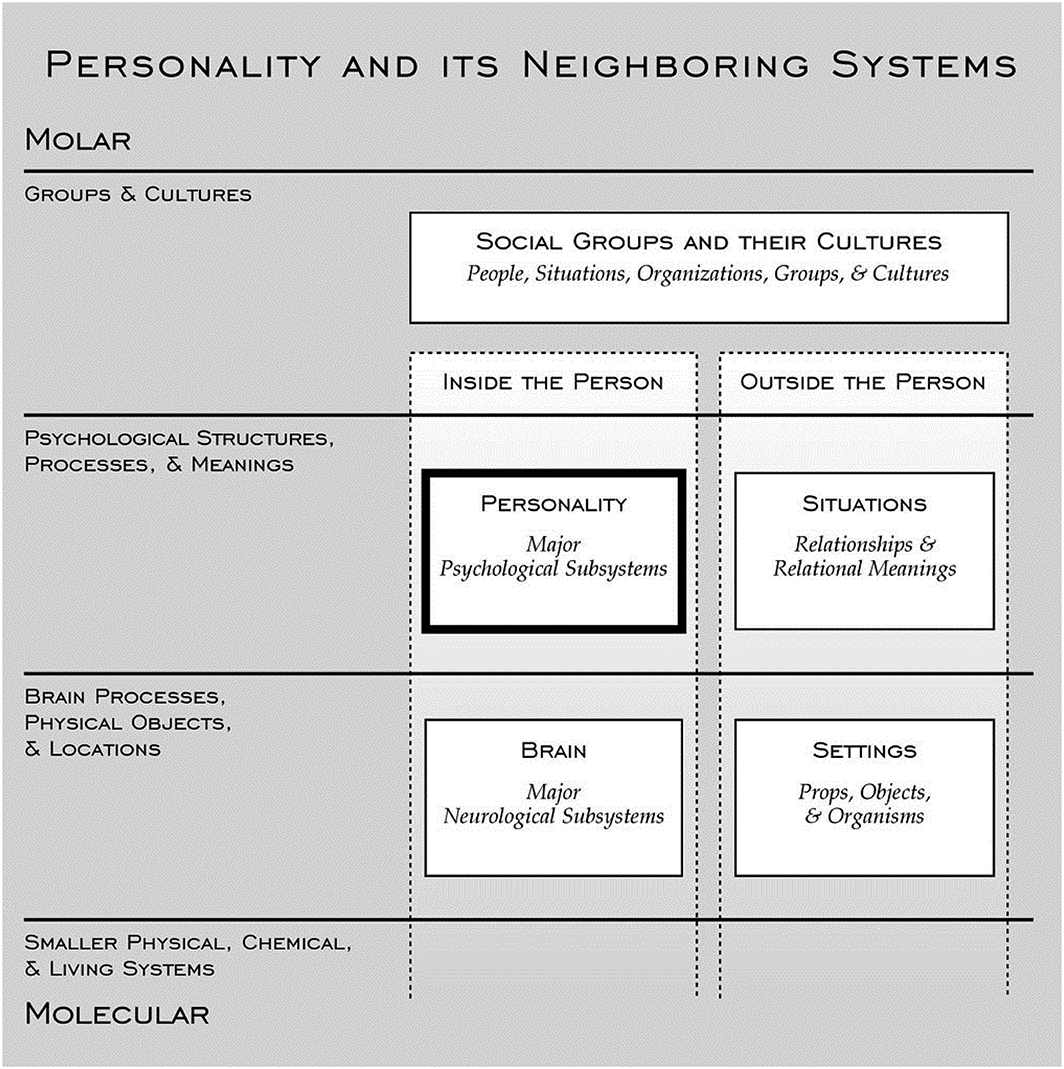
Figure reproduced from Mayer (2005, Figure 1) from “A Tale of Two Visions,” appearing in the American Psychologist, compliant with APA permissions policies as described at http://www.apa.org/about/contact/copyright/index.aspx
The Meaning(s) of Personality Structure
In Baumert and colleagues’ article, personality structure is defined as the “manner in which traits or states are organized with respect to each other among individuals, or states organized within individuals” (p. 527); it is determined by “covariation in behavior, including thoughts and feelings” (p. 503). We noticed that the authors also appealed to a second implicitly structural distinction: that of cognition, affect, and motivation (pp. 507–509, 512). The personality framework recognizes the usefulness of both conceptual divisions (e.g., cognition and affect) and mathematical–covariance meanings of the term structure (see Mayer, 2018, Chapter 8).
Implications
We turn next to the implications of these clarifications.
Baumert and colleagues state that “classes of psychological variables” that guide people toward their ultimate aims “such as motives, goals, values, preferences, and interests … are particularly important to understanding basic personality phenomena” (p. 511). Our definition of personality leads us to remark: Not only do motives and goals help us understand personality phenomena, they plainly are personality phenomena, no less so than the traits of the Big Five. To those variables, we would add intelligences and defense mechanisms, among others.
Baumert and colleagues argue for the advantages of sometimes disaggregating variables—e.g., using “facet traits” rather than the Big Five—to improve measurement and prediction. We agree and add that specific traits may differentially predict specific aspects of the individual's surrounding setting, situation, and groups, as in the case of predicting disaggregated college course performance (Mayer & Skimmyhorn, 2017).
Many of Baumert and colleagues’ recommendations concern handling more variables than in the past (e.g., beyond the Big Five). The personality systems framework can help organize diverse variables through its division of personality into four functional areas, each described by a broad group of traits. Expert judges appear better able to classify personality traits into these four areas than into older divisions such as motivation, emotion and cognition (Mayer, 2003).
The four areas and some examples of their associated traits are
motives and emotions (mental energy)—described by motivational traits (e.g., n achievement) and by traits of negative and positive affect, among others schemas and intelligences (knowledge guidance)—described by traits related to self–concept, values and intelligences action planning and implementation—described by traits of attachment, social styles and social skills, and executive–control—described by traits of self–control, mental coping, and defense (Mayer, 2015).
Variables from the above four areas can be analyzed together even when they are minimally correlated, using newly developed statistical procedures (e.g., Sherman & Serfass, 2015).
We learned a great deal from this review—more than we can discuss in this brief commentary—and we hope that our comments and suggested approach to organizing variables into four areas will reinforce several of Baumert and colleagues’ messages and help promote their vision.
Get Out of the Closet—But Mind the Gap
Marcus Mund, Birk Hagemeyer and Franz J. Neyer
Friedrich–Schiller–Universität Jena
The article by Baumert and colleagues is a timely and convincing plea for the integration of research strands that have, by now, advanced largely isolated from each other. In fact, by integrating these different research strands it might become possible to better understand how effects of broader traits on relevant outcomes such as occupational success, relationship quality, health, well–being, and longevity (Ozer & Benet–Martínez, 2006; Roberts, Kuncel, Shiner, Caspi, & Goldberg, 2007) are brought about. Although we applaud the authors and agree with many positions of this comprehensive and compelling review, we also see several challenges for truly integrating research on structure, processes, and the development of inter–individual differences. These challenges are related, firstly, to specific conceptual and methodological issues and, secondly, to the pervasive gap between findings from between–person and within–person designs (e.g., Asendorpf, 1995).
With regard to specific conceptual and methodological challenges, Baumert and colleagues provide several starting points for integrating research on structure, processes, and development of personality. In our view, however, this striving to implement integrative research must not lead to a uniform approach. On the contrary, we advocate diversity, because every subfield bears specific conceptual and methodological challenges. As an example from our field of research, when trying to understand dynamic transactions between personality traits and social relationships, it has to be kept in mind that intra–individual processes operate through different pathways that can only be disentangled in dyadic designs (Mund, Finn, Hagemeyer, & Neyer, 2016). Specifically, as detailed in Mund et al. (2016), intrapersonal (or actor) effects of neuroticism on relationship satisfaction can be understood as resulting from the interplay between cognitive, affective, and motivational processes within the person. To elicit interpersonal (or partner) effects, intrapersonal processes need to manifest in a form that can be perceived by the partner, that is, overt behaviour. In this regard, we argue for distinguishing carefully between overt behaviour on the one hand and intrapsychic processes related to affect, cognition, and motivation on the other hand. As a consequence, the integration of processes and development in research on personality and social relationships requires (a) longitudinal dyadic designs; (b) the assessment of cognitive, affective, and motivational processes; and (c) the assessment of overt behaviour (e.g., Hagemeyer, Schönbrodt, Neyer, Neberich, & Asendorpf, 2015). However, even research meeting this high standard is challenged by the gap between findings from between–person and within–person designs.
Process–oriented research mostly employs designs that allow for the investigation of associations within persons, such as experiments and experience sampling studies. However, the explanation of between–person associations by within–person processes requires the processes to operate in the same way on both levels, that is, to be ergodic (Molenaar & Campbell, 2009). Unfortunately, most psychological processes are non–ergodic (e.g., the well–known dissociation of positive and negative emotions; Epstein, 1983). As a consequence, inferences from the within–person level to the between–person level and vice versa are not warranted unless the investigated processes meet the (very rare) conditions of homogeneity (i.e., the same processes operate in all individuals) and stationarity (i.e., processes are time–invariant concerning their strength; Molenaar & Campbell, 2009). One way of resolving this issue might lie in the modeling of inter–individual differences in process characteristics on the basis of (micro–)longitudinal data. For instance, Mund and Neyer (2016) used growth mixture models to identify latent groups of developmental trajectories regarding self–esteem over a period of five years. A similar approach could be applied to experience–sampling data to investigate classes of processes that differentiate between individuals (for similar approaches, see Johnson, Hicks, McGue, & Iacono, 2007; Vanhalst et al., 2015). The probabilities of individuals to belong to each of the latent groups could then further be used as mediators of personality–environment transactions. Multilevel modeling is another way of combining within–person and between–person levels and thus bear great explanatory potential regarding differential processes underlying personality traits (Asendorpf, 2015). The same applies to trait moderation in experimental settings as already frequently applied in research areas where process–oriented conceptualizations of personality dispositions exist (e.g., motive research; Schultheiss & Brunstein, 2010). Mainstream trait psychology relying mostly on the Five Factor Model (McCrae & Costa, 2008), however, ignores intrapersonal processes at the conceptual level and still has to catch up in this regard.
In summary, to truly integrate personality structure, processes, and development as proposed by Baumert and colleagues, it will be necessary (a) to develop appropriate conceptualizations and methodologies tailored to specific subfields of personality psychology and (b) to tackle—not even speaking of solving—the issue of ergodicity in the current state of research. Nevertheless, we believe that integration as proposed in the Baumert and colleagues’ article bears the potential for personality psychology leaping forward. We hope this integrative effort will help personality psychologists to get out of the closets of their respective research strands and to improve connectivity within personality psychology as well as with other psychological disciplines.
Nice New Developments but More on Development?
Erik E. Noftle
Willamette University
In the 1990s the dominant perspective in personality seemed to be that environmental effects on personality were negligible, uncommon, or highly idiosyncratic. 4 However, over the last 20 years research on nurture has blossomed, demonstrating how shifts in life experiences (especially social roles) make their mark on personality. Although such research demonstrates that personality development is not just a biologically based unfolding of the expression of genes, whether it is nature– or nurture–oriented, research has nevertheless tended to conceptualize the individual as a passive recipient of forces outside of her control. What is needed is more research that investigates the individual as an active agent, who has intention and volition. Baumert and colleagues cite relevant research on learning, self–regulation, and self–reflection as forces in development. However, the degree to which individuals actually have control over their own development is still largely unanswered by the field. Recent research does suggest that it is normative for (at least) young adults to desire to change their personalities (Hudson & Fraley, 2015; Noftle, 2015; Robinson et al., 2015), preceding an age period of pervasive and socially desirable normative personality change. Although so far evidence is scant (and mixed) on whether such intentions to change are related to actual trait change, if volition pays off in precipitating self–change under certain conditions this may broaden our existing “passive” nature–nurture developmental models. In such research, personality psychology could do well to import and apply theories from lifespan psychology and aging such as developmental regulation (only obliquely referred to in the Baumert and colleagues’ article) and primary vs. secondary control. For example, Karen Hooker's pioneering framework integrating structure and process specifically within the context of development is especially germane here but is unfortunately omitted in Baumert and colleagues’ article (Hooker, 2002; Hooker & McAdams, 2003).
In Part III, Baumert and colleagues suggest some useful recommendations for future research on personality which individually are well reasoned and supported but coalesce into an unsurmountable challenge. Among their suggestions are to disaggregate broad traits into narrower facets for better fidelity; disaggregate traits into action, cognition, motivation, and emotion to determine their interaction and independence; link macro to micro processes; apply multimethod assessment including greater use of the experience sampling method (ESM); and employ experimental designs to uncover causal processes. It is difficult to disagree with any of these recommendations but also difficult to know where to begin or what to prioritize. Let's take, for example, a fine recent article by McCabe and Fleeson (2016). Using ESM, they examine associations between momentary goals and trait–relevant behavior, assessing approach and avoidance goals for each of two facets of extraversion and of conscientiousness. Their clever, stripped–down assessment in Study 1 included only three items for each facet and two items for each type of goal, resulting in 28 total items. Researchers who employ ESM typically consider that 30–40 items approaches a peak of what participants can reasonably respond to multiple times a day; this study almost reaches that limit. Because McCabe and Fleeson also employ an experimental approach in another study and connect Big–Five state ratings to trait ratings, the paper clearly checks many boxes conforming to Baumert and colleagues’ recommendations. However, what's also clear is that despite its considerable strengths, the article only includes two of the four aspects of “broad” behavior: motivation and action (neglecting cognitions and emotions), only includes two of six broad traits (neglecting Agreeableness, Neuroticism, Openness, and Honesty–Humility), only includes two facets of Extraversion and Conscientiousness (neglecting at least the respective central facets of Energy Level and Responsibility; Soto & John, 2017), and fails to include an unknown number of other goals. So based on these ideal recommendations, we're left with a nagging realization that even some of the best research on personality processes leaves out an incredible amount. 5 However, simultaneously, there's clearly not room in the study for expanding content coverage! So let's get real. Moving beyond these well–considered recommendations that culminate into an unreachable ideal, it would be helpful for Baumert and colleagues to delineate which of these practices may be most important to pursue, which may be feasible to combine, and which may pose the greatest challenges.
In “Implications for Future Personality Research,” Baumert and colleagues provide recommendations tapping into the structure and process foci, but the development focus is conspicuously absent. I have space for only two recommendations. First, researchers might focus on constructs that are relevant (or at least applicable) to people's personalities across wide swaths of the lifespan, so that different ages may be directly compared in terms of their personality structures and processes. For example, the research presently discussed on changes in trait/facet/behavior covariation across the lifespan rests heavily on the fact that the Big Five are relevant to all or most ages. Although much can be learned about development that is unique to specific ages (e.g. school transitions and retirement), research that can directly contrast ages will be highly useful to integrating structure, process, and development. Second, Baumert and colleagues state that in personality development self–reports are most commonly employed. If one studies traits or trait–like constructs via questionnaires over long periods, initially it seems difficult to identify an alternative to self–reports (e.g. informants come and go, lab–based behavior observations may be state–dependent or perceiver–dependent). However, ESM can provide a very useful alternative in developmental research (Noftle & Fleeson, 2015): not only does it open up new developmental questions, but density distributions of traits drawn from a representative period may be prone to less developmental imprecision (amongst other issues) than typical trait questionnaires. Hopefully, the authors can voice additional recommendations.
Let All Flowers Bloom: There is No Need for Complete Integration of Different Approaches to Personality
Arjen Noordhof, Jan Henk Kamphuis, Annemarie Eigenhuis, Lindy–Lou Boyette and Henk Jan Conradi
Department of Clinical Psychology, University of Amsterdam
According to Baumert and colleagues personality science should progress to successfully accomplish complete integration of processes, structure, and development. The authors provide a wide variety of interesting approaches towards partial integration, which testify to the fact that personality science is a broad, rich, and diverse field. In our view, this convincingly shows that attempts at integration, e.g., such as pursued by network–, cognitive–learning, and functionalist approaches, can yield new theoretical insights as well as novel research designs. Accordingly, we agree with the notion that (attempts at) integration may lead to better research. At the same time, we have reservations with regard to the much stronger claim that a complete integration is necessary for real progress, and we will plea for pluralism instead.
Central to the argument for the necessity of integration is the goal of arriving at causal mechanisms (‘process’) that explain rather than merely describe interpersonal differences (‘structure’) and stability and change of observed differences over time (‘development’). Baumert and colleagues argue that traits cannot explain behaviors if they are not defined independently of those behaviors. We strongly agree. Yet in our view, the authors do not manage to provide satisfactory suggestions for delineating causal mechanisms. Rather, the examples in the paper also consist of reiterations of the content of the structural models, making the explanations circular.
As an example of complex causal processes, Baumert and colleagues describe the relationship between two ‘process’ variables (perception of others as favorable and the desire for power) and two ‘structure’ variables (agreeableness and extraversion). The perception of others as favorable is positively related to both agreeableness and extraversion, while desire for power is negatively related to agreeableness and positively related to extraversion. The authors conclude that the process variables interact to cause individual differences in the structure variables. According to us, this conclusion is not warranted. The distinction between ‘process’ and ‘structure’ is not convincing. We cannot think of a reason why the perception of others, or the desire for power is more basic than the summary of these phenomena in trait terms. In other words, the variables reside at the same level of explanation. Other suggestions for causal mechanisms that may explain individual difference structure models suffer from similar issues. For example, motivational processes as summarized in traits such as reward sensitivity (Corr, 2004) largely converge with extraversion and can in turn not serve as an explanation.
Furthermore, traits may be causal to inter–individual differences in (parameters of) process. We were reminded of our own work on trait associations in fear conditioning (Gazendam et al., 2013). This line of research seeks to explain individual differences in parameters of differential fear conditioning (e.g., fear response development to “safe” [CS–] versus “danger” [CS+] stimulus). The idea is that some properties of the nervous system (e.g., individual set point in the amygdala, or more likely in complex interacting neural networks) may give rise to inter individual differences, which map onto (inter individual differences in) underlying processes. Hence, personality may, as suggested by Baumert and colleagues, emerge as a higher–order structure from a multitude of dynamic interactions between specific processes, but we should not rule out that the causality runs the other way. Another noteworthy aspect related to the examples provided is that they all seem oriented to the Five Factor Model of personality. While this model indeed has many advocates, its inductive, a–theoretical basis calls into questions whether it is optimally suited for identifying fundamental personality processes.
We do not believe that problems of circularity are inherent to the aim of integration itself. Rather, we believe that substantive personality theories are indispensable to avoid circularity. Theory should be general enough to delineate core personality processes, while specific enough to allow for deductive steps that results in testable hypotheses. The Baumert and colleagues’ article did not convince us that functionalism, cognitive–learning, or networks are sufficiently directive in this regard.
In our view, a more promising integrative theory is provided by the interpersonal approach (Pincus, 2010). Interpersonal theory posits that interpersonal processes are driven by two fundamental tendencies: agency and communion. From this general framework, more specific theories can be derived with regard to structures and processes. For example, it has been hypothesized that if these two themes are indeed dominant features of human social life, then they will emerge as two central dimensions in many inter–individual structures. Evidence for this has been found with regard to traits, interpersonal behaviors, motives, values, and problems (see Pincus, 2010). Yet from the same theory, process–related hypotheses have been derived with regard to similarities and complementarities in dyadic interactions over time (e.g., Horowitz et al., 2006). Furthermore, these theories have proved useful in developing hypotheses with regard to the structures and processes underlying psychopathology, for example, social phobia (Kachin, Newman and Pincus, 2001) and personality pathology (Hopwood, Wright, Ansell & Pincus, 2013; Pincus & Wilson, 2001). Finally, a recent development has been Multi–Surface Interpersonal Assessment (MSIA): a test–battery for interpersonal processes and problems. MSIA can be used for the construction of individual case formulations in clinical practice (e.g., Dawood and Pincus, 2016). In our view, this application to the individual level (N = 1) is not simply a useful bonus, but a crucial argument in favor of the approach: any theory of personality should (eventually) provide a means to characterize core features of an individual person.
Interpersonal theory has a long tradition within personality science and as such provides a counterexample to the claim that the field has not been sufficiently integrative. However, we do not think that it can serve to integrate each and every aspect of personality, nor that every scientist in the field should adopt it. Instead, we believe the field to be best served by the existence of multiple partially integrative theories that may sometimes overlap and sometimes contradict, and as such stimulate development of new hypotheses. In sum, while we heartily welcome efforts at partial integration, we hold that a strong agenda pushing for complete integration could well be counterproductive.
Person–Situation Transactions can Illuminate Personality Dynamics and Processes
John F. Rauthmann
Wake Forest University
Baumert and colleagues have done a superb job in comprehensively sketching how personality structures, processes, and development can be conceptualized and integrated. This feat is impressive, especially because the different and at times haphazard uses of the term “process” generally complicate such integration. For example, I note from my reading of various literatures that the term “process” has been used at least in five related but different meanings (sorted from short–term/micro to long–term/macro):
Neuro– and bio–physiological, perceptual, cognitive, affective, motivational, volitional, or regulatory information processing underlying personality traits or states (mechanisms; e.g., Revelle, 1995) The ways in which the self and personality traits are expressed in momentary states (manifestation; e.g., in density distributions: Fleeson & Jayawickreme, 2015) How short–term personality states and situational variables are interwoven and transact across measurement points in complex manners (dynamics, transactions; Rauthmann et al., 2016) How traits “work” in bringing about real–life consequences, including temporo–causal sequences of personality traits or states leading to mediating variables which in turn also impact outcomes (functioning; e.g., Hampson, 2012; Hayes, 2013) How middle– or longer–term developmental processes within persons unfold across time (development, change; Wrzus & Roberts, 2017)
The working definitions provided by Baumert and colleagues in the Appendix as well as the careful language within their article itself are important because each of the meanings comes with different conceptual foci and methodological needs. In this comment, I want to zoom in on the third meaning (dynamics, transactions) and further complement some of the excellent observations and suggestions from Baumert and colleagues in this domain.
Figure 1 gives an example of dynamics within an individual where the intensity of the expression of a personality state (e.g., talkativeness) is measured several times within and across several situations. As can be seen, there is some within–person variation in personality state expression (Geukes et al., 2017). These variations can be potentially explained by other variables, such as changing motivational and goal sets or changing situations. Of special interest may be the transition points between two adjacent situations (highlighted in gray) where differences between personality state expressions may be most pronounced. Why does the situation, and also personality state expression, change in the first place? To answer this question, and thus to start explaining the dynamics in Figure 1, one could, among other things, turn to different forms of person–situation transactions.
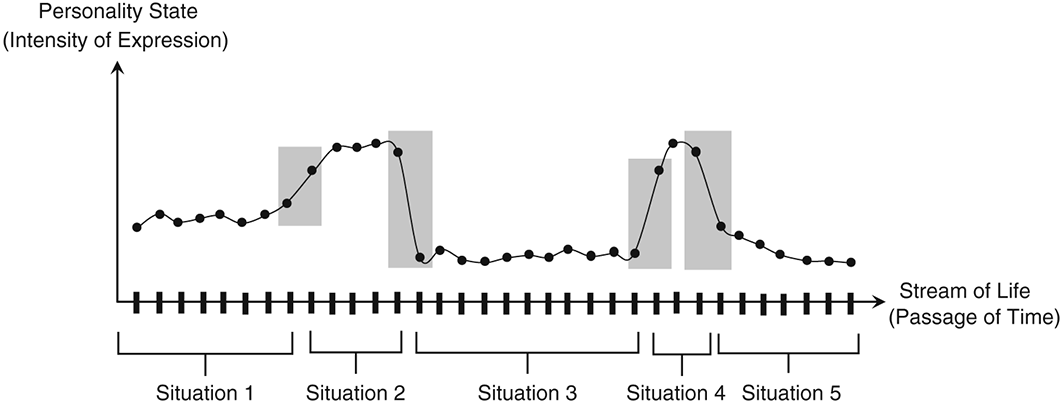
Example for unfolding personality dynamics and processes. Situations 1–5 are objectively different situations adjacent to each other in a temporal sequence. In each situation, a personality state's intensity of expression of one individual is measured (e.g., by ambulatory assessment, behavioral observation). Gray–shaded areas denote transitions from one situation to another. As can be seen, the measured personality states show markedly different intensities when in a new situation. This fictitious example shows variations within situations (e.g., expression intensity changes in Situation 5, becoming less and less) and across situations (e.g., expression intensity is higher in Situation 2 compared to Situation 3).
Here, I understand them more narrowly as person → situation transactions or how people navigate situations, 6 which we have previously termed situation management strategies (SMS; Rauthmann & Sherman, 2016). Figure 2 gives an overview of different SMS that may lead to a transition of a new perceived or new actual situation as in Figure 1's gray–shaded areas (e.g., Buss, 1987; Caspi & Roberts, 2001; Duckworth et al., 2016; Haase et al., 2013; Ickes et al., 1997; Plomin et al., 1977; Scarr & McCartney, 1983).

Dendrogram of situation management strategies. pOs:SMI = Cluster of positively flavored situation characteristics (pOsitivity: Sociality, Mating, Intellect); Neg:DADI = Cluster of negatively flavored situation characteristics (Negativity: Duty, Adversity, Deception, Intellect). For further information, see the text and Rauthmann (2016). The figure was adapted from Rauthmann (2017), licensed under CC–BY 4.0.
What happens in a situation? Basically, there are three options (of which I will consider only the first for reasons of space): In navigating a given situation, a person may focus on the situation only, on him–/herself only, or on both simultaneously. Focusing on the situation means that the cues in the situation are implicitly and explicitly processed so that a general evaluation of the situation's valence is formed (Rauthmann, 2016). In case of more positive situations (that often feel social, mating–relevant, or intellectually stimulating), the predominant global strategy may be to maintain them. This maintenance can take the form of (a) passively remaining in the situation (i.e., virtually just doing nothing and letting things happen), (b) actively trying to preserve the situation as is, or (c) trying to somehow increase or maximize the characteristics of the situation (which ties into the modification strategies outlined later). In case of more negative situations (that often feel dutiful, adverse, deceptive, or intellectually demanding), the predominant global strategy may be to terminate them. Such termination can take different forms. A first distinction is whether mental or behavioral strategies are used. Mental strategies result in different ways of re–construing the current situation. While such strategies do not lead to the actual situation changing, the subjective situation in terms of its perceived characteristics can change for the person. In contrast, the behavioral strategies change actual physical aspects of the situation. A person can either leave or stay in a given situation. Leaving is a selection strategy that involves avoiding/exiting the current situation and seeking/entering an entirely new one (e.g., going into another room). Staying can lead to a shaping of the current situation into an objectively different one, either unwillingly (evocation: eliciting certain reactions) or willingly (modification: actively and purposefully changing something). A very strong modification of the current situation may result in an entirely new situation (creation). Thus, persons have several strategies at hand for transforming their situations.
Baumert and colleagues have emphasized the importance of person–situation transactions. For example, they defined personality structures as “results of [mental and behavioral] processes in transaction with situational affordances (…)” and see the need to address questions “concerning why individuals with different trait levels behave differently in the same situation, and why an individual with a particular trait level behaves differently in different situations.” The goal will be to find SMS that can help explain people's trait levels as well as concrete behaviors enacted in situ. Towards this end, it is important to gain more conceptual clarity on SMS (e.g., Figure 2) and also measure them explicitly in intensive–data designs. The study of personality dynamics and processes may benefit from systematic SMS research that should ultimately help explain how and why certain people are in certain situations in the first place as well as what people do to the situations they are in.
Climate:Weather::Traits:States
William Revelle1 and David M. Condon2
1 Department of Psychology, Northwestern University
2 Department of Medical Social Sciences, Northwestern University
Preparation of this manuscript was funded in part by grant SMA–1419324 from the National Science Foundation to WR
The article by Baumert and colleagues is an ambitious attempt to combine personality structure, process and development into a coherent whole. We applaud the effort and would like to suggest an analogy that might prove useful when addressing their three questions: “personality is to emotion as climate is to weather.” More specifically, personality traits are long–term averages of behaviors and emotional reactions that seem to have different causes than the short–term fluctuations known as emotional, cognitive and behavioral states (Revelle, 2007; Revelle & Wilt, 2016).
We have previously discussed the importance of time in analyses of human behavior (Revelle & Condon, 2015) and believe that it is possible to provide common explanations for structure, process and development by looking for systematic differences across time. In this short note, we will use the climate:weather analogy to demonstrate our claim that the study of personality writ large is the study of affects, behaviors, cognitions and desires at different temporal levels. We believe that weather and climate are powerful examples of seemingly non–ergodic phenomena (Nesselroade & Molenaar, 2016; Revelle & Wilt, 2016) that can be unified by broader theory.
The questions that pertain to daily fluctuations in weather (will it rain? how cold will it be?) clearly differ from those that relate to seasonal fluctuations in climate (how much do the temperature ranges differ across the year in Warsaw relative to Rio or Singapore?) and the long–term effects on global climate induced by human consumption of fossil fuels. The motivations behind these questions clearly differ too—one thinks about weather when deciding to take an umbrella on a walk, about climate when planning a trip to Warsaw or Rio, and about climate change when attempting to predict its consequences. Though the ultimate “cause” of weather, climate, and climate change is the same—the difference between energy from the sun minus that re–radiated by the earth—all are distinguished by remarkably different time scales. The daily variation in temperature is a short–term consequence of the earth's rotation. Yearly variation in climate reflects the tilt of the earth as it revolves around the sun, changing the distribution of sunlight across the planet. Climate change has been induced by humans over several decades (and will persist for millennia).
A strict interpretation of this analogy would involve daily and seasonal fluctuations in personality, including inter– (and intra–) individual differences in patterns of affect and behavior across the day (morning larks and night owls) and throughout the year. But the nature of relations on both sides of the analogy can be extended by the need to account for far more complexity.
In weather, for example, local wind conditions reflect local differences between bodies of water and the nearby land (on–shore winds that start late in the morning because the land is warming more than the water, off–shore winds in the evening when the land is cooler than the water). Variations from day to day are due to local differences in energy absorption and the heat capacity of bodies of water, forests, savannas and deserts that are transmitted (by wind) between locations. Over slightly longer periods of time, these variations combine with solar heating to result in high and low pressure areas such as those charted by Galton (1863), long before he proffered a lexical hypothesis of individual differences (Galton, 1884). Large–scale variations in wind (e.g., jet streams, trade winds, and the doldrums) reflect differences in solar flux as a function of latitude as well as the Coriolis effect. Long–term change in climate results from very small differences in the solar–energy budget induced by increasing levels of CO2 that slightly change the balance between incoming and outgoing radiation.
But how does this brief discussion of climatology relate to the Baumert and colleagues’ article? It is that we need to address the authors’ state–trait–development questions by searching for the commonalities in causes as well as the unique effects at different time scales (days, years, decades). Just as the temperature varies throughout the day in response to local conditions, people differ in their behavioral states in response to the affordances of the local situation (Rauthmann, Sherman, & Funder, 2017). Some of the most obvious differences in states reflect positive and negative affect, likely due to differential sensitivities and rates of change to cues for reward and punishment (Gray & McNaughton, 2000; Revelle, 2008b; Smillie, 2014) as well as cognitive appraisals of the situation (Wilt, Funkhouser, & Revelle, 2011). These appraisals will reflect the goals and plans of the individual as they regulate their behavior (Carver & Scheier, 1990). These differences in state values can seem to overwhelm the differences in averages over the short term, but structural analyses of stable individual differences have led to the identify of descriptive models of the averages. These include widely replicated, broad–bandwidth models like the Big Five (Goldberg, 1992), the RAISEC (Armstrong, Day, McVay, & Rounds, 2008), and the VPR (Johnson & Bouchard, 2005) and CHC (McGrew, 2009) models of abilities in addition to models of more narrowly specified traits (Condon, 2016; Costa & McCrae, 1998). Personality changes over the life span are usually slow and gradual as is the effect of changing levels of CO2 on the global energy balance. When changes in mean levels become extreme (for either personality or climate), it leads to an increasing likelihood of extreme events (in terms of behavior or weather, respectively).
In closing, we would add that Baumert and colleagues’ call for integration does not necessarily require the development of more inter–connected theory. Certainly, better theory may follow from a better understanding of the causal mechanistic processes that underlie structure and development. But just as predictive weather models are built from ever–increasing records of historical data, we believe that a more integrated understanding of the common causes and unique effects of personality at different scales of time will require the collection and evaluation of very large datasets.
Integrating Personality Structure, Process, and Development is an Important but Daunting Task
Kenneth J. Sher
University of Missouri
The range of topics covered by Baumert and colleagues present a challenge for any commentator as to where to focus comments expanding their discussion. A systematic consideration of personality structure, personality process, and personality development arguably represents a framework for studying virtually all of individual human behavior (and much mammalian behavior as well), both conceptually and methodologically. Given the challenge, one could choose to either focus on some of the scaffolding that provides points of contact across these ostensibly distinct but overlapping areas, focus on specific aspects on one or more of these broad domains, or raise general points as to the nature of the contribution such an analysis makes. The sheer scope of the journey Baumert and colleagues embark upon is daunting and challenges ones knowledge base and analytic abilities. Coupling with limited space to tackle any more than a fraction of the issues raised, almost any commentary is rendered somewhat parochial.
As a psychopathologist, my first, and most general, reaction is that the discussion presented here parallels in multiple ways, the evolution of recent discussions of the need for psychopathology research to adopt a more process/mechanistic framework for characterizing mental disorder and move away from syndromal diagnosis, a shift embodied in the Research Domain Criteria (RDoC; Insel & Cuthbert, 2009, Insel et al., 2010, Kozak & Cuthbert, 2016). Indeed, the goals of the RDoC movement, briefly described as a “research framework for new ways of studying mental disorders … [that] integrates many levels of information (from genomics to self–report) to better understand basic dimensions of functioning underlying the full range of human behavior from normal to abnormal” (https://www.nimh.nih.gov/research–priorities/rdoc/index.shtml downloaded August 1, 2017). Indeed, upon a bit of reflection I was puzzled as to why this emerging framework and selected related research was not given more discussion in the analysis presented by Baumert and colleagues. As ambitious as their analysis is, it is in many ways far less ambitious than the RDoC which strives to link broad domains (i.e., negative valence systems, positive valence systems, cognitive systems, social processes, and arousal and regulatory systems) to hierarchically organized units of analysis (e.g., genes, neurocircuitry, behavior, and self–report) and the paradigms for studying them. If nothing else, Baumert and colleagues’ piece highlights the artificial distinction between personality psychology and psychopathology as well as the need for a greater integration of these overlapping disciplines which seem to be converging in similar ways. Indeed, the discussion of the role of network analysis of personality data (e.g., Costantini et al., 2015b; Cramer et al., 2012) parallels the recent, intense interest in these models in the study of psychopathology (e.g., Borsboom & Cramer, 2013) as alternatives to traditional latent variable approaches.
My second broad reaction, and perhaps one that is more familiar to personality psychologists, is related to the question of the value of trait psychology if personality traits are essentially merely “‘re–descriptions’, aggregations, or summaries of behaviors” (p. 505). As Mischel (1968) noted half a century ago, the empirical and conceptual utility of personality traits for predicting behavior is uncertain for many of the same reasons noted by Baumert and colleagues. Do we keep trait psychology, as typically defined, as core constructs of personality … something that is an essential part of psychology (and prepsychology going back to Galen's temperaments)? Or do we finally say that the organizational structure should shift to the structure of process and not the “redescriptions.” I wish these very thoughtful and knowledgeable authors had given more extensive attention to this fundamental issue that they raise.
Relatedly, the underlying heterogeneity of seemingly identical phenotypic behaviors owing to “equi–finality” represents a conceptual and measurement challenge and raises the question of how we might be able to use process measures as “marker variables” in latent variable models to disambiguate the meaning of various behaviors and, perhaps, derive factor structures that are more procedurally “pure.” It has been known for a number of years that the genetic architecture of personality scales (Heath & Martin, 1990) can vary dramatically from the phenotypic structure of personality data, and such approaches could likely be exploited to facilitate the integration of structure and process by revealing etiological heterogeneity of seemingly homogeneous persosnality phenotypes.
Many years ago, I highlighted the multiplicity of roles that personality likely plays in the etiology of alcoholism (Sher, 1991). One of the proposed mechanisms, pharmacological vulnerability to ethanol effects, has been an important concept for nearly 90 years (McDougall, 1929) and highlights that the potential complexities of understanding possible relations between traits and mechanisms. For example, by acting on the neurological substrates of personality, drugs of various classes can affect personality and its related processes acutely (Eysenck, 1957). Moreover, chronic substance use as associated with personality changes (Barnes, 1983) that plausibly arises out of neuroadaptation to homeostatic stress (i.e., allostasis) associated with repeated drug administration (e.g., Koob & Le Moal, 1997). The point here is that personality–process links might be somewhat obscure and be related at a level of analysis that is somewhat outside our typical level of analysis. Additionally, it suggests that some types of long–term personality change (at least those associated with addictive processes) may not follow typical developmental patterns and, indeed, be both predictable and possibly reversible. Here, the issue isn't necessarily one of states versus traits, at least not in the traditional senses of that distinction. Rather, it seems possible, if not likely, that some kinds of personality changes can be relatively enduring but lay somewhere between situational state–like variation and more systematic developmental change.
Regardless of what aspects of Baumert and colleagues’ analysis one chooses to consider, it is clear that there is significant value in having a comprehensive framework for viewing behavior that considers its structure, its distal and proximal determinants, and how it transacts with and develops in the context of the physical and social environment. It is equally clear that adapting such a framework means that investigators need to expand their horizons to consider a wider range of variables and approaches than most of us typically do.
Personality Trait Structure, Processes, and Development in Childhood and Adolescence
Rebecca L. Shiner
Colgate University
One of the challenges shared by parents, teachers, and personality development researchers alike is keeping up with the rapid changes in children's behavioral repertoires. The newborn who is content to sit in a bouncy seat peering out at the world quickly becomes a toddler who runs to investigate everything around her. The toddler who engages in parallel play alongside another toddler rapidly becomes the preschooler who engages in complex pretend play about pirates and monsters with friends. The preschooler who thinks that he is good at most things swiftly becomes the elementary school age child who recognizes that he is good at some things but not others. The school age child whose world revolves around her own family and friends becomes the adolescent who is concerned about social justice in the lives of people she will never meet. The first two decades of life are marked by rapid changes in children's behavioral, emotional, and cognitive capacities—rapid changes with important implications for the traits young people display.
In this comment, I argue that, despite the challenges inherent in studying young people, the rapid developmental changes taking place during childhood and adolescence make these periods of life an especially informative and vital time to test hypotheses about the mechanisms underlying the observed structure of personality traits and the normative patterns of change in those traits over time. When personality trait structures and mean levels change rapidly, as they do among children and adolescents, researchers have an exciting opportunity to trace changes in the underlying biological and psychological processes over time as well. My hope is to persuade more researchers of the particular value of studying the questions raised by Baumert and colleagues in samples of children and adolescents.
The rapidly changing nature of children's capacities provides a useful vantage point for better understanding the nature of personality trait structure. In infancy, children's traits are structured into three traits bearing strong similarities with later extraversion, neuroticism, and conscientiousness/constraint (Rothbart, 2011), whereas by some point in adolescence, personality structure stabilizes into the Big Five trait structure (Soto & Tackett, 2015). Across the intervening years from infancy through adolescence, as youth develop new capacities and manifest a wider array of individual differences, trait structure changes. New traits become apparent, including aspects of agreeableness and openness, and the relationships among higher–order traits change as well (Soto & Tackett, 2015). For example, preschool–age children begin to display individual differences in the curiosity, creativity, and intellectual engagement that are part of openness (Shiner & DeYoung, 2013; Soto, 2016), so these traits become an important aspect of trait structure. The relationship between openness and other traits changes over time as well, with openness first showing a stronger relationship with conscientiousness and later showing a stronger relationship with extraversion (Shiner & DeYoung, 2013).
Early traits do not simply change in terms of their structure in childhood and adolescence; they change in terms of their mean levels as well. For example, positive emotionality and extraversion decline in a steady fashion from preschool age through adolescence (Shiner, 2014; Soto, 2016). Mean level changes most likely occur more rapidly in childhood and adolescence than in adulthood, given the significant changes in the nature of youth's behavioral, emotional, and cognitive capacities.
These rapid developmental changes in both the structure and the mean levels of traits in childhood and adolescence offer researchers a rich opportunity to study the integration of trait structure and processes. Baumert and colleagues have made a persuasive case for why our understanding of traits will remain incomplete until we have integrated process–focused and structural approaches to personality traits: “ … only by identifying the processes that generate behavior and individual differences in behavior, can we understand the causes of covariations among behaviors.” Because the patterns of covariations among behaviors (i.e., the structure of traits) change in childhood and adolescence, researchers can use these structural changes as clues to potential changes in the mechanisms underlying traits. Personality trait structure does not appear to change significantly in adulthood, so research on adult traits does not offer this same opportunity for linking structure and process by looking at mechanisms underlying changes in structure over time.
Baumert and colleagues make a crucial point that a single set of processes may not underlie a correlated set of behaviors and that, instead, complex interactions among several processes may give rise to the manifestation of particular traits. Nonetheless, when the structure of youth's traits changes over time, there must be mechanisms underlying those changes, and researchers can learn more about the underlying processes by investigating mechanisms that may account for structural changes. Similarly, the relatively rapid changes in youth's mean levels of traits likewise offer a potential window into the mechanisms underlying the manifestation of traits. Traits show mean level changes in adulthood as well, but the mean level changes in childhood and adolescence occur over a shorter time window.
The family of traits comprising self–control/effortful control/conscientiousness can be used to illustrate the value of studying trait structure/process integration in childhood and adolescence. In infancy, this cluster of traits includes children's capacities for attention and self–regulation, whereas by preschool–age conscientiousness includes a broader range of traits, including determination, responsibility, planning ahead, and having high standards for oneself (Shiner & DeYoung, 2013; Soto, 2016). As noted previously, conscientiousness also changes from being linked with openness in childhood to being uncorrelated with openness by adulthood. What processes account for the emergence of these new aspects of the broader trait? Do attention and self–regulation somehow influence the standards children adopt for themselves and their determination to complete tasks? Are there biological mechanisms that may account for the changing relationship between conscientiousness and other traits? This cluster of traits shows substantial mean–level changes as well—increasing significantly in early childhood through elementary school, declining in adolescence, and then eventually increasing again (Shiner, 2014; Soto, 2016).
All of these striking changes in terms of structure and mean levels invite explanation: What biological and psychological mechanisms account for these changes? Childhood and adolescence offer an exciting window for investigating the complex relationships between human traits and the processes underlying them.
Evolutionary Behavioral Ecology Approaches to Integration in the Study of Animal Personalities
Andrew Sih1, Isaac Ligocki2, Amelia Munson1 and David Sinn1
1 Department of Environmental Science & Policy, University of California, Davis, CA; 2 Department of Neurobiology, Physiology and Behavior, University of California, Davis, CA
Baumert and colleagues champion the value of integrative approaches towards understanding human personalities. We provide a perspective from the study of animal personalities: the tendency for animals to exhibit intra–individual consistency and inter–individual consistent differences in behavior (Sih et al., 2004; Reale et al., 2007). Personalities have now been quantified in a broad range of vertebrate and invertebrate taxa. Most studies have focused on behavioral tendencies that affect survival and reproductive success (boldness, aggressiveness, general activity, exploratory tendency, and sociability). The field has long promoted an integrative approach to understanding personalities blending mechanism, development, evolution and function (Sih et al., 2004; Stamps and Groothuis, 2010). Here, we outline conceptual points and a modeling framework that guide our integrative understanding of variation in personalities.
Many animal personality traits represent different strategies for coping with an often–observed risk–reward tradeoff. Bolder, more aggressive or exploratory animals all potentially take more risks to gain more resources. At a cognitive level, a parallel axis is the speed–accuracy tradeoff. “Fast” individuals make decisions quickly (e.g., to flee versus attack) but with a cost of lower accuracy (Sih & Del Giudice, 2012). With tradeoffs, there is no single best strategy; instead both the social/ecological context and the individual's ‘state’ have major effects on behavior. Social/ecological context includes the species’ local density or sex ratio, the mix of personalities in the group, food or refuge availability, or the presence of predators or competitors. The individual's state could include it's ‘assets’ (energy reserves, condition, reproductive value, and knowledge) or its physiological or neuroendocrine state. Whether one should be bold or not depends on both the external environment (are predators present?) and the individual's state (hunger level or ability to outrun predators). Current behavior reflects not just current needs, but longer–term goals. For example, animals often forego current reproduction to build energy reserves that are critical for future reproduction or overwinter survival.
That an individual's external context, its state and its long–term needs interact to affect behavior is also featured in many of the ideas and examples described by Baumert and colleagues. Evolutionary behavioral ecology (EBE) generates predictions on how these factors affect personalities by using stochastic dynamic programming (SDP) and related state–dependent models that identify adaptive behaviors across a time track (that could be an individual's lifetime) where at each time step, the individual's current state influences the best behavior, and the behavior then affects the individual's future state and thus it's future behavior (Luttbeg & Sih, 2010; Wolf & Weissing, 2010).
Stable personalities and differences among individuals in personality can be connected to underlying state variables that are enduring over time; for example, physical attractiveness, strength or—for animals—size per se, physiological capacity (Reale et al., 2010), or hormone profiles (Koolhaas et al., 2010). However, in most cases, the underlying state variables themselves can also change. In that case, what explains long–term consistency? What mechanisms explain both intra–individual long–term consistency and consistent between–individual differences as well as predict change? The EBE approach suggests that a key lies in state–behavior feedback loops: where state affects behavior and behavior, in turn, affects state (Sih et al., 2015).
Some scenarios involve negative feedback loops. As Baumert and colleagues noted, a thirsty individual is motivated to drink, and after drinking, his/her thirst is reduced. Negative feedbacks are at the heart of the concept of homeostasis for numerous needs. Negative feedbacks, however, do not maintain consistent differences among individuals. Instead, they tend to converge individuals towards an intermediate state and personality. In EBE, a classic negative feedback loop involves assets and behavior. Individuals with low assets (low energy reserves) are in danger of starving and should be bold and feed even in the face of risks. If they survive, their assets should increase (and they should get less bold). In contrast, individuals with high assets are in no danger of starving, and instead have a lot to lose if they die, so they should be cautious and hide. But by hiding, over time, their assets decline, and they should then get bolder. Even if individuals start with different assets and personalities, both should converge.
In contrast, positive feedback loops maintain and even increase consistent differences among individuals. If individuals with high energy reserves are bold (e.g., because they are in great condition and can outrun predators), they gain yet more energy and stay in great shape, whereas if individuals with low reserves cannot outrun predators, and are thus cautious, and do not feed, they remain in poor condition and thus cautious. If both boldness and aggressiveness are driven by the same goals and processes, the positive feedback loops explain the behavioral correlation. Numerous other state variables can be involved in positive feedback loops with behavior. Being bold facilitates learning how to be good at being bold (the state variable is a skill set) which favors continuing to be bold, while also decreasing ability to be cautious judiciously (and vice versa for cautiousness). Baumert and colleagues note similar logic for the formation and maintenance of habits or developmental niches. Other examples of state–behavior feedbacks revolve around the individual's physiological state, social role or rank, its habitat or social situation, or even its parasite load (Sih et al., 2015). Importantly, many realistic scenarios involve a mix of negative and positive feedbacks. Personality patterns should then depend on the relative importance of these two feedback mechanisms.
EBE approaches to studying personality have not, however, addressed the ‘correspondence vs. emergence’ issue. A decade ago, many followed a correspondence approach in studying how hormones or physiology (and their genetic bases) might explain animal personalities, but we now realize that these views are too simplistic. Existing models have also stayed with the correspondence view (one or two state variables and behaviors). Expanding empirical work and models to account for complex interactions among many variables and processes (e.g., a network of numerous, dynamically interacting state and behavioral variables) will obviously be challenging. We look forward to tracking progress in the human personality literature for ideas and inspiration.
How Do Individual Experiences Aggregate to Shape Personality Development?
Elliot M. Tucker–Drob
Department of Psychology and Population Research Center, University of Texas at Austin
The author's research is supported by NIH grants HD083613, HD081437. The Population Research Center is supported by NIH grant HD042849
Patterns of thinking, feeling, and behaving fluctuate over time and change in response to experiences. When experiences are discrete, short–lived and isolated, personality traits often return back to pre–existing levels. However, when situational experiences are chronic, recurrent, or consistent in valence across longer periods of time, changes in personality may be more lasting. Short–term variability, individual responses and adaptations to discrete experiences, chronic situational conditions, and stochastic processes aggregate to produce macro–level patterns of relatively stable inter–individual differences and long–term developmental changes in personality. Thus, personality is influenced by an interdependent set of processes occurring at multiple timescales and within multiple embedded systems.
The above account is consistent with my own current working view of the complex process of personality development, and in my reading of the article, this view is largely shared by Baumert and colleagues. One major emphasis of the article is the question of whether the covariance structure of individual differences in personality results from broad psychological factors that reside within individuals, or from the ways in which the sociocontextual and interpersonal pressures external to individuals are themselves organized. This is a theoretically hefty question that has vexed differential psychology for a long while (Dickens, 2007; Cramer et al., 2012; Cronbach & Meehl, 1955; Thomson, 1916). However, with no intention of de–emphasizing the import of this question, I focus my attention here on what I believe is an equally important question: How do individual experiences aggregate to shape personality development? I suggest that endogenous genetic factors play a particularly central role in the process of experience–dependent personality change. In the remainder of this brief commentary, I discuss several ways that personality psychologists might conceptualize the symbiotic role of genetics and experience in personality development (for more comprehensive discussions of these ideas, see Briley & Tucker–Drob, 2014; Briley & Tucker–Drob; 2017, Tucker–Drob, in press; and Tucker–Drob & Briley, in press).
Perhaps the most classical conception of the role of genotype in personality variation is as a set point (Conley, 1984). This view holds that constitutional differences between individuals are the primary determinant of individual differences in personality. According to this view, experiential effects on personality are small and short–lived. Discrete experiences are thought to have ephemeral effects on personality, and individuals are expected to adapt relatively quickly to chronic situational conditions. Under a moving set point model (Costa & McCrae, 2006), age–related trends in personality represent developmentally programmed changes in endogenous equilibrium levels of personality traits. As neither a genetic set point model nor a moving genetic set point model allows for meaningful effects of experience on personality, I believe that such models are by themselves inadequate to account for accumulating empirical evidence for lasting experiential effects on personality (Bleidorn, Hopwood, & Lucas, 2016).
A more sophisticated view of the role of genotype in personality variation is that of a reaction norm (Figure 1, top panel). Whereas the genetic set point perspective treats experiences as impotent and ephemeral, a reaction norm view (Dobzhansky, 1955; Gottesman, 1963) allows for highly potent and lasting experiential effects on personality. Key, however, to the reaction norm concept is that genetic differences between people relate to the magnitude of personality change in response to the experience, both in the immediate term, and during the process of acclimation and fade–out (Tucker–Drob & Briley, in press). In this context, genetic influences on personality traits occur by way of an interaction between individuals and their environments: Environmental experiences cause changes in trait levels and genotypes affect the magnitude of the experience–driven change. Interestingly, some authors (e.g., Denissen & Penke, 2008; Nettle, 2009) have suggested that personality traits themselves are best conceptualized as reaction norms.
Three stylized representations of individual differences in engagement with trait–increasing experiences. Each colored line represents the trajectory for a given individual. In all three panels, an individual's trait level increases upon exposure to an experience and then begins to return to pre–exposure levels after the offset of the experience.
Finally, although much theoretical work in personality development has focused on the role that individuals play selecting, evoking, and creating their experiences (Buss, 1987; Caspi, Roberts, & Shiner, 2005), there has been less of an appreciation within personality psychology for the role of genetics in such processes. When genetically influenced motivations, aptitudes, and proclivities lead individuals to expose themselves to different sorts of trait–relevant experiences at different levels of frequency, duration, and intensity, this can lead to genetic influences on the traits themselves by way of environmental experience (Figure 1, middle panel; Bouchard, 1997; Hayes, 1962; Johnson, 2010; Scarr & McCarntey, 1983).
Baumert and colleagues argue that, with the exception of rarer traumatic or otherwise transformative experiences, “mostly, development is triggered and perpetuated by repeated experiences and enduring changes in those patterns” (p. 506). In other words, individual effects of discrete experiences typically fade over time, and it is the repeated exposure to the same or similarly valenced experiences that builds up temporally robust changes in personality. What, then, causes environments to be consistently and repeatedly experienced to shape personality on a lasting basis? Chance, happenstance, or arbitrary experiences may certainly shift the assortment of experiences to which an individual is later exposed. Here I have described two additional mechanisms that may be particularly relevant to the aggregation of experiential effects on personality. First, genetic factors may affect individual responses to the experience. Second, genetically driven “tastes” and “appetites” (Rimfeld et al., 2016) for particular classes of experiences may drive the consistent, repeated, selection and evocation of experiences. In a sense, then, genetic factors may act as set points, not for trait levels themselves, but for equilibrium levels of the types, quantity, duration, and consistency of experiences that an individual selects and evokes. I believe that both mechanisms are likely at play: genetic factors affect individual responses to the experiences to which they are differentially exposed on the basis of those same genetic factors. The combined result of these mechanisms is the differentiation of trait levels by genotype (Figure 1, bottom panel).
Basic Definitions in Personality Psychology: Challenges for Conceptual Integrations
Jana Uher
London School of Economics
The author gratefully acknowledges funding from a Marie Curie Fellowship of the European Commission's FP7 Programme (EC Grant Agreement number 629430)
Conceptual integrations presuppose clear definitions of basic terms and concepts. Personality psychology encounters particular challenges because its objects of research are phenomena of daily social life about which every person, including scientists, possesses comprehensive lay–psychological knowledge and vocabulary (Uher, 2011, 2015a). But unlike scientific concepts and terms, everyday concepts and terms are often fuzzy and context–sensitive (Hammersley, 2013) and contain circular explanations (Laucken, 1974; Uher, 2013, 2015b,c). Despite all scholarly efforts, this challenges psychologists’ abilities to unambiguously define basic terms and to make explicit their most basic concepts. I applaud Baumert and colleagues for highlighting the necessity of clear definitions and for providing working definitions. But instead of going beyond pre–existing concepts, they adopt vague and circular ideas from previous definitions. More precise terms and definitions may be cumbersome but are of utmost importance to overcome the field's current conceptual disintegration.
Definition of behaviour
The broad definition of behaviour (Appendix) as “everything an organism does” fails to exclude doings not commonly considered behaviours, such as organisms’ metabolism and growth (Millikan, 1993). Including “observable actions, covert actions, cognitions, motivations, and emotions” in the set of phenomena defined as behaviour entails fundamental circularity in explanation, for how can broadly defined behaviours be explained by underlying affections, cognitions and motivations if these phenomena constitute behaviours themselves? Why do we use such different terms at all if not to highlight essential differences among the phenomena they denote (Uher, 2016)?
The same circularity is entailed when defining personality as “a person's characteristic pattern of behaviors in the broad sense (including thoughts, feelings, and motivation)” (Appendix). When patterns in cognition, emotion and motivation form inherent parts of someone's personality, they cannot also serve as explanations. What phenomena other than those included in the definition can explain those conceived as personality? Contradicting their own working definition, Baumert and colleagues discuss various affective, cognitive and motivational processes that may causally contribute to the emergence of personality variation. Given this, what criteria define some psychical phenomena as forming part of personality but others only as their causes or consequences (Uher, in press)? The notion of “characteristic patterns” is surprisingly vague for a scientific definition. When are behavioural patterns “characteristic” enough for an individual to constitute “tendencies” and to warrant their interpretation as personality? That is, what differentiates behaviour from personality (Uher, 2013, 2015a; Uher & Visalberghi, 2016)?
Baumert and colleagues’ article mostly defines personality structure as “inter–individual differences” (Part 1), thus clearly denoting a population–level concept. But the working definition (Appendix) also refers to the individual–level concept of organisation “within individuals.” The discipline's founder, William Stern (1911), already highlighted essential differences between these two fundamental perspectives on individuals (i.e., differential psychology and personality psychology). The structure of personality differences in a population cannot reveal anything about the structure of an individual's personality or its underlying causes as the authors ascertain correctly. Clear terminological differentiations are essential to integrate these different structural concepts with concepts of personality processes and development, which inherently occur at the individual level (Uher, 2011, 2015c).
Baumert and colleagues oppose processes and development as different concepts but, at the same time, define processes as implying development (Appendix). The established concepts of microgenesis (Aktualgenese) and ontogenesis may provide more clarity for differentiating developmental processes and a solid theoretical basis for the ideas presented (Diriwächter & Valsiner 2008; Rosenthal, 2004; Uher, 2015c).
Traits defined as “relatively stable inter–individual differences in the degree/extent/level of coherent behaviors, thoughts, feelings” clearly denote a population–level concept. But traits are also interpreted as internal entities that may share underlying processes (Part 1), thus reflecting an individual–level concept. As Baumert and colleagues state correctly, different underlying psychical and physiological processes may be associated with similar observable behaviours in concrete situations, and vice versa. But given this and given that all of these phenomena together define a “trait,” what actually constitutes an individual's “trait level”? Commonly, individuals’ trait levels are determined as scores of assessment scales. But assessments are retrospective and memory–based methods. How can they measure individuals’ thoughts, feelings and observable behaviours, which are highly fluctuating phenomena that can thus be captured only in the moments in which they occur (Uher, 2013, 2015a; Uher & Visalberghi, 2016)?
These and further fundamental questions of personality psychology were explored by applying the Transdisciplinary Philosophy–of–Science Paradigm for Research on Individuals (TPS Paradigm), a paradigm aimed toward making explicit and scrutinising the most basic assumptions different disciplines make about individuals and the metatheories and methodologies used. It metatheoretically defines and differentiates various kinds of phenomena studied in individuals: morphology, physiology, psyche, behaviours, contexts, semiotic representations (language), and artificial outer–appearance modifications. For example, behaviours are conceived as phenomena occurring entirely external to individual's bodies that are therefore publicly accessible. Psychical phenomena, by contrast, are conceived as occurring entirely internally that are therefore inaccessible by others (for definitions, see Uher, 2015a, 2016).
The paradigm's frameworks were used to elaborate a metatheoretical definition of personality that embraces the ideas contained in previous definitions. It highlights that the central idea of personality concepts is individual specificity for which clear criteria are elaborated and that is studied in the various kinds of phenomena explored in individuals. This definition allows researchers to specify the particular phenomena in which they study individual specificity rather than using the abstract personality label uniformly for phenomena of very different kinds, thereby obscuring vital differences. Researchers can also specify which phenomena they explore as study phenomena and which as their causes or consequences, thus avoiding the circularity contained in previous personality definitions (Uher, in press, 2013, 2015a,c).
The TPS Paradigm highlighted that meaningful conceptual integrations require individual–specific structures and processes to be identified and categorised using between–individual and within–individual approaches complementarily and step–wise (the so–called Hourglass–shape methodology). The configurational and process structures of individual–specific variations, identified separately in each given kind of phenomenon (e.g., behaviour, psyche, and physiology), are then set in relation to one another to identify functional and causal interrelations as well as patterns of longitudinal development (Uher, 2015b,c).
Integrating the Structure, Process, and Development of Personality: A Very Worthy Goal
Thomas A. Widiger
Department of Psychology, University of Kentucky, Lexington, KY
The effort of Baumert and colleagues is admirable, to say the least. Much is known about the structure of personality (John, Naumann, & Soto, 2008; Widiger, 2017). There appears to be less consensus concerning the process and development of personality, with diverse affective, cognitive, and motivational models. In addition, much of this research is not well integrated with personality structure. This disconnect is perhaps particularly evident within the field of abnormal personality.
The structure of personality disorder is largely governed by the American Psychiatric Association's (APA) Diagnostic and Statistical Manual of Mental Disorders (DSM–5; APA, 2013). The APA has authoritatively held for many years that there are distinct personality disorder types, such as the borderline, the antisocial (or psychopathic), and the narcissistic, each with a presumably specific etiology and pathology.
Alternatively, the APA personality disorders can be understood as maladaptive variants of the FFM personality structure developed within psychology (Clark, 2007; Widiger, Gore, Crego, Rojas, & Oltmanns, 2017; Widiger & Trull, 2007). There is little to suggest that the personality structure of persons within psychiatric treatment is fundamentally different from the personality structure of persons not seeking treatment. An FFM understanding of personality disorder also adddresses many of the fundamental failings of the APA categorical personality structure (e.g., the substantial heterogeneity within diagnoses, inadequate coverage, lack of consistent diagnostic thresholds, and excessive diagnostic co–occurrence) and brings to the nomenclature a wealth of knowledge concerning the origins, childhood antecedents, stability, and universality of personality structure (Widiger, 2017). However, there is considerable opposition to understanding personality disorders within the psychological model of personality structure (Clarkin & Huprich, 2011; Gunderson, 2010, 2013; Shedler et al., 2010), one common reason being that the FFM is perceived as a static model, within nothing to offer with respect to process and dynamics (Hopwood, 2011). The realization of Baumert and colleagues could go far in helping the FFM become accepted as a model of personality structure within clinical psychology and perhaps even psychiatry.
This is not to say that there are no compelling models for the development of the FFM (DePauw, 2017; Roberts & DelVecchio, 2000) or for the mechanisms and process of the FFM domains, such as neuroticism (Tackett & Lahey, 2017) and extraversion (Wilt & Revelle, 2017). Nevertheless, it would not be surprising to find that little of this literature and research is known to traditional personality disorder clinicians and even researchers.
Personality disorder researchers and clinicians are considerably more interested in the psychodynamic, cognitive schema, interpersonal, and neurobiological models of personality disorder than much of the affective, cognitive, and motivational processes and mechanisms emphasized by Baumert and colleagues. It is perhaps noteworthy that Baumert and colleagues acknowledged that they did not cover the psychodynamic, interpersonal, or neurobiological models.
There have been many chapters and texts devoted to understanding the cognitive schemas for all of the APA personality disorders (e.g., Beck, Freeman, & Davis, 2004; Lobbestael & Arntz, 2012), but little has been written on the cognitive schemas for the FFM domains. There is at least a burgeoning literature on the neurobiology of FFM personality structure (DeYoung et al., 2010).
Much has also been written on the psychodynamic understanding of each of the APA personality disorders (e.g., Fonagy & Luyten, 2012; Gabbard, 2005; Kernberg, 1993; Stone, 1993). Very little, in comparison, has been written on a psychodynamic understanding of the FFM domains. It is not that the FFM structure would be incompatible with psychodynamic models. On the contrary, psychodynamic models of personality structure are fully compatible with the FFM (McCrae, Costa, & Busch, 1986; Mullins–Sweatt & Widiger, 2007), and there are some well–regarded psychodynamic clinicians who find the FFM to be very useful in treatment planning (e.g., Stone, 2013), but little of this literature appears to be convincing to many, if not most, psychodynamically oriented personality disorder clinicians and researchers (e.g., Clarkin & Huprich, 2011; Gunderson, 2010, 2013; Shedler et al., 2010).
The presence of a considerable body of literature concerning the process and dynamics of the APA personality disorders, in contrast to relatively little concerning the FFM is rather ironic, in that it is apparent that there is unlikely to be, in fact, specific pathologies or etiologies for the personality disorders. The DSM–5 personality disorders are constellations of maladaptive personality traits (Clark, 2007; Widiger & Trull, 2007), with each component having its own distinct etiology and pathology. Psychopathy, for example, is a syndrome consisting of traits of antagonism, low conscientiousness, extraversion, high neuroticism, and low neuroticism (Lynam & Widiger, 2007). Persons have devoted their careers in the search for the specific etiology and pathology of psychopathy (e.g., Hare, 1993; Lykken, 1995). However, with the recognition that psychopathy is a multifaceted syndrome of independent traits, there is unlikely to be a specific pathology (Crego & Widiger, 2015; Lilienfeld, Watts, Smith, Berg, & Latzman, 2015; Widiger & Lynam, 1998). The understanding of psychopathy (and other personality disorders) should perhaps concern the etiology and pathology, or the process and development, of the distinct components of the FFM.
One must applaud the effort of Baumert and colleagues to promote an integration of the study of personality structure with the study of the process and development of personality. The FFM is largely a theoretically neutral model, offering a compelling description of personality structure without any presumption of any particular explanation for its etiology, process, dynamics, or development. However, this has also left the model largely alien or disconnected from the study of process, motivation, and dynamics. If the FFM is to realize its potential within clinical psychology, as a model for understanding personality disorder, then attention should be given to the development of cognitive schema, psychodynamic, and neurobiological models for the FFM domains and facets.
To Fully Integrate Personality Structure, Process, and Development be Sure to Include Personality Pathology
Aidan G.C. Wright, Elizabeth A. Edershile and William C. Woods
University of Pittsburgh
Baumert and colleagues make a convincing case that integrating the study of personality structure, process, and development will lead to important new insights on the way toward a full understanding of normative personality. Though we may not entirely agree with each point raised, taken as a whole, this document offers a rich and impressive account of the opportunities to be gained from and challenges facing this integration. We support this effort and encourage even further integration by considering the role that personality pathology can play in clarifying some of the issues raised by Baumert and colleagues, as well as how this integration will shore up the transition to a scientific understanding of personality pathology.
From a structural perspective, normative range personality and personality pathology converge (at least at higher–order levels; Markon, Kreuger, & Watson, 2005; O'Connor, 2005; Wright & Simms, 2014). Moreover, individual differences in personality trait development track with changes in personality pathology over time (Wright, Hopwood, & Zanarini, 2015; Wright, Pincus, & Lenzenweger, 2011, 2013). However, these insights are relatively recent, and the theoretical articulation and study of personality pathology is rooted in a focus on processes. Because these are clinical constructs, the focus has often been on the functional role of these processes in their etiology, development, and maintenance. Therefore, personality pathology provides a focus on and elaboration of processes that converged structurally with basic personality, but were not explicitly designed to do so (Krueger et al., 2012). This general finding, in and of itself, would seem to be important to acknowledge here, because it further expands the net of the integrative efforts described by Baumert and colleagues.
To illustrate with an example, we consider the case of borderline personality disorder (BPD). From the perspective of the Big Five traits, BPD is associated with high neuroticism (negative affectivity), low conscientiousness (disinhibition), and low agreeableness (antagonism; Samuel & Widiger, 2008). These three traits often form a higher–order factor referred to by DeYoung (2006) as the meta–trait “stability” when keyed in the positive direction, and BPD has been characterized in the early clinical literature as a pattern of “stable instability” (Schmideberg, 1959). The reference to instability immediately conveys the notion of a dynamic process. Contemporary research of the type advocated in the Baumert and colleagues’ article (i.e., drawing on repeated momentary assessments) have generally confirmed the notion of a (relatively) unstable pattern of behavior and affect (e.g., Russell, Moskowitz, Zuroff, Sookman, & Paris, 2007; Trull et al., 2008). However, more to the point is the fact that the negative affectivity, disinhibition, and antagonistic interpersonal behavior arise from dynamic processes and their contingencies. Indeed, instability in general is merely evidence for some underlying processes and invites inquiry into what those might be.
These processes have received considerable theoretical and empirical attention in the literature on BPD. Although theories differ in their emphases, they generally converge in discussing acute interpersonal sensitivities to withdrawal or conflict, such that when these are perceived, it contributes to escalation of negative affect and maladaptive interpersonal behaviors. Ambulatory assessment studies provide direct evidence for these processes, such that perceptions of interpersonal separation or conflict result in heightened negative affect, and subsequent interpersonal quarrelsomeness (e.g., Berenson, Downey, Rafaeli, Coifman, & Paquin, 2011; Hepp et al., 2017; Sadikaj, Moskowitz, Russell, Zuroff, & Paris, 2010; Sadikaj, Russell, Moskowitz, & Paris, 2013). A full treatment of the construct would require a broader discussion of contingent dynamic processes (e.g., Miskewicz et al., 2015), but for the purposes of this brief commentary we will leave it to this one. Instead, we draw the reader's attention to what this process might account for, including elevated mean levels of negative affect and interpersonal antagonism, their between–person patterns of covariation, as well as potential negative–reinforcement patterns (i.e., quarrelsome behavior may serve to dispel the negative affect and aversive stimulus if the partner acquiesces) that contribute to deviant developmental trajectories throughout the life course.
We believe the example of the clinical construct of BPD is particularly illuminating and highlights how the personality pathology literature might offer an entrée into bridging the structure–process–development divides. To further illustrate, though, we can consider recent work with narcissistic personality disorder (NPD) features, which showed that like BPD, individuals high in NPD features were sensitive to others’ interpersonal behavior during interactions, although dominance was the trigger, and in turn responded with negative affect and quarrelsomeness in those situations (Wright et al., in press). Thus, based on this study, narcissistic antagonism would appear to reflect a contingent process stemming from dysregulation of negative affect in particular circumstances. This type of state–dependent behavior also helps navigate thorny issues of integrating constructs like narcissistic grandiosity and vulnerability that show disparate between–person nomological networks (e.g., Wright et al., 2013).
Finally, achieving greater integration of basic personality structure and processes is likely to make personality science more clinically relevant and informative. It is no secret that there has been staunch resistance to grounding contemporary diagnostic models of personality pathology in basic models of personality. We believe this is due, at least in part, to the fact that clinical theory and interventions focus on processes, and not broad trait domains derived from the study of normative individual differences. Accordingly, elaborating the process–based underpinnings of broad dimensions may make basic personality more palatable to psychiatric researchers and clinicians. This would then serve to correct the faulty diagnostic structure (10 discrete categories), retain important processes, and ground the clinical literature in basic science.
In sum, we agree with Baumert and colleagues that thinking about personality as a function of structure, process, and development is an important and worthwhile conceptualization. To fully reap the benefits of this model, it is important to expand the net to include pathological personality. Some work in the clinical literature has already begun this process. The next step is to integrate these fields and start to think about personality from all angles (normal–range and maladaptive). This is the work that will hopefully lead to a better understanding of the mechanisms at play and clear up definitional inconsistencies.
Broad Traits Need Simple Process Explanations
John M. Zelenski and Eve–Marie Blouin–Hudon
Department of Psychology, Carleton University, Ottawa, Canada
Baumert and colleagues valiantly engage with an ambitious goal: integrating structural, process, and developmental aspects of personality. Their wide review hints at promising ways forward and provides apt reminders of potential pitfalls. We agree with their core message that personality science will move forward by improving connections among structural, process, and developmental approaches, yet we want to underscore the value of understanding process at a broad trait level. The article pits ‘correspondence’ (direct trait–level causes) against ‘emergent’ approaches (many narrower causes). We argue for the value of correspondence approaches—not because we believe emergent approaches are wrong, but because we believe correspondence approaches are useful, such as the ‘simple’ idea that extraversion is caused by individual differences in approach motivation.
Broad traits are useful not because they do a good job of predicting particular behaviors, but because they predict a wide breadth of behaviors across contexts and time, which is arguably the core purpose of personality science. Indeed, traits can be described as the aggregation of momentary behaviors over time. As the Baumert and colleagues’ article notes, this approach to aggregation highlights ways that people differ from one another, and simultaneously attenuates situational and contextual influences. Knowing that more nuance and complexity are required to explain momentary behaviors does not negate the value of broader traits, and we argue that this is true even as part of momentary predictions.
First, aggregation may distill important commonalities that reflect causes within people (‘correspondence’) capable of explaining variation over time. For example, Gray's (1981) behavioral activation system (BAS) is essentially a (broad) cognitive–affective process about noticing and responding to reward cues in the environment with approach behavior. It includes between person differences in strength that correspond to the extraversion dimension. It can also account for situational variability because it is activated (predictive) only when there are reward cues present. Although the BAS does not explain all variation in the behavioral domains covered by extraversion, it may well represent a common core, that is, a (partial) cause of individual differences in things like cheerfulness, activity level, and assertiveness. More importantly, having a process explanation, even at the broad trait level, allows us to make more nuanced predictions about momentary behaviors. For example, a sociability–based view of extraversion suggests that extraverts seek out conversation even if there is little to gain or with unpleasant partners. On the other hand, a reward sensitivity explanation explains why an extravert might instead choose to stay home and play online poker (Lucas & Diener, 2001).
Second, even if broad traits are mainly theoretical fictions (i.e., more emergent via many narrower processes), they are still useful fictions (Revelle & Elleman, 2016). Emergent explanations seem necessarily limited by their complexity. Even if they are more correct, the focus on narrow processes or knotty arrays of nodes and connections seems unlikely to produce a useful or satisfying explanation for why extraverts behave as they do over time. For example, if we want to know whether Sam will attend Joe's party, knowing Sam's level of extraversion (or BAS) is probably less informative than knowing how Sam feels about Joe or how Sam feels about parties in general. However, knowing about Sam's extraversion is more informative in predicting myriad other behaviors, such as starting conversations in elevators or driving fast. It is not clear how many micro–processes might be needed to fully describe behavior in the Big Five/Six domains, but it would certainly be unmanageable to consider all simultaneously. As such, broad trait–level explanations are at the ‘right’ level for understanding some phenomena. Somewhere between 2 super–traits and 30 facets is a level of resolution that captures important differences between people. It is possible and desirable that we include explanations, rather than merely descriptions, at this level of analysis (e.g., DeYoung, 2015).
Of course broad correspondence explanations still benefit from studying momentary processes. Experience sampling studies of ‘state extraversion’ highlight both the stability of aggregated states as well as the substantial intra–personal variation across time and situations. This underscores the need for dynamic explanations, but it does little to provide them. Indeed, the correlates of extraverted states tend to be similar for dispositional introverts and extraverts (e.g., increased positive affect for all; Fleeson, Malanos, & Achille, 2002). Why, then, do extraverts act extraverted more often? Experiments have also manipulated state extraversion. This approach speaks to the causal consequences of trait–related behaviors, for example, extraverted behavior makes people feel like they are making social contributions (Sun, Stevenson, Kabbani, Richardson, & Smillie, 2017) and evokes pleasant responses from others (Davydenko, Zelenski, Gonzalez, & Whelan, 2017). While such findings help us understand how extraversion plays out in–the–moment, they are silent about what internal factors cause those states. Other manipulations, such as positive emotions, can produce state extraversion (Whelan & Zelenski, 2012). Here, causality is pointing towards the personality domain, but we urge extreme caution in extending causal effects from the state to the trait level. Indeed, the covariance structures differ at trait and state levels (Hamaker, Nesselroade, & Molenaar, 2007), and processes likely do too.
As a complementary, and perhaps more powerful approach, experimental manipulations can speak to (trait–level) causal processes when the manipulation targets the causal explanation (Zelenski, 2007). For example, if trait extraversion is about reward sensitivity, we expect to see momentary personality differences only when rewards are present (Smillie, Cooper, Wilt, & Revelle, 2012). Although broad traits are not ideally suited to predicting momentary behaviors, lab contexts can control (hold constant) extraneous factors such that reliable trait by manipulation interactions emerge. Moreover, holding the situation constant allows us to confidently attribute variation to internal personality factors, an advantage compared to most naturalistic experience sampling (Fleeson & Law, 2015). That is, when people report on situations, these reports are already filtered through an interpretive lens, which may be an important source of trait–level explanations (e.g., sensitivity to noticing reward cues).
In sum, broad trait correspondent processes can explain both momentary and long–term behavior trends, something that emergent approaches have yet to do satisfactorily.
Authors’ Response
Working towards Integration of Personality Structure, Process, and Development
Anna Baumert1,2, Manfred Schmitt3, Marco Perugini4, Wendy Johnson5, Gabriela Blum6, Peter Borkenau7, Giulio Costantini4, Jaap J.A. Denissen7, William Fleeson8, Ben Grafton9, Eranda Jayawickreme8, Elena Kurzius6, Colin MacLeod9, Lynn C. Miller10, Stephen J. Read11, Brent Roberts13,14, Michael D. Robinson12, Dustin Wood15 and Cornelia Wrzus16
1 Max Planck Institute for Research on Collective Goods, Bonn, Germany
2 School of Education, Technical University Munich, Germany
3 Department of Psychology, University of Koblenz–Landau, Germany
4 Department of Psychology, University of Milan–Bicocca, Italy
5 Department of Psychology, University of Edinburgh, UK
6 Department of Psychology, Martin–Luther–Universität Halle–Wittenberg, Germany
7 Department of Developmental Psychology, Tilburg University, The Netherlands
8 Wake Forest University, USA
9 Centre for the Advancement of Research on Emotion, School of Psychological Science, The University of Western Australia, Australia
10 Annenberg School for Communication and Journalism and Department of Psychology, University of Southern California, USA
11 Department of Psychology, University of Southern California, USA
12 Department of Psychology, North Dakota State University, USA
13 Department of Psychology, University of Illinois, USA
14 Eberhard Karls University Tübingen, Germany
15 Department of Management, University of Alabama, USA
16 Department of Psychology, Johannes Gutenberg University Mainz, Germany
We greatly appreciate the thoughtful and thought–provoking comments that we have received in reaction to our article “Integrating Personality Process, Personality Structure, and Personality Development.” We are very pleased that several commenters saw merit in our integrative framework. Crucial issues were also raised.
The very goal of developing a framework for the integration of the key questions and tasks of personality psychology has stimulated controversy. Some authors argued that (complete) integration may not be desirable because it could restrict possible approaches and thus hamper creativity (Allik & Realo; Noordhof, Kamphuis, Eigenhuis, Boyette, & Conradi; Mund, Hagemeyer & Neyer). Others argued that integration is not (yet) possible (Bleidorn & Hopwood; Noftle), and still others emphasized that integration had been established as a goal already (Cervone; Jeronimus, Ormel, & Riese; Fajkowska & Domaradzka) and accomplished to a considerable degree (Cervone; Fajkowska & Domaradzka; Mayer & Allen). In line with our proposal, however, a substantial number of comments acknowledged integration as an important, yet challenging goal for personality psychology (Beck & Jackson; Eaton; Finnigan & Vazire; Geukes & Back; Hicks & Durbin; Kubiak & Ebener–Priemer; Markon; Mayer & Allen; Noftle; Shiner; Zelenski & Blouin–Hudon).
Despite potential agreement on the importance of integration, our proposed framework did not fully satisfy commenters for different reasons. Some highlighted that the framework has revealed urgent needs for clarification of central concepts, such as our working definitions of behaviour and personality, and specifically a looming circularity in explanations (Greve & Kappes; Markon; Noordhof et al.; Uher). Also, some commenters found our framework too vague regarding the appropriate unit of analysis for personality research (Fajkowska & Domaradzka; Little) and missed a more substantial theoretical development of the fundamental organization of mechanisms to be addressed (Del Giudice; Fajkowska & Domaradzka). Besides these requests for theoretical specificity, some commenters were not convinced that psychological processes could offer sufficiently informative explanations for personality psychology. They argued that suggesting that inter–individual differences in intra–individual processes can cause variation in other processes or overt behaviour begs the question of why people come to differ in those processes in the first place (Jeronimus et al.) and why and how differences among persons become relatively stable and consistent (Bleidorn & Hopwood; Cervone; Greve & Kappes).
Yet many commenters saw potential in our framework for further theoretical specifications and extensions. They made suggestions for how to refine our proposal to conceptualize psychological processes as explanatory factors of behaviour, structure, and development. Specifically, commenters suggested as refinements identifying generic sequences of processes (Geukes & Back) and distinct functional areas (Mayer & Allen), detailing person–situation transactions (Bell & Saltz; Rauthmann; Tucker–Drob), and acknowledging implicit (Hicks & Durbin) in addition to explicit (Noftle) agentic processes. Several commenters proposed that system–theoretical, cybernetic approaches to integration could embrace self–regulatory, self–reflective, and learning processes, as we discussed, and allow detailed predictions regarding structure and development (DeYoung; Fajkowska & Domaradzka; Jeronimus et al.; Mayer & Allen; Sih et al.). Some commenters argued that other levels of explanations, apart from psychological processes, should be added, such as biological processes (DeYoung; Hicks & Durbin) and genetic determinants (Tucker–Drob).
Importantly, several comments highlighted the synergy most likely to result from drawing connections to related disciplines. From evolutionary theory and animal approaches to personality, a number of exciting new directions for research and for integrating structural and process–oriented approaches to personality were identified (Bell & Saltz; Del Giudice; Sih et al.). Regarding clinical research and application, commenters brought to our attention progress toward integration of process, structure, and development in psychopathology (Research Domain Criteria RDoC; see Sher). Researchers attempting to integrate normal personality structure, process, and development can learn from psychopathology research by including more detailed process analyses than the ones we reviewed, and by looking at interventions used in clinical applications that aim to change personality and foster its development (Roberts, Luo, Briley, Chow, Su, & Hill, 2017). Given the strong interest in intervention in psychopathology, integrating process, structure, and development as we propose will help bridge the gap between “normal” personality theory and research on one hand and personality disorder theory and research on the other (Eaton; Jeronimus et al.; Sher; Widiger; Wright et al.).
Besides theoretical refinements, several authors elaborated on methodological approaches to advance research within our proposed framework. They underscored our call for investigation of inter–individual differences in intra–individual psychological processes to explain behaviour, its covariation, and its development (e.g. Lönnqvist). But as Beck and Jackson noted, it is crucial to determine “… how to select what is measured, how often (when) to measure it, where to measure it, and how to model it once data are collected …” (p. 530). Finnigan and Vazire, Kubiak and Ebener–Priemer, and Back and Geukes stressed the relevance of repeated assessments on short time scales to depict processes as within–person variation and their inter–individual differences. These intensive assessments (“measurement bursts” Finnigan & Vazire, p. 542) should be coupled with longitudinal designs on longer time scales to reveal enduring changes in those processes and their inter–individual differences (Kandler). These authors, together with Hicks and Durbin, also highlighted the necessity of multi–method approaches beyond self–report to convey insight into relevant processes. Moving research outside the lab and exploiting the potential of new technologies could reveal how persons select into different environments, shape their environments in active and reactive ways, and, in turn, are influenced in relatively enduring ways (Kubiak & Ebener–Priemer; Rauthmann). At the same time, personality needs rigorous experimental research in the lab to understand and isolate the underlying basic processes, as we and some commenters (e.g. Lönnqvist; Zelenski & Blouin–Hudon) have stressed.
Shiner argued that childhood and adolescence should be particularly revealing for the integration of process, structure, and development, because these are phases in life during which substantial change occurs at all levels. Others might add that this also applies to old age. Beck and Jackson extended our short section on network analyses by outlining the added value of idiographic network analyses in exploring inter–individual differences in idiosyncratic organizations of intra–individual processes (also see Little for emphasis on idiographic analyses). Since designs and analyses need considerable complexity to reveal how processes, structure, and development come together on empirical grounds (Finnigan & Vazire; Noftle; Revelle & Condon), comments rightfully cautioned to insure the replicability of empirical results (Allik & Realo; Lönnqvist; Markon).
On the basis of these stimulating comments, we would like to clarify and strengthen our main proposals.
We have acknowledged and hasten to repeat that we were not the first to call for integration and that previous attempts at integration have had impact on personality theory and research. We recognize that steps toward integration taken in the past have yielded important insights. For example, process–oriented research has articulated associations among inter–individual differences in process variables and linked them with inter–individual differences in overt behaviour (Cervone; Zelenski & Blouin–Hudon). Interactionist approaches have flourished after Cronbach's (1957, 1975) calls for integration of experimental and correlational research (e.g., Poropat & Corr, 2015), and Whole Trait Theory (Fleeson & Jayawickreme, 2015) has provided integration of within and between person variation. More attempts at integration exist than the ones cited in our selective review (e.g. Fajkowska & DeYoung, 2015a, b; Maruszewski, Fajkowska, & Eysenck, 2010). Some of the comments brought integration efforts in adjacent fields of research, such as psychopathology (Sher) and animal personality (Bell & Saltz; Sih et al.), to our attention. Personality psychology will certainly gain substantially from this cross–disciplinary talk (Eaton; Widiger; Wright et al.; see also the literature from other disciplines cited by Jeronimus et al.).
Correspondence and emergence. To reiterate, inter–individual differences in a particular set of processes could be causally related to inter–individual differences in other processes and behaviours that are correlated among each other, but causally unrelated to processes and behaviours that are uncorrelated with this set. In these cases, we would characterize the clustered relations as correspondent to traits derived from factor analyses. Such patterns could be common, as pointed out in the comments of DeYoung and Zelenski and Blouin–Hudon. However, in our article we put particular emphasis on the possibility of emergence, which means that processes could transact with each other in complex ways giving rise to the observed patterns of correlations of inter–individual differences (see also Beck & Jackson). In our opinion, this possibility has not been considered sufficiently in structurally informed research. As DeYoung pointed out, the question of correspondence or emergence is not a strict dichotomy. Rather, factor–analytically derived traits may involve some correspondent processes, coupled with processes that they share with uncorrelated traits (reflective of emergence; for an empirical example, see Wood et al., 2015). Yet let us restate (along with Lönnqvist), this is an empirical question!
Process and development. Development–focused research has not yet fully embraced potential ways in which insight into psychological processes can illuminate why people change in enduring ways and differ in how they change (Greve & Kappes). In particular, understanding processes that explain behavioural variability at short time scales could illuminate change occurring at longer time scales (development), as sequences of these processes accumulate (Geukes & Back).
We see substantial potential for integration of theoretical approaches. For instance, a common principle which can be identified within evolutionary, interpersonal, psychodynamic, and various other frameworks which were nominated as ‘potentially incompatible’ (cf. Bleidorn & Hopwood) is utility maximization—where different parties, and within psychodynamics and ‘modular’ theories of mind, sometimes different ‘agencies’ within the person (e.g. Buss, 2008; Kurzban & Aktipis, 2007) are each attempting to maximize the attainment of their specific goals or the satiation of their specific motives. Consistent with Beck and Jackson, we agree that instantiating the process ideas discussed here will be aided by more rigorously formalized models. Part of the advantage of formalized models is in helping to clarify where different frameworks may offer overlapping or even fully redundant processes or units of analysis, such as the needs or drives within motivational theories, preferences within economic theories, and values within decision–making theories. We reviewed how some of these models might look (e.g. game theoretical and expectancy–value models, network models), and other ideas were presented in the comments (e.g. Geukes & Back). We suspect that the power of these theoretical models to be widely integrative will become more apparent as the measurement and modeling implications of such models become more explicitly and formally represented.
Methodological requirements of integration. Regarding methodological solutions, we greatly appreciate Finnigan and Vazire's comment that, along with other comments (Beck & Jackson; Kubiak & Ebener–Priemer; Noftle; Wright et al.; Zelenski & Blouin–Hudon), called for increasing design sophistication. Sophistication includes multi–method assessment, intensively repeated measurement to depict intra–individual processes and their inter–individual differences, longitudinal designs that allow studying their more enduring changes, as well as sampling situations and measuring them with as much care as we measure personality (Kubiak & Ebner–Priemer; Noftle; Rauthmann).
To write our article truly collaboratively, we started out with a set of working definitions of the key concepts. Despite the extensive discussions and iterations among ourselves needed to reach acceptance of the working definitions we presented, they elicited much criticism from some commenters. As a crucial lesson, therefore, we suggest that all personality psychology discussions rest on explicit definitions of key concepts. We continue by describing alterations to some of our proposed definitions (e.g. ‘behaviour’), prompted by reviewer comments, which we think improve upon those offered by us initially, as well as defend some (e.g. ‘trait’, ‘structure’) which we believe should attain greater usage in personality psychology.
We appreciate that making ‘trait’ a cross–cutting concept that applies to ALL process and behavioural variables represents a shift in use of the term, and potentially in thinking, for some personality psychologists. However, we suspect that efforts to distinguish traits from other substantively defined units, such as abilities, motives, or self–esteem, has brought little progress, and instead, might hamper progress in the better specification of the causal dynamics linking process variables to one another and to behaviour.
Revelle and Condon explained that “seemingly non–ergodic phenomena” (p. 564) at the between– and within–person levels potentially confound differences in time scale. As two examples of such “seemingly non–ergodic phenomena,” Mund et al. mentioned inter– and intra–individual correlations among positive and negative affect, and Kubiak and Ebener–Priemer mentioned inter–and intra–individual correlations between blood pressure and physical activity. In both examples, between– and within–person correlations differ. But Revelle and Condon's note about time scales can illuminate why. Within a time scale of minutes, people tend to experience either positive or negative affect so that within–person correlations tend to be negative, and physical activity causes increases in blood pressure. However, within longer time scales (e.g. across weeks), frequencies of positive and negative affective episodes are unrelated, and repeated physical activity can reduce resting blood pressure and its response to any instance of physical activity.
Consider the example of affect structure closely: Assume we measure positive and negative affect in a sample of individuals repeatedly at several randomly chosen times during a day and repeat this procedure over a period of many days. If we correlate positive and negative affect intra–individually over all time points, we will find a negative correlation between positive and negative affect because most people do not experience positive and negative emotions simultaneously, except for a small number of rather unusual situations. If we correlate negative and positive affect at any single occasion inter–individually across all members of the sample, we will also find a negative correlation for the same reason. At a randomly selected occasion, most individuals will report positive but not negative or negative but not positive affect to a certain degree.
Now what happens if we change the time scale and aggregate affect over all measurement occasions? The individual average of positive affect across occasions can serve as a trait measure of positive affectivity and the individual average of negative affect across occasions as a trait measure of negative affectivity (Hudson, Lucas, & Donnellan, 2017). When correlating these individual aggregate affectivity scores inter–individually, we know from many studies that the correlation will be closer to zero (Watson, Wiese, Vaidya, & Tellegen, 1999). We could also look at what happens if we partially aggregate affect over time by forming parcels and correlate these parcels of positive and negative affect intra–individually. Most likely, the result will depend on how many time points we aggregate. Given, however, that affective states typically change quickly, the aggregation over a few days will result in intra–individual correlation between parcels that is similar to the inter–individual correlation, i.e., close to zero. So at each time scale, separately, we can hypothesize that the same mechanisms might be responsible for within– and between–person variation. But of course, this needs to be tested (Jeronimus et al.).
Importantly, observing different correlational patterns at different time scales does not imply necessarily that different processes are at work. The processes that generate positive and negative affect in any concrete situation are also relevant for understanding frequencies of positive and negative affect over time. Some people might selectively expose themselves to negative or positive situations, might selectively attend to negative or positive cues, might selectively interpret cues more negatively or more positively, might be affected more strongly by negative or positive information, etc. These processes may explain, in combination with features of the situations encountered, the affective reaction of a person in any concrete situation and, by implication (due to the aggregation of these specific instances), the person's average affectivity over the interval, and how their affectivity changes over time.
Now consider Kubiak and Ebener–Priemer's example of differences in intra–individual vs inter–individual patterns of physical activity and blood pressure. In this example, again, inter– and intra–individual comparisons confound different time scales. But this example differs in interesting ways from the first example. Due to biological processes that we do not address here, in any moment, physical activity leads to an increase in blood pressure. Assume that we measure, similar to the affectivity example, momentary physical activity and blood pressure in a sample of individuals repeatedly at several randomly chosen times during a day and repeat this procedure over a period of a year. If we correlate physical activity and blood pressure intra–individually across the time points, we will find a positive correlation. If we correlate both variables at a specific time point inter–individually, we will also find a positive correlation because people who are more physically active than other people at that particular moment will show a higher blood pressure than other people at this same moment.
Now, assume that we aggregate physical activity and blood pressure, separately, intra–individually across all time points. We obtain the average physical activity and the average blood pressure of each member of the sample. If we correlate these two averages inter–individually, we will find a negative correlation. Why? Because, given a certain intensity of physical activity (e.g. running 100 meters in 20 seconds) and all other factors being equal, blood pressure increases less (slope) and peaks (maximum) earlier in people who exercise a lot as compared with people who exercise less. Thus, unlike in the affectivity example, there are more complex processes going on here as the average across time of one variable (physical activity) operates as a moderator of the effect of itself on another variable (blood pressure). In other words, in this case there are different mechanisms involved, at different time scales.
In the present examples, when un–confounding comparisons from differences in time scales, intra– and inter–individual comparisons might or might not yield identical results. The two examples differ with regard to the question whether different time scales require different explanations. In the affect example, the same processes that explain affective reactions in any particular situation serve to explain frequencies of affect across time, whereas in the second example, additional processes come into play when patterns across longer time scales compared with shorter time scales are to be explained.
These considerations, together with empirical results, indicate the fundamental relations among states and traits and development. Traits can be viewed as inter–individual differences in recurring characteristics of short–term processes (such as intra–individual mean levels of states or mean change in states in response to particular stimuli; Fleeson, 2001). As several commenters stressed, the question of time scale is critical, but cannot be answered categorically (Jeronimus et al.; Kandler; Kubiak & Ebener–Priemer; Mund et al.; Revelle & Condon). Rather, depending on the phenomenon of interest and the research focus, different time scales will be appropriate (see again the climate–weather analogy by Revelle & Condon). Also, choosing informative time scales depends on detailed explorations and correct descriptions of the phenomena of interest, so empirical data are required (Kandler; Revelle & Condon).
Last but not least, we would like to promote once more the psychological process level of analysis. Several comments suggested that our perspective would benefit from incorporating other levels of explanation, including biological features and evolutionary pressures. Doing so would be compatible with our framework. As Del Giudice correctly assessed, we see these other levels of explanation as principally compatible, and additionally informative, but we perceive unique value in focusing on psychological process variables. In particular, psychological processes represent proximal causes of overt behaviour. For explanation of concrete observable behaviour in concrete situations, this is likely the most powerful level. Relatedly, psychological processes offer opportunity for psychological intervention to change consequent processes and overt behaviour.
Given the importance of psychological process variables, adding other levels of explanation, in our view, has the status of detailing the causes of the causes. This would have been beyond the scope of one article. Compatible with the understanding that the psychological situation is the proximal cause of behaviour (e.g. Lewin, 1943; Reis, 2008; Rauthmann et al. 2015), we are content to assert that features of the objective environment mentioned by other commenters (e.g. biological factors) can be modeled as having their effects on behaviour through the psychological processes we discuss. For instance, we placed a strong emphasis on motivational dimensions (desires, preferences, etc.). A person's momentary or characteristic level of these motivational dimensions has to come from somewhere. Consistent with Hicks and Durbin, part of this will be basic biological factors, like dopamine genes, amygdala function, and so on. However, again, we can understand the role of these biological factors on a person's behaviour as being mediated through their effects on motives and other process variables that together construct the psychological situation and more proximally shape behaviour.
Article, Comments, and Rejoinder are a Valuable Package
To conclude, we greatly appreciate the criticism, discussion, and elaboration that our call for integration of personality structure, process, and development and our framework for integration received in the 33 comments. Taken together, 78 colleagues (19 authors of the article and this rejoinder and 59 authors of comments) have reflected, contributed, discussed, criticized, and provided constructive suggestions for the field in this sequence of article, comments, and response. We believe therefore that this collective effort forms a ‘package’ that can enrich the field in years to come.