







Abstract
The relations of HEXACO personality factors and religiosity with political orientation were examined in responses collected online from participants in 33 countries (N = 141 492). Endorsement of a right–wing political orientation was negatively associated with Honesty–Humility and Openness to Experience and positively associated with religiosity. The strength of these associations varied widely across countries, such that the religiosity–politics correlations were stronger in more religious countries, whereas the personality–politics correlations were stronger in more developed countries. We also investigated the utility of the narrower traits (i.e. facets) that define the HEXACO factors. The Altruism facet (interstitially located between the Honesty–Humility, Agreeableness, and Emotionality axes) was negatively associated with right–wing political orientation, but religiosity was found to suppress this relationship, especially in religious countries. In addition to Altruism, the Greed Avoidance and Modesty facets of the Honesty–Humility factor and the Unconventionality and Aesthetic Appreciation facets of the Openness to Experience factor were also negatively associated with right–wing political orientation. We discuss the utility of examining facet–level personality traits, along with religiosity, in research on the individual difference correlates of political orientation. Copyright © 2018 European Association of Personality Psychology
Introduction
People's attitudes about any pair of political issues may covary even when the political issues seem unrelated. For example, in modern Western countries, people favouring legal abortion are more likely to support marriage equality for gay and lesbian persons, and people opposing social welfare systems are more likely to support capital punishment (e.g. Ashton et al., 2005). In many modern societies, the regularities of people's political views are often summarized by a continuum contrasting left–wing (often called ‘liberal’) stances on the one end to right–wing (often called ‘conservative’) stances on the other. 1 In the present study, we examined how political orientation is associated with religiosity and personality characteristics using a dataset based on responses from over 140 000 individuals in 33 countries.
Hexaco Model of Personality Structure
The personality characteristics examined in the present research are based on the HEXACO model of personality (Ashton & Lee, 2007), which differs in important ways from the well–known Big Five (e.g. Goldberg, 1993) or five factor model (FFM; Costa & McCrae, 1992). Considering that the Big Five/FFM has been used heavily in the literature on political orientation and personality, we begin by describing some fundamental differences between the two models. First, the Extraversion, Conscientiousness, and Openness to Experience factors are nearly identical across the two models, and therefore previous findings involving these factors are expected to be observed in the present research. The other three factors in the HEXACO model distinguish it from the FFM (Ashton, Lee, & De Vries, 2014). First, HEXACO Agreeableness is similar to FFM Agreeableness in that it include gentleness and mildness, but the low pole of HEXACO Agreeableness also includes ill temper, which mainly defines FFM Neuroticism. HEXACO Emotionality is similar to FFM Neuroticism in that it includes anxiety, but Emotionality also includes sentimentality, which mainly defines FFM Agreeableness. Finally, Honesty–Humility in the HEXACO model has no direct counterpart in the FFM, although some of the defining traits of that factor are incorporated within some measures of FFM Agreeableness. In any case, much of the variance in the HEXACO Emotionality, Agreeableness, and Honesty–Humility factors is not represented within the Big Five or FFM dimensions. Given these imperfect correspondences, the previous findings from the Big Five/FFM cannot be directly extrapolated to the Emotionality and Agreeableness factors in the HEXACO model, let alone to the Honesty–Humility factor. Readers should keep these differences in mind in understanding the results described in the following sections.
Personality, religiosity, and political orientation
Before discussing findings from the past studies on political orientation, religiosity, and personality, we first explain why we consider religiosity and political orientation (or political attitudes) not to be personality traits per se, even though these constructs do not differ substantially from personality traits in terms of temporal stability, heritability, and so on (Kandler, Zimmermann, & McAdams, 2014). In our view, the key feature distinguishing religiosity and political orientation from personality characteristics is simply that the former constructs depend on a person's beliefs or attitudes. In contrast, personality characteristics have no such specific referents but instead represent general tendencies to feel, think, and behave in a variety of conceptually related ways not limited to the context of beliefs and attitudes. 2 In the present study, we will use the term personality in reference only to the HEXACO (or in some cases, the Big Five or FFM) characteristics and not to religiosity or political orientation.
The left/right political spectrum is widely viewed as a combination of two modestly intercorrelated dimensions. For example, Jost, Glaser, Kruglanski, and Sulloway (2003) suggested that two core dimensions underlying political orientation involving the left–right distinction are (i) advocating versus resisting social changes and (ii) rejecting versus accepting equality. Ashton et al. (2005) proposed a similar set of two dimensions, involving (i) individual freedom versus moral regulation and (ii) compassion versus competition. The two dimensions of both sets correspond fairly closely to two widely studied variables in political psychology, namely, (i) right–wing authoritarianism (RWA; Altemeyer, 1998) and (ii) social dominance orientation (SDO; Pratto, Sidanius, Stallworth, & Malle, 1994), as well as to two dimensions of personal values (Schwartz, 1992), namely, (i) Conservation (versus Openness to Change) and (ii) Self–Enhancement (versus Self–Transcendence). Kandler, Bleidorn, and Riemann (2012) showed that these two dimensions of political orientation have partly a genetic basis but are also influenced by social and economic environmental factors. 3
Empirical studies have investigated some psychological correlates of political orientation, including personality characteristics and religiosity (e.g. Sibley, Osborne, & Duckitt, 2012). For example, researchers have studied the associations of the two political orientation dimensions described earlier with the personality factors of the HEXACO framework. Lee, Ashton, Ogunfowora, Bourdage, and Shin (2010) studied US adults and Canadian and South Korean students. Their results showed that RWA and Conservation values were associated with lower scores on HEXACO Openness to Experience and that SDO and Self–Enhancement values were associated with lower scores on HEXACO Honesty–Humility (for similar results, see also Lee et al., 2009; Leone, Chirumbolo, & Desimoni, 2012). The findings of Lee et al. (2010) imply that an overall right–wing political orientation variable should be associated with both low Openness and low Honesty–Humility. Such results have been reported in samples from Italy (Chirumbolo & Leone, 2010), Germany (Zettler & Hilbig, 2010; Zettler, Hilbig, & Haubrich, 2011), and Sweden (Kajonius & Dåderman, 2014).
Political orientation has also been examined in relation to the Big Five personality factors. A meta–analysis of such studies by Sibley et al. (2012) reported that right–wing political orientation was associated with lower Openness (r = −.18), a result that is consistent with those obtained for the similar HEXACO Openness factor. In this meta–analysis, however, political orientation was found to be essentially unrelated to Big Five Agreeableness, which has often been found to show an inverse relationship with SDO (Akrami & Ekehammar, 2006; Ekehammar, Akrami, Gylje, & Zakrisson, 2004). This finding is an interesting contrast to findings that HEXACO Honesty–Humility, also a negative correlate of SDO, is associated with left–wing political orientation (e.g. Chirumbolo & Leone, 2010; Kajonius & Dåderman, 2014; Zettler et al., 2011; Zettler & Hilbig, 2010).
Religiosity, another plausible basis for political orientation, has been found to be only modestly associated with personality characteristics. Specifically, Saroglou's (2010) meta–analysis showed weak positive associations of religiosity with the Big Five Agreeableness and Conscientiousness factors, and other research has shown similarly modest links of religiosity with the HEXACO factors of Honesty–Humility, Emotionality, Agreeableness, and Conscientiousness (Ashton & Lee, 2013). In contrast, religiosity was found to be unrelated to Openness and Extraversion. Openness was associated, however, with two different expressions of religiosity: higher Openness was associated with spiritual, mystical forms of religiosity, whereas lower Openness was associated with traditionalist or fundamentalist forms of religiosity (Saroglou, 2010). These forms of religiosity also differ in their associations with political orientation: RWA is strongly associated with traditional religiosity but roughly unrelated to subjective spirituality, whereas SDO is roughly unrelated to traditional religiosity but weakly negatively related to subjective spirituality (Saucier & Skrzypińska, 2006). These results suggest that a general religiosity—intermediate between the traditional/fundamentalist and spiritual/mystical forms—would show moderate positive associations with RWA, perhaps a weak negative association with SDO, and probably a modest positive link with an overall right–wing political orientation.
In summary, findings from previous studies suggest that two personality dimensions in the HEXACO model of personality, Honesty–Humility and Openness to Experience, are negatively associated with a right–wing political orientation and that personal religiosity is positively associated with a right–wing political orientation. In the present research, we extend our analyses to a more specific facet–level conceptualization beyond the six broad HEXACO factors to understand the relations between personality and political orientation in more detail. Moreover, we examine these issues using data collected from participants from numerous countries with disparate socio–political backgrounds. We discuss each of these features in the following sections.
Facet–level investigation of personality
Human personality traits can be organized hierarchically such that a number of interrelated but distinct narrow personality traits (commonly called personality facets) are subsumed within a broader personality factor (e.g. those of the Big Five or HEXACO). Although the majority of previous studies examining personality and political orientation have focused on broad personality factors (typically those of Big Five model), the results of some recent studies support the value of examining correlates of political orientation using the narrower personality traits. For example, Hirsh, DeYoung, Xu, and Peterson (2010) found that two ‘aspects’ of Big Five Agreeableness—Compassion (soft–heartedness, altruism) and Politeness (gentleness, unselfishness)—showed opposite–signed regression coefficients in predicting right–wing political orientation (i.e. negative for Compassion and positive for Politeness; Osborne, Wootton, & Sibley, 2013).
The NEO Personality Inventory—Revised (NEO–PI–R; Costa & McCrae, 1992) measures a set of personality facets that has been used in several studies of the relationships between personality and variables relevant to political orientation (e.g. Akrami & Ekehammar, 2006). Two NEO–PI–R facets, Openness to Values (from the Openness to Experience domain) and Tender–Mindedness (from the Agreeableness domain), contain items describing political attitudes and thus may be considered to fall beyond the domain of personality (cf. Van Hiel, Kossowska, & Mervielde, 2000). As a consequence of these content similarities, there are strong empirical associations of these two facet scales with political attitude variables. For example, Akrami and Ekehammar (2006) found a particularly strong association between NEO–PI–R Openness to Values and RWA (r = −.65), whereas the other facets in the NEO–PI–R Openness to Experience domain correlated on average − .27 with RWA. Similarly, NEO–PI–R Tender–Mindedness correlated −.60 with SDO, whereas the other NEO–PI–R Agreeableness facets correlated on average − .28. In contrast, there are no facets in the HEXACO Personality Inventory—Revised (HEXACO–PI–R) whose items describe religious or political attitudes, and thus, there are no facets that show anomalously strong associations with these ideological variables.
Within the HEXACO–PI–R (e.g. Lee & Ashton, in press), there are 24 personality facet scales (four facets per factor) plus one interstitial facet named Altruism, which is related to Honesty–Humility, Agreeableness, and Emotionality (see Ashton & Lee, 2007 for the theoretical treatment of these three dimensions as altruism–related personality factors). Although we will not present a priori hypotheses involving the HEXACO facet scales in relation to political orientation, we should note that some of these facet scales may be relevant to the current investigation. For example, the Honesty–Humility domain includes a facet called Greed Avoidance, which essentially assesses one's lack of interest in material wealth and social status. This facet might be particularly relevant to political orientation in that materialistic tendencies may show a significant link to the acceptance of inequality. Consistent with this suggestion, Roets, Van Hiel, and Cornelis (2006) reported a positive correlation between materialism and SDO. As another example, the interstitial Altruism facet scale encompasses general prosocial tendencies (Ashton & Lee, 2007) and is also expected to play an important role in shaping political orientation due to altruists’ compassion, which is often considered a basis for left–wing attitudes. Zettler and Hilbig (2010) found that the Altruism factor scale in the HEXACO–PI–R was more strongly associated with political orientation than were any of the six HEXACO factor scales and showed considerable incremental prediction beyond the six broad HEXACO factors.
Multinational investigation
One of the challenges in identifying dispositional and religious correlates of political orientation is that there are many determinants of individuals’ political orientations. Moreover, the relative importance of those determinants is likely to vary across countries due to differences in historical and economic contexts. For example, in a study involving 19 European countries, Thorisdottir, Jost, Liviatan, and Shrout (2007) found that people's acceptance of inequality showed a significant association with right–wing political orientation in Western Europe but not in Eastern Europe. In a recent meta–analysis, Sibley et al. (2012) found non–trivial variation across countries in the relations between Openness and political orientation. Kandler, Bell, Shikishima, Yamagata, and Riemann (2015) also observed that the associations between political orientation and some FFM variables varied noticeably across Germany, the USA, and Japan. 4 The results of these studies suggest that investigating the psychological correlates of political orientation in one or a few countries may limit the generalizability of conclusions. It is therefore useful to study this issue in multiple countries with different historical and economic backgrounds.
Although it is difficult to make a priori hypotheses about how national characteristics moderate the relationship between personality/religiosity and political orientation, we decided to include some candidate moderators on an a priori basis. First, we examined the importance of religion (IOR) within a country, expecting that religiosity is more strongly related to individuals’ political orientation in countries where many people view religion as an important part of their lives. It may simply be the case that religiosity would play a role in political orientation only in relatively religious countries, because only in such countries would religion itself have an impact on political debate. A theoretical argument proposed by Gebauer et al. (2014) leads to a similar prediction. Those authors suggested that people differ systematically in their tendency to go toward or against the mainstream sociocultural norms. For example, Gebauer et al. (2014) suggested that Openness to Experience is associated with tendencies to go against sociocultural norms and that it should therefore show stronger negative associations with religiosity in religious countries than in secular countries. Following the perspective of Gebauer et al., one would expect that right–wing political tendencies characterized by social conformity (i.e. a tendency to assimilate to sociocultural norms) would show stronger positive relationships with religiosity in countries with higher IOR.
As a second moderator of the links between personality (and religiosity) with political orientation, we included the Human Development Index (HDI) as a global measure assessing the development of countries, as determined by life expectancy at birth, levels of education, and per capita income. We expected that the association between personality and political orientation would be greater in more developed countries, where economic, social, and political issues are more frequently and openly discussed, and where people will tend to be better informed on those issues due to the higher level of education. In such an environment, people are exposed to diverse political stances that they can adopt according to their own preferences and values. In contrast, in countries where social, political, and economic issues are less openly communicated and understood, people may not be easily able to adopt political stances that are aligned well with their personal preferences. In the present study, we conducted a largely exploratory investigation of the cross–level effects of national characteristics on the relationships between religiosity, personality traits, and political orientation.
Present data
We examined the issues discussed above using data collected from the online platform for the HEXACO–PI–R (http://hexaco.org). The online administration of this inventory also includes some additional optional questions, including questions about religiosity and political orientation. 5 Individuals who visit the site and complete the inventory do so on a voluntary basis primarily for self–exploration purposes (no active recruitment efforts are made by the site creators). Because these respondents are ‘self–selected’ (presumably by having sought an online personality assessment or by having been informed about the site by someone who did), they are unlikely to be representative of the general population. Furthermore, because only the English version of the HEXACO–PI–R is currently available on the online platform, respondents from non–English–speaking countries may be even more unrepresentative of their populations. These limitations are described further in the Discussion section, but readers should keep them in mind in interpreting the results of the present study. In particular, to the extent that the national samples of this study are more similar than are their corresponding national populations (e.g. in educational and other socioeconomic variables), this similarity may lead the present results to understate the extent of differences between the national populations in the associations of personality and religiosity with political orientation.
Method
Participants
Data were collected through the online survey site (http://hexaco.org) from 19 October 2014 to 18 October 2016. Respondents visited the website voluntarily and completed the questionnaires for the purpose of self–exploration. Before analysing the data, responses were first screened on the basis of (i) completion of all items, (ii) correct responses to three ‘attention–check’ items, and (iii) two other response–quality checks (i.e. coherence of responses and use of different response options; for details, see Lee & Ashton, in press). The screening thresholds in this quality check step were set conservatively so that only obviously non–purposeful responses were removed. This resulted in fewer than 1% of respondents who passed the first two screening criteria being eliminated by the third.
We recorded each respondent's country and kept for our analyses only those country samples that had at least 250 respondents (based on analyses of the stability of correlation coefficients by Schönbrodt & Perugini, 2013); 37 countries met this criterion. The inspection of the ethnic group composition of those countries indicated that, for some Asian and Middle Eastern countries, persons of European ethnic background were numerous, and we removed those respondents on the grounds that most of them were likely to be expatriates or relatively recent immigrants to those countries. Consequently, three countries (Hong Kong, Turkey, and United Arab Emirates) were removed from the analyses because the resulting sample size fell below 250. In addition, South Africa had fewer than 250 respondents for the majority ethnic background category of that country, so we also removed South Africa from the analyses. As a result, the final sample consists of 141 492 respondents from 33 countries. The age and sex distributions of our samples from each of the 33 countries are described in Table 1. 6 Other relevant demographic information such as religious background and educational level is provided in Appendix S1.
Characteristics of the national samples
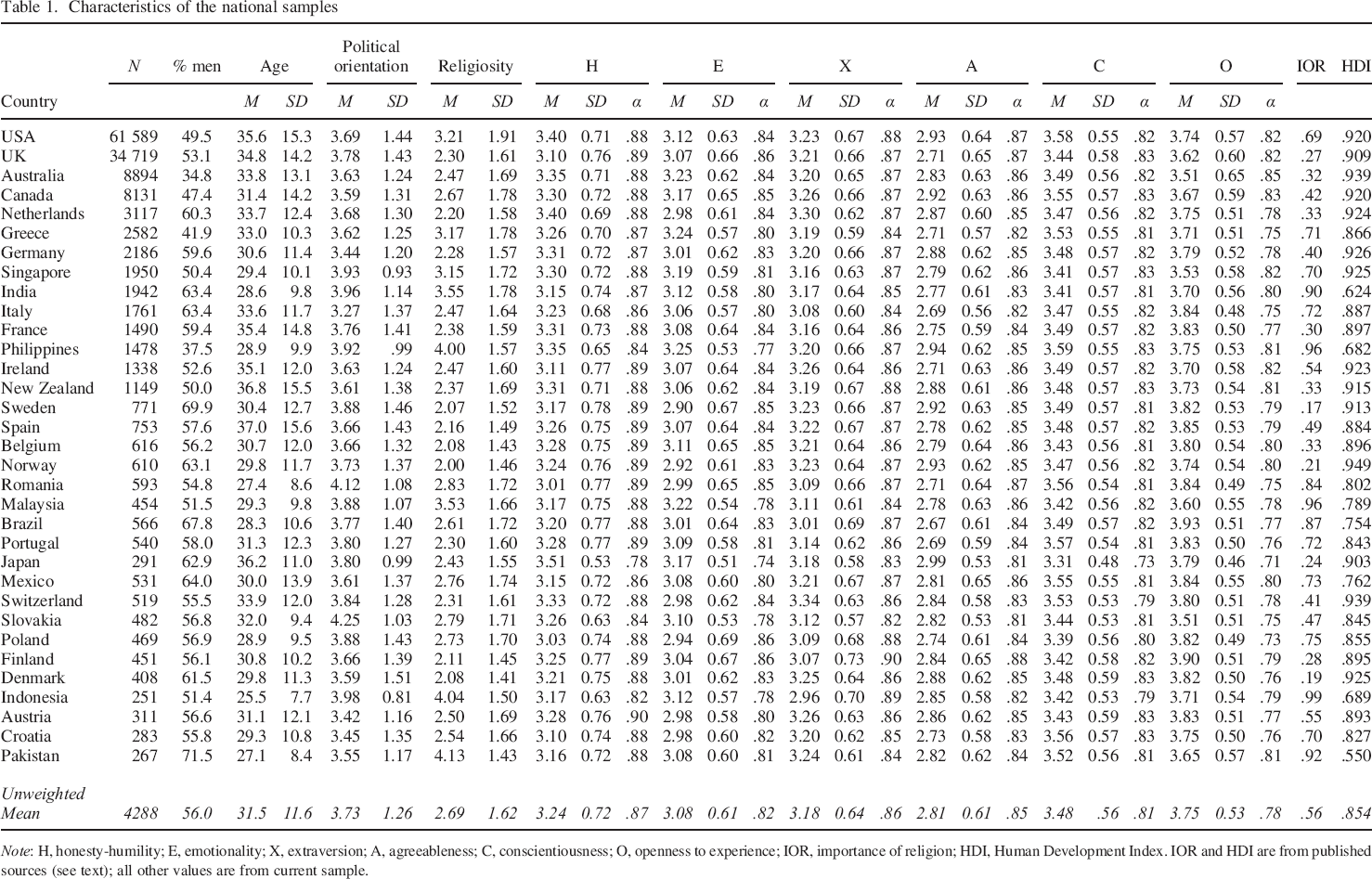
Note: H, honesty–humility; E, emotionality; X, extraversion; A, agreeableness; C, conscientiousness; O, openness to experience; IOR, importance of religion; HDI, Human Development Index. IOR and HDI are from published sources (see text); all other values are from current sample.
Measures
Personality
The English–language version of the HEXACO–100 (Lee & Ashton, in press) was used to assess the HEXACO personality factors. The order of the items in the online survey is the same as that of the paper–and–pencil version of the questionnaire, and each item was presented one at a time. As mentioned earlier, three attentiveness check items were embedded evenly throughout the questionnaire (e.g. ‘This is an attentiveness check; please indicate “neutral.”’). Responses were made on a 5–point scale with anchors ranging from strongly disagree (1) to strongly agree (5). The means, standard deviations, and alpha reliabilities of the HEXACO factor–level scales are shown in Table 1. The corresponding information about the HEXACO facet–level scales are provided in Appendix S2.
To evaluate the structure of the inventory within each country, we conducted principal axis factor analysis with varimax rotation separately for each country. The theoretically expected factor structure emerged from all of the subsamples, with each factor being defined chiefly by its designated facet scales (Appendix S3). To further assess the similarity of the factors across countries, we computed congruence coefficients of the six varimax–rotated factors observed in each country against those found in the US sample (i.e. the largest sample). The average congruence coefficients across factors and across countries were very strong (mean = 0.98), with the weakest congruence coefficient being .91 observed for the Agreeableness factor from the Indonesian sample (Appendix S4).
We also conducted a multi–group confirmatory factor analysis involving the 25 facets to test measurement invariance across 33 countries (Appendix S5). The results of the analysis suggested that metric invariance across the countries can be supported. That is, the six HEXACO factors were defined by the same set of facets, and constraining the factor loadings to be the same across the countries resulted in trivial differences in model fit (ΔCFI = .002, ΔRMSEA = .002). Scalar invariance, which further requires the indicator intercepts to be the same across countries, was not supported according to the conventional criteria suggested by Chen (2007; ΔCFI = .029, ΔRMSEA = .006). Considering that mean comparisons for facets across countries were not of primary interest in the present research, the support for metric invariance is judged to provide a sufficient basis for further analyses.
Religiosity and political orientation
After completing the HEXACO–100, participants responded to a series of demographic questions (e.g. age and sex) and a single 7–point item each for religiosity (‘How religious do you consider yourself to be?’ 1 = not at all to 7 = extremely) and political orientations (‘How would you describe your political orientation?’ 1 = very left–wing to 7 = very right–wing). Each item also included the response option of ‘prefer not to answer’, coded as missing data for our analyses.
National–level characteristics
In addition to assessing personality trait levels, religiosity, and political orientation at the individual level, we also obtained indices of national levels (i) of the importance of religion and (ii) of overall development. The importance of religion for the 33 countries was quantified by the percentage of the people who responded ‘yes’ to the 2009 global Gallup poll question: ‘Is religion important in your daily life?’ (Crabtree, 2010). Within the 33 countries included in the present research, the values ranged from 17% (Sweden) to 99% (Indonesia) with a mean of 56% (SD = 0.26). This variable had a correlation of .82 with the within–country mean for self–rated religiosity, which provides further support for the validity of these two variables. The overall development of countries was quantified by the HDI reported in 2015 by United Nations Development Programme (http://hdr.undp.org/en/content/human–development–index–hdi). The HDI is a composite score based on three key dimensions of human development (a country's mean life expectancy at birth, level of education, and per capita income) and is widely used as an indicator of countries’ overall well–being. In the present research, HDI ranged from .538 (Pakistan) to .944 (Norway) with a mean of 0.85 (SD = 0.10).
Analysis
We describe our results primarily based on the sizes of correlation coefficients. Given the very large sizes of many samples within the present research, even a trivially small correlation will be statistically significant. Hence, we do not report statistical significance tests here. Instead, we interpret the correlation coefficients themselves as indices of effect size. In the meta–analysis of Sibley et al. (2012), the strongest meta–analytic correlation was −.18 for Openness, followed by .10 for Conscientiousness. Considering that Openness to Experience is one of the most robustly found personality correlates of political orientation, we decided on an a priori basis to discuss effect sizes approaching this level of correlation. Although we mainly discuss the relationships involving absolute correlations exceeding .15, we also discuss some noteworthy relationships with absolute correlations in the low .10s.
We first computed correlations of political orientation with the religiosity and personality variables within each single country and meta–analysed them across the 33 countries. Although we provide both sample–weighted and sample–unweighted mean correlations, we interpret the results primarily based on sample–unweighted means because, even though all sample sizes were of at least moderate size (N > 250), some samples were vastly larger than others. As seen in Table 1, 68% of the participants are from the USA or the UK, which means that those two countries will heavily influence the sample–weighted means. To provide some indication of the variability of the correlation coefficients across countries, we also provide a 95% credibility interval for each meta–analytic correlation. The credibility interval indicates the extent to which the effect sizes vary across countries beyond the variance expected to occur due to sampling errors (Schmidt & Hunter, 2014).
We did not choose multilevel modelling as a primary statistical method, for two reasons. First, as mentioned earlier, we decided not to rely on significance tests in interpreting the results (cf. McShane, Gal, Gelman, Robert, & Tackett, 2017), and therefore, the inflation of Type I error rate in the nested data is not an issue in the present study. Second, the omnibus multilevel analysis results are also heavily influenced by the samples from the USA and the UK, a problem that we avoid by using the sample unweighted meta–analytic means.
Results
Table 2 shows the correlations of political orientation (scored in the right–wing direction) with religiosity and the HEXACO personality factors as well as multiple correlations achieved by these variables. Right–wing political orientation was not correlated with age (unweighted mean r = .02) and only weakly correlated with sex (unweighted mean r = −.14, men being more right–wing on average). Partialling out the effects of these two demographic variables made rather trivial differences, and therefore, we describe the results on the basis of bivariate zero–order correlations. With regard to the overall results pooled across the countries (i.e. the unweighted mean correlation across countries; see the bottom row of Table 2), the personality factor scale showing the strongest association with political orientation was Honesty–Humility (−.21), followed by Openness to Experience (−.17); that is, lower Honesty–Humility and lower Openness were each modestly associated with a more right–wing political orientation. These results are consistent with recent studies showing the central role of these two factors in the domains of ideology and values (e.g. Lee et al., 2010); recall also that in the review of Sibley et al., Openness to Experience correlated −.18 with right–wing political orientation. The link between Conscientiousness and right–wing political orientation was positive but weak (.08), similar to what was previously reported in the meta–analysis of Sibley et al. (2012). Religiosity was associated with right–wing political orientation, with a correlation (.17) equal in size but opposite in sign to that shown by Openness to Experience. These findings are generally consistent with our a priori expectations. Another noteworthy finding is that the Emotionality factor, one of the three prosocial personality factors in the HEXACO model, showed a correlation of −.13, the highest correlation after Honesty–Humility and Openness to Experience.
Correlations of right–wing political orientation with age, sex, religiosity, and HEXACO Personality Inventory—Revised factor scales
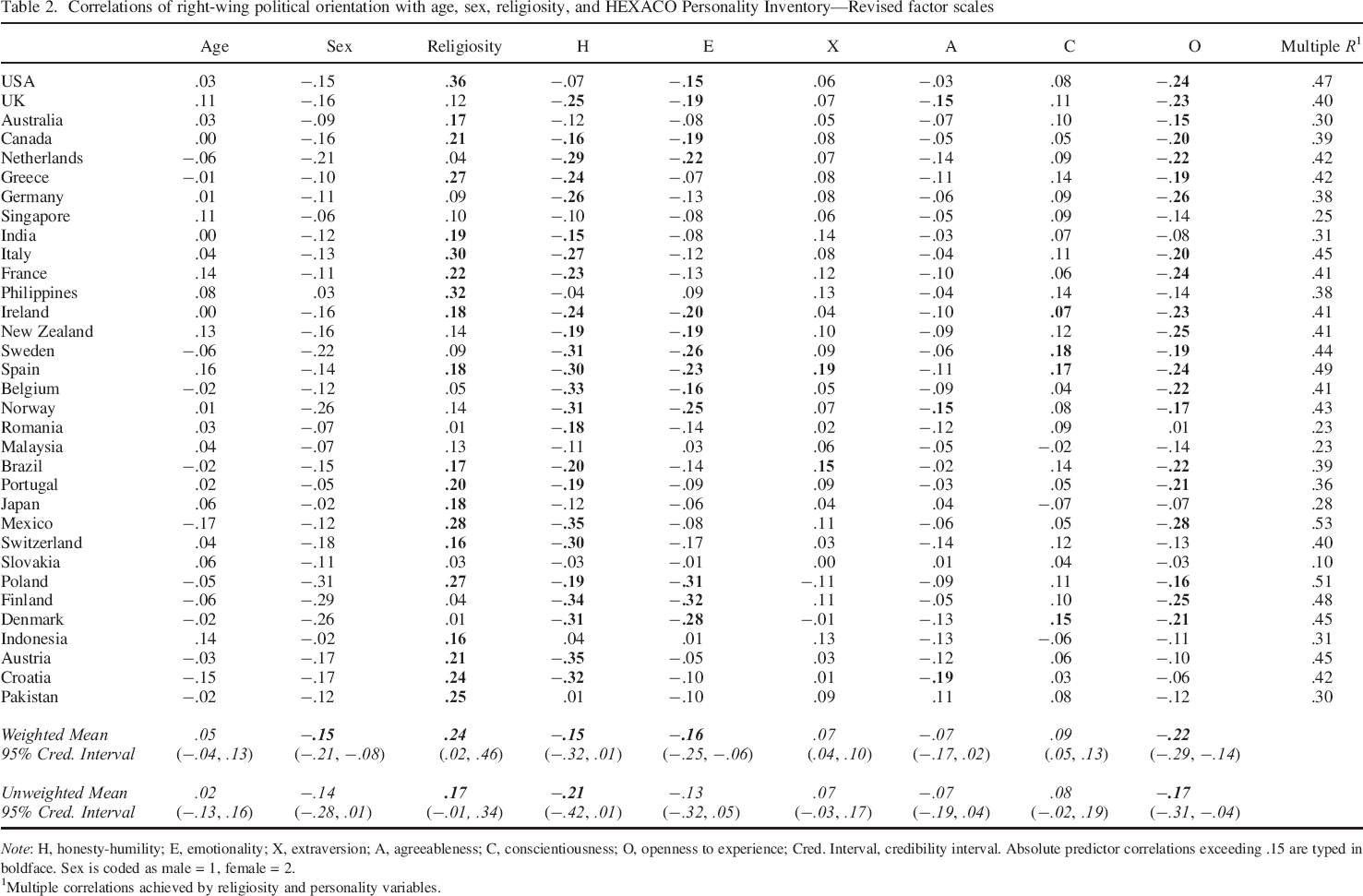
Note: H, honesty–humility; E, emotionality; X, extraversion; A, agreeableness; C, conscientiousness; O, openness to experience; Cred. Interval, credibility interval. Absolute predictor correlations exceeding .15 are typed in boldface. Sex is coded as male = 1, female = 2.
Multiple correlations achieved by religiosity and personality variables.
National–level results
Despite the modest effect sizes obtained in the pooled results, there was considerable variation in the effect sizes across the countries (see 95% credibility intervals shown in Tables 2 and 3). For example, lower Honesty–Humility was more strongly associated with right–wing political orientation in some countries (i.e. in the −.30s for Mexico, Austria, Finland, Belgium, Croatia, Sweden, Norway, and Denmark) than in others (in the −.00s for Indonesia, Pakistan, Slovakia, Philippines, and USA). For Openness to Experience, stronger negative correlations were observed in countries such as Mexico, Germany, New Zealand, Finland, and Austria (in the −.20s) than for others such as Romania, Slovakia, Croatia, Japan, and India (in the −.00s). With respect to religiosity, stronger positive correlations were observed for some countries (i.e. ≈.30 for USA, Philippines, Italy, and Mexico) than for other countries (i.e. ≈.00 for Denmark, Romania, Slovakia, Netherlands, and Finland).
Correlations of right–wing political orientation with Honesty–Humility, Emotionality, Extraversion, Agreeableness, Conscientiousness, and Openness to Experience Personality Inventory—Revised facet scales
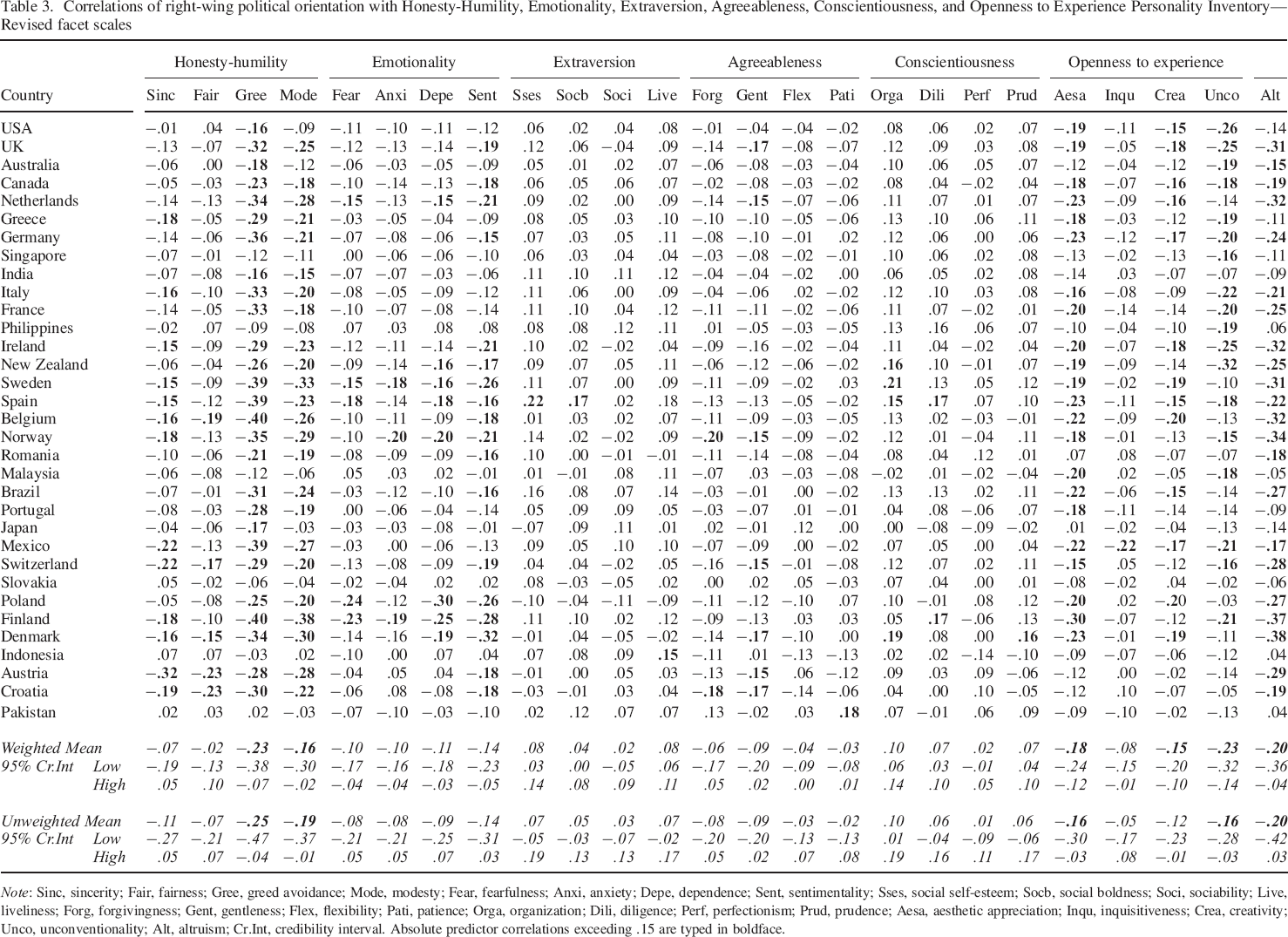
Note: Sinc, sincerity; Fair, fairness; Gree, greed avoidance; Mode, modesty; Fear, fearfulness; Anxi, anxiety; Depe, dependence; Sent, sentimentality; Sses, social self–esteem; Socb, social boldness; Soci, sociability; Live, liveliness; Forg, forgivingness; Gent, gentleness; Flex, flexibility; Pati, patience; Orga, organization; Dili, diligence; Perf, perfectionism; Prud, prudence; Aesa, aesthetic appreciation; Inqu, inquisitiveness; Crea, creativity; Unco, unconventionality; Alt, altruism; Cr.Int, credibility interval. Absolute predictor correlations exceeding .15 are typed in boldface.
Overall, religiosity and the six personality factor scales achieved an average (i.e. sample–unweighted) multiple correlation of .38 in predicting political orientation, with values ranging from .10 (Slovakia) to .53 (Mexico). These results support the notion that personality and religiosity are important in understanding individuals’ political orientation.
To further explore the variation across countries in the associations of political orientation with religiosity and personality variables, we computed correlations across countries of the IOR with the strength of relationship between religiosity and right–wing political orientation (Figure 1) and of the HDI with the strength of relationship between Honesty–Humility or Openness and right–wing political orientation (Figures 2 and 3). As expected, the IOR level of a country was associated with the extent to which individual religiosity predicts right–wing political orientation in a country (r = .47 across the 33 countries). Similarly, the HDI was related to the predictiveness of the Honesty–Humility and Openness factors for right–wing political orientation (rs = −.52 and −.37, respectively; that is, stronger negative associations were observed in countries with higher HDI levels, whereas weaker negative associations were observed in countries with lower HDI levels). As an ad hoc analysis, we also computed country–level correlations of the HDI with the extent to which the other four HEXACO personality factors correlated with political orientation, obtaining correlations of −.48 for Emotionality, −.27 for Extraversion, −.46 for Agreeableness, and .19 for Conscientiousness across the 33 countries. It thus appears that the associations of personality traits with political orientation are stronger in more developed countries, especially for prosocial personality traits such as Honesty–Humility, Emotionality, and Agreeableness.

Relation between importance of religion in a country and religiosity/political orientation correlation.
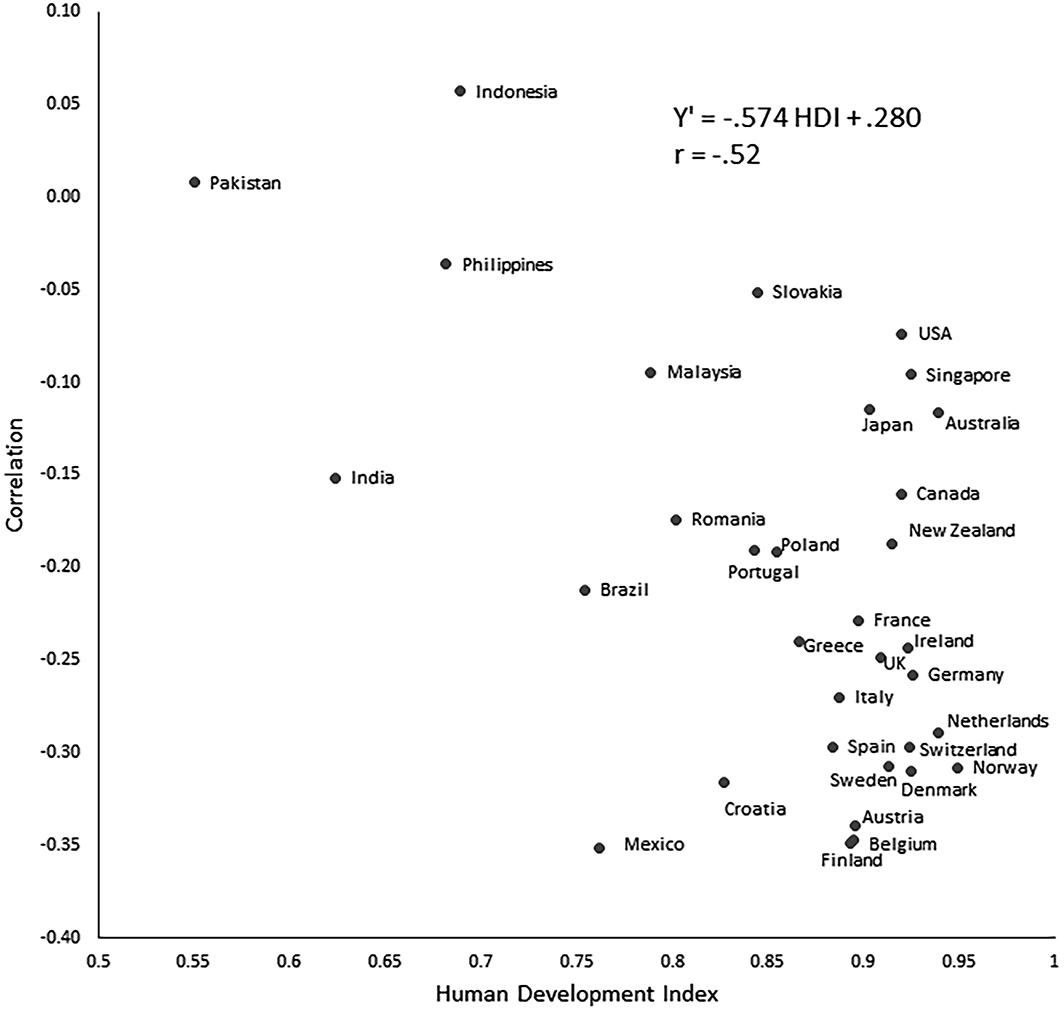
Relation between Human Development Index of a country and honesty–humility/political orientation correlation.
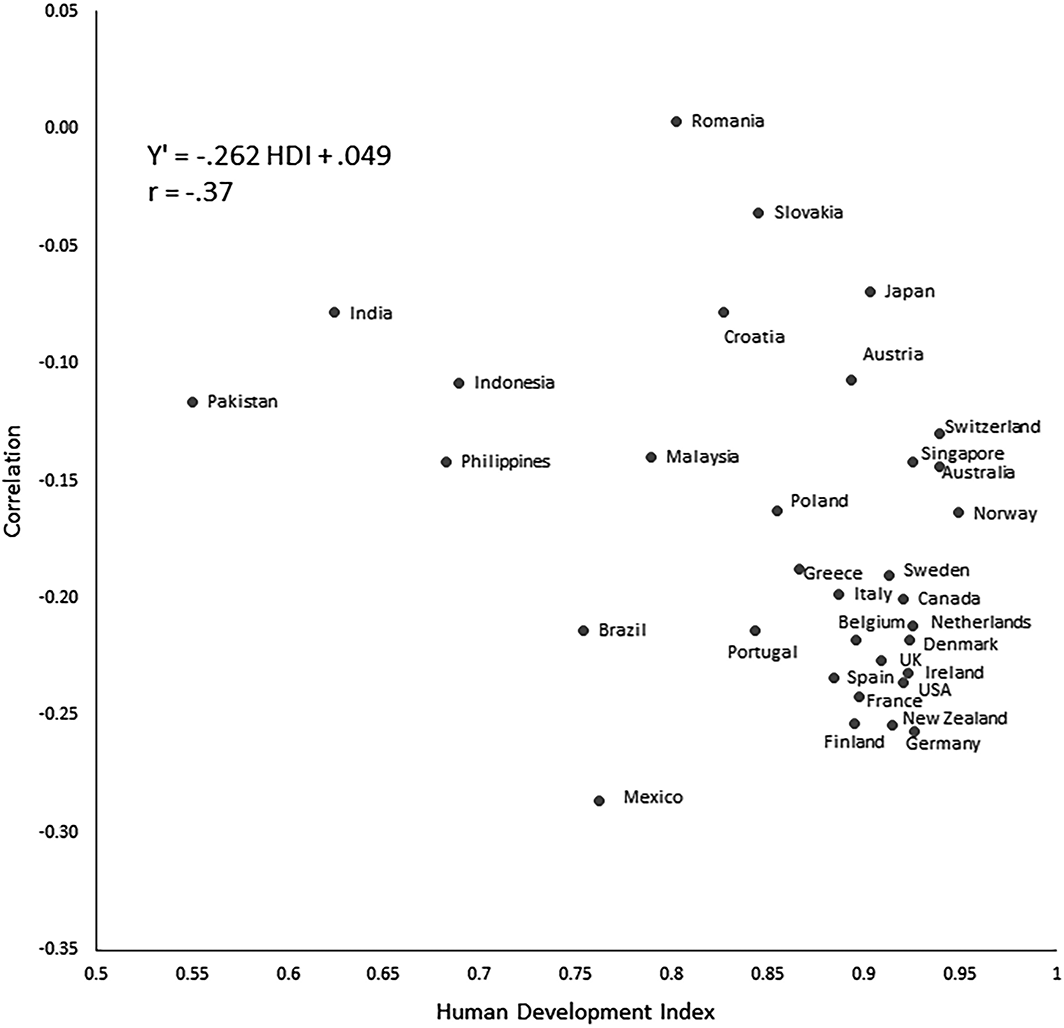
Relation between Human Development Index of a country and openness/political orientation correlation.
We also note that the national–level variables (the IOR and the HDI) are very strongly correlated with each other (r = −.77), and therefore, both variables showed a similar pattern of cross–level interaction effect described above. This raises interpretational ambiguity for the national–level findings, an issue commonly encountered in cross–national investigations, which we will consider in the Discussion section.
Facet–level personality scales
In examining how facet–level personality traits correlated with political orientation, we also focused on the personality traits showing an absolute correlation of .15 or greater with political orientation averaged across countries (see the unweighted mean row in Table 3). With respect to the facet scales in the Honesty–Humility domain, ‘humility’ facet scales showed noticeably higher correlations with right–wing political orientation than did ‘honesty’ facet scales. Specifically, Greed Avoidance and Modesty showed stronger negative correlations (−.25 and −.19, respectively) than did Sincerity (−.11) and Fairness (−.07). With respect to the Openness to Experience domain, low Aesthetic Appreciation (−.16) and low Unconventionality (−.16) were more strongly associated with right–wing political orientation than was low Inquisitiveness (−.05), with low Creativity (−.12) being intermediate.
Beyond the Honesty–Humility and Openness domains, only one facet scale showed an absolute correlation with political orientation that exceeded .15. Specifically, the Altruism scale, interstitially located between the Honesty–Humility, Emotionality, and Agreeableness factors, correlated −.20 with right–wing political orientation. One interesting observation regarding religiosity and altruism is that, despite their opposite relations with right–wing political orientation (.17 for religiosity and −.20 for Altruism), these two constructs showed a modest positive relationship with each other (unweighted mean r = .20). This suggests that, at least in countries with higher IOR levels, the association of Altruism with political orientation may be suppressed by religiosity. Consistent with this reasoning, at the national level, the altruism/politics relation was correlated with the IOR level of the country (r = .72); that is, Altruism had a much stronger (negative) link with right–wing political orientation in secular countries than in religious countries.
Discussion
Data collected from 33 countries showed that right–wing political orientation was positively associated with religiosity and negatively associated with the personality factors of Honesty–Humility and Openness to Experience (and to a lesser degree, Emotionality). Although the strength of these associations was modest when averaged across countries, there was substantial variation in these relationships across countries, which highlights the importance of multinational research in examining the relationships between these psychological characteristics and political orientation.
Religiosity and political orientation
In the present dataset, religiosity was associated modestly with right–wing political orientation (unweighted mean r = .17) but showed minimal correlations with the HEXACO personality factors (the strongest unweighted mean correlation being .13 for Emotionality). Given that personality/political orientation links were modest, these results suggest that religiosity has a direct link to right–wing political orientation not substantially mediated by the major personality factors. Other research suggests a substantial influence of the family environment on religiosity (albeit one that diminishes somewhat after young adulthood; Abrahamson, Baker, & Caspi, 2002; Koenig, McGue, Krueger, & Bouchard, 2005), so it appears that religious upbringing and socialization could have some direct influence on one's political orientation.
We also found that religiosity had a near–zero association with political orientation in some countries (e.g. Denmark, Finland, Belgium, and Slovakia) but a rather significant association in other countries (e.g. the USA, the Philippines, Italy, and Mexico), with this variation being partly accounted for by the importance of religion within each country. This suggests that the strength of the link between religiosity and right–wing attitudes in a given country may change over time as the status of religion changes within the country.
Personality and political orientation
As expected, we found that Honesty–Humility and Openness to Experience were the two primary personality correlates of political orientation. Although the role of Openness to Experience has been repeatedly found in the past (e.g. Sibley et al., 2012), the role of Honesty–Humility has not been understood clearly due to the predominance of the Big Five model in the literature on personality and politics (Chirumbolo & Leone, 2010; Zettler & Hilbig, 2010). The results of the present research are consistent with the notion that Honesty–Humility and Openness to Experience constitute the primary personality bases of socio–political attitudes (Lee et al., 2010) and personal values (Lee et al., 2009), both of which have been found to show rather strong associations with (left/right) political orientation. The fact that two factors in the HEXACO model (Honesty–Humility and Openness to Experience) were found to correspond roughly to the two psychological constructs thought to underlie political orientation (rejection of inequality and acceptance of social change; Ashton et al., 2005; Jost et al., 2003) provides evidence for the utility of the HEXACO model for understanding individual differences in political orientation.
We should note that, although the present results are based exclusively on self–report data, method variance due to self–report response styles is unlikely to have substantially biased the present results. Trait–specific response styles are limited because of the lack of any political content in the HEXACO–PI–R items. More general response styles, such as social desirability, are evidently weak in the HEXACO–PI–R given the small correlations between the factor–level scales, and in any case, the personality/political associations were specific to a few personality variables only. Nevertheless, it could be useful in future research to use cross–source designs involving closely acquainted persons, whereby for example personality self–reports could be examined in relation to political orientation spouse reports or vice versa.
Importance of multinational investigations
The extent to which religiosity and personality are related to political orientation varies widely across countries (Figures 1–2, and 3), which suggests that any snapshot picture of these relationships observed in one or a few countries should not be assumed to generalize to others. For example, in the USA and in the Philippines, right–wing political orientation showed a moderate positive association with religiosity and a near–zero negative association with Honesty–Humility; however, in several northern European countries, right–wing political orientation showed a moderate negative association with Honesty–Humility and a near–zero positive association with religiosity.
The results of national–level analyses seem to be consistent with the suggestion that political orientation is more strongly associated with religiosity in countries where religion is a central part of people's lives, and that personality matters more in countries that are more developed as indexed by the HDI. As suggested in the Introduction section, it may be that religiosity is relevant to political orientation in a country only when there are enough religious people to make religion an important element in national politics. Also, within more developed countries, people are likely to be better informed about various social, economic, and political issues due to open communications of these issues and higher education levels, and this political sophistication may allow people to develop coherent political orientations that are compatible with their predispositions.
One possible explanation for the weaker links between personality and political orientation in less developed countries is based on the concept of cultural ‘tightness’ suggested by Gelfand et al. (2011). 7 These authors indexed 33 countries in terms of cultural tightness (i.e. whether a culture has ‘many strong norms and a low tolerance of deviant behaviors’, p. 1100) and found that countries with high tightness scores were more likely to have autocratic rule, more controls for media, and fewer political rights and civil liberties. These circumstances can be considered a ‘strong’ situation in which personality's influence on political stances becomes weaker. This account appears to be consistent with the present data. When we inserted Gelfand et al. tightness index to our dataset (N = 21), it correlated −.53 with the HDI. Furthermore, the absolute correlations of political orientation with Honesty–Humility and Openness to Experience were lower for the countries with higher tightness scores: the cultural tightness index correlated .41 with the political orientation/Honesty–Humility correlation and .57 with the political orientation/Openness correlation, meaning that the negative correlations were weaker within the countries with greater cultural tightness.
We should add caveats in interpreting the findings at the national level. It is important to note that multination studies almost always involve small samples, with the further complication that some countries are rather similar to one another, thereby reducing the number of truly independent observations. Moreover, many of the national–level characteristics are substantially correlated: in the present research, for example, the IOR and the HDI were correlated at −.77 (see the Results section). For these reasons, any associations observed at the national level are subject to multiple interpretations. We therefore interpret our cross–national findings cautiously, by noting the non–trivial variation in the effect sizes across countries and by considering the observed associations involving national–level religiosity and development as initial evidence that could assist in understanding the nature of the variation. 8
Facet–level personality traits
The results of the present research also suggest that people's political stances can be better understood by considering personality constructs at the facet level. First, the Humility–related facets of the Honesty–Humility factor (Greed Avoidance and Modesty) were more strongly correlated with left–wing political orientation than were the Honesty–related facets (Sincerity and Fairness). In particular, Greed Avoidance showed the strongest association with left–wing political orientation. This facet represents a reluctance to pursue material wealth and social status, and this reluctance may promote opposition to social systems that cultivate inequality, which are typically associated with the political right. Consistent with this reasoning, Roets et al. (2006) observed a significant positive link between materialism (which corresponds closely to the negative pole of Greed Avoidance) and SDO. Similarly, the low pole of the Modesty scale is characterized by a strong sense of entitlement, which would be associated with a preference for a hierarchical social system, where such entitlement is likely to be more acceptable. However, we should also note that a study in Italy showed that the Humility–related and Honesty–related facets correlated about equally (negatively) with SDO, a result that is not fully consistent with the present findings (Leone, Desimoni, & Chirumbolo, 2012).
Within the Openness to Experience factor, the Unconventionality and Aesthetic Appreciation facets showed stronger correlations with political orientation than did Inquisitiveness and Creativity. This result is consistent with the results reported by Leone, Desimoni, et al. (2012), who found that those facet scales correlated negatively and more strongly than the other two scales in the Openness factor with RWA and SDO. In addition, Hirsh et al. (2010) also found that left–wing political orientation showed a stronger association with the Openness ‘aspect’ (aesthetic and imaginative) than with the Intellect ‘aspect’ (intellectual curiosity and self–rated knowledge) of a Big Five Openness/Intellect measure. Also, although it is not surprising to find that unconventional people are more likely to be political left wingers, some may be puzzled by the links of political orientation with Aesthetic Appreciation, which assesses a liking of artistic and natural beauty. However, this facet has been found to show a noticeably strong association with ecological attitudes and behaviours (Markowitz, Goldberg, Ashton, & Lee, 2012), and this might explain in part its significant role as a personality correlate of political orientation given that ecological and environmental concerns currently underlie some of the most important political issues.
We also found that the Altruism facet scale was associated with left–wing political orientation. This finding is consistent with that obtained in a sample of German adults (Zettler & Hilbig, 2010) and also with that obtained in North American samples by Hirsh et al. (2010), who showed the positive link of a Compassion ‘aspect’ of a Big Five Agreeableness measure, but not of a Politeness aspect, to left–wing political orientation. The fact that political orientation correlated about as strongly with Altruism as with Honesty–Humility suggests that, apart from Openness to Experience, the main personality axis underlying political attitudes may involve a blend of Honesty–Humility with Emotionality and Agreeableness (i.e. the other two altruism–related dimensions). However, the results of the present research suggest that Honesty–Humility is more relevant to political orientation than are Emotionality and (especially) Agreeableness (for a discussion of altruism in the HEXACO model, see Ashton et al., 2014).
Altruism and religiosity were related to right–wing political orientation in opposite directions, even though they were positively correlated with each other. This pattern implies that religiosity may be supressing the relationship between altruism and political orientation, especially in religious countries where religiosity is more strongly associated with political orientation. For example, in the USA, altruism correlated −.14 with political orientation, but if religiosity is controlled, the partial correlation was −.24. (Likewise, religiosity correlated .36 with political orientation, but if altruism is controlled, the partial correlation was .40). It thus seems that the altruism/politics link for a country tends to be weaker if the religiosity/politics link is stronger for that country. We should also note that this finding is consistent with the observation made by Malka, Soto, Cohen, and Miller (2011), showing that religiosity is positively associated with both cultural conservatism and prosocial value orientation, which are negatively correlated with each other. Another important implication of the present results is that findings observed by Malka et al. (2011) in their US sample may not generalize to countries where religiosity shows a near–zero association with political orientation (e.g. Northern European countries).
Finally, we would like to briefly discuss the relationships of some facets in the other factor domains beyond Honesty–Humility and Openness to Experience. The Sentimentality facet of the Emotionality factor showed a noticeably stronger negative association with right–wing political orientation (r = −.14) than did the other three Emotionality facets. Sentimentality is one aspect of prosociality that is conceptually rather similar to Big Five Aspect Scale called Compassion, which also showed the same negative association with right–wing political orientation (Hirsh et al., 2010). In addition, the Organization facet of the Conscientiousness factor showed the highest correlation among the facets of that factor with right–wing political orientation (r = .10), which is also consistent with the results reported in Hirsh et al. (2010).
Strengths and limitations
One of the important strengths of the present research is that it is one of the few multinational studies adopting a long form of a personality inventory (in this case, HEXACO–100, Lee & Ashton, in press). In the past, multinational studies examining political orientation in the Big Five model have typically been based on a very brief version of the Big Five measures such as the 10–item version of the Big Five Inventory (Rammstedt & John, 2007; but see Bleidorn et al., 2013; Gebauer et al., 2015). The use of a longer form of the HEXACO–PI–R made it possible to achieve much more differentiated assessment of personality and also allowed us to conduct facet–level analyses that would not have otherwise been possible. Nevertheless, we should note that the brevity of the facet scales (four items per facet) will tend to limit the strength of their associations with political orientation (itself assessed by a single item).
Although the large number of countries represented in this study can be considered a strength, the fact that only the English version of the HEXACO–100 was administered, even in countries where English is not the primary language, must be acknowledged as a possible source of sampling bias that may particularly compromise the representativeness of the sample. This feature seems to have made rather minor effects on the rank–order difference in religiosity across the countries; there was a strong correlation between the Gallup religiosity index with an index derived from mean religiosity ratings in the current dataset (r = .82).
It may well be, however, that the unrepresentativeness of the national samples has affected certain results based on the current dataset. For example, the participants from non–English–speaking countries are likely to have much higher levels of education compared with typical people in those countries. One of the prominent examples is the Pakistani sample, in which 50.2% of the respondents indicated they had finished ‘professional or graduate degrees’. The higher level of education in the present sample as compared with that of the general population within the country was also observed in English–speaking countries as well (Appendix S1). This is not really unexpected given the self–selection of the participants of the current dataset. Given that education levels might moderate the association with personality and political orientation, 9 one should be cautious in interpreting the results of the present research, particularly findings within an individual country. We should also note that, in the present dataset, the self–selection biases in recruitment generally work in ways to reduce the differences between countries, resulting in the variation in effect sizes across the national samples being smaller than it would be in the national populations.
We should also note that some participants may have been incorrectly assigned to a country (e.g. expatriates, student studying abroad, etc.). To alleviate this concern, we removed participants of certain ethnic groups when they are noticeably over–represented within a country (e.g. persons of European background in Middle Eastern or Asian countries). But it is entirely possible that each country includes some participants who are not members of the nationality, and this would also tend to obscure true differences among countries. As such, it may have been that some of the national differences observed in the present research are somewhat underestimated.
Another limitation has to do with the way in which political orientation was assessed. The present research relied on a single self–report item which asked respondents to indicate their political orientation on a continuum contrasting left–wing versus right–wing political orientation. Although such an approach has been commonly used in studies involving multiple countries (e.g. Piurko, Schwartz, & Davidov, 2011; Thorisdottir et al., 2007), it could have been more informative if the two psychological constructs underlying left/right political orientation were measured separately—that is, one dimension involving hierarchy and one dimension involving social conformity. These two core aspects of left/right ideology are differentially related to personality traits (e.g. Kandler et al., 2012; Lee et al., 2010) and likely represent psychological paths through which the influence of Honesty–Humility, Openness, and religiosity on left–versus–right political orientation can be better understood. Future research on personality and politics might therefore benefit from a more differentiated assessment of political orientation.
Acknowledgement
This research was supported by Social Sciences and Humanities Research Council of Canada (grant 410–2011–0089).
Supporting info item
Supporting info item, per2142-sup-0001-Supplementary_Appendix_Education_Religion - Personality, Religion, and Politics: An Investigation in 33 Countries
Supporting info item, per2142-sup-0001-Supplementary_Appendix_Education_Religion for Personality, Religion, and Politics: An Investigation in 33 Countries by Lee Kibeom, Ashton Michael C., Griep Yannick, Edmonds Michael and Kandler Christian in European Journal of Personality
Supporting info item
Supporting info item, per2142-sup-0002-Supplementary_Appendix_HEXACO_facets - Personality, Religion, and Politics: An Investigation in 33 Countries
Supporting info item, per2142-sup-0002-Supplementary_Appendix_HEXACO_facets for Personality, Religion, and Politics: An Investigation in 33 Countries by Lee Kibeom, Ashton Michael C., Griep Yannick, Edmonds Michael and Kandler Christian in European Journal of Personality
Supporting info item
Supporting info item, per2142-sup-0003-Supplementary_Appendix_Factor_Analysis - Personality, Religion, and Politics: An Investigation in 33 Countries
Supporting info item, per2142-sup-0003-Supplementary_Appendix_Factor_Analysis for Personality, Religion, and Politics: An Investigation in 33 Countries by Lee Kibeom, Ashton Michael C., Griep Yannick, Edmonds Michael and Kandler Christian in European Journal of Personality
Supporting info item
Supporting info item, per2142-sup-0004-Supplementary_Appendix_Factor_Analysis - Personality, Religion, and Politics: An Investigation in 33 Countries
Supporting info item, per2142-sup-0004-Supplementary_Appendix_Factor_Analysis for Personality, Religion, and Politics: An Investigation in 33 Countries by Lee Kibeom, Ashton Michael C., Griep Yannick, Edmonds Michael and Kandler Christian in European Journal of Personality
Supporting info item
Supporting info item, per2142-sup-0005-Supplementary_Appendix_CFA_MI - Personality, Religion, and Politics: An Investigation in 33 Countries
Supporting info item, per2142-sup-0005-Supplementary_Appendix_CFA_MI for Personality, Religion, and Politics: An Investigation in 33 Countries by Lee Kibeom, Ashton Michael C., Griep Yannick, Edmonds Michael and Kandler Christian in European Journal of Personality
Footnotes
Notes
References
Supplementary Material
Please find the following supplemental material available below.
For Open Access articles published under a Creative Commons License, all supplemental material carries the same license as the article it is associated with.
For non-Open Access articles published, all supplemental material carries a non-exclusive license, and permission requests for re-use of supplemental material or any part of supplemental material shall be sent directly to the copyright owner as specified in the copyright notice associated with the article.
