







Abstract
Embedded in a theoretically founded process model (termed Dynamics of Motive Satisfaction, ‘DynaMoS’), the present study examined the links between the implicit dispositional communion motive, everyday motivational dynamics, and relationship outcomes in couples. Within–subject processes are proposed to explain between–subject associations of dispositional motives and relationship satisfaction. For an empirical test of the model, data on the dispositional partner–related need for communion and global relationship satisfaction were obtained from 152 individuals in heterosexual relationships. In an extensive experience sampling spanning 2 weeks, a subsample of 130 individuals answered questions about their current motivational states, mood, state relationship satisfaction, and experiences with their partner five times a day. The results were largely consistent with the DynaMoS model: (1) individuals with a strong dispositional implicit communion motive reported more often to be in a communal motivational state; (2) communally motivated individuals were more likely to engage in subsequent instrumental behaviour; and (3) relationship experiences that potentially satisfy communion motivation led to more positive relationship outcomes when individuals were motivated before compared with when they were not. It is discussed how these results and the experience sampling method can foster our understanding of how dispositional characteristics translate into everyday processes and shape relationship outcomes. Copyright © 2018 European Association of Personality Psychology
When looking into the psychological literature about relationship functioning, a variety of research can be found on between–person and between–couple factors that are associated with better or worse relationship quality. These include, for example, attachment styles (Noftle & Shaver, 2006; Shaver & Brennan, 1992), personality traits (Heller, Watson, & Ilies, 2004; Malouff, Thorsteinsson, Schutte, Bhullar, & Rooke, 2010; Wilson, Harris, & Vazire, 2015), and relationship commitment (Le & Agnew, 2003), to name just a few. Research on such between–subject factors may serve as a starting point when addressing the within–subject processes that drive these associations (see, e.g. Howell, Ksendzova, Nestingen, Yerahian, & Iyer, 2017; Nezlek, Newman, & Thrash, 2017; Sadikaj, Moskowitz, & Zuroff, 2016; Kanat–Maymon, Argaman, & Roth, 2017; Sadikaj, Moskowitz, & Zuroff, 2015; Vater & Schröder–Abé, 2015; Gable & Poore, 2008, for such approaches). That being said, it is important to note that results of inter–individual analyses cannot be transferred to the intra–individual level of analysis, at least not under reasonable assumptions of non–ergodic psychological processes (Molenaar, 2004; Molenaar & Campbell, 2009). Doing so is known as an ecological fallacy (Curran & Bauer, 2011): Variation between individuals has to be distinguished from variation within individuals. Causal processes, however, typically operate on the within–person level (Hamaker, 2012). Furthermore, insights about mediating causal processes are necessary for interventions that aim to improve relationship quality (Back & Vazire, 2015).
The starting point for our research question was the finding that the dispositional need for closeness and communion is positively related to global relationship functioning in couples (Hagemeyer & Neyer, 2012; Hagemeyer, Neberich, Asendorpf, & Neyer, 2013). This between–subject result, however, is at best suggestive for the underlying causal processes. For example, one cannot conclude from this result that individuals’ momentary relationship satisfaction will change when experiencing a momentary motivation for closeness (which is a within–subject effect). By changing the level of analysis to the within–person level, the current paper takes a closer look at which intra–individual process chain can explain the between–subject finding (Back et al., 2011): How do individuals with different motive strength vary in their everyday experiences and what processes can predict their state and global relationship satisfaction? We propose a theoretically founded process model illustrating the within–person
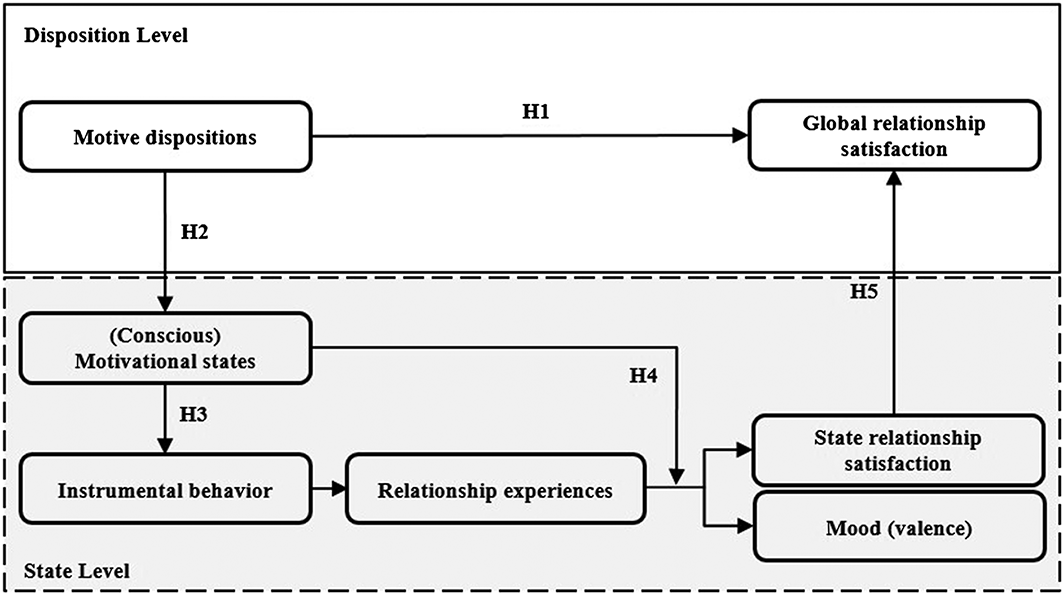
Overview of the Dynamics of Motive Satisfaction model and associated hypotheses. Figure available at https://osf.io/b8pu6/, under a CC–BY4.0 licence.
The DynaMoS model includes components from all phases of social interactions (Back & Vazire, 2015; Heckhausen & Heckhausen, 2008): motivation (pre–action phase), instrumental behaviour (action phase), and relationship perception (post–action phase). It is not a novel theoretical model, but derived from assumptions of existing theories and is meant to be generic for motivational processes in all kinds of relationships that furthermore should mutatis mutandis apply to all motivational domains, such as power or achievement. In the following descriptions, we will apply it to the target domain of the current study, which is communal motivation. We used an intensive longitudinal method (Experience Sampling Method, ESM; Csikszentmihalyi & Larson, 1987; Wrzus & Mehl, 2015) to test our predictions in the everyday lives of couples. In the following sections, we will elaborate on our understanding of motives, motivational states, and the assumed processes.
Motive Dispositions
Individuals differ in their preferences for certain classes of goal states. McClelland (1987) conceptualizes motives as such dispositional preferences, energizing behaviour in a desired direction, orienting attention to relevant incentives, and selecting behaviour by facilitating learning in that domain. Desirable classes of goals in interpersonal contexts concern, for example, power, independence, affiliation, and intimacy. Based on a classification first introduced by Bakan (1966), these motives can be combined to the broad categories of agency (for power and independence) and communion (for affiliation and intimacy; Brunstein, Schultheiss, & Grassmann, 1998; Hagemeyer & Neyer, 2012). These categories are also being used in the literature on interpersonal psychology, describing the two orthogonal behavioural dimensions of the interpersonal circumplex (Horowitz et al., 2006).
According to dual motives theory (McClelland, Koestner, & Weinberger, 1989; Schultheiss, 2001), two distinct motive systems can be distinguished that have functionally different underpinnings: The explicit motive system refers to self–attributed goals and values that can be deliberately retrieved by introspection and are supposed to guide decisions in highly structured situations. The system of implicit motives on the other hand corresponds to more spontaneous, inherently rewarding behaviour, for instance becoming apparent in unexpected situations that require prompt action. The current paper focuses on implicit motives, which are typically assessed by indirect measures, as they are not expected to be consciously accessible.
More specifically, we are interested in the implicit communion motive that comprises the motives of affiliation and intimacy. While those two motives can theoretically be distinguished in more detail, they both entail the need for closeness in positive, warm relationships (see Hofer & Hagemeyer, in press; Schönbrodt & Gerstenberg, 2012; Weinberger, Cotler, & Fishman, 2010, for a discussion of the difference between affiliation and intimacy) and show a high correlation (Hagemeyer, Dufner, & Denissen, 2016). In the context of couple relationships, the partner–related need for communion (pnCommunion) is defined as ‘a recurrent concern for closeness to one's partner and for experiences of the self as part of a dyad’ (Hagemeyer & Neyer, 2012, p. 115). While physical closeness facilitates the implementation of pnCommunion, emotional closeness is at the heart of it: deriving pleasure from a sense of unity, by both members of a couple sharing thoughts and emotions, involving the partner in one's experiences, and showing compassion and affection.
From Motive Dispositions to Global Relationship Satisfaction
We will now turn to highlighting different parts of the DynaMoS model presented in Figure 1. While implicit motives have been studied since the late 1940s in various settings (see Schultheiss & Brunstein, 2010, for an overview), research in the context of couple relationships is still rather sparse. Previous studies mainly highlighted the result of implicit motives being related to relationship outcomes. The implicit power and more broadly agency motives were found to be negatively related to relationship outcomes (Hagemeyer & Neyer, 2012; Hagemeyer, Schönbrodt, Neyer, Neberich, & Asendorpf, 2015; Mason & Blankenship, 1987; Stewart & Rubin, 1976; Zurbriggen, 2000).
Of specific interest for the current study though is research examining the influence of implicit communion motives (H1 in Figure 1): McAdams and Vaillant (1982) showed initial evidence for a positive association of the implicit intimacy motive with marital quality in a longitudinal study of 17 years investigating a male sample. The relationship–specific pnCommunion was also shown to be positively related to one's own—as well as the partner's—relationship satisfaction (Hagemeyer & Neyer, 2012). Two other findings indirectly suggest a worse relationship quality for those with high communion motives: Mason and Blankenship (1987) reported that female undergraduates characterized by a strong affiliation motive and activity inhibition exerted more physical and psychological abuse in their relationship when experiencing a stressful year. Similarly, Zurbriggen (2000) found that women with a high implicit affiliation–intimacy motive showed increased levels of aggression in their relationship. Weinberger et al. (2010) discuss these findings in the light of a ‘dark side’ of the affiliation motive (pp.73, 81), driving individuals to maladaptive behaviour when fearing their need for closeness to be frustrated by rejection or dissolution of a relationship (see also Hofer & Hagemeyer, in press). As relationships should on average satisfy the need for closeness more often than frustrate it, these results might not generalize to a worse relationship satisfaction per se. They might instead be indicative of more aroused reactions during episodes of frustration.
Taken together, some research points to communion motives being positively correlated with one's own overall relationship satisfaction, although person and situation variables might moderate and even reverse this association (e.g. during frustrating episodes in a relationship).
From Motive Dispositions to Motivational States
The process we assume behind the findings on associations between motives and global relationship satisfaction starts with the translation of motive dispositions into motivational states (H2 in Figure 1). Additional to assessing motive dispositions, the current study thus works with intensive longitudinal data on individuals’ self–reported motivational states throughout the day. It is therefore central to establish how motivation investigated in this way is assumed to relate to and differ from motive dispositions.
Generally, dispositions and traits depict stable differences in certain kinds of behaviours and experiences between persons. 1 States, however, also differ within a person and can vary on small time scales. Dispositions and states can be closely related, for example, when behaviour and experiences captured in state measures reflect the tendencies described in the definition of according disposition measures.
Traits as density distribution of states
Looking into research on the Big Five personality traits, Fleeson (2001) formulated and tested the assumption that inter–individual differences in personality are reflected in different density distributions of respective personality states. This was corroborated by studies reporting that average personality states show robust correlations with global personality trait measures (Augustine & Larsen, 2012; Fleeson, 2001; Fleeson & Gallagher, 2009). However, it was also pointed out that aggregated states are not to be considered equivalent to global trait reports, having different predictive validities (Augustine & Larsen, 2012; Finnigan & Vazire, 2017).
In a similar vein, we consider the density distributions of motivational states to reflect the correspondent motive dispositions: Individuals with a strong motive have a strong preference for certain classes of goals. Being motivated represents the momentary need to adjust the behaviour in the direction of such a preferred goal (e.g. increasing closeness to the partner for the communion motive). The frequency and strength of experiencing such motivational states should therefore be influenced by the individual preference described in motive dispositions. Additionally though, motivational states are determined by situational influences, as will be described in the following.
A systems theory of motivation
The Zurich Model of Social Motivation (Bischof, 1975, 1995) provides a functional perspective on the relationship between motive dispositions and motivational states. In terms of systems theory, motivation reflects a discrepancy between the current level and the reference level for a specific need. The reference level is supposed to be influenced by the motive disposition, being higher for individuals with a stronger motive. The current level, however, is shaped by the situation: When situations frustrate a specific motive, the current level can drop below the reference level, and motivational appetence should emerge. Appetence describes the momentary activation to reduce the discrepancy between current level and reference level (i.e. to have need satisfying experiences). For communion, this could translate to the motivation to seek out closeness to the partner. In contrast, when the current level exceeds the reference level, the term motivational aversion is used, indicating a momentary activation to move away from a certain end state. This could for instance be the motivation to reduce the amount of closeness to the partner (see also Schneider, 2001; Hofer & Hagemeyer, in press). 2
When motives would be permanently being fulfilled by the situation on a perfect level, even individuals with a strong dispositional motive should rarely experience motivational states. Nevertheless, a higher amount of satisfactory events is needed for these individuals to reach their reference level, compared with individuals with a weak motive. Therefore, averaged across typical situations, individuals with a strong motive disposition should experience the respective motivational appetence more often and more strongly (see Hagemeyer, Neyer, Neberich, & Asendorpf, 2013, for an application of this principle to scale development).
Conscious motivational states
According to Bischof (2008), implicit motives are considered to influence the (visible) behaviour and (conscious) affective experiences of individuals, but the associated motivational state that guides the attention to relevant incentives is not necessarily accessible to introspection. Nonetheless, individuals seem to be able to report on their motivational states, and these reports seem to be related to the implicit motive: McAdams and Constantian (1983) for instance showed that the implicit intimacy motive predicted a weaker self–reported (state) desire to be alone when participants interacted with someone. In contrast, when participants were alone, the motive predicted a stronger desire to interact with someone. This raises the question under which conditions motivational states are accessible to introspection. Bischof (2008) argues that these conditions include situations that constitute barriers impeding the satisfaction of the respective implicit motive (e.g. unavailability of the partner or frustrating circumstances). As such barriers prevent an automatic regulation of the motivational activation and behaviour, the explicit system is activated to provide additional cognitive resources to overcome the barriers, and motivational states tend to become conscious (see also Strack & Deutsch, 2004).
From Motivational States to Instrumental Behaviour
Following from the functional properties of motives, individuals who report feeling motivated should show corresponding instrumental behaviour to attain the desired end state of the respective motive (H3 in Figure 1). This process should serve to align the current level for a specific need with the reference level, for example, adjust an individual's behaviour to achieve a satisfactory level of emotional closeness. As already outlined earlier, this is not always possible, as situational circumstances might prohibit desired behaviour (e.g. the partner, norms, obligations). Moreover, individuals might have competing motives or other interests, interfering with the implementation of a specific behaviour (see Hofmann, Baumeister, Förster, & Vohs, 2012, Riediger & Freund, 2004, for studies on competing desires and goals). Despite these constraints, we would on average expect a positive relationship between motivational states and behaviour that aligns with these motivational states.
The Satisfaction of Motivational States in Relationships
An actor's instrumental behaviour can facilitate the satisfaction of his or her motives, but due to the interpersonal nature of the communal motive, the partner's behaviour is equally important.
Relationship experiences as a source of satisfaction
To foster closeness in a relationship, it is typically not sufficient for the actor to seek and show affection—the partner has to reciprocate and be willing to give the desired affection. In this sense, the partner's behaviour is a situational factor for the satisfaction of an actor's motives. Accordingly, the intimacy process model of Reis and Shaver (1988) proposes the perceived responsiveness of the partner as a central influence for the experience of intimacy. In this context, event–contingent and daily diary studies showed that not only self–disclosure, but also partner–disclosure predicted the experience of intimacy in interpersonal exchanges, with partner responsiveness partially mediating this association (Laurenceau, Feldman Barrett, & Pietromonaco, 1998, Laurenceau, Feldman Barrett, & Rovine, 2005; see also Debrot, Schoebi, Perrez, & Horn, 2013, for a study on actor and partner effects of everyday physical signs of affection).
However, the partner's motivated behaviour does not always align with an actor's motivation and instrumental behaviour, potentially leading to difficulties in the regulation of dyadic closeness. Still, given that most couples report at least slightly positive relationship satisfaction (Funk & Rogge, 2007; Heyman, Sayers, & Bellack, 1994), and communal behaviour tends to elicit communal behaviour (Markey, Funder, & Ozer, 2003), we expect that communal experiences generally are an inherent feature of a couple relationship (i.e. couples typically show affection and provide feelings of unity, especially if one partner initiates such behaviour), thereby satisfying communal motivation.
In this regard, our process model shares important aspects with a revision of the circumplex model of interpersonal behaviour (Horowitz et al., 2006). Likewise, this model (1) emphasizes that motives are the underlying force of interpersonal behaviour and (2) explicates that motivated behaviour requires and invites complementary, that is, matching reactions, to satisfy the motive behind it. As such, the model can be used to derive motive–specific partner reactions that are potentially involved in the satisfaction of a motivational state. Whereas the circumplex model describes the interpersonal reaction certain behaviour invites in other persons (i.e. one that satisfies the motive behind the behaviour; see also Markey et al., 2003), our model focuses on the intra–individual processes.
Motives and motivational states as affect–amplifiers
Behaviour that leads to rewarding experiences should elicit positive affect: Studies showed on the intra–individual level of analysis that satisfaction of different desires is generally positively related to daily well–being (Neubauer & Voss, 2016; Sheldon, Ryan, & Reis, 1996), and positive emotional experiences (Le & Agnew, 2001). The increase of perceived intimacy was found to predict positive affect in an ESM study with couples (Laurenceau, Troy, & Carver, 2005). These studies, however, did not consider the strength of the motive or momentary motivational state.
Motive theory (McClelland, 1987) posits that the attainment of a goal – such as emotional closeness – is not equally satisfactory for everybody, and the non–attainment of a goal not equally frustrating. Rather, the motive disposition should modulate the strength of the affective reaction: For persons with a weak intimacy motive, for example, a close interaction should be less satisfying than for a person with a strong intimacy motive. Likewise, being separated from significant others should be more frustrating for a person with a strong intimacy motive (‘motives as affect–amplifiers’, see Schultheiss, 2008 for a review). A study from Dufner, Arslan, Hagemeyer, Schönbrodt, and Denissen (2015) indeed showed such affective contingencies, namely individuals with a strong affiliation motive having a stronger tendency to experience and display physical indicators of joy in response to affiliative incentives. Further empirical studies showed that motives moderate the effect of motive–relevant experiences and goal progress on various measures of affect, well–being, and satisfaction (Brunstein et al., 1998; Job, Bernecker, & Dweck, 2012; McAdams & Constantian, 1983; McAdams, Jackson, & Kirshnit, 1984; Schultheiss, Jones, Davis, & Kley, 2008). Specifically for the communion domain, Hofer and Busch (2011a) could show in an inter–cultural study that individuals with a strong implicit affiliation motive had a higher relationship satisfaction when reporting high levels of relatedness experiences compared with those with a weak implicit motive (see Hofer & Busch, 2011b, for similar results regarding feelings of envy and aggression after frustration). While these existing studies on the affect–amplifying effect of dispositional motives are on the inter–individual level, the current study focuses on intra–individually varying motivational states, behaviour, satisfaction, and affect instead.
In this respect, we extend the hypothesis of ‘motives as affect–amplifiers’ to the motivational state level: Just as food tastes better when you are hungry, we expect that individuals who are momentarily highly motivated to experience closeness to their partner should be more happy when this desire is satisfied, compared with moments when they did not care as much. Generally speaking, the ‘motivation as affect–amplifiers’ hypothesis states that affective reactions are stronger—both in the positive and the negative direction—when the current motivation to fulfil a motive is strong, compared with when motivation is weak. As couple relationships typically provide such rewarding experiences, individuals with a strong pnCommunion should experience the affect–amplifying nature of motivation more often in a positive, satisfying way, leading to a higher relationship satisfaction on average compared with those with a less pronounced motive. We assume this motivational dynamic to be one of the processes not only influencing mood, but also momentary relationship satisfaction (H4 in Figure 1). The within–subjects process of affect–amplification would then contribute to the explanation of the between–subjects association between the implicit communion motive and global relationship satisfaction.
From State to Global Relationship Satisfaction
Finally, we assume an association between the mean of relationship satisfaction states and global assessments (H5 in Figure 1). Analogous to the domain of motives (mentioned earlier), and personality (Fleeson, 2001), the global evaluation should be a reflection of the density distribution of states: Individuals who frequently experience momentary feelings of satisfaction with their relationship should also assess their relationship globally positive. This was conceptually already shown, for instance, by Hofmann, Finkel, and Fitzsimons (2015), although with different operationalisations of relationship satisfaction on the state and global level. The association of stable constructs and mean states on the one hand for motives and on the other hand for relationship satisfaction relates the start and end of the within–subject process to the between–subject result.
Hypotheses
The aim of the present study is to test the proposed DynaMoS model in Figure 1 exemplarily for the domain of communion motives. We suggest that the illustrated processes are key to understanding why implicit motives are related to relationship outcomes.
In a first step, we aimed to replicate the previously reported inter–individual association between implicit communion motives and individuals’ global relationship satisfaction. A priori we did not see a theoretical justification for gender differences; therefore, we specified our hypothesis irrespective of gender, namely:
H1: Individuals’ implicit partner–related need for communion (disposition) is positively related to their global relationship satisfaction.
As the corresponding partner effect has not been as extensively studied in previous research, we did not make a prediction about it. Still, we included the partner effect of pnCommunion on global relationship satisfaction in our analyses. In a second step, we formulated hypotheses pertaining to the different parts of the proposed process in the DynaMoS model:
H2: Individuals’ implicit partner–related need for communion (disposition) is positively related to their mean state of communion motivation.
H3: Individuals’ communion motivation (state) is positively related to their subsequent instrumental communal behaviour (state).
H4A: Individuals’ communion motivation (appetence state) interacts with communal relationship experiences (state) to predict individuals’ subsequent mood (valence, state).
H4B: Individuals’ communion motivation (appetence state) interacts with communal relationship experiences (state) to predict individuals’ subsequent relationship satisfaction (state).
Finally, we assumed that the mean experience of state relationship satisfaction represents more stable, global assessments of relationship satisfaction. All hypotheses were preregistered. 3
H5: Individuals’ mean state of relationship satisfaction is positively related to their global relationship satisfaction.
Method
We report how we determined our sample size, all data exclusions, and all measures in the study (Simmons, Nelson, & Simonsohn, 2012).
Sample
Formal power analyses require a guess about several (co)variances and effect size components in a complex multilevel data structure. Given the largely unexplored nature of our research design, hypotheses, and measurement instruments (particularly at the state level), we determined sample size by practical constraints: Data collection was scheduled between November and 23rd December. One couple started late, with 2 days of the ESM taking place during the Christmas holidays. In order to eliminate potential bias due to the special nature of the holidays, we excluded the last two study days of this couple from our analyses.
During participant registration, we excluded three couples from the entire study for not having compatible smartphones. During the study, we learned that one ‘couple’ participated without actually being in a relationship, thus we excluded their data. In the end, we managed to collect data from 152 persons pertaining to 77 couples for the preliminary questionnaire. For two couples, only one partner participated, but the data from these individuals were still included. For one couple, both partners gave identical answers in the measure of implicit motives, therefore these answers were treated as missing. Most of the participants were students (77%), mean age was 22.74 years (SD = 4.54, Range = 18–40 years), average relationship duration was 2.49 years (SD = 2.01, Range = 2 weeks to 8 years), and only five individuals had children.
After finishing the preliminary questionnaire, six couples opted out of the ESM part of the study. Another two couples and six individuals answered less than one third of all surveys, which was below the preregistered minimum for inclusion in the analyses. This resulted in a final sample of 130 individuals (from 68 couples) for the ESM part. A post–study feedback questionnaire was completed by 117 of these individuals.
Procedure
Couples living in a heterosexual relationship were recruited via social networks, newsletters, and at a German university to participate in a study on social desires. When registering, each couple chose a time span of 13.5 hours in which they were usually awake and able to answer five surveys on a daily basis for 2 weeks. 4
Each individual received a personal identifier that served to link their data across datasets and to match partners. Subsequently, participants were instructed to individually answer an online preliminary questionnaire on their personal computers (programmed with formr; Arslan & Tata, 2016). Participants further received instructions to install an experience sampling application on their smartphones, which was developed at LMU Munich for Android devices. Upon logging into the app, the questions and survey modalities were introduced. Starting with the day after the login, five daily surveys were scheduled at semi–random time–points in the chosen time span for the following 2 weeks. The surveys were scheduled to be approximately evenly distributed throughout the day. Participants had 45 minutes to answer the questions before the survey became inactive. As the timing schedule was the same for both partners, the surveys were available at the same time, but participants were instructed to answer the questions separately from their partners and not to talk about their answers. Fifty–three entries were excluded from data analysis, because participants indicated that they had discussed their answers.
The questions were identical in each survey and median duration for answering was 3.28 minutes (interquartile range = 2.5). After 1 week, participants were encouraged via email to keep answering as many surveys as possible. Participants could receive a report on their own answers, were eligible for course credit, and had the opportunity to win a voucher when completing at least 80% of the 70 surveys. Actual compliance was on average 84% (SD = 14%), leading to a total of 7742 completed measurement points. After finishing the 2 weeks of ESM, participants were invited to give feedback about the study and to answer a few additional questions.
Measures of the preliminary questionnaire
The complete codebook of our measures can be found at https://osf.io/d5jp2. It includes all variables of this study, also those not included in the current paper.
Implicit partner–related need for communion
We used the Partner–Related Agency and Communion Test (Hagemeyer & Neyer, 2012) consisting of eight ambiguous pictures to assess pnCommunion. Participants were instructed to write a story based on three questions about the relationship(s) of the person(s) depicted on each of the pictures. The stories were coded for the appearance of communal themes without knowledge of the rest of the data by five trained coders. Each case was coded independently by two coders, who were randomly assigned to cases. Ambiguous codings were resolved by discussion, and inter–coder consistency was high (ICC(1,2) = .95). The sums of communion codings across the eight pictures from the two coders were averaged. The covariance between theses raw motive scores and word count (r = .37) was partialed out in a linear regression to control for confounding of motive scores with verbal fluency (Hagemeyer & Neyer, 2012).
Global relationship satisfaction
We used two measures to assess global relationship satisfaction with 16 items each: the Couple Satisfaction Index (CSI(16); Funk & Rogge, 2007) and the Positive–Negative Relationship Quality Scale (Rogge, Fincham, Crasta, & Maniaci, 2017). The CSI is meant to assess global evaluations of the relationship as a unidimensional construct. Participants were asked to rate statements such as ‘Please indicate the degree of happiness, all things considered, of your relationship’. on 6– and 7–point Likert scales and to evaluate their relationship on bipolar adjective scales (see codebook for details). Ratings were summed, with higher scores indicating higher satisfaction. The Positive–Negative Relationship Quality on the other hand assesses specifically the positive and negative qualities of the relationship as two distinct constructs. Participants rated their relationship regarding positive adjectives (e.g. enjoyable) and negative adjectives (e.g. miserable) on 7–point Likert scales ranging from 1 = Not at all to 7 = Extremely.
Measures during experience sampling
Communion motivation
Communion motivation was measured by two items, asking participants whether they wished for a certain relationship experience right now (‘Share experiences, thoughts or feelings with your partner’ and ‘Receive emotional affection from your partner’). The instruction changed for all items when participants indicated that they did not actively spend time with their partners at the moment of the survey. They were then asked to imagine they had 30 minutes of free time at that moment, which they could spend with their partner—and whether they wished for the mentioned behaviour in that time. We adjusted the instruction because of the potential distortions on self–reported motivational states while being busy (e.g. working, studying). In such situations, individuals might not report on their actual desires, but instead on the restricted opportunities in the situation. Answers were given on 7–point Likert scales, with four appetence answers (from yes, very strongly to yes, but only weakly), one middle category (no, I don't need this right now), and two aversion answers (no, that would rather bother me a little bit and no, that would bother me quite a lot). We calculated a scale by taking the mean of the two items (item level reliability was .66 with aversion answers, and .63 without 5 ).
Instrumental communal behaviour
Instrumental behaviour for communion motivation was measured with a multiple choice item. Participants indicated whether they had displayed any of a number of different behaviours since the last survey (e.g. interest, acceptance, affection, appreciation, understanding, or emotional empathy—all with regard to their partner; see codebook). The different behaviours were assigned weights regarding the degree to which they are apt to foster or hinder the fulfilment of communal needs. The weighting for all indices in the study was preregistered and derived from discussion among the four authors. An index was calculated by summing up the weighted answers. Positive scores reflect suitable instrumental behaviour, and negative scores reflect adverse behaviour.
Communal relationship experiences
Participants did not only provide information about the way they behaved as actors, but they also answered multiple choice items on (1) reciprocal behaviour (e.g. Stronger fight or conflict; see codebook) and (2) behaviour their partner showed since the last survey. The list of partner behaviours was identical to the list of their own behaviours (wording accordingly adjusted), but had different weights regarding their potential for communal satisfaction or frustration. For example the option praise, admiration or recognition had a small positive weight for communal satisfaction when it was received from the partner, but a zero weight when it was marked as one's own behaviour. Communal satisfaction was then calculated by summing up the weighted answers from own, partner, and reciprocal behaviour within individuals.
Mood and state relationship satisfaction
Mood was measured by an affect grid (Russell, Weiss, & Mendelsohn, 1989), asking participants how they felt right at the time of the survey. The x–axis reflected the valence dimension of mood, ranging continuously from unpleasant feeling (=0) over neutral (=0.5) to pleasant feeling (=1). The y–axis reflected arousal, ranging from inactive (=0) over neutral (=0.5) to activated (=1). Examples for mood states were displayed in the edges of the grid. In the current paper, we only focus on the valence dimension, but use the arousal dimension as a control variable in a robustness analysis.
State relationship satisfaction was initially measured with two items. We planned to compute a scale if the item level reliability exceeded .40. The scale did not reach this threshold, we therefore only used the single item ‘How do you feel about your relationship at the moment?’ with answers on a continuous slider ranging from bad (=1) to exceptionally good (=7). In the reverse–coded discarded item, participants were asked ‘How annoyed are you about your partner at the moment?’ with answers on a continuous slider ranging from not at all (=1) to strongly (=7). We conducted robustness checks with this item alone, as well as both items as a scale. All results replicated (see Footnotes 10 and 12).
Control variables
Explicit desire for closeness
The explicit desire for closeness to one's partner was assessed in the preliminary questionnaire with the ABC scales of social desires (Hagemeyer, Neyer et al., 2013). Our hypotheses focus on implicit motives, but the corresponding explicit motive was applied as a covariate in a robustness analysis. On eight items, participants rated the frequency of appetitive (e.g. ‘I like being very close to my partner’) and aversive experiences related to closeness (e.g. ‘I avoid being very close to my partner’; reversed) on 7–point scales (1 = Never, 4 = Sometimes, 7 = Always).
Amount of time spent with partner
During experience sampling, participants answered the question ‘How much time did you actively spend with your partner since the last survey (technically mediated as well)?’ on a continuous slider from none at all (=1) over half of the time (=3.5) to all of the time (=7). The variable was used as a covariate in the analysis for H3.
Analysis plan
As we preregistered the direction of the effects for our hypotheses, we used one–tailed tests and p–values for these. 6 All other reported p–values are two–tailed, and we tagged all one–tailed p–values in the tables.
Descriptive statistics for within–subject measures were calculated on the basis of item answers aggregated within persons. To test H1 about the replication of the inter–individual association between pnCommunion and global relationship satisfaction, we conducted an actor–partner interdependence model (APIM; Kenny, Kashy, & Cook, 2006) with structural equation modelling using the lavaan package (Rosseel, 2012) in the R statistical computing environment (R Core Team, 2016). APIMs account for the nonindependence of dyadic data, while estimating the effect from one's own motive on one's own relationship satisfaction (actor effects), and the effect of one's own motive on the partner's relationship satisfaction (partner effects). As we did not expect gender effects, we a priori constrained the paths to be equal for the two genders.
All other hypotheses concerned data repeatedly measured at the individual level. For these analyses, we used multilevel regression models (MLMs) using the lme4 and lmerTest package (Bates, Mächler, Bolker, & Walker, 2015; Kuznetsova, Brockhoff, & Christensen, 2016) to account for the nonindependence of the data, with item answers on level 1 nested within individuals on level 2. Individuals are further nested in couples on a third level, but as this level consists only of the two data points of the dyad, no within–level slope variability can be calculated. We therefore used double–intercept–models (Bolger & Laurenceau, 2013), creating a dummy variable for each member of the dyad based on their gender, and including these dummies in the fixed and random parts of the model. 7 This formally results in two–level models, with separate fixed and random intercepts for each gender. Further, we z–standardized all continuous measures using the grand–mean and standard deviation across both genders. For analyses with predictor variables on the within–subject level, we additionally centered these variables at the individual mean, so that zero reflects a typical state for that individual. 8 In these analyses, we controlled for the person–mean of the states at level 2 (‘centered within context with reintroduction of the subtracted means at Level–2’ method; Zhang, Zyphur, & Preacher, 2009, p.709). We also controlled for linear trends over time and potentially confounding variables correlated with the passage of time (Bolger & Laurenceau, 2013) by entering the index of the survey (0 = first survey). Finally, we accounted for potential differences between weekdays and weekends by entering the type of day as a dummy variable (0 = weekday, 1 = weekend).
When estimating a fixed slope for a within–subject variable that is focal to our hypothesis, we added the corresponding random slope as well (Barr, Levy, Scheepers, & Tily, 2013). We report the marginal R2 as an effect size (RGLMM(m)2), representing the explained variance by the fixed effects (Johnson, 2014; Nakagawa & Schielzeth, 2013), calculated with the MuMIn package (Barton, 2016). For all outcomes on level 1 (H3, H4), we followed our preregistration and excluded data for motivational states from the last survey of each day, as we did not expect the proposed process to persist overnight until the next day. When indicating the temporal sequence of surveys, we refer to any given measurement occasion as t1 and to the next measurement occasion after t1 as t2.
Results
Due to the dyadic nature of our data and the accompanying problem with anonymity, our data is available as a scientific use file that restricts access to academic users (Zygar et al., 2018).
We performed all analyses in R, and reproducible analysis scripts can be found in the associated OSF repository (https://osf.io/b8pu6/). A complete description of the parameter estimates, confidence intervals, and effect sizes for all following MLMs can be found in the Supplemental Materials (Tables S1–S10).
Descriptive statistics
Tables 1 and 2 show means and standard deviations of trait and state measures, respectively. Furthermore, we computed Intra–Class–Correlations (ICCs) with an unconditional random intercept model to separate between–person and within–person variance in the state measures. The trait measures (Table 1) had high reliability estimates, and there was a low correlation between implicit and explicit motives. All ESM measures had nominally a higher amount of within–person variance compared with between–person variance (Table 2), confirming the conceptual nature of these measures as states varying over time within individuals. 9
Descriptive statistics and correlations for trait measures
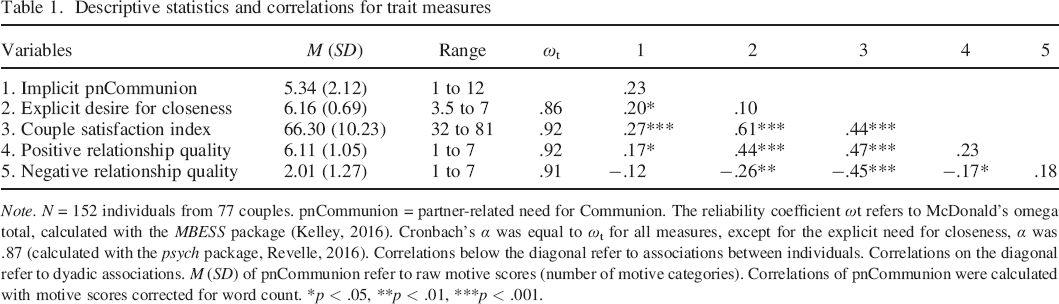
Note. N = 152 individuals from 77 couples. pnCommunion = partner–related need for Communion. The reliability coefficient ωt refers to McDonald's omega total, calculated with the MBESS package (Kelley, 2016). Cronbach's α was equal to ωt for all measures, except for the explicit need for closeness, α was .87 (calculated with the psych package, Revelle, 2016). Correlations below the diagonal refer to associations between individuals. Correlations on the diagonal refer to dyadic associations. M (SD) of pnCommunion refer to raw motive scores (number of motive categories). Correlations of pnCommunion were calculated with motive scores corrected for word count.
p < .05,
p < .01,
p < .001.
Descriptive statistics and intra–class correlations for state measures
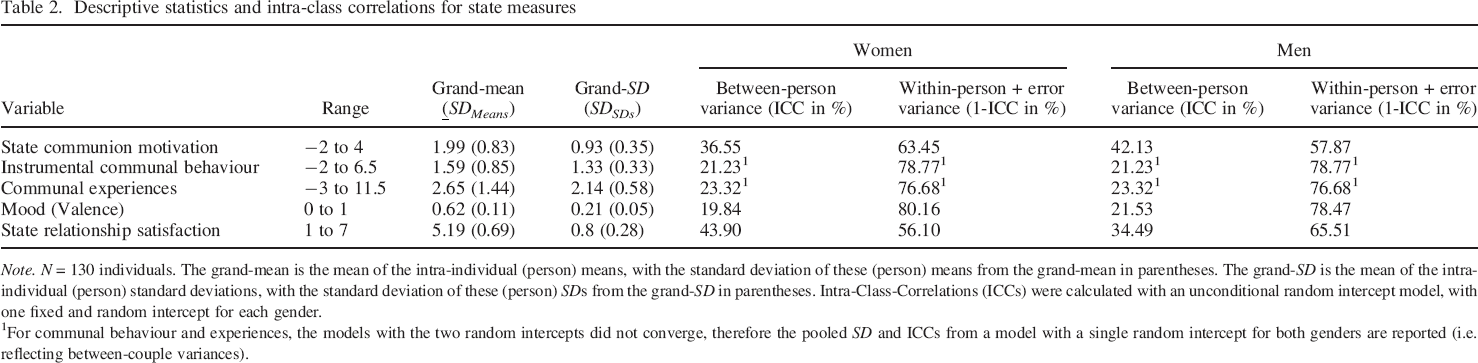
Note. N = 130 individuals. The grand–mean is the mean of the intra–individual (person) means, with the standard deviation of these (person) means from the grand–mean in parentheses. The grand–SD is the mean of the intra–individual (person) standard deviations, with the standard deviation of these (person) SDs from the grand–SD in parentheses. Intra–Class–Correlations (ICCs) were calculated with an unconditional random intercept model, with one fixed and random intercept for each gender.
For communal behaviour and experiences, the models with the two random intercepts did not converge, therefore the pooled SD and ICCs from a model with a single random intercept for both genders are reported (i.e. reflecting between–couple variances).
H1: From motive dispositions to global relationship satisfaction
We calculated APIMs using structural equation modelling, regressing both partners’ relationship satisfaction on both partners’ pnCommunion. First, we performed analyses comparing gender–constrained models with the corresponding unconstrained models with χ2 likelihood ratio tests. As the tests indicated that the constrained models were not significantly worse, Δχ2(2)≤3.00, ps > .223, Δ AICs ≤ 3.58, we only report the results of the constrained models. As expected, we found significant actor effects, indicating that high pnCommunion was associated with one's own high global assessment of relationship satisfaction and specifically positive evaluation of the relationship (PRQ), but unexpectedly not with a negative evaluation (NRQ; Figure 2). Exploratorily, we found one significant partner effect of pnCommunion: Individuals’ own pnCommunion was positively related to their partners’ global relationship satisfaction (CSI), but not to their partners’ more specific measures of relationship quality (PNRQ). Detailed results can be found in Table S1.
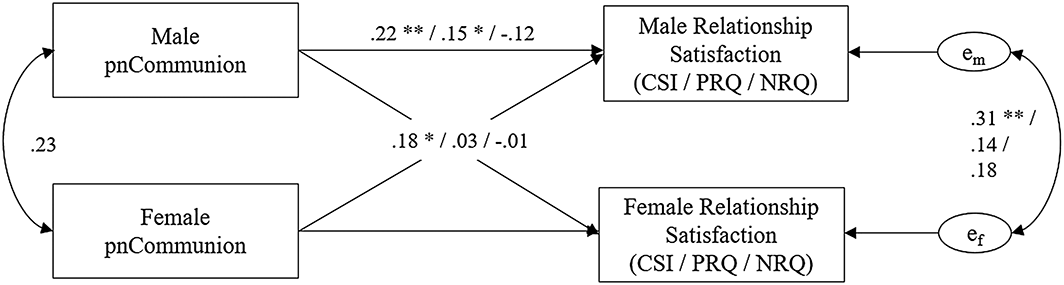
Path diagram of the fitted actor–partner interdependence models depicting actor and partner effects of partner–related need for communion (pnCommunion) on three measures of global relationship satisfaction (couple satisfaction index (CSI)/positive relationship quality (PRQ)/negative relationship quality (NRQ)). Variables were z–standardized a priori. Coefficients for actor and partner effects were constrained to be equal for both genders. N = 74 couples. Figure available at https://osf.io/b8pu6/, under a CC–BY4.0 licence. * p < .05, ** p < .01.
H2: From motive dispositions to motivational states
Consistent with our hypothesis, implicit pnCommunion predicted mean communion motivation in the MLM, b = 0.11, SEb = 0.05, pone–tailed = .023. We conducted exploratory analyses to check for the incremental contribution of the implicit motive to the average occurrence of motivational states over and above explicit motives. When controlling for the explicit desire for closeness to one's partner, pnCommunion was no longer significantly related to the mean of communion motivation, bpnCommunion = 0.08, SEb = 0.05, pone–tailed = .067. Table S2 contains the full results of these analyses.
H3: From motivational states to instrumental behaviour
H3 concerned the prediction of an actor's instrumental behaviour by his or her motivational state. As the variety of behaviours that can be shown depends heavily on the amount of time that was spent with the partner, we added this variable as a covariate in these analyses. The interpretation of our results does not change when omitting this variable. The results can be found in Table 3 (complete results in Table S3). Communion motivation at t1 significantly predicted instrumental communal behaviour shown between t1 and t2. There was also an inter–individual effect, that is, individuals experiencing on average strong communion motivation showed on average also more instrumental communal behaviour.
Multilevel analyses (fixed effects) predicting instrumental communal behaviour (z) between surveys by communion motivation (H3)
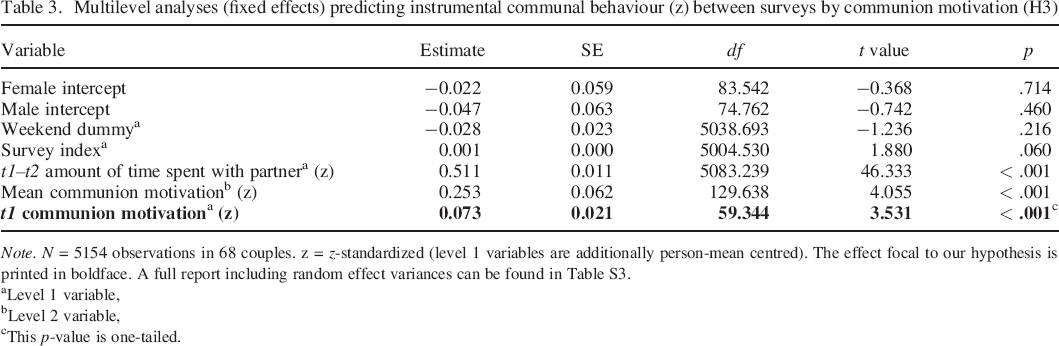
Note. N = 5154 observations in 68 couples. z = z–standardized (level 1 variables are additionally person–mean centred). The effect focal to our hypothesis is printed in boldface. A full report including random effect variances can be found in Table S3.
Level 1 variable,
Level 2 variable,
This p–value is one–tailed.
To examine the proposed direction of the intra–individual effect, we further explored whether behaviour between t1 and t2 predicted motivational states at t2. We did find such a reversed relationship, b = 0.18, SEb = 0.02, p < .001 (Table S4). This points to possible bidirectional influences between motivational states and behaviour.
H4: The Satisfaction of Motivational States in Relationships
In final confirmatory analyses, we turned to the prediction of state mood (H4A) and relationship satisfaction (H4B) by the interaction of motivational appetence and relationship experiences. The results are presented in Table 4 (Models 1A and 1B). For both the prediction of mood and relationship satisfaction, there was a significant positive main effect of communal experiences. A significant positive main effect of communal motivational states, however, was only found in the model for relationship satisfaction. Further, communal motivational states at t1 significantly interacted with communal relationship experiences between t1 and t2 to predict state relationship satisfaction at t2 (Figure 3) 10 : Individuals were most satisfied with their relationship when their motivation to be involved in communal activities had been strong and this motivation was fulfilled afterwards. Similarly, they were most dissatisfied when their motivation had been strong, but they made little communal relationship experiences. The slope for communal experiences was therefore more positive for those being highly motivated. Both simple slopes were significant, b = 0.30, SEb = 0.03, p < .001 for communal motivational states 1 SD below the mean, and b = 0.38, SEb = 0.03, p < .001 for communal motivational states 1 SD above the mean.
Multilevel analyses (fixed effects) for predicting mood and state relationship satisfaction by the interaction of communion motivation and communal experiences
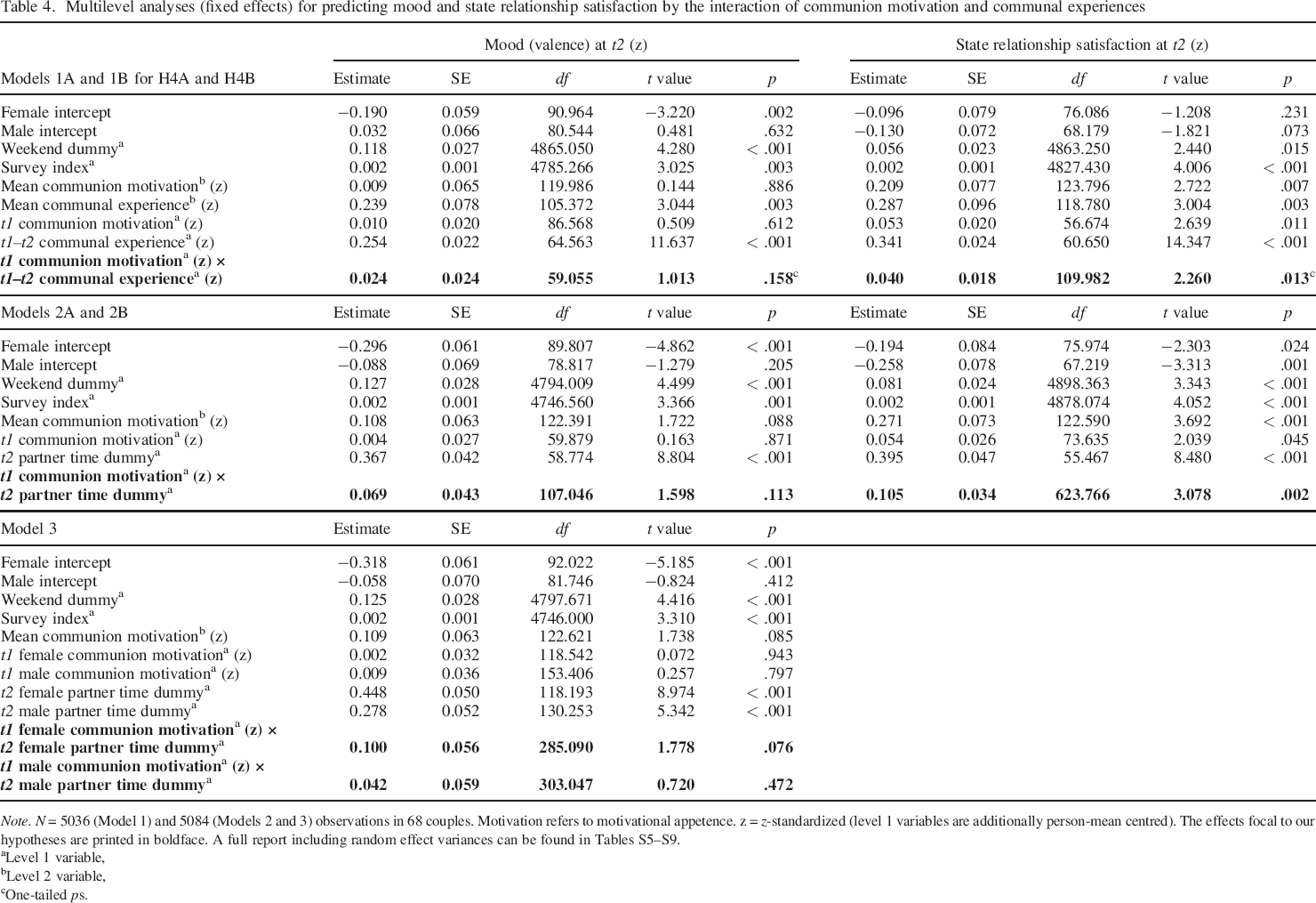
Note. N = 5036 (Model 1) and 5084 (Models 2 and 3) observations in 68 couples. Motivation refers to motivational appetence. z = z–standardized (level 1 variables are additionally person–mean centred). The effects focal to our hypotheses are printed in boldface. A full report including random effect variances can be found in Tables S5–S9.
Level 1 variable,
Level 2 variable,
One–tailed ps.
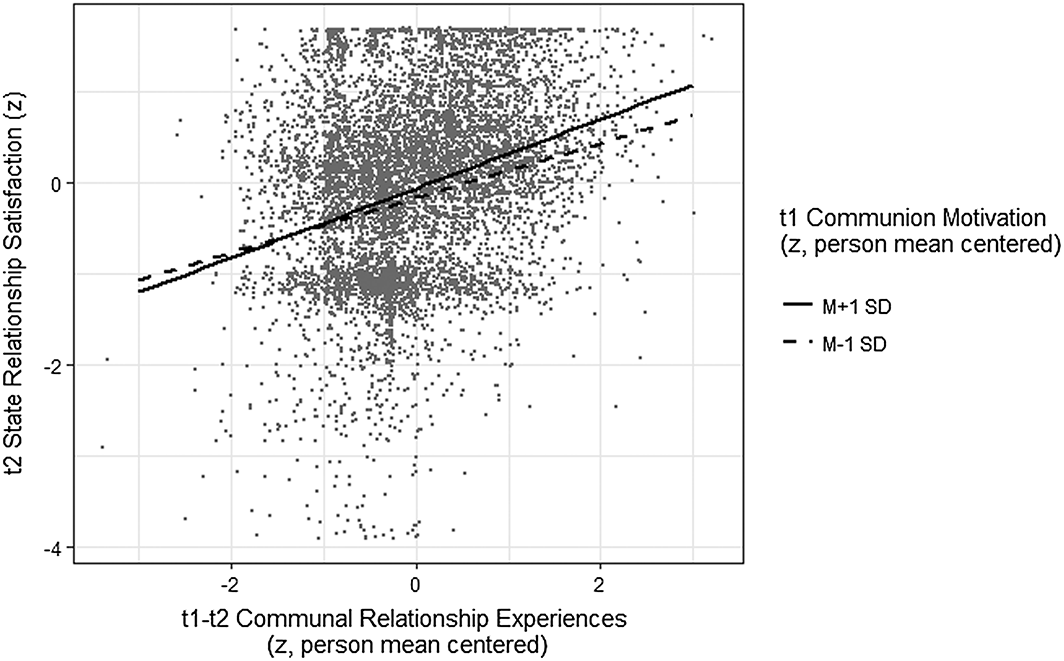
Prediction of state relationship satisfaction at t2 by the interaction of communal motivational states at t1 and communal experiences between t1 and t2. Figure created with ggplot2 (Wickham, 2009) and available at https://osf.io/b8pu6/, under a CC–BY4.0 licence.
However, no significant interaction was found when predicting individuals’ mood, 11 which is the analysis more directly representing the affect–amplifying function described in motive theory (although the coefficient was in the expected positive direction). We explored whether this result can be attributed to gender differences, but the original model was not significantly worse than a model with gender moderating the interaction, Δ χ2(3) = 5.59, p = .134,Δ AIC = 0.
In exploratory analyses, we substituted communal relationship experiences by a dummy variable indicating whether participants actively spent time with their partners at the moment of the survey (=1) or not (=0). This is an alternative operationalization of a potentially satisfying communal experience, albeit more imprecise because it does not specify the quality of the interaction. In contrast to the original analysis, it does not refer to a past time interval, but was assessed simultaneously with the two outcomes of interest. Therefore, the concurrent effect of this communal experience with the partner on mood and satisfaction can be evaluated. Again, we found significant positive main effects and an interaction between motivational states at t1 and time spent with the partner at t2 predicting state relationship satisfaction—but not mood—at t2 (see Models 2A and 2B in Table 4). Regarding mood as criterion, the model comparison pointed to a moderation by gender, as the model without this moderation fit the data significantly worse, Δ χ2(3) = 9.74, p = .021, Δ AIC = 4. An examination of the gender–specific model revealed that for women and for men, the main effect of the partner time dummy was positive and significant. While the interaction effect for women was stronger than for men, it was also not significant (see Model 3 in Table 4). Tables S5–S9 show the complete results.
H5: From relationship satisfaction states to global assessments
Multilevel regression model analyses confirmed our assumption that global relationship satisfaction can be predicted by average relationship satisfaction states, for the CSI, b = 0.61, SEb = 0.13, p < .001 as well as for Positive Relationship Quality, b = 0.39, SEb = 0.15, p = .008. The association with Negative Relationship Quality was not significant, b = −0.27, SEb = 0.14, p = .062 (Table S10). 12 Note that global relationship satisfaction was assessed before measuring average relationship states. However, we assume that global relationship satisfaction is relatively stable, thus warranting the presented analysis.
Discussion
Drawing on motive disposition theory (McClelland, 1987), the Rubicon model of action phases (Back & Vazire, 2015; Heckhausen & Heckhausen, 2008), and the Zurich Model of Social Motivation (Bischof, 1975), this study suggests the ‘DynaMoS’ model illustrated in Figure 1, which can be used to examine intra–individual motivational processes in couple relationships. Applying an experience sampling approach, we tested several focal paths of the model in the domain of communion motives. We not only replicated previous findings on positive inter–individual associations between the implicit pnCommunion and relationship quality for two out of three different aspects of satisfaction; but the data also supported most preregistered hypotheses regarding the intra–individual process model: Individuals who have a stronger disposition to strive for communal experiences feel the urge to seek out emotional closeness more frequently in everyday life. When motivated in that regard, they also behave in a communal way more often. The communal experiences individuals make as a consequence of their own and their partner's behaviour generally improve their mood and their momentary relationship satisfaction. Moreover, these experiences are even more beneficial for state relationship satisfaction if individuals had previously experienced strong motivation for closeness, compared with weak previous motivation. In turn, individuals who had frequent and intense experiences of state satisfaction reported higher global relationship quality than others.
The emergence of motivational states
Individuals with a strong dispositional communion motive (pnCommunion) experienced more communal motivational states across 2 weeks. However, this contribution of pnCommunion to the prediction of mean motivation was not incremental to the contribution of the explicit relationship–specific desire for closeness. This is a very strict test, as the desire for closeness is measured as the typical frequency of motivational states and is therefore conceptually similar with the average of the self–reported motivational states. In addition, our sample size might have not provided enough statistical power to detect an incremental contribution, therefore this question must be examined in a larger sample.
Further, it is theoretically assumed that implicit motives translate to self–reported motivational states if barriers hinder their fulfilment (Bischof, 2008). Accordingly, Hagemeyer et al. (2015) found in the complementary domain of agency that a strong implicit motive in men predicted higher agentic states only in potentially frustrating living arrangements. The current study did not look at such interactions between disposition and situation, a dynamic that has yet to be considered. We also did not examine motivational incentives that were present in the situation, being also relevant to the emergence of motivational states (McClelland, 1987). Nonetheless, we found that on average implicit communion motives are represented in self–reported motivational states.
Motivated behaviour
The experience of motivational states predicted instrumental communal behaviour that was shown afterwards. This means that a current desire for emotional closeness was followed by the implementation of behaviour that served this goal within a short time span of a few hours. This is not self–evident, as many circumstances can undermine the implementation of individuals’ motivation, such as situational barriers or competing desires.
We found in exploratory analyses that communal behaviour also predicted future motivational states—that is, when individuals acted communally, they were motivated to continue receiving fulfilling experiences. It has to be mentioned that looking at this direction of the process means to look at variables that were assessed during the same survey: We asked participants how they behaved since the last survey, during the same survey, they indicated their momentary motivational state. This simultaneous assessment could have biased the answers. Still, this result is consistent with a plausible bidirectional influence between motivational states and behaviour, at least on a short time scale: Not only does communion motivation lead to according behaviour; but communally satisfying behaviour also reinforces the motivation to have more of the same.
Applying systems theory, though, at a larger time scale, we would expect that motivation decreases after (enough) consummatory experiences, that is, when the perfect level of a specific state is achieved. Thinking further, we would even expect aversive reactions (‘too much closeness’) that translate into the wish to avoid further communal experiences.
It is therefore noteworthy that our analyses were limited to associations between adjacent time points. Thus, the extent of communal experiences reported at one time point was likely not sufficient to satisfy the previously reported motivation, which therefore persisted. At this point, little is known about the time scale of motivational arousal and satisfaction (Hagemeyer et al., 2015). Future studies using the ESM should aim at a better understanding of this basic feature of motivational dynamics.
The affect–amplifying nature of motivation
Situations and behaviours that satisfy communion motivation generally increased emotional valence and state relationship satisfaction. Moreover, and crucial for the test of our ‘motivation as affect–amplifier’ hypothesis, we found that communal experiences were more rewarding for individuals if they were highly motivated before. This result, however, was only found for state relationship satisfaction (H4B), not for general emotional valence (H4A). The latter outcome measure, however, is conceptually closer to the actual affective experience, which is central to the original formulation of motives as affect–amplifiers (McClelland, 1987; Schultheiss, 2008; Schultheiss & Wirth, in press). Hence, this hypothesis could only be partly confirmed.
As a post–hoc explanation, one could argue that the measurement of state relationship satisfaction is conceptually closer to the partner–related communion motive than the more domain–general mood assessment. Hence, one could assume a motive–specific version of the affect–amplification hypothesis, namely, that a motive or a motivational state amplifies predominantly motive–specific emotions, such as joy and love in the domain of communion (see also Zurbriggen & Sturman, 2002; Job et al., 2012).
Nonetheless, general mood should still be affected according to motive theory (McClelland, 1987; Schultheiss, 2008; Schultheiss & Wirth, in press). It could be that too much time passed between the positively valenced experience and the moment we asked for individuals’ mood: Participants reported on the behaviour that happened in the last couple of hours, but indicated their momentary mood. Compared with state relationship satisfaction, mood is more volatile (see within–person variances in Table 2) and might be more susceptible to influences outside of the relationship (e.g. the satisfaction of a certain motivation by other persons), while relationship satisfaction is mainly driven by experiences inside the relationship. On the other hand, the main effect of communal experiences was of similar strength for both outcomes.
We therefore additionally examined the interaction with a communally satisfying measure that was assessed simultaneously with mood: whether individuals actively spent time with their partner at the moment of the survey. Whereas the interaction with this alternative measure was in the expected direction, it was not significant and, if at all, only present for women. Relationship satisfaction, in contrast, showed the expected result irrespective of gender. The momentary involvement with the partner, though, is not an optimal measure of communal satisfaction—individuals might have had an argument and would still indicate that they had spent time with their partner. Other situational influences on participants’ mood and the time passed between communal behaviour and mood assessment might therefore play a role in the unexpected results.
It has to be mentioned that the fixed interaction effect on relationship satisfaction was rather small on an absolute scale, and might be as small for mood. One reason for not finding an effect for mood might therefore be that the statistical power provided by the current sample size was not sufficient to reliably detect similar interaction effects for mood. Furthermore, there were substantial inter–individual random variations of the main effect of motivation (95% range of random slopes: −0.17 to 0.28) and the focal interaction effect (95% random of random interaction coefficients: −0.07 to 0.15). Hence, there are many unexplained inter–individual variation in the strength of these associations.
Taken together, we could not find that fulfilling experiences boosted general mood more strongly for motivated individuals than for those who do not care (H4A). But we found this amplifying effect of motivation with regard to the more motive–specific measure of momentary relationship satisfaction (H4B).
The relationship between state and global relationship satisfaction
In a final step, we showed that individuals’ average relationship satisfaction states retrodicted a global measure of relationship satisfaction (the CSI) and a more specific measure representing the positive assessments of the relationship (the PRQ). We could not find a significant association with a measure tailored specifically at the negative aspects of the relationship (the NRQ), albeit the correlation was negative, as would be expected. 13 One could speculate that this is due to the positive wording of our state measure, but the results were similar with another state relationship satisfaction measure that was negatively worded. In total, the results point to the fact that inter–individual differences in relationship satisfaction are associated with the average experience of relationship satisfaction states.
Study limitations and recommendations for future research
Our results have to be interpreted under the consideration of some limitations. For one thing, our sample consisted of primarily young, highly educated, heterosexual, happy couples who mostly did not have children. These individuals were mostly at the beginning of their relationships and at different phases in their lives than, for instance, couples having been married for years or those raising kids. Yet, we expect the DynaMoS model to reflect basic motivational processes that should also be observable in couples who are in different circumstances. Especially in difficult stages of a relationship, for example, when having to step back more from one's own needs to meet the demands of a newborn, the motivational dynamics should become visible even more strongly. Further, we excluded homosexual couples solely for methodological reasons, as distinguishable dyads allowed us to compute double–intercept–models (Bolger & Laurenceau, 2013). A study analysing differences between heterosexual and homosexual couples showed that the factors predicting relationship quality can be generalized (Kurdek, 2004). We therefore expect the motivational relationship dynamics to be similar for homosexual couples.
Potential biases that might come along with our study should be considered: All variables, except for the implicit motives, were measured by self–report. Some of our results could therefore be inflated through shared method variance. To overcome this bias, future studies could use smartphones not only for ESM, but also as a tool to complement self–report with (more objective) behavioural data, such as logging the actual contacts individuals have with their partners via telephone or messenger or assessing the proximity to the partner via bluetooth or geopositioning (cf. Miller, 2012; Harari, Gosling, Wang, & Campbell, 2015).
Furthermore, the items we used to measure communion motivation did not have a good reliability in terms of internal consistency at the intra–individual level. This lack of reliability could in turn lead to an underestimation of the true effects. With regard to the validity of the items, we asked participants in the feedback questionnaire to give examples of situations in which they indicated to be motivated and what exactly they wished for. This qualitative data supports the assumption that participants did at least understand the items correctly. Generally, the ESM approach justifies the generalization to real life situations more strongly than artificial laboratory studies or questionnaire vignettes. Individuals report on their feelings and behaviour in their usual living context without the researcher being present. The prompt response to their momentary situations is less susceptible to recall bias compared with questionnaires usually asking participants to mentally average across a large variety of situations and report on these averages (Bolger, Davis, & Rafaeli, 2003).
Finally, the unequal time intervals between surveys (M = 3 hours, SD = 47 minutes, Range = 1 to 6 hours) were ignored in the lagged analyses. As the timing is a crucial component for lagged analyses in general (Bolger & Laurenceau, 2013; Collins & Graham, 2002; Gollob & Reichardt, 1987) and the dynamics we look at in particular, these unequally spaced intervals may have created some distortion for which the current analyses did not account for. It is therefore very important when designing future studies to consider carefully different time intervals.
The available results provide evidence for the proposed DynaMoS model in the domain of communion. Although we preregistered the model, hypotheses and analysis strategy, a direct replication of our results is necessary. We expect that the model generally applies to other motive domains, such as agency, which has also been shown to be an important motivational factor for relationship functioning (Hagemeyer et al., 2015). Additionally, explicit motives play an important role in relationships (Hagemeyer, Neyer et al., 2013) and deserve separate attention. In this regard, it is relevant that our study worked with self–reported motivational states, relating them to implicit motives. Future research should be devoted to ways of measuring implicit motivational states, for example, by using contingencies between motivationally relevant stimuli and affective or behavioural reactions. This was already performed for the dispositional affiliation motive in a study of Dufner et al. (2015), but has yet to be investigated for motivational states. The DynaMoS model can further be adapted to motivational dynamics in other contexts than couple relationships, for example, in friendships (see e.g. McAdams, Healy, & Krause, 1984). It could also be used to take a look at the circumstances under which physiological expressions of affect (e.g. smiling) instead of relationship satisfaction is influenced by the interaction of motivational states and situations (see e.g. Fodor & Wick, 2009).
The current study was based on data from dyads, but we primarily focused on intra–individual processes and investigated no within–dyad hypotheses. The partner is not only needed for the satisfaction of social motives, his or her own motives and experiences constitute a strong dynamical, situational factor in itself. For instance, Kanat–Maymon et al. (2017) recently showed that contingent positive or negative reactions from the partner to the satisfaction or frustration of needs (‘conditional positive or negative regard’) plays a crucial role in explaining relationship satisfaction at the intra–individual, as well as the inter–individual level. We already found at the inter–individual level that individuals’ pnCommunion is positively related to their partners’ global relationship satisfaction, thereby replicating prior results (Hagemeyer & Neyer, 2012). Looking at the interaction between individuals’ and their partners’ motivational states, behaviour, and reactions at the state level could produce further insights about the dyadic processes that occur in couple relationships and contribute to such partner effects.
Finally, the DynaMoS model (Figure 1) is not intended to and does by far not capture all processes that could be derived from motive theories and existing empirical research. Motivational processes can be examined from different perspectives applying higher or lower resolutions. In the DynaMoS model, each variable and each path could be decomposed into more specific components and associations, respectively, to achieve a higher resolution. For instance, although theoretically relevant, we omitted analyses of the distinction between approach and avoidance motivation and also did not analyse all of the potential moderating situational influences. Neither did we account for all theoretically plausible feedback loops and reciprocal paths. It should be kept in mind that theoretical models can never capture the complex reality of psychological phenomena as a whole. Rather, they depict theoretically sound assumptions about such phenomena that are never comprehensive and always simplified. The usefulness of a specific model with a specific level of resolution is (among other factors) determined by the research question at hand. Therefore, we focused our hypotheses and analyses to what is presented in this article. Future research could turn to motivational dynamics on other levels of resolution that are still consistent with the model presented here.
The explanatory power and limitations of the experience sampling approach
While intensive longitudinal data on individuals’ states collected with the ESM (Csikszentmihalyi & Larson, 1987) is observational and does not allow direct causal statements as in ‘when manipulating x, changes in y result’, it still has several strengths with regard to the interpretations that are possible: The repeated sampling from the same individuals allows to make statements about the within–subject effects, and to separate them from the between–subject effects. Conclusions can then be drawn about which associations hold at which level, and if they differ, how they differ. Statements at the between–subject level refer to average states or stable traits (e.g. ‘a person who feels on average more motivated / has a stronger motive disposition than another person, is on average more satisfied’). Statements on the within–subject level, however, refer to relationships between temporally changing states, either collected at a single time point or at different time points (e.g. ‘a person who feels at one moment more motivated than usual, is typically more satisfied at that moment / the next moment’). These interpretations have different implications for theory and interventions, therefore, it is important to disentangle these variances.
It has been argued that the temporal sequence of observed processes can serve as a ‘proxy for causality’ (Nezlek et al., 2017, p.3). When doing lagged analyses, that is, investigating participants’ answers at different time points, one can examine whether the relationship holds up when reversing the order of variables. For example, we hypothesized that motivational states at one time point predicted future behaviour reported at the next time point. We also looked at the alternative direction of the effect, that is, behaviour predicting future motivational states. The results suggest that the influence is bidirectional; or that the motivational activation persists for a longer time, implying that not enough satisfying experiences took place during the time span we looked at. Had only one of these relationships persisted in the analyses, the temporal precedence would indicate which variable might cause the other variable (Hamaker, Kuiper, & Grasman, 2015b; Nezlek, 2017; West & Hepworth, 1991). In addition, if researchers are interested in changes on a specific variable, analyses can include the lagged dependent variable as predictor (‘autoregression’; Hamaker et al., 2015b; Gollob & Reichardt, 1987; Hamaker & Grasman Raoul, 2015a). This is meant to control for the stability of the criterion over time, which is a potential confound. Additionally though, it assumes equally spaced intervals (Bolger & Laurenceau, 2013; Nezlek, 2017)—which was not the case in the present study—and alters the interpretation of results, because rather than predicting absolute values, relative values contingent on previous values (i.e. changes) are considered.
It is important to reiterate that data from ESM studies cannot provide the causal interpretations that are often warranted by randomized experiments (Bolger & Laurenceau, 2013; but see Deaton & Cartwright, 2017, who emphasize that even with randomization, one still has to consider confounding, post–randomization differences or the representativeness of the sample to be able to draw meaningful conclusions).
In purely within–subject MLM analyses of observational ESM data, individuals are held constant (which leads to ‘participants as their own controls’; Bolger et al., 2003, p.587), and changes on variables over time are addressed—contingent on individuals’ own averages on specific variables. The problem of unobserved confounds (which is usually tackled by randomization in experiments) is present in such analyses, but lies on the within–subject level. Here, confounding variables are not randomly distributed across the levels of a state variable the researcher is interested in. If, for instance, an unobserved confounding variable co–occurs with motivation and is related to subsequent behaviour, one would wrongfully assign the cause to motivation and not to the disregarded confound. Bolger and Laurenceau (2013, p.71) suggest including a variable representing the elapsed time of the study (as was carried out in the present study), to control for influences that are due to the duration of data collection (e.g. ‘measurement–as–treatment’; Collins & Graham, 2002, p.95). In the next step, to achieve an improved causal interpretation with longitudinal data, the assumed predictor would have to be manipulated accordingly and subsequent changes in the criterion (measured at the within–subject level) would have to be monitored.
Conclusion
Intensively measuring variation of individuals’ behaviour, motivational states, feelings, and experiences is an important endeavour when trying to understand differential outcomes of dispositions. With a process model (‘DynaMoS’) as theoretical framework, we showed that these kind of measures can help to uncover how different states are dynamically intertwined in couple relationships. Our results support the conception that implicit motives are reflected in motivational states, that these motivational states direct individuals’ behaviour toward satisfying end–states, and boost the positive effect communal experiences have on individuals’ evaluation of their relationship. We suggest that the DynaMoS model can be applied to further research on motives, while at the same time serving as an example of how to approach the thorough study of intra–individual processes, and how to connect them to inter–individual differences and associations.
Acknowledgements
This research was funded by grants from the German Research Foundation to Felix Schönbrodt (SCHO 1334/5–1) and Birk Hagemeyer (HA 6884/2–1). The authors thank Paula Fehrmann, Nicole Horn, and Lara Lietge for their support in PACT scoring, Helen Baumann for her assistance during data collection, and Tobias Kächele for the app development.
Supporting info item
Supporting info item, per2145-sup-001-EJP_FromMotivesToStates_Supplemental_Material - From Motive Dispositions to States to Outcomes: An Intensive Experience Sampling Study on Communal Motivational Dynamics in Couples
Supporting info item, per2145-sup-001-EJP_FromMotivesToStates_Supplemental_Material for From Motive Dispositions to States to Outcomes: An Intensive Experience Sampling Study on Communal Motivational Dynamics in Couples by Zygar Caroline, Hagemeyer Birk, Pusch Sebastian, Schönbrodt Felix D. and Kandler Christian in European Journal of Personality
Footnotes
Notes
References
Supplementary Material
Please find the following supplemental material available below.
For Open Access articles published under a Creative Commons License, all supplemental material carries the same license as the article it is associated with.
For non-Open Access articles published, all supplemental material carries a non-exclusive license, and permission requests for re-use of supplemental material or any part of supplemental material shall be sent directly to the copyright owner as specified in the copyright notice associated with the article.
