







Abstract
Using the HEXACO Model of Personality, we explored two kinds of ideal partner preferences regarding personality traits, namely, to what extent people prefer partners similar to themselves (similarity preference) and to what extent people prefer partners with more desirable trait levels than themselves (aspirational assortative preference). We conducted five studies (overall N > 900) across four countries (China, Denmark, Germany, and the USA), looking at both HEXACO factors and facets, using both self–report questionnaires and real–life data (personal profiles from a dating website), and comprising both student and more heterogeneous samples. The results provided support for both kinds of ideal partner preferences, with important differences across traits. Specifically, similarity preference was supported by all studies concerning all HEXACO traits, and aspirational assortative preference was supported by all four self–report studies (though not the dating website study) concerning all HEXACO traits except for Openness to Experience. Concerning differences in preferences among the HEXACO traits, similarity preference was particularly pronounced for Honesty–Humility and Openness to Experience, moderate for Agreeableness and Conscientiousness, and less pronounced for Emotionality and Extraversion. Aspirational assortative preference, by contrast, was particularly pronounced for Emotionality, Extraversion, and Agreeableness, moderate for Honesty–Humility, and inconsistent for Conscientiousness. © 2018 European Association of Personality Psychology
Researchers and laypersons alike have been interested in people's expectations and aspirations regarding their future partners’ behaviour, attitudes, and traits, typically termed as ideal partner preferences, ideal standards, mate preferences, partner preferences, and romantic ideals (e.g. Buss, 1989; Eastwick, Luchies, Finkel, & Hunt, 2014; Fletcher & Simpson, 2000; Fletcher, Simpson, Thomas, & Giles, 1999). Importantly, recent studies indicate that ideal partner preferences are not just idle fantasies but have real–world effects (Conroy–Beam & Buss, 2016; Gerlach, Arslan, Schultze, Reinhard, & Penke, 2017). For example, Campbell, Chin, and Stanton (2016) assessed the ideal partner preferences of singles (people not being in a casual or serious relationship) and tracked the singles for over a 5–month period until some of them entered into relationships. The new partners were then contacted and asked to describe themselves regarding the same characteristics the previous singles had used to describe their ideal partners. Results suggested that people were more likely to enter into relationships with others that have characteristics corresponding closely to the initially stated ideal partner preferences, illustrating the predictive validity of ideal partner preferences.
Given the importance of ideal partner preferences, research has aimed to understand how they come about. In this regard, particularly two—related—types of preferences have been discussed recently. One preference can be termed similarity preference, suggesting that ‘individuals feel most attracted to potential partners who, in important domains, are similar to themselves’ (Dijkstra & Barelds, 2008, p. 595). Another preference can be termed aspirational assortative preference, suggesting that ‘people ideally prefer partners with trait characteristics that are similar to—but better than—those that they themselves possess’ (Watson, Beer, & McDade–Montez, 2014, p. 118). For the first time, the current investigation explores both preferences using the HEXACO Model of Personality (Ashton & Lee, 2007), because the HEXACO model provides a viable theoretical framework to understand potential differences in the degree to which basic personality traits are linked to similarity preference and aspirational assortative preference, respectively.
Similarity Preference
Similarity preference suggests that people see their ideal partners as similar to themselves in various domains. A prominent early theoretical account for this preference is the reinforcement–affect model (Byrne & Clore, 1967), stating that similarity between oneself and others provides people with consensual validation for their beliefs, satisfying their need for interpreting the world consistently and accurately. Dissimilarity between oneself and others, by contrast, offers no such consensual validation and thus creates uncertainty about oneself. In brief, the reinforcement–affect model suggests that individuals picture their ideal partners in line with their own characteristics to satisfy their (conscious or unconscious) demands for self–affirmation.
Building upon the reinforcement–affect model, but interpreting the similarity preference from a different perspective, the ‘inferred evaluation–attraction relation’ proposes that people feel attracted by others with similar characteristics because they expect a positive evaluation from these similar others (Condon & Crano, 1988). Specifically, the inferred evaluation–attraction relation states that people assume that a person who is similar to them will also like them and that people tend to like those who like them.
Theoretical accounts for similarity preference have not only been provided by more classic social–personality psychological theories, but also by evolutionary theorizing, such as niche construction theory (Laland, Odling–Smee, & Feldman, 2001). Niche construction theory suggests that people actively choose to form relationships that are congenial, fluent, and low in conflict in order to construct a rewarding environment that fits their needs and facilitates their goals. One way to facilitate such an environment might be to pair up with others who are similar to oneself in, for example, political views, religiosity, or personal attitudes and values (e.g. Gaunt, 2006; Luo & Klohnen, 2005), because this might provoke less disagreement and smoother relationship functioning overall. Bahns, Crandall, Gillath, and Preacher (2017) recently applied niche construction theory to study similarity between friends in various domains (e.g. attitudes, recreational activities, and values) and found that people prefer to construct their social groups by initiating friendships with those who are similar to themselves in these domains. Although, to the best of our knowledge, niche construction theory has not yet been linked to ideal partner preferences in particular, people might also desire similarity between themselves and their ideal partners in different characteristics given the importance of intimate relationships for people's development and well–being (e.g. Feeney, 2004; Kiecolt–Glaser & Newton, 2001).
Irrespective of the theoretical account employed, the idea that similarity preference might drive ideal partner preferences has been corroborated by several studies. For example, Watson et al. (2014) reported that people prefer their ideal partners to share similarity with themselves across a range of domains (e.g. abilities, attitudes, physical characteristics, traits, and values). Considering basic personality traits in particular, other studies have also indicated that people desire an ideal partner whose personality resembles their own (Botwin, Buss, & Shackelford, 1997; Dijkstra & Barelds, 2008; Figueredo, Sefcek, & Jones, 2006). For instance, in samples analysed by Botwin et al. (1997) as well as Dijkstra and Barelds (2008), self–ratings and ideal partner ratings correlated 0.24 ≤ r ≤ 0.62 for Openness, 0.34 ≤ r ≤ 0.61 for Conscientiousness, 0.30 ≤ r ≤ 0.59 for Extraversion, 0.30 ≤ r ≤ 0.51 for Agreeableness, and 0.20 ≤ r ≤ 0.52 for Neuroticism.
Herein, we significantly extend previous work investigating the similarity between oneself and one's ideal partner personality by relying on the HEXACO model (Ashton & Lee, 2007), which comprises six basic personality traits: Honesty–Humility, Emotionality, Extraversion, Agreeableness, Conscientiousness, and Openness to Experience (in the following: Openness). Although there are reasons to expect similarity preference for each HEXACO trait (because people might generally prefer similarity in personality traits between themselves and their ideal partners), there are also reasons to expect differences across traits in the degree to which similarity is prioritized. Specifically, Luo (2017) reported that couples tend to share strong similarity on various attitudes and values, such as political orientation and religiosity, and weaker similarity on personality traits. The tendency for people to prioritize similarity with their partners on attitudes and values might be explained by the importance of having similarity on these variables for relationship outcomes, such as promoting relationship satisfaction and decreasing negative affect (Gaunt, 2006; Luo & Klohnen, 2005). By implication, similarity on traits that have a close association with attitudes and values might be more important than similarity on traits that have weaker or no associations with attitudes and values.
Based on this argumentation, previous research indicates Honesty–Humility and Openness as likely candidates for a higher degree of similarity preference within the HEXACO framework. Compared with the other HEXACO traits, Honesty–Humility and Openness have exhibited more consistent and stronger connections to basic social–political attitudes (e.g. Lee, Ashton, Ogunfowora, Bourdage, & Shin, 2010) as well as the basic dimensions of personal values in the Schwartz's framework (Schwartz, 1992; Schwartz et al., 2012), that is, Self–transcendence (vs. Self–enhancement) and Openness to Change (vs. Conservation; Lee et al., 2009).
Previous research has not investigated this potential special role—a stronger similarity preference—of Honesty–Humility and Openness concerning ideal partner preferences using the HEXACO framework (and, thus, considering Honesty–Humility). However, given that HEXACO and Big Five Openness largely correspond to each other (Hilbig, Moshagen, & Zettler, 2016), first indications for the appropriateness of this idea concerning Openness might be derived from research on the Big Five, descriptively pointing at a (slightly) higher similarity preference for Openness (0.24 ≤ r ≤ 0.81) compared with the other Big Five traits (0.20 ≤ r ≤ 0.73) in ideal partner preferences (Botwin et al., 1997; Dijkstra & Barelds, 2008; Figueredo et al., 2006; Watson et al., 2014). Considering the different theoretical and empirical accounts on similarity preference regarding personality traits overall, we thus not only expect some degree of similarity preference concerning ideal partner preferences in all HEXACO traits but also, for the first time, explicitly test the idea that similarity preference in ideal partner preferences is stronger in Honesty–Humility and Openness compared with the other four HEXACO traits (Hypothesis 1).
Aspirational Assortative Preference
In addition to desiring partners with similar personality traits, there is also evidence that people desire partners with ‘better’ (more desirable) personality traits than oneself (Figueredo et al., 2006). These two preferences—similarity preference and aspirational assortative preference—may in fact act somewhat in concert, as implied by mate selection criteria theory (MSC; Kenrick, Groth, Trost, & Sadalla, 1993). MSC integrates evolutionary models (focusing on gender differences; Buss, 1989) and social exchange models (focusing on self–appraisals; Thibaut & Kelley, 1959). According to MSC, self–appraisals represent minimum criteria for partners especially when considering long–term relationships, and both men and women seem to desire a partner who is at least as desirable as themselves—though there may be some differences between genders (which we address later).
Aspirational assortative preference does not necessarily imply that people want partners with the highest possible levels of desirable characteristics. This is not merely because extremely high levels of generally desirable traits such as being well–organized can be less desirable than high levels of the trait (Dunlop, Telford, & Morrison, 2012; Kuncel & Tellegen, 2009) but also reflects a pragmatic component: a partner with more desirable characteristics than oneself might be hard to attract and to retain. Accordingly, the personality traits that people desire in their ideal partners are anchored by their own self–appraisals.
Watson et al. (2014) provided some initial support for this idea, finding that even for generally very desirable characteristics (e.g. intelligence and physical attractiveness), people did not tend to describe their ideal partners as ‘perfect’ (i.e. as high as possible) but instead simply desired improvement over their own self–assessed levels of these characteristics. Additionally, this and previous work (Figueredo et al., 2006) found that aspirational assortative preference did not generalize across personality traits. Specifically, studies found that people have particularly strong preferences for ideal partners who have, relative to their own levels, lower levels in Neuroticism and higher levels in Agreeableness, Conscientiousness, and Extraversion. However, regarding Openness, studies indicated that people ascribed their ideal partners no (Figueredo et al., 2006) or only slightly different (Watson et al., 2014) trait levels compared with themselves. It is noteworthy how closely this parallels what one might expect given the connections between Big Five traits and relationship satisfaction found in a meta–analysis: Neuroticism, Agreeableness, Conscientiousness, and Extraversion each predicted relationship satisfaction in the direction of aspirational assortative preference, whereas Openness was unrelated to relationship satisfaction (Malouff, Thorsteinsson, Schutte, Bhullar, & Rooke, 2010).
Accordingly, we expect people to show aspirational assortative preference concerning Emotionality (as the conceptually somewhat similar counterpart to Big Five Neuroticism), Extraversion, Agreeableness, and Conscientiousness. More specifically, people should describe their ideal partners as having lower levels in Emotionality and higher levels in Extraversion, Agreeableness, and Conscientiousness than themselves (Hypothesis 2). Although no study so far has examined aspirational assortative preference in Honesty–Humility, it is reasonable to expect such a preference considering the socially desirable characteristics captured by Honesty–Humility (Zettler & Hilbig, 2015). However, we test this in an explorative manner. We do not expect that people ascribe their ideal partner different trait levels for Openness as compared with themselves.
The Present Investigation
Prior theories and corresponding empirical findings suggest two co–existing ideal partner preferences—similarity preference and aspirational assortative preference—where the strength of each of these preferences will differ across traits. Although previous studies have shed some light on ideal partner preferences in basic personality traits, several points would benefit from further exploration. For instance, previous studies did not rely on the HEXACO framework, which, due to its inclusion of a second trait heavily connected to values (Honesty–Humility), is particularly suitable for investigating potential differences across traits regarding similarity preference. Also, results from many of the existing studies examining ideal partner preferences might be marred by the relationship status of the participants, as studies often recruited couples or dating partners, mixed singles and couples together, or did not clarify the relationship status of the participants. Because being in a current relationship and/or one's current partner can influence one's ideal partner preferences (Fletcher et al., 1999; Fletcher & Simpson, 2000), such unexamined heterogeneity in relationship status is problematic. Consequently, the current research uses the HEXACO framework to examine these two ideal partner preferences with singles in five studies across four countries (China, Denmark, Germany, and the USA).
Study 1
Participants and Procedure
We started investigating our hypotheses in an online study, recruiting students from two Danish universities. Out of 305 students who started the study, 275 completed it. We excluded participants who were in a relationship (55%), who had other sexual orientations than heterosexual (8.1%), 1 and who did not respond correctly to two attention check items interspersed in the personality questionnaires (39%). The relatively high proportion of participants failing to respond the attention check items correctly might be due to a lack of motivation because we did not provide any incentive such as course credit or payment. The age in our final sample (N = 69, 77% female) ranged between 19 and 53 years, with a mean of 28.7 (SD = 9.6) years.
Participants provided consent, demographic information, and then completed self–ratings and ideal partner ratings on the HEXACO traits. Participants also filled out two short questionnaires, between the self–ratings and ideal partner ratings, as filler tasks so that they did not see virtually similar items immediately afterwards. Participants were thanked and debriefed upon completion.
Measures
The self–report personality traits were assessed via the self–report version of the HEXACO–60 (Ashton & Lee, 2009), which assesses each trait with 10 items. The ideal partner personality traits were assessed via an adapted version of the HEXACO–60, referring to ‘my ideal partner’ in the items. A sample item of the self–report version is ‘I would be quite bored by a visit to an art gallery’ (Openness, reverse scored), changed into ‘My ideal partner would be quite bored by a visit to an art gallery’ in the ideal partner version. In both versions, participants responded to each item on a 5–point Likert–scale ranging from 1 (strongly disagree) to 5 (strongly agree). All materials were in English; note that the invited students had English–language lectures as part of their Personality Psychology curriculum and rated their English proficiency very highly (96% of the participants as very good or native and the final 4% as satisfactory). An overview of all administered questionnaires, the raw data, and the syntaxes for this and all following studies can be found at https://osf.io/t43sb/.
Analytical Strategies
To index similarity between self– and ideal partner ratings for each personality trait, we used Pearson correlations, based on the recent recommendation by Rogers, Wood, and Furr (2018) that ‘simple between–person correlations are a straightforward approach to assess questions of correspondence for single [emphasis added] attributes’ (p. 115). 2 We also present partial correlations controlling for gender due to gender differences in the personality ratings as well as the gender imbalance in some of the samples.
We tested Hypothesis 1—whether people prefer higher similarity in Honesty–Humility and Openness compared with the other HEXACO traits—by comparing the gender–corrected correlations between self– and ideal partner ratings for Honesty–Humility and Openness with the respective correlations for the other traits. For this, we used the method of comparing two non–overlapping correlations from the same group via the cocor package in R (Diedenhofen & Musch, 2015). This method is appropriate because all correlations (e.g. the correlation between self–ratings and ideal partner ratings for Honesty–Humility and the respective correlation for Emotionality) were from the same participants but shared no common variables (e.g. there is no overlap in the items assessing Honesty–Humility and Emotionality, respectively).
We tested Hypothesis 2—whether people describe their ideal partners to have lower levels in Emotionality and higher levels in Extraversion, Agreeableness, and Conscientiousness—by using paired t–test comparisons between the self–ratings and the ideal partner ratings. This difference in aspirational assortative preference is described by the mean difference between self–ratings and ideal partner ratings within each trait. Whether aspirational assortative preference differs between traits is difficult to judge because the traits represent different properties. For interested readers, we nonetheless provide comparisons of aspirational assortative preference between the traits from a mixed–model ANOVA based on standardized self–ratings and ideal partner ratings in the Supporting Information (Tables S6 to S10 for Studies 1 to 5).
Results and Discussion
Table 1 presents the similarity correlations for the HEXACO traits between self–ratings and ideal partner ratings. The raw correlations were all significant (0.27 ≤ r ≤ 0.69) and remained significant after controlling for gender (0.25 ≤ r ≤ 0.69). Thus, participants generally preferred their ideal partners to be similar to themselves regarding all personality traits. Next, we compared the partial correlations of Honesty–Humility and Openness with the partial correlations of the other personality traits. The partial correlation of Honesty–Humility was significantly higher than the ones for Extraversion (z = 2.85, p = 0.004) and Conscientiousness (z = 2.16, p = 0.031) but not than those for Emotionality (z = 1.62, p = 0.106) and Agreeableness (z = 1.34, p = 0.182). The partial correlation of Openness was significantly higher than the ones for Emotionality (z = 2.17, p = 0.030), Extraversion (z = 3.43, p < 0.001), and Conscientiousness (z = 2.72, p = 0.007) but not than that for Agreeableness (z = 1.76, p = 0.079). These results supported Hypothesis 1 only partially.
Descriptive statistics, correlations, and differences between self–reports and ideal partner reports (Study 1)
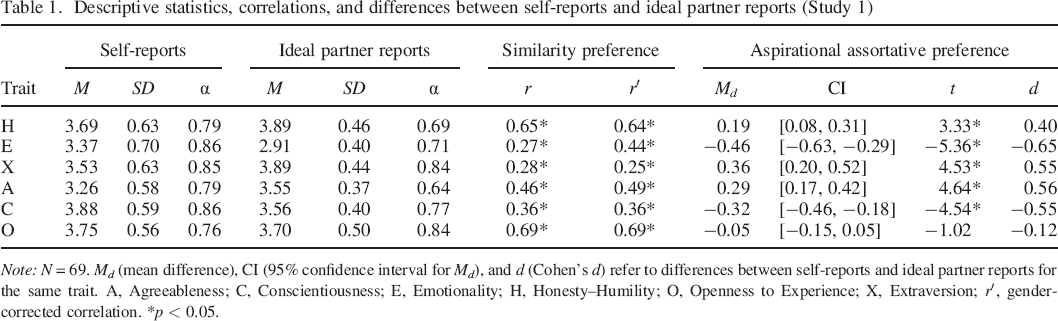
Note: N = 69.
M d (mean difference), CI (95% confidence interval for M d ), and d (Cohen's d) refer to differences between self–reports and ideal partner reports for the same trait.
A, Agreeableness; C, Conscientiousness; E, Emotionality; H, Honesty–Humility; O, Openness to Experience; X, Extraversion; r′, gender–corrected correlation.
p < 0.05.
Table 1 also presents the findings concerning aspirational assortative preference. In general, people preferred their ideal partners to have more desirable trait levels in Emotionality, Extraversion, and Agreeableness than themselves. While these findings support Hypothesis 2, participants also preferred their ideal partners to have lower levels in Conscientiousness than themselves, contrary to expectations. Participants did also indicate a preference for higher levels in Honesty–Humility in their ideal partners compared with themselves but neither a preference for higher nor lower levels in Openness in their ideal partners. From an explorative perspective, one might also be interested in comparing the aspirational assortative preference across the HEXACO traits (see Table S6 in the Supporting Information). Findings indicate that this preference was particularly pronounced for Emotionality and, as expected, particularly not pronounced (in any direction) for Openness.
In summary, the results of Study 1 indicate that singles generally showed a similarity preference concerning personality traits regarding their ideal partners and preferred higher similarity in Honesty–Humility and in Openness than in most (though, contrary to expectations, not than in all) other HEXACO traits. Additionally, the results provide partial support for Hypothesis 2 by showing that singles preferred their ideal partners, compared with themselves, to be lower in Emotionality and higher in Extraversion and Agreeableness, though not higher in Conscientiousness. Thus, Study 1 provides mixed support for both hypotheses. Additionally, the results indicate that singles preferred their ideal partners to have higher levels in Honesty–Humility relative to themselves.
Clearly, this study is not more than a toehold for several reasons. The most noticeable limitation is the small sample size. Also, the order of the self–ratings and ideal partner ratings was fixed, potentially resulting in carry–over effects. Finally, the current study was conducted in Denmark, representing a Western culture. Thus, it remains unknown whether our findings apply to different cultures, too. We addressed all of these potential limitations in a second study.
Study 2
The second study was designed to remedy the potential limitations of Study 1 and was conducted in China to shed some light on the cultural generalizability of the findings. We explicitly recruited heterosexual singles, invited them to participate in a lab study (using paper–and–pencil questionnaires), and paid them (RMB 20, approx. $3). Further, we randomized the order of the self–ratings and ideal partner questionnaires between participants.
Participants, Procedure, and Measures
One hundred fifty students from a Chinese university participated in our study. One was excluded because of incomplete answers and age in the final sample (50% female) ranged between 17 and 23 (M = 18.5, SD = 0.9) years. Fifty–two percent of the participants were from social or political sciences, 34% were from science, and the remaining 14% were from other disciplines. Upon arrival, participants were greeted by a student assistant who helped administer the consent and instruct participants. We used the same measurements as in Study 1, that is, the self–rating and the ideal partner version of the HEXACO–60, as well as two questionnaires (not related to the study) as a filler task. All questionnaires were administered in Mandarin. Note that the HEXACO items had already been translated into Chinese before (www.hexaco.org).
Results and Discussion
The similarity correlations between self–ratings and ideal partner ratings were significant for all HEXACO traits, except Emotionality (r = 0.16, p = 0.060), with correlations ranging from 0.16 to 0.61 overall (Table 2). After controlling for gender, the correlations were all significant, ranging from 0.26 to 0.60. These results show that singles generally preferred similarity between themselves and their ideal partners concerning basic personality traits. Next, we compared the partial correlations between self–ratings and ideal partner ratings of Honesty–Humility and Openness with the partial correlations of the other traits. The partial correlations of Honesty–Humility and Openness were significantly higher than those of Emotionality (z = 3.67, p < 0.001 for Honesty–Humility; z = 3.72, p < 0.001 for Openness), Extraversion (z = 2.39, p = 0.017; z = 2.47, p = 0.014), Agreeableness (z = 2.41, p = 0.016; z = 2.36, p = 0.018), and Conscientiousness (z = 2.81, p = 0.005; z = 2.92, p = 0.004). These results suggest that singles describe a higher similarity between themselves and their ideal partners in both Honesty–Humility and Openness compared with the other traits, fully supporting Hypothesis 1.
Descriptive statistics, correlations, and differences between self–reports and ideal partner reports (Study 2)
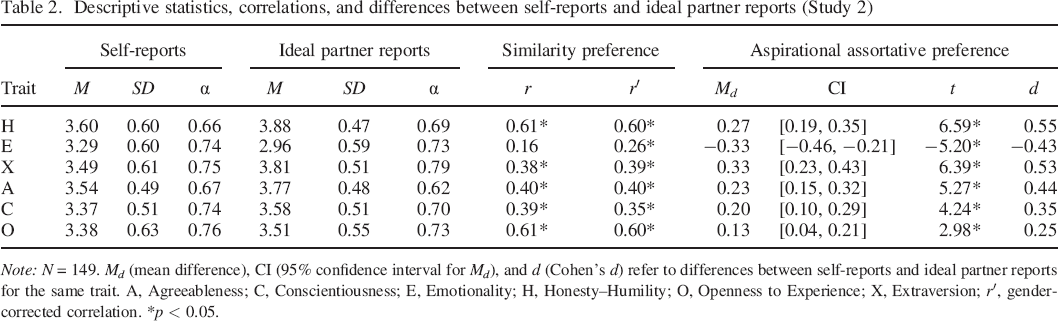
Note: N = 149.
M d (mean difference), CI (95% confidence interval for M d ), and d (Cohen's d) refer to differences between self–reports and ideal partner reports for the same trait.
A, Agreeableness; C, Conscientiousness; E, Emotionality; H, Honesty–Humility; O, Openness to Experience; X, Extraversion; r′, gender–corrected correlation.
p < 0.05.
Regarding aspirational assortative preference (Table 2), we found that singles preferred their ideal partners to have lower levels in Emotionality and higher levels in Extraversion, Agreeableness, and Conscientiousness. Thus, Hypothesis 2 was fully supported. Table 2 further shows that elevated levels in one's ideal partner relative to oneself were also preferred for Honesty–Humility and Openness. Again, a preference for different trait levels in one's ideal partner, compared with oneself, seemed less pronounced for Openness compared with the other traits (see also Table S7 in the Supporting Information).
Overall, Study 2 provided relatively strong support for both hypotheses. Generally, singles preferred their ideal partners to be both similar and more desirable compared with themselves concerning all HEXACO traits, and they tended to desire higher similarity between themselves and their ideal partners in Honesty–Humility and Openness than in the other traits. Interestingly, while the Danish participants preferred their ideal partners to be lower in Conscientiousness than themselves, their Chinese counterparts—in line with our hypothesis—preferred their ideal partners to be higher in Conscientiousness compared with themselves. Given this inconsistent finding, we opted to conduct another study.
In the third study, we also addressed two further potential limitations. First, both Study 1 and Study 2 used the relatively brief HEXACO–60, making it virtually impossible to investigate similarity preference and aspirational assortative preference on the (HEXACO) facet level. Second, in both Study 1 and Study 2, there was a brief filler task between the self–ratings and ideal partner ratings only, which might have not taken long enough to distract participants from their answers in the first questionnaire when filling out the second one. Thus, we used a longer time interval between the two personality assessments. Finally, we again changed the country of investigation to further look at the generalizability of our findings.
Study 3
Participants, Procedure, and Measures
Study 3 was conducted at a German university, at which psychology students were encouraged to participate in exchange for partial course credit. Out of 553 people who started the study at Time 1, 507 participants completed the assessment (8.3% drop–out rate). Three hundred thirty–four of these started the assessment at Time 2 (34% drop–out rate), and 327 completed it (2.1% drop–out rate). Of these, 166 participants (51%) indicated that they were single. Eleven of these participants (7.8%) were excluded, 10 due to mismatched codes between the assessments and 1 due to (self–rated) insufficent German language skills. Thus, our final sample comprised 155 participants 3 (77% female) aged between 19 and 57 years, with a mean of 30.6 (SD = 9.7) years.
The study was administered in two time points, each covering either the self–rating or the ideal partner form of the German version (Zettler, Lang, Hülsheger, & Hilbig, 2016) of the 200–item HEXACO Personality Inventory–Revised (HEXACO–200; Lee & Ashton, 2006), along with some demographic questions. The HEXACO–200 assesses each HEXACO trait via 32 items, which are further equally grouped into four facets per trait. Specifically, after accessing the website of our study, participants were randomly assigned to one of two conditions determining the order of the two personality questionnaires, and the mean time lag between the two assessments was 10.4 (Median = 8.8, SD = 3.5) days.
Results and Discussion
The correlations between self–ratings and ideal partner ratings for the six personality factors (0.21 ≤ r ≤ 0.81) as well as all their facets (0.20 ≤ r ≤ 0.80) were all significant and remained significant after controlling for gender (for factor level, 0.28 ≤ r ≤ 0.81; for facet level, 0.24 ≤ r ≤ 0.80; see Table 3). These results suggest that singles preferred their ideal partners to be similar to themselves not only at the HEXACO factor level but also at the facet level. We then compared the partial correlations between self–ratings and ideal partner ratings concerning Honesty–Humility and Openness with the partial correlations concerning the other traits. The partial correlations of Honesty–Humility and Openness were significantly higher than the ones of Emotionality (z = 6.59, p < 0.001 for Honesty–Humility; z = 5.33, p < 0.001 for Openness), Extraversion (z = 5.80, p < 0.001; z = 4.64, p < 0.001), Agreeableness (z = 5.60, p < 0.001; z = 4.06, p < 0.001), and Conscientiousness (z = 4.99, p < 0.001; z = 3.60, p < 0.001), fully supporting Hypothesis 1.
Descriptive statistics, correlations, and differences between self–reports and ideal partner reports (Study 3)
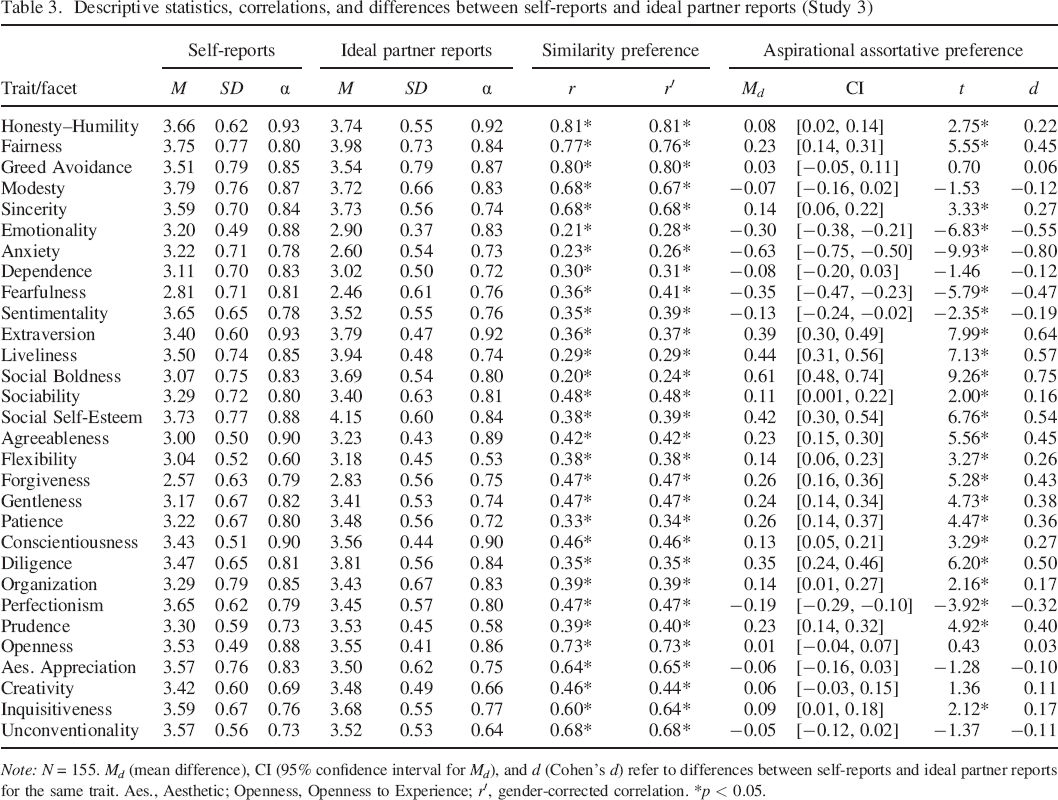
Note: N = 155.
M d (mean difference), CI (95% confidence interval for M d ), and d (Cohen's d) refer to differences between self–reports and ideal partner reports for the same trait.
Aes., Aesthetic; Openness, Openness to Experience; r′, gender–corrected correlation.
p < 0.05.
The partial correlations between self–ratings and ideal partner ratings were also significantly higher for all facets in Honesty–Humility and Openness (except for Creativity) compared with the facets of the other traits (2.47 ≤ z ≤ 6.97 for facets in Honesty–Humility and 2.08 ≤ z ≤ 5.08 for facets in Openness, all ps < 0.05). The respective similarity correlation concerning Creativity was not significantly different from any facet under Emotionality, Extraversion, Agreeableness, and Conscientiousness. Overall, singles showed a similarity preference in their ideal partners in Honesty–Humility and Openness on both the trait level and the facet level, except for Creativity.
Concerning Hypothesis 2, the results showed that singles preferred their ideal partners to have, compared with themselves, higher levels in Extraversion, Agreeableness, and Conscientiousness, and lower levels in Emotionality on both the factor level and the facet level (Table 3), except for Dependence (belonging to Emotionality) and Perfectionism (belonging to Conscientiousness). Thus, Hypothesis 2 was fully supported on the trait level and largely on the facet level. In addition, singles preferred their ideal partners to have higher levels in Honesty–Humility than themselves, and in its Fairness and Sincerity facets, but not in its Greed Avoidance and Modesty facets. Singles did not show any preference for their ideal partners to have different levels in Openness on the factor and facet levels, except for Inquisitiveness. Looking at differences across factors, aspirational assortative preference was relatively stronger for Extraversion (Table S8).
Again, Study 3 substantiated our hypothesis that singles want their ideal partners to have higher similarity with themselves in Honesty–Humility and Openness relative to the other HEXACO traits. We found the similarity preference held across the different facets of Honesty–Humility and Openness, with the exception of Creativity. The finding concerning Creativity may indicate that singles consider creativity as a ‘luxury trait’, which is more difficult to match. Indeed, Li, Bailey, Kenrick, and Linsenmeier (2002) noted that people tend to ensure that their ideal partners possess sufficient levels of necessary traits before considering ‘luxury traits’, and Creativity was regarded as a luxury trait by both men and women.
Concerning the other HEXACO traits, singles generally showed aspirational assortative preferences at both trait and facet levels, with the exceptions of Dependence (belonging to Emotionality) and Perfectionism (belonging to Conscientiousness). The finding for Dependence might be because people have a preference for mutual reliance in close relationships (Rusbult, Martz, & Agnew, 1998), and the finding for Perfectionism might be because this facet has been found to be particularly related to obsessive–compulsive personality disorder (Samuel & Widiger, 2011) and might thus be shunned in terms of ideal partner preferences. But, as with Creativity, these are just speculative thoughts and require further investigation.
In summary, Studies 1 to 3 revealed a relatively consistent picture that singles seek for both similarity preference and aspirational assortative preference in their ideal partners. Similarity preference is particularly strong for Honesty–Humility and Openness, and aspirational assortative preference is particularly consistent for Honesty–Humility, Emotionality, Extraversion, Agreeableness, and Conscientiousness. However, as each of these samples is of university students, the generalizability of the results might be questioned. To address this limitation, we conducted another study aiming to recruit participants with diverse backgrounds (and, again, from another country). Additionally, we also explored potential mediators explaining the similarity preference in Honesty–Humility and Openness.
Study 4
Studies 1–3 overall suggest that singles show a stronger similarity preference concerning their ideal partners in Honesty–Humility and Openness compared with the other traits. This might be because Honesty–Humility and Openness are strongly linked to basic attitudes and values, as shown by previous work (e.g. Lee et al., 2009). In Schwartz's (1992; Schwartz et al., 2012) values framework, one can consider two basic dimensions of personal values, namely, Self–transcendence versus Self–enhancement and Openness to Change versus Conservation. Self–transcendence (vs. Self–enhancement) contrasts preferences for equality, honesty, loyalty, and social justice to preferences for authority, competence, social power, and wealth. Openness to Change (vs. Conservation) contrasts preferences for creativity, curiosity, freedom, and novelty to preferences for obedience, security, social order, and tradition. Accordingly, Honesty–Humility seems to be well–aligned with Self–transcendence (vs. Self–enhancement), and Openness seems to be well–aligned with Openness to Change (vs. Conservation). Besides the two main hypotheses, we also tested in Study 4 whether Self–transcendence (vs. Self–enhancement) mediates the similarity preference in Honesty–Humility and whether Openness to Change (vs. Conservation) mediates the similarity preference in Openness.
Procedure, Participants, and Measures
Study 4 was conducted via MTurk, allowing recruitment of participants with a broad range of ages and educational backgrounds. We invited MTurk workers from the USA to fill out a brief screening questionnaire including a question about their relationship status and only invited singles (472 out of 1000 screened participants) to the actual study. Three hundred twenty–two participated (31.8% drop–out rate) at Time 1, and, from these, 246 (28.6% drop–out rate) participated at Time 2. Of these, we included those who still remained single at Time 2 (89%) and passed two attention check items interspersed in the different questionnaires (99%), resulting in a final sample of 217 participants (age range 18–71, M = 38.8, SD = 13.7 years; 60% female).
At Time 1, participants completed the ideal partner version of the HEXACO–60 and received $1.50 as payment. At Time 2 (initiated a month later), participants completed the self–report version of the HEXACO–60 and then the 48–item Schwartz Value Scale (SVS; Schwartz et al., 2012), assessing the two basic value dimensions, Self–transcendence (vs. Self–enhancement) and Openness to Change (vs. Conservation). In the SVS, participants are asked to think about how much a person described in an item is like or not like themselves. The SVS was completed using a 6–point response scale from 1 (not like me at all) to 6 (very much like me). The two value dimensions, Self–transcendence (vs. Self–enhancement) and Openness to Change (vs. Conservation), were constructed by subtracting the latter (vs.) scales from the former ones. Cronbach's alpha was 0.83 for Self–transcendence (vs. Self–enhancement), and 0.79 for Openness to Change (vs. Conservation). Participants received $2.50 as payment after completion in Time 2.
Results and Discussion
The correlations between self–reports and ideal partner reports within a HEXACO trait are shown in Table 4, indicating similarity preference for all traits (0.37 ≤ r ≤ 0.74; controlling for gender: 0.38 ≤ r ≤ 0.74). These results again indicate that singles showed similarity preference concerning their ideal partners in all HEXACO traits. Next, we compared the partial correlations between self–reports and ideal partner reports of Honesty–Humility and Openness with these of the other personality traits. The partial correlations of Honesty–Humility and Openness were significantly higher than those of Emotionality (z = 4.18, p < 0.001 for Honesty–Humility; z = 3.60, p < 0.001 for Openness), Extraversion (z = 5.43, p < 0.001; z = 4.99, p < 0.001), Agreeableness (z = 4.49, p < 0.001; z = 3.67, p < 0.001), and Conscientiousness (z = 2.70, p = 0.007; z = 1.97, p = 0.048). These results suggest that singles preferred higher similarity in Honesty–Humility and Openness compared with the other four traits in their ideal partners, fully supporting Hypothesis 1.
Descriptive statistics, correlations, and differences between self–reports and ideal partner reports (Study 4)
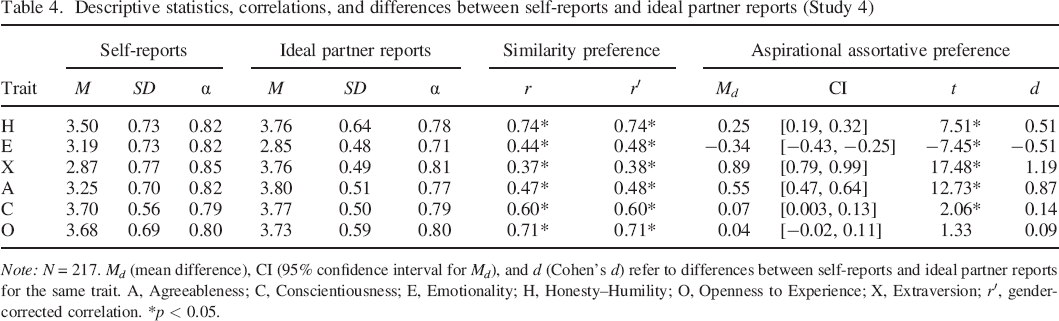
Note: N = 217.
M d (mean difference), CI (95% confidence interval for M d ), and d (Cohen's d) refer to differences between self–reports and ideal partner reports for the same trait.
A, Agreeableness; C, Conscientiousness; E, Emotionality; H, Honesty–Humility; O, Openness to Experience; X, Extraversion; r′, gender–corrected correlation.
p < 0.05.
As can be seen in Table S4 in the Supporting Information, Self–transcendence (vs. Self–enhancement) was strongly related to Honesty–Humility (r = 0.64, p < 0.001) and moderately related to Agreeableness (r = 0.37, p < 0.001), Conscientiousness (r = 0.28, p < 0.001), and Openness (r = 0.21, p = 0.002). Openness to Change (vs. Conservation) was fairly strongly related to Openness (r = 0.42, p < 0.001) and moderately related to Honesty–Humility (r = −0.28, p < 0.001), Emotionality (r = −0.24, p < 0.001), and Conscientiousness (r = −0.21, p = 0.002). We tested whether the value dimensions mediated similarity preferences of singles towards their ideal partners in Honesty–Humility and Openness, respectively. The mediation models were computed for each of 5000 bootstrapping samples using the ‘mediate’ function in the ‘psych’ package in R (Tingley, Yamamoto, Hirose, Keele, & Imai, 2014). The indirect effects of both Self–transcendence (vs. Self–enhancement; β = 0.09, 95% CI [0.02, 0.18]) and Openness to Change (vs. Conservation; β = 0.05, 95% CI [0.01, 0.11]) were significant. Self–transcendence (vs. Self–enhancement) partially mediated similarity preference in Honesty–Humility (Figure 1), and Openness to Change (vs. Conservation) partially mediated similarity preference in Openness (Figure 2).
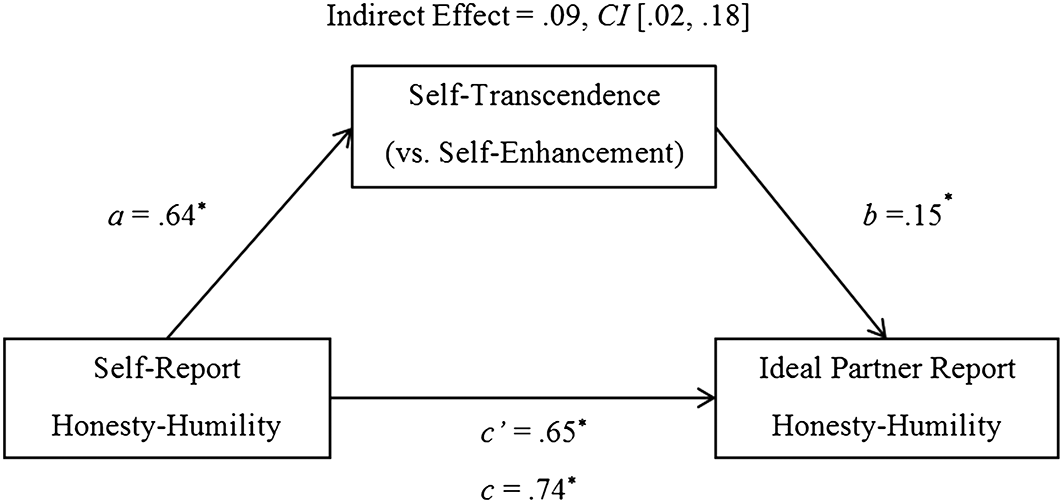
Self–transcendence (vs. Self–enhancement) mediates the similarity preference of singles towards their ideal partners in Honesty–Humility (Study 4). *p < 0.05.
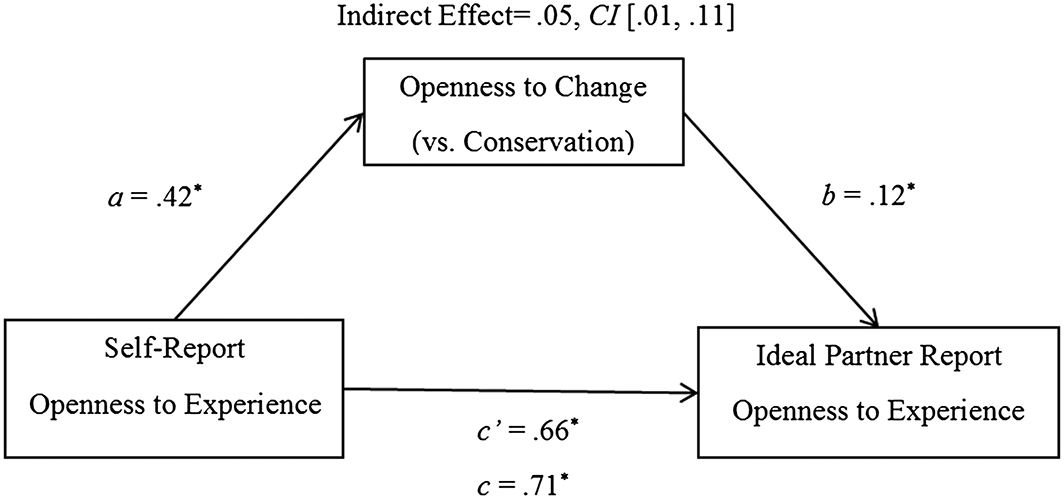
Openness to Change (vs. Conservation) mediates the similarity preference of singles towards their ideal partners in Openness to Experience (Study 4). *p < 0.05.
Finally, we tested for aspirational assortative preference and found that singles preferred their ideal partners to have, compared with themselves, lower levels in Emotionality and higher levels in Extraversion, Agreeableness, and Conscientiousness, supporting Hypothesis 2 (Table 4). Table 4 also shows that singles indicated a preference for elevated Honesty–Humility, but not for Openness, in their ideal partners relative to themselves. The aspirational assortative preference appeared to be relatively stronger for Extraversion (see Table S9 in the Supporting Information). Overall, the findings from Study 4 suggest that singles preferred their ideal partners to be similar to themselves in all HEXACO traits, and particularly in Honesty–Humility and Openness, and also to have higher levels in Honesty–Humility, Extraversion, Agreeableness, and Conscientiousness, as well as lower levels in Emotionality. Further, the higher similarity preference in Honesty–Humility and Openness was partially explained by Self–transcendence (vs. Self–enhancement) and Openness to Change (vs. Conservation), respectively. However, the mediation effects were rather weak and, thus, must be interpreted with caution.
Considering all four studies, the general preference pattern seems quite clear: singles have a general tendency for similarity preference concerning their ideal partners, which is more pronounced for Honesty–Humility and Openness compared with the other traits. Also, singles have a relatively consistent aspirational assortative preference concerning Honesty–Humility, Emotionality, Extraversion, Agreeableness, and Conscientiousness. The generalizability of these findings is indicated by their relatively successful replication across four different countries, different study designs (online vs. lab assessments), and different populations (students vs. MTurk participants). However, Studies 1–4 are limited by not looking at ‘actual’ behaviour (King, 2010). Regarding ideal partner preferences, this limitation can perhaps be surpassed, thanks to the prevalence of online dating services. In Study 5, we thus seek to replicate some of the previous findings by analysing personal profiles created by users of an online dating service.
Study 5
Procedure and Participants
Study 5 collected personal profiles from an American online dating website. On this website, people searching for a partner can provide personal information and write descriptions about themselves as well as their ideal partners. These descriptions were used in this study. As the main aim for people using this website is presumably to attract a partner and to initiate contact, people are likely to present their ‘best’ selves rather than completely candid ones (Toma, Hancock, & Ellison, 2008). At the same time, people may not necessary rise the bar for their ideal partners to the same (high) level; hence, this study is better suited to test Hypothesis 1 compared with Hypothesis 2. Nonetheless, we present results for both hypotheses.
We selected profiles from heterosexual persons who wrote at least 120 words about themselves and/or their ideal partners in the description column to ensure sufficient information about the users and their ideal partners. Based on these criteria, we randomly selected 320 personal profiles (50% female) and excluded one due to mismatch in coding. Thus, 319 personal profiles were included, and their owners aged between 20 and 83 (M = 41.2, SD = 13.4) years.
Method
The self–descriptions and ideal partner descriptions were coded based on the occurrence of HEXACO trait information by two raters. The raters were native in English, blind towards the aims of the study, and not part of our research group. We provided raters with three kinds of information: the English adjective list by Lee and Ashton (2008; comprising 449 adjectives), the items from the HEXACO–200 (Lee & Ashton, 2006), and some further typical descriptions of each trait, taken from www.hexaco.org as well as provided by experts on the model.
Raters were asked (a) to consider all words in a description, (b) not to code information irrelevant to the HEXACO traits, (c) to pay attention to reversed meaning, and (d) to code the lower (−) and the higher (+) poles of a trait separately. Raters were trained with all of these aspects in two training sessions. Alongside the training sessions, both raters rated 25 descriptions independently from each other, with an initial agreement of 92.1%. The raters then discussed and resolved their discrepancies.
To illustrate the coding, descriptions such as ‘trustworthy’ or ‘I am a sincere person’ were coded as Honesty–Humility (+), and descriptions such as ‘self–centred’ or ‘I am very fond of fancy cars’ were coded as Honesty–Humility (−). In this way, raters provided codings for up to 12 personality trait levels for each self–description and ideal partner description, namely, six concerning high levels of a trait and six concerning low levels of a trait. Separately for each self–description and ideal partner description, we then summed up the number of codings for each trait, separately for the low and high levels of a trait [e.g. ‘7’ for Honesty–Humility (+) and ‘2’ for Honesty–Humility (−)]. Each of the 12 sums were then divided by the overall number of codings (across all traits) in order to get a relative score and, thus, to control for the number of information provided for traits overall (e.g. ‘7/32 = 0.22’ and ‘2/32 = 0.06’). For each trait, we then subtracted the relative score of the lower trait level from the relative score of the higher trait level, resulting in the final score for each trait (e.g. 0.22–0.06 = 0.16). Finally, for each participant, we linked the scores from the self–description to the scores from the ideal partner description. 4
Results and Discussion
Means, standard deviations, and ranges of frequency of each pole of the HEXACO traits for self–descriptions and ideal partner descriptions are presented in Table 5. Table 6 shows the correlations between self–descriptions and partner descriptions within a trait, with both raw (0.12 ≤ r ≤ 0.34) and gender–corrected (0.12 ≤ r ≤ 0.35) correlations being significant. The real–life data thus suggest that people showed similarity preference concerning their ideal partners in all HEXACO traits. Next, we tested whether people prefer higher similarity between themselves and their ideal partners in Honesty–Humility and Openness compared with the other HEXACO traits. The gender–corrected correlation between self–descriptions and ideal partner descriptions of Openness (r = 0.35) was higher than those of Emotionality (z = 2.78, p = 0.006), Extraversion (z = 2.35, p = 0.019), Agreeableness (z = 3.09, p = 0.002), and Conscientiousness (z = 2.03, p = 0.042). However, the corresponding correlation of Honesty–Humility was not significantly higher than those of the other four traits: Emotionality (z = 1.52, p = 0.128), Extraversion (z = 1.20, p = 0.230), Agreeableness (z = 1.85, p = 0.064), and Conscientiousness (z = 0.82, p = 0.409). Thus, the results suggest that people described their ideal partners with a higher similarity to themselves in Openness, but not in Honesty–Humility, compared with the other HEXACO traits, partially supporting Hypothesis 1. For completeness, we also investigated aspirational assortative preference (Table 6). We found that people did not exhibit aspirational assortative preference concerning Emotionality, Extraversion, and Conscientiousness and that they even described their ideal partners to be lower in Agreeableness than themselves. People exhibited aspirational assortative preference in Honesty–Humility.
Means, standard deviations, and ranges of frequency for self–descriptions and ideal partner descriptions (Study 5)
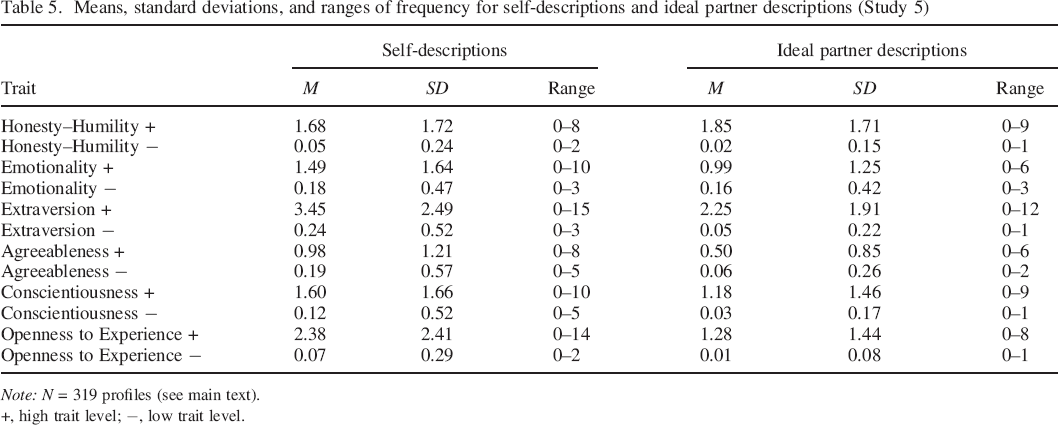
Note: N = 319 profiles (see main text).
+, high trait level; −, low trait level.
Descriptive statistics, correlations, and differences between self–descriptions and ideal partner descriptions (Study 5)
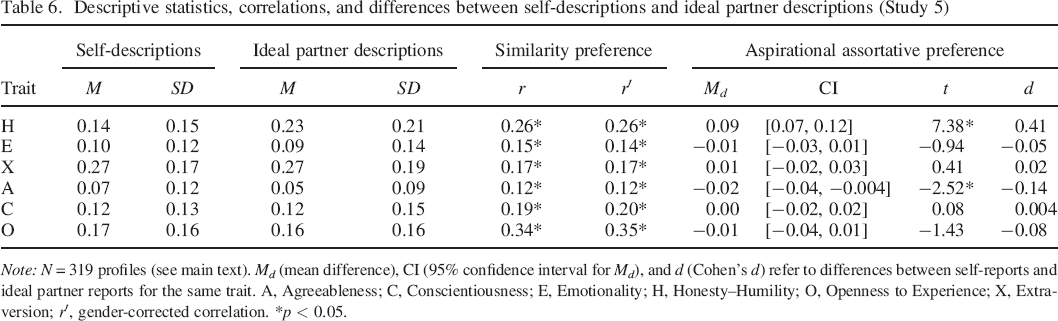
Note: N = 319 profiles (see main text).
M d (mean difference), CI (95% confidence interval for M d ), and d (Cohen's d) refer to differences between self–reports and ideal partner reports for the same trait.
A, Agreeableness; C, Conscientiousness; E, Emotionality; H, Honesty–Humility; O, Openness to Experience; X, Extraversion; r′, gender–corrected correlation.
p < 0.05.
Overall, this study partially supported Hypothesis 1, finding that people ascribed their ideal partners a higher similarity to themselves in Openness (but not in Honesty–Humility) relative to the other HEXACO traits. This is particularly noteworthy for supporting the similarity findings concerning Openness with a completely different approach (i.e. with real–life data).
Supplementary Analysis
We conducted a meta–analysis concerning our two hypotheses to summarize the results across the first four studies, excluding Study 5 due to the methodological differences (see Table S13 in the Supporting Information for a meta–analysis including all studies). The meta–analyses were performed with the ‘meta’ package in R (Schwarzer, 2007). As shown in Table 7, the meta–analytic effect size concerning similarity between self–ratings and ideal partner ratings ranged 0.29 ≤ r ≤ 0.72, indicating that people generally preferred their ideal partners to be similar to themselves in all HEXACO traits. The highest similarity preference was clearly found for Honesty–Humility and Openness (r = 0.72 and 0.69). To meta–analytically investigate aspirational assortative preference, we first converted all Cohen's ds into rs and then back converted the r effect size produced by the meta package into d. Overall, aspirational assortative preference was strong for Emotionality (d = −0.52), Extraversion (d = 0.80), and Agreeableness (d = 0.61) and moderate for Honesty–Humility (d = 0.43). However, there was no statistically significant tendency across the studies for people to prefer higher or lower levels in Conscientiousness (d = 0.14) or Openness (d = 0.09) in their ideal partners, compared with themselves.
Meta–analysis for similarity preference and aspirational assortative preference (Studies 1–4)
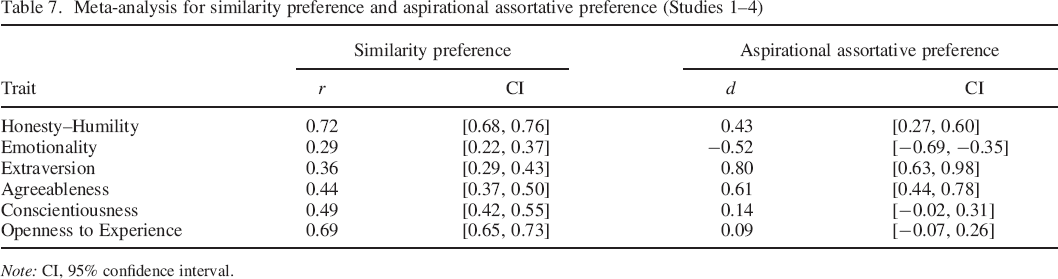
Note: CI, 95% confidence interval.
Finally, we compared gender differences in aspirational assortative preference in another meta–analysis across the first four studies. 5 As can be seen in Table 8, the results indicate that women were more selective in ideal partner preferences than men and preferred their ideal partners to have, compared with themselves, higher levels in Honesty–Humility, Extraversion, Agreeableness, and Conscientiousness, as well as lower levels in Emotionality. By comparison, men only desired their ideal partners to have higher levels in Honesty–Humility, Extraversion, and Agreeableness relative to themselves. However, the comparisons are only explorative in nature.
Gender differences in aspirational assortative preference in the HEXACO traits (Studies 1–4)
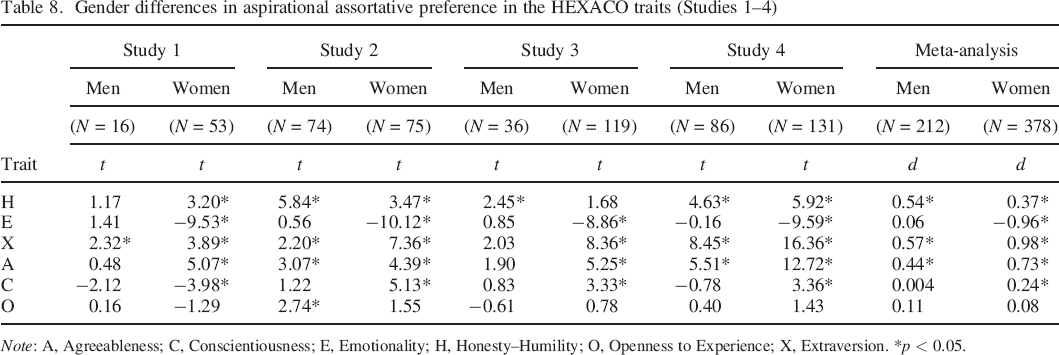
Note: A, Agreeableness; C, Conscientiousness; E, Emotionality; H, Honesty–Humility; O, Openness to Experience; X, Extraversion.
p < 0.05.
General Discussion
Herein, we provide a systematic theoretical and empirical account on two ideal partner preferences, similarity preference and aspirational assortative preference, relying on the HEXACO framework. In five studies across four countries (China, Denmark, Germany, and the USA), our results suggest that singles generally preferred similarity between themselves and their ideal partners in terms of all HEXACO traits and particularly preferred higher similarity in Honesty–Humility (when asked via questionnaires) and Openness (in questionnaire–based assessments and a real–life situation) compared with the other four traits. Additionally, our results suggest that singles (when asked via questionnaires) tended to exhibit aspirational assortative preference in their ideal partners concerning Honesty–Humility, Emotionality, Extraversion, Agreeableness, and Consciousness. Singles did not indicate a preference for higher nor lower trait levels in Openness in their ideal partners compared with themselves, which both mirrors previous findings in general (Figueredo et al., 2006; Watson et al., 2014) and matches its unique status as the only Big Five trait with no connection to relationship satisfaction (Malouff et al., 2010).
Overall, we found support for both similarity preference and aspirational assortative preference. We dissected the different applicability of the two preferences on different personality traits, providing a clear framework concerning how these preferences function differently on different personality traits given the nature of the trait in question. Studies 1–3 supported our hypotheses in student samples using either the HEXACO–60 or the HEXACO–200 (allowing us to test generalizability across facets), with similar results obtained both online and in the lab. Study 4 replicated these results in a more diverse sample with a longer time interval between self–reports and ideal partner reports. Further, Study 4 found partial mediation effects of the central dimensions of personal values for the similarity preference in Honesty–Humility (Self–transcendence vs. Self–enhancement) and Openness (Openness to Change vs. Conservation). However, the mediation effects were quite weak and should be interpreted with caution.
By analysing real–life personal advertisements, Study 5 provided rather strong support for the higher similarity preference in Openness but did neither find support for a stronger similarity preference in Honesty–Humility nor for aspirational assortative preference in Emotionality, Extraversion, Agreeableness, or Conscientiousness. The main reason for these differences—compared with the other studies—might be that in such a dating website, people likely present themselves in the best possible light (i.e. ascribing more desirable characteristics to themselves) without any corresponding elevation in the standards for potential mates in order to increase their chances of finding a partner. Indeed, previous research has suggested that desire to be in a relationship and fear of being single increase people's willingness to settle for less in their potential mates (Spielmann et al., 2013). Analogously, descriptions for partners in real–life dating websites might be more realistic rather than ‘ideal’. Given these design–based differences between Studies 1–4 and Study 5, we mainly focus on Studies 1–4 in the following discussion.
The Role of the HEXACO Traits for Ideal Partner Personality
Overall, our investigation provides relatively robust support for both similarity preference and aspirational assortative preference. Importantly, we dissect the two co–existing preferences based on the HEXACO framework, showing that singles exhibit particularly strong similarity preference on traits that are closely linked to basic attitudes and values and strong aspirational assortative preference on traits that appear to be more desirable. Starting with Openness, which has been shown to be closely linked to various attitudes and personal values (e.g. Lee et al., 2009; Liu, Ludeke, & Zettler, 2017), we found robust support for similarity preference for it. At the same time, and relatively consistent with previous work (Figueredo et al., 2006; Watson et al., 2014), we did not observe a strong preference concerning different levels in Openness ascribed to one's ideal partner as compared with oneself. We see two potential explanations for this. One might be that neither low nor high levels in Openness are considered to be particularly desirable, especially as compared with other traits (Funder & Dobroth, 1987; note, though, that components of Openness most connected to ‘Intellect’ might be considered high in evaluativeness/desirability; Vazire, 2010). Indeed, Thielmann, Hilbig, and Zettler (2018) analysed expert ratings of the evaluativeness/desirability of the HEXACO dimensions and found that experts did not ascribe a high evaluativeness to content captured by Openness (M = 3.24; the other traits: Honesty–Humility: M = 4.06; Emotionality: M = 2.90; Extraversion: M = 3.75; Agreeableness: M = 3.57; Conscientiousness: M = 3.62). A second potential explanation was introduced above: a meta–analysis on the links between the Big Five and relationship satisfaction indicated that unlike the other Big Five traits, Openness is not related to relationship satisfaction (r = 0.03; Malouff et al., 2010), and, thus, people might correspondingly do not put strong weight on particular levels in Openness in their future's partner (beyond the strong similarity preference observed for this trait).
Like Openness, Honesty–Humility is also linked to major attitudes and personal values, but it also captures many desirable characteristics (e.g. being fair, honest, and modest; Zettler & Hilbig, 2015). Correspondingly, we found strong support for both similarity preference and aspirational assortative preference in the self–report studies for Honesty–Humility. These results suggest that, consistent with MSC (Kenrick et al., 1993), similarity preference and aspirational assortative preference are not mutually exclusive. Both occur and can occur in the same trait.
The coexistence of similarity preference and aspirational assortative preference was also found for Agreeableness and Conscientiousness. Both traits have been shown to overlap with some attitudes and personal values (Lee et al., 2010; Olver & Mooradian, 2003; Parks–Leduc, Feldman, & Bardi, 2015), though typically to a less consistent and/or weaker degree than Honesty–Humility and Openness. Accordingly, we found a moderate similarity preference for these traits—smaller than for Honesty–Humility and Openness but larger than for Emotionality and Extraversion. However, future studies might investigate why aspirational assortative preference is comparatively modest in size for Conscientiousness. One reason might be the inclusion of Perfectionism, as suggested by Study 3, and another might be gender differences in emphasizing Conscientiousness–related characteristics (e.g. Buss, 1989; Li et al., 2002).
Finally, the patterns for similarity preference and aspirational assortative preference were also supported by Emotionality and Extraversion. Both traits are marginally, if at all, related to personal values (Lee et al., 2010) but appear to have a desirable direction in ideal partner ratings (i.e. low Emotionality and high Extraversion; Watson et al., 2014). Correspondingly, we found less support for similarity preference but strong support for aspirational assortative preference for these traits across the Studies 1–4.
Theoretical Implications for Future Research
Besides clarifying how similarity preference and aspirational assortative preference function differently in different HEXACO traits, the current research also has some important theoretical implications. First, the general preference for similarity between oneself and one's ideal partner in personality traits supports the reinforcement–affect model and the inferred evaluation–attraction relation. Additionally, the current research adds some new insights for both theories by dissecting different patterns of similarity preference for different traits. Concerning the reinforcement–affect model, our study implies a different importance of the reinforcing areas. The higher similarity preference in Honesty–Humility and Openness might suggest that it is more important for people (singles) to have validation and confirmation in their beliefs and values of the world, rather than in their emotions and social behaviours, as implicated by the relatively low similarity preference in Emotionality and Extraversion. Concerning the inferred evaluation–attraction relation, our study suggests that singles might be more likely to have positive perceptions about themselves when being with persons who share similarity in Honesty–Humility and Openness with them.
Although Study 5 failed to provide a support for our hypothesis concerning the special role of Honesty–Humility in ideal partner preferences, it offers some insights in similarity preferences in ideal partners in general. By investigating personal profiles from a dating website, we found that people actively sought similarity, rather than complementarity. Possibly, people initially desire similar ideal partners and then actively seek them out to construct a functioning and smooth intimate relationship, which echoes ideas from niche construction theory.
Concerning aspirational assortative preference, previous research has suggested that men and women tend to differ in the degree for such preference. From an evolutionary perspective, especially parental investment theory (Trivers, 1972), the different partner preferences men and women have might be due to their distinct investment in their offspring. Both the minimal and the typical investment of time and resources that women make in their offspring are larger than that of men, and accordingly, parental investment theory predicts women to be more selective than men in choosing partners. Consistent with this, women appeared to express more pronounced aspirational assortative preference in their ideal partners than men, desiring partners with higher levels in Honesty–Humility, Extraversion, Agreeableness, and Conscientiousness, as well as with lower levels in Emotionality. Men were less selective on all of these traits except for Honesty–Humility—another difference perhaps consistent with evolutionary theory, if it represents a male preference for women unlikely to be unfaithful, exploiting their partner's paternity uncertainty (Symons, 1979). However, these are only speculative explanations given the imbalanced sample sizes between men and women in some of our studies.
Besides the implications for ideal partner preferences, the current research might also provide some insights into intimate relationships in a more broad sense, such as relationship formation, mate selection, and relationship maintenance. Concerning relationship initiation, some recent studies have suggested that singles choose their real–life partners based on their initial ideal partner preferences (e.g. Campbell et al., 2016; Gerlach et al., 2017). However, other studies with different approaches, such as using live interaction or speed–dating paradigms, yielded weak or no support for the predictive validity of ideal partner preference (e.g. Eastwick et al., 2014; Eastwick, Finkel, & Eagly, 2011). Future research could address the predictive validity of similarity preference and aspirational assortative preference concerning personality traits with different paradigms. Concerning relationship maintenance, a high similarity between oneself and one's partner in Honesty–Humility and Openness might promote relationship satisfaction and reduce potential conflicts because couples are more likely to reach consensus in important attitudinal issues. Aspirational assortative preference in Honesty–Humility, Emotionality, Extraversion, Agreeableness, and Conscientiousness, in contrast, may indicate that people with desirable attributes in these traits are considered as higher in mate value and that partnering with these persons might motivate more mate retention behaviours (Sela, Mogilski, Shackelford, Zeigler–Hill, & Fink, 2017).
Strengths and Limitations
Besides the theoretical contributions, our investigation has several strengths. First, we only included singles (or, in Study 5, people actively seeking an intimate partner), excluding the potential influences of current partners on ideal partner preferences. This is important given that people tend to adjust their ideal partner preferences to resemble their current partners (Fletcher et al., 1999; Fletcher & Simpson, 2000). In addition, we focused on the ideal partner preferences of heterosexual singles, ruling out any differences between groups with different sexual orientations. For instance, research has indicated that heterosexual and homosexual groups differ in neurodevelopment (e.g. Santtila et al., 2008), social pressure (Filip–Crawford & Neuberg, 2016), and mating market (Black, Gates, Sanders, & Taylor, 2000). Consequently, homosexual people might exhibit different ideal partner preference patterns. Furthermore, we tested the generalizability of the two ideal partner preferences across four different countries.
However, our investigation also has some limitations that should be addressed by future research. First, personal values only weakly explained the similarity preference singles had for their ideal partners concerning Honesty–Humility and Openness. Future research might evaluate whether this might be attributable to measurement issues: the present studies used highly similar assessments to measure self–rated and ideal partner personality traits. Strong mediation effects seems unlikely in such scenario, as there is likely variance attributable to this measurement procedure that is (a) shared between self–rated and ideal partner personality traits and (b) not present in the measurement of values. Using different methods to assess self–rated and ideal partner personality traits might thus be more appropriate to test for mediation effects. Additionally, the rather weak mediation effects imply the existence of other mediators, perhaps expectations concerning a good relationship or forecast of low conflicts in relationships.
The real–life data from Study 5 did not support our hypotheses (except concerning Openness), perhaps due to the self–presentation bias people have in the dating website (Toma et al., 2008). Future studies could aim to tackle this issue by designing more refined experiments. Future research could also explore potential moderators between self–ratings and ideal partner ratings. For example, the nature of the relationship being sought (e.g. short–termed vs. long–termed) might influence the strength of the similarity and aspirational assortative preferences (Kenrick et al., 1993; Regan, Levin, Sprecher, Christopher, & Gate, 2000).
Conclusion and Outlook
Overall, the current study provides relatively strong and clear conclusions about ideal partner preferences concerning personality traits. Specifically, singles prefer their ideal partners to have higher similarity with themselves in Honesty–Humility and Openness compared with the other four HEXACO traits, for which singles prefer their ideal partners to be better than themselves, that is, to have higher levels in Extraversion, Agreeableness, and Conscientiousness and lower levels in Emotionality than themselves. Further, for Agreeableness and Conscientiousness, singles show an intermediate degree of similarity preference in their ideal partners, and for Honesty–Humility, singles show aspirational assortative preference as well. Overall, our investigation is the first to provide a clear framework for when similarity preference and when aspirational assortative preference apply concerning basic personality traits, considering a trait's links to basic attitudes and values as well as its desirability.
Acknowledgements
Parts of this investigation were funded by a grant from the Asian Dynamics Initiative, University of Copenhagen (Denmark), to the first author. All authors contributed to designing studies, acquiring data, interpreting data, and writing the manuscript. J. L. performed the analyses and prepared the first draft of the manuscript.
Supporting info item
Supporting info item, per2159-sup-0001-tablessuppl20180531 - Similar to And/Or Better than Oneself? Singles’ Ideal Partner Personality Descriptions
Supporting info item, per2159-sup-0001-tablessuppl20180531 for Similar to And/Or Better than Oneself? Singles’ Ideal Partner Personality Descriptions by Liu Jie, Ludeke Steven, Haubrich Julia, Gondan–Rochon Matthias, Zettler Ingo and Wrzus Cornelia in European Journal of Personality
Supporting info item
Supporting info item, per2159-sup-0002-PER_Open_Practices_Disclosure_Form_PER 2159 - Similar to And/Or Better than Oneself? Singles’ Ideal Partner Personality Descriptions
Supporting info item, per2159-sup-0002-PER_Open_Practices_Disclosure_Form_PER 2159 for Similar to And/Or Better than Oneself? Singles’ Ideal Partner Personality Descriptions by Liu Jie, Ludeke Steven, Haubrich Julia, Gondan–Rochon Matthias, Zettler Ingo and Wrzus Cornelia in European Journal of Personality
Open Practices Disclosure
Footnotes
Notes
References
Supplementary Material
Please find the following supplemental material available below.
For Open Access articles published under a Creative Commons License, all supplemental material carries the same license as the article it is associated with.
For non-Open Access articles published, all supplemental material carries a non-exclusive license, and permission requests for re-use of supplemental material or any part of supplemental material shall be sent directly to the copyright owner as specified in the copyright notice associated with the article.
