







Abstract
Multidimensional perfectionism includes the dimensions perfectionistic concerns and perfectionistic strivings. Many studies have investigated the nomological network of multidimensional perfectionism by relating perfectionistic concerns and perfectionistic strivings to the Big Five personality traits. Results from these studies were largely inconsistent. In the present study, we meta–analytically integrated 672 effect sizes from 72 samples (N = 21 573) describing relations between multidimensional perfectionism and the Big Five personality traits. Perfectionistic concerns correlated positively with Neuroticism (r = 0.383) and negatively with Extraversion (r = −0.198), Agreeableness (r = −0.198), Conscientiousness (r = −0.111), and Openness (r = −0.087). Perfectionistic strivings correlated positively with Conscientiousness (r = 0.368), Openness (r = 0.121), Neuroticism (r = 0.090), and Extraversion (r = 0.067) and were unrelated to Agreeableness (r = 0.002). The measures of perfectionistic concerns and perfectionistic strivings moderated most of these relations. Meta–analytic structural equation modelling allowed controlling each perfectionism dimension for the respective other. This partialling increased all correlations with the exception of the previously positive correlation between perfectionistic strivings and Neuroticism, which ceased to be significant. The findings support the distinction between perfectionistic strivings and perfectionistic concerns and demonstrate how multidimensional perfectionism is situated in the context of broader personality traits. © 2019 European Association of Personality Psychology
Just like the axis of the geographic coordinate system allows the description of geographic positions, the five–factor model (FFM) of personality provides a framework for the description of personality dispositions (Goldberg, 1993; Ozer & Reise, 1994). Locating new personality constructs within a larger taxonomy of personality is crucial to understanding what these constructs represent, to provide a basis for comparisons between psychological constructs, and ultimately to reveal redundancies (Briggs, 1992). For two reasons, this is particularly important for multidimensional perfectionism, a personality construct that has received increasing attention over the last decades. First, there is a long–lasting debate to which extent the dimensions of multidimensional perfectionism, namely, perfectionistic concerns and perfectionistic strivings, reflect adaptive or maladaptive personality characteristics (e.g. Bieling, Israeli, & Antony, 2004; Flett & Hewitt, 2006; Gotwals, Stoeber, Dunn, & Stoll, 2012; Greenspon, 2000; Stoeber & Otto, 2006). Second, there is a lacking consensus about the interpretation of perfectionistic concerns and perfectionistic strivings after partialling out their shared variance (A. P. Hill, 2014, 2017; Stoeber & Gaudreau, 2017). The purpose of the present study was to examine the nomological networks (Cronbach & Meehl, 1955) of perfectionistic concerns and perfectionistic strivings before and after partialling by meta–analytically integrating findings relating multidimensional perfectionism to the Big Five personality traits.
Conceptualization of Perfectionism
Perfectionism is a personality trait characterized by setting excessively high goals and standards for oneself combined with overly harsh self–evaluations (Flett & Hewitt, 2002; Frost, Marten, Lahart, & Rosenblate, 1990). There are unidimensional and multidimensional conceptualizations of perfectionism. Initially, perfectionism was viewed as a unidimensional and thoroughly dysfunctional personality trait (e.g. Horney, 1950). Unlike multidimensional approaches, unidimensional conceptualizations of perfectionism (e.g. Burns, 1980; Shafran, Cooper, & Fairburn, 2002) are closely linked to a psychopathological perspective (Enns & Cox, 2002) and, thus, predominantly studied in clinical contexts (e.g. Shafran, Lee, & Fairburn, 2004).
In the early 1990s, multidimensional measures of perfectionism emerged (Frost et al., 1990; Hewitt & Flett, 1991). A wealth of evidence suggests that there are two dimensions of perfectionism underlying various measures of multidimensional perfectionism: perfectionistic concerns and perfectionistic strivings (e.g. Bieling et al., 2004; Frost, Heimberg, Holt, Mattia, & Neubauer, 1993; for a review, see Stoeber & Otto, 2006). These two dimensions form the basis of almost all current theories of multidimensional perfectionism (see Dunkley, Blankstein, Masheb, & Grilo, 2006; Stoeber, 2018a) and allow the integration of different perfectionism measures in a single unified framework (A. P. Hill, 2016; Stoeber & Otto, 2006).
Perfectionistic concerns (alternatively labelled evaluative concerns perfectionism or maladaptive evaluation concerns) involve the fear of making mistakes (Frost et al., 1990; R. W. Hill et al., 2004), constant doubts about one's competencies and performance (Frost et al., 1990), perceiving others as expecting perfection of one–self (Hewitt & Flett, 1991), and a perceived discrepancy between one's standards and performance (Slaney, Rice, Mobley, Trippi, & Ashby, 2001). Perfectionistic concerns are positively associated with maladaptive outcomes such as negative affect (Molnar, Reker, Culp, Sadava, & DeCourville, 2006), stress (Dunkley, Mandel, & Ma, 2014), burnout (for a meta–analysis, see A. P. Hill & Curran, 2016), and procrastination (for a meta–analysis, see Sirois, Molnar, & Hirsch, 2017) and negatively associated with adaptive outcomes such as self–rated health (Sirois & Molnar, 2017). Consequently, perfectionistic concerns are commonly regarded as the more maladaptive perfectionism dimension (e.g. Frost et al., 1993; Rice, Ashby, & Slaney, 1998).
Perfectionistic strivings (alternatively labelled personal standards perfectionism or positive striving perfectionism) are conceptualized as a family of traits comprising the tendency to hold exceedingly high personal expectations and the belief that being perfect is important for oneself (Frost et al., 1990; Hewitt & Flett, 1991; R. W. Hill et al., 2004; Slaney et al., 2001). The pattern of relations with external criteria is heterogeneous. Adaptive correlates of perfectionistic strivings include positive affect (Damian, Stoeber, Negru, & Băban, 2014), academic achievement (Rice, Richardson, & Tueller, 2014), self–esteem (Grzegorek, Slaney, Franze, & Rice, 2004), and perceived ability (Lemyre, Hall, & Roberts, 2008). Maladaptive correlates include depressive symptoms (for a meta–analysis, see Smith, Sherry, Mackinnon, & Gautreau, 2016), self–criticism (Dunkley, Zuroff, & Blankstein, 2006), and negative affect (Dunkley et al., 2014).
In this meta–analysis, we focused on the multidimensional conceptualization of perfectionism for two reasons. First, because perfectionism is widespread in the general population (e.g. Stoeber & Stoeber, 2009), our aim was to investigate multidimensional perfectionism in the context of general personality functioning. In the investigation of perfectionism outside of clinical contexts, the multidimensional conceptualization of perfectionisms is by far the most frequently applied approach (for recent meta–analyses of perfectionistic concerns and perfectionistic strivings, see, e.g. A. P. Hill & Curran, 2016; A. P. Hill, Mallinson–Howard, & Jowett, 2018; Limburg, Watson, Hagger, & Egan, 2017; Sirois et al., 2017; Smith et al., 2018). Second, compared with the unidimensional approach, the multidimensional approach to perfectionism is broader in scope. Multidimensional perfectionism reflects that there are two forms of perfectionism (e.g. Hamachek, 1978) that frequently display opposing relations with relevant outcomes (e.g. Sirois & Molnar, 2017) and relate differently to broader personality traits (Stoeber, Corr, Smith, & Saklofske, 2018). In non–clinical samples, even in a measure designed to capture unidimensional perfectionism, there was evidence for a two–factorial structure reflecting perfectionistic concerns and perfectionistic strivings (Dickie, Surgenor, Wilson, & McDowall, 2012; Stoeber & Damian, 2014).
Measuring Multidimensional Perfectionism
There is a multiplicity of subscales from various measures that have been used to capture multidimensional perfectionism. The most frequently used measures are the Frost et al. (1990) Multidimensional Perfectionism Scale (FMPS), the Hewitt and Flett (1991) Multidimensional Perfectionism Scale (HFMPS), the Almost–Perfect Scale–Revised (APS–R, Slaney et al., 2001), and the Perfectionism Inventory (PI, R. W. Hill et al., 2004). From these most prevalent measures of multidimensional perfectionism, the seminal review by Stoeber and Otto (2006) recommends the concern over mistakes subscales (FMPS, Frost et al., 1990; PI, R. W. Hill et al., 2004), the doubts about actions subscale (FMPS, Frost et al., 1990), the socially prescribed perfectionism subscale (HFMPS, Hewitt & Flett, 1991), and the discrepancy subscale (APS–R, Slaney et al., 2001) as core facets of perfectionistic concerns and the personal standards subscale (FMPS, Frost et al., 1990), the self–oriented perfectionism subscale (HFMPS, Hewitt & Flett, 1991), the high standards scale (APS–R, Slaney et al., 2001), and the striving for excellence subscale (PI, R. W. Hill et al., 2004) as core facets of perfectionistic strivings. The other subscales from these measures are not regarded as core indicators of perfectionistic concerns or perfectionistic strivings (Stoeber, 2018a; Stoeber & Otto, 2006). This is because these scales are directed at other individuals (other–oriented perfectionism, HFMPS, Hewitt & Flett, 1991; high standards for others, PI, R. W. Hill et al., 2004; Stoeber, 2014, 2015), measure antecedents of perfectionism development (parental expectations, FMPS, Frost et al., 1990; parental criticism, FMPS, Frost et al., 1990; perceived parental pressure, PI, R. W. Hill et al., 2004; Neumeister, 2004; Rice, Lopez, & Vergara, 2005), form a third factor besides perfectionistic concerns and perfectionistic strivings (organization, FMPS, Frost et al., 1990; PI, R. W. Hill et al., 2004; order, APS–R, Slaney et al., 2001; Kim, Chen, MacCann, Karlov, & Kleitman, 2015; Suddarth & Slaney, 2001), or measure correlates rather than defining characteristics of perfectionistic concerns and perfectionistic strivings (planfulness, rumination, need for approval, PI, R. W. Hill et al., 2004; Blatt, Quinlan, Pilkonis, & Shea, 1995; Di Schiena, Luminet, Philippot, & Douilliez, 2012).
Perfectionism Dimensions and the Big Five Personality Traits
The FFM (Costa & McCrae, 1992a; John & Srivastava, 1999) is a widely accepted framework, which can be used to describe other personality constructs (John & Srivastava, 1999) including personality vulnerability styles (Widiger & Costa, 2002). This personality taxonomy distinguishes five broad personality dimensions: Openness, Conscientiousness, Extraversion, Agreeableness, and Neuroticism. Adjectives used to characterize individuals high in Openness are ‘imaginative’, ‘curious’, and ‘innovative’. High Conscientiousness implies that an individual is reliable, organized, and self–disciplined. Those who are high in Extraversion are described as talkative, energetic, and sociable. Agreeableness features characteristics such as trustfulness, altruism, and cooperativeness. High Neuroticism is characterized by emotional instability and proneness to experiencing negative emotions including insecurity, fear, and worry (Costa & McCrae, 1992a; Goldberg, 1992; John & Srivastava, 1999).
Besides the FFM, there are numerous other personality models such as H. J. Eysenck's Big Three (1947, 1967) and the HEXACO personality model (Lee & Ashton, 2004). Despite some conceptual overlap between these models and the FFM, aggregating findings across different frameworks may be misinformative. For example, the Agreeableness factor from the HEXACO personality model contains anger–related aspects captured by the Neuroticism dimension of the FFM (Ashton, Lee, & De Vries, 2014). Also, the psychoticism factor from Eysenck's Big Three captures variance of two different FFM dimensions (i.e. Agreeableness and Conscientiousness; McCrae & Costa, 1985). Thus, we exclusively reviewed studies based on a single personality framework, namely, the FFM.
Perfectionistic concerns and the Big Five personality traits
Perfectionistic concerns are positively related to Neuroticism (e.g. Dunkley, Blankstein, & Berg, 2012). Characteristics of perfectionistic concerns include insecurity, emotional instability, proneness to experiencing negative affect (Dunkley et al., 2012), and negative self–evaluations (Dunkley, Blankstein, Zuroff, Lecce, & Hui, 2006). These characteristics are also parts of the conceptualization of Neuroticism (Goldberg, 1992; John & Srivastava, 1999). Particularly, a fear of failure and defensive emotional responses to threat (i.e. indicators of a decreased probability of successful goal attainment; DeYoung & Weisberg, 2018) stand out as common characteristics of perfectionistic concerns and Neuroticism. Empirically, indicators of perfectionistic concerns showed robust bivariate associations with Neuroticism (e.g. Cruce, Pashak, Handal, Munz, & Gfeller, 2012; R. W. Hill, McIntire, & Bacharach, 1997). However, these relations varied greatly in magnitude (e.g. r = 0.23, Smith, Speth, et al., 2017, and r = 0.62, Gäde, Schermelleh–Engel, & Klein, 2017).
The bivariate relations of perfectionistic concerns with Openness, Conscientiousness, Extraversion, and Agreeableness were, to a large degree, inconsistent. Openness was sometimes unrelated (e.g. Smith, Saklofske, Stoeber, & Sherry, 2016) and sometimes negatively (e.g. Cuttler & Graf, 2007) related to indicators of perfectionistic concerns. Conscientiousness was in most studies unrelated (e.g. Dunkley & Kyparissis, 2008) but sometimes also negatively (e.g. Rice, Ashby, & Slaney, 2007) related to indicators of perfectionistic concerns. For Extraversion, small to medium negative associations with indicators of perfectionistic concerns were reported (e.g. Dunkley, Blankstein, Zuroff, et al., 2006). Yet, other studies found no relation (e.g. Nathanson, Paulhus, & Williams, 2006). Agreeableness was weakly to moderately negatively associated with indicators of perfectionistic concerns (e.g. Sherry, Hewitt, Flett, Lee–Baggley, & Hall, 2007). However, other studies failed to identify a significant relation (e.g. Hannah, 2015).
Perfectionistic strivings and the Big Five personality traits
Perfectionistic strivings are positively related to Conscientiousness (e.g. Kim et al., 2015). Shared characteristics of perfectionistic strivings and Conscientiousness include striving for high goals and achievement, dutifulness, self–discipline (Dunkley et al., 2012), and punctuality in task completion (Enns & Cox, 2002). Further, there are some similarities in item content between indicators of perfectionistic strivings and Conscientiousness, particularly with the Conscientiousness facet achievement–striving (Costa & McCrae, 1992b). Empirical studies consistently identified positive bivariate relations between indicators of perfectionistic strivings and Conscientiousness (e.g. Dunkley, Blankstein, Zuroff, et al., 2006; Rice et al., 2007; Stumpf & Parker, 2000). However, the strength of the relation was heterogeneous (e.g. r = 0.12, Sherry, Hewitt, Sherry, Flett, & Graham, 2010, and r = 0.61, Stoeber, Otto, & Dalbert, 2009).
Findings on the bivariate relations between perfectionistic strivings and Openness, Extraversion, Agreeableness, and Neuroticism were heterogeneous. Openness was in many cases moderately positively related (e.g. Page, Bruch, & Haase, 2008) and sometimes unrelated (e.g. R.W. Hill, McIntire, et al., 1997) to indicators of perfectionistic strivings. The pattern of results on the relations between Extraversion and indicators of perfectionistic strivings was similarly inconsistent, with mostly small positive (e.g. Ulu & Tezer, 2010) but also non–significant (e.g. J. D. Campbell & Paula, 2002) and small negative (e.g. Stoeber et al., 2009) correlations. Similarly, the correlations between Agreeableness and indicators of perfectionistic strivings were small and in many cases non–significant (e.g. Dunkley & Kyparissis, 2008). For Neuroticism, small positive (e.g. Molnar, Sadava, Flett, & Colautti, 2012), small negative (e.g. Mitchelson, 2009), and non–significant (e.g. Stoeber et al., 2009) correlations were found. This indicates that Neuroticism may be less central for perfectionistic strivings than for perfectionistic concerns.
The large heterogeneity in findings on the relations between multidimensional perfectionism and the Big Five personality traits demonstrates the need for a meta–analytic integration. Moreover, there are numerous differences between the summarized studies regarding study characteristics (e.g. measurement instruments of multidimensional perfectionism) and sample characteristics (e.g. age). Moderator analyses provide a means for testing whether these differences systematically explain the heterogeneity in findings.
Potential Moderators of the Relations between Perfectionism Dimensions and the Big Five Personality Traits
Measurement instrument
Different scales are used as indicators of perfectionistic concerns and perfectionistic strivings. These scales were initially developed based on different theoretical models (for reviews, see Enns & Cox, 2002; Stoeber & Madigan, 2016). Thus, different scales might reflect different constellations of broader personality traits. For instance, the high standards scale (APS–R, Slaney et al., 2001) has been hypothesized to more strongly capture conscientious achievement–striving compared with other indicators of perfectionistic strivings (Blasberg, Hewitt, Flett, Sherry, & Chen, 2016). Therefore, the high standards scale (APS–R, Slaney et al., 2001) might be more closely related to measures of Conscientiousness than other indicators of perfectionistic strivings. In recent meta–analyses, the measurement instrument moderated, for instance, the relations of perfectionistic concerns with mastery avoidance, cognitive anxiety (A. P. Hill et al., 2018), self–rated–health (Sirois & Molnar, 2017), procrastination (Sirois et al., 2017), and suicide attempts (Smith et al., 2018). Also, the measurement instrument moderated the relations of residual perfectionistic strivings with sport performance (A. P. Hill et al., 2018). However, in principle, scales representing the same personality dimension should display a similar pattern of relations with relevant external constructs (see Marsh, Craven, Hinkley, & Debus, 2003).
Domain
There is some disagreement about the domain specificity of perfectionism (e.g. McArdle, 2010). For instance, a recent meta–analysis found that perfectionistic concerns are more strongly related to burnout in work compared with sport and education (A. P. Hill & Curran, 2016). To date, it is an open question whether this can be explained exclusively by characteristics of the domains or also by differences in relations with broader personality dimensions (e.g. stronger links between Neuroticism and perfectionistic concerns in a working population).
Gender
The relations between perfectionism dimensions and other personality characteristics differ between genders. For instance, self–oriented perfectionism (HFMPS, Hewitt & Flett, 1991) as a core facet of perfectionistic strivings was more strongly related to self–criticism in women (r = 0.75) than in men (r = 0.22; Hewitt, Flett, Turnbull–Donovan, & Mikail, 1991). Also, in an interpersonal circumplex perspective, socially prescribed perfectionism (HFMPS, Hewitt & Flett, 1991) as a core facet of perfectionistic concerns was related to diverse interpersonal maladjustment and distress in women and to arrogant, socially distant characteristics in men (R. W. Hill, Zrull, & Turlington, 1997). In recent meta–analyses, gender moderated the relations of perfectionistic concerns with positive affect, satisfaction (A. P. Hill et al., 2018), self–rated health (Sirois & Molnar, 2017), and suicide attempts (Smith et al., 2018) but not with procrastination (Sirois et al., 2017). Also, gender moderated the relations of perfectionistic strivings with ego–involving climate and negative affect (A. P. Hill et al., 2018) but not with procrastination (Sirois et al., 2017).
Age
Multidimensional perfectionism changes with age (e.g. Hong et al., 2017). The development of perfectionism is a dynamic process with broader personality dimensions (or ‘temperament’) as factors contributing to perfectionism development (Flett, Hewitt, Oliver, & Macdonald, 2002). Conscientiousness has been found to predict increases in self–oriented perfectionism (HFMPS, Hewitt & Flett, 1991) over a period of 5 to 8 months (Stoeber et al., 2009). Hence, the strength of the relations between perfectionism and the Big Five personality traits might increase with age, reflecting dynamic development processes.
Publication year
In the last decades, the mean levels of various personality traits (Twenge, 2014), including multidimensional perfectionism (Curran & Hill, 2017), have changed. We exploratory included publication year as a moderator to test whether this has led to changes in the relation between perfectionism dimensions and the Big Five personality traits.
Country
We exploratory included country as a moderator to test the cross–cultural generalizability of our findings (see, e.g. Lee & Park, 2011; Stoeber, 2018b).
The Validity of Perfectionistic Concerns and Perfectionistic Strivings after Accounting for Their Correlation
Many studies have investigated the unique relations of perfectionistic concerns and perfectionistic strivings with indicators of psychological adjustment and maladjustment. In these studies, perfectionistic concerns and perfectionistic strivings were simultaneously entered as predictors of relevant outcomes removing their shared variance (e.g. in a multiple regression). This technique (i.e. partialling) allows researchers to answer several relevant questions such as which perfectionism dimension independently explains the largest proportion of variance in a criterion variable or whether one perfectionism dimension predicts the criterion variable after controlling for the contribution of the other perfectionism dimension. When examining unique relations of perfectionistic concerns after statistically partialling perfectionistic strivings, the negative relations of perfectionistic concerns with positive life outcomes increased (e.g. R. W. Hill, Huelsman, & Araujo, 2010). Also, the positive associations of perfectionistic strivings with adaptive outcomes were stronger, and the positive relations with maladaptive outcomes were weaker or vanished after partialling (see Stoeber & Otto, 2006).
A problem that may arise from partialling concerns the interpretation of the partialled variables. Removing shared variance changes the involved variables (Lynam, Hoyle, & Newman, 2006). Hence, the partialled variable may no longer represent the original variable (Miller & Chapman, 2001). This is particularly problematic when the involved psychological constructs are relatively broad so that it remains unclear which aspects are removed through partialling (Lynam et al., 2006). Moreover, the similarity between the unpartialled variable and the partialled variable decreases as the strength of the relation between the involved predictor variables increases. For instance, the nomological network of the Dark Triad personality constructs (narcissism, Machiavellianism, and psychopathy) changes considerably after partialling, which leads to interpretive difficulties (Vize, Collison, Miller, & Lynam, 2018).
In many cases, indicators of perfectionistic concerns and perfectionistic strivings correlate substantially. Consequently, it has been called into question whether inferences about unpartialled perfectionism dimensions can be drawn based on partialled variables (A. P. Hill, 2014, 2017; Molnar et al., 2012). Particularly, the nature of perfectionistic strivings has been suspected to change through partialling via the removal of core perfectionistic characteristics (e.g. self–criticism and conditional self–acceptance) because partialled perfectionistic strivings showed largely adaptive relations (A. P. Hill, 2014). However, both perfectionism dimensions possess unique characteristics essential for the understanding of perfectionism. Individuals might hold exceedingly high personal expectations without concerns about imperfection (and conversely; Gaudreau, 2015; Stoeber & Gaudreau, 2017). Differences and similarities between perfectionism dimensions before and after partialling can be studied by examining their relations to larger taxonomies of personality (see Vize et al., 2018).
The Present Study
Despite the wealth of studies, many questions regarding the relations of multidimensional perfectionism with the Big Five personality traits remained unanswered. First, findings for the relations of perfectionism dimensions with the Big Five personality are heterogeneous. Thus, it is unclear how perfectionistic concerns and perfectionistic strivings relate to the FFM as a broader personality framework. Second, it is unclear whether the heterogeneity in findings can be explained by characteristics of the studies (e.g. different indicator scales of perfectionism dimensions) and the samples. Third, it is unclear how the nature of perfectionistic concerns and perfectionistic strivings changes when the empirical overlap between the two dimensions is statistically partialled out (A. P. Hill, 2014, 2017; Stoeber & Gaudreau, 2017). The aim of the present study was to address these open questions by meta–analytically synthesizing findings on the relations between multidimensional perfectionism and the Big Five personality traits applying robust variance estimation (RVE, Tanner–Smith & Tipton, 2014) and meta–analytic structural equation modelling (MASEM; Cheung, 2015a).
Method
Literature search and inclusion criteria
We conducted a standardized literature search in PsycINFO on 24 October 2017 applying the search string [perfection* and (personality or ‘big five’ or ‘big 5’ or ‘five–factor model’ or FFM or openness or conscientiousness or extraversion or introversion or agreeableness or neuroticism or ‘emotional stability’)] in abstract and title. The search was limited to empirical studies with non–clinical human samples and published in English language. No date limit was set. We conducted an additional exploratory literature search by examining the references of all included studies and by entering our key words in Google Scholar. Furthermore, the corresponding authors of the included studies were asked via e–mail to provide further unpublished data sets if available.
Inclusion criteria for studies were (i) the study reports original quantitative data (e.g. not a re–analysis of existing findings or data included in both a thesis and a journal article; in this case, the larger data set was used). (ii) The study reports at least one effect size for a sample with a majority of healthy participants (non–clinical sample). (iii) The study results are reported in English language. (iv) The study includes at least one indicator of perfectionistic concerns or perfectionistic strivings. Indicators for perfectionistic concerns and perfectionistic strivings were determined based on the current practice in perfectionism research and the recommendations by Stoeber and Otto (2006). There are numerous scales that might or might not be excellent indicators of perfectionistic concerns or perfectionistic strivings. However, there is no consensus regarding the scales that serve as indicators of perfectionistic concerns or perfectionistic strivings (e.g. Stoeber, 2018b). Thus, we constrained the inclusion criteria to the best established measurement instruments and the most uncontroversial indicators of perfectionistic concerns and perfectionistic strivings. Indicators of perfectionistic concerns were the concern over mistakes scale and the doubts about actions scale from the FMPS (Frost et al., 1990), the socially prescribed perfectionism scale from the HFMPS (Hewitt & Flett, 1991), the discrepancy scale from the APS–R (Slaney et al., 2001), and the concern over mistakes scale from the PI (R. W. Hill et al., 2004). Indicators of perfectionistic strivings were the personal standards scale from the FMPS (Frost et al., 1990), the self–oriented perfectionism scale from the HFMPS (Hewitt & Flett, 1991), the high standards scale from the APS–R (Slaney et al., 2001), and the striving for excellence scale from the PI (R. W. Hill et al., 2004). Short forms, translations, combinations, and adaptations of these scales were included when they could unmistakably be identified as an indicator of perfectionistic concerns or perfectionistic strivings. When correlations for combinations of different scales were reported, we requested the study authors via e–mail to provide zero–order correlation coefficients for the relations between the single scales and the Big Five personality traits. (v) The study includes at least one standardized self–report measure of at least one Big Five personality trait. (vi) The study reports at least one zero–order correlation (or another effect size that can be transformed into a zero–order correlation) of perfectionistic concerns or perfectionistic strivings with a Big Five personality trait as well as the sample size for this effect. Authors who did not report the effect size of interest were requested via e–mail to provide the corresponding effect and sample size. Measures not designed based on the Big Five framework were not included in the meta–analysis to warrant construct validity.
The standardized literature search provided 262 studies. The exploratory literature search yielded 13 relevant studies. The details of the study selection process are shown in Figure 1. Study eligibility was determined in two steps. First, titles and abstracts were screened, and studies were either excluded or retained for inspection of the full text. In this step, we applied the inclusion criteria rather liberally to minimize the risk of falsely excluding a relevant study. Second, the full texts of the remaining articles were screened and excluded when failing to meet the inclusion criteria. We contacted the corresponding authors of 29 studies to request additional information (e.g. missing correlation coefficients; response rate: 55.17%). Eight studies could not be included because the relevant correlations were neither reported nor provided via e–mail by the authors. Two unpublished data sets were provided by the contacted authors (Langendörfer, Hodapp, Kreutz, & Bongard, n.d.; Soenens, n.d.). A final number of 63 studies was included in our meta–analysis.
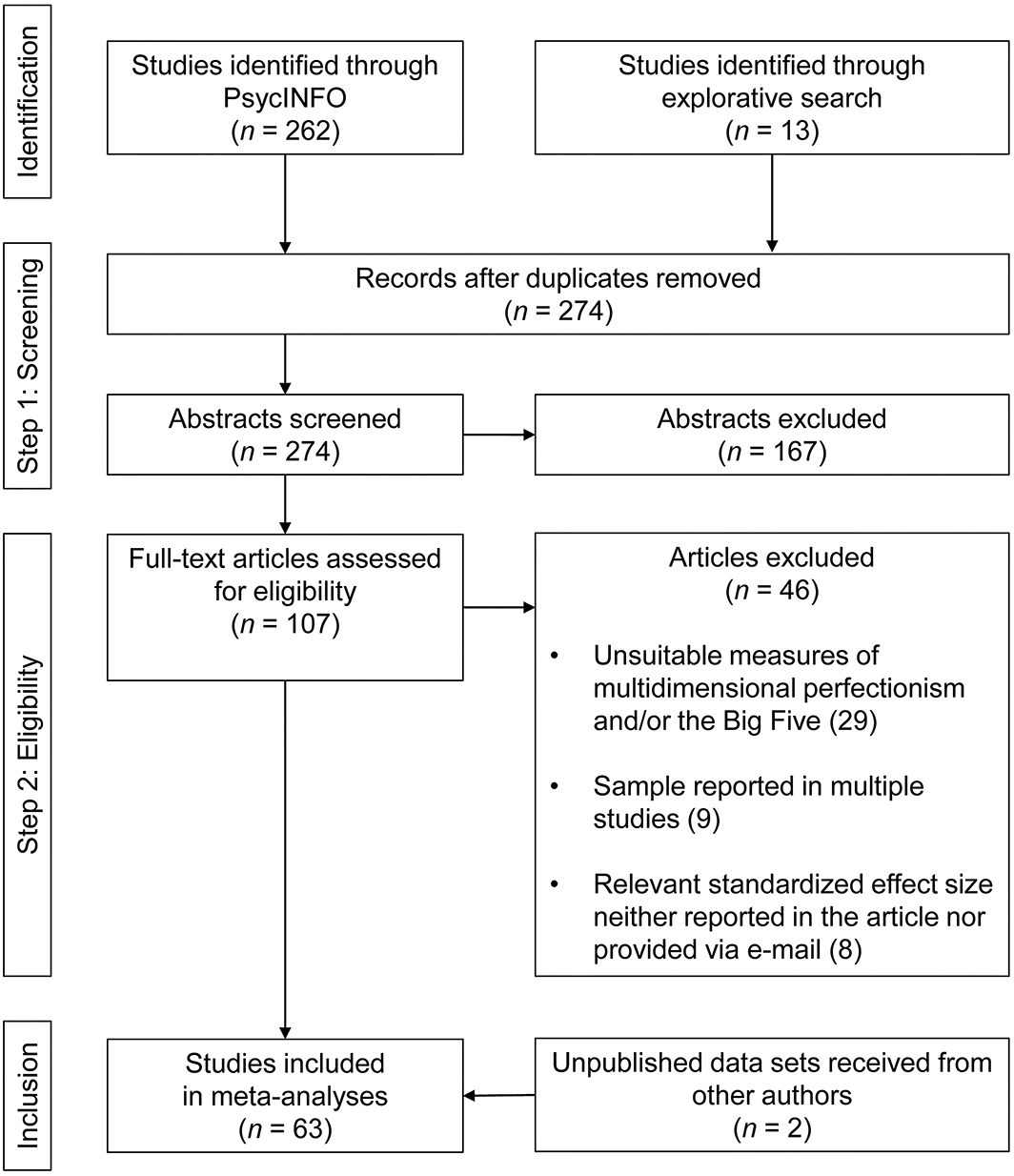
Flow diagram of the study search and inclusion process.
Study coding
The first author coded the effect sizes and study characteristics. The second author independently double–coded a random sample of 100 of the initially identified studies. Interrater agreement was assessed as the percentage of agreement between the coders and was 99.00% for study inclusion in step 1, 100.00% for study inclusion in step 2, 100.00% for effect sizes of the relations between multidimensional perfectionism and the Big Five personality traits, and 95.55% for moderators of these relations. Disagreements were resolved by consulting the original paper. The following information was coded for all studies: sample size, % female mean age, country of data collection, domain in which the measures were assessed, methodology (longitudinal vs cross–sectional), measures of multidimensional perfectionism and the Big Five personality traits, reliabilities (i.e. Cronbach's alpha) of all measures, effect sizes of the relations between multidimensional perfectionism and the Big Five personality traits, publication year, and publication status (published in a peer–reviewed journal vs not published in a peer–reviewed journal). For the included studies, we also coded the correlations between indicators of perfectionistic concerns and perfectionistic strivings.
Final database
The final data set comprised 815 effect sizes from 63 studies with 72 independent samples and overall 21 573 individuals. Of the effect sizes, 672 described the relations between multidimensional perfectionism and the Big Five personality traits. The other effect sizes described the relation between perfectionistic concerns and perfectionistic strivings (143 effect sizes).
Perfectionistic concerns were measured with scales derived from the socially prescribed perfectionism scale of the HFMPS (Hewitt & Flett, 1991) in 31.40%, the concern over mistakes scale of the FMPS (Frost et al., 1990) in 21.11%, the discrepancy scale of the APS–R (Slaney et al., 2001) in 18.21%, the doubts about actions scale of the FMPS (Frost et al., 1990) in 17.41%, the concern over mistakes scale of the PI (R. W. Hill et al., 2004) in 1.32%, and combinations of items from these scales in 10.55% of the effect sizes describing the relation between perfectionistic concerns and the Big Five personality traits.
Perfectionistic strivings were measured with scales derived from the self–oriented perfectionism scale of the HFMPS (Hewitt & Flett, 1991) in 39.25%, the personal standards scale of the FMPS (Frost et al., 1990) in 33.79%, the high standards scale of the APS–R (Slaney et al., 2001) in 23.55%, the striving for excellence scale of the PI (R. W. Hill et al., 2004) in 1.71%, and a combination of items from these scales in 1.71% of the effect sizes describing the relations between perfectionistic strivings and the Big Five personality traits.
The Big Five personality traits were measured with scales derived from the NEO Five–Factor Inventory (Costa & McCrae, 1992b) in 29.02%, the International Personality Item Pool (Goldberg et al., 2006) in 26.19%, the Big Five Inventory (John, Donahue, & Kentle, 1991) in 25.30%, and the Revised NEO Personality Inventory (Costa & McCrae, 1992b) in 19.49% of the effect sizes.
Analytic procedure
We used the robumeta package (Fisher & Tipton, 2015) in the R statistical environment (R Core Team, 2016) to synthesize effect sizes of the bivariate relations and to test moderation effects. We additionally used the metaSEM package (Cheung, 2015b) to compute the unique relations and the metafor package (Viechtbauer, 2010) to assess publication bias.
First, we conducted a series of 11 bivariate meta–analyses using RVE (10 for the relations between multidimensional perfectionism and the Big Five personality traits, 1 for the relation between perfectionistic concerns and perfectionistic strivings). We transformed all correlations using Fisher's z r –transformation to approximate a normal sampling distribution (Borenstein, Hedges, Higgins, & Rothstein, 2011; Lipsey & Wilson, 2001) and converted the effect sizes back to r later for reporting in this manuscript. For all meta–analyses, we used random effects models (Borenstein, Hedges, & Rothstein, 2007). We estimated mean effect sizes and model parameters using a weighted least squares approach (cf. Hedges, Tipton, & Johnson, 2010; Tanner–Smith & Tipton, 2014). In some cases, multiple effect sizes from the same samples and studies were included in a meta–analysis (e.g. correlations between different indicators of perfectionistic concerns and Neuroticism). Hence, the effect sizes within each of our meta–analyses were not statistically independent of each other. This can lead to an underestimation of the effect size variance in the population and ultimately too low error probabilities for the significance tests of the effect sizes (Hedges et al., 2010). RVE can account for non–independent effect sizes without knowledge of the effect size covariance structure (Hedges et al., 2010) and therefore permits the inclusion of multiple effect sizes from one study (Tanner–Smith & Tipton, 2014; Tanner–Smith, Tipton, & Polanin, 2016). We additionally computed effect sizes with correction for measurement unreliability of the perfectionism scale and the Big Five measure using Spearman's correction for attenuation (Hunter & Schmidt, 2004).
To test whether the relations were moderated by the measurement instruments or characteristics of the studies and the samples, we estimated mixed–effects RVE meta–regression models. In this model type, each predictor represents a continuous or specific dummy–coded level of an included moderator variable (for more details, see Tanner–Smith & Tipton, 2014). All dummy–coded moderators were tested against a reference category. We mean–centred all continuous moderators prior to the analyses to facilitate interpretation of the regression coefficients.
To explore whether the results might be distorted by publication bias, we conducted Egger's test for funnel plot asymmetry (Egger, Smith, Schneider, & Minder, 1997). Egger's test regresses the effect size on the inverse of the standard error (the estimate's precision). If the results from small studies (low precision) differ significantly from larger studies (higher precision), the intercept of this regression will be significantly different from zero indicating the presence of publication bias (Egger et al., 1997). As we are not aware of a method for publication bias analyses for dependent effect sizes, we conducted the analyses both on effect size level (assuming independence) and on study level using the study–average effect size. Additionally, we tested publication status (published in a peer–reviewed journal vs not published in a peer–reviewed journal) as a moderator to further investigate a potential publication bias. We assessed heterogeneity with τ2 that represents the magnitude of variation between the study–average effects (between–study variance; Deeks, Higgins, & Altman, 2008) and with I2 indicating the proportion of variance due to variability in true effects rather than sampling error (Borenstein, Higgins, Hedges, & Rothstein, 2017; Higgins & Thompson, 2002).
Second, we assessed the unique relations of perfectionistic concerns and perfectionistic strivings with the Big Five personality traits by adopting a two–stage structural equation modelling approach to MASEM (Cheung, 2015a). This technique outperforms previous MASEM approaches (Cheung & Chan, 2005). In the first stage, the correlation matrixes from all samples are synthesized into a pooled correlation matrix using multivariate methods taking into account the covariance between the included correlations and weighting each cell by its respective sample size. In the second stage, SEM models are fitted based on the pooled correlation matrix using weighted least square estimation. We computed a pooled correlation matrix for each of the Big Five personality traits containing the correlations of perfectionistic concerns and perfectionistic strivings with the respective Big Five trait and the correlation between perfectionistic concerns and perfectionistic strivings. For each Big Five personality trait, we estimated a separate SEM model with perfectionistic concerns and perfectionistic strivings as correlated simultaneous predictor of the respective Big Five trait. In the case that there were multiple effect sizes describing the same relation from one sample, these effect sizes were averaged within the sample. Some primary studies did not report all relevant correlations (e.g. the correlations between the perfectionism dimensions and Neuroticism were reported but not the correlation between perfectionism dimensions). The two–stage structural equation modelling approach handles missing correlations with the use of maximum likelihood estimation (Cheung & Cheung, 2016). Our data and R scripts are available via the Open Science Framework: https://osf.io/pnr8s/?view_only=75ef6bf7b5244202a504b9150061157f.
Results
Study characteristics
The number of studies and effect sizes for each meta–analysis can be found in Table 1. The sample size ranged from 28 to 1465 with a median of 226. The sample mean age ranged from 14 to 48 (M = 26.36, SD = 9.86). The mean proportion of female participants ranged from 0% to 100% (M = 62.93%, SD = 24.04). Of the samples, 62.50% came from North America, 29.17% came from Europe, and 8.33% came from other continents or the continent was not specified. Regarding the domain, 66.67% of the samples were from educational contexts (i.e. student samples), 12.50% of the samples were from work contexts, and 20.83% were from other/mixed/unknown contexts. The median year of publication was 2010. Of the included effect sizes, 83.44% were from studies reported in peer–reviewed journals and 16.56% were from dissertations, book chapters, and unpublished data sets. Cross–sectional relations were described by 92.88% of the effect sizes, and longitudinal relations were described by 7.12% of the effect sizes.
Meta–analytic estimates of the relations between perfectionism dimensions and the Big Five personality traits without correction for measurement unreliability
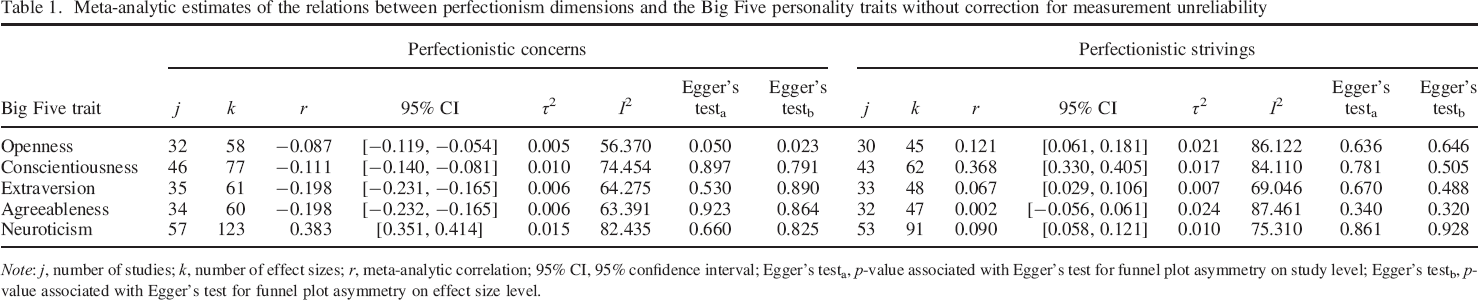
Note: j, number of studies; k, number of effect sizes; r, meta–analytic correlation; 95% CI, 95% confidence interval; Egger's testa, p–value associated with Egger's test for funnel plot asymmetry on study level; Egger's testb, p–value associated with Egger's test for funnel plot asymmetry on effect size level.
Bivariate relations of perfectionism dimensions and the Big Five personality traits
Table 1 displays the meta–analytic estimates of the relations between perfectionism dimensions and the Big Five personality traits without correction for measurement unreliability. Table 2 displays the meta–analytic estimates of the relations between perfectionism dimensions and the Big Five personality traits with correction for measurement unreliability. The effect sizes with correction for measurement unreliability differed only slightly from the uncorrected effect sizes (|
Meta–analytic estimates of the relations between perfectionism dimensions and the Big Five personality traits with correction for measurement unreliability
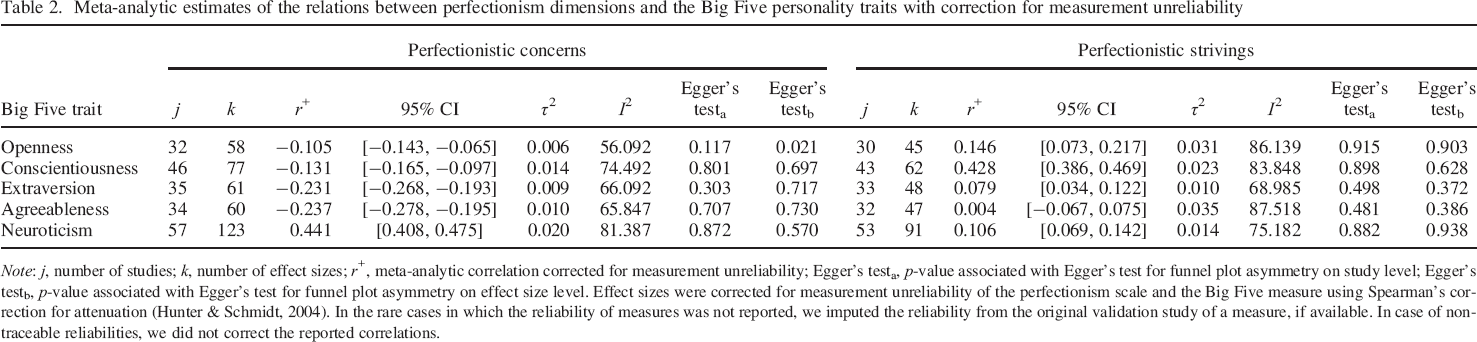
Note: j, number of studies; k, number of effect sizes; r + , meta–analytic correlation corrected for measurement unreliability; Egger's testa, p–value associated with Egger's test for funnel plot asymmetry on study level; Egger's testb, p–value associated with Egger's test for funnel plot asymmetry on effect size level. Effect sizes were corrected for measurement unreliability of the perfectionism scale and the Big Five measure using Spearman's correction for attenuation (Hunter & Schmidt, 2004). In the rare cases in which the reliability of measures was not reported, we imputed the reliability from the original validation study of a measure, if available. In case of non–traceable reliabilities, we did not correct the reported correlations.
The results of the tests for funnel plot asymmetry are shown in Table 1. Egger's test for funnel plot asymmetry did not reach significance for any of the relations on study level. On effect size level, Egger's test reached significance (p = 0.023) for the relation between perfectionistic concerns and Openness. There was no significant difference in the strength of the relations between studies published in peer–reviewed journals and studies not published in peer–reviewed journals (see Tables S1–S10). Figure 2 shows the funnel plot of the relation between perfectionistic concerns and Neuroticism. Figure 3 shows the funnel plot of the relation between perfectionistic concerns and Neuroticism. Funnel plots for all other relations can be found in Figures S1–S8. I2 ranged between 56.37% and 87.46% indicating the presence of medium to strong heterogeneity between studies.
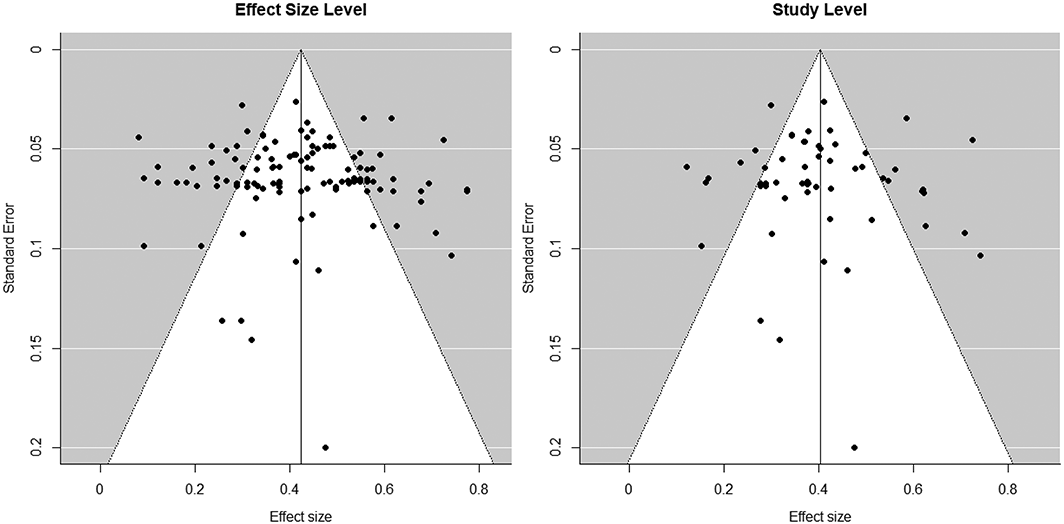
Funnel plots of the standard error and the effect size (z–standardized) of the relation between perfectionistic concerns and neuroticism on the effect size level and the study level.
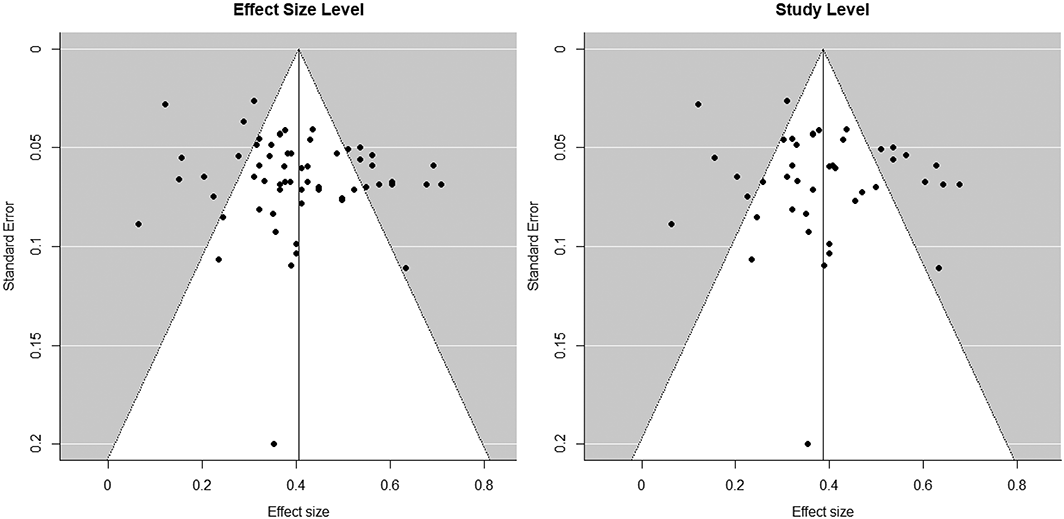
Funnel plots of the standard error and the effect size (z–standardized) of the relation between perfectionistic strivings and conscientiousness on the effect size level and the study level.
Moderation analyses
We had to aggregate countries on continent level to allow moderator testing. Even after aggregating, we could only test North America and Europe as moderator levels. Also, due to a lack of studies in other domains, work and education were the only domains included as moderator levels. Similarly, we were unable to test differences between cross–sectional and longitudinal relations due to the small proportion of studies using a longitudinal design. The complete results of the moderation analyses can be found in Tables S1–S10. Estimates of the relations between the different indicator scales of perfectionistic concerns and perfectionistic strivings can be found in Table S11.
Moderation of the relations between perfectionistic concerns and the Big Five personality traits
Measurement instrument
The measurement instrument moderated the relations of perfectionistic concerns with Conscientiousness, Extraversion, Agreeableness, and Neuroticism. The meta–analytic correlations with Conscientiousness ranged between r = −0.205 (discrepancy, APS–R, Slaney et al., 2001) and r = −0.040 (concern over mistakes, FMPS, Frost et al., 1990), the meta–analytic correlations with Extraversion ranged between r = −0.277 (doubts about actions, FMPS, Frost et al., 1990) and r = −0.172 (socially prescribed perfectionism, HFMPS, Hewitt & Flett, 1991), the meta–analytic correlations with Agreeableness ranged between r = −0.243 (socially prescribed perfectionism, HFMPS, Hewitt & Flett, 1991) and r = −0.130 (discrepancy, APS–R, Slaney et al., 2001), and the meta–analytic correlation with Neuroticism ranged between r = 0.300 (socially prescribed perfectionism, HFMPS, Hewitt & Flett, 1991) and r = 0.441 (doubts about actions, FMPS, Frost et al., 1990). The relation of perfectionistic concerns with Openness was not moderated by the measurement instrument.
Other
Four other moderators reached significance in any of the meta–analyses. The negative relation between perfectionistic concerns and Openness increased slightly with age (b = −0.004, p = 0.037) and decreased slightly with the percentage of female participants in the sample (b = 0.002; p = 0.047). Also, the negative relation between perfectionistic concerns and Extraversion was stronger in Europe (r = −0.248) than in North America (r = −0.173) and increased slightly with the study publication year (b = −0.007, p = 0.025).
Moderation of the relations between perfectionistic strivings and the Big Five personality traits
Measurement instrument
The measurement instrument moderated the relations of perfectionistic strivings with Openness, Extraversion, Agreeableness, and Neuroticism. The meta–analytic correlations with Openness ranged between r = 0.052 (self–oriented perfectionism, HFMPS, Hewitt & Flett, 1991) and r = 0.267 (high standards, APS–R, Slaney et al., 2001), the meta–analytic correlations with Extraversion ranged between r = 0.012 (self–oriented perfectionism, HFMPS, Hewitt & Flett, 1991) and r = 0.070 (personal standards, FMPS, Frost et al., 1990), the meta–analytic correlations with Agreeableness ranged between r = −0.051 (self–oriented perfectionism, HFMPS, Hewitt & Flett, 1991) and r = 0.191 (high standards, APS–R, Slaney et al., 2001), and the meta–analytic correlations with Neuroticism ranged between r = −0.002 (high standards, APS–R, Slaney et al., 2001) and r = 0.120 (self–oriented perfectionism, HFMPS, Hewitt & Flett, 1991). The relation of perfectionistic strivings with Conscientiousness was not moderated by the measurement instrument.
Other
No other moderator reached significance indicating stability of the bivariate relations across various characteristics of the samples and the studies.
The effect of partialling on the relations of perfectionism dimensions and the Big Five personality traits
Table 3 displays the bivariate and the unique relations of perfectionistic concerns and perfectionistic strivings with the Big Five personality traits. Estimates of the bivariate relations from the MASEM approach were almost identical to the estimates from the RVE approach (|
Meta–analytic estimates of the relations between the perfectionism dimensions and the Big Five personality traits (bivariate and controlled for the respective other perfectionism dimension)
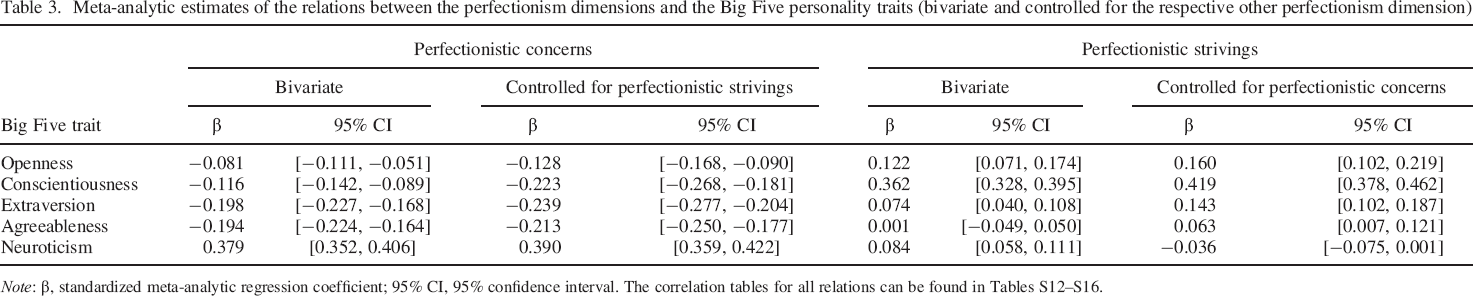
Note: β, standardized meta–analytic regression coefficient; 95% CI, 95% confidence interval. The correlation tables for all relations can be found in Tables S12–S16.
Discussion
In this meta–analysis, we synthesized a large number of findings on the relations of perfectionistic concerns and perfectionistic strivings with the Big Five personality traits by combining the unique strengths of two meta–analytic techniques. In addition to the bivariate relations, we tested potential moderators, and we examined the unique relations of perfectionistic concerns and perfectionistic strivings with the Big Five personality traits. By doing so, we aimed to contribute to three open questions in perfectionism research: (i) how are perfectionistic concerns and perfectionistic strivings related to the FFM as a broader personality framework? (ii) How robust are the relations of perfectionistic concerns and perfectionistic strivings with the Big Five personality traits across different measurement instruments and sample characteristics? (iii) What is the effect of partialling on perfectionistic concerns and perfectionistic strivings?
Perfectionism dimensions and the Big Five personality traits
Perfectionistic concerns and the Big Five
The finding that perfectionistic concerns were most strongly associated with Neuroticism is in line with the portrayal of individuals high in perfectionistic concerns as emotionally unstable, insecure, and prone to experiencing negative affect (Dunkley et al., 2012). Also, neurotic aspects of perfectionistic concerns are visible in the form of a heightened sensitivity to stressors (Flett, Nepon, Hewitt, & Fitzgerald, 2016) and anxious tendencies (e.g. Rice et al., 2005). Before the background of these conceptual similarities, the distinction of perfectionistic concerns from Neuroticism is an ongoing issue of contention (e.g. Mahaffey, Watson, Clark, & Kotov, 2016; Naragon–Gainey & Watson, 2018). Our meta–analysis showed that perfectionistic concerns and Neuroticism display a similar pattern of relations with Openness, Extraversion, and Agreeableness (Van der Linden, te Nijenhuis, & Bakker, 2010). However, the correlation between Conscientiousness and perfectionistic concerns (r = −0.11) was smaller than the correlation between Conscientiousness and Neuroticism (r = −0.32, Van der Linden et al., 2010). Thus, Neuroticism differs from perfectionistic concerns in that it is more strongly associated with carelessness and disorderliness (i.e. low Conscientiousness). Also, the moderate strength of the relation between perfectionistic concerns and Neuroticism in our meta–analysis indicates that perfectionistic concerns are related but not redundant to measures of Neuroticism. Moreover, in previous studies, perfectionistic concerns predicted relevant outcomes beyond Neuroticism including depressive symptoms (for a meta–analysis, see Smith, Sherry et al., 2016), fatigue (Magnusson, Nias, & White, 1996), anxiety, and stress (Smith, Saklofske, Yan, & Sherry, 2017).
The negative relations of perfectionistic concerns with Extraversion and Agreeableness indicate an introvert and disagreeable component in perfectionistic concerns (see Dunkley et al., 2012; Stoeber et al., 2018). These findings support the assumption that perfectionistic concerns are accompanied by social disharmony and a sense of disconnection from others (Sherry & Hall, 2009). This socially antagonistic tendency is a core element of the perfectionism social disconnection model (Hewitt, Flett, Sherry, & Caelian, 2006). This model assumes that perfectionistic concerns, via social behaviours, cognitions, and outcomes, lead to social disconnection (i.e. feeling excluded and rejected), which subsequently leads to depressive symptoms.
The finding that perfectionistic concerns were negatively related to Conscientiousness is contrary to intuitive perceptions of perfectionists as being organized and self–disciplined. Perfectionistic concerns are related to difficulties in task completion and task initiation (Sirois et al., 2017). Consequently, perfectionistic concerns might be detrimental to the development of conscientious characteristics such as a sense of competence. This can be explained in terms of cognitive processes. Worrying and attention to negative thoughts capture attentional resources (Hirsch & Mathews, 2012). These attentional resources are subsequently unavailable for the initiation and efficient attainment of other goals (M. W. Eysenck, Derakshan, Santos, & Calvo, 2007), which might lead to a reduced sense of competence.
The small negative relation of perfectionistic concerns and Openness was unexpected. Thus far, Openness was not assumed to play a major role in perfectionistic concerns (e.g. Stoeber et al., 2018). Yet, indicators of perfectionistic concerns have been linked to a reduced ability to adjust to new situations (Ferrari & Mautz, 1997) and lower tolerance in the context of creativity (Miller, Lambert, & Speirs Neumeister, 2012). Individuals with high perfectionistic concerns might display reduced Openness because they are concerned about the demands of entering new contexts.
Perfectionistic strivings and the Big Five
Perfectionistic strivings were most strongly associated with Conscientiousness. There has been some disagreement whether perfectionistic strivings are distinguishable from Conscientiousness (e.g. Greenspon, 2000). In this debate, it has been emphasized that perfectionistic strivings should not be equated with high levels of Conscientiousness because the achievement goals associated with Conscientiousness are more flexible than those in perfectionistic strivings (e.g. Flett & Hewitt, 2006). In our meta–analysis, the moderate size of the relation between perfectionistic strivings and Conscientiousness indicated no redundancy. Moreover, there is a striking difference between perfectionistic strivings and Conscientiousness in the correlation patterns with the other Big Five personality traits: Whereas Conscientiousness is negatively related to Neuroticism (r = −0.32; van der Linden et al., 2010), there was a small but significant positive correlation between perfectionistic strivings and Neuroticism (r = 0.09) in our meta–analysis. This finding distinguishes perfectionistic strivings from Conscientiousness. The positive relations between perfectionistic strivings and Neuroticism might reflect elements of self–criticism and contingent self–worth that are integral to perfectionistic strivings (A. P. Hill, 2014; DiBartolo, Frost, Chang, LaSota, & Grills, 2004; Flett & Hewitt, 2006). The observation that perfectionistic strivings were, albeit to a different degree, related to Conscientiousness and Neuroticism might also explain the heterogeneity in the relations between perfectionistic strivings and external criteria (e.g. Gotwals et al., 2012). Whether adaptive consequences (resulting from conscientious elements) or maladaptive consequences (resulting from neurotic elements) of perfectionistic strivings prevail might depend on contextual factors (e.g. Chang, Sanna, Chang, & Bodem, 2008). In addition, Conscientiousness longitudinally predicts increases in perfectionistic strivings (Stoeber et al., 2009). This might be explained by a sense of achievement and efficacy in conscientious individuals, which leads to increased strivings for the highest standards (Damian, Stoeber, Negru–Subtirica, & Băban, 2017).
Because perfectionistic strivings were, albeit weakly, associated with Openness, one might speculate whether, in some contexts, pursuing high personal goals requires a degree of curiosity, creativity, and imaginativeness (see Feist, 2006). For instance, Openness is related to academic performance in high school (Zuffianò et al., 2013) and in higher education (Schneider & Preckel, 2017). In any case, our results indicate that perfectionistic strivings should not be equated with a rigid and narrow mind set.
In extending the perfectionism social disconnection model, it has recently been suggested that negative social behaviours and cognitions accompany not only perfectionistic concerns but also perfectionistic strivings (Sherry et al., 2016). In our meta–analysis, we found no evidence for tendencies that indicate social disconnection or interpersonal hostility (i.e. introversion or disagreeableness) in perfectionistic strivings. To the contrary, perfectionistic strivings were, albeit weakly, positively related to Extraversion. Therefore, it seems that an important distinction between the two perfectionism dimensions is that a socially antagonistic component is integral to perfectionistic concerns but not to perfectionistic strivings.
Comparing perfectionistic concerns and perfectionistic strivings
In sum, our results showed that perfectionistic concerns and perfectionistic strivings display a divergent pattern of relations with broader personality traits, which supports the differentiation between the two perfectionism dimensions. Perfectionistic concerns are primarily characterized by emotional instability and proneness to experiencing negative affect (i.e. high Neuroticism). To a smaller extent, individuals with high perfectionistic concerns are introvert (i.e. low in Extraversion), socially antagonistic (i.e. low in Agreeableness), careless and disorderly (i.e. low in Conscientiousness), and sceptical about new experiences (i.e. low in Openness). Perfectionistic strivings are primarily characterized by dutifulness and self–discipline (i.e. high Conscientiousness). To a smaller extent, perfectionistic strivings are characterized by a preference for novelty (i.e. high Openness), sociability (i.e. high Extraversion), and emotional instability (i.e. high Neuroticism). Negative self–evaluations prevalent both in perfectionistic concerns and in perfectionistic strivings (A. P. Hill, 2014; DiBartolo et al., 2004) can explain why both perfectionism dimensions were, albeit to a different degree, characterized by Neuroticism. However, this tendency seems less pronounced in perfectionistic strivings than in perfectionistic concerns.
Generalizability of relations of perfectionism dimensions with the Big Five personality traits
The finding that relations of both perfectionism dimensions with the Big Five personality traits displayed a large degree of generalizability across various characteristics of the studies and the samples (i.e. domains, continents, genders, age, and publication years) adds validity to the comparison of perfectionism levels between cohorts (Curran & Hill, 2017) and between subgroups based on demographic differences (e.g. Hewitt & Flett, 1991).
The measurement instrument, however, moderated the relations between most Big Five personality traits and the two perfectionism dimensions. All indicators of perfectionistic concerns were most strongly associated with Neuroticism. This relation was largest for the doubts about actions scale (FMPS, Frost et al., 1990) and smallest for the socially prescribed perfectionism scale (HFMPS, Hewitt & Flett, 1991). Thus, constant doubts about one's actions might reflect a stronger internalization of insecurities and negative self–evaluations compared with the impression that others expect perfection of oneself. All indicators of perfectionistic strivings were most strongly associated with Conscientiousness. This relation was not moderated by the measurement instrument. Thus, there was little evidence for the assumption that the high standards scale (APS–R, Slaney et al., 2001) is more closely related to Conscientiousness than other indicators of perfectionistic strivings (see Blasberg et al., 2016). However, Neuroticism was positively related to self–oriented perfectionism (HFMPS, Hewitt & Flett, 1991) and personal standards (FMPS, Frost et al., 1990) but not to high standards (APS–R, Slaney et al., 2001). Consequently, the high standards scale (APS–R, Slaney et al., 2001) might capture the more adaptive components of perfectionistic strivings.
Taken together, our results show the strengths and weaknesses of the two–dimensional approach to perfectionism. Perfectionistic concerns and perfectionistic strivings provide a useful framework to distinguish between perfectionism facets that primarily relate to Neuroticism and perfectionism facets that primarily relate to Conscientiousness. This is useful for the integration of multiple perfectionism models and measures in a single framework. However, our results also demonstrate that different indicator scales represent different facets of perfectionism dimensions that are not completely interchangeable. The distinctive features of these facets are lost in the two–dimensional approach (see A. P. Hill, 2016). On a general level, we find it problematic that the scales subsumed under the labels ‘perfectionistic concerns’ and ‘perfectionistic strivings’ vary between studies (cf. ‘the jingle fallacy’, Thorndike, 1904). In our point of view, the field would greatly benefit from a continued theoretical debate with the aim to develop standard definitions of the two perfectionism dimensions and subsequently find commonly agreed measures.
Unique relations of perfectionistic concerns and perfectionistic strivings with the Big Five personality traits
The debate about the effects of partialling on the meaning of perfectionistic concerns and perfectionistic strivings has predominantly been based on theoretical arguments and changes in relations with relevant external criteria (A. P. Hill, 2014, 2017; Stoeber & Gaudreau, 2017). We sought to add to this debate by examining the effect of partialling on the network of broader personality characteristics associated with perfectionistic concerns and perfectionistic strivings.
Partialled perfectionistic concerns were more strongly associated with emotional instability, closeness to new experiences, low conscientiousness, introversion, and disagreeableness compared with unpartialled perfectionistic concerns. Hence, our findings indicate a more maladaptive constellation of personality traits for partialled perfectionistic concerns in comparison with unpartialled perfectionistic concerns. This might explain why the negative relations of perfectionistic concerns with adaptive external criteria increase after partialling (e.g. R. W. Hill et al., 2010). Yet, there is a large degree of similarity in the relations of partialled and unpartialled perfectionistic concerns with the Big Five personality traits. Partialling did not eliminate or reverse any of the relations with the Big Five personality traits. In addition, the nomological network of perfectionistic concerns is distinct from the nomological network of related constructs such as fear of failure (e.g. Martin & Marsh, 2003), which is also characterized by increased Neuroticism but largely unrelated to Openness, Conscientiousness, and Agreeableness (e.g. Watson, 2001). Thus, partialled perfectionistic concerns may be interpreted as a more maladaptive form of perfectionistic concerns.
Partialled perfectionistic strivings were more strongly associated with Openness, Conscientiousness, Extraversion, and Agreeableness compared with unpartialled perfectionistic strivings. In addition, the small positive relation with Neuroticism vanished. Consequently, by eliminating the neurotic element, partialled perfectionistic strivings seem to reflect the more adaptive components of perfectionistic strivings. This might explain why partialled perfectionistic strivings are consistently associated with adaptive outcomes whereas the pattern is mixed for unpartialled perfectionistic strivings (for a review, see Stoeber & Otto, 2006). Recently, excellencism (i.e. the pursuit of excellence) has been introduced as a personality characteristic distinct from perfectionistic strivings (Gaudreau, 2018). Adjectives like ‘demanding’, ‘strict’, and ‘excessive’ describing one's aims and strivings have been used to differentiate perfectionistic strivings from excellencism. Thus, because partialling removes the neurotic element from perfectionistic strivings, one might speculate whether partialled perfectionistic strivings are more similar to excellencism than to unpartialled perfectionistic strivings. However, whereas excellencism is conceptualized as being associated with increased efficiency in task completion (Gaudreau, 2018), partialled and unpartialled indicators of perfectionistic strivings are associated with decreased efficiency in task completion (Stoeber & Eysenck, 2008) and decreased research productivity (Sherry et al., 2010). Consequently, additional research applying the recently developed measure of excellencism (Gaudreau & Schellenberg, 2018) is needed to further clarify the distinction of partialled perfectionistic strivings and excellencism.
In sum, our findings showed that partialled perfectionistic concerns and partialled perfectionistic strivings are not equal to unpartialled perfectionistic concerns and unpartialled perfectionistic strivings. This highlights the importance of providing a bivariate correlation table when applying multivariate statistics and to carefully distinguish between partialled and unpartialled perfectionistic concerns and perfectionistic strivings (see A. P. Hill, 2014; Stoeber & Gaudreau, 2017).
Limitations and future research directions
This meta–analysis showed the FFM's ability to contribute to the clarification of questions regarding the nature of personality constructs, the differences between measurement instruments, and the effects of statistical techniques (i.e. partialling). However, there are several limitations to our study.
We examined the relations between multidimensional perfectionism and the FFM on the broader level of the five factor domains, which are higher order factors of more narrow personality facets (Costa & McCrae, 1992b; Costa & McCrae, 1995). Future analysis on the level of these personality facets could allow a more fine–grained portrayal of the nomological networks of perfectionistic concerns and perfectionistic strivings (see, e.g. Dunkley et al., 2012). This would also allow a more precise understanding of the components of perfectionistic concerns and perfectionistic strivings that are removed through partialling. Unfortunately, to date, there is no sufficient amount of studies available to obtain reliable meta–analytic estimates of the relations on the level of Big Five facets.
Another limitation of our meta–analysis is the focus on personality functioning in non–clinical samples. Further research is needed to test whether the relations with broader personality traits identified in this meta–analysis generalize to clinical samples. Also, the cross–cultural generalizability of our findings is unclear in that most studies were conducted in Western countries and the interpretability of the moderating effects of age and gender might be limited due to the limited diversity of our samples. An additional essential limitation is the exclusive reliance on self–reports. The identified correlations might be explained by common method–variance in self–report measures (D. T. Campbell & Fiske, 1959; Podsakoff, Whiting, Welsh, & Mai, 2013). Thus, an important future research direction is a multi–method approach that allows to control for method variance and rater–specific perspectives to validate the identified correlations across different measurement methods and rater perspectives. Further, due to the low number of longitudinal studies, we were unable to test whether the Big Five personality traits are antecedents for the development of multidimensional perfectionism (see Stoeber et al., 2009). More longitudinal studies are needed to investigate the interplay of multidimensional perfectionism and the Big Five personality traits.
Conclusion
This meta–analysis investigated how the dimensions of multidimensional perfectionism relate to the FFM as a broader personality framework. Perfectionistic concerns were primarily associated with Neuroticism and perfectionistic strivings were primarily associated with Conscientiousness. We also identified smaller negative relations of perfectionistic concerns with Extraversion, Agreeableness, Conscientiousness, and Openness and small positive relations of perfectionistic strivings with Openness, Extraversion, and Neuroticism. Thus, both perfectionism dimensions, although to a different extent, share an element of emotional instability. The opposing relations with the other Big Five personality traits support the distinction between perfectionistic concerns and perfectionistic strivings. Moreover, most associations of perfectionism dimensions with the Big Five personality traits differed between measurement instruments. This finding highlights the importance of discriminating between the different facets of perfectionistic concerns and perfectionistic strivings. In addition, this meta–analysis showed that partialling affects the nomological networks of perfectionistic concerns and perfectionistic strivings. Consequently, partialled and unpartialled perfectionism dimensions need to be carefully distinguished when reporting and interpreting findings. In sum, this meta–analytic study adds to tightening the conceptual framework required to integrate the large number of approaches and measures used in perfectionism research.
Supporting info item
Supporting info item, per2186-sup-0001-Supplementary_Material - Multidimensional Perfectionism and the Big Five Personality Traits: A Meta–Analysis
Supporting info item, per2186-sup-0001-Supplementary_Material for Multidimensional Perfectionism and the Big Five Personality Traits: A Meta–Analysis by Stricker Johannes, Buecker Susanne, Schneider Michael, Preckel Franzis and Kandler Christian in European Journal of Personality
Table S1. Moderator Analyses for the Meta-Analytic Correlations of Perfectionistic Concerns and Openness
Table S2. Moderator Analyses for the Meta-Analytic Correlations of Perfectionistic Concerns and Conscientiousness
Table S3. Moderator Analyses for the Meta-Analytic Correlations of Perfectionistic Concerns and Extraversion
Table S4. Moderator Analyses for the Meta-Analytic Correlations of Perfectionistic Concerns and Agreeableness
Table S5. Moderator Analyses for the Meta-Analytic Correlations of Perfectionistic Concerns and Neuroticism
Table S6. Moderator Analyses for the Meta-Analytic Correlations of Perfectionistic Strivings and Openness
Table S7. Moderator Analyses for the Meta-Analytic Correlations of Perfectionistic Strivings and Conscientiousness
Table S8. Moderator Analyses for the Meta-Analytic Correlations of Perfectionistic Strivings and Extraversion
Table S9. Moderator Analyses for the Meta-Analytic Correlations of Perfectionistic Strivings and Agreeableness
Table S10. Moderator Analyses for the Meta-Analytic Correlations of Perfectionistic Strivings and Neuroticism
Table S11. Meta-Analytic Correlations Between Indicator Scales of Perfectionistic Concerns and Perfectionistic Strivings (Without Correction for Measurement Unreliability)
Table S12. Meta-Analytic Bivariate Correlations Used to Estimate the Unique Relations of Perfectionistic Concerns and Perfectionistic Strivings with Openness (34 Samples)
Table S13. Meta-Analytic Bivariate Correlations Used to Estimate the Unique Relations of Perfectionistic Concerns and Perfectionistic Strivings with Conscientiousness (51 Samples)
Table S14. Meta-Analytic Bivariate Correlations Used to Estimate the Unique Relations of Perfectionistic Concerns and Perfectionistic Strivings with Extraversion (37 Samples)
Table S15. Meta-Analytic Bivariate Correlations Used to Estimate the Unique Relations of Perfectionistic Concerns and Perfectionistic Strivings with Agreeableness (36 Samples)
Table S16. Meta-Analytic Bivariate Correlations Used to Estimate the Unique Relations of Perfectionistic Concerns and Perfectionistic Strivings with Neuroticism (66 Samples)
Figure S1. Funnel plots of the standard error and the effect size (z-standardized) of the relation between perfectionistic concerns and Openness on the effect size level and the study level.
Figure S2. Funnel plots of the standard error and the effect size (z-standardized) of the relation between perfectionistic concerns and Conscientiousness on the effect size level and the study level.
Figure S3. Funnel plots of the standard error and the effect size (z-standardized) of the relation between perfectionistic concerns and Extraversion on the effect size level and the study level.
Figure S4. Funnel plots of the standard error and the effect size (z-standardized) of the relation between perfectionistic concerns and Agreeableness on the effect size level and the study level.
Figure S5. Funnel plots of the standard error and the effect size (z-standardized) of the relation between perfectionistic strivings and Openness on the effect size level and the study level.
Figure S6. Funnel plots of the standard error and the effect size (z-standardized) of the relation between perfectionistic strivings and Extraversion on the effect size level and the study level.
Figure S7. Funnel plots of the standard error and the effect size (z-standardized) of the relation between perfectionistic strivings and Agreeableness on the effect size level and the study level.
Figure S8. Funnel plots of the standard error and the effect size (z-standardized) of the relation between perfectionistic strivings and Neuroticism on the effect size level and the study level.
Supporting info item
Supporting info item, per2186-sup-0002-Open_Practices_Disclosure_Form - Multidimensional Perfectionism and the Big Five Personality Traits: A Meta–Analysis
Supporting info item, per2186-sup-0002-Open_Practices_Disclosure_Form for Multidimensional Perfectionism and the Big Five Personality Traits: A Meta–Analysis by Stricker Johannes, Buecker Susanne, Schneider Michael, Preckel Franzis and Kandler Christian in European Journal of Personality
Supporting Information
References
Supplementary Material
Please find the following supplemental material available below.
For Open Access articles published under a Creative Commons License, all supplemental material carries the same license as the article it is associated with.
For non-Open Access articles published, all supplemental material carries a non-exclusive license, and permission requests for re-use of supplemental material or any part of supplemental material shall be sent directly to the copyright owner as specified in the copyright notice associated with the article.
