







Abstract
It is well established that goals energize and direct behaviour across the lifespan. To better understand how goals are embedded in people's lives across adulthood, the present research examined life goals’ content (health, personal growth, prosocial engagement, social relations, status, work), dynamics (interplay between goal importance and goal attainability), and outcomes (subjective well–being) from a developmental perspective. We argue that people rate those goals as important and attainable that enable them to master developmental tasks, that they adapt their goals to personal capacities, and that goals predict subjective well–being after 2 and 4 years. The sample included 973 individuals (18–92 years old, M = 43.00 years) of whom 637 participated 2 years later and 573 participated 4 years later. Goal importance and well–being were assessed at all occasions and goal attainability at the first two occasions. Results indicated that age was negatively associated with importance and attainability of personal–growth, status, and work goals but positively associated with importance and attainability of prosocial–engagement goals. The association between goal importance and attainability was largely bidirectional over time; and goal attainability, rather than goal importance, was positively linked to later well–being. Implications of these findings are discussed in light of adult lifespan development. © 2019 European Association of Personality Psychology
Keywords
Mature striving is linked to long–range goals. (Gordon W. Allport, 1955)
As people move through their adult years, they meet various challenges regarding their identity, social relations, and occupational pathways (Erikson, 1968). To successfully manage these challenges, people develop, maintain, and adjust their goals (e.g. Austin & Vancouver, 1996). Defined as ‘desired states that people seek to obtain, maintain, or avoid’ (Emmons, 1996, p. 314), goals are not set in stone but instead are adjusted to circumstances that emerge across the lifespan (Freund & Riediger, 2006). Accordingly, goals have been referred to as personality in context (Little, 1989) or characteristic adaptations (McAdams, 2015), expressing the idea that, in interaction with physical, cultural, or social contexts, people actively shape their development by allocating resources to specific life goals (Wiese & Freund, 2005). This, in turn, highlights the importance of contextualizing goals within broader life conditions, such as age–related concerns.
In the present research, we built on this argument and studied (i) age effects on the domains that people rate as important and perceive as attainable (i.e. goal content) from the perspective of their compatibility with developmental tasks (Erikson, 1968; Havighurst, 1972); (ii) the longitudinal association between goal importance and goal attainability (i.e. goal dynamics) from the perspective of adaptations to personal capacities (Baltes, 1987, 1997; Brandtstädter & Greve, 1994; Heckhausen, 1999); and (iii) the long–term consequences of goal importance and goal attainability for subjective well–being (i.e. goal outcomes) from the perspective of motivational underpinnings of subjective well–being across adulthood (Diener, 1994; Diener, Suh, Lucas, & Smith, 1999).
To our knowledge, the present study is the first to systematically assess major life goals’ content, dynamics, and outcomes over time in a sample that covers the entire adult lifespan (i.e. age 18–92 years). Knowing how life goals’ importance and attainability are distinct in different life domains across adulthood, how life goals are adjusted to personal capacities, and how goals are differentially linked to subjective well–being complements and expands on current research in both the goal and the lifespan literature.
Content of goals: Age differences in goal importance and goal attainability
Conceived as motivated agents (McAdams, 2015), individuals strive to develop themselves and are inclined to expand who they are. From this humanistic perspective (Maslow, 1954; Rogers, 1995), people expand their potential by setting a motivational agenda, which moves them toward internal representations of desired future outcomes or events, represented in life goals (Austin & Vancouver, 1996). In the present study, we focused on major life goals (such as starting a family) rather than on more specific strivings (such as dating a particular person) because major life goals set the compass that directs and guides the life course (Emmons, 1986) and, accordingly, shape personality development (McAdams, 2015).
Life goals as an example of a type of characteristic adaptation (McAdams, 2015) do not emerge in a contextual vacuum. Instead, they vary with changing circumstances, role expectations, and maturation over the life course (Elder, 1995; McAdams & Pals, 2006; Roberts & Wood, 2006). Consequently, life goals represent what individuals are planning and working on while they find themselves in a certain life period (Brunstein, Dangelmayer, & Schultheiss, 1996; Cantor & Kihlstrom, 1987). According to Erikson (1968) and Havighurst (1972), each life period includes developmental tasks that arise at a certain time in personal development and that contain age–graded normative expectations, which entail specific roles, positions, and obligations, reflecting an interplay between social demands and expectations, biological development and maturation, and personality (also Freund & Baltes, 2005; Hutteman, Hennecke, Orth, Reitz, & Specht, 2014; Little, Salmela–Aro, & Phillips, 2007; Nurmi, 1992). We, consequently, argue that developmental tasks will be reflected in an age–dependent relative importance that people allocate to certain life–goal domains.
More specifically, developmental tasks in young adulthood (roughly ages 18–40 years; Staudinger & Bluck, 2001) are characterized by a focus on growth (i.e. developmental gains; Heckhausen, Dixon, & Baltes, 1989) that enables young adults to gain information and to explore who they are. This growth orientation enables young adults to acquire new skills and to reach their full potential (Ebner, Freund, & Baltes, 2006; Havighurst, 1972). Moreover, it is usually in young adulthood that people enter the workforce, establish long–lasting friendships, and commit to their first long–term romantic relationship, which makes topics of work and social relations salient for the young adult (Havighurst, 1972; Nurmi, 1992). Thus, we expect young adults’ developmental tasks to be reflected in the importance of personal–growth, social–relation, and work goals. Moreover, previous research has shown that extrinsic life goals (i.e. life goals directed at obtaining external rewards such as money, fame, and praise) tend to be expressed more in young adulthood than in other age groups (Deci & Ryan, 2000), which leads us to predict the importance of extrinsic goals (i.e. status goals) to be negatively linked to age.
In contrast to the proving grounds of young adulthood, in middle age (roughly ages 41–60 years; Staudinger & Bluck, 2001), adults pursue goals that secure, consolidate, and stabilize what has been established and that orient them toward the future of subsequent generations (Erikson, 1968; McAdams, 2015). For instance, middle–aged adults tend to value goals related to family and raising children, work, prosocial engagement, and passing traditions on to the next generation (Freund & Riediger, 2006; Havighurst, 1972; Neugarten & Datan, 1996). Accordingly, we expect middle–aged adults to give importance to prosocial–engagement, social–relation, and work goals.
The developmental tasks of older adults (roughly age 61 years and above; Staudinger & Bluck, 2001) are centred around the maintenance of a functional level in domains such as health or leisure (Ebner et al., 2006; Heckhausen et al., 1989), orienting older adults toward avoiding losses rather than acquiring potential gains (Freund, 2008; Ogilvie, Rose, & Heppen, 2001). In addition, given that the future tends to be perceived as limited in late adulthood, older adults usually follow goals that are present oriented, such as deepening close relationships (Carstensen, Isaacowitz, & Charles, 1999). Finally, older compared with younger adults tend to be more altruistic, for example, in more strongly valuing contributions to the public good and being more likely to donate money to a good cause (Freund & Blanchard–Fields, 2014). We therefore expect older adults to rate goals of health, prosocial engagement, and social relations as important.
Taken together, life stages with their normative expectations and structural opportunities yield developmental tasks that lay the ground for allocating differential importance to certain life goals (Hutteman et al., 2014). Building on this rationale, we predict that age shapes the relevance assigned to life goals: Importance of personal–growth, status, and work goals should be negatively associated with age, whereas importance of health and prosocial–engagement goals should be positively associated with age. As outlined, people of each life stage are inclined to value social–relation goals. Hence, we do not expect age differences in the importance ascribed to social–relation goals, although the motivation to value these goals might differ across age: The growth focus among young adults might shift to a focus on established and secured aspects of life in middle adulthood and to momentary rewards in older age. Despite these different motivations, social relationships are considered essential for individuals to thrive across the lifespan (e.g. Deci & Ryan, 2008) and should therefore reflect an important goal in each age group.
As well as goal importance, we investigated goal attainability, defined as the subjective perception of ‘opportunity, control, and support’ of goal pursuit (Brunstein, 1993, p. 1062). Given that goal importance and goal attainability dynamically interact with each other (Brandtstädter & Rothermund, 2002), we expect goal attainability to vary with age in a similar manner to goal importance. We predict that age effects on goal attainability should show the same age–related pattern as age effects on goal importance: Attainability of personal–growth, status, and work goals should be negatively associated with age; attainability of health and prosocial–engagement goals should be positively associated with age; and attainability of social–relation goals should not be affected by age. One can expect a differential effect in the health domain, because—although health goals become more important with increasing age—older adults often have to deal with physical health issues, health impairment, and cognitive decline, which limit the resources they can devote to attaining their goals (Reynolds & Finkel, 2016). Yet we expect age to be positively related to health–goal attainability for the following reason: If people experience a discrepancy between their goals and the likelihood of achieving these goals, they start to cope with this discrepancy (Brandtstädter & Rothermund, 2002; refer to the next section). Assuming that health goals become more important with increasing age at the same time that resources are shrinking, older adults might, for instance, rescale their aspirations in the health domain, develop more feasible health goals, and invest in these newly developed goals (Brandtstädter & Rothermund, 2002). These adjustment strategies likely render it possible not only to value health goals as important with increasing age but also to perceive them as attainable.
Goal dynamics: Association between goal importance and goal attainability over time
As indicated above, goals vary not only in their importance but also with regard to their perceived attainability (Atkinson, 1964; Tomasik, Knecht, & Freund, 2017). Self–regulation theories of development posit that people strive for control over their lives by balancing the importance and attainability of their goals (Baltes, 1987, 1997; Brandtstädter & Greve, 1994; Heckhausen, Schulz, & Wrosch, 1998). More specifically, the dual–process framework (Brandtstädter & Rothermund, 2002) proposes two modes of coping with the dynamics between the pursuit and the adjustment of goals, namely, the assimilation mode and the accommodation mode. Both modes illustrate two types of adaptive processes, which are complementary in that both intend to resolve a goal discrepancy, but they function in opposite ways (Brandtstädter, 1989; Brandtstädter & Renner, 1990; Brandtstädter & Rothermund, 2002; Rothermund & Brandtstädter, 2003).
The assimilation mode implies a purposeful and intentional change of individuals’ own behaviour or their life circumstances. That is, when important goals appear less attainable, people tend to invest more heavily in the goal pursuit and to intentionally modify the situation (assimilation mode or primary control strategies; Brandtstädter & Rothermund, 2002; Heckhausen & Schulz, 1995; Heckhausen et al., 1998; Rothermund & Brandtstädter, 2003; Wrosch, Heckhausen, & Lachman, 2000). This is typically the case in young adulthood when enough resources are available to acquire new skills, to improve existing functions, and to seek environments that offer access to new resources (Brandtstädter & Rothermund, 2002; Ebner et al., 2006). For instance, a 19–year–old woman might have the goal of becoming a successful professional swimmer, so she practices on a nearly daily basis to achieve this goal. During competitions, however, she rarely wins a medal. She realizes that her important goal appears to be becoming less attainable. As a consequence, she begins to practice with a new trainer to learn a modified swimming technique, and she joins a more competitive swimming group. She invests more heavily in her goal in that she has purposefully and intentionally changed her behaviour and life circumstances.
As evident from the above, these assimilative efforts require available resources, such as the perception of having enough time, of receiving social and/or financial support, and of being in good physical and/or mental shape (Brandtstädter & Rothermund, 2002). As people age, however, these internal and external resources may shrink (Brandtstädter & Rothermund, 2002; Freund, 2008), and the ratio of expected gains to expected losses of resources becomes less favourable (Ogilvie et al., 2001). It is, thus, the adjustment of goals to these constraints and the lowering of aspirations that contribute to the maintenance of high goal attainability and to control in older adulthood (i.e. accommodation mode or secondary control strategies; Brandtstädter & Rothermund, 2002; Heckhausen & Schulz, 1995; Heckhausen et al., 1998; Rothermund & Brandtstädter, 2003; Wrosch et al., 2000). This mode typically implies eliminating blocked goals, rescaling aspirations, or funnelling energies and investment into new, more feasible goals. For instance, a 72–year–old man might have the goal of being actively engaged in the political work of his community. For the last 20 years, he has participated in weekly meetings of his local government, given public speeches, and met various stakeholders and politicians to discuss current topics. Within the last 2 years, however, his ability to effortlessly give long speeches and travel long distances has decreased. While remaining actively engaged in community work, he has rescaled this goal. Now, he provides his expertise and knowledge from the back office through being a wise mentor for the next generation's politicians and a close advisor in speech writing.
As outlined, the balance between the assimilative and accommodative modes depends on the conditions and resources that individuals think are available in a specific life condition. We argue that age might be a moderating factor in this balance. We expect the associations between goal importance and goal attainability to be positive but to vary in how pronounced they are across adulthood. We assume that young adults more intensely invest in important goals, which will increase the perceived likelihood of attaining these goals (i.e. assimilation mode). Consequently, we predict that it is in younger age that goal importance predicts later goal attainability, and we expect this positive association to be negatively associated with age. In contrast, we hypothesize that older adults lower their aspirations and mentally decrease the importance of those goals that are no longer perceived as attainable (i.e. accommodation mode). Consequently, we predict that it is in older age that goal attainability predicts later goal importance, and we expect this positive association to be positively associated with age. Given that any life domain that is open to be modified can be addressed through these adaptive processes (Brandtstädter & Rothermund, 2002), we expect our hypotheses to apply to each of the investigated life–goal domains.
Goal outcomes: Goal importance and goal attainability as predictors of subjective well–being
It is well established that the pursuit of personally meaningful goals is advantageous for various indicators of subjective well–being (e.g. Brunstein, Schultheiss, & Maier, 1999; Deci & Ryan, 1985, 2008; Emmons, 1996; Emmons & King, 1988; C. Harris, Daniels, & Briner, 2003; Schmuck, Kasser, & Ryan, 2000). However, the study of goals for well–being has not been without controversy, because their role is ambiguous (Brandtstädter & Rothermund, 2002): While they motivate behaviour, give structure, and provide meaning, goals might also be a source of dissatisfaction when they are perceived as unattainable (especially when the goal remains important and no accommodative strategies have been applied). Thus, the link between goals and subjective well–being in light of both goal importance and goal attainability needs to be carefully investigated.
In line with previous theory (Diener, 1984; Diener et al., 1999; Lucas, Diener, & Suh, 1996), we understand subjective well–being as comprising a cognitive–evaluative component (global life satisfaction and domain–specific satisfaction) and an affective component (positive and negative affect). One way to investigate the consequences of life goals for subjective well–being is, for instance, to differentiate between intrinsically and extrinsically oriented goals (Deci & Ryan, 2000). On the basis of past theory and research (e.g. Kasser & Ryan, 1996), we define intrinsic goals as goals directed at the fulfilment of innate psychological needs such as relatedness, autonomy, and competence, including goals for meaningful relationships, community contributions, personal growth, and health. We conceptualize extrinsic goals as those directed at the desire for fame, image, and wealth, mapping on status goals. Work goals, finally, most likely reflect a combination of intrinsic and extrinsic goals.
Previous research suggests that intrinsic life goals are particularly conducive to well–being (e.g. Brunstein, 1993; Deci & Ryan, 1985). Extrinsic goals, in contrast, tend to work against people's well–being given that these goals are focused on obtaining external rewards and approbation from others, thereby giving the activity an instrumental character to achieve an intended consequence (e.g. Deci & Ryan, 1985; Kasser & Ryan, 1993, 1996; Schmuck et al., 2000). For the present research, we expect a positive association between goal importance and subjective well–being for the intrinsic goal domains and a negative association for the extrinsic goal domains.
With respect to goal attainability as a predictor of subjective well–being, we base our hypotheses on findings from research on locus of control (Rotter, 1966). While an internal locus of control implies that a person holds the belief that his or her own ability, effort, or actions determine what happens, an external locus of control reflects that fate, luck, or outside forces are responsible for what happens (Rotter, 1966). People tend to be more satisfied if they perceive a goal as attainable and feel a sense of control (e.g. Judge & Bono, 2001; Rodin, 1986; Rodin & Langer, 1977). Applying this to the present research, we expect that people who perceive their goals as attainable will indicate higher levels of subjective well–being. Here, we again differentiate between intrinsic and extrinsic goals. A previous finding demonstrated that the importance and attainability of intrinsic goals are positively linked to positive affect, while the importance and attainability of extrinsic goals are negatively linked to positive affect (Kasser & Ryan, 1996). No effects were found for the link between goal importance/attainability of intrinsic/extrinsic goals and negative affect in this study (Kasser & Ryan, 1996). Although these findings provide insights into the relevance of intrinsic and extrinsic goals for the affective component of subjective well–being (as well as, among others, vitality, depression, and physical symptoms), the study was limited in that other, more cognitive aspects of subjective well–being were not included (Kasser & Ryan, 1996). In addition, the study covered a short time span (a maximum of 7 days in Study 2), which highlights the need for a more nuanced investigation of the longitudinal prediction of the effects of goals on later subjective well–being. This leads us to expand the long–term prediction of an effect of goal attainability to diverse indicators of subjective well–being.
Finally, in line with the life–course perspective of the present study, we test whether age moderates the association between goal importance and subjective well–being and/or between goal attainability and subjective well–being. So far, there is a limited amount of research on possible age–related differences in the link between goal importance/goal attainability and subjective well–being. In their study, Kasser and Ryan (1996) found no support for a moderating effect between goal importance/goal attainability and the affective component of well–being. However, these findings bear two limitations. First, although the study sample included participants with a wide age range (18–79 years), it was a small sample of 100 adults, and age effects might have been underestimated. Second, the cognitive–evaluative component of subjective well–being was not included in the study. Hence, we seek to shed further light on possible moderating effects of age on the association between goal importance/goal attainability and different indicators of subjective well–being.
We have now established links between importance and attainability of life goals with life satisfaction, positive affect, and negative affect for the present investigation. Yet we want to go one step further and focus on an additional aspect of the cognitive–evaluative component of well–being: Domain–specific satisfaction. Although past findings have demonstrated a consistent association between certain life goals and well–being, they often tend to overlook that the link between goals and satisfaction can differ between life domains (Diener, 1994; Vansteenkiste et al., 2007). In other words, rating goals in the work domain as important and perceiving them as attainable might have positive ramifications for satisfaction in the work domain (e.g. Lent & Brown, 2006; Maier & Brunstein, 2001; Roberson, 1990) but not in the family domain. This is the case because work goals lead to allocation of resources to the work domain but not to the relationship and family domains (e.g. Wiese & Freund, 2005). Conversely, relationship goals might be positively linked to satisfaction in the relationship domain (e.g. Sanderson & Evans, 2001) but not to satisfaction in the occupational domain.
Given that goals require the allocation of resources to particular life domains at the expense of allocations to other domains, we expect to find thematic associations between the importance and attainability of goal domains and satisfaction within given life domains (e.g. work goals predicting satisfaction with work but not satisfaction with social relationships). In terms of life domains, we focus on (i) occupational performance, (ii) health, and (iii) interpersonal relations as salient and important domains of an adult's life. For (i) occupational performance, we consider that people of different ages are confronted with different aspects of occupational performance and investigate both satisfaction with education (likely to be present for young adults) and satisfaction with work [likely to be (or to have been) present for middle–aged and older adults]. For (ii) health, we assess overall satisfaction with one's health. Finally, for (iii) interpersonal relations, previous research has shown that social contexts change over the lifespan and, more specifically, that social networks decrease after a person's second decade of life (Wrzus, Hänel, Wagner, & Neyer, 2013). However, findings of this study also suggest taking a differentiated perspective on a person's social network given that friendship networks decrease across age but family networks remain stable (Wrzus et al., 2013). We thus acknowledge the manifold character of social contexts and differentiate between three areas of interpersonal relationships, namely, satisfaction with family life, satisfaction with one's romantic relationship, and satisfaction with friendships.
In line with the developmental focus of this paper, we again test for moderating effects of age. We hypothesize that goal–outcome associations are stronger for goal domains that correspond to developmental tasks at a particular age. This might be the case because focusing on goals that correspond to developmental tasks enables people to fulfil these tasks, which is likely experienced as rewarding. Consequently, we expect that the link between work goals and satisfaction in the work domain decreases with age, that the link between health goals and satisfaction in the health domain increases with age, and that the link between social goals and satisfaction in the social domain remains stable across adulthood.
The Present Study
The aim of the present study is to position major life goals’ content, dynamics, and outcomes in the context of a lifespan perspective. To that aim, we explore three major research strands.
Effects of age on goal importance and goal attainability (goal content)
Hypothesis 1a: Importance of work, status, and personal–growth goals is negatively associated with age, and importance of health and prosocial–engagement goals is positively associated with age. We do not expect age effects on importance of social–relation goals. Hypothesis 1b: Attainability of work, status, and personal–growth goals is negatively associated with age, and attainability of health and prosocial–engagement goals is positively associated with age. We do not expect age effects on attainability of social–relation goals.
The association between goal importance and goal attainability over 2 years (goal dynamics)
Hypothesis 2a: Goal importance and goal attainability are reciprocally linked to each other; that is, goal importance predicts later goal attainability, and goal attainability predicts later goal importance. Hypothesis 2b: We expect these associations to be moderated by age in that (i) the association between goal importance and later goal attainability is weaker with higher age, while (ii) the association between goal attainability and later goal importance is stronger with higher age.
Goal importance and goal attainability as predictors of subjective well–being (goal outcomes)
Hypothesis 3a: Importance of intrinsic life goals is positively linked to later subjective well–being (i.e. life satisfaction, and positive and negative affect), and importance of extrinsic life goals is negatively linked to later subjective well–being. Hypothesis 3b: Attainability of intrinsic life goals is positively related to later subjective well–being (i.e. life satisfaction, and positive and negative affect), and attainability of extrinsic life goals is negatively related to later subjective well–being. Hypothesis 3c: For domain–specific satisfaction, we expect a thematic link between goal domains and their respective satisfaction domains: Importance and attainability of work goals predict satisfaction with the occupational domain; importance and attainability of health goals predict health satisfaction; and importance and attainability of social–relation goals predict satisfaction in the social domain. These associations are stronger at the age at which the goal is valued as more important and attainable.
Method
Sample and general procedure
Data for the present study were obtained from the longitudinal Co–Development in Personality (CoDiP) 1 study that was conducted in the German–speaking parts of Switzerland. Ethical approval for the CoDiP study was received from the regional ethics committee of Basel (approval number: 175/09) at the University of Basel, Switzerland. Necessary supplemental materials (i.e. overview of study variables and data analysis script) are stored at a public and open–access repository (accessible through the following link: https://osf.io/s2w3n/).
Individuals from different age groups were recruited either through university and vocational schools (young adults) or through lectures given as part of a lifelong learning course aimed at seniors (older adults). Individuals were asked to invite their parents and grandparents (in the case of young adults) and their children and grandchildren (in the case of older adults) to participate. Thus, the final sample of the study included family members of three age groups (young, middle–aged, and older adults) who participated at three measurement occasions (referred to as Time 1, Time 2, and Time 3) with intervals of 2 years. At all three measurement occasions, participants provided self–reports on goal importance and subjective well–being (i.e. life satisfaction, positive affect, negative affect, and domain–specific satisfaction). Goal attainability was assessed at Time 1 and Time 2.
Participants
At Time 1, the sample included 973 individuals above age 18 years from 341 families, of whom 637 participated at Time 2 and 573 participated at Time 3. The age of participants at Time 1 ranged from 18 to 92 years (M = 43.00 years; SD = 22.08) with 57.6% identifying as female and 42.4% as male. To test for attrition effects, we compared participants who participated after Time 1 (continuers) with those who participated only at Time 1 (noncontinuers). Continuers, compared with noncontinuers, were more often female (62.7% vs. 53.8%), were older (M = 44.52 vs. M = 39.45 years), t(972) = −3.33, p = .001, and indicated lower scores in importance of work goals (M = 3.30 vs. M = 3.40), t(955) = −2.66, p = .01, and lower scores in importance of status goals (M = 2.06 vs. M = 2.22), t(969) = −4.53, p < .001. Continuers, compared with noncontinuers, also reported lower scores in attainability of status goals (M = 2.33 vs. M = 2.47), t(965) = −3.31, p = .001, positive affect (M = 3.60 vs. M = 3.68), t(972) = −2.30, p = .02, and negative affect (M = 1.72 vs. M = 1.83), t(971) = −2.67, p = .01. No other differences were statistically significant (all ps ≥ .05).
Within the sample of continuers, we further compared participants who continued to Time 3 (long–term continuers) with those who participated at Time 1 and Time 2 (short–term continuers). Long–term continuers, compared with short–term continuers, were more often female (64.6% vs. 45.5%) and were significantly more satisfied with their life at Time 1 (M = 3.99 vs. M = 3.80), t(688) = 2.84, p = .01, and at Time 2 (M = 4.01 vs. M = 3.84), t(628) = 2.45, p = .02. Long–term continuers were also more satisfied with their work domain at Time 1 (M = 7.52 vs. M = 6.87), t(357) = 4.47, p < .001, with their work domain at Time 2 (M = 7.52 vs. M = 6.87), t(415) = 2.43, p = .02, and with their health domain at Time 2 (M = 7.52 vs. M = 6.87), t(628) = 2.82, p = .01. No other differences were statistically significant (all ps ≥ .05).
Measures
Life goals
Life goals were assessed with an adapted version of the Aspiration Index (Deci & Ryan, 1997; Kasser & Ryan, 1993) in its German version (Klusmann, Trautwein, & Lüdtke, 2005). The Aspiration Index measures individuals’ aspirations concerning the importance and attainability of seven broad goal domains. The domains cover four intrinsic aspirations (i.e. health, community, personal growth, and social relations) and three extrinsic aspirations (i.e. fame, image, and wealth). In addition to the original seven domains, we assessed goals covering family, generativity, and work (e.g. ‘to have an intact family life’ for family goals, ‘to campaign for the general welfare’ for generativity goals, and ‘to be successful in my job’ for work goals). For each of the 10 life–goal domains, participants rated four items (Table S1). Goal importance was measured with ‘How important is this to you?’, and goal attainability was measured with ‘How likely is it that this will happen in your future?’ The 4–point assessment scales ranged from 1 (not at all important) to 4 (very important) for goal importance and from 1 (very unlikely) to 4 (very likely) for goal attainability.
Factor analysing across life goals
To reduce the number of life goals and to extract higher–order patterns that illustrate the relations among the goal variables, we applied exploratory factor analysis for goal importance and goal attainability at Time 1 and Time 2. Factors were treated as orthogonal (i.e. varimax rotation). For goal importance, H. F. Kaiser's (1960) eigenvalue–greater–than–1 rule suggested two factors, Cattell's (1966) scree plot suggested three factors, and parallel analysis suggested four factors. We examined the goodness–of–fit indices for each of these solutions. For the two–factor solution, both the Tucker–Lewis index (TLI) and the root mean square error of approximation (RMSEA) indicated a poor model fit of this structure (TLI = 0.749 and RMSEA = 0.117 at Time 1, TLI = 0.662 and RMSEA = 0.140 at Time 2). For the three–factor solution, the goodness–of–fit indices indicated a better model fit (TLI = 0.875 and RMSEA = 0.082 at Time 1, TLI = 0.886 and RMSEA = 0.082 at Time 2), as they did for the four–factor solution (TLI = 0.898 and RMSEA = 0.074 at Time 1, TLI = 0.926 and RMSEA = 0.066 at Time 2). On the basis of these model fits, we have chosen the model with the best fit indices, the one with the four–factor solution. Table S2 presents the standardized loadings extracted from the factor analysis at Time 1 and Time 2. In addition, to maintain the developmental–task focus of this study and on the basis of their factor loadings, we next treated health and personal–growth goals as their own life–goal domains, which brought a final solution of six life–goal domains. As a result of this procedure, health goals were conceived as a single category (Life–Goal Domain 1) separate from personal–growth goals (Life–Goal Domain 2). Community and generativity goals were grouped under prosocial–engagement goals (Life–Goal Domain 3) and family and relationship goals under social–relation goals (Life–Goal Domain 4). Wealth, fame, and image goals were grouped under status goals (Life–Goal Domain 5), and work goals remained in their own category (Life–Goal Domain 6).
We applied the same procedure for goal attainability, which also showed the best model fit for the four–factor solution (TLI = 0.933 and RMSEA = 0.072 at Time 1, TLI = 0.921 and RMSEA = 0.081 at Time 2). The standardized loadings of these factor analyses are also provided in Table S2. To obtain the same developmental–task domains for goal attainability as we had for goal importance, we treated health and personal–growth goals as their own life–goal domains. The other life goals were interpreted as shown in the factor solution, resulting in the same six categories for goal attainability as for goal importance. Internal consistency of importance and attainability of life–goal domains ranged from Cronbach's α = .70 to .90. Personal growth had a lower internal consistency of α = .50 for importance and of α = .56 for attainability.
Life satisfaction
To measure global cognitive–evaluative judgements of subjective well–being, participants were asked to rate their life satisfaction, assessed with the German translation of the Satisfaction with Life Scale (Diener, Emmons, Larsen, & Griffin, 1985; Glaesmer, Grande, Braehler, & Roth, 2011). The questionnaire included five items (e.g. ‘The conditions of my life are excellent.’) that were rated on a 5–point Likert scale ranging from 1 (strongly disagree) to 5 (strongly agree). The scale had an internal consistency of α = .84.
Positive and negative affect
The affective component of well–being was assessed with the German translation of the Positive and Negative Affect Schedule (Krohne, Egloff, Kohlmann, & Tausch, 1996; Watson, Clark, & Tellegen, 1988). Participants rated their general feelings and emotions on the basis of 10 items for positive affect (e.g. ‘active’, ‘interested’, and ‘enthusiastic’) and 10 items for negative affect (e.g. ‘distressed’, ‘hostile’, and ‘afraid’). Items were rated on a 5–point Likert scale ranging from 1 (not at all) to 5 (extremely). Cronbach's alpha for positive affect was α = .84 and for negative affect α = .83, suggesting good internal consistency.
Domain–specific satisfaction
Domain–specific satisfaction was assessed with 11 items on the basis of the German Socio–Economic Panel and the Swiss Household Panel. Participants rated their satisfaction with work and education (occupational domain), with their health (health domain), and with family life, their romantic relationship, and friendships (social domain). Satisfaction for each domain was rated with one item on an 11–point Likert scale ranging from 0 (completely unsatisfied) to 10 (completely satisfied). Given that not all domains were relevant for each participant (e.g. satisfaction with work was applicable only if the participant was actively involved in the labour market, or satisfaction with romantic relationship only if committed to a romantic partner), sample sizes varied from domain to domain.
Data analysis approach
Given that our sample included participants from the same family (i.e. young–adult children, parents, and grandparents), we first tested for interrelations between family members on the key variables. Intraclass correlation coefficients ranging between 0.14 (life satisfaction) and 0.55 (importance of social–relation goals) supported the assumption of nonindependence of data. Consequently, to conduct statistical analyses, we used a multilevel modelling approach that takes nonindependence of data into account. 2 We applied a two–level approach, in which Level 2 represents the family and Level 1 the individual. Controlling for variation between families on Level 2, Level 1 represents individuals’ variations on the relevant key variables. Given that variations between families were not the focus of the present paper, we present results on Level 1. Multilevel analyses were conducted by using the lme4 package in R (Bates, Maechler, Bolker, & Walker, 2015), and figures were created by making use of the effects package (Fox et al., 2018) and the ggplot package in R (Wickham, 2016). Johnson–Neyman analyses to explore the regions of significance for the age moderations were conducted by using the jtools package in R (Long, 2018). For all analyses, age was used as continuous variable. Life–goal predictors, age, and outcomes were grand mean centred. Missing values were handled with the maximum likelihood estimation approach.
For the hypotheses on goal content (Hypotheses 1a and 1b), we applied multilevel regression analyses in two separate models. In the first model, the dependent variable was goal importance; in the second model, the dependent variable was goal attainability. In both models, the predictor was age (continuous linear effects and squared effects). Results represent effects at Time 1. 3
For the hypotheses on goal dynamics (Hypotheses 2a and 2b), we applied multilevel regression analyses in two separate models for goal importance and goal attainability. In the first model, we tested the stability of the variable of interest (i.e. earlier goal importance on later goal importance as well as earlier goal attainability on later goal attainability). In the second model, we regressed goal importance at Time 1 on goal attainability at Time 2, and vice versa, controlling for the 2–year stability of the later variable. In both models, we included the interaction effect of goal importance and age as well as the interaction effect of goal attainability and age in the model.
For the hypotheses on goal outcomes (Hypotheses 3a, 3b, and 3c), we conducted multilevel regression analyses for each outcome variable in separate models. The dependent variables were life satisfaction, positive affect, negative affect, and domain–specific satisfaction (i.e. work, education, health, family, relationship, and friendship satisfaction). We calculated models for outcomes at Time 2 and Time 3, controlling for the stability of the outcome. In each model, the predictors were goal importance at Time 1, goal attainability at Time 1, the interaction between goal importance and age, and the interaction between goal attainability and age. 4
We are aware of the problems associated with multiple testing and note that the present study includes a considerable number of analyses. However, rather than lowering the p level and narrowing the confidence interval (CI), we have decided to report all analyses at the conventional p level of 5% and at a CI of 95% and to interpret those results that show a consistent and robust pattern (Perneger, 1998).
Results
Descriptive statistics and preliminary analyses
Table 1 shows the means and standard deviations of goal importance, goal attainability, and well–being at Time 1, as well as their intercorrelations. As evident from this table, with one exception, all goal domains were intercorrelated with each other in both their importance and their attainability. The exception was status goals, which showed fewer correlations for both importance and attainability. The table also reveals that most goal domains were positively related to indicators of subjective well–being with the exception of status goals and work goals, for which fewer correlations were observed. Means and standard deviations of goal importance and goal attainability at Time 2 as well as means and standard deviations of well–being at Time 2 and Time 3 are provided in Table S7.
Means and standard deviations of goal importance, goal attainability, and subjective well–being at Time 1 and their intercorrelations
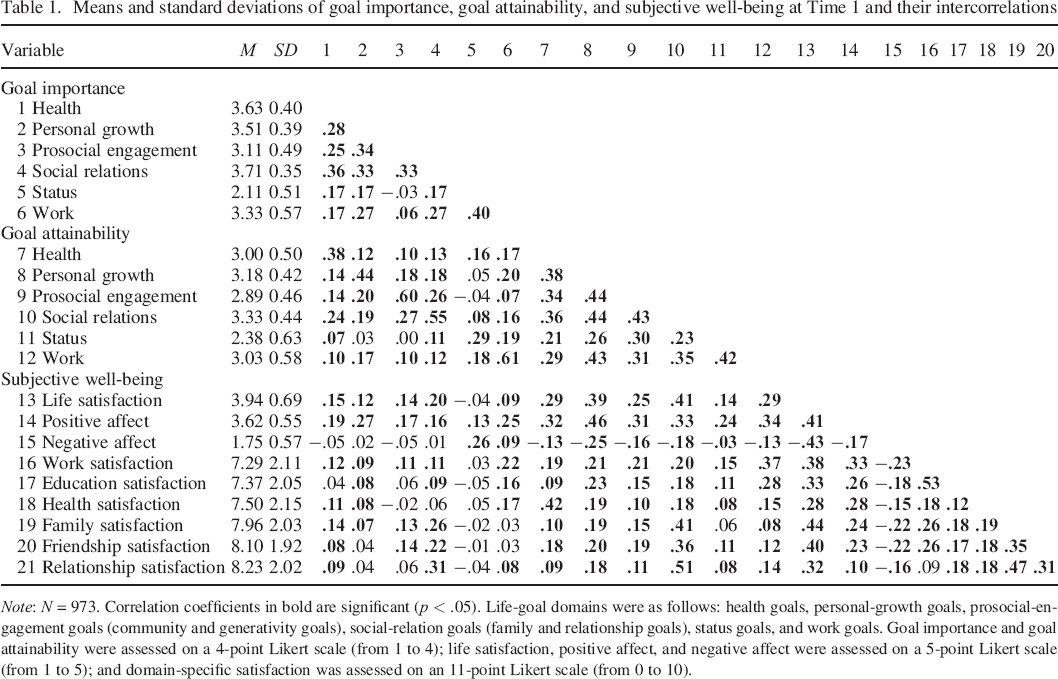
Note: N = 973. Correlation coefficients in bold are significant (p < .05). Life–goal domains were as follows: health goals, personal–growth goals, prosocial–engagement goals (community and generativity goals), social–relation goals (family and relationship goals), status goals, and work goals. Goal importance and goal attainability were assessed on a 4–point Likert scale (from 1 to 4); life satisfaction, positive affect, and negative affect were assessed on a 5–point Likert scale (from 1 to 5); and domain–specific satisfaction was assessed on an 11–point Likert scale (from 0 to 10).
Content of goals: Age effects on goal importance and goal attainability
Linear and squared age effects on goal importance and goal attainability are presented in Table 2. Age exhibited significant effects on goal importance in all life–goal domains: Age had a negative linear effect on importance of personal–growth, social–relation, status, and work goals, whereas it had a positive linear effect on importance of health and prosocial–engagement goals. Further, age had a positive squared effect on status goals, while it exhibited a negative squared effect on work goals. No other significant squared effects were observed (all ps > .05). Figure 1 illustrates the linear and squared age effects on goal importance. Except for the negative age effect on social–relation goals, the present results support Hypothesis 1a.
Linear and squared effects of age on goal importance and goal attainability at Time 1
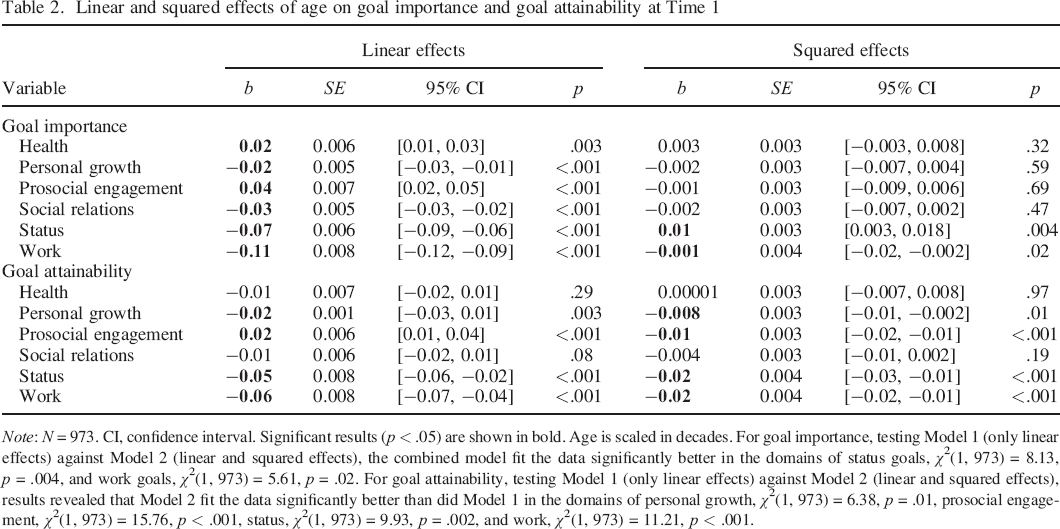
Note: N = 973. CI, confidence interval. Significant results (p < .05) are shown in bold. Age is scaled in decades. For goal importance, testing Model 1 (only linear effects) against Model 2 (linear and squared effects), the combined model fit the data significantly better in the domains of status goals, χ2(1, 973) = 8.13, p = .004, and work goals, χ2(1, 973) = 5.61, p = .02. For goal attainability, testing Model 1 (only linear effects) against Model 2 (linear and squared effects), results revealed that Model 2 fit the data significantly better than did Model 1 in the domains of personal growth, χ2(1, 973) = 6.38, p = .01, prosocial engagement, χ2(1, 973) = 15.76, p < .001, status, χ2(1, 973) = 9.93, p = .002, and work, χ2(1, 973) = 11.21, p < .001.
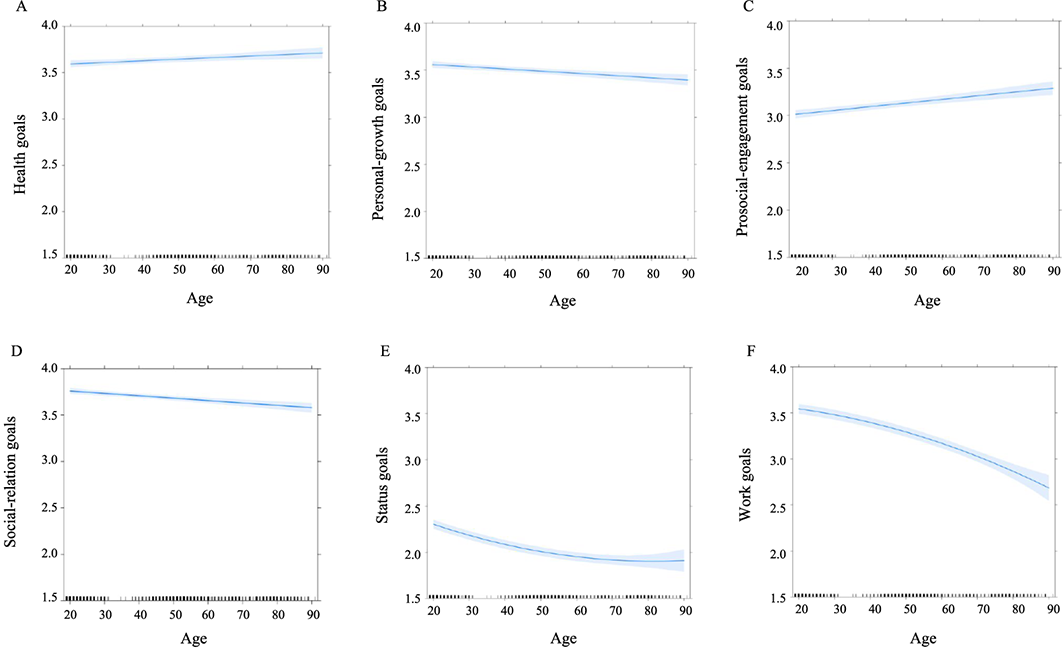
Effects of age on goal importance in six life–goal domains. Areas in light blue display the 95% confidence intervals. For Models A, B, C, and D, linear effects fit the data sufficiently, while for Models E and F, the combined model of linear and squared effects fit the data better. [Colour figure can be viewed at wileyonlinelibrary.com]
For goal attainability, age exhibited fewer effects: Age had a negative linear effect on the attainability of personal–growth, status, and work goals and a positive effect on the attainability of prosocial–engagement goals. Further, age exhibited a negative squared effect on personal–growth, prosocial–engagement, status, and work goals. Neither linear nor squared age effects were observed for attainability of social–relation and health goals. Figure 2 illustrates the linear and squared effects that age exhibited on goal attainability. Except for the nonsignificant effect on health goals, these findings support Hypothesis 1b.
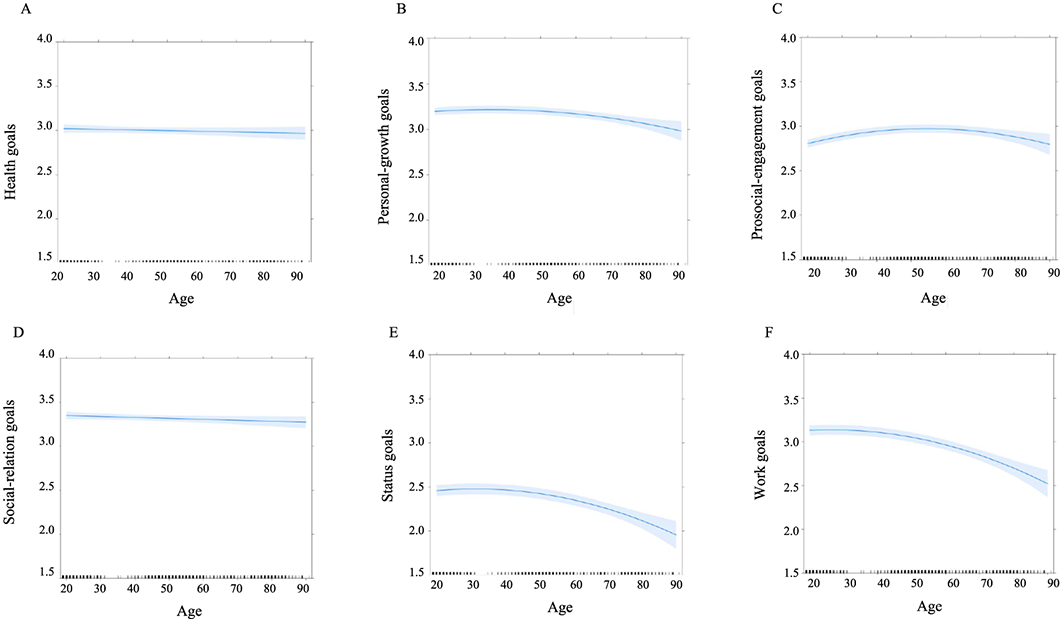
Effects of age on goal attainability in six life–goal domains. Areas in light blue display the 95% confidence intervals. For Models A and D, linear effects fit the data sufficiently, while for Models B, C, E, and F, the combined model of linear and squared effects fit the data better. [Colour figure can be viewed at wileyonlinelibrary.com]
Goal dynamics: Association between goal importance and goal attainability over time
Next, we tested the reciprocal association between goal importance and goal attainability over a time span of 2 years, which is shown in Table 3. Goal importance and goal attainability were fairly stable in all life–goal domains across the two measurement occasions. In addition, goal importance and goal attainability predicted each other significantly over time: Earlier goal attainability positively predicted later goal importance in the life–goal domains of health, personal growth, and social relations. For the inverse direction—earlier goal importance on later goal attainability—all associations were significant in a positive direction.
Multilevel regression analyses predicting goal importance and goal attainability at Time 2 (T2) from goal importance and goal attainability at Time 1 (T1)
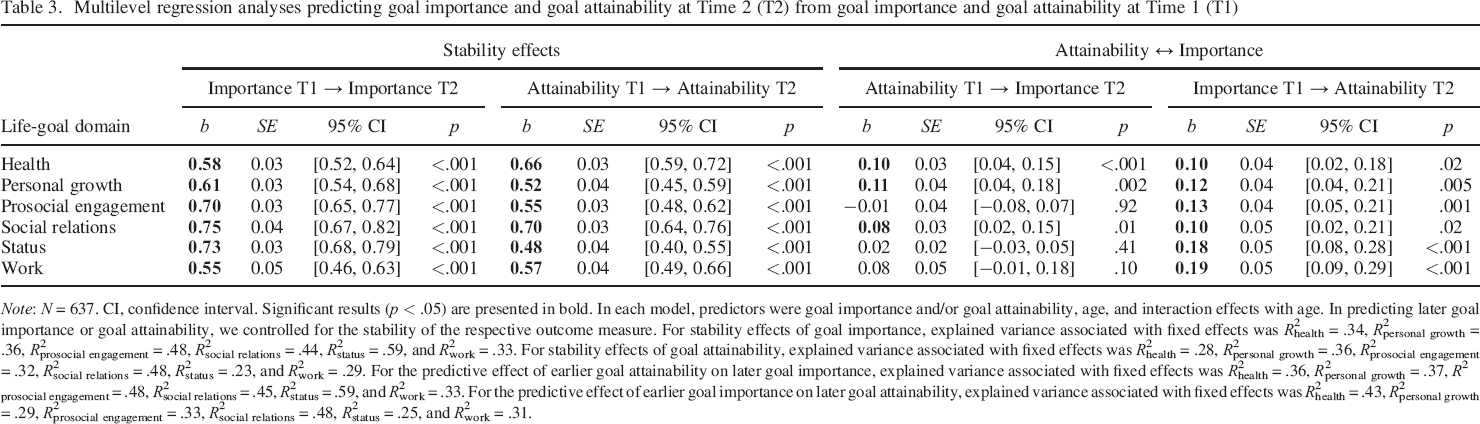
Note: N = 637. CI, confidence interval. Significant results (p < .05) are presented in bold. In each model, predictors were goal importance and/or goal attainability, age, and interaction effects with age. In predicting later goal importance or goal attainability, we controlled for the stability of the respective outcome measure. For stability effects of goal importance, explained variance associated with fixed effects was R2health = .34, R2personal growth = .36, R2prosocial engagement = .48, R2social relations = .44, R2status = .59, and R2work = .33. For stability effects of goal attainability, explained variance associated with fixed effects was R2health = .28, R2personal growth = .36, R2prosocial engagement = .32, R2social relations = .48, R2status = .23, and R2work = .29. For the predictive effect of earlier goal attainability on later goal importance, explained variance associated with fixed effects was R2health = .36, R2personal growth = .37, R2prosocial engagement = .48, R2social relations = .45, R2status = .59, and R2work = .33. For the predictive effect of earlier goal importance on later goal attainability, explained variance associated with fixed effects was R2health = .43, R2personal growth = .29, R2prosocial engagement = .33, R2social relations = .48, R2status = .25, and R2work = .31.
Age moderations
We observed two significant age moderations, both within the status–goal category. First, age moderated the link between earlier status–goal importance and later status–goal importance (b = 0.003, p = .02, 95% CI [0.001, 0.005]). The Johnson–Neyman analysis (Johnson & Fay, 1950) to obtain areas of significance revealed that it was within participants’ entire age range that slopes of status–goal importance were significant (at p = .05). The magnitude of these slopes, however, was slightly stronger with higher age, that is, when age was 1 SD above the sample mean (66.63 years; b = 0.80, p < .001, 95% CI [0.72, 0.88]), compared with when age reflected the sample mean (44.75 years; b = 0.74, p < .001, 95% CI [0.69, 0.79]) or was 1 SD below the sample mean (22.88 years; b = 0.68, p < .001, 95% CI [0.61, 0.75]). 5
Second, age moderated the link between earlier status–goal importance and later status–goal attainability (b = 0.006, p = .01, 95% CI [0.001, 0.01]). We found that among participants older than 29.33 years, higher importance of status goals predicted higher attainability of status goals; this effect was more pronounced the older participants were.
These results mainly support Hypothesis 2, arguing for a positive association between goal importance and goal attainability over an interval of 2 years. This association was more pronounced for the predictive effects of earlier goal importance on later goal attainability (than vice versa) and was largely independent of age.
Goal outcomes: Goal importance and goal attainability as predictors of subjective well–being
Addressing the predictive validity of goal importance and goal attainability on subjective well–being, we tested predictive effects on later subjective well–being (i.e. life satisfaction, positive affect, negative affect, and domain–specific satisfaction) after intervals of 2 and 4 years. Here, we provide tables for the prediction of well–being at Time 2, while tables for the prediction of well–being at Time 3 are shown in Tables S8, S9, and S10.
Life satisfaction
The first section of Table 4 shows the predictive effects of goal importance and goal attainability on life satisfaction at Time 2, controlling for life satisfaction at Time 1. While no main effect was observed of earlier goal importance on later life satisfaction, earlier goal attainability showed significant predictive validity: Attainability of health, personal–growth, prosocial–engagement, and social–relation goals was positively associated with life satisfaction at Time 2. For life satisfaction at Time 3, earlier attainability of personal–growth goals (b = 0.24, p < .001, 95% CI [0.12, 0.36]) and social–relation goals (b = 0.20, p = .001, 95% CI [0.08, 0.31]) remained a significant positive predictor, while attainability of health and prosocial–engagement goals was no longer significantly predictive (Table S8).
Multilevel regression analyses predicting subjective well–being at Time 2 from goal importance and goal attainability at Time 1
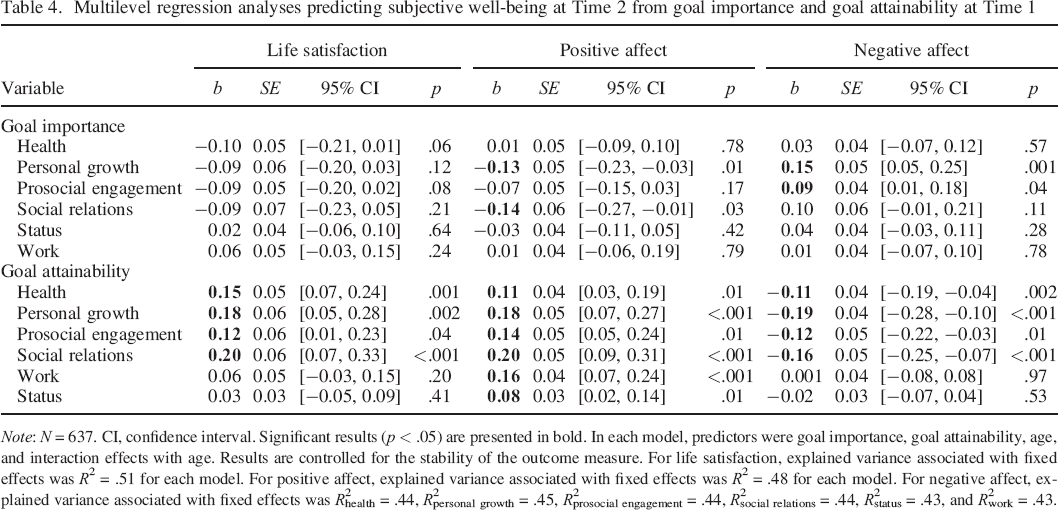
Note: N = 637. CI, confidence interval. Significant results (p < .05) are presented in bold. In each model, predictors were goal importance, goal attainability, age, and interaction effects with age. Results are controlled for the stability of the outcome measure. For life satisfaction, explained variance associated with fixed effects was R2 = .51 for each model. For positive affect, explained variance associated with fixed effects was R2 = .48 for each model. For negative affect, explained variance associated with fixed effects was R2health = .44, R2personal growth = .45, R2prosocial engagement = .44, R2social relations = .44, R2status = .43, and R2work = .43.
Age moderations
We observed one significant age moderation for the association between earlier goal importance/goal attainability and later life satisfaction: Age moderated the link between earlier work–goal importance and life satisfaction at Time 2 (b = −0.004, p = .04, 95% CI [−0.008, −0.001]). We found that among participants younger than 21.85 years, higher importance of work goals predicted higher life satisfaction and that this effect was more pronounced the younger participants were.
Positive affect
As shown in the second section of Table 4, positive affect at Time 2 was negatively predicted by earlier importance of personal–growth goals and social–relation goals, while it was positively predicted by attainability of all life–goal domains. For positive affect at Time 3, importance of prosocial–engagement goals (b = 0.10, p = .03, 95% CI [0.01, 0.21]) as well as attainability of personal–growth goals (b = 0.12, p = .03, 95% CI [0.02, 0.23]) and social–relation goals (b = 0.14, p = .01, 95% CI [0.02, 0.24]) were significant positive predictors (Table S8).
Age moderations
We observed five significant age moderations for the association between earlier goal importance/goal attainability and later positive affect. First, age moderated the link between the importance of personal–growth goals and positive affect at Time 2 (b = 0.005, p = .02, 95% CI [0.001, 0.01]). It was among participants younger than 49.19 years that higher importance of personal–growth goals predicted lower positive affect and that this effect was more pronounced the younger participants were.
Second, age moderated the link between the importance of personal–growth goals and positive affect at Time 3 (b = −0.007, p = .01, 95% CI [−0.011, −0.002]; with a coefficient of the main effect of b = 0.06, refer to Table S8). We observed that among participants younger than 33.21 years, higher importance of personal–growth goals predicted higher positive affect; this effect was more pronounced the younger participants were. We also observed significant slopes among participants older than 85.29 years: Higher importance of personal–growth goals predicted lower positive affect; this effect was more pronounced the older participants were.
Third, age moderated the link between the importance of prosocial–engagement goals and positive affect at Time 3 (b = −0.006, p = .005, 95% CI [−0.01, −0.002]; with a coefficient of the main effect of b = 0.10, refer to Table S8). It was among participants younger than 44.08 years that higher importance of prosocial–engagement goals predicted higher positive affect and that this effect was more pronounced the younger participants were.
Fourth, age moderated the link between the attainability of personal–growth goals and positive affect at Time 3 (b = 0.005, p = .03, 95% CI [0.001, 0.01]; with a coefficient of the main effect of b = 0.12, refer to Table S8). We found that among participants older than 40.91 years, higher attainability of personal–growth goals predicted higher positive affect; this effect was more pronounced the older participants were.
Finally, age moderated the link between the attainability of social–relation goals and positive affect at Time 3 (b = −0.005, p = .01, 95% CI [−0.01, −0.001]; with a coefficient of the main effect of b = 0.14, refer to Table S8). It was among participants younger than 48.67 years that higher attainability of social–relation goals predicted higher positive affect and that this effect was more pronounced the younger participants were.
Negative affect
As shown in the third section of Table 4, negative affect at Time 2 was positively predicted by earlier importance of personal–growth goals and prosocial–engagement goals and negatively predicted by earlier attainability of health, personal–growth, prosocial–engagement, and social–relation goals. For negative affect at Time 3, goal importance was not predictive, but attainability of personal–growth goals (b = −0.09, p = .03, 95% CI [−0.18, −0.01]) yielded a significant negative effect (Table 8).
Age moderations
We observed one significant age moderation for the association between earlier goal importance/goal attainability and later negative affect: Age moderated the link between the importance of status goals and negative affect at Time 3 (b = −0.004, p = .02, 95% CI [−0.007, −0.001]; with a coefficient of the main effect of b = −0.05, refer to Table S8). We observed that among participants older than 62.70 years, higher importance of status goals predicted lower negative affect; this effect was more pronounced the older participants were.
Satisfaction with occupational domain
Tables 5 and 6 display the predictive effects of goal importance and goal attainability on domain–specific satisfaction at Time 2. For the occupational domain at Time 2 (Table 5), work satisfaction was not predicted by goal importance in any goal domain, but work satisfaction was positively predicted by earlier attainability of personal–growth and work goals. Educational satisfaction was also not predicted by goal importance, but it was positively predicted by attainability of status goals. For satisfaction with the occupational domain at Time 3, goal importance was again not predictive, but attainability of health goals (b = 0.82, p < .001, 95% CI [0.43, 1.24]) and attainability of personal–growth goals (b = 0.60, p = .02, 95% CI [0.04, 1.14]) were significant positive predictors of later work satisfaction (Table S9). Attainability of these two goal domains was also positively predictive of educational satisfaction at Time 3 (health goals: b = 0.94, p = .002, 95% CI [0.34, 1.53]; and personal–growth goals: b = 0.80, p = .04, 95% CI [0.05, 1.64]).
Multilevel regression analyses predicting domain–specific satisfaction (work satisfaction, educational satisfaction, and health satisfaction) at Time 2 from goal importance and goal attainability at Time 1
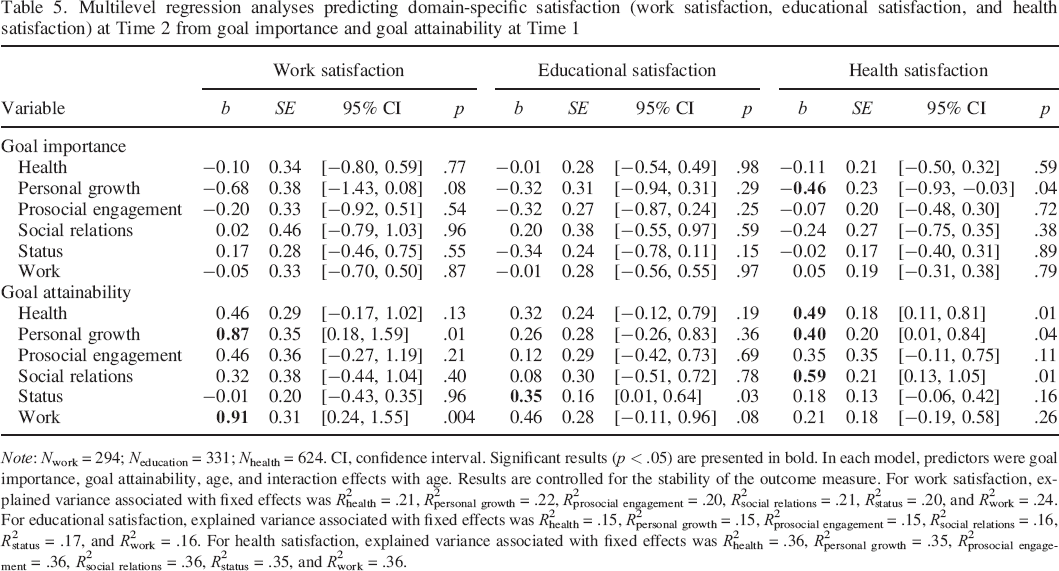
Note: Nwork = 294; Neducation = 331; Nhealth = 624. CI, confidence interval. Significant results (p < .05) are presented in bold. In each model, predictors were goal importance, goal attainability, age, and interaction effects with age. Results are controlled for the stability of the outcome measure. For work satisfaction, explained variance associated with fixed effects was R2health = .21, R2personal growth = .22, R2prosocial engagement = .20, R2social relations = .21, R2status = .20, and R2work = .24. For educational satisfaction, explained variance associated with fixed effects was R2health = .15, R2personal growth = .15, R2prosocial engagement = .15, R2social relations = .16, R2status = .17, and R2work = .16. For health satisfaction, explained variance associated with fixed effects was R2health = .36, R2personal growth = .35, R2prosocial engagement = .36, R2social relations = .36, R2status = .35, and R2work = .36.
Multilevel regression analyses predicting domain–specific satisfaction (family satisfaction, romantic relationship satisfaction, and friendship satisfaction) at Time 2 from goal importance and goal attainability at Time 1
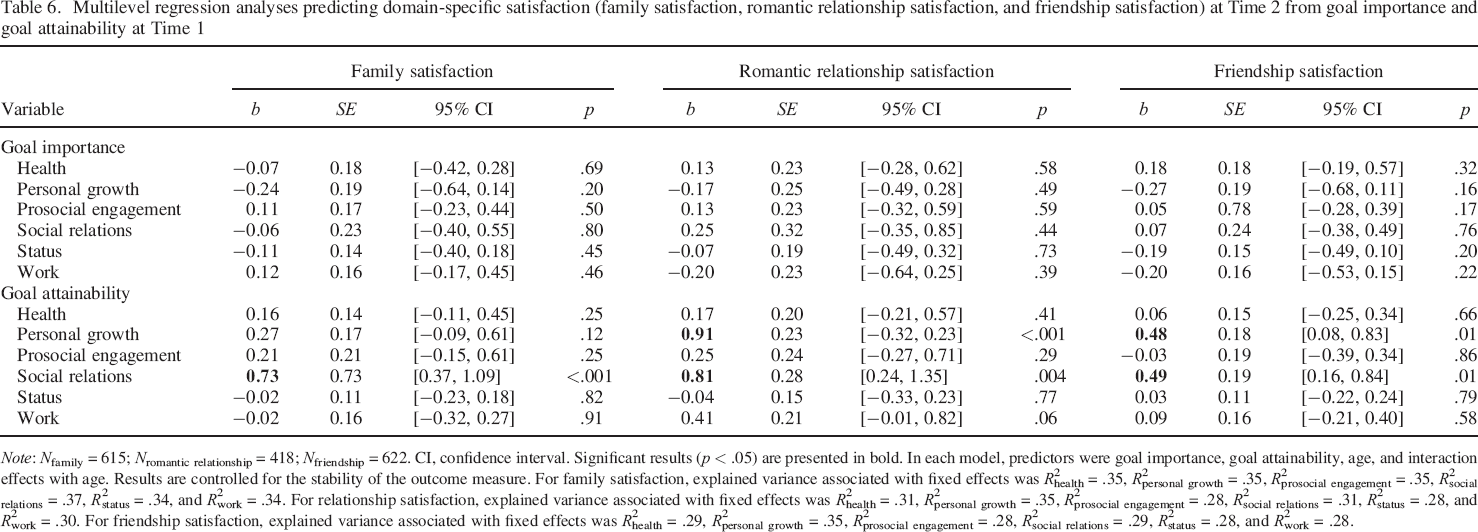
Note: Nfamily = 615; Nromantic relationship = 418; Nfriendship = 622. CI, confidence interval. Significant results (p < .05) are presented in bold. In each model, predictors were goal importance, goal attainability, age, and interaction effects with age. Results are controlled for the stability of the outcome measure. For family satisfaction, explained variance associated with fixed effects was R2health = .35, R2personal growth = .35, R2prosocial engagement = .35, R2social relations = .37, R2status = .34, and R2work = .34. For relationship satisfaction, explained variance associated with fixed effects was R2health = .31, R2personal growth = .35, R2prosocial engagement = .28, R2social relations = .31, R2status = .28, and R2work = .30. For friendship satisfaction, explained variance associated with fixed effects was R2health = .29, R2personal growth = .35, R2prosocial engagement = .28, R2social relations = .29, R2status = .28, and R2work = .28.
Age moderations
Testing moderating effects of age for the association between earlier goal importance/goal attainability and later occupational satisfaction (i.e. work satisfaction and educational satisfaction), we found no significant effect (all ps > .05).
Satisfaction with the health domain
For the health domain at Time 2 (Table 5), health satisfaction was negatively predicted by importance of personal–growth goals and positively predicted by attainability of health, personal–growth, and social–relation goals. For health satisfaction at Time 3, attainability of health goals remained a significant predictor (b = 0.88, p < .001, 95% CI [0.49, 1.25]), while the other effects were no longer significant (Table S9).
Age moderations
Two significant age moderations emerged for the association between earlier goal importance/goal attainability and later satisfaction in the health domain. First, age moderated the link between prosocial–engagement goal importance and health satisfaction at Time 2 (b = 0.02, p = .02, 95% CI [0.004, 0.04]). It was among participants older than 84.15 years that higher importance of prosocial–engagement goals predicted higher health satisfaction and that this effect was more pronounced the older participants were.
Second, age moderated the association between health–goal attainability and health satisfaction at Time 3 (b = 0.02, p = .004, 95% CI [0.008, 0.04]; with a coefficient of the main effect of b = 0.88, refer to Table S9). We observed that among participants older than 27.52 years, higher attainability of health goals predicted higher health satisfaction; this effect was more pronounced the older participants were.
Satisfaction with social domain
For satisfaction with the social domain at Time 2 (Table 6), we found no main effects of goal importance on satisfaction in any social domain (i.e. satisfaction with family life, romantic relationship, and friendships), but we observed significant age moderations, signifying that goal importance predicted satisfaction with the social domain in specific age ranges (refer to the next section on age moderations for more details).
Goal attainability was predictive for satisfaction in all three social domains: First, for satisfaction with family life, attainability of social–relation goals was a significant positive predictor; second, for satisfaction with the romantic relationship, attainability of personal–growth goals and attainability of social–relation goals were positive significant predictors; third, for satisfaction with friendships, attainability of personal–growth goals and attainability of social–relation goals were positively predictive. It was also for the social domain at Time 3 that goal importance was not a strong predictor of later satisfaction (except for a positive link between importance of prosocial–engagement goals and relationship satisfaction; b = 0.50, p = .02, 95% CI [0.02, 0.94]). Goal attainability was no longer predictive of family and relationship satisfaction; but attainability of prosocial–engagement goals (b = 0.40, p = .03, 95% CI [0.07, 0.73]), attainability of social–relation goals (b = 0.42, p = .03, 95% CI [0.27, 0.78]), and attainability of work goals (b = 0.34, p = .04, 95% CI [0.02, 0.64]) were significant positive predictors of later friendship satisfaction (Table S10).
Age moderations
We observed several significant age moderations for the association between earlier goal importance/goal attainability and later satisfaction in the social domain. First, for family satisfaction, age moderated the link between the attainability of personal–growth goals and family satisfaction at Time 2 (b = 0.02, p = .02, 95% CI [0.002, 0.03]). We found that among participants older than 46.66 years, higher attainability of personal–growth goals predicted higher family satisfaction and that this effect was more pronounced the older participants were. Age also moderated the link between work–goal attainability and family satisfaction at Time 3 (b = −0.02, p = .04, 95% CI [−0.03, −0.001]). The Johnson–Neyman analysis, however, indicated that slopes would be significant outside the participants’ observed age range.
Second, for romantic relationship satisfaction, age moderated the link between the attainability of social–relation goals and relationship satisfaction at Time 2 (b = 0.03, p = .03, 95% CI [0.002, 0.05]). It was among participants older than 36.12 years that higher attainability of social–relation goals predicted higher relationship satisfaction and that this effect was more pronounced the older participants were. Age also moderated the link between work–goal attainability and relationship satisfaction at Time 2 (b = 0.02, p = .04, 95% CI [0.005, 0.04]). We found that among participants older than 42.18 years, higher attainability of work goals predicted higher relationship satisfaction and that this effect was more pronounced the older participants were. In addition, age moderated the link between health–goal attainability and relationship satisfaction at Time 3 (b = −0.03, p = .01, 95% CI [−0.04, −0.005]; with a coefficient of the main effect of b = 0.09, refer to Table S10). We observed that among participants younger than 38.44 years, higher attainability of health goals predicted higher relationship satisfaction and that this effect was more pronounced the younger participants were.
Finally, for friendship satisfaction, age moderated the link between earlier growth–goal attainability and friendship satisfaction at Time 2 (b = 0.02, p = .02, 95% CI [0.003, 0.04]). It was among participants older than 36.60 years that higher attainability of personal–growth goals predicted higher friendship satisfaction and that this effect was more pronounced the older participants were. Furthermore, age moderated the link between prosocial–engagement goal attainability and friendship satisfaction at Time 2 (b = 0.02, p = .03, 95% CI [0.002, 0.03]). We observed that among participants older than 78.49 years, higher attainability of prosocial–engagement goals predicted higher friendship satisfaction; this effect was more pronounced the older participants were. 6 Age also moderated the link between work–goal attainability and friendship satisfaction at Time 2 (b = 0.02, p = .01, 95% CI [0.005, 0.03]). We found that among participants older than 52.93 years, higher attainability of work goals predicted higher friendship satisfaction and that this effect was more pronounced the older participants were. Finally, age moderated the link between work–goal attainability and friendship satisfaction at Time 3 (b = −0.02, p = .01, 95% CI [−0.03, −0.005]; with a coefficient of the main effect of b = 0.34, refer to Table S10). We found that among participants younger than 44.14 years, higher attainability of work goals predicted higher friendship satisfaction; this effect was more pronounced the younger participants were.
Overall, the present results mainly support Hypothesis 3, revealing (i) a positive link between earlier intrinsic life goals—particularly their attainability—and later subjective well–being; (ii) a thematic predictive validity for domain–specific satisfaction; and that (iii) moderations with age occurred mainly with regard to goal attainability, rather than goal importance. Overall, we found the following pattern for age moderations: When cut–offs for significant slopes were within the age group of young adults, we observed that slopes were more pronounced the younger participants were. When cut–offs for significant slopes were within the age group of older adults, conversely, we found this association to be more pronounced the older participants were. For cut–offs within the age group of middle–aged adults, we did not find a clear picture: While some associations were more pronounced the older participants were (e.g. the link between health–goal attainability and health satisfaction at Time 3); other associations were more pronounced the younger participants were (e.g. the link between social–relation goal attainability and positive affect at Time 3).
Discussion
The purpose of the present study was to position life goals—as a motivational aspect of personality—in the context of adult development. We approached this aim through three complementary research avenues. First, we examined the content of what people across adulthood rate as important and perceive as attainable. Second, we analysed the reciprocal dynamics between goal importance and goal attainability over 2 years. Third, we studied the predictive power of goal importance and goal attainability on later subjective well–being (i.e. life satisfaction, positive affect, negative affect, and domain–specific satisfaction). Briefly, we found that (i) life goals mapped fairly well onto developmental tasks encountered in the respective life stage; (ii) goal importance and goal attainability were reciprocally linked to each other across age with goal importance exhibiting a stronger and more robust effect on goal attainability than vice versa; (iii) goal attainability, compared with goal importance, had a more pronounced effect on later subjective well–being, which was a largely age–independent effect 7 ; and (iv) associations between life goals and domain–specific satisfaction reflected thematic links: Satisfaction was higher in the domains in which individuals thought that they could achieve their goals.
Content of goals: Age differences in goal importance and goal attainability
Baltes (1987) differentiated between three factors that may have an influence on goal content: Nonnormative factors, normative history–graded factors, and normative age–graded factors. Focusing on the latter of these aspects, and in line with Hypothesis 1a, the present findings revealed that age predicted which goals people rate as important: With higher age, participants rated goals of personal growth, status, and work as less important, while they rated goals of health and prosocial engagement as more important. Participants also rated social–relation goals as less important with higher age, which was not in line with our hypothesis and will be discussed later. With regard to goal attainability and in line with Hypothesis 1b, participants perceived goals of personal growth, status, and work as less attainable later in life, while they valued goals of prosocial engagement as more attainable. No significant effects were found for the predicted effects on health–goal attainability, and no effects were found for the attainability of social–relation goals, indicating that people of all ages perceived their health goals and their social–relation goals as equally attainable.
Our findings correspond to the findings of Nurmi's (1992) study of three age groups that was conducted 25 years ago in Finland: Goals reflect what is possible and normative for people of different ages given their physical, cognitive, and social resources. Goals also reflect what is desirable for people of different ages, underscoring the role of age–related norms that make certain life tasks salient. Hence, the present results underline the integral part that age plays in the life goals that people value as important and perceive as attainable, situating the present findings in the context of developmental–task theory and supporting the concept of the postulated social–biological, age–based tasks (Hutteman et al., 2014). Our findings also highlight the concept of a social clock (Heckhausen, 1999; Neugarten, 1972), which means that norms and demands provide a temporal and contextual setting on which to orient one's goal pursuit in each life stage (Freund & Baltes, 2005). Overall, we maintain that the development over the adult lifespan is not a passive process but an active and dynamic interaction between the person and the norms, constraints, and tasks imposed by an age–graded environment (Baltes, Lindenberger, & Staudinger, 1998).
Prosocial–engagement, health, and social–relation goals across adulthood
While the findings for the domains of personal–growth, work, and status goals align with our predictions, the results for the domains of prosocial–engagement, health, and social–relation goals need some further discussion.
First, for the domain of prosocial engagement, the results showed differential age effects for goal importance and goal attainability, which was against our prediction: For the importance of prosocial–engagement goals, we found linear age effects, indicating that prosocial–engagement goals were rated as more important with higher age. In other words, prosocial–engagement goals represent an important psychological life theme, which enters the repertoire of people's motivational strivings and remains present into late adulthood, a finding that corresponds to previous findings on the role of generativity in older age (McAdams, St, Aubin, & Logan, 1993). For the attainability of prosocial–engagement goals, however, we found a combination of linear and squared effects to most accurately fit the data. That is, the attainability of prosocial–engagement goals increases throughout young adulthood, peaks in middle adulthood, and declines toward late adulthood.
Reasons for why middle–aged people are considered to be at the peak of their subjectively perceived influence on society (Erikson, 1968; Havighurst, 1972) may be manifold. It is reasonable to assume that although older people rate prosocial–engagement goals as important and tend to aspire to reach such goals, they perceive limited resources for achieving these goals. Experiencing a discrepancy between goal importance and goal attainability will likely lead to coping mechanisms (Brandtstädter & Rothermund, 2002). Hence, in the course of late adulthood, individuals disengage from the active roles that they have occupied, such as worker or parent of young children (Gall, Evans, & Howard, 1997), and start to find new roles, such as grandparent or responsible civil community member (Nimrod & Shrira, 2016). Although these roles might contribute to nourishing older adults’ strivings for prosocial engagement, older adults might feel their likelihood of attaining their prosocial–engagement goals is limited, which might explain the lower attainability of prosocial–engagement goals in late adulthood. Middle–aged adults, in contrast, might have more resources and possibilities to fulfil their prosocial–engagement goals, in their community (e.g. through doing volunteer work), in their family (e.g. through passing traditions on to their young children), or, particularly, in their work environment (e.g. through being a role model for the upcoming generation). On the basis of the present results, we thus conclude that prosocial engagement is a topic of increasing importance throughout adulthood but that middle–aged adults are most likely to perceive their prosocial–engagement goals as attainable.
Second, it was in the life–goal domain of health that age was positively linked to goal importance, whereas age was not related to goal attainability. Within late adulthood, adults are usually confronted with decreasing physical and mental health and have to deal with the necessary adjustment to these limitations (for an overview, see Kaiser, 2009). It is in line with this reasoning that health goals were rated as more important with higher age, assuming that with having explicit health goals, older adults seek to maintain and/or improve their functional capacities for as long as possible (Ebner et al., 2006). Perceived attainability of health goals, however, was unrelated to age. Although this finding is contrary to Hypothesis 1b, in which we expected positive age effects on health–goal attainability, the finding also implies that adults of all ages perceive their health goals as equally attainable, a finding that highlights a potential protective factor for late adulthood and may complement theories of successful aging and sources of resilience in later life (Ryff, 1995; Ryff, Singer, Love, & Essex, 1998; Schulz & Heckhausen, 1996; Staudinger, Marsiske, & Baltes, 1995). More specifically, it is reasonable to assume that older adults who rate their health goals as important might adjust their concrete behaviour or life circumstances if their resources are still high (i.e. assimilative mode) or they may rescale their aspirations and their concrete health–goal content (i.e. accommodation mode) to align their goal importance and goal attainability (Brandtstädter & Rothermund, 2002). Both mechanisms would be illustrative of adaptive processes for coping with the discrepancy between goal importance and goal attainability. The concrete mechanisms underlying this finding remain to be explored in future studies (such as shown for the protective effects of health engagement control strategies among older individuals; Wrosch, Schulz, & Heckhausen, 2002).
The third finding that did not align with our hypotheses refers to the importance of social–relation goals. Contrary to our argument that social–relation goals reflect an innate need and should therefore be valued as equally important across the adult lifespan, our results showed that social–relation goals were less important with higher age. Although this finding does not correspond to self–determination theory, which argues for relatedness being an equally important need across the adult lifespan (Deci & Ryan, 2000), it does parallel developmental–task theory (Havighurst, 1972), which posits that social–relation goals reflect strivings of major importance for young adults. This aspect is further supported by a meta–analysis on age–related changes in social networks (Wrzus et al., 2013), showing that it is throughout adulthood that the social network, reflecting all social relationships of a person, decreases. Similarly, recent findings (Wrzus, Wagner, & Riediger, 2016) have shown that young adults, compared with middle–aged adults, are more often surrounded by family and friends. However, findings from this meta–analysis have also demonstrated that social networks need to be understood from a differentiated perspective (Wrzus et al., 2013): Whereas some social networks decrease with age (mostly friendship networks), family networks and relationships with a few close others are not affected by age. It remains to be seen what underlying factors drive the steady decrease of some social networks across the adult lifespan and what factors are responsible for the stability of other social networks. With corroborating findings from the present study, it is reasonable to assume that lower strivings for social relations might constitute one such underlying factor. Future studies investigating the potentially mediating role of social–relation strivings in the link between age and size of social networks are needed to test this assumption. To acknowledge the differentiated role that social relationships might play across the adult lifespan, such research would benefit from decomposing the overall social–relation domain into more specific social–relation goals (such as relationships with acquaintances, friends, family members, and close others).
Aside from a decreasing social network, one could also argue that reasons for the lower importance of social–relation goals might be found in the different goal orientations that people of different age groups adhere to (Ebner et al., 2006): Whereas young adults are inclined to pursue goals with a growth orientation, middle–aged and older adults are more prone to pursue their goals with a focus on maintenance and loss prevention. Applied to the present findings, one could argue that older adults value the relationships they have but are not likely to assign high importance scores to goals of the social domain. This is the case because, by their very definition, goals are salient if change is sought to motivate behaviour, as in the case of social–relation goals through expanding the social network, finding a new partner, or seeking a new social environment. Consequently, if change in a particular life–goal domain is not sought, goals of this domain might be less salient. Hence, one cannot conclude from the present findings that the social–relation domain is no longer important for older adults. It might instead be the case that older adults maintain and value their social status quo, and our participants may not have reported goals that would imply effort or investment in changing their current social situation. Thus, rather than inferring that social–relation goals are no longer meaningful with higher age, it is much more reasonable to assume that adults from middle and late adulthood are already socially embedded and have existing relationships: Their social relations are an integral part of their life but do not require striving toward. Yet it needs to be stressed that given the family design of this study, our older participants were embedded in a family setting. The findings might emerge differently if a wider and more diverse range of older adults is considered, such as older adults without a family or a partner, who might be more likely to strive for social relations. In addition, one needs to consider that we gave participants predetermined goal domains; their goal importance might have been different if they had been free to describe and rank their goals.
We also investigated goal attainability in the social–relation domain. Our findings revealed that although social–relation goals were rated as less important with age, age was not related to attainability of social–relation goals. It is beyond the scope of the present study to explain why social–relation goals were perceived as equally attainable across age groups, but it is possible that age was not the driving force for the perceived likelihood of reaching social–relation goals. Rather than age–graded norms and demands, it is reasonable to intuit that internal factors might be relevant for whether a person perceives social–relation goals as attainable, such as a person's internal working model (e.g. attachment), which remains relatively stable across age (Freund & Nikitin, 2012; Mikulincer & Shaver, 2007). Similarly, more dispositional personality aspects, such as personality traits, might play an important role. For instance, personality traits have been shown to relate to the quality of social relationships (e.g. Asendorpf & Wilpers, 1998), to the initial level and changes in social well–being (e.g. Hill, Turiano, Mroczek, & Roberts, 2012), to relationship satisfaction (e.g. Dyrenforth, Kashy, Donnellan, & Lucas, 2010; Weidmann, Ledermann, & Grob, 2016), or to friendship development (e.g. K. Harris & Vazire, 2016). It is, thus, reasonable to assume that rather than age, more internal factors (such as personality traits or attachment styles) play a significant role in whether people feel their social–relation goals are attainable. Future studies are needed to disentangle the interplay between age, various internal factors, and social–relation goals in more detail.
Goal dynamics: Association between goal importance and goal attainability over time
Both goal importance and goal attainability showed 2–year stabilities of moderate size that are comparable or slightly higher than previously reported in longitudinal studies (Lüdtke, Trautwein, & Husemann, 2009; Roberts, O'Donnell, & Robins, 2004). But goal importance and goal attainability are also dynamic constructs that adapt over time and alter along with changing life circumstances and key developmental tasks (Freund & Ebner, 2005). It has been suggested that one's goal pursuit needs to be stable to be attainable but flexible at the same time to adjust to new circumstances (Brandtstädter & Rothermund, 2002), which is referred to as the stability–flexibility dilemma (e.g. Bak & Brandtstädter, 1998). Given the present findings, we conclude that both the stability component and the flexibility component were present. More specially, we found a positive link between earlier goal importance and later goal attainability in all six life–goal domains, even when controlling for the stability of goal attainability. In other words, people who rate their goals as important and are motivated to accomplish these goals perceive these goals as more attainable (Koo & Fishbach, 2008).
However, the inverse link of goal attainability on later goal importance was less consistent across life–goal domains. Goal attainability was predictive of importance of health, personal–growth, and social–relation goals but not of prosocial–engagement, status, and work goals. It is possible that goal attainability might not have been the leading mechanism for later goal importance in these domains for two reasons: First, in the case of work goals, work importance is emphasized by society during major parts of the lifespan, which makes work an important and socially desirable endeavour for most people. Thus, work goals need, in some sense, to be important irrespective of whether these goals are perceived as attainable. Second, in the case of prosocial–engagement and status goals, these life–goal domains might also reflect the personality of the individual who pursues them rather than the goals’ attainability. The perceived importance of these goals might therefore be fuelled less by their attainability than by their pursuer's ideals and values, that is, by other aspects of that individual's personality. Future research is needed to shed light on these preliminary explanations for why goal attainability was not consistently predictive of later goal importance, above and beyond previous goal importance.
In summary, we maintain that goal importance and goal attainably are fairly stable across time and share a longitudinal association, which is bidirectional for most goal domains. Except for a moderating age effect in the status–goal domain, we found no moderating effect on the association of age, which leads us to assume similar goal dynamics for people across adulthood. The bidirectionality might help people exhibit high control over their development and supports the dual–process framework of an assimilative mode and accommodative mode (e.g. Brandtstädter & Rothermund, 2002; Brandtstädter, Wentura, & Rothermund, 1999): If people rate a certain life goal as important, they invest more in this goal, which makes the goal more likely to be perceived as attainable. In contrast, if a goal appears less attainable, people devalue the importance of this life goal. We thus maintain that goal dynamics help people adjust goals to personal and contextual resources and that this dynamic is largely age independent.
Goal outcomes: Goal importance and goal attainability as predictors of subjective well–being
Life goals guide and motivate a person's behaviour, which is likely to relate to that person's well–being (Deci & Ryan, 2000). In the present study, we tested the predictive effects of goal importance and goal attainability on cognitive–evaluative (i.e. life satisfaction and domain–specific satisfaction) and on affective components of subjective well–being (i.e. positive and negative affect). We tested these effects for both 2–year and 4–year intervals.
Effects of life goals on life satisfaction
We found no main associations between goal importance and later life satisfaction. This finding speaks against Hypothesis 3a, which predicted positive associations between goal importance and life satisfaction for intrinsic life–goal domains and negative associations between goal importance and life satisfaction for extrinsic life–goal domains. Rather than goal importance, it was goal attainability that predicted later life satisfaction: Goal attainability was a significant predictor of life satisfaction after 2 years in the health, personal–growth, prosocial–engagement, and social–relation domains and a significant predictor after 4 years in the personal–growth and social–relation domains. In contrast to the nonsignificant goal domains of work and status, these goal domains are likely to be intrinsic in nature and to fulfil innate needs (Deci & Ryan, 1985, 2000). This is particularly true for the two goal domains that showed predictive validity after 4 years, with personal–growth goals referring to the need for competence and autonomy and social–relation goals referring to the need for relatedness (Deci & Ryan, 1985, 2000). It is also in line with recent findings on the effect of active social pursuits on later well–being (Rohrer, Richter, Brümmer, Wagner, & Schmukle, 2018) that social relationships matter for people's evaluation of their lives. We, thus, maintain that it is the attainability of intrinsic life–goal domains (rather than the importance of intrinsic life–goal domains) that is conducive to later life satisfaction and that these benefits hold across adulthood, as the effects were largely independent of age.
Effects of life goals on positive and negative affect
It was also for the affective components of well–being (i.e. positive and negative affect) that links with goal attainability, rather than links with goal importance, were present. For positive affect, goal attainability in all life–goal domains was a significant positive predictor after 2 years, but only attainability of personal–growth and social–relation goals was predictive after 4 years. For negative affect, attainability was a significant negative predictor after 2 years in the health, personal–growth, prosocial–engagement, and social–relation domains, and attainability of personal–growth goals was a significant predictor after 4 years. Again, the goal domains of personal growth and social relations map onto fulfilling innate needs (Deci & Ryan, 1985, 2000). Thus, similar to the findings on the cognitive–evaluative component of well–being, goal attainability of intrinsic life goals was a consistent predictor for affect, particularly for the 4–year prediction. These findings suggest that intrinsic aspects of the personal–development and social domain are important not only for the cognitive evaluation of one's life but also for the emotional realm.
It was for life satisfaction and positive affect that perceiving intrinsic life goals as attainable had an effect over 2 and 4 years. For negative affect, conversely, attainability of personal–growth goals had relevance after 2 years but not after 4 years, indicating some temporary character in this goal–affect link. Reasons for this might be found in results of twin studies, which suggest that negative affect tends to be relatively heritable, while positive affect does not show a significant heritable component but rather a shared environmental influence (Zheng, Plomin, & von Stumm, 2016). Accordingly, developmental tasks and their corresponding life goals might have a long–lasting impact on positive affect but less on negative affect. Following this logic, for negative affect, people would sooner return to their set point (for research on set point theory, see, for example, Brickman, Coates, & Janoff–Bulman, 1978; Fujita & Diener, 2005), which lessens the long–term effect of life goals on negative affect.
To summarize, the present findings partially support our hypotheses (Hypotheses 3a and 3b), indicating that the attainability of intrinsic goals was positively linked to later well–being. Goal attainability might be conducive for subjective well–being given that it reflects a person's feeling of control and perceived sphere of influence (Rotter, 1966). It has been argued that people are more satisfied if they feel they have this internal locus of control (Rotter, 1966), and that a greater feeling of goal attainability might yield more opportunities for goal achievement (Brunstein, 1993). Put differently, if people have no perceived control over the attainability of their goals, they might likely be dissatisfied. This is also in line with theories of learned helplessness, positing that the perceived loss of control over important goals is detrimental to well–being and a risk factor for depression (e.g. Abramson, Metalsky, & Alloy, 1989; Seligman, 1975). Following the postulates of the dual–process framework (Brandtstädter & Rothermund, 2002), it is reasonable to assume that people who feel their goals are not attainable might have experienced difficulties in switching from the assimilative to the accommodative mode when they realized a discrepancy between goal importance and goal attainability. Consequently, one could argue that low well–being is likely to be experienced if difficulties in this switching process have occurred and the ascribed importance to blocked goals persists.
Effects of life goals on domain–specific satisfaction
In a test of our final hypothesis (Hypothesis 3c), we investigated the thematic associations between life goals and domain–specific satisfaction. For the first domain–specific satisfaction category—occupational satisfaction—it was again goal attainability rather than goal importance that was predictive. Most consistently, attainability of health and personal–growth goals showed a positive link to work and education satisfaction after 4 years. Work goals, as we hypothesized, were highly relevant for work satisfaction after 2 years but lost their predictive validity after 4 years. This finding illustrates that work goals tend to be meaningful and important, but they do not foster a person's satisfaction over a longer period. The same applies to the attainability of status goals, which was predictive of education satisfaction after 2 years but not for a longer period of time. As argued by Niemiec, Ryan, and Deci (2009), extrinsic goals (which would include status goals) might be satisfying because they imply certain positive consequences of the activity rather than satisfaction with the activity itself. Applied to the present case, perceiving status goals as attainable might be related to higher engagement and commitment to the educational path, eventually expecting a successful career, which is linked to more progress and to higher satisfaction with one's education. The downside of this pursuit, however, might come after time, when extrinsic goals alone are no longer motivating and fail to nourish basic needs.
Goals that consistently predicted satisfaction after 2 and 4 years in the occupational domain were health and personal–growth goals. At first glance, these goals seem not to have much in common or to be obviously relevant for occupational satisfaction. Yet perceiving personal–growth goals as attainable might nurture innate needs of autonomy and competence, which likely nourishes satisfaction. Health goals, on the other hand, might more frequently be pursued by people who are high in conscientiousness, a trait that, in turn, has been shown to relate to success and satisfaction in the occupational domain (e.g. Ozer & Benet–Martinez, 2006).
For the second domain–specific category, health satisfaction, importance of personal–growth goals was negatively predictive, while attainability was positively predictive for health, personal–growth, and social–relation goals across 2 years. Attainability of health goals was the only goal domain that remained a significant predictor across 4 years. People who perceive their health goals as attainable might allocate more time and effort to their health, eventually leading to higher satisfaction with their health. These results—similar to findings in the social domain—suggest that content–specific goals are relevant for one's content–specific satisfaction.
For the third domain–specific category, social satisfaction, it was again goal attainability rather than goal importance that played a significant part in predicting later satisfaction: Attainability of personal–growth goals was a significant predictor for satisfaction after 2 years in two social areas (i.e. romantic relationships and friendships), and attainability of social–relation goals was a significant predictor for satisfaction after 2 years in all three social areas (i.e. family, romantic relationships, and friendships). Given that no other domains were relevant, these results speak to the importance of content specificity for satisfaction in the social domain. That is, people who perceive their personal development and, particularly, their social relations as attainable are more satisfied with their social life. This corresponds to research on romantic relationships and emphasizes that relational goals are likely to positively relate to close relationships (e.g. Reis, Collins, & Berscheid, 2000). Relationship processes, such as partner affirmation (Drigotas, Rusbult, Wieselquist, & Whitton, 1999) or fulfilment of relatedness needs (Hadden, Smith, & Knee, 2014), illustrate day–to–day aspects that might account for this link. Moreover, if people feel they can develop who they are, they tend to be satisfied with their social relationships, which is in line with research from the close relationship literature (Drigotas et al., 1999). Yet when it comes to predictive effects after 4 years, attainability of social–relation and personal–growth goals remained a significant predictor for satisfaction with friendships but was not predictive of family satisfaction and relationship satisfaction. Future research is needed to address how these life goals differently apply to and relate to satisfaction with friendships after 4 years, compared with satisfaction with family life and romantic relationships.
Following the logic that age would moderate the effects in the domain and life stage during which the respective developmental tasks are most salient (e.g. health in older age), we expected age to moderate effects in the occupation and health domains but not in the social domain. (i) For the occupational domain, we observed no significant age moderations, indicating that the link between goal importance/goal attainability and occupational satisfaction was independent of age. (ii) For satisfaction with the health domain, the association between prosocial–engagement goal importance and health satisfaction at Time 2 as well as the association between health–goal attainability and health satisfaction at Time 3 was moderated by age. It was with higher age that rating prosocial–engagement goals as important and perceiving health goals as attainable were linked to later satisfaction with one's health. (iii) For the social domain, significant age moderations emerged, revealing two implications: First, the domain–specific link between goals and social satisfaction was—against our hypothesis—the one that was most dependent on age. Second, it was more the association with goal attainability than the association with goal importance that was moderated by age. These moderations need further investigation in future studies to test why the social domain seems to be the most age–dependent domain.
In sum, the present findings have shown that the attainability of personally important goals in one domain likely relates to the satisfaction with this domain. At the same time, the results seem to suggest that personally meaningful goals in one domain do not come at cost to another domain. For instance, people who value their work goals as important are not, as might have been supposed, less satisfied with their social relationships. Although these cross–domain effects were not in the scope of the present investigation, they reveal meaningful impetus for future studies. One could assume that (i) cross–domain costs rarely arise or (ii) costs occur only if the concrete goal pursuit is examined, such as time investment in goals or allocation of resources in attaining these goals. Future research is needed to more thoroughly investigate these within–domain benefits and potential cross–domain costs with regard to different indicators of goals (i.e. goal importance, goal attainability, and goal investment).
It also needs to be addressed in future studies why age had an (linear and/or squared) effect on mean–level differences of goal importance and goal attainability but only partly contributed to the association between goal importance and goal attainability on the one hand (Hypothesis 2) and their predictions of later subjective well–being on the other (Hypothesis 3). From the present findings, it is, so far, to conclude that the content of goals is sensitive to age, while the dynamic interplay between goal importance and goal attainability as well as goals’ predictive power on later life outcomes are less sensitive to age.
Strengths and limitations
One of the strengths of the present research is the sample covering major parts of the adult lifespan, which enabled us to test the concept of developmental tasks in a large age–heterogeneous sample. Second, our study spans multiple measurement points, providing us with an insight into the longitudinal interplay between goal importance, goal attainability, and subjective well–being. Third, most research investigating the links between goals and satisfaction in the social domain (e.g. relationship satisfaction) has focused on relationship–specific goals. We extended past research by including goals across important life domains as predictors of satisfaction in social and other domains. Fourth, as well as clustering life goals into extrinsic and intrinsic goal components, as has often been done when using the Aspiration Index (e.g. Kasser & Ryan, 1996), we factor analysed goals and grouped them into six thematic domains to obtain a more fine–grained picture of life goals and their predictive validity on outcomes.
Some limitations should be borne in mind when interpreting the results. First, even though our sample was large and age heterogeneous, it represents a convenience sample with rather cognitively fit older adults. In addition, people from different cultural, socio–economic, and educational backgrounds might evaluate life goals and their attainability differently.
Second, we exclusively refer to self–report measures. Future research would benefit from including multi–method approaches by gathering additional information, such as observational data, other–reports, objective major life events occurring in a given life stage, or experience sampling and combining these data with self–reports.
Third, owing to the model misfits mentioned in Footnote 2, it is a limitation of this study that analyses were conducted by making use of manifest variables rather than latent variables. Hence, future studies would benefit from (i) improving their measurement of the study's key variables, which (ii) would make it possible to create latent variables. This, in turn, would allow to apply an MSEM approach to account for measurement errors and to calculate cross–lagged models with multiple outcomes (e.g. life satisfaction at Time 2 and life satisfaction at Time 3 predicted by goal importance and goal attainability at Time 1).
Fourth, we assessed people's life goals in that we explicitly asked participants about the importance and attainability of various life–goal domains. In doing so, we might have limited participants’ option to mention life–goal domains that were not captured by the pre–existing goal domains. Hence, age–related differences in goal domains are only applicable to the goal domains that we asked for, and age–related effects occurring in other domains might have been masked. In a similar vein, our framing of goals was on a more abstract (e.g. ‘pursuing one's own occupational career’) than concrete (e.g. ‘becoming a successful medical doctor in the area of cardiology’) phrasing level (Little, 1989). An abstract phrasing might leave more room for individual interpretation, which might imply different meanings for different people and hence suggest different implications for a person's concrete assimilation and accommodation mode (Brandtstädter & Rothermund, 2002) as well as subjective well–being.
Fifth, we did not prompt participants to prioritize certain life goals in their evaluations. In everyday life, people might experience conflict between their life goals, such as between the work and family domains (Wiese & Freund, 2005). This conflict might be particularly prominent and relevant in the so–called rush hour of life (Bittman & Wajcman, 2000), which characterizes young adulthood as a life stage in which several life goals are pursued simultaneously. Future research might more closely look at the hierarchy of goals that a person holds and how this prioritization might change across the lifespan and is differently related to well–being.
Sixth, taking into account ontogenetic and historical contextualism, we cannot preclude that our findings would be better explained by cohort than age (e.g. Grob, Krings, & Bangerter, 2001; Staudinger & Bluck, 2001).
Finally, it was beyond the scope of the present study to answer questions pertaining to explanatory mechanisms: Why are goal importance and goal attainability reciprocally linked to each other and what mechanisms, for instance, translate social–relation goals into satisfaction with the social domain? Investigating such processes might further provide an understanding of how life goals are embedded in people's everyday life across adulthood.
Future steps
Limitations reveal impetus for future research. While our study included goal importance and goal attainability, it cannot speak to concrete goal progress, which would add to the characteristics of goal–appraisal dimensions (Brunstein et al., 1999). In this attempt, future studies might also employ a microfocus on goal processes. Studying daily or weekly life–goal processes could provide a deeper insight into the concrete implementation and progress of life goals in daily life.
A second approach worth studying is to include implicit goals and motives (e.g. Schultheiss, 2001) so as to thoroughly understand the role of motivational processes across adulthood and in the realms of different life domains. It could be argued that the pursuit of explicit goals that are not in alignment with implicit goals is unlikely to nourish well–being (Brunstein, Schultheiss, & Grässman, 1998).
A third point of further inquiry is to measure goal–relevant support that is provided by close others. It has been argued that these social resources stimulate the setting of life goals and assist with the achievement of these goals (e.g. Brunstein et al., 1996; Diener & Fujita, 1995; Fitzsimons, Finkel, & VanDellen, 2015). In particular, as close others might foster or hinder one's personal development across the lifespan (e.g. Bühler, Weidmann, Kumashiro, & Grob, 2018; Drigotas, 2002), future studies might include emotional and instrumental support that is provided by a person's social network for approaching a certain goal and might investigate how this support changes across the lifespan.
Fourth and finally, future research might benefit from asking participants in an open format for their life goals (for a similar approach, see Massey, Gebhardt, & Garnefski, 2009). For instance, within the domain of work, results might vary depending on whether, for instance, work goals refer to ‘getting promoted’ compared with ‘working less’. Future research might investigate how these open–format goals are related to age and promote later satisfaction within a given domain.
Conclusion
As Allport (1955) put it, mature striving is linked to long–range goals. With the aim of positioning life goals in the context of adult development, we applied a developmental perspective to goal content, the dynamics of goal importance and goal attainability, and goal outcomes. Given the results, we conclude that age matters for life goals in the following ways: First, people rate those life goals as important and attainable that correspond to the developmental tasks of their current life stage. Second, goal–related regulatory dynamics (such as balancing goal importance and goal attainability) seem to support people in the pursuit of their personal life goals across the entirety of adulthood and, consequently, to actively shape personality development. Finally, major life goals—particularly their attainability—seem to be of long–term importance for cognitive and affective components of well–being and show thematic predictive validity for domain–specific satisfaction across the adult lifespan.
Acknowledgements
The authors thank Ruben Arslan, Robert P. Burriss, Andrea Meyer, and Anita Todd for their valuable comments on drafts of this paper. The author(s) disclose receipt of the following financial support for the research, authorship, and/or publication of this article: This research was supported by the grant P0BSP1_168915 (grantee: Janina L. Bühler) from the Swiss National Science Foundation (Schweizerischer Nationalfonds zur Förderung der Wissenschaftlichen Forschung) and by grants CRSI11_130432 and CRSII1_147614 (principal investigator [PI]: Alexander Grob, University of Basel; co–PIs: Franciska Krings, University of Lausanne; Mike Martin, University of Zurich; Bettina Wiese, RWTH Aachen University) from the Swiss National Science Foundation.
Supporting info item
Supporting info item, per2194-sup-0001-Supplementary_Tables - A Closer Look at Life Goals across Adulthood: Applying A Developmental Perspective to Content, Dynamics, and Outcomes of Goal Importance and Goal Attainability
Supporting info item, per2194-sup-0001-Supplementary_Tables for A Closer Look at Life Goals across Adulthood: Applying A Developmental Perspective to Content, Dynamics, and Outcomes of Goal Importance and Goal Attainability by Bühler Janina Larissa, Weidmann Rebekka, Nikitin Jana, Grob Alexander and Wrzus Cornelia in European Journal of Personality
Table S1. Items for Assessing Goal Importance and Goal Attainability in Life-Goal Domains
Table S2. Standardized Factor Loadings Extracted From Exploratory Factor Analyses Across Life-Goal Domains for Goal Importance and Goal Attainability at Time 1 and Time 2
Table S3. Overview of Goodness-of-Fit Indices for Multilevel Structural Equation Analyses in Testing Hypotheses 2 and 3
Table S4. Measurement Invariance in Goal Importance Across Time 1 and Time 2
Table S5. Measurement Invariance in Goal Attainability Across Time 1 and Time 2
Table S6. Linear and Squared Effects of Age on Goal Importance and Goal Attainability at Time 2
Table S7. Means and Standard Deviations of Goal Importance and Goal Attainability at Time 2 and Subjective Well-Being at Time 2 and Time 3
Table S8. Multilevel Regression Analyses Predicting Subjective Well-Being at Time 3 From Goal Importance and Goal Attainability at Time 1
Table S9. Multilevel Regression Analyses Predicting Domain-Specific Satisfaction (Work Satisfaction, Educational Satisfaction, and Health Satisfaction) at Time 3 from Goal Importance and Goal Attainability at Time 1
Table S10. Multilevel Regression Analyses Predicting Domain-Specific Satisfaction (Family Satisfaction, Romantic Relationship Satisfaction, and Friendship Satisfaction) at Time 3 from Goal Importance and Goal Attainability at Time 1
Figure S1. Multilevel structural equation model of the dynamic association between goal importance and goal attainability (Hypothesis 2) exemplified for work goals. Abbreviations: gwoimp1T1 = work-goal importance at Time 1 (Item 1); gwoimp1T2 = work-goal importance at Time 2 (Item 1); gwoatt1T1 = work-goal attainability at Time 1 (Item 1); gwoatt1T2 = work-goal attainability at Time 2 (Item 1); rT1 = concurrent correlation between goal importance and goal attainability at Time 1; rT2 = concurrent correlation between goal-importance residual and goal-attainability residual at Time 2. I → I = stability effect of goal importance from Time 1 to Time 2; A → A = stability effect of goal attainability from Time 1 to Time 2; I → A = effect of goal importance at Time 1 on goal attainability at Time 2, controlling for the stability of goal attainability. A → I = effect of goal attainability at Time 1 on goal importance at Time 2, controlling for the stability of goal importance. Other abbreviations can be interpreted following the format of gwoimp1T1 and gwoatt1T1, where the first number refers to the item number and the second number refers to time. Level 2 represents the family level and Level 1 the individual level.
Figure S2. Multilevel structural equation model of the predictive effect of the association between goal importance and goal attainability at Time 1 on outcomes at Time 2 and Time 3 (Hypothesis 3) exemplified for the association between work goals and life satisfaction. Abbreviations. gwoimp1T1 = work-goal importance at Time 1 (Item 1); gwoatt1T1 = work-goal attainability at Time 1 (Item 1); swlsls1T2 = life satisfaction at Time 2 (Item 1); swlsls1T3 = life satisfaction at Time 3 (Item 1); rT1 = concurrent correlation between goal importance and goal attainability at Time 1. I → LST2 = predictive effect of goal importance on life satisfaction at Time 2, controlling for the stability of life satisfaction (from Time 1 to Time 2); A → LST2 = predictive effect of goal attainability on life satisfaction at Time 2, controlling for the stability of life satisfaction (from Time 1 to Time 2); I → LST3 = predictive effect of goal importance on life satisfaction at Time 3, controlling for the stability of life satisfaction (from Time 1 to Time 3); A → LST3 = predictive effect of goal attainability on life satisfaction at Time 2, controlling for the stability of life satisfaction (from Time 1 to Time 3); LST2 → LST3 = stability effect of life satisfaction from Time 2 to Time 3. Other abbreviations can be interpreted following the format of gwoimp1T1 and gwoatt1T1, where the first number refers to the item number and the second number refers to time. Level 2 represents the family level and Level 1 the individual level.
Supporting info item
Supporting info item, per2194-sup-0002-Open_Practices_Disclosure_Form - A Closer Look at Life Goals across Adulthood: Applying A Developmental Perspective to Content, Dynamics, and Outcomes of Goal Importance and Goal Attainability
Supporting info item, per2194-sup-0002-Open_Practices_Disclosure_Form for A Closer Look at Life Goals across Adulthood: Applying A Developmental Perspective to Content, Dynamics, and Outcomes of Goal Importance and Goal Attainability by Bühler Janina Larissa, Weidmann Rebekka, Nikitin Jana, Grob Alexander and Wrzus Cornelia in European Journal of Personality
Open Practices Disclosure
Footnotes
Notes
References
Supplementary Material
Please find the following supplemental material available below.
For Open Access articles published under a Creative Commons License, all supplemental material carries the same license as the article it is associated with.
For non-Open Access articles published, all supplemental material carries a non-exclusive license, and permission requests for re-use of supplemental material or any part of supplemental material shall be sent directly to the copyright owner as specified in the copyright notice associated with the article.
