







Abstract
Growing research on personality–relationship dynamics demonstrates that people's personality and their (enjoyment of) social relationships are closely intertwined. Using experience sampling data from 136 adults (aged 18–89 years) who reported on more than 50 000 social interactions, we zoom into everyday real–world social interactions to examine how Big Five personality traits and social context characteristics shape people's happiness in social encounters across the adult lifespan. Results revealed that interactions that were social (vs. task–oriented) and with close (vs. less close) others were associated with higher momentary happiness as were higher levels of the target person's extraversion, agreeableness, and conscientiousness, and lower neuroticism. Of the 10 personality × situation interactions tested, only one reached significance (with p = .041): Individuals with higher levels of neuroticism benefitted more from interactions with friends than did individuals low in neuroticism. The role of social context characteristics for momentary happiness changed with age, but the role of personality or personality × social context did not, suggesting that personality effects on happiness in social context manifest in similar ways across the adult lifespan. We discuss implications for personality–situation research and the understanding of affective dynamics in everyday social interactions. © 2019 European Association of Personality Psychology
Keywords
Introduction
Research on personality–relationship dynamics emphasizes that individuals’ Big Five personality traits and their (enjoyment of) social relationships are closely intertwined (Asendorpf & Wilpers, 1998; Magnusson, 1990; see also Back, Baumert et al., 2011; Mund, Finn, Hagemeyer, & Neyer, 2016). For example, research shows that people high in extraversion and openness to experience are better at establishing new relationships and experience stronger emotional closeness in their social networks, whereas individuals high in neuroticism tend to experience less closeness and greater insecurity (McCrae, 1996; Mund & Neyer, 2014; Wagner, Lüdtke, Roberts, & Trautwein, 2014). However, because most studies on the interplay of Big Five personality traits (defined as relatively stable patterns of thoughts, feelings, and actions; McCrae & Costa, 1995) and social relationships are based on macro–level (multi–)annual questionnaire data, less is known about how long–term associations generalize to micro–level shorter–term processes surrounding day–to–day social interactions. Existing research has also mostly focused on specific age groups (e.g. young and middle–aged adults; cf. Mund & Neyer, 2014; Wagner et al., 2014), leaving it an open question how the interplay between individuals’ personality and social context manifests during different phases of the adult lifespan.
In the current study, we aim to extend the body of existing knowledge in two ways: First, we use extensive experience sampling data from 136 adults (aged 18 to 89 years) who reported on more than 50 000 social interactions to zoom into everyday real–world social interactions and examine how personality and social context characteristics shape people's momentary happiness. Specifically, drawing on long–standing notions of personality–situation fit (Diener, Larsen, & Emmons, 1984; Emmons, Diener, & Larsen, 1985), we investigate whether individuals report feeling happier when characteristics of their social interactions (i.e. interaction partner and purpose of the interaction) match their personality. Second, we move current research further by studying personality–social context dynamics from an adult lifespan developmental perspective investigating to what extent the influence of personality and social context characteristics on individuals’ momentary happiness manifests differently in different periods of life.
Person–Environment Dynamics
Individuals actively select and shape their environment according to their dispositions (Plomin, DeFries, & Loehlin, 1977; Scarr & McCartney, 1983). Conversely, the environments people select themselves into and the affordances and demands that come with these influence their own well–being and development. As humans are deeply social in nature and characterized by a profound need to belong to others (Baumeister & Leary, 1995), one of the most important aspects of individuals’ environment are social relationships (Antonucci, 2001; Bronfenbrenner, 1979; Carstensen, 1991). Specifically, social convoy theory and surrounding evidence (Antonucci, 2001; Antonucci & Jackson, 1987) proposes that people go through their lives embedded in social ties and that the structure, quality, closeness, and function of these ties shape well–being throughout the life course.
In light of the pronounced effects that social context has on people's physical and mental health, longevity, and well–being (Antonucci & Jackson, 1987; Carr, Freedman, Cornman, & Schwarz, 2014; Gerstorf et al., 2016; Hoppmann & Gerstorf, 2016; Löckenhoff & Carstensen, 2004; Steptoe, Shankar, Demakakos, & Wardle, 2013), there is a long–standing interest in how individuals’ characteristic patterns of thoughts, feelings, and actions—that is their personality traits—are linked to specific aspects of their social environment (Asendorpf & Wilpers, 1998; Buss, 1987; Magnusson, 1990; see also Back, Baumert, et al., 2011; Mund et al., 2016; Wrzus, Zimmermann, Mund, & Neyer, 2017). Research in this area has provided highly valuable insights into personality–relationship dynamics, showing, for example, that individuals high in emotional stability, extraversion, agreeableness, and conscientiousness tend to have more lasting relationships, tend to be more satisfied with these relationships, and report receiving more social support (Deventer, Wagner, Lüdtke, & Trautwein, 2019; Harris & Vazire, 2016; Hill, Turiano, Mroczek, & Roberts, 2012; Malouff, Thorsteinsson, Schutte, Bhullar, & Rooke, 2010; Mund & Neyer, 2014; Neyer & Lehnart, 2007; Roberts, Kuncel, Shiner, Caspi, & Goldberg, 2007; Selfhout et al., 2010; Wagner et al., 2014). Much of this research has focused on macro–level associations between personality traits and relatively stable between–person differences in social network characteristics. In the current study, we take a closer look at everyday–life dynamics and examine how Big Five personality traits impact individuals’ enjoyment of their day–to–day social interactions.
Personality–Situation Fit and Momentary Happiness in Social Context
Accompanied and fostered by technological advancements that facilitate intense ecological momentary assessments, renewed attention has been focused in recent years on the ways in which personality traits shape people's everyday lives (Funder, 2008; Mehl, Gosling, & Pennebaker, 2006; Rauthmann, Sherman, & Funder, 2015; Rauthmann, Sherman, Nave, & Funder, 2015; Sherman, Rauthmann, Brown, Serfass, & Jones, 2015; Wilson, Harris, & Vazire, 2015; Wrzus, Wagner, & Riediger, 2016). One question that has received increased attention is whether and how personality traits interact with situational features to influence behavioural and emotional outcomes (Breil et al., 2019; Rauthmann, 2013; Sherman et al., 2015). For example, Sherman et al. (2015) found that trait extraversion moderated the relation between sociality of the situation and state extraversion, such that extraverted individuals were particularly likely to behave extraverted when the situation was rated high in sociality (see also Breil et al., 2019). Extending this line of research, the current investigation zooms into one particular type of personality × situation interaction that has received comparatively little attention, namely, personality–situation fit.
The original concept of personality–situation fit dates back more than 30 years and entails that, analogous to person–environment fit (French, Rodgers, & Cobb, 1974; Pervin, 1968; see also Caplan, 1987; Edwards & Cooper, 1990), the congruence or match between personality and situational characteristics is an important driver of individuals’ experienced well–being (Diener et al., 1984; Emmons et al., 1985). This fit between person and situation characteristics can take at least two different forms (Cable & Edwards, 2004; Kristof, 1996; Muchinsky & Monahan, 1987). Supplementary fit requires that a person ‘supplements, embellishes, or possesses characteristics [e.g. abilities, values] which are similar to other individuals in the environment’ (Muchinsky & Monahan, 1987, p. 269). For example, an extraverted individual typically values and often displays outgoing and sociable behaviour and would thus experience high supplementary fit in a situation in which such behaviour is valued and frequently shown (e.g. a party). Complementary fit occurs when ‘the weaknesses or needs of the environment are offset by the strength of the individual, and vice–versa’ (Muchinsky & Monahan, 1987, p. 271). Thus, complementary fit entails that a person possesses characteristics that benefit the environment or the environment possesses characteristics that benefit the individual. For example, an extraverted individual possesses the ability to be assertive and would thus fit well into a situation in which assertive behaviour is needed (e.g. a group task that requires someone to take the lead).
Over the last decades, ample empirical support for the importance of person–environment fit for individual well–being has been generated by organizational research paradigms that are particularly concerned with the fit between persons and organizations (see Kristof–Brown & Guay, 2011, for a review). In contrast, less is known about the role of more short–term person–situation fit for momentary happiness in peoples’ everyday lives. In a foundational set of studies, Diener et al. (1984) and Emmons et al. (1985) found first evidence for personality–situation fit among college students showing that, for example, extraverted individuals reported feeling happier in social or high arousal settings, whereas individuals with a high need for achievement experienced greater positive affect when in class or studying in the library (see also Newton, Pladevall–Guyer, Gonzalez, & Smith, 2018, for similar effects in older adults). This suggests that individuals indeed tend to most enjoy those situations that fit their personality (for discussion, see also Moskowitz & Coté, 1995). More recent support for the importance of personality–situation fit was provided by a study from Rauthmann (2013), which asked participants to recall different instances of high versus low personality–situation fit and report on how they were feeling in the respective situations. In line with theoretical predictions, individuals reported having had higher positive affect in situations they recalled under the high personality–situation fit condition.
In the current study, we aim to advance existing research on personality–situation fit in several ways. First, acknowledging that social interactions may be considered among the strongest situations regularly encountered in daily life (i.e. with the greatest impact on individual behaviour and affect; Baumeister & Leary, 1995; Pincus, 2018; Reis, 2009), we study personality–situation fit through a social lens and focus specifically on how characteristics of daily social encounters interact with personality traits in predicting individuals’ momentary happiness. Second, embracing a lifespan developmental perspective, we make use of a sample of adults aged 18 to 89 years to investigate whether and how age moderates the role of personality–situation fit for momentary happiness.
In the following, we provide a short overview of the social context characteristics we focus on in the present project. We then discuss how personality traits might interact with these aspects of individuals’ momentary social environment to shape happiness and elaborate how these dynamics might be expected to change with age.
The social situation side
There are many ways to define a (social) situation (Rauthmann et al., 2015), including the type of interaction partner (Chui, Hoppmann, Gerstorf, Walker, & Luszcz, 2014; Vogel, Ram, Conroy, Pincus, & Gerstorf, 2017), the place or activity (Wrzus et al., 2016), the purpose (McCabe & Fleeson, 2016), and the perceptions (Horstmann & Ziegler, 2018; Rauthmann et al., 2014; Sherman et al., 2015) and behaviours of the individuals involved (Côté & Moskowitz, 1998; Fournier, Moskowitz, & Zuroff, 2008; Pincus, 2018; Pincus, Hopwood, & Wright, 2015; Wang et al., 2014). However, in research designs where only the target person's perception is used to measure a situation, distinctions between person and situation variables can become blurred, because person variables may influence situation perception (cf. circularity principle; Rauthmann et al., 2015; see also Leising, Rehbein, & Sporberg, 2006). This issue appears to be particularly pronounced when studying affect (or happiness) as an outcome variable, because affect has been shown to have substantial effects on situation perceptions (Horstmann & Ziegler, 2018; see also Horstmann, Rauthmann, Sherman, & Ziegler, 2018). To avoid circularity, we thus focus on two aspects of the social situation that are (i) unlikely to be subject to perceptual biases and (ii) can be expected to have a substantial impact on individuals’ momentary happiness based on prior theory and research: the type of the interaction partner and the purpose of the interaction (a complete list of all available variables is provided in the OSF repository, please also see our results section for a discussion of alternative measures).
Type of interaction partner
How people experience social interactions is likely shaped by who they are with (Reis, 2009; Reis, Collins, & Berscheid, 2000). Specifically, relationship research suggests that different types of social partners differ, among other things, in closeness and reciprocity (Neyer, Wrzus, Wagner, & Lang, 2011) and that such differences are linked to individuals’ experienced well–being in social interactions (Chui et al., 2014; Larson, Mannell, & Zuzanek, 1986; Vogel et al., 2017). For example, it has been repeatedly shown that people experience greater positive affect in the presence of close others such as family and friends compared with co–workers, acquaintances, strangers, or others (Chui et al., 2014; Downie, Mageau, & Koestner, 2008; Oishi, Napa Scollon, Diener, & Biswas–Diener, 2004; Vogel et al., 2017). When comparing strong–tie relationships, interactions with friends tend to provide greater affective benefits than interactions with family (Chui et al., 2014; Huxhold, Miche, & Schuz, 2014; Larson et al., 1986), a difference attributed to a greater frequency of leisure activities with friends, the transcendence of daily routines and family duties, as well as greater reciprocity in friend versus family interactions (Braun, Rohr, Wagner, & Kunzmann, 2018; Larson et al., 1986). Little is known, however, about the extent to which such associations might be moderated by individual differences in personality. Initial evidence from two studies indicates that individuals high in neuroticism tend to benefit more from the presence of close others than those low in neuroticism (Chui et al., 2014; Shackman et al., 2017). These findings suggest that neuroticism moderates links between type of interaction partner and momentary happiness, but it is not yet established whether the other Big Five traits might have similar effects on how happy people feel in the presence of different types of interaction partners.
Purpose of interaction
Situational research often distinguishes between task–related (e.g. running errands, working, and studying) and recreational settings (e.g. relaxing, watching TV, and hiking) because these situations have different effects on individuals’ affective experiences (e.g. Diener et al., 1984; Emmons et al., 1985; Newton et al., 2018). Similarly, social interactions can have different purposes and offer specific opportunity structures and constraints that may foster or dampen momentary happiness. Accordingly, the current study distinguishes between interactions that were primarily task–related (i.e. focused on accomplishing a specific task), socially oriented (i.e. with the primary objective of spending recreational time with others), or a mix thereof. Task–related interactions can be expected to be more externally structured, likely require more self–regulation, focus, and assertiveness. More socially oriented interactions, in contrast, might offer more opportunities for the fulfilment of emotional needs and potentially convey a greater sense of social acceptance and affiliation. Based on prior research showing that people tend to feel happier when they engage in recreational versus task–related activities (Diener et al., 1984), one could speculate that individuals are more content overall in socially oriented versus task–related interactions. At the same time, earlier studies also found substantial individual differences in situational preferences (Diener et al., 1984; Emmons et al., 1985; Newton et al., 2018; Wrzus et al., 2016), suggesting that personality dispositions might play a role in shaping people's enjoyment of task–related versus socially oriented interactions.
The person(ality) side
In the following, we briefly summarize prior research linking personality traits to interpersonal processes of interest for the current report and elaborate how existing theory and research informs our hypotheses about the role of personality–situation fit for momentary happiness in social interactions.
Neuroticism
Higher levels of neuroticism have been frequently linked to greater exposure and reactivity to social stressors (Bolger & Schilling, 1991; Gunthert, Cohen, & Armeli, 1999; Suls & Martin, 2005; Zautra, Affleck, Tennen, Reich, & Davis, 2005). Many scholars have attributed this phenomenon to heightened threat sensitivity and increased insecurity (Denissen & Penke, 2008; Haas, Omura, Constable, & Canli, 2007; Harris & Vazire, 2016). Indeed, neuroticism has been associated with a myriad of anxiety–driven cognitions and behaviours in social contexts: Individuals high in neuroticism (inaccurately) believe they are disliked by strangers and feel generally less comfortable and more self–conscious around people they are not familiar with (Back, Schmukle, & Egloff, 2011; Cuperman & Ickes, 2009). They also tend to exhibit a negative interpretation bias in their romantic relationships (Finn, Mitte, & Neyer, 2013), show more problematic family social behaviour (Buss, 1991; Wang, Repetti, & Campos, 2011), and potentially burden their friendships through excessive reassurance seeking (Joiner, Metalsky, Katz, & Beach, 1999), resulting in less satisfying relationships overall (for overview, see Harris & Vazire, 2016).
At the same time, there is initial evidence indicating that despite these ‘handicaps’, individuals high in neuroticism benefit from the presence of others under certain conditions. Specifically, Shackman et al. (2017) found that individuals high in neuroticism benefit more from the company of close companions such as friends and family than their peers who score lower on neuroticism, whereas being in the presence of more distant others did not improve their affective well–being relative to being alone. Further refining this picture, Chui et al. (2014) found that older adults high in neuroticism experience lower negative affect when with their friends, while associations between momentary affect and other types of social partners (spouse, family, and acquaintances) were not moderated by neuroticism. One potential explanation is that voluntary but close relationships such as long–term friendships provide maximum potential for positive reassurance, which, in line with notions of complementary person–situation fit, has been proposed to be a central compensatory mechanism boosting positive affect in individuals high in neuroticism (Shackman et al., 2017).
In sum, prior research suggests that people with higher levels of neuroticism feel happiest around friends and, to a slightly lesser degree, family but might feel greater insecurity and thus lower happiness around individuals that they are less close to such as colleagues and acquaintances. In contrast, individuals low in neuroticism exhibit higher emotional stability and can thus be expected to be less affected by the type of interaction partner. For the purpose of interactions, one could expect that individuals high in neuroticism experience higher levels of momentary happiness in socially oriented versus task–related interactions, because the former might offer more possibilities for positive reassurance from others. Conversely, being less dependent on social reassurance, the momentary happiness of individuals low in neuroticism is likely less closely associated with the purpose of the interaction.
Extraversion
Defining features of extraversion are positive emotionality and sociability. Accordingly, individuals high in extraversion are more confident when interacting with strangers, more likely to believe that they are well liked, and more likely to be liked by others (at least at low levels of acquaintance; Back et al., 2011; Cuperman & Ickes, 2009). They also tend to feel happier in social situations (although this effect has partly been attributed to their heightened reward sensitivity; Lucas & Diener, 2001) and are generally more satisfied with their (friend) relationships (Harris & Vazire, 2016; Malouff et al., 2010; Neyer & Lehnart, 2007; Wagner et al., 2014; Wilson et al., 2015). Above and beyond such main effects, extraversion may interact with specific context characteristics to influence social interaction. Specifically, given that people who score high on extraversion feel more confident around others and are often both perceived and treated more favourably by individuals at low levels of acquaintance, they might be more comfortable in the company of peripheral contacts (strangers, acquaintances, or even colleagues) than individuals with lower levels of extraversion. Moreover, in light of their tendency to seek and enjoy high arousal situations (Emmons et al., 1985), people high on extraversion might be particularly likely to enjoy the presence of acquaintances, colleagues, or even friends compared with family members because these contexts might provide more opportunities for arousal (Vogel et al., 2017).
For the purpose of interactions, one could expect individuals high in extraversion to enjoy socially oriented situations more than task–related ones, because the former are typically less structured and less externally constrained and thus offer more possibilities to satisfy their need for active engagement. At the same time, task–related interactions might be appealing to people with higher levels of extraversion because they could offer greater potential for self–assertion and the fulfilment of agentic needs. We thus investigate the interplay between extraversion and purpose of interaction in an exploratory manner.
Openness
Compared with the other Big Five traits, openness has been less consistently linked to social outcomes (Harris & Vazire, 2016; Malouff et al., 2010; Wilson et al., 2015, but see McCrae, 1996). However, there is some evidence that individuals high in openness initiate interactions and relationships with greater ease (Festa, Barry, Sherman, & Grover, 2012), have larger social networks (Wagner et al., 2014) and are better at handling conflict (Berry, Willingham, & Thayer, 2000). Combined with their general propensity to seek out and enjoy new experiences and perspectives, this might make individuals high in openness more likely to enjoy interactions with less familiar partners (i.e. strangers, acquaintances, and colleagues). Moreover, given that family contexts are often associated with everyday duties and responsibilities (e.g. making dinner and taking care of children), interactions with friends might be more novel and stimulating for people high in openness than the typically more structured family environment (see Larson et al., 1986), which provides lower supplementary and complementary fit to people high in openness. In contrast, individuals low in openness can be expected to feel happier when interacting with more familiar individuals. For the purpose of interactions, we note that both social and work settings might satisfy individuals’ openness in different ways (e.g. visiting a museum with a friend and solving an interesting problem together with a colleague). Consequently, there is no clear–cut expectation on how the purpose of the interaction might impact openness–happiness associations.
Agreeableness
Next to extraversion, agreeableness is the most socially oriented trait. Accordingly, it has been associated with a myriad of relationship processes and outcomes: Agreeable individuals are more likely to form positive perceptions of others (Cuperman & Ickes, 2009; Wood, Harms, & Vazire, 2010), are more liked and more often selected as friends (Selfhout et al., 2010; Wortman & Wood, 2011), are less likely to engage in conflict as well as more likely to find constructive solutions if they do (Berry et al., 2000; Park & Antonioni, 2007), and report higher relationship quality, stability, and emotional closeness (Berry et al., 2000; Festa et al., 2012; Malouff et al., 2010; Neyer & Lehnart, 2007; Wagner et al., 2014). Given their ability to successfully navigate all kinds of social relationships and challenges, agreeable people are expected to experience higher levels of momentary happiness than less agreeable individuals across all types of interactions (i.e. displaying high complementary fit across diverse social settings). However, it is possible that agreeable individuals feel greater pressure to behave more ‘disagreeably’ when they are in a setting that requires greater assertiveness (i.e. low supplementary and complementary fit), resulting in diminished happiness in task–related interactions and interactions with colleagues compared with more socially oriented ones (see Côté & Moskowitz, 1998; Moskowitz & Coté, 1995; Yao & Moskowitz, 2015).
Conscientiousness
Like openness, conscientiousness has been less frequently linked to social processes and outcomes, but seems to have a consistent positive effect on relationship maintenance and quality (Berry et al., 2000; Hill, Payne, Jackson, Stine–Morrow, & Roberts, 2014; Malouff et al., 2010; Roberts et al., 2007; Wagner et al., 2014) that might be attributable to high self–control and less interpersonal conflict (see Harris & Vazire, 2016). Because conscientious individuals are dutiful, self–disciplined, and more likely to enjoy task–related settings (see Emmons et al., 1985), conscientiousness might, in addition to having a positive main effect on people's happiness in social situations, also be associated with higher levels of happiness when interacting with family members and colleagues (i.e. contexts that typically are associated with certain responsibilities) and being in a task–related as compared with a socially oriented interaction (high supplementary and complementary fit).
A Lifespan Developmental Perspective
Because research on personality × situation interactions is primarily focused on the situation as the relevant context, one aspect that is often overlooked is how situational dynamics are influenced by an individual's position in the life course. In light of substantial evidence indicating that affective processes and outcomes manifest differently in different phases of life (Carstensen et al., 2011; Charles, 2010; Luong, Charles, & Fingerman, 2010), the role of personality–situation fit for momentary happiness is expected to change with age. Specifically, both lifespan developmental theory (M. M. Baltes & Carstensen, 1996; P. B. Baltes & Baltes, 1990) and the strengths and vulnerability integration (SAVI) model (Charles, 2010) suggest that as regulatory resources and physiological plasticity decline with age, older individuals have greater difficulties in dealing with and recovering from stressful situations. Thus, older adults might feel less equipped to handle situations that do not match their personality, leading to a heightened importance of personality–situation fit for momentary happiness. People high in neuroticism might, for example, feel particularly uncomfortable when interacting with less familiar people the older they get.
It has also been argued that with a lifetime of experience, older adults become more efficient at proactive self–regulation and are better able to select themselves into situations that help maintain or foster affective well–being (Carstensen, 1991; Charles, 2010). Indeed, there is substantial evidence indicating that older adults successfully employ strategies that foster positive social experiences and reduce negative ones by avoiding conflict, resulting in lower exposure and reactivity to interpersonal stress (Birditt, 2014; Birditt, Fingerman, & Almeida, 2005; Carstensen et al., 2011; Luong et al., 2010; Neupert, Almeida, & Charles, 2007). Moreover, studies indicate that older adults are treated more positively and with greater forgiveness from others (Fingerman & Charles, 2010; Fingerman, Miller, & Charles, 2008; Luong et al., 2010), which may further enhance positive social experiences in old age. From this perspective, it seems plausible to expect diminished effects of person–situation fit on momentary happiness with greater age, because (i) observed interactions might be positively preselected and (ii) older adults might be better at avoiding interpersonal stress even when in a low fit interaction.
The Present Study
The current report uses extensive experience sampling data from 136 individuals aged 18 to 89 years who reported on more than 50 000 social interactions to investigate the role of personality–situation fit on momentary happiness in social context. Based on previous research on personality–situation fit, we hypothesized that individuals would report feeling happier after interactions that fit their personality with respect to the type of interaction partner (friend, family, colleague, or other) and the purpose of the interaction (task–related, socially oriented, or both) as detailed previously. In addition, we examined the moderating effect of age. Because prior research provides plausible reasons to expect person–situation fit to either increase or decrease in importance with age, we examined both predictions as alternative hypotheses.
Methods
The present report makes use of data from the Intraindividual Study of Affect, Health, and Interpersonal Behavior (iSAHIB), a multiple timescale experience sampling study (for details, see Ram et al., 2014). Some parts of the data pertaining to affective dynamics and their manifestation in different social contexts have already been published in Vogel et al. (2017). Details pertinent to the present report focusing on the role of personality–situation fit are outlined in the following. We report how we determined our sample size, all data exclusions, all manipulations, and all measures in the study (cf. Simmons et al., 2012) or refer to detailed documentations elsewhere (see documentations in the OSF for additional details regarding measures and Ram et al., 2014, for more information about the study design and procedures). Hypotheses were not preregistered but based on existing theory and evidence. Data were supplied by Nilam Ram under licence and so cannot be made freely available. Requests for access to these data should be made to Dr Nilam Ram,
Participants
The iSAHIB sample comprises 150 adults (51% women) who were recruited from the Pennsylvania State University and surrounding community and purposefully stratified by gender and age in 18–24 (n = 22), 25–34 (n = 27), 35–49 (n = 30), 50–64 (n = 41), 65+ (n = 30) years of age bins. Participants had completed 2 to 24 years of formal education (M = 16.36, SD = 3.90). About 50% of participants were employed full–time; 64% were in a committed relationship, engaged, or married; 91% identified as Caucasian (4% African American, 1% Asian American, and 4% Mixed or Other ethnicity); and 93% identified as heterosexual.
Over the course of one year, participants provided extensive information about their daily lives through a combination of web–based (completed in the laboratory) and smartphone–based questionnaires (completed multiple times per day on a smartphone). Of the 150 participants, 136 (90.7%) completed the entire extensive protocol. The 14 participants who did not complete the entire study did not have the opportunity to complete personality questionnaires and were not included in the final N = 136 sample used here (mean age = 48.12; SD = 18.38; range = 18–89). Excluded participants did not differ systematically from those who completed the entire study on any of the socio–demographic measures (ps > .05).
Procedure
Participants in the analysis sample completed a total of three ‘measurement bursts’ that lasted 21 days each and were spaced out over one year at approximately 4.5–month intervals. During each data collection period, participants were instructed to complete a short 27–item questionnaire on a study–provided smartphone shortly after each face–to–face social interaction they were involved in that lasted longer than five minutes. These questionnaires included information on the interaction partner, the time and place of the interaction, and participants’ momentary affect. Participants provided on average 432 (SD = 116) reports throughout the three measurement bursts (first burst: M = 143, SD = 40; second burst: M = 143, SD = 49; third burst: M = 147, SD = 45) resulting in a total of 59 087 interaction reports (M = 7 reports/day).
Complementing the experience sampling protocol, additional information on participants’ demographic characteristics, personality, health, and well–being was obtained during laboratory visits that took place before and after each measurement burst. For the present analyses, we use demographic variables obtained at baseline and personality variables obtained before the third burst. 1
Measures
Happiness
Momentary happiness was measured after each social interaction by asking participants to answer the question ‘How HAPPY do you feel right now?’ on a slider–type scale ranging from 0 (not at all) to 100 (extremely).
Social context
Characteristics of the social context were also measured after each social interaction. Type of interaction partner was assessed by asking participants to ‘Describe the person you interacted with …’ by choosing one of seven checkboxes: friend, romantic partner, family, co–worker, service professional, stranger, or other (including students, clients, roommates, and someone else). For the current analysis, we followed the procedure described in Vogel et al. (2017) and constructed a type of interaction partner variable with four categories: family (romantic partner or family), 2 friend, colleague (co–worker), and other (all other categories). On average, participants interacted with family 42%, with friends 23%, with colleagues 20%, and with others 15% of the time. All participants reported at least one interaction per category, with the exception of 10 participants who did not report any interactions with colleague and three participants who did not report any interactions with family. For analysis, category types were invoked using three dummy variables, with family serving as the reference category. 3
Purpose of the interaction was assessed by asking participants to answer the question ‘What was the primary purpose of the interaction?’ by choosing one of three checkboxes: task, social, and both task and social. On average, participants indicated that 20% of their interactions had a task purpose, 57% had a social purpose, and 23% had a mixed purpose. All participants reported on at least one social interaction in each category. For our analysis, category types were invoked using two dummy variables, with task purpose serving as the reference category.
Personality
The Big Five personality traits were assessed in the laboratory using the NEO–Five–Factor Inventory (Costa & McCrae, 1992). Participants indicated their agreement with 60 self–descriptive statements on a Likert–type rating scale that ranged from 1 (strongly disagree) to 5 (strongly agree). Per usual, scores for each dimension were calculated as the mean of relevant items (neuroticism: Cronbach's α = .89; extraversion: α = .83; openness, α = .81; agreeableness: α = .80; conscientiousness: α = .87) and sample centred.
Demographics
As has become a standard practice in research on affective dynamics, we control for gender and age as key demographic variables (e.g. Birditt et al., 2005; Carstensen et al., 2011). Gender was coded 1 for men, 0 for women (51% women). Chronological age was computed as the difference between an individual's birthdate (from demographic questionnaire) and the first day of the study (12 May 2010) and centred at 48.12 years. Because age may have both linear and quadratic effects on individuals’ momentary happiness (Carstensen et al., 2011), we control for both linear and quadratic age in all analyses.
Data analysis
Relations among personality, social context characteristics, and momentary happiness in social interactions and how these differed across the adult lifespan were examined in a multilevel modelling framework that accommodated the nested structure of the data (interactions nested within persons; Snijders & Bosker, 1999). To avoid issues with multicollinearity, separate models were examined for each social context characteristic and personality trait pair: total of 10 models (five personality traits × two social context characteristics). For example, when examining neuroticism and type of interaction partner, the model was specified as

where person i's momentary happiness at interaction t is modelled as a function of a person–specific intercept, β0i, representing expected level of momentary happiness in family interactions (reference category), and person–specific coefficients, β1i to β3i, reflecting the expected difference in momentary happiness for each specific type of interaction partner, and residual error, e ti , that is assumed normally distributed and auto–correlated. Between–person differences in the person–specific coefficients were simultaneously modelled as




where the γs are sample–level parameters describing how momentary happiness (in reference category situations) is associated with neuroticism and demographic variables and how person–level predictors, personality and age, moderate the relation between momentary happiness and social context characteristic, and the us are residual unexplained between–person differences (random effects) that are assumed multivariate normally distributed and may be correlated.
Models for the other personality dimensions and social context characteristics had the same configuration. For parsimony of presentation, three–way interaction terms (γ13, γ23, and γ33) were trimmed when not statistically significant at p < .05. We report exact p values for all models to guide the interpretation of results. Following recent recommendations (McShane, Gal, Gelman, Robert, & Tackett, 2017), we treat p values as one continuous criterion alongside others (e.g. prior evidence and plausibility) to evaluate our effects and provide the reader with all necessary information to weigh the evidence accordingly. In doing so, we discuss all effects that were significant up to p < .05, but specifically emphasize that effects that were .01 < p < .05 should be interpreted with caution considering the number of tests conducted.
All models were estimated using the lme4 package (Bates, Mächler, Bolker, & Walker, 2015; version 1.1–14) in R (R Development Core Team, 2013). R scripts for all data analyses reported in this manuscript can be obtained from OSF.
Results
Descriptive statistics and correlations among study variables can be found in Tables 1 and 2. Results from multilevel models examining how personality and social context characteristic were related to individuals’ momentary happiness and how these relations were moderated by age are shown in Tables 3 and 4.
Intercorrelations among study variables: Between–person associations
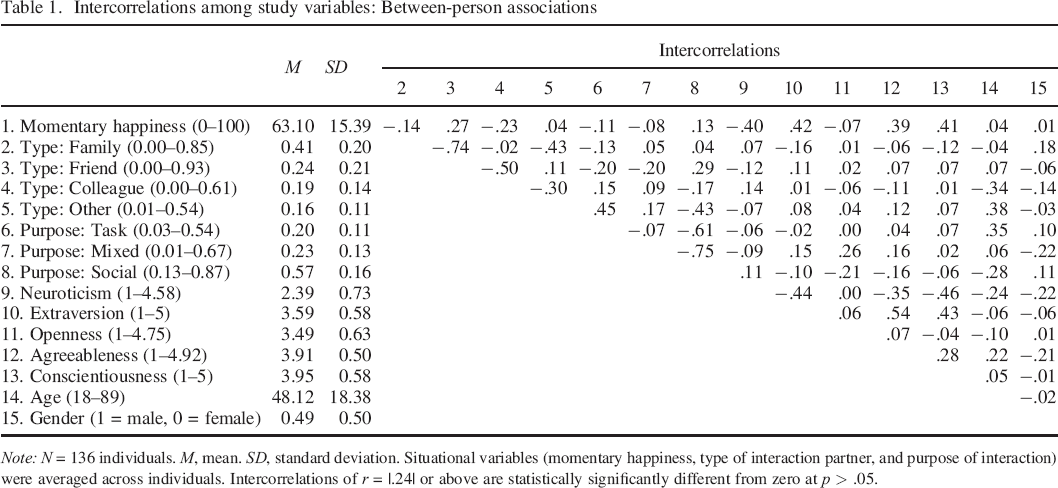
Note: N = 136 individuals. M, mean. SD, standard deviation. Situational variables (momentary happiness, type of interaction partner, and purpose of interaction) were averaged across individuals. Intercorrelations of r = |.24| or above are statistically significantly different from zero at p > .05.
Intercorrelations among study variables: Average within–person associations
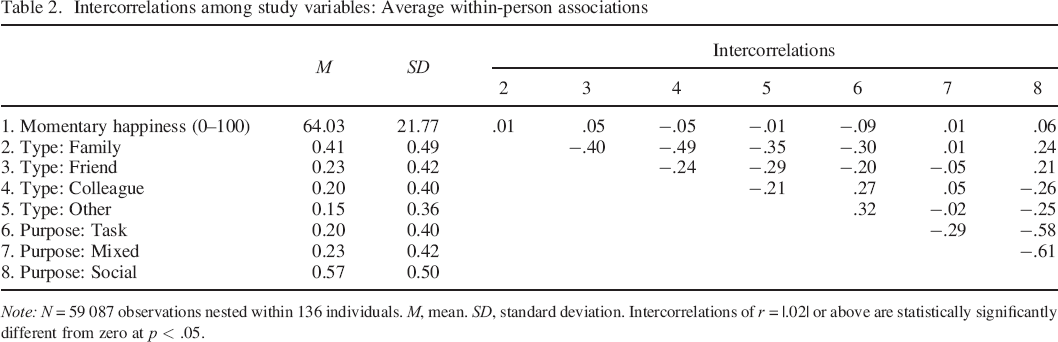
Note: N = 59 087 observations nested within 136 individuals. M, mean. SD, standard deviation. Intercorrelations of r = |.02| or above are statistically significantly different from zero at p < .05.
Multilevel model examining momentary happiness as a function of personality, type of social interaction partner, and covariates
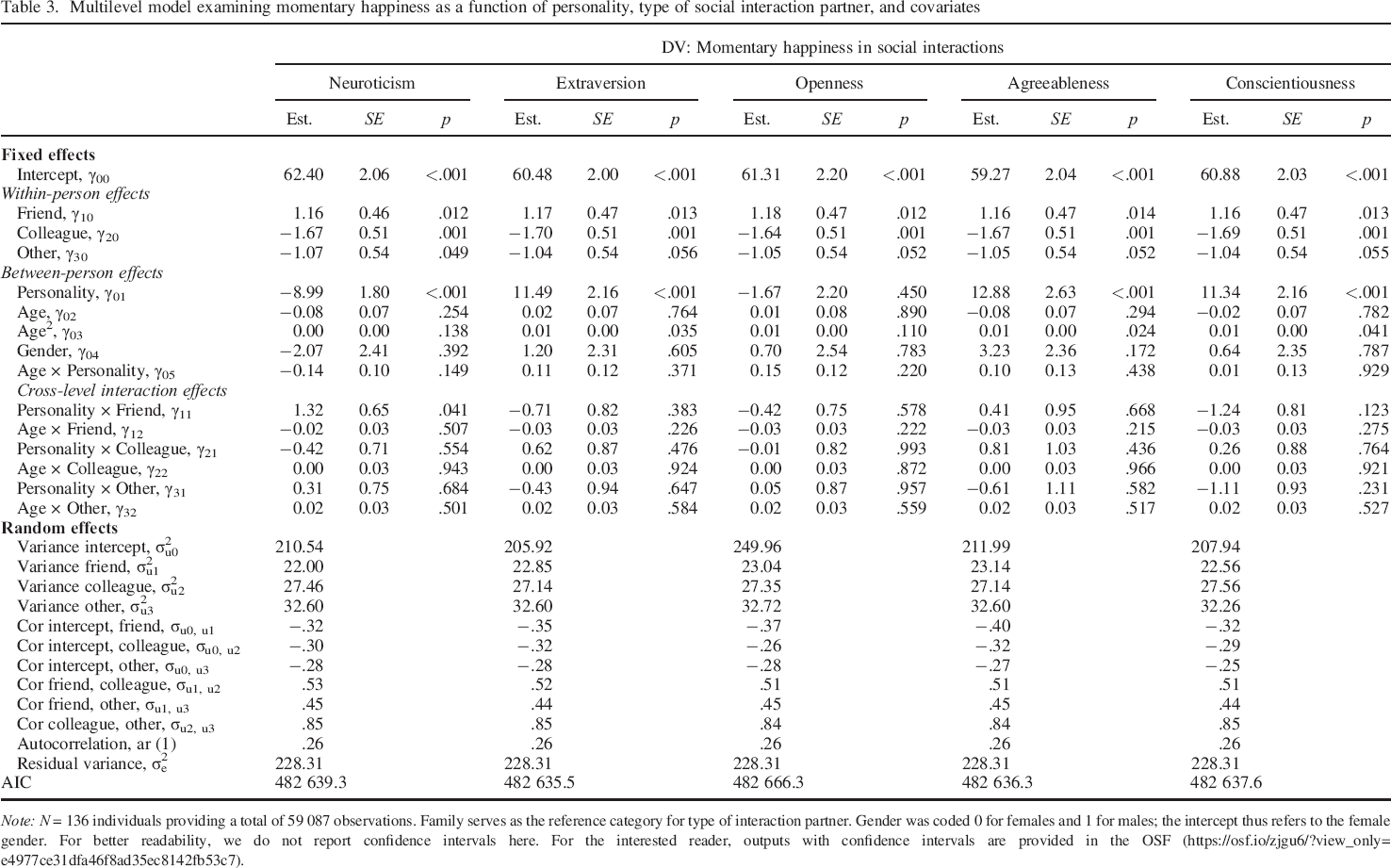
Note: N = 136 individuals providing a total of 59 087 observations. Family serves as the reference category for type of interaction partner. Gender was coded 0 for females and 1 for males; the intercept thus refers to the female gender. For better readability, we do not report confidence intervals here. For the interested reader, outputs with confidence intervals are provided in the OSF (https://osf.io/zjgu6/?view_only=e4977ce31dfa46f8ad35ec8142fb53c7).
Multilevel model examining momentary happiness as a function of personality, purpose of social interaction, and covariates
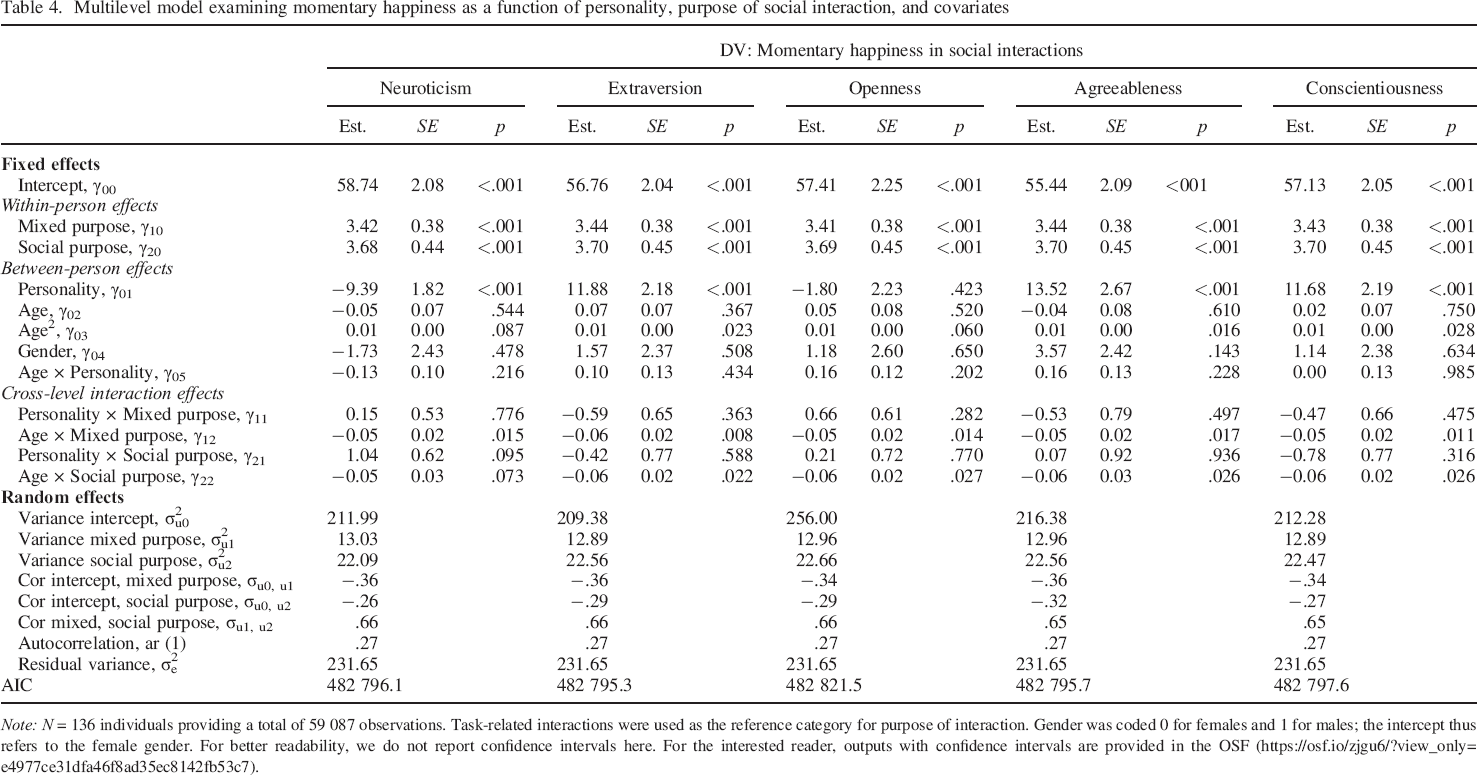
Note: N = 136 individuals providing a total of 59 087 observations. Task–related interactions were used as the reference category for purpose of interaction. Gender was coded 0 for females and 1 for males; the intercept thus refers to the female gender. For better readability, we do not report confidence intervals here. For the interested reader, outputs with confidence intervals are provided in the OSF (https://osf.io/zjgu6/?view_only=e4977ce31dfa46f8ad35ec8142fb53c7).
Main effects of personality traits and social context characteristics on momentary happiness
Converging with existing evidence, we found significant main effects of social context characteristics on momentary happiness (see Figure 1). Specifically, as seen in Table 3 (column 1), participants generally reported feeling happier after interactions with friends (γ10 = 1.16, p = .012), followed by interactions with family members (reference category), others (γ30 = −1.07, p = .049), and colleagues (γ30 = −1.67, p = .001). While in line with prior research (e.g. Vogel et al., 2017), note that the main effects for interactions with friends and others were only significant at a less strict alpha–level (.01 < p < .05). As seen in Table 4 (column 1), participants reported feeling happier after interactions with a mixed (γ10 = 3.42, p < .001) or a socially oriented (γ20 = 3.68, p < .001) compared with a task–related purpose (reference category).
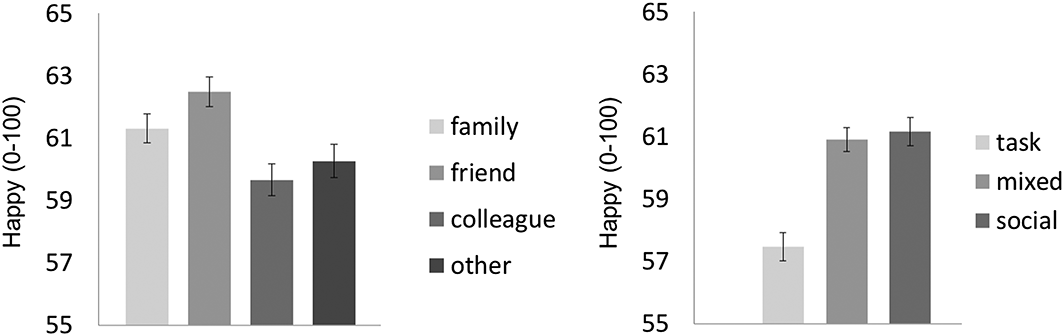
Main effects of situation characteristics on momentary happiness in social interactions. Effects of the type of interaction partner are displayed on the left–hand side, effects of the purpose of the interaction on the right–hand side. Differences between interactions with family and interactions with friends (p = .012) and colleagues (p = .001) were statistically significant, as were differences between interactions with friends and interactions with colleagues or others (p < .001). For the purpose of the interaction, significant differences were found between task–related interactions and mixed or socially oriented interactions (p < .001). Note. Parameter estimates are based on main effect models not controlling for personality or personality × situation interactions. Error bars represent standard errors of the means.
As expected, we also found significant main effects of the Big Five traits on momentary happiness (see Figure 2). In line with prior research, traits that have been associated with positive affective and relationship outcomes at a macro level were also linked to higher momentary happiness in social interactions at a micro level. As seen in Table 3, openness was not associated with differences in overall happiness (γ01 = −1.67, p = .45), higher neuroticism was associated with lower overall happiness (γ01 = −8.992, p < .001), and higher extraversion (γ01 = 11.49, p < .001), agreeableness (γ01 = 12.88, p < .001), and conscientiousness (γ01 = 11.34, p < .001) were all associated with higher overall happiness. 4
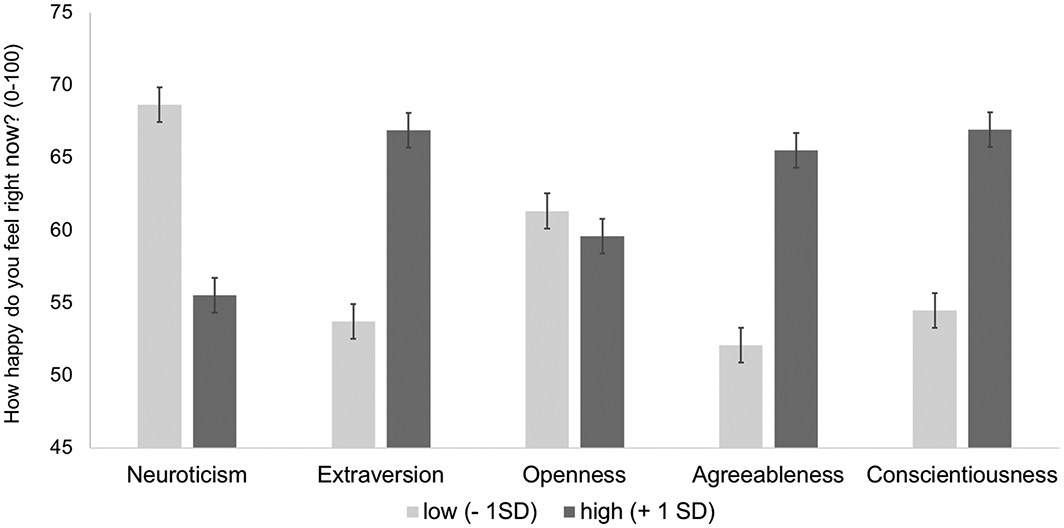
Main effects of personality traits on momentary happiness in social interactions. All traits but openness were significantly associated with momentary happiness (p < .001). Note. Parameter estimates are based on main effect models not controlling for situational variables or personality × situation interactions. Error bars represent standard errors of the means.
Personality–situation fit and momentary happiness
Unexpectedly, personality did not emerge as a consistent moderator of the relation between social context characteristics and momentary happiness. Across all 10 models, only one personality × social context characteristic interaction (the γ11, γ21, and γ31 parameters) was statistically significant, and only at p = .041. As shown in Figure 3, individuals with higher neuroticism scores felt significantly happier after interactions with friends compared with interactions with family or colleagues (γ11 = 1.32, p = .041), whereas the type of interaction partner had little effect on momentary happiness in those low in neuroticism.
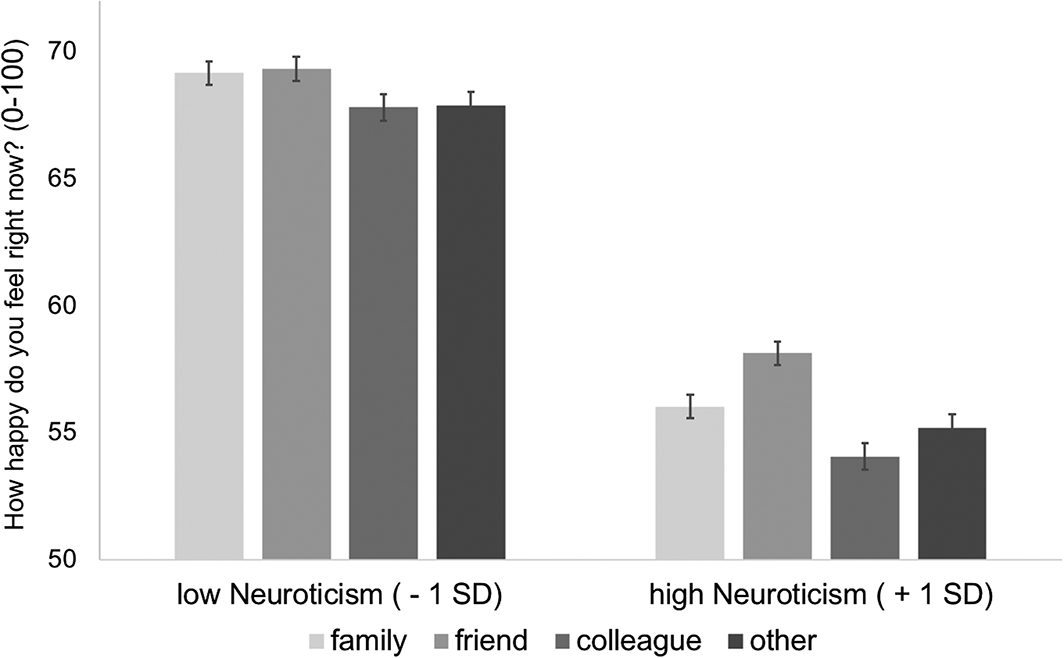
Neuroticism moderates associations between type of social interaction partner and momentary happiness. For example, it can be obtained that individuals with higher levels of neuroticism benefitted more from interactions with friends (compared with interactions with family) than did individuals low in neuroticism (p = .041). Note. Error bars represent standard errors of the means.
Age differences in relations among personality, social context characteristics, and momentary happiness
There was no evidence of age differences in the way personality moderated links between social context characteristics and momentary happiness. Specifically, none of the three–way interaction terms (γ13, γ23, and γ33) were significantly different from zero and were thus trimmed from the final models. Main effects of personality traits on overall happiness were also not moderated by age (for all γ05, p > .05). However, some of the main effects of social context characteristics on momentary happiness were moderated by age. Specifically, as seen in the models in Table 4, the difference in happiness between task–purpose situations and mixed–purpose situations (p < .05 for all γ12) and social–purpose situations (p < .05 for all γ22 except in the neuroticism model) was smaller at older ages. However, these effects were only significant at lower levels of significance (.01 < p < .05) and should thus be interpreted with caution.
Additional follow–up analyses
A major challenge in situational research is the operationalization of the situation and the choice of situational variables. In the present study, we made use of the two social context characteristics that appeared most psychologically and conceptually relevant for our current investigation (type of interaction partner and purpose of interaction). However, acknowledging that the choice of social context characteristics is not unambiguous (especially in contrast to the very well–established Big Five trait taxonomy), we conducted several follow–up analyses with alternative operationalizations of the social situation in order to provide a more comprehensive picture and to illuminate whether or how our analytical choices might have impacted the results (R scripts including model outputs can be found in OSF).
In a first step, we reran analyses using the two alternative situational variables available in the data set: the location of the interaction and the familiarity of the interaction partner. The location variable initially comprised seven different response options, which we recoded into four different categories: home (reference category), work or class, recreational (café, restaurant, and recreational facility), and other (in transit, store, and other). We then entered these categories as dummy variables into multilevel models analogous to our main analyses. Overall, individuals reported feeling happier after interactions that took place in a recreational context compared with interactions at home (γ = 2.58, p < .001). In addition to this main effect, two significant personality × situation interactions emerged: Neuroticism moderated the effect of the location such that individuals with higher levels of neuroticism benefited even more from interactions in recreational settings compared with those at home than did individuals low in neuroticism (γ = 1.77, p = .011). This converges with results from our main analyses suggesting that individuals high in neuroticism benefit more from interactions with friends compared with interactions with family. In contrast, people high in conscientiousness found interactions that occurred in recreational contexts (γ = −2.71, p = .001) as well as interactions in other contexts (γ = −2.52, p < .001) less pleasant than interactions at home.
For the familiarity of the interaction partner, we used participants’ response to the item ‘How well do you know this person’ that was recorded on a slider–type scale from 0 (not at all) to 100 (very well). Overall, individuals felt happier after interactions with more familiar interaction partners (γ = 0.03, p < .001). None of the personality × familiarity interactions were significant.
In a second step, we tested whether using more differentiated categories for type of interaction partner impacted our results. In our main analyses, we grouped family and romantic partners into one category. However, the downside of this approach is that potential differences between romantic partners and other family members might have been overlooked. In a follow–up analysis, we thus split our family category into one category including all family members other than romantic partners and one category including only romantic partners (married or unmarried) and entered the romantic partner category as an additional dummy variable into our models examining the role of the type of interaction partner. In these updated models, the highest happiness scores were reported after interactions with family or friends (γ = −0.33, not significant), followed by interactions with others (γ = −2.59, p > .001), romantic partners (γ = −2.79, p < .001), and colleagues (γ = −3.21, p < .001). The results for personality × social context interactions were largely consistent with our initial analyses using a combined family category, with two exceptions: First, neuroticism no longer moderated the effect of friend interactions on momentary happiness. Instead, neuroticism moderated the association between momentary happiness and interactions with romantic partners (γ = −2.49, p = .004) and, at a lower level of significance, colleagues (γ = −1.76, p = .025), such that individuals high in neuroticism felt particularly unhappy after interactions with their romantic partner and after interactions with colleagues, whereas the type of interaction partner had less influence on those low in neuroticism. Second, individuals high in extraversion reported feeling happier after interactions with colleagues than did individuals low in extraversion (γ = 2.23, p = .021), although this effect was only significant at .01 < p < .05.
Discussion
The current report makes use of more than 50 000 interaction reports to examine the role of personality–situation fit for momentary happiness in social interactions across the lifespan. In line with previous research, we found additive effects of social context characteristics and personality traits, which were both significantly associated with momentary happiness. We found little to no support for personality × situation interactions or for age moderation, suggesting that personality effects on momentary happiness in social interactions might manifest in similar ways across the lifespan. In the following, we discuss these findings and their implications in more detail.
Personality–situation fit and momentary happiness
Contrary to our expectations and long–standing conceptual notions (Diener et al., 1984; Emmons et al., 1985), the congruence of personality traits and social context characteristics did not seem to have a consistent effect on momentary happiness. In the following, we discuss potential reasons for and conclusions drawn from this pattern of results.
Why did we not find more evidence for personality–situation fit?
One potential explanation for the lack of personality × situation interactions could be that the situational categories are too broad to capture relevant differences in situational affordances and constraints. Our follow–up analyses provide at least some indication that this might have been the case: In the models using the location of the interaction as a social context characteristic, we found that neuroticism was associated with greater enjoyment of interactions in recreational contexts compared with interactions at home (mirroring the effects we found for type of interaction partner), while conscientious individuals reported feeling less happy after social interactions in recreational setting. This latter finding somewhat converges with our theoretical reasoning suggesting that conscientious individuals would enjoy socially oriented interactions less than task–oriented ones, but our distinction between task–related, mixed–purpose, and socially oriented interactions seems to have been too broad to capture such effects. When contrasting interactions in recreational contexts with those at home (a context more strongly shaped by daily routines and family duties), however, the moderating effect of conscientiousness appears more apparent. Similarly, the follow–up analyses in which we differentiated the type of interaction partner into more narrow categories (separating romantic partners from other family members) revealed slightly more nuanced moderation effects for neuroticism and extraversion as did our main analyses using broader categories.
Nonetheless, although follow–up analyses suggest that increasing the specificity by which situation characteristics are studied might help to identify more fine–grained personality × situation effects, the majority of tested interactions remained not significant. Although there is a strong theoretical foundation for the existence of personality × situation interactions (Diener et al., 1984; Emmons et al., 1985; Funder, 2008; Lewin, 1951; Mischel & Shoda, 1995; Tett & Guterman, 2000), previous studies have had similar struggles to detect such effects empirically (Ching et al., 2014; Sherman et al., 2015). For example, Sherman et al. (2015) investigated to what extent momentary expressions of behaviour and emotion could be attributed to personality traits, situational features, and interactions between personality and situational characteristics. Out of nine possible interaction effects, only two reached significance, even though the authors used a relatively detailed situational taxonomy to capture differences in situations (DIAMONDS; Rauthmann et al., 2014).
However, we believe that it is far too early to close this chapter. Instead, we propose that, similar to personality–relationship transactions, personality × situation interactions might need to be ‘treated with respect’ (Mund & Neyer, 2014). Rather than looking at a set number of situational characteristics and how they interact with relatively broad personality traits, it may be more fruitful to zoom into one personality trait at a time and identify the most relevant specific situational features for each particular trait and its underlying facets. As pointed out by Sherman et al. (2015), investigations with a narrower focus appear to be more successful in detecting personality × situation interactions. For example, a recent study on interpersonal dependency found that individuals high in dependent traits experienced greater negative affect than average following social interactions where they perceived the other person to be passive/submissive (Wang et al., 2014), a situation that does not fit with the dependent person's need for strong others to guide and lead (Bornstein, 2016; see also Côté & Moskowitz, 1998). Similarly, focusing on extraversion and sociable behaviour in social interactions, Breil et al. (2019) demonstrated that individuals high in extraversion acted particularly sociable in hedonic/positive/low–duty situations. And finally, based on the current report and other recent investigations (Chui et al., 2014; Shackman et al., 2017), type of interaction partner appears to be an important situational characteristic that interacts specifically with neuroticism in shaping momentary affective well–being. A major challenge for future research will be to investigate such nuanced effects while at the same time fostering a more integrated understanding of person–situation transactions (see Rauthmann et al., 2015).
Why does neuroticism consistently emerge as a moderator of the association between social context and affect?
Although we found little evidence for personality × situation interactions overall, one interaction effect did emerge: Individuals high in neuroticism felt significantly happier in interactions with friends compared with interactions with family and colleagues, while for individuals low in neuroticism, the type of interaction partner had little effect on momentary happiness (see Figure 3). Although this effect was only significant at .01 < p < .05, it closely mirrors results from two previous studies, indicating that neuroticism is at least to some degree associated with how individuals react to different types of social partners. Specifically, Shackman et al. (2017) demonstrated that individuals high in neuroticism reported lower levels of negative affect and higher levels of positive affect when they were in the company of close others (family, friends, and romantic partners) relative to being alone, whereas the company of more distant others did not improve their affective well–being. Having a closer look at different types of interaction partners, Chui et al. (2014) further refined this picture showing that individuals high in neuroticism reported lower negative affect when they were with friends compared to being alone, while being with other family members, spouses, or peripheral contacts was not linked to their affective well–being. Thus, both our results and the findings from Chui et al. indicate that being with friends is particularly beneficial for individuals high in neuroticism, while being with family does not seem to have the same effect.
One potential explanation could be that interactions with friends more easily convey feelings of social connection and acceptance (cf. Shackman et al., 2017), while interactions with family members or partners might involve more tension and ambiguity (Chui et al., 2014; Fingerman, Pitzer, Lefkowitz, Birditt, & Mroczek, 2008; Finn et al., 2013; O'Brien & DeLongis, 1996). More specifically, research linking neuroticism to a relationship–specific interpretation bias (Finn et al., 2013; Finn, Mitte, & Neyer, 2015) suggests that individuals high in neuroticism might be particularly insecure when presented with ambiguous situations involving their partner.
Our follow–up analyses differentiating romantic partners from other family members provide some support for this notion. Analyses using more narrow relationship categories revealed that individuals high in neuroticism experienced significantly lower levels of happiness after interactions with their romantic partner compared with interactions with other family members or friends, speaking to the possibility that interactions with romantic partners might be particularly challenging for those high in neuroticism. Zooming into and contrasting the cognitive, behavioural, and affective processes that shape affective well–being of people high in neuroticism in romantic versus other social contexts thus appears to be a fruitful avenue for future research that could provide valuable insights into the more and less adaptive regulatory mechanisms associated with neuroticism.
A lifespan developmental perspective
We hypothesized that the role of personality–situation fit for affective well–being could either (i) become more important with age because older adults have less regulatory resources to deal with and recover from stress (M. M. Baltes & Carstensen, 1996; P. B. Baltes & Baltes, 1990) or (ii) might become less important with age because older adults are more successful in using regulatory strategies to minimize or avoid negative interpersonal experiences (Birditt et al., 2005; Fingerman, Miller, et al., 2008; Luong et al., 2010).
There was no evidence for any age moderation in either direction: None of the three–way interactions between age, personality, and social context reached significance. What could be possible explanations for this non–effect? Drawing from the SAVI model (Charles, 2010), one potential explanation could be that age differences in emotion regulation strengths and vulnerabilities have balanced each other out. According to Charles (2010), age–related improvements in affective well–being should be most apparent in situations in which emotion regulation skills including attentional strategies, appraisals, and behaviour can be employed to minimize negative emotional experiences and enhance positive affect. In contrast, age–related difficulties in emotion regulation are thought to be more pronounced in high–arousal situations and situations in which negative experiences cannot be avoided (e.g. chronic stressors). Based on research by Emmons and Diener (1986a, 1986b), whether emotion regulation strategies can be successfully implemented to maximize positive and minimize negative experiences is likely dependent on the degree to which a situation was self–chosen or imposed. Using daily situational reports from college students, the authors demonstrated that the variance in individuals’ emotional and behavioural expressions was larger in self–chosen versus imposed situations, indicating that imposed situations offer less room for individual differences in regulatory strategies or behaviours to manifest. Accordingly, the type of situation selection (self–chosen vs. imposed) moderated associations between personality traits, situational characteristics, and affect. For example, neuroticism was significantly correlated with being unhappy in imposed social situations, but not in self–chosen social situations.
Integrating these findings with propositions from the SAVI model (Charles, 2010), older age might be associated with a reduced importance of personality–situation fit for happiness in self–chosen interactions that offer greater potential to employ the regulatory strategies older adults excel in. In contrast, the association between personality–situation fit and momentary happiness in imposed social interactions potentially increases with age. Unfortunately, we were not able to differentiate between self–chosen and imposed interactions in the current study and could not test these tentative speculations. We strongly believe, however, that zooming into the different types of situations and situational constraints individuals encounter throughout the lifespan provides a valuable avenue for future research.
Limitations and outlook
Our study had multiple strengths, including the use of extensive experience–sampling data comprising reports on over 50 000 real–life social interactions in an adult lifespan sample. Nonetheless, several limitations should be kept in mind when interpreting the results. Beginning with limitations in our measures, our analyses were aimed at providing a comprehensive overview of personality–situation fit and momentary happiness including all Big Five traits. Consequently, our personality measures were rather broad and did not have the specificity to uncover more nuanced patterns of results. It is well possible that facet–level analyses would have revealed a more differentiated picture (Deventer et al., 2019; Mund & Neyer, 2014). For example, individuals high in openness to actions might particularly enjoy contact with strangers or low–level acquaintances, whereas those high in openness to intellect might derive greater pleasure from having profound conversations with close friends.
Similarly, our measures of social context were rather broad, relied on relatively objective features of social interactions, and covered only a portion of the larger realm of situational variables (Rauthmann et al., 2015). Although using these more objective characteristics has the advantage of reduced reporting bias, other more subjective aspects of the social interaction might also interact with personality in shaping affective well–being. For example, Downie et al. (2008) found that the degree to which social interactions offer the potential to satisfy essential human needs for autonomy, relatedness, and competence was associated with the enjoyment of these interactions. As indicated previously, future work that measures very specific personality–relevant aspects of social situations (e.g. self–chosen vs. imposed: Diener et al., 1984; Emmons et al., 1985; behaviour of interaction partners: Fournier et al., 2008; Pincus, 2018; Pincus et al., 2015; Pincus, Hopwood, & Wright, in press; needs and goals: Downie et al., 2008; Hoppmann & Klumb, 2006; McCabe & Fleeson, 2016) will be important in discovery and assessment of personality–situation fit. To investigate the role of subjective perceptions without falling into the circularity trap, it would be particularly interesting to complement real–world assessments with data from more standardized situations (e.g. lab setting) that offer the possibility to compare situation ratings from multiple sources. Finally, we note that we only assessed situational characteristics that the participants were aware of. It is of course possible that features that lie outside conscious awareness impact affective experiences in social interactions (Reis, 2009).
Regarding our sample, a major strength of the iSAHIB study is that it comprises individuals from age 18 to 89 years and thus covers almost the entire adult lifespan. However, this large age range means that the number of individuals per 10–year age bin was too small to examine more nuanced age–group differences. For example, it is well possible that the role of personality–situation fit for momentary happiness follows a curvilinear trajectory across the life–course. Drawing from research on age–related improvements and difficulties in emotion regulation (Carstensen et al., 2011; Charles, 2010), the role of personality–situation fit might be more pronounced in middle–adulthood when people's regulatory resources are strained by the multitude of developmental tasks they are confronted with, it might then become less important after retirement and in young–old age when individuals benefit from age–related improvements in emotion regulation skills, and finally, the importance of personality–situation fit for momentary happiness could peak again in old–old age as individuals suffer from more pronounced resource constraints.
In addition to such curvilinear effects not having been detected, our sample size might not have been sufficient to detect smaller age effects. However, according to a simulation study on multilevel models (Mathieu, Aguinis, Culpepper, & Chen, 2012), the statistical power to detect cross–level interactions is more strongly determined by the Level 1 sample size compared with the Level 2 sample size, such that the gain in power with increasing Level 2 observations is relatively moderate when the Level 1 sample size is high. Specifically, the simulation study revealed that a Level 1 sample size of 18 or higher and a Level 2 sample size of 35 yielded a power of 80% to detect average–sized cross–level interactions. Although our interaction effects are more complex (three–way interactions), these simulation results still suggest that our power is in a comfortable range given that our analyses are based on over 400 Level 1 observations per participant. Of note is also that a number of significant age interactions emerged in a different report using the same sample and a similar outcome: Predicting affect valence and arousal by situational characteristics, social ecology variables, and age, Vogel et al. (2017) also tested for age interactions with a structure similar to ours (age × Level 2 variable × Level 1 variable) and found multiple significant three–way interactions with age across several different models. This large number of age interactions cannot be attributed to chance and indicates that the iSAHIB sample has sufficient power to detect cross–level age interactions of at least the size observed in Vogel et al. Thus, our current results suggest that if age plays a role in shaping personality–situation fit and its affective consequences, effects are either relatively small or too nuanced to be detected within our current design. To further the examination of more fine–grained age–differentiated dynamics, it would be highly valuable if recent efforts to conduct and integrate multiple–site experience sampling studies (see Breil et al., 2019; Geukes et al., 2017) would be expanded to include more age–diverse lifespan samples, thus providing a broader database for the analysis of potential age effects.
Finally, as a limitation in our design, the current study only included participants’ summary reports of completed social interactions but did not incorporate the interaction partners’ perspectives or the within–situation dynamics. Given that intrapersonal and interpersonal processes of both interaction partners mutually influence each other (Back, Baumert, et al., 2011; Mund et al., 2016; Sadler, Ethier, Gunn, Duong, & Woody, 2009), it would be highly interesting to examine both interaction partners’ personalities, situational perceptions, and affective fluctuations simultaneously (e.g. Hopwood et al., 2018; Ross et al., 2017).
Conclusions
In the present study, we used extensive experience–sampling reports of over 50 000 real–life social interactions to investigate the role of personality–situation fit for momentary happiness across the adult lifespan. Results suggest that both personality traits and social context characteristics are independently associated with momentary happiness in social interactions, whereas there was little evidence for interactive effects and no evidence for age moderation. Only 1 of 10 personality × situation interactions emerged as statistically significant (with p = .041): Adding to the growing evidence indicating that the affective well–being of individuals high in neuroticism is particularly context–dependent, we found that people with higher levels of neuroticism benefited more from interactions with friends compared with those low in neuroticism. We encourage future research to extend our efforts to illuminate the intricate ways in which personality and social context might interact in shaping affective well–being and provide several suggestions on how to proceed.
Funding Information
This work was supported by the National Institute on Health (AG035645), and Swantje Mueller was funded by German Research Foundation (DFG: WA 3509/3–1).
Supporting info item
Supporting info item, per2198-sup-0001-Open_Practices_Disclosure_Form - Happy Like a Fish in Water? The Role of Personality–Situation Fit for Momentary Happiness in Social Interactions across the Adult Lifespan
Supporting info item, per2198-sup-0001-Open_Practices_Disclosure_Form for Happy Like a Fish in Water? The Role of Personality–Situation Fit for Momentary Happiness in Social Interactions across the Adult Lifespan by Mueller Swantje, Ram Nilam, Conroy David E., Pincus Aaron L., Gerstorf Denis, Wagner Jenny and Wrzus Cornelia in European Journal of Personality
Open Practices Disclosure
Footnotes
Notes
References
Supplementary Material
Please find the following supplemental material available below.
For Open Access articles published under a Creative Commons License, all supplemental material carries the same license as the article it is associated with.
For non-Open Access articles published, all supplemental material carries a non-exclusive license, and permission requests for re-use of supplemental material or any part of supplemental material shall be sent directly to the copyright owner as specified in the copyright notice associated with the article.
