







Abstract
There is a well–established link between substance use and four personality traits of anxiety–sensitivity, hopelessness, impulsivity, and sensation–seeking. However, construct–level models of personality may conceal indicator–level personality–outcome associations. The current study aims to investigate evolution of the network constellation of personality and cannabis/alcohol use from early to late adolescence. Data comes from the longitudinal Co–Venture cohort (N = 3800). Personality indicators, measured by Substance Use Risk Profile Scale (SURPS) items, and the frequency of cannabis/alcohol use were assessed at four consecutive years (13–17 years old). Network constellations of the SURPS items and cannabis/alcohol use were estimated using Bayesian Gaussian graphical models at four time points. Results highlighted the age–specific associations between personality indicators and substance use. The positive role of the sensation–seeking trait (e.g. attitude towards transgression) was constant, whereas the positive role of hopelessness indicators (e.g. not being enthusiastic about future) and the negative role of anxiety–sensitivity indicators (e.g. fear of having unusual body sensations) were more prominent at early adolescence. The current study provides a novel perspective on the network structure of personality and substance use in adolescence and suggests substance–specific and age–adjusted targets in intervention efforts. © 2020 European Association of Personality Psychology
Introduction
Adolescent substance use and risk behaviours impose significant economic costs in terms of lost productivity, reductions in health–related quality of life, and rehabilitation (Edmunds, Ling, Shakeshaft, Doran, & Searles, 2018). Youth substance use precipitates negative consequences on the brain and behavioural health of the individual (Chassin & Hussong, 2009). Cannabis and alcohol are the most used substances among adolescents (Lipari, Hedden, & Hughes, 2013). Early onset of cannabis/alcohol use is associated with a range of negative consequences including subsequent dependence (Rioux et al., 2018) and polydrug use (Secades–Villa, Garcia–Rodríguez, Jin, Wang, & Blanco, 2015), cognitive deficits (Castellanos–Ryan et al., 2017; Morin et al., 2018), and psychotic–like experiences (Bourque, Afzali, & Conrod, 2018; Bourque, Afzali, O'Leary–Barrett, & Conrod, 2017). Studies of the personality correlates of adolescent substance use have shown promising results in terms of the development and implementation of targeted prevention/intervention strategies (Conrod et al., 2013; Conrod, O'Leary–Barrett, Massé, Stewart, & Séguin, 2017; Teesson et al., 2017). The current study uses a network approach to study personality correlates of adolescent cannabis/alcohol use in an attempt to derive age–specific personality item indicators related to concurrent and subsequent use.
Personality traits related to proneness to substance use is commonly described by the term ‘addictive personality’. Two main broad domains of disinhibited personality and overly inhibited personality, corresponding to the two basic behavioural tendencies of approach and avoidance, are most commonly cited in the literature as being associated with substance use (Castellanos–Ryan & Conrod, 2012). The literature highlights four personality subdomains within the aforementioned broad domains implicated in substance use, impulsivity/disinhibition and sensation–seeking within the domain of disinhibited personality along with anxiety/anxiety–sensitivity and negative thinking/hopelessness within the domain of inhibited personality (Castellanos–Ryan & Conrod, 2012; Woicik, Stewart, Pihl, & Conrod, 2009). The substance use literature refers to this as the four–factor model of personality vulnerability (i.e. impulsivity, sensation–seeking, hopelessness, and anxiety–sensitivity).
In the context of the four–factor model of personality vulnerability, impulsivity is defined as the propensity for rash, undeliberated action, specifically the inability to inhibit behaviour and lack of consideration of the consequences for others, self, or the environment. The literature has highlighted that higher levels of self–reported impulsivity are related to subsequent substance use (Conrod, Castellanos–Ryan, & Strang, 2010; Janssen et al., 2015). Sensation–seeking is defined as the desire for high levels of stimulation in the form of intense novel experiences along with the tendency to take risks to obtain this stimulation. Sensation–seeking adolescents have higher sensitivity to rewarding outcomes and positive reinforcement resulting from substance use (Woicik et al., 2009). For instance, a prospective study indicated that after accounting for initial levels of alcohol use, both baseline sensation–seeking and increasing levels of sensation–seeking over time predicted greater odds of subsequent alcohol use (MacPherson, Magidson, Reynolds, Kahler, & Lejuez, 2010). Hopelessness (negative thinking) is defined as the tendency to overcriticize and think negatively about the self, one's value, and future. Epidemiological studies have highlighted the association between hopelessness and both onset and accelerated trajectory of substance use in young people (Conrod, Castellanos, & Mackie, 2008; Krank et al., 2011). Similarly, a recent machine–learning study indicated that the hopelessness personality factor is implicated in weekly alcohol use and increases the risk for adolescent potential alcohol abuse (Afzali et al., 2018). Finally, the last trait in the four–factor model that is theorized to predict substance use (Bartel, Sherry, Smith, Vidovic, & Stewart, 2018) is anxiety–sensitivity that is defined as the specific fear of anxiety–related emotions and bodily sensations as a result of beliefs that any anxiety–related feeling will lead to catastrophic outcomes. Although some studies suggest that youth anxiety is associated with later substance use, other studies did not show any concurrent or subsequent association between anxiety–sensitivity and youth substance use (Conrod et al., 2010; Wolitzky–Taylor, Bobova, Zinbarg, Mineka, & Craske, 2012). It has been suggested that this relationship may be age–specific where anxiety–sensitivity may actually be a protective factor in very early adolescence (Krank et al., 2011).
To our knowledge, there is only one instrument that independently and distinctly assesses these four personality factors of impulsivity, sensation–seeking, hopelessness, and anxiety–sensitivity. Specifically, the Substance Use Risk Profile Scale (SURPS) (Woicik et al., 2009) is a brief 23–item questionnaire designed to measure, theoretically, nonoverlapping variance along four factors of personality related to substance use (Table 1). The SURPS is designed for large scale epidemiological and longitudinal studies (Conrod et al., 2013; Newton, Teesson, Barrett, Slade, & Conrod, 2012; O'Leary–Barrett et al., 2017) and aims to facilitate research on the role of these four personality traits in substance use and related comorbid psychopathology (Krank et al., 2011; Woicik et al., 2009). Original and translated versions of the SURPS have shown reliability and validity across both clinical and nonclinical populations (Castonguay–Jolin et al., 2013; Krank et al., 2011; Robles–García et al., 2014; Woicik et al., 2009). However, a recent study indicated some concerns regarding the validity of this instrument and underlined that the four–factor structure of the SURPS showed an adequate model fit only by correlating residual errors and/or cross–loading items. Likewise, measurement invariance in this study analysis showed that the four–factor structure of SURPS, with the exception of impulsivity, lacked invariance across genders (Blanchard, Stevens, Sher, & Littlefield, 2019).
Substance Use Risk Profile Scale: items and descriptions
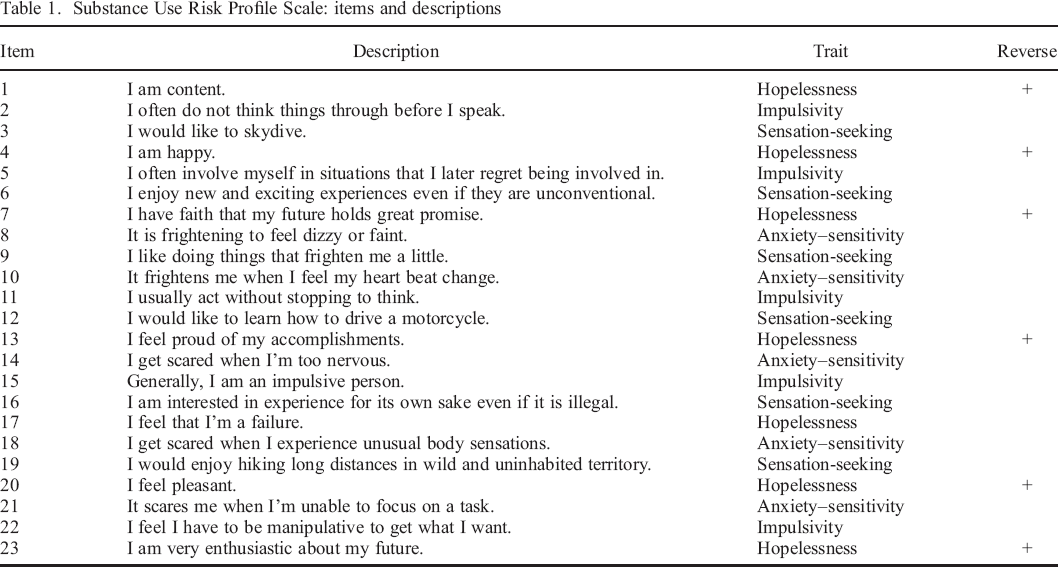
In line with standard approaches in personality research, the aforementioned validation studies of the SURPS used factor analysis to confirm the underlying set of four latent variables that can explain the structural covariation in the data and investigated associations between personality factors and outcomes such as substance use (Castonguay–Jolin et al., 2013; Krank et al., 2011; Robles–García et al., 2014; Woicik et al., 2009). This approach corresponds to a causal interpretation of latent variables (Borsboom, Mellenbergh, & van Heerden, 2003) where responses to items such as ‘I am interested in experience for its own sake even if it is illegal’ and ‘I would enjoy hiking long distances in wild and uninhabited territory’ are viewed as being intercorrelated because of their causal dependence on a latent variable (i.e. sensation–seeking). Recently, however, this perspective has been challenged by the introduction of network theory to the personality and psychopathology literature (Costantini et al., 2019; Costantini & Perugini, 2016; Cramer, Waldorp, van der Maas, & Borsboom, 2010).
Recent personality theories suggest that broad personality factors (i.e. traits) might be better conceptualized as artificial constructs that serve only for assessment or practical research purposes such as a succinct summary of individual differences without any causal interpretation (Mõttus, 2016). Several recent studies in the personality field suggest that the structural covariation in personality instruments results from direct interactions between the variables measured through personality indicators (i.e. items). According to this approach, personality factors represent ecosystems in which indicators such as behaviours, characteristics, and emotional valences activate each other, while other indicators inhibit such an activation (Costantini et al., 2015, 2019; Costantini & Perugini, 2016). Along these lines, the sensation–seeking construct can be understood as the interaction between multiple facets like attitude towards transgression and novelty–seeking, which are represented by distinct indicators such as I am interested in experience for its own sake even if it is illegal and I would enjoy hiking long distances in wild and uninhabited territory.
Also, such an approach allows the investigation of the indicator–level associations between personality and a given outcome, as opposed to the latent factor level (Christensen, Golino, & Silvia, 2019; Mõttus, 2016). Here, our definition of the term ‘outcome’ follows major lines of research defined by Mõttus (2016) indicating ‘the associations of [personality] traits with various variables that presumably reflect something outside the domain of personality, to which I collectively refer as outcomes’. Along these lines, the reliance on latent variable models in personality research might be misleading or inappropriate. Therefore, a more suitable way to investigate the structure of the ecosystem of personality may be to analyse personality data through the construction of a network–like graphical representation of the indicator–level associations between personality items and potential outcomes, instead of imposing an a priori latent variable structure. A network is a graphical representation that demonstrates complex and dynamic systems using two basic components: (i) nodes, representing the basic elements of the system, and (ii) edges, which connect nodes and represent pairwise interactions between basic elements (Costantini et al., 2015, 2019). Such an approach highlights the differential links between components of a given construct (e.g. transgression and novelty–seeking for the sensation–seeking construct) with a single or multiple outcomes (e.g. substance use).
It is worth noting that, despite the increasing popularity of network models in recent years, some researchers are sceptical of whether the contrast between latent variables and network models is necessary. Recent studies highlight similarities between network and latent variable models (Bringmann & Eronen, 2018). Indeed, some have shown that certain network models can be made equivalent mathematically and practically to other approaches such as latent variable modelling (Epskamp, Kruis, & Marsman, 2016; Epskamp, Maris, Waldorp, & Borsboom, 2016; Golino & Epskamp, 2016; Kruis & Maris, 2016). This highlights the necessity of innovative studies that put forward the potential advantages of network modelling in the domain of personality. For instance, in the indicator–outcome framework, a hierarchical linear regression where all indicators predict a single outcome could be considered as equivalent of a simple indicator–outcome network. However, in case of several outcomes (e.g. different forms substance use), an indicator–outcome network could highlight the differential association of each indicator with each outcome taking into consideration the association between different outcomes.
Here, we argue that in the context of substance use research, modelling personality risk factors as a network offers two distinct advantages: (i) it enables the investigation of putative mechanisms underlying the structural organization of each personality risk factor; and (ii) it facilitates the examination of indicator–level associations between personality items (e.g. behaviours, characteristics, emotional valences, and motivations) and concurrent/subsequent substance use. The latter approach is also called investigation of personality–outcome associations in the literature. More specifically, in the case that a broad factor (here personality) is associated with an outcome (here substance use), researchers should examine indicator–level associations to determine whether the associations are similar across all indicators (Christensen et al., 2019; Mõttus, 2016). In this context, the goal of the current study is to provide a network of indicator–level associations between SURPS items and the frequency of cannabis and alcohol use among a large sample of Canadian adolescents. Furthermore, the current study aims to examine the age–specificity of indicator–level associations; thus, we will examine the longitudinal evolution of network constellations from early to late adolescence.
Method
Data
Data were obtained from a longitudinal cohort of Canadian adolescents. The sample is part of a 4–year follow–up (2012–2016) of the Co–Venture cohort (at baseline N = 3800, age 12.8 ± 0.4 years, 49.2% girls), comprising 31 of secondary schools in the greater Montreal area. These schools represent 15% of all schools in the area and each of their respective school districts in size and deprivation indexes within 1.5 standard deviations (Bourque et al., 2018; Conrod et al., 2017). Attrition by the 4–year follow–up was 21% and was not significantly associated with demographic characteristics.
Outcome
The current study focused on mid–adolescence cannabis and alcohol use as the main outcomes. In the above–mentioned sample, cannabis and alcohol use was assessed using the validated ‘Detection of Alcohol and Drug Problems in Adolescents’ questionnaire (Landry, Tremblay, Guyon, Bergeron, & Brunelle, 2004). Participants rated their frequency of use on a 6–point scale (0 = Never, 1 = Occasionally, 2 = Monthly, 3 = 2–3 times per month, 4 = Weekly, 5 = Every day). Four personality traits relevant to substance use were assessed using the SURPS Woicik et al., 2009; Table 1). The SURPS measures personality risk for substance use and other behavioural problems according to four traits: anxiety–sensitivity, hopelessness (negative thinking), impulsivity, and sensation–seeking. Each trait was assessed using 5–7 items each rated on a 4–point scale (1 = strongly disagree, 2 = disagree, 3 = agree, 4 = strongly agree) (Castonguay–Jolin et al., 2013; Woicik et al., 2009). Investigation of concurrent and predictive validity of SURPS among adolescents highlighted that subscales sum scores are strong independent correlates concurrent of substance use and problems as well as predictors of initiation and escalation of substance use over the next 12 months (Krank et al., 2011). Reliability alpha coefficients and score ranges for each subscale in this sample were as follows, anxiety–sensitivity (range = 5–20, α = 0.76), hopelessness (negative thinking) (range = 7–28, α = 0.85), impulsivity (range = 5–20, α = 0.79), and sensation–seeking (range = 6–24, α = 0.73).
Network Analyses
Distinct networks were constructed for the association between personality indicators at each time point and concurrent cannabis/alcohol use (e.g. personality at the age 13 and cannabis/alcohol use at the age 13) as well as the association between personality indicators at each time point and late adolescence cannabis/alcohol use (e.g. personality at the age 13 and cannabis/alcohol use at the age 17). Personality networks consist of nodes, representing items, and edges, which reflect the pairwise conditional relations between two nodes, controlling for their associations with all other nodes in the network. The first step involved constructing an adjacency matrix of pairwise conditional relations among the set of items. We estimated the network structure using the Bayesian estimation for a Gaussian graphical model using the BGGM package in r statistical environment (Williams, 2018; Williams & Mulder, 2019). In this model, edges represent partial correlations between nodes, which means an edge depicts the association between two nodes controlling for the associations among all other nodes in the network. The BGGM has several advantages such as providing edgewise credible intervals from the posterior distributions as well as the possibility of the direct comparison between networks across samples that incorporates uncertainty within the Bayesian framework (Jones, Williams, & McNally, 2019; Williams & Mulder, 2019). To evaluate the accuracy of partial correlation estimates, we evaluated the credible intervals from the posterior distributions and identified nodes linked with cannabis/alcohol use with a 95% credible interval that does not include zero. To examine the evolution of each network from one time point to the other, temporally adjacent networks were compared at three different levels of global, nodewise, and edgewise connectivity using the posterior predictive distribution of Kullback–Leibler divergence (KLD) measure (Kullback, 1987). In our case, KLD can be considered as a distance measure between the expected networks of different time points, conditional on the observed data. The lower bound assumes equal network structures across time points (Williams, 2018; Williams & Mulder, 2019). In line with the aims of the current study, for nodewise and edgewise comparisons, we only focused on alcohol use and cannabis use. To facilitate visual comparisons, common layouts were established on the data for the four time points using the ‘spring’ layout (Epskamp, Cramer, Waldorp, Schmittmann, & Borsboom, 2012). Finally, to evaluate the stability of each network, we performed 1000 iterations of case–drop bootstrapping with gradual decreasing sample sizes (from full sample to half of sample size) and examined the correlation between edge weights and node strengths of each iteration with the original network.
Results
Table 2 details descriptive information of the personality factors and substance use from early to late adolescence. The difference in the rate of reported occasional alcohol use versus cannabis use at the final evaluation can be attributed to the fact that the participants were asked about drinking in general (i.e. drinking as little as a sip). The personality/substance use network at early adolescence (age 13) is shown in Figure 1 with personality items related to concurrent (age 13) and subsequent (age 17) substance use, with line thickness showing strength of association and line colour direction of association (red negative association, blue positive association). Inspection of edge confidence intervals (CIs) (see supplementary materials) indicated the accuracy of edges that relate substance use to personality with credible intervals excluding zero. Concurrent cannabis use was positively associated with one sensation–seeking indicator (attitude towards transgression—SURPS 16), one hopelessness indicator (not being optimistic regarding future—SURPS 23), and one sensation–seeking indicator (attitude towards frightening acts—SURPS 19). Likewise, concurrent alcohol use (Figure 1 A) was positively associated with one sensation–seeking indicator (attitude towards transgression—SURPS 16) and two impulsivity indicators (being manipulative—SURPS 22—and lack of premeditation—SURPS 2). Subsequent cannabis use (i.e. late adolescence cannabis use, Figure 1 B) was only predicted by one early adolescence sensation–seeking indicator (attitude towards transgression—SURPS 16) and negatively predicted by one anxiety–sensitivity indicator (it is frightening to have unusual body sensations—SURPS 18), while subsequent alcohol use was only predicted by one sensation–seeking indicator (attitude towards frightening acts—SURPS 19).
Descriptive information of the personality factors and substance use for from early to late adolescence
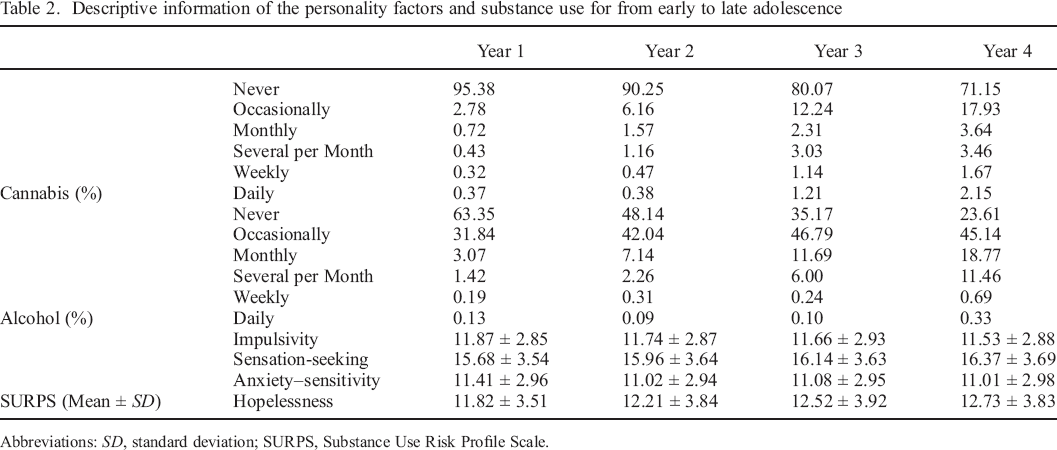
Abbreviations: SD, standard deviation; SURPS, Substance Use Risk Profile Scale.
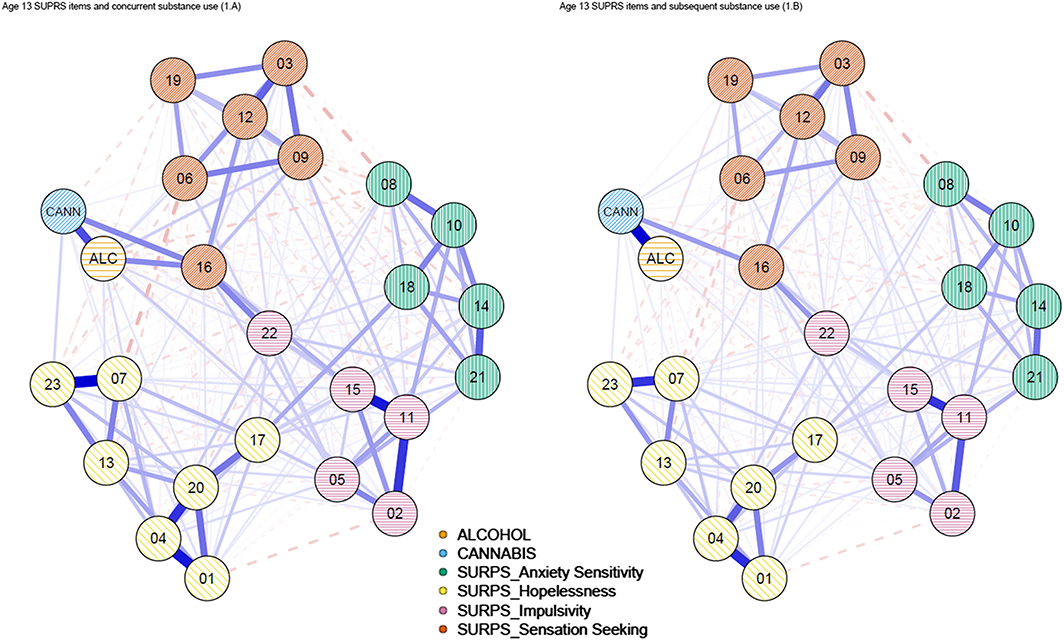
The network of personality indicators at early adolescence (age 13) with concurrent substance use (age 13, left panel A, N = 3745) and subsequent substance use (age 17, right panel B, N = 2729). SURPS, Substance Use Risk Profile Scale.
The personality/substance use network at mid–adolescence (age 14/15) is shown in Figure 2 with personality items related to concurrent (age 14/15) and subsequent (age 17) substance use. Inspection of edge CIs highlighted that concurrent cannabis use was positively associated with one sensation–seeking indicator (attitude towards transgression—SURPS 16), one hopelessness indicator (not being optimistic regarding future—SURPS 23), and one impulsivity indicator (being engaged in regrettable activities—SURPS 5). Likewise, concurrent alcohol use (Figure 2 A) was associated with one sensation–seeking indicator (attitude towards transgression—SURPS 16) and one impulsivity indicator (lack of premeditation—SURPS 2). Subsequent cannabis use (i.e. late adolescence cannabis use, Figure 2 B) was positively predicted by one early adolescence sensation–seeking indicator (attitude towards transgression—SURPS 16) and negatively predicted by one anxiety–sensitivity indicator (it is frightening to have unusual body sensations—SURPS 18), while subsequent alcohol use was positively associated with one sensation–seeking indicator (attitude towards transgression—SURPS 16) and one impulsivity indicator (lack of premeditation—SURPS 2).
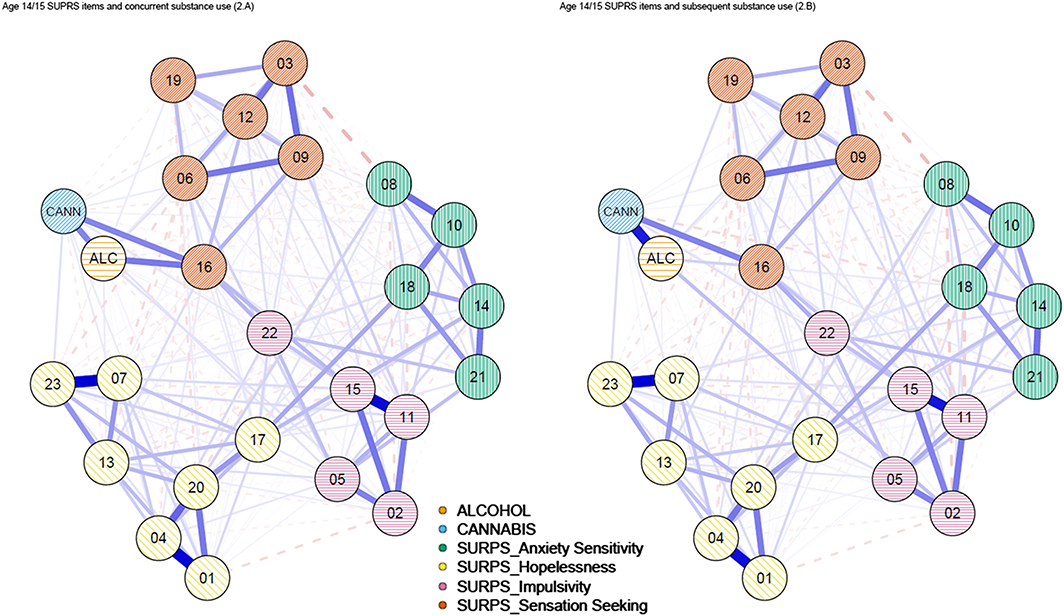
The network of personality indicators at mid–adolescence (age 14–15) with concurrent substance use (age 14–15, left panel A, N = 3182) and subsequent substance use (age 17, right panel B, N = 2554). SURPS, Substance Use Risk Profile Scale.
The personality/substance use network at mid–adolescence (age 15/16) is shown in Figure 3 with personality items related to concurrent (age 15/16) and subsequent (age 17) substance use. Inspection of edge CIs highlighted that concurrent cannabis use was positively associated with one sensation–seeking indicator (attitude towards transgression—SURPS 16) and negatively associated with one anxiety–sensitivity indicator (anxiety–related focus problems—SURPS 21) and one hopelessness indicator (not being optimistic regarding future—SURPS 23). Likewise, concurrent alcohol use (Figure 3 A) was positively associated with one sensation–seeking indicator (attitude towards transgression—SURPS 16) and one impulsivity indicator (lack of premeditation—SURPS 2) and negatively associated with one anxiety–sensitivity indicator (fear of fainting—SURPS 8). However, subsequent cannabis use (i.e. late adolescence cannabis use, Figure 1 B) was only predicted by one early adolescence sensation–seeking indicator (attitude towards transgression—SURPS 16), while subsequent alcohol use was positively associated with one sensation–seeking indicators (attitude towards transgression—SURPS 16—and hiking in uninhabited territories—SURPS 19) and one impulsivity indicator (lack of premeditation—SURPS 2) and negatively associated with one anxiety–sensitivity indicator (fear of fainting—SURPS 8).
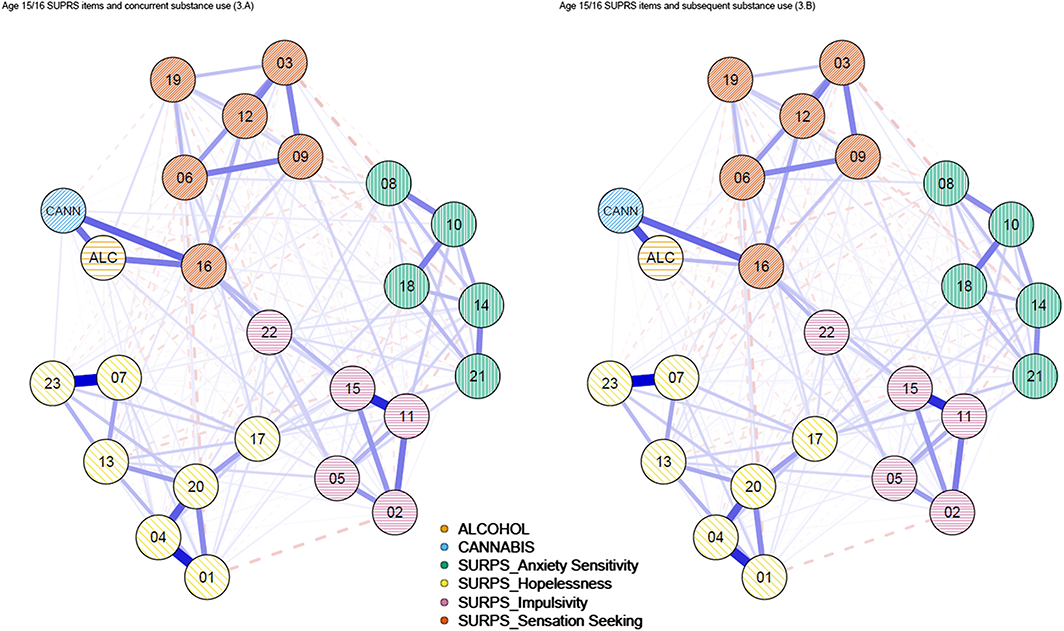
The network of personality indicators at mid–adolescence (age 15–16) with concurrent substance use (age 15–16, left panel A, N = 2898) and subsequent substance use (age 17, right panel B, N = 2494). SURPS, Substance Use Risk Profile Scale.
The personality/substance use network at mid–adolescence (age 17) is shown in Figure 4 with personality items related to concurrent substance use. Inspection of edge CIs highlighted that concurrent cannabis use was associated with one sensation–seeking indicator (attitude towards transgression—SURPS 16) and one impulsivity indicator (getting involved in regrettable activities—SURPS 5). Likewise, concurrent alcohol use was associated with two sensation–seeking indicators (attitude towards transgression—SURPS 16—and interest in hiking in uninhabited territories—SURPS 19) and one impulsivity indicator (lack of premeditation—SURPS 2). For all networks, bootstrapping analysis with gradually decreasing sample size indicated correlation coefficients higher than 0.80 for both network edges and the strength centrality measure suggesting high stability and low chance of false positive results because of a sampling bias (see supplementary materials for stability analysis). Likewise, a series of sensitivity analysis models were estimated to ensure the robustness of these findings in subsample participants who used alcohol or cannabis at least once at each time point. Although magnitude of links decreased, the same pattern of edgeweight with regards to cannabis and alcohol use emerged from this subsample (Supporting Information Table S1c and S1d).
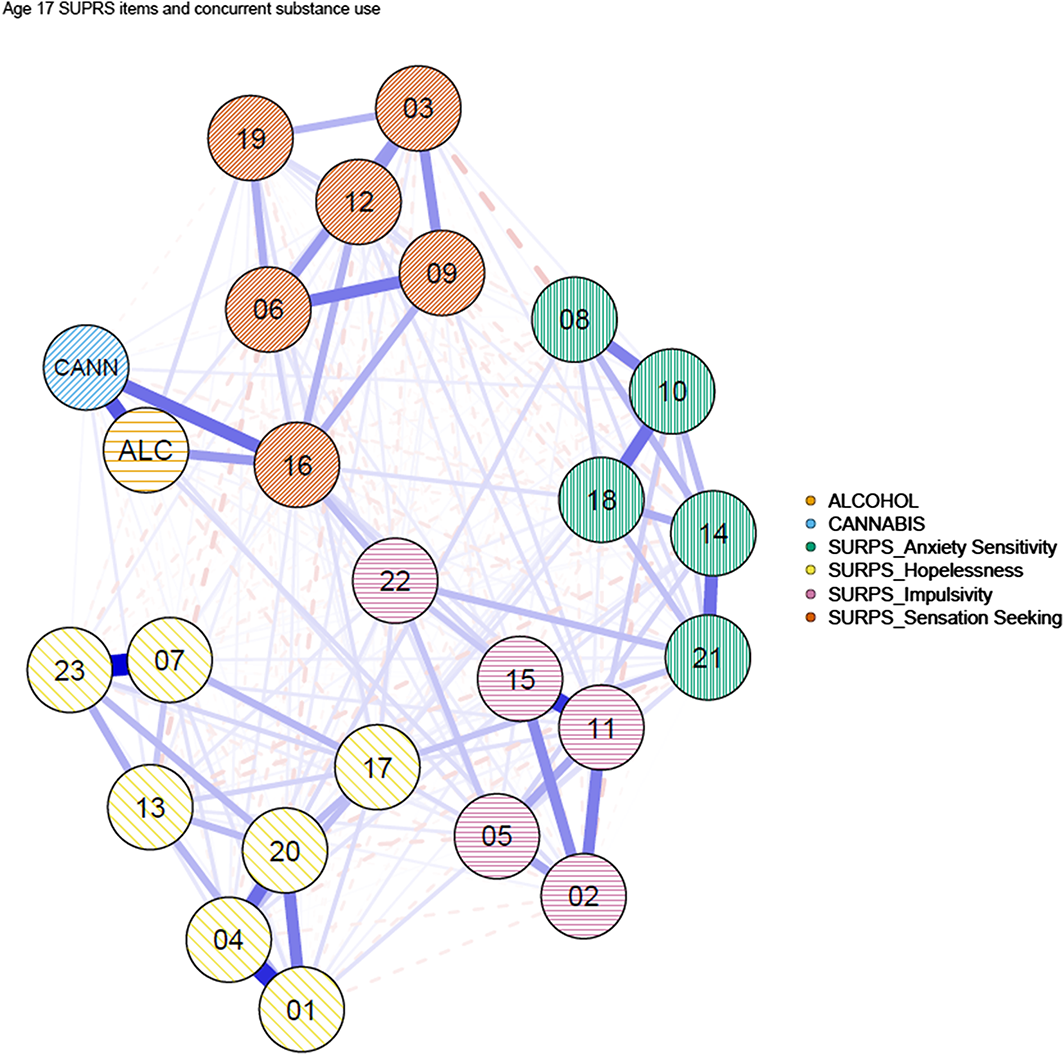
The network of personality indictors at late adolescence (age 17) and concurrent substance use (N = 2740). SURPS, Substance Use Risk Profile Scale.
Comparison of temporally adjacent networks of concurrent use in terms of global connectivity highlighted a significant difference between year 1 and year 2 networks (KLD = 0.210, p = 0.001), a difference in posterior predictive distributions between year 2 and year 3 networks (KLD = 0.16, p = 0.001), and a difference in posterior predictive distributions between year 3 and year 4 networks (KLD = 0.14, p = 0.002). Nodewise comparisons for cannabis and alcohol use showed a difference in posterior predictive distributions between year 1 and year 2 cannabis use (KLD = 0.013, p = 0.02) but not alcohol use (KLD = 0.003, p = 0.66), a difference in posterior predictive distributions between year 2 and year 3 cannabis use (KLD = 0.60, p = 0.001) and alcohol use (KLD = 0.031, p = 0.001), and no difference between year 3 and year 4 cannabis use (KLD = 0.001, p = 0.312) and alcohol use (KLD = 0.001, p = 0.67). Inspection of CIs of the edges related to cannabis and alcohol use in temporally adjacent networks highlighted an increase in the association between one sensation–seeking indicator (attitude towards transgression) and cannabis/alcohol use from early to mid–adolescence, an increase in the association between two hopelessness items and cannabis use from early to mid–adolescence, and a decrease in the association between one anxiety–sensitivity indicator and cannabis use from mid to late adolescence (see supplementary materials). In sum, network evolution highlights that, in late adolescence, the protective role of anxiety–sensitivity indicators is no longer present, but the risk related to sensation–seeking and impulsivity indicators remains constant for both alcohol and cannabis use. Moreover, network age–specific constellations underlined a higher number of hopelessness indicators that were associated with cannabis use compared to alcohol use.
Discussion
To our knowledge, this study represents the first personality–outcome investigation of early–onset substance use based on the network analysis framework. The current study contributes to recent literature using network models to examine a constellation of personality indicators as an ecosystem. Individual indicators (i.e. items) within the four–factor structure differed markedly in their concurrent/subsequent associations with substance use. Our results highlighted that the well–established prospective/concurrent association between four personality factors/traits and adolescent substance use can be accounted by a handful of personality indicators. Results also underlined the age–specificity of the association between the four–factor model of personality vulnerability and substance use. Indicators noticeably differed in their association with different substances (i.e. cannabis/alcohol) at early versus late adolescence. More specifically, the positive role of the sensation–seeking factor (specifically one item i.e. attitude towards transgression) was consistent, whereas the positive role of hopelessness indicators (specifically one item i.e. not being enthusiastic about future) and negative role of anxiety–sensitivity indicators (specifically, answers to two items i.e. it is frightening to have unusual body sensations/heart beat change) was early adolescence–limited.
The prominent role of the sensation–seeking indicator in assessing adolescents’ attitude towards transgression (i.e. I am interested in experience for its own sake even if it is illegal) in concurrent/subsequent substance use is in line with prior research concerning the association between attitudes towards law, delinquency tendencies, and adolescent substance use (Cheung, 2014; Monahan, Rhew, Hawkins, & Brown, 2014). Our results suggest that a positive attitude towards transgression potentially mediates the association between other sensation–seeking indicators and substance use (especially cannabis use). Along these lines, first–generation immigrant youths who tend to have more positive views towards the law, and less cynical attitudes towards the legal system, have a lower probability of substance use (Afzali et al., 2018; Piquero, Bersani, Loughran, & Fagan, 2016). Moreover, in line with recent developments in indicator–based personality assessment (Christensen et al., 2019), future versions of substance use risk–related personality instruments should go further in the assessment of this facet of the sensation–seeking construct (e.g. including more items to evaluate different aspects of transgression). In the same vein, our findings highlight the developmentally sensitive and substance–specific role of an openness–to–experience facet of the sensation–seeking construct. Along these lines, the sensation–seeking indicator in assessing adolescents’ openness–to–experience and attitude towards frightening acts (i.e. would enjoy hiking long distances in wild and uninhabited territory) is negatively linked to concurrent cannabis use and positively related to subsequent alcohol use at age 13. Furthermore, this indicator is either not linked or negatively linked to substance use in early adolescence, while it is positively linked to substance use (particularly alcohol) in late adolescence. This letter is in line with the substance–specific and developmentally sensitive role of the openness–to–experience facet of the sensation–seeking construct.
Our results highlighted an age–specific association between hopelessness indicators and substance use. More specifically, early–/mid–adolescence (13 to 15 years old) hopelessness was only related to concurrent alcohol and cannabis use. In line with the literature, this association is mainly because of the indicator assessing adolescents’ attitude towards the future (i.e. I am very enthusiastic about my future; reverse coded), which might be considered as a proxy for the ‘hope’ construct (Brooks, Marshal, McCauley, Douaihy, & Miller, 2016). This is line with previous results indicating the role of hopelessness in early–onset substance initiation and increasing use among early–onset users, leading to potential problematic use (Afzali et al., 2018; Nair, Newton, Slade, Conrod, & Teesson, 2016). However, the less prominent role (the absence of a role) of hopelessness along with the more prominent role of impulsivity and sensation–seeking during late adolescence could suggest that the effect of hopelessness on substance use at this stage might depend on other cognitive/motivational processes such as problem–solving and decision making. This is in line with findings in the literature suggesting that problem–solving might be an important mechanism underlying the link between hopelessness and substance use. For instance, one study showed that the association between hopelessness and lifetime cannabis and alcohol use in adolescence was mediated by reduced rational problem–solving skills (Jaffee & D'Zurilla, 2009).
Concerning the age–specific association between anxiety–sensitivity indicators and substance use, our results highlighted a protective role of early–/mid–adolescence anxiety–sensitivity (13 to 15 years old). Both cross–sectional and longitudinal studies have found conflicting evidence of association between adolescence anxiety–sensitivity and substance use. Focusing on alcohol use, a recent meta–analysis (Bartel et al., 2018) suggested that anxiety–sensitivity does not predict quantity of alcohol consumption, frequency of alcohol consumption, and frequency of binge drinking or alcohol–related problems, which is consistent with our findings. Other studies suggested anxiety–sensitivity may be a protective factor in very early adolescence (Krank et al., 2011; Nair et al., 2016; Stewart & Kushner, 2001).
The current study has a number of potential implications in terms of assessment and intervention research. From an assessment perspective, our results showed that personality indicators (as assessed by the SURPS) are not interchangeable vis–à–vis concurrent/subsequent substance use. More specifically, the ‘transgression’ sensation–seeking indicator, the ‘absence of future hope’ hopelessness indicator, and the ‘fear of bodily sensations’ anxiety–sensitivity indicators were shown to be more sensitive to substance use outcomes and to potentially mediate the association between other indicators and substance use. The results presented in the current study could help generate item pools for future versions of substance–related personality risk/protection instruments (Christensen et al., 2019). This could be integrated and implemented within the context of recent developments of network–based computerized adaptive testing (Epskamp, Maris, et al., 2016) to produce time–efficient and accurate estimation of personality risk profiles that are applicable in clinical and school settings. From an intervention perspective, our findings suggest that personality–targeted intervention strategies should take into consideration the age–specificity of different personality risk profiles. While the risk status of some personality factors is consistent throughout adolescence (e.g. sensation–seeking), other high personality factors (e.g. hopelessness) might benefit from intervention in earlier adolescence. Similarly, targeted interventions could potentially increase their effectiveness by being tailored according to specific personality–related risk indicators.
This study should be interpreted in light of a number of limitations. First, the current study used undirected cross–sectional networks on longitudinal panel data aiming to assess the role of personality indicators on substance use across time. The current methodology for longitudinal networks (e.g. multilevel vector autoregressive models and Bayesian estimation of the dynamical structural equation modelling) are not adapted for the longitudinal panel data with few time points (i.e. here four). Using intensive longitudinal data, future studies could estimate directed longitudinal networks to highlight potentially causal effects of personality indicators on substance use across adolescence. Second, using the data from community samples with similar levels of substance use, prior studies have established the association between four–factor–level personality risk profiles and substance use, and personality–targeted interventions are designed and implemented based on these results. However, the resulting network structures should be examined and validated in large samples with a relatively high base rate of substance use (e.g. samples from juvenile justice programs). Accordingly, caution should be exercised in extrapolating the findings. Third, the current study will pave the way for future network–based studies of the measurement invariance of the four–factor structure of SURPS both with respect to gender and longitudinal measurement invariance. Considering recent evidence on the lack of measurement invariance of the four–factor structure of SURPS with respect to gender (Blanchard et al., 2019), future studies should implement multigroup network models (e.g. Fused Graphical Lasso) to examine the potential effects of gender differences in personality–outcome network constellations (Danaher, Wang, & Witten, 2014). Additionally, an indicator–based study of longitudinal measurement invariance might point towards temporal variations in the factor structure of the instrument and age–specific indicators of the substance use risk. Finally, although the personality indicators were assessed using a widely used and reliable brief self–report instrument, the results may not match the accuracy of more thorough assessments. Future studies should investigate whether the assessment method affects the constellation of personality–substance use associations using multimethod and multiple informant data.
Notwithstanding the above limitations, strengths of this study include the use of the novel methodology of network analysis and a large sample to further our understanding of the association between personality risk indicators and substance use. The use of large scale longitudinal data overcomes some inherent problems in cross–sectional personality–outcome research. Large scale longitudinal samples, such as the data used in the current study, cover the complete spectrum of variations in personality risk profiles and substance use in the population and highlight the age–specificity of the association between these variables. Examination of indicator–level associations between personality items and substance use using the network framework demonstrated that a small number of indicators appear to be accounting for the construct–level personality–outcome associations.
In closing, the findings have important theoretical implications for the role of personality factors in the substance use and clinical implications based on the indicator–based approaches of assessment and screening of early–onset risk behaviours. For instance, the trajectory of substance use could be related to the emergence of personality risk indicators during adolescence, the severity of substance use could be related to the presence and quantity of personality risk indicators, and treatment response could be related to the persistence of personality risk indicators.
Supporting Information
Supporting Information, per2245-supp-0001 - The Network Constellation of Personality and Substance Use: Evolution from Early to Late Adolescence
Supporting Information, per2245-supp-0001 for The Network Constellation of Personality and Substance Use: Evolution from Early to Late Adolescence by MOHAMMAD H. AFZALI, SHERRY HEATHER STEWART, JEAN R. Séguin and PATRICIA CONROD, in European Journal of Personality
Supporting Information
Supporting Information, per2245-supp-0001 - The Network Constellation of Personality and Substance Use: Evolution from Early to Late Adolescence
Supporting Information, per2245-supp-0001 for The Network Constellation of Personality and Substance Use: Evolution from Early to Late Adolescence by MOHAMMAD H. AFZALI, SHERRY HEATHER STEWART, JEAN R. Séguin and PATRICIA CONROD, in European Journal of Personality
Footnotes
Supporting Information
Additional supporting information may be found online in the Supporting Information section at the end of the article.