







Abstract
In this study, we examine how daily life fluctuations in positive affect (PA) and negative afect (NA) relate to mixed emotions—that is, simultaneous positive and negative feelings. We utilised three experience sampling studies (total N = 275), in which participants reported their affect 10 times each day for up to 14 days. Because people generally experience fairly stable moderate levels of PA in daily life, we proposed that mixed emotions would typically occur when NA increases and overlaps with, but does not entirely eliminate, PA. Accordingly, within individuals, we found that mixed emotions in daily life were more strongly predicted by changes in NA and the occurrence of negative events than by changes in PA and positive events. At the between–person level, individuals with more variable NA, more stable PA, and higher trait Neuroticism scores experienced higher average levels of mixed emotions. Further, we found evidence that the average magnitude of NA increases may partially mediate the association between Neuroticism and mixed emotions. We also found that positive predictors of mixed emotions are negative predictors of individuals’ within–person PA/NA correlations—that is, affective synchrony. Our findings elucidate trait predictors and affective dynamics of daily life mixed emotions, which appear closely intertwined with NA variability. © 2020 European Association of Personality Psychology
How did you feel when you graduated from university? What about the last time you moved house or started a new job? Did you feel happy or sad? Excited or nervous? These complex life situations may not have felt purely pleasant or unpleasant—sometimes we feel both of these ways at once. Such concurrent, positively, and negatively valenced feelings are known as mixed emotions (Larsen & McGraw, 2014). Many lab–based studies have shown that mixed emotions can be reliably elicited in response to complex or ambivalent stimuli and events (Berrios, Totterdell, & Kellett, 2015). Yet far less is known about how mixed emotions naturally arise in everyday life and how personality traits may incline some individuals towards feeling mixed. Given the growing interest in mixed emotions as a basic topic in psychological science (Berrios et al., 2015)—as well as emerging links between mixed emotions and wellbeing (Berrios, Totterdell, & Kellett, 2018)—it is important to understand who tends to experience mixed emotions and how these experiences occur. In this paper, across three experience sampling studies, we examine how within–person dynamics of positive affect (PA) and negative affect (NA), as well as between–person differences in personality, relate to everyday experiences of mixed emotions.
Prevalence of mixed emotions in daily life
Only a handful of naturalistic studies have investigated experiences of mixed emotions in daily life. In one early diary study, participants who rated their feelings in response to their strongest daily emotional event reported experiencing non–zero levels of both PA and NA on over 40% of their reports (Diener & Iran–Nejad, 1986). In 12% of cases, participants’ PA and NA ratings were both above 2 on 0–6–point unipolar intensity scales and 3% of cases consisted of ratings both above the scale midpoint. Thus, mixed emotions were prevalent in daily life, but mixed emotional experiences of higher intensities were less common. This study was limited in two important respects. On the one hand, because participants reported on only one emotional experience each day, the true prevalence of participants’ daily life mixed emotions may have been underestimated. On the other hand, the use of end–of–day (i.e. retrospective) ratings could have led to an inflated prevalence of mixed emotions, capturing rapidly vacillating, in addition to simultaneous, experiences of PA and NA (Barrett & Bliss–Moreau, 2009; Brehm & Miron, 2006).
More recently, experience sampling methods (ESM; Mehl & Conner, 2012) have been used to assess momentary emotions. By sampling participants’ experiences in the present moment, multiple times per day, ESM can provide more reliable estimates of the prevalence of mixed emotions than daily diary studies. ESM studies operationalising mixed emotions as the co–occurrence of PA and NA at any non–zero intensity have reported that mixed emotions occur on 30–50% of all ESM reports (Scott, Sliwinski, Mogle, & Almeida, 2014; Trampe, Quoidbach, & Taquet, 2015). However, studies that have constrained the definition of mixed emotions to include only specific pairs of emotions (e.g. happiness and sadness; Kööts, Realo, & Allik, 2012) or co–occurrences of PA and NA only at moderate–to–high intensities (e.g. Riediger, Schmiedek, Wagner, & Lindenberger, 2009; Riediger, Wrzus, & Wagner, 2014; Schneider & Stone, 2015; Watson & Stanton, 2017) have yielded lower prevalence rates of around 5–15%. These studies broadly confirm that, although blends of high intensity positive and negative emotions may be less common, mixed emotions do comprise a meaningful portion of daily life affective experiences.
Within–person and between–person predictors of mixed emotions
Mixed emotional episodes appear to be part of the natural flow of affective experience in daily life, but how do these episodes arise? To date, the within–person affective dynamics and between–person personality correlates of everyday mixed emotions have received scant empirical attention. Our aims in the present research were to fill this gap by examining how mixed emotions in daily life are related to (i) within–person fluctuations in PA and NA and the occurrence of positive and negative events and (ii) between–person variations along basic personality dimensions (i.e. the Big Five; see John, Naumann, & Soto, 2008) that may confer an inclination towards experiencing mixed emotions in daily life, namely, Neuroticism, Extraversion, and Openness/Intellect.
Dynamics of positive and negative affects
In daily life, people tend to report moderate levels of PA most of the time, whereas experiences of NA tend to be less frequent and intense (Diener & Diener, 1996; Diener, Kanazawa, Suh, & Oishi, 2015; Scott et al., 2014; Trampe et al., 2015; Zelenski & Larsen, 2000; Zevon & Tellegen, 1982). This phenomenon, known as the positivity offset, implies that mildly positive feelings will often prevail in the absence of salient emotional events (Diener et al., 2015). Moreover, the finding of Scott et al. (2014) that mixed emotions are more common in daily life than purely negative emotional experiences suggests that moderate levels of PA may frequently persist even in the face of fluctuations in NA (e.g. in response to everyday stressors).
Of course, because mixed emotions entail the co–occurrence of positive and negative feelings (Larsen, Hershfield, Stastny, & Hester, 2017; Larsen & McGraw, 2014), some association with PA and NA intensity seems like a foregone conclusion. Further, given evidence that NA is on average less intense than PA in daily life (Diener et al., 2015; Scott et al., 2014; Trampe et al., 2015), it is reasonable to suggest that NA might be especially strongly associated with measures of mixed emotions that are constrained by the lower intensity affective experience. Consider the minimum statistic (MIN), which has been argued to best capture co–occurrences of PA and NA (Larsen et al., 2017; Schimmack, 2001). MIN and binary indices utilising a MIN based cut–off have been used in several daily life studies of mixed emotions (Kööts et al., 2012; Riediger et al., 2009; Riediger et al., 2014; Schneider & Stone, 2015; Scott et al., 2014; Trampe et al., 2015; Watson & Stanton, 2017). This measure is calculated as the intensity value of the lesser of the two co–occurring emotions (e.g. if PA is rated as 5 out of 10 and NA is rated as 3 out of 10, then MIN is also 3). Thus, this measure overlaps strongly with the lesser intensity affect. Although NA has been demonstrated to be less intense than PA on average, it is unknown from prior studies whether this is also typically the case during episodes of mixed emotions. Further, NA intensity and MIN will only track each other closely if NA increases frequently do not eliminate or exceed PA intensity, which would run counter to hypotheses regarding the mutual exclusivity of positive and negative feelings (Russell & Carroll, 1999). Nevertheless, it seems likely that mixed emotions, as operationalised using MIN, will closely track NA in daily life. 1
Crucially, however, our aim in this paper is not to simply demonstrate that mixed emotions are related to their component affects (as is self–evident), or to NA in particular (as we propose to be especially likely). Rather, our aim is to examine how the overall pattern of dynamic fluctuations in both PA and NA over time is related to mixed emotional experiences. Given our assumption that NA will typically remain the lower intensity affect even during episodes of mixed emotions, there are at least three distinct patterns of within–person affective fluctuations that could lead to mixed emotional experiences in daily life, which we illustrate in Figure 1.
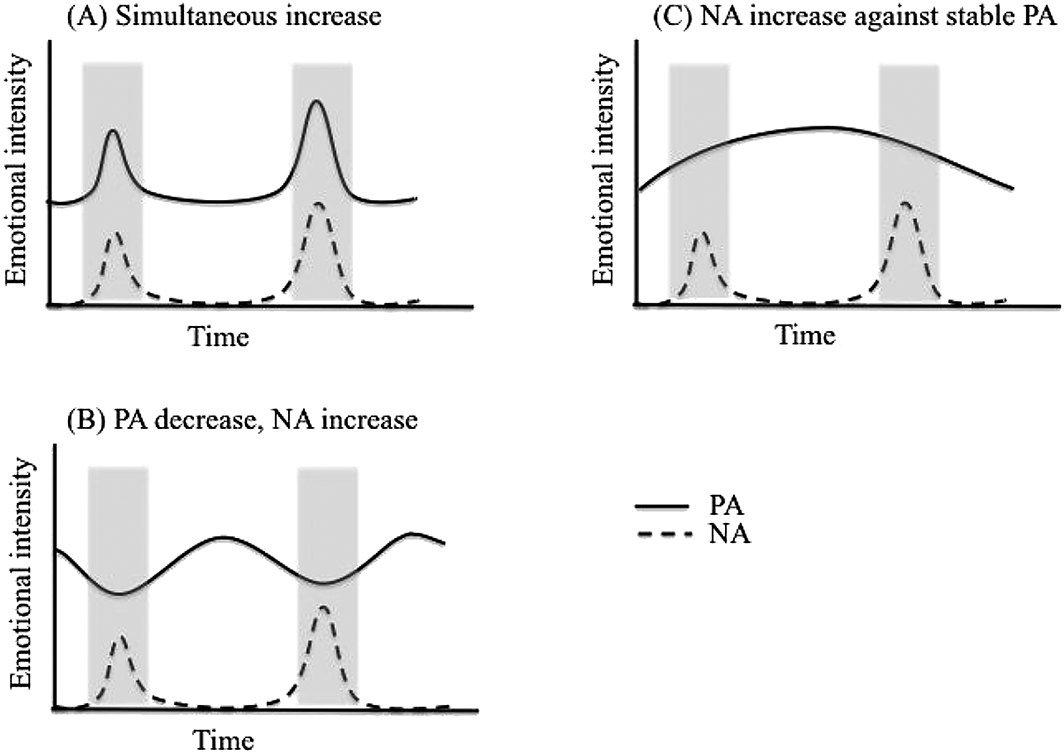
Hypothetical patterns of fluctuations in PA and NA that may lead to daily life mixed emotions. In panel A, a mixed emotional experience (shaded region) occurs when both PA and NA increase. In panel B, a mixed emotional experience occurs when PA decreases and NA increases, and in panel C, a mixed emotional experience occurs when NA intensity rises and PA remains relatively consistent. In any of these panels, NA may sometimes rise above the level of PA, but it is expected based on prior research that PA will be higher in intensity on average.
First, mixed emotions may arise when PA and NA simultaneously increase over time (Figure 1A). This would imply that increases in both PA and NA would be positively associated with increases in mixed emotions. This pattern might be expected, for example, if mixed emotions in daily life were most commonly experienced in response to mixed–valenced (e.g. bittersweet) stimuli. Indeed, this seems to be the implicit assumption in the literature given that mixed emotions are almost always discussed in relation to such mixed–valence stimuli and situations. For instance, Larsen and McGraw (2011) note that ‘people feel happy and sad at the same time’ in response to such stimuli and events as ‘meaningful life transitions’ (e.g. graduating from university), ‘evocative pictures’, and ‘bittersweet advertisements’ (p. 3). Furthermore, a notable theoretical perspective on mixed emotions suggests that they emerge as a result of mixed–valenced appraisals of affectively complex stimuli and situations (Shuman, Sander, & Scherer, 2013). This suggests that mixed emotions specifically arise in response to stimuli that trigger both positive and negative emotions at the same time.
However, as we have proposed, another possibility is that mixed emotions in daily life may most commonly arise when opposite–valence emotions blend together as moods change over time. In this case, the patterns in panels B or C of Figure 1 may be more representative of typical daily life mixed emotions. Panel B illustrates mixed emotions arising when a decrease in PA occurs simultaneously with an increase in NA. This would be consistent with research demonstrating that PA and NA are (moderately) inversely correlated within–person and between–person (e.g. Dejonckheere et al., 2018; Diener & Iran–Nejad, 1986). In contrast, panel C illustrates mixed emotions arising when NA increases to approach a relatively stable moderate level of PA, in line with the theoretical rationale provided earlier. This would imply that mixed emotions would be more strongly associated with fluctuations in NA than with fluctuations in PA.
Positive and negative events
If mixed emotions often emerge as a result of increases in NA against a background of relatively stable PA, negative events may also be closely tied to mixed emotions in daily life. Two sets of previous findings support this notion: first, experiments reveal that purely negative stimuli tend to elicit more mixed emotions than purely positive stimuli (e.g. Hunter, Schellenberg, & Schimmack, 2008). Second, daily life studies show that negatively valenced situations elicit mixed emotions. One such study showed that mixed emotions were more commonly reported in response to negative events than positive events (Hui, Fok, & Bond, 2009), and another showed that mixed emotions were four times as likely to occur when stressors were present than when they were absent (Scott et al., 2014).
Affective synchrony
Individual differences in the within–person PA/NA correlation—termed ‘affective synchrony’ (Rafaeli, Rogers, & Revelle, 2007) or sometimes ‘bipolarity’ (Dejonckheere et al., 2018)—may also provide information about how mixed emotions tend to occur in everyday life. Although it has been demonstrated to be a poor indicator of the co–occurrence of PA and NA (Larsen et al., 2017), affective synchrony does capture the degree to which PA and NA tend to co–vary, which may shed further light on the dynamics of mixed emotions. For instance, individuals for whom PA and NA are positively associated might typically experience mixed emotions in the manner portrayed in Figure 1A, a joint increase in PA and NA. Conversely, individuals for whom PA and NA are negatively associated may still experience mixed emotions but may typically experience mixed emotions in the manner portrayed in Figure 1B; as one affect increases, the other tends to decrease. Finally, individuals for whom the association between PA and NA approaches zero may experience mixed emotions that manifest in the pattern illustrated in Figure 1C. Importantly, this pattern could also be compatible with a lack of mixed emotions. For example, if an individual experienced mainly PA and seldom reported NA, or vice versa, PA and NA would be largely uncorrelated, and mixed emotions would be infrequent. Thus, although affective synchrony cannot properly be considered a measure of mixed emotions (see Larsen et al., 2017), it may be useful to compare how predictors of mixed emotions are related to affective synchrony.
Personality traits and daily life mixed emotions
Neuroticism and extraversion
To the degree that fluctuations in PA and NA relate to mixed emotions, we might also expect that basic personality traits capturing differential susceptibility to PA and NA will predict mixed emotions in daily life. First, because individuals higher on Neuroticism experience more frequent and intense NA and evince stronger emotional reactivity to negative events and stressors (Bolger & Zuckerman, 1995; Gross, Sutton, & Ketelaar, 1998; Larsen & Ketelaar, 1991; Suls, Green, & Hillis, 1998), this trait is likely to be a strong, positive predictor of mixed emotions. This assumes that neurotic individuals often maintain at least a moderate level of PA when experiencing increases in NA. In support of this hypothesis, both cross–sectional and daily life studies show that Neuroticism is associated with more negative but not less positive emotions (e.g. Verduyn & Brans, 2012; Watson & Tellegen, 1985). Further, Neuroticism has already been associated with more frequent mixed happy and sad emotional experiences in daily life (Kööts et al., 2012) as well as with higher scores on a dispositional measure of the tendency to experience mixed emotions (Barford & Smillie, 2016). In this latter study, we found that the association between Neuroticism and trait mixed emotions was explained by trait negative affectivity—that is, the tendency to experience more frequent NA. However, we are aware of no previous ESM studies examining whether any relation between Neuroticism and mixed emotions can be described in terms of an indirect association via negative affectivity.
Second, the relation between Neuroticism and mixed emotions may be stronger among individuals also high on Extraversion. This is because the degree to which PA is maintained or simultaneously rises with NA might depend on individuals’ susceptibilities to PA, which is captured by Extraversion (Rusting & Larsen, 1997; Smillie, Cooper, Wilt, & Revelle, 2012; Smillie, DeYoung, & Hall, 2015). If this were the case, we would expect Neuroticism to interact with Extraversion in the prediction of mixed emotions. Against this reasoning, however, Barford and Smillie (2016) found no significant interaction between Extraversion and Neuroticism in relation to a dispositional measure of mixed emotions. Nevertheless, no previous ESM studies to our knowledge have investigated this interaction, so we examine it in the present study.
Finally, there is indirect evidence to suggest that an interaction between Neuroticism and Extraversion may be associated with affective synchrony. Specifically, the within–person correlation between PA and NA has been demonstrated to vary widely across individuals (Rafaeli et al., 2007) and is predicted by an individuals’ trait levels of positive and negative emotions. For individuals high in trait NA, trait PA predicts more positive within–person PA/NA correlations, whereas those low in trait NA tend to have more positive PA/NA correlations if they are also low in trait PA (Wilt, Funkhouser, & Revelle, 2011). Given that Neuroticism and Extraversion are strongly associated with trait NA and PA respectively (Watson & Clark, 1992), we might also expect them to interact in the prediction of affective synchrony.
Openness/intellect
Finally, trait Openness/Intellect—the tendency to be creative, curious, and imaginative (DeYoung, 2014)—may also be a unique predictor of the tendency to experience mixed emotions in daily life. We recently demonstrated that individuals high on Openness/Intellect tend to make more mixed appraisals (i.e. simultaneous positive and negative evaluations) of affectively complex stimuli (Barford, Fayn, Silvia, & Smillie, 2018). As noted earlier, such ‘mixed appraisals’ have been theorised to underlie and give rise to mixed emotional experiences (Shuman et al., 2013). In addition, individuals high on Openness/Intellect are more tolerant of ambiguity (Furnham & Marks, 2013; Jach & Smillie, 2019) and may therefore be less motivated to avoid or suppress experiences of opposite valences. Indeed, Openness/Intellect was the only trait other than Neuroticism to have a replicable association with mixed emotions across studies of Kööts et al. (2012) and Barford and Smillie (2016) on the personality correlates of mixed emotions. Thus, Openness/Intellect may be an additional unique predictor of individual differences in mixed emotions in daily life.
The present study
Few studies have investigated mixed emotional experiences in daily life, and even fewer have examined within–person and between–person correlates of these experiences. In the present study, we took steps towards a more comprehensive account of daily life mixed emotions, focusing on hypothesised dynamic predictors of within–person fluctuations in mixed emotions—changes in PA and NA and the occurrence of positive and negative events—as well as potential trait predictors of between–person differences in mixed emotions—Neuroticism, an interaction between Extraversion and Neuroticism, and Openness/Intellect. We tested our predictions in three ESM studies, all of which assessed participants’ momentary experiences of PA and NA several times a day for up to 2 weeks, and two of which additionally measured the occurrence of positive and negative events. Participants in all three samples also completed personality questionnaires measuring their Big Five traits. The following hypotheses were derived from the presented rationale (hypotheses were not pre–registered):
First, although it is necessary that PA and NA will have some association with indices of mixed emotions, the specific pattern of PA and NA dynamics associated with mixed emotions over time remains unknown. We propose that mixed emotional experiences in daily life will largely be driven by momentary upsurges in NA, at least some of which are in response to negative events, against a backdrop of relatively stable moderate intensity PA (i.e. the pattern illustrated in Figure 1C). We contrast this prediction with two alternative possibilities that one might plausibly expect based on the previous literature—that changes in both PA and NA might positively predict mixed emotions (Figure 1A) or fluctuations in PA might negatively predict mixed emotions while changes in NA positively predict mixed emotions (Figure 1B). We therefore predicted that changes in momentary levels of mixed emotions would be positively associated with moment–to–moment increases in NA and negatively associated with momentary decreases in NA at the within–person level and that these changes in NA would be more strongly associated with changes in mixed emotions than would changes in PA (H1). We also explored between–person associations of average PA and NA increases and decreases with average levels of mixed emotions, as well as with patterns of affective synchrony.
As a convergent test of this first prediction, concerning relations between PA, NA, and mixed emotions, we also examined participant reports of positive and negative events. Because PA and NA often rise in response to positive and negative events, the effect of these events on mixed emotions may mirror associations with PA and NA. We therefore expected that the occurrence of negative events would be more strongly associated with increases in mixed emotions (within–persons) than the occurrence of positive events (H2). We further explored the between–person associations of positive and negative events with average levels of mixed emotions, as well as affective synchrony.
Concerning potential personality predictors of mixed emotions: first, we expected that Neuroticism would positively predict average levels of mixed emotions (H3) and that the between–person association between Neuroticism and mixed emotions would be partly accounted for by individual differences in the average magnitude of NA increases (H4a) and NA reactivity to negative events (H4b). We also examined whether the Extraversion × Neuroticism interaction would predict average levels of mixed emotions in daily life, such that the relation between Neuroticism and mixed emotions would be even stronger for those also high on Extraversion (H5). Further, we predicted that Openness/Intellect would positively predict average levels of mixed emotions in daily life (H6). Finally, we also explored relations between the Big Five and affective synchrony and examined whether any within–person relations between changes in PA/NA and changes in mixed emotions were moderated by relevant Big Five predictors (Extraversion, Neuroticism, and Openness/Intellect).
Method
Participants
Sample 1 (see Pasyugina, Koval, De Leersnyder, Mesquita, & Kuppens, 2015) comprised 101 Flemish university students (73.7% female) with an average age of 21.40 years (SD = 2.15), who were paid up to 40 euros for completing a 1–week ESM study. Participants needed to be aged 18–30 and not in treatment for a psychological disorder to be eligible for the study. Sample 2 (see Pe & Kuppens, 2012) comprised 79 Flemish university students (62.5% female; mean age = 23.5, SD = 7.82 years), who were paid up to 40 euros for a 2–week ESM study. Sample 3 (see Koval, Pe, Meers, & Kuppens, 2013) comprised 95 Flemish university students (62.1% female; mean age = 19.06, SD = 1.28 years), who were paid up to 70 euros for completing a 1–week ESM study. Sample 3 differed from the other two samples in that participants were selected using a stratified sampling approach (Ingram & Siegle, 2009) to represent a wide range of depressive symptom scores. Although these datasets have been investigated in prior studies (as cited earlier), the analyses presented in the present study are entirely novel and do not overlap with those presented in prior publications.
As this study involved analysis of existing ESM data, target sample sizes were not determined on the basis of the present hypotheses. As described below, our three samples comprised a minimum of 5788 observation points, suggesting that each sample should be sufficiently well–powered to detect within–person associations—at least according to many commonly cited guidelines (e.g. Kreft & de Leeuw, 1998; Maas & Hox, 2005). However, it should be kept in mind that our samples are potentially somewhat underpowered to detect between–person associations or interaction effects. For this reason, we will only interpret effects that are significant across multiple samples and measures of mixed emotions and remind readers that non–significant effects should also be regarded cautiously (i.e. not as providing evidence in favour of the null).
Measures
Momentary affect measures
Momentary experiences of PA and NA were assessed with slightly different items in each sample (Table 1). We averaged selected items from each sample to create PA and NA scales. Items were selected to ensure that each item was matched with an opposite–valence item that closely approximated an equal arousal/activation level (e.g. excited/stressed; Russell, 1980). Thus, additional PA or NA items that could not be paired with an opposite affect at a similar arousal level were excluded. It is important to note that these specific composites of PA and NA were created based on affective valence and are therefore closer to notions of Russell (1980) of pleasant and unpleasant valence, rather than notions of Watson and Tellegen (1985) of positive and negative activation. In samples 1 and 2, the affect items were rated on a scale from 0 (not at all) to 100 (very much). In sample 3, the response scale ranged from 1 to 100, which we rescaled to range from 0 to 99 to ensure that 0 reflected the absence of affect in all samples.
Affect descriptive statistics
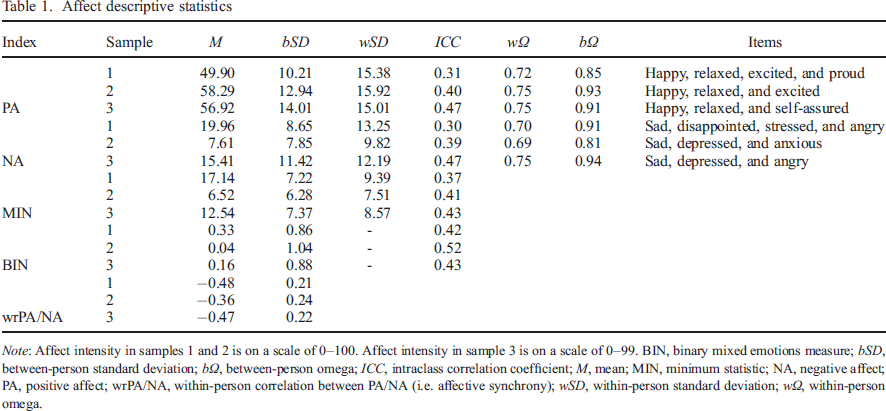
Note: Affect intensity in samples 1 and 2 is on a scale of 0–100. Affect intensity in sample 3 is on a scale of 0–99. BIN, binary mixed emotions measure; bSD, between–person standard deviation; bΩ, between–person omega; ICC, intraclass correlation coefficient; M, mean; MIN, minimum statistic; NA, negative affect; PA, positive affect; wrPA/NA, within–person correlation between PA/NA (i.e. affective synchrony); wSD, within–person standard deviation; wΩ, within–person omega.
Positive and negative events
In sample 1, participants reported the occurrence of positive or negative events using a single item, which asked ‘has anything happened since the last survey’, with response options of ‘something positive’, ‘something negative’, or ‘nothing’. Events were not comparably assessed in sample 2. In sample 3, positive and negative events were assessed separately using two dichotomous (yes/no) items assessing the occurrence of positive/negative events since the last survey. In both samples with event data, we recoded the event items so that each participant had two binary event indices for each moment, one for whether a positive event occurred, and the other for whether a negative event occurred. Thus, for example, in sample 1, participants received a 1 on the positive event index if they reported a positive event and a 0 if they reported a negative event or nothing (and vice versa). In sample 3, participants received a 1 on the positive event index if they reported a positive event and a 0 if they did not report a positive event.
Big Five personality traits
Participants in samples 1 and 3 completed the Dutch translation of the Ten Item Personality Inventory (TIPI; Hofmans, Kuppens, & Allik, 2008), which measures each of the Big Five traits (Extraversion, Neuroticism, Conscientiousness, Agreeableness, and Openness/Intellect) using two items each (e.g. I see myself as extraverted, enthusiastic), rated on a scale from 1 (disagree strongly) to 7 (agree strongly). Participants in sample 2 completed the 60–item Dutch version of the NEO–Five Factor Inventory (NEO–FFI; Hoekstra, Ormel, & De Fruyt, 1996), which measures each Big Five domain with 12 items (e.g. I often feel tense and jittery), rated on a scale from 1 (strongly disagree) to 5 (strongly agree). In all three studies, Big Five scores were computed as the average of the responses to each item in the scale.
For the personality measures, internal consistencies as measured by Cronbach's alphas in studies 1, 2, and 3, respectively, were as follows: Extraversion (.83, .80, and .77), Neuroticism (.51, .88, and .70), Conscientiousness (.43, .83, and .64), Agreeableness (.48, .72, and .24), and Openness/Intellect (.62, .62, and .41). All NEO–FFI measures used in sample 2 had high internal consistencies except for the Openness/Intellect measure, which was slightly lower. Unsurprisingly, the Cronbach's alphas for the shorter, two–item TIPI measures used in samples 1 and 3 were markedly lower than those for the NEO–FFI (see Gosling, Rentfrow, & Swann, 2003). Nevertheless, Cronbach's alphas for Extraversion and Neuroticism, at least, were acceptable (>.50).
Procedure
The procedure was similar across all samples. Participants attended the lab to receive instructions for completing a 7–day (samples 1 and 3) or 14–day (sample 2) ESM protocol. Participants completed ESM surveys on a dedicated mobile device provided by researchers (samples 1 and 3 were collected using smartphones, whereas sample 2 used palmtop computers, aka PDAs). In all samples, each day was divided into 10 equal intervals, and participants were prompted to respond to an ESM survey at one random moment during each interval. Participants daily start and end times for the ESM survey varied slightly to accommodate individual wake and sleep times. In sample 1, participants started their daily ESM surveys between 9 a.m. and 12 p.m. and ended between 8 p.m. and 11 p.m. each day. In sample 2, ESM surveys started between 5 a.m. and 9 a.m. and ended between 10 p.m. and 1 a.m., and finally, in sample 3, ESM surveys started at 10 a.m. and ended between 9 p.m. and 10 p.m. Participants completed a total of 6199 (sample 1), 9410 (sample 2), and 5788 (sample 3) ESM surveys, with average compliance rates of 91.61% (SD = 7.82), 81.67% (SD = 10.25), and 91.47% (SD = 6.23), respectively. Participants additionally completed measures of the Big Five personality dimensions either before (samples 1 and 3) or after (sample 2) completing the ESM procedure. In samples 1 and 3, participants underwent further measures and manipulations at the conclusion of the ESM procedure, and these were unrelated to the aims of the present study (see Koval et al., 2013, and Pasyugina et al., 2015, for further details).
Indices of mixed emotions
In order to measure mixed emotions, we used the minimum statistic (MIN; Larsen et al., 2017; Schimmack, 2001). As previously described, MIN is equivalent to the intensity of the weaker of two affective states and therefore reflects the intensity at which the two emotional experiences (PA and NA) overlap. Because the MIN does not capture the degree to which PA and NA are balanced (i.e. experienced at similar intensities), we also computed an adjustment to the MIN to take this into account (see Barford, 2018). Our findings using this adjusted measure of mixed emotions were very similar to our main analyses using MIN (see Supporting Information at https://osf.io/2ve9h/?view_only=67a0cfeb793243f9888ecd2f12afe89e).
In addition, we utilised a binary measure of mixed emotions (BIN), in which all instances where PA and NA co–occurred at an intensity of 20/100 or higher were coded as 1 (mixed) and all other instances were coded as 0 (non–mixed). The intensity of 20/100 was chosen as it is comparable with prior studies that have used intensity cut–offs of 1 when affect ratings were made on 5– or 6–point scales (e.g. Kööts et al., 2012; Schimmack, 2001). In addition, intensities of 1 and 50/100 were examined and prevalence of mixed emotions were very high and very low, respectively (Table 2). Therefore, 20 was chosen as a moderately strict cut–off for mixed emotions that would still allow sufficient variation for exploration of within–person and between–person predictors.
Prevalence of mixed emotions
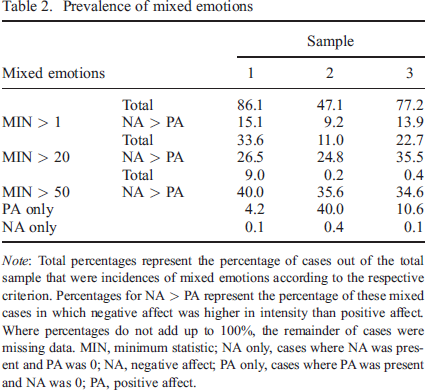
Note: Total percentages represent the percentage of cases out of the total sample that were incidences of mixed emotions according to the respective criterion. Percentages for NA > PA represent the percentage of these mixed cases in which negative affect was higher in intensity than positive affect. Where percentages do not add up to 100%, the remainder of cases were missing data. MIN, minimum statistic; NA only, cases where NA was present and PA was 0; NA, negative affect; PA only, cases where PA was present and NA was 0; PA, positive affect.
Finally, although it does not index mixed emotions per se (Larsen et al., 2017), we also calculated individual differences in affective synchrony (i.e. the within–person PA/NA correlation) to explore alongside our between–person indices of mixed emotions.
Data analyses
To account for the hierarchical structure of the ESM data (i.e. surveys nested within participants) and to examine within–person and between–person predictors of mixed emotions in daily life, we ran a series of multilevel models using Mplus 8.4 (Muthén & Muthén, 2012). We used Bayesian estimation, which allowed us to use latent centring in multilevel models with random slopes and missing data (see Asparouhov & Muthén, 2019) and also to obtain standardised multilevel parameter estimates. We used Mplus's default priors, which implies that our results approximate those obtained under maximum likelihood estimation (Zyphur & Oswald, 2015). We consider estimates to be ‘significant’ (or meaningfully different from zero) when their 95% credibility intervals do not include zero.
First, we ran three models, to test dynamic (within–person) predictors of mixed emotions (testing H1 and H2). In these three analyses, the observed outcome and predictor variables were decomposed into latent within–person and between–person components using latent–mean centring (see Asparouhov & Muthén, 2019). At the within–person level, mixed emotions (the outcome) were regressed on either (i) increases in PA and NA, (ii) decreases in PA and NA, or (iii) positive and negative events, while controlling for lagged mixed emotions. 2 Increases and decreases were operationalised as absolute difference scores (see below). While the main aim of these models was to test within–person predictors of momentary mixed emotions, we also modelled the latent between–person components of all variables as predictors of mixed emotions at the between–person level. Between–person effects represent how individual differences in average levels of each predictor (e.g. PA or NA increases) predict individual differences in average levels of the outcome (i.e. mixed emotions). In addition, we report exploratory moderation analyses, testing whether all within–person effects in these models were moderated by the Big Five traits (Extraversion, Neuroticism, and Openness/Intellect).
Next, we investigated personality predictors of mixed emotions in daily life (testing H3, H5, and H6) using models in which the outcome (mixed emotions) was decomposed into latent within–person and between–person components and scores on the Big Five traits and the Extraversion × Neuroticism interaction term were entered as simultaneous predictors of mixed emotions at the between–person level.
After investigating dynamic (within–person) predictors and personality (between–person) predictors of mixed emotions, we tested the hypothesised indirect effects of Neuroticism on mixed emotions via NA increases and NA reactivity to negative events (H4a and H4b). In these models, parameters representing increases in NA, or NA reactivity to negative events, were modelled at the within–person level and also allowed to vary randomly at the between–person level. We then estimated indirect effects of Neuroticism on average levels of mixed emotions via each of the aforementioned within–person parameters, modelled as random effects at the between–person level of the model.
Finally, we explored predictors of affective synchrony. Consistent with most previous research on the (within–person) relation between PA and NA, we conducted these analyses using a two–step approach (see, e.g. Dejonckheere et al., 2018) in SPSS: first, we estimated each person's level of affective synchrony as their within–person correlation between PA and NA across all ESM surveys. These correlations (representing affective synchrony) were saved and used as an outcome in subsequent OLS regression analyses, in which average increases in PA and NA, decreases in PA and NA, and positive and negative events were explored as predictors of affective synchrony. Relations between the Big Five and affective synchrony were also explored.
All analyses are described in further detail below. Openly accessible data analysis scripts are provided in the Supporting Information at https://osf.io/2ve9h/?view_only=67a0cfeb793243f9888ecd2f12afe89e.
Results
Preliminary analyses
Following Bolger and Laurenceau (2013), we estimated reliabilities of the PA and NA scales using multilevel confirmatory factor analyses, from which we calculated within–person and between–person estimates of omega (Table 1). Within–person omegas ranged between .69 and .75 and between–person omegas ranged from .81 to .94, justifying the use of composite PA and NA scores. Descriptive statistics for participants’ momentary affect ratings are also reported in Table 1. On average, participants reported higher levels of PA than NA, consistent with previous ESM research (Diener et al., 2015; Scott et al., 2014; Trampe et al., 2015). Average scores on MIN in each sample reflect that participants experienced PA and NA simultaneously at intensities of 6.52 to 17.14 (out of 99 or 100) on average. Means on the binary measure of mixed emotions (BIN) are model implied probabilities, reflecting that the average probability of experiencing mixed emotions ranged from .04 to .33 in the three samples. The average within–person correlation between PA/NA was moderate and negative across the three samples, as reflected by average affective synchrony scores.
To provide an indication of the overall prevalence of mixed emotions, we examined three different cut–offs for joint intensity of PA and NA (1, 20, and 50) presented in Table 2. In the majority of instances of mixed emotions, PA and NA co–occurred at an intensity of greater than 1 but less than 50. The prevalence of mixed emotions according to an intermediate joint intensity cut–off of 20—matching our binary measure of mixed emotions—ranged from 11% to 34% of sampled experiences across the three samples. This broadly aligns with descriptions of the prevalence of mixed emotions reported in previous experience sampling studies (Kööts et al., 2012; Riediger et al., 2009; Riediger et al., 2014; Schneider & Stone, 2015; Scott et al., 2014; Trampe et al., 2015; Watson & Stanton, 2017). Also, confirming our assumptions discussed earlier, NA was generally lower than PA during most mixed emotions experiences. For example, at the joint intensity threshold of 20, NA exceeded PA on only ∼25–36% of occasions.
Within–person and between–person covariances among PA, NA, MIN, and BIN were calculated in two–level models in Mplus using a Bayesian estimator. We report standardised covariances (i.e. correlations) resulting from these models in Table 3. As noted earlier, for analyses involving affective synchrony, we adopted a two–step approach and thus between–person associations of PA, NA, and mixed emotion measures with affective synchrony were estimated as single–level Pearson correlations in SPSS. At the between–person level, NA was very strongly positively associated with MIN and BIN, whereas PA was moderately negatively correlated with MIN in two of three samples and with BIN in one sample. Affective synchrony was largely unrelated to mean PA and moderately negatively associated with mean NA in two out of three samples. MIN and BIN were very strongly positively associated with one another and moderately negatively associated with affective synchrony in two of three samples. PA and NA were weakly to moderately negatively associated on average for the three samples. 3
Within and between–person correlations between affect measures
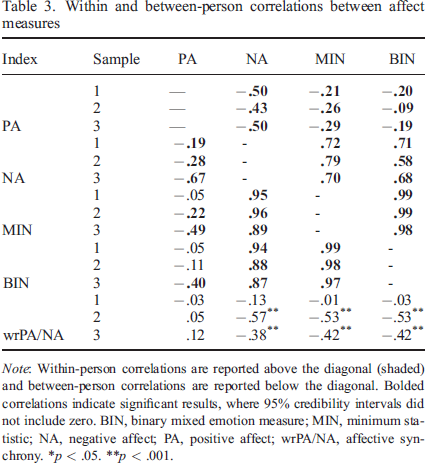
Note: Within–person correlations are reported above the diagonal (shaded) and between–person correlations are reported below the diagonal. Bolded correlations indicate significant results, where 95% credibility intervals did not include zero. BIN, binary mixed emotion measure; MIN, minimum statistic; NA, negative affect; PA, positive affect; wrPA/NA, affective synchrony.
p < .05.
p < .001.
Within–persons, mixed emotions as indexed by MIN and BIN were strongly positively associated with NA and were negatively associated with PA. MIN and BIN were very strongly negatively associated within–persons. Finally, PA and NA were moderately negatively associated within–persons.
Main analyses
Dynamic predictors of mixed emotions in daily life
Changes in positive and negative affects
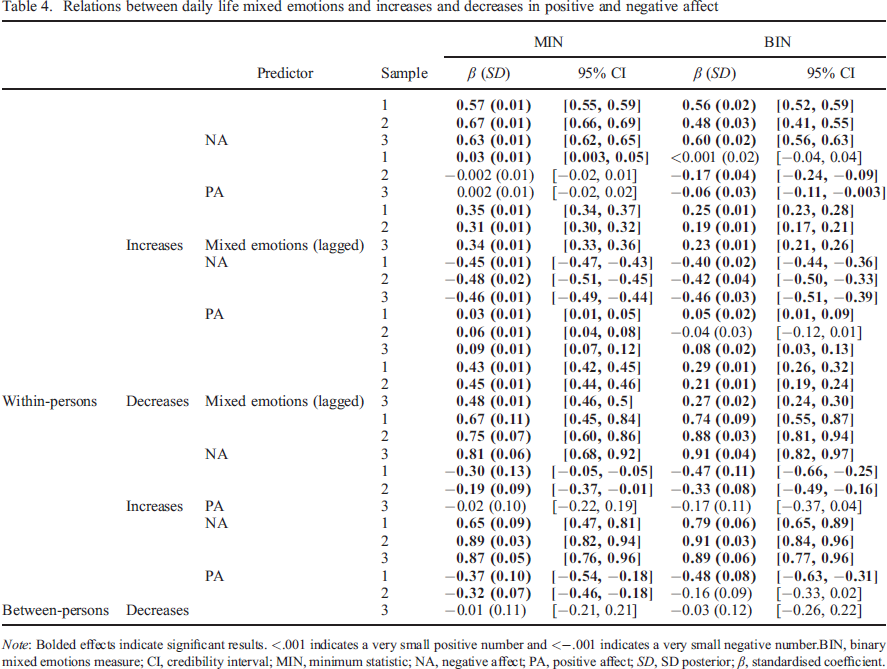
To test our hypothesis that increases in NA would be positively associated (and decreases in NA, negatively associated) with changes in mixed emotions over time in daily life (H1), we created separate variables coding for increases and decreases in NA and PA across successive ESM surveys. For example, NA increases refer to the absolute successive difference score (|NAt + 1 − NA t |) for ESM surveys on which NA had increased since the previous survey and are equal to zero for all ESM surveys on which NA had either decreased or not changed. We used absolute successive difference scores so that higher scores represented larger changes in NA or PA for both increases and decreases. 4 In order to investigate whether increases and decreases in NA and PA predicted changes in mixed emotions over time, we controlled for mixed emotions at the previous time point, t (i.e. lagged mixed emotions) in the within–person models. Results of the analyses testing H1 are shown in Table 4. These models included either increases or decreases in both PA and NA (entered as simultaneous predictors).
Relations between daily life mixed emotions and increases and decreases in positive and negative affect
Note: Bolded effects indicate significant results. <.001 indicates a very small positive number and <−.001 indicates a very small negative number.BIN, binary mixed emotions measure; CI, credibility interval; MIN, minimum statistic; NA, negative affect; PA, positive affect; SD, SD posterior; β, standardised coefficient.
At the within–person level, momentary increases in NA were strongly associated with increases in mixed emotions (for both MIN and BIN measures) from one ESM survey to the next in all samples. In contrast, momentary increases in PA were weakly positively related to MIN in just one of three samples and were, divergently, weakly negatively associated with BIN only in the other two samples. With regard to decreases in affect, decreases in NA were moderately associated with decreases in mixed emotions within–persons in all samples. Conversely, within–person decreases in PA were weakly associated with increases in mixed emotions in all samples (except for the binary measure of mixed emotions in sample 2).
In addition, we used z–tests to compare the effects of NA versus PA dynamics (increases or decreases) in predicting mixed emotions. These tests showed that, in terms of absolute magnitude, NA dynamics (i.e. increases and decreases) predicted mixed emotions more strongly than the within–person dynamics of PA (Table S1). Thus, for the average person, experiencing larger moment–to–moment increases in NA and, to a lesser extent, decreases in PA was associated with increases in mixed emotions. Conversely, momentary decreases in NA were associated with decreases in mixed emotions.
At the between–person level, there was a strong effect of NA increases and decreases on mixed emotions, such that individuals who reported larger average increases and decreases in NA tended to report higher average levels of mixed emotions for both MIN and BIN measures. In contrast, in samples 1 and 2, there was a moderate negative effect of PA increases and decreases on mixed emotions, such that individuals who reported smaller average changes in PA reported higher average levels of mixed emotions (however, this relation between PA decreases and BIN was not significant for sample 2).
In addition, a z–test comparing the absolute average magnitude of NA and PA increases (entered simultaneously as predictors of mixed emotions) demonstrated that NA increases were more strongly associated with mixed emotions than PA increases between–persons in all samples (Table S1). NA decreases were also significantly stronger predictors of mixed emotions than PA decreases between–persons. Thus, greater variability in NA and, to a lesser extent, lesser variability in PA were associated with experiencing more intense mixed emotions on average.
Positive and negative events
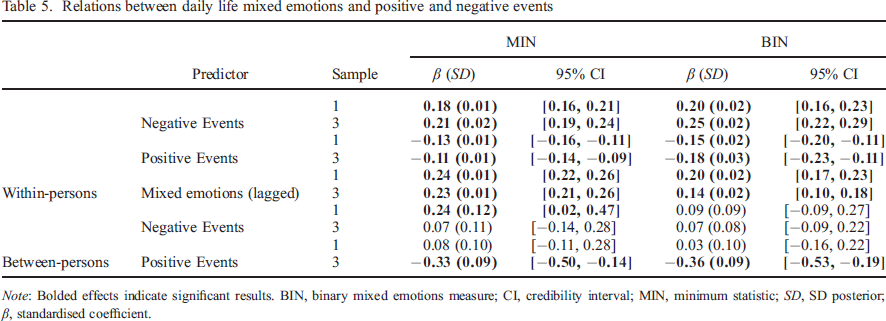
To test our second hypothesis, that negative events would be positively associated with changes in mixed emotions within–persons (H2), we regressed mixed emotions on positive and negative events simultaneously. We again included lagged mixed emotions (person–mean centred) in the within–person analyses to model change in mixed emotions over time. We also explored the between–person relations between mixed emotions and positive and negative events. Results of these analyses are reported in Table 5.
Relations between daily life mixed emotions and positive and negative events
Note: Bolded effects indicate significant results. BIN, binary mixed emotions measure; CI, credibility interval; MIN, minimum statistic; SD, SD posterior; β, standardised coefficient.
At the within–person level, the occurrence of a negative event since the previous time point weakly to moderately predicted increased mixed emotions, whereas the occurrence of positive events was a slightly less strong predictor of mixed emotions in the opposite direction. Z–tests comparing the absolute magnitude of the within–person effects of positive and negative events revealed that negative events were stronger predictors of within–person change in mixed emotions than positive events in both samples for both MIN and BIN measures (Table S1).
At the between–person level, the proportion of ESM surveys on which participants reported negative events was largely unassociated with their average levels of mixed emotions, whereas there was a moderate negative association between positive events and average levels of mixed emotions in one of two samples. Z–tests comparing the absolute magnitude of the between–person effects of positive and negative events showed no significant differences in effect sizes.
Personality predictors of mixed emotions in daily life
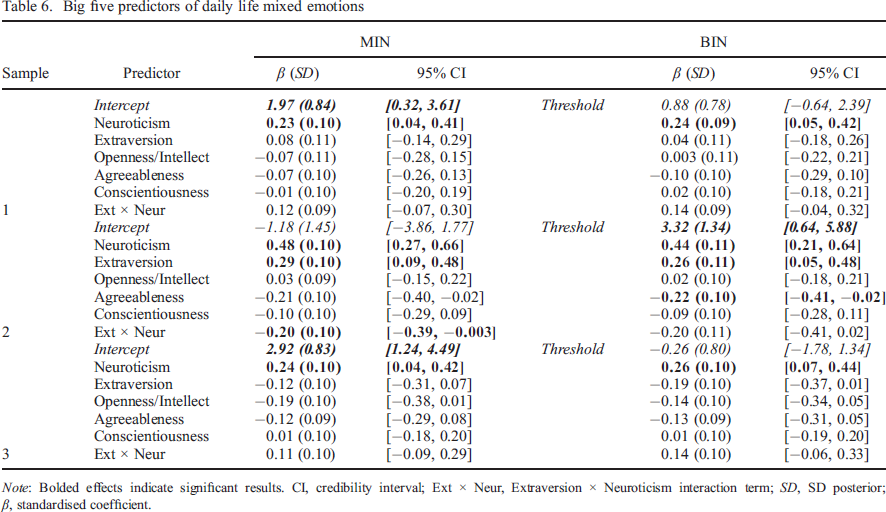
We then examined whether Neuroticism, the Extraversion × Neuroticism interaction, and/or Openness/Intellect were associated with average levels of mixed emotions in daily life using two–level random intercept models (H3, H5, and H6). For all models, at the between–person level, each of the Big Five traits, as well as the Extraversion × Neuroticism interaction, was entered as simultaneous predictors of the random intercept of mixed emotions. Results for these models are reported in Table 6.
Big five predictors of daily life mixed emotions
Note: Bolded effects indicate significant results. CI, credibility interval; Ext × Neur, Extraversion × Neuroticism interaction term; SD, SD posterior; β, standardised coefficient.
Neuroticism was a consistent, moderate, positive predictor of mixed emotions across all samples, such that more neurotic individuals tended to experience more mixed emotions, on average. In contrast, Openness/Intellect was not associated with mixed emotions in any sample, and Extraversion and the Extraversion × Neuroticism interaction was only associated with mixed emotions in sample 2. There was also an unexpected association between Agreeableness and the binary mixed emotions measure in sample 2. Due to the inconsistency of these findings across measures and samples, they are not discussed further.
Indirect effects of neuroticism on mixed emotions
Increases in negative affect
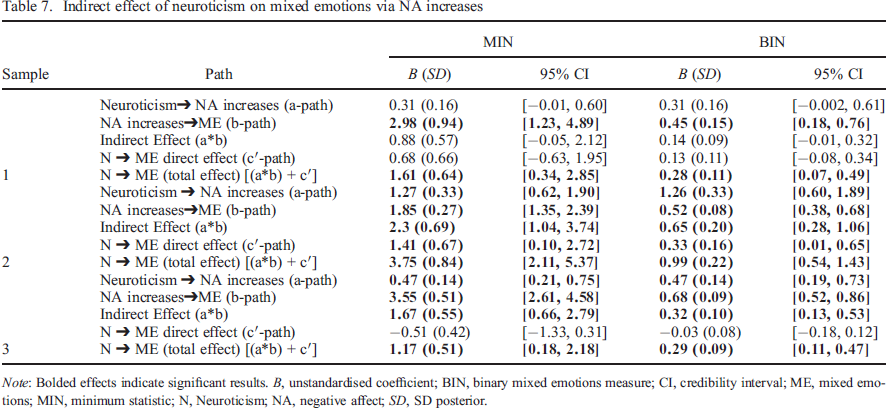
Having established that both Neuroticism and NA increases were positively associated with mixed emotions in all three samples, we then investigated whether the relation between Neuroticism and mixed emotions could be explained in terms of NA increases (H4a). In order to test this hypothesis, we ran a two–level random intercept model. At the between–person level, the effects of Neuroticism on NA increases (a–path), NA increases on mixed emotions (b–path), and Neuroticism on mixed emotions (direct c′–path) were simultaneously estimated. We then tested whether NA increases partly accounted for the relation between Neuroticism and mixed emotions by calculating the indirect effect of Neuroticism on mixed emotions via NA increases (calculated as the product of the a–path and the b–path). The total effect of Neuroticism on mixed emotions was also calculated by summing the indirect and direct effects. Results for these analyses are reported in Table 7. Unstandardised results are reported, as standardised results could not be calculated for the indirect effect. The indirect effect was significant in two out of three samples for both MIN and BIN measures of mixed emotions, providing some support for our prediction that greater average NA increases may (at least partly) explain the relation between Neuroticism and mixed emotions.
Indirect effect of neuroticism on mixed emotions via NA increases
Note: Bolded effects indicate significant results. B, unstandardised coefficient; BIN, binary mixed emotions measure; CI, credibility interval; ME, mixed emotions; MIN, minimum statistic; N, Neuroticism; NA, negative affect; SD, SD posterior.
Negative affect reactivity
Finally, given our finding that the occurrence of negative events was positively associated with mixed emotions, we investigated a second potential indirect pathway through which Neuroticism may be related to daily life mixed emotions—reactivity to negative events (H4b)—using a two–level random slope model. At the within–person level, reactivity was estimated by regressing NA on negative events, controlling for lagged NA (NAt − 1). This parameter was then allowed to vary randomly between participants at the between–person level. At the between–person level, reactivity slopes were regressed onto Neuroticism (a–path), 5 mixed emotions were regressed onto individual differences in reactivity slopes (b–path) and onto Neuroticism (c′–path) simultaneously. The between–person effects for the a–path and the b–path were then multiplied to estimate the indirect effect of Neuroticism on mixed emotions via NA reactivity. The total effect of Neuroticism on mixed emotions was also calculated by summing the indirect and direct effects. Results of these analyses are reported in Table 8. Unstandardised results are reported, as standardised results could not be calculated for the indirect effect. Neither of the indirect effects were statistically significant, suggesting that the relation between Neuroticism and mixed emotions could not be explained in terms of NA reactivity to negative events.
Indirect effects of neuroticism on mixed emotions via reactivity
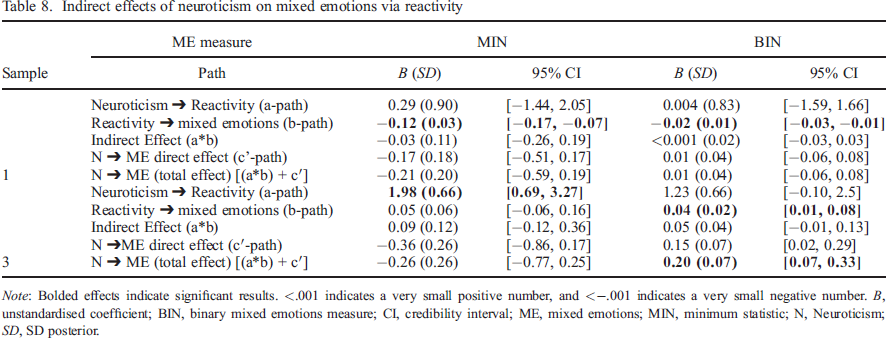
Note: Bolded effects indicate significant results. <.001 indicates a very small positive number, and <−.001 indicates a very small negative number. B, unstandardised coefficient; BIN, binary mixed emotions measure; CI, credibility interval; ME, mixed emotions; MIN, minimum statistic; N, Neuroticism; SD, SD posterior.
Exploratory analyses
Moderators of the predictors of mixed emotions
The aforementioned analyses suggest that, for the average person, NA increases and, to a lesser degree, PA decreases are associated with increases in mixed emotions over time. However, it is possible that these within–person assocations are stronger for some individuals compared with others. We ran a series of two–level random slopes models testing whether our focal Big Five traits (i.e. Neuroticism, Extraversion, or Openness/Intellect) predicted variation in these within–person slopes. Within–person relations between mixed emotions and NA and PA increases or decreases were estimated (controlling for person–mean centred lagged mixed emotions), and these random slopes were regressed on the three trait predictors at the between–person level. None of the results of these analyses were consistent across all samples and measures (Table S2). For example, individuals higher in Neuroticism had weaker relations between NA increases and changes in mixed emotions in sample 3, whereas this appeared in sample 2 only for the MIN measure of mixed emotions and did not appear in sample 1 at all.
Affective synchrony
Finally, we explored predictors of affective synchrony using multiple regression. All analyses were conducted at the between–person level given that PA–NA correlations were calculated across all ESM occasions for each individual and therefore did not vary within–persons. Results are presented in Tables 9 and 10. First, NA and PA increases or decreases (calculated as described earlier) were entered simultaneously as predictors of affective synchrony. Average magnitude of increases (except in sample 1) and decreases in NA negatively predicted affective synchrony. This indicates that individuals with greater NA variability have stronger negative within–person relations between PA and NA. Average PA increases and decreases were unrelated to affective synchrony. Second, positive and negative events were entered as simultaneous predictors. There were no significant relations between events and affective synchrony. Finally, the Big Five traits and the Extraversion × Neuroticism interaction were entered simultaneously as predictors of affective synchrony. Neuroticism was a significant predictor in two of three samples, indicating that individuals higher in trait Neuroticism had stronger negative correlations between their momentary levels of PA and NA.
Relations between affective synchrony and increases and decreases in positive and negative affect and positive and negative events
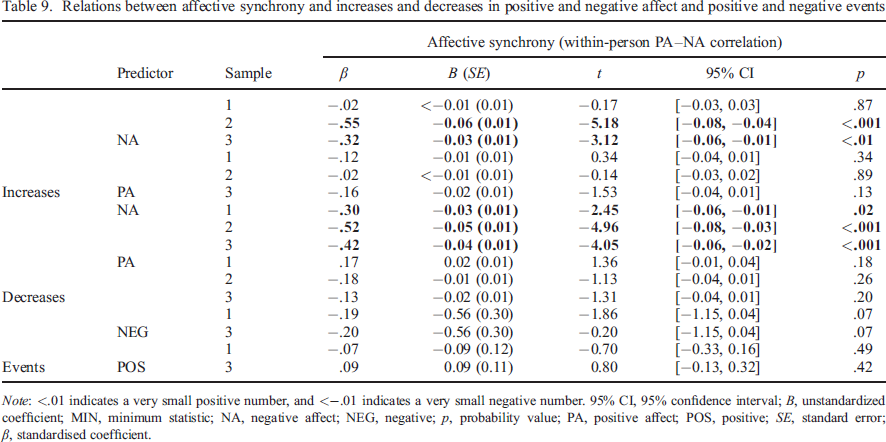
Note: <.01 indicates a very small positive number, and <−.01 indicates a very small negative number. 95% CI, 95% confidence interval; B, unstandardized coefficient; MIN, minimum statistic; NA, negative affect; NEG, negative; p, probability value; PA, positive affect; POS, positive; SE, standard error; β, standardised coefficient.
Big five predictors of affective synchrony
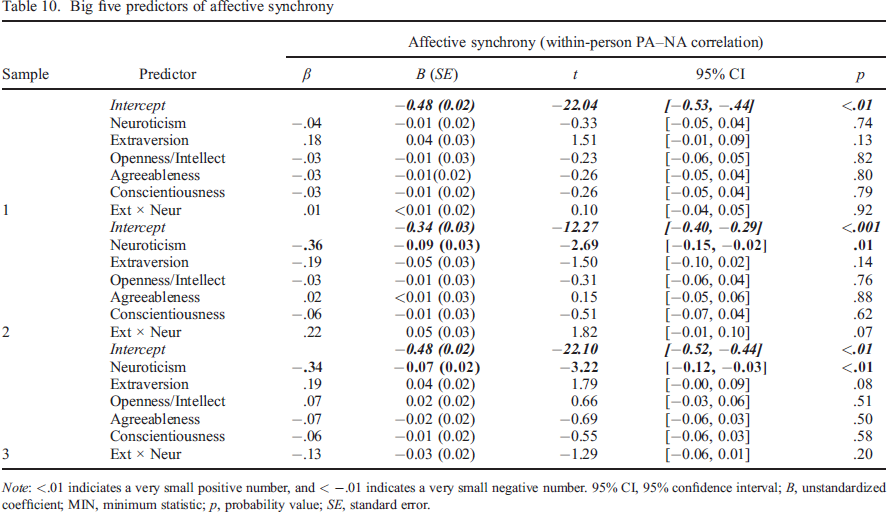
Note: <.01 indiciates a very small positive number, and < −.01 indicates a very small negative number. 95% CI, 95% confidence interval; B, unstandardized coefficient; MIN, minimum statistic; p, probability value; SE, standard error.
Discussion
In the present study, we examined dynamic predictors of variation in mixed emotions over time in daily life, as well as personality predictors of individual differences in everyday mixed emotions. We proposed that mixed emotions in daily life might typically track rises in NA against a steady background of more intense PA (Figure 1C). Indeed, as described below, results were largely consistent with this pattern suggesting that mixed emotions may most typically occur when NA rises against a relatively steady background of PA. In addition, some of our findings seem more consistent with the pattern in Figure 1B, which depicts mixed emotions arising from simultaneous decreases in PA and increases in NA. Importantly, our results fit least well with the pattern presented Figure 1A, suggesting that mixed emotions in daily life do not commonly occur as a result of simultaneous increases in PA and NA.
Affective dynamics of mixed emotions in daily life
Changes in NA and PA were related to changes in mixed emotions within–persons in a way largely consistent with Figure 1C, which depicts daily life mixed emotions occurring when NA rises against a steady background of more intense PA over time. As predicted, NA increases were strongly and consistently associated with increases in mixed emotions, whereas PA increases were largely unrelated or inconsistently related to mixed emotions. Also as predicted, within–person changes in NA intensity (both increases and decreases) were more strongly associated with mixed emotions than changes in PA intensity.
In addition, some within–person findings seem more consistent with the pattern in Figure 1B, which depicts mixed emotions arising from simultaneous decreases in PA and increases in NA. Specifically, we found that PA decreases were weakly positively related to mixed emotions at the within–person level. Given that momentary experiences of PA and NA tend to be moderately inversely correlated within–persons (Dejonckheere et al., 2018), rises in NA may tend to be accompanied by (at least slight) decreases in PA, resulting in a weaker (albeit statistically significant) positive association between PA decreases and mixed emotions within–persons. However, in order for mixed emotions to occur, PA must not be eliminated when NA increases. The fact that concurrent experiences of PA and NA comprise ∼11–34% of the emotion reports in our data, and even higher percentages in other studies (e.g. Scott et al., 2014), suggests that this is often the case—contrary to what has been suggested elsewhere in the literature (Russell & Carroll, 1999). It is also possible that the slight negative relation between PA increases and mixed emotions reflects that mixed emotions do not tend to occur at high intensities. For instance, PA and NA were only both above their scale midpoints for 2–9% of mixed emotional episodes across our three samples.
Further, supplementary analyses showed that, when only NA increases and PA decreases were entered as predictors of mixed emotions, NA increases were positively associated with mixed emotions, and PA decreases were negatively associated with mixed emotion at both the within–person and between–person levels (see Supporting Information at https://osf.io/2ve9h/?view_only=67a0cfeb793243f9888ecd2f12afe89e). Thus, larger increases in NA and smaller decreases in PA corresponded with increased mixed emotions. This is again more consistent with Figure 1C, where stable PA is associated with mixed emotions, rather Figure 1B, where PA decreases are associated with mixed emotions.
Taken together, the within–person findings suggest that mixed emotions in daily life appear to correspond with momentary upsurges in NA and, perhaps to a lesser extent, also by momentary reductions in PA. This suggests that mixed emotions may most typically occur when NA rises against a relatively steady background of PA, which either remains constant or decreases only slightly.
Between–person findings
Finally, our findings at the within–person level were reinforced by similar findings at the between–person level: individuals with greater variability in NA (i.e. larger increases and decreases in NA) and greater stability in PA (i.e. smaller increases and decreases in PA) tended to experience more mixed emotions, on average. We note, however, that the between–person relation between PA decreases and mixed emotions was somewhat inconsistent across samples. Nevertheless, these findings were broadly consistent with our proposal that mixed emotions in daily life may be driven by fluctuating NA levels against a backdrop of fairly stable PA, as portrayed in Figure 1C.
Positive and negative events
Our findings that positive and negative events were associated with subsequent changes in mixed emotions are also consistent with our hypothesised account of mixed emotions in daily life. Specifically, mixed emotions increased following the occurrence of negative events and decreased following the occurrence of positive events. This may suggest that, in daily life, encountering positive events often elicits purely positive emotional responses, whereas negative events may often increase NA without completely eliminating PA. These findings are congruent with previous findings showing that mixed emotions are more common during negative than positive experiences (Hui et al., 2009; Hunter et al., 2008) and that the occurrence of stressors increases the probability of mixed emotions four–fold (Scott et al., 2014). Surprisingly, however, these findings did not translate to the between–person level: negative events were not associated with mixed emotions at the between–person level, and positive events were negatively associated with mixed emotions between–persons in only one of two samples. Therefore, the individual differences in NA variability that predict average levels of mixed emotions may not reflect variability tied to the experience of more negative events. Instead, they may reflect a tendency to experience greater variability in non–event related negative affect (i.e. negative mood) in daily life.
Personality traits
Given the close links between changes in NA and mixed emotions, it is unsurprising that Neuroticism—the trait most strongly associated with the experience of NA (e.g. Larsen & Ketelaar, 1991; Rusting & Larsen, 1997; Verduyn & Brans, 2012)—was most consistently associated with mixed emotions in the current study. This relationship appears to be robust across different measures of mixed emotions, as it aligns with findings by Barford and Smillie (2016) using a dispositional measure of mixed emotions. We also extended this finding, demonstrating that the tendency for individuals higher in Neuroticism to experience more mixed emotions seems to be partly explained by their tendency to experience more frequent and intense increases in NA in daily life.
The finding that NA increases, but not NA reactivity to negative events, partly accounted for the relation between Neuroticism and mixed emotions is also consistent with our findings that experiencing a higher proportion of negative events in daily life does not predict mixed emotions at the between–person level. Thus, the increases in NA that link Neuroticism with mixed emotions are not necessarily tied to negative events but may rather reflect a more general tendency to experience increases in NA. This lack of event–contingency may reflect that Neuroticism is associated with rumination (Muris, Roelofs, Rassin, Franken, & Mayer, 2005) and emotional inertia (Koval, Sütterlin, & Kuppens, 2016; Suls et al., 1998), such that individuals high on this trait continue to experience negative affect even when they are not in an especially negative situation. The finding that average NA increases partly explain the relation between Neuroticism and mixed emotions may also reflect that mixed emotions and NA may be difficult to disentangle in daily life (discussed further below).
Contrary to expectations, we found only weak evidence to suggest that Extraversion may moderate the relation between Neuroticism and mixed emotions. A statistically significant interaction between these traits emerged in only one of our three samples. We also found no reliable relation between Openness/Intellect and mixed emotions in this study. This finding diverges from the results of the Kööts et al. (2012) study, where Openness/Intellect was positively associated with mixed happy and sad emotions in a daily life ESM study. These divergent findings may be due to methodological differences, including the use of more reliable measures of Openness/Intellect by Kööts and colleagues. Alternatively, the fact that we failed to replicate the relation between Openness/Intellect and mixed emotions in daily life across three samples may indicate that this association is not robust or reliable.
Previous findings suggesting a relation between Openness/Intellect and mixed emotions may be owing to the use of stimuli or contexts that are rarely encountered in daily life settings. For example, Openness/Intellect has been associated with the tendency to make more mixed–valenced cognitive evaluations (i.e. mixed appraisals) of complex visual artworks (e.g. simultaneously ‘beautiful’ yet ‘disgusting’; Barford et al., 2018). Although this tendency to make more mixed appraisals may lead to mixed emotions (as proposed by Shuman et al., 2013), strongly mixed–valenced eliciting stimuli are unlikely to be commonplace in daily life. Individuals high on Openness/Intellect may report more frequent mixed emotions on retrospective measures (Barford & Smillie, 2016) due to recall biases, whereby individuals more easily recall relatively rare, yet salient or intense emotional experiences (Conner & Barrett, 2012). Indeed, it seems plausible that individuals high in Openness/Intellect would be particularly likely to savour and recall mixed emotional experiences arising in affectively complex situations, given their general preference for complexity and tolerance of ambiguity (Fayn, Silvia, Dejonckheere, Verdonck, & Kuppens, 2019; Jach & Smillie, 2019). Further work is therefore needed to clarify the possible links between Openness/Intellect and mixed emotions, particularly in contexts where strong mixed–valenced stimuli are present.
Trait moderators of the dynamics of mixed emotions
Our results demonstrate that moment–to–moment increases in NA are associated with increases in mixed emotions and that individuals higher in Neuroticism experience more mixed emotions partly because they tend to experience greater increases in NA on average. However, exploratory analyses provided no evidence that the relation between NA increases and mixed emotions is stronger for more neurotic individuals. Indeed, there was some (albeit inconsistent) evidence that those higher in Neuroticism have weaker within–person associations between NA increases and mixed emotions relative to individuals low in Neuroticism. In addition, we found some (albeit inconsistent) evidence that more neurotic individuals may have stronger within–person relations between increases in PA and mixed emotions. Rises in NA may be less critical to the formation of mixed emotions than rises in PA for more neurotic individuals simply because they already tend to feel more negative than their less neurotic counterparts. Furthermore, if NA tends more often to be the higher intensity emotion among more neurotic individuals, changes in PA may then more strongly predict mixed emotions—in contrast to the average individual. These speculations are offered cautiously, given that they are based on somewhat inconsistent findings from an exploratory analysis. Nevertheless, they hint at potentially fruitful avenues for further understanding individual differences in affective dynamics of mixed emotions.
Affective synchrony
We also explored the between–person predictors of affective synchrony (aka affective bipolarity), computed as the within–person correlation between PA and NA. Although this is distinct from mixed emotions (Larsen et al., 2017), it is was of interest to examine in this context as a further index of the interplay of positive and negative emotions. Results demonstrated that higher NA variability and trait Neuroticism were predictors of negative within–person associations between PA and NA in two of three samples. It is possible that these findings did not appear in sample 1 owing to the slightly higher average intensity of negative emotion and lower average intensity of positive emotion (possibly in part due to slightly different PA and NA items included in sample 1) in this sample, compared with the other two samples.
These findings suggest that same predictors that positively predict incidences of mixed emotions are negatively associated with affective synchrony. This potentially suggests that individuals high on Neuroticism and NA variability experience mixed emotions in a pattern similar to Figure 1B, such that as NA increases, PA decreases but is not eliminated. However, it might also reflect that for individuals low in Neuroticism, who experience little NA and little NA variability, PA and NA are largely uncorrelated. In this case, a more positive correlation between PA and NA would not necessarily reflect that they vary independently or co–occur often; rather, it would reflect that one affect is absent the majority of the time. Our results are thus in line with the suggestion of Larsen et al. (2017) that more positive within–person correlations between PA and NA do not index mixed emotions. Nevertheless, similar to our measures of mixed emotions, affective synchrony appears to largely reflect the dynamics of NA (i.e. NA variability) rather than PA within ESM studies.
Disentangling mixed emotions from negative affect (and vice versa)
An important implication of the overall pattern of findings in this study is that it may often be challenging to tease apart NA and mixed emotions in daily life. As shown here and elsewhere (e.g. Scott et al., 2014), negatively valenced experiences are often accompanied by a non–zero level of PA in daily life. Therefore, researchers studying NA in daily life may need to consider that negative feelings may only rarely be experienced in the absence of positive affect in ordinary daily life contexts. In turn, researchers investigating mixed emotions should consider the possibility that mixed emotions might often be difficult to dissociate from NA. This is perhaps especially the case if mixed emotions are defined using a relatively low cut–off for overlapping positive and negative valence (e.g. see row 1 of Table 2).
Mixed emotions are predominately operationalised in the present literature by the MIN statistic (Larsen et al., 2017; Schimmack, 2001), which is equivalent to the lesser intensity affect (typically NA) or binary cut–offs derived from the MIN. Indeed, these have been used in several daily life studies to quantify mixed emotions (Kööts et al., 2012; Riediger et al., 2009; Riediger et al., 2014; Schneider & Stone, 2015; Scott et al., 2014; Trampe et al., 2015; Watson & Stanton, 2017). We have now demonstrated that in daily life studies, this operationalisation of mixed emotions largely reflects changes in NA. Of course, it is important to note that the MIN statistic may be less closely tied to NA in experiments that expose participants to mixed–valenced stimuli that might be more likely to trigger simultaneous increases in PA and NA. Indeed, mixed emotions experienced in daily life may be qualitatively different from those that have been elicited in the lab. This poses a challenge both to the ecological validity of previous experimental studies of mixed emotions, and to the measurement of mixed emotions, distinct from NA, in daily life. On this latter point, the development of measures that operationalise mixed emotions beyond the intensity of the lesser of two affective states would be of value in future research. Our mixed statistic measure, utilised in supplementary materials, provides a first step in this direction (see also Loossens et al., 2019).
Limitations and future directions
A number of limitations of the present study arose from our use of archival samples, limiting our ability to tailor data collection to our research questions. This precluded the addition of measures that would have helped to further probe our research questions (e.g. appraisals of ambivalent or mixed–valence stimuli or events). In samples 1 and 3, we were also limited to the Ten Item Personality Inventory as a measure of the Big Five, which typically has low reliability and brings a risk of spurious observations (Credé, Harms, Niehorster, & Gaye–Valentine, 2012). Fortunately, relations between the Big Five traits and mixed emotions using this shorter scale were fairly consistent with sample 2, which used a longer, more reliable measure of the Big Five. On the other hand, the statistically significant finding for the interaction between Extraversion and Neuroticism emerged in sample 2 only, and it seems possible that this interaction may not have replicated in samples 1 and 3 due to the lower reliability of the TIPI. Divergent findings for sample 2, including the lower prevalence of mixed emotions, higher prevalence of purely positive emotions, and the broader array of associated traits might also be a product of this studies longer sampling period (2 weeks vs 1 week for samples 1 and 3).
In addition, our measurement of positive and negative events could be improved in future studies. Only two of our three samples included these measures, and in one of these participants could only report that a positive or a negative event, not both, had occurred since the previous survey. Participants also did not report on the valence of the situation they were in at the time of the emotion survey. Future studies could use more detailed measures, such as the DIAMONDS situation assessment (Rauthmann, Sherman, & Funder, 2015), to assess the valence of situations and events. In addition, future studies should investigate whether our findings can be reproduced using different operationalisatons of mixed emotions, for example, when using discrete emotion pairs (e.g. happiness and sadness) rather than positive and negative affect composites. Indeed, Kööts et al. (2012) found slightly different personality predictors of mixed emotions using this operationalisation.
It is also important to consider the limitations of ESM methodology. As is standard practice in analyses of ESM data, our within–person (lagged) analyses assume equally spaced intervals between successive ESM surveys, which may result in biased parameter estimates when intervals vary randomly (de Haan–Rietdijk, Völkle, Keijsers, & Hamaker, 2017). Future studies may therefore benefit from adopting newly developed continuous time modelling approaches (e.g. Driver, Oud, & Völkle, 2017). The nature of ESM also precludes us from drawing conclusions about emotional changes in between sample periods, and the exact simultaneity of positive and negative emotions could be called into question despite responding to the items in rapid succession. It is also difficult to draw conclusions about who is more susceptible to experiencing mixed emotions from daily life studies, as eliciting stimuli cannot be held constant across participants.
We also acknowledge that our findings and their implications may not generalise to other populations. All three samples comprised university students from western cultures. Results may therefore not generalise to people of different age groups or cultures, which have also been shown to differ in their experiences of mixed emotions (e.g. Miyamoto, Uchida, & Ellsworth, 2010; Riediger et al., 2009). Finally, an interesting direction for future research on mixed emotions would be to examine their potential consequences. For example, this research could elaborate upon the burgeoning literature about the relationship between mixed emotions and wellbeing (Berrios et al., 2018).
Conclusions
Across three samples, we showed that mixed emotions in daily life typically correspond with the occurrence of negative events, increases in NA, and to a lesser extent, decreases in PA. Individual differences in Neuroticism, NA variability, and PA stability were positively associated with the tendency to experience mixed emotions on average. Further, we demonstrated that the positive relation between Neuroticism and mixed emotions was partly accounted for by the tendency to experience larger increases in NA on average. NA variability and Neuroticism also tended to predict more negative within–person correlations between PA and NA. Contrary to the intuition that mixed emotions emerge from joint increases in PA and NA, these findings align with our reasoning that mixed emotions in daily life may arise when negative feelings increase against a sustained, or only moderately decreasing, background of positive feelings. Our findings provide new insight into how and when mixed emotions in daily life occur, who tends to experience them, and why.
Supporting Information
Supporting Information, per2264-sup-0001-Data_S1 - When Good Feelings Turn Mixed: Affective Dynamics and Big Five Trait Predictors of Mixed Emotions in Daily Life
Supporting Information, per2264-sup-0001-Data_S1 for When Good Feelings Turn Mixed: Affective Dynamics and Big Five Trait Predictors of Mixed Emotions in Daily Life by Barford Kate A., Koval Peter, Kuppens Peter and Smillie Luke D. in European Journal of Personality
Table S1: Tests of differences in effect sizes
Table S2: Big Five Moderators of the within-person relations between changes in PA and NA and changes in mixed emotions
Table S3: Descriptive statistics for the mixed statistic (MIX)
Table S4: Relations between MIX and increases and decreases in positive and negative affect
Table S5: Relations between MIX and positive and negative events
Table S6: Big Five predictors of daily life mixed emotions
Table S7: Relations between daily life mixed emotions and increases in negative affect and decreases in positive affect
Open Practices Disclosure Form
Open Practices Disclosure Form, per2264-sup-0002-Open_Practices_Disclosure_Form - When Good Feelings Turn Mixed: Affective Dynamics and Big Five Trait Predictors of Mixed Emotions in Daily Life
Open Practices Disclosure Form, per2264-sup-0002-Open_Practices_Disclosure_Form for When Good Feelings Turn Mixed: Affective Dynamics and Big Five Trait Predictors of Mixed Emotions in Daily Life by Barford Kate A., Koval Peter, Kuppens Peter and Smillie Luke D. in European Journal of Personality
Footnotes
Supporting Information
Additional supporting information may be found online in the Supporting Information section at the end of the article.
Acknowledgement
This research was partly supported by a grant from the Australian Research Council (DP160102252) awarded to P. Koval and P. Kuppens.
Notes
References
Supplementary Material
Please find the following supplemental material available below.
For Open Access articles published under a Creative Commons License, all supplemental material carries the same license as the article it is associated with.
For non-Open Access articles published, all supplemental material carries a non-exclusive license, and permission requests for re-use of supplemental material or any part of supplemental material shall be sent directly to the copyright owner as specified in the copyright notice associated with the article.
