







Abstract
Why are open people open? A recent theory suggests that openness/intellect reflects sensitivity to the reward value of information, but so far, this has undergone few direct tests. To assess preferences for information, we constructed a novel task, adapted from information‐seeking paradigms within decision science, in which participants could choose to see information related to a guessing game they had just completed. Across two studies (one exploratory, n = 151; one confirmatory, n = 301), openness/intellect did not predict information seeking. Our results thus do not support a straightforward version of the theory, whereby open individuals display a general‐purpose sensitivity to any sort of new information. However, trait curiosity (arguably a facet of openness/intellect) predicted information seeking in both studies, and uncertainty intolerance (inversely related to openness/intellect) predicted information seeking in Study 2. Thus, it is possible that the domain‐level null association masks two divergent information‐seeking pathways: one approach motivated (curiosity) and one avoidance motivated (uncertainty intolerance). It remains to be seen whether these conflicting motivations can be isolated and if doing so reveals any association between information‐seeking and the broader openness/intellect domain.
Keywords
Introduction
Openness/intellect describes individual differences in the breadth, complexity, and depth of one's imagination and experience (John & Srivastava, 1999; Schwaba, 2019). High scorers on openness/intellect tend to be curious about the world (e.g., Kashdan et al., 2009; Kashdan et al., 2018; Kashdan, Rose, & Fincham, 2004; McCrae & Costa, 1997), creative (McCrae, 1987), artistic (Kaufman et al., 2016), intellectual (Mussel, 2013), and intelligent (DeYoung, Quilty, Peterson, & Gray, 2014; Kretzschmar, Spengler, Schubert, Steinmayr, & Ziegler, 2018). Two decades ago, McCrae and Costa (1997) observed that openness/intellect is the ‘least researched and least understood of the five fundamental dimensions of personality’ (p. 840). Since that time, there has been substantial research investigating how openness/intellect relates to attitudes and behaviours (e.g. Belke, Leder, Strobach, & Carbon, 2010; Gosling, Ko, Mannarelli, & Morris, 2002; Jost, Glaser, Kruglanski, & Sulloway, 2003; Kraaykamp & Van Eijck, 2005; Rentfrow & Gosling, 2003), cognitive processes and abilities (Antinori, Carter, & Smillie, 2017; Silvia, Nusbaum, Berg, Martin, & O’Connor, 2009), and neural indices (Beaty et al., 2016; DeYoung, Peterson, & Higgins, 2005). Further, there is a growing theoretical base concerning potential cognitive and biological processes underlying this trait (e.g. DeYoung, 2013; DeYoung, Grazioplene, & Peterson, 2012; Kaufman et al., 2016; Mussel, 2013; Denissen & Penke, 2008; Ziegler, Schroeter, Lüdtke, & Roemer, 2018). To our knowledge, however, none of these theories has yet been subjected to an explicit confirmatory test.
In the present research, we evaluate the evidence for one such theory that we term the information‐seeking theory of openness/intellect. According to this theory, openness/ intellect is grounded in greater sensitivity to the reward value of information, and thus open individuals should be more motivated to seek information (DeYoung, 2013, 2015a, 2015b). Information can be operationally defined simply as something you did not already know. This aligns with dictionary definitions of information as knowledge obtained (e.g. Merriam‐Webster online dictionary) and is consistent with an abstracted version of some definitions within information theory (Shannon, 1948). Additionally, it orients information to reflect the individual's internal model of the world, rather than any external stimuli/object. For example, a book is not inherently informative; rather, a reader gains information if they are unfamiliar with the contents.
We first describe the information‐seeking theory of openness/intellect and the indirect existing evidence supporting it. Next, we review paradigms used in decision science to assess information‐seeking preferences in a carefully controlled manner. We then discuss the small body of research that has explored individual differences using these paradigms, identifying factors that may have influenced results from these studies. We then provide two empirical tests of the theory, the first exploratory and the second confirmatory.
The information‐seeking theory of openness/intellect: Summary and current evidence
The information‐seeking theory of openness/intellect is one part of an overarching neurobiological theory of exploratory behaviour proposed by DeYoung (2013). According to this theory, the neurotransmitter dopamine mediates reinforcement sensitivity, and potentiates approach behaviour, to both rewards and information. DeYoung suggests that, just as the motivational value of rewards partially drives individual differences in extraversion (Depue & Collins, 1999; Pickering & Gray, 2001; Rammsayer, 1998), the motivational value of information partially drives individual differences in openness/intellect. This would mean that individuals scoring higher on openness/intellect should be (i) more sensitive to the reward value of information and (ii) more motivated to seek out information.
What evidence supports the information‐seeking theory of openness/intellect? One might argue that clear evidence already exists: after all, people higher in openness/intellect undertake more years of formal education, visit art galleries more frequently, and consume and own a greater volume and variety of books, music, film, and other artefacts of culture (Chamorro‐Premuzic, Reimers, Hsu, & Ahmetoglu, 2011; Gosling et al., 2002; Trapp & Ziegler, 2019; Van Eijck & de Graaf, 2004). However, these observations are simply part of our descriptions of what it means to be open: most openness/intellect scales include items that refer directly to such behaviours and interests (e.g. is fascinated by art, music, or literature; Soto & John, 2017). In contrast, we are seeking an explanation for these descriptions—to identify what makes open people open. It is circular to treat books, plays, and culture as examples of information seeking and then conclude that information seeking does indeed underpin openness/intellect. Moreover, people may seek out these stimuli for reasons that have little to do with the reward value of information. For instance, one may visit galleries to signal status or sophistication to others or collect cultural artefacts as a financial investment. To effectively test the information‐seeking theory of openness/intellect, we must use stimuli that are not inherently attractive to people higher in openness/intellect, and that are not useful to achieve goals beyond information gains.
A second argument linking openness/intellect to information seeking is the connection to curiosity and related traits (e.g. interest and need for cognition). Curiosity can be defined as the motivation to pursue what is new, unknown, and/or complex and is sometimes conceptualized in terms of the drive to gain information or fill an ‘information gap’ (Lowenstein, 1994). Curiosity is strongly correlated with openness/intellect (e.g. Kashdan et al., 2004; Kashdan et al., 2009; Kashdan et al., 2018) and has been conceptualized as a narrower trait within the broader openness/intellect domain (McCrae & Costa, 1997; Woo et al., 2014). It is possible that if openness/intellect does relate to information seeking, it could do so via higher interest and curiosity to engage with stimuli.
Several studies have examined relations between state curiosity and information seeking, finding that when participants report being more curious about particular trivia questions, they are more willing to pay time or money to learn the answer (Gruber, Gelman, & Ranganath, 2014; Kang et al., 2009; Ligneul, Mermillod, & Morisseau, 2018; Marvin & Shohamy, 2016). As state curiosity is experienced more frequently and intensely by people higher in trait curiosity (Kashdan & Steger, 2007), this provides tentative, but indirect, encouragement for DeYoung's (2013) theory. Conversely, other studies have administered trait measures alongside information seeking, but these studies did not include a decision to seek information. For example, Lydon‐ Staley, Zhou, Blevins, Zurn, and Bassett (2019) asked participants to explore Wikipedia for 21 days and found that different facets of curiosity mapped onto different information‐seeking strategies. Although these findings may reveal how people seek information, they do not directly address whether curious people are more likely to read Wikipedia articles in the first place. Another study measured experiences of interest in daily life, presumably across many situations in which information gain was possible (Ziegler et al., 2018). Although most interests were those we already know are attractive to individuals higher in openness/ intellect (e.g. artistic interests), both state and trait openness/intellect predicted one item describing broad exploratory interests. Again, this finding provides only indirect encouragement for the information‐seeking theory of openness/intellect, as exploratory intentions, not exploratory behaviour, were assessed. One final study assessed four information‐seeking paradigms in which participants browsed a website, studied trivia facts, and read articles (von Stumm, 2018). However, this study was focused on how openness/intellect relates to knowledge acquisition, not information‐seeking preferences. Thus, although the study showed that openness/intellect predicted knowledge attainment in all four studies, it could not provide any evidence that open people were more motivated to seek information. Further, in all but the first study, the experimenter explicitly instructed participants to seek information, rather than measuring natural exploratory behaviour; and in the final two studies, participants were incentivised for high performance. The first study allowed participants to seek information at their leisure, but the information concerned beautiful lakes, a topic that high‐open individuals would likely be attracted to. Further, the author did not report whether the time spent freely viewing the site correlated with openness/intellect.
In summary, although previous research seems broadly consistent with the information‐seeking theory, there does not seem to be any direct test of the prediction that people higher in openness/intellect are more willing to seek information in and of itself. What is required is a study assessing how openness/intellect—and connected traits such as curiosity—relate to information seeking within a paradigm that (i) unambiguously assesses the decision to seek information and (ii) uses stimuli other than those people high in openness/intellect tend to prefer. We now introduce methods developed in decision science that may help to achieve this goal.
Information seeking in decision science
Information seeking has been extensively investigated by researchers within decision science and cognitive neuroscience (e.g. Bennett, Bode, Brydevall, Warren, & Murawski, 2016; Bennett, Sutcliffe, Tan, Smillie, & Bode, 2019; Blanchard, Hayden, & Bromberg‐Martin, 2015; Bromberg‐Martin & Hikosaka, 2009; Brydevall, Bennett, Murawski, & Bode, 2018; Charpentier, Bromberg‐Martin, & Sharot, 2018; Kobayashi, Ravaioli, Baranès, Woodford, & Gottlieb, 2019). These researchers directly assess the decision to seek information with tasks where participants must make a choice to view information. Further, these studies only assess the preference for non‐instrumental information; that is, information that provides no increased likelihood of receiving an extrinsic reward (such as money or food) that could confound apparent preferences for information. Additionally, the information used in this research typically bears no resemblance to art, poetry, or other cultural stimuli that are referenced within measures of openness/intellect, thus avoiding any methodological circularity in our measures. Finally, information seeking is typically assessed over tens or even hundreds of trials, which helps to minimise measurement error. Therefore, these tasks could be effective to test the information‐seeking theory of openness/intellect.
One such task involves an array of cards in which the majority colour among a set of five cards (coloured black vs. red) determines the outcome of each trial (e.g. gain vs. no gain or loss vs. no loss; Bennett et al., 2016). Participants choose to see either an informative set of cards (i.e. the set on which the trial outcome will actually be based) or an uninformative set of cards (i.e. a random selection of black and red cards that has no relation to the trial outcome). On some trials, participants must pay a small proportion of their winnings to see this advance information. No matter their choice, participants learn if they win or lose after the trial ends, making the informative cards economically non‐instrumental. Despite this, participants show reliable preferences for information in this task, and there are robust individual differences in the willingness to pay to see the information (Bennett et al., 2016; Bennett et al., 2019; Brydevall et al., 2018).
Interestingly, the information‐seeking theory of openness/intellect was partly inspired by an animal analogue of this very task (see DeYoung, 2013, pp. 4‐5). Specifically, Bromberg‐Martin and Hikosaka (2009) found that primates will sacrifice primary rewards (food and juice) to learn the outcome of a gamble in advance (see also Blanchard et al., 2015). These researchers found that non‐instrumental information elicits release of dopamine within the brain reward system, in a similar manner to primary rewards, suggesting that information has a reward value. DeYoung grounded his conception of information rewards, to which individuals high in openness/intellect are putatively more sensitive, in these studies. Thus, if openness/intellect predicts seeking even this form of information—devoid of any aesthetic or intellectual content—this would be consistent with the existence of a general‐purpose sensitivity to the reward value of information. This would provide strong evidence in favour of the information‐seeking theory.
To date, three studies have directly assessed the Big 5 personality correlates of non‐instrumental information seeking using this task (Smillie, 2019, Studies 1 and 2; and Bennett et al., 2019, which used the same data set as Study 1 from Smillie, 2019). In these studies, participants were overwhelmingly likely to choose information when it was free, and individual differences emerged when participants were required to pay some small amount of money to see the informative set. However, in both studies (N = 139 and N = 163, respectively), correlations between openness/intellect and information seeking were non‐significant and near zero (Study 1 r = .03; Study 2 r = −.03; Smillie, 2019). Conversely, measures of neuroticism and obsessive‐compulsive tendencies, reported by Bennett et al. (2019), predicted a stronger preference to see information (r = .31 and r = .25, respectively).
These findings fail to support a straightforward prediction that people high in openness/intellect are more motivated to seek information. However, the way in which information seeking was operationalized might partially explain why. Specifically, information seeking within this task entails making a choice to reduce one’s uncertainty about the money that they would soon be winning or losing. As such, this form of information might be particularly suited to motivate individuals higher in trait intolerance of uncertainty. These individuals might find the lack of information aversive and subsequently seek information as a strategy to reduce their negative emotions (Bennett et al., 2019; Carleton et al., 2012). As intolerance of uncertainty correlates negatively with openness/intellect and curiosity and is strongly associated with higher neuroticism (Carleton et al., 2012; Jach & Smillie, 2019; Kashdan et al., 2018), this may explain why neuroticism, rather than openness/intellect, was found to predict information seeking (Bennett et al., 2019; Smillie, 2019).
Aims of the present research
Building on these recent tests of the information‐seeking theory of openness/intellect, we sought to examine forms of information seeking that do not lead to reductions in uncertainty about upcoming monetary outcomes and thus are less likely to be motivated by intolerance of uncertainty. To achieve this, we reversed the sequence of events within the task structure employed by Bennett et al. (2016) such that participants first learn the outcome of a guessing game (win or loss) and can then seek additional information. This information concerned an inconsequential detail of the just‐completed game. This information is non‐instrumental as it cannot affect their monetary outcome, and because it is made available after the game, a choice to view information cannot serve to resolve uncertainty regarding the game outcome. In all other aspects, this task retains the benefits described previously: it measures non‐instrumental information; uses stimuli that are not, by definition, desirable to people higher on openness/intellect; and includes multiple trials. Whereas curiosity may still motivate information seeking, aversion to uncertainty related to the monetary prize should not, allowing us to assess whether openness/intellect predicts (possibly curiosity driven) information seeking.
Study 1 was designed to explore these potential questions. According to DeYoung's (2013) theory, we expected that openness/intellect would positively predict seeking information, and we also expected this to be the case for measures of trait curiosity. Conversely, we expected that intolerance of uncertainty would not significantly predict this form of information seeking. Study 2 adopts a confirmatory approach, providing a pre‐registered test of hypotheses derived from Study 1. All study materials, deidentified data and analysis scripts for both studies, and preregistration for Study 2 are available on the Open Science Framework (project: https://osf.io/2hjfc/ preregistration https://osf.io/fsx5e). The supporting information includes a table listing our compliance to the preregistration. Ethical approval for both studies was provided by the University of Melbourne Human Ethics Advisory Group (ID 1953559.1).
Study 1
Method
Participants and procedure
We recruited 154 U.S. residents through the online marketplace Amazon Mechanical Turk (mTurk). We scaled the participant incentive to $7.25 per hour, the approximate U.S. minimum wage in early 2019. This equated to a $1.00 base payment plus 50c bonus for passing two simple attention checks, plus a second 50c bonus for winning the decision‐making games. We excluded participants if they (i) completed less than 90% of the study, (ii) had a within‐person standard deviation of less than 0.50 across the Likert‐scale items or a sequence of equal to or greater than 20 consecutive responses (to prevent straight lining), or (iii) failed both a comprehension check at the end of the behavioural information‐seeking tasks and an attention check embedded within the surveys. After removing three participants for failing any of these exclusion criteria, the final sample was 151 individuals (meanage = 36.68, SDage = 9.85, 47% female participants). A sample of this size—which was determined by financial constraints—provides approximately 70% power to detect a typical effect size within the context of personality psychology (r = .20; Gignac & Szodorai, 2016).
Materials and procedure
Behavioural information seeking
We assessed information seeking via a series of five guessing games, plus an additional information‐seeking question after the games had ended, resulting in a 6‐item measure of behavioural information seeking. To motivate participants, we informed them that their bonus for the experiment would be based on their performance for one randomly selected game. However, in reality, all participants were allocated the same winning amount (and were appropriately debriefed about this following the survey).
For each trial, participants made a guess as to the correct answer and were immediately told if they had won or lost that trial. 1 Following their guess and feedback, participants could choose to view non‐instrumental information about an earlier stage of the game. Choosing to view this information did not change the game outcome and could not be used to inform future behaviour. Additionally, choosing information required navigating to a new screen and therefore entailed a small time cost, which we believed would be salient to mTurk workers.
Game 1 (Figure 1) presented participants with a display of six fruits, and asked participants to guess which fruit was secretly rotten. After losing the game, participants were asked if they would like to know which fruit had indeed been rotten. The choice to see the rotten fruit was coded as seeking information. In Game 2, participants were told that the numbers 1 to 10 had been divided into two boxes, with one box containing the numbers 1 to 5, and the second box containing the numbers 6 to 10. Their task was to choose a box from which one number would be drawn: a number between 1 and 5 would mean a loss, and a number between 6 and 10 would mean a win. Following their win, participants were asked if they would like to see the specific number that had been selected from the box. For Games 3 through 5 (adapted from Jach & Smillie, 2019), participants were asked to imagine that they were explorers searching for two precious gems, chromite and zanium. In all three games, participants had to choose between two options with equal expected utility but where one option was more ambiguous than the other. In Game 3, following their choice, they were asked whether they would like to know which gem they selected. In Game 4, participants were asked if they would like to know the exact proportion of gems in the right chest. In Game 5, participants were asked if they would like to see how many zanium gems were in the chest. These choices were coded as information seeking.
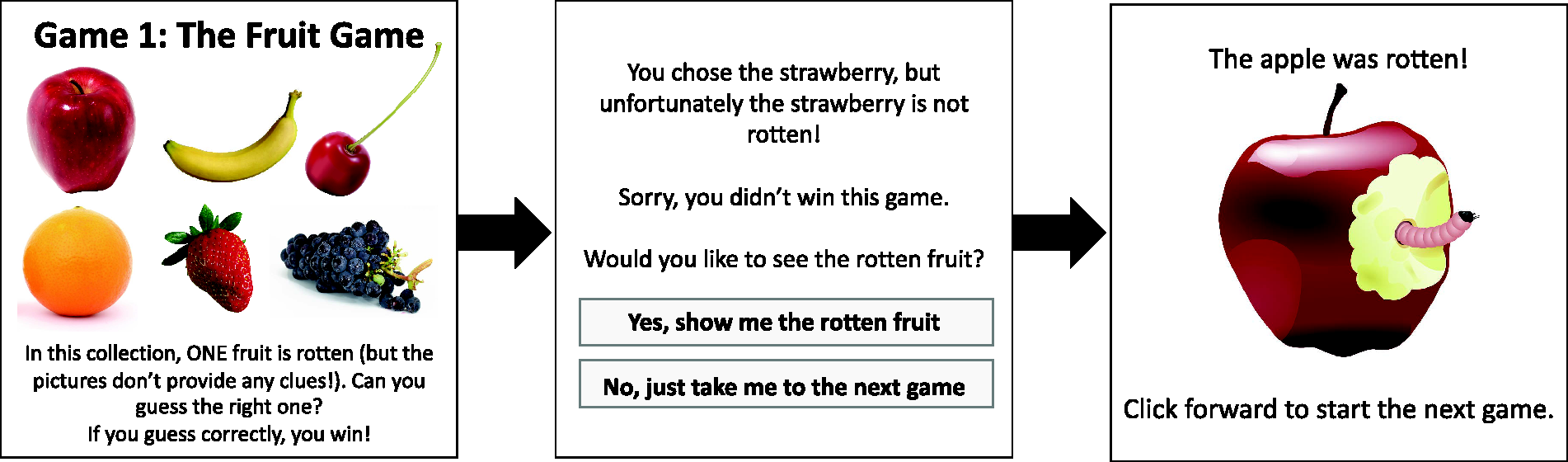
Behavioural information seeking, Game 1. In this example, the participant chooses to seek information and is shown an image of the fruit that was rotten (the apple). [Colour figure can be viewed online].
Following the five games, participants were informed that they had won the bonus money. They were then asked if they would like to see which game was connected to winning the bonus or continue the survey without ever knowing. The choice to see this game was the final measure of information seeking.
Big 5 personality traits
The Big Five Aspect Scales (DeYoung, Quilty, & Peterson, 2007), a widely used measure of the Big Five traits and their lower level aspects, was used to measure openness/intellect, neuroticism, extraversion, agreeableness, and conscientiousness. Our primary focus was on the openness/intellect domain, which divides into intellect, describing engagement with semantic and abstract information (e.g. Like to solve complex problems), and openness, describing engagement with aesthetic and perceptual information (e.g. Enjoy the beauty of nature).
Curiosity
Curiosity was assessed using the five‐dimensional curiosity scale (Kashdan et al., 2018). This scale divides into five factors, two of which are particularly pertinent to the current study: joyous exploration, describing enthusiasm for exploring and leaning in general (e.g. I find it fascinating to learn new information), and deprivation sensitivity, describing an intense hunger for specific knowledge (e.g. I work relentlessly at problems that I feel must be solved). Three additional dimensions are stress tolerance (e.g. I cannot handle the stress that comes from entering uncertain situations [reversed]), social curiosity (e.g. I like to learn about the habits of others), and thrill seeking (e.g. Risktaking is exciting to me). The scale's factor structure, temporal stability, internal consistency, and construct validity have been supported across three studies comprising 4000 participants.
Ambiguity and uncertainty tolerance
The Multiple Stimulus Types Ambiguity Scale‐II (e.g. I am tolerant of ambiguous situations; McLain, 2009) and the intolerance of Uncertainty Scale‐12 (e.g. The smallest doubt can stop me from acting; Carleton, Norton, & Asmundson, 2007) were employed to measure ambiguity tolerance and uncertainty intolerance. Note that the stress tolerance subscale from Kashdan et al.'s (2018) curiosity measure can also be considered a measure of uncertainty tolerance.
Analyses
R version 3.5.2 (R Core Team, 2019) was used for all pre‐processing and analyses. Within R, we used the following packages: tidyverse (Wickham, 2017), careless (Yentes & Wilhelm, 2018), cowplot (Wilke, 2018), lm.beta (Behrendt, 2014), lavaan (Rosseel, 2012), apaTables (Stanley, 2018), psych (Revelle, 2018), and BayesFactor (Morey & Rouder, 2018).
Results
Descriptive statistics
Means, standard deviations, reliability, and correlations between Study 1 variables.
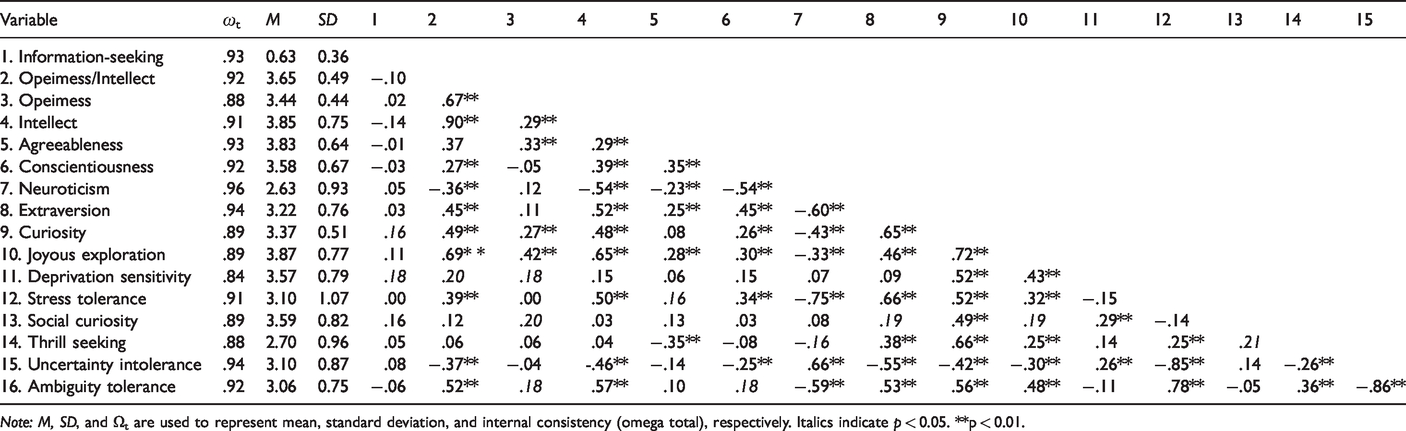
Note: M, SD, and Ωt are used to represent mean, standard deviation, and internal consistency (omega total), respectively. Italics indicate p < 0.05. **p < 0.01.
Considering interrelations between survey measures, openness/intellect was positively related to curiosity (r = .49, 95% CI [.36, .60]), positively related to ambiguity tolerance (r = .52, 95% CI [.40, .63]), and negatively related to uncertainty intolerance (r = −.37, 95% CI [−.50, −.23]), in line with previous research (Jach & Smillie, 2019; Kashdan et al., 2018). When assessing how openness/intellect related to sub‐scales of curiosity, the strongest relationship was with joyous exploration (r = .69, 95% CI [.60, .76]), but there were also significant relations between openness/intellect and deprivation sensitivity (r = .20) and stress tolerance (r = .39).
Information seeking and personality
Information seeking did not significantly relate to openness/intellect (r = −.10, 95% CI [−.25, .06]). However, information seeking correlated with curiosity (r = .16, 95% CI [+.00, .31]) including its subscale deprivation sensitivity (r = .18, 95% CI [.02, .33]) but not the subscale joyous exploration (r = .11, 95% CI [−.05, .27]). Additionally, none of ambiguity tolerance, uncertainty intolerance, or stress tolerance significantly correlated with seeking information. As a lack of evidence for an effect does not provide evidence for a null effect, we employed a Bayes factor regression to assess evidence for models in which openness/intellect predicted information seeking against a null model with flat regression slopes. Bayes factors greater than 1 provide evidence that the variables are predictors of information seeking, whereas Bayes factors less than 1 provide evidence for the null hypothesis (Dienes, 2014). The current study takes the reciprocal of values <1 to provide more easily interpretable results concerning support for the null, such that all Bayes factors for and against the null are 1 or greater (as such, the term M01 indicates evidence in support of the null, whereas M10 indicates evidence for the alternative). We follow Jeffreys (1939/1961) who suggests conventional cut‐offs with >3 considered substantial evidence for the alternative/reciprocal null.
For regressions predicting information seeking from openness/intellect, weak evidence for the null was obtained (M01 = 2.99), suggesting inconclusive evidence to state whether or not openness/intellect predicts informationseeking. We also used Bayes factor regressions to assess support for the null with our three scales measuring tolerance for uncertainty (ambiguity tolerance, intolerance of uncertainty, and stress tolerance) and found support for the null with all three scales measured separately (M01 = 4.46, 3.68, and 5.70, respectively) and even stronger support when they were all entered into the same regression equation (M01 = 13.05 in favour of the null). This tentatively suggests that our task was successful in eliciting curiosity‐driven rather than uncertainty‐driven information seeking.
Study 1 interim discussion
In this exploratory study, we found that curiosity was related to seeking non‐instrumental information, whereas multiple measures of uncertainty intolerance were not. This suggests that our new task design may have successful reduced decisions motivated by intolerance of uncertainty.
Despite the strong correlation between openness/intellect and curiosity, we did not observe that openness/intellect predicted information seeking. However, we did not find decisive evidence against this relation, with a non‐significant result and Bayes factors indicating only anecdotal evidence for the null.
There are several possible reasons for this outcome. First, although we observed a relation between information seeking and curiosity, when broken down by facet, it was significant only for the deprivation sensitivity subscale. It is possible that the design of the information‐seeking task could be improved to increase the chance of tapping other factors of curiosity, such as joyous exploration. For example, we placed all information‐seeking games together in the survey, which may have been repetitive and boring. Additionally, we did not explicitly tell participants that the information they could select would not be beneficial to them later in the experiment, so some participants may have suspected that the information they gained could help to win a future game. This may have explained the high numbers of people choosing to see information throughout the games and particularly
in Game 1 (around 90%). However, this seems unlikely given that, from Game 2 onwards, participants would see how different each of the games were from each other. Nevertheless, if people thought that the information might assist in future decision making, this may have increased pragmatic decision making.
Aims and hypotheses for Study 2
For Study 2, we aimed to address the potential issues in the task outlined above. To reduce the repetitiveness of these tasks, we interspersed them between sections of the surveys. To ensure participants were aware of the non‐instrumental nature of the information they could obtain, we explicitly stated that the information for a given game would not be useful in subsequent games. We also included a single information‐seeking question at the end of the games. Here, participants could choose to immediately know if they won the bonus money but incur a 30‐second time delay before proceeding with the survey; or alternatively, they could wait until the end of the survey to see if they had won. Unlike our main task, this information serves to reduce uncertainty about the potential bonus and is thus analogous to the task used by Smillie (2019) and Bennett et al. (2019). We considered that including this task alongside our main information‐seeking measure may help disentangle effects of curiosity‐driven versus uncertainty‐driven information‐seeking.
We hypothesized that when information seeking was measured as it was for Study 1, openness/intellect, curiosity, and its facets deprivation sensitivity and joyous exploration would positively correlate with and predict information seeking. We also hypothesized that uncertainty intolerance, ambiguity tolerance, and neuroticism would not predict information seeking.
Further, we hypothesized that neuroticism and uncertainty intolerance would positively predict our new reward‐related information‐seeking question; that ambiguity tolerance would negatively predict it; and that openness/intellect would not be a significant predictor. 2
Study 2
Method
Participants
Participants were 316 U.S. residents recruited through mTurk. As we found in Study 1 that a small proportion of participants required more time to complete the study than we had expected, we increased the base study payment to $1.50, keeping the 50c bonus for winning the decision‐making games (which we allocated to everyone) and the 50c attention‐check bonus. The target sample for this study was N = 300. We excluded participants for the same reasons as stated in Study 1, and exclusion criteria led to the total loss of 15 participants, leaving a final study sample of 301 (meanage = 36.54, SDage = 10.30, min = 19, max = 69; 124 female participants, 175 male participants, and two responding ‘other’). This sample provides approximately 94% power to detect a typical effect size within the context of personality psychology (r = .20; Gignac & Szodorai, 2016).
Materials and procedure
We used all measures from Study 1. As described previously, we also included an additional single‐item information seeking question that provided temporal reduction of uncertainty about an upcoming reward. Specifically, after completing all trials of the main information‐seeking task, participants were asked to choose between either (i) learning immediately if they won the bonus payment but incurring a 30‐second time penalty; or (ii) waiting until the end of the experiment to learn this information, with no time penalty. Note that if participants asked to wait until the end of the study to find out their bonus, then we also waited until that time to assess the final information‐seeking item from the main measure (see Study 1 Methods for full explanation of the original trials).
Analysis strategy
Mean (observed) scores were used for descriptive and inferential statistics. However, the supporting information contain several additional companion analyses. First, as inferences concerning parameter values from multiple regression can sometimes be misleading with observed variables, we computed regressions with latent variables, which account for measurement error and typically give a better estimate of the true effect size (Westfall & Yarkoni, 2016). Second, we computed tetrachoric factor scores for information seeking and conducted regular regressions with otherwise observed variables. Finally, similarly to Study 1, our information‐seeking measure was non‐normal (and thus could potentially lead to incorrect Type 1 error rates; Coxe et al., 2009). We thus employed Poisson regressions as were used for Study 1. Unless otherwise stated, inferences presented in the manuscript body were consistent for each of these measures.
We used Bayes factor regressions for several of our key hypotheses from which we intended to make inferences concerning null effects. For each regression, we tested the null hypothesis that regression slopes were 0 against the alternative that all slopes were non‐zero. This package uses default mixture‐of‐variance priors that are calculated from a version of the multivariate Cauchy distribution (see Rouder & Morey, 2012 for a full description of this approach).
Results
Descriptive statistics
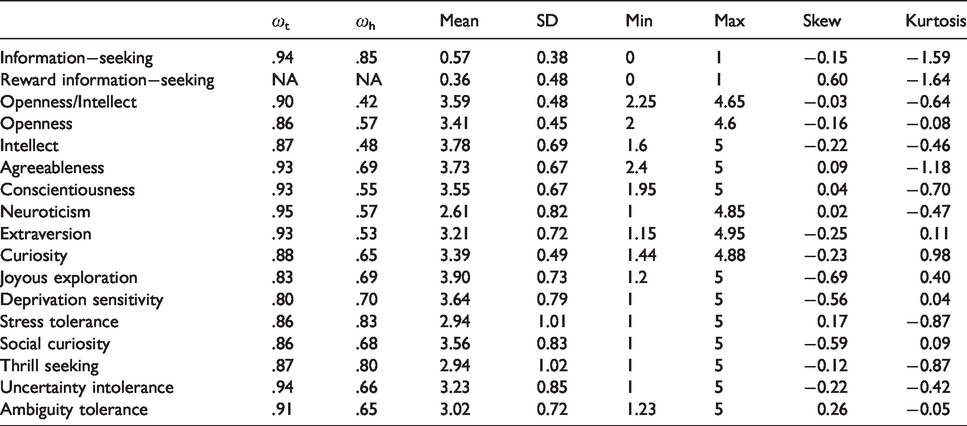
As in Study 1, information seeking demonstrated excellent reliability (Table 2). Figure 2 shows (a) the frequency of information seeking for each of the six items separately, (b) how often each person chose to seek information, and (c) responses to the reward‐related information‐seeking question. A large number of participants chose to view information on the first trial, but choices were more evenly divided for the remainder of trials. Participants appeared to seek information slightly less frequently than in Study 1, perhaps as a result of our assurance that information was not instrumentally useful for performance. For the single‐item reward‐ related question (Figure 2c), a majority of people chose to wait until the end of the survey to find out if they won bonus money, rather than seeking this information immediately.
Responses to the customized information-seeking responses. (a) The frequency of responses for each individual item. No = participants chose not to view information, yes = participants chose to view information. Note that Choose Info 1 has a large proportion of participants choosing to view the information, but the remainder of the questions contain roughly equal responses. (b) Frequency of times out of six an individual chose to see information. Roughly a third of respondents always chose to see information. (c) Single-item information-seeking measure that reduces uncertainty about an upcoming reward. Here, most participants chose to wait rather than seek information. [Colour figure can be viewed online]. Internal consistency, means, standard deviations, and distribution information for all variables.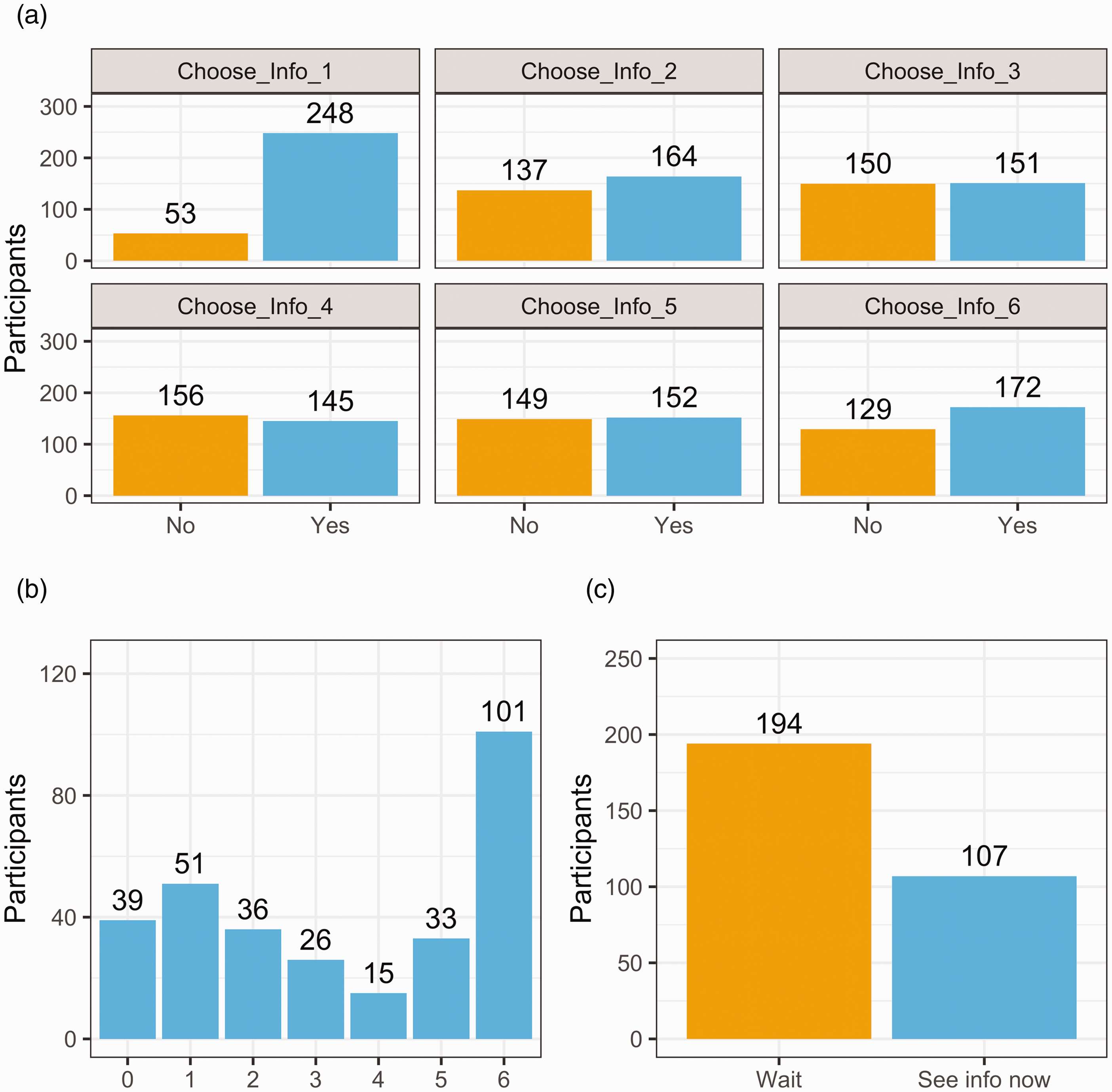
Correlation matrix, Study 2.
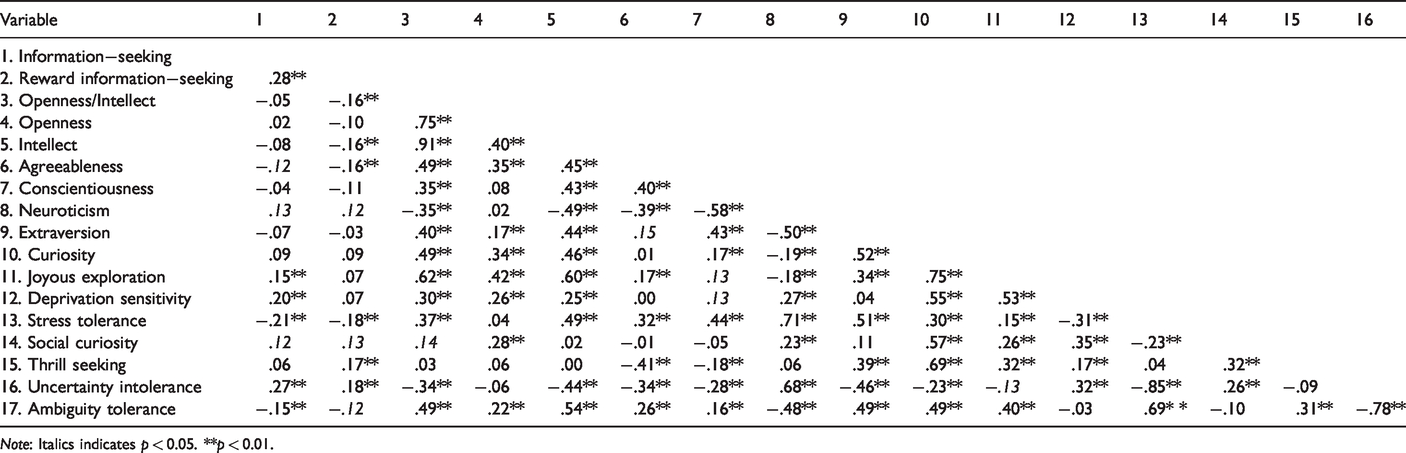
Note: Italics indicates p < 0.05. **p < 0.01.
Openness/intellect, curiosity, and information seeking
In contrast to our hypotheses, but consistent with Study 1, openness/intellect did not significantly correlate with information seeking, either at the domain level (r = −.05, 95% CI [−.16, .06]) or the aspects openness (r = .02) or intellect (r = −.08). In addition, a Bayes factor regression indicated that the data were 5.59 times more likely to occur under the null hypothesis than under the alternative hypothesis, providing substantial evidence for a null effect of openness/intellect predicting information seeking (Jeffreys, 1939/1961).
Next, supporting our predictions, we found that curiosity sub‐scales deprivation sensitivity and joyous exploration each positively related to information seeking (deprivation sensitivity r = .20, 95% CI [.09, .31]); joyous exploration r = .15, 95% CI [.04, .26]). However, in contrast to Study 1, curiosity as a whole did not significantly correlate with information seeking (r = .09, 95% CI [−.02, .20]). This was likely due to the moderate and negative correlation between information seeking and the curiosity sub‐scale stress tolerance (r = −.21, 95% CI [−.32, −.10]). Indeed, when computing curiosity as a latent variable, it became a significant positive predictor of information seeking (see Table S3.1). This appeared to be due to the poor loading of stress tolerance on a general curiosity factor: the model evidently reduced the negative effect that stress tolerance was playing on predicting information seeking, allowing the remaining sub‐scales to display their positive effect on information seeking. Thus, with the exception of stress tolerance, curiosity was positively associated with information seeking in Study 2.
Uncertainty attitudes, neuroticism, and information seeking
Contrary to our predictions, information seeking correlated significantly with uncertainty intolerance (r = .27, 95% CI [.16, .37]) and neuroticism (r = .13, 95% CI [.02, .24]) and correlated negatively with ambiguity tolerance (r = −.15, 95% CI [−.26, −.04]). Similarly, Bayes factors revealed substantial evidence in favour of associations between information seeking and ambiguity tolerance (B10 = 3.46) and intolerance of uncertainty (B10 = 4898.79), whereas there was indeterminate evidence for a relation between neuroticism and information seeking (B10 = 1.53 in favour of the alternative). This indicates that participants who were more intolerant of uncertainty were more likely to pay in time to view the informative option.
Reward‐related information seeking
We next examined our single‐item information‐seeking measure that allowed participants to remove uncertainty about an upcoming reward. We predicted that we would observe similar information‐seeking relations found by prior research using this version of the task (i.e. a positive relation with intolerance of uncertainty and neuroticism and no measurable relation to openness/intellect). Supporting the first predictions, reward‐related information seeking significantly correlated with intolerance of uncertainty (r = .18, 95% CI [.07, .29]), ambiguity tolerance (r = −.12, 95% CI [−.23, −.01]), and neuroticism (r = .12, 95% CI [.01, .23]). A Bayes factor regression comparing a model in which each variable predicted information‐seeking with a model in which there was no relationship found evidence that intolerance of uncertainty predicted information seeking (B10 = 16.07 in favour of predicting information‐seeking) and anecdotal evidence for ambiguity tolerance (B10 = 1.21) and neuroticism (B10 = 1.12). Note that these effect sizes are on par or less than those observed from our main information‐seeking task, indicating that we do not have evidence that our modified task more strongly elicited intolerance of uncertainty. That said, the relation between curiosity and information‐seeking was absent for the altered task: neither joyous exploration nor deprivation sensitivity correlated with seeking advance information about an uncertain outcome, and Bayes factor regressions indicated substantial evidence for a null relation (deprivation sensitivity B01 = 4.14; joyous exploration B01 = 3.79).
Finally, in contrast to our prediction that openness/intellect would not relate to the choice to see uncertainty‐reducing information, a negative correlation was observed (r = −.16, 95% CI [−.27, −.05]). This appeared to be driven primarily by the intellect aspect (r = −.16), suggesting that individuals higher in intellect were more likely to wait until the end of the study to see their bonus payment. Convergent results were found with a Bayes factor regression: openness/intellect negatively predicted information seeking (B10 = 5.90), but assessing aspects, evidence for the alternative was substantial for intellect (B10 = 5.51), whereas indeterminate evidence for a null effect was found for openness (B01 = 1.86).
Exploratory analyses
To further explore combinations of variables that may relate to seeking information, we conducted a Bayesian model comparison predicting our original 6‐item information‐seeking measure from openness/intellect, joyous exploration, deprivation sensitivity, ambiguity tolerance, and uncertainty intolerance. We followed the guidelines of Rouder and
Morey (2012) and compared each predictor in turn, followed by all combinations of predictors. The supporting information contains figures and exact numerical values for each predictive model.
The model with the highest evidence was given by the predictors joyous exploration and uncertainty intolerance, indicating that this model was 208,067 times more likely than a null model. Sampling from the posterior distribution of this model in order to obtain parameter estimates of regression slopes, each predictor was positively related to seeking information (joyous exploration μ = 0.10, 95% credible interval [0.04, 0.15]; intolerance of uncertainty μ = 0.13, 95% credible interval [0.08, 0.17], which converges with a traditional frequentist multiple regression finding that both of these are significant predictors of information seeking (joyous exploration β = 0.19, t(298) = 3.45, p < .001; intolerance of uncertainty β = 0.29, t(298) = 5.26, p < .001). The second highest performing model (joyous exploration, intolerance of uncertainty, and openness/intellect) was not a substantially worse performer (BF10 = 0.73). However, given that the additional predictor did not result in a better fitting model, the former model could be favoured on grounds of parsimony. All other models were considered substantially worse (all BF 10 < 0.33). Note that for the second highest performing model, openness/intellect was a negative predictor of information seeking (μ = −0.10, 95% credible interval [−0.21, −0.02]) whereas the other variables were positive predictors.
Given the well‐documented links among openness/ intellect, uncertainty intolerance, and curiosity, we were interested to observe the evidence for these variables as predictors of openness/intellect. We thus performed an additional Bayes factor model comparison predicting openness/intellect from joyous exploration, deprivation sensitivity, intolerance of uncertainty, and 6‐item information‐seeking. The model with the greatest evidence was comprised of joyous exploration and intolerance of uncertainty (M10 = 1.05e+37), the same two variables that formed the highest performing model predicting information seeking. However, whereas both variables were positive predictors of information seeking, joyous exploration was a positive predictor of openness/intellect (μ = 0.38, SD = .03, 95% credible interval [0.32, 0.44]) but intolerance of uncertainty was a negative predictor (μ = −0.15, SD = 0.02, 95% credible interval [−0.20, −0.10]). This suggests that one reason openness/intellect was unrelated to information seeking in our study is because it relates positively to one driver of information seeking and negatively to another.
General discussion
The information‐seeking theory of openness/intellect proposes that openness/intellect is grounded in greater sensitivity to the reward value of information and should, therefore, predict information‐seeking behaviour (DeYoung, 2013). We tested this theory by investigating whether openness/intellect predicted the choice to pay a time cost to view non‐instrumental information. Across two studies, individuals high in openness/intellect were no more likely to choose to view this form of information than their less open counterparts. However, curiosity predicted information seeking in both studies, and intolerance of uncertainty predicted information seeking in Study 2. To our knowledge, this is the first time that trait curiosity has been found to relate to information seeking. Because curiosity and intolerance of uncertainty relate in opposite ways to openness/intellect, their associations with information seeking may help account for the lack of such an association at the broader openness/intellect domain. Thus, our findings may help to refine DeYoung's information‐seeking theory.
Is the information‐seeking theory of openness/intellect supported?
Information seeking is sometimes mentioned in definitions of openness/intellect (e.g. Allen & DeYoung, 2017; DeYoung, 2015a, 2015b), giving the appearance that DeYoung's (2013) theory has been long since supported. However, there has been little research that has directly measured information seeking. To address this, we adapted a task from decision science assessing willingness to pay for non‐instrumental information (Bennett et al., 2016). In an effort to reduce any motivation driven by intolerance of uncertainty, information within this task did not inform participants of an upcoming event or outcome. Instead, participants first learned if they had won a reward and were then asked if they would like to see some information that did not affect any outcome.
Some might argue that the information in this task is too trivial to capture individual differences in openness/intellect. But this triviality is exactly the point: If individuals higher in openness/intellect have a preference to know things that they did not already know, then this should be evident regardless of the form of information. These stimuli allow for a strong test of the theory: if we found that openness/intellect predicts seeking even this form of information, this would have provided compelling evidence that open individuals have a general‐purpose sensitivity to any sort of new information. Conversely, demonstrating that open individuals are motivated to view artworks or intellectual materials could simply reflect the content of the openness/intellect scale items.
Consistent with Smillie (2019), we found no relation between openness/intellect and information seeking in either study, with substantial evidence for a null effect obtained in Study 2. However, in both studies, curiosity—arguably a lower‐level facet of the broader openness/intellect domain—positively predicted seeking information. Moreover, in Study 2, we observed that uncertainty intolerance positively predicted information seeking. 3 At the same time, consistent with prior research (Jach & Smillie, 2019; Kashdan et al., 2018), we found that these traits were both strongly related to openness/intellect but in opposite directions: openness/intellect was negatively related to uncertainty intolerance but was strongly positively related to trait curiosity. The difference between the domain‐level and facet‐level associations aligns with research showing that constructs measured at different levels of the trait hierarchy can produce unexpected results compared to when these are measured on the same level (Kretzschmar et al., 2018). If trait associations are specific to only particular facets or aspects of a trait, it might then be inappropriate to generalize these associations to the broader trait as a whole (Mõttus, 2016). Thus, the present findings suggest a potential refinement to DeYoung's (2013) information‐seeking theory of openness/intellect, in that it may apply more narrowly to a specific facet of this domain (curiosity), but perhaps not to the domain more broadly.
In summary, the most straightforward version of the theory (i.e. higher openness/intellect leads to more information seeking) was not supported by our results. However, restricted support for the theory could be found via its relation to curiosity. Of course, as we did not pre‐register this precise prediction, future studies are necessary to confirm these results.
Future research
One important implication of our results is that the task and stimuli used to measure information seeking matter: in both of our studies, curiosity predicted seeking information about inconsequential task details, but when the information reduced uncertainty about an upcoming reward, curiosity no longer predicted information seeking, and openness/intellect became a negative predictor. If curiosity is the process via which openness/intellect relates to information seeking, then we might observe a relation between openness/intellect and information seeking if we could find stimuli that elicit feelings of curiosity much more strongly than uncertainty. One promising option is to use trivia questions. Many studies have shown that state curiosity predicts paying a cost to see answers to trivia questions (Gruber et al., 2014; Kang et al., 2009; Ligneul et al., 2018; Marvin & Shohamy, 2016), but no study has assessed if state curiosity relates to trait curiosity or openness/intellect or how this may in turn predict information‐seeking preferences. Recently, a rich, normed database of trivia questions has been made available to researchers (Fastrich, Kerr, Castel, & Murayama, 2018), providing an opportunity for future research to investigate these questions. An additional advantage of trivia questions is the ability to measure learning, thereby connecting information‐seeking findings to theories of how openness/intellect relates to intelligence and knowledge acquisition (e.g. von Stumm, 2018; Ziegler et al., 2018).
An additional approach could be an information‐seeking intervention measured with experience sampling (Scollon, Prieto, & Diener, 2009). These methods have been used to assess interests in everyday life (Ziegler et al., 2018) and could be built on by explicitly asking participants to seek information in their everyday life, examining potential effects of self‐reported (or other‐reported) openness/intellect throughout the intervention. If curiosity‐driven information seeking underlies openness/intellect, then upregulating information seeking should theoretically lead to increased openness/intellect—particularly if participants are instructed to seek information via fascination (i.e. joyous exploration) rather than to reduce their anxiety at not knowing (intolerance of uncertainty). Experience sampling approaches have been previously used to assess the causal structure between extraversion and positive affect (Jacques‐Hamilton, Sun, & Smillie, 2019) and processes that may drive volitional personality change (Hudson & Fraley, 2015), giving some precedence to this technique.
Finally, rather than upregulating curiosity, future information‐seeking paradigms could attempt to hold constant uncertainty, or yoke uncertainty to information such that gains in information entail increases in uncertainty. This may seem a formidable goal, given that information is often equated with reductions in uncertainty by definition (e.g. Bennett et al., 2016; Gottlieb, Oudeyer, Lopes, & Baranes, 2013; Shannon, 1948). However, it is common for real‐world information gains to accompany increases in uncertainty. Learning something can make you less certain about a prior belief (e.g. when reading a murder mystery, new evidence can come to light that makes you unsure about your previous suspect), and uncertainty can immediately follow information gain (this new evidence can make you question the motives of the other characters in the novel). This connects to existing ideas and research surrounding openness/intellect. DeYoung (2013) proposed that temporary increases in uncertainty can be rewarding to some individuals, as exploring uncertainty may lead to long‐term knowledge acquisition and understanding (i.e. an ultimate decrease in uncertainty, even if there are many short‐term increases). Relatedly, Mussel (2013) proposed that personality traits related to intellectual achievements (including the intellect aspect of openness/intellect) are underpinned by dual motivations to seek and conquer information, where seeking involves exploring complex stimuli (i.e. engaging in temporary increases of uncertainty) before attempting to understand and thus conquer that stimuli (i.e. reducing uncertainty). Openness/intellect is also associated with more positive relations between the emotions of interest and confusion (Fayn, Silvia, Dejonckheere, Verdonck, & Kuppens, 2019). As confusion may arise from uncertainty, this suggests that individuals higher in openness/intellect may be better able to stay interested when exploring uncertain, confusing stimuli. We might thus expect curiosity and openness/intellect to relate to information seeking when uncertainty increases, whereas individuals who are intolerant of uncertainty might be unlikely to seek information that also increases uncertainty. A multi‐trial experimental paradigm that can measure the objective and subjective uncertainties in the environment would be highly valuable to test this basic hypothesis, link to prior ideas, and ultimately further refine the information‐seeking theory of openness/intellect.
Limitations
The primary limitation of the current studies is the use of cross‐sectional designs from which we are attempting to draw evidence of causal mechanisms. Specifically, we have conceptualized curiosity and intolerance of uncertainty as mechanisms that cause people to seek information and potentially explain why the broad openness/intellect domain may not directly relate to information seeking. This is obviously not an inference that we can make given the nature of our variables. However, conducting such correlation‐based research was a necessary first step towards gathering evidence for these hypotheses. If we did not observe any relation between curiosity and information seeking, or between intolerance of uncertainty and information seeking, that would suggest that our theorizing was not correct (Underwood, 1975). At the least, we have found that our results are not inconsistent with our theoretical conceptions and have paved the way for future studies, as suggested previously.
An additional limitation concerns the small number of trials used for our measure of information seeking: six choices for our main measure and only one for reward‐related information seeking. Although we obtained high reliability for our main measure, it would be valuable to confirm these findings using a version of our task with many more trials (as in Bennett et al., 2016; Brydevall et al., 2018). It would also be useful to add a measure of intelligence to any such study, given that some theories of intelligence propose bidirectional effects of fluid intelligence and openness on seeking out and acquiring knowledge (e.g. Ziegler et al., 2018).
Finally, although participants were explicitly told that information would not be useful in subsequent games, this does not ensure that they believed us. If participants believed information was instrumental, this could have increased reward‐driven motivation to seek information and reduced the impact of uncertainty‐driven and curiosity‐driven motivation. It might be particularly likely for participants to be suspicious about the value of information for the last three games, which all concerned a similar storyline (a ‘gem quest’). However, if participants did believe that information was instrumental for those final three games, then we would expect to observe proportions of information seeking that were higher for the penultimate and final game compared with the first. We did not see this (Figure 2a), which may provide some reassurance that participants were following instructions as intended.
Conclusion
Openness/intellect—the putative trait of cognitive exploration—has itself been explored across multiple studies, but few direct tests of its proposed mechanistic underpinnings have been performed. To address this gap, we conducted some initial tests of the information‐seeking theory of openness/intellect. We observed for the first time that trait curiosity, a facet of openness/intellect, predicted seeking non‐instrumental information, and so too did intolerance of uncertainty. However, global openness/intellect did not predict choosing to view this form of information, perhaps because individuals scoring high on this trait tend to be both curious and tolerant of uncertainty. Our results thus fail to support any broad link between information seeking and the openness/intellect domain. However, the relation between information‐seeking and curiosity arguably provides some support for a restricted version of the theory. We hope that this study can spur future research to disentangle these interrelated constructs and ultimately better understand the mechanistic underpinnings of curiosity, creativity, imagination, and exploration.
Footnotes
Acknowledgements
Funding in support of this project was provided by the Melbourne School of Psychological Sciences. H. K. Jach was supported by an Australian Government Research Training Program Scholarship.
We are grateful to Daniel Bennett for his helpful comments on an earlier version of this manuscript.
Data accessibility statement
This article earned Open Data, Open materials and Preregistered + Analysis Plan badges through Open Practices Disclosure from the Center for Open Science: https://osf.io/tvyxz/wiki.The data are permanently and openly accessible at https://osf.io/2hjfc/, https://osf.io/mnw3d/ and https://osf.io/saqhe/. The permanent path to the registration is openly accessible at  . Author's disclosure form may also be found at the Supporting Information in the online version.
Supporting information
Additional supporting information may be found online in the Supporting Information section at the end of the article.
Open Practices Disclosure Form
Data S1. Supporting Information
Notes
References
Supplementary Material
Please find the following supplemental material available below.
For Open Access articles published under a Creative Commons License, all supplemental material carries the same license as the article it is associated with.
For non-Open Access articles published, all supplemental material carries a non-exclusive license, and permission requests for re-use of supplemental material or any part of supplemental material shall be sent directly to the copyright owner as specified in the copyright notice associated with the article.
