







Abstract
This paper introduces key concepts for studying intraindividual variability in narratives (narrative IIV). Narrative IIV is conceptualized in terms of sources of within–person variation (events and audiences) and dimensions of variation (structural and motivational/affective dimensions of narratives). Possible implications of narrative IIV for well–being and self and social development are outlined. Considering narrative IIV leads to complexity in both theory and method, raising the issue of whether some avenues might be more productive than others. Using previously collected data, we sought to evaluate the research potential of different indices of narrative IIV (n = 106 participants; n = 1272 narratives). All analyses were preregistered: doi: 10.17605/OSF.IO/SXV4W. Findings show that narrative IIV is distinct depending on source and dimension, replicating previous work. However, narrative IIV was largely unrelated to the measures of well–being and self and social development used in the present study. These findings support the practice of aggregating across narratives in existing research, at least for these outcomes and sources of variation, and provide important guidance for investigators who remain interested in the possible insights that narrative IIV may reveal about the person. © 2020 European Association of Personality Psychology
Introduction
People show both stability and variability in their behaviours, and recent theories about personality traits have emphasized the importance of accounting for both stability and variability in the traits people display (e.g. ‘whole trait theory’, Fleeson & Jayawickreme, 2015). We consider how intraindividual variability might be investigated at the narrative level of personality (Dunlop, 2015; McAdams, 1996; McLean, Pasupathi, Greenhoot, & Fivush, 2017) and present the results of preliminary work that may inform such investigations.
Despite the rise of frameworks for examining personality along multiple levels (Cervone, 2004; McAdams, 1996) and the increasing evidence that narrative approaches provide important insights about personality beyond trait and motivational level frameworks (Adler, Lodi–Smith, Philippe, & Houle, 2016), there is relatively little examination of within–person variability in narrative (for exceptions, see Dunlop, 2015; McLean et al., 2017; Pasupathi & Oldroyd, 2015). The primary goal of our paper is to provide an organizing frame for examining IIV at the narrative level of personality (McAdams, 1996) and to document an initial investigation of some approaches to narrative IIV.
Iiv from Traits to Narratives
Trait theorists have been working to integrate stability and variability into their frameworks for some time (Cervone, 2004; Fleeson & Jayawickreme, 2015; Mendoza–Denton, Ayduk, Mischel, Shoda, & Testa, 2001). Descriptively, people's ‘states’ on trait dimensions can be mapped as density distributions, which differ in their central tendencies, size, and shape across individuals (Fleeson & Jayawickreme, 2015). Those distributions appear to capture stable properties of the person, and the shape of each person's distribution can be understood as arising from idiographic social cognitive frames the person has developed over their lifetime (see also Caldwell, Cervone, & Rubin, 2008; Mendoza–Denton et al., 2001). IIV in traits is clearly an important aspect of personality in its own right. IIV may also be related to outcomes such as well–being (e.g. Donahue, 1994), although present findings are inconclusive (Baird, Le, & Lucas, 2006).
Our goals were to frame questions about IIV in narrative levels of personality, drawing on, but also expanding from, the basis laid by trait theorists. More than two decades of research have established that narratives are a critical level of personality that both expresses and reflects aspects of identity, development, well–being, relationship functioning, and many other psychologically meaningful constructs, above and beyond what traits alone can tell us (for reviews see Adler et al., 2016; Graci, Watts, & Fivush, 2018; McAdams, 2013; McAdams & Pals, 2006). However, one of the implicit and deeply held assumptions embedded in narrative personality research is that what matters in narrative identity are underlying consistencies in the way people narrate disparate events. This assumption is best demonstrated by the practice of aggregating across narratives (e.g. Blagov & Singer, 2004; Mansfield, Pasupathi, & McLean, 2015; McAdams et al., 2004; McLean, Breen, & Fournier, 2010). However, some researchers focus on a single event narrative as a window into narrative identity—as reflecting some of those consistencies (e.g. McLean & Pratt, 2006; Pals, 2006; Syed & Azmitia, 2008).
People also do demonstrate some consistency in the thematic qualities of their narratives about different events (e.g. McAdams et al., 2006; Thorne, Cutting, & Skaw, 1998). Moreover, established links between specific narrative features and the kinds of important outcomes listed earlier presumably reflect the importance of people's consistent ways of narrating events. Yet, we also know that the same person tells different kinds of stories differently. Happy stories differ from sad ones (e.g. Banks & Salmon, 2013; Fivush, Sales, & Bohanek, 2008; McLean & Lilgendahl, 2008), stories about doing harm differ from those about being the victim of harm (Pasupathi et al., 2015; Wainryb, Brehl, & Matwin, 2005), and individuals shift their narrating of events within different social contexts (McGregor & Holmes, 1999; Pasupathi, Stallworth, & Murdoch, 1998; Tversky & Marsh, 2000). Further, some studies suggest that differences in stories told by the same person are larger than differences between people in telling similar stories (e.g. McLean et al., 2017)—that is, within–person variability exceeds between–person variability by a substantial margin (see Fleeson & Jayawickreme, 2015). However, in part because some of the work looking at differences in the way the same person tells different stories has not been grounded in the tradition of narrative identity and personality psychology, these differences have often been framed as ‘situation effects’ or ‘event differences’. But such differences might also provide for a more complex view of narrative identity as a level of personality. In other words, within–person variation in narrating could also carry important insights about the whole person. That said, characterizing intraindividual variability in narrative is complex.
Variability in Narrating around What? Sources of Intraindividual Variability
There are multiple potential sources of intraindividual variability in the way people tell stories, and these sources are important for contextualizing the potential meaning of intraindividual variability in narratives. We focus here on two: narrating different events or types of events in varied ways, something we term narrative differentiation (see, e.g. McLean et al., 2017), and narrating the same event to different people and/or in different contexts, which we term narrative sensitivity.
In terms of narrative differentiation, we need to consider how someone varies in narrating specific events within a general class of events (e.g. low–point events), as well as their variation in narrating different types of events (e.g. low points and high points). In terms of classes of events, some people may be more varied than others in the way they narrate a series of low–point events. Greater variability might indicate the absence of a strong script for how low points should be narrated or an attunement to particular features of a specific event rather than reliance on a script. Less variability might be related to having a fairly strong script for a particular class of events. Our own prior work on within–person variability in narrative suggests that this dimension of variability is, in fact, meaningful for adaptive outcomes, particularly when variability is examined for highly identity–relevant experiences such as self–defining memories and low points (McLean et al., 2017). In the present study, we consider a different element of narrative differentiation, namely, differentiation across different types of identity–relevant events, including high points, low points, and turning points.
A typical narrative identity assessment asks people to narrate a variety of significant events across their lives, and those events typically include a turning point, a high point, and a low point. Variability in the way people on average tell these events suggests something about the affordances of the events themselves for narration, such as the idea that negative events require more accounting and explanation (Habermas, Meier, & Mukhtar, 2009; McLean & Lilgendahl, 2008). But beyond the impact of the events, some individuals may demonstrate larger differences in the way they narrate these different events than do others. Such within–person patterns in narrative differentiation capture something about the way people draw narrative distinctions between different types of events. For example, an individual with a low level of narrative differentiation may narrate turning points and low points with similar levels of elaboration, resolution, and positive meaning. In contrast, a person with a higher degree of differentiation might create greater distinctiveness by narrating turning points with high elaboration, resolution, and positive meaning, but low points with little elaboration, low resolution, and negative rather than positive meaning.
In terms of narrative sensitivity, a person may tell the very same event in different ways depending on the social context—whether they are telling mothers or friends, or whether their listener is engaged or inattentive, or supportive versus challenging (McLean & Jennings, 2012; Pasupathi & Hoyt, 2009; Pasupathi, McLean, Weeks, & Hynes, 2019; Weeks & Pasupathi, 2011). Yet some people may be more variable across social contexts than others. Variability in this sense may indicate that some individuals adapt stories more intensively—whether deliberately or subconsciously—to the listener at hand. Although many studies demonstrate that people readily adapt stories to their proximal audiences (Pasupathi, Wainryb, Oldroyd, & Bourne, in prep; McLean & Pasupathi, 2011; Pasupathi et al., 1998; Pasupathi et al., 2019), to our knowledge, no study has examined differences between people in the extent to which this is the case.
But Does it Matter? Narrative Differentiation and Sensitivity in Relation to Developmental Outcomes and Well–Being
Broadly, those who differentiate their narratives more around distinct events or distinct classes of events may be more flexible in creating meaning (or not) from the various events that they experience. These individuals may be more selective in constructing meaning around some types of experiences rather than others, and they may experience different classes of events as more varied in complexity and comprehensibility (McLean & Thorne, 2003; Thorne, McLean, & Lawrence, 2004). Individuals who display more narrative sensitivity, narrating differently depending on context and listener, may more sensitively respond to social interactional cues whether or not they do so deliberately, with awareness, or via relatively non–deliberate processes. This thinking leads to several general predictions. First, we would expect that these two aspects of narrative IIV would be distinct rather than highly correlated, given that they capture conceptually distinct kinds of variability. Second, we might expect that higher narrative differentiation is associated with more advanced self–development, insofar as it suggests more complex and varied ways of making sense of life events. Third, we would anticipate that higher narrative sensitivity might relate to more advanced social development, in that it reflects higher adaptation to current social cues. But such adaptability might come at a cost, in that it may lead to a risk for fragmentation across social contexts (Donahue, Robins, Roberts, & John, 1993; but see Baird et al., 2006). If this is the case, we might, surprisingly, expect narrative sensitivity to actually be related to a less clear and coherent sense of self and therefore to lower well–being (Donahue et al., 1993; but see Baird et al., 2006). Importantly, more advanced self and social development may support greater differentiation between events and greater sensitivity to social contexts, and greater differentiation between events and sensitivity to social contexts could also promote more advanced self and social development—the data we report below are correlational and cannot distinguish between these possibilities.
Variability in What? Variation by Specific Narrative Feature
Even within the same source of variability—events or audiences—the extent and implications of narrative IIV will also likely depend on the narrative feature examined. A narrative can be characterized along many dimensions depending on the research question at stake. Within the personality literature, both conceptual and factor analytic approaches have converged on a core set of organizing dimensions that (i) capture central individual differences in narratives; (ii) emerge across child development in theoretically predicted ways; and (iii) are relevant for adaptive outcomes like psychological well–being (Adler et al., 2016; Fivush, Booker, & Graci, 2017; Graci et al., 2018; McLean et al., 2019). Critical dimensions that have emerged are structural properties of narratives (elaboration and coherence) and motivational/affective properties (growth themes, redemption, contamination, ending valence). Of note, in some work, motivational/affective themes that differ in valence, like growth and contamination, load on a single dimension (McLean et al., 2019), while in other work, they are treated as distinct factors for positive and negative dimensions (Graci,et al., 2018). Likewise, resolution is coded in a variety of ways from affectively oriented approaches such as ending valence (McLean et al., 2019) to more structural approaches such as the extent to which an event is viewed as resolved (e.g. Graci et al., 2018; Pals, 2006; Waters, Shallcross, & Fivush, 2013).
Notably, some dimensions of narrative may be more variable than others in general and across people. For example, elements of narratives that are fundamental to constructing a story, such as coherence, should show lower within–person variability across contexts or events (McLean et al., 2017; Reese et al., 2011; Waters, Köber, Raby, Habermas, & Fivush, 2018). By contrast, motivational and affective themes, as well as more discretionary structural aspects of stories, such as elaboration and some forms of story resolution, may be more variable in general, across people but, more important to the present discussion, also more variable across narratives told by the same person. That is, are some individuals always (or never) elaborative, or do some individuals always draw positive meanings from experiences to the same (high or low) extent across different events and audiences, whereas other individuals show greater variability in whether they employ these narrative features across different events and listeners?
Further, is narrative IIV conceptualized in this way a general property of individuals, such that some individuals are more variable in their narration across all narrative dimensions, or is narrative IIV feature specific? Our own prior work (McLean et al., 2017) suggests that narrative IIV will be feature specific—that is, for example, those who are highly variable in their propensity for drawing positive meanings may be relatively consistent in their propensity to resolve their stories. Further, our prior findings suggested that variability in meaning making and resolution in identity–relevant experiences was more relevant to well–being than was variability in other narrative dimensions, such as coherence, or emotional elaboration (McLean et al., 2017). Thus, in the present work, while we examine narrative differentiation and narrative sensitivity across multiple features of narratives (elaboration, resolution, growth themes, and damage themes), we anticipated that variability on resolution, growth, and damage themes would be of greater import for well–being and other outcomes than would variability on elaboration.
The Present Study
Testing ideas about narrative IIV is challenging because it requires collecting multiple narratives from the same person and, in the case of narrative sensitivity, the collection of multiple narratives from the same person about the same event across multiple contexts. Moreover, the multidimensionality and multiple sources of variation that can apply to narrative are also challenges to researchers, as they provide perhaps a surfeit of wealth in the questions that could be posed. With these considerations in mind, the goal of the present study was to provide an exploratory investigation of narrative differentiation and narrative sensitivity across some commonly assessed narrative features. In some sense, the present study serves as a feasibility study about these two key concepts.
We used an existing data set designed to test differences in the construction of narratives about the same set of life story events for different audiences (Pasupathi et al., 2019). This data set allowed us to ask questions about narrative IIV for both differentiation (IIV across distinct classes of events) and sensitivity (IIV across distinct audience settings). The data also allowed us to examine whether differentiation and sensitivity were meaningfully related to indicators of well–being (life satisfaction, depression symptoms), self–development (self–concept clarity, ego identity), and social development (intimacy, empathy).
Preregistered Hypotheses
We anticipated that narrative differentiation and sensitivity would be distinct from one another and that both types of narrative IIV would be feature specific, as indicated by relatively low correlations among these different indices of narrative IIV. We additionally proposed exploratory analyses of relationships between five–factor personality and indicators of variability, in keeping with discussions of narrative indicators as valuable beyond traits (e.g. Adler et al., 2016). We tentatively hypothesized that higher narrative differentiation would relate to higher well–being and more advanced self–development, insofar as it suggests more complex and varied understandings of important life experiences. Again tentatively, we hypothesized that given prior work on competing social demands and roles, higher narrative sensitivity could be associated with lower well–being and less advanced self–development (see, e.g. Donahue et al., 1993), but with more advanced social development. Across these tentative hypotheses, we anticipated that our predictions would be supported for narrative IIV in resolution and positive and negative meaning making, but not necessarily for narrative IIV in other features (e.g. elaboration). Finally, we included exploratory tests of interactions between average qualities of narratives and indicators of narrative IIV, because variability may have different implications for people whose narratives have high and low averages on a feature like positive meaning making, akin to the logic of work on lability in other constructs (e.g. Peng, Schaubroeck, & Xie, 2015).
All hypotheses as well as the analytic plans were preregistered at https://doi.org/10.17605/OSF.IO/SXV4W. Annotated statistical output and other study materials, including additional analyses, can be found at https://doi.org/10.17605/OSF.IO/TF4AX.
Methods
Design
The study varied event type (low point, a transgression, a turning point, and a high point) and audience (the ‘original’ prompt, mother, and friend, with the latter counterbalanced) in a fully within–subjects design. With respect to event type, a typical ‘snapshot’ of the life story interview is provided by the low point, turning point, and high point narratives (e.g, McLean et al., 2019); we added transgression narratives based on work showing their importance for identity (Mansfield et al., 2015) and because such events challenge people's sense of themselves as good people (Pasupathi et al., 2015), providing an important addition for examinations of narrative differentiation. The ‘original prompt’ was included because it reflects the way most narrative identity research is conducted. Mothers and friends were chosen because these relationship contexts represent the most frequent audiences for narration among emergent adults (Pasupathi et al., 2019), as well as audiences perceived relatively positively by young adults.
The resulting 12 narratives were coded for two structural elements (elaboration, which is structural in that it provides the needed detailed information to move a story forward; Fivush, Bohanek, Zaman, & Grapin, 2012; and resolution, which brings the story to a close), exploration of the identity implications of the event (autobiographical reasoning; McLean et al., 2019), and two affective themes (growth themes and damage themes). Note that our initial results showed that elaboration and identity exploration were highly correlated, in line with similar findings about elaboration and exploration in previous work (McLean et al., 2019); hence, we combined these codes into a single elaboration/exploration code for analysis.
The data were originally collected as part of a different project on emerging adult narrative identity construction in relation to distinct audiences (Pasupathi et al., 2019). In that project, we reported event and audience effects on average narrative qualities, as well as additional survey findings; no analyses of intraindividual variability were conducted.
Participants
Participants (N = 106, 70 women) were recruited from a Pacific Northwest College participant pool sample. Participants averaged 20 years old (standard deviation = 3.2), and most were White (n = 83), with smaller numbers reporting Asian (n = 17), mixed (n = 9), Latin–x (n = 6), and other ethnicities (n = 4); participants could select multiple ethnicity labels. Note that an additional 21 students began participation, but did not complete the protocol due to a range of procedural issues.
Power
Our sample size was constrained by the use of already available data. The primary analyses involve regression and correlation; there is no prior work on which to draw for speculations about effect sizes. Using the GPower program (Erdfelder, Faul, & Buchner, 1996), a sample of 109 gives adequate power to detect a medium sized R2 value as different from zero with our eight main effect predictors, meaning that we were just under adequately powered for main effects analyses and underpowered for detecting interactions. As our analyses are exploratory and intended to illuminate directions for future work, we did not adjust our alpha levels for multiple comparisons, and any findings must be examined with extreme caution.
Procedure
Participants first wrote narratives about a low point, a transgression, a turning point, and a high point using the standardized life story written narrative prompts available from the Foley Center for the Study of Lives (https://www.sesp.northwestern.edu/foley/instruments/guided/), as well as an adaptation of those prompts for the transgression event. The prompts introduce the nature of the event to be elicited, ask participants to focus on one that would be part of their life story, and then ask for significant elaboration around what happened and the meaning and significance of the event. Participants were then asked to edit those narratives for their mothers and their friends, with the order of listeners counterbalanced. The full survey instrument is provided at https://doi.org/10.17605/OSF.IO/TF4AX. Note that this procedure, newly developed for this study, may encourage participants to edit their stories more than they might in more ecologically valid settings; that demand must be weighed against the accountability pressure and effort provided by the need to make deliberate changes from the story they previously provided.
Measures
Variability
The 12 narratives were reliably coded using approaches standard within the literature for elaboration, exploration, growth, damage, and resolution for the previous project (see Pasupathi et al., 2019; coding manual is provided at https://doi.org/10.17605/OSF.IO/TF4AX). Eleven undergraduate coders (from separate institutions) were trained on the coding scheme and then two coders evaluated each narrative; coders did not code the same narrative across different audience conditions. Intraclass correlation coefficients were excellent for elaboration (.94), exploration (.89), growth (.95), damage (.95), and good for resolution (.79). Ratings for the two coders were averaged to create a single score for each narrative for each of these five scales. These measures served as the basis for calculating the measures of variability used in the present study. Based on preliminary analyses (see https://doi.org/10.17605/OSF.IO/TF4AX), we aggregated codes for elaboration and exploration, resulting in four features on which variability was assessed: elaboration/exploration, growth, damage, and resolution.
To calculate variability scores separately for event types and audiences, we first calculated average scores for each narrative feature by aggregating across the non–focal variability source. For narrative differentiation, we aggregated scores for each narrative feature within each event type, across the three audience conditions. For narrative sensitivity, we aggregated scores for each narrative feature across the four event types, within each of the three audience conditions. For resolution, to illustrate, this resulted in a single resolution score for each of the four event types (turning points, low points, high points, and transgressions) and a single resolution score for each audience (original prompt, mother, and friend).
We then computed an initial variability measure by calculating the standard deviation for each narrative feature, across the relevant aggregate score. Variability for event types was computed as the standard deviation across the four event types within each narrative feature. Variability for audiences was computed as the standard deviation of each narrative feature across the three audiences. We then calculated the average level for each narrative feature across all 12 narratives and regressed those initial variability measures on this average and its square. These regressions served to produce variability measures (the unstandardized residuals) that were corrected for linear and curvilinear relationships with average scores (Baird et al., 2006; Eid & Diener, 1999; McLean et al., 2017). Unstandardized residuals were employed to avoid altering raw variability through standardizing (Baird et al., 2006; McLean et al., 2017).
Overview of Analytic Strategy
To test relationships between narrative IIV and the other measures described below (e.g. self and social development, well–being), we conducted a series of hierarchical multiple regressions separately for indicators of narrative differentiation and narrative sensitivity. On the first step, we included participants’ average score for each narrative quality (across all 12 narratives) and the residualized variability scores for event–based or audience–based variability, respectively. On the second step, we entered interactions between the residualized standard deviations and the mean for each of the four dimensions. Variables were centred for analyses.
Self and Social Development
The development of self encompasses a range of outcomes, including having a clear, coherent sense of one's characteristics, roles, and ideological commitments, but also complexities in the way people conceive of themselves. More advanced self–development is often conceptualized as a clearer and more coherent sense of self, and this is the conceptualization used in this study. We used a measure of self–concept clarity (Campbell et al., 1996) and an Eriksonian measure of identity development (Rosenthal, Gurney, & Moore, 1981) to capture individuals’ current standing on self–development. Social development can be conceptualized as capacities for perspective taking and engaging in positive and close relationships; to capture individuals standing on social development, we employed an Eriksonian measure of intimacy (Rosenthal et al., 1981) and the Davis Empathy Scale (Davis, 1983), which captures the capacity to empathize with others. These are not the only measures one could employ, and we return to this issue in the Discussion. Cronbach's alphas were acceptable: self–concept clarity (α = .85), identity (α = .84), intimacy (α = .73), and empathy (α = .84).
Well–Being Measures
To assess well–being, we measured life satisfaction using a 12–item scale (Diener, Larsen, Levine, & Emmons, 1985, α = .88), depressive symptoms (Schimmack et a., 2004, α = .93), and the Quiet Ego Scale (Wayment, Bauer, & Sylaska, 2015, α = .79) as a measure of eudaimonic well–being.
Additional Measures
We also collected a measure of the Big Five personality traits (Big Five Inventory, John et al., 2008). Reliabilities in this sample were good for extraversion (α = .87), agreeableness (α = .78), neuroticism (α = .81), openness to experience (α = .79), and conscientiousness (α = .77). Other measures not reported here included surveys about narration to mothers, fathers, friends, and romantic partners (reported in Pasupathi et al., 2019) and measures of relationship quality with mother and friend (reported on https://doi.org/10.17605/OSF.IO/TF4AX). Data can be obtained on request from the fourth author.
Results
Is Narrative Differentiation Distinct from Narrative Sensitivity, and is Narrative Iiv Also Feature Specific?
Table 1 reports intercorrelations between our event–based and audience–based residualized variability scores. In addition, descriptive statistics for overall average narrative elaboration/exploration, growth, damage, and resolution are reported and standard deviations for the unstandardized residualized variability scores (means are always zero because these are residuals). As expected, variability for audiences and for events is largely independent, as shown in Table 1. Table 2 reports intercorrelations between variability for different narrative dimensions, separately for event–based and audience–based variability. As seen there, while there were small and sometimes significant relationships between different variabilities, as expected, variability for different dimensions appeared to be generally distinct. Because there were significant correlations, however, we include all narrative dimensions simultaneously in the primary regression analyses below. These findings confirm that investigations of narrative IIV will need to focus on distinct sources of variability (differentiation and sensitivity were not the same) and distinct features of narratives.
Intercorrelations between variability scores across events and audiences, with descriptive statistics
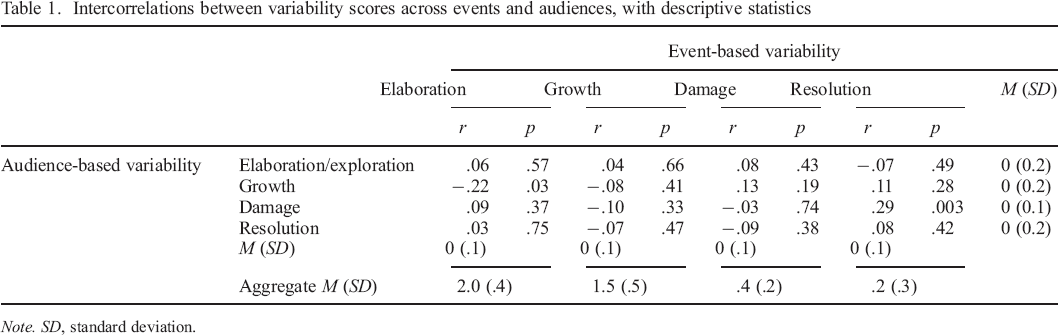
Note. SD, standard deviation.
Intercorrelations of variability on narrative dimensions for event–based variability (below diagonal) and audience–based variability (above diagonal)
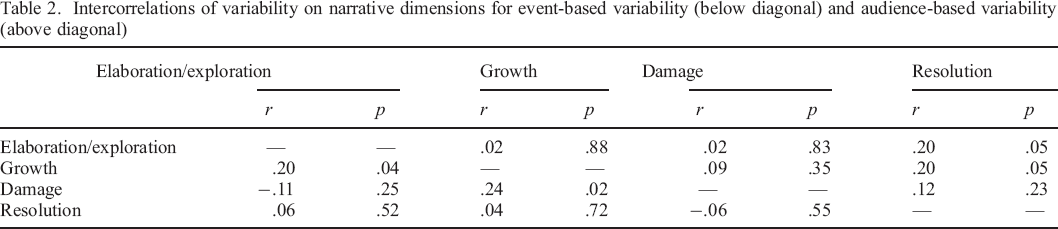
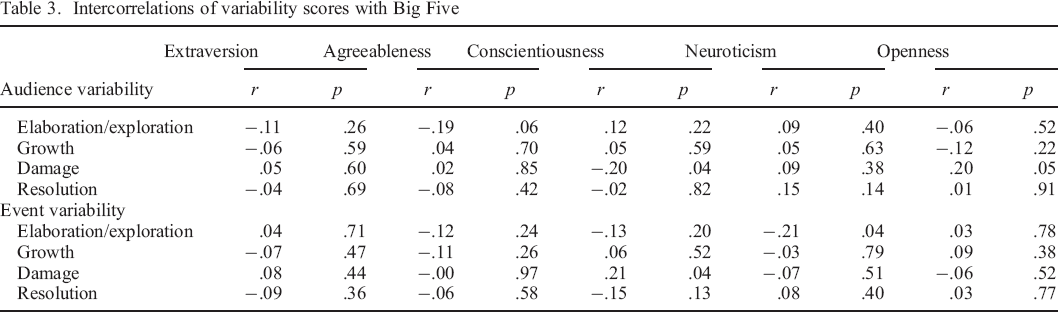
Table 3 reports correlations of residualized variability scores with the Big Five. As seen there, variability scores were also largely unrelated to Big Five personality measures, and the number of significant correlations present in the table would be expected by chance.
Intercorrelations of variability scores with Big Five
Relationships between Narrative Iiv and other Measures
Narrative Iiv around Events
Table 4 shows results for narrative IIV around events. As can be seen in the table, the regression analyses were only statistically significant for subjective well–being, and in that case, the only significant predictor was average levels of damage themes. Higher levels of damage themes overall were associated with lower subjective well–being. Our directional hypotheses were that greater variability across events in growth, damage, and resolution would be associated with higher well–being and lower depression scores, higher self–concept clarity, and higher scores for identity. These hypotheses were not supported.
Regressions predicting self, developmental, well–being, and relational outcomes from narrative IIV across events
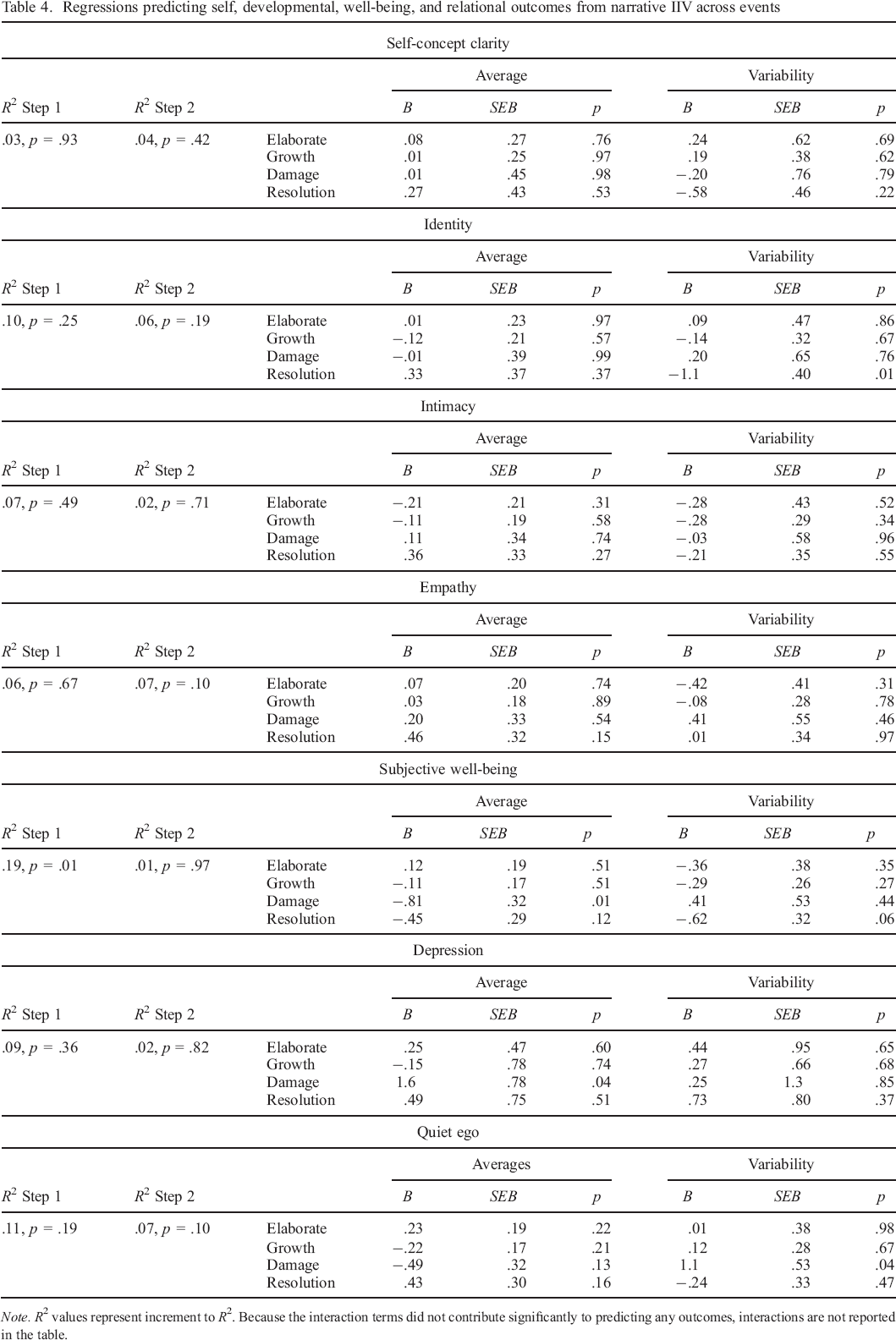
Note. R2 values represent increment to R2. Because the interaction terms did not contribute significantly to predicting any outcomes, interactions are not reported in the table.
Narrative Sensitivity: Iiv around Audiences
Results of regressions examining links between narrative features (averages, variability–by–audience, and interactions) are shown in Table 5. As can be seen there, only one regression analysis showed overall significant prediction, and that was for subjective well–being. People whose narratives averaged higher levels of damage themes and higher levels of resolution reported poorer subjective well–being.
Regressions predicting self, developmental, well–being, and relational outcomes from narrative IIV across audiences
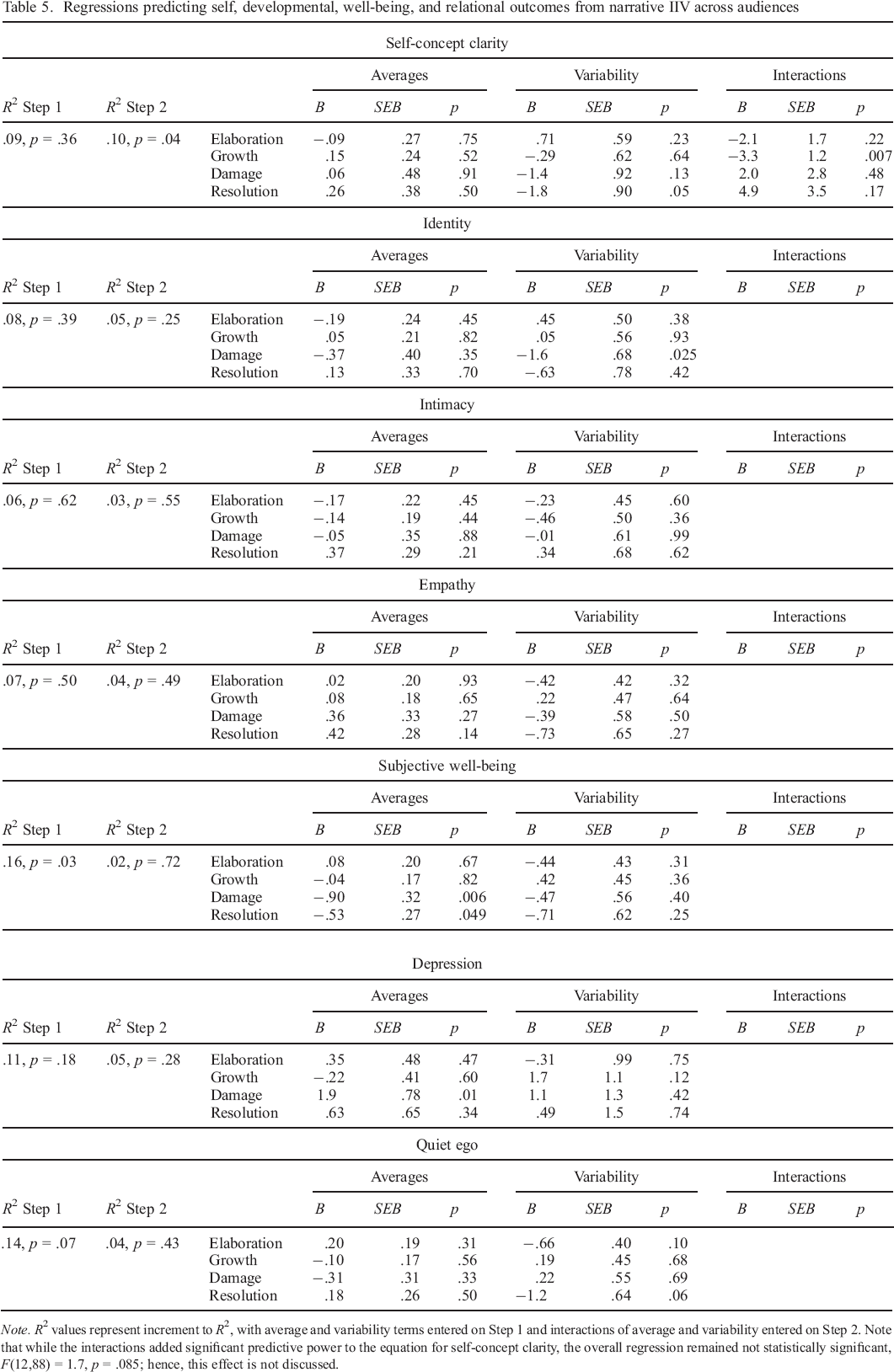
Note. R2 values represent increment to R2, with average and variability terms entered on Step 1 and interactions of average and variability entered on Step 2. Note that while the interactions added significant predictive power to the equation for self–concept clarity, the overall regression remained not statistically significant, F(12,88) = 1.7, p = .085; hence, this effect is not discussed.
We had hypothesized that higher variability across audiences in general would be related to lower self–concept clarity, lower identity scores, and lower well–being, but potentially with higher intimacy and empathy scores. We further expected that these patterns would be most likely evident for variability across audiences in growth, damage, and resolution rather than elaboration. Our results did not support these predictions.
Discussion
Above, we have presented an exploratory examination of two aspects of narrative IIV—narrative differentiation and narrative sensitivity. Our initial analyses focused on examining whether differentiation and sensitivity were distinct from one another and whether they required dimension–specific exploration. As expected, narrative IIV is relatively source specific (e.g. sensitivity and differentiation are largely uncorrelated) and dimension specific (e.g. elaboration variability is not highly correlated with damage variability), consistent with earlier work from our research group (McLean et al., 2017). The most important implication of these initial findings is that researchers investigating narrative IIV will need to focus on specific sources and dimensions of variability at all phases of research.
Because the specificity of narrative IIV leads to a relatively large array of possibilities for researchers, we also wanted to examine whether some sources and dimensions might be more productive avenues than others, particularly in relation to well–being, self, and social development outcomes. We note that there may be multiple factors that contribute to narrative differentiation and narrative sensitivity, some implicit and some explicit, including non–conscious adaptation to the current context, deliberate impression management, and many others. We focused on whether and how individuals might show differentiation and sensitivity as a first step in exploring intraindividual differences in narrative style. Overall, our analyses revealed few links between narrative IIV and our particular measures of self and social development or well–being, for the dimensions and sources of variation examined here.
Are these approaches to narrative IIV dead ends? One possibility is that the variability we captured is not a reliable and stable property of individuals—that someone whose narrative differentiation or sensitivity was high in our study will not necessarily show stability in that high score over time. It is possible that within–person narrative variability should not be conceptualized as a property of the person, as with traits, but as a dynamic interaction of the person, the event, and the passage of time. We know that narratives vary as a function of time since the event and possibly the number of times already told, as well as with the narrator's developing capacities to engage in meaning making. Thus, narrative variability may reflect a contextual and temporal process rather than a stable characteristic of the person across time and context (e.g. Fivush et al., 2017).
Although this interpretation presents a highly complex problem of how to conceptualize narrative variability as a temporal process, the possibility that this may be the necessary conclusion is supported by the existence of few relationships between trait personality and narrative IIV. Regardless of personality trait levels, creating meaning from lived experiences may take time. Further, these temporal parameters may be different for individuals with different underlying traits, as well as the type of meaning made. There is another possibility, however, which is that, like similar approaches to trait variability (Baird et al., 2006), narrative IIV, as we have captured it, is simply not relevant for the aspects of well–being and development that we examined here.
For differentiation, we might conclude that distinguishing the key episodes in the life story interview by narrating them differently is something people do (McLean & Lilgendahl, 2008; Pasupathi et al., 2019), but despite the fact that some might do so to a greater extent than others, that tendency is not tied to well–being or self and social development. This is quite good news for an aggregation approach to studying life story episodes—it suggests that the aggregation approach captures the important aspects of narrative identity. This should be reassuring to those of us working within the life story and other aggregation–focused approaches. As with differentiation, for sensitivity, our findings suggest that distinguishing narratives for different audiences in an a priori or anticipatory way (consistent with our design) is something people do to varying degrees, but again, that variation is not overwhelmingly important for well–being and self and social development.
That said, we have only examined one set of features of narrative and two sources of variability, and we have attempted to link those features to only a limited set of indicators of self and social development and well–being, although arguably, we addressed key aspects of well–being as previously studied in this field. There remain potential avenues for examining within–person variability that are untapped. These include within–person variability in the way an event is narrated across time, as well as considering variability in other features of narratives such as motivational and affective themes. Examining narrative variability across events that have different emotional qualities (Fivush, Berlin, Sales, Mennuti–Washburn, & Cassidy, 2003; Habermas et al., 2009) and including different types of self and social development indicators might still provide evidence that narrative IIV is meaningfully related to self and social development.
For example, aspects of self and social development that tap the increasing complexity with which people conceive of themselves in relation to their experiences and their social worlds, such as ego development (Loevinger, 1966), might be important to examine in future work. Further, the possibility for dynamic relations between measures of intraindividual variability in narrative and assessments of self and social development may require longitudinal examination for a fully adequate test. Self–development, social development, and well–being are known to be interrelated, and we did not account for this in our models in the present paper. Finally, our study focused on emerging adults, where both self and social development are more in flux than would be the case in adulthood ‘proper’ and where variability might be adaptive for the accomplishment of specific developmental tasks that were not assessed as part of this project (e.g. Hutteman, Hennecke, Orth, Reitz, & Specht, 2014). In fact, in lifespan developmental psychology, variability often indicates the potential for change, whether positive, as in strategy acquisition in learning in childhood (e.g. Siegler, 2007), or negative, as in cognitive decline with aging (Nesselroade & Ram, 2004). From this standpoint, narrative IIV might indicate something like the change potential in someone's narrative identity—whether or not that potential gets realized. Further investigating this possibility would require assessments of changes in narrative identity longitudinally, as well as the potential to assess narrative IIV at one point in time.
For narrative sensitivity, some additional considerations are warranted for future work. Our protocol may have encouraged participants to make larger a priori distinctions between different audiences than they otherwise would, but we cannot rule out the possibility that some variation was related to participants’ responsiveness to demand characteristics rather than their capacity to tune stories for different relational settings. In addition, participants’ relationships with mothers and friends have distinctive, individual–specific properties that we did not capture with our audience manipulation and that may obscure differences between these two audiences in the aggregate. Most importantly, our design falls short of an examination of in vivo narrative sensitivity, and social competence may be better reflected by in vivo narration.
Untapped Potential
Given the preponderance of null effects in our analyses as well as the number of tests we conducted, despite preregistration, one question is whether there is any utility in continuing to investigate narrative IIV. Beyond investigations of narrative sensitivity in relation to in vivo audiences, and a more comprehensive examination of self and social development, we believe that there remain areas of investigation that warrant continued attention. One is directional variability in narration. Our investigation of narrative IIV was ‘directionless’, drawing on the work of trait theorists (Baird et al., 2006; Fleeson & Jayawickreme, 2015). Other approaches to IIV in personality look at the specific nature of people's profiles across distinct situations (e.g. Mendoza–Denton et al., 2001), taking both variation and the direction of that variation into account by extracting if–then relationships for people (e.g. if peer teases, then respond with aggression; if counsellor teases, respond with withdrawal). For our purposes, the analogy would be comparing the implications of narrating negative experiences more elaboratively than positive, versus the opposite pattern, versus not distinguishing the two experiences in elaboration. Such approaches require relatively large samples, of both people and stories, and depending on the unknown distributions of those three profiles, the sample requirements may be prohibitively large. Small–scale, qualitative approaches could be useful to identify promising areas for this type of research (e.g. Pasupathi & Wainryb, 2018; Schachter, 2004). Note, too, that qualitative approaches could permit examination of people's experience of variability over time. Our examination here did not address the phenomenological experience of variability or sameness; it is possible that people could vary substantially in the observed characteristics of their stories without perceiving themselves to be varying meaningfully.
Our approach was also to assess variability at one point in time, rather than to examine variability unfolding across successive narrations of the same event, incorporating time into the analysis. Such an approach to narrative IIV remains an avenue worth pursuing, particularly in view of the conceptualization of narrating as a coping process (e.g. Fivush et al., 2003). A third potentially fruitful arena for research focuses on domain specificity in narrative identity, such as work and love lives (Dunlop, Hanley, McCoy, & Harake, 2017; see also Lilgendahl & McLean, 2019). Domain specificity remains a possible direction for future work that is somewhat independent of narrative IIV. Finally, examining how narrative differentiation changes as a function of both development and of time since experiencing the events being narrated might provide a more complex but complete understanding of if and how narrative differentiation is a useful construct.
In sum, we have offered the key concepts of narrative differentiation and narrative sensitivity and have outlined the feature–specific nature of narrative IIV. These concepts can help shape future investigations of narrative IIV. Our empirical findings are likely most productive in supporting the source–specific and feature–specific nature of narrative IIV. Perhaps most importantly, our findings affirm and support the aggregation approach that characterizes much of narrative personality research and prior findings showing that narrative ‘styles’ are more recognizable than chance, even from relatively brief exposures (McLean et al., 2017; Waters et al., 2018). Important elements of people's selves are reflected in the consistencies in their stories, and it will take future work to evaluate whether the variation in people's stories provides additional insights into selves.
Supporting Information
Supporting Information, PER2279-sup-0001 - Intraindividual Variability in Narrative Identity: Complexities, Garden Paths, and Untapped Research Potential
Supporting info item
Supporting Information, PER2279-sup-0001 for Intraindividual Variability in Narrative Identity: Complexities, Garden Paths, and Untapped Research Potential by MONISHA PASUPATHI, ROBYN FIVUSH, ANDREA FOLLMER GREENHOOT and KATE C. MCLEAN, in European Journal of Personality
Supporting info item
Footnotes
Supporting Information
Additional supporting information may be found online in the Supporting Information section at the end of the article.