







Abstract
Most work on self-control and impulsivity typically assumes, more or less tacitly, that people value self-control as more important than succumbing to temptations. According to this narrative, people regard impulsive behaviours as ‘failures’ of self-control and experience negative self-evaluations such as feelings of guilt or shame in response. Here, we direct attention to a neglected but crucial meta-behavioural valuation dimension of impulsive behaviour. We posit that individual differences in people's valuation of temptation enactment (VOTE) qualify whether and to what extent impulsive behaviours trigger negative self-evaluations and whether and to what extent people feel motivated to self-improve. Using a newly constructed VOTE scale, we first show that individual differences in VOTE can be reliably measured and clearly distinguished from traditional impulsivity or self-control scales (Studies 1–3; total N = 576). Across three subsequent studies (total N = 460), we then demonstrate that high VOTE, as compared with low VOTE, reduces the link between impulsive behaviours and negative self-conscious emotions (Studies 4 and 5), as well as between past impulsive behaviour and self-improvement motivation (Study 6). These findings have implications for the discourse on self-control failure and for the link between impulsive behaviour and self-evaluation, self-improvement motivation, and well-being.
Introduction
In daily life, people experience a large number of short-term motivations that are incompatible with their long-term standards and goals (e.g. Baumeister & Heatherton, 1996; Delaney & Lades, 2017; Hofmann, Baumeister, Förster, & Vohs, 2012; Veilleux et al., 2018). Typical examples include the tempting dessert when being on a diet, a sexual impulse for someone other than one's partner, inclinations to consume drugs, or the urge to surfe the internet while working. In such moments, we are typically torn between two motivational forces that compete against each other, accompanied by feelings of conflict (Carver, 2005; Hofmann, Baumeister et al., 2012; Inzlicht & Legault, 2014; Kotabe & Hofmann, 2015; Milkman, Rogers, & Bazerman, 2008). Self-control helps the individual to resist conflicting short-term motivations, often referred to as ‘temptations’, and to behave in a way that is in accordance with endorsed self-regulatory goals, standards, and societal norms (Baumeister, Heatherton, & Tice, 1994; Kotabe & Hofmann, 2015). Accordingly, a growing body of research has carved out numerous benefits of having high self-control abilities (Daly, Baumeister, Delaney, & MacLachlan, 2014; de Ridder, Lensvelt-Mulders, Finkenauer, Stok, & Baumeister, 2012; Mischel, Shoda, & Peake, 1988; Moffitt et al., 2011; Wiese et al., 2018).
Adding a much-neglected value dimension
Little is known, however, about how people regard the enactment of temptations. The typical narrative among both scholars of self-control and the portrayal of self-control research in the general public is that people tend to value self-discipline more favourably than the enactment of temptations (but fail for reasons of low motivation or ability). One example from everyday life is that overeating is often explained in terms of bad impulse control or low willpower, as evidenced, for instance, in much of the self-help literature on dieting (e.g. McGonigal, 2011). Hence, the predominant working assumption behind much self-control research is that, deep inside, people want to refrain from giving in to the alluring aspects of tempting stimuli. Consequently, impulsive acts can be regarded as failures of self-control that people try to avoid and generally feel guilty about.
In line with the common narrative equating short-term indulgence with self-control failure, considerable work finds significant (overall) relationships between temptation enactment and negative self-conscious emotions such as shame and guilt (Baumeister, Vohs, DeWall, & Zhang, 2007; Carver & Scheier, 1998; Giner-Sorolla, 2001; Tangney, Stuewig, & Mashek, 2007). For example, research has shown that giving in to food temptations (i.e. candy and chocolate consumption) or even only remembering past impulsive acts is typically followed by negatively valenced self-conscious emotions, such as shame and guilt (e.g. Macht & Dettmer, 2006). Similarly, exceeding and thereby violating one's own standards of alcohol consumption is associated with increased feelings of guilt (Muraven, Collins, Morsheimer, Shiffman, & Paty, 2005a, 2005b). Moreover, a recent study has shown that succumbing to temptation increased levels of guilt, which ‘spoiled’ the pleasure that was typically accompanied with the fulfilment of non-conflicting short-term motivations (Hofmann, Kotabe, & Luhmann, 2013).
In the present work, we do not challenge these overall effects. However, we ask whether this general tendency may already tell us the full story. Intuition and observation certainly underscore the idea that some people may value impulsive behaviours more positively than others. Whereas some may see the enactment of temptations as an interesting, if not essential, part of life, others may emphasize the importance of self-discipline as a virtue. The purpose of this work is to take a closer look at how people actually valuate the enactment of tempting impulses and to show that such variation exists and matters.
Why are such differences not already captured in present measures of impulsivity, self-control, or other related constructs? Whereas many individual differences measures of trait impulsivity or trait self-control (TSC) have been proposed, a close look at prominent measures suggests that they typically address the behavioural and not the valuation dimension, both in theory as well as measurement. For instance, people high in impulsivity have been defined as those who frequently (i) act without thinking, (ii) make quick cognitive decisions, and (iii) lack future orientation in what they do (Patton, Stanford, & Barratt, 1995). Accordingly, a high rating on a typical item from the Barratt Impulsivity Scale such as ‘I act on impulse’ (Patton et al., 1995), answered on a scale from ‘rarely/never’ to ‘always’, does not provide any indication of whether such impulsive action is actually valued in a positive or negative light. Likewise, scoring highly on ‘I am good at resisting temptation’ (Tangney, Baumeister, & Boone, 2004) does not necessarily imply that the person values having high levels of self-control, as one could easily imagine a wit such as Oscar Wilde to have added: ‘—and I deeply regret that’.
Other related traits can be delineated from the valuation of temptation enactment (VOTE). For instance, in his theory of brain functions and behaviour, Gray proposes two dimensions of personality, representing individual differences in the sensitivty of the appetitive and aversive motivational system. The appetitive system, also referred to as the behavioural activation system (BAS), is sensitive to reward signals and propels people to engage in goal-directed behaviour to attain those rewards (e.g. ‘I go out of my way to get things I want.’). The aversive motivational system, also referred to as the behavioural inhibition system (BIS), is sensitive to cues of punishment, non-reward, and novelty and propels people to inhibit behaviour that may incur negative or painful consequences (e.g. ‘I feel pretty worried or upset when I think or know somebody is angry at me.’) (Carver & White, 1994). Whereas BIS/BAS have been linked to components relevant to impulsivity and self-control in multiple ways (Hofmann, Baumeister, et al., 2012), these constructs are very broad in their scope and not specifically geared towards the self-control sphere, leaving room for more specific constructs and measurement. Also, as the aforementioned scales, the BIS/BAS meaures are primarily concerned with the intensity of approach and avoideance-related behaviour and associated immediate affective reactions (e.g. reward and anxiety) rather than with the valuation of the displayed behaviour/reaction in the context of the motivaitonal dilemma of self-control. Finally, influential taxonomies of human values such as the theory of basic values (Schwartz & Bilsky, 1990) include the dimension of hedonism or enjoyment, which can be defined in terms of the broad goal expressed by it, that is, seeking pleasure or sensuous gratification for oneself. Our valuation approach can be situated in this general area but represents as a more context-specific application thereof, one that was specifically tailored to the self-control domain as detailed in our measurement approach in the succeeding text.
Why would individual differences in the VOTE matter? Our main line of argument is that this valuation dimension may critically shape how individuals construe, appraise, and ultimately 'make sense'of their behaviours in the self-control domain. Suppose an individual regards (occasional) temptation enactment as perfectly fine or even an essential/authentic part of one's life. For that individual, giving in to alluring conflicting impulses should not be construed as an incident of self-control failure. Consequently, this individual should display little to no negative self-evaluations when engaging in impulsive behaviours. He or she may also not feel the impetus to change his or her own future behaviour towards more self-discipline but rather be reasonably satisfied with how things are and how life is lived. In other words, individual differences in the VOTE may have important consequences for self-evaluation, well-being, and the motivation to self-improvement through the way people construe their behaviours.
Preliminary evidence for such a moderating role of VOTE comes from research that has shown that the way people justify impulsive indulgences affects the intensity of resulting self-conscious emotions. For instance, Prinsen, Evers, and de Ridder (2016) found that (situation-specific) justifications for indulgences can attenuate the link between impulsive indulgences and negatively valenced self-conscious emotions. Participants who received a licence for giving in to a tempting chocolate pie experienced less aversive self-conscious emotions of guilt in comparison with participants who did not receive such a licence. Whereas these findings are encouraging for the hypothesis that individuals' value ascription towards temptation enactment qualify the link between impulsive behaviours and negative self-evaluations, these studies did not directly measure and demonstrate the presumed moderating role of individual differences in such valuations.
However, by neglecting the values people ascribe towards temptation enactment, scholars of self-control and public policymakers alike may falsely assume that individuals may have construed such impulsive deeds as problematic incidents of self-control failures. Such a normative, outsider's perspective is dangerous in that it may result in a misleading, premature, and perhaps overly moralized picture of (all-to) human behaviours. A deeper understanding of what constitutes a self-control failure for whom and with what consequences for self-evaluation and self-change is of vital importance for our theoretical understanding of self-control failure as well as for psychologically informed public policy making.
The present research
The present research strived to take a closer look at how people value temptation enactment and to scrutinize its implications for the study of self-control failure. In doing so, we had two major aims: First, we sought to demonstrate that individual differences in how people valuate temptation enactment exist and that these can be measured reliably. To this end, we developed and validated a measure that strives to assess individuals' VOTE in Studies 1 to 3. We expected that such a measure, due to its explicit focus on the valuation of impulsive behaviours, would be correlated with but separable from traditional measures of impulsivity or self-control. Because of its evaluative nature, we conceptualized the VOTE construct as a relatively stable disposition, similar to a broad attitude measure. Furthermore, even though VOTE is based on theories of self-control that posit a conflict between short-term and long-term motivation (hence the dilemma of self-control), it is not a measure of goal conflict strength itself.
Second, we aimed to show that the value individuals place on temptation enactment modulates whether impulsive behaviours are construed as problematic incidents of self-control failure, as manifested in negative self-evaluative processes (i.e. feelings of shame and guilt). To do so, we utilized both general assessments of a broad spectrum of impulsive behaviours (Study 4), as well as domain-specific assessments of impulsive behaviours in a field setting (overeating at the local cafeteria; Study 5). Finally, we also sought to show, in the context of eating behaviour and body weight, that impulsive behaviours do not necessarily trigger a motivation for change or self-improvement (i.e. weight loss), unless temptation enactment is devalued (Study 6). In sum, we strived to show that impulsive behaviours cannot be equated with self-control failures; rather, this link hinges on individuals' value systems.
We report on six focal studies taking an individual differences approach to VOTE, involving a total of 1036 participants. In the absence of prior research on the strength of the presumed moderator effect of VOTE for Studies 4 to 6, we assumed a small to medium effect size. A test of increase in R2 due to the interaction term between two predictors in a multiple regression is equivalent to the test of significance of the interaction term coefficient. Assuming a small to moderate effect size f2 of.08, an α level of .05, and 80% power to detect the effect, at least 101 participants are required for each moderator study (GPower; Faul, Erdfelder, Lang, & Buchner, 2007). Wherever possible, we used available third-party funding to increase sample size over and above that benchmark to optimize statistical power. We did not preregister our aforementioned hypotheses before data collection. We report all data exclusions and all measures and manipulations in those studies. Materials, data, and code for all studies are available at https://osf.io/apqnh. All data were collected in a manner consistent with ethical standards for the treatment of human subjects. To ensure data quality, we included a seriousness check item (Aust, Diedenhofen, Ullrich, & Musch, 2013) for all six studies. Except for one participant in Study 1, all remaining 1035 participants (99.9%) passed the check, so we decided to simply include all participants in analyses.
Study 1: Scale development (exploratory factor analysis)
Items, factor loadings, means, standard deviations, Cronbach's α changes, and item-total correlations of the final 10-item valuation of temptation enactment scale
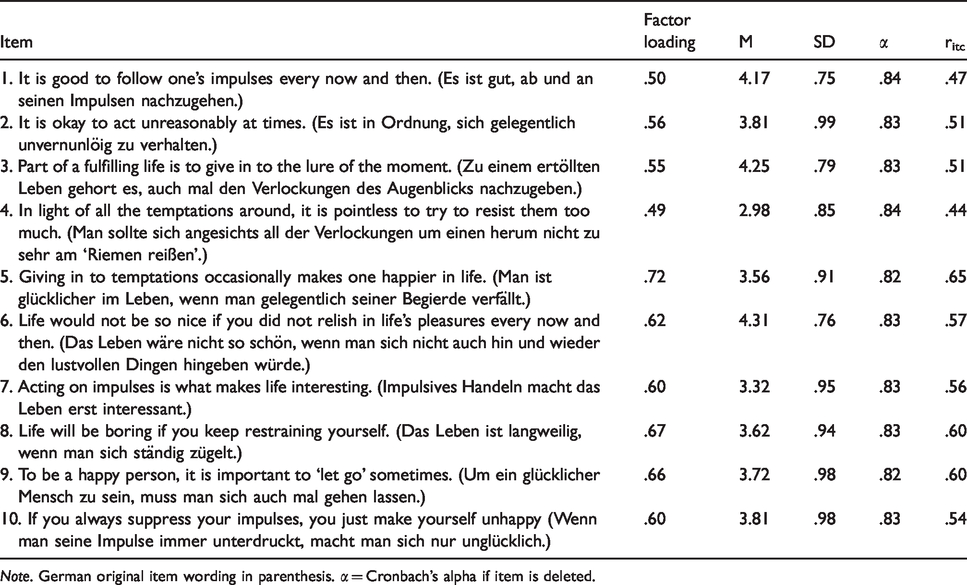
Note. German original item wording in parenthesis. α = Cronbach's alpha if item is deleted.
Method
Participants, materials, and procedure
The sample consisted of 280 participants from Germany (83% female participants; mean age = 24.16, SD = 6.15, range = 18 to 61) who were recruited online via various posts on social media sites and a participation newsletter. The study was announced as a brief scientific study as part of a dissertation project. As monetary incentive, we offered a lottery of three €20 vouchers among all participants. After having provided informed consent, participants were instructed that As humans, we are confronted with various temptations time and again. Sometimes, we enact such temptations, and hence act ‘impulsively’, and sometimes we do not enact them. In the following, we would like to learn how you generally think about such situations.
They then completed the set of 20 items on a five-point scale from 1 do not agree at all to 5 fully agree. Participants then indicated demographics, completed the seriousness check, were debriefed, and were compensated for their participation.
Successive item exclusion
We conducted an initial principal axis analysis with promax rotation. The Kaiser-Meyer-Olkin measure of sampling adequacy (.89) and the Bartlett's test of sphericity, χ2(45) = 776.7, p < .001, revealed that items were significantly correlated. The exploratory factor analysis revealed one strong factor with an eigenvalue of 6.73 accounting for 30.93% of the overall variance and three much smaller factors with eigenvalues of 1.63 (8.15%), 1.29 (6.47%), and 1.16 (5.80%). To cut the number of items down towards a still simpler and more economic final scale, we first eliminated seven items based on a discussion of item content as these tapped into more peripheral aspects (i.e. appraisal of impulsive people). We then excluded more unspecific, general statements regarding hedonism (e.g. ‘If you do not enjoy life to the fullest, you have not lived properly.’) and more extreme or somewhat contradictory item formulations (‘For well-being, it is also beneficial to satisfy unhealthy needs.’) (Table S1). We also dropped one item (‘Only those who let themselves go will lead a pleasurable life.’) with a relatively large semantic overlap with another item (‘To be a happy person, it is important to “let go” sometimes’). The remaining list of 12 items was subject to a reliability analysis. Based on the results, we eliminated two further items with an item-total correlation below .40 (‘Everybody has to “let off steam” once in a while by obeying to his/her own impulses and needs.’; ‘Never giving in to an urge could be harmful to the body.’).
Results
The resulting final set of 10 items showed good internal consistency, Cronbach's α = .84, and item-total correlations above .40 for all items. The exploratory factor analysis performed on the final selection revealed a clear one-factorial solution with an eigenvalue of 4.17 (next highest eigenvalue = 1.02) accounting for 35.85% of the overall variance. The final items, their means, item-total correlations, and factor loadings are displayed in Table 1.
Study 2: Confirmatory analysis of the final vote scale
To corroborate the exploratory analyses in Study 2, we subjected the final, 10-item version of the VOTE scale to a new sample and re-examined its psychometric qualities. In addition, we performed a confirmatory factor analysis to corroborate the factorial validity of the scale.
Method
Participants, materials, and procedure
Participants were 147 participants from Germany (78% female participants; mean age = 25.54, SD = 8.75, range = 18 to 89) who were recruited online via various channels and compensated via a raffle of three €15 gift cards. After consent was provided, participants completed the short 10-item scale and indicated their demographics. They then completed a seriousness check (Aust et al., 2013), were debriefed, and were compensated for participation.
Results
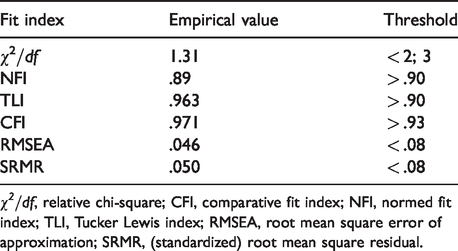
As in Study 1, the final VOTE scale displayed good internal consistency, Cronbach's α = .83. Next, we conducted a confirmatory factor analysis of the measure. The obtained model fit indices are summarized in Table 2, indicating good to very good model fit. The loadings of each item on the latent VOTE factor are depicted in Figure 1. Together, these analyses corroborate the internal validity and structural validity of the VOTE scale. We therefore used the final, 10-item scale for the remainder of the research programme presented in this article.
Confirmatory factor analysis presenting standardized regression weights (Study 2). Overview of empirical values for model fit indices and threshold for model fit indices (Study 2) χ2/df, relative chi-square; CFI, comparative fit index; NFI, normed fit index; TLI, Tucker Lewis index; RMSEA, root mean square error of approximation; SRMR, (standardized) root mean square residual.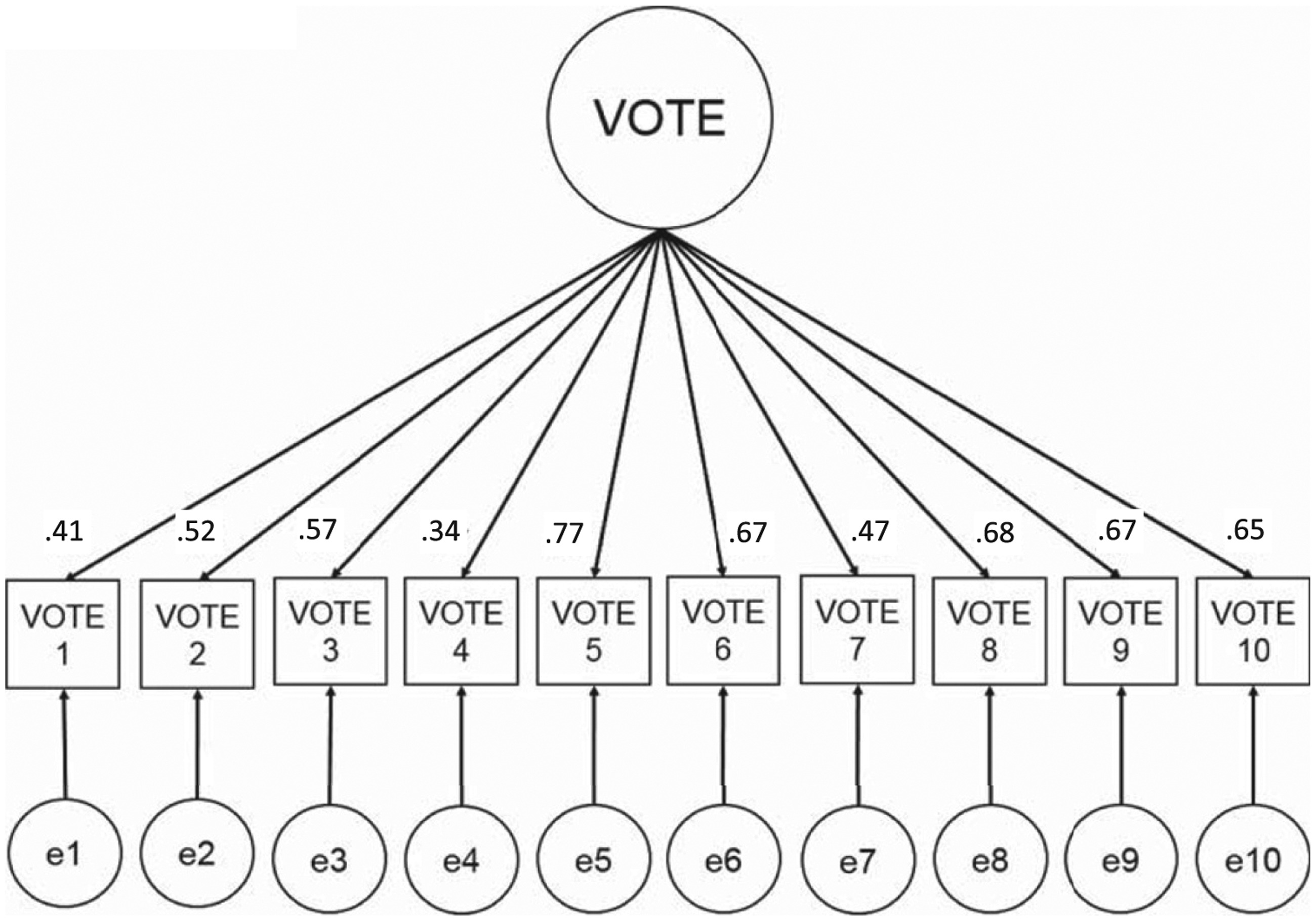
Study 3: Convergent and divergent validity
The purpose of this validation study was to investigate the convergent and discriminant validity of the VOTE scale. In light of our aforementioned key goal to separate impulsive behaviour from its valuation, our theoretical key focus was on its associations with a range of traditional measures of impulsivity and self-control (e.g. trait impulsivity, BAS, and TSC). Due to the conceptual differences outlined previously, we expected only small to medium size relationships among the VOTE scale and traditional measures of impulsivity and self-control. We also included a broad measure of general hedonism. Because general hedonism taps into people's general emphasis on and preference for having fun and doing things that give pleasure in life (Schwartz, 1992), we expected a substantial positive association between general hedonism and VOTE. However, as the VOTE measure was constructed so as to explicitly assess the valuation of impulsive behaviour (e.g. ‘It is good to follow one's impulses every now and then.’) and to the underlying tension between giving in to temptation and restraining oneself (e.g. ‘Giving in to temptations occasionally makes one happier in life.’; ‘Life is boring if you keep restraining yourself’; see Table 1), we expected this association to be non-perfect and our measure to be more relevant and predicitve for the self-control context. Moreover, we also included more distal measures of self-regulation in general such as self-efficacy (see succeeding texts, for references to these constructs). Furthermore, we were interested in its relationships with well-being, particularly life satisfaction, and explored basic demographic correlates (gender, age, religiosity, and political orientation) but did not enterain specific hypotheses regarding these variables.
Method
Participants and procedure
The sample consisted of 149 participants from Germany (81% female participants; mean age = 24.19, SD = 6.64, range = 18 to 55), recruited online via various channels. As monetary incentive, we offered a lottery of three €15 gift cards among all participants. The main part consisted of a battery of measures described in the succeeding text. At the end of the study, participants provided their demographics, completed a seriousness check (Aust et al., 2013), were debriefed, and were compensated for participation.
Materials
Means, standard deviations, scale range, and zero-order correlations with valuation of temptation enactment in Study 3
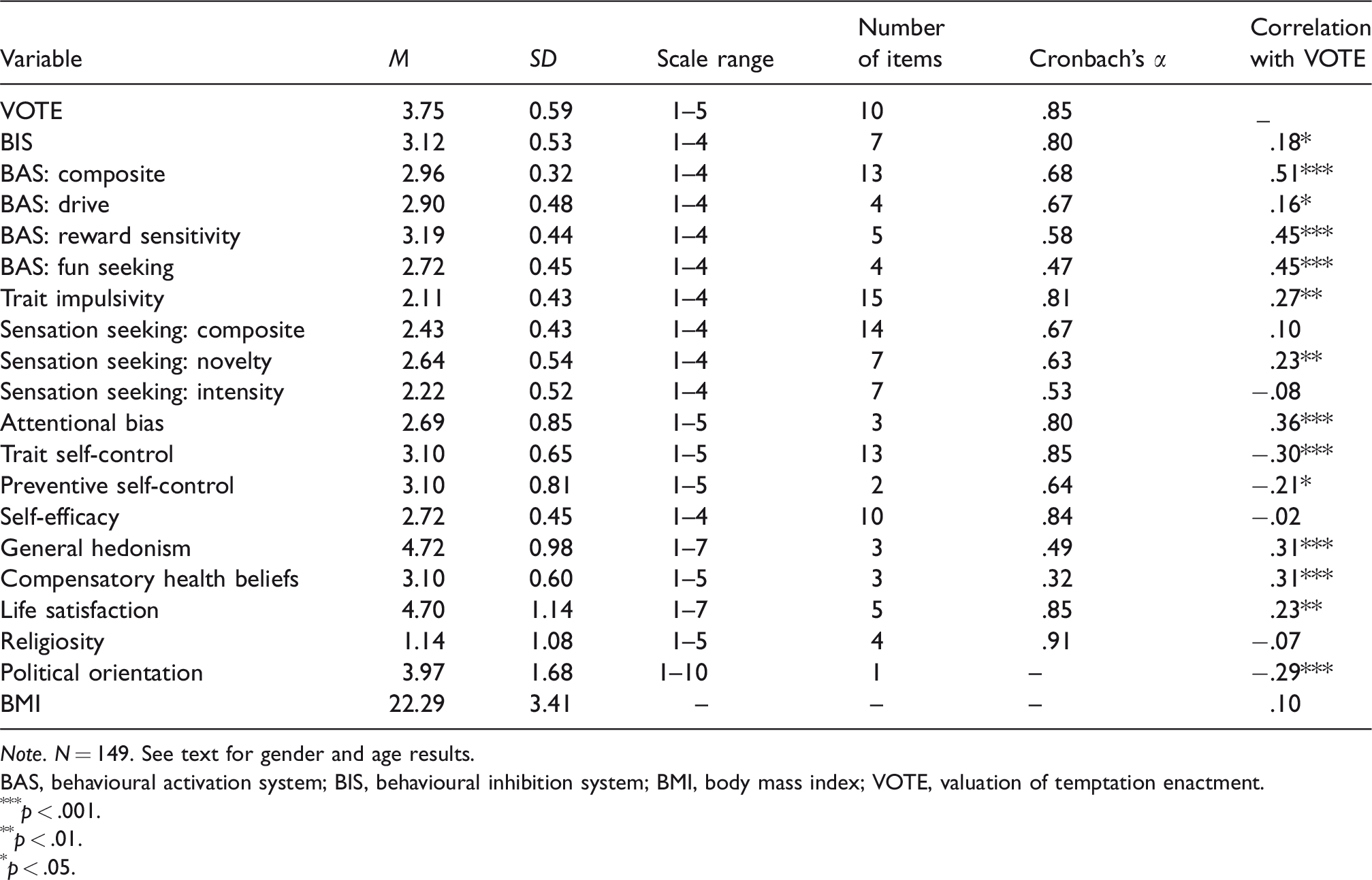
Note. N = 149. See text for gender and age results.
BAS, behavioural activation system; BIS, behavioural inhibition system; BMI, body mass index; VOTE, valuation of temptation enactment.
p < .001.
p < .01.
p < .05.
Results
Table 3 also provides the zero-order correlations between the VOTE scale and all assessed variables. Most correlations were clearly in a direction consistent with our theoretical approach. For instance, VOTE was positively associated with traditional measures of impulsivity such as the BAS scales, the Barratt impulsivity measure, or the more specific measure of attentional bias and negatively associated with TSC or related constructs such as preventive self-control. At the same time, most correlations were in the medium range, suggesting that none of these constructs overlapped too closely with the VOTE measure. Albeit small, we found an unexpected positive association with BIS (r = .18, p = .027).
Regarding demographic variables, there was no relationship between VOTE and religiosity and body mass index (BMI) (Table 3). As gender and age were routinely assessed, we meta-analysed their correlations with VOTE across the seven main studies using the METAFOR package (Viechtbauer, 2010) for a more comprehensive picture. Regarding gender, the overall relationship from a random-effects model was r = .115, p = .025, with a 95% confidence interval from 0.015 to 0.216, suggesting a very weak tendency for female participants to report slightly higher VOTE scores (see Figure S2, Panel A, for a forest plot of meta-analytic results). Regarding age, the overall relationship was r = .053, p = .093, with a 95% confidence interval from −0.009 to 0.114, suggesting no to a very weak relationship between age and VOTE (see Figure S2, Panel B).
To better visualize how the VOTE construct is embedded within the larger nomological network of psychological constructs assessed, we conducted a psychological network analysis using the qgraph package in R (Epskamp, Cramer, Waldorp, Schmittmann, & Borsboom, 2012). We included all psychological constructs listed in Table 3, using the composite scores of BAS and sensation seeking to reduce complexity. As can be seen from Figure 2, VOTE emerged as a relatively central node in the network that was positively connected to satisfaction with life, BAS, attentional bias, and hedonism. A multiple regression analysis confirmed that, even though VOTE and TSC were negatively associated with each other, both positively predicted life satisfaction independently, βSVOTE = .36, p < .001 and βTSC = .44, p < .001, a finding we will come back to in the general discussion. In addition, the network analysis yielded a number of interesting side findings, such as a strong connection between TSC and our newly developed measure of preventive self-control and reduced attentional bias, confirming prior re-interpretations of this construct (Hofmann, Baumeister et al., 2012).
Network visualization of relationships among valuation of temptation enactment and all other constructs in Study 3. Each node represents a construct, and each edge (line) represents a residual connection between two constructs that takes into account indirect connections as well. Green/straight edges indicate positive associations, red/dotted edges negative associations, and the width of the edges correspond to the relative strength of the association (the thicker, the stronger). [Colour figure can be viewed online]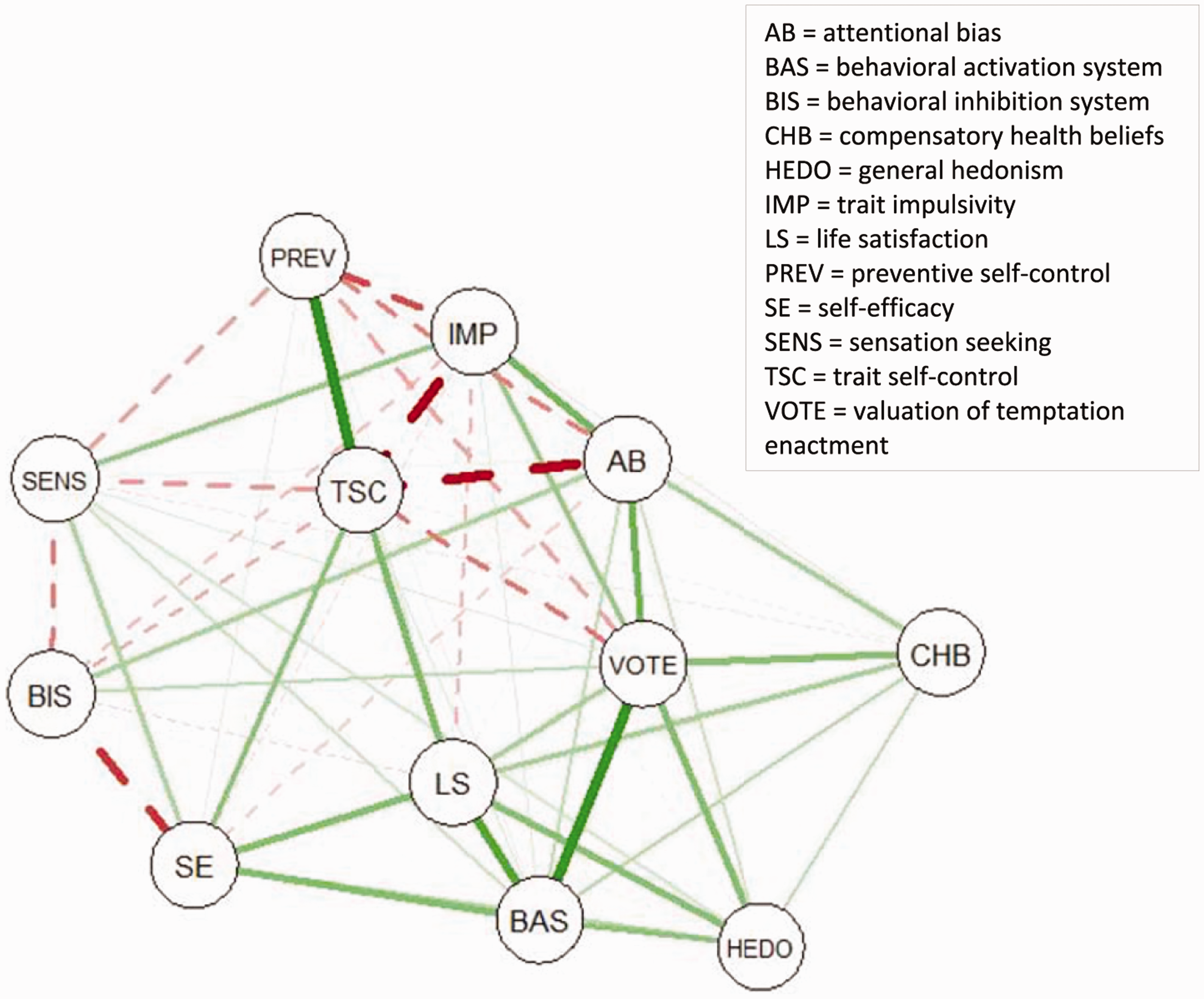
In sum, these results support the criterion validity of the VOTE measure and provide evidence for its convergent and divergent validity, suggesting, as expected, that adding an evaluative layer of temptation enactment resulted in a construct that is empirically clearly distinguishable from traditional measures of impulsivity and self-control. With construct validity established, we turned to our investigation of the assumed moderating role of VOTE for the relationships between temptation enactment and consequences for self-evaluation and self-improvement motivation.
Study 4: Oops, i did it again … (so what?)
The aim of Study 4 was twofold. First, we strived to test the validity of the basic predictions in the domain of negatively valenced self-conscious emotions, namely, current feelings of shame and guilt. We predicted that, compared with individuals ascribing more negative values towards temptation, those ascribing more positive values towards temptation enactment would experience lower levels of shame and guilt when having behaved in an impulsive manner. In other words, we expected VOTE to buffer an otherwise positive association between impulsive behaviours and negative self-evaluations, as captured by feelings of shame and guilt. Even though shame and guilt can be conceptually differentiated (Tangney, 1995; Tangney et al., 2007; Tangney & Dearing, 2002) (Tangney, 1995; Tangney et al., 2007; Tangney & Dearing, 2002) they often tend to co-occur in general (Lewis, 1987) and in particular as a result of succumbing to temptation (Prinsen et al., 2016; Stuewig & Tangney, 2007). For this reason, we scrutinized both their separate as well as composite effects.
Second, the current study strived to provide evidence for the incremental benefit of assessing individuals' VOTE using the VOTE measure in comparison with traditional measures. To this end, we added measures of trait impulsivity, TSC, and general hedonism and scrutinized whether the expected moderating role of VOTE prevails when controlling for these variables.
Method
Participants
Around 132 participants, (72% female participants; 89% university students; mean age = 23.35, SD = 5.46, range 18 to 61) were recruited online via various channels and compensated via a raffle of four €25 gift card vouchers. Based on a screening of IP addresses, one participant appeared to have participated twice, so we only included the first valid response. 1 Hence, the final sample size was N = 131. All participants were eligible to take part in a lottery to win several Amazon gift cards, each worth of €25.
Materials and procedure
Participants were informed that they were to take part in two independent studies. Specifically, we told participants that the goal of the first study was to investigate the relationship between different behavioural measures, whereas the goal of the second study was to assess the frequency of everyday life experiences and its relation to memory performance. Following the cover story, all participants filled out the VOTE scale (a = .81), our key moderator candidate. In addition, they also completed the Brief Self-Control Scale (Bertrams & Dickhäuser, 2009; Tangney et al., 2004; α = .84), a measure of trait impulsivity (Barratt Impulsiveness Scale; Meule, Vögele, & Kübler, 2011; Spinella, 2007; α = .78), and a measure of general hedonism (Audebert et al., 2006; α = .55) as control variables. The order of these control measures was counterbalanced across participants. In order to bolster the cover story, participants were asked to wait several seconds before being redirected to the second study and had to work on an ostensible memory task. This memory task required participants to name all federal states of Germany that were coming up to their minds.
As our independent predictor variable, we employed a measure of impulsive behaviours that assesses the frequency of impulsive behaviours across a broad range of variables, which has been adopted and modified from prior research (Job, Walton, Bernecker, & Dweck, 2015). Specifically, we asked participants to indicate the frequency of impulsive behaviours in the prior week on a 7-point scale (1 = never, 2 = once, 3 = twice, 4 = 3–4 times, 5 = 5–6 times, 6 = once a day, and 7 = two or more times per day). These behaviours included (i) procrastination, (ii) consumption of unhealthy foods and drinks, (iii) overconsumption of addictive drugs, (iv) poor time management, (v) impulsive spending, and (vi) failures to control emotions and impulses. The moderate Cronbach's α of .57 reflects the breadth of this composite measure. 2
As dependent variables, we assessed participants’ feelings of shame (e.g. ‘I feel ashamed how I have behaved in the previous week’, α = .96) and feelings of guilt (e.g. ‘I have a bad conscience of how I have behaved in the previous week’, α = .92) via two items each on a five-point scale (0 = not at all to 4 = very much). Both self-conscious emotions were in reference to their behaviour in the prior week. Moreover, to exclude that any effects are driven by general affective state, we additionally assessed positive and negative affect using the PANAS (Krohne, Egloff, Kohlmann, & Tausch, 1996; positive affect: a = .64; negative affect: a = .58). All dependent variables were counterbalanced across participants. As expected, we did not find any main effects of the measure of impulsive behaviour or VOTE or any interaction effects between both variables on positive or negative affect (all ps > .471). Hence, we will only report the findings with regard to self-conscious emotions. Feelings of shame and guilt were highly interrelated (r = .82, p < .001), hence we also computed a composite index, aggregating both negatively valenced self-conscious emotions (α = .90). Finally, participants filled out a seriousness check (Aust et al., 2013), provided demographic variables, were debriefed, and compensated for their participation.
Results
Means, standard deviations, and correlations of core variables in Study 4
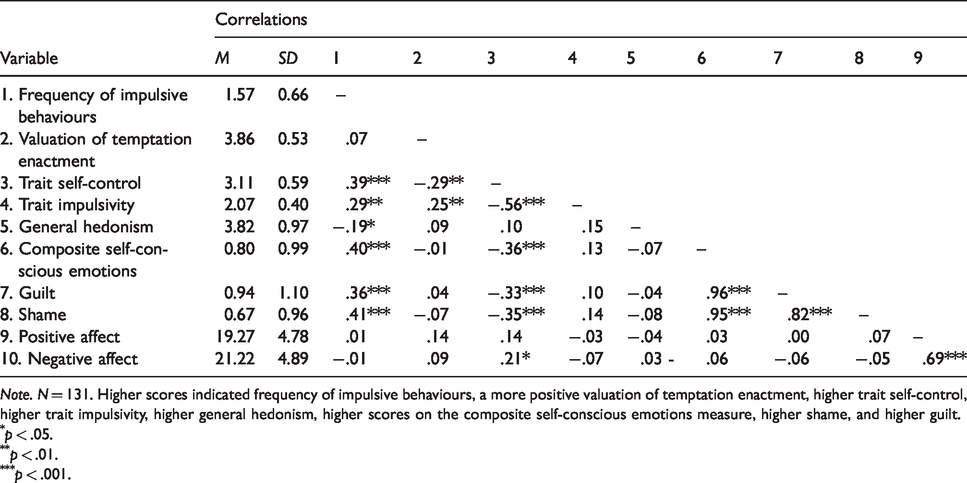
Note. N = 131. Higher scores indicated frequency of impulsive behaviours, a more positive valuation of temptation enactment, higher trait self-control, higher trait impulsivity, higher general hedonism, higher scores on the composite self-conscious emotions measure, higher shame, and higher guilt.
p < .05.
p < .01.
p < .001.
The moderated regression results are shown in Table 5. Over and above the main effects, the regression analysis (R2 = .19) for the analysis without covariates revealed a significant two-way interaction between the frequency of impulsive behaviours and VOTE (B = −0.45, β = −.16, t (120) = −2.09, 95% CI [−0.87, 0.02], p = .038). The interaction effect is illustrated in Figure 3. Simple slope analyses (Hayes, 2013) corroborated our predictions such that among participants scoring low (−1 SD) on VOTE, more frequent impulsive behaviours in the previous week were much more strongly positively associated with the composite guilt and shame score, B = 0.82, p < .001, as compared with participants scoring high (+1 SD) on VOTE, B = 0.35, p = .048. Moreover, among participants reporting high (+1 SD) impulsive behaviours, those low (−1 SD) in VOTE showed significantly elevated negative self-evaluation as compared with those high (+1 SD) in VOTE, B = −0.49, t(120) = −2.23, 95% CI [−0.925, −0.056], p = .027 (Figure 3).
Composite self-conscious emotions as a function of frequency of impulsive behaviours and valuation of temptation enactment in Study 4. Estimated simple slopes are based on values one standard deviation below and above the mean of frequency of impulsive behaviours and valuation of temptation enactment. ***p < .001. *p < .05. Overview of regression results for moderator analysis predicting composite self-conscious emotions from frequency of impulsive behaviours and valuation of temptation enactment, both without and with control variables included (Study 4) Note. N = 131, = .19, p < .001, and R2 = .27, p < .001 for first and second model, respectively. CI = confidence interval for B; FIB = frequency of impulsive behaviours. All predictor variables were mean-centred prior to analysis.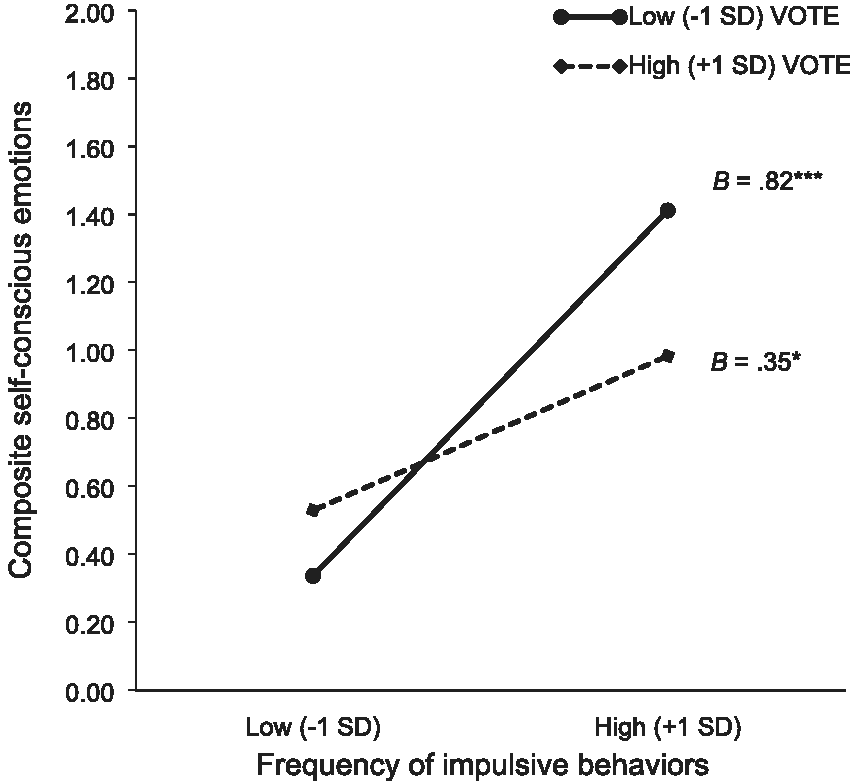
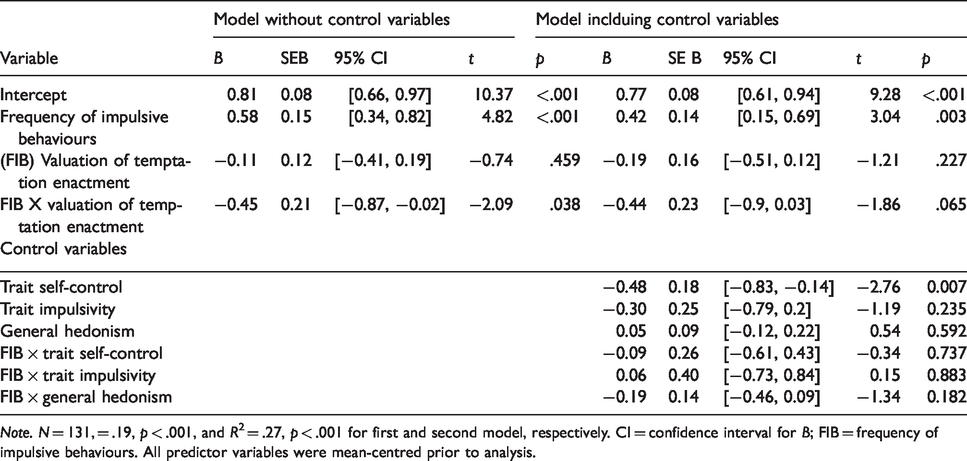
The inclusion of covariates reduced the earlier effect to non-significant, B = −0.44, p = .065. The general pattern of results was very similar, however, and none of the control variables exerted a comparable interaction effect (all ps > .182). Follow-up analyses revealed that the interaction effect for the composite measure was mainly driven by a significant interaction effect on feelings of guilt, B = −0.60, β = −.19, p = .015, and remained significant when including covariates (Table S2). The interaction effect on feelings of shame was in the expected direction but not significant, B = −0.30, β = −.11, p = .158 (Table S3). Both interaction effects are displayed in Figure S1.
Discussion
Study 4 provided a good starting point for the basic prediction that impulsive behaviours cannot be equated with problematic incidents of self-control failures. First, the overall empirical relationship between impulsive behaviours and VOTE was low, suggesting that the frequency of behaviour and its valuation can and should be differentiated. In other words, next to people displaying convergence between behaviour and valuation, there also appears to be a non-trivial amount of people who engage in impulsive behaviours at above-average levels but do not value such behaviours very positively, just as there seems to be a non-trivial amount of people who engage in impulsive behaviours at below-average levels, despite being generally positively inclined towards having fun and acting on the spur of the moment. Second, and consistent with this general argument, whether impulsive behaviours are connected to negative self-evaluation, particularly feelings of guilt, depends on the values people place on temptation enactment. As predicted, the connection between frequent engagement in impulsive behaviours in the prior week was more strongly associated with feelings of guilt as well as a composite measure of guilt and shame for individuals low in VOTE. Regarding the discriminant validity of this effect, only VOTE but not traditional measures of trait impulsivity, TSC, or general hedonism reliably moderated the relationship between the frequency of impulsive behaviours and negative selfevaluation. In sum, our findings show that the link between succumbing to temptations and negative self-conscious emotions is not self-evident and more complex than previously assumed (Carver & Scheier, 1998; Tangney & Dearing, 2002; Tracy & Robins, 2007).
Why did the moderator effect primarily emerge for feelings of guilt rather than shame? It may be the case that the measure of impulsive behaviour we have used facilitates attributing poor performance more in terms of a lack of self-control effort rather than a lack of self-control ability, resulting in more guilt than shame (Brown & Weiner, 1984; Tangney, Wagner, & Gramzow, 1992; Tracy & Robins, 2007). Still, an inspection of the non-significant interaction revealed a pattern similar to the significant ones but less pronounced.
One limitation of Study 4 is that the measure of impulsive behaviour we used may be prone to memory biases. Specifically, participants ascribing more negative values towards temptation enactment may have selectively remembered fewer impulsive transgressions in order to avoid experiencing self-conscious emotions. However, this alternative interpretation is at odds with the present findings because we did not find a significant positive correlation between the frequency of impulsive behaviours and the VOTE scale (Table 4). Nevertheless, we utilized a measure that is less prone to memory biases in the following studies.
Study 5: Overeating in the cafeteria
In Study 5, we utilized a field approach to provide some more ecologically valid evidence for the proposed moderating role of VOTE. Specifically, we conducted a field study on responses to (over)eating in an everyday cafeteria setting at lunchtime. Several studies have accumulated evidence that impulsivity is positively linked to overeating or binge eating (Davis et al., 2007; Meule, 2013). People who overeat tend to score higher on measures of trait impulsivity (Mobbs, Iglesias, Golay, & Van der Linden, 2011) and tend to suffer from problems at inhibitory control (e.g. Batterink, Yokum, & Stice, 2010; Manasse et al., 2014). Overeating implies that the individual deviates from his or her eating goals and norms by giving in to the impulse of eating more highly palatable foods than implied by these self-regulatory standards. Such discrepancies may result in negative self-evaluations, such as feelings of shame and guilt (e.g. Sanftner, Barlow, Marschall, & Tangney, 1995; Tracy & Robins, 2007).
Crucially, however, our theoretical framework predicts that the association between overeating and negative self-conscious emotions of shame and guilt is not unconditional. Rather, it should be considerably less pronounced among participants who regard the enactment of impulses as a valuable, essential part of human life.
Method
Participants
Around 143 participants (65% female participants; mean age = 22.23, SD = 3.08, range = 17 to 33) took part in a study on ‘perception and evaluation of the University Cafeteria’ located in the main canteen of the University of Cologne. Completing the whole study took approximately 10 min. At the end of the study, participants provided demographic information, a seriousness check (100% passed), and received either a coffee coupon or a chocolate bar as an acknowledgement for their contribution, both worth around €1.
Procedure
Data were collected in the entrance hall of the main cafeteria between 11:30 am and 3:30 pm using mobile tablets. Only participants planning to have lunch were eligible to participate. The study consisted of two parts. In the first part, participants were asked to indicate their hunger states on a single item (0 = not at all to 4 = very much). Subsequently, participants' VOTE was assessed via the VOTE measure (α = .83) which concluded the first part of the study. Participants were instructed to return back to the study booth after having had their lunch to participate in a brief second part and collect their compensation.
Upon returning to the second part, participants were asked to indicate to what extent they agreed with nine statements that were used as filler items. These filler items addressed participants’ perception and evaluation of the cafeteria and the offered foods. Interspersed in these filler items, we also assessed participants’ self-reported degree of overeating in the cafeteria with a single item (‘I have eaten too much.’) and subsequently assessed their feelings of guilt and shame, both adjusted to participants’ eating behaviour in the cafeteria (‘The way I just nourished myself just now, gives me a bad conscience.’; ‘I feel ashamed about the way I just nourished myself.’). In accordance with the prior study and research (Tangney et al., 2007), we found a high correlation between shame and guilt and therefore calculated a composite measure again (α = .72). After the dependent measures, participants completed an item tapping into health nutrition importance (‘How important is healthy eating to you?’) and dietary importance (‘How important is being on a diet to you?’). All of the aforementioned items were assessed using 5-point scales from 0 to 4. Upon study completion, all participants filled out a seriousness check
Results
Means, standard deviations, and correlations of core variables (Study 5)
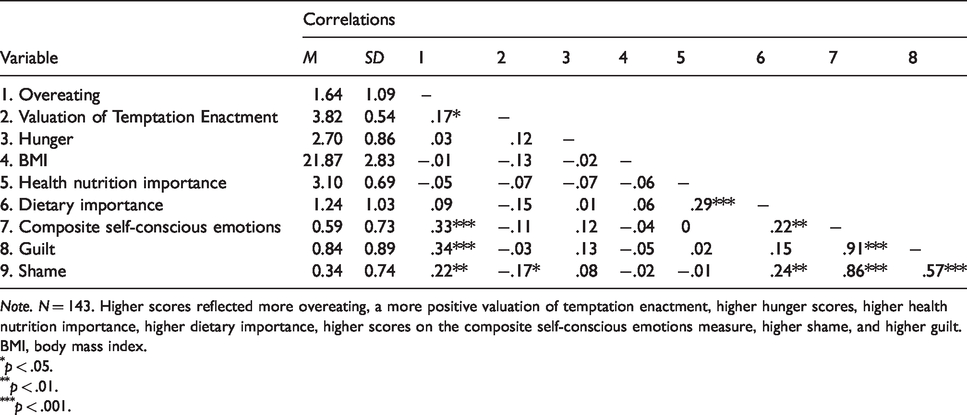
Note. N = 143. Higher scores reflected more overeating, a more positive valuation of temptation enactment, higher hunger scores, higher health nutrition importance, higher dietary importance, higher scores on the composite self-conscious emotions measure, higher shame, and higher guilt.
BMI, body mass index.
p < .05.
p < .01.
p < .001.
The regression analysis (R2 = .21) yielded a significant positive main effect of overeating, B = 0.22, t(138) = 4.26, 95% CI [0.117, 0.320], p < .001, suggesting that higher overeating is linked to a higher score on the composite index, encapsulating shame and guilt. Moreover, we also obtained a significant negative main effect of the VOTE measure, B = −0.26, t(138) = −2.44, 95% CI [−0.463, −0.049], p = .016. Most importantly, the crucial two-way interaction effect between overeating and the VOTE measure emerged, B = −0.33, β = −.27, t(138) = −3.21, 95% CI [−0.533, −0.127], p = .002. Ancillary analyses revealed that the interaction effect was driven by both a significant interacting effect regarding guilt, B = −0.31, t(138) = −2.37, 95% CI [−0.561, −0.050], p = .019, as well as shame, B = −0.35, t(138) = −3.30, 95% CI [−0.568, −0.142], p = .001, both of which showed similar interactive patterns as the composite.
Simple slope analyses showed that the interaction pattern is consistent with predictions (Figure 4): For individuals scoring low (−1 SD) on VOTE, the relationship between overeating and the composite index was significant, B = 0.40, t(138) = 5.52, 95% CI [0.254, 0.537], p < .001. In contrast, for individuals scoring high (+1 SD) on VOTE, the relationship between overeating and the composite index was reduced and non-significant, B = 0.04, t(138) = 0.53, 95% CI [−0.114, 0.197], p = .598. Moreover, among participants reporting above-average (+1 SD) levels of overeating, those low (−1 SD) in VOTE showed significantly elevated negative self-evaluation as compared with those high (+1 SD) in VOTE, B = −0.62, t(138) = −3.97, 95% CI [−0.923, −0.309], p < .001 (Figure 4).
Composite self-conscious emotions as a function of overeating and VOTE in Study 5. Estimated simple slopes are based on values one standard deviation below and above the mean of overeating and VOTE. ***p < .001.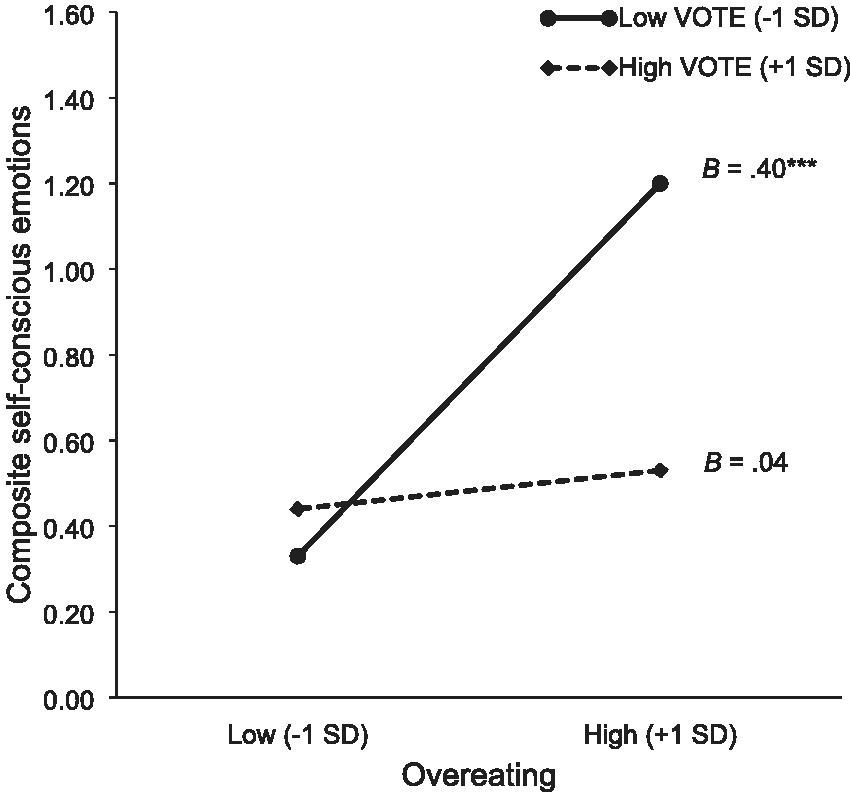
Ancillary regression analyses revealed that including health nutrition importance, dietary importance, and BMI as covariates did not change any of the previous statistical conclusions. Also, the two-way interaction effect between overeating and the VOTE measure was neither moderated by health nutrition importance (B = −0.31, t(134) = −1.33, 95% CI [−0.771, 0.150], p = .185), dietary importance (B = −0.06, t(134) = −0.60, 95% CI [−0.241, 0.129], p = .553), nor BMI (B = −0.04, t(134) = −0.95, 95% CI [−0.135, 0.048], p = .346).
Discussion
The goal of this field study was to extend the findings of Study 4 by providing additional evidence for our predictions in a different domain. Although we employed a different measure of impulsive behaviour and utilized a different paradigm in the more specific setting of eating behaviour, the obtained results closely resemble those from Study 4. Again, our measure of behavioural intensity (of overeating) was empirically strongly distinguishable from our valuation measure (of temptation enactment). As predicted, we found a significantly stronger positive association between overeating in the cafeteria and negative self-conscious emotions for individuals low rather than high in VOTE. As in Study 4, differences in VOTE become increasingly powerful in shaping differences in self-evaluation as levels of overeating increased, presumably because people regarding occasional temptation enactment as an essential or unavoidable part of life may have an easier (i.e. less conscience stricken) time to come to terms with discrepancies between their self-regulatory standards and their actual behaviour.
One potential limitation of this study is that we did not manage to assess individuals' actual consumption behaviour in this real-life setting. Instead, we solely had to rely on their self-reported degree of overeating. The next study addresses this potential limitation by utilizing the BMI as a more objective and cumulative measure.
Study 6: Vote and self-improvement motivation
Whereas the hitherto accumulated findings demonstrated that impulsive behaviours do not necessarily trigger aversive self-evaluative processes (i.e. shame and guilt) and that this link depends on VOTE. Study 6 strived to show that impulsive behaviours also do not necessarily trigger a corresponding motivation to change one's future behaviour towards more self-discipline and that it depends on individuals' VOTE.
In addition, Study 6 strived to examine the moderating role of VOTE with regard to the BMI, as a relatively objective proxy for overeating. Utilizing a more objective/cumulative measure of behaviour would help to exclude the possibility that VOTE may only bias people's perceptions of behaviours connected to trait impulsivity, irrespective of the actual engagement in these behaviours. A large body of research has revealed strong evidence for the idea that impulsivity is a major contributor to the development of overweight (e.g. Guerrieri, Nederkoorn, & Jansen, 2008), suggesting that a relatively high BMI (i.e. overweight) can be used as a cumulative measure of past frequent impulsive behaviours.
Second, while the previous studies focused on aversive self-conscious emotions, the present study strived to test the generalizability of our hypotheses by applying the predictions to the motivation for self-change. The general link between overweight and dietary intentions/restraint has been clearly documented in the literature (e.g. Braet & Van Strien, 1997; Klesges, Isbell, & Klesges, 1992; Snoek, van Strien, Janssens, & Engels, 2008; van Strien & Oosterveld, 2008), albeit moderating variables such as VOTE that might reduce or strengthen this association remain underexplored. Given the long-lasting health consequences of being motivated or the absence thereof to change one's overweight, this study therefore also offered insights into the theoretical and practical issue of individual differences variables affecting behavioural intention formation. Specifically, we investigated whether increasingly positive values towards temptation enactment would significantly reduce the expected overall positive association between overweight (i.e. BMI) and weight-loss intentions.
Method
Participants
Around 188 participants (79% female participants; 76% students; mean age = 26.71 years, SD = 9.85, range 18 to 71) were recruited online via various channels to take part in an online experiment ostensibly on ‘dieting and memory’. Due to technical problems during data collection, two participants were excluded from data analysis. Hence, the overall sample size consisted of N = 186 participants. All participants were able to participate in a lottery of three Amazon gift cards, each worth €50. All participants gave informed consent before the actual experiment started.
Procedure
At the beginning of the experiment, participants completed a few demographic variables, including a measure of body dimensions to calculate the BMI. This measure of the extent of overweight served as our predictor variable. Next, participants filled out the VOTE measure (α = .85). To reduce awareness between assessed predictor variables and the criterion variable, we employed the same memory task as in Study 5. Following this filler task, participants answered three items regarding their weight-loss intentions (e.g. ‘Iam pursuing the goal to lose weight’) and were measured using 5-point scales (0 = not at all to 4 = very much). Because these items converged very well (α = .93), we created a composite index of weight-loss intentions. Finally, all participants completed a seriousness check (100% passed), were debriefed, and compensated for participation.
Results
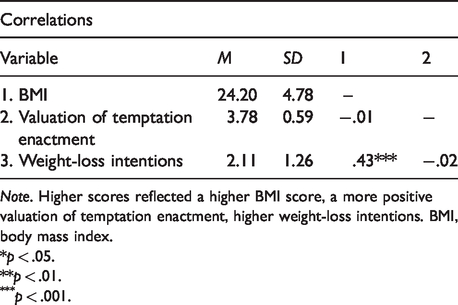
The means, standard deviations, and correlations of the core variables are depicted in Table 7. BMI and VOTE were entirely uncorrelated, r = −.01, p = .940. A moderated regression analysis (R2 = .21) predicting weight-loss intentions from mean-centred BMI variable, the mean-centred VOTE measure, as well as their interaction term showed a significant positive main effect of the BMI measure on weight-loss intentions, B = 0.12, t(182) = 6.71, 95% CI [0.083, 0.151], p < .001, suggesting that higher body weight is associated with stronger weight-loss intentions, replicating past research (e.g. Klesges et al., 1992; Snoek et al., 2008). There was no main effect of VOTE, B = −0.06, t (182) = −0.44, 95% CI [−0.344, 0.217, p = .658. However, VOTE significantly moderated the relationship between BMI and weight-loss intentions, B = −0.07, P = −.16, t (182) = −2.46, 95% CI [−0.133, −0.015], p = .015. This interaction is plotted in Figure 5.
Weight-loss intentions as a function of body mass index and valuation of temptation enactment in Study 6. Estimated slopes are based on values one standard deviation below and above the mean of body mass index and valuation of temptation enactment. ***p < .001. **p < .01. Means, standard deviations, and correlations of core variables (Study 6) Note. Higher scores reflected a higher BMI score, a more positive valuation of temptation enactment, higher weight-loss intentions. BMI, body mass index. *p < .05. **p < .01. p < .001.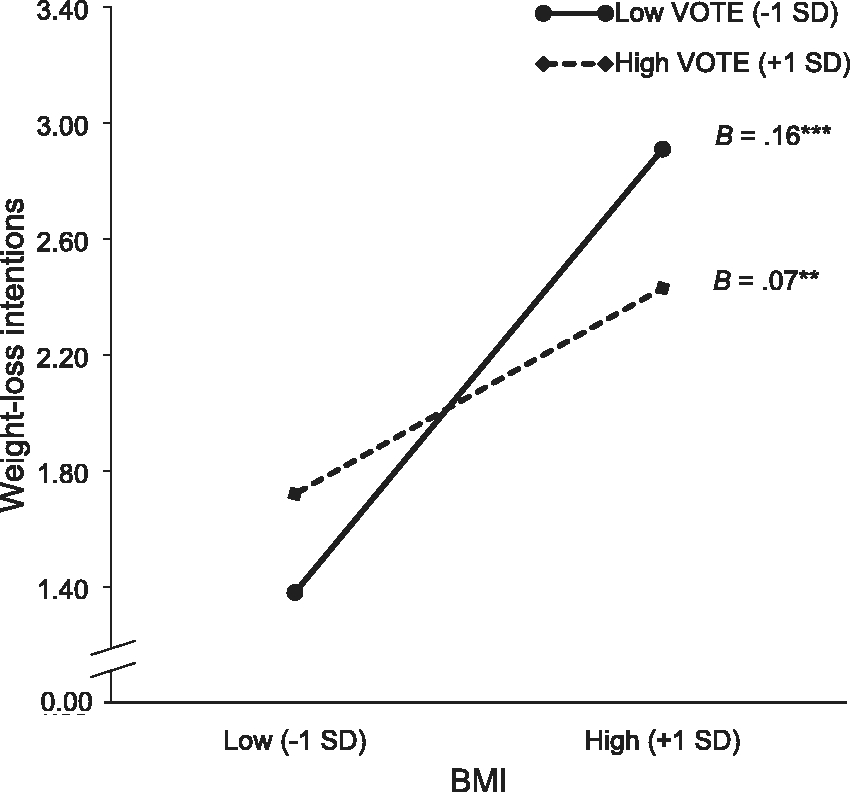
To scrutinize the moderator effect, simple slope analysis was performed. In line with our predictions, the association between BMI and weight-loss intentions was stronger for individuals scoring low (−1 SD) on the VOTE measure, B = 0.16, t(182) = 6.21, 95% CI [0.109, 0.211], p < .001, than for individuals scoring high (+1 SD) on VOTE, B = 0.07, t(182) = 3.12, 95% CI [0.027, 0.120], p = .002. In addition, among participants high in overweight (+1 SD), those participants who ascribed more positive (+1 SD) values towards temptation enactment were less committed to lose weight, as compared with those who harboured more negative (−1 SD) values, B = −0.42, t(182) = −1.96, 95% CI [−0.834, 0.004], p = .052. No differences among high and low VOTE individuals emerged for low (−1 SD) BMI scores, B = 0.29, t(182) = 1.51, 95% CI [−0.879, 0.666], p = .132.
Discussion
The aim of the last study was to investigate possible implications of VOTE for future self-control, or self-improvement, more broadly. More specifically, this study shows that ascribing more positive values towards temptation enactment reduces the motivation for self-improvement, particularly among those with a problematic current state from the perspective of self-control (i.e. overweight). As expected, current overweight was a stronger predictor of weight-loss intentions among individuals endorsing a more negative VOTE. Put differently, the inclusion of VOTE allowed us to identify, within overweight individuals, those individuals who have a relatively high motivation for self-change from individuals who are less motivated to alter their current state. Hence, the present study shows that the link between weight status and weight-loss intentions is more complex than previously assumed (e.g. Snoek et al., 2008), in that it hinges, in a systematic manner, on people's values regarding the human self-control dilemma. This finding also has implications for which aptitude-treatment interactions to expect in health campaigns, public policy programmes, and clinical interventions regarding self-control problems, an issue we will come back to in the general discussion.
One potential alternative explanation for the present findings is that VOTE might have acted as a mediator, rather than a moderator, of the link between BMI and weight-loss intentions. As participants were required to fill out demographic variables at the beginning of the experiment, this might have served as a reminder of the presence (or absence) of one's own heavyweight and hence could have encouraged participants to change their value ascriptions accordingly. However, this alternative implies a significant positive association between the BMI assessment and the VOTE scale, which is at odds with the present correlational findings.
In sum, the present findings add further converging evidence for the notion that, for individuals who valuate temptation enactment positively, impulsive behaviours cannot be equated with self-control failures. Next to being less prone to negative self-evaluation, as the previous studies have shown, an interesting motivational implication of high VOTE is that these individuals are less eager to change their future behaviours towards more self-discipline.
General discussion
Do people regard succumbing to temptation differently, and if so, with what effect for self-evaluation and self-improvement motivation? In the present line of research, we demonstrate that individual differences in how people regard the enactment of temptations exist, that they are empirically separable from measures of the frequency or intensity of impulsive behaviours, that they can be reliably measured, and that they matter with regard to how people appraise their own actions and evaluate themselves. In the first part of this research programme, we constructed and validated a novel, brief measure of VOTE. The final measure exhibited good internal consistency and a clear one-factorial solution. As expected, an assessment of convergent and divergent validity (Study 3) showed that VOTE could be clearly differentiated from traditional constructs of trait impulsivity or TSC (which, as we have argued, do not directly tap into the value dimension).
In the second part, we demonstrated important implications of such value ascriptions. Going beyond prior research and traditional reasoning in self-control research, we argued that impulsive behaviours cannot necessarily be equated with self-control failures. Our theoretical distinction between behavioural frequency/intensity and valuation thereof was supported by the generally low relationships between our respective operationalizations of impulsive behaviours (broad composite, overeating, and BMI) and the VOTE measure. Going an important step further, we theorized that the link between action and action appraisal should be moderated by how people regard temptation enactment. Studies 4 and 5, hence, scrutinized the link between impulsive deeds and negative self-evaluative processes (i.e. self-conscious emotions of shame and guilt), which are often elicited by impulsive behaviours (e.g. Giner-Sorolla, 2001; Hofmann et al., 2013; Ramanathan & Williams, 2007).
As predicted, VOTE qualified the link between the enactment of impulsive behaviours and self-evaluation (Studies 4 and 5): People who ascribe positive values to temptation enactment showed substantially reduced levels of negative self-evaluations. These results held both across domains of impulsivity (Study 4) as well as within the specific domain of overeating (Study 5). Study 4, surveying a large range of impulsive behaviours, also suggested that the moderator effect on our composite measure of guilt and shame was particularly driven by guilt rather than shame, whereas Study 5 found highly similar effects for both self-conscious emotions. More research seems needed to investigate whether there are substantial enough differences between the more action-oriented emotion of guilt and the more person-oriented emotion of shame in this area. Furthermore, Study 4 provided evidence for the discriminant validity of our prediction, in that only VOTE but not traditional measures of trait impulsivity, TSC, or general hedonism showed the crucial moderator effect. This pattern of findings resonates with the arguments laid out in the introduction regarding why VOTE can be conceptually differentiated from meausures of impulsivity, BAS sensitivity, TSC, or general hedonism, either due to its focus on the valuation of behaviour rather than its frequency/intensity or due to its higher degree of domain specificity rather than generality or both. Study 5, conducted in a highly naturalistic setting (lunch at the cafeteria), also added to the ecological validity of our conclusions and to some generalizability across contexts.
In our last study, we also investigated a logical implication of high VOTE with regard to the motivation to change one's future behaviour towards more self-discipline. We reasoned that the motivation for behaviour change should be contingent on how individuals value temptation enactment, i.e. whether impulsive behaviours and their manifestations are construed in problematic terms. To this end, we investigated whether VOTE also qualifies the established general link between overweight, as indexed by BMI and weight-loss intentions (Klesges et al., 1992; Snoek et al., 2008). As expected, BMI was a stronger predictor of weight-loss intentions for individuals ascribing more negative rather than positive values to temptation enactment. Taken together, albeit we used different measures of impulsive behaviours, different outcome variables, and varied domain specificity, we obtained relatively consistent evidence for a non-negligible role of VOTE in shaping how people deal with temptation enactment.
Theoretical Implications
The present research adds an important additional value dimension to existing theories and frameworks of self-control. Our findings suggest that many past frameworks are somewhat incomplete or even misleading in the sense that engagement in impulsive behaviours is more or less equated with ‘self-control failures’. By taking such a normative perspective and branding human actions this way, scholars of self-control as well as the general public may gain a distorted picture of what constitutes a true self-control failure. As such, our findings accord well with recent ‘symmetric’ models of self-control behaviour determination that provide a parsimonious account of the processes or mechanisms through which behaviour on the continuum from short-term oriented to long-term oriented is brought about. For instance, Kopetz, Woerner, and Briskin (2018) argue that people engage in impulsive as well as self-controlled behaviours as part of one and the same general principle of goal pursuit (Kopetz et al., 2018; see also Stroebe, Mensink, Aarts, Schut, & Kruglanski, 2008). In a similar vein, Berkman, Hutcherson, Livingston, Kahn, and Inzlicht (2017) propose to conceptualize self-control as a value-based choice or decision-making process whereby people decide for the long-term or short-term option based on the relative subjective values assigned to the competing response options. These models can be differentiated from more ‘asymmetric’ models distinguishing between a driving motivational force (e.g. impulses and desire) and a restraining motivational force (e.g. higher order goals), which tend to build in more specific assumptions regarding the key characteristics of and differences between these two motivational forces in a typical self-control conflict (e.g. regarding affective hotness/intrinsic reward, concreteness/temporal scope, and intentionality) while maintaining that, ultimately, behaviour is determined through a common (response selection) mechanism that trades off or prioritizes the net force or activation of these conflicting motivations (e.g. Kotabe & Hofmann, 2015). However, we believe that our present point that people differ in their valuation of their impulsive behaviours is separate from that debate, as it is located at a second order, meta-level—a level that is conceptually independent of the exact processes or mechanisms through which impulsive behaviour is actually brought about. 3 According to our theoretical reasoning, whether an enacted behaviour should count as an episode of ‘failure’ is, first and foremost, a first-person, subjective matter that depends, as shown here, on the value background of the person. Research on self-control has hitherto largely glossed over the fact that people differ in how they value the enactment of temptation from such a meta-level. We therfore believe that taking into account such differences can further our theoretical understanding in at least four important ways:
Self-conscious emotions
Individual differences in VOTE appear to have implications for the intensity of negative self-conscious affect. According to the framework by Tracy and Robins (2004, 2007), three key appraisals are involved in the generation of self-conscious emotions such as guilt or shame. The first appraisal refers to an event's relevance to an identity goal (e.g. ‘Does it matter for who I am or would like to be?’), the second to the degree of goal congruence or incongruence between the actor and the event (e.g. ‘Is the event compatible or incompatible with my goal(s) about who I want to be?’), and the third appraisal is concerned with causality (‘Is it something about me or related to me that caused the event?’ (Tracy & Robins, 2007). We believe that VOTE allows connecting such appraisal-based frameworks of self-conscious affect more intimately with the specific self-control area via the first and second appraisal stages. That is, VOTE adds a dimension that captures people's identity goals regarding the basic human problem of how to best juggle the trade-off between short-term gratification and long-term goal pursuit in life. Whereas low VOTE may leave people who just experienced an event of own impulsivity little wiggle room to attest compatibility with their identity goal (exclusion), triggering higher levels of negative self-conscious affect, high VOTE more likely provides the mental background for a compatibility judgement (inclusion), resulting in low or even zero levels of negative self-conscious affect.
Motivation for self-change
Individual differences in VOTE also have implications for the motivation to engage in future self-control. The present work adds to our theoretical understanding of the larger literature on the motivation for self-change, lifestyle, or behaviour change. For instance, the transtheoretical model of behaviour change (Prochaska, 2013) distinguishes among pre-actional (precontemplation, contemplation, and preparation) and post-actional (action, maintenance, and termination) stages of change. Study 6 suggests that how people value temptation enactment strongly relates to the preparatory (i.e. intention-setting stage), distinguishing among those with relatively high vs. low intentions. Even though comprehensive models such as the transtheoretical model of behaviour acknowledge the role of temptation, defined as the urge to ‘engage in the unhealthy behavior across different challenging situations’ (Prochaska, 2013, p. 99), temptation is typically conceptualized as an obstacle with regard to ‘carrying through’ during the actional stage of behaviour change. However, the evaluative dimension of temptation enactment introduced here suggests that such valuations function as a more ‘upstream’ obstacle to forming a sufficiently strong intention to change in the first place. More research is needed, however, to determine whether reduced intentions, as harboured by high VOTE individuals, may still be comparatively effective. Specifically, it is possible that low VOTE individuals tend to set themselves exaggerated, unrealistic high standards about the likely speed, ease, and consequences of self-change. This ‘false hope syndrome’ may set the stage for a negative cycle of failure (Polivy & Herman, 2002).
Valuation of temptation enactment and well-being
Moreover, individual differences in VOTE seem to concern broader issues of well-being. This is suggested by the positive link between VOTE and life satisfaction in Study 3. Even though speculative at this point, valuing temptation enactment positively may actually enable individuals to live more satisfied lives. Western cultures, in which these studies were conducted, typically tend to cultivate the importance of self-discipline, industriousness, and restraint as values in life (e.g. Baumeister & Exline, 1999; Hofmann, Wisneski, Brandt, & Skitka, 2014; Weber, 1904/2013, for an early treatment). On the other hand, humans host an entire cabinet of psychological needs and motivations in need of coordination, including those geared towards short-term rewards and pleasures (Freud, 1930; Kotabe & Hofmann, 2015; Livnat & Pippenger, 2006; Morsella, 2005). A balanced, integrative approach to temptations, which acknowledges the occasional need for self-indulgence may therefore not only facilitate momentary happiness or affective well-being (due to the harvesting of such rewards and the absence of negative selfevaluation) but also satisfaction with the way one generally leads one's life or cognitive well-being.
At first sight, this is somewhat counter-intuitive from the perspective of traditional self-control research revealing a host of positive long-term outcomes among the highly self-controlled (Moffitt et al., 2011; Shoda, Mischel, & Peake, 1990). In fact, a first route to high life satisfaction can be seen in the effective achievement of self-control goals by cultivating strategies and habits that help to attain long-term goals (the ‘Puritan’ approach; Oishi, Westgate, Tucker, & Komiya, 2015). Considerable research has shown that high TSC facilitates life satisfaction (e.g. Hofmann, Luhmann, Fisher, Vohs, & Baumeister, 2014; Wiese et al., 2018), most likely due to adaptive habits and preventive strategies that allow people high in TSC to avoid and resolve problematic self-control dilemmas in line with their long-term goals (de Ridder et al., 2012; Galla & Duckworth, 2015; Hofmann, Baumeister, et al., 2012). In concert with these findings, we not only replicated the positive link between TSC and life satisfaction but also found that TSC was associated with preventive self-control (Table 3) and that higher TSC was associated with reduced self-conscious emotions of shame and guilt in Study 4 (Table 4).
Yet the pattern that TSC and VOTE were negatively related with each other but both positively and independently predicted life satisfaction (and reduced negative selfevaluation) suggests that there is also a quite different, second route to life satisfaction: taking a more lenient, balanced, or accepting stance towards temptation—even when such indulgences are in conflict with endorsed self-regulatory goals and standards. Even though speculative at this point, such a more balanced approach may allow individuals to feel content about and still ‘in control’ of their life in general despite engaging in impulsive behaviours from time to time. More research is clearly needed to better understand the functionality, limits, and reality constraints of each of the two routes. For instance, indulging too permissively in short-term motivations may create a variety of problems in the long-run, such as serious health issues due to long-lasting overweight (Schroeder, 2007), which may negatively impact life satisfaction later in life. However, it is not clear yet whether VOTE is connected to functional or rather dysfunctional patterns of balancing short-term and long-term rewards (see Prinsen, Dohle, Evers, de Ridder, & Hofmann, 2019, for a recent distinction). Longitudinal research beyond the present scope may help illuminate whether valuing temptation enactment positively or negatively contributes to long-term life satisfaction and a more rewarding life in general.
Valuation of temptation enactment and morality
We have argued previously that our findings highlight the importance of a first-person perspective on self-control failure. This opens up highly interesting questions for future research at the intersection of self-control and morality (e.g. Hofmann et al., 2018). Specifically, across human societies, prevailing cultural or moral norms serve as third-person standards against which a person's behaviour is evaluated. In other words, self-control conflicts are often moralized, and this fact of our social and civilized lives presents a potential source for a clash between individual and societal values. Suppose, for instance, that a given individual does not subscribe to the generally agreed-upon rule that engagement in sexual behaviour should be consensual in order to respect the freedom of the other person. Sooner or later, this individual may face serious legal consequences. Case such as these, in which the enactment of impulsive behaviour transgresses binding moral or legal rules highlight, that sometimes, the third-person perspective takes precedence over the first-person perspective. However, that does not mean that the first-person perspective is obsolete; Rather, the moral problem emerges precisely because, in this case, the first-person valuation deviates from the binding societal moral norm or standard. For many domains of self-control, such as eating or drinking, there seem to be only relatively ‘lose’ moral standards (but even there, the moral landscape is subject to change; e.g. Rozin, Markwith, & Stoess, 1997). However, as the degree of moralization of self-control may differ across domains, it seems a highly interesting issue for future self-control research to explore how the first-person and third-person perspectives interlock. For instance, we would predict long-term increases in domain moralization to be reflected in a declining trend (as well as a more restricted range) in the VOTE in such domains.
In sum, we believe that it is time to devote a greater level of attention to how people regard temptation enactment and to acknowledge the inherently subjective, constructed nature of self-control failure. Focusing on how people valuate temptation enactment may help us gain a deeper understanding, among other things, of what constitutes self-control failure, its implications for self-evaluation, self-improvement motivation, and, ultimately, well-being.
Practical implications for behaviour change
The present findings also have some practical implications with regard to health behaviour change and public policy. For instance, it is well known that many individuals struggle with losing weight (Stroebe, 2008; Wing & Phelan, 2005). Complete abstinence from indulgence, however, seems almost impossible in light of the obesogenic environment surrounding people in most countries (Hill & Peters, 1998). Negative self-evaluative psychological states, triggered by impulsive indulgences interpreted as ‘self-control failures’ or ‘weakness of will’, may promote a vicious cycle of subsequent impulsive indulgences, spiralling out of control (e.g. Baumeister et al., 1994; Muraven et al., 2005a, 2005b). Those who (learn to) construe occasional temptation enactment as less problematic may thus become less vulnerable to what has been termed a ‘snowballing’ or ‘what the hell’ effect (Baumeister et al., 1994; Herman & Mack, 1975; Marlatt & Gordon, 1985; Muraven et al., 2005a, 2005b).
Although speculative at this point, public policy campaigns that acknowledge the impulsive parts of human nature and thus communicate some appreciation of ‘balance’ may help prevent such patterns. Likewise, interventions that not only foster skills and cognitive abilities required for successful self-regulation (Hofmann, Schmeichel, & Baddeley, 2012) but also help people re-calibrate towards more realistic standards and expectations for behaviour change may ultimately be more effective. It is true that results from Study 6 urge caution that the motivation for self-change—though far from zero—was significantly reduced among the high as compared with the low VOTE subgroup. However, as noted previously, it remains to be seen whether the beneficial effects of increased satisfaction with the self or the detrimental effects of being less committed to self-change prevail in shaping long-term treatment outcomes. Luckily, many other (valuation independent) techniques for selectively boosting the motivation for behaviour change exist (Michie, Van Stralen, & West, 2011; Thaler & Sunstein, 2008); these could be added to the mix to get the best of both worlds— an acceptance-based safeguard against snowballing and sufficient motivation for incremental (rather than radical) self-improvement.
Conclusion
People differ in how they valuate temptation enactment, and these individual differences can be reliably measured. Self-control failure may best be viewed as a construction, a construction that takes place against the background of people's value stance regarding the human need to balance short-term and long-term motivations. When people endorse a positive rather than negative VOTE, they are less likely to experience negative self-evaluation in response to impulsive behaviour but also less likely to want to self-improve and engage in behaviour change. It is our hope that the present meta-behavioural perspective may add value towards a deeper understanding of the nature of self-control and its connection to human values—and, ultimately, human well-being.
Footnotes
Declaration of conflicting interests
The author(s) declared no potential conflicts of interest with respect to the research, authorship, and/or publication of this article.
Funding
The author(s) disclosed no financial support for the research, authorship, and/or publication of this article.
Data accessibility statement
This article earned Open Data and Open Materials badges through Open Practices Disclosure from the Center for Open Science: https://osf.io/tvyxz/wiki. The data and materials are permanently and openly accessible at  . Author's disclosure form may also be found at the Supporting Information in the online version.
Notes
Supporting information
Additional supporting information may be found online in the Supporting Information section at the end of the article.
Table S1. Included and excluded items of the final 10-item VOTE scale. German translation in parentheses.
Table S2. Overview of regression results for moderator analysis predicting feelings of guilt from frequency of impulsive behaviors and VOTE, both without and with control variables included (Study 4)
Table S3. Overview of regression results for moderator analysis predicting feelings of shame from frequency of impulsive behaviors and VOTE, both without and with control variables included (Study 4)
Table S4. Guilt (left panel) and Shame (right panel) as a function of frequency of impulsive behaviors and valuation of temptation enactment (VOTE) in Study 4. Estimated slopes are based on values one standard deviation below and above the mean of frequency of impulsive behaviors and VOTE. ***p < .001. *p < .05.
Table S5. Forest plots from the meta-analysis of the relationship between VOTE and gender (0 = male; 1 = female; Panel A) and VOTE and age (Panel B) across all six studies.
References
Supplementary Material
Please find the following supplemental material available below.
For Open Access articles published under a Creative Commons License, all supplemental material carries the same license as the article it is associated with.
For non-Open Access articles published, all supplemental material carries a non-exclusive license, and permission requests for re-use of supplemental material or any part of supplemental material shall be sent directly to the copyright owner as specified in the copyright notice associated with the article.
