







Abstract
Person–situation interactions have attracted researchers’ attention for decades. Likewise, the current work focuses on the interaction of honesty–humility and situational conditions in bringing about counterproductive work behaviour (CWB). As such, we introduce perceptions of organizational politics as a situational construct representing an opportunity for CWB. In a sample of N = 148 employees we found that particularly individuals low in honesty–humility were affected by situational circumstances. By contrast, those high in honesty–humility reported practically the same (lower) amount of CWB independent of the level of perceptions of organizational politics. In other words, employees low in honesty–humility were especially likely to condition their behaviour on environmental factors, a result that mirrors previous findings. Copyright © 2010 John Wiley & Sons, Ltd.
Keywords
Introduction
In recent years, the personality dimension of honesty–humility has been a topic of research (Ashton & Lee, 2008a). Indeed, this sixth factor of the HEXACO model of personality (Honesty–Humility, Emotionality, eXtraversion, Agreeableness, Conscientiousness and Openness to Experience; Lee & Ashton, 2004, 2006, 2008) is a vital predictor for a whole host of criteria such as materialism, social adroitness, or unethical business decisions (Ashton & Lee, 2008b). So far, most investigations have focused on direct effects of honesty–humility. However, in line with the well accepted notion that person and situation interact in shaping behaviour (e.g. Krueger, 2009; Webster, 2009), recent findings in the field of economic decision making suggest that contextual circumstances also play a role for how honesty–humility affects behaviour (Hilbig & Zettler, 2009). In this very vein, the current work delves into the question to which extent the well documented relationship between honesty–humility and counterproductive work behaviour (CWB, e.g. Marcus, Lee, & Ashton, 2007) might be intertwined with situational circumstances. More precisely, we examine whether honesty–humility and perceptions of organizational politics interact in bringing about CWB.
Honesty–humility and counterproductive work behaviour
For many years, the broad dimensions of the five–factor model of personality have been associated successfully to diverse outcomes (McCrae & Costa, 1999). However, work by Ashton and Lee (e.g. 2005, 2007) suggested, among other things, that the five–factor approach largely misses out on a specific personality characteristic: honesty–humility. The domain of honesty–humility is typically described by aspects of honesty, sincerity, or fair–mindedness versus greed, deceit, or boastfulness (Ashton & Lee, 2008a). So, not surprisingly, this dimension has been found to relate to exploitive and/or criminal activities. Especially, several studies have shown significant correlations between honesty–humility and CWB or related constructs, such that individuals low in honesty–humility tend to show more CWB or similar activities (e.g. Lee, Ashton, & de Vries, 2005; Lee, Ashton, & Shin, 2005).
The domain of CWB is of immense importance for industrial and organizational psychology as it encompasses employees’ activities which may harm the organization, its members, or both (Robinson & Bennett, 1995). Typical examples of such behaviours are consuming alcohol at work, acting rudely towards colleagues, or revealing organizational secrets (Bennett & Robinson, 2000; Marcus, Schuler, Quell, & Hümpfer, 2002). Research has shown that actions reflecting CWB pose severe financial and/or psychological costs for the affected organization, economy, or colleagues (Bennett & Robinson, 2000). So, CWB contributes to organizational effectiveness (negatively), and is thus a central aspect of job performance besides constructs which enhance effectiveness (e.g. task performance; Dudley, Orvis, Lebiecki, & Cortina, 2006; Rotundo & Sackett, 2002).
Considering potential sources of CWB, Marcus and Schuler (2004, cf. Marcus, 2001) proposed a general framework in order to classify possible antecedents. They suggested two dimensions by which to structure predictor variables: First, they revert to the well–known distinction between person and situation as two vital sources of behaviour (e.g. Mischel, 1973). Secondly, they distinguish between the central explanatory mechanisms for CWB, namely motivation and lack of control, respectively. Thus, potential antecedents of CWB can be classified into four categories: Propensity (person–motivation), lack of internal control (person–control), trigger (situation–motivation) or opportunity (situation–control).
Clearly, honesty–humility represents a person variable in this framework since it stands for a stable and broad individual difference construct. However, it comprises both motivational aspects as well as a lack of control, so that it neither stands for a propensity, nor a lack of internal control variable exclusively. Concerning motivational issues, high honesty–humility yields disinterest in luxury goods or a specific social status (particularly represented by the scales ‘greed avoidance’ and ‘modesty’, Lee & Ashton, 2004) which makes it unlikely to act counterproductively in order to reach such aims. With regard to a lack of internal control, those high in honesty–humility generally avoid fraud, stealing, or cheating (particularly represented by the scale ‘fairness’) and tend to be genuine in interpersonal relations (represented by the scale ‘sincerity’). Both aspects might be interpreted as an internal inhibition capacity in employees with highly developed honesty–humility and therefore render CWB less likely. In any case, honesty–humility reflects a person variable in the framework of Marcus and Schuler (2004).
As outlined above, it has been found that honesty–humility is highly associated with CWB (e.g. Lee, Ashton, & de Vries, 2005), and, compared to other personality constructs, is one of the strongest predictors in general (e.g. Lee, Ashton, & Shin, 2005). However, possible interdependencies with situational circumstances have not been investigated so far. So, as hinted above, we hearken back to the extensive literature on interactions between personal and situational variables in general and CWB in particular (e.g. Flaherty & Moss, 2007; Henle, 2005; Skarlicki, Folger, & Tesluk, 1999) in order to address this issue. More precisely, we examine perceptions of organizational politics as a possible situational variable which, we assume, will interact with honesty–humility.
Perceptions of organizational politics and CWB
Roughly three decades ago, researchers introduced a political view of behaviour in organizations (e.g. Mintzberg, 1983). Thus, political actions (influence attempts, bargaining, impression management etc.), which often take place in ambiguous, non–sanctioned settings, were assumed to be directed at promoting or protecting one's personal and/or organizational interests (Byrne, Kacmar, Stoner, & Hochwarter, 2005; Silvester, 2008). Thereby, the perception of such activities, namely perceptions of organizational politics, ‘is commonly defined as an individual's subjective evaluation about the extent to which the work environment is characterized by co–workers and supervisors who demonstrate […] self–serving behaviour’ (Ferris, Harrell–Cook, & Dulebohn, 2000, p. 90). Results of a recent meta–analysis indicated exclusively negative effects of high perceptions of organizational politics, including lower organizational commitment or greater job stress (Miller, Rutherford, & Kolodinsky, 2008). These effects are, broadly speaking, explained through incongruity of different self–serving actions, loss of employees’ trust in the degree to which the organization values their efforts, or doubts about the organization's motivation to look after employees’ psychological well–being (Hochwarter, Kacmar, Perrewé, & Johnson, 2003). Surprisingly, however, perceptions of organizational politics have, to the best of our knowledge, not been examined in relation to CWB so far.
Within the approach of Marcus and Schuler (2004), we classify perceptions of organizational politics as an opportunity variable since the latter ‘are conceptualized as any situation or perception of the situation that facilitates (or inhibits) the exertion of an act of [CWB] by enhancing (or restricting) access to desired outcomes or by making the negative consequences for the actor less (or more) likely or costly’ (p. 650). In this vein, perceptions of organizational politics might reflect a general self–serving climate which makes CWB more common place. Moreover, it would probably reduce the subjective probability of facing negative consequences for showing CWB. Thus, perceptions of organizational politics should be positively related to CWB.
Note that Marcus and Schuler (2004) explicitly considered ‘mere’ perceptions of a situation as a situational variable as well. This view is supported by the literature which treats perceptions of organizational politics as ‘the subjective reality upon which individual behaviour is based’ (Kacmar, Collins, Harris, & Judge, 2009, p. 1573) due to ‘the theme that situations should be assessed in terms of how they are perceived’ (Hochwarter, Witt, & Kacmar, 2000, p. 473). Accordingly, previous research has treated perceptions of organizational politics (e.g. Witt, Kacmar, Carlson, & Zivnuska, 2002) or similar constructs (e.g. perceived organizational support, Colbert, Mount, Harter, Witt, & Barrick, 2004) as situational indicators. In what follows, we will sketch why perceptions of organizational politics appear to be a likely candidate to interact with honesty–humility on CWB.
Interaction of honesty–humility and situational circumstances
Herein, we aim to extend previous findings on honesty–humility by introducing an interaction between this characteristic, one of the strongest predictors of CWB of all broad personality dimensions, and perceptions of organizational politics as an organizational opportunity. In doing so, it is essential to consider important differences between individuals high and low in honesty–humility. Specifically, those low in honesty–humility are characterized by manipulating, cheating or enjoying privileges (Ashton & Lee, 2008b; Lee & Ashton, 2004). As they are motivated to seek advantages and exploit others when possible without having to fear retaliation, such individuals should also be more sensitive to the characteristics of different situations. Specifically, individuals low in honesty–humility should be responsive towards circumstances which yield possibilities for manipulating or exploiting others (cf. Hilbig & Zettler, 2009).
A corresponding strategic reaction to situational factors by individuals low in honesty–humility was recently corroborated in experimental work: Specifically, in ultimatum bargaining decisions, it was observed that those low in honesty–humility adapted their behaviour strategically to the—experimentally manipulated—power of the recipient, by cooperating if and only if having to expect retaliation for non–cooperation. Those high in honesty–humility, by contrast, behaved fairly irrespective of whether they were in absolute power to allocate amounts or not (Hilbig & Zettler, 2009). So, overall, those with lower scores were indeed more likely to adapt their degree of cooperation to the situational circumstances.
However, the reported work is rather basic in nature; thus, it seemed important to test whether corresponding effects extend to more applied settings. In this vein, we intended to put the same basic notion to test in an organizational setting. As a consequence, we also sought a sample of actual employees rather than students. In doing so, we investigated the following hypotheses: First, and least boldly, we expected to replicate the negative relationship between honesty–humility and CWB (Lee, Ashton, & de Vries, 2005; Lee, Ashton, & Shin, 2005; Marcus et al., 2007). Secondly, and aiming for a novel finding, we hypothesized that perceptions of organizational politics should be positively related to CWB. Third, and most centrally, we hypothesized an interaction: We assumed that employees low in honesty–humility should show more CWB conditional upon high perceptions of organizational politics. Those high in honesty–humility, by contrast, should report less CWB quite independent of different organizational conditions. In other words, they should retain non–aggressive and modest behaviour irrespective of weaker versus stronger perceptions of organizational politics—even though the latter yields a stronger temptation and opportunity to act counterproductively at work, too.
To provide particularly conservative tests of the proposed main effects and especially the hypothesized interaction, we further expected each to hold after controlling for the main effect of the other five broad personality dimensions in the HEXACO model. In other words, honesty–humility, perceptions of organizational politics, and their interaction term were hypothesized to explain unique variance in CWB beyond emotionality, extraversion, agreeableness, conscientiousness and openness to experience.
Method
Procedure and participants
To achieve satisfactory statistical power (1−β > .90) for small to medium–sized (f2 = 0.08) increases in explained variance in a hierarchical multiple regression when adding one predictor (the interaction term) to seven (the six broad dimensions of personality and perceptions of organizational politics), a sample of N ≥ 134 was required, given a type–I–error rate of 0.05 (Faul, Erdfelder, Lang, & Buchner, 2007).
Based on this a priori power analysis, and expecting a return rate above 50%, study materials (paper–pencil questionnaires with enclosed stamped and return–addressed envelopes) were distributed to 250 German employees from different organizations and professions through personal contact. Participants joined the study anonymously, voluntarily and without compensation. However, they could sign up for feedback about the general results (of the entire sample) by providing their email–address separately. Of the 250 employees we approached, 157 (63%) returned the questionnaire. After excluding participants who worked less than 15 hours a week, had worked for less than 6 months in their organization, or did not complete the entire questionnaire, 148 data sets (59%) remained. This resulting final sample (48% female) consists of individuals who had been in their organization for a mean of 10 years (SD = 10 years), with a mean age of 35 (SD = 11) years and an average labour time of 39 hours per week (SD = 8 hours). Employees worked in different occupations such as salesmen, secretary, or mechanic.
Measures
HEXACO personality dimensions
The HEXACO factors were measured with the German version of the 100–item HEXACO Personality Inventory–Revised (HEXACO–PI–R, Ashton & Lee, 2008b; Lee & Ashton, 2006). For this, a 5–point Likert–type scale ranging from ‘strongly disagree’ to ‘strongly agree’ was used. Sample items of honesty–humility are ‘I wouldn't use flattery to get a raise or promotion at work, even if I thought it would succeed’ or ‘I would be tempted to buy stolen property if I were financially tight’. More information on the HEXACO–PI–R (including all items and the translations which already exist) can be found on http://www.hexaco.org.
Perceptions of organizational politics
We translated the Perceptions of Politics (POPs) scale validated by Kacmar and Carlson (1997) which consists of 15 items into German. The same answer scale as for the HEXACO dimensions was applied. Sample items are ‘People in this organization attempt to build themselves up by tearing others down’ or ‘Agreeing with powerful others is the best alternative in this organization’. 1 In the translation process, which was supervised by the authors, we used the translation–retranslation technique (e.g. Brislin, 1980) with bilingual translators (2 individuals), re–translators (2 individuals) and native English speakers as raters (2 individuals). After two translation–retranslation cycles, all items were rated satisfactorily similar (> 90% content agreement).
Counterproductive work behaviour
To measure CWB, the 19–item Workplace Deviance Scale by Bennett and Robinson (2000) was also translated into German, in the same process as the POPs scale. Participants were asked to state how often they showed 19 different behaviours in the last year (from 1 = never to 7 = daily). As sample items consider ‘Acted rudely toward someone at work’ or ‘Came in late to work without permission’. With respect to recent meta–analytic results and theorizing (Dalal, 2005), we combined both subscales of the Workplace Deviance Scale (interpersonal and organizational) to obtain an overall CWB score since ‘the target–referent of behaviour may not be as important as often believed’ (p. 1247). Similar procedures have, for instance, been reported by Judge, LePine, & Rich (2006) or Lee and Allen (2002).
Note that participants also filled in some other questionnaires. However, these were irrelevant for the current investigation.
Results
Means, standard deviations, Cronbach's α and correlations between all measures are reported in Table 1, which shows that all internal consistencies were satisfactory (all α ≥ .75). Also, the correlations corroborate that lower honesty–humility and higher perceptions of organizational politics are associated with more CWB (r = −.37, and r = .30, respectively, both p < .005), representing medium effect sizes. To test our hypotheses, we used a hierarchical multiple regression with CWB as criterion: In Step 1, we controlled for the other five dimensions in the HEXACO model, apart from honesty–humility. In Step 2 we then assessed the increase in variance explained when adding honesty–humility and perceptions of organizational politics (as simple main effects). Finally, in Step 3, the interaction term of the latter two was added (cf. Cohen, Cohen, West, & Aiken, 2003). The results of this analysis are reported in Table 2.
Means, standard deviations, Cronbach's α and correlations
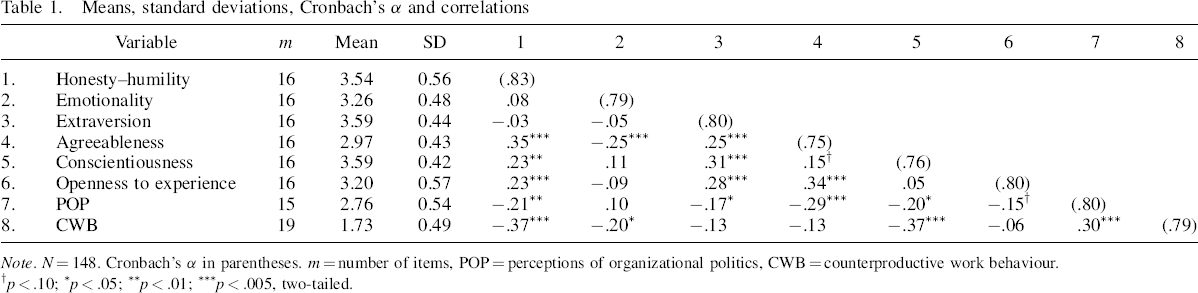
Note. N = 148. Cronbach's α in parentheses. m = number of items, POP = perceptions of organizational politics, CWB = counterproductive work behaviour.
p < .10;
p < .05;
p < .01;
p < .005, two–tailed.
Results of multiple hierarchical moderated regression analyses
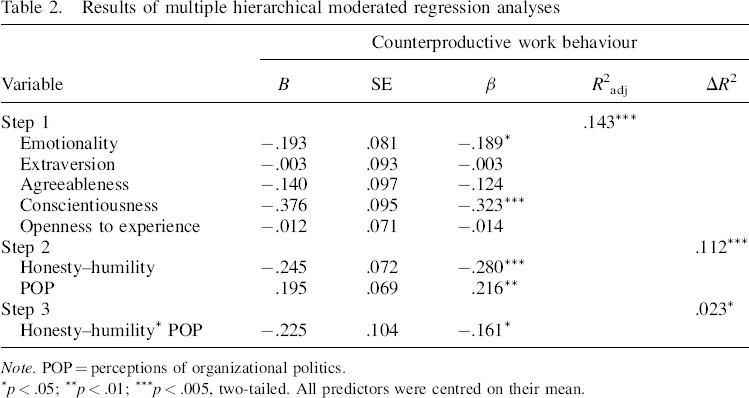
Note. POP = perceptions of organizational politics.
p < .05;
p < .01;
p < .005, two–tailed. All predictors were centred on their mean.
As can be seen in Step 2, both honesty–humility (β = −.280, p < .005) and perceptions of organizational politics (β = .216, p < .01) were noteworthy predictors of CWB and together they explained unique variance beyond the remaining five dimensions of the HEXACO model (ΔR2 = .112, p < .005). 2 Moreover, and most centrally, our main hypothesis was confirmed as their interaction explained further incremental variance in CWB (ΔR2 = .023, p < .05).
For additional clarity, the interaction is plotted in Figure 1 which shows that both lower scores in honesty–humility and stronger perceptions of organizational politics yielded more CWB. More importantly, and as hypothesized, particularly those individuals low in honesty–humility tended to be affected by the level of organizational politics and indicated considerably more CWB when organizational politics were more strongly perceived. By contrast, individuals high in honesty–humility were hardly influenced by different perceptions of organizational politics. These findings thus provide converging evidence that those high in honesty–humility show a higher degree of non–aggressive, fair and modest behaviour and are less likely to adapt this degree to contextual factors.
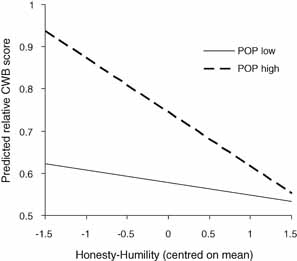
Prediction of relative counterproductive work behaviour score from honesty–humility (centred on mean), depending on perceptions of organizational politics.
Discussion
There can be little doubt that person and situation mutually shape behaviour (Funder, 2009) and that it is an important challenge to researchers in personality (and beyond) to uncover the various interactions between them. Indeed, Funder (2001) proposed that investigations of personality should generally comprise consideration of the person, the situation, and behaviour. In line with such arguments as well as much previous literature on person–situation interactions (cf. Kenrick & Funder, 1988), the current work focused on the interaction between honesty–humility and situational factors in bringing about CWB (Ashton & Lee, 2008a).
Specifically, we expected individuals low in honesty–humility to strongly condition counterproductive behaviour on situational circumstances; their counterparts with high scores of honesty–humility, by contrast, were expected to refrain from CWB quite independent of situational factors. This hypothesis mirrors previous results showing that strategically adapting behaviour to situations in order to gain advantages or exploit others is a mark specific to those low in honesty–humility (Hilbig & Zettler, 2009). Aiming to extend such findings to an applied setting, we considered the degree to which employees perceive organizational politics (Ferris, Adams, Kolodinsky, Hochwarter, & Ammeter, 2002) as a situational factor. Firstly, we expected this to be directly associated with CWB (which is itself a novel prediction). More importantly, however, we expected perceptions of organizational politics to interact with honesty–humility, which has previously been identified as an important predictor of CWB (e.g. Lee, Ashton, & de Vries, 2005).
Our results obtained in a sample of 148 employees support these hypotheses. Centrally, the contextual factor—perceptions of organizational politics—was influential only for individuals low in honesty–humility; conversely, high scores of honesty–humility entailed less CWB regardless of perceptions of organizational politics. Thus, the proposed interaction was corroborated and the according pattern was in line with our main assumptions. This is also well in line with Hilbig and Zettler's (2009) recent findings on honesty–humility in the field of economic decision making: Whereas those high in honesty–humility provided fair allocation decisions irrespective of the recipient's power in a given situation, their counterparts with less honesty–humility clearly conditioned their allocation decision on the power of the recipient and thus the caveat of retaliation inherent in the current context.
Taken together, the current findings extend previous work suggesting that low versus high scores of honesty–humility result in different reactions to situational factors. On the one hand, individuals high in honesty–humility seem to behave cooperatively, fairly and non–aggressively across different situations. In other words, their tendency to be modest and honest is not so much a matter of the situation but rather stable. On the other hand, those low in honesty–humility appear to be both willing and able to react differentially to specific circumstances. These individuals seem to be sensitive to fine–grained environmental differences in the chance for seeking own advantages—to the degree that acting counterproductively can also be interpreted in terms of ‘achieving a good mood or a high level of satisfaction’ (Dalal, 2005, p. 1251).
This conclusion is also in line with the associations between low honesty–humility and manipulating or cheating behaviour (Ashton & Lee, 2007; Lee & Ashton, 2006). As is known from the literature on influencing (e.g. Ferris et al., 2005), people who intend to manipulate others must identify specific circumstances appropriately for their influencing strategy to be successful. Further support for our interpretation can be found in work on Machiavellianism, which comprises ‘a flexible ability to shift from cooperation to manipulation as opportunities for gain emerge’ (Dahling, Whitaker, & Levy, 2009, p. 228)—and indeed, research has shown strong negative correlations between Machiavellianism and honesty–humility (Ashton, Lee, & Son, 2000; Lee & Ashton, 2005).
Apart from this central finding, our results also supported two main effects on CWB. First, the link between honesty–humility and CWB (e.g. Lee, Ashton, & Shin, 2005) could be replicated in our sample. Secondly, perceptions of organizational politics were positively associated with CWB which is, to the best of our knowledge, a novel finding. Note that both effects held over and above the influence of the five broad dimensions of personality besides honesty–humility. Moreover, each of these effects actually held when the according other was also controlled for; that is, honesty–humility predicted CWB beyond the other five HEXACO dimensions and perceptions of organizational politics, while the latter explained unique variance in CWB beyond all six HEXACO factors.
From a theoretical point of view, these findings can be integrated with Marcus and Schuler's (2004) framework: Firstly, honesty–humility is an important personality characteristic in general as well as for CWB in particular. Moreover, perceptions of organizational politics can be considered an organizational opportunity variable for CWB. This adds to the growing body of knowledge on negative effects of perceptions of organizational politics—in addition to, for instance, other job performance dimensions, job stress, or job satisfaction (Miller et al., 2008). Considering that CWB represents a dimension of job performance (which is typically deemed the central criterion in industrial and organizational psychology, cf. Bommer, Johnson, Rich, Podsakoff, & MacKenzie, 1995), this finding is rather vital: Whereas political behaviour may have positive or negative effects (Hochwarter, Ferris, Zinko, Arnell, & James, 2007), high perceptions of such actions are quite consistently linked to detrimental outcomes (cf. Miller et al., 2008).
Admittedly, perceptions of organizational politics could also be considered a trigger rather than an opportunity in the framework of Marcus and Schuler (2004). In this case, perceived self–serving behaviours of others would be interpreted as personal offenses or provocation to which employees then react by showing CWB as a form of retaliation. In effect, whether perceptions of organizational politics are deemed an opportunity or a trigger may well be a question of how it is measured. Nonetheless, in both cases it represents a situational variable (e.g. Hochwarter et al., 2000; Witt et al., 2002) which is vital to our hypotheses.
Two limitations of this study must be named: First, the correlational design does not conclusively imply causal effects. However, other research in the field of CWB does support the assumption that individual and situational variables are—at least temporally speaking—antecedents of CWB rather than vice versa (e.g. Roberts, Harms, Caspi, & Moffitt, 2007). Secondly, all variables were based on self–report data only. However, Spector (2006) concluded that constructs measured with the same method need not be severely affected by common method variance. Moreover, relying exclusively on self–report data is a common practice in research on CWB (e.g. Bennett & Robinson, 2000), and is further supported by meta–analytic results (Ones, Viswesvaran, & Schmidt, 1993). Accordingly, studies have indicated at least moderate associations between self– and other–reports of CWB (e.g. Fox, Spector, Goh, & Bruursema, 2007; Judge et al., 2006), and more importantly, a recent meta–analysis (Berry, Ones, & Sackett, 2007) has shown similar relationships between predictor variables (for instance, the dimensions of the five–factor model) and CWB irrespective of whether the latter is measured via self– or other–reports. Concerning honesty–humility, observer reports have been found to predict self–report criteria such as unethical business decisions (Ashton & Lee, 2008b) and tend to be highly correlated with self–reports of this personality dimension (e.g. Lee, Ashton, Pozzebon, Visser, Bourdage, & Ogunfowora, 2009). Nevertheless, the current findings should be replicated or extended with other–ratings (particularly of CWB), longitudinal designs, further control variables (e.g. self–control, cf. Marcus & Schuler, 2004), or outside Germany. However, previous research has already examined the role of honesty–humility for CWB in Germany compared to other cultures (namely, Canada), and did not find core differences between these countries (Marcus et al., 2007), so that we expect our current and previous (Hilbig & Zettler, 2009) findings on honesty–humility to hold. In the same vein, one might transfer our investigation into a specific organization or profession since we collected data from independent employees across different occupations and organizations, respectively, and research on personality variables has shown that some associations with organizational criteria might be linked variously across different circumstances (e.g. professions, cf. Hurtz & Donovan, 2000).
In summary, our results go hand in hand with the well–accepted notion of person and situation sharing causal responsibility for behaviour. Specifically, we focused on the recently introduced broad personality characteristic of honesty–humility showing, for the first time within an applied setting, that situational factors (perceptions of organizational politics) are particularly influential for those low in honesty–humility. Of course, this interaction can be understood in two ways: One may conclude that it is a question of the situation (organizational politics) whether personality (honesty–humility) predicts behaviour (CWB), much in line with the idea of weak versus strong situations (cf. Boone, De Brabander, & van Witteloostuijn, 1999; Weiss & Adler, 1984). This is, for instance, in line with trait activation theory (e.g. Kamdar & van Dyne, 2007) which ‘suggests that individuals possess unique dispositional profiles but demonstrate certain traits only when situational cues signal that it is appropriate to do so’ (Kacmar et al., 2009, p. 1573). In this vein, one might consider situational factors as moderators. Alternatively, one can understand the obtained interaction as a mark of honesty–humility in particular. As we have argued, those low in honesty–humility should be more likely to adapt to environmental differences to gain advantages or benefits whenever possible. As such, the degree to which situations lead to differences in behaviour depend on individuals’ personality, a view which has also been introduced with regard to CWB (e.g. Colbert et al., 2004) as well as to perceptions of organizational politics (e.g. Witt et al., 2002) before. Honesty–humility thus also represents a factor from which specific hypotheses concerning situational shifts in behaviour can be derived. Clearly, these interpretations are not exclusive and indeed, they are equally favoured by the data. Rather, both point to the importance of understanding both the who and the when of behaviour.
Footnotes
Acknowledgements
We thank Kathinka Menze and Katharina Wendler for their support in collecting data.