







Abstract
Taking sides is one of the reactions available to third parties in handling a dispute. From the perspective of individual differences, this study was aimed at identifying lay third parties’ motives for side taking and exploring their relations with the Big Five personality traits. We tested our assumptions using three samples: A Dutch student sample (n = 111), a Dutch employee sample (n = 101) and a Chinese student sample (n = 124). The findings revealed four types of side–taking motives: Moral, relational, reward–approaching and sanction–avoiding motives. The results also showed that individuals’ personality traits were relevant to the four types of side–taking motives: Agreeableness was associated with the relational motive for side taking, and intellectual autonomy was associated with the reward–approaching motive, the sanction–avoiding motive and the relational motive for side taking. Implications and explanations of these findings are discussed. Copyright © 2010 John Wiley & Sons, Ltd.
Introduction
When faced with disputes, controversies and disagreements, individuals in the role of outsider often need to make a choice about which side they will support. For example, in the long–lasting conflict between Israel and Palestine, which side are you on? In the 2008 debate for the Democratic Party Candidateship, did you side with Hillary Clinton or with Barack Obama? Taking sides is one of the options available to outsiders in reacting to a conflict. It occurs often in daily life. However, in the research field of conflict management, the overwhelming goal of ‘problem–solving’ presets the focus of researchers on a conflict de–escalation process (such as third–party mediation and arbitration), with the consequence that other reactions like side taking receive little attention (Black, 1993; Yang, Van de Vliert, Shi, & Huang, 2008). In this study we concentrated on the side–taking reaction of individuals; we aimed to identify their motives for side taking and examined the relationships between those motives and individuals’ personality traits.
In this study we focused only on the role of outsider or lay third party. Compared with professional third parties like mediators or arbitrators, lay third parties who are confronted with a conflict usually do not have expertise or experience of the issue under discussion, and do not have the right to be in the business of resolving problems (Pruitt & Kim, 2004). In other words, lay third parties intrude into a dispute on their own initiative, rather than being invited by disputants. Under this circumstance, taking sides is one of the most frequent ways for lay third parties to respond to a conflict (Van de Vliert, 1981; Yang et al., 2008).
Exploring lay third parties’ motives for side taking is important for several reasons. First, by taking sides, an outsider becomes an insider and a two–party dispute becomes a multi–party conflict. Investigation of lay third parties’ motives for side taking can facilitate our understanding of conflict escalation dynamics. Second, the relationships between personality traits and side–taking motives provide supporting evidence to the literature showing that individual differences do matter in handling a conflict.
Below, we first theoretically identify the four types of motives for side taking and examine the possible associations between lay third parties’ personality traits and their side–taking motives. We then report on an empirical study based on three samples to test our assumptions. Finally, we discuss the implications of our findings.
Four types of motive for side taking
Research findings in the field of conflict management have demonstrated that third parties usually take into account three factors—justice, relationships with disputants and self–interests—when intervening in a dispute (e.g., Conlon & Meyer, 2004; Lim & Carnevale, 1990; Sheppard, 1984; Ury, Brett, & Goldberg, 1988). In this study these three considerations were used as a reference to distinguish between lay third parties’ side–taking motives.
First, justice or legitimacy consideration refers to third parties’ general perception of disputants’ arguments and actions as reasonable, proper, appropriate or fair (e.g., Gross, Mason, & McEachern, 1958; Tyler & Blader, 2005). For instance, before lay third parties take any action on the conflict, they will judge whether the disputants’ arguments are reasonable; whether the procedure of debating is fair to the disputants; or whether the disputants distribute the outcomes properly. To form a correct judgment, lay third parties need to weigh information gathered from the disputants and conflict situation against either socially constructed norms or their inner moral values and beliefs. Depending on the ‘match’ between the two, lay third parties form a judgment about who is right and who is wrong. As a result, they tend to side with the ‘right’ party and against the ‘wrong’ one. The judgment of ‘right–or–wrong’ is rooted in one's moral values (Tyler, 1990). This means that those socially constructed norms will be accepted only when they are internalized and become part of personal moral values. We, therefore, refer to the motive of siding with ‘right’ and against ‘wrong’ as the moral motive.
Second, when interpersonal relationships with disputants are considered, lay third parties will pay attention to who the conflicting parties are, and judge what kind of relationships they have with the disputants (Yang, Van de Vliert, & Shi, 2007). Third parties can have a pre–existing relationship with neither disputant, or can be equally close to both disputants, or can be closer to one disputant than to the other. Pruitt and Carnevale (1993) pointed out that in most cases third parties (especially lay third parties) have an asymmetric pre–existing relationship with disputants: They are closer to disputant A than to disputant B. In a side–taking dilemma, if lay third parties have a closer relationship with disputant A than with disputant B, they tend to form a more positive attitude towards A than towards B. The positive attitude towards A then leads lay third parties to recall or interpret information in ways that confirm the original attitude (using the mechanism of selective perception and memory). Lay third parties then accept A's arguments more easily than B's. In other words, they have a tendency to support A and fight against B. Lay third parties’ motive for side taking triggered by interpersonal relationships with disputants is referred to below as the relational motive.
Third, all social conflicts involve interests. Third parties, just like disputants, are also motivated by their own interests in a conflict (Thompson, Neale, & Sinaceur, 2005), which means that lay third parties have to take their self–interests into account when deciding whose side they are on. Self–interests direct lay third parties to calculate the balance between the amount of time and effort they invest against the gains or the losses they will receive. As a consequence, an optimal side–taking decision for lay third parties is to support the disputant who will benefit their self–interests most. In line with the rational choice theory (for more information see Hechter & Kanazawa, 1997; Herrnstein, 1990), the self–interest concerns for side taking can be demonstrated in two directions: Lay third parties can be motivated to maximize their gains and be sensitive to benefits and rewards. They then favour the disputant who can satisfy their needs most. This type of motive is named the reward–approaching motive. Lay third parties can also be self–protective, and then minimizing losses and avoiding punishments from disputants become a main concern. Self–protection triggers the lay third parties to be inclined to confirm the expectations of the disputant who will punish them (Gross et al., 1958). We refer to this type of motive as the sanction–avoiding motive.
Relationships between the Big Five personality traits and the motives for side taking
Another purpose of this study aimed to explore the relationships between lay third parties’ personality traits and their motives for side taking. Traits in personality psychology are often described as referring to people's ‘stylistic and habitual patterns of cognition, affect and behaviour’ (Emmons, 1989), and motives refer to people's wishes and desires (Winter, John, Stewart, Klohnen, & Duncan, 1998). Although in theory the relationships between personality traits and motives continue to be debated (Emmons, 1989; Winter et al., 1998), empirical findings show that personality traits are somewhat associated with individuals’ self–attributed motives such as individuals’ social motives for conflict handling (Macintosh & Stevens, 2008), employees’ motives for workplace learning (Major, Turner, & Fletcher, 2006) and adults’ drinking motives (Stewart & Devine, 2000). In line with these findings, we expected that lay third parties’ personality traits would also be relevant to their motives for side taking.
In examining the relationships between lay third parties’ personality traits and their side–taking motives, we used the Big Five personality factors derived from lexical studies—more specifically, the Abridged Big Five Dimensional Circumplex Model (AB5C; Hofstee, De Raad, & Goldberg, 1992)—as an organizing framework. We chose the AB5C model mainly because of its familiarity and popularity. In the AB5C model, the five personality traits are described as extraversion, agreeableness, conscientiousness, emotional stability and intellectual autonomy (De Raad, 2000; De Raad, Hendriks, & Hofstee, 1992; Goldberg, 1992). In relation to the side–taking motives, in this study we highlighted agreeableness and conscientiousness, because the findings of empirical studies in conflict management suggest that these two dimensions are more closely connected with individual conflict–handling styles than the other three dimensions (e.g., Bono, Boles, Judge, & Lauver, 2002; Jensen–Campbell, Gleason, Adams, & Malcolm, 2003; Moberg, 1998; Wood & Bell, 2008).
It is worthwhile to mention that the AB5C model was developed on the basis of factor analyses of a large number of trait–descriptive adjectives rather than on the basis of personality theory per se, so there was no underlying theory to guide us in developing rigid hypotheses. Therefore, the relationships examined in this study are correlational in nature; the aim was to gain knowledge for theory development. In the following section, we briefly describe each of the five traits and discuss the possible associations with the four types of motives for side taking.
Agreeableness refers to ‘the more human aspects of humanity’, including characteristics such as cooperativeness, compliancy and being moved by others’ needs (De Raad, 2000). Agreeable individuals are concerned with good interpersonal relationships. Less agreeable individuals are described as cynical, competitive with others, ruthless and cruel (Bono et al., 2002). Prior research has demonstrated that, compared to the other four traits, agreeableness is most relevant to individual conflict–handling strategies: Agreeableness was found to be negatively associated with conflict frequency (Suls, Martin, & David, 1998), negatively related to the amount of relationship conflict reported (Bono et al., 2002), positively related to the endorsement of constructive tactics (Jensen–Campbell et al., 2003), and negatively related to destructive tactics (Moberg, 1998).
Regarding a side–taking dilemma, lay third parties are not invited to resolve a conflict. Instead they are expected to form an alliance with one of the disputants. With this consideration in mind, we linked agreeableness with the processes of lay third parties’ information collecting and choice making. Agreeable lay third parties focus on their interpersonal relationship with disputants, and maintaining good relationships is of primary importance to them. Agreeable lay third parties, therefore, may prefer to trust and believe the disputant with whom they have a close relationship. We propose that agreeableness is positively associated with the relational motive for side taking.
Conscientiousness represents the drive for accomplishment, and it contains the characteristics associated with such a pursuit (Goldberg, 1992). The positive pole of this trait is described in terms of achievement oriented, responsible and dutiful. The negative pole includes such characteristics as disorganized, absent minded and unsystematic (Hofstee et al., 1992). In terms of side taking, the findings of previous studies (Gross et al., 1958; Yang, van de Vliert, & Shi, 2009) suggest that some personality characteristics such as fair mindedness and integrity are associated with third parties’ moral motive for side taking. For example, in a scenario study, Yang et al. (2009) found that outsiders’ moral orientation together with their perception of the legitimacy of disputants’ arguments had a dominant impact on which side they would support. Considering that characteristics like dutifulness, integrity, and responsibility have been found to be associated with conscientiousness, we expected an association between conscientiousness and the moral motive for side taking. However, because the major theme of conscientiousness is ‘achievement oriented’ instead of ‘ethical oriented’ (De Raad, 2000), we expected that the link between conscientiousness and the moral motive for side taking might not be strong.
Extraversion is a trait, which reflects an ‘energetic approach’ to the social and material world. Extraverted individuals are active, sociable and enthusiastic (Hofstee et al., 1992). The influence of this trait is reflected in how individuals approach a problem (John & Srivastava, 1999). However, in a side–taking dilemma, lay third parties are already faced with a conflict. The way in which they approach an issue seems less important in the process of side–taking decision making. In this sense, the impact of extraversion on side–taking motives is not self–evident. We did not expect an association between extraversion and side–taking motives.
Emotional stability is also a factor in the AB5C model. Individuals high in emotional stability are not prone to getting upset or anxious (John & Srivastava, 1999). They are described as calm, satisfied and stable. Intellectual autonomy—the fifth factor in the Dutch AB5C model—is the most ambiguous dimension (De Raad, 2000). This factor emphasizes independent decision making as its core meaning (Hendriks, 1997; Hendriks, Hofstee, & De Raad, 1999a, 1999b), rather than intellect and imagination as found in the English version (Goldberg, 1992; Hofstee et al., 1992; John & Srivastava, 1999). Also, this fifth Dutch Factor has some rebellious colouring (De Raad et al., 1992). To the best of our knowledge, however, there is no empirical evidence that emotional stability and intellectual autonomy are associated with individual conflict–handling styles. Therefore, we did not formulate any hypotheses about the relationship between these two factors and side–taking motives. Nevertheless, for the purposes of exploration, we included extraversion, emotional stability and intellectual autonomy in the data collection.
Method
Participants
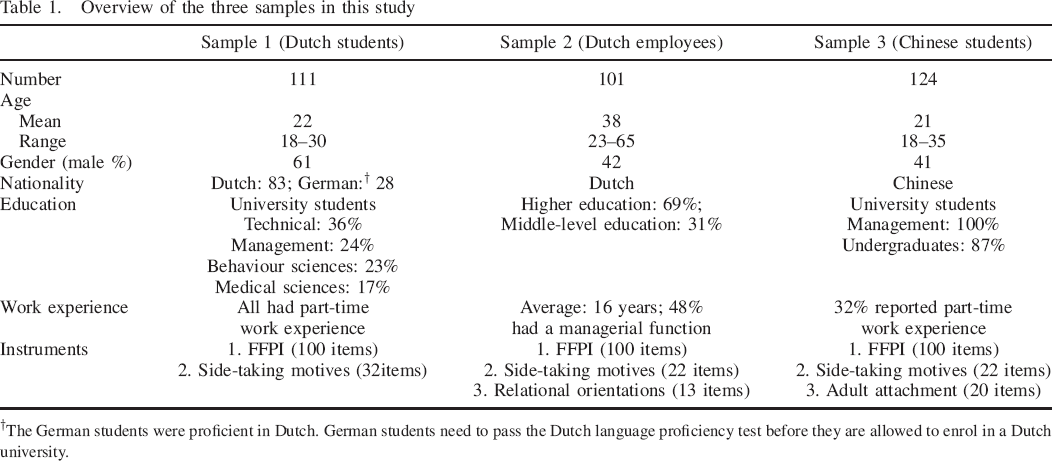
Three samples—a Dutch student sample (Sample 1), a Dutch employee sample (Sample 2) and a Chinese student sample (Sample 3)—were used in this study. An overview of the demographic information of the three samples can be found in Table 1.
Overview of the three samples in this study
The German students were proficient in Dutch. German students need to pass the Dutch language proficiency test before they are allowed to enrol in a Dutch university.
Sample 1 was used to explore the structure of side–taking motives and to conduct an initial test of the relationships between personality traits and the motives for side taking. Sample 2 was used to refine the instrument to measure the side–taking motives and generalize the research conclusion from the student population to the employee population. Sample 3 was used to obtain some empirical evidence on cultural generalization regarding the structure of side–taking motives and the relationships between the personality traits and the side–taking motives. For this purpose, we recruited a Chinese student sample from Mainland China.
Procedure
For the two Dutch samples, two research assistants (university students) helped us with data collection. The two research assistants started by approaching participants through their personal networks. Their acquaintances were asked whether they would like to participate in this study and whether they would like to help us distribute questionnaires. Through this procedure, we came up with a participation list. For the student sample, we initially distributed 250 personality questionnaires, and 143 were returned. We then handed out the side–taking motive questionnaires to those 143 participants, and 111 were returned (44.4% response rate). For the employee sample, 300 personality questionnaires were distributed, and 121 were returned. These 121 respondents then received the side–taking motive questionnaire, and 101 were returned (33.7% response rate).
When distributing the questionnaires, we created a temporal separation by introducing a week's delay between the two self–rating measures. In the first week, participants filled in the paper–and–pencil–based personality questionnaire. In the second week they were asked to complete the side–taking motive questionnaire. Participants were asked to fill in their email address in both questionnaires to enable us to match up the answers from the same respondent. A reminder was sent when questionnaires were not handed in.
For the Chinese sample, the participants completed the questionnaires during class. Participants were informed explicitly that the questionnaires were irrelevant to their course evaluation. In the first week, the participants filled in the personality questionnaire. In the second week, they completed the questionnaire regarding the side–taking motives and other measures. The student registration numbers were used as an identifier to match the answers from the same respondent. We handed out 172 questionnaires (both types); 124 questionnaires were correctly paired (72.1% response rate).
The participants in Sample 1and Sample 2 answered the Dutch–language questionnaires; the participants in Sample 3 answered the Chinese–language questionnaires. We followed the conventional translation and back–translation technique to ensure linguistic equivalence. All respondents were assured that their answers would be treated confidentially and used for scientific research purposes only.
Measures
Personality traits were measured using the Five Factor Personality Inventory (FFPI) developed by Hendriks et al. (1999a, 1999b). This instrument has been tested nationally (among many samples, including a large Dutch population sample) and internationally (across 13 countries). It has proved to be a reliable and valid measure to assess the Big Five personality traits (e.g., Hendriks et al., 1999b, 2003). In total, the FFPI contains 100 items; each of the Big Five is represented with 10 items of the ‘positive’ pole (+) and 10 items of the ‘negative’ pole (−) (e.g., extraversion vs. introversion). Examples of items are takes time out to chat (extraversion), tries to prevent quarrels (agreeableness), Works hard (conscientiousness), keeps his/her emotions under control (emotional stability) and decides things on his/her own (autonomy). Responses were given on a five–point scale ranging from 1 = not at all applicable to 5 = entirely applicable. A person's ‘compatible anchored factor scores’ were computed using the FFPI scoring software. Compatible anchored factor scores are standardized scores anchored at the scale midpoint (Hofstee & Hendriks, 1998). They are computed as weighted linear combinations of a person's 100 item responses, using item weights established in the Dutch norm sample. The internal consistency reliabilities of the FFPI factor scores ranged from .83 to .87 (Median = .85) in the Dutch student sample, from .80 to .88 (Median = .84) in the Dutch employee sample and from .77 to .88 (Median = .80) in the Chinese student sample.
Four types of side–taking motives
The instrument for measuring individuals’ motives for side taking was developed in four steps. First, on the basis of literature review and our previous work (e.g., Gross et al., 1958; Van de Vliert, 1981; Yang et al., 2009), we formulated 40 items related to the side–taking motives. In the second step, we discussed those 40 items with two experts in the field. Based on their feedback, we removed eight items because of redundancy or unclearness. A 32–item list was then generated describing moral (8 items), relational (8 items), sanction–avoiding (8 items) and reward–approaching motives (8 items). All items were measured on five–point Likert scales (1 = strongly disagree, and 5 = strongly agree).
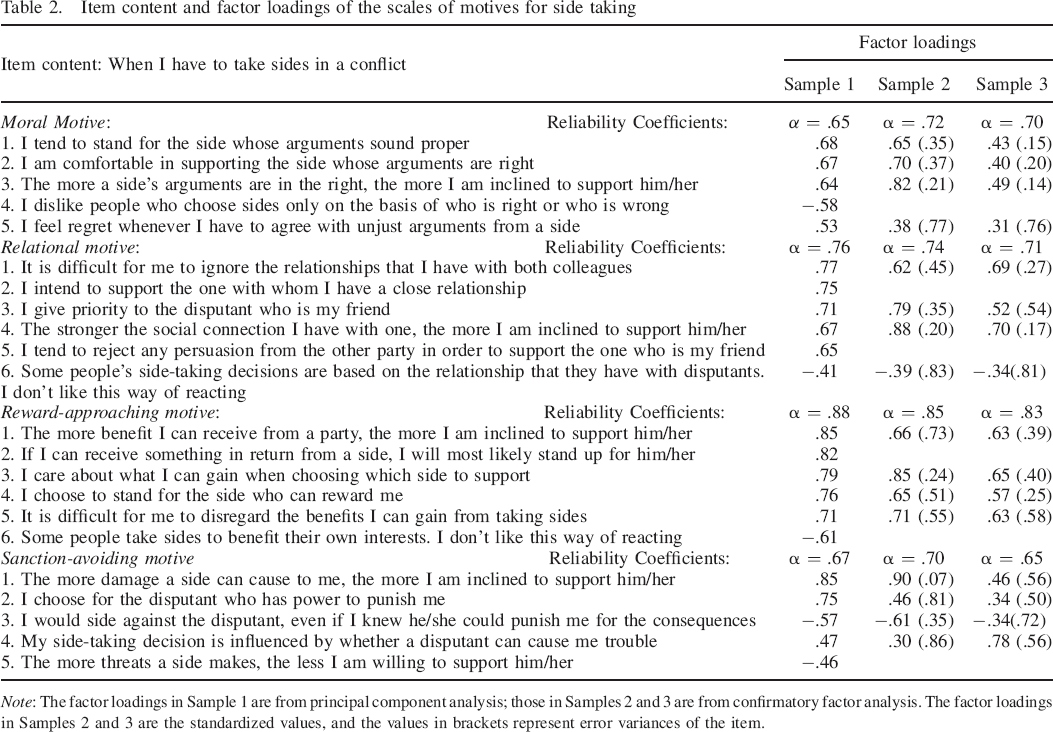
In the third step, the 32–item questionnaire was administered to Sample 1 to explore the structure of side–taking motives. We tested the internal consistency coefficient of each sub–scale (with 8 items) and did exploratory factor analysis on the 32 items. The reliability of each sub–scale reached or exceeded .65 (see Table 2). The results from principal component analysis indicated a four–factor structure in which 22 items had at least one loading with an absolute value of .30 or greater (see Table 2).
Item content and factor loadings of the scales of motives for side taking
Note: The factor loadings in Sample 1 are from principal component analysis; those in Samples 2 and 3 are from confirmatory factor analysis. The factor loadings in Samples 2 and 3 are the standardized values, and the values in brackets represent error variances of the item.
In the fourth step, we first re–ran a reliability test for each subscale in Sample 2 and Sample 3, respectively. We deleted four reversed items to improve internal consistency reliability (especially for Sample 3). We also removed one item from the relational scale (I intend to support the one with whom I have a close relationship) and one item from the reward–approaching scale (If I can receive something in return from a side, I will most likely stand up for him/her) because of redundancy. We then conducted a confirmatory factor analysis on the remaining 16 items in Sample 2 and Sample 3. The Cronbach's alpha (α) coefficients for internal consistency of each scale, item content and factor loadings can be found in Table 2.
The instructions for the motives for side–taking questionnaire read as follows: In daily life, you are sometimes confronted with a dispute or a disagreement between others. For example, two of your fellow students (or co–workers) have different opinions about how to allocate an assignment in a team project. When the dispute gets intense, especially when both sides want to make a coalition with you, you often have to stand for one side or the other. We would like to know the criteria that you use in making up your mind. The following descriptions concern people's opinions about and reasons for taking sides in a conflict. Could you please indicate to what extent you disagree or agree with each of these statements. Note that there is no right or wrong answer to these statements.
Other measures—Communal versus Reciprocity Orientation and Adult Attachment Styles—were included in some of the questionnaires (Sample 2 or Sample 3) to provide criterion–related validity for the instrument used to measure the motives for side taking.
The measure of communal versus reciprocity orientation was developed by Yang et al. (2008) and consisted of 13 items to measure participants’ two types of relational orientations. Communal orientation was measured using six items describing an interpersonal interaction from the perspective of internalized normative obligation. That is, individuals give or take benefits in response to others’ needs (e.g., When a family member is in need, I feel obliged to provide support, even if he/she is not nice to me; α = .76). Reciprocity orientation was measured using seven items describing an interpersonal interaction from the perspective of social exchange (e.g., If I have done something for an acquaintance, I expect a favour in return from him or her; α = .72). This measure was included in the booklet of Sample 2.
The measure of adult attachment styles consisted of 20 items for measuring four types of participants’ attachment styles. The instrument was developed by Hofstra, Van Oudenhoven, and Buunk (2005). Five items were used to assess the preoccupied style (e.g., I am often afraid that other people don't like me; α = .70), four items to assess the fearful style (e.g., I am afraid that my hopes will be deflated when I get too closely related to others; α = .78), six items to assess the secure style (e.g., I find it easy to engage in close relationships with other people; α = .75) and five items to assess the dismissing style (e.g., I do not worry about being alone because I do not need other people that badly; α = .76). This measure was included in the booklet of Sample 3.
In addition, demographic variables of participants’ gender, age, educational levels and occupational skill levels (or major subject areas in the student samples) were included in the questionnaires.
Results
Exploring the structure of the motives for side taking (sample 1)
A principal component analysis was conducted on the 32 side–taking items. The first eight eigenvalues were as follows: 5.96, 4.04, 2.75, 1.97, 1.34, 1.21, 1.10 and 1.05. Based on our a priori expectations, we retained the first four factors, which were then orthogonally (varimax) rotated. Six items loaded on the first rotated factor, which was interpreted to measure the ‘reward–approaching motive’ (explained variance: 15%); another six items loaded on the second rotated factor, which was interpreted to measure the ‘relational motive’ (explained variance: 11.5%); five items loaded on the third rotated factor, which was interpreted to measure the ‘moral motive’ (explained variance: 10.4%); another five items loaded on the fourth rotated factor, which was interpreted to measure the ‘sanction–avoiding motive’ (explained variance: 9.1%). The remaining ten items showed no high loadings. Together, the four factors explained 46% of total variance. The minimum item loading of these 22 items on their corresponding factors was .41. All their cross loadings were lower than .30. Table 2 lists item content and the factor loadings after rotation (Sample 1).
Confirming the structure of the motives for side taking (samples 2 and 3)
We re–ran the internal consistency test for each sub–scale (resulting from the remaining 22 items) in Samples 2 and 3 and scrutinized the wording of each item. This process resulted in 16 satisfactory items. A confirmatory factor analysis was then conducted on these 16 items (both Sample 2 and Sample 3). Using LISREL 8.80, we analysed the covariance matrices of the two samples using maximum likelihood solution. Three criteria were used to judge the fit between data and model: Goodness–of–fit indicators, item loadings and error covariances between items. In the Dutch employee sample (sample 2), all goodness–of–fit indices were satisfactory (χ2= 112.65, df =96, p= .12; GFI = .92, NFI = .89, CFI = .95, IFI = .95, RMSEA = .04, SRMR = .06). In the Chinese student sample (sample 3), except for the Chi–Square value (χ2= 141.81, df =96, p <.05), the goodness–of–fit indices were quite satisfactory (GFI = .90, NFI = .85, CFI = .94, IFI = .94, RMSEA = .05, SRMR = .07). Table 2 lists the factor loadings and error variances of each item. We also tested a three–factor solution (the reward–approaching motive and the sanction–avoiding motive combined as one factor) on both samples. All goodness–of–fit indices became inferior to the four–factor model.
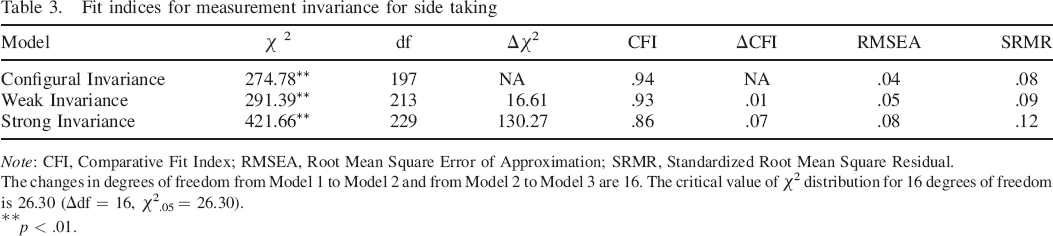
Next, we tested the measurement invariance of the instrument across the two samples (Sample 2 and Sample 3) to investigate cross–group construct equivalence of the scale for side–taking motives. Following the suggestions put forward by Meredith (1993; see also Wu, Li, & Zumbo, 2007), we examined three levels of nested hierarchy of factor invariance. The results are shown in Table 3. First, configural invariance requires the same factor model specification across groups. As indicated by the values of RMSEA (≤.05), CFI (≥.90) and SRMR (≤.10) in the first row of Table 3, the four–factor model proved to be equal for the two samples. Second, weak measurement invariance requires cross–group equality of the factor loadings. As indicated by the values of Δχ2 (≤26.30), ΔCFI (≤.01), CFI (≥.90) and SRMR (≤.10) in the second row of Table 3, the factor loadings were found to be equal across the two samples. Third, strong measurement invariance postulates that, for all items, not only the factor loadings but also the intercepts are equal across groups. However, as indicated by the values Δχ2 (≥26.30), ΔCFI (≥.01), CFI (≤.90) and SRMR (≥.10) in the third row of Table 3, this assumption was not supported by the data.
Fit indices for measurement invariance for side taking
Note: CFI, Comparative Fit Index; RMSEA, Root Mean Square Error of Approximation; SRMR, Standardized Root Mean Square Residual.
The changes in degrees of freedom from Model 1 to Model 2 and from Model 2 to Model 3 are 16. The critical value of χ2 distribution for 16 degrees of freedom is 26.30 (Δdf = 16, χ2.05= 26.30).
p < .01.
In sum, confirmatory factor analyses suggested that the four–factor model consisting of 16 items was applicable to both the Dutch employee sample and the Chinese student sample. Further, the factor loadings were found to be identical across groups, but the means of the latent variables (or factor score densities) were scaled differently. On the basis of these results, we examined these two samples separately in further analysis.
Criterion–related validity tests on the scale of the motives for side taking
We correlated the four types of motives for side taking with the measures of adult attachment styles and of communal versus reciprocity orientation in order to provide some references for the construct validity of the side–taking motive scale. In terms of the correlations with the adult attachment styles, the results indicated that the preoccupied style, which is characterized by manipulating or controlling relationships with others, was positively correlated with the relational motive (rrelational = .30, p <.05), the reward–approaching motive (rreward = .24, p <.05) and the sanction–avoiding motive (rsanction = .17; p <.10). The fearful style, which is described as including low self–confidence and distrust of others, was positively and significantly associated with the reward–approaching motive (r = .25; p< .05), and positively but non–significantly associated with the sanction–avoiding motive (r = .15; p = .13). The secure style (characterized by having high confidence about self and others) was positively correlated (r = .17; p< .10) with the moral motive for side taking. Regarding the correlations with the relational orientations, the results showed that the moral and the reward–approaching motives were positively associated with the reciprocity orientation (r moral = .22; rreward = .21; ps < .05), but none of the motives was correlated with the communal orientation. This correlation pattern suggests that the item contents of the motives for side taking contain the meaning argued for the concepts.
Descriptive analysis
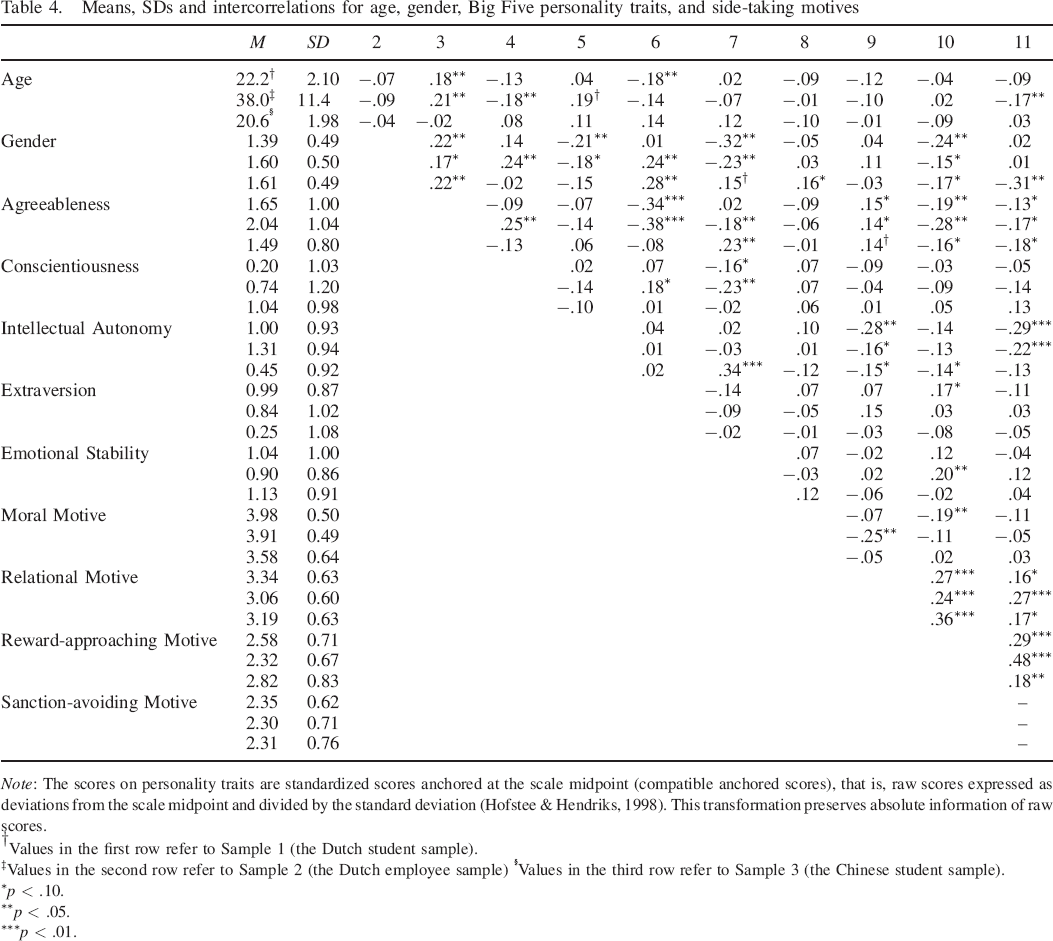
Table 4 reports the means, SDs and inter–correlations among the relevant variables. The three samples showed a consistent pattern for the four types of motives for side taking: The moral motive scored highest, followed by the relational motive and the reward–approaching motive, while the sanction–avoiding motive scored the lowest. The correlations showed that the relational motive was positively correlated with the reward–approaching motive (rsamp1 = .27; rsamp2 = .24 and rsamp3 = .36; ps < .01) and with the sanction–avoiding motive (rsamp1 = .16, p< .10; rsamp2 = .27, p < .01 and rsamp3 = .36, p < .10). The reward–approaching motive was positively correlated with the sanction–avoiding motive (rsamp1 = .29; rsamp2 = .48, and rsamp3 = .18; ps < .05). The moral motive did not correlate with the other three types of motives.
Means, SDs and intercorrelations for age, gender, Big Five personality traits, and side–taking motives
Note: The scores on personality traits are standardized scores anchored at the scale midpoint (compatible anchored scores), that is, raw scores expressed as deviations from the scale midpoint and divided by the standard deviation (Hofstee & Hendriks, 1998). This transformation preserves absolute information of raw scores.
Values in the first row refer to Sample 1 (the Dutch student sample).
Values in the second row refer to Sample 2 (the Dutch employee sample)
Values in the third row refer to Sample 3 (the Chinese student sample).
p < .10.
p < .05.
p < .01.
In addition, gender was negatively correlated with the reward–approaching motive across the three samples (rsamp1 = −.24, p< .05; rsamp2 = −.15; and rsamp3 = −.17, ps < .10): Men reported a higher reward–approaching motive than women.
Associations between the Big Five personality traits and the motives for side taking
We conducted hierarchical regression analysis to examine the association between the Big Five personality traits and the four types of side–taking motives. Two control variables— age and gender—were first entered into the equation, followed by the five personality traits. The results are shown in Table 5. Consistent with our expectations, the results showed that agreeableness was positively associated with the relational motive for side taking in all three samples (βsamp1 = .21; βsamp2 = .18; ps < .05; βsamp3 = .14; p < .10). Unexpectedly, we found that agreeableness was negatively associated with the reward–approaching motive in Sample 2 (βsamp2 = −.33; p < .05) and the sanction–avoiding motive in Sample 1 and Sample 2 (βsamp1 = −.20; p < .05; βsamp2 = −.19; p < .10).
Regression analysis: the impact of Big Five personality traits on side–taking motives across the three samples
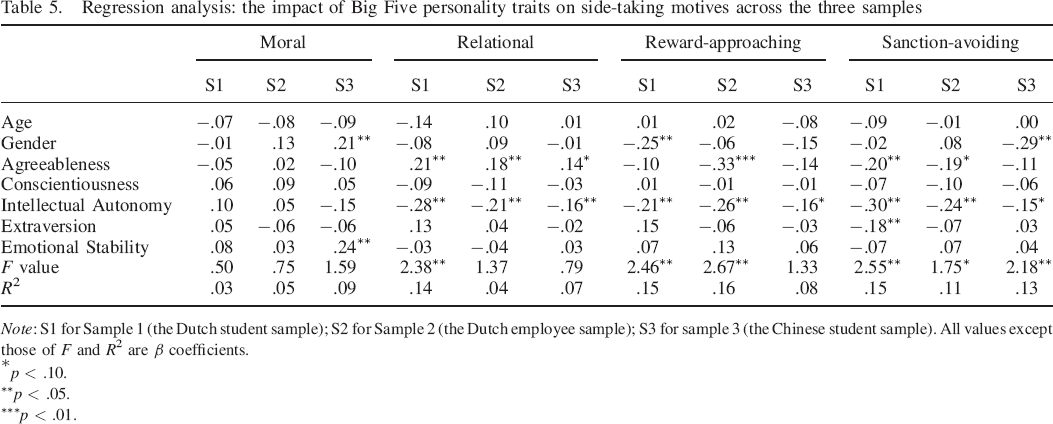
Note: S1 for Sample 1 (the Dutch student sample); S2 for Sample 2 (the Dutch employee sample); S3 for sample 3 (the Chinese student sample). All values except those of F and R2 are β coefficients.
p < .10.
p < .05.
p < .01.
The results did not reveal a significant association between conscientiousness and the moral motive for side taking across the three samples. Conscientiousness indeed was not associated with any type of motive for side taking. This result may be caused by the fact that the major theme of conscientiousness in the FFPI is achievement oriented rather than ethical decision–making oriented. To refine our hypothesis testing, we chose a specific FFPI item (behaves properly), which has a secondary factor loading on agreeableness next to its primary factor loading on conscientiousness (Hendriks, 1997). This item thus represents the ‘ethical’ characteristics in the AB5C model (Hofstee et al., 1992). The moral motive for side taking was then regressed on this item. A marginally significant association between this item and the moral motive for side taking was detected across the three samples (βsamp1 = .12; βsamp2 = .20; βsamp3 = .14; ps < .10).
In addition, intellectual autonomy was found to be negatively associated with the reward–approaching motive (βsamp1 = −.21; βsamp2 = −.26; ps < .05; βsamp3 = −.16; p < .10), the sanction–avoiding motive (βsamp1 = −.30; βsamp2 = −.24; ps < .05; βsamp3 = −.15; p < .10) and the relational motive across all three samples (βsamp1 = −.28; βsamp2 = −.21; βsamp3 = −.16; ps < .05). This consistent pattern is in line with the core meaning of FFPI–intellectual autonomy, which is independent decision making. It seems to be the case that individuals who are high in intellectual autonomy, that is, who tend to form their own opinions and can easily link facts together and analyse problems (see Hendriks, 1997; Hendriks et al., 1999b), may dislike taking sides by reason of fulfilling socially accepted roles or being influenced by instrumental stimuli.
For the personality traits of extraversion and emotional stability, the results did not show any consistent pattern in terms of their associations with the side–taking motives. Extraversion was negatively associated with the sanction–avoiding motive only in the Dutch student sample (Sample 1) (βsamp1 = −.18; p < .05). Emotional stability was positively associated with the moral motive for side taking only in the Chinese student sample (Sample 3) (βsamp3 = .24; p < .05). These findings indicate a lack of strong associations between the traits of extraversion and emotional stability and the side–taking motives.
Discussion
This study was aimed at identifying the types of side–taking motives and exploring the associations between the Big Five personality traits and side–taking motives. The empirical results from the three samples revealed some interesting results: Regarding the construct of the side–taking motives, a four–factor structure was first observed among the Dutch student sample, and was then confirmed in the Dutch employee and the Chinese student samples. Regarding the relationships between the Big Five personality traits and the side–taking motives, the results indicated that agreeableness was positively associated with the relational motive for side taking and intellectual autonomy was negatively associated with the reward–approaching motive, the sanction–avoiding motive and the relational motive for side taking. Below, we further discuss two specific contributions of this study: The construct of side–taking motives and its relations to the Big Five personality traits.
The construct of side–taking motives
When faced with an interpersonal conflict, third parties are often concerned with three types of information: What is the conflict about? Who is involved in the conflict? What are the consequences of the conflict? (e.g., Van de Vliert, 1981; Yang et al., 2009). Relevant to these concerns, three criteria—justice, relationships with disputants and self–interests—have been proposed for use in evaluating third party interventions (e.g., Conlon & Meyer, 2004; Ury et al., 1988). In this study, those three criteria served as a reference to identify lay third parties’ motives for side taking. A four–factor structure—moral, relational, reward–approaching and sanction–avoiding motives—was proposed to describe lay third parties’ motives for side taking. This structure was confirmed by the empirical findings from the three samples.
A four–dimensional structure of side–taking motives somewhat extends our knowledge about the underlying principles guiding third parties to take sides. In their seminal work on side taking, Gross et al. (1958) proposed two dominant principles: Perceived legitimacy of disputants’ arguments and expected negative sanctions from disputants. The former is reflected by the moral motive and the latter is mirrored by the sanction–avoiding motive. Although researchers have questioned whether these two principles are powerful enough to cover all reasons for side taking (e.g., Miller & Shull, 1962; Van de Vliert & Cottrell, 1979; Yang et al., 2007), as far as we know, no prior research has come up with extra justifications. By adopting the recent work on third–party intervention (e.g., Conlon & Meyer, 2004; Lim & Carnevale, 1990; Ury et al., 1988), we developed a new construct to categorize individual side–taking motives. Especially the identification of two new factors—the relational and the reward–approaching motives—suggests that the reasons that trigger lay third parties to take sides could be more complicated than those proposed by Gross et al. (1958).
As mentioned in the introduction, in this study we approached lay third parties’ side–taking motives from an individual–differences perspective. We therefore did not specify a side–taking dilemma. We assumed that, without intervention, the evoked side–taking dilemmas should be randomly distributed among respondents. Respondents’ reactions to the questions then reflect more individual differences than situational constraints in which they would be given. Our findings indicate that individuals do differ in their motives for side taking. For this reason, we believe that side taking is not only a reaction provoked by situations (e.g., Van de Vliert, 1981), but is also related to individual–differences factors in terms of predispositions.
Given that both personality traits and situational factors are connected with individuals’ side–taking reactions, an interactive approach (personality traits by situational factors) needs to be taken in future studies to refine the associations between personality traits and side–taking motives. It is possible that certain associations between personality traits and side–taking motives become salient in a specific conflict situation. For instance, a side–taking dilemma concerning a relational conflict may highlight the relationship between agreeableness and the relational motive for side taking.
Associations between the Big–Five personality traits and side–taking motives
In this study, we also explored the relationships between individuals’ personality traits and their motives for side taking. In line with our expectation, agreeableness was positively associated with the relational motive. Unexpectedly, we found a negative association between agreeableness, on the one hand, and the reward–approaching and the sanction–avoiding motives, on the other. These findings echo the outcomes from previous studies (e.g., Bono et al., 2002; Jensen–Campbell et al., 2003; Moberg, 1998), and once again indicate that agreeableness is of particular importance to the study of conflict.
Our findings did not support the general link between conscientiousness and the moral motive for side taking. However, one item in the conscientiousness scale, which covers the meaning of responsibility and integrity (behaves properly), was associated with the moral motive for side taking. This finding has two implications. First, it partially supports the notion that the moral motive for side taking is associated with individual characteristics. Second, conscientiousness (at least as measured using the FFPI) may be too broad to be associated with the moral motive for side taking. Future research needs to include a more specific ‘ethical–oriented’ construct to investigate the association with the moral motive for side taking. Intellectual autonomy appeared to be negatively associated with the reward–approaching, the sanction–avoiding, and the relational motives for side taking. This pattern was consistent across the three samples. Given that the core meaning of intellectual autonomy is described using adjectives like ‘sharp–witted’ and ‘critical’ and behaviours like ‘wants to form his/her own opinion’ and ‘does not follow the crowd’ (Hendriks et al., 1999b), the observed negative relationships are hardly surprising. Autonomous individuals are likely to be less driven in their decision making by external factors like relationships, rewards and sanctions for side taking. What is surprising, however, is that no positive relationship was found with the moral motive for side taking. This question certainly deserves more attention in future research on side taking.
For extraversion and emotional stability, we did not formulate any clear hypothesis regarding their associations with the four types of side–taking motives. None of the empirical results showed a consistent pattern on their relationships. Based on our findings, we suspect that these two personality traits are less relevant to side–taking motives. However, in a recent study, De Raad et al. (2008) proposed that extraversion and emotional stability are so–called temperament factors, meaning that their functions for behaviours (or behaviour intentions) are conditional upon and evoked by situations. It would be interesting to take situational factors into account when examining the effects of these two personality traits on side–taking motives.
It is also worthwhile to mention that, although our samples are from two different cultures—the Dutch culture is more horizontal–individualistic oriented and the Chinese culture is more vertical–collectivistic oriented (e.g., Triandis, 1995; Yang et al., 2007), our findings have shown a quite consistent pattern of the associations between the five personality traits and the motives for side taking. This suggests that the relationships between personality traits and the motives for side taking may be generalizable across cultures.
Limitations
In interpreting the results of our study, some limitations need to be considered. First, in this study the four types of motives for side taking were considered separately and independently. Their connections and relations were neglected. It is highly possible that these four types of motives reinforce each other in reality. This means that the ‘real’ associations between personality traits and side–taking motives might be more complicated than indicated by the current findings. Second, the scales of side–taking motives contain few reverse–key items, which may inflate the correlations among the four types of motives as well as the correlations of the motive scales with any other scales that show a similar imbalance. These scales certainly need to be improved in future studies, for example, by adding well–written reverse–keyed items that are strong indicators of their respective traits.
The third shortcoming is related to the construct validity of the scales of side–taking motives. Although some information on the reliability and validity of the scales of side–taking motives has been provided in this study, as it is a new scale much more evidence of different forms of validity (i.e., predictive, concurrent, discriminant) is still needed to enable the construct assessed using this scale to be inferred with confidence. The fourth limitation concerns data collection. The method of data collection was not completely anonymous and the procedure of data collection deviated between samples. This may have contaminated our findings. However, the consistent pattern of the results across the samples convinces us that any biases resulting from the data collection procedures were not too influential. Last but not least, as mentioned above, we took an individual–differences perspective in this study to investigate lay third parties’ motives for side taking. Situational factors for side taking were downplayed. It is possible that the relationships between personality traits and side–taking motives are partly dependent on specific conflict situations.
Footnotes
Acknowledgements
The authors thank Hanna Lange for her help in collecting the data. They are grateful to the editor Michael Ashton for his valuable suggestions and to Evert van de Vliert and Ellen Giebels for their critical comments on a previous version of this paper.