







Abstract
The relationship between self–regulatory capacities and self–esteem as well as well–being is examined by a mediation model that views self–regulation as promoting the development of identity achievement which, in turn, is expected to be associated with well–being. Among secondary school students (Study 1) identity achievement mediated the association between the self–regulatory capacity of attention control and self–esteem. In Study 2 (university students), the mediational effect of identity achievement was found for the relationship between the self–regulatory capacity of action control and well–being. Explicit motives moderated this association. In sum, a firm identity enhances well–being by lending a sense of continuity to one's life. However, explicit motives have a substitution effect by giving direction to life when lacking firm identity commitments. Copyright © 2010 John Wiley & Sons, Ltd.
Introduction
Psychology has always been interested in factors which hamper and foster individuals’ well–being and positive views of oneself. Whereas early studies focused on the relationship of well–being and demographic variables such as age, income and marital status, more recently scholars started to study personality–based causes and correlates of subjective well–being (Diener, Suh, Lucas, & Smith, 1999). Thus, for various features of personality, such as traits (DeNeve & Cooper, 1998), commitment to goals (Emmons, 1991) and self–regulation (Baumeister & Vohs, 2003), a significant association with well–being has been shown. By focusing on self–regulatory capacities in two independent studies, we investigated their interrelation with identity development as well as self–esteem and well–being. In addition, we examined whether individuals’ explicit (consciously represented) motives meaningfully affect the link between identity and well–being (Study 2). Thus, the present study sheds light on why self–regulation has a beneficial effect on self–esteem and well–being.
Self–regulation
Self–regulation is a broad term, denoting any kind of regulation of the self by the self; thus, whenever by use of some psychological capacity some psychological process—be it behavioural, motivational or attentional—is brought to a desired state, this is an instance of self–regulation (cf. Vohs & Baumeister, 2004). As such, self–regulation has many facets (Baumeister, Gailliot, DeWall, & Oaten, 2006; Vohs & Baumeister, 2004). For example, with respect to the regulation of motivational and behavioural processes self–regulation is involved in self–concordant goal setting and enactment and successful completion of the goal–directed action (Carver & Scheier, 1998). Enabling individuals to act or refrain from action despite inner or outer stimuli inciting the opposite, self–regulation also comprises control of one's thoughts, emotions and attention.
Thus, among self–regulatory capacities are the dispositions of action control, i.e. the intuitive ability to regulate one's feelings and thoughts (Baumann, Kaschel, & Kuhl, 2005), and of attention control, i.e. the ability to keep one's attention focused on a given goal in spite of distractors (Diehl, Semegon, & Schwarzer, 2006). Action control denominates the capacity to regulate affect without needing external support, to have access to one's self–representations, and to find and put into practice alternative goal–directed and appropriate behaviour even under stress. When facing or anticipating failure or stress individuals either have the tendency to ruminate about the unpleasant situation and remain in a state of inactivity due to lack in access to behaviour alternatives, or down–regulate the negative affect caused by the stressful event, activate positive affect and initiate behavioural alternatives. The former pattern is termed state orientation, the latter action orientation (Kuhl, 1992; see Koole, Kuhl, Jostmann, & Vohs, 2005, for a review).
These dispositions of action control are primarily shaped by experiences in early childhood in which the self acquires the capacity to regulate affect (Kuhl, 2000): prompt and adequate reactions by a caregiver, usually the mother, to self–expressions of the child support a development in which affect regulation processes (i.e. self–relaxation or self–motivation) come increasingly under the control of the self–system (Kopp, 1989). Comparably, attention control also develops during childhood (Rueda, Posner, & Rothbart, 2005).
Self–regulation and well–being
As Baumeister and Vohs (2003: p. 213) state, ‘the ability to self–regulate is an integral component of mental and physical well–being’ as self–regulation, for example, enables people to persist despite failure feedback (Vohs, Baumeister, Schmeichel, Twenge, Nelson, & Tice, 2008), but also to give up unattainable goals (Wrosch, Scheier, Miller, Schulz, & Carver, 2003).
Baumann, Kaschel, and Kuhl (2007) found that high affect sensitivity, i.e. the intensity of an individual's first emotional reaction to a stressful event, is associated with impaired well–being and increased psychosomatic symptoms only when the self–regulatory capacity of action control is weak. Impaired action control also increases the perseveration of negative affect states and hence the development of psychosomatic symptoms under stress induced by motive–goal incongruence for example (Baumann et al., 2005). Beckmann and Kellmann (2004) suggest that action orientation facilitates a recovery from stress by empowering people to generate positive affect which itself has a motivating effect. Moreover, Brunstein (2001) could longitudinally show that action orientation among students was associated with both a decrease in negative affect and an increase in positive affect. Thus, it is well–established that individual differences in action control have far–reaching consequences which find their expression in well–being.
Analogously, it has been argued that self–regulation is needed to put beneficial (e.g. health–related) behaviour into practice although this might entail effort and strain (Schwarzer & Luszczynska, 2008). Self–regulation such as attention control is required to stay focused on a given goal and resist temptations along the way. As such, attention control is important for the volitional process of transforming intentions into corresponding action. This given, attention control is positively associated with general self–efficacy and proactive coping but shows negative correlations with depressive symptoms (Diehl et al., 2006). In sum, self–regulatory capacities such as action or attention control are related to well–being.
Specifically, gaining access to the self or keeping focused on a goal in the face of aversive circumstances (e.g. difficult decisions) should be associated with good well–being by enabling individuals to master challenging developmental tasks. The successful resolution of developmental conflicts in turn increases the likelihood for higher levels of well–being. Identity formation is one such developmental task which would be expected to benefit from self–regulatory capacities.
Identity
Identity formation is the main developmental task of adolescence (Erikson, 1968). A firm identity functions to enhance adolescents’ sense of self as a unique person and to secure their interrelatedness with other people (Adams & Marshall, 1996). Marcia (1966) refined Erikson's original formulation by postulating the existence of four identity statuses (achievement, foreclosure, diffusion and moratorium) (for a review see Schwartz, 2001).
Marcia defines identity as ‘an internal, self–constructed, dynamic organization of drives, abilities, beliefs and individual history’ (Marcia, 1980: p. 159) and explains differences in identity formation with reference to the two dimensions of exploration and commitment. Individuals characterized by identity achievement have come to a firm commitment to identity–defining elements such as beliefs and values after having gone through a phase of exploring and testing alternative elements. Foreclosure describes people who have likewise established strong commitment; the elements committed to, however, were generally adopted from parents without testing alternatives. Individuals in the moratorium and diffusion identity status are characterized by a lack of commitment to aspects of identity. The difference is that those in the moratorium are in the process of looking for meaningful identity elements to which finally a commitment can be made, while those in the diffusion status are not.
Identity and self–regulation
The process of identity formation is a potentially stressful situation as it requires giving up well–known values and well–practiced roles in life. Such an argument may particularly be true in modern societies where the ‘self is seen as having the license and obligation to create itself’ (Baumeister, 1997: p. 206). Hence, personal resources are crucial when engaging in an ego–threatening process of searching for personal identity elements and persisting in this process despite the negative affect it might entail (Luyckx, Soenens, Berzonsky, Smits, Goossens, & Vansteenkiste, 2007). Accordingly, Baumeister and Vohs (2003), who argue that self–regulation is activated whenever volitional processes of changing the self take place, emphasize the significance of self–regulation in maximizing capabilities of the self (see also Côté, 1997): whereas some individuals perceive an event as challenging, the same event is threatening for others because they lack necessary resources to successfully cope with it. Analogously, Adams and Marshall (1996) consider self–regulatory capacities to be primary mechanisms in identity transformation.
Indeed, differences between identity statuses concerning self–regulatory capacities have been reported: individuals with an achieved identity have highly internalized self–regulatory and self–examining processes at their disposal (Marcia, 1993). Focusing specifically on the disposition of action control as indicator of self–regulation, Hofer, Chasiotis, Kiessling, and Busch (2006) showed that action orientation enables the development of an achieved identity even under adverse childhood family conditions. Thus, the relationship between self–regulation and identity formation is well–established.
Identity and well–being
The question of how identity statuses affect psychological functioning and mental health has been central to research on identity right from its beginning (Marcia, 1980; Meeus, Iedema, Helsen, & Vollebergh, 1999). The picture is quite clear–cut in that an achieved identity is the healthiest status, while the associations with well–being are negative for moratorium and diffusion and not unequivocal for foreclosure (Hofer, Kärtner, Chasiotis, Busch, & Kiessling, 2007; Meeus, 1996; Waterman, 2007).
By demonstrating that identity achievement indeed is positively associated with a wide array of measures of well–being, Waterman (2007) argues that the exploration of a variety of possibilities increases the likelihood to identify resolutions to identity issues consistent with personal talents and needs but also to yield greater information about benefits and costs of possible alternatives. Thus, individuals are more likely to succeed when pursuing such self–congruent and informed commitments and, finally, to enjoy higher levels of well–being. We postulate that the argument analogously holds true for self–esteem: although well–being and self–esteem are distinct constructs, they certainly show a certain overlap in that self–esteem is also associated with a variety of positive outcomes in adolescence (e.g. DuBois, Burk–Braxton, Swenson, Trevendale, Lockerd, & Morna, 2002) and in strong associations between the two constructs (Baumeister, Campbell, Krueger, & Vohs, 2003; Paradise & Kernis, 2002). Indeed, according to St. Louis and Liem (2005) adolescents with an achieved identity seem to have higher self–esteem than youths in other identity statuses.
The Present Research: Study 1
In Study 1, we will examine the association between all three variables that have, to the best of our knowledge, not been conjointly considered in a common model, i.e. self–regulation, identity achievement and self–esteem. In the literature, there is consensus that self–regulatory capacities are primarily acquired in early childhood (Kopp, 1989; Rueda et al., 2005) and facilitate later developmental tasks. Identity formation, on the other hand, is a central developmental milestone in adolescence and young adulthood. Thus, from a developmental perspective we argue that if one is to consider self–regulation, identity status and self–regulation conjointly, the causal influences should be from self–regulatory capacities on both self–esteem and identity formation. Furthermore, the central developmental task of identity formation should at least partly mediate the beneficial effect of self–regulation on self–esteem. This mediational hypothesis will be tested in Study 1.
Study 1
Study 1 tests the mediational hypothesis delineated above. We assumed a significant association between attention control and self–esteem. This relation, however, is hypothesized to be mediated by achieved ego identity because self–regulatory capacities such as attention control facilitate the development of an achieved ego identity by enabling adolescents to engage and persist in the active exploration of identity elements. In turn, identity achievement leads to self–esteem. Thus, it is assumed that the link between attention control and self–esteem is mediated by identity achievement.
Method
Participants
Students in grade 11 and 12, respectively, were recruited at two German secondary schools. Altogether, 151 students (87 female participants) with a mean age of 17 years (SD = 1.4) were included in the sample. Female and male students did not differ in age.
Measures
Measurements were administered in group settings. Students voluntarily participated in the study during free school periods and were granted full anonymity and confidentiality. Students provided data on attention control, identity achievement and self–esteem.
Self–regulation: Attention Control
Focusing on a specific component of self–regulation, the Self–Regulation Scale (SRS; Schwarzer, Diehl, & Schmitz, 1999) measures attention control which is defined as an individual's ability to focus on a given task in spite of interfering stimuli (Diehl et al., 2006). The scale comprises 10 items (e.g. After an interruption, I don't have any problem resuming my concentrated style of working), which have to be scored on a Likert scale from 0 (not at all true) to 3 (completely true). A total score is formed by summing up the 10 item scores. Cronbach's α of the SRS was .80.
Identity
The revised Extended Objective Measure of Ego Identity Status (EOM–EIS; Bennion & Adams, 1986; German: Kapfhammer, 1995) was applied to measure level of identity achievement status. The full questionnaire consists of 64 items (16 items for each of Marcia's statuses) that are evaluated on a Likert scale ranging from 1 (strongly disagree) to 6 (strongly agree), so that higher scores reflect a more pronounced identity status. Only the 16 items assessing identity achievement were employed. Half of the items relate to an interpersonal (i.e. friendship, dating, sex roles and recreation; e.g. I've tried many different friendships and now I have a clear idea of what I look for in a friend) and the other half to an ideological domain (i.e. occupation, politics, religion and philosophical lifestyle; e.g. After considerable thought I've developed my own individual viewpoint on what is for me an ideal ‘lifestyle’ and don't believe anyone will be likely to change my perspective). In Study 1, scores of both domains were combined to determine an individual's level of global identity. The α value for global identity achievement was .72.
Self–esteem
The Rosenberg Self–Esteem Scale (RSES; Rosenberg, 1965; German: Ferring & Filipp, 1996) was employed to assess self–esteem. Consisting of 10 items (e.g. On the whole, I am satisfied with myself) to be scored on a Likert scale ranging from 0 (strongly disagree) to 3 (strongly agree), the RSES is the most widely used instrument in research on self–esteem (Gray–Little, Williams, & Hancock, 1997). The sum of the item scores is used as indicator of an individual's global self–esteem. Cronbach's α for the RSES was .75.
Results
In the following, descriptive statistics of and correlations among variables are presented. Additionally, effects of age and gender on psychological constructs are examined. Next, analyses on the mediation hypothesis (attention control, global identity achievement and self–esteem) are presented.
General statistics, correlations among measurements and effects related to age and gender
In Table 1, descriptive data and correlations among measurements are given. As shown, measurements were significantly associated with each other: higher scores for attention control were significantly related to higher scores of both identity achievement and self–esteem; these in turn were positively associated with each other. Age– and gender–related effects on measurements were tested by analyses of covariance (ANCOVA) with gender (factor) and age (covariate). None of the analyses indicated a significant effect of age or gender (Fs1, 148 ≤ 3.50; η2s ≤ .02). 1
Correlations among and descriptive statistics of attention control, identity achievement and self–esteem (N = 151)
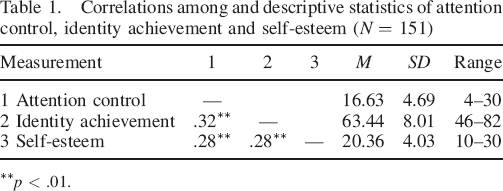
p < .01.
Testing the mediation hypothesis
We computed mediation analyses applying Baron and Kenny's (1986) four–step model. The criteria for mediation specified by this model applied: first, there was a significant total effect of attention control on self–esteem (b = .24; SE = 0.07; p < .001); second, there was a significant total effect of attention control on identity achievement (b = .55; SE = 0.14; p < .001); third, there was a significant direct effect of identity achievement on self–esteem, controlling for attention control (b = .11; SE = 0.04; p < .01). Finally, the direct effect of attention control on self–esteem decreased when controlling for identity achievement (b = .18; SE = 0.07; p < .05; with R2 for achievement = .12; p < .001). The indirect effect of attention control on self–esteem via identity achievement (Δb = .06) was further supported by a significant Sobel test (z = 2.19, p < .05). 2 This can be taken as evidence that the direct effect of attention control on self–esteem was partly mediated by identity achievement.
Brief Discussion
As hypothesized, a mediation model was confirmed: the relationship between attention control as facet of self–regulation and self–esteem is partly mediated by identity achievement. This result suggests that self–regulatory capacities lead to self–esteem, at least partly, as they are significantly involved in the process of establishing a firm identity which serves to guarantee a sense of stability and continuity in people's self–perception.
To be able to more confidently generalize from this result, we aimed to replicate the mediation model in a second sample at a different stage of identity development. Young adulthood poses new developmental changes which revitalize the search for a personal identity (Arnett, 2000). Moreover, to rule out that the result was due to the specific component of self–regulation and to self–esteem as proxy for well–being examined in Study 1, different facets of these variables were employed in the replication.
Study 2
The present study aims at replicating the mediation model tested and verified in Study 1. However, there are some important differences between the two studies: as indicator of self–regulation action control is assessed instead of attention control. To test if attention and action control have a common core and thus represent various aspects of self–regulation, a sample of 47 psychology freshmen (age: M = 21.20; SD = 2.30) provided information on both constructs. Analyses yielded a correlation of r = .54 (p < .001). Thus, we view attention and action control as facets of a common underlying psychological phenomenon, namely self–regulation.
Action control represents a competence deeply rooted in personality which begins to develop in infancy and is highly influenced by parenting practices (see Kuhl's, 2000, systems–conditioning assumption). It empowers people to gain access to the self and alternative behavioural options even in stressful situations by an effective affect–regulation.
As indicator of well–being, a composite measure which considers the affective and cognitive dimensions of well–being will be employed. Moreover, participants are university students. Being considerably older than secondary school students in Study 1, they represent a more advanced stage of identity formation. Besides these changes which aim at making it possible to generalize from the results of Study 1, the said model was extended by an additional factor, namely explicit motives, which are assumed to affect the association of identity and well–being. Thus, Study 2 will explore the function of explicit motives in moderating the effect of identity achievement on well–being.
Explicit motives and well–being
Explicit, i.e. consciously represented motives, typically assessed by motivational forms of cognition (e.g. goals and values), drive and energize behaviour, and give direction and meaning to people's lives (Emmons, 1991). Thus, pursuing important goals and making progress towards attaining those increases well–being (Brunstein, 1993). However, pursuance of strivings is not uniformly associated with well–being.
Explicit motives clearly differ in their level of self–congruence (Kuhl & Kazén, 1994). In the self–concordance model (Sheldon & Elliot, 1999), it is argued that individual strivings are differentially motivated: while some goals serve inner values, needs and desires (intrinsic and identified motivation), other goals are pursued for external rewards or to conform to external regulations (extrinsic and introjected motivation). Congruence of explicit motives with pre–consciously represented affective preferences, i.e. implicit motives, has beneficial effects on well–being (Baumann et al., 2005) and is particularly high in individuals characterized by high levels of identity achievement (Hofer, Busch, Chasiotis, & Kiessling, 2006). Supposedly, good self–regulatory capacities of individuals in the identity achievement status enable them to select goals that fit their implicit motives and reject those that do not.
In contrast, societal norms and other regulators that have their locus outside the individual (Pepitone, 1976) prescribe certain values and life plans, thus influencing the process of goal commitment. Acting in accordance with those socially desired goals itself is associated with well–being because by doing so adolescents can affirm social belongingness and conformity. Thus, pursuing externally prescribed strivings entails positive social feedback and recognition and finally contributes to well–being (Grotevant, 1987). We assume that this effect, however, should be relevant for individuals with high levels of explicit motives but who are also low in identity achievement as they have not yet come to a firm conclusion on which personally meaningful motives to pursue and which to reject.
To summarize, the following moderated mediation hypothesis is tested: extending the mediation model for identity achievement (Study 1), the association between identity and well–being is additionally moderated by explicit motives. As explicit motives give direction in life even if unexplored and not tested for personal fit, individuals high in explicit motives are assumed to show high levels of well–being even if low in identity achievement. In contrast, we expect a positive association between identity achievement and well–being for participants low in explicit motives: low levels of explicit motives may not be associated with reduced levels of well–being among individuals high in identity achievement as the exploration process can just as well result in rejection of particular explicit motives.
Explicit motives refer to different spheres of life: a common differentiation specifies agency and communion motives, with the former subsuming strivings to be effective in one's environment and the latter primarily referring to motives of establishing and maintaining social relations (Bakan, 1966). This specification parallels a wide–spread discrimination of two domains of specific identity content (Bennion & Adams, 1986): the ideological domain covers all elements that refer to topics of politics, religion, career and life style. The interpersonal identity domain on the other hand summarizes those identity elements that stand in reference to relationships with others, including topics of romantic partnership, friendship, leisure–time activities and gender roles. Thus, the moderated mediation model will be tested for agency motives in relation to the ideological identity domain and for communion motives in relation to the interpersonal identity domain.
Method
Participants
The sample consists of 200 German university students (146 females) from various faculties. Among students of psychology (n = 65) only freshmen were accepted as participants to ensure that answers were unbiased by advanced psychological knowledge. Participants ranged in age from 18 to 30 years (M = 21.74; SD = 3.28). Female and male students did not differ in age.
Measures
Measurements were administered in group settings. Participants, who received course credit or small monetary compensation, were granted full anonymity and confidentiality. Students provided data on disposition of action control, identity achievement, emotional and cognitively represented facets of subjective well–being, and explicit communion and agency motives.
Self–Regulation: Action Control
Individuals’ disposition of action control was assessed by a short version of the action control scale (ACS: Kuhl, 1994). This 12–item questionnaire assesses two significant facets of action control, i.e. first, action orientation subsequent to failure and in the face of threatening experiences versus preoccupation (self–relaxation and maintaining self–access by downregulation of negative affect) and, second, prospective and decision–related action orientation in the face of difficulties versus hesitation (self–motivation/volitional facilitation by upregulation of positive affect). Each of the items describes a particular situation (e.g. When I have a lot of important things to do), in which participants are asked to choose either of two possible alternatives. One alternative is characteristic of action orientation (e.g. I find it easy to make a plan and stick with it) and the other of state orientation (e.g. I often don't know where to begin), which are considered to reflect two poles of the dimension action control. Action–oriented answers are summed up to determine an individual's total score on action control (Kuhl, 1994). Thus, higher scores reflect a more pronounced action orientation. In contrast, lower scores point to an individual's state–oriented disposition of action control. Internal consistency (Kruder–Richardson 20) for disposition of action control was .77.
Identity
As in Study 1, the EOM–EIS (Bennion & Adams, 1986; Kapfhammer, 1995) was employed as measure of identity status and only the 16 items assessing identity achievement were used for analyses. However, analyses using global (cf. Study 1) as well as domain–specific scores (i.e. considering the interpersonal vs. ideological domain separately) were conducted to test the moderated mediation hypotheses. The α values were .76 for global, .60 for ideological and .72 for interpersonal identity achievement.
Subjective well–being
Subjective well–being includes pleasant emotions, a relative lack of unpleasant moods, and life satisfaction which is assumed to be associated with the search for meaning and purpose in one's life (Diener et al., 1999). Data on components of subjective well–being (SWB) were collected by applying two widely used methods, i.e. the Satisfaction With Life Scale (SWLS: Diener, Emmons, Larsen, & Griffin, 1985; German: Schumacher, 2003) and the Positive and Negative Affect Schedule (PANAS; Watson, Clark, & Tellegen, 1988; German: Krohne, Egloff, Kohlmann, & Tausch, 1996).
The SWLS is composed of five items used to measure one's global life satisfaction. Each item (e.g. In most ways my life is close to my ideal) is rated on a seven–point scale (1 = strongly disagree to 7 = strongly agree). The results of the five items are summed to produce an overall score. Cronbach's α for life satisfaction was .82.
The PANAS measures the two primary dimensions of mood, namely positive and negative affect. Each dimension is represented by 10 items (e.g. positive affect: interested, strong; negative affect: distressed, afraid). In the present study, participants were asked to indicate to what extent they had experienced each given mood state during the past few weeks by using a five–point Likert scale ranging from 1 (very slightly or not at all) to 5 (extremely). Cronbach's αs were .84 for positive affect and .82 for negative affect.
In the present study, these three criteria are combined to form one single indicator of SWB (see McAuley, Bond, & Ng, 2004; Yoon, Lee, & Goh, 2008). Intercorrelations amongst the measures were sufficiently high with r = .46 (p < .01; SWLS and positive affect), r = −.41 (p < .01; SWLS and negative affect) and r = −.33 (p < .01; affect measurements). Thus, for theoretical and empirical reasons, we used a single indicator of SWB (see footnote 8, however). To produce a single measure of well–being the three scales were combined based on the regression factor scores for the first component derived from principal components analysis that accounted for 60% of the variance. Factor loadings of the emerged one–factor solution were .82 (SWLS), .77 (positive affect) and −.73 (negative affect).
Explicit motives
Explicit (consciously represented) motives for affiliation (e.g. I seldom put out extra effort to make friends; reversed–scored), achievement (e.g. I will not be satisfied until I am the best in my field of work) and dominance (e.g. I would like to play a part in making laws) were assessed by applying three scales of the Personality Research Form (PRF; Jackson, 1984; German: Stumpf, Angleitner, Wieck, Jackson, & Beloch–Till, 1985). The PRF is currently one of the most widely used questionnaires to assess self–reported strivings in research on personality. Each of the three scales is assessed by 16 items in a true–false format. Internal consistencies (KR 20) were .74 for affiliation, .70 for achievement and .84 for dominance. For further analyses, achievement and dominance were combined (mean of achievement and power motives) to form participants’ agency motives (KR 20: .82). Affiliation represents participants’ explicit communion motives.
Results
First, descriptive statistics of and correlations among variables are presented together with findings on differences related to participants’ gender and age. In the next section, the replication of the mediation model (action control, global identity achievement and well–being) and in the final section, the moderated mediation analyses (action control, domain–specific identity achievement, explicit motives and well–being) will be presented.
General statistics, correlations among measurements and effects related to age and gender
In Table 2, descriptive data on action control, global and domain–specific identity achievement, components of well–being and explicit motives for affiliation, achievement and dominance are given.
Descriptive statistics of action control, identity statuses, components of well–being and explicit motives
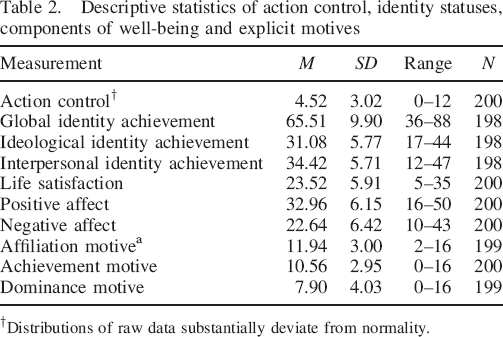
Distributions of raw data substantially deviate from normality.
Table 3 presents correlations between variables. According to the hypotheses of the study, intercorrelations are presented by using higher order measures of well–being and agency motives.
Correlations among measurements of action control, identity statuses, well–being and explicit motives for communion and agency
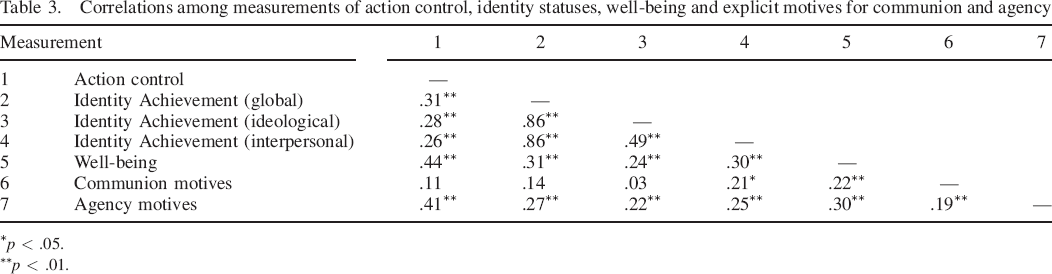
p < .05.
p < .01.
Domain–specific measures of identity achievement were highly intercorrelated. Furthermore, more pronounced levels of identity achievement (global and domain–specific) were positively associated with higher scores for action orientation, well–being and agency motives. Higher scores of interpersonal identity achievement additionally were associated with higher explicit communion motives. Considering remaining relationships, high scores of action control significantly related to higher levels of well–being and agency motives. Higher scores of well–being were also related to higher levels of communion and agency motives.
Effects of age and gender on identity achievement were tested simultaneously by conducting a multivariate analysis of covariance (MANCOVA) with global and domain–specific identity achievement as dependent variables, gender as factor, and age as covariate. Multivariate statistics indicated variability across age (F2, 194 = 4.69/Wilks’ criterion; p < .05; η2 = .05). In detail, higher age was significantly associated with more pronounced levels of global and domain–specific identity achievement (Fs1, 195 ranging from 6.47 to 9.39; achievementglobal: p < .01; η2 = .05; achievementideological: p < .05; η2 = .03; achievementinterpersonal: p < .01; η2 = .04).
Effects of age and gender on action control, well–being and explicit motives (communion and agency) were tested with separate analyses of covariance (ANCOVA). Male participants (M = 5.69; SD = 3.45) reported a significantly higher action orientation than female subjects (M = 4.08; SD = 2.73; F1, 197 = 7.87; p < .01; η2 = .04). Moreover, the older participants were, the higher their scores for action orientation were (F1, 197 = 7.29; p < .01; η2 = .04).
No age– and gender–related effects were found for well–being and agency motives. Similarly, gender showed no effect on communion motives. However, higher age was related to less pronounced explicit communion motives (F1, 196 = 9.32; p < .01; η2 = .05). 3
Testing the mediation hypothesis
Again, the hypothesis on the simple mediation, which can be considered to represent an average model, was tested according to Baron and Kenny's (1986) four–step model. Analyses with the standardized regression factor score of SWB as the dependent variable, the action control score as the predictor, and scores for global identity achievement as mediator variable showed that criteria for mediation applied (n = 198): first, there was a significant total effect of action orientation on well–being (b = .15; SE = 0.02; p < .001); second, there was a significant total effect of action control on global identity achievement (b = 1.04; SE = 0.22; p < .001); third, there was a significant direct effect of global identity achievement on well–being, controlling for action control (b = .02; SE = 0.001; p < .01). Finally, the direct effect of action orientation on well–being, controlling for global identity achievement decreased (b = .13; SE = 0.02; p < .001; with R2 for achievement = .23; p < .001). The indirect effect of action control on well–being via global identity achievement was further supported by a significant Sobel test (z = 2.43, p < .05). This indirect effect has a size of .02 (see footnote 2). Thus, the direct effect of action control on well–being was partly mediated by global identity achievement.
Testing the moderated mediation hypotheses
To test the moderated mediation hypotheses, we used the integrative approach suggested by Edwards and Lambert (2007). This approach allows combining mediation and moderation into one general analytical framework. This analytical framework allows expressing mediation in terms of direct, indirect and total effects (Edwards & Lambert, 2007; see also Muller, Judd, & Yzerbyt, 2005; Preacher, Rucker, & Hayes, 2007). Furthermore, it is possible to illustrate how the effect of the mediator on the dependent variable varies across levels of the moderator. In the model that applies here, disposition of action control is the independent variable that should have an effect on well–being. As illustrated in Figure 1, this effect should, in part, be mediated by identity achievement. Furthermore, explicit motives should moderate the path from identity achievement to well–being. Edwards and Lambert (2007) call this type of model the second stage moderation model, since the moderator affects the second stage of the mediation. 4 As recommended (Aiken & West, 1991; Pedhazur, 1997), p < .10 was selected as criterion probability for examining interaction effects. In the first analysis, agency motives moderated the path from ideological identity achievement to well–being, while in the second analysis communion motives moderated the path from interpersonal identity achievement to well–being.
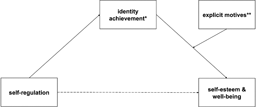
The moderated mediation model: identity achievement mediating the relationship between self–regulatory capacities and well–being (Studies 1 and 2), with the association of identity and well–being being moderated by explicit motives (Study 2). Note: * Global identity for the basic mediation model, domain–specific (interpersonal, ideological) for the moderated mediation model. ** Agency and communion motives considered separately in the moderated mediation model.
Coefficient estimates in Table 4 show that, in the first analysis, there was a significant direct effect of action orientation on well–being and ideological identity achievement. Ideological identity achievement, in turn, was related to well–being on a marginally significant level (p = .09). Most important for our hypothesis, agency motives moderated the path from ideological identity to well–being (bMZ).
Moderated mediation of action control on well–being
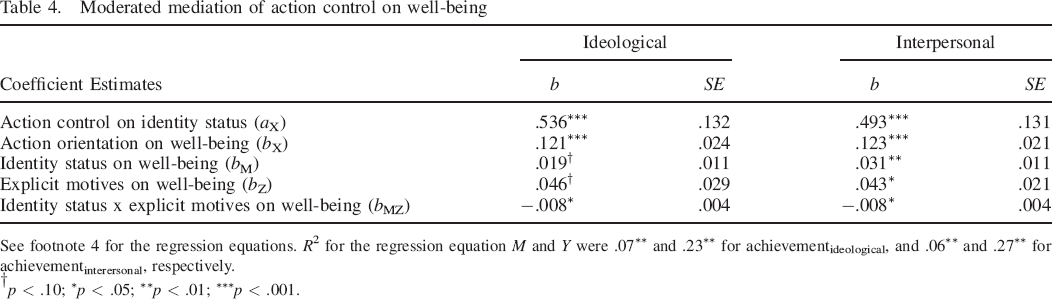
See footnote 4 for the regression equations. R2 for the regression equation M and Y were .07** and .23** for achievementideological, and .06** and .27** for achievementinterersonal, respectively.
p < .10;
p < .05;
p < .01;
p < .001.
To analyse the way in which agency motives moderated the path from ideological identity to well–being, we computed conditional effects for low, medium and high agency motives. 5 As Figure 2 shows, the relationship between ideological identity achievement and well–being was steeper for respondents who reported low and medium rather than high agency motives, and high agency motives respondents reported high levels of well–being across all levels of ideological identity achievement.
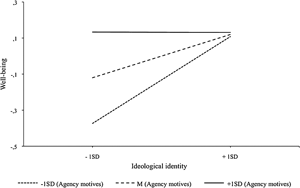
Effects of ideological identity on well–being moderated by agency motives.
To represent the conditional indirect effect of action orientation on well–being at specific values of the moderator (agency motives), we used Edwards and Lambert's (2007) reduced form equation. 6 Furthermore, tests of significance came from Preacher et al.'s (2007) SPSS Macro for moderated mediation analysis based on a bootstrap approach because the distribution of product terms is usually skewed. 7
For low agency motives (i.e. one standard deviation below the mean), there was a significant indirect effect of action orientation on well–being (indirect effect = .022, z = 2.15, p < .05). For agency motives at the mean (indirect effect = .010, z = 1.51, p = .13) and for high agency motives (i.e. one standard deviation above the mean; indirect effect = .001, z = −.14, p = .89) the indirect effects did not reach level of significance. This means that, if agency motives are not high, the effect of action control on well–being is partly mediated by ideological identity achievement. Since the direct effect of action orientation on ideological identity achievement remains constant, independent of the value of the moderator, differences in indirect effects are due to the conditional effects of ideological identity achievement on well–being.
In the second analysis, examining interpersonal identity achievement and communion motives, there was a significant direct effect of action orientation on well–being and interpersonal identity achievement (see Table 4). Interpersonal identity achievement, in turn, was significantly related to well–being. The interaction term of interpersonal identity achievement and communion motives was significantly related to well–being, indicating that communion motives moderated the path from interpersonal identity achievement to well–being.
To see how communion motives moderated the path from interpersonal identity achievement to well–being, we again computed conditional effects for low, medium and high communion motives. As Figure 3 shows, the relationship between interpersonal identity and well–being was steeper for respondents who reported low and medium rather than high communion motives, and high communion motives respondents reported higher levels of well–being across all levels of ideological identity achievement.
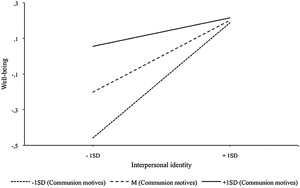
Effects of interpersonal identity on well–being moderated by communion motives.
As above, conditional indirect effects at low (i.e. one standard deviation below the mean), medium and high levels (i.e. one standard deviation above the mean) of communion motives were computed. Showing a similar pattern as above, there was a significant indirect effect of action orientation on well–being for low and average levels of communion motives (indirect effect for low level of communion = .027, z = 2.46, p < .05; indirect effect for medium level of communion = .015, z = 2.12, p < .05), but not for high communion motives (indirect effect = .003, z = .38, p = .70). This means that, if communion motives are low or medium, the effect of action orientation on well–being is partly mediated by interpersonal identity achievement. Since the direct effect of action orientation on interpersonal identity achievement remains constant, independent of the value of the moderator, differences in indirect effects are due to the conditional effects of interpersonal identity achievement on well–being. 8
To further examine the quality of our proposed model, a number of additional analyses were performed. In a first step, it was found that explicit motives (aggregated score of communion and agency motives) did moderate the link between global identity achievement and well–being (p = .01). In a second step, we found, however, additional evidence for the specific link between the domains of identity achievement and the corresponding motive domain. In detail, communion motives did not moderate the path between ideological identity achievement and well–being. Likewise, agency motives did not moderate the relationship between interpersonal identity achievement and well–being. Further support for the proposed model stems from analyses showing that explicit motives, either using aggregated scores or domain–specific motives, did not moderate the path from action control to identity achievement.
Brief Discussion
Results have confirmed the hypotheses of Study 2. In detail, we could replicate the mediation effect in Study 1. Additional analyses indicated, however, that the average mediation model can further be elaborated by including individuals’ consciously represented motives. It was shown that explicit communion and agency motives moderated the association between identity achievement in the interpersonal and ideological domain, respectively, and well–being. Participants with high explicit motives showed pronounced levels of well–being regardless of their level of identity achievement, i.e. they could compensate the generally detrimental effect of low identity achievement on well–being by pursuing corresponding explicit goals and thus gaining direction and purpose in life. In contrast, identity achievement was positively associated with well–being among students characterized by low levels of explicit motives in a given domain.
Discussion
The present research aimed to shed light on the complex interplay of facets of self–regulatory capacities, identity and self–esteem and well–being, respectively. Furthermore, the role of domain–specific explicit motives, i.e. agency and communion motives, was highlighted in this context. More specifically, identity achievement was found in two studies to partly mediate the relation between self–regulation and both, self–esteem and well–being: facets of self–regulation facilitate identity achievement which increases self–esteem and well–being. These results generalize across diverse indicators of self–regulatory capacities and measures of self–esteem and well–being, respectively. However, this model was expanded by scrutinizing the role of explicit motives in this context. Here, we found that domain–congruent explicit motives moderate the relation between identity achievement in the ideological and the interpersonal domain and well–being by lending direction to life.
As hypothesized, aspects of self–regulation, i.e. attention control and action control, promote identity achievement. This is assumed to be the case because finding one's identity is a process involving risks and threats that have to be coped with. In this context, action control and attention control should be important abilities: high levels of action orientation facilitate the identity formation process because they probably enable individuals to stand the risk of ‘saying “no” to elements of their past of which they are certain and make the affirmative leap into an uncertain future’ (Marcia, 1980, p. 160). The ability to gain access to the self even when facing considerable difficulties and repeated setbacks (Baumann & Kuhl, 2002; Koole & Jostmann, 2004), and to down–regulate the negative affect associated with uncertainty permits adolescents to initiate the search for personally important values, goals and directions in life. Such exploration is essential for testing possible commitments for their personal fit and either reject them as unfitting or integrate them into their self–representation. In terms of classical expectancy–value theories (Carver & Scheier, 1998; Heckhausen, 1991), individuals high in action orientation may, above all, commit themselves to life goals that are highly desirable and feasible. They might even have particularly brief phases of exploration and moratorium as their self–accessory capacities allow them to come to a conclusion about whether to commit to any given identity aspect quickly.
Similarly, attention control, the ability to stay focused on desired and blend out undesired stimuli competing for attention, enables adolescents to act according to the firm commitments made to identity elements identified as self–congruent. Given the emotional turmoil often experienced in adolescence and the oftentimes conflicting expectations of parents and peers, keeping to a course of action considered desirable and beneficial for one's own life requires the self–regulatory capacity of not being led astray by distracting external or internal stimuli (Schwarzer & Luszczynska, 2008).
However, having identified identity elements that are in congruence with one's inner needs and having made firm commitments to identity elements, for example by pursuing certain goals, is felt as fulfilling and consequently results in well–being and experiences of personal expressiveness by inducing ‘a feeling that this is who one really is’ (Waterman, 1993, p. 679). As such, self–regulatory capacities can be regarded as a prerequisite for the formation of an identity which in turn leads to happiness: while individuals with pronounced self–regulatory capacities form an achieved identity and come to a firm commitment to identity elements that are congruent with their personality (including the subconscious aspects thereof; see Hofer, Busch, et al., 2006), and thus are generally found to experience high well–being, low levels of self–regulation relate to rumination and difficulties in deciding on a course of action in stressful situations (see also Luyckx et al., 2007). Thus, individuals low in self–regulatory capacities may generally evaluate the search for a complete self as being more difficult and even postpone decisions in significant life domains, which reflects in their lower levels of identity achievement and well–being. For them identity formation may be particularly stressful in modern societies which place the burden of finding a purposeful identity on the individual and provide little societal support for the development of personally meaningful life plans (Baumeister, 1997), especially as state–oriented individuals are generally more dependent on external sources of action control and affect regulation (Hofer, Chasiotis, et al., 2006).
Examining the average mediation model described so far, it was expanded by the component of explicit motives. The rationale for this was that the strength of the indirect effect of self–regulatory capacities on well–being through identity achievement is influenced by explicit motives. That is, for individuals with pronounced explicit motives, the effect of identity achievement on well–being is lower than for individuals with less pronounced explicit motives. Indeed, as results show, coming to self–generated commitments about whether an identity domain is self–relevant or not is associated with well–being. This does not necessarily imply, however, that individuals that have not yet come to such a commitment cannot feel a certain well–being: the subjective attractiveness of a goal can depend on a variety of incentives such as external rewards and evaluations by significant others (Heckhausen, 1991; Oettingen, Pak, & Schnetter, 2001).
Thus, external sources of definitions of what is desirable (i.e. norms) can establish a sense of direction in life, be a basis of a sense of group belongingness (community of values), and provide opportunity for positive social feedback (Grotevant, 1987; Ryan & Deci, 2001). Indeed, the present results confirm such a moderating effect of extrinsic or introjected motives that are associated with an external locus of causality (Deci & Ryan, 2000) on the relationship between identity domains and well–being.
That is, students high in explicit motives report pronounced levels of well–being irrespective of their level of identity achievement. Thus, individuals with pronounced explicit motives particularly benefit from the pursuance of goals allowing positive evaluations of others (e.g. acceptance of parents and peers) and, consequently, the experience of well–being if they have not yet come to a conclusive decision on whether to reject or endorse certain commitments (low levels of identity achievement). Somehow, even goals that are not yet integrated into the self–concept may function, at least temporarily, as a substitute for self–congruent goals and life plans.
Despite these results, however, it is not claimed that drawing one's conscious motives based on external incentives is as healthy for psychological functioning as self–generating one's own goals is (at least in Western cultural contexts). There is ample evidence that self–determination is beneficial for well–being (see Ryan & Deci, 2001, for an overview). In the long run, pursuing self–generated goals is associated with more well–being than pursuing goals stemming from external sources.
However, adolescence is a time in the life span in which a lot of changes (physical, social, psychological) take place simultaneously. Moreover, in modern societies this episode of life changes finds continuation in the phase of emerging adulthood with its educational, vocational and interpersonal changes (Arnett, 2000). In this situation, the task of identity formation adds further insecurity. Hence, commitment to externally generated identity aspects might serve to give a certain direction in life which buffers this insecurity and prevents feelings of distress. Nevertheless, the process of testing commitments for their fit with one's self has sooner or later to be gone through to come to firm and lasting commitments, and can be substituted by externally generated commitments only for a while.
In this context, some limitations of our study have to be acknowledged. For one, employing continuous measures of identity statuses manifested in a given person does have advantages (e.g. no reduction of sample size when pure identity status cannot be assigned, no usage of somewhat arbitrary cut–off points; Schwartz & Dunham, 2000) but somewhat complicates the interpretation of results for individuals low in identity achievement: whether these would best be described as being diffusion, moratorium or foreclosure cannot be inferred from this information alone. Thus, it is possible that those low in identity achievement are more heterogeneous than those high in identity achievement. For our hypotheses, however, only the level of identity achievement was crucial for consideration. Future research, however, may consider a more fine–grained differentiation of identity statuses as several sub–statuses not included in the original status paradigm are described in literature (e.g. Crocetti, Rubini, Luyckx, & Meeus, 2008).
As data were obtained from a well–educated sample, it seems necessary to conduct similar studies including participants with different educational, socio–economical and cultural background. As our study was based on a cross–sectional, correlational design, a longitudinal design would be useful to support the proposed route of causation (action control as a prerequisite for identity formation) that is, however, firmly based on theoretical considerations and empirical evidence on the temporarily distinct development of those significant components of personality. Future research should also include further measurements of self–regulation that represent behavioural measures of self–regulation (Baumeister, Vohs, & Funder, 2007) but also outcomes of identity formation rather than being their precursors. Côté and Levine (2002) suggest that progress in identity development enhances individuals’ sense of self–efficacy. In the present analysis, however, we were focusing on self–regulatory capacities which develop in early childhood (Kopp, 1989) and thus have to be considered antecedents rather than consequences of identity formation and other developmental tasks.
In the present study, we concluded that explicit motives for agency and communion do not present self–concordant strivings (Sheldon & Elliot, 1999) but are rather based on external incentives when an individual scored low on domain–specific identity achievement. Future studies could, however, more closely focus on disentangling different types of incentives related to individuals’ explicit motives by including further psychological constructs (e.g. self–determination of behaviour; Deci & Ryan, 2000). As our results indicate a partial mediation of identity achievement, future studies may also aim to examine additional mechanisms by which capacities of self–regulation lead to happiness (e.g. quality of social relationships, academic achievements). Thereby, the function of self–regulation for the resolution of significant developmental tasks in other age groups and its association with various indicators of well–being may be further scrutinized (e.g. industry in school–aged children).
Despite these limitations the present study makes a valuable contribution to the literature on personality and well–being. First, it highlights the role of self–regulation in the process of identity formation by arguing that the capacities for active affect–regulation even in times of insecurity and for staying focused in spite of distracting incentives promote identity achievement. Furthermore, the positive effect of identity achievement, well–established in the corresponding literature, is replicated and extended by the integration of explicit motives as source of well–being for those who have not yet achieved identity.