







Abstract
Emotional eaters tend to eat more when emotionally aroused and their food–related actions are associated with lack of control. Two studies tested the hypothesis that implicit measures of attitudes would be more strongly associated with the dietary behaviour of emotional eaters. In both Study 1 (N = 32) and Study 2 (N = 101), participants completed the DEBQ sub–scale of emotional eating and implicit measures of attitude, explicit attitude and behaviour measures concerning chocolate consumption. In both studies, high emotional eaters were more likely than low emotional eaters to eat in line with their implicit measures of attitudes. The relationship between implicit measures of attitudes and food intake varies as a function of emotional eating style. Copyright © 2010 John Wiley & Sons, Ltd.
Introduction
Rather than actively drawing on one's explicit attitudes and beliefs to guide behaviour, an individual's judgments, choices and actions can be affected by an evaluation that is activated effortlessly, quickly and without intention (Bargh, Chaiken, Govender, & Pratto, 1992; Fazio, 1990). This automatic association between an object and evaluation has been assessed by implicit measures of attitude (De Houwer, Teige–Mocigemba, Spruyt, & Moors, 2009; Greenwald & Banaji, 1995). Research has proposed that implicit measures of attitudes tap into an associative learning system which is influenced by emotion, whereas explicit attitudes stem from a reflective learning system that is slow and requires more effort (DeCoster, Banner, Smith, & Semin, 2006; Hermans, Baeyens, & Eelen, 2003; Smith & DeCoster, 2000; Strack & Deutsch, 2004). Although there is a range of theoretical accounts that specify a role for both explicit and implicit measures of attitudes in predicting behaviour (e.g. Strack & Deutsch, 2004; Wilson, Lindsey, & Schooler, 2000) and supportive empirical evidence (e.g. Perugini, 2005; Richetin, Perugini, Prestwich, & O'Gorman, 2007), it remains important to examine the role of individual difference variables in helping to understand relationships between implicit measures of attitudes and behaviour. Research testing such moderators has expanded rapidly in recent years (for a review, see Friese, Hofmann, & Schmitt, 2008a). A moderator variable influences the relationship between two other variables (cf. Baron & Kenny, 1986) and the present research examined whether the relationship between implicit measures of attitudes and the consumption of sweet foods was moderated by emotional eating style—a tendency for one's food intake to be cued by emotional arousal.
The Implicit Association Test (IAT) and dietary behaviour
Procedures designed to elicit implicit measures of attitudes, such as the IAT (Greenwald, McGhee, & Schwarz, 1998), purport to tap the degree to which associations exist between concepts in memory (Greenwald, Banaji, Rudman, Farnham, Nosek, & Mellott, 2002). It has been suggested that attitudes are, themselves, represented as associations between an attitude object and an evaluation of that object in memory (De Houwer et al., 2009; Fazio, Sanbonmatsu, Powell, & Kardes, 1986; Greenwald et al., 2002). Concepts can be automatically activated in response to external stimuli or by excitation of other associated concepts (Fazio et al., 1986; Greenwald et al., 2002). Variations in task performance on procedural measures, such as the IAT, supposedly reflect the strength of association between concepts in memory, on which attitudes are subsequently inferred (Ward, Hudson, Johnston, & Marshall, 1997). In support of this, De Houwer et al. (2009) note that experimental manipulations such as those that attempt to create attitudes to novel objects have led to predicted variations in performance on the IAT. Moreover, correlational studies such as those showing IAT scores can predict various behaviours, including those related to diet, also imply that IAT effects are caused by the attitudes they are argued to tap. However, the extent to which the IAT should be judged as implicit (involving lack of controllability, processing resources, awareness, time) is difficult to determine given mixed findings in the few relevant studies conducted in relation to this issue. In their review, De Houwer et al. (2009) conclude that the literature pertaining to whether the IAT lacks controllability, reflected in studies assessing whether IAT scores can be faked, presents mixed evidence. Moreover, they argue the translation of attitudes to IAT scores appears to be efficient but are not without awareness, and that research is needed to assess how lack of time impacts on the validity of IAT effects.
The application of measurement procedures designed to tap implicit measures of attitudes has been increasing in the area of food and eating behaviour and there is evidence to suggest that implicit measures of attitudes are related to food choices (e.g. Conner, Perugini, O'Gorman, Ayres, & Prestwich, 2007; Friese et al., 2008a, Study 1; Hofmann & Friese, 2008; Perugini, 2005; Richetin et al., 2007; but see Karpinski & Hilton, 2001, Study 2). For example, Perugini (2005) demonstrated that an implicit preference for fruit relative to sweets was significantly related to whether a person selected fruit or sweets when presented with a choice of either at the end of the experiment. Importantly, Conner et al. (2007) and Richetin et al. (2007) reported evidence of incremental validity. Specifically, implicit measures of attitudes explained unique variance in food–choice behaviour, over and above explicit attitudes.
Moderators of the relationship between implicit measures of attitudes and behaviour
While implicit measures of attitudes have been shown to predict a range of different behaviours (see Greenwald, Poehlman, Uhlmann, & Banaji, 2009, for a review), a range of moderators influencing the relationship between implicit measures of attitudes and behaviour have emerged. These moderators have been usefully classified into three groups in a recent review (Hofmann, Friese, & Wiers, 2008): availability of control resources, motivation to control one's behaviour and reliance on impulses (see also Friese et al., 2008a). When an individual does not rely on their impulses and has the motivation and capacity to draw on rule–based, non–associative processes then one's implicit measures of attitudes should be less strongly linked to behaviour than when behaviour is impulsive or motivation is lacking and one's attentional or self–regulatory resources are otherwise engaged or depleted (e.g. Conner et al., 2007; Friese et al., 2008a; Hofmann, Rauch, & Gawronski, 2007). Essentially, explicit attitudes are more predictive of deliberative behaviours that are easy to consciously control while implicit measures of attitudes are related to spontaneous behaviours that are difficult to control (e.g. Dovidio, Kawakami, Johnson, Johnson, & Howard, 1997; McConnell & Leibold, 2001; Perugini, 2005; Wilson et al., 2000). Examining the role of individual difference factors could help further elucidate the relationship between these different types of attitudes and behaviour. One potential moderator, in the domain of dietary behaviours, is emotional eating.
Implicit measures of attitudes and emotional eating
Being an emotional eater, or a person that consumes more when anxious or emotionally aroused (Van Strien, Frijters, Bergers, & Defares, 1986), has been linked with disinhibition or loss of control (e.g. Wardle, Marsland, Sheikh, Quinn, Federoff, & Ogden, 1992) and an increased tendency, particularly for emotional eaters, to respond to stress by snacking on high fat/sugar foods such as chocolate (O'Connor, Conner, Jones, & Ferguson, 2008). Moreover, Heatherton and Baumeister (1991) suggest that certain individuals overeat to escape negative self–awareness by shifting their focus away from negative emotions and towards stimuli in the environment (i.e. available food). This disinhibits intake and promotes overeating (Herman & Polivy, 1984; Wallis & Hetherington, 2004). O'Connor et al. (2008) note that ‘such low levels of attention reduce self–awareness to a level where meaningful thought, valuations of self and the implications of one's activities are avoided’ (p. S29). Emotional arousal can reduce the control resources available to emotional eaters, thereby hindering the capacity to self–regulate and leading to disinhibitive eating (Baumeister, Heatherton, & Tice, 1994; Muraven, Tice, & Baumeiester, 1998; Wardle et al., 1992). This suggests that deliberative thought, on which explicit attitudes are based, may be compromised, leading to automatic, or implicit measures of attitudes to dominate in guiding behaviour among those high in emotional eating. Research has also found that highly emotional eaters demonstrate cognitive biases for food (Brignell, Griffith, Bradley, & Mogg, 2009; Pothos, Tapper, & Calitri, 2009). Attention is shifted towards food cues and this heightened processing bias may lead to greater predictive validity for implicit measures of attitudes. Relating emotional eating to Hofmann, Friese et al.'s (2008) framework of moderators and supporting evidence (e.g. Friese et al., 2008a; Hofmann, Friese, & Roefs, 2009; Hofmann, Friese et al., 2008, Study 2), emotional eaters are likely to exhibit less control, be less motivated to control their dietary behaviour and have a greater reliance on impulses. As a result, their implicit measures of attitudes should be more predictive of their dietary behaviours than non–emotional eaters. In addition, an alternative explanation for the moderating role of emotional eating in implicit measures of attitudes–chocolate consumption relations could be habit and this is consistent with Hofmann, Friese et al.'s (2008) reliance on impulse factor. Highly palatable food (e.g. chocolate) can relieve stress through the release of endogenous opioids (Mercer & Holder, 1997) and this can create a conditioned, habitual response to eat in the presence of stress, but in the absence of hunger. Wardle, Steptoe, Oliver, & Lipsey (2000) suggested that restricted food, such as high–fat snacks like chocolate, is seen as more rewarding and may be used to mitigate negative mood states, particularly for emotional eaters. Emotional eating can therefore become reinforced as a coping strategy and this may develop into habitual behaviour. When behaviour is habitual, it displays more features of automaticity and relies less on effortful cognitive functioning (Ouellette & Wood, 1998; Wilson et al., 2000). Instead, such behaviour is thought to rely on associative structures, and it is through these associative networks that implicit associations are also thought to operate (Hermans et al., 2003). Subsequently, the relationship between implicit measures of attitudes and behaviour may be more pronounced with increasing habit. In support of this, Conner et al. (2007, Study 2) found that the IAT (fruit vs. chocolate) more strongly predicted the choice between a chocolate or fruit snack for participants high compared to low in habitual chocolate consumption.
Consistent with Hofmann, Friese et al.'s (2008) framework, Strack and Deutsch's (2004) Reflective Impulsive Model also suggests that the relative impact of implicit and explicit measures of attitudes will depend upon the availability of resources; reflective processes require more cognitive capacity than automatic processes. When processing capacity is limited, according to the RIM, behaviour will be primarily guided by automatic processes or implicit measures of attitudes. Taken together, these converging lines of evidence support the assumption that attitudes tapped by implicit measures are likely to become activated and guide subsequent dietary behaviour in relation to appetizing foods such as chocolate.
Before attempting to identify the potential mechanisms underlying the moderating role of emotional eating in the relationship between implicit measures of attitude and behaviour, it is important to establish that a theoretically meaningful moderator exists. There have been few attempts to identify individual difference variables that moderate the relationship between implicit measures of attitudes and behaviour and no study has previously tested the moderating role of emotional eating. Given the role of emotion in associative processing and the likelihood that emotional eaters are more prone to disinhibition or to impulsively consume foods, it was hypothesized that implicit measures of attitudes would be more predictive of chocolate consumption in high emotional eaters than low emotional eaters. Two studies are presented that test this hypothesis.
Study 1
In Study 1, participants’ level of emotional eating was assessed and implicit and explicit measures of attitudes taken before participants kept a food diary regarding their chocolate consumption over the following week. Chocolate was selected because it is pleasant tasting and often desired, and thus likely to evoke some emotional response, and also because the consumption of comfort and snack foods increases with emotional distress (e.g. Benton & Donohoe, 1999; Greeno & Wing, 1994; O'Connor et al., 2008; Oliver, Wardle, & Gibson, 2000).
Method
Participants
Thirty–two participants, from a UK university, completed all measures (24 females, M = 24.16 years, SD = 3.73). On completion, all participants were entered into a prize draw.
Measures
Emotional eating
Emotional eating was assessed using the appropriate sub–scale from the Dutch Eating Behaviour Questionnaire (DEBQ; Van Strien et al., 1986). The DEBQ demonstrates high internal consistency, factorial validity and categorical stability (Van Strien et al., 1986; Wardle, 1987). This scale comprised 13 items (e.g. Do you have a desire to eat when you are emotionally upset?) requiring responses along 5–point scales (never [1], seldom [2], sometimes [3], often [4], very often [5]) and possessed excellent internal reliability (α = .95). A higher score represented higher levels of emotional eating.
Explicit attitudes
To assess explicit attitudes (α = .90) participants were required to respond to the stem: ‘I think that for me to eat chocolate is:’ along 7–point (1–7) semantic differential scales: bad–good; foolish–wise; unpleasant–pleasant; negative–positive; unenjoyable–enjoyable; unhealthy–healthy; unattractive–attractive. A high score reflected positive attitudes towards chocolate.
Implicit measures of attitudes
Implicit measures of attitudes were assessed using the Implicit Association Test (IAT; Greenwald et al., 1998). Of all the implicit measures of attitudes, the IAT demonstrates greatest evidence of construct and predictive validity, with good internal consistency (usually α ≥ .80) and test–retest values (usually r > .60, Perugini, 2005). The IAT in this study incorporated the standard seven–block sequence (cf. Greenwald, Nosek, & Banaji, 2003). The task requires rapid sorting of target words, representing two concept categories and two attribute categories. The target concept was chocolate and its contrast was shapes, 1 whereas the attribute categories were pleasant and unpleasant; five exemplars were chosen to represent each category (chocolate: snickers, toblerone, twix, maltesers, mars; shapes: rectangle, square, triangle, circle, cube; pleasant: love, gift, joy, pleasure, rainbow; unpleasant: evil, cancer, vomit, death, agony). Practice blocks (stages 1–2 and 5) each incorporated 20 trials, while participants were required to respond to 62 2 trials within each critical block (stages 3–4 and 6–7). The order in which participants did these critical blocks was counterbalanced. 3 Stimuli were presented in a random order across participants. The required key responses for each of the seven stages within the present study are summarized (see Table 1). The internal reliability of the IAT was high (overall: α = .84; IAT for high emotional eaters: α = .82; IAT for low emotional eaters: α = .87). IAT scores were calculated such that a positive score reflected positive implicit measures of attitudes towards chocolate and followed the new scoring algorithm D, as recommended by Greenwald et al. (2003) who showed that it improved power, reliability, and validity of IAT effects. 4
Descriptives and Pearson correlations between measured variables in Study 1 (N = 32)
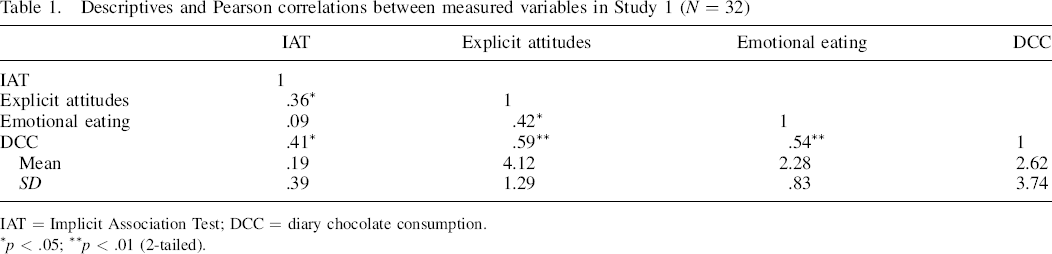
IAT = Implicit Association Test; DCC = diary chocolate consumption.
p < .05;
p < .01 (2–tailed).
Behaviour
A self–reported diary of daily chocolate consumption (diary chocolate consumption, DCC) was completed after the first laboratory session and required participants to record their consumption of chocolate each day over a 1–week period. Instructions on the front page explained exactly how to complete an entry. Each day of the week was split into five periods: before lunch, for lunch, between lunch and dinner, for dinner, and after dinner, plus spare space to use if necessary. Participants were instructed that chocolate referred to bars of chocolate, such as Snickers, and small bags of chocolates such as Maltesers. To prevent problems with recollection, participants were asked to record their chocolate consumption throughout the day rather than completing the diary at the end of the day. The snack diary enabled a measure of more regular chocolate consumption to be obtained. The number of chocolate bars/bags of chocolates was summed for the week and this provided the measure of chocolate consumption.
Procedure
Each participant was greeted in a reception area and then seated, individually, in an experimental cubicle at a table with a desktop computer. Each participant was asked to read and sign written consent forms. Following this, participants completed the emotional eating and explicit attitude items before the IAT or vice versa. All participants responded to the emotional eating items before the explicit attitudes measure. At the end of the experimental session, participants were thanked and given a 7–day food diary with the instruction to begin completing it the following day.
Results and discussion
Examining the correlations between the outcome measures (see Table 1) indicated that implicit measures of attitudes were significantly correlated with explicit attitudes. Both implicit measures of attitudes and explicit attitudes were significantly correlated with DCC, whilst emotional eating was not significantly related to DCC.
To examine implicit measures of attitudes and explicit attitudes as predictors of behaviour (DCC), and the potential interaction between implicit measures of attitudes and emotional eating, a 2–step linear regression was conducted. Emotional eating, implicit measures of attitudes and explicit attitudes were entered as predictors on the first step. The interaction terms (i.e. implicit measures of attitudes × emotional eating and explicit attitudes × emotional eating) were entered on the second step using the stepwise method. All variables were standardized prior to analysis.
On the first step of the linear regression, F(3, 28) = 9.81, p < .0005, R2 = .51, DCC was significantly predicted by explicit attitudes, β = .33, p = .04, and emotional eating, β = .38, p = .02, and was marginally significantly predicted by the implicit measure of attitudes, β = .27, p = .07. On the second step, the relationship between the implicit measure of attitudes and DCC was moderated by emotional eating, β = .36, p = .007 but the relationship between the measure of explicit attitudes and DCC was not moderated by emotional eating, β = .21, p = .14, and was thus not entered into the final model, F(4, 27) = 11.41, p < .0005, R2= .63, ΔR2= .12, p = .007.
Following the standardization of predictor and outcome variables, simple slopes were probed at 1 SD above, 1 SD below and at the mean of emotional eating scores (Figure 1). Results showed that implicit measures of attitudes were significantly related to chocolate consumption for those individuals that were high, B = .70, SE = .19, p = .001, or moderate, B = .33, SE = .13, p = .02, in emotional eating. Implicit measures of attitudes were unrelated to chocolate consumption for non–emotional eaters, B = −.04, SE = .17, p = .82.
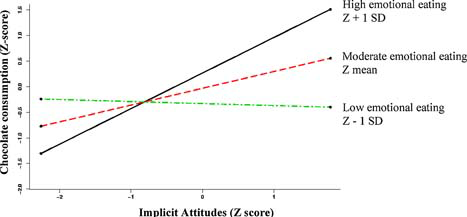
The moderation of implicit measures of attitudes–behaviour by emotional eating (Study 1).
Study 1, therefore, suggests that implicit measures of attitudes can have a (marginally) significant impact on behaviour over and above explicit attitudes and emotional eating. More importantly for the primary aim of this contribution, the relationship between implicit measures of attitudes (but not explicit attitudes) and chocolate consumption was moderated by emotional eating. The results of this study suggest that those high in emotional eating are more likely than those low in emotional eating to eat in line with their implicit measures of attitudes. However, the lack of a significant interaction between explicit attitudes and emotional eating suggests that for high and low emotional eaters, explicit attitudes were similarly correlated with chocolate consumption.
There are some limitations associated with Study 1. Using shapes as a neutral contrast category may reduce the validity of our IAT measurement procedure compared to IATs that incorporate a true contrast category (Conner et al., 2007; Penke, Eichstaedt, & Asendorpf, 2006; Perugini, 2005). In addition, Study 1 measured explicit attitudes towards eating chocolate, yet the IAT assessed attitudes towards objects (i.e. chocolate and shapes). These issues were addressed in Study 2.
Study 2
Study 2 was designed as a partial replication and extension of Study 1. It sought to examine the central finding of Study 1—that the dietary behaviour of high emotional eaters is better predicted by their implicit measures of attitudes than that of low emotional eaters. We increased the size of the sample in Study 2 to provide greater statistical power and introduced a more comprehensive measure of explicit attitudes. Explicit attitudes were measured towards chocolate and fruit, and the behaviour measure assessed chocolate and fruit consumption via a 7–day snack diary. Unlike Study 1 which measured attitudes towards eating chocolate, Study 2 assessed attitudes towards the objects chocolate/fruit, thereby increasing the level of correspondence between the implicit and explicit attitude measures. Furthermore, Study 2 employed an IAT with the category headings love and hate (rather than pleasant, unpleasant), and used a food contrast (fruit) rather than a neutral contrast (shapes) to verify that the pattern of results was not specific to the category headings used in Study 1.
Method
Participants
A total of 101 participants (22 males, 79 females, mean age = 23.1, SD = 10.2) were recruited on a University campus in northern England through an email mailing list of people who had earlier signed up for notice of experiments. They were paid £5 (approximately $8.50) for participating.
Measures
Emotional eating
Similarly to Study 1, emotional eating was assessed using the appropriate sub–scale from the DEBQ (Van Strien et al., 1986). A higher score represented higher levels of emotional eating (α = .93).
Explicit attitudes
The explicit attitudes measures consisted of a standard semantic differential measure of attitude to chocolate and to fruit on nine bipolar scales (‘I think that CHOCOLATE/FRUIT is…’, bad–good, tasty–untasty, unpleasant–pleasant, disgusting–delicious, unenjoyable–enjoyable, unhealthy–healthy, unsatisfying–satisfying, untempting–tempting, undesirable–desirable), anchored with very at each end above the extreme values and intermediate over the central value. Similarly to Study 1, all explicit attitude measures were on a 7–point (1–7) bipolar scale. The final attitude scores were taken as the difference between the attitude towards chocolate and the attitude towards fruit (i.e. positive scores indicate a preference for chocolate over fruit; α = .87).
Implicit measures of attitudes
The IAT was identical to that used in Study 1 with the following exceptions. The target concept was chocolate (Snickers, KitKat, Maltesers, Twix, Crunchie) and the contrast category was fruit (bananas, apples, oranges, strawberries, mango). The attribute categories were love (love, affection, passion, adore, and desire) and hate (hate, loathe, detest, disgust, and revulsion). Similar to Study 1, there were 20 practice trials in steps 1–3 and 5–6, and 62 test trials in steps 4 and 7, with the first two being dummy trials (to be discarded). Positive score reflected preference for chocolate over fruit (overall: α = .88; IAT for high emotional eaters: α = .85; IAT for low emotional eaters: α = .90).
Behaviour measures
The diary measure was identical to Study 1 with the following exception. In addition to measuring chocolate consumption, participants were also required to state how much fruit they consumed. 5 Participants were told that ‘fruit’ excluded fruit drinks or fruit contained in other items of food, such as blueberry muffins or apple pie. This behaviour measure was calculated as the proportion of recorded chocolate and fruit that was chocolate (diary proportion chocolate consumption, DPCC). Scores over 0.5 would indicate that more than half the choices were for chocolate.
Procedure
The procedure was identical to Study 1.
Results and discussion
The correlations between the attitude measures and DPCC are reported in Table 2. Implicit measures of attitudes were significantly correlated with explicit attitudes. Whilst explicit attitudes were significantly correlated to DPCC, implicit measures of attitudes were only marginally significantly related with DPCC. Emotional eating was not significantly related to DPCC.
Descriptives and Pearson correlations between measured variables in Study 2 (N = 101)
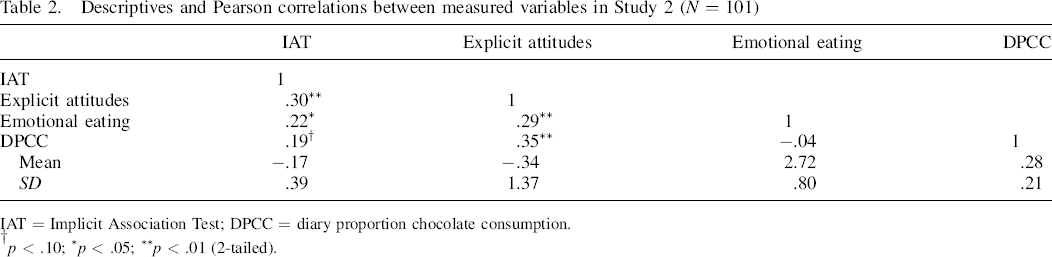
IAT = Implicit Association Test; DPCC = diary proportion chocolate consumption.
p < .10;
p < .05;
p < .01 (2–tailed).
To examine attitudes as predictors of behaviour, a 2–step regression was again conducted using the same method as in Study 1. A similar pattern of results emerged to those obtained in Study 1. On the first step of the linear regression, F(3, 86) = 5.04, p < .01, R2 = .15, behaviour (DPCC) was significantly predicted by explicit attitudes, β = .36, p = .001, but not implicit measures of attitudes, β = .11, p > .10, or emotional eating, β = −.16, p > .10. On the second step, implicit measures of attitudes significantly interacted with emotional eating, β = .30, p = .003, but the effect of explicit attitudes was not moderated by emotional eating, β = .001, p > .10, and was not therefore entered into the final model, F(4, 85) = 6.47, p < .01, R2= .23, ΔR2= .08, p = .003.
Similar to Study 1, simple slopes analyses showed that implicit measures of attitudes were significantly related to chocolate consumption for those individuals that were high, B = .50, SE = .16, p = .003 in emotional eating. Implicit measures of attitudes were unrelated to chocolate consumption for moderate, B = .17, SE = .10, p = 0.10, and non–emotional eaters, B = −.15, SE = 0.13, p = 0.25 (Figure 2).
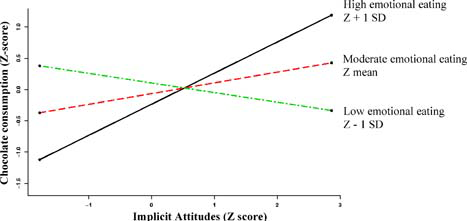
The moderation of implicit measures of attitudes–behaviour by emotional eating (Study 2).
General Discussion
In both studies the relationship between implicit measures of attitudes and chocolate consumption was moderated by emotional eating such that implicit measures of attitudes were more predictive of the eating behaviour of those high in emotional eating. The relationship between explicit attitudes and chocolate consumption was not moderated by emotional eating in both studies.
Whilst our research did not initially seek to explain or isolate the mechanisms underlying emotional eating, Hofmann, Friese et al.'s (2008) framework of moderators is pertinent in helping to explain our findings. With respect to the capacity and motivation components of this classification system, the control resources of emotional eaters may be reduced due to emotional arousal, leading to diminished self–regulation. This, in turn, could result in a propensity for disinhibitive eating and a general lack of motivation to control dietary behaviour (Baumeister et al., 1994; Hofmann, Gschwendner, Friese, Wiers, & Schmitt, 2008, Study 2; Hofmann et al., 2009; Muraven et al., 1998; Wardle et al., 1992). This may help to explain the greater correspondence we observed between implicit measures of attitudes and chocolate consumption of individuals high but not low in emotional eating. Within Hofmann, Friese et al's (2008) framework of moderators, the reliance on impulse factor also captures the possibility that if emotional eating becomes a habitual response strategy to cope with emotional arousal, then this may also result in implicit measures of attitudes more readily guiding behaviour (Conner et al., 2007, Study 2). Future research could therefore control for the role of habitual chocolate consumption in emotional and non–emotional eaters in order to disentangle the mechanisms underlying emotional eating.
Hofmann, Friese et al's (2008) framework of moderators also raises some interesting avenues for future research aimed at examining the underlying mechanisms of emotional eating. For example, do emotional eaters have difficulty with affect regulation in general and does this also permeate other behaviours, leading to an increased predictive ability for implicit measures of attitudes? Do emotional eaters exhibit greater impulsivity in general or is this impulsive tendency and reliance on implicit processing specific to just their eating behaviour? Finally, is emotional eating a habitual behaviour and is it this habitualness, rather than emotional arousal as such, that results in greater predictive validity for implicit measures of attitudes?
Although we conclude that being an emotional eater is likely to moderate the relationship between relevant implicit measures of attitudes and intake of chocolate snacks, this is not equivalent to the view that emotional eaters rely relatively more on their implicit than explicit measures of attitudes. Behaviour is not governed only by one's implicit and explicit measures of attitudes and they do not necessarily operate in a fashion such that as one of these attitudes becomes important, the other factor is less important (Perugini, 2005). One's perceived behavioural control or self–efficacy regarding their performance of the behaviour, for instance, could be important. Likewise, when behaviour becomes more automatic, habits are likely to come to the fore. Yet, the data do suggest that the impact of implicit measures of attitudes on behaviour under increasing levels of emotional eating, increases in the positive direction, and this effect appears stronger, and more consistent, than the equivalent shift in the role of explicit cognitions.
Rather than consistently having a direct effect on associative processes (i.e. emotional eating was only significantly correlated with implicit measures of attitudes in Study 2), it appears that being an emotional eater facilitates the role of associative processes by enhancing the correspondence between implicit measures of attitudes and behaviour. The lack of such a significant correlation in Study 1 may also indicate that the relationship between emotional eating and implicit measures of attitudes becomes stronger when participants are actually in a critical situation.
Hermsen, Holland, and van Knippenberg (2006) found that implicit measures of attitudes predicted behaviour in positive mood whilst explicit attitudes predicted behaviour in negative mood. Initially, this may appear difficult to reconcile with the notion that implicit measures of attitudes were more predictive of behaviour for individuals high but not low in emotional eating (emotional eating being more generally associated with the experience of negative emotions; see Bruch, 1964; Greeno & Wing, 1994; O'Connor et al., 2008). However, Hermsen et al. (2006) failed to separate the effects of emotional intensity from valence and consequently, their results are therefore open to interpretation. Unfortunately, within the present study, mood and intensity of emotional arousal were also not controlled for. Future research ought to therefore examine and attempt to separate the affects of emotional valence and intensity when probing the link between implicit measures of attitudes and emotional eating.
The need for a more thorough understanding of emotional eating has also been recently emphasized by Evers and colleagues (Adriaanse, De Ridder, & Evers, 2010; Evers, De Ridder, & Adriaanse, 2009). Their research has questioned the validity of emotional eating as a construct and highlighted the difficulty of using self–report scales to capture this construct. In a series of studies, they found that self–reported emotional eaters did not increase their food consumption following emotion induction procedures. Yet, if emotional eating were dismissible as a construct, then the consistent significant moderating role for emotional eating ought not to have been observed in both Study 1 and Study 2. Nevertheless, it is also plausible that a different underlying construct within the DEBQ emotional eating subscale was responsible for these findings. We have already highlighted the potential role of habit in emotional eating and a further explanation warrants consideration here; Turner, Luszczynska, Warner, and Schwarzer (2010) suggest that the impact of emotional eating may be mediated by uncontrolled eating. Uncontrolled eating is associated with a failure to self–regulate and has been found to correlate with emotional eating (Karlsson, Persson, Sjostrom, & Sullivan, 2000; Stotland & Larocque, 2005; Turner et al., 2010). Evidence has suggested that implicit measures of attitudes are more likely to guide behaviour when self–regulation resources are low, whilst explicit attitudes are better predictors of behaviour under conditions of high self–regulatory resources (Friese, Hofmann, & Wänke, 2008b; Hofmann et al., 2007). Hence, this inability to self–regulate, rather than emotional eating, per se, may explain why implicit measures of attitudes were predictive of behaviour within Study 1 and Study 2. Further research deconstructing the concept of emotional eating, and addressing its’ predictive validity, is therefore merited; in addition, research should also examine the more general role of affect and investigate its potential impact on the predictive ability of implicit and explicit measures of attitudes. For example, experimental manipulations of affect could be induced to discover their impact on objective eating behaviour (e.g. food choice tasks or eating tests).
It is also important to highlight limitations of the present research. First, although it appears that including a neutral category does not adversely affect the internal reliability of the IAT, indeed across the studies the internal reliabilities were similar and consistent with those reported in other studies (e.g. Perugini, 2005), it is unclear whether the method generally increases or decreases the predictive validity of the IAT. More research is, therefore, recommended to address the potential utility of incorporating a neutral category, such as shapes, within the IAT. Second, emotional eating was significantly correlated with behaviour in Study 1 but not Study 2. This might be attributed to the use of a contrast food category in Study 2 which might not be consumed differentially between emotional and non–emotional eaters. However, in both studies the key moderator prediction was supported.
While it remains possible that implicit and explicit measures of attitudes are distinct constructs that relate to dietary behaviour differentially for emotional and non–emotional eaters, it is important to note that implicit and explicit measurement procedures vary in a number of ways. These differences may confound our conclusions. For example, explicit attitude measures typically directly assess attitudes by requiring people to read and respond to statements. Tests of implicit measures of attitude are typically indirectly asking people to respond to a single word. Payne, Burkley, and Stokes (2008) recently presented a series of studies suggesting that, for one procedural test of implicit measures of attitudes at least (the Affect Misattribution Procedure, AMP, Payne, Cheng, Govorun, & Stewart, 2005), the relationship between scores on measures of implicit and explicit measures of attitudes became more strongly correlated when the test formats were more similar. As well as seeking to replicate our findings with alternative tests of implicit measures of attitudes, research should examine whether the differential moderating role between measures of implicit/explicit measures of attitudes and eating behaviour hold when the structural fit between measures of implicit and explicit measures of attitudes converge. However, this may prove a difficult task as manipulating tests of implicit measures of attitudes could inadvertently reduce their reliability and/or validity.
Notwithstanding these limitations, the present research has important implications. Theoretically, the research highlights an important personality moderator of implicit measures of attitude–behaviour relationships (at least for food). While previous research regarding moderators of this relationship has tended to focus on the degree of spontaneity of the action, this research implicates the role of individual differences. Specifically, implicit measures of attitudes appear to more reliably predict the food consumption of emotional eaters. Foods high in calories and saturated fat, such as chocolate, have been linked with weight gain and high cholesterol which are risk factors for heart disease (British Heart Foundation, 2010). From an applied perspective, establishing a link between implicit measures of attitudes and the consumption of such unhealthy foods (a behaviour likely to contain both spontaneous and controlled components), provides some justification for interventions targeting such constructs, in addition to explicit attitudes, in order to help individuals understand and change their unhealthy eating habits. Furthermore, interventions attempting to change the impact of implicit and explicit measures of attitudes on behaviour should take into account whether the individual is an emotional eater or not. In addition, in order to change emotion–driven behaviour, particularly when changing the emotional reaction is difficult, it might be necessary and/or efficient to try to target attitudes assessed by implicit measures.
Footnotes
Acknowledgements
This research was supported by a University of Leeds doctoral studentship to Karen Ayres under the supervision of Mark Conner.