







Abstract
Paranoia has been hypothesized to be negatively correlated with self–esteem. However, hypotheses differ about how low self–esteem might produce paranoia. The paranoia as defense model views paranoia as a defensive reaction against low self–esteem. In contrast, the paranoia as expression model views paranoia in part as a reflection of low self–esteem. In the current study, paranoia was negatively associated with global explicit self–esteem, self–competence, self–liking and self–serving attributional style, but unassociated with implicit self–esteem as measured with the Implicit Association Test. In contrast, facets of narcissism, which also have been hypothesized to be associated with defensive self–processing, were associated with defensiveness. Overall, these results suggest that paranoia is better represented by the expression model. Copyright © 2010 John Wiley & Sons, Ltd.
Keywords
Introduction
Paranoia is the tendency to be inappropriately suspicious of other people's motives and behaviours directed towards oneself (Fenigstein & Vanable, 1992), and paranoia is a feature of several disorders (e.g. schizophrenia, paranoid personality disorder, schizotypal personality disorder; American Psychiatric Association, 2000). A number of psychopathologists have hypothesized that paranoia is associated with biases or errors in self–relevant information processing (e.g. Bentall & Kaney, 1996; Blackwood, Howard, Bentall, & Murray, 2001; Fenigstein, Scheier, & Buss, 1975). However, previous research has suggested two different theories about how paranoia is related to self–processing. The current research examines whether paranoia is better represented by the ‘defence’ or ‘expression’ models of paranoia. Additionally, the current research examines whether paranoia exhibited different associations with self–processing than does narcissism, another trait that like paranoia has been posited to be associated with defensive self–processing.
It has been previously suggested that paranoia might be associated with multiple aspects of self–processing, in particular self–esteem and attributional style. Self–esteem is thought to involve both explicit and implicit components (e.g. Greenwald & Banaji, 1995). Explicit self–esteem can be defined broadly as how a person feels about themselves (Kernis, 2003), while implicit self–esteem refers to automatic, over learned and non–conscious evaluations of the self that guide spontaneous reactions to self–relevant stimuli (Bosson, Swann, & Pennebaker, 2000; Greenwald & Banaji, 1995). Attributional style refers to individual differences in causal attributions for life events (Peterson, Semmel, von Baeyer, Abramson, Metalsky, & Seligman, 1982). A self–serving attributional style is the tendency to view good events as due to internal factors (e.g. a salary increase to hard work) and bad events to external factors (e.g. job loss due to a bad economy). In theorizing about how paranoia might be associated with self–processing, a number of researchers have hypothesized that paranoia is associated with self–esteem. However, researchers have offered at least two different hypotheses about how varying levels of self–esteem might be involved in producing paranoia. One hypothesis about the relation between paranoia and self–esteem has been labelled the ‘paranoia as defence model’ by Garety and Freeman (1999). We will refer to the second hypothesis about the relation between paranoia and self–esteem as the ‘paranoia as expression model’. The current research examined whether associations between paranoia and self–processing (i.e. self–esteem and self–serving attributional style) were consistent with the predictions of either of these two models.
According to the paranoia as defence model, paranoia involves a defensive reaction to maintain higher explicit self–esteem in the face of lower implicit self–esteem (Bentall, Kaney, & Dewey, 1991). From this view, paranoia should be associated with a discrepancy between implicit (lower) and explicit (higher) self–esteem. Furthermore, this model posits that people with paranoia should have an exaggerated self–serving attributional style (i.e. viewing good events as due to internal factors and bad events as due to external factors) as a mechanism for keeping negative self–representations out of conscious thought (Bentall, Kinderman, & Kaney, 1994). Therefore, according to the paranoia as defence model, paranoia should be associated with a discrepancy between lower implicit self–esteem and higher explicit self–esteem and with an exaggerated self–serving attributional style. The paranoia as defence model has a long history in the psychological literature. For example, Freud (1911) posited that persecutory delusions serve a defensive function. More recent theorists have suggested that people with persecutory delusions are more sensitive to perceived threats to the self (Colby, Faught, & Parkinson, 1979) or that paranoid schizophrenia is a type of camouflaged depression (Zigler & Glick, 1988). Bentall et al. were the first to adapt these ideas to cognitive models of paranoia (Bentall, Corcoran, Howard, Blackwood, & Kinderman, 2001; Bentall et al., 1991; however, note that their most recent model does not make specific predictions about levels of self–esteem).
In contrast to the paranoia as defence model, the second hypothesis about the relation between paranoia and self–esteem, the ‘paranoia as expression model’, views paranoia as a direct reflection of low self–esteem, whether measured implicitly or explicitly (e.g. Garety & Freeman, 1999). For example, paranoid thoughts are largely negative in nature. These negative paranoid thoughts (e.g. others are out to get me) might be a reflection of negative views about oneself (e.g. I am a bad and weak person). Similarly, previous research has found a moderate association between self–esteem and self–serving attributional bias, such that participants with low self–esteem also have a decreased self–serving attributional bias (Metalsky, Joiner, Hardin, & Abramson, 1993; Tennen, Herzberger, & Nelson, 1987). Hence, if self–esteem is moderately associated with a self–serving bias, then the paranoia as expression model predicts that, if anything, paranoia also might be moderately negatively associated with self–serving bias. Therefore, according to the paranoia as expression model, paranoia should be negatively associated with implicit and explicit self–esteem. Moreover, to the extent that self–esteem is associated with self–serving bias, paranoia also should be negatively associated with self–serving attributional style. Hence, the paranoia as defence and expression models make different predictions about the relation between paranoia and attributional style. However, the paranoia as expression model suggests that paranoia should be negatively associated with both implicit and explicit self–esteem, while the paranoia as defence model suggests that paranoia should be associated with a discrepancy between higher explicit self–esteem and lower implicit self–esteem. The current research examined whether associations between paranoia and self–processing were consistent with either the paranoia as defence or paranoia as expression models.
As mentioned, the paranoia as expression model predicts that paranoia should be negatively associated with implicit self–esteem and the paranoia as defence model predicts that paranoia should be negatively associated with implicit self–esteem in people with high explicit self–esteem. In previous research, there is some evidence that paranoia might be negatively correlated with implicit self–esteem (Bentall & Kaney, 1989; Smith, Freeman, & Kuipers, 2005). However, one potential criticism of these studies is that they did not use a validated measure of implicit self–esteem. At the same time, most putative measures of implicit self–esteem have extremely poor reliability and validity. In contrast, the Implicit Association Test (IAT; Greenwald & Farnham, 2000; Greenwald, McGhee, & Schwartz, 1998) has been found to be the most reliable and valid measure of implicit self–esteem (Bosson et al., 2000). In the current study we examined whether paranoia was associated with low implicit self–esteem using the IAT.
Although the paranoia as defence and the paranoia as expression models make similar predictions for implicit self–esteem, they make different predictions about the relation between paranoia and explicit self–esteem and between paranoia and attributional style. Previous research on the relation between paranoia and explicit self–esteem and attributional style has arguably produced mixed results (Bentall et al., 2001). For example, some studies have reported associations between paranoia and increased self–serving bias (Candido & Romney, 1990; Kaney & Bentall, 1989), whereas a number of other studies have not (Humphreys & Barrowclough, 2006; Jolley et al., 2006; Martin & Penn, 2002). However, studies that have supported the paranoia as defence view (e.g. paranoia and increased self–serving bias) have compared a paranoid group to a depressed control group, which might be a problematic comparison group because depression itself is negatively correlated with explicit self–esteem and self–serving bias (Candido & Romney, 1990; Kaney & Bentall, 1989). At the same time, research supporting the paranoia as expression model (e.g. paranoia and decreased self–esteem) has been criticized due to possible methodological weaknesses of measures of explicit self–esteem and attributional style (Bentall et al., 2001). Therefore, from this view, results supporting the expression rather than defence model could be due to problems in the measurement of self–processing. One way to attempt to deal with this methodological issue is to examine another personality trait conjectured to be associated with defensive self–processing in addition to paranoia. If this other personality trait, but not paranoia, was found to be associated with defensive processing, then it would seem less likely that the lack of association between paranoia and defensive self–processing can be entirely accounted for by poor measurement of self–processing.
Another personality trait hypothesized to be associated with defensive self–processing is narcissism (Brown & Bosson, 2001; Jordan, Spencer, Zanna, Hoshino–Browne, & Correll, 2003). For example, previous research has found that narcissism is associated with a discrepancy between explicit and implicit self–esteem or is associated with high explicit self–esteem but unassociated with implicit self–esteem (Campbell, Bosson, Goheen, Lakey, & Kernis, 2007). In addition, narcissism also has been found to be associated with an exaggerated self–serving attributional style (McAllister, Baker, Mannes, Stewart, & Sutherland, 2002). Therefore, both paranoia and narcissism have been hypothesized to involve a defence against low self–esteem. In the current research, we examined whether paranoia and narcissism exhibited differential relations between self–esteem and attributional style. Finding associations between defensive self–processing and narcissism would make it less likely that a lack of associations between paranoia and defensive self–processing can be entirely accounted for by methodological problems in measuring self–processing.
In addition to discrepancies in implicit/explicit self–esteem and attributional style, one unexplored way paranoia and/or narcissism could be associated with defensiveness is paradoxical self–esteem. Some research has suggested that explicit self–esteem may be comprised of two distinct but correlated factors, self–liking and self–competence (Tafarodi & Milne, 2002). Self–liking refers to an individual's attitudes about the self as a causal agent and is related to self–efficacy. Self–liking and self–competence have been found to be distinct attitudes about the self, with self–liking associated with social or communal related attitudes, and self–competence more associated with achievement related attitudes (Tafarodi & Milne, 2002). Moreover, a discrepancy in self–esteem types (e.g. low self–liking, high self–competence) has been referred to as paradoxical self–esteem. Paradoxical self–esteem is associated with an increased tendency to remember words related to negative personality traits when participants believed these words described themselves (Tafarodi, Tam, & Milne, 2001) and with the interpretation of ambiguous statements as having a negative social context when led to believe the statements were about the participant (Tafarodi, 1998). Thus, paradoxical self–esteem may reflect a high level of defensive self–processing, as people try to compensate for low levels of self–liking with inflated feelings of self–competence. If paranoia is better represented by the defence model, then it may be associated with paradoxical self–esteem. On the other hand, if paranoia is better represented by the expression model, then paranoia may be negatively associated with both self–liking and self–competence.
The current research examines whether paranoia is more consistent with the defence or expression models in several ways. First, it examines whether paranoia is associated with a discrepancy between implicit and explicit self–esteem. Second, it examines whether paranoia is associated with a self–serving attributional style. Third, the current research examines whether paranoia is associated with paradoxical self–esteem. Finally, the current research examines whether narcissism, which also has been hypothesized to be associated with defensive self–processing, is associated with these variables. If narcissism is associated with defensive self–processing, but paranoia is not, then this would provide further evidence of an actual absence of an effect between paranoia and defensive self–processing.
Method
Participants
Participants (n = 186) were native English–speaking undergraduate college students at a large Midwestern public university who completed the study as partial completion of a course requirement and took part in a larger study. Participants ranged from 18 to 42 years old, with an average age of 18.90 (SD = 2.21). Participants were 59% female, 91.4% White, 5.8% African–American, 1.4% Asian–American and 1.4% other.
Measures
Paranoia
Four measures of paranoia were administered in the current research. The Paranoid Personality Disorders Features Questionnaire (PPDFQ; Useda & Trull, 2004; M = 29.83, SD = 12.54, α = 0.88) is a 23–item questionnaire (e.g. I am careful about the way I act around other people because they may take advantage of me) on which participants rate statements on a scale from 0 (strongly disagree) to 4 (strongly agree). The PPDFQ has been found to be highly correlated with other measures of paranoia (r = .78; Useda & Trull, 2004).
The Paranoia and Suspiciousness Questionnaire (PSQ; Rawlings & Freeman, 1996; M = 14.64, SD = 8.27; α = 0.89) is a 47–item yes–no questionnaire that measures paranoia in non–clinical samples (e.g. ‘Would you have been more successful if others around you had not put difficulties in your way?). The PSQ was developed from several well–validated paranoia scales (Buss & Perry, 1992; Cattell, Eber, & Tatsuoka, 1970; Eysenck & Eysenck, 1975; Hathaway & McKinley, 1989; Hewitt & Claridge, 1989).
Another measure of paranoia was the 8–item Suspiciousness Subscale from the Schizotypal Personality Questionnaire (SPQ–S; Raine, 1991 e.g. ‘Do you sometimes get concerned that friends or coworkers are not really loyal or trustworthy?’ M = 1.82, SD = 1.81; α = 0.72) Overall, the full Schizotypal Personality Questionnaire (SPQ; Raine, 1991) is a 74–item yes–no questionnaire designed to measure DSM–III–R schizotypal personality disorder. The SPQ has been frequently used in studies examining the factor structure of schizotypy traits (e.g. Stefanis et al., 2004). The paranoia subscale has been found to be highly correlated with other paranoia scales and to form a distinct factor along with other paranoia measures (Cicero & Kerns, 2010).
A fourth paranoia measure was the Suspiciousness Subscale of the Dimensional Assessment of Personality Pathology–Basic Questionnaire (DAPP–BQ–S; Livesley & Jackson, 2002; M = 3.54, SD = 2.05; α = 0.90). The DAPP–BQ–S includes 14 items (e.g. When people do something nice for me, I wonder what their real motives are) on a scale from 1 (very unlike me) to 5 (very like me), and has been found to be highly correlated with paranoid personality disorder symptoms (r = .67; Bagge & Trull, 2003).
All four paranoia measures were highly correlated with each other (rs range from 0.52 to 0.76). To test whether it made sense to compute a composite paranoia score, we tested whether a confirmatory factor analysis model fit the data well when all four paranoia scales loaded on a single factor. This model fit the data well (χ2 = 2.35, p = 0.13, CFI = 0.99, RMSEA = 0.07, SRMR = .01). Thus, the four measures of paranoia were converted into z–scores, and the mean z–score of the four measures was used as a composite paranoia score.
Narcissism
The Narcissistic Personality Inventory (NPI; Raskin & Terry, 1988) is a 40–item questionnaire (e.g. If I ruled the world it would be a much better place) that is commonly used scale to measure narcissism. The NPI has been found to be related to narcissistic behaviour, clinician ratings of narcissism and two characteristics thought to be associated with narcissism: dominance and sociability (Raskin & Terry, 1988). Some previous research has found that the NPI is multidimensional (e.g. Corry, Merritt, Mrug, & Pamp, 2008) and composed of at least two factors including grandiosity and entitlement (Brown, Budzek, & Tamborski., 2009). An item–level analysis of the NPI using confirmatory factor analysis compared the fit of 2–, 3–, 4– and 7–factor models that have been suggested in the literature (Corry et al., 2008) concluded that a 2–factor model composed of Exhibitionism/Entitlement and Leadership/Authority provided the best and most parsimonious fit to the data. Thus, in the current research, subscale scores were calculated for these two factors. As can be seen in Table 1, these two subscales of the NPI were highly correlated with each other and had high–internal reliability.
Relations among paranoia, narcissism and self–processing
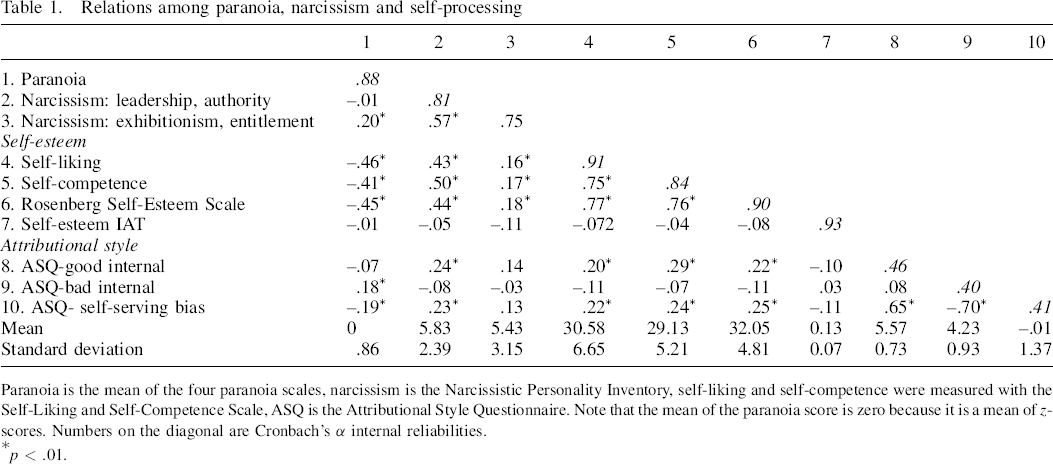
Paranoia is the mean of the four paranoia scales, narcissism is the Narcissistic Personality Inventory, self–liking and self–competence were measured with the Self–Liking and Self–Competence Scale, ASQ is the Attributional Style Questionnaire. Note that the mean of the paranoia score is zero because it is a mean of z–scores. Numbers on the diagonal are Cronbach's α internal reliabilities.
p < .01.
Explicit self–esteem
Global explicit self–esteem was measured with the Rosenberg Self–Esteem Scale (RSES; Rosenberg, 1965). The RSES includes 10–items on a Likert scale ranging from 1 (strongly agree) to 4 (strongly disagree; e.g. ‘I feel that I am a person of worth, at least on an equal plane with others’). Overall, the RSES may be the most commonly used measure of explicit self–esteem (Leary, Tambor, Terdal, & Downs, 1995). It has been shown to have high–internal consistency and test–retest reliability (Rosenberg, 1965) and to be highly associated with other measures of explicit self–esteem (e.g. Demo, 1985; Tafarodi & Swann, 1995).
The Self–Liking/Self–Competence Scale (SLCS; Tafarodi & Swann, 1995) was used to measure self–liking and self–competence domains of explicit self–esteem. The SLCS is a 20–item questionnaire on which participants rate their agreement from 1 (strongly disagree) to 4 (strongly agree). The scale contains two 10–item subscales measuring self–liking (e.g. I'm secure in my sense of self–worth) and self–competence (e.g. I perform well at a number of things). Previous research has found that the SCSL is highly correlated with other measures of self–esteem and to have high internal and test–retest reliability (Tafarodi & Swann, 1995).
Implicit self–esteem
Implicit self–esteem was measured with the self–esteem Implicit Association Test (IAT; Greenwald et al., 1998). Scores were calculated using the improved scoring algorithm (Greenwald, Nosek, & Banaji, 2003). Trials with response times greater than 10 seconds were removed. Mean latencies were calculated for each individual block of each individual participant and pooled standard deviations for blocks 3 and 6, and 4 and 7 were calculated. Errors were replaced with the participant's mean of correct trials for that block, plus 600 milliseconds. Difference scores for blocks 6 and 3, and blocks 7 and 4 were then calculated and divided by the appropriate pooled standard deviations. Finally, an average of these two scores was calculated and this served as the final IAT score for each participant. Seven participants were excluded for either failing to follow instructions or for having more than 10% errors. All results in the current research are based on the improved scoring algorithm (although, results are virtually identical if the conventional algorithm is employed).
Attributional style
The Attributional Style Questionnaire (ASQ; Peterson et al., 1982) was designed to measure causal attributions for positive and negative events. On the ASQ, participants are presented with 12 hypothetical events and asked to first imagine the situation happening to them and then decide what the one major cause of the situation would be, and finally answer four questions about the cause (internality, stability, globality and importance). Participants rated the cause on internality from 1 (totally due to other people or circumstances) to 7 (totally due to me). The self–serving bias score was calculated by subtracting the score for the internality of bad events from the score of internality for good events. Scores on the ASQ have been shown to be correlated with attributions given for actual events (e.g. poor performance on a laboratory task; Peterson et al., 1982).
Procedure
Participants first completed the Self–Esteem Implicit Association Test. Participants completed the IAT first because some research suggests that completing explicit measures of self–esteem before the IAT may influence IAT performance, but we are not aware of any research suggesting that completing the IAT first could influence explicit self–esteem ratings (Bosson et al., 2000). Then they completed the Schizotypal Personality Questionnaire Suspiciousness Subscale and the Paranoia and Suspiciousness Questionnaire randomly mixed together. Then participants completed the Attributional Style Questionnaire, Paranoid Personality Disorder Features Questionnaire, DAPP–BQ Suspiciousness subscale and the Rosenberg Self–Esteem Scale. Participants then completed the Self–Liking/Self Competence Scale. Participants completed the study in one occasion in an isolated room, with the entire study taking approximately 90 minutes.
Results
Paranoia and self–esteem
As can be seen in Table 1, paranoia was negatively correlated with global self–esteem, self–liking and self–competence, but not significantly correlated with implicit self–esteem. With the exception of implicit self–esteem, this is largely consistent with the paranoia as expression model, given that paranoia is associated with negative self–evaluations.
Paranoia and implicit/explicit self–esteem discrepancies
To examine whether paranoia was associated with a discrepancy between implicit and explicit self–esteem, we tested whether there was a significant interaction between implicit and explicit self–esteem predicting paranoia.
To test this interaction, implicit and explicit self–esteem scores were centred around their means and entered as step one of a hierarchical linear regression predicting the composite paranoia score. The product of the implicit and explicit self–esteem scores was entered in step two of the analysis. Following Aiken and West (1991), to interpret the interaction, scores were calculated for +1 and −1 standard deviations from the mean for both implicit and explicit self–esteem. There was not a significant interaction between implicit and explicit self–esteem to predict paranoia, t(182) = 0.23, p = .82. These results are more consistent with the paranoia as expression model than the paranoia as defence model because paranoia was not associated with a discrepancy between implicit and explicit self–esteem, but was negatively correlated with explicit self–esteem.
Paranoia and attributional style
As can be seen in Table 1, paranoia was negatively correlated with self–serving attributional bias. This is consistent with the paranoia as expression model which predicts that paranoia would be either unassociated with a self–serving bias or would be negatively associated with self–serving attributional bias possibly due to self–esteem being negatively correlated with paranoia.
Paranoia and paradoxical self–esteem
To test whether paranoia was associated with paradoxical self–esteem, we tested whether there was an interaction between self–liking and self–competence in predicting paranoia. Following the same format as the implicit/explicit self–esteem interaction, mean centred self–liking and self–competence scores were entered in step 1 of a hierarchical linear regression and the product of self–liking and self–competence was entered in step 2. As can be seen in Figure 1, there was not a significant interaction between self–liking and self–competence to predict paranoia, t(182) = −1.02, p = .30. Paranoia tended to be associated with decreased self–liking, regardless of the levels of self–competence.
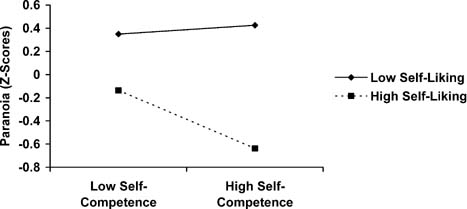
Paranoia as a function of self–liking and self–competence graphed at +1 and −1 standard deviations from the mean.
Narcissism and self–esteem
In contrast to the results for paranoia, narcissism was positively correlated with self–liking, self–competence and global self–esteem (see Table 1) for both narcissism facets as well as the NPI total score (rs with total NPI score are .37, .43, .40, respectively). However, narcissism was not significantly associated with implicit self–esteem.
Narcissism and discrepancies between implicit/explicit self–esteem
To test whether there was an interaction between implicit and explicit self–esteem in predicting narcissism, mean–centred implicit self–esteem and explicit self–esteem and an interaction term were regressed on NPI factor scores. There was not a significant interaction predicting NPI leadership/authority, t(182) = 1.61, p = .11, NPI Exhibitionism/entitlement, t(182) = 0.34, p = .74 or NPI total scale score, t (182) = 0.97, p = .33.
Narcissism and attributional style
In contrast to the results for paranoia, the leadership/authority facet of narcissism was associated with an increased self–serving attributional style. The NPI total score was also significantly associated with self–serving bias (r = 0.23, p < .001). This is consistent with the narcissism as defence model which suggests that individuals with high narcissism are more likely than others to view negative events as having external causes and positive events as having internal causes. However, this also may be consistent with the expression model if the self–serving bias is an expression of high self–esteem.
Narcissism and paradoxical self–esteem
To test whether there was an interaction between self–liking and self–competence in predicting narcissism, self–liking, self–competence and the interaction term were regressed on narcissism. There was a significant interaction between self–liking and self–competence predicting NPI total score, t(182) = 2.27, p < .01. This interaction was also significant in predicting NPI leadership/authority scores t(182) = 2.73, p < .01, but not for NPI exhibitionism/entitlement scores t(182) = 1.52, p = .13. As can be seen in Figure 2, participants with high self–competence, but low self–liking had the highest levels of total narcissism. These results are consistent with the narcissism as defence model in which narcissism may arise as a defence against low self–liking.
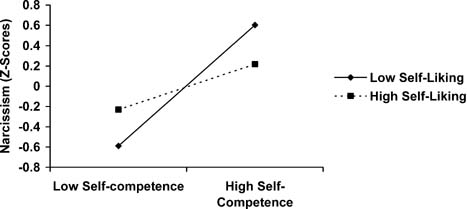
Interaction between self–liking and self–competence predicting total Narcissistic Personality Inventory scores graphed at +1 and −1 standard deviations from the mean.
Discussion
The current research suggests that paranoia is better represented by the paranoia as expression model than the paranoia as defence model. Paranoia seems to be a direct expression of low explicit self–esteem or maladaptive self–relevant information processing, rather than a defence against maladaptive self–processing. This was evident in that paranoia was negatively associated with global self–esteem, self–liking, self–competence and self–serving attributional style. Participants with low levels of self–liking tended to have high levels of paranoia regardless of their levels of self–competence, which was evidenced by the lack of a significant interaction between self–liking and self–competence in predicting paranoia. However, paranoia was not negatively associated with implicit self–esteem, which is predicted by the paranoia as expression model. The finding that narcissism was associated with defensive self–processing suggests that the lack of an observed relation between paranoia and defensiveness reflects an actual absence of an effect rather than a type 1 error.
The paranoia as defence and expression models make different predictions about paranoia's relation with explicit self–esteem and attributional style. In the current study, consistent with the paranoia as expression model, paranoia was negatively correlated with explicit self–esteem. This also is consistent with a number of other studies that also have found that paranoia is negatively associated with explicit self–esteem (e.g. Combs & Penn, 2004; Freeman et al., 1998). Hence, it appears that when comparing people with paranoia versus a relatively normal control group (and not comparing them to a depressed control group; Candido & Romney, 1990; Lyon, Kaney, & Bentall, 1994), paranoia is negatively correlated with explicit self–esteem.
The current research did not find an interaction between implicit and explicit self–esteem in predicting paranoia or narcissism. This is consistent with some previous research that also has not found this hypothesized interaction for narcissism (Campbell et al., 2007) and for paranoia (Moritz, Werner, & von Collani, 2006; Smith et al., 2005). Bosson, Lakey, Campbell, Zeigler–Hill, Jordan, and Kernis (2008) also reported that several unpublished data sets have failed to find an interaction between implicit and explicit self–esteem in predicting narcissism. However, one possibility is that narcissism and paranoia are not associated with global implicit self–esteem, but are only associated with agenic, or self–competence, implicit attitudes (Campbell et al., 2007). Thus, future research could examine whether there are interactions between agenic implicit self–attitudes and explicit self–competence, such that people with narcissism have high explicit self–competence and low implicit agenic self–esteem.
At the same time, consistent with the paranoia as expression but not the paranoia as defence model, paranoia was negatively associated with self–serving attributional style. From the paranoia as expression view, paranoia should be negatively associated with self–serving bias to the extent that self–esteem is negatively associated with self–serving bias. Consistent with previous research (Tennen et al., 1987), in this study explicit self–esteem had a moderate negative association with self–serving bias. As predicted by the paranoia as expression model, paranoia also had a significant zero–order negative association with self–serving bias. Critically, paranoia and narcissism were not significantly associated with each other. The finding that narcissism was positively associated with a self–serving attributional bias, but paranoia was negatively associated with a self–serving bias suggests that narcissism may serve a defensive function and paranoia may not.
In addition to implications for paranoia and narcissism, the current research suggests several issues for future research. The results for paranoia are largely consistent with the Threat Anticipation Cognitive Model of Persecutory Delusions (Freeman, 2007). This model posits that negative self–relevant information processing (e.g. low self–esteem, decreased self–serving attributional style) contributes to the formation of paranoid ideation along with other factors about the way a person interacts with the world including personality characteristics and anomalous perceptual experiences. The current research identifies several self–processing variables that could contribute to the development of paranoia. Future research could examine whether there is an interaction between these variables and self–processing variables that are thought to be associated with paranoia or delusion–like beliefs including aberrant salience and anomalous perceptual experiences. For example, the Threat Anticipation Cognitive Model of Persecutory Delusions suggests that anomalous perceptual experiences may interact with self–esteem to predict paranoia such that participants with high levels of anomalous experience, but low levels of self–esteem may have the highest levels of paranoia (Cicero, Becker, Martin, Docherty, & Kerns, manuscript in preparation). Moreover, recent research has found that aberrant salience may be a driving mechanism behind anomalous experiences and psychotic–like experiences (e.g. Kapur, 2003). Future research could examine whether aberrant salience interacts with self–processing variables to predict paranoia and psychotic–like experiences.
In addition to being consistent with several models of paranoia, the finding that paranoia is negatively associated with explicit self–esteem is consistent with basic models of self–esteem functioning. For example, the Sociometer Theory posits that an individual's level of self–esteem is dependent on his or her perception of how others evaluate him or her (Leary et al., 1995). Several studies have found that people who think others think of them in a negative light are more likely to have low self–esteem and that experimentally manipulating perceptions of acceptance can cause a decrease in self–esteem (e.g. Leary, Haupt, Strausser, & Chokel, 1998; Murray, Griffin, Rose, & Bellavia, 2003). Since paranoia is associated with a heightened suspicion of other people's motives, it is likely that people with paranoia believe others have negative opinions of them and do not accept them. Thus, paranoia being an expression of low self–esteem is consistent with the Sociometer Theory of self–esteem. Moreover, paranoia may be a rational or logical response to these feelings of non–acceptance and perceptions of negative feelings in others. In this sense, paranoia may be an adaptive mechanism among people with low self–esteem.
In addition to testing whether self–processing interacts with other variables to predict paranoia, future research could examine whether decreased self–esteem actually plays a causal role in producing paranoia. Potentially, decreased self–esteem could cause someone to think that other people are more likely to treat him or her poorly. Conversely, decreased self–esteem could be a by–product of the psychological distress associated with paranoia. One way to potentially examine this in future research is to examine whether threats to self–esteem cause an increase in paranoid behaviours and judgments. It is important to note that previous research has been able to successfully cause an experimental increase in paranoia (Fenigstein & Vanable, 1992). In an initial study, we have found some evidence that a threat to self–esteem can cause an increase in paranoid behaviour and evaluations of others in the lab (Cicero & Kerns, 2007). At the same time, examining whether self–processing manipulations cause an increase in paranoia also might be a way to examine specific associations between paranoia and self–processing without the confounds of correlational research (Miller & Chapman, 2001).
Although the current research did not find evidence that paranoia was associated with defensive self–processing, future research could examine other ways in which paranoia could be associated with defensive self–processing. For example, some previous research suggests that paranoia may be associated with discrepancies in actual vs. ideal self (Kinderman & Bentall, 1996b), a personalizing rather than self–serving attributional bias (Kinderman & Bentall, 1996a) and self–esteem instability (Thewissen, Bentall, Lecomte, van Os, & Myin–Germeys, 2008). At the same time, it has been suggested that there might be at least two phenomenologically different forms of paranoia, ‘bad–me’ paranoia and ‘poor–me’ paranoia (Trower & Chadwick, 1995). The current results are consistent with bad–me paranoia, as paranoia was associated with decreased self–esteem. However, it is possible that other people with paranoia might exhibit poor–me paranoia and a tendency to think that others are conspiring against them for reasons outside of their own control, which might result in intact or even elevated explicit self–esteem.
The current research also may have implications for narcissism. To our knowledge, this study was the first to find that narcissism is associated with a combination of high self–competence but low self–liking. Thus, narcissism may develop in part as a defensive mechanism to protect against relatively low feelings of self–liking in the presence of high feelings of self–competence. This is consistent with theoretical explanations of narcissism, in which narcissism has been hypothesized to be positively correlated with feelings of self–competence that are maladaptive due to underlying feelings of self–worth or self–liking (Bosson et al., 2008). Additionally, previous research has found that narcissism may be positively correlated with agenic self–esteem and negatively correlated with ‘communal’ self–esteem (e.g. Campbell, Rudich, & Sedikides, 2002). This may be analogous to the observed pattern of high self–competence and low self–liking in the current research.
As mentioned, a number of studies have found that people with paranoia tend to have an excessive focus on the self. There may be a number of reasons for this self–focus. For example, previous research has found that victims of childhood abuse or trauma tend to have higher levels of paranoia in adulthood (e.g. Janssen et al., 2004; Lobbestael, Arntz, & Bernstein, 2010). Moreover, some research has suggested that the mechanism by which trauma causes paranoia may be anxiety or self–focused attention (Freeman & Fowler, 2009). Childhood trauma may cause people to experience more anxiety and more self–focused attention, which may in turn cause people to experience more paranoid ideation. Moreover, recent research has found that other risks for psychosis, such as substance abuse, may be mediated by self–focused attention or anxiety (Freeman & Fowler, 2009).
The current findings for paranoia and narcissism also may have implications for clinical populations of people with disorders related to paranoia (e.g. paranoid personality disorder, schizophrenia) and narcissism (e.g. narcissistic personality disorder). However, the use of a non–clinical population may be a limitation of the application of the current results to clinical populations. Previous research suggests that paranoia may be similar to persecutory delusions in people with schizophrenia (Combs & Penn, 2004), and that subclinical narcissism may be similar to clinical narcissism (Miller & Campbell, 2008). These theorists have argued that measuring paranoia and narcissism subclinically may be a good starting place for understanding clinical paranoia and narcissism. However, in contrast, some researchers have argued that there are differences between subclinical paranoia and persecutory delusions such that only persecutory delusions are defensive (Bentall et al., 2001). Future research could examine whether clinical paranoia and narcissism are similarly associated with expression and defence models as found in the current research.
One possible explanation for not finding support for the paranoia as defence model is that there could be methodological problems in measuring self–processing. For example, perhaps explicit self–esteem measures do not actually measure explicit evaluations of oneself (Bentall et al., 2001). At the same time, perhaps the lack of associations between paranoia and self–serving attributional style could be due to low reliability of attributional style measures. However, a methodological explanation for not finding support for the paranoia as defence model seems less likely given that in the current study we did find support for narcissism being associated with defensive self–processing. Consistent with previous research, in the current study narcissism was associated with high explicit self–esteem even though it was unassociated with implicit self–esteem (Campbell et al., 2007). Moreover, also consistent with previous research, narcissism was associated with an increased self–serving attributional style (McAllister et al., 2002). Therefore, the current study suggests that narcissism, but not paranoia, is associated with defensive self–processing. Moreover, it does not seem like methodological problems in measuring self–processing can easily account for the failure to support the paranoia as defence model.
Footnotes
Acknowledgements
The work on this paper was supported by National Institute of Mental Health Grant MH072706, National Institute on Drug Abuse Grant DA022405 and a MU Research Board Grant.