







Abstract
Previous research showed that in the individualistic culture, adults endorse the personal more than the general belief in a just world (PBJW vs. GBJW). Comparatively little is known about the prevalence character and adaptive functions of GBJW, especially in the collectivistic culture. We conducted three surveys among the Chinese adults and adolescents. We found that (1) Chinese adults and adolescents endorsed more GBJW than PBJW; (2) Adult survivors with high exposure to post–earthquake trauma and adolescents in the poverty–stricken area maintained high GBJW, with relatively lower PBJW. (3) GBJW predicted the psychological resilience in all the three samples independent of PBJW. The results imply that in contrast to populations from the individualistic culture, people from the collectivistic culture endorse a robust GBJW, which allows them to resiliently confront harsh realities. Copyright © 2010 John Wiley & Sons, Ltd.
Introduction
According to Lerner's just–world theory (Lerner & Miller, 1978), individuals have a need to believe that they live in a just world where people get what they deserve. The belief in a just world (BJW) is essential for individuals to confront their physical and social environment as though they were stable and orderly, and people are very reluctant to give up this belief. Nonetheless, the world is not always a just place, so BJW is regarded as a fundamental delusion which enables people to function despite life's tragedies and is thus defended by individuals living in the unjust world, and minimize the apparent injustice being suffered (Lerner, 1980, 1998; but see Sutton, Douglas, Wilkin, Elder, Cole, & Stathi, 2008). Most of the previous studies showed that BJW functioned as an anti–social belief system, leading people to blame and derogate disadvantaged groups such as the poor (Furnham, 2003; Furnham & Gunter, 1984), the unemployed (Reichle, Schneider, & Montada, 1998), the elderly (Lipkus & Siegler, 1993), as well as the innocent victims (De Judicibus & McCabe, 2001). However, recent studies reveal that BJW, as a double–edged sword, is the personal resource when dealing with challenges (Dalbert, 2001). It could serve as a coping mechanism in face of harsh realities to promote mental health and enhance achievement behaviour (Dalbert, 1997, 1998; Lambert, Burroughs, & Nguyen, 1999).
Dalbert (1999) argued that, the contradiction in the functions of BJW derived from the distinction of the BJW in general and the BJW in one's own fate. General belief in a just world (GBJW) leads individuals to believe that people generally live in a just world (i.e. ‘I think basically the world is a just place and people by and large get what they deserve’), while the personal belief in a just world (PBJW) concerns whether they are personally fairly treated (i.e. ‘I believe that, by and large, I deserve what happens to me’). Along with the just–world research concentrating on its impact on mental health over the past decade, the differentiation between GBJW and PBJW has become more and more important (Dalbert, 1999). Evidence from individualistic cultures demonstrates that PBJW is primarily related to indices of mental health, such as life satisfaction, self–esteem, and meaning in life; while GBJW primarily contributes to victim derogation such as harsh attitudes towards the poor and the elderly (Bègue and Bastounis, 2003; Lipkus, Dalbert, & Siegler, 1996; Sutton & Douglas, 2005). Some theory and research also suggest that GBJW and PBJW are primitive beliefs that lose some of their importance in adulthood. Further, it suggests that GBJW would lose its importance much earlier and to a larger extent than PBJW and would be replaced by more sophisticated forms of reasoning which enables individuals to handle a world that is neither orderly nor just (Oppenheimer, 2006).
Nonetheless, it remains debatable whether GBJW really drops off or continues to serve an adaptive function in adulthood. Rubin & Peplau (1975) argued that just–world belief would vary across individual correlates, and even grew stronger among older people, especially those nearing death might derive much–needed comfort from the belief. Contrary to Oppenheimer (2006), some researchers found that GBJW increases in the older age group (Maes & Schmitt, 2004) and might be heightened by just–world threatened conditions during adulthood (Callan, Ellard, & Nicol, 2006). In a typical collectivistic culture, the Chinese adults have been found to hold GBJW in a comparable level with PBJW (Liu, Yin, & Zhao, 2008), and their GBJW was found to be associated with their life satisfaction like PBJW (Wu, Wang, Zhou, Wang, & Zhang, 2009; Zhu, Wu, & Li, 2010). This is contrary to the classical rationale derived from the individualistic cultures that individuals hold more belief in a personal just world than in a general just world, and that PBJW (compared to GBJW) was the major predictor to mental health (Bègue & Bastounis, 2003; Dalbert, 1999; Lipkus, Dalbert, & Siegler, 1996; Sutton & Douglas, 2005). However, there is very little empirical evidence to help to establish the prevalence character and adaptive function of GBJW, especially in collectivistic cultures.
The main purpose of the current research is to explore the prevalence of GBJW and its adaptive function in a collectivistic culture. Previous studies showed that people in collectivistic cultures who usually had lower level of GDP, lower life quality, less opportunities for personal development and stronger competitive motivations, more often held such beliefs as good deeds would be rewarded (Bond, Leung, Au, Tong, de Carrasquel, et al., 2004). For example, people in East Asia usually lived in collectivistic cultures, and they held higher BJW than societies in other regions such as North America and Europe (Furnham, 1985, 1993). Among these groups, especially the Chinese population were found to have comparable scores on GBJW and PBJW (Liu et al., 2008). These results suggest that in collectivistic cultures, the general belief that effort, knowledge and careful planning lead to positive results, will encourage people to solve the actual problems they are faced with and thus reduce their stress levels (Bond, Leung, Au, Tong, & Chemonges–Nielson, 2004). In other words, though the general belief that ‘good deeds will be rewarded’ is a delusion in the view of the just–world theory, it serves as a resilient function for individuals to effectively cope with conflict and stress. It was suggested that these justifying beliefs would help people to be psychologically mobilized to confront environmental difficulties and expect to succeed (Bond, Leung, Au, Tong, de Carrasquel, et al., 2004), and could serve the palliative function of releasing the frustration of the disadvantaged (Jost, Pelham, Sheldon, & Sullivan, 2003). That is, GBJW would serve as justifying strategies to promote individuals’ resilience that indicates positive adaptation in face of adversity (Luthar & Cicchetti, 2000).
It so happens that people in collectivistic cultures (such as Chinese) appear to have strong resilience. For example, epidemiological studies indicate that populations in collectivistic cultures consistently report low prevalence of negative affect and related mood disorders (Chiao & Blizinsky, 2009), although they experienced harsh realities including widespread pathogen contamination (Fincher, Thornhill, Murray, & Schaller, 2008) and obstructed socioeconomic development (Inglehart & Welzel, 2005). Accordingly, resilience has been found to be a significant characteristic of Chinese culture, reflected from adolescents’ reaction to adversity (Shek, 2004) and workers’ maintenance of competition motivation (Luthans, Avey, Clapp–Smith, & Li, 2008; Luthans, Avolio, Walumbwa, & Li, 2005). This evident resilience coincides with the fact that there were serious disasters every 2 or 3 years throughout the long Chinese history, and that Chinese people have been suffering wars, revolutions, social transition and polarization of wealth since the late 19th century (Ren, 2000). Consistent with the above argument that GBJW prevails and promotes resilience in harsh realities, the Chinese ancient philosophy emphasizes the acceptance of the outside world and the transcending of adversity at present through the reconciliation of the contradic sides. For example, Chinese Taoism recommends people should not change the natural order, called Tao, but should follow it; Taoists believe that the suffering always underlies the blessing, and children even without critical thinking of the real world are the happiest and most healthy human beings (Fung, 1985; Zhang & Veenhoven, 2008). This cultural strategy is very similar to the complementary model of justice, in that system–justifying beliefs that ‘social arrangements are fair and legitimate’, are held by the disadvantaged to buffer stress responses (Kay & Jost, 2003; Kay, Jost, Mandisodza, Sherman, Petrocelli, & Johnson, 2007). However, until now there has been no psychological research about the possible relationship between GBJW and psychological resilience among Chinese, which the current study aims to address.
In summary, in collectivistic cultures, at least in China, disadvantageous and traumatic experience would elevate the need to hold a robust GBJW; especially, the Chinese Culture that highlights the acceptance of the outside world would promote the agency of GBJW rather than PBJW. Concerning these regards, three studies were conducted to test whether GBJW really prevails during adulthood among the Chinese people, and whether GBJW, independently of PBJW, predicts life satisfaction and resilience. One is a survey from normal adults residing at several regions across China, so as to evaluate the methodological fitness of the Chinese version scale of GBJW and PBJW, and their relationship to life satisfaction and psychological resilience. Afterward, we obtained questionnaire data of the above four aspects from adult survivors who just experienced a serious earthquake. We also used these same scales among adolescents, with one group from the metropolitan region and the other from the impoverished region. The later two studies enabled us to investigate the adaptive functions of GBJW in extremely harsh realities. In particular, with the disaster sample, we can examine the functioning of the GBJW when people experience great trauma in their lives. With the adolescent sample, we attempted to replicate the profile of the adaptive functions of GBJW during the early years of life with disadvantage, thus gaining insight into their development.
Study 1
Above all, although GBJW and PBJW have been separately assessed among the Chinese population in previous studies (Liu et al., 2008; Yin, Pan, & Tu, 2009; Zhu, Wu, Li, Shi, & Wang, 2010), there has not been direct evidence to confirm the construct validity of GBJW and PBJW among the Chinese population. In study 1, therefore, we first sought to investigate the construct validity of GBJW and PBJW among normal Chinese adults across the country, and their relationship to life satisfaction and psychological resilience. Besides, GBJW and PBJW were previously primarily examined on pupils or college students and it has been revealed that GBJW and PBJW do not reach steady state until adulthood (Liu et al., 2008; Oppenheimer, 2006). Therefore, to work up a clear profile of GBJW and PBJW, adult participants were recruited to take part in the current study. We supposed that people in the collectivistic culture would hold more GBJW than PBJW during adulthood, and both of them could contribute to people's life satisfaction, whereas GBJW could promote psychological resilience independent of PBJW.
Method
Participants
Four hundred participants were sampled from four cities across the whole country: Daqing (120, Heilongjiang province in North China), Shenzhen (80, Guangdong province in South China), Kuerle (80, Xinjiang province in West China) and Shaoxing (120, Zhejiang province in East China). The four regions are relatively developed cities in China with per capita GDP of $5487 (37 386 RMB) and above in 2008, and all of them ranged in top 100 of the entire country (National Bureau of Statistics, 2008). 340 (85%) of the participants responded as instructed (164 females; 42.95 ± 14.43 years, ranging from 18 to 82).
Materials and procedure
The General–Personal Just–World Belief Scale is a 13–item questionnaire assessing the GBJW and PBJW (see Table S3) (Dalbert, 1999). The Chinese version was translated from the English version with ensured fluency and accuracy (items were translated by the authors and back–translated by two expert English–Chinese interpreters independent of the current study). Participants were required to respond on a 6–point Likert scale (1 = strongly disagree, 6 = strongly agree) to indicate the extent to which they agreed with the statements about GBJW (e.g. ‘I believe that, by and large, people get what they deserve’) and PBJW (e.g. ‘I believe that, by and large, I deserve what happens to me’). In the current study, the reliability coefficient (Cronbach's α) of GBJW was 0.86 with that of PBJW 0.84.
The Satisfaction with Life Scale (SWLS) is a 5–item questionnaire (Diener, Emmons, Larsen, & Griffin, 1985; Pavot & Diener, 1993), which has been applied worldwide to assess global life satisfaction (e.g. ‘So far I have gotten the important things I want in my life’). Participants were required to respond on a 6–point Likert scale (1 = strongly disagree, 6 = strongly agree) instead of a 7–point one, in order to avoid the midpoint response bias of attitude scale among the Chinese (Chen, Lee, & Stevenson, 1995). The current reliability coefficient (Cronbach's α) of SWLS was 0.84.
A 10–item Connor–Davidson Resilience Scale (CD–RISC) was used to measure the psychological resilience (Campbell–Sills & Stein, 2007; Connor & Davidson, 2003) (e.g. ‘I can achieve goals despite obstacles’; ‘I tend to bounce back after illness or hardship’). Respondents rated items on a 5–point Likert frequency scale from 0 (not true at all) to 4 (true nearly all the time). The scale was refined from the original version by Connor and Davidson and the Chinese version was developed by Yu and Zhang (2007). The current reliability coefficient (Cronbach's α) of CD–RISC was 0.91.
Volunteers were trained for help with data collection. Participants were recruited with interviewers visiting door by door, and they were instructed by interviewers to fill out the questionnaires on their own. At the end, a gift was offered as reward. The study protocol received approval from the Institutional Review Board of the Institute of Psychology, Chinese Academy of Sciences.
Result and Discussion
We tested the construct validity of the 13 items in the PBJW & GBJW questionnaires with three structural equation models, one with the two latent variables (GBJW and PBJW) correlated, one with the two latent variables independent, and another with a unique latent variable (BJW = GBJW and PBJW). According to the 2–index rule proposed by Hu and Bentler, 1998, which proposed that SRMR (Standardized Root Mean Square Residual) and one of other index (NNFI, IFI, CFI, et al.) are essential to the fitness of one model, we found that the model with two latent variables correlated met the harsh criteria (NNFI, IFI or CFI ≥ 0.95; SRMR ≤ 0.08), while both of the models with two latent variables independent and that with a unique latent variable failed to met the criteria (see Table S1). We then averaged the corresponding items of two factors to score the GBJW and PBJW as well as those of life satisfaction and psychological resilience in the following analysis (see Table S2).
Paired samples t–test (GBJW vs. PBJW) revealed that the GBJW score was significantly higher than PBJW (4.06 ± 1.02 vs. 3.87 ± 0.93, t(326) = 4.29, p < 0.001) (See Figure 1A), and the Pearson correlation coefficient of GBJW and PBJW was 0.66 (p < 0.001).
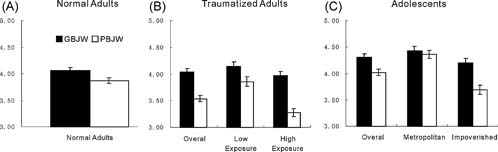
The mean scores of GBJW and PBJW in study 1 (A), study 2 (B) and study 3 (C). Note. GBJW = general belief in a just world, PBJW = personal belief in a just world; ‘Normal Adults’ indicates the normal participants aged 18–82 years in study 1; ‘Traumatized Adults’ indicates the survivors aged 19–77 years after Sichuan Earthquake in study 2, Low Exposure indicates experiencing Sichuan Earthquake with person and property intact or recovered, and High Exposure indicates experiencing Sichuan Earthquake with family members lost; ‘Adolescents’ indicates all the participants in study 3 (aged 10–15 years), ‘Metropolitan’ indicates those living in the metropolitan city, and ‘Poverty Stricken’ indicates those living in the poverty–stricken county.
Hierarchical regression analyses were used to determine whether GBJW predicted life satisfaction and psychological resilience independent of PBJW. In the first model, demographic variables including gender, age, education and marriage status were entered as basic predictors. In the second model, PBJW and GBJW were entered to test the prediction power of them on life satisfaction and psychological resilience. As summarized in Table 1, both GBJW and PBJW significantly predicted life satisfaction (β = 0.31 and 0.39 respectively, all p < 0.001), and GBJW (β = 0.26, p < 0.01) independently predicted psychological resilience compared to the non–significant prediction power of PBJW (β = 0.13, p = 0.086, NS).
Regression analysis showing the prediction power of GBJW and PBJW on life satisfaction and psychological resilience in study 1
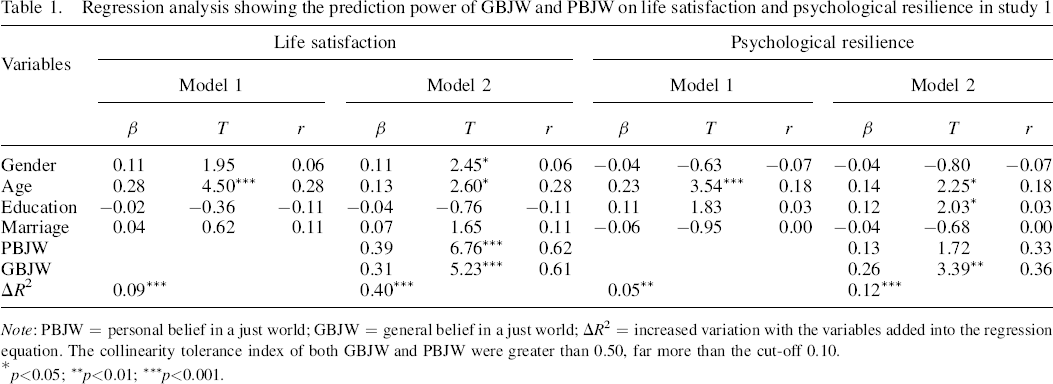
Note: PBJW = personal belief in a just world; GBJW = general belief in a just world; ΔR2 = increased variation with the variables added into the regression equation. The collinearity tolerance index of both GBJW and PBJW were greater than 0.50, far more than the cut–off 0.10.
p<0.05;
p<0.01;
p<0.001.
The results confirmed the reliability and validity of the application of the PBJW and GBJW questionnaires among the Chinese population. Furthermore, Chinese adults believed that the world was more just generally than for themselves (higher GBJW than PBJW), which was contrary to the case in individualistic cultures (Dalbert, 1999; Lipkus, Dalbert, & Siegler, 1996; Oppenheimer, 2006; Sutton & Douglas, 2005), but consistent with previous studies on the Chinese population (Liu et al., 2008). We also found that GBJW and PBJW together could serve as predictors of life satisfaction, and especially GBJW played a key role for promoting psychological resilience among Chinese, while PBJW could not. However, the prediction effect of GBJW on resilience was not strongly distinct with that of PBJW which was marginally significant. Thus this finding should be interpreted cautiously; pending further tests in multiple populations.
Study 2
In study 2, we sought to investigate GBJW and PBJW among adults experiencing a disaster, specifically the 2008 Sichuan Earthquake, and their relationship to life satisfaction and psychological resilience. On the basis of the Chinese philosophy of transcending in adversity (Fung, 1985; Zhang & Veenhoven, 2008) or the complementary justice (Kay & Jost, 2003; Kay et al., 2007), we hypothesized that adult survivors would maintain high GBJW in spite of their PBJW being shattered by high exposure to trauma (Cubela Adoric, Kvartuc, Ramona Bobocel, & Hafer, 2007; Dzuka & Dalbert, 2007; Gluhoski & Wortman, 1996; Janoff–Bulman, 1989, 1992). We also predicted, furthermore, the strong GBJW as a possible coping mechanism to trauma, would be independently associated with psychological resilience in both high exposure and low exposure to traumatic events such as a major earthquake. Additionally, we predicted that both GBJW and PBJW would be positively associated with life satisfaction after earthquake, as observed in the normally adult sample of Study 1.
Method
Six hundred and seventy three cases of adult survivors were from a randomly sampled database ‘Warm Hand & Warm Heart Survey’ at the Mianyang and Deyang dwelling sites eight months after the 2008 Sichuan Earthquake (Wu, Zhu, & Li, 2010). Participants completed the same questionnaires as in study 1. 166 (24.67%) of them were identified to be exposed to the high level of trauma who had lost family members (either parents or children or spouses) and to respond as required by instruction (97 females; 41.86 ± 9.59 years, ranging from 21 to 70 years). 131 (19.47%) of them were exposed to the low level of trauma who had their family and property intact or recovered and responded as required by instruction (66 females; 40.11 ± 12.43 years, ranging from 19 to 77). Others with ambiguous family and property information were excluded from further analysis.
The data were collected in the same way as Study 1. We conducted a mixed–design MANOVA, (trauma × type of BJW) to test the variation of GBJW (vs. PBJW) across different levels of exposure to trauma (high vs. low).
Result and discussion
The repeated measures (GBJW vs. PBJW) MANOVA revealed that there was a significant main effect of BJW type (F(1, 287) = 94.23, p < 0.001), and a significant interact effect of trauma × BJW type (F(1, 287) = 16.59, p < 0.001). That is, adult survivors’ GBJW was higher than PBJW (4.05 ± 1.07 vs. 3.54 ± 1.02); participants in the high exposure endorsed comparable GBJW (3.97 ± 1.13 vs. 4.14 ± 0.98, F(1, 290) = 1.86, p = 0.174, NS) but less PBJW (3.28 ± 1.08 vs. 3.86 ± 0.83, F(1, 292) = 23.91, p < 0.001) than those in the low exposure (See Figure 1B).
Hierarchical regression analyses replicated similar results with those of Study 1. As shown in Table 2, the models that demographic variables (gender, age, education and marriage status) as basic predictors, PBJW and GBJW as the main predictors were entered, revealed that among both the group with high and low exposure to the trauma, GBJW and PBJW both significantly predicted life satisfaction (β = 0.22 ∼ 0.31, all p < 0.01), while only GBJW (β = 0.37 and 0.30 respectively, all p < 0.001) predicted psychological resilience compared to the non–significant prediction power of PBJW (β = 0.10 or 0.06, p = 0.303 or 0.578, NS).
Regression analysis showing the prediction power of GBJW and PBJW on life satisfaction and psychological resilience in study 2
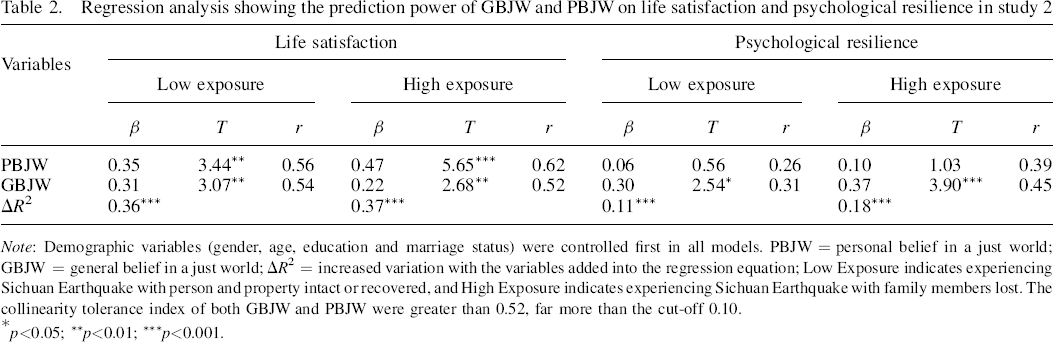
Note: Demographic variables (gender, age, education and marriage status) were controlled first in all models. PBJW = personal belief in a just world; GBJW = general belief in a just world; ΔR2 = increased variation with the variables added into the regression equation; Low Exposure indicates experiencing Sichuan Earthquake with person and property intact or recovered, and High Exposure indicates experiencing Sichuan Earthquake with family members lost. The collinearity tolerance index of both GBJW and PBJW were greater than 0.52, far more than the cut–off 0.10.
p<0.05;
p<0.01;
p<0.001.
Though experiencing extremely hash realities, adult survivors still believed that the world was more just generally than for them. Further, GBJW was held by survivors with high exposure as well as those with low exposure to trauma, even though their PBJW broke down. These results are consistent with the model (Schmitt, 1998; Sutton et al., 2008) that BJW is based on life experience, especially among people who personally receive injustice. We also replicated the findings of the prediction power of GBJW and PBJW on life satisfaction and psychological resilience in study 1. Furthermore, in the light of the transcending or compensation of the personal experience with post–earthquake trauma, the independent prediction power of GBJW on psychological resilience among disaster survivors was even stronger (β = 0.30 and 0.37 vs. 0.26) than among ordinary population, especially among participants with high exposure to post–earthquake trauma (β = 0.37).
Study 3
Resilience was originally found among children growing up in disadvantaged socioeconomic circumstances (Masten, 2001). Although it has been broaden to understand adults facing potentially traumatic events (Bonanno, 2004) and disasters (Bonanno, Galea, Bucciarelli, & Vlahov, 2006), as research progressed, researchers increasingly acknowledged that children's resilience might have derived from external factors (Luthar, Cicchetti, & Becker, 2000). Therefore in Study 3 we recruited adolescents living in an impoverished area to test whether GBJW promoted their resilience. We supposed that, consistent with study 1, Chinese adolescents should hold higher GBJW than PBJW (Liu et al., 2008; Yin, Pan, & Tu, 2009). Also like in study 2, they would complementarily maintain GBJW in disadvantaged conditions (impoverished vs. metropolitan) (Fung, 1985; Kay & Jost, 2003; Kay et al., 2007; Zhang & Veenhoven, 2008) in despite of shattered PBJW by disadvantaged status (Cubela Adoric, 2004), and their GBJW would help promote psychological resilience independent of PBJW. Additionally, both GBJW and PBJW could contribute to their life satisfaction, as observed in the normally adult sample.
Method
One hundred and forty seven adolescents from Yunxi (a poverty–stricken county in China) and 131 adolescents from Beijing (a metropolitan city in China) were conveniently sampled to complete the questionnaire with the same protocol as in the above two studies. 145 (98.64%) of the former (63 females; 12.84 ± 0.86 years, ranging from 10 to 15) and 130 (99.24%) of the latter (66 females; 12.25 ± 0.52 years, ranging from 10 to 14) responded as required by instruction. The questionnaire was handed out and completed in the classroom, and then a gift was offered as reward.
Informed consent from the adolescent participants combined with the informed consent from their teachers was obtained as required by the Institutional Review Board, and the whole data–collection process was conducted under the supervision of their teachers.
Result and discussion
The repeated measures (GBJW vs. PBJW) MANOVA revealed that there was a significant main effect of BJW type (F(1, 268) = 36.11, p < 0.001), and a significant interact effect of poverty × BJW type (F(1, 268) = 22.03, p < 0.001). That is, consistent with the results from adults, the adolescents had a higher GBJW than PBJW (4.31 ± 0.97 vs. 4.01 ± 1.04), and participants living in the poverty–stricken county maintained a comparative GBJW (4.20 ± 0.91 vs. 4.43 ± 1.02, F(1, 271) = 3.74, p = 0.054) but held less PBJW (3.69 ± 0.92 vs. 4.36 ± 1.06, F(1, 270) = 31.17, p < 0.001) than those living in the metropolitan city (See Figure 1C).
The prediction power of GBJW was also similar to that of Study 1 and Study 2. As shown in Table 3, the hierarchical regression models that demographic variables (gender and age) as basic predictors, PBJW and GBJW as the main predictors were entered, revealed that both GBJW and PBJW significantly predicted life satisfaction among metropolitan adolescents (β = 0.36 and 0.40 respectively, p < 0.001), while only GBJW predicted the life satisfaction of impoverished adolescents (β = 0.44, p < 0.001); GBJW predicted the psychological resilience in both groups (β = 0.50 and 0.43 respectively, p < 0.001), while PBJW did not predict the psychological resilience of either group (β = 0.18 or −0.10, p = 0.068 or 0.380, NS).
Regression analysis showing the prediction power of GBJW and PBJW on life satisfaction and psychological resilience in study 3
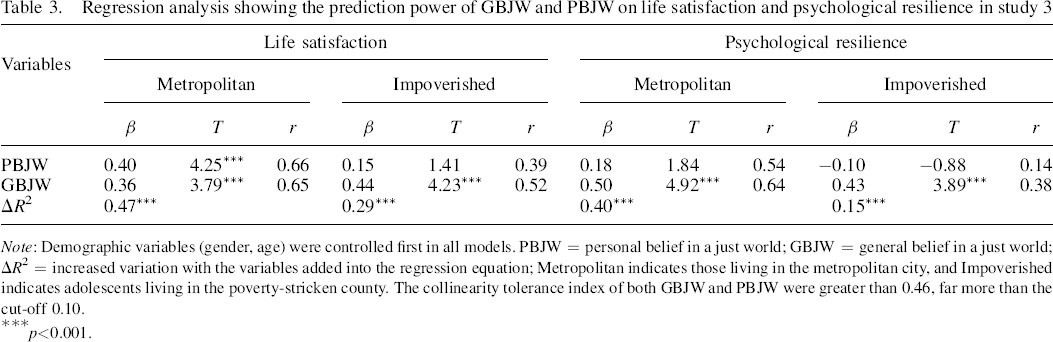
Note: Demographic variables (gender, age) were controlled first in all models. PBJW = personal belief in a just world; GBJW = general belief in a just world; ΔR2 = increased variation with the variables added into the regression equation; Metropolitan indicates those living in the metropolitan city, and Impoverished indicates adolescents living in the poverty–stricken county. The collinearity tolerance index of both GBJW and PBJW were greater than 0.46, far more than the cut–off 0.10.
p<0.001.
Consistent with the beliefs in a just world among adults, Chinese adolescents also endorsed higher GBJW than PBJW, and GBJW was well maintained among those in the poverty–stricken county. The same prediction pattern of GBJW and PBJW on life satisfaction and psychological resilience was found among adolescents as in the above two adult samples. Further compared to Study 1 and Study 2, we found that the independent prediction power of GBJW on psychological resilience was strongest (β = 0.43 ∼ 0.50 vs. 0.26 ∼ 0.37), especially among participants living in the poverty–stricken county (β = 0.43 in GBJW vs. −0.10 in PBJW). The robust GBJW and its adaptive function shaded the light on the greater importance of GBJW among adolescents than adults (Oppenheimer, 2006). Especially for adolescents living in the poverty–stricken county, these results demonstrated that the complementary or transcending of adversity (Fung, 1985; Kay & Jost, 2003; Kay et al., 2007; Zhang & Veenhoven, 2008) had been developed in the early years of life.
General Discussion
In the current research, we found that the Chinese version of the GBJW and PBJW scales were reliable and valid, and that GBJW was stably higher than PBJW in three samples. Previous studies found that Chinese adolescents and young adults showed comparable GBJW with PBJW (Liu et al., 2008; Yin, Pan, & Tu, 2009). And the present results obtained from a large sample revealed a robust effect that GBJW prevails over PBJW across the general Chinese population. Both GBJW and PBJW showed significant predictive power in relation to life satisfaction while only GBJW showed significant prediction power on psychological resilience. These results were found in both adolescent and adult samples. It confirmed the intuition that a good external environment was extremely important in Chinese culture (Mou, 2005), so that Chinese adults would not give up the belief even though they experienced various frustration. Rather, they believed that ‘the world is more just generally than for me’ and maintained their GBJW in misfortune at a cost of low PBJW.
A robust GBJW is often observed among people living in collectivistic cultures, and is still maintained in the extreme conditions such as disaster (Bond, Leung, Au, Tong, de Carrasquel, et al., 2004; Furnham, 1985, 1993; Wu, Wang, et al., 2009; Zhu et al., 2010). Such belief should be a kind of justification strategy that existing social arrangements are regarded as fair and justifiable (Jost, Banaji, & Nosek, 2004; Jost & Hunyady, 2005), and especially the transcending or complementary strategy in disadvantaged conditions (Fung, 1985; Kay & Jost, 2003; Kay et al., 2007; Zhang & Veenhoven, 2008). This might explain the consistently high GBJW across all three samples in the current research, and the stability of GBJW across different levels of exposure to post–earthquake trauma and poverty experience. As an ancient saying from I–Ching goes, ‘the world revolves, the gentleman should improve himself’, the Chinese have been educated to construct a justifying belief in the world. Such belief not only enables the Chinese to resiliently respond to the external environment without casting doubt on the justice of the whole world (Mou, 2005), but also encourages them to construe injustice personally to maintain social harmony in face of unjust treatment (Markus & Kitayama, 1991).
Furthermore, it is implied that these justification strategies could serve the palliative function of releasing frustration in face of harsh realities (Jost & Hunyady, 2002; Jost et al., 2003). As is well known, injustice is prevalent across the current society of China, for example, in the widening gap between the rich and poor, and the lagging development of country provinces compared to the cities. Recent statistics showed that 169.2 million Chinese (13.1% of total) and 42.9 million children aged under 16 years (16.8% of total) living on less $1 per day (the poverty line set by the World Bank) (WorldBank, 2009). In 2008, the Sichuan Earthquake left millions of people homeless and 80 thousands people perished or missing (Stone, 2008). In face of such suffering, our study shows that people still maintained a high score on GBJW (if not higher), although with a low PBJW. As the ancient Chinese philosophies suggest, people in harsh realities can have a good life through their own ability, power and effort like Confucians, and also can spiritually enjoy the meaning transcending of the adversity like Taoists (Zhang & Veenhoven, 2008). It is through these system–justifying beliefs that individuals complement their disadvantage and release their stress in harsh realities (Kay & Jost, 2003; Kay et al., 2007). Actually, similar findings in individualistic cultures also reveal that the disadvantaged groups are found to be more likely to preserve system–justifying beliefs (including general just–word belief) (Jost & Hunyady, 2002; Jost et al., 2003). Therefore, we have reason to conclude that GBJW is a kind of justification strategy in harsh realities even across cultures.
However, some previous studies reported confusing findings in harsh realities, in those populations in disadvantaged socioeconomic status held higher BJW than the control group (Hunt, 2000), while trauma exposure to disaster challenged the victims’ BJW (Solomon, Iancu, & Tyano, 1997). The current research showed that the trauma exposure of adults and poverty experience of adolescents led to a stable victimized trajectory with regard to GBJW and PBJW, i.e. harsh realities did not destroy individuals’ GBJW, even if their PBJW broke down. Actually, present studies have shown that the unique sensitivity to one's personal experiences of injustice was found among individuals who perceived themselves as being victimized in the workplace, thus PBJW but not GBJW broke down (Cubela et al., 2007; Dzuka & Dalbert, 2007; Gluhoski & Wortman, 1996). According to Janoff–Bulman & Morgan (1994) and Montada (1994), the victims’ belief of general just–world coexisting with their undeserved feelings of traumatic experience which are sometimes unrelated to action–outcome expectancies and their comparisons with others, is a typical reaction of survivors to victimization. For example, since earthquake is a natural disaster happened out of human control, survivors would not think that they lost their families because they did anything wrong, or it is unfair for them to lose their families whereas other people did not. Therefore, they would not change their beliefs about the general justice, even though they felt their personal trauma was undeserved. Furthermore, maintained GBJW provides them an optimistic outlook on the future to help them be confident of avoid an unjust fate in harsh realities (Dalbert, 2009).
Participants’ lower PBJW in harsh realities also directly reflects their cognitive reaction to being innocent victims (Schmitt, Gollwitzer, Maes, & Arbach, 2005; Schmitt, Neumann, & Montada, 1995). Their own world which should originally take care of them (protection, security and freedom from harm) appears to be shattered by the victimization of trauma or poverty, and the belief that they did not deserve what happened to them is an important clue of survivors’ reaction to the victimization (Janoff–Bulman & Morgan, 1994). Especially in collectivistic cultures, individuals are motivated to decrease the positive statement related to oneself, and to pursuit success through the resilient improvement in the long run (Bond & Smith, 1996; Hamamura & Heine, 2008); such motivational approach would strengthen the tendency of low endorsement on PBJW and suppress the complaint on the outside world in face of personal frustration. Nevertheless, we are not sure whether victims in the individualistic culture would reveal stably lower PBJW than those in advantage. There is a probability that some of them reveal sensitivity to the unfairness of one's own fate (Cubela et al., 2007; Dzuka & Dalbert, 2007; Gluhoski & Wortman, 1996) and to the disadvantage of in–group condition (Sutton & Winnard, 2007; Sutton et al., 2008), whereas some of them would maintain PBJW in a high level due to self enhancement which would lead to self deception in the individualistic cultures (Hamamura & Heine, 2008), and deny the injustices and discriminations of one's own (Crosby, 1984, 2004; Dalbert & Yamauchi, 1994; Taylor, Wright, Moghaddam, & Lalonde, 1990).
Another important finding from the current study was that GBJW (compared to PBJW) equally predicted life satisfaction and independently predicted psychological resilience. This is contrary to previous findings from individualistic cultures that PBJW independently predicted mental health while GBJW primarily contributed to anti–social attitudes (Bègue & Bastounis, 2003; Dalbert, 1999; Lipkus, Dalbert, & Siegler, 1996; Sutton & Douglas, 2005). Furthermore, previous studies in harsh reality were primarily focused on the buffer effect of PBJW (Otto, Boos, Dalbert, Schöps, & Hoyer, 2006, but see McParland & Knussen, 2010), whereas we repeatedly verified the adaptive function of GBJW (i.e. enhancing life satisfaction) (Wu, Wang, et al., 2009; Zhu et al., 2010). It implied that the adaptive function of BJW was not exclusive to PBJW, and GBJW also served very important function and even independently promoted psychological resilience to help individuals face adversities such as disaster and poverty.
Furthermore, the current study established a reliably unique link between GBJW and psychological resilience itself rather than a very general index such as life Further, this relation grew in strength with increasing exposure to harsh realities. This mirrors previous findings with collectivistic populations. For example, the general belief that ‘good deeds will be rewarded’ among collectivistic populations who usually lived in harsh realities, was related to the preference for adaptive coping strategy of psychological stress (Bond, Leung, Au, Tong, & Chemonges–Nielson, 2004), so that psychologically mobilized individuals were able to confront environmental difficulties and expect to succeed (Bond, Leung, Au, Tong, de Carrasquel, et al., 2004). Meanwhile in individualistic cultures, GBJW has been proved to uniquely associate with positive adaptation in behavioural aspects, for example, enhancing the interpersonal trust (Bègue, 2002) and releasing psychological distress in chronic pain (McParland & Knussen, 2010). These results are consistent with recent findings that GBJW functions as a buffer against negative reaction to external risks that are beyond the individual's control (Dalbert, 2001, 2009).
The sample from adolescents also confirmed that the division between GBJW and PBJW was very apparent at a young age, and GBJW already showed unique power to predict their psychological resilience, especially among those with poverty experience. This result is consistent with the notion that during adolescence GBJW would play a key role in much greater degree than PBJW (Liu et al., 2008; Oppenheimer, 2006). As expected, the results revealed that the adaptive function of GBJW and the effect of harsh realities in collectivistic cultures already existed during the early years. It is very interesting that the power of GBJW to predict psychological resilience was stronger during adolescence than adulthood, even though previous findings showed that GBJW and psychological resilience would increase with age, namely, the elderly who had richer life experience would endorse more GBJW (Maes & Schmitt, 2004) and psychological resilience (Foster, 1997) than the youth. This implied that individuals’ justifying strategies for coping stress might start developing during childhood, which should be through the achievement and interpersonal practices of positive attitude on the existing system in socialization settings such as schools (Dalbert, 2004). And their adaptive function could be mainly arrived from external delusion (by GBJW here), since they almost hadn't been independent from the external environment (Luthar et al., 2000).
Future studies need to include cross–cultural evidence so as to directly compare the prevalence of GBJW and its adaptive function in different cultural contexts. Particularly, it is not yet clear whether the strong GBJW is specially fostered by the cultural tradition of Chinese people, or GBJW serves as a kind of complementary justice in harsh reality of any culture, especially when the culture declares dialectical relationship between reconciliation of opposites (for example, disaster and fortune, poverty and rewards, elements of yin and yang of Chinese Taoism, and so on) (Kay & Jost, 2003; Kay et al., 2007; Mohiyeddini & Montada, 1998). Perhaps GBJW would become important to psychological adaptation, as long as PBJW be shattered by harsh reality. A pan–culture research in different kinds of personal victimizations (such as natural disaster, social arrangement, manmade tragedy, clinical adversity and so on) will be helpful to address the above concerns. Additionally, it is worth noting that one of GBJW items, namely ‘I am convinced that in the long run people will be compensated for injustices’, may be overlap with general belief in ultimate justice, which, in the individualistic culture, has shown clear positive relationships with adaptive processes, such as the ability to find sense and meaning in severe illness, the protection of pupils’ mental well–being, the reconciliation of human faults and life attraction (Maes, 1998; Maes & Kals, 2002; Maes & Schmitt, 1999), and compensating for misfortune by perceiving meaning and enjoyment in victims’ later lives (Anderson, Kay, & Fitzsimons, 2010). In the long run, people have a natural tendency to anticipate compensatory outcomes in the future, which lead them to perceive a current situation as relatively more fair (Gaucher, Hafer, Kay, & Davidenko, 2010). Based on the construal level theory (Liberman & Trope, 2008), events in the generally just world that take place in future rather than at present or occur to other people rather than to oneself, can be said to be psychologically distant and to be represented by their abstract, superordinate and global features (high–level construals). When the current events in personal experience (e.g. I am usually treated fairly) have not directly happened or happen to me with remote possibility, individuals will represent them in terms of its superordinate goal and its global meaning (Wakslak, Trope, Liberman, & Alony, 2006). Thus, the high–level construals tend to produce more superordinate identities (Wakslak, Nussbaum, Liberman, & Trope, 2008) and less emotional distress (Williams & Bargh, 2008). However, there is no empirical study to test GBJW (vs. PBJW) in the complementary model of justice and in the compensatory model of psychological distance, both of which need further investigation across cultures and conditions.
It is also desirable to further explore the multiple functions of GBJW. On the one hand, the current study only included life satisfaction as an index for subjective well being and psychological resilience as the single index of resilience system, which obviously could not describe the whole adaptive functions of GBJW. So the contribution of GBJW to other aspects of adaptive function, such as motivation, affection, interpersonal relationships, and social engagement, is also worth investigation in future. For example, previous studies concerned the relationship between BJW and future consideration, suggesting that the justness of others’ fates had clear implications for the future of the individual's own fate, and the sense of just world would lead individuals to commit themselves to the pursuit of long term goals (Hafer, 2000; Hafer, Bègue, Choma, & Dempsey, 2005; Lerner & Miller, 1978), whereas this relationship need further exploration in the context of the GBJW and PBJW distinction. On the other hand, the resilient function of GBJW in the collectivistic culture does not reversely recompose the relationship between GBJW and the anti–social attitude in the individualistic culture (Dalbert, 1999; Lipkus, Dalbert, & Siegler, 1996; Oppenheimer, 2006; Sutton & Douglas, 2005). Rather, the excessive acceptance of the social system, which can be demonstrated with the robust GBJW, has been criticized as an important reason for the stagnation of Chinese history by western scholars (Fairbank, Reischauer, 1989; Hegel, 1837; see also Zhang & Veenhoven, 2008). For example, the Chinese people prefer the high endorsement on system justification and victim derogation (Wu, Zhang, & Lai, 2008; Wu, Zhu, & Zhang, 2009). Such impact was also attacked by Chinese scholars, who want to reform China in the modern and scientific standard, and they argue that it leads to the extreme conservatism and the infantile hurt between each other (Shi & Rao, 2010; Sun, 2004). Therefore, the coupling of the adaptive and maladjusted function of GBJW can also be a concern.
In summary, the current research proposes an alternative view of just–world theory with evidence from a collectivistic culture. That is, GBJW is persistently higher than PBJW, even among people experiencing traumatic events and impoverishment, and GBJW, independent of PBJW, predicts psychological resilience among the Chinese. Our findings extend the study on GBJW and PBJW into domains where the investigation in the collectivistic culture is silent.
Supporting Information
Supporting info item, PER_807_sm_Supporting_Information - General Belief in A Just World and Resilience: Evidence from A Collectivistic Culture
Supporting info item, PER_807_sm_Supporting_Information for General Belief in A Just World and Resilience: Evidence from A Collectivistic Culture by Wu Michael Shengtao, Yan Xiaodan, Zhou Chan, Chen Yiwen, Li Juan, Zhu Zhuohong, Shen Xiangqin and Han Buxin in European Journal of Personality
Table S1. Confirm factor analysis of GBJW and PBJW.
Table S2. Descriptive statistics of GBJW, PBJW, life satisfaction and psychological resilience in all three studies.
Table S3. General–personal belief in a just world scale.
Please note: Wiley–Blackwell are not responsible for the content or functionality of any supporting materials supplied by the authors. Any queries (other than missing material) should be directed to the corresponding author for the paper.
Footnotes
Supporting Information
Additional supporting information may be found in the online version of this paper.
Acknowledgements
The authors express their gratitude to the volunteers for their help with data collection in study 1 and study 2, and to Professor Wenzhong WANG and Professor Zhanbiao SHI for their assistance at the earthquake sites in study 2, and to Professor Jianxin ZHANG and Dr. Christine FU for their comments on study 2. They also appreciate the insightful comments from Professor Robbie Sutton, Professor Claudia Dalbert, the editor Professor Manfred Schmitt and the anonymous reviewers. This research was partially supported by the Knowledge Innovation Project of Chinese Academy of Sciences (No.KSCX2–YW–R–130), the Knowledge Innovation Project of Institute of Psychology of Chinese Academy of Sciences (No.07CX011001) and the National Hi–Tech Research and Development Program of China (No. 2008AA022604). The funders had no role in the study design, data collection and analysis, decision to publish, or preparation of the paper. The authors have declared that no competing interests exist.
References
Supplementary Material
Please find the following supplemental material available below.
For Open Access articles published under a Creative Commons License, all supplemental material carries the same license as the article it is associated with.
For non-Open Access articles published, all supplemental material carries a non-exclusive license, and permission requests for re-use of supplemental material or any part of supplemental material shall be sent directly to the copyright owner as specified in the copyright notice associated with the article.
