







Abstract
The study presents the superordinate structure of personality measured by the Inventory of Child Individual Differences (ICID) and its links with behavioural approach system (BAS) and behavioural inhibition system (BIS), problem behaviour and family environment measures in parent reports of 1780 Russian children aged 3–17 years and 573 adolescent self–reports. Two higher–order factors, α comprising Agreeableness, Conscientiousness and Neuroticism (reversed), and β comprising Openness, Extraversion, Conscientiousness and Emotional Stability, were confirmed across gender and age. Structural model linking BAS with α and BIS with β was supported. α was negatively associated with externalising problems and β was negatively related to internalising problems. The links with family cohesion, punishment, westernisation and affluence supported the external validity of the Big Two. Copyright © 2011 John Wiley & Sons, Ltd.
Introduction
Over recent decades, research has demonstrated the robustness of the Five–Factor Model of personality in childhood and adolescence (Caspi, Roberts, & Shiner, 2005; Caspi & Shiner, 2006; Halverson, Kohnstamm, & Martin, 1994). Markon, Krueger, and Watson (2005) in their meta–analysis showed that personality structure was hierarchical: The Big Five, Big Four, Big Three and Big Two and their hierarchical relationships with one another replicated across samples of measures and participants. Markon et al. (2005) demonstrated that the Big Five traits differed in their level of abstraction: Neuroticism existed at five–, four– and three–factor level, Conscientiousness and Agreeableness remained the same at four–factor level and comprised disinhibition at three–factor level, Extraversion and Openness comprised positive emotionality which was essentially equivalent at four–, three– and two–factor level.
Markon et al. (2005) argued that the unbalanced nature of personality hierarchy could help to explain the controversy about the number of the Big Traits (see also De Raad and Peabody, 2005). Research on individual differences from infancy to adulthood demonstrated four–factor personality structure in preadolescent children (Zupančič, Podlesek, & Kavčič, 2006), three–factor structure of child temperament (Rothbart & Bates, 2006) and the Big Two underlying temperament–personality interface (Halverson, 2004).
Digman's (1994, 1997) pioneering work has attracted research attention to the superordinate structure of the Big Five. Exploratory factor analysis of correlational data from 14 studies with different measures, based on teacher, peer and self–reports of children, adolescents and adults, revealed two higher–order factors: α was related to Emotional Stability (reversed Neuroticism), Agreeableness and Conscientiousness; β was related to Extraversion and Openness. The confirmatory factor analysis tested two models with uncorrelated factors and factor coefficients fixed in accord to mean loadings across the child studies and across the adult studies. For Model 1, values less than .20 were fixed at zero; Model 2 allowed to estimate loading of Extraversion on α and loadings of Agreeableness and Conscientiousness on β. The fit of both models was very good across all studies. Digman (1994, 1997) proposed that these two higher–order factors might represent broad personality constructs found in the works of earlier theorists and suggested that α reflected successful versus unsuccessful socialisation while β could be interpreted in terms of personal growth versus constriction.
Recent research with adults provided support for the two higher–order factors of the Big Five. Markon et al. (2005) identified two similar superordinate factors in their meta–analysis of normal and abnormal personality traits based on 44 scales from five inventories in 77 samples and in empirical study of university students using 53 scales from four inventories. DeYoung (2006) confirmed the standard higher–order structure of the Big Five in a large community sample aged 18–80 years using multi–trait multi–method analyses of four informants’ ratings on two instruments and labelled the two superordinate factors stability and plasticity. Blackburn, Renwick, Donnelly, and Logan (2004) showed that Digman's (1997) higher–order factors of the Big Five in a sample of male forensic psychiatric patients are related to the impulsivity and withdrawal scales of the Antisocial Personality Questionnaire and interpreted them in terms of basic motivational dimensions of agency and communion.
Recently, Rushton and Irwing (2008) reanalysed Digman's (1997) data and have not replicated a strict version of original model, with two uncorrelated factors, α specified only by loadings of Agreeableness, Conscientiousness and Emotional Stability, and β only by loadings of Extraversion and Openness, both for young and adult participants. They showed that the best representation of the data was a slightly less restrictive higher–order model, with a general personality factor, accounting for the correlation between the Big Two. There were also notable differences in secondary loadings, common and unique factor covariances and the magnitude of model estimates across the studies. These differences could be explained by the fact that personality structure is not simple and, in addition to primary associations, there are secondary relationships between traits and some part of the subordinate trait variance is unique to that trait and not shared with superordinate traits (Markon et al., 2005).
The tendency to use different names for the Big Two might reflect the ‘jingle–jangle’ problem (e.g. Caspi & Shiner, 2006; Halverson et al., 2003) when the same trait is studied under different names, or might be due to real differences in the content of superordinate traits. Nevertheless, agreement over the primary constructs should facilitate the research on the higher–order structure of personality. In this connection, names α and β for the two superordinate factors seem to be preferable because they are free from premature substantive interpretations. Recently, the emerging consensus about the higher–order structure of the Big Five has been challenged by McCrae et al. (2008) who suggested alternative interpretations of α and β as artefacts of evaluative bias. Using data from large twin, cross–observer and multi–method studies, they demonstrated that artefact models outperformed substance models, but models combining both artefactual and substantive factors were significantly better than either alternative. These findings suggest that further research on the two superordinate factors should take into account possible confounding of α and β with evaluative biases.
The research into the foundations of normal and abnormal personality development provided support for two higher–order factors of impulsivity and inhibition, derived from both parent and teacher rating scales (Martin & Bridger, 1999) and three different inventories (Martin, Halverson, Havill, & Lu, 2003). Martin and Bridger (1999) suggest that these two higher–order dimensions reflect motivation/emotion systems of behavioural approach (BAS) and behavioural inhibition (BIS) outlined in Gray's (1973) biological theory of personality now known as reinforcement sensitivity theory (RST, Corr, 2008).
In the original version of RST (Gray, 1973), BAS and BIS were posited as distinct neuropsychological systems sensitive to conditioned signals of reward and punishment and were suggested to underlie personality differences. The third Fight/Flight System (FFS) was sensitive to unconditioned aversive stimuli and was not thought to play a role in personality. In the revised RST (Corr, 2008), the FFS has been renamed the fight–flight–freeze system; it mediates reactions to all aversive stimuli and generates the emotion of fear. BAS is a reward–oriented system sensitive to all appetitive stimuli and generates anticipatory positive emotions and various varieties of high–risk, impulsive behaviour. BIS is responsible for the resolution of goal conflict between various combinations of approach and avoidance and generates emotion of anxiety and inhibition of prepotent behaviour. While the RST research is in progress, the relations of reinforcement systems to personality are still unclear and improved psychometric measurement remains an important task (Corr, 2008; Smillie, Pickering, & Jackson, 2006).
In wider personality research, BAS and BIS have been also viewed as basic brain–behaviour systems sensitive to reward and punishment and underlying two fundamental dimensions of approach and avoidance (Carver & White, 1994). Digman (1994) proposed that hierarchical personality structure embraces biologically–based temperamental dimensions along with traits resulting from maturation and socialisation and suggested that the Big Two higher–order factors might account for the personality–temperament link. More recently, Evans and Rothbart (2009) provided evidence for the two–factor structure of adult temperament similar to Digman's (1997) model with the exception of affiliativeness–agreeableness content. However, the empirical evidence linking superordinate personality factors with BAS/BIS measures is lacking.
There is increasing recognition that hierarchical personality structure integrates normal and abnormal traits (Markon et al., 2005) and common psychopathology in adults (Blais, 2010). In childhood and adolescence, most problem behaviours are captured by two broadband factors (Achenbach, Howell, Quay, & Conners, 1991; Rutter, 1989). The behavioural (or externalising) problems involve destructiveness, aggression, hyperactivity and antisocial behaviours. The emotional (or internalising) problems involve worries, fears, depressive features and psychosomatic symptoms. The specific associations between these higher–order factors of children's problems and the Big Five have been well–documented: Behavioural problems are clearly linked with low Conscientiousness, low Agreeableness and, to a lesser extent, high Neuroticism, while emotional problems are associated with high Neuroticism and low Extraversion (Caspi & Shiner, 2008; Mervielde, De Clercq, De Fruyt, & Van Leeuwen, 2005). However, little is known about the relations between problem behaviour and superordinate personality factors in childhood. A useful strategy for evaluating the pattern of these relations is to examine personality and problem behaviour variables jointly in the same factor analyses (Krueger, Caspi, Moffitt, & Silva, 1998). This approach will help to untangle whether personality and problem behaviour are distinct dimensions, or represent the same latent variables.
Another important issue concerns the links between personality and environment. Some of the most powerful evidence for such links comes from behaviour genetic studies. Research has shown that shared family environment has little effect on personality traits and the links between personality and environment are partly due to genes shared by family members (Caspi et al., 2005; Caspi & Shiner, 2006). However, genetic makeup does not operate on its own, in the course of personality development it constantly interacts with family environment (Krueger, South, Johnson, & Iacono, 2008). Therefore, there is a need to identify the most relevant family characteristics at each level of personality hierarchy. If the Big Two account for personality–temperament link and if lower–order traits emerge from broad temperament dispositions through the processes of developmental elaboration (Caspi & Shiner, 2006) in constant interaction with environment, then the links between the Big Two and the contextual factors might help to understand aetiological differentiation at the superordinate level and offer additional information about the origins of individual differences in personality.
The present study aimed to explore the superordinate structure of child personality in different age and gender groups. In addition, it examined the links of the superordinate factors with BAS and BIS, emotional and behavioural problems and family life style. First, Digman's (1997) model with two factors, α and β, was tested. Second, the hypotheses that α is negatively associated with BAS and behavioural problems and β is negatively related to BIS and emotional problems were examined. Finally, the Big Two were validated against measures of family life style.
Method
Participants and procedures
Questionnaires were from a variety of sources and diverse socioeconomic background. Most data (79%) came from Novosibirsk, Russia's third largest city and the economic and academic capital of Siberia, others were from rural areas in nearby regions. Parents completed the Inventory of Child Individual Differences (ICID), the Strengths and Difficulties Questionnaire (SDQ) and Family Life Style Questionnaire. Adolescents completed the ICID and the Gray–Wilson Personality Questionnaire, short form (GWPQ–S).
The present study included only ICIDs with no missing Big Five scores. The sample consisted of parent reports of 1780 children (46% female) from 3 through 17 years (M = 10.4, SD = 4.2) distributed over four age groups: Preschool (3–6 years, N = 385), middle childhood (7–10 years, N = 501), early adolescence (11–14 years, N = 418) and late adolescence (15–17 years, N = 473); three children had missing age. Most data came from mothers (83%), fathers rated 8% of children and other close adults rated the rest. Forty–two per cent of the mothers and 38% of the fathers have completed college, 49% of the mothers and 46% of the fathers had university degree. Self–reports were available for 573 adolescents from the total sample (64% of 11–17 year olds), 255 early– and 318 late adolescents. Exact sample sizes for the SDQ, Family Life Style Questionnaire and GWPQ–S vary because of the missing data.
Measures
The Inventory of Child Individual Differences (ICID, Halverson et al., 2003) is a culturally and age–decentred instrument designed to assess child personality. The ICID 108 items comprise 15 mid–level and five higher–order scales. The recent study (Knyazev, Zupančič, & Slobodskaya, 2008), supported the invariance of the Five–Factor structure in both parent reports and adolescent self–reports in two gender and four age groups in Russia. αs for ICID mid–level scales ranged from .74 to .88 with a mean of .81 for parent reports and from .65 to .85 with a mean of .76 for self–reports. Extraversion (α = .92 for parent reports and .92 for self–reports) comprised of sociable, positive emotions and activity. Disagreeableness (α = .85 for parent reports and .84 for self–reports) comprised of antagonism and strong willed. Conscientiousness (α = .90 for parent reports and .85 for self–reports) comprised of achievement, organised, and undistractible. Neuroticism (α = .88 for parent reports and .89 for self–reports) comprised of fearful, shy and negative affect. Openness (α = .90 for parent reports and .87 for self–reports) comprised of open to experience and intelligent.
The Strengths and Difficulties Questionnaire (SDQ, Goodman, 2001) comprises 25 items and covers common areas of emotional and behavioural difficulties, divided into five scales: Emotional symptoms, conduct problems, hyperactivity, peer problems and prosocial behaviour. The Russian version has been recently validated in a stratified random sample (Goodman, Slobodskaya, & Knyazev, 2005). The CFA of the SDQ problem scales supported two factor model, χ2(1) = 1.04, p = .31; NFI = 0.928; CFI = 0.944; RMSEA = .005. Externalising (α = .78) comprised Conduct Problems and Hyperactivity and Internalising (α = .64) comprised emotional symptoms and peer problems.
Family Life Style Questionnaire (Slobodskaya, Goodman, & Ryabichenko, 2006). Items on demographic characteristics included child's gender, age and father's and mother's educational level. Affluence was a 10–item scale (α = .64) scale asking about financial situation, family possessions; how the child spent vacations and whether the child received pocket money. Family cohesion was a five–item scale (α = .72) asking about parent–child relationship and four items from the general functioning scale of the MacMaster family assessment device (FAD–GFS, Miller, Epstein, Bishop, & Keitner, 1985). Punishment was measured by a question asking about the methods of dealing with child's bad behaviour (coded on a four–point scale: 1 = talking the problems over, 2 = withdrawal of privileges or additional chores, 3 = shouting or swearing, 4 = hitting with hand or object). Westernisation was a four–item scale (α = .71) asking about the preferred country to continue studying, live and work (response points ‘Russia’, ‘other’ and ‘Western’) and child's preferences in music (response points ‘Russian’, ‘other’ and ‘Western’). All scales structure was verified with factor analysis (principal component method, varimax rotation) and internal consistency analysis.
The Gray–Wilson Personality Questionnaire (GWPQ; Wilson, Barrett, & Gray, 1989), short form (GWPQ–S, Slobodskaya, Knyazev, Safronova, & Wilson, 2003) is a self–report measure of behavioural inhibition system (BIS) and behavioural approach system (BAS) validated with adolescents. BIS (α = .68) includes 12 items tapping flight (e.g. ‘Stalwart and courageous in medical procedures’), passive avoidance (e.g. ‘Take criticism to heart and “fall to pieces”’) and extinction (e.g. ‘Avoid competition if likely to lose’) behaviours relating to threatened punishment or frustrative non–reward in social situations, which involve the conflicting reinforcement signals. BAS (α = .66) includes 12 items tapping approach (e.g. ‘Buy clothes without trying on’), active avoidance (e.g. ‘Carry coat/umbrella when rain threatens’) and fight (e.g. ‘Physical fights with other children’) behaviours relating to signals of impending reward or relief from punishment. The development of the GWPQ–S has been based on the factor analyses of the original GWPQ items and subscales providing evidence for the two dimensions, BIS and BAS. GWPQ BIS is closely related to Carver and White's (1994) BIS scale and anxiety measures; GWPQ BAS is more closely related to impulsivity, while Carver and White's (1994) BAS scale is mostly related to Extraversion (Knyazev, Slobodskaya, & Wilson, 2004).
Statistical analyses
The superordinate personality structure was examined using exploratory factor analysis (EFA) and confirmatory factor analysis (CFA) from AMOS.17 software for structural equation modelling (Arbuckle, 2008). All models were analysed with maximum likelihood estimation based on the full covariance matrices. To test whether the higher–order personality structure was due to substantive or artefactual interrelations among the Big Five, the biases of specific informants were separated from the latent traits representing variance shared across informants in the two–informant adolescent subsample. Following the approach described by McCrae et al. (2008) and DeYoung (2006), four models were fitted with the CFA: (1) orthogonal traits, orthogonal residuals (OTOR) is a baseline model that assumes that the Big Five are uncorrelated and does not model any method effect; (2) correlated traits, orthogonal residuals (CTOR) is a substance model that assumes that only the Big Five are correlated; (3) orthogonal traits, correlated residuals (OTCR) is an artefact model that assumes that the Big Five are uncorrelated and models method effects as correlations among the five uniquenesses for each informant and (4) correlated traits, correlated residuals (CTCR) is a full model with both substance and artefact effects.
Next, Digman's (1997) Models 1 and 2 for younger participants and a strict configural Model 3 were tested in the total sample. In Model 3, α was specified by Disagreeableness (reversed), Conscientiousness and Neuroticism (reversed); β was specified by Extraversion and Openness; the correlation between two higher–order factors was freely estimated. For model identification, factor loading of Openness on β was fixed to 1, factor loading of Disagreeableness on α was fixed to −1 and all variances were estimated. Then Model 3 was modified using a small number of modifications validated in previous research. The resulting model was separately applied to each gender group and each of four age groups. Goodness–of–fit was assessed by χ2 test. In addition, the comparative fit index (CFI) and root mean square error of approximation (RMSEA) were calculated.
To compare superordinate personality structure across gender and age groups, simultaneous modelling was used. First, the model with identical structure and freely estimated parameters was tested. Next, measurement weights were constrained to be equal and then structural variances and covariances were constrained to be equal. The links between two superordinate factors and RST–related traits were explored via structural equation model using parent–reported personality measures and self–reported BAS and BIS measures in the subsample of adolescents who completed the GWPQ–S. The links of the Big Two with problem behaviour and family environment were explored via structural equation modelling and exploratory factor analysis in the total sample of parent reports.
Results
Descriptive statistics and correlations
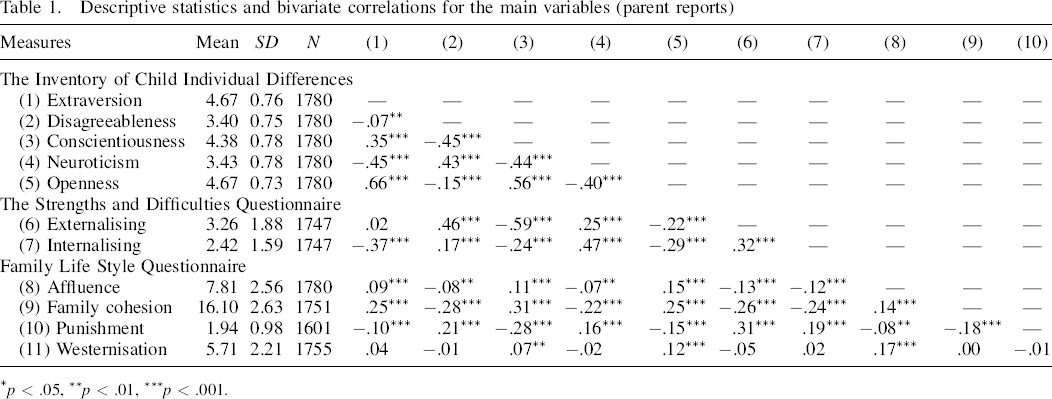
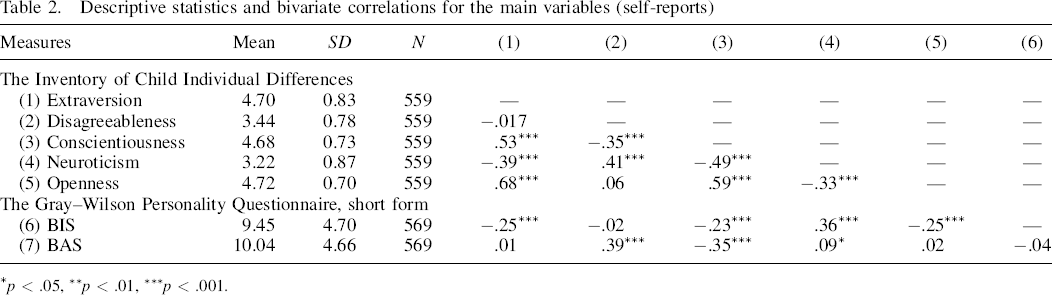
Table 1 shows the means, standard deviations and bivariate correlations for the main variables included in this study. Table 2 shows the descriptive statistics and bivariate correlations for adolescents’ self–reports on the ICID and GWPQ–S scales. Inspection of the univariate measures of distribution for each variable in the present study did not indicate major deviations from normality: Absolute values of skewness ranged from 0.03 to 1.41, absolute values of kurtosis ranged from 0.01 to 1.46. Correlations between parent reports and adolescent self–reports of the Big Five were r = .48 for Extraversion, r = .32 for Disagreeableness, r = .31 for Conscientiousness, r = .32 for Neuroticism and r = .39 for Openness (all p < .001).
Descriptive statistics and bivariate correlations for the main variables (parent reports)
p < .05.
p < .01.
p < .001.
Descriptive statistics and bivariate correlations for the main variables (self–reports)
p < .05.
p < .01.
p < .001.
The superordinate personality structure
Table 3 presents fit indices for the CFA of the four models testing substance and artefact hypotheses for the relations among the Big Five in the two–informant adolescent subsample. The full model with both correlated latent traits and correlated errors (CTCT) was clearly the best, with the lowest χ2 and other indices indicating moderately good fit. The artefact model (OTCR) performed better than the substance model (CTOR), but according to fit indices, still did not show a reasonable fit. According to χ2 and CFI differences, all models significantly differed and none of the RMSEA confidence intervals overlap, suggesting significant progressive improvement across the models. These findings warrant further investigation of the higher–order personality factors.
Confirmatory factor analyses of parent and self–reported ICID Big Five scales in adolescents (N = 559)
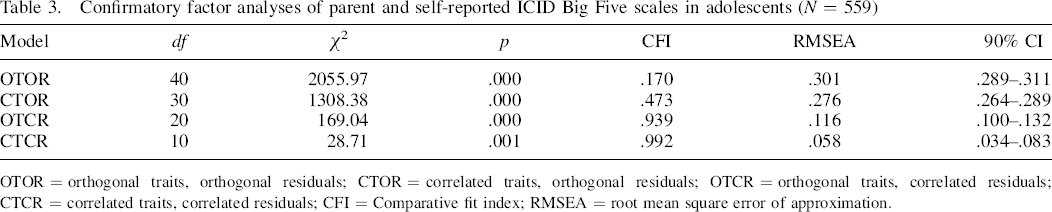
OTOR = orthogonal traits, orthogonal residuals; CTOR = correlated traits, orthogonal residuals; OTCR = orthogonal traits, correlated residuals; CTCR = correlated traits, correlated residuals; CFI = Comparative fit index; RMSEA = root mean square error of approximation.
Next, correlation matrix of parent–reported Big Five in the total sample was subjected to principal component analyses. The first two eigenvalues exceeded unity; the parallel analyses (O'Connor, 2000) also suggested the two–factor structure. After varimax rotation, congruence coefficients were calculated for the corresponding factors in Russian data and Digman's (1997) Model 1 for younger participants. Values were 0.98 for α, and 0.96 for β, indicating practical identity of the two superordinate factors. A similar two–factor structure emerged from adolescent self–report data: Congruence coefficients with parent–reported structure were 0.99 for α, and 0.98 for β, and both congruence coefficients with Digman's (1997) Model for younger participants were .94.
Then the goodness–of–fit of the model to the parent–report data was tested with CFA using maximum likelihood estimation. Because outliers can lead to biased fit indices (Tomarken & Waller, 2005), two cases with the highest Mahalanobis D–square values were removed following the screen for multivariate outliers provided by AMOS (Arbuckle, 2008). The CFA showed that Digman's (1997) Model 1 for younger participants yielded a poor fit to the data, Model 2, with three freely estimated cross–loadings, provided a significantly better fit, Δχ2(3) = 373.66, p < .000 (Table 4). However, χ2 and RMSEA values suggested that overall this model did not show a satisfactory fit to the data. The strict configural Model 3 also failed to yield a good fit, therefore, a number of modifications have been utilised. These included two cross–loadings on β, for Conscientiousness and Neuroticism, and one error covariance, Extraversion with Neuroticism. In addition, freely estimated factor loadings were fixed in accord with the values provided by Digman's model for younger participants with the exception of loading of Conscientiousness on β. The small negative error variance for Openness equal to −.018 (SE = .024, p = .458) was constrained to be zero. The resulting Model 4 (Figure 1) provided excellent fit to the data, as seen in Table 4.
Confirmatory factor analysis fit indices for different models of two higher–order factors of the Big Five in parent reports (N = 1778)

CFI = Comparative fit index; RMSEA = root mean square error of approximation.
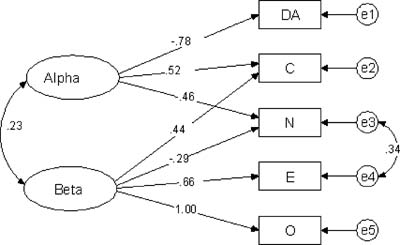
The superordinate personality structure of the ICID Big Five. N = 1778. Values are standardised estimates (p < .001).
Table 5 presents the results for each gender group and each of four age groups. The model showed adequately good fit for all subsamples with insignificant χ2 in boys, middle childhood and early adolescence. The inspection of regression weights indicates the considerable uniformity of results across gender and age groups.
Confirmatory factor analyses of the ICID Big Five scales in different gender and age groups
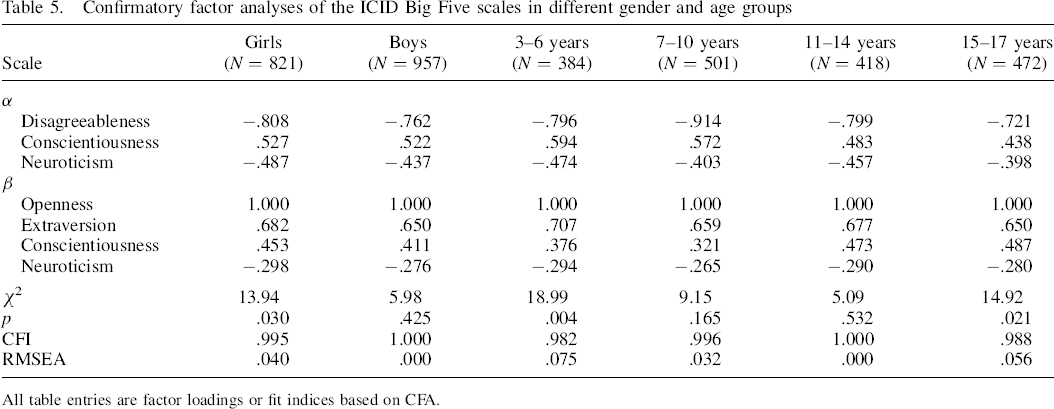
All table entries are factor loadings or fit indices based on CFA.
Next, the personality structure was compared across gender and age groups. In both gender groups, the model has identical structure, χ2(12) = 19.92, p = .07; equal estimated measurement weight, Δχ2(1) = 2.00, p = .16 and equal structural variances and covariance, Δχ2(3) = .68, p = .88. When compared across four age groups, preschool, middle childhood, early adolescence and late adolescence, the model with identical structure provided good fit, χ2(24) = 48.16, p = .002, CFI = .992; RMSEA = .024. Model fit deteriorated significantly when estimated measurement weight was constrained to be equal, Δχ2(3) = 21.13, p = .000; when structural variances and covariance were constrained to be equal, χ2 change was also significant, Δχ2(9) = 18.75, p = .027. However, according to fit indices, the model with identical structure and equal measurement weights, structural variances and covariance showed a good fit across the four age groups, CFI = .983; RMSEA = .029. In the subsequent structural models, this model was used as a measurement model for the latent constructs of the Big Two.
Associations between the BAS and BIS and two superordinate personality factors
Correlations between self–reported α and β factor scores and BIS and BAS scale scores were −.12 (p = .006) for BIS–α, −.31 (p = .000) for BIS–β, −.38 (p = .000) for BAS–α and .01 (p = .84) for BAS–β. Cross–informant correlations were −.001 (p = .975) for BIS–α, −.13 (p = .002) for BIS–β, −.17 (p = .000) for BAS–α and .04 (p = .318) for BAS–β. Then, the links between adolescents’ self–reported BAS and BIS and parent–reported personality were assessed in a structural equation model. The measurement model for the latent constructs of the Big Two was based on the Big Five traits, BAS and BIS constructs were measured by the respective GWPQ–S scales. The structural model tested the hypothesis that BAS would predict α and BIS would predict β. The structural paths from BAS to α and from BIS to β were specified as free to be estimated; cross–paths and BIS–BAS covariance were fixed to zero. The results indicated that the structural model showed adequately good fit for the data, χ2(15) = 53.73, p < .001; CFI = 0.962; RMSEA = .067. When structural paths from BAS to β and from BIS to α and BIS–BAS covariance were allowed to be estimated, model fit was not significantly improved, and these parameter estimates were not significant. Figure 2 depicts the model showing the structural paths between endogenous and exogenous variables.
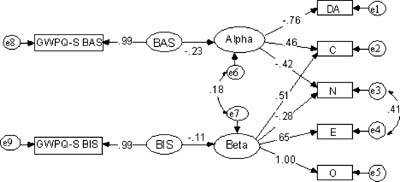
Structural equation model of the associations between the BAS and BIS and two superordinate personality factors. N = 569. Values are standardised path coefficients (p < .01). GWPQ–S—the Gray–Wilson Personality Questionnaire, short form.
In this structural model, most of the degrees of freedom are associated with the measurements and only three are associated with the postulated causal relations. In such cases a global test cannot be solely relied upon because a well–fitting measurement model might mask a poor–fitting structural component (McDonald & Ho, 2002; Tomarken & Waller, 2003). Therefore, measures of fit were separated into parts corresponding to these two components, following recommendations by Tomarken and Waller (2003). To test the measurement restrictions alone, all four latent variables in Figure 2 were allowed to freely covary with one another. This measurement component of the model imposed no restrictions on the relations among the latent constructs and had χ2(12) = 50.79, p < .001; RMSEA = .075. Then fit of the structural component of the model was calculated as the difference between the χ2 statistics for the measurement component and the full model that imposes three restrictions on the relations among the latent constructs: χ2 = 2.94, df = 3, p = .40. Thus, the postulated relations between BAS, BIS and the Big Two were supported.
Superordinate personality and problem behaviour structure
Table 1 shows that correlations between the Big Five and problem behaviours were as expected: Disagreeableness and low Conscientiousness were strongly linked to Externalising, low Extraversion and Neuroticism were mostly related to Internalising while Openness was a protective factor for both kinds of problems. When this correlation matrix was subjected to factor analysis, a clear pattern emerged. Table 6 shows that first factor strongly resembled β, with two smaller loading on Neuroticism and Conscientiousness, and second factor was identical in content to α–reversed. Congruence coefficients calculated over the Big Five with Digman's α and β were .98 and .95, respectively, and both congruence coefficients with the corresponding factors from the parent–reported superordinate personality structure were .98. Internalising problems had negative loading on β and Externalising problems heavily loaded on α–reversed, no substantial cross–loadings were found for these scales.
Higher order factor analysis of personality and problem behaviour
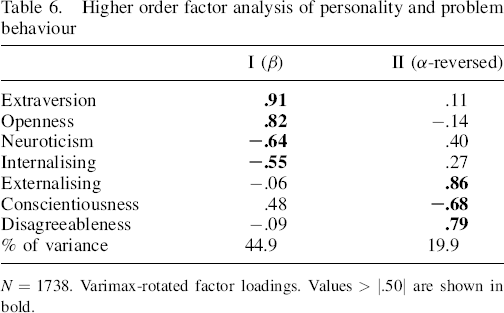
N = 1738. Varimax–rotated factor loadings. Values > |.50| are shown in bold.
Superordinate personality factors and family environment
The relation between the two higher–order personality factors and family environment was assessed using structural equation modelling. The measurement model for the latent constructs of the Big Two was based on the Big Five traits. In the structural model, affluence, family cohesion, punishment and westernisation were specified as exogenous observed variables. The structural model tested the hypothesis that family life style would predict the Big Two. The structural paths from family life style variables to higher–order personality constructs and covariances between the exogenous variables were specified as free to be estimated. Model fitted data well, with χ2(18) = 72.22, p < .001; CFI = 0.985; RMSEA = .041. When non–significant paths and covariances were fixed to zero, the fit was not significantly worse, with χ2(22) = 73.02, p < .001; CFI = 0.986; RMSEA = .036. Figure 3 depicts the model showing only the significant parameter estimates. Overall, life style variables accounted for 10% of variance in β and 18.3% of variance in α. Family cohesion and harsh parenting were linked to both superordinate factors, while westernisation and affluence were associated only with β.
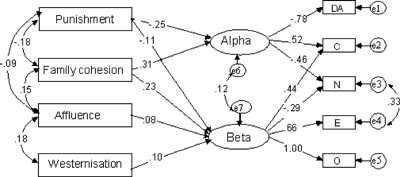
Structural equation model of the associations between family life style and two superordinate personality factors. N = 1565. Values are standardised path coefficients (p < .01).
Discussion
The study of superordinate personality structure of the ICID Big Five scales in the large sample of parent reports of 3–17 year old Russian children supported two superordinate factors, α, comprising Disagreeableness (reversed), Conscientiousness and Neuroticism (reversed), and β, defined by Extraversion and Openness, and also Conscientiousness and Emotional Stability. The congruence coefficients between varimax rotated factors in the present study and mean factor loadings for α and β in children and adolescents reported by Digman (1997) were very high and indicated practical identity of the two superordinate factors. The similar superordinate personality structure emerged from adolescent self–reports.
Given the recent criticism of the Digman's substantive factor interpretation of α and β by McCrae et al. (2008), the substance and artefactual influences on the interrelations among the Big Five have been tested in the adolescent subsample, where both parent and self–reports were available. Agreement between adolescents and their parents was moderate but significant and supported the validity of personality judgment. The CFA showed that although the model with interrelations among latent traits and no method effects performed worse than the model with only method effects, the model with both substantive and method influences was the best and the only model that fitted data reasonably well. These findings, along with the evidence from the other studies (DeYoung, 2006; McCrae et al., 2008) indicate that correlations among the Big Five could be best explained by both substantive α and β factors and artefacts of evaluative bias.
The CFA of a higher–order structure of the Big Five provided a model that slightly differed from those presented by Digman (1997). One freely estimated cross–loading of Conscientiousness on β showed a substantial regression weight (.44), while in Digman's Model 1 for younger participants this loading was much smaller (.14). However, the EFA of the study sample clearly showed that Conscientiousness was primarily associated with α (with loading of .66) and its loading on β (.46) was much smaller than those of Extraversion (.90) and Openness (.87). It should be also noted that Digman's Model 2 included three freely estimated cross–loadings (Extraversion on α, Agreeableness and Conscientiousness on β) and two fixed cross–loadings (Openness on α and Neuroticism on β). Digman suggested that a consistent secondary relation between β and Conscientiousness might reflect ‘certain agentic aspects of Conscientiousness’ (1997, p. 1251). In line with this reasoning, a substantial secondary loading of Conscientiousness on β in the current study could be explained by those features of Conscientiousness that encompass motivation and goal–directed behaviour on one end and constraint or inhibition on the other (Caspi & Shiner, 2006; Else–Quest et al., 2006; Halverson et al., 2003).
A secondary negative loading of Neuroticism on β was present in Digman's (1997) model and Blackburn et al.'s. (2004) study and might be explained by the dual nature of Neuroticism that includes both fearful distress and irritable distress (Caspi et al., 2005). It seems plausible that irritable component of Neuroticism is primarily associated with Disagreeableness, while fearful component is also linked to low Extraversion and low Openness. On the whole, studies included in Digman's (1997) meta–analysis and later research (e.g. Blackburn et al., 2004; Rushton & Irwing, 2008) often found substantial cross–loadings on α and β. Evans and Rothbart (2009) reported the two–factor model of adult temperament that differed from Digman's (1997) model only in affiliativeness–agreeableness loading on β. The similar cross–loading was present in higher order model of personality reported by Rushton and Irwing (2008).
In contrast to original Digman's model, the resulting model in the present study included one error covariance. Error covariance indicates shared method variance and/or common evaluative bias that was not accounted for by substantial superordinate factors. In other studies, correlated uniquenesses also improved the fit of the superordinate factor models, e.g. DeYoung (2006) reported the model with one error covariance, between Neuroticism and Openness; Musek's (2007) models based on three different Big Five measures in three samples (two adult and one adolescent self–reports) included two error covariances: One was the same for all models (between Extraversion and Openness), the other different. These differences in the content of error covariances are in contrast to consistent correlations among the Big Five traits and might be due to specific features of an instrument or a sample. Cross–method analyses can help to control for shared method variance, but the sources of evaluative biases remain to be investigated.
Finally, in the present study two superordinate factors correlated with each other, while Digman's (1997) α and β were orthogonal. In other studies, two higher–order factors of the Big Five mostly correlated, with correlations range from .20 to .48 for different samples and personality measures (Musek, 2007). DeYoung (2006) showed that the Big Two in the multi–informant models were orthogonal and suggested that the correlations between higher–order factors in single–informant studies might be artefactual. McCrae et al. (2008) also found support for the models with correlated biases and orthogonal α and β in cross–observer data. Thus, although the present study along with other findings suggest that α and β share common variance, future research will need to determine whether their correlation is due to the substantive general factor of personality (Musek, 2007; Rushton & Irwing, 2008) or the general evaluative factor (McCrae et al., 2008).
The proposed model of superordinate personality structure showed an excellent fit to the data. Multi–group modelling provided good support for the invariance of the model across gender and four age groups: Preschool, middle childhood, early and late adolescence. Thus, although children's individual differences become increasingly differentiated and complex over development, superordinate personality structure in childhood and adolescence is remarkably similar to that found in adulthood. Recently, Tackett, Krueger, Iacono, and McGue (2008) provided evidence for a higher–order structure of personality in middle childhood that maps on to findings in adult populations supporting hierarchical relationships among two–, three–, four– and five–factor models of personality. The present study extends the findings for the two superordinate personality factors to the wide age range from preschool to late adolescence. This gives empirical grounds for analysing the links of the Big Two with BAS and BIS, problem behaviour and family life style that may provide useful pointers to mechanisms of normal and abnormal personality development in childhood. In addition, these links may help to clear the ‘jingle–jangle’ problem, showing whether α represents the socialisation process and β can be interpreted as personal growth versus constriction (Digman, 1997).
This study examined the relationship between BIS/BAS and the Big Two suggested by the temperament/personality researchers (e.g. Halverson, 2004; Martin et al., 2003; Mitchell, Kimbrel, Hundt, Cobb, Nelson–Gray, & Lootens, 2007). The links were not strong, but significant, and probably as clear as could be expected between the two constructs of very different origin being reported by different informants. BIS and BAS originated from animal learning research focused on neuroanatomical organisation and physiological functions and were identified as motivational systems sensitive to signals of punishment and reward (Corr, 2008; Smillie et al., 2006), whereas α and β emerged from factor analytical studies of Big Five personality scales. Furthermore, the structural model tested cross–informant links: BAS and BIS were measured by adolescents’ self reports whereas personality was measured by parent reports. Interrater agreement on the Big Five traits was moderate, similar to usually reported correlations between parent reports and adolescents’ self–reports in the .20–.40 range (e.g. Laidra, Allik, Harro, Merenäkk, & Harro, 2006). Although the effects of BIS/BAS on superordinate personality factors were small to moderate in size, they operate in all individuals across all situations and accumulate over a lifetime. Therefore, they may be important for understanding normal and abnormal personality development (Caspi & Shiner, 2006).
The results supported the hypothesised relationship between the Big Two and measures of BAS and BIS: BAS was primarily related to reversed α (unsuccessful socialisation) and BIS was primarily related to reversed β (personal constriction). The negative association between BIS and β is an agreement with the recent literature based on adult studies: Blackburn et al. (2004) linked reversed β with withdrawal, and Markon et al. (2005) emphasised the positive emotionality content of β. The negative relation between BAS and α is also in accord with adult findings: In Markon et al.'s (2005) meta–analysis, α was reversed and comprised negative emotionality and disinhibition content, and in Blackburn et al.'s (2004) study α–reversed was equivalent to impulsivity. On the other hand, the RST literature links BAS to impulsivity, negative emotionality (Carver, 2004), disinhibition (Wallace & Newman, 2008) and antisocial sensation seeking (Pickering & Gray, 2001), but also to Extraversion, reward–drive and positive affect (Smillie et al., 2006).
When interpreting the findings on temperament–personality associations, the content of specific traits should be carefully considered. It might be possible that α–BAS link was partly due to the GWPQ BAS measure that emphasises angry, aggressive and impulsive behaviour. However, inspection of the items from the BAS scale and the Big Five comprising α indicated that these measures do not overlap considerably in their content. The results, furthermore, were partially consistent with the higher–order factor structure of RST and the Big Five reported in adults using different measures (Mitchell et al., 2007). Three correlated factors emerged, the first accounted for 29% of variance and represented sensitivity to punishment, the second accounted for 24% of variance, consisted of Agreeableness, Conscientiousness, Neuroticism (reversed) and Sensitivity to reward (reversed) and was similar to Digman's (1997) α. The third factor accounted for 15% of variance consisted of Extraversion, Openness and sensitivity to reward and closely resemble Digman's β. These findings show that BAS is primarily associated with α, although also has a weaker relationship with β.
Apart from the content of the measures, specific age period may possibly also have a role. Given that child and adolescent studies of personality and reinforcement sensitivity generally confirm adult findings (e.g. Caspi & Shiner, 2006; Colder & O'Connor, 2004; Cooper, Gomez, & Aucote, 2007), it seems implausible that the relations between the Big Two and BIS/BAS in the present study may be due to specific characteristics of adolescent period. More research is needed to get better understanding of the links between BIS/BAS and superordinate personality traits at different ages.
A joint factor analysis of the Big Five and Externalising and Internalising problems revealed two superordinate factors highly congruent with α and β. The results suggest unequivocal associations between personality development and problem behaviour: As expected, α (unsuccessful socialisation) was linked with Externalising problems and β (personal constriction) was linked with Internalising problems. It is worth noting that when measures of problem behaviour were included in the analysis, Neuroticism loaded more heavily on β than on α. A substantial association between Neuroticism and β has been also shown in adult studies that include both normal and abnormal personality measures (Blackburn et al., 2004; Markon et al., 2005).
The links between superordinate personality factors and family environment suggest substantial external validity for the latent constructs of the Big Two. The contribution of contextual variables to α (Socialisation) was much larger (18%) than to β (Personal Growth, 10%). These findings for α are in accord with the evidence suggesting that shared family environment is a major reason for child and adolescent behavioural problems, in contrast to other behavioural traits (Moffitt, 2005). Both superordinate traits, successful socialisation and personal growth, were positively related to family cohesion and negatively related to harsh parenting with physical punishment. In addition, personal growth was positively linked with affluence and westernisation. These findings support Digman's (1997) interpretation of the Big Two, although the underlying causal mechanisms are still unclear.
Though old works emphasised the family influence on personality, it now seems unlikely that shared family environment has the principal causal role. Research has shown that individuals actively select and shape environments according to their personalities. Caspi and Shiner (2006) outlined several processes of developmental elaboration through which children's temperament/personality influences their reactions to specific environments. However, along with evidence on the genetic effects on the links between personality and environment, there is accumulating evidence on the family influences on genetic effects (Caspi & Shiner, 2006; Moffitt, 2005). Future research will help to understand the mechanisms through which environment affects childhood temperament/personality of specific genotypes. Meanwhile, although the current findings do not show the direction of effects, they provide the important evidence about the associations of the superordinate factors of personality with BAS and BIS, children's emotional and behavioural problems and family life style.
The present study has several limitations that should be addressed in future research. First, the study would benefit from the parent–reported BIS and BAS measures for use with children. Such measures have been recently developed (Blair, 2003; Colder & O'Connor, 2004) and need to be validated in other countries. Second, to increase the validity of the findings, parent reports should be confirmed by other measures. Although cross–observer data provided support for the substantive nature of α and β and their links with BIS and BAS, these findings should be confirmed with data from three or more informants. Further, because the relationships of the Big Two with problem behaviour and family environment might be partly due to shared method variance, a particularly important step is to obtain measures from different sources. Third, although large and diverse, the sample was not representative; to increase the external validity of the findings, more elaborated sampling methods are needed. Finally, the cross–sectional design did not allow an exploration of the developmental trends and causal influences, future studies should utilise the longitudinal design.
Footnotes
Acknowledgements
The author is grateful to Olga A. Akhmetova, Gennadij G. Knyazev, the participants of the study and anonymous reviewers for their helpful comments. This work was supported by Russian Foundation for Basic Research grant No. 08–06–00011–a.