







Abstract
So far, relationship research has only considered an intrapersonal perspective on links between adult attachment, conflict resolution and relationship satisfaction. This study investigated the mediating effects of partner–reported conflict resolution styles among the attachment dimensions of avoidance and anxiety, and relationship satisfaction in a sample of 207 heterosexual couples. Dyadic and structural aspects of mediation were tested using the Actor–Partner Mediator Model with latent variables. Few significant partner–related meditational pathways were found indicating compensating effects of positive problem solving and compliance. More frequent positive problem solving could improve relationship satisfaction, even when the partner showed higher scores on anxious attachment. In addition, the use of compliance could suppress the negative effects of attachment avoidance on partner's relationship satisfaction. Copyright © 2011 John Wiley & Sons, Ltd.
Keywords
Introduction
The manner in which couples engage in and try to resolve conflicts is one of the major indicators of relationship functioning. How both partners solve problems and cope with conflict not only predicts whether a partnership will remain intact or break up, but also influences whether a current relationship is experienced as satisfactory (Gottman & Driver, 2005). Dysfunctional conflict resolution styles, such as conflict engagement (e.g., personal attacks and losing control) and withdrawal (e.g., refusing to discuss the issue further and tuning the other partner out), have been found to be negatively related to relationship satisfaction, whereas the functional conflict resolution style of positive problem solving (e.g., compromise and negotiation) supports a satisfied partnership (Kurdek, 1994, 1995; Marchand, 2004). However, findings regarding the conflict resolution strategy of compliance (e.g., giving in and not defending one's position) were not as consistent (Gottman & Krokoff, 1989; Kurdek, 1994). Compliance was the one particular conflict resolution style least likely to be related to relationship outcomes. One explanation for this may be that analyses were based on individual sets of conflict resolution styles and that relationship outcomes did not consider the interdependency of both relationship partners (Kenny, Kashy, & Cook, 2006). Hence, Kurdek (1994) noted that a partner's compliance has to be examined in conjunction with the other partner's conflict resolution style in order to take on explanatory power as a relationship maintenance strategy. More specifically, giving in to the aversive conflict behaviour of a partner may lead to dissatisfaction, whereas giving in to the positive problem solving of a partner may result in satisfaction. Hence, examining associations between partners‘ conflict resolution styles and relationship outcomes by a dyadic approach may offer a clearer view of the effects that functional and dysfunctional conflict resolution styles in general, and specifically compliance, may have.
Furthermore, most of the studies use self–evaluations of conflict resolution styles (e.g., Cann, Norman, Welbourne, & Calhoun, 2008; Shi, 2003), which could be biased through emotions and feelings associated with conflictual situations. This is crucial for two reasons. First, partners‘ views on their own conflict resolution behaviour may be biased, which may lead to a representation of their conflict resolution style as highly desirable. Second, the perception of the partner's conflict resolution behaviour—not the partner's self–assessment of his or her conflict resolution style—has a strong influence on one's own behaviour. In this context, the partner's perception of one's own conflict resolution style may be a more relevant and objective source of information (Kurdek, 1994). Consistent with this idea, Cann et al. (2008) recommended that considering the partner's view could broaden the understanding of relationship characteristics. Whether conflict facilitates a satisfying relationship or exacerbates distress may depend on individual differences in the way in which both partners interpret and respond to relationship conflicts.
Adult attachment, conflict resolution and relationship satisfaction
Attachment theory (Bowlby, 1973), and its application to adulthood relationships (Hazan & Shaver, 1987), has been used as a framework for understanding individual differences in responses to conflict (see Pietromonaco, Greenwood, & Barrett, 2004). Attachment characteristics are most likely to be activated in stressful situations such as conflictual partner interaction, which emphasizes the need for emotional support in times of stress (Kobak & Duemmler, 1994). Depending on the availability and responsiveness of primary caregivers, different working models of attachment are formed (e.g., Brennan, Clark, & Shaver, 1998). These working models are reflected by two dimensions from which assumptions about the self and others in relationships can be inferred (Brennan et al., 1998). The dimension of avoidance containing negative representations of close others reflects the degree to which individuals feel comfortable with closeness and emotional intimacy. People who score high on avoidance tend to show less investment in their relationships and seek behavioural independence and emotional distance from their romantic partners (Hazan & Shaver, 1994). The dimension of anxiety, including a negative representation of the self in close relationships, reflects the degree to which individuals worry about being rejected or abandoned by their partner. Highly anxious individuals desire emotional support, closeness and reassurance from their romantic partners (Collins & Read, 1990) and place greater weight on cues of rejection (Simpson & Rholes, 1994). Individuals with low scores on both attachment dimensions are securely attached, whereas insecurely attached persons have high scores on one or both attachment dimensions (Bartholomew & Horowitz, 1991).
There has been good documentation of non–specific links between attachment and relationship satisfaction showing that low scores both on the anxiety and avoidance dimension predict high scores on relationship satisfaction whereas high scores on one or both attachment dimensions are associated with lower relationship satisfaction (e.g., Collins & Read, 1990; Feeney, 1999). Plausibly, both attachment and relationship satisfaction are closely tied to the ways in which individuals tackle conflicts. But what are the underlying mechanisms through which adult attachment manifests itself in different conflict resolution strategies to influence relationship satisfaction? According to Mikulincer and Shaver (2003), who expand on Bowlby's (1973) formulations by creating a psychodynamic model of relationship functioning, availability and responsiveness of a significant caregiver allow different affect regulation strategies to develop. Those affect regulation strategies are important for dealing with potential or actual attachment relevant threats such as conflict between relationship partners.
Securely attached individuals (with representations of available and responsive attachment figures) are assumed to own security–based affect regulation strategies, which are based on positive declarative (e.g., optimistic beliefs about distress management, the other's goodwill and a sense of self–efficacy about dealing with threats) and procedural knowledge (e.g., functional coping strategies like acknowledging, seeking emotional support and instrumental problem solving) about the self and others in close relationships. In line with this, researchers could show that securely attached individuals tend to rely more on adaptive conflict–solving strategies, such as reaching a compromise with the partner and integrating both partner's positions (e.g., Creasey & Ladd, 2005; Wampler, Shi, Nelson, & Kimball, 2003). Furthermore, securely attached individuals react to a partner's negative behaviour in a controlled and deescalating manner, which has beneficial effects on the conflict resolution process (Mikulincer, Gillath, & Shaver, 2002).
Unavailability of the attachment figure, in turn, leads to circumstances where the individual must self–regulate by using less effective or dysfunctional conflict resolution strategies (Cassidy & Kobak, 1988). Depending on the kind of insecurity–based attachment strategy, the conflict can be intensified or left unresolved. Anxiously attached individuals tend to use hyperactivating strategies aimed at minimizing distance from partners and eliciting a partner's involvement, care and support (Shaver & Hazan, 1993). Those strategies include overdependence on relationship partners as well as clinging and controlling behaviour, which can foster conflict escalation. Accordingly, anxious attachment is associated not only with obliging behaviour (i.e., sacrifice one's own interests to satisfy the partner's interests) but also with the willingness to dominate conflict resolution processes (Corcoran & Mallinckrodt, 2000). In contrast, avoidantly attached individuals tend to use deactivating strategies aimed to inhibit the quest for support and try to handle distress alone. These strategies contain avoidance of the closeness and intimacy, denial of attachment needs as well as maximization of cognitive, emotional and physical distance from others. Likewise, avoidantly attached individuals distance themselves from conflict and avoid engaging with their partner (Pistole & Arricale, 2003). Given that avoidantly attached individuals are relatively uncomfortable with emotional expression, they will often try to end disagreements or conflicts (Simpson, Rholes, & Phillips, 1996), which may also include giving in to their partner's wants and needs.
Conflict resolution as a mediator
Shi (2003) found that attachment anxiety and avoidance are predictive of conflict resolution behaviours and relationship satisfaction. Specifically, individuals with high anxiety show more obliging conflict resolution behaviour. Avoidantly attached individuals withdraw from conflict, show little positive conflict resolution behaviour, such as compromising and integrating behaviour, and evidence greater deficits than anxiously attached individuals in generating satisfactory conflict resolution. This is in line with a study by Cann et al. (2008) who examined the relationships between attachment styles, conflict styles and humour styles in the context of romantic relationships. The use of integrating, obliging and dominating conflict styles partially mediated the relationship between the avoidance component of attachment style and relationship satisfaction. Specifically, participants who were less avoidant were more likely to use obliging and integrating styles of conflict resolution, and were less likely to use dominating styles of conflict resolution, both of which thus predicted greater relationship satisfaction. Integrating and dominating conflict styles also partially mediated the relationship between anxiety and relationship satisfaction. Participants who were less anxious were more likely to use affiliative humour and integrating conflict styles and were less likely to use dominating styles, leading to greater relationship satisfaction.
These findings suggest that conflict resolution processes may constitute specific behavioural expressions of the attachment system, which may eventually determine relationship success. In other words, attachment characteristics may influence both partners‘ styles of conflict resolution, which subsequently contribute to their relationship satisfaction. Nevertheless, most of the studies were based on individual data and did not consider the interdependence of each partner's appraisal and the influence of the partner's attachment characteristics on the other partner's relationship outcomes.
The present study
The current investigation aimed to advance theory in this area by examining conflict resolution strategies as a potential mediator between adult attachment and relationship satisfaction. No previous study has investigated conflict resolution strategies, attachment dimensions and relationship satisfaction by using a dyadic approach considering mediator effects of both partner's conflict resolution styles. Past research led us to suggest a model in which attachment avoidance is related to withdrawal from conflict whereas attachment anxiety is associated with conflict engagement. Both attachment dimensions are assumed to be negatively related to positive problem solving. We sampled couples of varying occupation and age in contrast to many studies of romantic attachment that have only relied on samples of college students (e.g., Cann et al., 2008); the sample included shorter–term and longer–term relationships, enabling a greater generality of findings across length of partnerships and different relationship stages. Finally, we overcame exclusive self–evaluations by using partner reports of conflict resolution styles.
In extension of previous studies, we were interested in testing what kind of mediation is present. There are two distinct perspectives on the style of mediation in the present study, which we will refer to as a dyadic and a structural aspect. There are three different routes by which mediation can take place, owing to the fact that the mediator is a mixed variable (i.e., scores vary both within and between dyads on conflict resolution styles). First, there could be actor–actor mediation (e.g., male anxiety predicts male positive problem solving, which in turn predicts male relationship satisfaction). The second possible route is actor–partner mediation (e.g., male anxiety predicts male positive problem solving, which in turn predicts female relationship satisfaction). Finally, partner–partner mediation could take place (e.g., male anxiety predicts female positive problem solving, which in turn predicts male relationship satisfaction). The structural aspect of the mediation analysis concerns the different extent to which mediation occurred; that is whether the different kinds of dyadic mediation occurred as a partial or a complete mediation.
Hypotheses
The following assumptions of the structural aspect of mediation form the first hypothesis of our study. Our prediction includes the following hypotheses:
The second hypothesis is focused on the specific associations between attachment characteristics and conflict resolution styles. Our prediction includes the following hypotheses:
Methods
Recruitment and participants
Our sample consisted of 207 heterosexual couples (414 participants) living in a partnership for at least six months. They were part of a German student and graduate network of the University of Leipzig and the University of Halle. Students and graduates also asked their parents, friends and relatives to take part, so further study members could be acquired through a ‘snowball effect’. Participating couples completed some questionnaires concerning their partnership experiences and the present partnership separately from each other. Male partners had a mean age of 41 years (SD = 15.2, range = 19–81). On average, female partners were 38 years old (SD = 14.6, range = 19–77). The mean relationship duration was 15 years and four months (SD = 14.0) with a minimum of six months and a maximum of 53 years and six months. Approximately half of the couples (48%) were married, and the other half (52%) had cohabiting relationships. The majority of them (80%) lived together. A large portion of the participants had neither common children (58%) nor children from a previous relationship (90% of the men, 89% of the women). Employed participants totalled 57% of the men and 51% of the women, whereas a minority (20% men, 30% women) were still studying, already retired (14% men, 11% women) or unemployed (9% men, 8% women). Comparisons of married couple members with unmarried couple members illustrated that married couple members were older [M = 50.1 (SD = 13.5) versus M = 30.1 (SD = 8.4), t(297) = −17.25, p < .001, d = 1.80] and reported a longer relationship duration [M = 25.3 (SD = 13.4) versus M = 5.3 (SD = 3.7), t(220) = −20.11, p < .001, d = 2.07]. However, married and unmarried participants did not significantly differ on any of the variables of interest, with the exception of attachment anxiety and compliance. Unmarried participants reported higher anxiety (M = 2.69, SD = 0.94) than married participants [M = 2.44 (SD = 0.79), t(398) = 2.84, p < .01, d = 0.29]. Furthermore, married participants were more compliant than unmarried participants [M = 2.37 (SD = 0.78) versus M = 2.10 (SD = 0.75), t(390) = −3.45, p < .01, d = .35]. Both differences are small in terms of effect sizes.
Measures
Experiences in close relationships—revised
The 36–item Experiences in Close Relationships Scale (ECR; Brennan et al., 1998) was used to assess the two major dimensions of adult attachment style, attachment anxiety (sample item: ‘I worry a fair amount about losing my partner’) and attachment avoidance (‘I don't feel comfortable opening up to romantic partners’). Participants were asked to complete the measures in terms of how they generally experience relationships, rather than their specific experience in a current relationship. The items utilize a 7–point scale ranging from strong disagreement (1) to strong agreement (7). Strong agreement or higher scores on the scale imply high attachment anxiety or avoidance. In the present study, we used the German version of the ECR–R by Ehrenthal, Dinger, and Schauenburg (2006). The internal consistencies for each of the dimensions were as follows: anxious attachment (α = .81) and avoidant attachment (α = .73). For attachment avoidance, men reported an average score of 2.06 (SD = 0.70, range = 1–4), whereas women had an average score of 1.95 (SD = 0.73, range 1–4), t(401) = −1.56, ns. The mean score of attachment anxiety was 2.56 (SD = 0.87, range 1–6) for men and 2.58 (SD = 0.89, range 1–5) for women, t(401) = 0.26, ns. Combined scores across both couple members reported in Table 1 (M = 2.02 and M = 2.58) indicate that couples generally describe themselves as less anxious and avoidant.
Descriptive statistics and intercorrelations for study variables
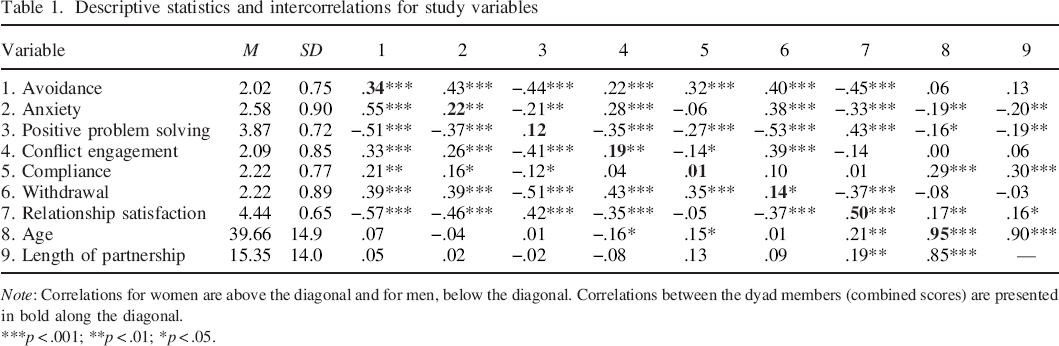
Note: Correlations for women are above the diagonal and for men, below the diagonal. Correlations between the dyad members (combined scores) are presented in bold along the diagonal.
p < .001;
p < .01;
p < .05.
Conflict resolution styles inventory
Each partner's conflict resolution styles were assessed by the partner report version of the Conflict Resolution Styles Inventory (Kurdek, 1994). For this measure, respondents indicated, on a 5–point scale ranging from never (1) to always (5), how frequently their partners use each of 16 styles to deal with arguments and disagreements. There were four items apiece for positive problem solving (e.g., ‘Focusing on the problem at hand’), conflict engagement (e.g., ‘Exploding and getting out of control’), withdrawal (e.g., ‘Reaching a limit, shutting down, and refusing to talk any further’) and compliance (e.g., ‘Giving in with little attempt to present his/her side of the issue’). We used the German translation by Herzberg and Sierau (2010), which also indicates good psychometric properties as well as concurrent validity. Reliabilities (Cronbach's α) for the present sample were .78 for compliance, .85 for conflict engagement and .86 for positive problem solving and withdrawal. Men and women did not differ significantly on ratings of their partner's conflict resolution styles (all p's > .05). Combined means across both partners are reported in Table 1.
Dyadic adjustment scale
Relationship satisfaction was assessed by the six–item short form of the Dyadic Adjustment Scale (Sharpley & Cross, 1982; Spanier, 1976). Including a 6–point scale, respondents answered how well they conform in different aspects of their partnership and how often they discuss things and work together on a common project. The anchors on the scale vary across items. Summed scores can range from 6 to 36. The scale has been found to be reliable and valid (Hunsley, Pinsent, Lefebvre, Jamey–Tanner, & Vito, 1995), and it showed good reliability in the current sample (α = .83). The mean score for relationship satisfaction was 4.35 (SD = 0.52, range = 2–5) for men and 4.30 (SD = 0.57, range = 2–5) for women, t(401) = −1.00, ns, indicating satisfied couples (for combined means, see Table 1).
Statistical analyses
The Actor–Partner Mediator Model (APMeM; Ledermann & Bodenmann, 2006), on which we based our statistical analyses, is an extension of the Actor–Partner Interdependence Model (APIM) proposed by Kenny and colleagues (e.g., Kashy & Kenny, 2000). The APMeM allows researchers to estimate mediator effects within dyads in addition to the effects of an individual's characteristics on his or her own score on the dependent variable (actor effect) as well as on the partner's score on the dependent variable (partner effect). Moreover, this method provides an estimate of the effects of the independent variable (e.g., adult attachment) on the dependent variable (e.g., relationship satisfaction) while controlling for dyadic interdependence on the independent variable.
We used a covariance approach to test the APMeM because measurement error makes it difficult to detect mediation effects. Thus, when examining mediation effects, it is recommended that structural equation modelling (SEM) should be used to control for the effects of measurement errors. We used
The model included six latent variables (see Figure 1): two independent latent variables (self–assessed attachment scores), two latent mediator variables (partner reports of conflict resolution styles) and two latent outcome variables (self–reported relationship satisfaction). All latent variables were modelled by item parcels from the corresponding scales. We preferred item parcels over items as indicators for latent variables because composite–level indicators were more normally distributed (see Bandalos & Finney, 2001).
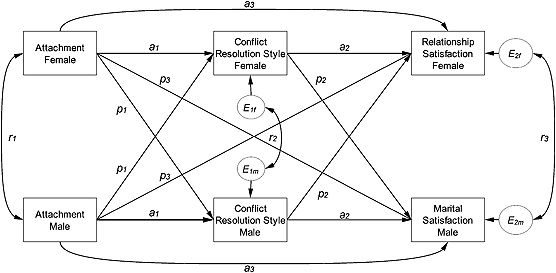
Actor–Partner Mediator Model with attachment avoidance and attachment anxiety as exogenous variables, conflict resolution styles as mediator, and relationship satisfaction as endogenous variable (see text for more details). a = actor effect, p = partner effect, r = covariances.
Prior to estimating the APMeM, we tested whether dyad members were distinguishable by sex by using the omnibus SEM test for distinguishability (Kenny et al., 2006). The omnibus test simultaneously evaluates sex differences in mean levels, variances and covariances for attachment scores, conflict resolutions styles and relationship satisfaction. Because the omnibus test indicates no evidence that couple members could be distinguished by sex (χ2(23) = 16.57, p > .05), we used the specification for the APIM for interchangeable dyads in SEM as proposed by Olsen and Kenny (2006). In addition to imposing these specifications, we corrected model fit indices, as Olsen and Kenny (2006) described in their article.
Testing structural aspects of mediation
We first formally tested whether the actor and partner effects of attachment predicting relationship satisfaction were mediated by conflict resolution styles by using the logic of comparing nested models in path analysis (Bollen & Stine, 1990). To examine the presence of mediation with SEM, Kelloway (1996) has suggested examining the significance of direct and indirect paths by comparing several nested structural equation models. Thus, complete mediation is established by comparison of the fit of a ‘full’ model that includes the direct effects of attachment predicting relationship satisfaction (both actor and partner paths) with the fit of a ‘reduced’ model in which these paths are fixed to zero. Or, stated differently, a model that specified that only some of the association between attachment and relationship satisfaction was transmitted by conflict resolution (partial mediation) was compared with a model that specified that the entire association between attachment and relationship satisfaction was transmitted by conflict resolution (full mediation). The fit of the models was assessed with the chi–square value and with root mean square error of approximation (RMSEA) and their confidence interval. A non–significant value associated with the chi–square value indicates that the model had a good fit. However, because the significance value of chi–square is sensitive to large sample sizes and easily produces a statistically significant result, we used the chi–square value for model comparison only. RMSEA values below 0.06 indicate a good fit, and values from 0.07 to 0.08 indicate a reasonable fit (Hu & Bentler, 1999). For comparing the fit of nested models, we used the chi–square difference test, which tests the null hypothesis of no significant difference in fit between two models. If the difference is significant, then the null hypothesis is rejected. Furthermore, we used the Bayes information criterion (BIC; Schwarz, 1978) for comparing different models where better models are indicated by lower BIC values.
To examine the structural assumptions about conflict resolution as the mediating variable between attachment styles and relationship satisfaction (Hypotheses 1a and 1b) and to specify the relationship between attachment styles and different kinds of conflict resolution styles (Hypotheses 2a and 2b), we tested three nested models. The first model is a standard APIM, which tests the direct relationship between avoidance and relationship satisfaction (direct APIM). The second model investigates whether conflict resolution styles mediate the relation between avoidance and relationship satisfaction, assuming no direct relationship between avoidance and relationship satisfaction, which would indicate full mediation (complete APMeM). The partial mediation model expands the complete APMeM by assuming a direct path from avoidance to relationship satisfaction (partial APMeM).
Separating different kinds of dyadic mediation
The nested model approach is a useful omnibus test examining whether there is no, full or partial mediation. One shortcoming of this approach is that it is inexpedient to disentangle what kind of dyadic mediation (actor–actor, actor–partner, partner–actor and partner–partner mediation) takes place. Although the different pathways by which mediation could occur can be tested by a large number of nested models, we decided to use the nested model approach only for the overall testing of full or partial mediation. To disentangle the different kinds of mediation, we examined mediation effect by testing the significance of the indirect effects. Currently, most SEM software packages provide the Sobel test for the indirect effects (Sobel, 1982). The Sobel approach tests mediation by examining the product of the direct path from the independent variable to the mediator and the direct path from the mediator to the dependent variable. One problem associated with using this approach in testing the significance of indirect effect is that the indirect effect is not normally distributed. Simulation studies have shown that the distribution of mediation effects is skewed, particularly when the sample size is small to medium (MacKinnon, Warsi, & Dwyer, 1995). Because this product term is not normally distributed, the bias–corrected bootstrapping method to establish confidence intervals for the mediation effects is recommended.
Results
Interrelations of study variables
Couple's descriptive statistics and each dyad member's intrapersonal and interpersonal correlations between avoidance, anxiety, conflict resolutions styles, relationship satisfaction, age and length of partnership are provided in Table 1. Correlations above the diagonal are for women, and correlations below the diagonal are for men. Within dyad associations appear in bold along the diagonal. Pearson's correlation coefficients were calculated, revealing significant moderate to modest correlations between individual's attachment characteristics, conflict resolution styles and relationship satisfaction. In general, avoidance and anxiety were positively associated with the dysfunctional conflict resolution styles of conflict engagement, compliance and withdrawal (all r's > .20), whereas correlations between both attachment characteristics with positive problem solving and relationship satisfaction were negative (all r's > −.20). Only women's compliance showed no significant association with anxiety (r = −.06), and for men, the correlation between anxiety and compliance was weak (r = .16). Age and length of partnership were negatively related to anxiety and positive problem solving, but only for women (all r's > −.16). Older men showed less conflict engagement (r = −.16). Generally, older participants were more compliant in conflict resolution (r = .29 for women and r = .15 for men). Age and length of partnership were positively associated with relationship satisfaction (all r's > .16). Except for compliance and positive problem solving, dyad members showed significant similarities in their ratings of all study variables (all r's between .14 and .95). These findings suggest that the data are most appropriately analysed with a method that accounts for the interdependence within the dyad.
In the following, results of the mediational analyses are presented separately for each of the attachment dimensions. First, goodness–of–fit results for the nested models will be reported to evaluate the structural meaning of mediation (Hypotheses 1a and 1b). Second, specific associations between attachment characteristics and conflict resolution styles will be reported to test Hypotheses 2a and 2b. Finally, the dyadic meditational pathways, based on the bias–corrected bootstrapping method, will be reported (Hypothesis 1).
Avoidance as exogenous variable
Goodness–of–fit results are presented in Table 2. In general, all three nested models yielded good or reasonable RMSEA values for all conflict resolution styles. However, when considering the RMSEA confidence interval, it becomes clear that only the partial APMeM satisfied the criteria for evaluating the RMSEA as good. The chi–square differences between successive models were all statistically significant (Δχ2 > 36 with Δdf = 2, p < .001) for all conflict resolution styles. The partial APMeMs displayed the lowest BIC values, indicating an improvement in the fit for the partially mediated model and the non–mediating APIM. Therefore, the partial APMeM was considered for interpretation and further analyses. Table 3 displays the actor and partner effects for the partial APMeMs for avoidance. 1
Model fits for the non–mediated and mediated Actor–Partner Models for avoidance and anxiety
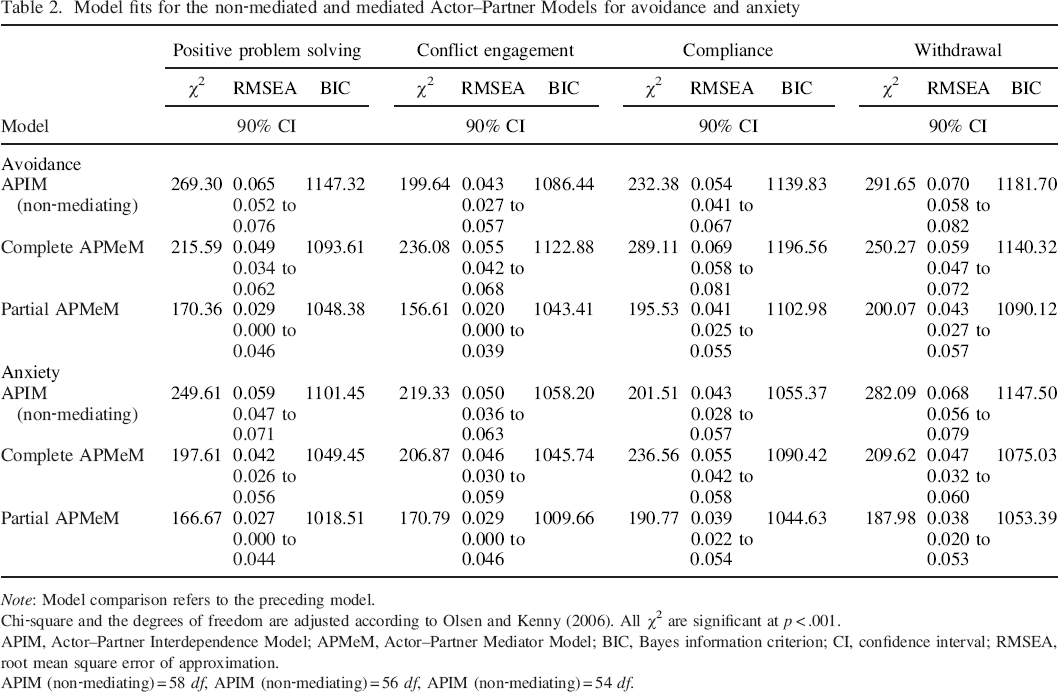
Note: Model comparison refers to the preceding model.
Chi–square and the degrees of freedom are adjusted according to Olsen and Kenny (2006). All χ2 are significant at p < .001.
APIM, Actor–Partner Interdependence Model; APMeM, Actor–Partner Mediator Model; BIC, Bayes information criterion; CI, confidence interval; RMSEA, root mean square error of approximation.
APIM (non–mediating) = 58 df, APIM (non–mediating) = 56 df, APIM (non–mediating) = 54 df.
Actor and partner effects for partial Actor–Partner Mediator Model for avoidance
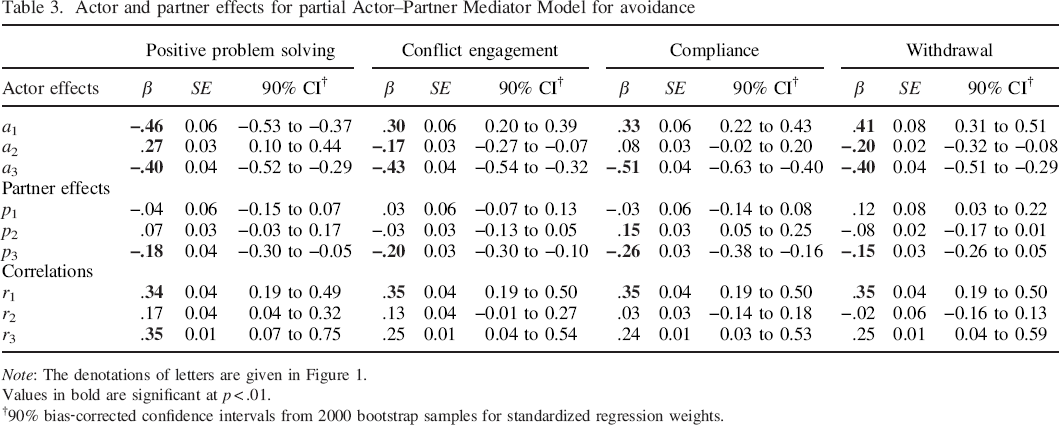
Note: The denotations of letters are given in Figure 1.
Values in bold are significant at p < .01.
90% bias–corrected confidence intervals from 2000 bootstrap samples for standardized regression weights.
Positive problem solving
As expected, the actor effect between avoidant attachment and positive conflict solving was negative (−.46, p < .001), whereas positive conflict solving and relationship satisfaction showed a positive relation (.27, p < .001). Accordingly, higher levels of avoidance in attachment were tied to lower levels in relationship satisfaction (−.40, p < .001). The influence of the partner was only statistically significant for partner avoidance on one's own relationship satisfaction (−.18, p < .001).
The indirect actor effect from avoidance to relationship satisfaction (−.13, p < .001) was statistically significant when we evaluated it with the 95% confidence interval (95% CI = −0.21 to −0.04). 2 On the other hand, the indirect partner effect from avoidance to relationship satisfaction (−.04, p > .05) was not statistically significant (95% CI = −0.10 to 0.01). Thus, we obtained evidence that positive conflict solving is influenced by partial actor–actor mediation (e.g., male avoidance predicts perceived male positive problem solving, which in turn predicts male relationship satisfaction). On the other hand, there is no mediation of the corresponding partner effect on relationship satisfaction. This analysis clarifies the results obtained from the nested model comparison approach by highlighting that actor–actor mediation is more important than actor–partner related mediation.
Conflict engagement
Results indicated a positive actor effect between avoidant attachment and conflict engagement (.30, p < .001), whereas conflict engagement and relationship satisfaction showed a negative relation (−.17, p < .01). Accordingly, higher levels of avoidance in attachment were tied to lower levels in relationship satisfaction (−.43, p < .001). The influence of the partner was only statistically significant for partner avoidance on one's own relationship satisfaction (−.20, p < .001).
The indirect actor effect from avoidance to relationship satisfaction (−.05, p < .05) was statistically significant (95% CI = −0.09 to −0.02). On the other hand, the indirect partner effect from avoidance to relationship satisfaction (−.01, p > .05) was not statistically significant (95% CI = −0.05 to 0.01). Thus, we obtained evidence that conflict engagement is influenced by partial actor–actor mediation (e.g., male avoidance predicts perceived male conflict engagement, which in turn predicts male relationship satisfaction). There is no mediation of the corresponding partner effect on relationship satisfaction.
Compliance
Results indicated a positive actor effect between avoidant attachment and compliance (.33, p < .001), whereas the relationship between compliance and relationship satisfaction was not statistically significant (.08, p > .05). Accordingly, higher levels of avoidance in attachment were tied to lower levels in relationship satisfaction (−.51, p < .001). The influence of the partner was statistically significant not only for partner avoidance on one's own relationship satisfaction (−.26, p < .001), but also for compliance on relationship satisfaction of the partner (−.15, p < .001).
The indirect actor effect from avoidance to relationship satisfaction (.02, p > .05) was not statistically significant (95% CI = −0.01 to 0.07). The indirect partner effect from avoidance to relationship satisfaction (.05, p < .05, 95% CI = 0.02 to 0.10) was statistically significant. Thus, we obtained no evidence for actor–actor mediation, whereas results indicate partial actor–partner mediation for compliance (e.g., male avoidance predicts perceived male compliance, which in turn predicts female relationship satisfaction). Because direct (−.26) and indirect (.05) partner effects for avoidance and relationship satisfaction showed different signs, this actor–partner mediation may operate as a suppression effect.
Withdrawal
Results indicated a positive actor effect between avoidant attachment and withdrawal (.41, p < .001), whereas withdrawal and relationship satisfaction showed a negative relation (−.20, p < .001). Accordingly, higher levels of avoidance in attachment were related to lower levels in relationship satisfaction (−.40, p < .001). The influence of the partner was only statistically significant for partner avoidance on one's own relationship satisfaction (−.15, p < .001).
The indirect actor effect from avoidance to relationship satisfaction (−.09, p < .05) was statistically significant (95% CI = −0.15 to −0.04). The indirect partner effect from avoidance to relationship satisfaction (−.06, p < .05) was also statistically significant (95% CI = −0.11 to −0.02). Although we obtained a statistically significant indirect effect, this result did not fit the criteria for a mediated effect because the partner path from withdrawal to relationship satisfaction was not statistically significant (p2 = −.08, p > .05). Thus, we only obtained evidence for partial actor–actor mediation for withdrawal.
Anxiety as exogenous variable
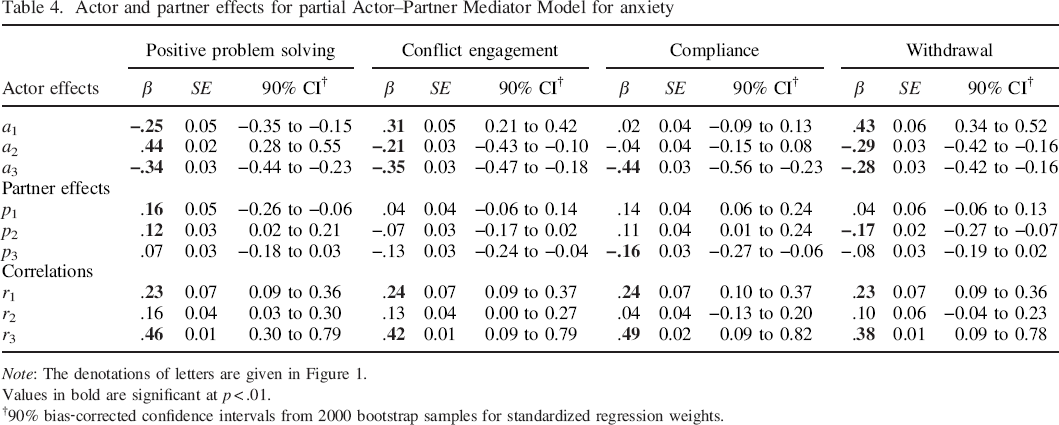
The analyses described for avoidance were repeated using anxiety as the exogenous variable. Goodness–of–fit results for anxiety are presented in Table 2. As mentioned previously, all three nested models yielded good or reasonable RMSEA values for all conflict resolution styles. However, including the RMSEA confidence interval makes clear that only the partial APMeM satisfied the criteria for evaluating the RMSEA as good. The chi–square differences between successive models were all statistically significant (Δχ2 > 12 with Δdf = 2, p < .01) for all conflict resolution styles. The partial APMeM obtained the smallest BIC, indicating an improvement in the fit for the partially mediated model. Therefore, the partial APMeM was considered for interpretation and further analyses. Table 4 displays the actor and partner effects for the partial APMeM.
Actor and partner effects for partial Actor–Partner Mediator Model for anxiety
Note: The denotations of letters are given in Figure 1.
Values in bold are significant at p < .01.
90% bias–corrected confidence intervals from 2000 bootstrap samples for standardized regression weights.
Positive problem solving
The actor effect between anxiety and positive conflict solving was negative (−.25, p < .001), whereas positive conflict solving and relationship satisfaction showed a positive relation (.44, p < .001). Accordingly, higher levels of anxiety in attachment were related to lower levels in relationship satisfaction (−.34, p < .001). The influence of the partner was statistically significant for partner anxiety on positive conflict solving style (.16, p < .001) and from positive conflict solving style to partner relationship satisfaction (.12, p < .001).
The indirect actor effect from anxiety to relationship satisfaction (−.13, p < .01) was statistically significant (95% CI = −0.19 to −0.08). The indirect partner effect from anxiety to relationship satisfaction (−.10, p < .01) was also statistically significant (95% CI = −0.15 to 0.05). Thus, we obtained evidence that positive conflict solving is mediated by partial actor–actor effects (e.g., male anxiety predicts perceived male positive problem solving, which in turn predicts male relationship satisfaction). The partner effect has to be interpreted as full mediation effect because the path from anxiety to relationship satisfaction is not significant (p3 = .07, p > .05). This means, that male anxiety influences female positive conflict solving, which in turn influences male relationship satisfaction.
Conflict engagement
Results indicated a positive actor effect between anxiety and conflict engagement (.31, p < .001), whereas conflict engagement and relationship satisfaction showed a negative relation (−.21, p < .01). Accordingly, higher levels of anxiety in attachment were related to lower levels in relationship satisfaction (−.35, p < .001). None of the partner effects were statistically significant (all p's > .05).
The indirect actor effect from anxiety to relationship satisfaction (−.07, p < .05) was statistically significant (95% CI = −0.12 to −0.03). On the other hand, the indirect partner effect from anxiety to relationship satisfaction (−.03, p > .05) was not statistically significant (95% CI = −0.07 to 0.00). Thus, we obtained evidence that conflict engagement is influenced by partial actor–actor mediation (e.g., male anxiety predicts perceived male conflict engagement, which in turn predicts male relationship satisfaction). There is no mediation of the corresponding partner effect on relationship satisfaction.
Compliance
Neither the actor effect between attachment and compliance was statistically significant (.02, p > .05) nor was the relationship between compliance and relationship satisfaction (−.04, p > .05). Only anxious attachment was inversely related to relationship satisfaction (−.44, p < .001). The influence of the partner was only statistically significant for partner anxiety on one's own relationship satisfaction (−.16, p < .01).
Neither the indirect actor effect from anxiety to relationship satisfaction (.01, p > .05) was statistically significant (95% CI = 0.00 to 0.05) nor was the indirect partner effect from anxiety to relationship satisfaction (.00, p > .05, 95% CI = −0.02 to 0.02). Thus, we obtained evidence that no mediation occur for actor–actor as well as actor–partner effects for compliance.
Withdrawal
Results indicated a positive actor effect between anxiety and withdrawal (.43, p < .001), whereas withdrawal and relationship satisfaction showed a negative relation (−.29, p < .001). Accordingly, higher levels of anxiety in attachment were related to lower levels in relationship satisfaction (−.28, p < .001). A significant partner effect on one's own relationship satisfaction (−.17, p < .001) emerged from withdrawal. The other partner effects were not statistically significant (all p's > .05).
The indirect actor effect from anxiety to relationship satisfaction (−.13, p < .01) was statistically significant (95% CI = −0.21 to −0.07). The indirect partner effect from anxiety to relationship satisfaction (−.08, p < .01) was also statistically significant (95% CI = −0.15 to −0.04). Although we obtained a statistically significant indirect effect, this result did not fit the criteria for a mediated effect, because only the partner path from withdrawal to relationship satisfaction was statistically significant (p2 = −.17, p < .05) whereas the two other paths were not. Thus, we only obtained evidence for partial actor–actor mediation for withdrawal as a dysfunctional conflict resolution style.
Summarizing mediational effects
The goodness–of–fit results for the nested models testing structural aspects of the association between both attachment characteristics and relationship satisfaction revealed partial mediating effects of positive problem solving, conflict engagement and withdrawal as well as one full mediation of the partner's positive problem solving. Therefore, Hypothesis 1 was supported, although we did not expect conflict engagement as a mediator between avoidance and relationship satisfaction as well as withdrawal mediating the pathway between anxiety and relationship satisfaction. As for compliance, only one significant actor–partner mediating effect (attachment avoidance, compliance and partner's relationship satisfaction) was found. The test of dyadic mediational pathways shows that actor–actor mediation occurred throughout all analyses. Only a few partner effects were statistically significant, mostly the direct relations between attachment dimensions and relationship satisfaction. This indicates an actor–only pattern (Kenny & Cook, 1999).
Regarding specific associations between attachment characteristics and conflict resolution styles in the tested models, positive problem solving was negatively related to attachment anxiety and avoidance, supporting our assumptions in Hypothesis 2. Contrary to our expectations, we found one positive effect of anxiety on partners‘ positive problem solving. This effect was only small in magnitude (.16, p < .001). As expected, higher scores of attachment anxiety were associated with higher scores of conflict engagement, and no significant relationship with compliance was found. In line with our expectations, withdrawal showed a positive relation to attachment avoidance. A positive relation to attachment anxiety was not presumed.
Discussion
The present study was designed to test the nature of mediation between adult attachment and relationship satisfaction within dyads. The idea of assuming conflict resolution styles as mediators was theoretically derived from the psychodynamic model of relationship functioning (Mikulincer & Shaver, 2003) and empirically from findings on adult attachment, conflict resolution styles and relationship satisfaction (Cann et al., 2008; Shi, 2003). In extension of previous studies (e.g., Cann et al., 2008), we were interested in the structural and dyadic aspects of mediation. We tested mediational effects by using the APMeM (Ledermann & Bodenmann, 2006), an extension of the APIM proposed by Kenny and colleagues (e.g., Kashy & Kenny, 2000) to consider the characteristics of dyadic data. Furthermore, we used a covariance approach to test the APMeM because measurement errors may obscure mediation effects. In addition, to overcome exclusive self–evaluations, we were interested in the partner perception of conflict resolution styles.
The results were generally supportive of the assumption that conflict resolution styles partially mediate the association between adult attachment characteristics and relationship satisfaction. This seems to suggest that mental representations of the self and others determine how individuals express themselves in conflict, which influences the satisfaction of close relationships. In line with former studies (Cann et al., 2008), conflict resolution only partially accounts for the relationship between attachment and relationship satisfaction, which implies a more direct association between attachment and satisfaction or could also be viewed as pointing to additional mechanisms influencing this connection.
Based on the psychodynamic model of attachment, we expected specific combinations of attachment–conflict resolution style patterns linking attachment anxiety and avoidance to different conflict resolution strategies. First of all, positive views of the self (low anxiety) and of others (low avoidance) as characteristics of secure attachment style models should be predictive of functional conflict resolution strategies, such as integrating both partners‘ perspectives and seeking a positive conflict solution (e.g., Creasey & Ladd, 2005; Wampler, et al., 2003). We found support for this assumption, although this was only evident for actor effects. Only two partner effects were significant. The first revealed a surprising positive association between attachment anxiety, the partners‘ use of positive problem solving and relationship satisfaction. This indicates that individuals with higher scores on anxious attachment showing less functional conflict resolution may encourage their partner's positive problem solving, which then increases both partners‘ relationship satisfaction. This result demonstrates a kind of dyadic compensating mechanism in which more frequent positive problem solving of one partner could improve relationship satisfaction, even when the other partner shows higher scores on anxious attachment. One explanation may be that one partner adjusts to the other partner's attachment anxiety by showing more frequent positive problem solving. This could not be tested in the present study, but could be analysed in future longitudinal studies. Other studies (e.g., Cann et al., 2008) did not find positive associations between attachment anxiety and positive problem solving. However, in these studies, individual sets of conflict resolution styles were analysed. The second partner mediation was found to link attachment avoidance to compliance, which was positively associated to a partner's relationship satisfaction. The use of compliance suppressed the negative effects of avoidance on a partner's relationship satisfaction. This is in contrast to the results of Kurdek (1994) as well as Gottman and Krokoff (1989), who found that observed compliance was non–significantly linked to both partners‘ relationship outcomes. Again, their statistical analyses were based on individual data. Hence, examining associations between partners‘ conflict resolution styles and relationship outcomes through a dyadic approach offers a clearer view of the compensating effects that conflict resolution styles may have on the relationship satisfaction of insecurely attached individuals. In line with Simpson, Rholes, and Phillips (1996), we found support for the assumption that attachment avoidance can be associated with giving into the partner's wants and needs, which may be functional for a partner's relationship satisfaction. This interpretation is supported by the positive association of the conflict resolution style of compliance with the personality dimension of agreeableness (Herzberg & Sierau, 2010). Nevertheless, these positive effects were only evident for the specific association between avoidance and compliance.
Furthermore, specific associations between attachment avoidance and withdrawal as well as attachment anxiety and conflict engagement were expected. The evidence for this correspondence was limited. Both attachment dimensions showed similar negative relations to the dysfunctional conflict resolution styles of withdrawal and conflict engagement, revealing no considerable differences in magnitude. One possible reason for this could be that specific associations between attachment dimensions and conflict resolution styles may be more obvious in less satisfactory relationships and in relationships with insecurely attached partners (who have high scores on the attachment dimensions). On the other hand, avoidant and anxiously attached individuals may change their conflict resolution styles and—depending on the situation—may be able to show withdrawal as well as conflict engagement, at least in the view of their partners. However, the conflict goals can be the same. For example, conflict engagement can also be seen as an attempt to end disagreements quickly.
Future studies could explore possible influencing variables, such as personality characteristics, which may have an impact on the choice of a specific conflict resolution strategy of insecurely attached partners.
There are several limitations of our study that must be mentioned. First, in terms of the sample obtained, the use of a convenience sample does not allow for generalization to a known population. The couples in this study scored relatively low on the dimensions of attachment anxiety and attachment avoidance. Conducting a comparable study among distressed couples who may score higher on both these dimensions could reveal even stronger patterns of association. A related limitation is the fact that the majority of the partners who took part in our study were satisfied, which may reflect a kind of self–selection bias. It would be advantageous for future studies to recruit a sample with greater variance in dependent and independent variables. Second, the data in this study were based mainly on self–reports, and it is possible that response biases may have influenced the results. The correlations obtained may be attributable to a more general response set such as social desirability (Paulhus, 1991). We believe that this is not a serious concern, because previous research has shown that for individual characteristics and relationship satisfaction, there is a strong convergence between self–reported, spouse–rated and observer–rated data (Luo & Klohnen, 2005), suggesting that self–reports are a reliable source of data. Furthermore, limiting the influence of shared variance, we used partner ratings for the assessment of the conflict resolution style. However, the use of self–report versus narrative assessments is also a controversial issue in the attachment literature (Roisman et al., 2007). On the other hand, Crowell, Fraley, and Shaver (1998) have given several reasons why self–report instruments are appropriate for investigating individual differences in adult attachment. One important reason is, for example, that adults have sufficient experience in close relationships (partly because of the things their partners have told them about their behaviour) to recount their behaviour in such relationships. Extensive psychometric analyses indicated that the ECR–R provided a reliable dual factor self–report measure of adult romantic attachment (Fairchild & Finney, 2006; Sibley, Fisher, & Liu, 2005).
Third, the cross–sectional design makes it impossible to establish causal pathways or developmental trends in close relationships. In effect, causal inferences about the direction of the relations cannot be drawn. In line with this, we acknowledge that real mediation can only be demonstrated over some length of time, as it characterizes some form of process and provides some evidence to back up the implied temporal sequence of the variables in the mediational chain. Assessing the interrelations between attachment characteristics, conflict resolution styles and relationship satisfaction over time would be a useful next step.
Fourth, although heterogeneity of a sample may strengthen the generalizabilty of the findings, heterogeneity may also bias results. Examples are cohort effects that contribute to differences in findings across the groups defined by length of partnership. As depicted in Table 1, correlations of possible moderator variables (age, length of partnership) in the current study are below .25. To exclude possible moderator effects, we re–analysed all tested models as multigroup models with median splits of the possible moderator variables. Results indicate that age and length of partnership do not operate as moderator variables.
Finally, as the assessment of the attachment style was dimensional and not categorical, couple pairing, analysing matches (e.g., secure–secure, B–B; avoidant–avoidant couples) as well as meshes (e.g., A–C, C–A) between the partners (see Crittenden, Partridge, & Claussen, 1991) could not be carried out. The dyadic mediation of the conflict resolution style between attachment and partnership satisfaction is probably different in couples being matched (similar) or meshed (opposite and complimentary) in regard to their attachment styles. Categorical analysis of couple pairing may be an interesting idea for future studies.
Footnotes
1
Although not the focus of our study, results indicated that actor effects outperform partner effects. The equality of actor and partner path was tested by setting the corresponding actor and partner paths pairwise (e.g., a1 and p1) equal. In all tested models, this restriction worsened the model fit in comparison with a model without equality restriction for actor and partner paths. Results can be obtained by request from the second author.
2
All confidence intervals are based on bias–corrected bootstrapping with 2000 bootstrap samples.