







Abstract
This study of university students (n = 357) and community adults (n = 223) examined personal standards (PS) and evaluative concerns (EC) higher–order dimensions of perfectionism that underlie several measures from three different theoretical frameworks. In both students and community adults, confirmatory factor analyses supported PS perfectionism and EC perfectionism higher–order latent factors. In relation to the revised NEO Personality Inventory, PS perfectionism was primarily related to conscientiousness and achievement striving. In contrast, EC perfectionism was primarily related to neuroticism, and lower positive emotions, trust and competence. EC perfectionism accounted for unique variance in current depressive and anxious symptoms over and above the five–factor domain scores. Copyright © 2011 John Wiley & Sons, Ltd.
Introduction
Over the past two decades, perfectionism has received increasing empirical attention as a multidimensional cognitive–personality construct that is presumed to play a role in various psychological problems, such as depression and anxiety (see Bardone–Cone et al., 2007; Flett & Hewitt, 2002; Shafran & Mansell, 2001). Three multidimensional conceptualizations of perfectionism that have generated considerable interest are those of Frost, Marten, Lahart, and Rosenblate (1990), Hewitt and Flett (1991), and Slaney, Rice, Mobley, Trippi, and Ashby (2001). Although there are important differences between these conceptualizations, an important advance in the perfectionism field has been the identification of two higher–order dimensions of perfectionism that cut across many different perfectionism constructs and measures (see Blankstein & Dunkley, 2002; Dunkley, Blankstein, Masheb, & Grilo, 2006; Stoeber & Otto, 2006). The main purpose of the present study was to gain a better understanding of what these personal standards (PS) and evaluative concerns (EC) higher–order dimensions of perfectionism are measuring by relating these dimensions to a comprehensive scheme of personality—the five–factor model—in both university students and community adults. We also examined the incremental associations of PS and EC perfectionism dimensions with depressive and anxious symptoms over and above the five–factor domains.
Although different language and labels have been used to describe essentially the same two higher–order dimensions of perfectionism (see Stoeber & Otto, 2006), we refer to the two dimensions as PS perfectionism and EC perfectionism (e.g. Dunkley, Blankstein, Masheb, et al., 2006). PS perfectionism involves the setting of and striving for high standards and goals for oneself, which is integral to the perfectionism concept typically described in the literature (see Shafran, Cooper, & Fairburn, 2002). PS perfectionism is presumably related to striving for excessive achievement, resilience and adaptive coping, although possibly at some emotional cost and stress (e.g. Blankstein, Dunkley, & Wilson, 2008; Stoeber & Otto, 2006). On the other hand, EC perfectionism involves constant and harsh self–scrutiny and self–evaluation, an inability to derive satisfaction from successful performance, and chronic concerns about others‘ criticism and disapproval (e.g. Dunkley, Blankstein, Masheb, et al., 2006). EC perfectionism is believed to be manifested and maintained in a wide variety of insecure expressions, including suspiciousness, avoiding intimacy, social distancing and disengagement from decisions and actions (e.g. Dunkley, Blankstein, Zuroff, Lecce, & Hui, 2006; Hewitt & Flett, 1991).
Empirically, factor analytic studies (e.g. Blankstein et al., 2008; Suddarth & Slaney, 2001) of scales derived from these three different conceptualizations of perfectionism have consistently revealed two higher–order latent factors, which map onto the distinction between PS perfectionism and EC perfectionism (see Dunkley, Blankstein, Masheb, et al., 2006; Stoeber & Otto, 2006). PS perfectionism indicators include the personal standards scale from the Frost et al. (1990) Multidimensional Perfectionism Scale (FMPS), the self–oriented perfectionism scale from the Hewitt and Flett (1991) Multidimensional Perfectionism Scale (HMPS) and the high standards scale from the Slaney et al. (2001) Revised Almost Perfect Scale (APS–R). EC perfectionism indicators include FMPS concern over mistakes, HMPS socially prescribed perfectionism and APS–R discrepancy (Blankstein et al., 2008; Suddarth & Slaney, 2001). Although PS perfectionism measures are often weakly or negligibly related to depressive and anxious symptoms, EC perfectionism measures consistently demonstrate moderate to strong relations with depressive and anxious symptoms (e.g. Rice, Ashby, & Slaney, 2007; Slaney et al., 2001; see Dunkley, Blankstein, Masheb, et al., 2006). 1
Several literature reviews have pointed out the importance of exploring the relations of specific vulnerability traits, such as perfectionism, to other personality variables (e.g. Flett, Hewitt, Endler, & Bagby, 1995; Widiger & Costa, 2002). Firstly, this would provide an assessment of the similarities and differences between the PS and EC higher–order dimensions of perfectionism derived from separate theoretical frameworks of perfectionism and facilitate clarification of their origins and/or underlying nature. Secondly, relating vulnerability styles to the ‘Big Five’ allows an examination of whether these relatively specific variables can be meaningfully distinguished from certain higher–order vulnerability factors, such as neuroticism. Numerous studies have supported the five–factor model (FFM) of personality as a useful heuristic framework that is relevant to the portrayal of specific personality vulnerability styles, such as perfectionism (see Widiger & Costa, 2002). The FFM is a version of trait theory that identifies five broad domains of personality functioning as most important, namely neuroticism, extraversion, openness to experience, agreeableness and conscientiousness. Previous studies found that PS perfectionism indicators (FMPS personal standards, HMPS self–oriented perfectionism, APS–R high standards) were moderately to strongly correlated with the conscientiousness domain, whereas EC perfectionism indicators (e.g. FMPS concern over mistakes, HMPS socially prescribed perfectionism, APS–R discrepancy) were moderately to strongly correlated with the neuroticism domain (e.g. Dunkley & Kyparissis, 2008; Enns & Cox, 2002; Hill, McIntire, & Bacharach, 1997; Rice et al., 2007; Stumpf & Parker, 2000).
Although these previous studies have clarified the broad distinction between the higher–order PS and EC dimensions of perfectionism from the perspective of the FFM, a richer, more fine–grained understanding of what the PS and EC dimensions represent can be provided by the revised NEO Personality Inventory (NEO–PI–R; Costa & McCrae, 1992). The NEO–PI–R assesses the five–factor domains, which are each further composed of six, more specific, personality trait facets. Three previous studies (Dunkley, Blankstein, Zuroff, et al., 2006; Dunkley & Kyparissis, 2008; Hill et al., 1997) have examined one PS perfectionism measure, namely HMPS self–oriented perfectionism, and one EC perfectionism measure, namely HMPS socially prescribed perfectionism, in relation to the NEO–PI–R 30 facets. HMPS self–oriented perfectionism was strongly related to the achievement striving facet of conscientiousness and exhibited weak to moderate relations with several other facets of conscientiousness and the assertiveness and activity facets of extraversion. On the other hand, HMPS socially prescribed perfectionism exhibited moderate to strong relations with the depression facet of neuroticism; weak to moderate relations with the anxiety, angry hostility, self–consciousness and vulnerability facets of neuroticism; and weak to moderate negative relations with the warmth, positive emotions, values and trust facets (e.g. Dunkley & Kyparissis, 2008; Hill et al., 1997). To our knowledge, only one out of three PS perfectionism (i.e. HMPS self–oriented perfectionism) and only one out of three EC perfectionism indicators (i.e. HMPS socially prescribed perfectionism) has been examined in relation to the NEO–PI–R 30 facets. Thus, we are left with an incomplete picture of what the higher–order PS and EC dimensions of perfectionism are really measuring from the perspective of the FFM, particularly as assessed by measures from all three of the most widely studied perfectionism frameworks (Frost et al., 1990; Hewitt & Flett, 1991; Slaney et al., 2001). Further, it is unknown whether PS perfectionism and EC perfectionism higher–order dimensions will exhibit the same pattern of convergent and divergent relations with the NEO–PI–R 30 facets as found in previous studies of HMPS self–oriented perfectionism and HMPS socially prescribed perfectionism.
The first goal of the present study was to build on previous studies (Blankstein et al., 2008; Suddarth & Slaney, 2001) by using confirmatory factor analyses to provide further support for a two–factor model of perfectionism containing PS perfectionism (FMPS personal standards, HMPS self–oriented perfectionism, APS–R high standards) and EC perfectionism (FMPS concern over mistakes, HMPS socially prescribed perfectionism, APS–R discrepancy) higher–order latent factors in both a university student sample and a community adult sample. The second goal of the present study was to gain a more definitive understanding of the differences between the PS perfectionism and EC perfectionism higher–order dimensions by relating these variables to a comprehensive scheme of personality, provided by the NEO–PI–R, in both university students and community adults. Based on theory and prior research, in relation to the NEO–PI–R 30 facets, we hypothesized that individuals with higher PS perfectionism would primarily describe themselves as diligent, purposeful and working hard to achieve their goals and aspirations (achievement striving); dominant, forceful and socially ascendant (assertiveness); and leading fast–paced lives (activity). In contrast, we hypothesized that individuals with higher EC perfectionism would primarily describe themselves as prone to feelings of sadness, hopelessness and loneliness (depression); formal, reserved and distant in manner (low warmth); less exuberant and high spirited (low positive emotions); tending to accept authority, honour tradition and be generally conservative (low openness to values); and cynical and sceptical of others (low trust).
Finally, some reviewers have encouraged finding explanations of the effects of specific vulnerability traits, such as perfectionism, in terms of other personality variables in order to better understand how these constructs confer vulnerability to depression and anxiety (e.g. Coyne & Whiffen, 1995). We examined the incremental value of PS and EC dimensions of perfectionism relative to the five–factor higher–order domains in both university students and community adults. Previous studies have distinguished various measures of EC perfectionism from neuroticism in terms of EC perfectionism's unique relations with, for example, negative interpersonal domains (introversion, antagonism) and depressive symptoms (e.g. Dunkley, Blankstein, Zuroff, et al., 2006; Rice et al., 2007; see Zuroff, Mongrain, & Santor, 2004). To our knowledge, our study was the first to examine the incremental associations of perfectionism dimensions with depressive and anxious symptoms over and above all five–factor domains. Although depression and anxiety can be distinguished phenomenologically and empirically, there is an overlap between these constructs (e.g. Watson et al., 1995). Thus, we examined the unique relation between EC perfectionism and both shared and unique components of depression and anxiety.
Method
Participants
The university student sample consisted of 357 (139 men, 218 women) university students with a mean age of 20.0 years (SD = 3.7) enrolled in an undergraduate Introductory Psychology course at the University of Toronto at Mississauga. The present study presents additional findings from the Dunkley and Kyparissis (2008) sample of community adults. The community adult sample consisted of 223 English–speaking and French–speaking participants (75 men, 148 women) with a mean age of 40.1 years (SD = 12.3) holding paid employment. The community adults were recruited through newspaper advertisements and posted bulletins in Montreal, Quebec. Of the total sample of community adults, 109 participants (33 men, 76 women) completed the English version of the questionnaire package, and 114 participants (42 men, 72 women) completed the French translation of the questionnaire package.
Procedure
For both the university student and community adult samples, participants completed a package of questionnaires, including measures of perfectionism, comprehensive personality and current depressive and anxious symptoms, in a 1.5– to 2–hour lab session. The relevant measures were presented in two alternate random orders and were intermixed with additional measures that were not the focus of the present study. The university students received course credit for participation. The community adults were compensated $25 for completing the study.
Measures
Personal standards and concern over mistakes
The 35–item FMPS (Frost et al., 1990) was used to assess personal standards (seven items; e.g. ‘If I do not set the highest standards for myself, I am likely to end up a second–rate person’) and concern over mistakes (nine items; e.g. ‘People will think less of me if I make a mistake’). The personal standards and concern over mistakes scales have demonstrated good internal consistencies and validity (e.g. Frost et al., 1990). Rhéaume et al.'s (1994) French translation of the FMPS was administered to community adults completing the study in French. The internal consistencies and validity of the French version of the FMPS have been found to be similar to the original English version (Bouvard et al., 2000; Labrecque, Stephenson, Boivin, & Marchand, 1998).
Self–oriented perfectionism and socially prescribed perfectionism
The 45–item HMPS (Hewitt & Flett, 1991) was used to assess self–oriented perfectionism (15 items; e.g. ‘I set very high standards for myself’) and socially prescribed perfectionism (15 items; e.g. ‘Anything I do that is less than excellent will be seen as poor work by those around me’). The self–oriented perfectionism and socially prescribed perfectionism scales have demonstrated adequate internal consistencies and validity (e.g. Hewitt & Flett, 1991). Labrecque et al.'s (1998) French translation of the HMPS was administered to French–speaking community adults. The internal consistencies and validity of the French version of the HMPS have been found to be similar to the Hewitt and Flett (1991) measure (Dunkley & Kyparissis, 2008; Labrecque et al., 1998).
High standards and discrepancy
The 23–item APS–R (Slaney et al., 2001) was used to assess high standards (seven items; e.g. ‘I have a strong need to strive for excellence’) and discrepancy (12 items; e.g. ‘My performance rarely measures up to my standards’). The internal consistencies and validity of the high standards and discrepancy scales have been well established (e.g. Slaney et al., 2001). For the community adults completing the study in French, the APS–R was translated into French and then back translated into English to ensure that the original meaning of each item was retained.
Revised NEO Personality Inventory
The NEO–PI–R (Costa & McCrae, 1992) is a 240–item self–report questionnaire designed to provide a comprehensive assessment of the FFM of personality. Considerable evidence has supported the internal consistency and validity of the NEO–PI–R five domain and 30 facet scales (e.g. Costa & McCrae, 1992). A validated French version of the NEO–PI–R (Rolland & Petot, 1998) was administered to the community adults completing the study in French. The French NEO–PI–R has been found to be largely equivalent to the original English language version (Rolland, Parker, & Stumpf, 1998).
Depressive and anxious symptoms
The Mood and Anxiety Symptom Questionnaire (MASQ; D. Watson & L. A. Clark, University of Iowa, Iowa City, unpublished manuscript) Short Form was used to measure depressive and anxious symptoms. The MASQ Short Form is a 62–item measure, which consists of four scales. General distress: depressive symptoms (12 items), and general distress: anxious symptoms (11 items) assess depressed and anxious mood, respectively, as well as other symptoms that were found to be relatively non–specific to depression and anxiety. In contrast, the other two scales, anhedonic depression (22 items) and anxious arousal (17 items), contain symptoms that measure anhedonia/low positive affect and somatic hyperarousal, respectively, and are expected to better discriminate between depression and anxiety. Internal consistency and validity of the MASQ scales have been supported (Watson et al., 1995). Waintraub, Delalleau, Lavergne, and Bertrand's (1997) French translation of the MASQ was administered to the community adults completing the study in French.
Results
Descriptive statistics and intercorrelations
Table 1 reports the means, SDs and alpha internal consistency coefficients of the PS perfectionism measures (FMPS personal standards, HMPS self–oriented perfectionism, APS–R high standards), the EC perfectionism measures (FMPS concern over mistakes, HMPS socially prescribed perfectionism, APS– R discrepancy), the NEO–PI–R five domains and the MASQ depression (general, anhedonic) and anxiety (general, anxious arousal) measures. t–tests comparing the means on these measures showed that the university students relative to the community adults had higher mean scores on self–oriented perfectionism, high standards, concern over mistakes, discrepancy, neuroticism, extraversion, and depressive and anxious symptoms; and they had lower mean scores on openness, agreeableness and conscientiousness (see Table 1). There were no differences in any mean scores on these variables between community adults who completed the English version of the questionnaires and the community adults who completed the French version of the questionnaires. A multiple groups approach to test invariance of the covariance matrices between English community participants and French community participants was performed using Analysis of Momentary Structure 5.0 (Arbuckle, 2003, Small Waters Corporation, Chicago, Illinois, USA), which uses the maximum likelihood estimation method to examine the fit of models to their respective observed variance–covariance matrices. The covariances among the main study variables (i.e. six perfectionism measures, five NEO–PI–R domain scores, four MASQ scores) of community adults completing the English version of the questionnaires were constrained to be equal to those of community adults completing the French version of the questionnaires. The fit of this constrained model was compared with the fit of a model in which the covariances were freely estimated between English and French community adults. The non–significant difference between the constrained model and the freely estimated model, χ2diff (105, n = 223) = 124.70, not significant, suggested that the covariances among variables were comparable between English and French community adults.
Means, SDs and internal consistencies
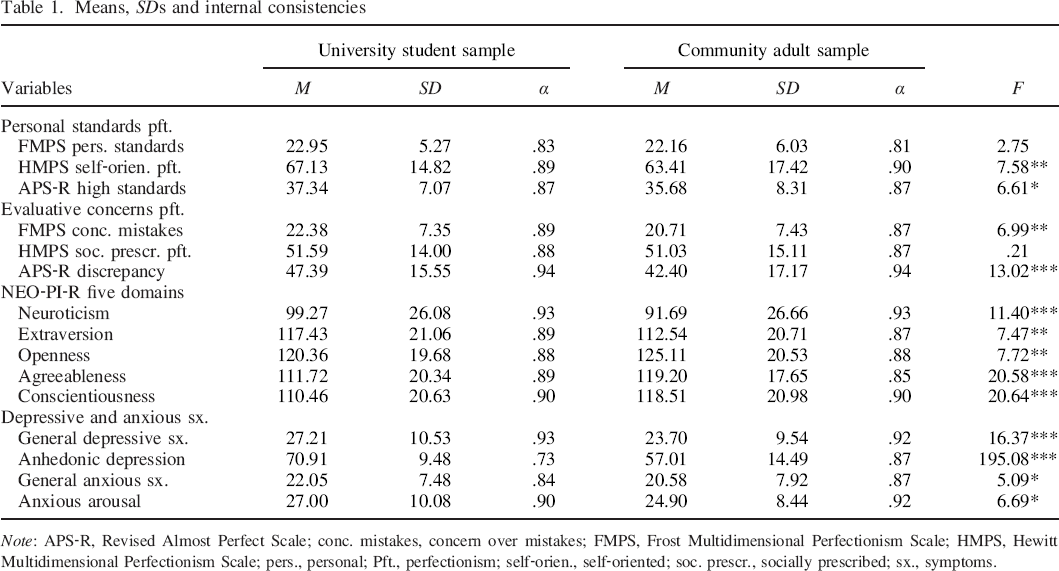
Note: APS–R, Revised Almost Perfect Scale; conc. mistakes, concern over mistakes; FMPS, Frost Multidimensional Perfectionism Scale; HMPS, Hewitt Multidimensional Perfectionism Scale; pers., personal; Pft., perfectionism; self–orien., self–oriented; soc. prescr., socially prescribed; sx., symptoms.
Additional preliminary analyses assessed multivariate normality with Mardia's multivariate kurtosis and Mahalanobis distances by using the six perfectionism measures, the five NEO–PI–R domain scores and the four MASQ scores. For university students, the critical ratio for Mardia's kurtosis was 17.93, and the maximum Mahalanobis distance observed was 62.23. For community adults, the critical ratio for Mardia's kurtosis was 9.51, and the maximum Mahalanobis distance observed was 38.01. Therefore, the data were considered multivariate normal.
Table 2 reports the zero–order intercorrelations among the PS perfectionism measures, the EC perfectionism measures and the MASQ depression and anxiety measures. As shown in Table 2, the correlations among the six PS perfectionism and EC perfectionism measures were weak to strong across university students and community adults. However, the EC perfectionism measures exhibited moderate to strong zero–order correlations with depressive and anxious symptoms, whereas the PS perfectionism measures had weak or negligible correlations with depressive and anxious symptoms in university students and community adults.
Intercorrelations
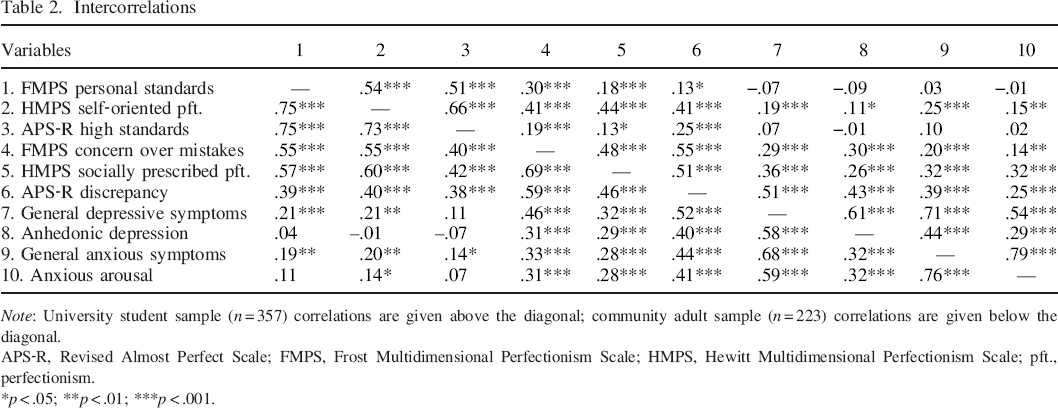
Note: University student sample (n = 357) correlations are given above the diagonal; community adult sample (n = 223) correlations are given below the diagonal.
APS–R, Revised Almost Perfect Scale; FMPS, Frost Multidimensional Perfectionism Scale; HMPS, Hewitt Multidimensional Perfectionism Scale; pft., perfectionism.
p < .05;
p < .01;
p < .001.
Confirmatory model comparison
Confirmatory model comparison was performed using Analysis of Momentary Structure 5.0. Consistent with Hoyle and Panter's (1995) recommendations, we considered multiple indexes of fit that provided different information for evaluating model fit (i.e. absolute fit, incremental fit relative to a null model, fit adjusted for model parsimony). We considered the goodness–of–fit index (GFI; Jöreskog & Sörbom, 1984; absolute fit), incremental–fit index (IFI; Bollen, 1989; type–2 incremental fit) and comparative fit index (CFI; Bentler, 1990; type–3 incremental fit), with values 0.90 or over indicating better fitting models (see Hoyle & Panter, 1995). We also considered the root mean square error of approximation (RMSEA; Steiger, 1990; parsimony–adjusted fit), with values of 0.08 or less indicating adequate fit (see Browne & Cudeck, 1993). Finally, consistent with Hoyle and Panter's (1995) recommendations, we performed sequential comparisons between nested, competing models with χ2 difference tests and an index of fit that takes into account the degree of parsimony in the model, the Akaike information criterion (AIC; Akaike, 1987) with lower values preferred.
Confirmatory techniques were used to compare two nested, competing models for both the university student and community adult samples. The first model for comparison was a two–factor model derived from previous factor analytic findings (e.g. Blankstein et al., 2008; Suddarth & Slaney, 2001) with the three PS perfectionism subscales (FMPS personal standards, HMPS self–oriented perfectionism, APS–R high standards) loading on a PS perfectionism higher–order latent factor and the three EC perfectionism subscales (FMPS concern over mistakes, HMPS socially prescribed perfectionism, APS–R discrepancy) loading on an EC perfectionism higher–order latent factor. The PS perfectionism and EC perfectionism latent factors were permitted to correlate because we expected them to be related to some degree in that they share a focus on self–worth, self–definition and self–control; and several previous studies have demonstrated that the latent factors are substantially correlated (see Stoeber & Otto, 2006). A multiple groups approach was employed in which the two–factor model was estimated between the university student and community adult groups. The two–factor model resulted in an adequate fit to the data: χ2 (16, n = 580) = 104.67; GFI = 0.95; IFI = 0.94; CFI = 0.94; RMSEA = 0.10, 90% confidence interval (0.08, 0.12); AIC = 156.67.
The second model for comparison was a one–factor unidimensional model with all six perfectionism scales loading on a single perfectionism higher–order latent factor. A multiple groups approach was used in which the one–factor model was estimated between the university student and community adult samples. The one–factor model resulted in a poor fit: χ2 (18, n = 580) = 347.53; GFI = 0.82; IFI = 0.78; CFI = 0.78; RMSEA = 0.18, 90% confidence interval (0.16, 0.20); AIC = 395.53. The two–factor model showed a superior fit compared with the one–factor model, χ2diff (1, n = 357) = 242.86, p < .001, and had a lower AIC value (indicative of a better fitting model).
The standardized factor loadings and correlations between latent factors for the two–factor model for the university student and community adult samples are given in Figure 1. All factor loadings ranged between 0.57 and 0.96, and were highly significant (p < .001 level). The correlation between the two latent factors was 0.58 for the university student sample and 0.72 for the community adult sample. Given that the PS perfectionism and EC perfectionism latent factors were strongly associated, we further assessed discriminant validity by examining a 95% confidence interval around these correlations (Anderson & Gerbing, 1988). The bootstrap procedure was used to construct the confidence intervals by creating 1000 bootstrap samples by random sampling and replacement of the original data set for both the university student (n = 357) and community adult (n = 223) samples. The bias–corrected 95% confidence interval around the correlation between PS perfectionism and EC perfectionism was 0.46 to 0.67 for university students and 0.60 to 0.81 for community adults. Thus, because unity (1.0) did not appear in these confidence interval bands, the constructs were considered to be significantly associated but distinguishable from one another. In sum, these confirmatory factor analyses supported the two–factor model across the university student and community adult samples.
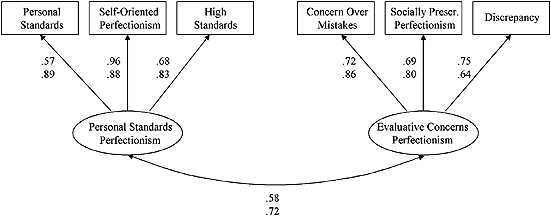
Standardized factor loadings and correlations between personal standards perfectionism and evaluative concerns perfectionism higher–order factors. University student sample (n = 357) factor loadings and correlation are on top; community adult sample (n = 223) factor loadings and correlation are on the bottom. Prescr. = prescribed.
Personal standards perfectionism and evaluative concerns perfectionism and the revised NEO Personality Inventory five domains and 30 facets
The FMPS, HMPS and APS–R subscales were combined (after being transformed into z–scores) to create the PS perfectionism measure (FMPS personal standards + HMPS self–oriented perfectionism + APS–R high standards) and the EC perfectionism measure (FMPS concern over mistakes + HMPS socially prescribed perfectionism + APS–R discrepancy). The correlation between PS perfectionism and EC perfectionism when assessed by composite measures was weaker for the university student sample (r = .39, p < .001) and for the community adult sample (r = .61, p < .001) than the respective correlations between latent factors, which is not surprising because there is more measurement error in observed scores that tends to produce an underestimate of the relation between scores. Correlational analyses were carried out to examine the relations between the PS and EC dimensions of perfectionism and the five domains and 30 facets of the NEO–PI–R for both the university student and community adult samples (see Tables 3 and 4). To keep the number of statistical tests to a manageable size, results are reported for the total university student sample and the total community adult sample only.
Zero–order correlations, partial correlations and standardized regression coefficients of personal standards perfectionism and evaluative concerns perfectionism with the neuroticism, extraversion, openness, agreeableness and conscientiousness domains for the university student sample (n = 357) and the community adult sample (n = 223)
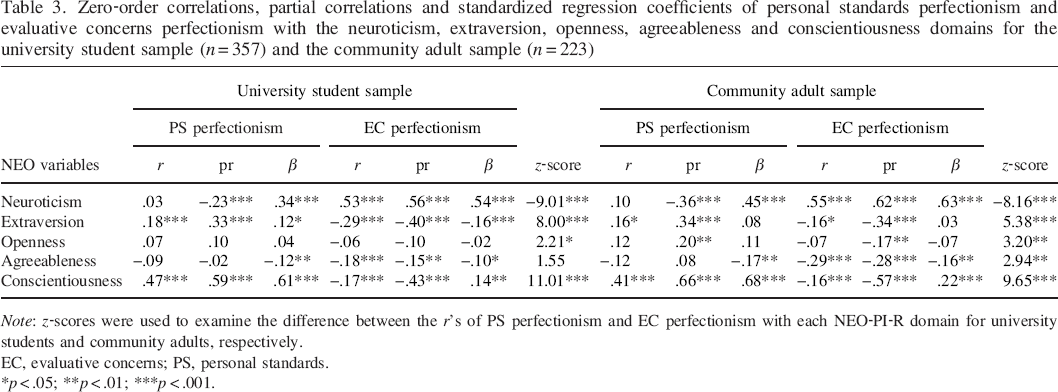
Note: z–scores were used to examine the difference between the r's of PS perfectionism and EC perfectionism with each NEO–PI–R domain for university students and community adults, respectively.
EC, evaluative concerns; PS, personal standards.
p < .05;
p < .01;
p < .001.
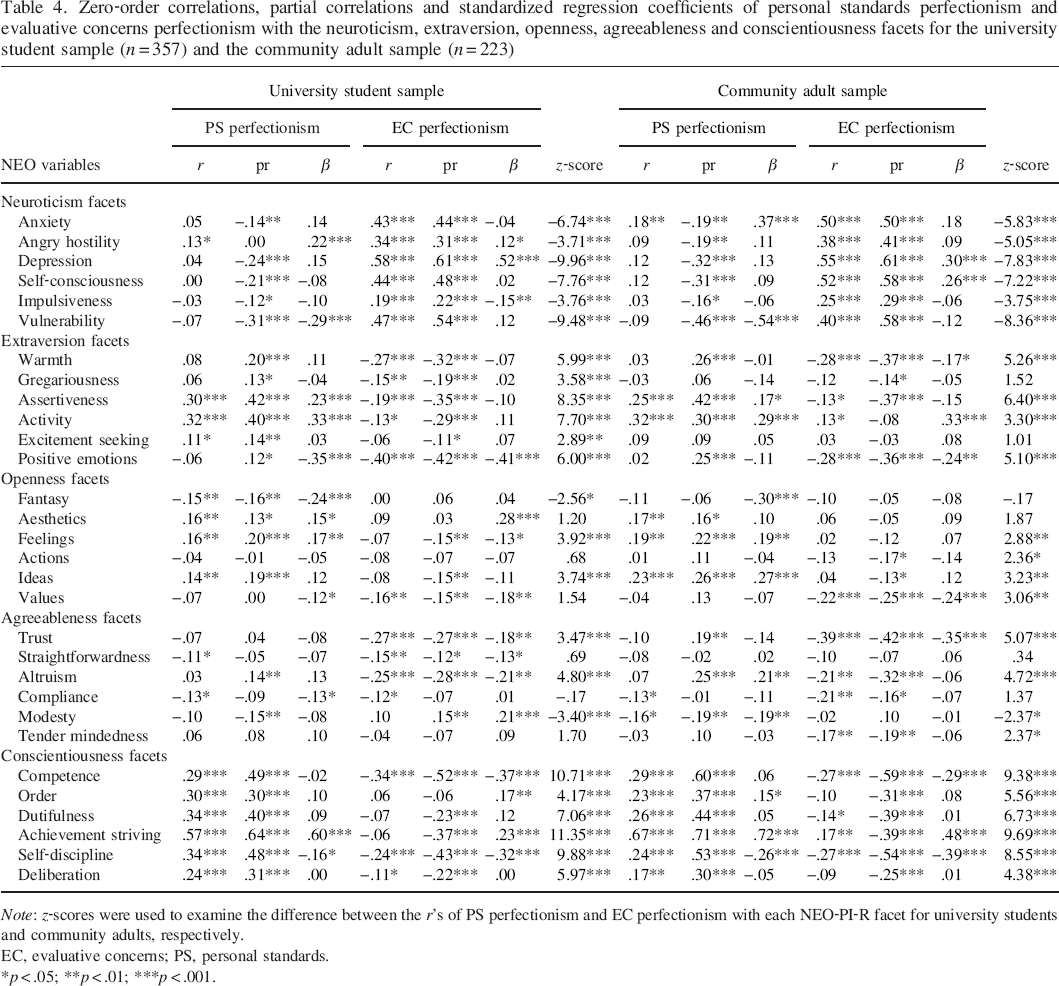
Zero–order correlations, partial correlations and standardized regression coefficients of personal standards perfectionism and evaluative concerns perfectionism with the neuroticism, extraversion, openness, agreeableness and conscientiousness facets for the university student sample (n = 357) and the community adult sample (n = 223)
Note: z–scores were used to examine the difference between the r's of PS perfectionism and EC perfectionism with each NEO–PI–R facet for university students and community adults, respectively.
EC, evaluative concerns; PS, personal standards.
p < .05;
p < .01;
p < .001.
z–tests were used to examine the difference between the zero–order correlations of PS perfectionism and EC perfectionism with each of the domains and facets from the NEO–PI–R for both the university student and community adult samples. In addition to reporting the zero–order correlations, we examined the partial correlations between the PS and EC dimensions of perfectionism and the NEO–PI–R domains and facets partialling out the overlap between PS perfectionism and EC perfectionism in order to further differentiate the two perfectionism dimensions (Hill, Huelsman, & Araujo, 2010; see Stoeber & Otto, 2006). We also examined the standardized beta weights between PS perfectionism and EC perfectionism and the NEO–PI–R five domain summary scores and six facets of each domain in order to assess the unique predictive contributions of each five–factor domain/facet after shared variance with the other domains/facets of the respective domain was partialled out. Some partial correlations and standardized beta weights between PS perfectionism and EC perfectionism and certain NEO–PI–R domains and facets were stronger, and sometimes of opposite direction, than the zero–order correlations because of suppressor effects (see Cohen, Cohen, West, & Aiken, 2003). To facilitate comparison, in the succeeding paragraph, we focus on the results where the zero–order correlations, partial correlations and standardized beta weights were significant and of the same valence (positive or negative), and where there was a significant difference between PS perfectionism and EC perfectionism in terms of their zero–order correlations with a domain/facet.
Table 3 presents the zero–order correlations, partial correlations and standardized beta weights between the NEO–PI–R five domain summary scores and PS perfectionism and EC perfectionism, along with z–tests assessing the difference between the zero–order correlations of PS perfectionism and EC perfectionism with each of the domains. For both university students and community adults, PS perfectionism was strongly related to conscientiousness only, whereas EC perfectionism was strongly related to neuroticism and was weakly related to lower agreeableness. For university students only, PS perfectionism was weakly related to higher extraversion, whereas EC perfectionism was weakly related to lower extraversion.
Table 4 presents the zero–order correlations, partial correlations and standardized beta weights between the PS and EC dimensions of perfectionism and the NEO–PI–R 30 facets, along with z–tests assessing the difference between the zero–order correlations of PS perfectionism and EC perfectionism with each of the facets. Together with zero–order correlations and partial correlations, we examined the standardized beta weights between PS perfectionism and EC perfectionism and the six facets of the neuroticism, extraversion, openness, agreeableness and conscientiousness domains, respectively, in order to assess the unique predictive contributions of each facet after shared variance with the other facets in the respective domain was partialled out. For both university students and community adults, PS perfectionism was uniquely related to the assertiveness and activity facets of extraversion, to the feelings facet of openness and especially to the achievement striving facet of conscientiousness (see Table 4). For community adults only, PS perfectionism was uniquely related to the ideas facet of openness and to the order facet of conscientiousness. In contrast, for both university students and community adults, EC perfectionism was uniquely related to the depression facet of neuroticism and exhibited unique inverse associations with the positive emotions facet of extraversion, with the values facet of openness, with the trust facet of agreeableness and with the competence and self–discipline facets of conscientiousness (see Table 4). There were some differences between university students and community adults in terms of additional relations between EC perfectionism and other NEO–PI–R facets. For university students only, EC perfectionism was also uniquely associated with the angry hostility facet of neuroticism and had unique negative relations with the straightforwardness and altruism facets of agreeableness. For community adults only, EC perfectionism also had unique relations with the self–consciousness facet of neuroticism and had unique negative relations with the warmth facet of extraversion (see Table 4).
Personal standards and evaluative concerns dimensions of perfectionism and five–factor domains in relation to depressive and anxious symptoms
Zero–order correlations were computed to examine the relations between the PS and EC dimensions of perfectionism and the MASQ general depressive symptoms, anhedonic depression, general anxious symptoms and anxious arousal scores. Consistent with the results for the individual PS and EC perfectionism measures (see Table 2), PS perfectionism had weak or negligible correlations, whereas EC perfectionism had moderate to strong correlations with general depressive symptoms, anhedonic depression, general anxious symptoms and anxious arousal for university students and community adults, respectively.
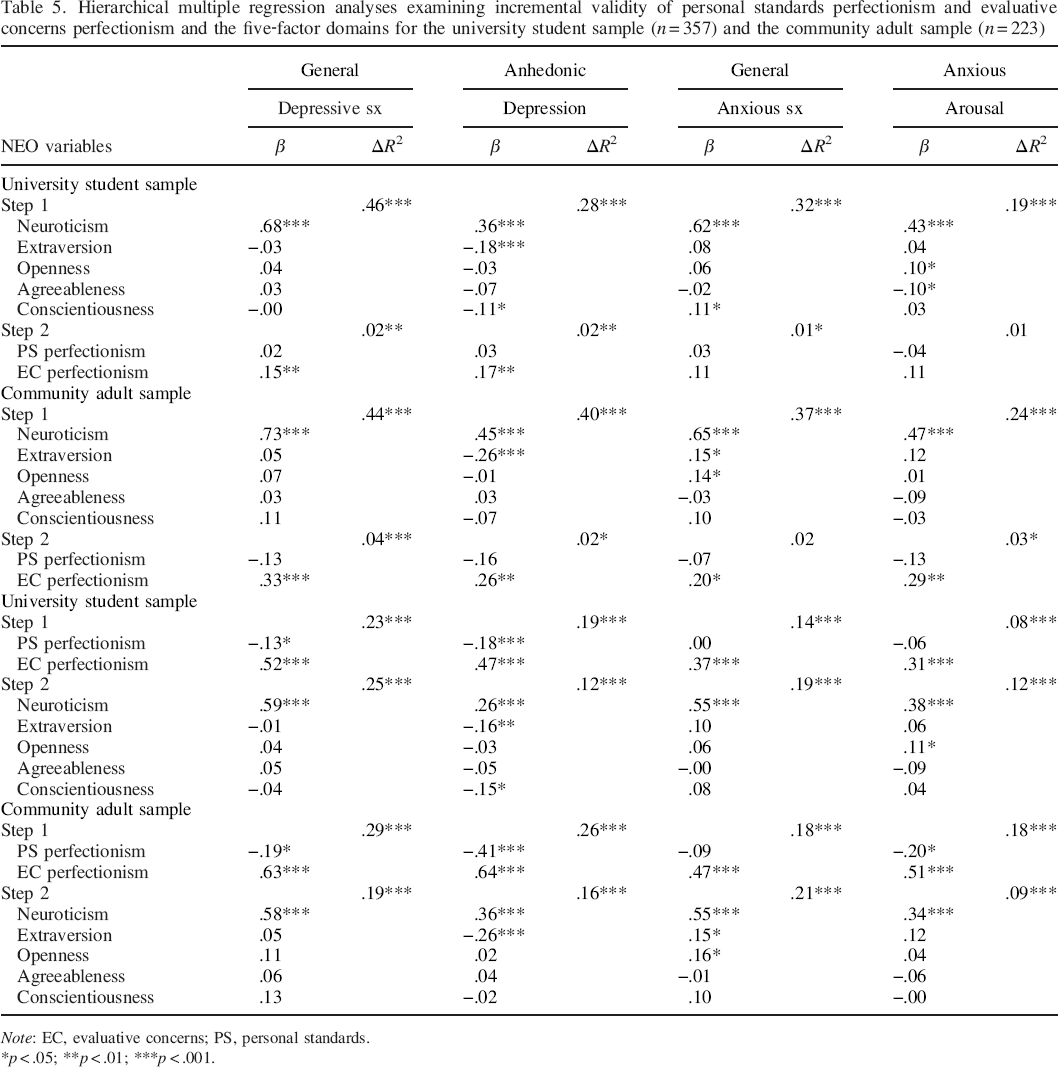
Hierarchical regression analyses examined the incremental validity of PS perfectionism and EC perfectionism in accounting for unique variance in MASQ general depressive symptoms, anhedonic depression, general anxious symptoms and anxious arousal scores over and above the variance accounted for by the five–factor domain scores in both the university student and community adult samples. In four separate regressions for both samples, the five–factor summary scores were entered in the first block, and the PS perfectionism and EC perfectionism scores were entered in the second block. As shown in Table 5, the five–factor summary scores accounted for large amounts of variance in predicting general depressive symptoms (46%, 44%), anhedonic depression (28%, 40%), general anxious symptoms (32%, 37%) and anxious arousal (19%, 24%) for university students and community adults, respectively. Neuroticism was the only consistent unique predictor within the first block across the four measures of depressive and anxious symptoms. The subsequent entry of PS perfectionism and EC perfectionism in the second block accounted for significant incremental variance in general depressive symptoms (2%, 4%) and anhedonic depression (2%, 2%) for both university students and community adults, and significant incremental variance in general anxious symptoms (1%) for university students only and anxious arousal (3%) for community adults only. EC perfectionism was the only unique predictor within the second blocks in relation to general depressive symptoms and anhedonic depression for both university students and community adults, and in relation to general anxious symptoms and anxious arousal for community adults (see Table 5).
Hierarchical multiple regression analyses examining incremental validity of personal standards perfectionism and evaluative concerns perfectionism and the five–factor domains for the university student sample (n = 357) and the community adult sample (n = 223)
Note: EC, evaluative concerns; PS, personal standards.
p < .05;
p < .01;
p < .001.
Conversely, we examined the incremental validity of the five–factor summary scores in accounting for unique variance in depressive and anxious symptoms over and above the PS perfectionism and EC perfectionism scores. In four separate regressions for both samples, the PS perfectionism and EC perfectionism scores were entered in the first block, and the five–factor summary scores were entered in the second block. As shown in Table 5, the subsequent entry of the five–factor summary scores in the second block accounted for significant incremental variance over and above the first block containing PS perfectionism and EC perfectionism in general depressive symptoms (25%, 19%), anhedonic depression (12%, 16%), general anxious symptoms (19%, 21%) and anxious arousal (12%, 9%) for both university students and community adults.
Discussion
The findings of the present study are consistent with convergent theory and previous factor analytic studies (e.g. Blankstein et al., 2008; Suddarth & Slaney, 2001; for reviews, see Dunkley, Blankstein, Masheb, et al., 2006; Stoeber & Otto, 2006), which suggest that personal standards and self–critical evaluative concerns are higher–order dimensions of perfectionism that underlie numerous measures derived from the different research frameworks of Frost et al. (1990), Hewitt and Flett (1991) and Slaney et al. (2001). Factor analyses of the selected PS perfectionism (FMPS personal standards, HMPS self–oriented perfectionism, APS–R high standards) and EC perfectionism (FMPS concern over mistakes, HMPS socially prescribed perfectionism, APS–R discrepancy) measures supported a two–factor model consisting of PS and EC higher–order latent factors of perfectionism over a one–factor unidimensional model of perfectionism in both university students and community adults. As these core PS and EC dimensions can be considered the building blocks of description on which subsequent attempts at explanation of the perfectionism construct can be built (see Dunkley, Blankstein, Masheb, et al., 2006), the present study obtained a more definitive understanding of what the higher–order PS and EC dimensions of perfectionism actually represent by relating them to a comprehensive scheme of personality, the five–factor model.
An important strength of the present study was that we demonstrated the generalizability of the relations of the PS and EC dimensions of perfectionism to the NEO–PI–R five domains and 30 facets across university students and community adults, which provides additional assurance regarding the veracity of the clear distinction between PS and EC dimensions. At the broader level of the five–factor domains, PS perfectionism was clearly distinguished from EC perfectionism in that PS perfectionism was primarily associated with the conscientiousness domain, whereas EC perfectionism was primarily associated with the neuroticism domain and negatively associated with the agreeableness domain in both university students and community adults. These findings are in keeping with the five–factor domains correlates of individual FMPS, HMPS and APS–R PS perfectionism and EC perfectionism measures found in previous studies (Dunkley, Blankstein, Zuroff, et al., 2006; Enns & Cox, 2002; Hill et al., 1997; Rice et al., 2007; Stumpf & Parker, 2000).
To our knowledge, our study was the first to relate the NEO–PI–R 30 facets to the higher–order PS perfectionism and EC perfectionism dimensions. This allowed for a richer, more fine–grained portrait of the distinction between these two dimensions than that previously provided in the extant literature. In relation to the NEO–PI–R 30 facets, both university students and community adults who scored higher on PS perfectionism primarily described themselves as diligent, purposeful and working hard to achieve their goals and aspirations (achievement striving); dominant, forceful and socially ascendant (assertiveness); leading fast–paced lives (activity); and receptive to their own inner feelings and emotions (openness to feelings). In addition, community adults who scored higher on PS perfectionism also uniquely described themselves as willing to consider new ideas (openness to ideas) and neat, tidy and well organized (order). These results are in keeping with the NEO–PI–R 30 facets correlates of HMPS self–oriented perfectionism previously found (Dunkley, Blankstein, Zuroff, et al., 2006; Hill et al., 1997).
In sharp contrast to PS perfectionism, both university students and community adults who scored higher on EC perfectionism primarily described themselves as prone to feelings of sadness, hopelessness and loneliness (depression); less exuberant and high spirited (low positive emotions); tending to accept authority, honour tradition and be generally conservative (low openness to values); cynical and sceptical of others (low trust); often unprepared and inept (low competence); and easily discouraged and eager to quit (low self–discipline). In addition, although university students with higher EC perfectionism also uniquely described themselves as prone to anger, frustration and bitterness (angry hostility) and reluctant to get involved in the problems of others (low altruism), community adults with higher EC perfectionism also uniquely described themselves as sensitive to ridicule and prone to feelings of inferiority (self–consciousness) and formal, reserved and distant in manner (low warmth). These results are in keeping with the NEO–PI–R 30 facets correlates of HMPS socially prescribed perfectionism found in previous studies (e.g. Dunkley, Blankstein, Zuroff, et al., 2006; Hill et al., 1997), as well as the NEO–PI–R 30 facets correlates of other related measures derived from other different theoretical frameworks (Dunkley, Blankstein, & Flett, 1997; Dunkley & Kyparissis, 2008; Dunkley, Sanislow, Grilo, & McGlashan, 2004).
In summary, although Shafran et al. (2002) considered the clinical perfectionism concept to be a unidimensional construct that involves both the determined pursuit of self–imposed standards and extremely vulnerable self–evaluation, the emerging empirical evidence underscores the suggestion that perfectionism is better conceptualized as composed of distinct dimensions (see Dunkley, Blankstein, Masheb, et al., 2006). Our convergent NEO–PI–R findings suggest that the PS higher–order dimension of perfectionism most closely reflects the active perfectionistic striving aspect of the perfectionism construct that has been emphasized in the literature (see Shafran et al., 2002). On the other hand, the EC higher–order dimension of perfectionism most closely reflects the extremely vulnerable self–evaluation and pathological components of perfectionism but does not reflect the determined pursuit of self–imposed standards. Moreover, our results support the contention that EC perfectionism is primarily manifested in an insecure and defensive interpersonal orientation (e.g. mistrust) that maintains a vulnerable and unstable sense of self (see Dunkley, Blankstein, Zuroff, et al., 2006). Considering the clinical application of these findings, clinicians might not focus solely on trying to reduce high standards in treating perfectionists; rather, clinicians might also target these self–critical evaluative tendencies of perfectionism and their dysfunctional aspects (see Dunkley, Blankstein, Masheb, et al., 2006).
Although EC perfectionism was strongly related to neuroticism, the present findings also illustrated that EC perfectionism is a more differentiated construct than the global dimension of neuroticism in that EC perfectionism was also uniquely characterized by lower levels of agreeableness in both university students and community adults. This finding is consistent with previous studies of EC perfectionism indicators and related variables that indicate that EC perfectionism reflects a disagreeable form of neuroticism (e.g. Dunkley et al., 1997; Dunkley, Blankstein, Zuroff, et al., 2006; see Zuroff et al., 2004). The specific associations between the six neuroticism facets and EC perfectionism suggest that EC perfectionism is uniquely related to the depression facet in both university students and community adults, which is also in keeping with previous studies of EC perfectionism indicators and related variables (e.g. Dunkley et al., 1997; Dunkley, Blankstein, Zuroff, et al., 2006; Hill et al., 1997).
Furthermore, we examined whether the main effects of EC perfectionism and PS perfectionism in predicting depressive and anxious symptoms were through shared variance with the five–factor domains (see Coyne & Whiffen, 1995). In hierarchical regression analyses, the five–factor domain scores, in particular neuroticism, was a strong predictor of depressive and anxious symptoms (see Table 5). However, EC perfectionism and PS perfectionism accounted for significant amounts of incremental variance in general depressive symptoms and anhedonic depression scores for both university students and community adults, with EC perfectionism emerging as the unique predictor within the block. EC perfectionism and PS perfectionism and/or EC perfectionism within the block also exhibited unique associations with general anxious symptoms and anxious arousal (for community adults only) after controlling for the five–factor domain scores. Thus, our results provide further support for EC perfectionism as a specific, lower–order trait that has incremental validity over and above higher–order personality traits (e.g. Dunkley, Blankstein, Zuroff, et al., 2006; Zuroff et al., 2004). The negative interpersonal style that individuals with higher EC perfectionism exhibit beyond neuroticism seems a good candidate to explain the incremental predictive validity of EC perfectionism because previous research has found the relation between EC perfectionism measures and depressive symptoms to be explained through low levels of perceived social support (e.g. Dunkley, Sanislow, Grilo, & McGlashan, 2009; Dunkley, Zuroff, & Blankstein, 2003).
There are limitations of the present study and areas that warrant attention in future research. First, our findings were based on self–report measures. Thus, replication with other methods of data collection (e.g. daily diaries, observer ratings) would be beneficial. Second, the data for this study were collected concurrently. Longitudinal studies would be useful to demonstrate the differential effects of PS and EC dimensions of perfectionism over time. Finally, the generalizability of the present results should be examined in other relevant populations (e.g. highly gifted people) and in clinical populations.
In conclusion, the present study provides further support for personal standards and self–critical evaluative concerns higher–order dimensions of perfectionism, which cut across numerous measures derived from separate theoretical frameworks (e.g. Frost et al., 1990; Hewitt & Flett, 1991; Slaney et al., 2001). Our study provides a richer and more definitive understanding of what the PS and EC higher–order dimensions of perfectionism represent by locating these dimensions within a comprehensive scheme of personality provided by the NEO–PI–R in both university students and community adults. Moreover, our findings indicate that EC perfectionism is clearly distinguishable from neuroticism in terms of a disagreeable interpersonal style, a specific negative emotional trait (i.e. depression) and current depressive symptoms.
Footnotes
Acknowledgements
This research was supported by Social Sciences and Humanities Research Council of Canada Standard Research Grants awarded to the first and second authors, a Fonds de la Recherche en Santé du Québec Bourses de Chercheurs–Boursiers awarded to the first author and a University of Toronto at Mississauga Internal Research Grant awarded to the second author.
1
Cohen's (1992) criteria for weak (r = .10), moderate (r = .30) and strong (r = .50) effect sizes are used to describe the strength of zero–order correlations.