







Abstract
Recent research on men's dominance perception suggests that the extent to which men perceive masculine men to be more dominant than relatively feminine men is negatively correlated with measures of their own dominance. In the current studies, we investigated the relationship between indices of women's own dominance and their perceptions of other women's facial dominance. Women's own height and scores on a dominance questionnaire were negatively correlated with the extent to which they perceived masculine women to be more dominant than relatively feminine women. In follow–up studies, we observed similar individual differences when (i) women separately judged other women's social and physical dominance, suggesting that individual differences in women's dominance perceptions generalize across two different types of dominance judgment and (ii) we assessed the perceivers’ dominance indirectly by using a questionnaire that measures the extent to which women view interactions with other women in competitive terms. These findings present new evidence that the extent to which people perceive masculine individuals to be more dominant than relatively feminine individuals is negatively correlated with measures of their own dominance and suggest that competition and conflict among women may have shaped individual differences in women's dominance perception. Copyright © 2011 John Wiley & Sons, Ltd.
Introduction
Masculine facial characteristics are positively correlated with indices of men's dominance, including measures of physical strength (Fink, Neave, & Seydel, 2007; see also Sell et al., 2009, and Undurraga et al., 2010), reproductive potential (Rhodes, Simmons, & Peters, 2005) and social status (Mueller & Mazur, 1996). Masculine facial characteristics are also positively correlated with men's baseline testosterone levels (Penton–Voak & Chen, 2004; Roney, Hanson, Durante, & Maestripieri, 2006), testosterone responses to competitive interactions (Pound, Penton–Voak, & Surridge, 2009) and indices of prenatal testosterone exposure (Fink et al., 2005; Neave, Laing, Fink, & Manning, 2003). Consistent with these findings linking masculine facial characteristics to indices of men's dominance, many studies have now demonstrated that masculine versions of men's faces are perceived to be more dominant than feminine versions (for a comprehensive review, see Watkins, Fraccaro, et al., 2010). Collectively, these data suggest that masculine characteristics in men's faces signal dominance (for recent reviews, see Puts, 2010, and Watkins, Fraccaro, et al., 2010).
Aggressive conflict among men can be extremely costly, potentially resulting in serious injury and/or loss of resources (see, e.g. Manson & Wrangham, 1991; Sell et al., 2009). Thus, men's perceptions of other men's dominance may function, at least in part, to reduce the costs of aggressive conflict (Puts, Gaulin, & Verdolini, 2006; Puts, Hodges, Cardenas, & Gaulin, 2007; Watkins, Fraccaro, et al., 2010; see also Sell et al., 2009). However, it may be adaptive for low–dominance men to demonstrate a greater tendency to perceive masculine men to be more dominant than relatively feminine men if less dominant men are more likely to incur substantial costs (e.g. serious injury or loss of resources) should they underestimate the difference in dominance between masculine and feminine potential rivals (Watkins, Fraccaro, et al., 2010; Watkins, Jones, & DeBruine, 2010). Consistent with this proposal, recent research by Watkins and colleagues (Watkins, Fraccaro, et al., 2010; Watkins, Jones, et al., 2010) found that the extent to which men perceived masculinized versions of other men's faces to be more dominant than feminized versions was negatively correlated with men's own height, a well–established index of male dominance (Buunk, Park, Zurriaga, Klavina, & Massar, 2008), and also with their scores on the dominance scale of the international personality item pool (IPIP; http://ipip.ori.org/ipip/; Goldberg, 1999), a questionnaire that assesses the extent to which individuals dominate their peers during social interactions. Complementing these findings, other research suggests that taller men report less jealousy when they imagine their romantic partner flirting with a physically dominant rival than do shorter men (Buunk et al., 2008). Although these findings are consistent with the proposal that less dominant men demonstrate a greater tendency to perceive masculine men to be more dominant than relatively feminine men, another recent study by Wolff and Puts (2010) did not observe any significant correlations between indices of men's own dominance (e.g. self–rated dominance, physical aggressiveness) and the extent to which they perceived masculinized versions of men's voices to be more dominant than feminized versions.
The vast majority of research on dominance perception has focused on men's perceptions of other men's dominance and the role of male–male aggressive conflict in sexual selection (for reviews, see Puts, 2010, and Watkins, Fraccaro, et al., 2010). However, aggressive conflict is a prominent feature of female–female interactions in some non–human animals, including various non–human primates (e.g. Hohmann & Fruth, 2003; Watts, 1994) and bird species (e.g. Cristol & Johnsen, 1994; Johnson, 1988; Owens, Burke, & Thompson, 1994). There is some good evidence that the importance of dominance and aggressive conflict and/or competitiveness among women may be underestimated in the human dominance literature (Buunk et al., 2008; Cashdan, 1998). For example, violence among women has been widely documented in societies where there is reduced access to high–quality men (Campbell, 1995; Schuster, 1983, 1985) and in areas with poor socio–economic conditions (Ness, 2004). Additionally, Burbank (1987) found that women would fight with other women for access to resources, such as mates, in over 60% of 137 different cultures. Thus, perceptions of dominance may play a role in within–sex competition among women. Indeed, although aggressive conflict among women is less common than among men, the costs of aggressive conflict for women may well be greater than they are for men (for a discussion, see Archer, 2009, and Campbell, 1999).
Consistent with the proposal that dominance may play a role in within–sex competition among women, observers can accurately judge the strength and fighting ability of women from their facial cues alone (Sell et al., 2009). This finding may, at least partly, reflect the positive correlation between perceptions of women's facial masculinity and perceptions of their physical strength (Jones, DeBruine, et al., 2010). Additionally, women perceive masculinized versions of other women's faces and voices to be more dominant than feminized versions (Jones, DeBruine, et al., 2010; Jones, Feinberg, DeBruine, Little, & Vukovic, 2010; Perrett et al., 1998), and women's facial masculinity is positively correlated with their scores on the dominance scale of the IPIP (Quist, Watkins, Smith, DeBruine, & Jones, 2011). Although recent research has suggested that indices of men's own dominance predict individual differences in the extent to which they attribute greater dominance to masculine than feminine men (Watkins, Fraccaro, et al., 2010; Watkins, Jones, et al., 2010), no studies have yet tested for corresponding correlations between indices of women's own dominance and their perceptions of the dominance of masculine versus feminine women. Such tests may present converging evidence that differential costs of inaccurate dominance perception have shaped adaptive variation in perceptions of the dominance of rivals. Perhaps more importantly, they would also extend previous findings for individual differences in men's dominance perception to women's perceptions of rivals’ dominance.
In light of the previous paragraph, in Study 1, we investigated the relationship between the extent to which women perceived masculinized versions of women's faces to be more dominant than feminized versions, and both their own height and their scores on the dominance scale of the IPIP (Goldberg, 1999). We chose these individual difference measures in order to parallel previous work on potentially adaptive variation in men's dominance perception (Watkins, Fraccaro, et al., 2010; Watkins, Jones, et al., 2010). Height is likely to be a good index of women's dominance because it is positively correlated with their upper body strength (Angst et al., 2010), perceptions of their assertiveness (Chu & Geary, 2005) and both their workplace success and income (for a meta–analytic review, see Judge & Cable, 2004). Indeed, Buunk et al. (2008) recently found that taller women were less jealous of physically dominant rivals, potentially reflecting greater dominance among taller women.
Following previous work on men's dominance perceptions (Watkins, Fraccaro, et al., 2010; Watkins, Jones, et al., 2010), we predicted that women's height and scores on the dominance scale of the IPIP would be negatively correlated with the extent to which they perceived masculinized versions of women's faces to be more dominant than feminized versions. Because some prior research on dominance perception has emphasized a possible distinction between social and physical dominance, whereby perceptions of physical dominance are more closely linked to masculine characteristics than are perceptions of social dominance (e.g. Puts et al., 2006; Watkins, Jones, et al., 2010), we conducted a second study (Study 2) to compare individual differences in the extent to which women ascribe high dominance to masculinized versus feminized faces when judging women's physical and social dominance, separately.
Finally, in Study 3 we investigated the relationship between the degree to which women tended to view interactions with other women in competitive terms (assessed using an intrasexual competition questionnaire; Buunk & Fisher, 2009) and the extent to which they perceived masculinized versions of women's faces to be more dominant than feminized versions. Previous research on individual differences in jealousy suggests that low–dominance women are more likely to view other women in competitive terms (Buunk et al., 2008). Consequently, we predicted that the extent to which women attributed greater dominance to masculine than feminine women would be positively correlated with their scores on the intrasexual competition questionnaire.
Study 1
Methods
Participants
Heterosexual women (n = 119, mean age = 19.7 years, SD = 1.91 years) took part in the study. All participants were undergraduate students at the University of Aberdeen, who were participating in the study in return for course credit.
Face stimuli
Following previous studies of systematic variation in perceptions of masculine versus feminine faces (DeBruine, Jones, Smith, & Little, 2010; DeBruine et al., 2006; Jones et al., 2007; Welling et al., 2007, 2008), we used prototype–based image transformations to objectively manipulate sexual dimorphism of 2D shape in face images.
Here, 50% of the linear differences in 2D shape between symmetrized versions of the male and female prototypes were added to or subtracted from face images of 10 young White adult women. This process creates masculinized and feminized versions of the individual face images that differ in sexual dimorphism of 2D shape and that are matched in other regards (e.g. identity, skin colour and texture; Rowland & Perrett, 1995). Examples of masculinized and feminized face images are shown in Figure 1. The symmetrized male and female prototypes used to manipulate individual face images were manufactured by averaging the shape and colour information from 20 young adult White male faces and 20 young adult White female faces, respectively, and then warping each prototype into a perfectly symmetric shape (see, e.g. Jones et al., 2007; Welling et al., 2007, 2008).
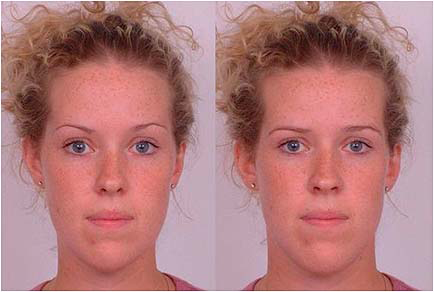
Examples of feminized (left column) and masculinized (right column) women's faces used in the study.
This process created 10 pairs of female images in total, each pair consisting of a masculinized and a feminized version of the same individual. Previous studies have demonstrated that this method for manipulating masculinity of 2D face shape affects perceptions of facial masculinity in the predicted manner (DeBruine et al., 2006; Jones et al., 2007; Welling et al., 2007, 2008).
Procedure
The methods that we used to assess perceptions of masculinized versus feminized faces have been used in many previous studies (e.g. Jones et al., 2007; Welling et al., 2007, 2008). Participants were shown the 10 pairs of faces (each pair consisting of a masculinized and feminized versions of the same woman) and were instructed to indicate which face in each pair looked more dominant. They were also instructed to indicate how much more dominant they thought the chosen face was (relative to the other face in the pair) by choosing from the options ‘much more dominant’, ‘more dominant’, ‘somewhat more dominant’ and ‘slightly more dominant’. The order in which these pairs of faces were shown was fully randomized, as was the side of the screen on which the masculinized and feminized versions were presented.
In addition to completing the dominance perception test, participants were also instructed to complete the dominance scale of the IPIP (http://ipip.ori.org/ipip/; Goldberg, 1999), which assesses the extent to which respondents dominate their peers during social interactions. Participants indicate how accurately each of 11 statements (e.g. ‘I impose my will on others’) describes them by choosing from the options ‘very accurate’, moderately accurate’, ‘neither accurate nor inaccurate’, ‘moderately inaccurate’ and ‘very inaccurate’. The mean score on this questionnaire was 28.2 (SD = 6.75), and high scores indicate high dominance. The internal consistency of responses on the dominance questionnaire was high (Cronbach's alpha = .81). Four women elected not to complete the dominance questionnaire or gave incomplete responses. Consequently, they were not included in the analyses involving the dominance scale.
Participant height was also measured to the nearest 5 mm (M = 166.8 cm, SD = 5.76 cm). Six women elected not to have their height measured. Consequently, they were not included in the analyses involving height.
The order in which participants completed the face perception test and the dominance questionnaire and had their height measured was randomized across participants.
Initial processing of data
Following Watkins, Fraccaro, et al. (2010), responses on the dominance perception test were coded using the following scale:
0 = feminized face judged much more dominant than masculinized face
1 = feminized face judged more dominant than masculinized face
2 = feminized face judged somewhat more dominant than masculinized face
3 = feminized face judged slightly more dominant than masculinized face
4 = masculinized face judged slightly more dominant than feminized face
5 = masculinized face judged somewhat more dominant than feminized face
6 = masculinized face judged more dominant than feminized face
7 = masculinized face judged much more dominant than feminized face
The internal consistency of responses on the facial dominance perception test was high (Cronbach's alpha = .80). For each participant, we calculated her average score on the dominance perception test. One participant whose score was more than 3 standard deviations from the mean for the sample was excluded from the data set at this point (i.e. was not included in any subsequent analyses).
Results
Because all variables were normally distributed (all Kolmogorov–Smirnov Z < 1.01, all p > .25), parametric tests were used for all analyses. Two–tailed p–values are reported for all analyses.
First, we used a one–sample t–test to compare scores for women's faces with what would be expected by chance alone (i.e. 3.5). This test showed that women perceived the masculinized versions of women's faces to be significantly more dominant than the feminized versions (t(117) = 6.43, p < .001; M = 4.00, SEM = 0.08).
Next, we tested for significant negative correlations between women's scores on the face perception test and both their scores on the dominance scale of the IPIP and their height. Women's scores on the dominance scale were negatively correlated with the extent to which they perceived masculinized versions of women's faces to be more dominant than feminized versions (r = −.20, n = 114, p = .035; Figure 2). Although taller women were less likely to perceive masculinized versions of women's faces to be more dominant than feminized versions, this correlation only approached significance (r = −.18, n = 112, p = .052; Figure 3). There was no significant relationship between women's height and their scores on the dominance scale of the IPIP (r = .10, n = 109, p = .30).
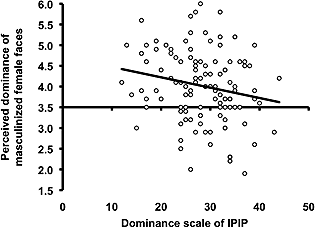
The significant negative relationship between women's scores on the dominance scale of the IPIP and the extent to which they perceived masculinized versions of women's faces to be more dominant than feminized versions in Study 1 (r = −.20, n = 114, two–tailed p = .035). On the y–axis, 3.5 is chance.
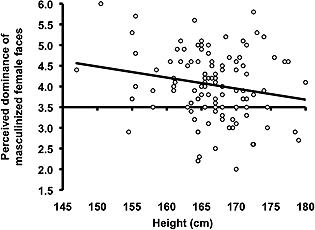
The negative relationship between women's height and the extent to which they perceived masculinized versions of women's faces to be more dominant than feminized versions in Study 1 (r = −.18, n = 112, two–tailed p = .052). On the y–axis, 3.5 is chance.
Study 2
Methods
The stimuli and methods used to assess perceptions of masculinized versus feminized versions of women's faces were identical to those used in Study 1, except that participants were asked which face in each pair looked more socially dominant and, in a separate block of trials, which face in each pair looked more physically dominant. Trial order and the side of the screen on which any given image was shown were fully randomized, and social and physical dominance judgments were made in separate, randomly ordered blocks of trials. Each participant also completed the dominance scale of the IPIP (M = 29.5, SD = 7.87; Cronbach's alpha = .85). The order in which women completed the questionnaire and face perception tests was randomized among participants.
Socially and physically dominant individuals were defined for participants by using descriptions adapted from Puts et al. (2006) and as used by Watkins, Jones, et al. (2010). Physically dominant individuals were described as ‘someone who would be likely to win a fistfight with another person of the same sex’, and socially dominant individuals were described as ‘someone who tells other people what to do, is respected, influential, and often a leader’.
The study was run online, and 177 women (mean age = 21.4 years, SD = 4.38 years) participated. Previous research, including studies of dominance perception, suggests that online studies produce patterns of results for face perception that are virtually identical to those obtained in laboratory–based studies (e.g. Jones et al., 2007; Main, Jones, DeBruine, & Little, 2009; Senior, Barnes, et al., 1999; Senior, Philips, Barnes, & David, 1999). Responses were coded, and average scores were calculated as in Study 1, except that separate scores for social and physical dominance were calculated for each woman. All variables were normally distributed (all Kolmogorov–Smirnov Z < 1.04, all p > .23). The internal consistency of responses on the facial dominance perception tests was high in both conditions (Cronbach's alphas: physical dominance = .87 and social dominance = .88).
Results
Two–tailed p–values are reported for all analyses. One–sample t–tests comparing scores with what would be expected by chance alone (i.e. 3.5) showed that women perceived masculinized versions of women's faces to be more physically dominant than feminized versions (t(176) = 15.49, p < .001; M = 4.62, SEM = 0.07) but perceived feminized versions of women's faces to be more socially dominant than masculinized versions (t(176) = −2.71, p = .007; M = 3.26, SEM = 0.09).
Scores were further analysed using ANCOVA [within–subjects factor: dominance judgment (physical, social); covariate: dominance scale]. This analysis revealed a main effect of dominance judgment (F(1,175) = 8.44, p = .004), reflecting the stronger tendency to ascribe high dominance to masculinized women than feminized women when judging physical dominance than when judging social dominance (see one–sample t–tests discussed in the previous paragraph). There was also a significant main effect of dominance scale (F(1,175) = 4.44, p = .037), whereby, irrespective of the type of dominance judgment, women with higher scores on the dominance scale were less likely to ascribe high dominance to masculinized women (r = −.16, p = .037; Figure 4). The interaction between dominance scale and dominance judgment was not significant (F(1,175) = 0.15, p = .70). Repeating this analysis with participant age as an additional covariate did not alter the pattern of significant results.
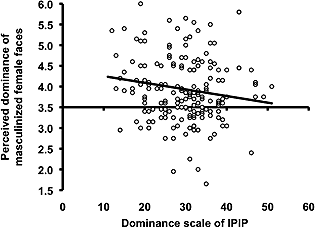
The significant negative relationship between women's scores on the dominance scale of the IPIP and the extent to which they perceived masculinized versions of women's faces to be more dominant than feminized versions in Study 2 (r = −.16, n = 177, two–tailed p = .037). On the y–axis, 3.5 is chance.
Study 3
Methods
Seventy–five women, all of whom were undergraduate students at the University of Aberdeen, participated in the study in return for course credit (mean age = 20.53 years, SD = 3.41 years). None of these women had participated in Study 1. Individual differences in women's perceptions of masculinized versus feminized versions of women's faces were assessed using the dominance perception test and scoring conventions that we had previously used for Study 1. Individual differences in women's intrasexual competitiveness were assessed using a questionnaire developed for this purpose by Buunk and Fisher (2009) (see also Buunk, Pollet, Klavina, Figueredo, & Dijkstra, 2009). This questionnaire consists of 12 items (e.g. ‘I just don't like very ambitious women’). Women indicate how applicable each item is to them using a 1 (not at all applicable) to 7 (completely applicable) scale. The average score on the scale was 2.85 (SD = 0.98), and high scores indicate high competitiveness. The internal consistency of responses on the questionnaire and facial dominance perception test was high (Cronbach's alphas: competition questionnaire = .86 and facial dominance perception test = .86). Like Study 1, Study 3 was conducted in the laboratory.
Results
All variables were normally distributed (all Kolmogorov–Smirnov Z < 0.96, all p > .32). Two–tailed p–values are reported for all analyses, except those testing for correlations between competitiveness and dominance perceptions. For those analyses, we report one–tailed p–values because of the strong directional prediction based on the previous studies’ findings. First, we used a one–sample t–test to compare scores for women's faces with what would be expected by chance alone (i.e. 3.5). This test showed that women perceived the masculinized versions of women's faces to be significantly more dominant than the feminized versions (t(74) = 4.19, p < .001; M = 3.98, SEM = 0.12).
Next, we tested for significant negative correlations between women's scores on the face perception test and their scores on Buunk and Fisher's (2009) intrasexual competition questionnaire. Women's scores on the intrasexual competition questionnaire were positively correlated with the extent to which they perceived masculinized versions of women's faces to be more dominant than feminized versions (r = .22, n = 75, one–tailed p = .030; Figure 5). Because older women tended to score lower on the intrasexual competition questionnaire (r = −.20, n = 75, two–tailed p = .08), we repeated the initial analysis using a partial correlation to control for the possible effects of participant age. This analysis also revealed a relationship between women's scores on the face perception test and their scores on the intrasexual competition questionnaire (partial r = .22, one–tailed p = .029).
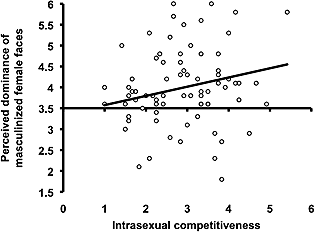
The significant relationship between women's scores on Buunk and Fisher's (2009) intrasexual competition questionnaire and the extent to which they perceived masculinized versions of women's faces to be more dominant than feminized versions in Study 3 (r = .22, n = 75, one–tailed p = .030). On the y–axis, 3.5 is chance.
Discussion
Consistent with previous research (Jones, DeBruine, et al., 2010; Main et al., 2009; Perrett et al., 1998), women in Study 1 perceived masculinized versions of women's faces to be more dominant than feminized versions. However, in Study 1, we also observed systematic variation in women's perceptions of the dominance of masculinized versus feminized versions of women's faces; women's scores on the dominance scale of the IPIP were negatively correlated with the extent to which they attributed greater dominance to masculinized versus feminized versions of women's faces. Additionally, a similar negative correlation was observed between women's height and the extent to which they attributed greater dominance to masculinized than feminized women, although this relationship only approached significance (two–tailed p = .052). Collectively, these results complement previous research by Watkins and colleagues (Watkins, Fraccaro, et al., 2010; Watkins, Jones, et al., 2010) in which men's scores on the dominance scale of the IPIP and their own height were negatively correlated with the extent to which they attributed greater dominance to masculinized than feminized versions of men's faces. Study 1's findings also complement Buunk et al. (2008), who found that shorter women and men reported greater jealousy when imagining their partner flirting with a dominant rival. The perception of a greater difference in dominance between masculinized and feminized versions of female faces among low–dominance women may reflect the greater costs incurred by low–dominance individuals if they incorrectly assess the relative dominance of potential rivals (Watkins, Fraccaro, et al., 2010; Watkins, Jones, et al., 2010).
Consistent with previous research on perceptions of men's dominance (Watkins, Jones, et al., 2010; see also Puts et al., 2006), Study 2 indicated that women perceived masculinized versions of women's faces to be more physically dominant than feminized versions. However, women perceived feminized versions of women's faces to be more socially dominant than masculinized versions (for a similar finding when men judged women's social dominance, see Watkins, Jones, et al., 2010). That feminized women's faces were perceived to be socially dominant, together with research showing very strong correlations between facial femininity and women's attractiveness (for a meta–analytic review, see Rhodes, 2006), suggests that attractiveness may be an important component of perceived social dominance and that, unlike in men (Fink et al., 2007; Puts, 2010), physical dominance is negatively correlated with attractiveness in women. Nonetheless, in Study 2, we found that women with low scores on the IPIP (indicating low dominance) ascribed greater dominance to masculine versus feminine women than did women with relatively high scores on the IPIP (indicating high dominance), irrespective of whether they were judging social or physical dominance.
In Study 3, we tested for converging evidence for a link between women's own dominance and the extent to which they attributed greater dominance to masculine than feminine women. Previous research on individual differences in jealousy suggests that low–dominance women are more likely to view interactions with other women in competitive terms (Buunk et al., 2008), suggesting that the degree to which women view interactions with other women in competitive terms may be a proxy for their dominance. Consistent with both this proposal and our earlier findings, we found that women with higher scores on an intrasexual competition questionnaire (Buunk & Fisher, 2009) tended to attribute high dominance more strongly to masculinized versus feminized versions of women's faces. A tendency for more competitive women to perceive greater differences between the dominance of masculine and feminine women could function to minimize the costs of incorrectly assessing the relative dominance of potential rivals in women who are particularly prone to engage in within–sex competition. Indeed, other recent studies have presented evidence for adaptations in women that also appear to function to reduce the costs of potential conflict with intimidating rivals (Rucas, Gurven, Kaplan, & Winking, 2010).
Although Study 2's findings suggest that the individual differences in women's perceptions of other women's dominance that we observed in Study 1 and Study 3 reflect variation in impressions of both women's physical and social dominance, it is less clear whether women's own physical dominance, social dominance, or both, are important predictors of variation in the extent to which women ascribe high dominance to masculine women. Although height is positively correlated with some indices of social dominance in women (e.g. workplace success; Judge & Cable, 2004), it is likely that it is primarily an index of men's and women's physical dominance (see also Buunk et al., 2008, and Watkins, Fraccaro, et al., 2010). By contrast, the dominance scale of the IPIP is ostensibly an index of social dominance (Watkins, Jones, et al., 2010), although it is correlated with women's facial masculinity (Quist et al., 2011). In our sample of women in Study 1, the correlation between women's height and their scores on the dominance questionnaire was not significant. Thus, it is possible that women's dominance sensitivity is predicted by both their physical and their social dominance. Women with low physical dominance may benefit from overestimating the difference in dominance between masculine and feminine women because they will fare relatively poorly in aggressive conflict with masculine rivals. Additionally, women with low social dominance may benefit from overestimating the difference in dominance between masculine and feminine women if they are less likely to have formed strong alliances with other physically dominant women, as is the case among female non–human primates (e.g. Chapais, 1992) and has been previously suggested for men's dominance perception (Watkins, Jones, et al., 2010). Further research investigating how social and physical dominance predict alliances and social relationships among women is likely to be a fruitful topic for research in the future. Indeed, using measures of dominance that are more clearly related to physical dominance specifically (e.g. measures of muscularity and strength) may help to clarify some of these issues.
A further unresolved issue from our work relates to the nature of the paradigm that we used to assess participants’ perceptions of others’ dominance. In our studies, participants assessed the dominance of masculinized versus feminized versions of faces, providing us with a score that reflects the extent to which masculinized individuals were perceived as more dominant than feminized individuals. A strength of this method is that it ensures that our dependent variable indicates the relative perceived dominance of masculine and feminine individuals, rather than reflecting the dominance of potential rivals as assessed relative to oneself (as may be the case when stimuli are rated individually, Wolff & Puts, 2010). However, an important limitation of our method is that the resultant dependent variable cannot resolve whether low–dominance individuals overestimate the dominance of masculine rivals or underestimate the dominance of feminine rivals.
In summary, we found that two indices of women's own dominance (height and scores on a dominance questionnaire) were negatively correlated with the extent to which they attributed dominance to masculinized versus feminized versions of women's faces (Studies 1 and 2). We also found that women who reported being particularly likely to view interactions with other women in competitive terms, and who previous research suggests are likely to be low dominance (Buunk et al., 2008), were more likely to attribute higher dominance to masculine than feminine women (Study 3). Collectively, these findings complement those reported in previous research on systematic variation in men's perceptions of men's dominance (Watkins, Fraccaro, et al., 2010; Watkins, Jones, et al., 2010) and in work on individual differences in men's and women's jealousy of dominant rivals (Buunk et al., 2008). A stronger tendency for low–dominance individuals to perceive a greater difference in dominance between masculine and feminine women may reflect greater costs (e.g. injury and/or loss of resources) incurred by low–dominance individuals if they incorrectly assess the relative dominance of potential rivals. Although most previous research on dominance has focussed on adaptations that were shaped by aggressive conflict among men (for recent reviews, see Puts, 2010, and Watkins, Fraccaro, et al., 2010), our new findings suggest that aggressive conflict among women may also have shaped adaptive responses to cues of other women's dominance.