







Abstract
Toxoplasmosis is associated with specific differences in the personality of infected subjects relative to non–infected subjects. These differences are usually considered to be a side effect of the manipulative activity of the parasite aimed to increase the probability of its transmission from the intermediate host to the definitive host by predation. The personality of infected subjects was studied mostly using the Cattell's questionnaire. However, this questionnaire is now considered outdated and has been mostly substituted with the Neuroticism–Extraversion–Openness Personality Inventory—Revised (NEO–PI–R) questionnaire in clinical practice. Here, we searched for the association between toxoplasmosis and the personality by screening a population of students with the NEO–PI–R questionnaire. We found that Toxoplasma–infected male and female students had significantly higher extraversion and lower conscientiousness. The conscientiousness negatively correlated with the length of infection in men, which suggested that the toxoplasmosis associated differences were more probably the result of slow cumulative changes induced by latent toxoplasmosis, rather than transient side effect of acute Toxoplasma infection. The existence of this correlation also supported (but of course not proved) the hypothesis that Toxoplasma infection influenced the personality, rather than the hypothesis that the personality influenced the probability of the infection. Copyright © 2011 John Wiley & Sons, Ltd.
Introduction
Toxoplasma gondii is a coccidian parasite that uses practically any warm–blooded animals including humans as secondary hosts and felids as definitive hosts. In humans, the prevalence of infection reaches about 30% in the Czech Republic and up to 60% in several European countries. Mostly, infected people are unaware of the fact that they are infected. After a short phase of acute infection, the parasitosis turns to the latent stage, which in medical terms is considered asymptomatic and is life–long.
Experimental infection with Toxoplasma is known to influence the behaviour of mice and rats (for a review, see Webster, 2001, 2007). Humans with latent toxoplasmosis differ from Toxoplasma–free subjects in behaviour in ethological experiments including experimental games (Lindová et al., 2006, 2007) and in personality profile measured with personality questionnaires (Flegr, Novotná, Fialová, Kolbeková, & Gašová, 2010). Most psychological data in toxoplasmosis research were collected using Cattell's 16PF questionnaire, fourth edition (Cattell, 1970), translated and standardized for the Czech population by Říčan (1975) in the 1990s (Flegr, 2007). Specifically, Flegr et al. (1996) studied 443 biology students and professors (69 men and 44 women infected by Toxoplasma) and found higher affectothymia (factor A, warmth) and lower protension (factor L, low vigilance) in seropositive women and lower superego strength (factor G, low conscientiousness), higher protension (factor L, vigilance) and higher guilt proneness (factor O, apprehension) in infected men, all relative to seronegative subjects. Factors A (affectothymia, warmth), G (superego strength, conscientiousness), L (protension, vigilance), N (shrewdness, privateness) and Q3 (high strength of self–sentiment, perfectionism) showed a gender–different pattern of Toxoplasma–associated alterations (women had higher A, G and Q3 whereas men exhibited higher L and N relative to uninfected controls; for results of the enlarged sample, see Flegr, Hrdá, & Havlíček, 1999). Although a later study in 191 women (55 infected) failed to confirm some of these differences (Flegr & Havlíček, 1999), the authors found a positive association of toxoplasmosis with B (intelligence) and O (guilt proneness) and higher variance in factors L and Q3 in Toxoplasma–infected relative to Toxoplasma–free subjects. Another study (Flegr, Kodym, & Tolarová, 2000) found a positive correlation between the length of toxoplasmosis and factors G and Q3 in 230 women diagnosed with acute toxoplasmosis 2–13 years before the study and a negative correlation between the anti–Toxoplasma antibodies titre (proxy for the length of toxoplasmosis) and factors A, F (surgency, liveliness), G, H (parmia, social boldness) and L in Toxoplasma–infected women. This effect was relatively strong—the effect size estimated with the tau of Kendall non–parametric correlation test was 0.21–0.27 for particular factors.
In addition to the 16PF questionnaire, Cloninger's Temperament and Character Inventory has been used to study the association between toxoplasmosis and personality. Skallová et al. (2005) found lower levels of novelty seeking in Toxoplasma–infected women compared with Toxoplasma–free women. In terms of the subscales, this was caused mainly by lower extravagance and disorderliness. Lower novelty seeking in infected subjects has also been reported in a large sample of men (military conscripts; Flegr et al., 2003; Novotná et al., 2005). Flegr et al. (2010) have confirmed lower novelty seeking in female blood donors. Their study also found a significant effect of the RhD phenotype–toxoplasmosis interaction on the factors harm avoidance, reward dependence, self–directedness and cooperativeness in men.
The mechanism underlying a possible association between personality, behaviour and toxoplasmosis is unknown. In animals, artificial infection experiments proved that the behavioural alterations associated with toxoplasmosis are induced by the infection. Artificial infection of humans cannot be carried out, and therefore, we have to rely on indirect evidence. It suggests that the observed behavioural differences are induced by toxoplasmosis rather than being responsible for an increased risk of infection in some subjects (for details, see the DISCUSSION section). Although behavioural changes elicited by toxoplasmosis in rodents and other animals have been explained by the manipulatory activity of the parasite aimed to increase the probability of transmission to the definitive host by predation (Holmes & Bethel, 1972), such an assumption does not hold in humans who, of course, are not preyed on by felids at the present time (Webster, 2001). Therefore, other theories have been proposed, which consider psychological and behavioural changes in toxoplasmosis–infected humans as non–specific behavioural responses to toxoplasmosis–induced neurological or endocrinological changes. However, the explanation of the observed behavioural changes by the adaptive manipulation activity of the parasite cannot be completely ruled out because (i) man's animal ancestors were probably hunted by large cats (Zuberbuhler & Jenny, 2002) and (ii) Toxoplasma is not aware of the host where it is located in.
The major aims of the present cross–sectional study were to test whether the personality factor differences associated with latent toxoplasmosis can also be detected by a more standardly used personality questionnaire, the Neuroticism–Extraversion–Openness Personality Inventory—Revised (NEO–PI–R), and to show which of the five personality factors are associated with toxoplasmosis. We also evaluated the correlation between the length of toxoplasmosis (estimated from the concentration of anti–Toxoplasma antibodies) and the amount of the personality factor differences relative to uninfected subjects, which in our view, could indicate that the personality differences between infected and non–infected subjects were rather induced by toxoplasmosis than that pre–existing personality differences influence the probability of infection.
Method
Participants
Undergraduate biology students of the Faculty of Science, Charles University, Prague, were addressed during regular biology lectures and were invited to participate in the study on a voluntary basis. Three hundred and twenty–three students (mean age = 21.53, SD = 2.40) were enrolled in the study and signed an informed consent form. All participants provided 2 ml of blood for serological testing. During a 5–hour testing session, all participants performed the same panel of psychological and behavioural tests, including the NEO–PI–R (Costa & McCrae, 1992) Czech version by Hřebíčková (2001). The students were paid CZK 200–600 ($10–30) for participation in the study, depending on their results (how much they won) in experimental games. The recruitment of the study subjects and data–handling practices complied with the Czech legislation in force, and the study was approved by the IRB Faculty of Science, Charles University.
Immunological tests for toxoplasmosis
All serological tests were carried out in the National Reference Laboratory for Toxoplasmosis, National Institute of Public Health, Prague. All study subjects were screened for specific anti–Toxoplasma IgG antibodies, and those with high IgG levels were tested for IgM antibodies by ELISA (IgG: SEVAC, Prague, Czech Republic; IgM: TestLine, Brno, Czech Republic; optimized for early detection of acute toxoplasmosis) and the complement fixation test (CFT; SEVAC, Prague, Czech Republic), which is more reliable in established (old) T. gondii infections as decrease in CFT titres is more regular (Kodym et al., 2007). Toxoplasma antibody titres in the sera were measured at dilutions between 1:4 and 1:1024. The subjects testing IgM negative by ELISA (positivity index < 0.9) and having CFT titres higher than 1:8 were considered latent toxoplasmosis positive. None of the study subjects had a CFT titre higher than 1:128 or a positivity index for IgM higher than 0.9.
Results
The final sample consisted of 181 Toxoplasma–negative and 30 Toxoplasma–positive female students and 95 Toxoplasma–negative and 17 Toxoplasma–positive male students. The seroprevalence rates of latent toxoplasmosis were 14.2% in women and 15.2% in men. No significant difference was found in the mean age between women (21.56) and men (21.48) (t = 0.283, p = 0.778) or between Toxoplasma–negative (21.53) and Toxoplasma–positive subjects (21.51) (t = 0.059, p = 0.953). Neither the CFT titres nor the concentration of anti–Toxoplasma IgG antibodies significantly correlated with the age of male or female subjects (results not shown).
General linear model (GLM) analyses with sex and toxoplasmosis as independent (binary) variables showed that two of the five personality factors, that is, extraversion and conscientiousness, were associated with Toxoplasma infection (Table 1). The results were approximately the same when the age of subjects was included into the model as a continuous variable (results not shown). The Toxoplasma–sex interactions were not significant for any of the five factors and were only significant for two of 30 facets (Table 2), values (p = 0.018) and straightforwardness (p = 0.012).
Mean Neuroticism–Extraversion–Openness Personality Inventory—Revised personality factors in female and male students and the effect of latent toxoplasmosis
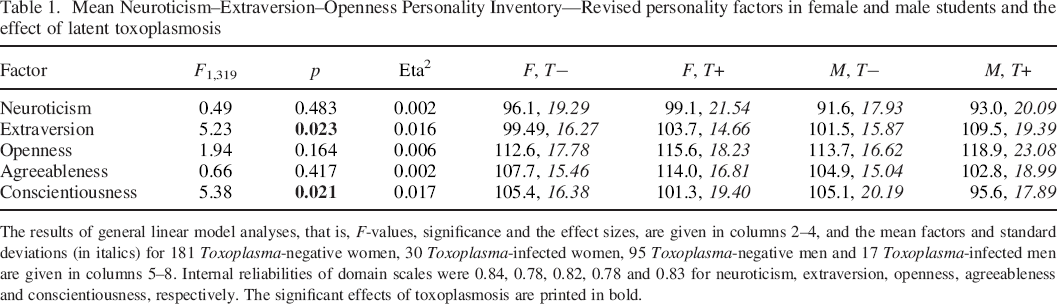
The results of general linear model analyses, that is, F–values, significance and the effect sizes, are given in columns 2–4, and the mean factors and standard deviations (in italics) for 181 Toxoplasma–negative women, 30 Toxoplasma–infected women, 95 Toxoplasma–negative men and 17 Toxoplasma–infected men are given in columns 5–8. Internal reliabilities of domain scales were 0.84, 0.78, 0.82, 0.78 and 0.83 for neuroticism, extraversion, openness, agreeableness and conscientiousness, respectively. The significant effects of toxoplasmosis are printed in bold.
Mean Neuroticism–Extraversion–Openness Personality Inventory—Revised personality facets in female and male students and the effect of latent toxoplasmosis
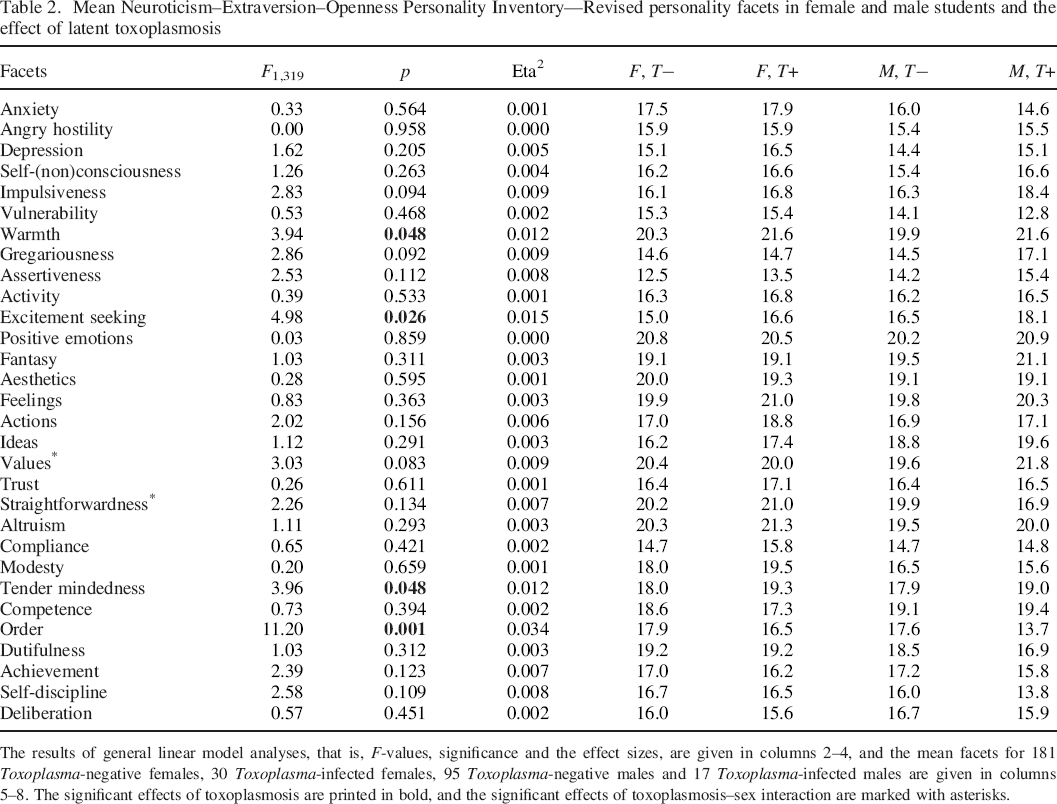
The results of general linear model analyses, that is, F–values, significance and the effect sizes, are given in columns 2–4, and the mean facets for 181 Toxoplasma–negative females, 30 Toxoplasma–infected females, 95 Toxoplasma–negative males and 17 Toxoplasma–infected males are given in columns 5–8. The significant effects of toxoplasmosis are printed in bold, and the significant effects of toxoplasmosis–sex interaction are marked with asterisks.
To compare the toxoplasmosis–personality association in men and women, we performed separate one–tailed test analyses for male and female students. These analyses showed a positive association of toxoplasmosis and agreeableness (p = 0.021, eta2 = 0.020) for women and a positive association of toxoplasmosis and extraversion (p = 0.036, eta2 = 0.029) and a negative association of toxoplasmosis on conscientiousness (p = 0.035, eta2 = 0.030) for men.
The length of the infection in particular subjects is mostly unknown. However, statistically, the concentration of anti–Toxoplasma antibodies decreases with the length of the infection (see Figure 2 in Kodym et al., 2007). Therefore, it is possible to study the correlation between the length of the infection and personality factors by an evaluation of the correlation between the concentration of antibodies and the levels of those personality factors that differ between Toxoplasma–infected and Toxoplasma–free subjects. Partial Kendall correlation with age as a covariate performed separately for men and women showed that the concentration of anti–Toxoplasma antibodies measured with CFT correlated negatively with conscientiousness (partial tau = 0.519, p = 0.005) in men. Partial correlations for extraversion in Toxoplasma–infected men and for extraversion and conscientiousness in Toxoplasma–infected women were non–significant (extraversion: partial tau = −0.121, p = 0.366; conscientiousness: partial tau = −0.129, p = 0.337).
Discussion
Toxoplasma–infected subjects had higher extraversion and lower conscientiousness than Toxoplasma–free subjects. In Toxoplasma–infected men, the length of infection estimated on the basis of CFT titres correlated with low conscientiousness.
In some aspects, the present results are compatible with the reported data obtained using Cattell's 16PF questionnaire in different population samples. Higher extraversion could be considered as corresponding to higher Cattell's factor A (affectothymia, warmth) found previously for women, as Cattell's factor A has been previously found to correlate with several NEO extraversion scales (Gerbing & Tuley, 1991). Indeed, one of the facets that the NEO–PI–R extraversion can be decomposed into is warmth, and this facet is significantly higher in infected individuals in our study (but note that this result would be non–significant after Bonferroni correction for multiple testing). However, Cattell's factor A was found to load rather weakly on the NEO–PI–R extraversion in contrast to factors F (liveliness) and H (social boldness; Rossier et al., 2004). Moreover, the NEO–PI–R facet warmth was found to load comparably strongly, for example, on agreeableness and extraversion (Cattell, 1996; Child, 1998; Conn & Rieke, 1994). Therefore, it is unlikely that the positive association of extraversion with toxoplasmosis might be caused by increased warmth only. In fact, our results show at least one more positive association of latent toxoplasmosis with the extraversion facet excitement seeking (non–significant after Bonferroni correction).
At face value, lower conscientiousness, observed especially in men, corresponds well with lower factor G (conscientiousness) and factor Q3 (perfectionism), sometimes observed in men. However, factor G was found to correlate only moderately with the NEO–PI–R conscientiousness, in contrast to, for example, low factor M (low abstractedness; Rossier et al., 2004). Also, the significantly lower score for infected subjects found in the facet order (p = 0.001) in this study indicates the relatively stronger connection of perfectionism (Q3) with the NEO–PI–R conscientiousness.
The important difference between the present NEO–PI–R personality profile and 16PF personality profiles of infected subjects was that the toxoplasmosis–associated differences relative to Toxoplasma–free subjects in Cattell's personality factors were mostly in opposite directions for men and women, whereas the differences in the NEO–PI–R factors were generally in the same direction for both genders. Specifically, the NEO–PI–R extraversion differs in the same direction (relative to Toxoplasma–free subjects) in both genders in contrast to Cattell's factor A proposed to be comparable with extraversion (see preceding discussion), which was different only in women. It was speculated (Lindová et al., 2006) that these observed differences in the directions of the 16PF factor shifts between men and women might be an artefact of the personality assessment method used (Cattell's 16PF), which made it possible that the subjects conventionalized, endeavoured to appear better than they really were and hid their ‘weaker’ personality traits, where one of the genders (women as proposed) was more prone to such behaviour. Moreover, the 16PF questionnaire, based on 16 primary factors discovered by the factor analysis, faced a variety of criticisms regarding the ability to verify the primary factor level across gender, age and method (Digman, 1990; Eysenck & Eysenck, 1969; Eysenck, 1972). This may also be responsible for the inconsistencies in the toxoplasmosis–personality associations between men and women and between different population samples. More specifically, gender difference concerning Cattell's factor A may be at least partly caused by the relatively lower internal consistency and reliability of the 16PF factor A (Rossier et al., 2004; Lindová et al., 2008). We have to note, however, that there seems to be not a strong theoretical ground for the proposed interpretation of Cattell's 16PF allowing stylization of the subjects in contrast to the NEO–PI–R, because the NEO–PI–R items seem to require at least as much self–assessment as the 16PF (Cattell & Mead, 2008).
The 16PF questionnaire is still widely used in clinical practice in many countries, including the Czech Republic. For experimental purposes, however, it has been mostly abandoned in favour of the questionnaires based on the Big Five model measuring five basic personality traits, namely neuroticism, extraversion, openness, agreeableness and conscientiousness, in the past two decades (Goldberg, 1992; Costa & McCrae, 1992). These five basic dimensions appear repeatedly in broad cross–cultural studies, and even the 16PF itself was modified towards a five–factor model on the second–order level in its fifth edition (Cattell, Cattell, & Cattell, 1993). The higher popularity of the Big Five model is also very likely based on the fact that dealing with five factors is more straightforward than dealing with 16 factors. However, Cattell (Cattell & Mead, 2008) points out that the validity of the Big Five model, which was in fact originally obtained in a factor analysis of 16PF primary factors, can be seriously limited by the statistical methods used to generate it, namely the induced orthogonality of factors by varimax rotation (see also Cattell, 1996). For instance, because of the induced orthogonality, valid personality concepts such as warmth and dominance are being given little credit in the Big Five model. Interestingly also, Depue and Collins (1999) show in their review on extraversion the relative independence of the affiliation (warmth) and agency (social dominance) components of extraversion (and further regard impulsivity as a third component whose association with extraversion they consider as questionable). However, our finding of an association of the biological factor toxoplasmosis with the whole factor extraversion rather than only with specific extraversion facets indicate that extraversion could be viewed as homogeneous with a possible common biological underpinning.
On the other hand, the gender differences found with the use of Cattell's 16PF have been basically confirmed by two behavioural studies. Lindová et al. (2006) have observed a lower tendency to maintain close relationships, a lower tendency towards orderly and responsible behaviour, and lower clothes tidiness in infected men compared with uninfected men. In contrast, infected women were found to behave more orderly and responsible than uninfected women. Moreover, Lindová et al. (2010), using the experimental trust game, have reported infected men compared with uninfected men to repay less money from the amount invested by the opponent back to him or her. The same was not observed for women. Gender difference was also found in the levels of testosterone of infected compared with uninfected subjects, with infected women having lower and infected men having higher levels compared with uninfected controls (Flegr, Lindová, & Kodym, 2008).
Secondly, neither the results obtained with the NEO–PI–R questionnaire revealed identical differences between infected and non–infected subjects in both genders when analysed separately. Interestingly, the higher agreeableness seen in our study for Toxoplasma–infected women only corresponds to lower 16PF factor L (higher trust; Rossier et al., 2004), which was also shown in previous studies for women but not for men (see preceding discussion). In spite of the fact that the main five personality dimensions are associated with toxoplasmosis identically for both genders, the divergences found on lower levels in both the NEO–PI–R and 16PF support the existence of some gender differences in toxoplasmosis–associated personality traits possibly reflecting the variation in biological (e.g., endocrinological) effects of Toxoplasma.
The possible mechanisms of toxoplasmosis–associated differences observed in humans and animals are still unknown. It is highly probable that an increase of dopamine in certain parts of the brain is involved (Flegr et al., 2003; Skallová, Kodym, Frynta, & Flegr, 2006; Hodková, Kodym, & Flegr, 2007; Webster & McConkey, 2010; Vyas & Sapolsky, 2010), which could also explain the strong association between latent toxoplasmosis and schizophrenia (Torrey, Bartko, Lun, & Yolken, 2007; Fekadu, Shibre, & Cleare, 2010). There are, however, also some indices suggesting that toxoplasmosis–associated differences in steroid hormone concentration could play a role in the observed phenomena (Flegr, Hrušková, Hodný, Novotná, & Hanušová, 2005; Flegr, Lindová, & Kodym, 2008; Hodková, Kolbeková, Skallová, Lindová, & Flegr, 2007). The concentration of some steroid hormones (e.g., oestrogen) highly fluctuates during the menstrual cycle. The higher variance of hormone concentration in women relative to men could explain the difficulties in demonstrating the existence of a significant correlation between the length of toxoplasmosis and the level of personality factors in women observed in the present as well as in some other studies (Flegr & Hrdý, 1994).
Theoretically, the association between toxoplasmosis and personality traits could be caused either by an increased probability of Toxoplasma infection in subjects with certain personality profile or by induction of personality changes by toxoplasmosis. However, the former hypothesis has been rejected by several studies showing that the personality alterations increase with the duration of infection (not with age of patients; for a review, see Flegr, 2007). Moreover, it has been shown that Rh–positive subjects are protected against the toxoplasmosis–associated alterations (Flegr et al., 2010). Last but not the least, behavioural differences between infected and non–infected individuals closely related to specific personality differences between infected and non–infected individuals observed in humans, namely the higher scores of novelty seeking, have been proven to exist by experiments on animals where a laboratory infection of rodents was performed (Webster, 2001; Skallová et al., 2006). For obvious reasons, such experimental infection cannot be carried out with humans. A longitudinal prospective study in humans is out of the reach of normal a researcher—due to a low incidence of toxoplasmosis in adult subjects, many thousands of subjects would have to be involved into such a study. Moreover, even a longitudinal study cannot resolve whether the association between toxoplasmosis and the personality profile differences is the result of the influence of toxoplasmosis on the personality profile or the result of the influence of some unknown factor both on the personality profile and on the risk of the Toxoplasma infection. The present cross–sectional study again supports the hypothesis that the observed personality differences were induced by Toxoplasma infection. It was shown that the CFT titres (in contrast to the concentration of specific IgG antibodies measured with ELISA) decreased relatively regularly with the length of latent toxoplasmosis (Kodym et al., 2007). Therefore, the length of Toxoplasma infection in a particular subject can be estimated on the basis of the CFT titres. In the present study, we demonstrated that the score of the personality factor conscientiousness in men was correlated with the length of latent toxoplasmosis. Therefore, the observed personality differences between Toxoplasma–infected and Toxoplasma–free subjects were more probably a result of the cumulative effect of the latent infection rather than some kind of a carryout effect of acute toxoplasmosis. The existence of such correlation in models where the age of subjects is controlled also suggests that the opposite causality direction (increased probability of Toxoplasma infection in, for example, subjects with lower conscientiousness) is less probable. It must be stressed, however, that using cross–sectional observational studies, the question of what is the cause and what is the effect in the Toxoplasma–human system cannot be definitely solved.
The strength of the observed effects (effect size estimated with eta2 in the GLM test and Kandal tau in Kendall correlation test) was relatively low. In the GLM tests, toxoplasmosis explained 2–3% of the variability in particular personality traits. On the other hand, the effect of the length of infection on the score of conscientiousness in men is rather strong: Kendall tau of 0.519 indicates that the probability that among two randomly chosen male students the one with the lower concentration of anti–Toxoplasma antibodies (with probably longer infection) will have a lower conscientiousness score is about 76%. It should be, however, reminded that the real effect size of the associations and correlation is probably stronger as any source of stochastic errors (e.g., any inaccuracies in measurement of the concentration of anti–Toxoplasma antibodies or in measurement of the personality traits) has a negative influence on the estimated strength of the effect. Similarly, the obtained significances are negatively influenced by the fact that the prevalence of toxoplasmosis among Czech students (and in the Czech population in general) is relatively low (Schachter & Chow, 1995). A similar study performed on a population of the same size in some high–prevalence country, for example, in France, in Spain or in any South American or African country, would probably give more significant result.
In 2006, Lafferty demonstrated that differences in the prevalence of latent toxoplasmosis could explain a statistically significant portion of the variance in aggregate neuroticism among populations of various countries as well as in the ‘neurotic’ cultural dimensions of sex roles and uncertainty avoidance (Lafferty, 2005, 2006). It would be interesting to repeat this correlational study to find out whether the international differences in the Big Five personality traits extraversion and conscientiousness could be partly explained by the variation in the prevalence of toxoplasmosis in different parts of the world.
Footnotes
Acknowledgements
This work was supported by grant number P303/11/1398 from the Grant Agency of the Czech Republic and grant number 0021620828 from the Czech Ministry of Education, Youth and Sports.