







Abstract
People are able to assess some personality traits of others based on videotaped behaviour, short interaction or a photograph. In our study, we investigated the relationship between body odour and the Big Five personality dimensions and dominance. Sixty odour samples were assessed by 20 raters each. The main finding of the presented study is that for a few personality traits, the correlation between self–assessed personality of odour donors and judgments based on their body odour was above chance level. The correlations were strongest for extraversion (.36), neuroticism (.34) and dominance (.29). Further analyses showed that self–other agreement in assessments of neuroticism slightly differed between sexes and that the ratings of dominance were particularly accurate for assessments of the opposite sex. Copyright © 2011 John Wiley & Sons, Ltd.
Keywords
Introduction
Judging the personalities of other people is an important aspect of all human interactions. It is an attempt to determine the psychological properties of people that help to explain what they have done in the past and to predict what they will do in the future (McCrae & Costa, 1990). Funder's Realistic Accuracy Model (RAM) suggests that accuracy of such judgments is a function of the availability, detection and utilization of relevant cues (Funder, D. C, 1995). Research has examined numerous variables that might affect accuracy. They include the kinds of traits being judged, the characteristics of judges, the information that judgments are based on and the nature of the relationship between the judge and the target (Borkenau & Liebler, 1992; Funder, D. C, 1995). It has been suggested that judgmental accuracy should increase as the amount of available or certain kinds of information increases (Carney et al., 2007); however, it has yet to be determined what exactly makes accurate judgments more likely.
Research on the judgment of strangers in zero–acquaintance situations suggests, for example, that people are able to accurately assess personality traits of others based on video taped behaviour or short interaction (e.g. Albright et al., 1988; Borkenau & Liebler, 1992; Carney et al., 2007; Watson, 1989). A review by Hall, Andrzejewski, Murphy, Mast and Feinstein (2008) shows that the average accuracy of such assessments of the Big Five dimensions is .23 (from .40 for extraversion to .12 for agreeableness—Pearson's r correlation). Other studies have examined the accuracy of personality judgments based on photographs alone (for a review, see Zebrowitz, 1997). They have also confirmed the accuracy of such assessments for some Big Five dimensions. Judgments were accurate for extraversion (e.g. Naumann et al., 2009; Penton–Voak et al., 2006) and, in some studies, for neuroticism and openness to experience [Naumann et al. (2009) and Penton–Voak et al. (2006) found that for male faces only]. Still, little research has investigated sources of information over and above appearance. Borkenau and Liebler's (1992) study, for example, attempted to examine the effects of additional, verbal and non–verbal sources of information on personality judgment. The results of their study suggest that sources of information other than physical appearance might increase accuracy of personality judgments.
It could be presumed that the availability of, for example, olfactory cues might also increase accuracy of personality judgments. It has long been known that animals use their olfactory senses to communicate information, including sexual status, individual identification and maternal attraction (Bossert & Wilson, 1963; Eisenberg & Kleiman, 1972).
In humans, axillary odour is thought to serve a signalling function (e.g. Penn et al., 2007) due to high concentration of apocrine glands, which become active only during puberty. Also, the presence of axillary hair, which might serve as a trap for signalling chemicals contribute to this function. Human body odour has been shown to convey information about sex (e.g. Hold & Schleidt, 1977; Russell, 1976; Schleidt, 1980), age (Haze et al., 2001), genetic compatibility (Wedekind et al., 1995) and female fertility status (Havlicek et al., 2006). The fact that olfactory information is considered to be a highly important variable in human interactions was confirmed also in self–report questionnaires (Herz & Cahill, 1997; Herz & Inzlicht, 2002; Havlicek et al., 2008). Until now, however, no research has investigated whether personality can be judged on the basis of olfactory cues.
Factors influencing body odour composition are of a very complex nature. Results of studies regarding the odour similarity of twins (e.g. Roberts et al., 2005) suggest genetic influence on human scent. Also, the psychophysiological functioning of individuals, reflected in the levels of various chemical substances in the skin, saliva, urine and genital secretions, contribute to the natural body odour (Kohl et al., 2001; Zouboulis, 2004). At the same time, hormones and neurotransmitters seem to be related to personality, particularly extraversion, dominance and neuroticism (Carver & Miller, 2006; Mazur & Booth 1998; Zuckerman, 1995). It is generally suggested that also conscientiousness, agreeableness and openness to experience have biological basis (McCrae & Costa, 1990). It is, however, hard to find strong evidence linking body odour and these traits.
Low serotonin turnover is associated with impulsivity, aggressiveness and anxiety–related traits such as neuroticism (for a review, see Carver & Miller, 2006; Ebstein et al., 2000; Reif & Lesch, 2003). Dopamine is thought to mediate approach, impulsive behaviour, seeking social incentives, excitement and positive feelings, which can be related to extraversion and novelty seeking in humans (e.g. Ebstein et al., 2000; Van Gestel & Van Broeckhoven, 2003). At the same time, serotonin and dopamine were shown to contribute to many physiologic functions including, for example, food intake, neuroendocrine rhythms, mechanisms regulating eccrine sweating intensity, as well as mood, emotion, schizophrenic and neurodegenerative disorders (Carver & Miller, 2006; Heils et al., 1996; Stahl et al., 1983; Stanley et al., 1982; Thorner, 1975; Trindade et al., 1998). It is probable that the composition of both apocrine and eccrine axillary secretions is also indirectly influenced by their action. Additionally, sweating intensity affects humidity and, consequently, the bacterial composition in the axilla. The action of skin bacteria generates the odoriferous compounds from non–smelling molecules present in the apocrine secretions (Shelley et al., 1953); therefore, the neurotransmitters might again indirectly influence the body odour.
Furthermore, the personality trait dominance is related to physiological processes, particularly the hormonal profile of an individual—dominant and aggressive behaviour tends to correlate positively with elevated levels of testosterone and its metabolites (Cashdan, 1995; Gray et al., 1991). Testosterone stimulates proliferation of sebocytes and affects functioning of apocrine sweat glands (Zouboulis, 2004), and it is probable that more dominant men smell differently. The notion that dominance is reflected in a target's body odour is being confirmed by a growing number of studies. It has been shown that dominance might influence the attractiveness of human body scent (Havlicek et al., 2005; Rantala et al., 2006). Also, different steroids, typically related to masculinity, might explain the detection of dominance based on olfactory cues. It was shown that 16–androstenes (particularly androstenol and androstenone) might modify the behaviour of people who smell them (e.g. Cowley and Brooksbank, 1991). A significant correlation was also found between the rating of the pleasantness of the male pheromone androstenone and the preference for masculinity of male faces (Cornwell et al., 2004). Overall, we might assume that biological parameters influencing body odours also affect personality, making odours a cue to personality traits.
Also, other lines of research might suggest that some personality dimensions (especially those related to emotions) could be related to body odour. Chemosignalling of fear and stress in the form of alarm pheromones is well documented in many animals. Experiencing these emotions is accompanied by a series of neurochemical changes (Panksepp, 1998), some of which may be released in the sweat. At the same time, chemicals associated with fear and danger produce behavioural, physiological and immunological changes in the recipient animals of the same species (Wyatt, 2003; Zalaquett & Thiessen, 1991). It was also demonstrated that chemosensory signals of anxiety activate brain areas involved in the processing of social anxiety signals and structures, which mediate the internal representation of the emotional state of others (Prehn–Kristensen et al., 2008). Humans have been shown to distinguish between the sweat collected from the same individuals during fearful and neutral affective states (Ackerl et al., 2002) and between fearful and happy states (Chen & Haviland–Jones, 2000). Other studies have shown that the fear–related chemosignals increased cautiousness (Chen et al., 2006) or anxiety of women (Albrecht et al., 2011). In summary, it might be that individuals who experience anxiety and fear more frequently—a hallmark of the personality trait neuroticism—smell in some specific way and, importantly, that other people are able to detect it in the body odour.
The previous studies suggest that it might be possible to assess personality based on body odour. In our study, we analysed the relationship between body odour and the Big Five personality dimensions and dominance.
Our hypotheses, on the basis of previous research, were as follows: (i) it might be possible to assess some personality traits of other people based on their body odour; (ii) extraversion, neuroticism and dominance should be the most accurately judged personality dimensions because of their relationship with emotionality and/or neurophysiology; (iii) conscientiousness, agreeableness and openness to experience might be assessed with some accuracy; however, it would probably be lower in case of other traits; and (iv) to the extent that there are gender differences, women should show greater accuracy of judgment than men. Accuracy research often demonstrates that female judges are on average more accurate than male judges in decoding non–verbal expressions of emotions (Hall, 1984) and in judging some personality traits (e.g. Ambady et al., 1995; Lippa & Dietz, 2000). Women also outperform men in various aspects of the olfactory abilities (for a review, see Doty & Cameron, 2009). Overall, past research suggests that women may be more accurate than men on all the constructs that we assessed in the current study.
Method
We investigated the correlations between self–reported and perceived trait levels based on the target's scent exclusively. Self–other agreement was defined as the correlation between a judge's ratings based on a target's scent and the target's criterion scores on the same construct.
Participants
Odour donors—targets—were a group of 30 women (age: M = 22.77; SD = 2.18) and 30 men (age: M = 23.33; SD = 3.33). Odour raters were 100 women (age: M = 21.13; SD = 0.90) and 100 men (age: M = 21.79; SD = 1.83). All participants were volunteers—students from Wroclaw (Poland) recruited by the authors at various university campuses. The participants were not compensated for taking part in the study.
Procedure
The odour donors completed the following personality tests:
NEO Five–factor Inventory [NEO–FFI; full version; five dimensions: neuroticism, extraversion, openness to experience, conscientiousness and agreeableness (Costa & McCrae, 1992); Polish adaptation by Zawadzki et al., 1998]. D–26 [directiveness scale; one dimension: dominance (Ray, 1976); Polish adaptation by Brzozowski, 1997].
The NEO personality inventory (NEO–FFI) was used as the primary psychometric tool because it has high validity and reliability, consistent correlations between self and observer ratings, and longitudinal stability (McCrae & Costa, 1990).
Odour donors were given 100% cotton white T–shirts laundered in delicately scented washing powder for people with allergy and were asked to wear them for three consecutive nights on one scheduled weekend. They were asked to refrain from using scented cosmetics (i.e. fragrances, deodorants and soaps), eating odorous foods, drinking alcohol and smoking. The subjects were also told to use non–scented cosmetics each night before donning the T–shirt. All odour donors were single and slept alone during the experiment. During the daytime, the T–shirts were left wrapped in their bed linen. After three days, the T–shirts were collected, placed in two sealed plastic bags and frozen (freezing of the samples has no effect on body odour quality, as shown by, e.g. Lenochová, Roberts, & Havlicek, 2009).
Within a week of T–shirt collection, the raters assessed thawed odour samples in a closed, well–ventilated room. Each participant was rating six (three men's and three women's) randomly selected odour samples in non–transparent plastic bags. To counter the effects of fatigue, judges had a short break in the middle of rating sessions. Each odour sample was assessed by 20 raters.
Before the presentation of the odour, we asked the participants about their potential olfactory deficits (caused by, e.g. a runny nose) and excluded those with olfactory problems (other people were found to replace them). Afterwards, participants were given a short, narrative description of the assessed personality dimensions taken from the methods’ manuals and a paper–and–pencil questionnaire with instructions on how to mark their judgments. Participants rated sex, age and the following personality dimensions of targets (bipolar, scale of 1–10): neurotic–emotionally stable; extravert–introvert; open to experience–not open to experience; agreeable–antagonistic; conscientious–not conscientious; dominant–submissive. The assessment together with presentation of the instructions took about 15 minutes.
Results
The internal consistencies (alphas) of the NEO–FFI scales were.80 for neuroticism, .77 for extraversion, .68 for openness to experience, .68 for agreeableness and .82 for conscientiousness. The internal consistency (alpha) of the D–26 scale was .75.
Each odour sample was assessed by 10 men and 10 women. To test whether further analyses should be conducted separately for male and female targets and raters, we checked if the attributions about the characteristics of male and female targets made by men and women were different, applying a General Linear Model (GLM) repeated measures ANOVA, with target's sex as a between–subjects factor and perceiver's sex and personality dimension as within–subjects factors.
We found main effects of the targets’ sex [F(1, 58) = 14.64, p < .001] as well as the perceivers’ sex [F(1, 58) = 6.27, p < .05]. Also, ratings of the six personality dimensions differed among each other [F(5, 290) = 20.25, p < .001] (means from the lowest to the highest: neuroticism = 5.06, agreeableness = 5.62, extraversion = 5.79, openness to experience = 5.79, dominance = 5.72 and conscientiousness = 6.11; as this effect was not related to the aim of the study, we did not explore it further). We also found a significant ‘target's sex × personality dimensions’ interaction [F(5, 290) = 3.75, p < .005]. Simple effects showed that male and female targets differed in assessed extraversion (6.05 for women versus 5.52 for men; p < .001) and conscientiousness (6.38 for women versus 5.84 for men; p < .001). Other interaction effects were non–significant (all p's > .31).
To assess the accuracy of sex assessments, the percentage of correct assessments of targets’ sex was calculated and compared with the 50% accuracy expected by chance. The analyses were conducted separately for all assessments of all scents, women assessing all scents, men assessing all scents, women assessing men, men assessing women, women assessing women and men assessing men.
In all assessments of all scents, sex of targets was identified correctly in 67% of ratings, which is significantly higher than chance level [χ2 (1, n = 60) = 6.66, p < .01, φ = .33]. In women's assessments of all scents, sex of targets was identified correctly in 68% of ratings, which is significantly higher than chance level [χ2 (1, n = 60) = 8.06, p < .005, φ = .37]; and in men's assessments of all scents, sex of target was identified correctly in 65% of ratings, which is also significantly higher than chance level [χ2 (1, n = 60) = 5.4, p < .025, φ = .30]. Differences in accuracy of sex identification between men and women were found not to be significant.
Further analyses showed that in women's assessments of women's scents and men's assessments of men's scents, sex of targets was identified correctly in 64% and 58% of ratings, respectively, which is not significantly higher than chance level [χ2 (1, n = 30) = 2.13, n.s., φ = .27, and χ2 (1, n = 30) = .53, n.s., φ = .13, respectively]. In women's assessments of men's scent and men's assessments of women's scent, sex of targets was identified correctly in 72% of ratings, which is significantly higher than chance level [χ2 (1, n = 30) = 6.53, p < .025, φ = .47].
To evaluate the consensus between judges, intraclass correlation coefficients (ICC = 1, 20) were calculated (Shrout & Fleiss, 1979). The mean consensus for all the analysed dimensions equalled .44. The consensus for the particular dimensions was significant and strongest for neuroticism (.47, p < .001), followed by extraversion (.38, p < .005), openness (.36, p < .005) and conscientiousness (.25, p < .05). The ratings of agreeableness (.17, p = .149) and dominance were not consistent (.17, p = .149). Consensus for age assessments was above chance level (.31, p < .025).
To evaluate the self–other agreement in olfactory assessments, ratings based on scent were averaged across judges and then correlated with the criterion—real age of donors and their self–assessed personality dimensions. Personality and age judgments of each odour donor used in further analyses were the average assessments for (i) all the judges, (ii) male judges and (iii) female judges. The analyses were conducted separately for all assessments of all scents, women assessing all scents, men assessing all scents, women assessing men, men assessing women, women assessing women and men assessing men.
The correlations between self–assessed personality and judgments based on body odour were significant and strongest for neuroticism (r = .34, p < .005), extraversion (r = .36, p < .005) and dominance (r = .29, p < .025). Judgments of all targets by all judges in the case of the other dimensions (openness to experience, conscientiousness and agreeableness) were not accurate. Additionally, we found that correlations for all three dimensions were significantly weaker than correlations for neuroticism, extraversion and dominance (all p's ≤ .05, except for comparison of conscientiousness and dominance, where p = .06; one–sided test). Also, targets’ age was rated above chance level (r = .24, p < .05).
Further analyses showed that self–other agreement in assessments of particular dimensions differed between sexes (Table 1). Self–other agreement in neuroticism judgments in the cases of all targets rated by women was above chance level (r = .39, p < .005), and self–other agreement in extraversion judgments in all targets rated by women and men separately was above chance level (r = .31, p < .01 for women; r = .28, p < .025 for men). More detailed analysis of the results showed that the women's judgments of neuroticism in men and extraversion and agreeableness in women were above chance level. Dominance was rated above chance level in the opposite sex for both men and women. All results are presented in Table 1.
Correlations between self–reported traits of donors and judgments based on scent
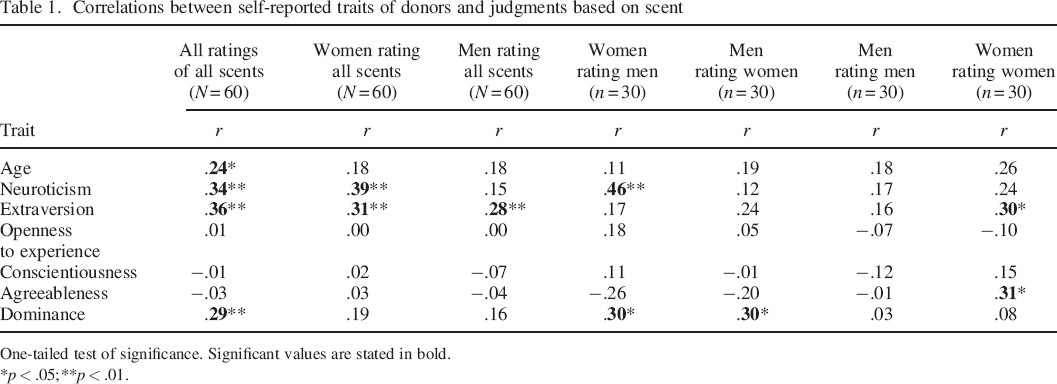
One–tailed test of significance. Significant values are stated in bold.
p < .05;
p < .01.
Self–other agreement in women's ratings of all targets’ neuroticism was slightly stronger than men's; however, this difference was only a marginally significant statistical trend (p = .083, one–sided test). Self–other agreement in neuroticism judgments in the case of ratings of opposite sex was also a marginally significant statistical trend (p = .086, one–sided test)—women judged men's neuroticism relatively better than men judged women's neuroticism. All the other differences between correlations divided by the sex of targets and judges failed to reach statistical significance (all p's > .05).
Additionally, all correlations of self–assessed personality dimensions and personality dimensions assessed on the basis of body odour were analysed. As for correlations between self–reported and judged dimensions, self–reported neuroticism correlated negatively with other–reported agreeableness (−.31, p < .025), self–reported dominance correlated positively with other–reported extraversion (.36, p < .005), self–reported openness correlated positively with other–reported neuroticism (.27, p < .05) and self–reported agreeableness correlated positively with other–reported dominance (.26, p < .05). Also, some correlations between other–reported personality dimensions were very strong. Judgments of neuroticism negatively correlated with rated agreeableness (−.64, p < .001) and conscientiousness (−.74, p < .001). Judgments of agreeableness correlated with conscientiousness (.50, p < .001), and rated extraversion positively correlated with openness to experience (.51, p < .005). All results are presented in Table 2.
Intercorrelations between self–reported traits of donors and judgments based on scents (all judges rating all targets)
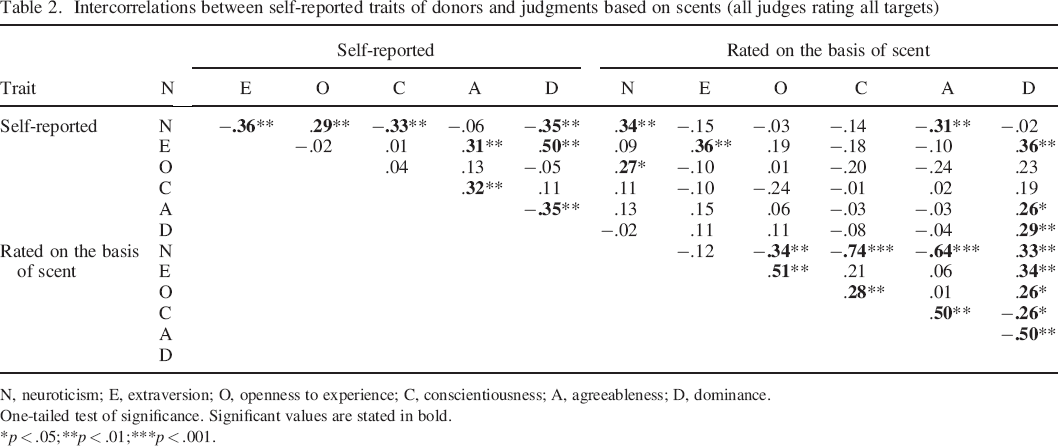
N, neuroticism; E, extraversion; O, openness to experience; C, conscientiousness; A, agreeableness; D, dominance.
One–tailed test of significance. Significant values are stated in bold.
p < .05;
p < .01;
p < .001.
Discussion
The main finding of the presented study is that a few personality traits can be assessed with some degree of accuracy based on olfactory cues. For all assessments of all donors, the correlation between self–assessed personality traits and judgments based on body odour was strongest for extraversion, neuroticism and dominance.
There exist some explanations as to why these particular traits could be judged on the basis of body odour. First of all, they all seem to be related to physiological variables or processes. As presented in the Introduction section, some studies suggest that there exist hormones, enzymes and neurotransmitters that might directly or indirectly link extraversion, neuroticism and dominance to the composition of human body odour (e.g. Carver & Miller, 2006; Ebstein et al., 2000; Rantala et al., 2006; Zuckerman, 1995). These traits might have stronger connection with substances influencing body odour than other personality traits. It might help to explain the fact that we observed almost no significant correlations between traits attributed on the basis of body odour and self–assessed agreeableness, conscientiousness and openness to experience.
Additionally, neuroticism and extraversion are highly ‘emotional’ dimensions. Experiencing fear and stress is probably related to production of some specific substances influencing the human body odour (Ackerl et al., 2002; Albrecht et al., 2011; Chen & Haviland–Jones, 2000; Chen et al., 2006). These emotions might also increase sweating, modify bacterial flora in the axilla and thus make neurotics smell differently. Self–other agreement in neuroticism judgments was especially strong when women judged men's neuroticism. It is very interesting that agreement between judgments based on body odour and self–assessed personality in the case of this dimension exhibited the strongest sex difference in our study. As women generally perform better in perception of emotions (Hall, 1984), again, it suggests that the judgment of neuroticism may have more in common with judging emotions (Hodges & Wegner, 1997). Such hypothesis is consistent with previous research. At the same time, extraversion is closely related to experiencing positive emotions (McCrae & Costa, 1990), and it was shown that people might be able to smell happy states of others (Chen & Haviland–Jones, 2000). Prehn–Kristensen et al. (2008) showed that chemosignals of specific emotions influence the functioning of our brains. It might be presumed that the ability to detect some specific emotions in others was adaptive in our evolutionary past, and this is why we could recognize individuals who often experience them based on scent exclusively.
However, some other alternative explanations of the observed results might be also provided. Relatively strong self–other agreement in olfactory judgments of extraversion is not surprising, because among the Big Five dimensions, extraversion was judged accurately most consistently in studies regarding assessments of personality based on physical appearance (for a review, see Hall et al., 2008), probably because it has the greatest number of valid and available behavioural cues (Funder, D. C., & Sneed, C. D, 1993). Body odour might be another consequence of behaviour of extraverts, for example, their specific diet. This is another reason why it could be assessed accurately even on the basis of limited information. It should be also noticed that some other–reported traits were strongly intercorrelated. When just given body odours as a cue, the judges did not seem to discriminate very well between neuroticism, agreeableness and conscientiousness, and (to a lesser degree) also not between extraversion and openness to experience. It is probable that neuroticism, extraversion and dominance influence the general impression people form about others to such extent that it is hard to judge the other traits of people. This might also partly explain the weak consensus for agreeableness and conscientiousness judgments.
It is important to notice that judgments of extraversion and neuroticism based on olfactory cues were, in our study, similarly or even more accurate than ratings based on videotaped behaviour in previous studies (e.g. Carney et al., 2007; Lippa & Dietz, 2000). It shows that although olfaction has been a little undervalued in psychological studies, it might also be an important source of information about other people.
Dominance of other people might be one of the most important traits we attribute to them. In judges’ perception, dominance correlated (negatively or positively) with the highest number of traits (intercorrelations of traits judged on the basis of scent; Table 2.). Also, ratings of the targets’ dominance correlated positively with their self–assessed extraversion. It is probable that this happened because one of the elements of extraversion is assertiveness (McCrae & Costa, 1987), which might be related to testosterone due to its similarity to dominance. However, we could not test such hypothesis because NEO–FFI test is not divided into subscales. Interestingly, analyses of sex differences demonstrated that correlations between self–assessed and judged dominance were significant only for participants rating the opposite sex donors. It suggests that judgments of dominance based on body odour might be especially important in a mating context. However, the judges did not agree in their attributions of this trait. Further research is necessary to analyse and explain this result.
Why, except for their weaker relationship with physiology, is it that the remaining personality traits were assessed less accurately? As for agreeableness, we expected the assessments of this dimension based on body odour to be hard, because it was the hardest to judge in other studies based on physical appearance (Carney et al., 2007; for a review, see Hall et al., 2008). Reasons for inaccurate judgments of openness to experience and conscientiousness are not obvious at the first sight. Analyses support the characterization of openness as a primarily cognitive—not emotional trait (DeYoung et al., 2005). Openness to experience can be manifested in fantasy, aesthetics and novel ideas (McCrae & Costa, 1987); and such characteristics are not closely related to emotionality. The case of conscientiousness might be similar. Conscientious may mean either governed by conscience or careful and thorough (McCrae & Costa, 1987), neither of which links this dimension to emotions. On the other hand, it is sometimes suggested that neuroticism and extraversion are somehow complementary, extraversion being the positive and neuroticism being the negative emotionality. Our study suggests that the traits, which are not related directly to emotions and/or physiology, are either weakly related (or not related at all) to body odour, or that people have for some reasons not developed the ability to detect the substances related to these traits. To assess conscientiousness, agreeableness and openness to experience accurately, people might need some more information—social context or longer acquaintanceship. However, further investigation is necessary to determine if such supposition is correct.
Our results show that the age and the sex of people might be assessed with relatively strong self–other agreement. Like in previous studies regarding such judgments, accuracy of sex assessments was significantly above chance level (Doty et al., 1978; Hold & Schleidt 1977; Russell, 1976; Schleidt 1980). However, what is a little surprising, contrary to these studies, is that women in our study were not more accurate than men. Another interesting observation was that the judgments were especially accurate in the case of ratings of the opposite sex. This result might show that odour cues are especially important in mating.
The exact mechanism of assessing personality based on body odour needs still to be investigated. It is possible, for example, that people infer personality traits based on pleasantness of body odour. In our study, we observed many intercorrelations of attributed traits, which suggests that people might form some general impressions that drive all the different trait judgments. It is likely that on the basis of initial impression regarding body odour attractiveness, they also judge a person's personality, attributing different personality traits. Additionally, accurate judgments may also arise from abilities and characteristics of raters (personality, intelligence, etc.; Lippa & Dietz, 2000). In future studies, it could be investigated whether some people are better in judging personality of others based on olfactory cues and which characteristics might influence the self–other agreement in such judgments.
Although the results of our study are promising, there exist some limitations that need to be discussed. Our small sample size may raise concerns about the generality of the findings regarding the assessment of personality based on body odour. Additionally, we did not control the scent of participants’ linen, and this smell might have influenced the perception of participants’ body odour. Added to this, the T–shirts were washed in delicately scented detergent for people with allergy. However, all the T–shirts were washed in the same washing powder; therefore, it should not have affected the results. Also, self–other agreement in personality judgments was measured by correlating observers’ ratings with a criterion measure based solely on self–reports. Multimethod criterion measures are more reliable and more valid than criteria from a single source; however, researchers agree that even self–views are quite accurate (e.g. Funder, D. C, 1995). Finally, although the consensus between judges was significant in most cases, it was still relatively weak. It might suggest that not all the people are able to use olfactory cues in personality assessments.
Our study demonstrates that, among other elements of human physical appearance, body odour might influence the perception of person's personality. Olfactory cues might be therefore included in Realistic Accuracy Model analyses (Funder, D. C, 1995) as cues affecting judgmental accuracy. Of course, we do not argue that the olfaction is the most reliable and useful modality in personality judgments. Instead, we show that accurate assessment of personality might be possible also on the basis of cues, which have not been investigated in psychology so far. Our study is the first attempt to determine the relationship between body odour and personality assessments. Although some of the obtained results might be difficult to explain at this stage of research, our study expands the understanding of personality perception and shows that olfaction may supplement visual and auditory cues contributing to the accuracy of impressions of personality.
Footnotes
Acknowledgement
This study was supported by a grant of the University of Wroclaw, Faculty of Historical and Pedagogical Sciences (#1361/M/IPs/11) to the first author. The authors thank Dominika Kras and Heather McLellan for their help.