







Abstract
The aim of the present study is to determine the structure of values in the Spanish population and its relation to the Big Five personality traits. Using a psycholexical approach, 566 words were identified as values and administered to a sample of participants who were instructed to rate the extent to which they were guided by each value. Principal components analysis revealed seven factors: Social Recognition, Competence, Love and Happiness, Benevolence, Idealism, Equilibrium and Family. The results show that there is no complete equivalence between these factors and those obtained in previous studies. However, the results are congruent with those obtained in other studies as far as the relation between values and personality traits is concerned. Copyright © 2011 John Wiley & Sons, Ltd.
Introduction
In recent decades, there has been an increasing interest in identifying and classifying values. The main authors in value research of the three to four decades, Rokeach and Schwartz, have approached the issue of identification and classification from different perspectives and have correspondingly developed different instruments for assessing the values that characterize people. The psycholexical perspective, which has traditionally been used to classify personality traits, has also shown explicit interest in structuring the domain of values in a variety of cultures (e.g. Aavik & Allik, 2002; De Raad & Van Oudenhoven, 2008; Renner, 2003). The aim of the present study is to determine, according to this psycholexical approach, which values characterize the Spanish population and to determine their relation with personality variables.
Definitions of values
Although there are numerous definitions of values, according to Van Deth and Scarbrough (1995), values are usually considered as conceptions of the desirable, and they coincide in that they seem to engage moral considerations (cf. Feather, 1996, p. 222). According to Rokeach (1973), values consist of long–lasting beliefs that certain forms of behaviour or end–states of existence are personally or socially preferable to others. Thus, the desirability aspect introduces a moment of direction in the definitions of values (cf. Allport, 1961). Similarly, Schwartz (1999) defined values as ‘conceptions of the desirable that guide the way social actors (e.g., organizational leaders, policy–makers, individual persons) select actions, evaluate people and events, and explain their actions and evaluations’ (p. 24).
Summarizing the key ideas of the definitions proposed previously in the literature, in the present study a value is understood to be ‘a relatively enduring characteristic of individuals that reflects what is important to them and that guides them in their behaviors and decisions’ (see also De Raad & Van Oudenhoven, 2008).
Principal studies on identifying and classifying values
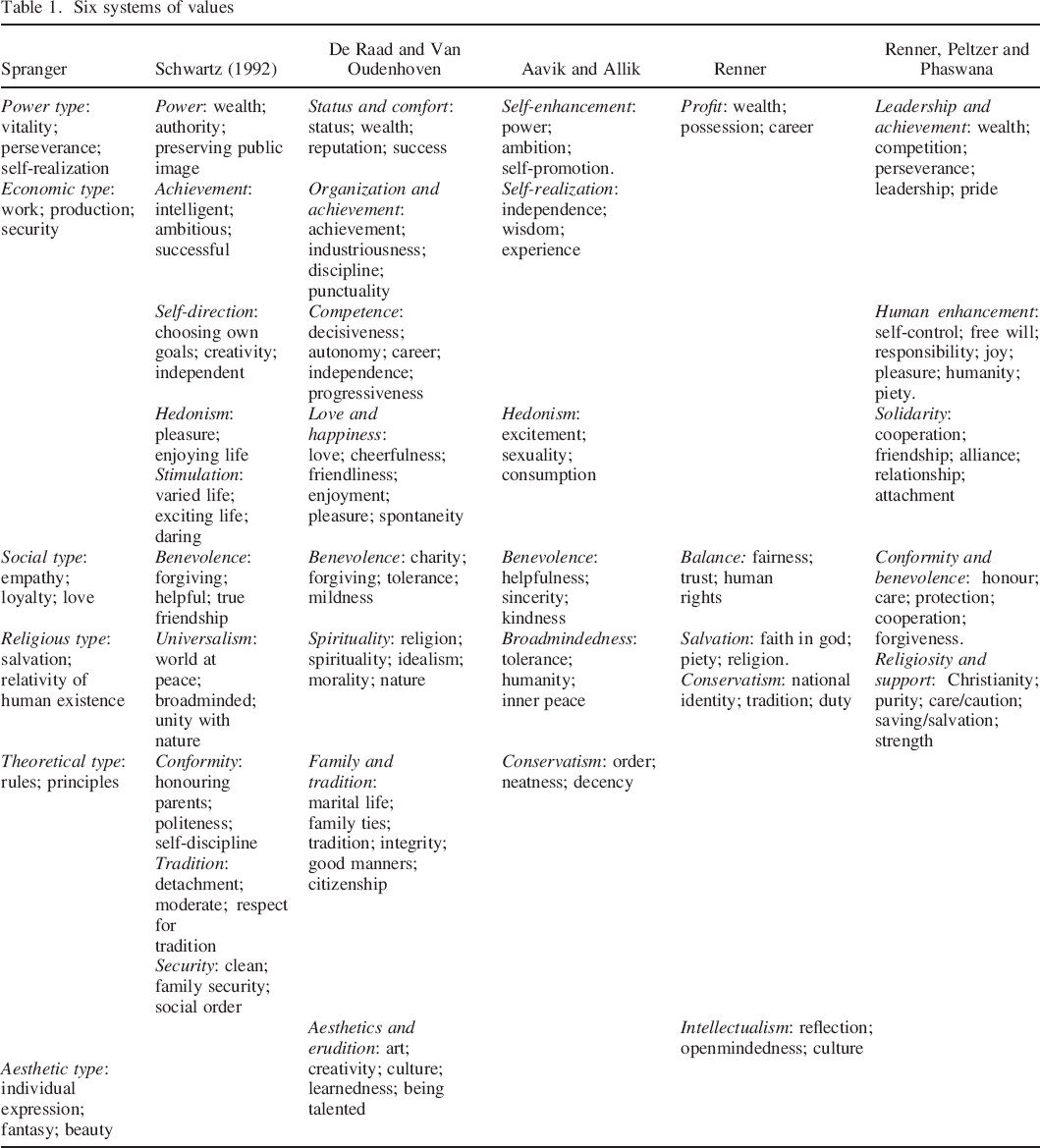
For many years, the questionnaire Study of Values (Allport & Vernon, 1931) was one of the most commonly used instruments in Psychology. Allport's conception of values was based on Spranger's theory (1928) of the six ideal Types of Men, which involved a variety of value orientations that are shown in Table 1.
Six systems of values
Next, the publication ‘The Nature of Human Values’ (Rokeach, 1973) has had a considerable influence on the study of values and on the way they were understood. Characteristic of Rokeach’ model was his distinction between instrumental and terminal values. The former are the forms of behaviour that are desirable, whereas the latter are the end–states of existence or the goals that a person would like to achieve during his/her lifetime. He developed the Rokeach Value Survey (Rokeach, 1967) to assess both kinds of values.
In recent years, the theoretical conception put forward by Schwartz and Bilsky with regard to the structure of values (Schwartz, 1992; Schwartz & Bilsky, 1987, 1990) has dominated the field. The Schwartz Value Survey (SVS; Schwartz, 1992, 1994) is now one of the most commonly used instruments to measure values and has given rise to a considerable number of cross–cultural studies (e.g. Schwartz, 1992; Schwartz & Boehnke, 2004). The authors used a facet theoretical approach to identify values. In particular, they reviewed the literature and the studies made on the topic and identified 10 types of values as shown in Table 1. According to Schwartz and colleagues, values involve practical, psychological and social aspects that may conflict or be compatible with other values. They had values represented in a quasi–circumplex format in which the proximity between the values could indicate the similarity of their underlying motivations (Schwartz, 1992; Schwartz & Boehnke, 2004). The different motivational value types are thus summarized in a two–dimensional arrangement (Schwartz, 1996), with the one axis being made up of ‘openness to change’ values (combining Stimulation and Self–direction) versus ‘conservation’ values (combining Security, Conformity and Tradition). The second axis encompasses ‘self–enhancement’ values (combining Power and Achievement) versus ‘self–transcendence’ values (combining Benevolence and Universalism).
A serious restriction of the facet theoretical approach is that the identification of facets and their elements on behalf of a complete taxonomy largely depends on the insights and discretion of the theoretician (cf. De Raad & Hendriks, 1997). To avoid restrictions due to theoretical predispositions (cf. Sneath & Sokal, 1973), the psycholexical approach starts with a virtually exhaustive enumeration of the descriptive units for the domain under investigation. Therefore, Aavik and Allik (2002), Renner (2003) and De Raad and Van Oudenhoven (2008) turned to the psycholexical approach for the definition of the universe of values in Estonian, German and Dutch language, respectively. The subsequent structuring of the domain for these languages is carried out empirically and independently. Despite some cultural differences that have been identified in the distinctions of the 10 value types of Schwartz (1992), the use of existing instruments in different languages after translation has become under scrutiny (Cheung, Van de Vijver, & Leong, 2011). As argued by Aavik and Allik, the administration of a translated questionnaire in many languages in an attempt to obtain universal values is sub–optimal with respect to the possibility of identifying and evaluating cultural values, specific to particular cultures, which also provide important information. Because the psycholexical approach takes as its starting point the lexicon of a particular language, it does enable cultural values to be identified from the start. Also, language does not depend on the accuracy of pre–existing scientific concepts.
Psycholexical approach to the study of values
According to Goldberg (1981), the most significant individual differences in daily transactions with other people will be represented in language. In particular, if these differences are truly important, people will feel the need to speak of them or create specific words to express them. Following this logic, the so–called lexical hypothesis proposes that important phenomena of daily life are represented in the lexicon of a language, and therefore, an analysis of the full lexical vocabulary will make it possible to make an exhaustive identification of those elements. The lexical approach generally uses the dictionary to identify the descriptors of human behaviour, values and so on that are present in the lexicon of a language.
The first who applied the psycholexical approach to study values were Aavik and Allik (2002). They identified a set of 560 words related to values in Estonian. This list was reduced in subsequent steps to a relatively brief list of 78 value descriptors, which was administered to 294 participants who had to rate the extent to which the values were guiding principles in their lives. Principal components analysis revealed six factors. These factors are shown in Table 1. The analyses carried out by Aavik and Allik showed that these factors are only partially interchangeable with the factors of the SVS. Moreover, some Estonian factors could hardly be predicted using the SVS. For this reason, Aavik and Allik concluded that there was a certain cultural component in the values of their country that was not fully represented in the SVS.
In Austria, Renner (2003) followed the psycholexical approach to study the values in German. He ultimately identified 383 nouns and 299 adjectives to describe terminal and instrumental values, respectively. The two lists were administered to 456 participants who had to rate themselves on the extent to which the values formed guiding principles in their lives. Principal components analysis on the terminal values produced five value factors. Analysis of the instrumental value ratings revealed four factors, which corresponded to four of the five ‘terminal’ factors; for this reason, Renner concluded that individuals do not distinguish between instrumental and terminal values. The maximum set of five factors is shown in Table 1.
Renner, Peltzer, and Phaswana (2003) carried out a similar study in Northern Sotho (South Africa), using a set of 138 nouns (adjectives do not exist in Northern Sotho). Principal components analysis revealed five factors (see Table 1).
In the study carried out in Dutch, De Raad and Van Oudenhoven (2008) first identified 4659 value–relevant words. The list was progressively reduced until it contained 641 words, 70 of which were synonyms of the SVS values. Because 25 words of the SVS had no direct synonyms in the 641 list, these 25 were subsequently added to the list to enable to compare the results with the domain distinctions made in Schwartz's model. The final list of 666 value descriptors was administered to 634 participants to rate the extent to which they were guided by the values in their behaviours and decisions. A principal components analysis of the list of 641 lexical words gave rise to eight factors. These factors are shown in Table 1.
The authors compared their factors with the values of the SVS and with the values obtained by Aavik and Allik (2002) and by Renner (2003). The results indicated that four of the factors (Benevolence, Love and happiness, Organization and achievement and Competence) were related to factors of other systems of values, but there was no one–to–one replication. In fact, each one of these factors was related to several factors from other systems.
To summarize, the psycholexical studies carried out in different countries obtained between four and eight factors from several hundreds of value descriptors. This approach differs considerably from all other studies carried out on the identification and classification of values, which are all based on only a few dozen of values and which tend to summarize clusters of values in two dimensions (Schwartz, 1992). What is more, the results obtained by the psycholexical approach reveal cultural differences that may not be assessed as easily by administering the same measuring instrument in different cultures. Some values are replicated in different cultures (for example, Benevolence), but others seem to be more specific to particular behaviours and are not clearly replicated (for example, Broadmindedness, obtained in the study carried out by Aavik & Allik, 2002).
Values and personality
Personality traits are generally understood as relatively stable patterns of thought, feelings or actions that differentiate people from each other (Johnson, 1997); they form the natural tendencies of individuals to act, think or feel. Values, on the other hand, are guiding principles, and they are characterized by their evaluative component because they refer to beliefs about what is desirable and important in a person's life. As Parks and Guay (2009) pointed out, ‘values relate to what we believe we ought to do, while personality relates to what we naturally tend to do’, which implies that traits may be positive or negative, whereas values are cognitive representations of what is desirable. According to some authors, personality traits are relatively innate and enduring characteristics that determine how people think, feel and behave (e.g. Costa & McCrae, 1992; Olver & Mooradian, 2003), and values are relatively stable individual preferences that reflect socialization (Bilsky & Schwartz, 1994). According to Roccas, Sagiv, Schwartz, and Knafo (2002), traits are enduring dispositions and values are enduring goals.
Alston (1975) distinguished between T–concepts (Dispositional or Trait) and PC–concepts (Purposive–Cognitive). T–concepts refer to dispositions in the sense that if people are in a particular situation, they will emit a particular response. For example, cooperative means that a person is expected to comply with reasonable requests. As Alston pointed out, it would be self–contradictory to say ‘he is very cooperative but he rarely complies with reasonable requests’. However, concepts of needs, motives, interests, values, attitudes and abilities (PC–concepts) do not fit the T–model frequency format. A person may have certain needs or abilities or values but, nevertheless, rarely exercise them. In fact, it is not contradictory to say ‘he has a strong need for close relationships, but he rarely does anything to foster them’. Despite the difficulties of differentiating between values and personality traits, they are different constructs, and people may value characteristics that they do not have or not value characteristics that they do have. It should be pointed out that both values and personality traits are useful for describing and explaining motivation and behaviour (Parks & Guay, 2009). Parks and Guay stated that although they are both related to motivation, values are more closely related to the goals individuals choose to pursue, and personality traits are more related to goal striving, which refers to the amount of intensity, effort and persistence individuals engage in when pursuing their goals over time.
Although values and personality traits are different constructs, they are conceptually related. Numerous studies have been made to gain insight into the relationship between values and personality traits in general (e.g. Olver & Mooradian, 2003; Parks & Guay, 2009). In particular, the Big Five trait factors have been studied in relation to the SVS value types (e.g. Olver & Mooradian, 2003; Parks, 2007; Roccas et al., 2002) and to value factors derived psycholexically (De Raad & Van Oudenhoven, 2008; Renner, 2003).
The personality factor Extraversion was found to be related to the SVS value types Achievement, Stimulation, Hedonism and Power, to the Love and happiness of De Raad and Van Oudenhoven and to the Profit and Balance of Renner. The factor Agreeableness was found to be positively related to the SVS value types Benevolence and Tradition and negatively to Power. In De Raad and Van Oudenhoven, Agreeableness was positively related to the value factors Benevolence and Love and happiness and negatively to Status and comfort and, in Renner, positively related to Balance and Salvation and negatively to Profit. The personality factor Conscientiousness was found to be positively related to the SVS value types Security, Conformity and Achievement. In De Raad and Van Oudenhoven, Conscientiousness was positively related to the value factor Organization and achievement and in Renner to Balance and Conservatism. For the personality trait Emotional stability, typically no significant relations were found with the values assessed by the SVS. Interestingly, in De Raad and Van Oudenhoven, Emotional stability was found to be moderately positively related to the value factor Spirituality. Renner found significant positive relations with Balance and Intellectualism and a negative relation with Salvation. The personality trait factor Openness to Experience was positively related to the SVS value types Universalism and Self–direction and negatively to Conformity, although some of these studies also obtained significant lower negative correlations with Security and Tradition, and a positive correlation with Stimulation. In De Raad and Van Oudenhoven, the corresponding trait factor Intellectual Autonomy was positively related to the value factors Competence and Status and comfort. In Renner's study, Openness to Experience was related to the value factor Intellectualism (positively) and Conservatism (negatively).
The main objective of the present study is to use the psycholexical approach to determine the structure of values in a Spanish population and to compare this structure with those obtained in psycholexical studies carried out in other countries and also with the system of values described by Schwartz (1992). An additional aim is to further determine the relation between values and the Big Five Personality Factors.
Method
This research into the relationships between values and personality comprises two studies. In the first study, descriptors for values in Spanish were selected and reduced to a set of manageable proportions. In the second study, the emphasis was on the structure of values and the stability of the factors of value. Moreover, the Spanish value factors were compared with the ones reported in previous studies. Finally, the relations between factors of values and the Big Five personality factors were assessed.
Study 1: Selection of value descriptors in Spanish
Although in most psycholexical studies the descriptors of traits or values were selected from a dictionary, in the current study they were selected from the Nim Chimsky database, which consisted of a list of 31 428 Spanish words. The Nim Chimsky database was developed by researchers from the Psychology Department of the Rovira i Virgili University and was based on the Spanish lexicon in the bigger LEXESP database (Sebastián, Martí, Carreiras, & Cuetos, 2000). The Nim Chimsky database only included the words between 3 and 12 letters long. In general, words with more than 12 letters are learned words that most people do not understand or do not use when they speak, and words with fewer than three letters are prepositions, conjunctions, interjections and so on that are not used to express values. Neither does the database include words in LEXESP with a low frequency of use, so the Nim Chimsky database can be regarded as a representative pool of the most common words in a Spanish vocabulary.
The selection of the value descriptors took place in five stages. To obtain a nearly exhaustive list of value terms, we followed a conservative process consisting of removing words that clearly do not express human behaviour or thoughts. In the first stage, one researcher removed the terms that were not related to human behaviours or thoughts (for example, physical objects). After these words had been removed, the list had 9762 descriptors.
In the second stage, the same researcher, considering how values had been defined in the literature, removed the words that did clearly not describe values (for example, words with a negative connotation). In order not to remove important words, this was done without being too restrictive. After this reduction, the new list had 2356 words that potentially described human values. Even so, it was still too long to be administered to participants, so it had to be reduced to a more manageable size.
In the third stage, three judges (the same researcher as before, one professor and one PhD student) decided which of these words described values. The instructions were the following: (i) decide which words describe values, assuming the understanding of values as ‘what people find important’; (ii) give priority to nouns over adjectives or verbs, unless an adjective or a verb is a more natural way of expressing the value. Aavik and Allik (2002) suggested that nouns are preferable for expressing values because people usually think of values in noun form. However, not all nouns are equally good at expressing values, and an adjective or a verb may sometimes be preferable. De Raad and Van Oudenhoven (2008) stated that some nouns referring to people showing a specific behaviour, such as admirer, are less natural for describing a value than other forms from the same family, such as to admire or admiration. In the Spanish list, there are other similar examples such as the noun communicator, which is less natural than communication or to communicate. For this reason, the judges were instructed to choose the more natural form for expressing the value when they had several forms from the same family, giving priority to nouns when possible. The judges answered on a binary scale (Yes/No). The inter–rater reliability was .71. Words were removed when the three judges agreed that they were not values. This process resulted in a new list of 952 words.
During the fourth stage, eight judges (two professors, three lecturers and three PhD students) were asked to decide on the extent to which the words described values. A Likert scale was used (1 = completely disagree, 2 = disagree, 3 = neither agree nor disagree, 4 = agree, and 5 = completely agree). The inter–rater reliability was .81. The mean of the overall scores was 27.1 (SD = 5.6). The words with an overall score below 24 on a scale from 8 to 40 were removed because low overall scores meant that judges, in general, did not regard these words as values. The resulting list had 650 words.
In the fifth stage, two judges checked the words of the list to remove any synonyms. They also checked words from the same family that still remained in the list and decided whether they were close synonyms or not. When the two judges agreed that two words were synonyms, one of them was removed from the list. The final list had 566 words.
Study 2: Structuring the domain of values in Spanish
Participants
The list of 566 values was administered to 532 Spanish university undergraduates (419 females and 107 males). The sample size clearly exceeded the size required to guarantee stability of components (cf. Guadagnoli & Velicer, 1988). The sample comprised students from different degrees: 46.1% from Psychology, 4.9% from Labour Relations, 36.5% from Teaching and 12.6% from Social Work. The average age of the participants was 22 years, ranging from 18 to 50 years (SD = 5.5). Of these 532 participants, 484 also filled out the Five–Factor Personality Inventory (FFPI; Hendriks, Hofstee, & De Raad, 1999).
Instruments and procedure
Besides the list of 566 value descriptors, the Spanish version (Rodríguez–Fornells, Lorenzo–Seva, & Andrés–Pueyo, 2001) of the FFPI (Hendriks et al., 1999) was administered to find out the relations between values and the Big Five personality traits. The inventory consisted of 100 items, 20 for each of the Big Five scales. In the present study, Cronbach's alpha coefficients for the FFPI scales were good: .89 for Extraversion, .85 for Agreeableness, .85 for Conscientiousness, .85 for Emotional stability, and .83 for Autonomy. There were some significant correlations between the scales, as Rodríguez–Fornells et al. (2001) reported. Extraversion was related with Conscientiousness, Emotional stability and Autonomy, with correlations of .19, .45 and .48, respectively (p < .01). Conscientiousness was related with Agreeableness, Emotional stability and Autonomy, with correlations of .32, .25 and .13, respectively (p < .01). Emotional stability was also correlated with Autonomy, with a correlation of .56 (p < .01).
The participants were instructed to rate for each value, on a 5–point scale, the extent to which it was important for them and, in other words, the extent to which they were guided by that value. The questionnaires were administered in class, in groups of 20–50 individuals. The amount of time needed to fill out the list of value descriptors and the personality inventory was about 60 min.
Results
Factors of values
A principal component analysis was performed on the value ratings. Different criteria were used to determine the number of factors to be extracted: the eigenvalue pattern, the scree test, the interpretability of the factors, the hierarchy of factors (if factors are relatively new or just splits from higher level factors) and the resonance with previous studies. The eigenvalue pattern and the scree test did not give a clear answer about the number of factors to extract. This could well be 5 up to 10 factors, for which the following eigenvalues were obtained: 96.06, 38.9, 16.9, 14.9, 11.4, 8.9, 8.2, 6.9, 6.5 and 6.3. As in previous psycholexical studies on values, the first unrotated factor explained a large amount of variance (17%) suggesting a general value factor. Considering these results, several principal component analyses were performed followed by varimax orthogonal rotations, and all solutions with between 2 and 10 factors were extracted. Some of the factors in solutions that had more than seven were uninterpretable, and they did not have any resonance with previous studies, so only the solutions with seven factors or fewer were considered to be relevant. Moreover, this factor solution involved relatively new factors, not just splits from higher level factors. In the solution with seven factors, these factors explained 34.5% of the overall variance.
Figure 1 shows the factors obtained in each solution and the correlations between the factors in different solutions, thus producing a hierarchy of factors. Correlations between the factors of .30 or lower were left out. The order of the factors in the solutions is shown in the figure, above the factor names. For example, the first factor obtained in the seven–factor solution, called Social recognition, is encoded as 1/7. From the four–factor solution to the seven–factor solution, the factors Social recognition, Competence and Love and happiness remain the same, considering the virtually perfect correlations across the different solutions. The content of some factors at one level splits up into more factors at the next level. The factor Idealism and equilibrium (5/6) splits up into the factors Idealism (7/7), with which it has 21% of the variance in common, and Equilibrium (5/7), with 77% of the variance in common. Here, Idealism is a relatively new factor. The split factors at a lower hierarchical level should be seen as more specific than factors at a higher level.
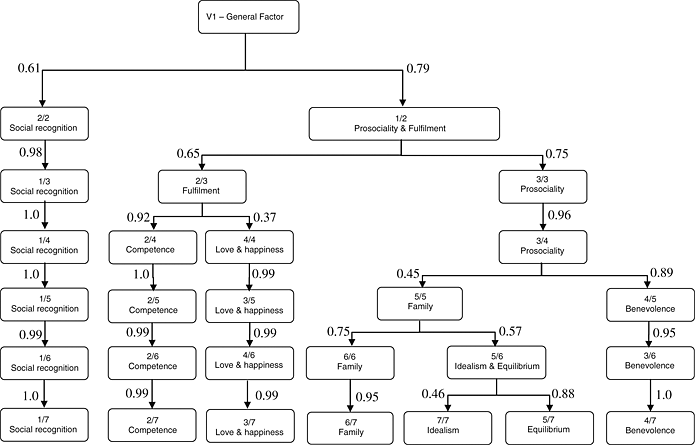
Solutions obtained with principal component analysis followed by varimax orthogonal rotation.
Because all the factors obtained in the seven–factor solution were clearly interpretable, unlike the solutions with more than seven factors, this seven–factor solution was retained. In Table 2, the factors are described by selecting values with loadings higher than 0.30 that convey the different facets contained in each factor. The factors are explained in more detail below.
Descriptors with high loadings in the seven factors of values
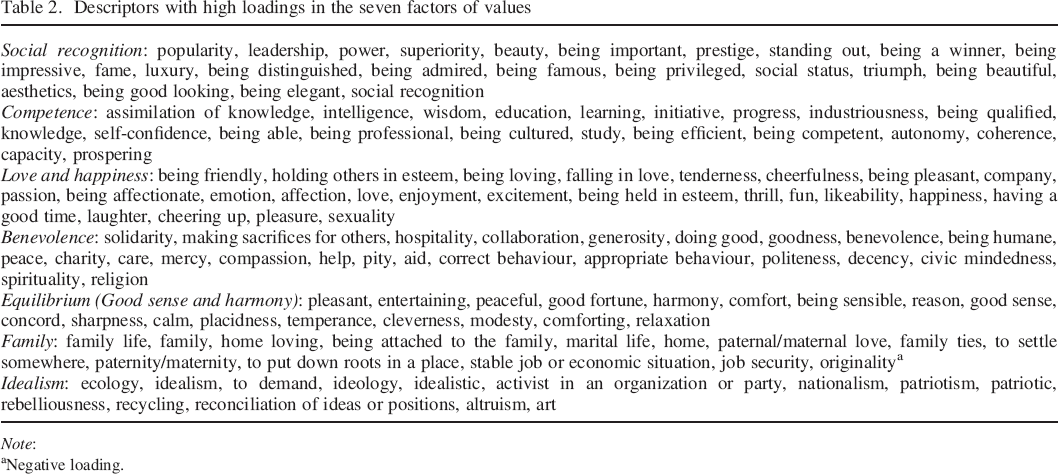
Note:
Negative loading.
Social recognition
This factor includes descriptors of success, dominance, prestige, social recognition and beauty. For example, some of the words related to success are social status, triumph, prestige and being important. The descriptors related to dominance are words such as superiority, power or leadership. Some examples of social recognition are the descriptors fame, being admired and popularity. Some examples of descriptors related to beauty are the words being elegant, beauty, being good looking and aesthetics. In conclusion, this factor seems to describe those characteristics that make a person stand out from others.
Competence
Descriptors of this factor refer to knowledge and capacity. More precisely, the descriptors related to knowledge include words such as learning, education or being cultured. The words related to capacity include words such as intelligence, being competent, being efficient, initiative and so on. To sum up, these words describe personal skills and acquired knowledge that are important for being a competent person and a good professional.
Love and happiness
Some of the value descriptors of this factor refer to emotions of love and affection, including descriptors about being warm and affectionate with others, words about being loved by others and also words about vibrating with emotion. There are also words referring to social relationships with other people, such as being friendly. Other words refer to positive feelings of happiness and enjoyment, including descriptors such as fun, cheerfulness, excitement or happiness.
Benevolence
The factor Benevolence includes descriptors referring to the concepts of solidarity, generosity, mercy, compassion, peace and civic mindedness. This factor describes those behaviours and attitudes that have traditionally described goodness and correct behaviour. For this reason, besides the descriptors of goodness, this factor includes not only words about civic mindedness, such as decency, politeness, correct behaviour and so on but also descriptors about religion and spirituality, which suggests that for the Spanish population religiosity is part of the general concept of Benevolence.
Equilibrium (Good sense and harmony)
This factor includes descriptors related to harmony and good sense. Descriptors referring to harmony include words such as relaxation, temperance or placidness. Descriptors referring to good sense include words such as reason, good sense or sharpness. These two somewhat distinct sets of descriptors suggest an overall equilibrium, including living in harmony and living in an intellectual equilibrium related to good sense.
Family
The descriptors of this factor refer to family ties and having a stable life. In fact, some of the descriptors refer directly to family, such as marital life, family life, paternity/maternity and so on. The descriptors referring to stability include words such as home, stable job or economic situation, job security or to settle somewhere. In this factor, there is one descriptor with a negative loading, the descriptor originality, which suggests that stability and living in a family are not considered original.
Idealism
This factor includes descriptors related to idealism, which implies the wish for a better world. It includes descriptors such as ecology, idealism, activist in an organization or party, rebelliousness, altruism, nationalism, recycling and so on. The fact that some words are related to the country and the nation are congruent with the Spanish population's characteristics and feelings. In fact, the country is divided into different regions with different cultures, so citizens are well aware of regional identities.
Sex differences in values
The study of sex differences usually generates a great deal of interest and controversy and can also provide interesting information. Table 3 shows descriptive statistics for the seven factors of values across sex. As can be seen, women have higher scores in the Love and happiness factor, t(324) = −3.74, p < .01, and also have higher scores than men in the Family factor, t(324) = −4.25, p < .01. Men have higher scores in the Social recognition factor, t(324) = 2.97, p < .01, and the Equilibrium factor, t(324) = 3.46, p < .01.
Gender differences for factors of values

Stability of the value structure for different factor solutions
To check the stability of the seven–factor structure versus other factor solutions, we randomly split the set of variables into two subsets. Because the eigenvalue pattern and the scree test showed between 5 and 10 factors and the solutions with more than seven factors were not interpretable, the congruence coefficients between the two subsets were computed for five to seven solutions. The congruence coefficients obtained for each pair of factors in the seven–factor solution were as follows: .95 for Social recognition, .92 for Competence, .85 for Benevolence, .85 for Love and happiness, .74 for Equilibrium, .67 for Idealism and .70 for Family. The congruence coefficients obtained for each pair of factors in the six–factor solution were as follows: .95 for Social recognition, .91 for Competence, .72 for Benevolence, .83 for Love and happiness, .56 for Idealism and equilibrium and .48 for Family. Finally, the congruence coefficients obtained for each pair of factors in the five–factor solution were as follows: .95 for Social recognition, .92 for Competence, .78 for Benevolence, .86 for Love and happiness and .68 for Family. The higher congruence coefficients obtained with the five and seven–factor solutions show that they are more stable than the six–factor solution. The congruence coefficients were similar for the five and seven–factor solutions, so we decided to keep the seven–factor solution because it provides additional values.
Comparison between the Spanish value factors and other studies of values
The seven value factors obtained in the present study were compared with four other systems of values, with three developed in different cultures following the psycholexical approach. More specifically, the seven value factors were compared with the Austrian structure of values (Renner, 2003), the Dutch structure of values (De Raad & Van Oudenhoven, 2008), the Estonian structure of values (Aavik & Allik, 2002) and the Schwartz system of values (Schwartz, 1992). The equivalences between these descriptors and the Spanish descriptors were found by means of the following process: firstly, a native English speaker, with an expert knowledge of English and Spanish, translated the English descriptors reported by Aavik and Allik (2002) and De Raad and Van Oudenhoven (2008). He also translated the terms provided by Renner (personal communication) and reported by De Raad and Van Oudenhoven. To compare the Spanish values and the Schwartz system of values, we used the enhanced list of markers developed by Parks (2007), which was also used in the study by De Raad and Van Oudenhoven. We decided to use the same enhanced list to compare our results with those obtained by these authors. The list was also translated into Spanish. Finally, we checked the Spanish list of descriptors to find these terms or equivalent terms.
We found sufficient equivalents in the Spanish list of values to reliably represent the different value systems mentioned above. We found 116 markers to represent the Dutch factors of values in our list, 43 markers for the Estonian factors of values and 88 markers of Schwartz's domains of values (see Appendix). For the comparison between Spanish and Austrian values, we combined Renner's (2003) instrumental and terminal values into a set of four factors, as provided by the author (personal communication) and reported by De Raad and Van Oudenhoven (2008). We identified equivalents for 47 of these markers (see Appendix). Table 4 shows the number of markers and the reliabilities for each factor in each system of values.
Reliabilities for the previous systems of values
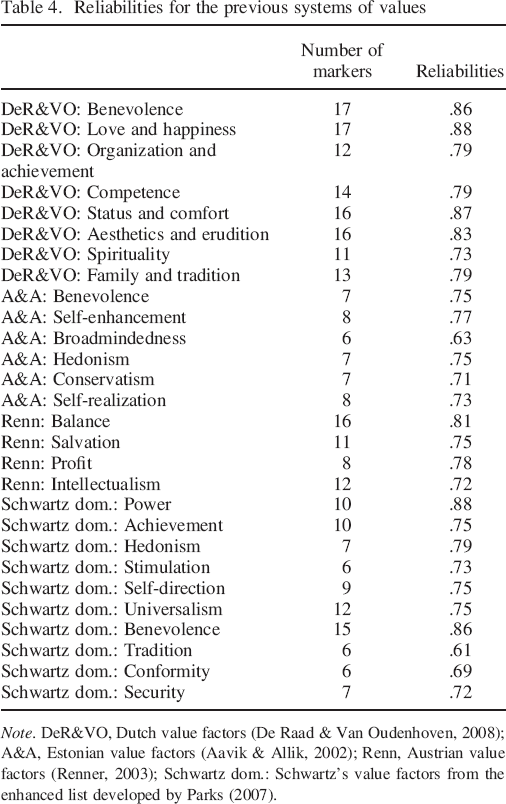
Note. DeR&VO, Dutch value factors (De Raad & Van Oudenhoven, 2008); A&A, Estonian value factors (Aavik & Allik, 2002); Renn, Austrian value factors (Renner, 2003); Schwartz dom.: Schwartz's value factors from the enhanced list developed by Parks (2007).
Table 5 shows the correlations between the seven Spanish value factors and the other sets of value factors. The size of the correlations, many of which were moderate to high, suggests that there is no simple one–to–one correspondence between the Spanish value factors and the other systems of values. Moreover, the Spanish value factors tend to correlate with several factors in each system of values. For example, the factor Benevolence has high correlations with the factors Benevolence from the Dutch, the Estonian and the Schwartz systems of values because all of them include markers referring to goodness, but it is also related with other factors such as Tradition from the Schwartz system of values (both factors have markers of spirituality and tradition). Likewise, the factor Social recognition has the highest correlations with the factors related to wealth, status and success (the Dutch factor Status and comfort, the Estonian factor Self–enhancement, the Austrian factor Profit and the factors Power and Achievement in the Schwartz system of values), but it also has moderate correlations with other factors. The Spanish factors with the lowest correlations are Idealism and Family. The factor Idealism has moderate correlations with those factors that refer to the wish for a better world, with markers about ideology, politics or the protection of nature (the Dutch Spirituality, the Austrian Intellectualism and the Universalism from the Schwartz system). The factor Family has a positive correlation with the Dutch factor Family and tradition and a negative correlation with the factor Stimulation from the Schwartz system.
Correlations between the four systems of value factors and domains

Note: Correlations higher than 0.12 were significant at 0.01 level, but only correlations higher than 0.29 are in boldface, to facilitate the interpretation of the table.
DeR&VO, Dutch value factors (De Raad & Van Oudenhoven, 2008); A&A, Estonian value factors (Aavik & Allik, 2002); Renn, Austrian value factors (Renner, 2003); Schwartz dom.: Schwartz's value factors from the enhanced list developed by Parks (2007).
Table 5 also gives multiple correlations between the different systems of values. The multiple correlations between the Spanish value factors and the other sets of factors are high (between .76 and .95), and they show that the Spanish system substantially predicts all the factors in the other systems. On the other hand, the moderate multiple correlations between the Estonian system and the values Equilibrium and Family of the Spanish system and the moderate multiple correlations between the Austrian system and the values Equilibrium, Family and Idealism of the Spanish system suggest that the Estonian and Austrian systems do not cover the full extent of the Spanish values. Likewise, the moderate multiple correlations between the Schwartz system and the value Equilibrium of the Spanish system suggest that the Schwartz domains of values do not cover the full extent of the Spanish values. Although the Dutch system also has moderate correlations with the factors Equilibrium and Idealism of the Spanish system, most of the multiple correlations obtained with this system are higher than those obtained with the other systems. This result suggests that the Dutch system covers a larger part of the Spanish system of values, in comparison with the rest of systems.
Two–dimensional circumplex representation of values and a comparison with the Schwartz domain scales
Several studies have depicted values in a circular representation organized around two major axes (De Raad & Van Oudenhoven, 2008; Renner, 2003; Schwartz, 1992). Schwartz (1992) used multidimensional scaling to arrive at a circular representation of the value types. For a proper comparison with that circular system, the present data were Z–scored per participant across the value–variables before factoring the data (cf. De Raad & Van Oudenhoven, 2008). The extraction of two factors in this case produces results that are comparable with the results provided by multidimensional scaling. The loadings of the values in the two factors are used as coordinates to depict the values in the two–dimensional space; only those values that had loadings higher than |0.24| on at least one of the factors were used for this purpose.
Figure 2 shows the circular structure obtained. The values depicted were chosen because of their loadings and their capacity to cover the full circular range. One pole of Axis I contained those values related to benevolence and social responsibility, both referring to pro–social values, for example, Justice, Integrity, Civic mindedness and Solidarity. The other pole on this axis contains the values related to social recognition, such as Beauty, Popularity and Success. This pole seems to refer to pro–individual values. On Axis II, one pole contains values related to competence and perseverance such as Capacity, Being cultured, Perseverance and Improving oneself. The other pole of this axis refers to emotions, with values such as Love, Tenderness and Good mood. This axis seems to cover the intellectual values at one pole and the emotional values at the other.
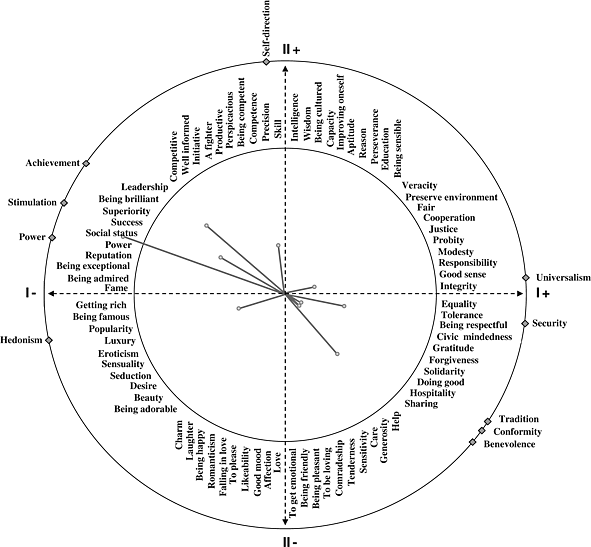
Circumplex of values.
Moreover, we also correlated the Schwartz domain scales and the two factors. These scales are represented in the circumplex on the basis of their pertaining correlations with both factors. The Schwartz domain labels are located along the outer circle. Taking into account the distribution of values shown in the Figure 2, some of the Schwartz domain scales seem to cover the same segments of values: the domains Achievement, Power and Stimulation are located almost together on the left side, and the domains Universalism and Security are located almost together on the right side of the circumplex. The Schwartz domain scales do not fully cover all the segments of the circumplex. In fact, the upper–right quadrant and the lower–left quadrant are less represented by Schwartz's domain scales. On the other hand, the Schwartz domains Tradition and Conformity show the lowest correlations with the two factors, so these scales are least covered by the circumplex.
Relations between value factors and personality traits
Table 6 gives correlations between the Big Five personality traits from the FFPI questionnaire and the different systems of values: the seven value factors of the Spanish sample, the Austrian value factors (Renner, 2003), the Dutch value factors (De Raad & Van Oudenhoven, 2008), the Estonian value factors (Aavik & Allik, 2002) and the Schwartz value factors (Schwartz, 1992). Table 6 also shows the multiple correlations based on regressions of the Big Five scales on each of the five systems of values and the multiple regressions of the five systems of values on the Big Five scales.
Correlations between dimensions of values and personality traits
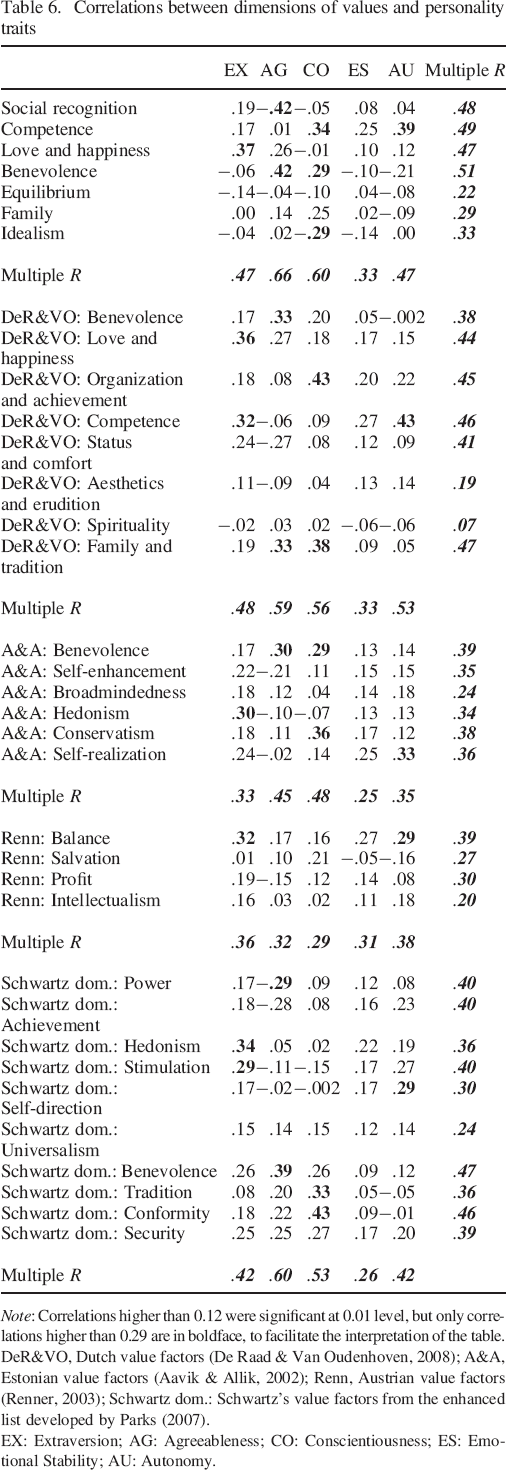
Note: Correlations higher than 0.12 were significant at 0.01 level, but only correlations higher than 0.29 are in boldface, to facilitate the interpretation of the table.
DeR&VO, Dutch value factors (De Raad & Van Oudenhoven, 2008); A&A, Estonian value factors (Aavik & Allik, 2002); Renn, Austrian value factors (Renner, 2003); Schwartz dom.: Schwartz's value factors from the enhanced list developed by Parks (2007).
EX: Extraversion; AG: Agreeableness; CO: Conscientiousness; ES: Emotional Stability; AU: Autonomy.
The results suggest that people with higher levels in Extraversion tend to value hedonism, emotions of love and happiness and also social relationships. In fact, this trait factor is correlated with the factors Hedonism in both the Estonian and the Schwartz sets of values and Love and happiness in the Spanish and Dutch systems of values. The two Love and happiness value factors both include descriptors of fun and enjoyment as well as descriptors of love and social relationships.
The factor Agreeableness is positively correlated with the value factor Benevolence in various systems of values. Benevolence refers to values of goodness and correct behaviour, and trait–agreeable individuals have been described as altruistic, straightforward, trusting, soft–hearted, modest and compliant (Graziano, 1994; McCrae & Costa, 1999). Moreover, Agreeableness is negatively correlated with the factor Social recognition in the Spanish set of values. These results suggest that people with higher levels of Agreeableness tend to value concepts such as goodness, solidarity and compassion.
The trait factor Conscientiousness is correlated with values of capacity and professionalism, as comprised by the factor Competence in the Spanish set of values and the factor Organization and achievement in the Dutch set of values. Conscientiousness is also related to factors that refer to stability in life, family and tradition, as expressed in the factor Family and tradition in the Dutch system of values, the factor Conservatism in the Estonian values and the factors Tradition and Conformity in the Schwartz system. These results suggest that people with higher levels of Conscientiousness consider responsibilities, such as their profession, their family and traditions, as important issues in their lives.
The trait factor Emotional Stability does not correlate substantially with any value factor in any system of values, although the moderate correlations with the value factors Competence agree with earlier findings in De Raad and Van Oudenhoven (2008).
The trait factor Autonomy is related to Competence in the Spanish and Dutch systems of values. It is also related to the Self–realization factor in the Estonian set of values. These results suggest that individuals with higher levels in the Autonomy trait value the achievement of personal goals of competence, professionalism, culture and self–realization.
Most of the multiple correlations in Table 6 are moderate, which suggests that values generally predict the personality traits only moderately. The Benevolence factor has the highest multiple correlations, and the Equilibrium and Family factors have the lowest multiple correlations in the Spanish set of values. The personality trait factor with the lowest multiple correlations is Emotional stability, which is congruent with previous studies (e.g. De Raad & Van Oudenhoven, 2008; Roccas et al., 2002).
Discussion
We followed the psycholexical approach to determine the structure of values in the Spanish population and to establish the similarities and differences with the results obtained in other cultures. The results show seven value factors that have been called: Social recognition, Competence, Love and happiness, Benevolence, Equilibrium, Family and Idealism. The results indicate that these factors are not fully equivalent with those in other cultures using the psycholexical approach. Yet, what prevails is the similarity to the results previously found, especially to the Dutch system (De Raad & Van Oudenhoven, 2008) that came about in much the same fashion as the Spanish system. The analytic procedures followed in the Estonian study by Aavik and Allik (2002) and in the Austrian study by Renner (2003) showed marked differences as described in the introduction.
In fact, the Spanish value factors Social recognition, Benevolence, Love and happiness and Family have high correlations with the respective factors Status and comfort, Benevolence, Love and happiness and Family and tradition in the Dutch study. The Spanish factor Competence seems to be related to two more specific value factors in the Dutch study: the value factor known as Competence and the factor Organization and achievement. The Spanish factor Competence seems to be conceptually more general than the Dutch factor Competence, and it includes markers referring to capacities, studies, professionalism and productivity. The listing of these markers makes it understandable why the Spanish Competence is also related to the Dutch Organization and achievement.
The values described by Schwartz do not seem to represent the totality of the values obtained in the Spanish population. The Spanish value factors Social recognition, Competence, Benevolence and Love and happiness have high correlations with the respective factors Power, Universalism, Benevolence and Hedonism in the Schwartz domains, but there is no one–to–one replication. On the other hand, the Spanish factors Family and Idealism only show low and moderate correlations with the Schwartz domains. This lack of one–to–one replication is also clear in the conceptual comparison between both systems of values. For example, the factor Power described by Schwartz (1992) is conceptually similar to the factor Social recognition obtained in the present study. They both refer to domination over others and include aspects such as prestige, authority, social status and wealth. In the present study, however, this value also includes markers referring to body and image such as beauty and elegance, which may also contribute to the notion of superiority over others. The factor Benevolence in the present study is somewhat related to Schwartz's factor of the same name because they both refer to doing others good, but they are not conceptually identical. The Schwartz's Benevolence domain also includes aspects such as responsibility, love and friendship, which are represented in other specific factors in the Spanish structure. The Spanish factor Love and happiness includes descriptors that belong to conflicting values in the Schwartz domain of values: descriptors related to friendship and love, which belong to the factor Benevolence in Schwartz's system, and descriptors related to pleasure and enjoyment, which belong to the factor Hedonism in Schwartz's system. These results suggests that friendship and feelings or emotional states such as love or enjoyment cannot be considered as contradictory in the Spanish population, possibly for cultural reasons. The Spanish factor Idealism includes both nationalistic and liberal ideas, which belong to the conflicting values Security and Universalism in Schwartz's system. This may also be because of cultural reasons. The fact that Spain accommodates several subcultures has given rise to general nationalistic ideas in contrast to the more specific nationalistic ideas such as the Catalans and Basques. This has negative consequences on social harmony and understanding between people, concepts that are related to the values of Security and Universalism.
According to Schwartz (1992), values can be represented around two major axes, in a circular representation that reflects the similarities and differences between the motivations underlying the different values. In the circumplex structure obtained by De Raad and Van Oudenhoven (2008), the values of the two clusters are distributed in a circular configuration as well. However, as the Dutch authors pointed out, Schwartz's values do not cover all the segments of the Dutch circumplex. The first axis of both structures differentiates between pro–individual values (such as leadership, perseverance or self–confidence) and pro–social values (such as affection or helpfulness). The second axis of Schwartz's model differentiates between traditional values and openness to change. The second axis on the circumplex of De Raad and Van Oudenhoven, however, differentiates between the values of conscientiousness, order and duty and values of happiness and joy. The procedure described by De Raad and Van Oudenhoven was used in the present study to reduce the values to two general dimensions, giving rise to a circumplex structure. The first axis in the Spanish circumplex also differentiates between pro–social and pro–individual values. The second axis differentiates between intellectual values (such as capacity, culture or persistence) and more emotional values of love, friendship and happiness. Therefore, this second axis is similar to the one described in the study by De Raad and Van Oudenhoven. To sum up, the psycholexical approach provides not only new values that are not included in Schwartz's model but also different arrangements of these values that might reflect cultural differences.
As far as the relation between values and the Big Five personality traits is concerned, the results of this study are, in general, congruent with those of previous studies (e.g. De Raad & Van Oudenhoven, 2008; Parks & Guay, 2009; Roccas et al., 2002). Moreover, as in the study by De Raad and Van Oudenhoven (2008), the present trait factors Agreeableness and Conscientiousness share a great deal of variance with the present value factors, which means that the personality traits enable values to be partially predicted. As in previous studies, the trait factor Agreeableness is positively related to Benevolence. As was expected, the trait factor Conscientiousness is positively related to values of responsibility, professionalism and duty, such as Competence and Family. The studies carried out by De Raad and Van Oudenhoven (2008) and Parks and Guay (2009) also found significant correlations between this trait factor and the value factors Security and Conformity. The trait factor Extraversion is related to values of social relations, pleasure and happiness such as Love and happiness and Hedonism as De Raad and Van Oudenhoven also found. Roccas et al. (2002) also found a significant relation between this trait factor and Hedonism, although Parks and Guay did not. The trait factor Emotional Stability has no substantial relation with values, which also coincides with previous studies. Finally, the trait factor Autonomy, the tendency to have personal opinions, to be critical and analytical, is related to the values of Competence, Self–realization and Self–direction. However, De Raad and Van Oudenhoven also found a negative correlation between this trait factor and Status and comfort and positive relations to the values Achievement and Stimulation, so they concluded that the trait factor Autonomy is related to values that reflect character information.
The main limitation of the present study is the lack of heterogeneity of the sample used, which was made up of university students from a variety of courses, mainly women. Further research is required to determine whether the value structure is replicated in more heterogeneous samples, with a greater proportion of men and with subjects from different socioeconomic and cultural levels. Another limitation of this study is the use of the same self–ratings to compare different systems of values, which might enhance the correlations. However, the size of the correlations shows that the different systems of values are not equivalent, so they do not include exactly the same descriptors. Moreover, further research is also needed to assess the relation between the system of values obtained in the current study and motivation.
In conclusion, the present study has identified the structure of values in the Spanish population and compared them with the structures found in other psycholexical studies. There is no exact equivalence between these values and those obtained in previous studies, which suggests that the structures obtained in other psycholexical studies are not completely representative of the values of the Spanish population. As far as the relation between values and personality are concerned, the results are generally similar to those obtained in other studies.