





Abstract

Introduction
Urban communities represent sectors of great potential for the American economy. Unfortunately, many of these neighborhoods currently represent economically depressed areas around the country, composed of high rates of unemployment and crime, along with other indicators of community instability. The current study adds to our knowledge on communities by providing various reviews of theories that discuss neighborhood organization and development. High crime rates are not new to urban areas. In the early part of the century, these communities were noted for their excessive rates of deviance with the influx of immigrants entering American society. Various theoretical models have been developed to give us a greater understanding of the causes of crime in urban communities throughout America. Economically depressed neighborhoods often exhibit higher levels of crime and victimization. With the aid of the models presented in the present study, an analysis is developed that better informs public policy on issues surrounding crime and neighborhood organization.
The major theoretical works that guide the implications of the current analysis stem from research conducted by Max Weber, John Sibley Butler and Edna Bonacich. These scholars identified the significant role that entrepreneurship plays in community development. Weber noted that the protestant religion and work ethic provided a stimulus for the development of capitalism in the Western world. Butler notes that entrepreneurship is not new to black Americans and has played a vital role the development of economically self sufficient communities, particularly during the early part of the twentieth century in places such as Durham, North Carolina and Tulsa, Oklahoma. Edna Bonacich shows that despite societal hostility, stemming from racism, minorities groups have been able to use entrepreneurship as a means to advance and occupy a middleman status in countries that attempted to exclude them from political and educational advancement. The current analysis adds to this body of research by using logistic regression to examine the relationship between self-employment and fear of crime. It was hypothesized that self employment would be negatively related to fear of crime, suggesting that entrepreneurs are risk takers, willing to locate in areas that may not seem viable for traditional businesses. The data supports these assumptions, showing that small businesses may serve as a viable mechanism to help bring growth and stability to neighborhoods that experience high rates of crime and unemployment.
Literature Review
Research shows that fear of crime decreases when people perceive a lower likelihood of victimization (Parker 1993). The disorder model states that fear is a response to the perceptions of residents that the area is showing signs of disorder and incivility, indicators that the neighborhood is eroding. Disorderly behaviors reflect the breakdown of accepted standards of public behavior and it is assumed that community instability may be perceived by residents as leading directly to increases in crime. The presence of disorder may also lead to a breakdown of community cohesion (Bursik 1993), which occurred in many urban communities during the late 1970s and early 1980s. The exodus of manufacturing jobs and other forms of employment for minorities in inner cities coincided with the increase of drug abuse, gang activity, and a host of other ills that plagued these areas.
Wesley Skogan provides a detailed analysis of communities, crime, and neighborhood organization. He examined the attitudes of residents in three central cities and suburbs: Rochester, New York, Tampa-St. Petersburg, Florida, and St. Louis, Missouri. His study sought to find out whether or not there was an answer to the question of the ability of local organizations to adopt crime prevention agendas, and if new anticrime groups could be spawned in areas where none were active (Skogan 1988; Lewis, Grant, and Rosenbaum 1988). An important part of this research is that it tests these hypotheses at the community level, instead of the individual level (which dominates most of the literature in this area). There are competing views about what the relationship between neighborhood organization and crime looks like. The positive view states that crime problems stimulate action. This perspective states that people who live in high-crime and fear provoking neighborhoods ought to mobilize themselves through the formation of neighborhood organizations to do something about these disturbances (Lewis 1979). The negative view states that problems discourage constructive responses. In other words, fear of crime does not stimulate crime prevention behavior (Tyler and Lavrakas 1986) due to high levels of fear and mutual distrust. After testing these hypotheses, Skogan found that organized activity was stimulated by serious crime. The link was strong and positive. There was also an inverse relationship between the quality of police service and the extent of local organizational activity. These findings support much of the research on the effectiveness of community-based programs.
The economic characteristics and social demography of neighborhoods tends to evolve slowly. These variables are stable at the individual and household level. Those with more economic resources and a vested interest in the community may be more concerned with crime and other problems in their areas. In the face of community problems, they are more likely to join or form organizations to fight the problems or they may move. Blacks and immigrants, who make up a large percentage of urban residents, participate in grassroots associations at a significant level (Williams, Babchuk, and Johnson, 1973). This may be due to the fact that minorities face more discrimination and a higher rate of social and economic problems. They may also be less likely to have access to informal connections to power. Both of these disadvantages make grassroots organizing necessary in inner city communities (Perkins 1996).
Research also shows that ethnicity appears to be a powerful predictor of fear among minority groups. Evidence suggests that blacks may express lower levels of fear due to precautionary measures. Possibly, they travel in groups or avoid particular places at certain hours (Parker 1993). Data from the Bureau of Justice Statistics show that a sample of 1,775 urban youth had taken many defensive actions to ward off crime. Only 11 percent of the sample indicated that they had not taken any defensive actions. Defensive actions taken by members of the respondents' households included installing a burglar alarm (22 percent), keeping a “trained dog” (17 percent), keeping lights on at night (39 percent), and installing security locks (38 percent). As the above shows, a variety of precautionary measures were taken to thwart crime and reduce fear (U.S. Department of Justice 1986).
The community crime prevention approach examines major factors that increase fear of crime. This model also offers solutions for decreasing crime rates. The community orientation shifts the focus of attention from potential offenders and their motivations to potential victims and their environment. The Hartford Crime Prevention Program sums up the approach:
The crime rate in a residential neighborhood is a product of the linkage between offender motivation and the opportunities provided by the residents, users, and environmental features of that neighborhood.
The crime rate for a specific offense can be reduced by lessening the opportunities for that crime to occur.
Opportunities can be reduced by: (a) Altering the physical aspects of buildings and streets to increase surveillance capabilities and lessen target/victim vulnerability, to increase the neighborhood's attractiveness to residents, and to decrease its fear-producing features; (b) increasing citizen concerns about and involvement in crime prevention and the neighborhood in general; and (c) Utilizing the police to support the above.
Opportunity-reducing activities will lead not only to a reduction in the crime rate but also to a reduction in fear of crime. The reduced crime and fear will mutually reinforce each other, leading to still further reductions in both (Lewis and Salem 1981).
Rather than attempting to change perpetrators, this model asserts that crime is to be prevented by educating potential victims, thus limiting the opportunities for victimization. The authors of this model sought to determine both the level of crime and the level of fear Americans were experiencing.
Mary Achilles notes that “community involvement helps restore our sense of safety and well being. We need to educate ourselves and our neighbors—children as well as adults—on the impact of crime and the need for victim assistance. We need to pull together—community organizations, social service agencies, churches, neighborhood watch groups, law enforcement agencies, prosecutors and corrections agencies—and take an active role in responding to crime victims and organizing violence prevention strategies” (1994). As mentioned previously, this study will contribute to the current literature by adding self-employment and business activity into the analysis of fear of crime and criminal victimization.
Minority Groups and Entrepreneurship
At the turn of the century, Max Weber noted that the Protestant religion played a major role in the development of capitalism: “A glance at the occupational statistics of any country of mixed religious composition brings to light with remarkable frequency a situation which has several times provoked discussion in the Catholic press and literature, and in Catholic congresses in Germany, namely, the fact that business leaders and owners of capital…are overwhelmingly Protestant” (1930). Weber posited a relationship between the “Spirit of Capitalism,” as measured by the will to take risk and go into the economic world. These influences came from the ideas of Protestant thinkers like Luther and Calvin. Werner Sombart argued for the primacy of religious beliefs found in Judaism, stating that entrepreneurship had been a characteristic of the Jewish population due to thousands of years of oppression: “On one hand, they influenced the outward form of modern capitalism; on the other, they gave expression to its inward spirit” (1951).
One can compare the entrepreneurship of present immigrants and minorities to the ideals of these early theorists. Ethnic groups—such as blacks, Hispanics, Pakistanis, and Asians—have entered entrepreneurship as a result of religious influences, exclusion from the larger economies of host societies, and numerous other factors. Many immigrant communities that engage in entrepreneurship create business incubators. Self-employed minorities practice economic strategies that inspire internal investment. Financial resources circulate within the community to sustain a consistently growing source of capital. Edna Bonacich notes that minority groups in various parts of the world have often used business to carve a niche by occupying a status gap, serving as Middlemen in the economy, even when host societies have been hostile to their culture (1972). John Sibley Butler and Patricia Greene note how Pakistani Americans, for example, engage in their self-help practices as a natural outgrowth of their Ismaili Islamic religion (1996). Repeated surveys of this community revealed that their self-help techniques give them a sense of control over their economic and educational welfare. They own many small-scale businesses, such as convenience stores. A rotating community fund allows them to open additional stores after new immigrants learn English and how to operate a business. An instance of the methods they use to deal with crime is shown in how the community business leaders advise store owners on security. Community members join together to purchase security cameras and they also install surveillance equipment. This practice allows their businesses to survive even if they are located in or near high crime areas.
Research shows that small businesses tend to stabilize communities, making them efficient and pleasant places to live (Gallagher 1989). Economic resources circulate throughout the neighborhood, creating necessary jobs and infrastructural investment. The 1994 State of Small Business, a report of the President, showed that small firms added more than one million jobs to the economy in 1993, while large firms reduced employment by more than 200,000. Firms with four or fewer employees added 2.6 million new jobs. Small businesses employ 60 percent of the workforce, and contribute to 54 percent of sales (Scott 1995).
Ethnic businesses have grown over the last few years. The U.S. Census Bureau reports that minority-owned firms increased 62 percent from 1,213,750 in 1987 to 1,965,565 in 1992. Receipts increased by 160 percent from $77.8 billion to $202.0 billion. The data in this report were collected as a part of the 1992 Economic Census from a large sample of all non-farm businesses filing 1992 tax forms as individual proprietorships, partnerships, or subchapter S corporations, and with receipts of $500 or more (1992).
Thomas Boston notes that traditional black-owned businesses, like retail and personal service industries, are being replaced by a new generation of black businesses that emerged during the early 1980s. He states the following: “Ambitious young black professionals are starting new businesses at a rapid clip, often at very early ages. They have more financial wherewithal than their predecessors, and are bigger risk takers” (1995). The most successful of these new black entrepreneurs have formed 1120 subchapter C corporations, and data on these businesses are not included in the government's survey universe for the Survey of Minority-Owned Business Enterprises (SMOBE). Thus, a substantial portion of this growth phenomenon is unrecorded. Boston goes on to note that policy makers believe that black businesses contribute only marginally to employment, but current research shows that this is not true (1995). Policy implications for the growth of minority owned businesses and their employment potential will be discussed later.
Minority entrepreneurship represents a return to tradition. For instance, Butler states that self-employment is not new to the black community. In the 1700s, blacks were involved in manufacturing industries that employed a significant number of black and white workers. Black companies amassed wealth that can be placed at a conservative amount of $50 million on the eve of the Civil War. This tradition carried on into the twentieth century. Black Americans were heavily involved in the banking industry in the early part of the 1900s. There were no less than 134 banks developed by African Americans between 1888 and 1934. Total resources of all of these banks reached a high of $12.8 million in 1926. The tradition carried on for the next few decades. There were 163,000 African American firms in 1969 (1996).
Hypotheses
Due to the fact that steady employment and financial security seem to play an important role in community health as shown by Weber, Butler and Bonacich, it was hypothesized that individuals involved in entrepreneurship—i.e., self-employment—would be less likely to express fear of crime (or reprisal, as termed in the current questionnaire). It was also assumed that individuals who are unemployed would be more likely to express fear, compared to those who have stable jobs. These hypotheses arise from the examination of previous research that on this topic. Although few studies have been conducted that deal directly with entrepreneurship and attitudes toward crime, a growing body of research, as mentioned previously, shows that community level behavior plays a vital role in the healthy development of neighborhoods. As Skogan's research showed, organized activity may be stimulated by crime, instead of people becoming prisoners in their own communities. The current study seeks to add to the literature by examining occupational categories (with an emphasis on self-employment) that have significant relationships to lower fear of crime, which may, in the final analysis, provide additional insight into the factors that play important roles in the organizational behavior of neighborhoods and their level stability.
Data Analysis / Methods
The following data were originally collected by the United States Department of Justice—Bureau of Justice Statistics. The title of the study is National Crime Surveys: National Sample, 1986–1992. The objective of the National Crime Surveys is to provide data on the level of crime victimization in the United States and to collect information on the characteristics of crime incidents and victims. This particular sample was drawn in 1990. Each respondent was asked a series of screen questions to determine if he or she was victimized during the six-month period preceding the first day of the month of the interview. Screen questions cover the following types of crimes, including attempts: rape, robbery, assault, burglary, larceny, and motor vehicle theft. The data include type of crime, description of the offender, severity of the crime, injuries or losses, and demographic information on household members such as age, sex, race, education, employment, etc.
The dichotomous dependent variable in the present analysis is fear of reprisal, with fear coded as one and no fear coded as zero. As mentioned previously, the aim of the analysis was to identify the occupational variable(s) that may have significant relationships to less fear. Logistic regression was chosen as the statistical technique because it is able to provide probable estimates for fear of reprisal under different conditions of the independent variables. Due to the fact that logits are estimated by the maximum likelihood method, variables do not have to meet specific assumptions about their distribution as in ordinary least squares (OLS) regression. Therefore, this is a more appropriate statistic for the analysis of a skewed dichotomous dependent variable.
Findings
Table 1 shows the characteristics of the 32,816 individuals who were interviewed. 85.9 percent of the sample was female, while 14.1 percent was male. The smaller proportion of males was due to the fact that a rape subset was included in which investigators sought to identify important characteristics of rape victims and offenders. 85.4 percent of the interviewees were white; 11.3 percent were black; and .6 percent were members of other ethnic groups. The income distribution of the respondents was fairly even across most of the categories while the largest group fell into the range of $50,000–$74,999 at 10 percent, followed by $20,000–$24,999 at 8.5 percent, and $40,000–$49,999 at 8.3 percent. 27.9 percent of the respondents reported that they were employed within the past six months while 15.4 percent reported that they had no job within the past six months. A substantial portion of the respondents, 56.7 percent fell in the category “out of universe” for this variable. Because the National Crime Surveys include individuals under the age of 16, this question was not appropriate for a number of the respondents and some of the others answered incorrectly or not at all. 2.7 percent of the respondents reported that they were self-employed; 20.2 percent maintained a wage or salary position; 4.5 percent were government employees; and .1 percent worked without pay in a family business.
Characteristics of the Sample (N=32,816)
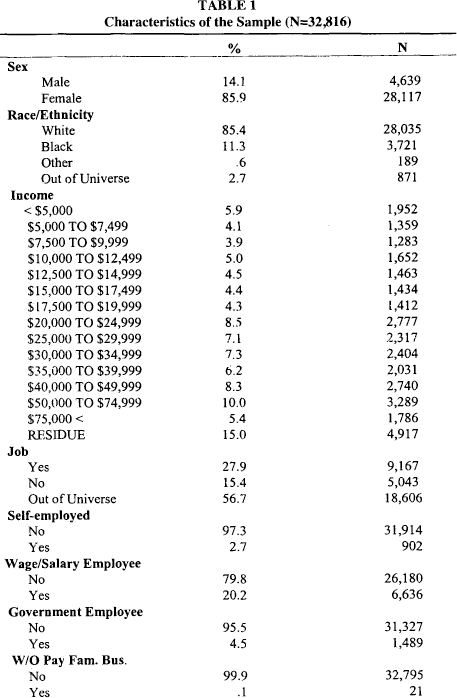
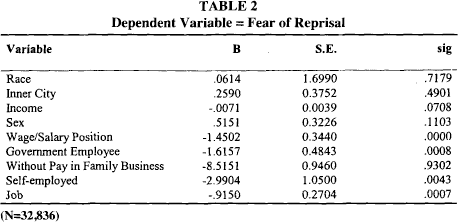
Table 2 shows the results of the logistic regression analysis. The independent variables are race, living in the inner city, income, gender, working in a wage or salary position, working as a government employee, working without pay in a family business, working in a self-employed position, and having a job versus being unemployed. As predicted, there is a negative relationship between the independent variable self-employed and the dependent variable fear of reprisal (B = −2.99; p <.01) when the other predictors are held constant. The alternative employment statuses were added in the analysis for comparison and to determine if they also had an effect on fear of reprisal. The second hypothesis was also supported as the data demonstrated that having a job (B = −0.97; p < .01) was negatively related to fear of reprisal. Being employed in a government position (B = −1.62; p < .01) has an effect on one's fear, but the slope for this employment status was about half of the size for that of the self-employed variable. Additionally, working in a wage/salary position was negatively related to fear of reprisal (B = −1.45; p < .01). Race was not a significant factor, so ethnicity does not play a major role in predicting one's fear of reprisal after being victimized in the present analysis.
Dependent Variable = Fear of Reprisal
(N=32,836)
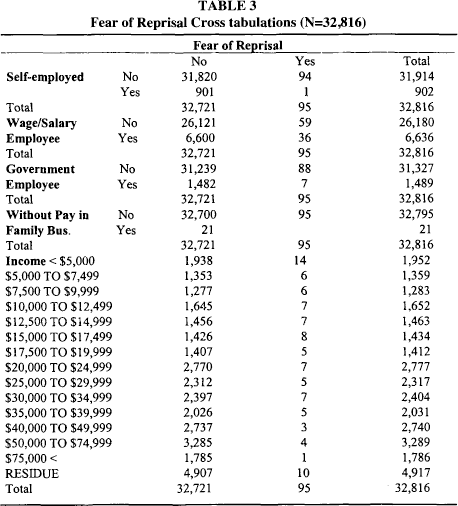
Table 3 shows the cross tabulations of the independent variables with fear of reprisal. Nine hundred and one of the self-employed expressed no fear of reprisal after being victimized. Only one self-employed individual from the sample answered yes to this question. Sixty-six hundred wage/salary individuals reported that they did not fear reprisal, while thirty-six answered affirmatively. One thousand four hundred eighty-two government employees expressed no fear of reprisal, while seven did. Twenty-one of those who worked without pay in a family business expressed no fear while zero did not. Due to the fact that there were such a small number of cases in this category, the results had no significant results in the logistic regression statistic. Although income was not statistically significant in the regression analysis (B =–.007; p > .05), this variable yielded interesting results in the cross tabulations. As income increased, the number of individuals who did not fear reprisal increased.
Fear of Reprisal Cross tabulations (N=32,816)
The variable fear of reprisal represents a shortcoming in the data analysis. Wording of the questionnaire would not allow for a more precise measurement for fear of crime. Although fear of reprisal is not an exact measurement for fear of crime, it still provides useful information. One can say that fear of reprisal is a cousin to fear of crime. If a person is afraid of crime in general then he or she would more than likely express fear of reprisal after being victimized. On the other hand, if a person has been victimized and indicates that he or she is afraid of reprisal, this person may or may not have been afraid of crime before becoming victimized. In other words, a person who has never been victimized may not be as likely to express fear than one who has been victimized. Despite these various conceptional issues, the results provide valuable information and lend support to previous research which shows that there is a negative relationship between fear of crime and economic self efficacy. The findings also extend the work of Weber, Butler, and Bonacich by adding fear of crime into the analysis of the impact that entrepreneurship has on community organization.
Discussion
One might assume that there would be an automatic positive relationship between prior victimization and fear of crime. But research has shown that this relationship is not as strong as one would suppose, even when adjustments are made for the degree to which people are exposed to risky situations. A study conducted by Ralph Taylor concluded that the relationship between victimization and fear is essentially zero at the individual level (1986). Previous research also shows that the self-employed are risk takers. In other words, they possess a certain tolerance for ambiguity. They tend to be less troubled by disorder and uncertainty. Decisions are made without a clear and distinct understanding of options or certainty about which alternative will succeed (Daft 1994). Korean small businesses in Atlanta provide a case in point. One fourth of the businesses owned by respondents in a study conducted by Pyong Gap Min were located in inner city Atlanta. Another 33 percent of Korean businesses are located in areas where blacks constitute 50 percent or more of the population. So almost 60 percent of Korean businesses are located in the inner city.
Min notes that while white small businesses and large corporations have been divesting from inner cities, room has been made for many Korean immigrants who are prepared to take the risk of robbery. Overall, the benefits of the inner city outweigh the disadvantages. Eighteen of the 150 respondents made an annual income of $50,000 or more. More than two thirds fell in the next two categories: $20,000–$29,000 and $30,000–$49,000. Min states that disadvantages in non-business occupations, job discrimination faced, and status inconsistency are major push factors for Korean immigrants to enter small business. They utilize formal and informal networks as well. About 80 percent of the respondents in this study belong to at least one ethnic organization and 70 percent have affiliations with ethnic churches.
One might assume that fear of crime would reduce social interaction, constraining one's behavior to the home with limited public contact. But previous research shows the opposite to be the case. Constrained behavior actually increases one's fear of crime (Liska 1988). Korean immigrants, for example, heavily rely on their social networks. As mentioned above, they tend to open up businesses in areas that may be perceived too dangerous for many. Their dependence on social networks may actually reinforce their tendency to open up businesses in central cities where they have to interact with multiple ethnic groups. This could be a major factor in reducing their fear of crime.
As mentioned previously, one major reason business leaders see disadvantages in the inner city is crime and fear of crime. Although this is a valid concern in a number of cases, attitudes toward crime are often misconstrued. Heightened fear of crime does not coincide with increasing crime rates in many instances. A 1992 Gallup Poll reported that 54 percent of Americans felt that crime was getting worse in their area than the year before. In 1972, 51 percent believed it was getting worse, and 54 percent thought it was getting worse in 1981 (Gallup Poll 1992). These studies show that at least half of the public thought that crime was increasing.
The U.S. Department of Justice conducted a study that showed that crime actually declined 12.4 percent during 1995, the largest drop in survey history. Personal victimizations declined by 13 percent and household property victimizations fell 9.1 percent. Burglary dropped 12.9 percent and household thefts fell by 8.4 percent. The report showed that urban areas had a 10.7 percent drop in total violent victimizations, compared to a 15.1 percent decline in the suburbs and an 11.0 percent decline in rural regions. This lends support to the claim that entrepreneurship acts a factor in stabilizing communities. Rises in self-employment coincided with decreases in crime in urban and rural communities throughout 1980s and 1990s. Small businesses may serve as a barometer of health of the local economy and quality of life, as mentioned by Gallager in 1986. Richard Taub states that businesses can be used to mobilize municipal service bureaucracies to meet the standards of a community (1984). They can also devote some of their resources to the community in such a way that the stability of the area can be increased.
Policy Implications
Successful stories of inner city business activity provide support for initiatives that are geared toward economically refurbishing these communities. Fear of crime may lead some individuals to avoid opening businesses in central cities, as mentioned previously. But high levels of anxiety also lead to formal and informal collective action directed against the source of that fear (Lavraks and Herz 1982). And as the data analysis shows, the self-employed are less likely to be afraid of crime. Shortly after the Los Angeles riots in 1993, President Clinton proposed a program for creating community development banks (CDBs). These are known as “microenterprise programs” that make loans to bidding entrepreneurs in impoverished areas, something conventional banks tend to avoid (Glastris 1993). There have been success stories of such programs. Shorebank Corporation provides an example of how these initiatives are supposed to work. A community group that wanted to fight the pattern of disinvestment in Chicago's South neighborhoods bought out the bank in 1973. During the previous year, owners of the bank had made only two mortgage loans in the entire South Shore neighborhood, composed of about 80,000 predominately black working-class to middle-class families. The owners of Shorebank Corporation used loans and government grants to increase business activity and refurbish rundown buildings and apartments. This sparked an economic chain reaction and presently South Shore is an economically thriving neighborhood with rising real-estate value.
Some community organizations are pushing local banks to make more loans available to inner city businesses. They use the Community Reinvestment Act (CRA) of 1977 as a weapon. This act obliges banks to meet the credit needs of the neighborhoods where they operate. A number of banks have been accused of “redlining” certain districts, making the areas ineligible for loans. After a series of battles in CRA proceedings, the banks usually agree to earmark a certain amount of loans to the community (Alpert 1991). Access to capital is often an obstacle that faces many urban entrepreneurs. More community investment programs are needed from private and public sectors.
In a study on the state of black business, Matthew S. Scott notes that “a tightfisted banking community continues to stifle minority business owners, many of whom bear the burden of providing employment opportunities in their communities.” He goes on to state that “small businesses are expected to play a role in revitalizing America's economically depressed communities, both urban and rural. Some minority entrepreneurs are still hoping to build their businesses with help from state and local programs and empowerment zones, which have been designed to resuscitate distressed communities” (1995). This is the major reason minority groups are calling on greater enforcement of the CRA with a special emphasis on redlining.
Although the national government has not been actively involved in central city business development, future investments from this level could offer viable remedies for urban decline. HUD's Community Development Block Grants, the National Trust for Historic Preservation's Main Street Center, and the banking community are sources that could be utilized for urban business development. Floyd Lapp notes that past programs usually had three major components: (1) public improvements and street amenities; (2) storefront renovations; (3) an ongoing maintenance program to sustain improvements (1985). In the future, these programs should be directed towards areas that are most in need of improvement. Little success came from these programs in the past due to the fact that a large number of central cities were left out.
National urban policies have been unsuccessful for a variety of reasons. Gerald Jaynes notes that much of the debate has been over centralization versus decentralization over the quantity and types of welfare and income-transfer programs delivered by political entities to their citizens. How welfare is distributed can not substitute for a sound urban policy that seeks to provide a firm economic base from which labor market opportunities enable the poor to provide for themselves (1984). Any initiatives that fail to attack the underlying poverty can not offer permanent solutions to urban problems. Sound policy must assure a flow of benefits that exceed costs for a majority of the polity.
As mentioned previously, The Survey of Minority-Owned Business Enterprises (SMOBE), which is published every five years by the Department of Commerce, leaves out important changes that are occurring in minority owned firms. This survey fails to include all corporations in its survey universe. It only accounts for 1120 S corporations (small corporations). A significant number of minority firms have developed in the 1120 subchapter C status (regular corporations). In a study conducted by Thomas D. Boston, he found that in Atlanta, not only do black-owned subchapter C corporations greatly outnumber subchapter S corporations, but they also have much greater financial capacity. This omission leaves out a significant present and future employment sector for urban communities. In Atlanta, there are between 1.7 to 2.6 black-owned C corporations for every S Corporation (Boston 1995).
The U.S. Census Bureau notes that it would cost three million dollars to revise its data collection methodology to include C corporations. Boston states that the additional cost may be small relative to the potential gain in public policy effectiveness. Black businesses will remain at the periphery of policy prescriptions as long as policy makers believe that they contribute only marginally to employment. “Black-owned businesses have a long way to go before they are in a position to contribute substantially to the employment needs of African Americans,” notes Boston. “Nevertheless, it is conceivable that in the not too distant future, black businesses may be able to generate enough jobs to reduce the black unemployment rate permanently by two to three percentage points. This alone would be something that the federal government has not been able to do despite countless expenditures on supply-side and demand-side employment policies” (1995). A more accurate report on the state of black business capacity may actually reveal an added weapon in the fight against black unemployment and urban decay.
Peter Dreier notes that America's future as a whole depends on how well and how soon it tears down the walls which separate cities and suburbs and replaces them with bridges of cooperation: “The rational for federal efforts to revitalize cities should not depend on charity, compassion, or even ‘riot insurance.’ Instead, it should be recognized that metropolitan regions (cities and suburbs) are critical players in the global economy.” (1995).
A total eradication of welfare programs, as some call for, would be unwise. Rather, a program should be enacted that moves families from welfare to economic independence. A policy of this type must include a projected increase in capital formation and business investment (Jaynes 1984). Past programs of this type benefited suburban and other non-central-city areas. More funds for better schools and training facilities were directed toward non-urban areas, leaving central city residents behind (1984). One of the first priorities of sound urban policy must address the problems facing urban schools and training programs. Investments must also be made available for entrepreneurs who plan to locate in these areas, bringing with them needed jobs and a continuous cycle of economic resources.
Research about cities declined tremendously during the 1980s. The Reagan and Bush Administrations cut federal funds for social science research, along with dramatic slashes in urban aid. Federal dollars accounted for 14.3 percent of city budgets in 1980; it was less than five percent by 1992 (Dreier 1995). Social Scientists and policy analysts, such as William Julius Wilson, along with the Ford and MacArthur foundations, began to challenge the conservative view that public policy could do little to address urban poverty and inner city decay.
Even after the election of liberal Democrat Bill Clinton, no national commitment to the rebuilding of central cities emerged. William Schneider explained part of the reason by saying that the 1992 elections, the first in which suburbanites were a majority of voters, marked the beginning of a “suburban century” in American politics. The number of congress members who represent suburbs is now larger than the number who represent urban districts. Little attention has been given to the inner cities, despite the fact that 60 percent of Americans thought the nation was spending too little on cities in the wake of the Los Angeles riots in 1992—up from 46 percent in 1988 (Dreier 1995). Any successful attempts at forging a federal urban policy will necessitate appealing to some portion of the suburban electorate and their congressional representatives.
Dreier notes that federal aid to the cities during the past half-century has amounted to a drop in the bucket compared with those that fostered suburbaniztion. America's postwar suburban migration was shaped and subsidized by federal government policies that pushed people (and businesses) out of cities into suburbs. Dreier goes on to state that the country is mostly suburban as a result (1995). Mapping out an effective urban policy would require a rethinking of old notions of “city” and “suburb.” As mentioned above, the cities and suburbs are inextricably linked, so efforts to bring businesses back to urban areas would help the country as a whole.
Conclusion
There are a number of successful economic initiatives that have been geared toward revitalizing America's inner cities. These programs may not be a panacea for all of the problems that plague these areas, but evidence shows that many of them help stabilize neighborhoods. Entrepreneurship has played a major role in the success of generations of American families. Minorities have used this tool to achieve economic stability even when the odds were against them. As the present analysis demonstrates, the self-employed appear to be less afraid of crime, which supports the notion that small business activity should be encouraged in America's inner cities. If entrepreneurs could succeed when policies prohibited them from equally participating in national economies in various parts of the world, then they should also be able to succeed in urban America. Evidence shows that many are already taking advantage of the opportunities that exist in these areas, achieving economic success for themselves and the surrounding communities. Government programs should encourage entrepreneurship in central cities. Some progress has been made in this area, but continued support from policy makers is needed. Future programs should be directed towards training inner city residents to be entrepreneurs. Educational and financial assistance would enable them to open up more businesses that could help inspire internal investment. Once this is achieved, an increasing number of central cities should see continued drops in crime, unemployment, and community instability.