







Abstract

Introduction
Patients frequently ask if they can drive after minimally invasive surgery of the hand under local anesthesia. Evidence does not exist to provide a definitive answer to this question. Many physicians are unclear on the patient's safety and the patient's perception of this decision.
The purpose of this study is to evaluate the patient's perception of safety when driving immediately after hand surgery under local anesthesia without sedation. We sought to assess the factors affecting the decision to drive after such surgery and the timing of returning to driving. We also investigated whether patients have had any difficulties, specifically motor vehicle collisions or summons issued for traffic violations.
Materials and Methods
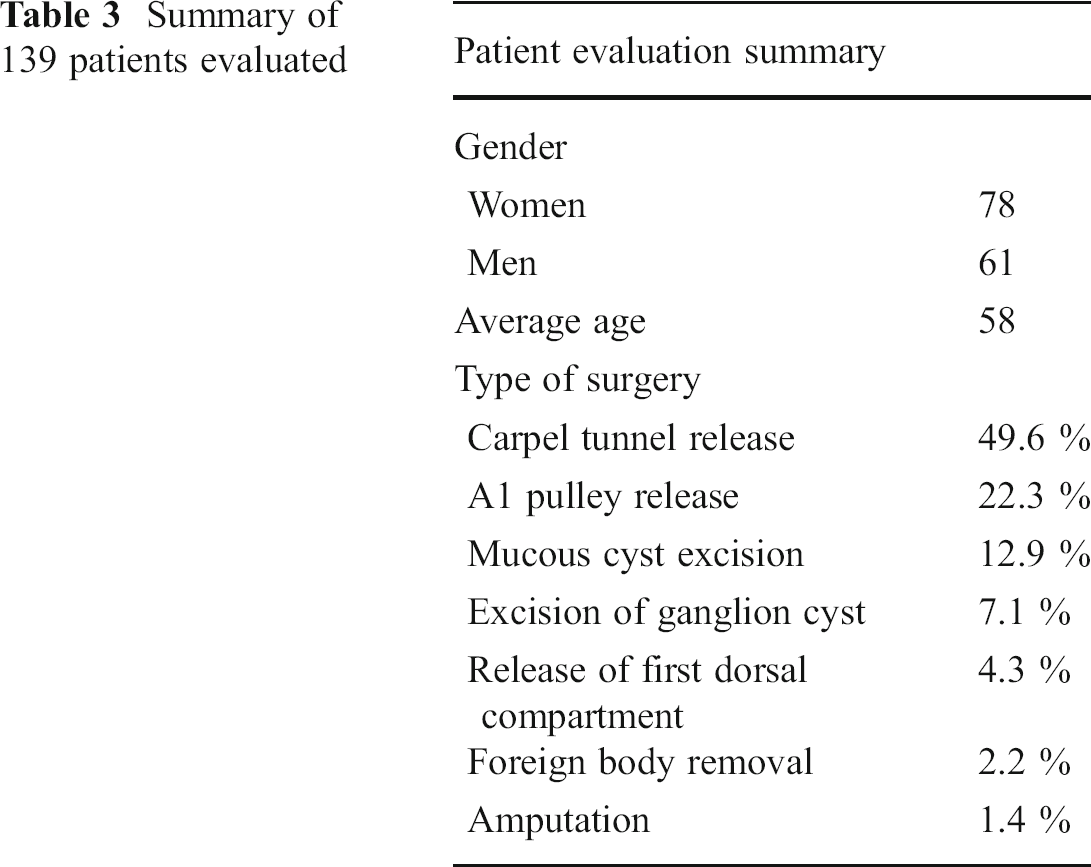
After obtaining approval from the institutional review board, we identified 428 patients who had hand surgery under local anesthesia without sedation over a 5-month period performed by four surgeons. Patients were identified through a database of outpatient procedures. A chart review was preformed to identify the age of the patient, gender, and procedure type. Patients were then contacted to complete a telephone interview. Three attempts were made to reach each patient and messages were left for those we were unable to contact. No attempts were made at mailing the questionnaire to remain within the study time frame. Of the 428 patients identified, 139 were available and completed the questionnaire. The cohort included 78 women and 61 men. The average age of the patients was 58 (range 20–89) years. There were 139 procedures performed on the 139 patients by four attending hand surgeons: 69 (49.6 %) carpal tunnel releases, 31(22.3 %) A1 pulley releases, 18 (12.9 %) mucous cyst excisions, 10 (7.1 %) ganglion cyst excisions, 6 (4.3 %) first dorsal compartment releases, 3 (2.2 %) foreign body removals, and 2 (1.4 %) amputations. All procedures were performed with local anesthesia infiltrated into the surgical field.
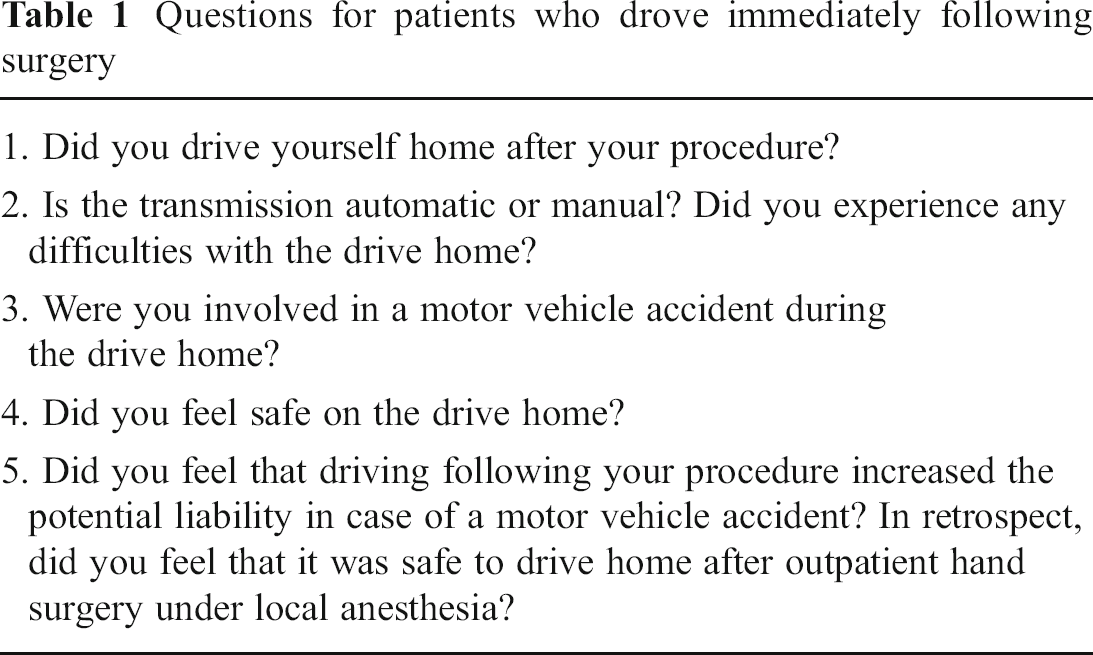
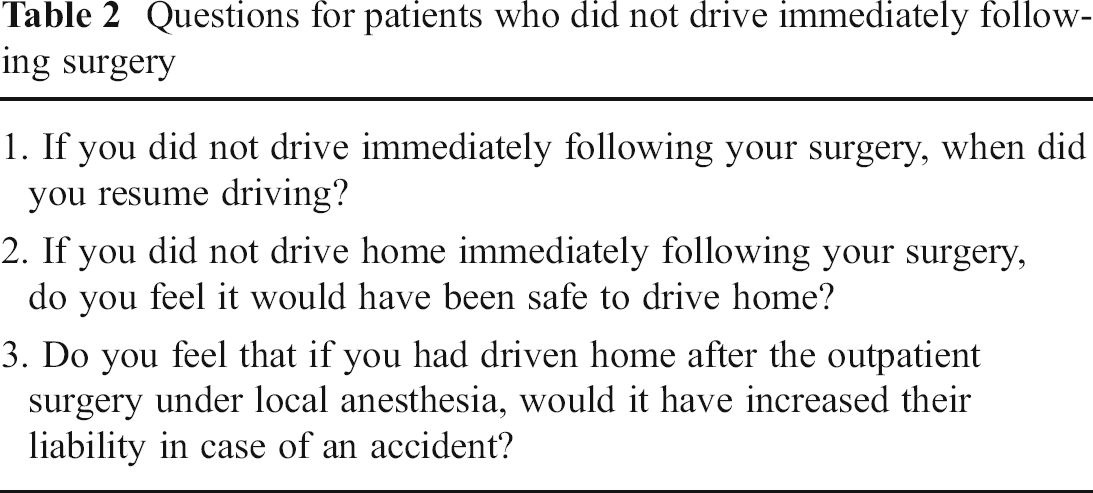
Patients were asked a series of questions and answers were recorded on a Microsoft Excel spreadsheet (Table 1). Variables of interest for study participants were summarized using appropriate descriptive statistics. Alternate questions were used for patients that had not driven home after their surgery (Table 2).
Questions for patients who drove immediately following surgery
Questions for patients who did not drive immediately following surgery
Results
Of the 428 patients indentified who had hand surgery under local anesthesia, 139 completed the questionnaire. There was no statistically significant difference in the results of patients who drove immediately after surgery or those who did not between surgeons, procedure, or technique (Table 3).
Summary of 139 patients evaluated
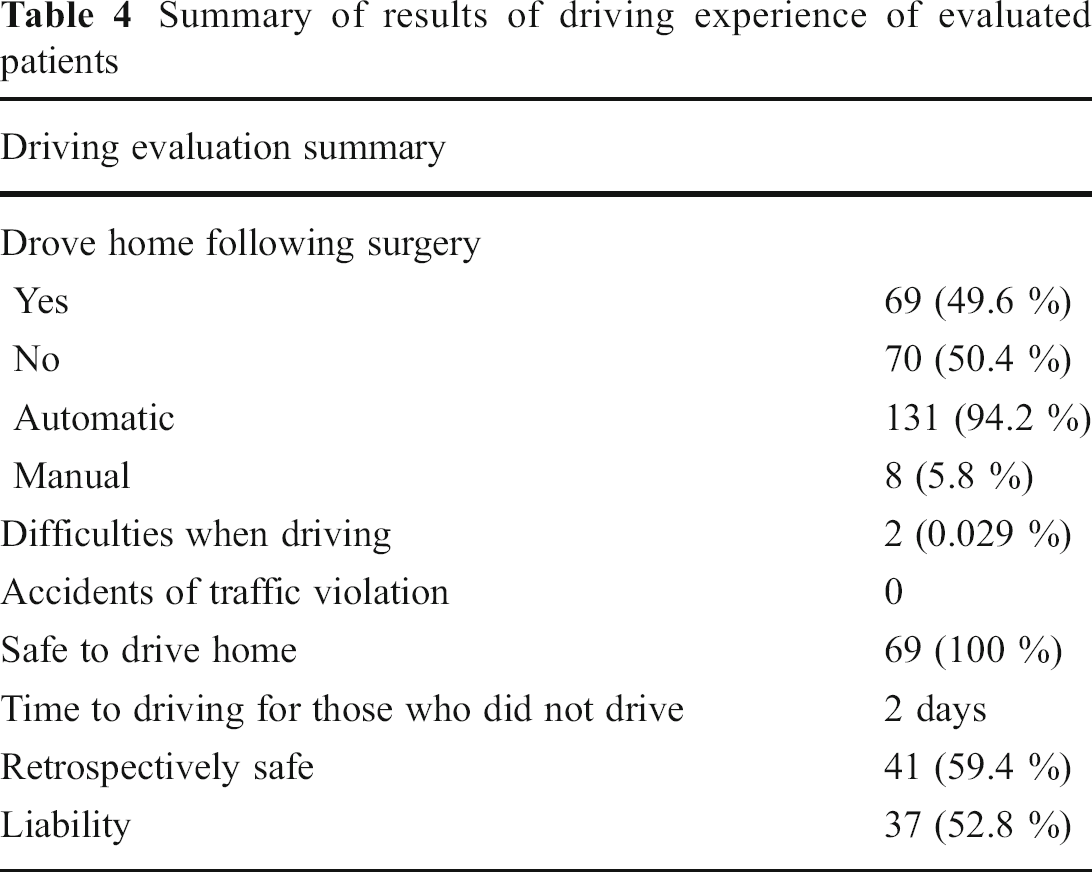
Of those 139 patients who underwent hand procedures under local anesthesia, 69 (49.6 %) operated a vehicle immediately after surgery. One hundred thirty-one patients drove an automatic transmission car, while eight patients drove a manual transmission car. Only two patients reported difficulties in driving after surgery; one patient reported having trouble in adjusting the seat belt, while the other patient reported that the dressing became loose during the drive home. Both of these difficulties were encountered while driving an automatic transmission vehicle. There were no accidents or traffic summons during the drive home after surgery. There were no accidents reported on the days or the week after the accident. Of the 69 patients who drove home, all felt that they were safe to drive home. Seventy (50.4 %) of the patients who underwent hand procedures under local anesthesia chose not to drive immediately after surgery. These patients waited on average of 2 days (1 h to 14 days) before driving. Forty-one (58.5 %) of the patients that chose not to drive immediately after surgery stated that they believed it would have been safe to drive. Of the 139 patients who completed the questionnaire, 37 (26.6 %) believed that they would be held at an increased liability had they been involved in a motor vehicle accident or had the police stopped them (Table 4).
Summary of results of driving experience of evaluated patients
Discussion
Patients frequently operate their automobiles after outpatient, minimally invasive surgical procedures on their hands. Common hand surgical procedures such as carpal tunnel surgery, A1 pulley release, and mucous cyst excisions are commonly performed under local anesthesia. Many physicians feel that it is safe to drive following hand surgery procedures under local anesthesia, but the literature does not clearly address this topic.
By searching using Medline and PubMed (search terms used: automobile driving, surgery, surgical procedures, operative minimally invasive, hand, safe, safety, upper extremity, and orthopedics), we discovered that the literature is scant pertaining to the safety of driving after minimally invasive surgery to the hand. Most of the literature relating to driving after orthopedic surgery involve lower extremity surgery and none of the literature examines driving immediately after surgery. The literature concerning driving after orthopedic surgery discusses reaction time to breaking. The literature that involves the upper extremity applies to those who are immobilized after fracture or fracture fixation [2]. In the European literature, there is one article that demonstrates a widespread lack of agreement on who is responsible for advising the patient to drive with use of a splint [1]. It is felt that the governing authority should make the determination, and that doctors should discuss this with the transit authority in question. The European literature also warns doctors that they may be held liable if the patient is advised to drive and is involved in an accident [2]. New York State vehicle code does not provide specific guidelines or recommendations regarding driving following local anesthesia or hand surgery. Recommendations include the position of the hands at the four and eight o'clock position most of the time and the driver must be able to operate the vehicle safely in their present condition. This is known as driving with due regard for the safety of others. We contacted State Farm and Allstate representatives and determined that they do not have a policy regarding driving with a splint on the upper extremities after hand surgery. They also stated that they did not have a policy concerning driving after local anesthesia and did not feel that driving after a procedure to the upper extremities or with a cast or splint would increase the liability to the patient or to the company.
In our study, we examined the patient's perception of safety when driving after hand surgery under local anesthesia. We noted that 49.6 % of patients drove immediately after their surgery. Those who did drive had no accidents or traffic violations and only two encountered difficulties, but all felt they were safe to drive. Factors which affected the decision to drive were the belief that the surgeon approved of driving immediately after surgery, concern of liability in the event of a violation or accident, and the perception that local anesthesia indicated minor impairment.
Retrospectively, of those who did not drive, 58.5 % felt it would have been safe to drive. Overall, 26.6 % of the patients felt that they would be at risk for higher liability had they been involved in a motor vehicle collision or had been cited a traffic violation.
This study has several limitations. We are relying on patients' perceptions, rather than on objective measures, such as a driving test immediately following hand surgery under local anesthesia, but this would be difficult to arrange and would still rely on subjective interpretation of driving. Based on this information, we are still not able to definitively determine if it is safe to drive following hand surgery under local anesthesia, but we do note that many patients do. In addition, we were only able to contact 139 of the 428 patients during our study period, but those were able to contact were willing to participate. Finally, this study was conducted in only one medium-sized city (population of approximately 900,000) and perceptions may differ in other localities that differ in population and density.
In conclusion, patients generally perceived that it was safe to drive following hand surgery procedures under local anesthesia. We found no accidents and only minor difficulties in this patient population. Patients who delay driving only do so for 2 days, and most feel it would be safe to drive immediately after surgery if they needed to drive.
Footnotes
The authors have nothing to disclaim and no conflicts of interests.