






Abstract

Introduction
For over two decades, researchers have been investigating the question of why married men earn more than their unmarried counterparts. Among the alternative theories which have been considered are that married men possess more of the characteristics that the labor market values, and that, by providing career support, marriage enhances men's productivity. More recently, it has been suggested, in the context of the United States economy, that tenure within marriage, rather than marriage per se, is responsible for the marital premium observed for men in the estimation of earnings regression equations. 1
The recent takeoff in the trend toward consensual cohabitation in industrialized countries has also led some researchers to inquire whether such cohabitation yields labor market premiums qualitatively similar to those observed for legally married men. This question ought to be of particular interest in Caribbean societies as well, where cohabitational relationships—frequently referred to in the region as common-law unions (CLUs)—have long been observed to occur with high frequency. 2 For example, whereas data for the U.S. reveal that there were six unmarried-couple households for every 100 married-couple households as of 1993, 3 the 1993 data to be employed in the present study show around 20 unmarried-couple households for every 100 married-couple households in Trinidad & Tobago. The extent of this phenomenon is even greater in the predominantly Afro-Caribbean societies. 4
Several well-known sociological and anthropological works undertaken for the Caribbean have examined the origin and nature of CLUs in the region. More than 50 years ago, Thomas Simey observed that the high rates of CLUs in Afro-Caribbean societies fell with age, and concluded that the practice among Afro-Caribbean people of delaying marriage until late in the life cycle was associated with higher societal expectations for that phase of life. 5 Based on studies for Trinidad and Jamaica, the Herskovitses and Fernando Henriques observed that legal marriage was more likely to prevail among those with greater economic stability and higher social ranking. 6 Dom Basil Matthews found that CLUs were more prevalent in rural than in urban parts of Trinidad, often representing up to 80 to 90 percent of all unions in rural districts. 7 Raymond Smith asserted that lower-class Afro-Guyanese viewed legal marriage as an upper-class symbol, its real significance being an act of conformity to “respectable” values. 8 Edith Clarke, in her study of three Jamaican villages, concluded that, beyond economic status and age, the extent of “integration of the community” was also important to determining marriage rates. 9 William Goode and Judith Blake both argued that the prevalence of CLUs in the Caribbean reflected the lack of bargaining power of the women who were willing to use such unions to improve their chances of marriage. 10 Hyman Rodman observed that while his lower-class Afro-Trinidadian respondents believed legal marriage was the ‘more respectable’ institution, they often cited poverty as the factor preventing them from marrying. 11
The literature on marriage and the family suggests that women and children generally fare better within legal marriage, as they have more secure claims on the family's economic and social capital. Indeed, in the Trinidadian context, Rodman found that women were keener than men to marry, in part because of the respect, but more so because of the legal advantages that marriage brought them. 12 This raises the question as to which partner was the more likely to choose the CLU. In the context of the Caribbean, Thomas Simey suggested that it was the female, whereas Raymond Smith claimed that it was the male. 13
The main purpose of this article is to glean some insights into how the labor market in Trinidad & Tobago remunerates individuals who are legally married, in comparison to those in CLUs. Using a framework grounded in human capital theory, it estimates earnings equations for men and women in both types of conjugal unions, in an effort to determine whether and to what extent the differences in earnings can be explained by characteristics possessed by these workers. The next section discusses some characteristics of the data under analysis; the third section presents the model to be estimated; the fourth section discusses the empirical results, and the fifth section performs a standard decomposition analysis on the earnings differentials. The final section contains the conclusions of the article.
Data Characteristics
The data analyzed in this study are obtained from the Continuous Sample Survey of the Population (CSSP), conducted by Trinidad & Tobago's Central Statistical Office in 1993. The data sample comprises working men and women who were either legally married or in a common-law union. The respective numbers of males and females in the sample are 3,936 and 1,578. This calculates at five working men for every two working women. Since the original data set for all workers contains twice as many men as women, the present sample reflects the reality that women in conjugal unions are less likely than their single counterparts to participate in the labor market.
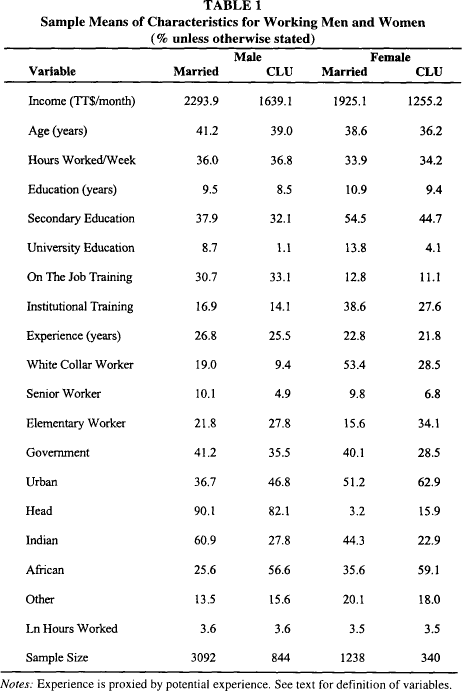
Table 1 contains data on the mean levels of the characteristics employed in the present analysis. Rather remarkably, the data reveal similar ratios of men to women across the two types of conjugal unions. This offers somewhat of a challenge to the hypothesis found in the Caribbean literature that women in CLUs, prone to feel less secure about the nature of their conjugal relationships, are more likely to be employed at labor market work than their married counterparts. Men in CLUs earned about 72 cents to the dollar realized by their counterparts who were legally married, while women in CLUs earned 65 percent of the remuneration obtained by their married counterparts. Expressing these ratios somewhat differently, married women earned 84 cents to the dollar realized by married men, while the corresponding ratio among those individuals in common law unions was about 77 cents.
Sample Means of Characteristics for Working Men and Women (% unless otherwise stated)
Notes: Experience is proxied by potential experience. See text for definition of variables.
In ascertaining why individuals in CLUs do relatively worse in the labor market than their legally married counterparts, one immediately notices that the groups of married workers are older and more educated. Specifically, married males are 2.2 years older than CLU males, while married females are 2.4 years older than CLU females. The married males have one year more of schooling than their CLU counterparts, while the educational difference between married and CLU females is 1.5 years. This is all the more significant since continuous improvements in the educational system over time should naturally result in younger workers with higher levels of educational attainment. Given the highly selective nature of university education in the Caribbean, the fact that married groups are several times more likely than their CLU counterparts to have attended university is contributory toward understanding the social structure in the region. Viewed from a gender perspective, the educational data reveal both groups of employed women to be better educated than their male counterparts.
In respect of training, two measures are employed in the present analysis: on-the-job training (OJT), and training undertaken at a formal training institute other than university—defined here as “institutional training.” The data in Table 1 reflect the proportions of workers receiving either type of training. Via the nature of the questions asked in the CSSP, these two types of training are defined to be mutually exclusive. Among men, the differences in proportions receiving either type of training are not very large: 2.4 percentage points for OJT, and 2.5 percentage points for institutional training. CLU men were the more likely to have acquired OJT, while married men were the more likely to have acquired institutional training. As to the female samples, married women acquired more of both types of training than their CLU counterparts. One difference that stands out across the sexes is that women were more likely to acquire formal training, while men were more likely to acquire OJT. 14
With respect to occupational choices, three categories are explicit to Table 1: “white collar,” “senior,” and “elementary” occupations. The white collar category is the agglomeration of professional, technical and clerical workers. To the extent that the “senior” occupational category represents management positions, it would also constitute a white collar occupational category. It is, however, separated out because the definition employed in the CSSP is observed to include self-employed individuals in entrepreneurial activities across all sectors of the economy; many of these operations have no employees other than the proprietor. Beyond these four occupational categories, the CSSP contains five generally “blue collar” categories, one of which is explicitly included in Table 1: “elementary” (i.e., unskilled) workers. It is not surprising that the more-educated groups of married workers predominate in the white collar (and senior) categories, while the less-educated groups of CLU workers are more heavily represented among “elementary” workers.
Evident from Table 1 is the fact that the samples of married men and women are about twice as likely as their CLU counterparts to be employed in white collar jobs, while the sample of working women in CLUs is more than twice as likely as the group of married women to be employed at elementary jobs. Undertaking an analysis of occupational segregation using the Duncan Index of Dissimilarity, 15 and employing all of the one-digit occupational categories contained in the data set, reveals that 16.3 percent of the males in either the legally married or the CLU groups would need to change occupations to have similar distributions across occupational categories. In the case of females, 27.8 percent of those in either the legally married or the CLU groups would need to change jobs to accomplish a similar outcome of eliminating occupational segregation. The obvious interpretation of such outcomes is that women across the two types of conjugal unions are more dissimilar in their occupations than are their male counterparts. 16
From the remaining data contained in Table 1, both men and women in CLUs are seen to work marginally longer work weeks than their counterparts who are legally married. As might be expected, both groups of men work longer hours than the women. Based on the higher educational levels and higher proportions of white collar workers within the married groups, it is not surprising that the latter are more likely to be in government employment. Working men in either group are also more likely than their female counterparts to be in the government service. Finally, the observation that working women are more likely to reside in urban areas than working men is related to the greater degree of gender segregation of work in rural than in urban areas, as well as the fact that urban women are likely to be more educated, and more liberal, than their rural counterparts. In fact, it is not implausible that some formerly rural residents would have relocated to urban areas, in order to enhance their employment options in the formal sectors of the economy.
The fact that individuals in CLUs were more likely to reside in urban areas might seem, at first blush, to be incongruent with the findings of Matthews, mentioned in the previous section. This, however, can be explained via the ethnic delineation of the population in Trinidad & Tobago. As might be inferred from Table 1, the CLU is far less prevalent among the predominantly rural Indian population segment than in the largely urban non-Indian segment. Once ethnicity is controlled for, the Matthews observation is reestablished.
Table 2 shows sample means of various characteristics for employed male heads of household. These data are included because men's higher labor force participation rates (LFPRs) yield a clearer representation of the adult population in Trinidad & Tobago. Because the survey codes minor children along with the data for the respective heads of household, separating those male heads with children present in the household from those with no children present offers a sense of how and when individuals sequence the two alternative types of conjugal unions under analysis. The data in Table 2 reveal higher average ages for male heads with no minor children present in the household. 17 The fact that this outcome applies not only to marriage, but to CLUs as well, is suggestive of cohabitation in the Caribbean being less of a “trial marriage” than in countries such as the U.S., where rates of cohabitation have taken off since the 1970s. The average age of CLU male heads in households where children were present is 39 years of age, only slightly lower than that for their counterparts who are legally married. When compared with average ages of 43.3 and 48.5 years for men in CLUs and in legal marriages with no minor children present in the household, they appear to support the observations from prior studies of some CLUs being converted into formal marriage later in the life cycle. An important indicator of these conversions might be the wider income gap between the two groups of male heads in households with no minor children: as the responsibilities of child-rearing end, higher levels of disposable income afford individuals in CLUs a better opportunity to convert their non-legal unions into legal ones. It is also not surprising the observation from Table 2 that male heads with no children present in the household would work longer hours.
Sample Means of Characteristics for Working Male Heads (% unless otherwise stated)
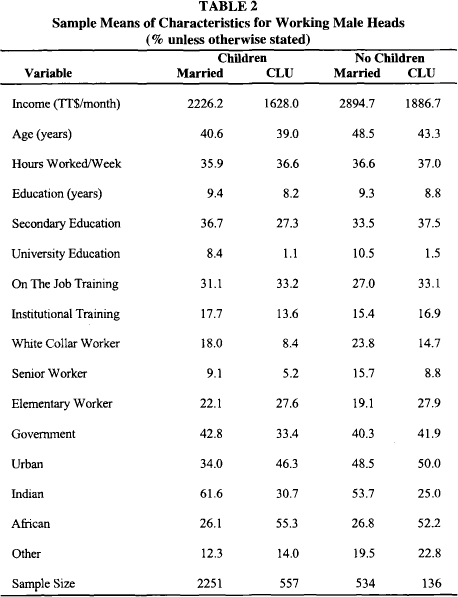
As mentioned previously, it is not implausible, given continuous educational improvements over time, that older males would have less education; yet Table 2 revealed hardly any difference in educational levels for the two groups of married males. The older “empty-nest” male heads had less secondary education, but more university education. More surprising, however, is the fact that the older CLU male heads were more educated than their counterparts in households with children present. It should be mentioned here that the households of CLU males averaged slightly more children than those of their married counterparts—2.54 and 2.4 children respectively. All this makes it somewhat unclear how CLU households “emptied the nests” more readily than married households. 18
Worthy of notice is the educational gap between the sample of CLU men with children in the household and their married counterparts. What averages out to be one year of schooling is a 16.7 percentage point differential in the attainment of post-primary education, or a 59 percent greater likelihood, in favor of men who were legally married. Since most of this education would have been completed prior to the formation of conjugal unions, one might surmise that those who formed CLUs were generally less academically oriented than those who formed legal marital unions. Indeed, this is rather evident in the present data, when one compares men with children across the two types of conjugal unions.
Among some of the issues that arise in the literature on cohabitation are the extent to which it is a “pre-family” lifestyle, and the degree of egalitarianism in CLUs when compared with legal marriages. While the present data cannot directly address these issues, they do offer somewhat of a perspective on them. In regard to the “pre-family” nature of cohabitation, the 1993 data for Trinidad & Tobago show approximately 80 percent of the cohabiting households containing children; this corresponds to around 35 percent for the U.S. in 1994. 19 Also, the fact that cohabiting households with no minor children present are older than those with minor children points to the likelihood that the children of many of these cohabiting adults are grown. When taken together with the fact that the average age of the male cohabitor in a household with children is only slightly lower than that of his legally married counterpart (39.0 versus 40.6 years of age), they point to cohabitation as a “family” lifestyle rather similar to marriage in 1993 Trinidad & Tobago.
The Model
Early analyses of human capital theory specified the wage rate to depend on schooling and experience, as follows:

where In W is the natural logarithm of the wage rate, S is years of schooling, and X is experience, defined as post-schooling years. With respect to the parameters, β0 represents the logarithm of the wage due to zero schooling and experience; β1 is the return to an additional year of schooling; and the coefficients β2 and β3 capture the diminishing return to years of experience. Further to the education and experience components of the model, wages are hypothesized to depend (positively) on training, white collar employment, government sector employment, urban location of residence, and legal marriage. The inclusion of an urban dummy variable in the present analysis is motivated by the argument that, as compensation for higher living costs, nominal wage rates for comparable jobs would generally be higher in urban than in rural areas. The absence of explicit hourly wage data for the present study necessitates another slight modification: “hours worked” is included as a regressor variable, and earnings become the model's dependent variable.
The full regression model to be estimated is:
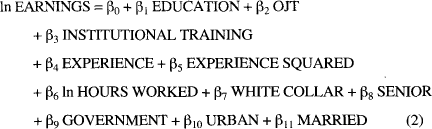
The variables are defined as follows. Education is denoted by years of schooling attained. Training is measured using two dummy variables: on-the-job training (OJT), and institutional training. The absence of explicit data on experience warrants the employment of an appropriate proxy variable; the practice followed is that of using potential experience, captured by post-schooling years: age minus education minus 5. Since no explicit wage rate data are available, the inclusion of hours worked accommodates for the use of earnings as the dependent variable. The “hours worked” variable uses data for the week prior to the survey, while the earnings data are given as monthly earnings. 20 This therefore necessitates the assumption that workers' hours in the week referred to were characteristic of their work histories for the prior month. White collar, senior, government, urban and (legally) married are all represented by 0–1 dummy variables (1 = “yes”; 0 = “no”).
Regression Analysis
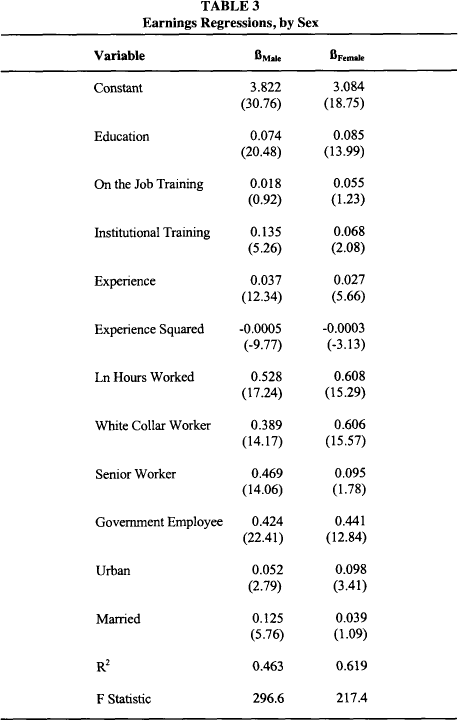
Ordinary least squares regression results are presented for two variants of the model given in equation 2. Table 3 presents estimates for men and women in conjugal unions, while Table 4 presents a re-estimation of the model with a delineation by the type of conjugal union: either legal marriage, or consensual cohabitation—referred to in the CSSP instrument as “common-law” union. The results in Table 3 reveal that the labor market rewarded men, but not women, with a significant premium to marriage. Since the regression coefficients in Table 3 are “averages” of the coefficients obtainable from the separate estimations by marital union status, Table 4 relaxes this constraint of similar coefficient estimates for the variables included in the analysis. The remainder of this section offers a discussion of the four regressions contained in Table 4, presented at the level of the individual variables contained in the model.
Earnings Regressions, by Sex
Earnings Regressions, by Union Status
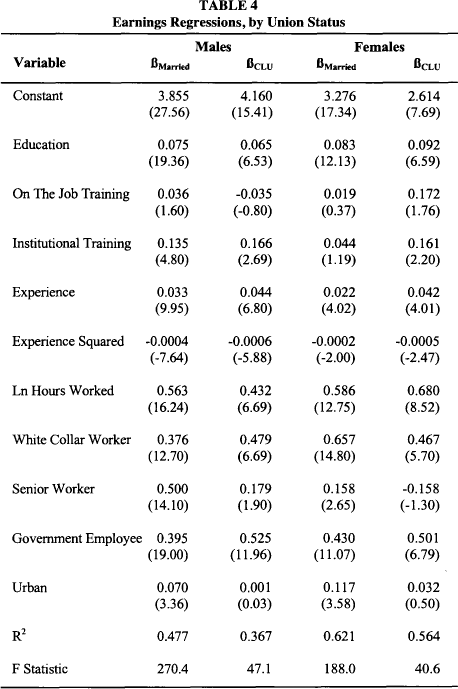
In respect of education, the estimated returns for married and CLU men were in the vicinity of 7.5 percent and 6.5 percent respectively for an additional year of schooling. In the case of women, those in CLUs also experienced a higher return to additional schooling than those who were legally married. Institutional training was valuable to all except married women, while on-the-job training was valuable only to CLU women. Stated differently, neither type of training was remunerative to married women, while both types of training were remunerative to women in CLUs. The fact that married women were far more likely to hold white collar jobs than CLU women might explain somewhat the difference in returns to OJT; the non-remunerative nature of institutional training to married women is, however, more surprising.
The initial years of labor market experience appear to have been more remunerative to men and women in CLUs than to their legally married counterparts. Among those who were legally married, men's returns to experience were greater than women's; a similar ranking was, however, not observed for those in CLUs. To the extent that the proxy measure employed (potential experience) captured the actual labor market experiences of women in CLUs better than it did those of married women, it is not implausible that employed married women would have less continuous careers than their CLU counterparts, for reasons of family formation under conditions of greater emotional and financial security. 21 With respect to the hypothesis of generally quadratic experience-earnings profiles, this was rejected in none of the four cases analyzed. However, the higher initial returns observed among those in CLUs did not persist throughout their working careers. An analysis of the slopes of these profiles across the four groups of workers reveals that the experience-earnings profile for CLU men became flatter than that for married men after about 28 years of experience; in the case of women, a similar reversal in the steepness of the two profiles occurred after 33 years of experience. 22 When taken in conjunction with average ages on leaving school, the general picture is that married men in their 50s got better returns to experience than CLU men, while married women's returns to experience bettered those of their CLU counterparts beyond age 45. Since returns to white-collar occupations are likely to remain positive longer than those to blue-collar and other elementary occupations, these outcomes do not appear to be all too surprising.
As was previously alluded to, the motivation for including the “senior” and “white collar” occupational categories separately in the regression analysis was that “senior” did not always refer to a white-collar job. The differences between the two coefficients are somewhat striking. Married men constituted the only group among the four to have obtained generally better returns to senior occupations than to white-collar occupations. In the case of CLU women, the senior occupational category yielded no premium, and the quantitative magnitude of the coefficient was negative, even though it failed to be significant at traditional levels of statistical significance.
Table 4 reveals statistically significant earnings premiums from government sector employment for all four categories of workers. Such results suggest, on average, more attractive rates of remuneration by the government than those offered by the private sector for comparable human capital, demographic and other measured characteristics. The premiums for men and women in CLUs exceed those for their legally married counterparts. Given the higher average incomes of those who were legally married, such an outcome very likely reflects a “catching-up” effect, since government should be less likely than the private sector to discriminate against workers based on the nature of their conjugal unions.
With respect to location of residence, the results in Table 4 reveal premiums to married workers who resided in urban areas but not to their CLU counterparts. The data contained in Table 1 for working men revealed the married segment of the population in Trinidad & Tobago was predominantly Indian; it also showed the likelihood of urban residence to be greater for men in CLUs than for their legally married counterparts. 23 Since earlier work has shown that only the Indian segment of the population obtained significant premiums for urban residence in Trinidad & Tobago, 24 the mystery of the urban premium to married individuals is unraveled: the urban premium here is not explicitly a consequence of being married.
Supplemental Analysis on the Earnings Differentials
The income data in table 1 point to the significant logarithmic earnings differentials which exist among the four groups of workers in the present analysis. The two foci of inquiry here offer explanations of the earnings differentials across union types, as well as across the sexes. In particular, the former analysis seeks to determine how individuals in CLUs would have fared with the returns of their counterparts who were legally married. Specifically, the logarithmic earnings differential,

where X and B are the vectors of mean levels of the measured characteristics and returns to those characteristics, and In Ei the average (logarithm of) earnings to household group i [= legal marriage (L), and common law union (C) respectively], may be decomposed in various ways. Two of the simpler approaches are:

and

The second term on the right hand side of (4) is the difference in returns to workers in legal and non-legal conjugal unions, evaluated at the mean levels of characteristics of those in CLUs; the alternative formulation in equation 5 weights this difference in returns by mean levels of characteristics of those who are legally married. These differences in returns are obtained from the coefficients in table 2, while the mean characteristics are for the most part evident in table 1.
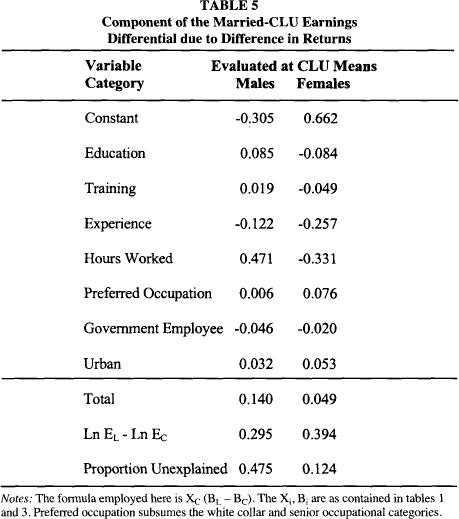
Table 5 shows the magnitudes by which the logarithm of earnings for those in CLUs would rise or fall if they were to receive returns similar to those obtained by workers who were legally married (i.e., employing equation 4 above). Aggregating all of the variable categories contained in table 5, which are based on table 4's regression results, yields the outcome that individuals in CLUs would be better off with the returns paid to their legally married counterparts. In the case of men, nearly half of the 29.5 logarithmic percentage point earnings gap would be eliminated by remunerating CLU men at rates similar to those received by those who are married; for women, however, only 12 percent of the 39.4 logarithmic percentage point earnings difference would be erased by equivalent rates of remuneration. Put differently, the major portion of the earnings gap between women who are married and those in CLUs is explained by differences in the possession of characteristics valued by the labor market; among men, half of the gap is due to differences in endowments of these characteristics that the labor market valued. When a corresponding analysis is performed at the aggregated level across the sexes (Table 6), the earnings differentials between working men and women are largely unexplained by characteristics valued by the labor market; for both union types, the unexplained portions exceeded 100 percent of the earnings differentials.
Component of the Married-CLU Earnings Differential due to Difference in Returns
Component of the Male-Female Earnings Differential due to Difference in Returns
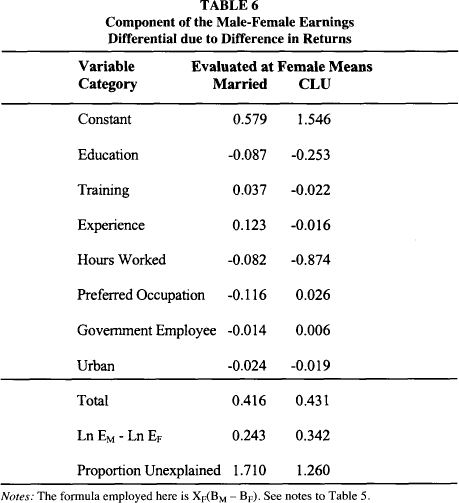
Notes: The formula employed here is XF(BM – BF). See notes to Table 5.
At the less aggregated level, men in CLUs would experience increases in their earnings if remunerated at rates equivalent to those of their married counterparts for the following variable categories (in order of importance): hours worked, education, urban location, training, and “preferred occupations” (defined here as the “white collar” and “senior” occupations). They would be worse off with the remuneration rates of their married counterparts for (in order of importance): experience, government sector employment, and the unmeasured characteristics captured by the intercept term. A corresponding analysis for women reveals improved earnings for CLU women were they to receive the returns of their legally married counterparts in the preferred occupations and for urban residence; the biggest boon to CLU women's earnings, however, would arise from being remunerated equivalently to married women for the unmeasured characteristics captured by the intercept term. Women in CLUs would be worse off with married women's rates of return in all other variable categories.
Finally, a look at Table 6 reveals that women across both union types would be worse off with men's returns to education, hours worked, and urban location, while they would be substantially better off if they received the returns obtained by men to the unmeasured characteristics captured in the intercept term. The other four variable categories do not yield qualitatively consistent outcomes across the two union types. In the cases of training and government employment, these are small in magnitude. In the case of experience, married women's earnings would be about 12 percent higher with men's returns, while CLU women's earnings would be about 2 percent lower. In the preferred occupations, however, married women would be about 12 percent worse off with married men's returns, while CLU women would be about 3 percent better off with the returns obtained by their male counterparts.
Conclusion
This preliminary investigation of earnings differences between men and women in a Caribbean country by the constitution of their marital union has sought to bring some contemporary evidence to bear on a long-asked question: to what extent does conjugal union status matter in Caribbean society? More specifically, the article investigated this matter within the context of the Trinidad & Tobago labor market, and identified two types of conjugal unions: legal marriage and consensual cohabitation, generally referred to in the Caribbean literature as “common-law” unions.
In 1993 Trinidad & Tobago, men in common-law unions earned 72 percent of what their legally married counterparts earned, while among women the concomitant ratio was 65 percent. Just over half of the earnings differential between the two groups of men (29.5 logarithmic percentage points) was explained by differences in the characteristics they possessed that were valued by the labor market; among the two groups of women, the bulk of the 39.4 logarithmic percentage point earnings differential was due to the endowments of characteristics they brought to their respective jobs. To the extent that the unexplained proportions of the earnings differentials reflect possible discrimination, the inference here is that men in Trinidad & Tobago who cohabit are more likely to be discriminated against in the labor market than their female counterparts. In the sociological context, several researchers have argued that Caribbean women who cohabit are more desirous than their male partners of converting their union status to legal marriage. If they are correct, then the issue of conjugal union status appears to raise different questions for men than for women in the economic and sociological realms.
At the level of individual characteristics included in the analysis, the earnings of men in common-law unions would have increased were they to receive the same rates of remuneration as their married counterparts for hours worked, education, urban location, training, and “white collar” occupations, while they would been worse off with the remuneration rates of their married counterparts for experience, government sector employment, and the unmeasured characteristics captured by the intercept term. As for women, those in common-law unions would have had improved earnings if they received similar returns to their legally married counterparts in the white-collar occupations, urban residence, and the unmeasured characteristics captured in the analysis by the intercept term. In all of the other variable categories, women in common-law unions would have been worse off with married women's rates of return.
To the extent that marriage matters more in the labor market for men than for women, it should not be surprising that many cohabitors in the Caribbean do marry eventually. One cannot be sure, however, that this marriage later in the life cycle does much to enhance these men's labor market options. Of course, the entire matter might be a consequence of self-selection: men who have the characteristics that the labor market values might be better positioned to marry, while those without these characteristics deem themselves less marriageable.
Since the results suggest that marriage benefits men more than it does women, it might be tentatively concluded that Caribbean men have the better bargaining position in the marriage market. All this, of course, warrants further investigation. Since the sociological literature for the Caribbean offers mixed results as to whether conjugal union status matters to the offspring of these unions, another potentially worthwhile area of investigation would be the effects of parents' marriage, including the timing of such a marriage, on the socioeconomic outcomes for their children.
Footnotes
1.
See Sanders Korenman and David Neumark, “Does Marriage Really Make Men More Productive?” Journal of Human Resources, Vol. 26, No. 2 (1991), pp. 282–307.
2.
They are more prevalent and longer in duration than in most other regions of the world, where cohabiting relationships are often short-term, and are frequently perceived as “trial marriages.” According to Larry Bumpass and James Sweet, the median length of cohabitation in the U.S. is one year. See Larry Bumpass and James Sweet, “The Role of Cohabitation in Declining Rates of Marriage,” Journal of Marriage and the Family, Vol. 53, No. 4 (1991), pp. 913–927. For a perspective on the different union types in Jamaica and Trinidad & Tobago, see George Roberts and Sonja Sinclair, Women in Jamaica: Patterns of Reproduction and Family (Millwood, NY: KTO Press, 1978).
3.
See Mary Ann Lamanna and Anne Riedmann, Marriages and Families: Making Choices in a Diverse Society, 6th ed. (Belmont, CA: Wadsworth, 1997), p. 161.
4.
This seems plausible since removing the Indian population segment from the present data sample pushes the proportion for the predominantly Afro-Trinidadian segment of the adult population cohabiting closer to 35 percent.
5.
Thomas Simey interpreted the available evidence as showing the common-law relationship to be largely a feature of the early years of adulthood, either dissolving or being converted to a legal marriage. See Thomas Simey, Welfare and Planning in the West Indies (Oxford: Clarendon, 1946), p. 82. Michael G. Smith generally agreed with Simey, observing that marriage was the appropriate form of cohabitation for women in their 40s, with few remaining in consensual cohabitation beyond their 54th year. See Michael G. Smith, West Indian Family Structure (Seattle, WA: University of Washington Press, 1962), p. 147.
6.
See Fernando Henriques, Family and Colour in Jamaica (London: Macgibbon and Kee, 1953) and M. Herskovits and F. Herskovits, Trinidad Village (New York: Alfred Knopf, 1947). This observation was also made by G. E. Cumper, “Household and Occupation in Barbados,” Social and Economic Studies, Vol. 10, No. 4 (1961), pp. 386–419.
7.
See Dom Basil Matthews, Crisis of the West Indian Family: A Sample Study (Westport, CT: Greenwood Press, 1952), p. 51. He also pointed to the importance of social class in the determination of union type: in urban centers, he found the common-law union to be “practically non-existent in the upper middle and upper classes” (p. 56).
8.
Smith also determined that there is no sociological distinction between marriage and common-law marriage. See Raymond T. Smith, The Negro Family in British Guiana: Family Structure and Social Status in the Villages (London: Routledge and Kegan Paul, 1956), p. 97.
9.
See Edith Clarke, My Mother who Fathered me (London: Allen & Unwin, 1957), at pp. 27–28, 84, and 109.
10.
See William Goode, “Illegitimacy in Caribbean Social Structure,” American Sociological Review, Vol. 25, No. 1 (1960), p. 29; and Judith Blake, Family Structure in Jamaica: The Social Context of Reproduction (New York: Free Press of Glencoe, 1962), p. 162. Goode maintained that there was a general absence of punishments for entering CLUs, and of rewards for legal marriage in the Caribbean. Citing economic need and the presence of children as the main reasons for most CLUs, Blake claimed that both men and women in Caribbean society preferred marriage—men for the better care that was forthcoming to the man and the home in legal marriage, and women for the fact that men “recognized” few obligations in common-law unions (p. 162).
11.
See Hyman Rodman, Lower Class Families: Culture of Poverty in Negro Trinidad (New York: Oxford University Press, 1971), pp. 62–65; but see also Mariam Slater, The Caribbean Family: Legitimacy in Martinique (New York: St. Martins, 1977), p. 243, for an opinion contrary to this. Rodman explained the dissonance between beliefs and behavior by claiming that the lower class “stretched” the general values of society to help them adjust to their deprived economic circumstances (p. 195).
12.
Rodman, Lower Class Families, p. 65.
13.
See Simey, Welfare and Planning, p. 87; and Smith, Negro Family in British Guiana, pp. 37 and 138.
14.
This difference is, however, not all that surprising. Given women's greater likelihood of exiting the labor market for reasons of family formation, employers are reluctant to invest in women's training experiences to the same degree that they are willing to invest in men's training. Women are thus wont to acquire training experiences at their own expense, which are, for the most part, undertaken at formal training institutes.
15.
See Otis Duncan and Beverly Duncan, “A Methodological Analysis of Segregation Indices,” American Sociological Review, Vol. 20 (1955), pp. 210–217.
16.
A similar type of analysis performed across the gender divide shows that 31.3 percent of either men or women in CLUs would have to change jobs to eliminate occupational segregation by gender; whereas 36.8 percent of men or women among the married segment of the work force would need to change jobs to eliminate occupational segregation. In other words, there is more sex segregation of occupations among married than among CLU workers.
17.
Note that the average number of children is higher in households headed by males in CLUs than in households headed by married men.
18.
Some of these men might well have left legal marriages and formed CLUs, without their minor children accompanying them into the new relationships. Such a phenomenon would, of course, result in an increase in female-headed households. While not offering a direct answer to this matter, the discussion by Simey, Welfare and Planning, of how CLUs transition either via dissolution or conversion to legal marriage later in the life cycle might offer some useful insight.
19.
See Lamanna and Riedmann, Marriages and Families, p. 161.
20.
See Glenn Cain, “The Economic Analysis of Labor Market Discrimination: A Survey,” in Orley Ashenfelter and Richard Layard (eds.), Handbook of Labor Economics, Vol. 1 (Amsterdam: North-Holland, 1986), p. 753 for an argument which favors earnings over wage rates in such analyses.
21.
This is, of course, speculative. Data contained in the CSSP on number of months worked during the past 12 months do, however, reveal averages of 10.1 and 9.5 months for married and CLU women respectively.
22.

23.
A further analysis of the data employed here yielded an 8:1 ratio of legal marriage to CLUs among Indians, but an approximately 2:1 ratio for the remainder of the population.
24.
See Addington Coppin and Reed Olsen, “Earnings and Ethnicity in Trinidad & Tobago,” Journal of Development Studies, Vol. 34, No. 3 (February 1998), pp. 116–134.