






Abstract

Owing to the practice of slavery, its legacy of discrimination, and the history of black social and economic disadvantage, the central organizing principle of racial/ethnic relations in the United States has revolved around the axis of the black-white color line (Bobo 1997; Clark 1965; Drake and Cayton [1945] 1993; Farley and Allen 1987; Myrdal 1944). The unique deprivations blacks have suffered and the history of black-white relations in this country provide stark reminders of the strength of the divide—a delineation that assigns and consigns blacks and whites to different positions in the social order and attaches a different set of rights and privileges to each group (Blumer 1965). In numerous ways, many Americans have viewed the black-white gulf in categorical and absolute terms, as reflected in the legal adoption of the “one-drop” rule in U.S. southern states (Davis 1991; Wright 1994) and in the color line's long discriminatory life in the United States. The enduring nature of the fault line, of course, was famously forecast in 1903 by the prominent African American social theorist W.E.B. Du Bois when he prophesied that the “problem of the twentieth-century is the problem of the color line” ([1903] 1997: 45).
Now, many observers in the United States think problems of race are beginning to recede into the background. Nearly one hundred years after the end of the Civil War, the Civil Rights laws of the 1960s eradicated the last vestiges of legal discrimination on the basis of race. In part as a result, by the end of the 1970s, considerable, if not complete, progress had been achieved in closing black-white economic gaps (Jaynes and Williams 1989; Farley 1996). But disparities remained, and the gains of the 1970s subsequently stalled, or in some instances even reversed themselves (Danziger and Gottschalk 1995; Smelser, Wilson, and Mitchell 2001; Wilson 1987). Some public intellectuals and commentators see grounds for optimism in these patterns and emphasize the progress that has occurred (e.g., Thernstrom and Thernstrom 1997), embracing a positive perspective on race relations in the country and suggesting the beginnings of the disappearance of the black-white color line. Others see grounds for pessimism and emphasize the continuing nature and degree of the gulf between blacks and whites (Bobo 1997, 1999; Hacker 1992; Massey and Denton 1993; Oliver and Shapiro 1995; Schuman, Steeh, and Bobo 1985).
Other trends have increasingly transformed questions about race relations in the United States into questions about racial/ethnic relations. The biggest, of course, is immigration, which over the past four decades has added complex new dimensions to the matter. Because of the vast number of newcomers, America is no longer merely a black and white society, and as a result, questions are now being raised about the current placement and meaning of America's racial/ethnic color lines (Gans 1999; Sanjek 1994; Skrentny 2001; Waters 1999). In fact, the use of the term “color” itself now introduces ambiguities into the matter of racial/ethnic terminology. Sometimes the word has been used to designate persons who are nonwhite, whereas at others, it has been used more traditionally to refer only to blacks. Such multiplicities of usage, while assuredly not new, reflect transformations in the country that are currently broader and deeper than at any time since the first part of the twentieth century. Even in 1903, during a time of substantial immigration, it seems unlikely that Du Bois could have anticipated that America's new immigrants in the late twentieth century would so drastically modify the racial and ethnic makeup of the United States, perhaps either changing or obscuring the nature of the color line in the process.
Today's immigrants are notable because they are mainly non-European. By the 1980s, only 12 percent of legal immigrants originated in Europe or Canada, whereas nearly 85 percent reported origins in Asia, Latin America, or the Caribbean (U.S. Immigration and Naturalization Service 2002; Waldinger and Lee 2001). America's newcomers have made an indelible mark on the nation's racial/ethnic scene, and in the year 2002, immigrants and their children accounted for almost 66 million people, or about 23 percent of the U.S. population (Fix, Passel, and Sucher 2003; Smith and Edmonston 1997; U.S. Bureau of Census 2002). And according to National Research Council projections, by the year 2050, America's Latino and Asian populations are expected to triple and constitute about 25 and 8 percent of the U.S. population, respectively (Smith and Edmonston 1997).
Along with the increased racial/ethnic diversity brought about by changes in immigration over the past four decades are the dramatic rises in racial/ethnic intermarriage. Within the thirty-year period between 1960 and 1990, a time coinciding with the rise of the new immigration, the intermarriage rate between whites and Asians and whites and Latinos increased tenfold, now exceeding 50 percent among the third-generation Asians and Latinos (Jacoby 2001; Waters 1999). The increase in interracial marriage has also led to a growing multiracial population. Currently, one in forty persons identifies himself or herself as multiracial, and by the year 2050, this ratio could rise to one in five (Farley 2001; Smith and Edmonston 1997).
What does current thinking and evidence about the new immigration, race/ethnicity, intermarriage, and multiracial reporting imply about America's racial/ethnic divides? At first glance, these changes seem to indicate that race has become a less prominent social marker in the United States, pointing to the erosion of racial/ethnic boundaries. However, this may not be the case; or it may be the case for only some groups and not others. While increases in intermarriage, properly interpreted, may indicate the loosening of racial/ethnic boundaries, a crucial question is whether such increases are evenly distributed across all groups. If the evidence points to a substantial loosening of boundaries for only some groups, this would suggest that while boundary crossing may be more common, it is not unconditional, suggesting the birth of a new racial/ethnic divide.
Although America's landscape has changed to one that is far more multiracial and multiethnic, theory and research in the fields of race and ethnicity have often not kept pace with the nation's vastly changing demographic scene, often pursuing the study of immigration and race/ethnicity as separate topics (Bean and Bell-Rose 1999). Thus, much theorizing about race and ethnicity continues to be couched in terms of the traditional black-white framework. For example, scholars often treat today's new immigrant groups as if they were racialized minorities who are subject to mobility barriers and levels of discrimination sufficiently strong to create the beginnings of a new rainbow underclass by the second generation (Portes and Rumbaut 2001). However, unlike African Americans who were forcefully brought to this country as slaves, today's Latino and Asian newcomers are voluntary migrants, and consequently, their experiences may be qualitatively distinct from those of African Americans. Hence, it may be inaccurate to treat them as racialized minorities who incur barriers to mobility and suffer discrimination, similar to that of African Americans. Instead, the newest immigrants may be more akin to the earlier European immigrants who initially experienced discrimination but eventually became indistinguishable from and part of the larger white racial category. Which of these possibilities is more nearly correct bears direct relevance to the way we think and interpret evidence about changes in America's color lines.
One important contingency in resolving this question concerns whether the members of immigrant groups see themselves and are treated by others primarily as racialized minorities. For instance, if one adopts the perspective that Latinos and Asians are racialized minorities (that is, as persons whose race or ethnicity constitutes a basis for substantial discrimination), and thus persons falling closer to blacks than whites along some scale of social disadvantage, then the high levels of intermarriage and multiracial reporting occurring among these groups suggest that boundaries are not only fading for these groups, but also for all nonwhites, including blacks. Such a conclusion would support the sanguine view that the old black-white divide is breaking down and that racial prejudice and boundaries are fading altogether. However, this interpretation may attribute signs of incorporation to all nonwhites that are in fact more the province of Latinos and Asians than blacks, thus risking overly optimistic conclusions about the breadth of boundary dissolution.
If, on the other hand, Latinos and Asians more represent new immigrant groups, whose members' disadvantage derives from their not yet having had time to join the economic and social mainstream, but many of whom soon will, then their high levels of intermarriage and multiracial reporting signal that their experience may be different from that of blacks altogether. Such a conclusion would support a more pessimistic view that the experiences and situations of Latinos and Asians do not necessarily imply that similar improvements can be expected among blacks. Thus, what may at first glance appear to suggest a dissolution of color lines for all racial/ethnic groups may simply be a loosening of boundaries for new immigrant groups who are undergoing the transitional phases of immigrant incorporation. This distinction is critical, and helps us to differentiate whether color lines are shifting for all racial/ethnic groups, or whether they are changing mainly to accommodate new nonblack immigrant groups.
In this chapter, we thus inquire into the theoretical and empirical bases for drawing conclusions about the placement and strength of color lines in the United States given the new immigration, including an assessment of what this suggests about the strength and salience of America's traditional black-white color line. We begin by focusing on extant theories concerning immigration and immigrant incorporation, the declining significance of race, and group position in the United States. Then, we present recent data on intermarriage and multiracial identification and examine differences among whites, blacks, Latinos, and Asians. We note that the higher rates of intermarriage and multiracial identification for Latinos and Asians compared to blacks suggest that the boundaries may be less salient for these groups. These patterns reveal that the color line may not be as strong (or may be shifting more rapidly) for these newer immigrant groups compared to blacks. Based on these patterns, we find evidence of a new color line that is no longer divided by black and white (and by implication white and nonwhite) but rather by black and nonblack. Finally, we return to debates about the declining significance of race and group position theory. Based on our theoretical syntheses and examinations of recent data, we suggest that little ground may exist to claim that major changes have occurred in the country that signify a notably reduced significance of race or an unconditional fading of racial/ethnic boundaries, especially for blacks.
Theory and Evidence
This study falls at the intersection of the literature on race/ethnicity and immigrant incorporation. First, we review previous research and theory on immigration and immigrant incorporation and then examine the tenets of theories of the declining significance of race and group position. While scholars have developed and debated both the race/ethnicity and immigrant incorporation literatures, these bodies of literature have rarely been considered together, even though each has implications for patterns of intermarriage, multiracial identification, and changing color lines. In fact, each of these theoretical frameworks provides rationales for expecting higher levels of intermarriage and multiracial reporting among Asians and Latinos than among blacks.
Immigration and the Construction of Race/Ethnicity
In the conclusion to her book Black Identities, Waters (1999: 339) raises the following questions about immigration and America's color lines: “How will this wave of immigration affect American race relations? Where will the color line be drawn in the twenty-first century?” A number of social scientists have suggested that today's racial/ethnic hierarchy could be replaced by a dual hierarchy consisting of “blacks and nonblacks” or “whites and nonwhites” (Bean and Stevens 2003; Gans 1999; Gitlin 1995; Lee and Bean 2003, 2004; Sanjek 1994; Waters 1999). Higher rates of intermarriage and multiracial identification for Latinos and Asians indicate that the racial/ethnic hierarchy may be changing once again with race declining in significance for these groups, especially compared to blacks.
Social scientists generally agree that race is a social rather than biological category, and have documented the processes by which racial categories have undergone reconceptualization throughout our nation's history. For instance, previously “nonwhite” ethnic groups such as Irish, Italians, and Jews became “white,” often by deliberately distinguishing themselves from blacks (Alba 1985, 1990; Brodkin 1998; Foner 2000; Gerstle 1999; Igantiev 1995; Roediger 1991). Even Asian ethnic groups such as the Chinese in Mississippi have changed their lowly racial status from almost black to almost white by achieving economic mobility, emulating the cultural practices of whites, intentionally distancing themselves from blacks, and rejecting fellow ethnics who married blacks, as well as their Chinese-black multiracial children (Loewen 1971). The change in racial classification among ethnic groups from nonwhite to white or almost white illustrates that race is a cultural rather than biological category that has expanded over time to incorporate new immigrant groups (Alba 1985, 1990; Gerstle 1999; Omi and Winant 1994; Tuan 1998; Waters 1990, 1999). As Gerstle (1999: 289) explains, whiteness as a category “has survived by stretching its boundaries to include Americans—the Irish, eastern and southern Europeans—who had been deemed nonwhite. Contemporary evidence suggests that the boundaries are again being stretched as Latinos and Asians pursue whiteness much as the Irish, Italians, and Poles did before them.”
However, many social scientists caution that the very fact that Irish, Italians, and Jews were not subject to the same type of systematic legal discrimination as African Americans illustrates that they were on a different plane from blacks to begin with, a standing that facilitated their eventual racial treatment as whites (Alba 1985; Foner 2000; Lieberson 1980). Moreover, the disappearance of national origin differences among European ethnics and the discontinuation of tendencies to view such differences not only in racial terms, but in fact in rigid black-white terms, contributed to the development of the idea that, for many European immigrants, race was an achieved rather than an ascribed status (Alba 1990; Gans 1979; Perlmann and Waldinger 1997; Waters 1990). But this in all likelihood was because such persons were viewed as nonwhite rather than black. In that time period's rigidly compartmentalized black-white world governed by the “one-drop” rule (which emphasized pure whiteness versus everything else), not being white did not necessarily involve actually being black, but it was like being black. Thus, it is not surprising that these national origin groups were treated as black. Perhaps because in fact they were not black, their status was eventually allowed to change, thus hastening the evolution and acceptance of the idea that at least some racial categories—maybe all except black—could in fact be changed.
Furthermore, because the construction of racial identities is a dialectical process—one that involves both internal and external opinions and processes—the way in which the native-born population categorizes immigrant ethnic groups is a crucial component of determining the group's racial and ethnic boundaries (Loewen 1971; Nagel 1994; Portes and MacLeod 1996; Portes and Rumbaut 2001). Unlike the traditional “one-drop” rule that has historically imposed a racial identity on blacks (Davis 1991; Nobles 2000; Wright 1994), the U.S. native-born population seems less concerned with constraining the identification of Latinos and Asians. In addition, the very size and socioeconomic diversity of the Latino and Asian immigrant streams make it more difficult for the native-born to categorize them so easily. Thus, the sheer racial, ethnic, and socioeconomic diversity among contemporary Latino and Asian immigrants may render racial and ethnic boundaries less constrained and more negotiable than for blacks. Moreover, like earlier European immigrants, today's immigrants have not undergone the social history of slavery of African Americans, out of which the pernicious black-white color line was born and cemented. Hence, the bipolar racial divide may be less relevant to the historical and contemporary experiences of today's Latino and Asian immigrants (Lopez and Espiritu 1990; Rodriguez 2000). By contrast, the unique history and experience of black Americans in this country, especially with regard to slavery and de jure segregation, make the black-white racial divide qualitatively different from the Latino-white or Asian-white racial divides (Bailey 2001). All of these reasons provide bases for expecting higher rates of intermarriage and multiracial reporting among Latinos and Asians than among blacks.
Immigrant Incorporation
Given that immigrants and their children account for 23 percent of the U.S. population, it is also important to consider how their process of incorporation may affect changes in the nation's color lines. Different racial/ethnic minority groups in the United States have had different historical experiences before they came to the United States and a variety of incorporation experiences after they have arrived (Bean et al. 1997; Bean and Stevens 2003; Portes and Rumbaut 1990; Portes and Zhou 1993). These experiences have led to the formulation of three main perspectives about the processes and outcomes of incorporation: straight-line assimilation, segmented assimilation, and ethnic pluralism. The first two have been very influential in the debates about immigrant incorporation, but ethnic pluralism less so. A key difference among these views concerns their implicit or explicit treatment of the relationship between structural and cultural incorporation—a matter that has implications for the persistence and reformation of racial/ethnic identities and America's color lines.
The first is the classic “straight-line” model of assimilation (Gordon 1964), with its many variants (Alba 1990; Crispino 1980; Gans 1992; Waters 1990). The straight-line model predicts that newcomers will both affect and be affected by the fabric of American life so that, in the long run, the immigrant minorities and the majority become ever more indistinguishable from one another, at least after several generations. Born of the predominantly European-origin migration taking place at the beginning of the twentieth century, this model emerged out of the experience and strategy of incorporation adopted by European immigrants for establishing a foothold and gaining economic mobility in the United States. This view was canonized by Gordon (1964), who postulated that acculturation not only preceded but was also necessary for structural incorporation.
The failure of the model had partly to do with its imperfections in depicting the experiences of European migrants, but also partly with its inability to explain the experience of African Americans (Glazer and Moynihan 1963). While African American customs, practices, ideals, and values by the early 1960s had come to mirror those of the larger population to a considerable degree, what was missing was satisfactory African American structural incorporation. The prevailing view was that the removal of legal barriers would in fairly short order lead to substantial structural incorporation among African Americans. The elimination of such barriers to blacks, however, resulted in only slight improvements in black economic situations, a consequence that could readily be discerned by the mid-1970s (Bean and Bell-Rose 1999; Glazer 1997; Wilson 1987).
At about the same time, it was also becoming increasingly clear that many white European groups continued to manifest aspects of ethnic distinctiveness despite their substantial structural incorporation. Researchers have demonstrated, however, that much of the ethnic revival of this period was symbolic, giving rise to the concept of “symbolic ethnicity” for white ethnics (Alba 1990; Gans 1979; Waters 1990). Both of these trends, however, contributed to the development of an ethnic pluralist model of incorporation that was predicated on the idea that cultural incorporation was neither inevitable nor necessary for structural incorporation (Greeley 1974). In the end, both the straight-line and pluralist models promoted the preservation and distinctiveness of sharp racial/ethnic boundaries.
The difficulty with both the straight-line and pluralist models is that the historical experiences that have helped give rise to them (i.e., those of European immigrants and African Americans) seem inadequate to describe the situations and experiences of the new Asian and Latino immigrants in the later part of the twentieth century. Today's newest immigrants to America's shores are neither black nor white but appear to occupy a position in between, at least in terms of skin color. Moreover, Latinos—especially Mexicans, who are by far the largest immigrant group—have come mostly from “hybrid” or “mestizo” backgrounds where racial boundaries are not as sharply drawn (Glazer 2003; Rodriguez 2000; Rodriguez 2003). Moreover, if cultural accommodation facilitated structural incorporation in the past, this has not seemed apparent or necessary for many of today's newcomers, illustrating the frequent decoupling of the traditional linkages thought to exist between acculturation and economic mobility (Neckerman, Carter, and Lee 1999; Portes and Zhou 1993). Rather, many of today's new Asian and Latino immigrants seem to have adopted a path of “selective acculturation” (Portes and Rumbaut 2001; Portes and Zhou 1993; Zhou and Bankston 1998) or “accommodation without assimilation” (Gibson 1988). In the path of selective assimilation, ethnicity acts as a resource to upward mobility and appears less constraining than previously presumed, becoming more useful, flexible, and non-constraining than emphasized by the straight-line model. As a result, we would expect that interracial marriage and multiracial identification to be more likely among Asian and Latino immigrants than among blacks because racial/ethnic boundaries are not as constrained for the newer immigrant groups compared to native-born blacks.
The Declining Significance of Race
Two separate strands of thinking about race provide further bases for expectations about changing color lines. The first is represented in Wilson's seminal work The Declining Significance of Race (1980), the basic thesis of which is that the direct effects of race on economic opportunities and outcomes have diminished significantly since the 1960s. According to Wilson's argument, race per se and the racial characteristics of one's parents matter less in determining one's life chances than class. Thus, racial differences in earnings may persist, but they are now more likely to stem from racial differences in education rather than from direct racial discrimination (Sakamoto, Wu, and Tzeng 2000). Hence, according to Wilson (1980) and Sakamoto et al. (2000), the color line between majority whites and non-white minorities in the United States has become much less sharply drawn.
This reasoning and evidence can be applied to the likelihood of interracial marriage between whites and nonwhites and multiracial identification. At least in those cases involving a white partner or one of the identities being white among multiracial individuals (which according to the results of the 2000 Census made up 80.1 percent of the multiracial identities), Wilson's thesis implies that the likelihood of white-nonwhite interracial marriage and the likelihood of multiracial identification will be similar among all racial/ethnic groups. The greatest variance would be across class lines. Hence, according to the major idea in the declining significance of race thesis, the factors that produce and reflect racial mixing, intermarriage, and multiracial reporting should be equally evident among all racial/ethnic groups, with perhaps lower levels of interracial marriage and multiracial reporting among blacks for whom Sakamoto et al. (2000) find somewhat higher unexplained earnings disadvantages.
Wilson's ideas, while highly influential, have not gone without criticism. One major line of critique is that societal progress in reducing the perniciously negative direct effects of discrimination has been substantially less successful in reducing the indirect effects of race. This is especially the case in regard to effects connected to racial residential segregation between whites and blacks, and its resultant consequences in limiting opportunities and labor market outcomes for African Americans (Farley and Frey 1994; Massey and Denton 1993; Neckerman and Kirschenman 1991; Newman 1999; Pattillo-McCoy 1999). In a similar vein, although not one that emphasizes the spatial aspects of black disadvantage, Patterson (1998a; 1998b) argues that black economic progress has been concentrated among those with high education. Blacks with lower levels of education continue to experience severe disadvantages.
While research points to the continued disadvantage experienced by many blacks (Smelser, Wilson, and Mitchell 2001), America's newest nonwhite immigrant groups evince quite different patterns. Recent scholarship on immigrant incorporation reveals that such handicaps among less well-educated Latinos and Asians do not appear to persist much beyond the first generation (Bean and Stevens 2003; Bean et al. 2000; Gibson 1988; Kao and Tienda 1995; Portes and Rumbaut 2001; Zhou and Bankston 1998). Hence, we may find evidence of the emergence of a new color line at the beginning of the twenty-first century, namely a black-nonblack line that will persist with greater strength than a white-nonwhite line or the black-white color line. Furthermore, we would expect that the black-nonblack line is much stronger in the case of blacks with lower levels of education than it is in the case of blacks of higher education. Therefore, we would expect less intermarriage and multiracial reporting among blacks than among the other major racial/ethnic groups, with most of the deficit concentrated among blacks at lower levels of education and income.
Group Position Theory
The ideas advanced by group position theory are also relevant for understanding differential rates of intermarriage and multiracial identification and their implications for America's changing color lines. Introduced by Blumer (1958) and extended and elaborated by Bobo and his colleagues (Bobo 1997, 1999, 2001; Bobo and Hutchings 1996; Bobo, Kluegel, and Smith 1997), group position theory holds that the major impetus for racial prejudice is not individuals' likes or dislikes, but instead, the manifest attempts by the dominant group (exercised both directly and indirectly), to protect the dominant group's position vis-à-vis others in a racialized hierarchy, especially when this position is perceived as threatened. As Bobo (2001: 206) succinctly articulates,
To be sure, group position theory is directly concerned with hierarchical social arrangements: systematic and long-standing advantage and disadvantage, privilege and disprivilege allocated along racial lines. Yet, group position theory is also expressly historized…. Once a set of arrangements and practices is well institutionalized and rationalized, the dominant groups' privilege is readily maintained by defending “the system” and reacting against threats to it posed by members of subordinate groups.
According to group position theory, racial attitudes are not simply expressions of individual prejudice, but rather, are reflections about preferences regarding the status arrangements of racial groups in relation to one another. In essence, acts of racial prejudice stem from group concerns about entitlements, privileges, and threats (Bobo and Johnson 2000).
Associated with group position theory is the emergence of a new form of racism—best described as “laissez-faire racism”—which involves a tendency to see the situations of racial groups as deriving from their own efforts (or lack thereof) rather than from historical factors or systemic constraints. If outcomes are only the product of individual efforts (thus the use of the term “laissez-faire”), then individuals are responsible for their own lack of success. This perspective views blacks themselves, not prejudice on the part of whites, as responsible for blacks' position in the socioeconomic hierarchy, thus denying any white responsibility for the social condition of African Americans (Bobo, Kluegel, and Smith 1997). According to group position theory, laissez-faire racism functions effectively to defend white privilege, group entitlement, and group position vis-à-vis blacks, consequently serving to widen the gap between whites and blacks. Defending the sense of group position in a racialized order is central to understanding the persistence of the black-white color line, which has been and continues to be historically, culturally, and structurally entrenched (Bobo 1997, 1999).
While debates about the declining significance of race and group position depict the nature and nuances of the black-white model of race relations and the black-white color line, for the most part, this debate has rarely extended to include the experiences of other groups such as Latinos and Asians (see Bobo et al. 2000; Lee 2002a, 2002b for exceptions). Also curiously missing in the debates about race and group position is the attention to recent patterns of immigration, intermarriage, and multiracial identification that may have a profound affect on today's racial hierarchy. While group position theory would suggest that patterns of black-white intermarriage and multiracial reporting would be low because whites seek to secure their sense of privilege and position vis-à-vis blacks, the implications of group position theory for Latinos and Asians are ambiguous. They are ambiguous precisely because it is unclear whether these groups are racialized minorities or new immigrants who have not fully completed processes of incorporation. If Latinos and Asians are treated as racial minorities as some research posits (e.g., Bobo et al. 2000), then we would expect similarly low rates of intermarriage and multiracial reporting among Latinos, Asians, and blacks. By contrast, if Latinos and Asians are treated as new, albeit ethnically distinct, immigrant groups, we would expect to find higher rates of interracial marriage and multiracial reporting for these groups compared to blacks.
Intermarriage in the United States
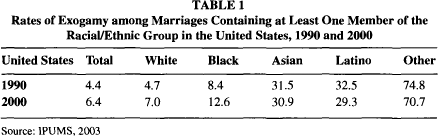
At the beginning of the twentieth century, intermarriage between white ethnics was rare and nearly caste-like, especially between “old” white ethnics and newer arrivals from Eastern and Southern Europe (Pagnini and Morgan 1990). Today, white ethnics intermarry at such high rates that only one-fifth of whites has a spouse with an identical ethnic background, reflecting the virtual disappearance of boundaries among white ethnic groups (Alba 1990; Lieberson and Waters 1988, 1993; Waters 1990). By contrast, marriage across racial/ethnic groups, while on the rise, is still relatively uncommon between some groups, and all groups continue to intermarry at rates lower than would be predicted at random (Moran 2001). For example, only 4.7 percent of white and 8.4 percent of black marriages were exogamous in 1990, while 31.5 percent of Asian and 32.5 percent of Latino marriages were. While these percentages increased in 2000, they remained relatively low. Only 7.0 percent of white and 12.6 percent of black marriages were exogamous compared to 30.9 percent of Asian and 29.3 percent of Latino marriages (see Table 1).
Rates of Exogamy among Marriages Containing at Least One Member of the Racial/Ethnic Group in the United States, 1990 and 2000
Source: IPUMS, 2003
In one sense, that intermarriage is not as common as white interethnic marriage should come as little surprise given that it was illegal in sixteen states as recently as 1967 until the Supreme Court ruling Loving v. Commonwealth of Virginia overturned the last remaining anti-miscegenation laws. The ruling had an enormous impact on the rise in interracial marriage, which increased tenfold within a thirty-year period from 150,000 in 1960 to 1.6 million in 1990 (Jacoby 2001; Waters 2000b), far beyond what would be predicted by population growth alone. Trends in exogamy are significant because social scientists conceive of racial/ethnic intermarriage as a measure of decreasing social distance, declining prejudice, and changing group boundaries (Davis 1941; Fu 2001; Gilbertson, Fitzpatrick, and Yang 1996; Gordon 1964; Kalmijn 1993; Lee and Fernandez 1998; Lieberson and Waters 1988; Merton 1941; Rosenfeld 2002; Tucker and Mitchell-Kernan 1990). Given its theoretical significance, we review recent findings on intermarriage between whites and nonwhites and explore their implications for America's color lines.
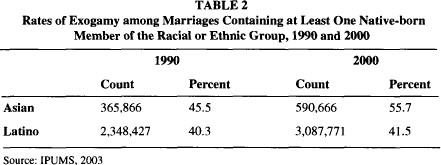
While the tenfold rise in intermarriage over the past thirty years might initially appear to indicate that boundaries are fading for all groups, the different rates of intermarriage between white and nonwhite groups speak volumes about where the boundaries are eroding most rapidly. For instance, the intermarriage rate for Asians and Latinos is nearly three times as high as the black intermarriage rate, and these rates rose between 1990 and 2000. In addition, among the native-born Asians and Latinos, the rate of intermarriage is even higher; in the year 2000, 55.7 percent of marriages containing a native-born Asian and 41.5 percent of marriages containing a native-born Latino were exogamous (see Table 2). Among young (25–34 years of age) native-born Asians and Latinos, the intermarriage figures are higher still; nearly two-thirds of married Asians and two-fifths of Latinos out-marry, mostly with whites (Qian 1997). The comparatively higher rates of intermarriage among native-born Asians and Latinos indicate that as these groups incorporate into the United States, not only do they become receptive to intermarriage, but whites also perceive them as suitable marriage partners (Moran 2001). By contrast, less than one-tenth of young blacks marry someone of a different racial background (Perlmann 2000). While the rate of black-white intermarriage more than doubled in the 1970s and 1980s (Kalmijn 1993), on the whole, the intermarriage rate for whites and blacks remains relatively low (see Table 1).
Rates of Exogamy among Marriages Containing at Least One Native-born Member of the Racial or Ethnic Group, 1990 and 2000
Source: IPUMS, 2003
In sum, there appear to be three distinct trends in interracial marriage in the United States. First, intermarriage for all racial groups has increased dramatically over the last thirty-five years and will probably continue to rise. Second, intermarriage is not uncommon in the cases of newer immigrant groups such as Asians and Latinos (particularly among the young, native-born populations). Third, compared to Asians, Latinos, and American Indians, intermarriage is still relatively uncommon among blacks. The differential rates of intermarriage among nonwhite racial groups suggest that racial/ethnic boundaries are more prominent for some groups than for others. The significantly higher rates of intermarriage among Asians and Latinos indicate that racial/ethnic boundaries are more fluid and flexible, and racial/ethnic prejudice less salient for these groups. By contrast, the lower rates of intermarriage among blacks suggest that racial boundaries are more prominent, and the black-white divide more salient than the Asian-white or Latino-white divides. Hence, while boundaries are fading, boundary crossing among racial groups is not unconditional, and race is not declining in significance at the same pace for all groups.
Multiracial Identification
The rise in intermarriage has resulted in the growth of the multiracial population in the United States. This population became highly visible especially when, for the first time in the nation's history, the 2000 Census allowed Americans to select “one or more races” to indicate their racial identification. Brought about by a small but highly influential multiracial movement, this landmark change in the way the United States measures racial identification reflects the view that race is no longer conceived as a bounded category (DaCosta 2000; Farley 2001; Hirschman, Alba, and Farley 2000; Waters 2000a; Williams 2001). In 2000, 6.8 million persons, or 2.4 percent of Americans identified themselves as multiracial, that is, about one in every forty people. While these figures may not appear large, a recent National Academy of Science study noted that the multiracial population could rise to 21 percent by the year 2050 when—because of rising patterns in intermarriage—as many as 35 percent of Asians and 45 percent of Hispanics might claim a multiracial background (Smith and Edmonston 1997). The growth of the multiracial population provides a new reflection on the nation's changing racial/ethnic boundaries.
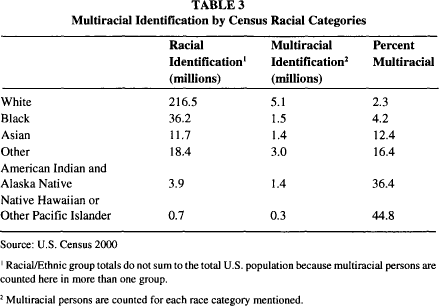
Of those who reported a multiracial background, 93 percent reported exactly two races, 6 percent reported three races, and only 1 percent reported four or more races. While most individuals who report a multiracial identification list exactly two races, the selection of these races is not evenly distributed across all racial groups. As Table 3 illustrates, the groups with a high percentage of multiracial persons as a percentage of the total group include “Native Hawaiian or Other Pacific Islander,” “American Indian and Alaska Native,” “Other,” and “Asian.” While “Latino” or “Hispanic” was not a racial category on the 2000 Census, the Office of Management and Budget directive about the change in the race questions mandated two distinct questions regarding a person's racial/ethnic background: one about race and a second about whether a person was of Spanish-origin in order to identify the Latino population of the United States. In both 1990 and 2000, slightly more than 97 percent of those who checked “Other” were Latinos (Anderson and Fienberg 1999; U.S. Bureau of the Census 2001).
Multiracial Identification by Census Racial Categories
Source: U.S. Census 2000
Racial/Ethnic group totals do not sum to the total U.S. population because multiracial persons are counted here in more than one group.
Multiracial persons are counted for each race category mentioned.
As illustrated in Table 3, the groups with the lowest proportion of persons claiming a multiracial background in 2000 are “Whites” and “Blacks.” However, because whites account for 77 percent of the total U.S. population, most individuals who report a multiracial identity also claim a white background. More specifically, while 5.1 million whites report a multiracial background, this accounts for only 2.3 percent of the total white population. Like whites, the proportion of blacks who claim a multiracial background is also quite small, accounting for only 4.2 percent of the total black population. These figures stand in sharp contrast to those among American Indian/Alaska Natives and Native Hawaiian or Other Pacific Islanders who show the highest percentage of multiracial reporting as a proportion of their populations at 36.4 and 44.8 percent, respectively. Asians and Latinos fall in between with significantly higher rates of multiracial reporting than blacks and whites at 12.4 and 16.4 percent, respectively, but lower rates compared to American Indian/Alaska Natives and Native Hawaiian/Other Pacific Islanders.
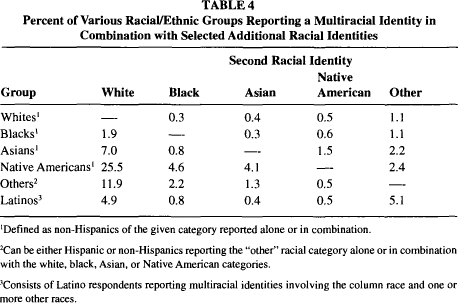
If we examine the rates of black-white, Asian-white, and Latino-white multiracial combinations as a percent of the total black, Asian, and Latino populations (Table 4), we find these figures equal 1.9,7.0, and 4.9 percent, respectively. Among Asians, the Asian-white multiracial combination is about three and a half times more likely to occur, and among Latinos, the Latino-white combination more than two and a half times more to occur, as the black-white combination among blacks. Mirroring trends in intermarriage, there appear to be three distinct patterns in multiracial identification. First, the multiracial population seems likely to continue to grow in the foreseeable future as a result of increasing intermarriage. Second, multiracial identification is not uncommon among the members of new immigrant groups such as Asians and Latinos (particularly for those under the age of eighteen). Third, at only 4.2 percent, multiracial identification remains relatively uncommon among blacks compared to Asians and Latinos.
Percent of Various Racial/Ethnic Groups Reporting a Multiracial Identity in Combination with Selected Additional Racial Identities
Defined as non-Hispanics of the given category reported alone or in combination.
Can be either Hispanic or non-Hispanics reporting the “other” racial category alone or in combination with the white, black, Asian, or Native American categories.
Consists of Latino respondents reporting multiracial identities involving the column race and one or more other races.
Why blacks are far less likely to report a multiracial background is particularly noteworthy considering that the U.S. Census Bureau estimates that at least three-quarters of the black population in the United States is ancestrally multiracial (Davis 1991; Spencer 1997). In other words, while at least 75 percent of black Americans have some alternative ancestry (mostly white) and thus could claim multiracial identities on that basis, just over 4 percent choose to do so, although recent studies reveal that younger black/white multiracials feel less constrained to adopt an exclusively black monoracial identity. For example, Korgen's (1998) study of forty black/white adults reveals that only one-third of her sample under the age of thirty exclusively identifies as black. Moreover, Harris and Sim's (2002) study of multiracial youth shows that 17.1 percent of black/white adolescents choose white as the single race that best describes them. While younger blacks are less likely to report an exclusively black monoracial identity than older black cohorts, blacks overall are still far less likely to report multiracial backgrounds compared to Asians and Latinos.
The tendency of black Americans to be less likely to report multiracial identifications undoubtedly owes to the legacy of slavery, including lasting discrimination and the formerly de jure and now de facto invocation of the “one-drop rule” of hypodescent (Davis 1991; Haney Lopez 1996; Nobles 2000). For no other racial or ethnic group in the United States and in no other country does the one-drop rule so tightly circumscribe a group's identity choices (Harris et al. 1993). Unlike the “one-drop rule” of hypodescent that has historically constrained racial identity options for multiracial blacks, the absence of such a traditional practice of labeling among multiracial Asians, Latinos, and American Indians leaves room for exercising discretion in the selection of racial/ethnic identities (Bean and Stevens 2003; Eschbach 1995; Harris and Sim 2002; Lee and Bean 2003, 2004; Stephan and Stephan 1989; Xie and Goyette 1997). The higher rates of multiracial reporting among Latinos and Asians, both as a proportion of the total Latino and Asian populations, and vis-à-vis blacks, indicate that racial boundaries are less constraining for these groups compared to blacks. While boundary crossing may be more common for all groups, it appears that the legacy of institutional racism in the country, as exemplified in such practices as the informal rule of hypodescent, more forcefully constrains the identity options for blacks compared to other nonwhite groups.
In addition, because a significant proportion of Latinos and Asians in the United States are either immigrants or the children of immigrants, their understanding of race, racial boundaries, and the black-white color divide is shaped by a different set of circumstances than those of African Americans. Most importantly, what sets Latinos and Asians apart is that their experiences are not rooted in the same historical legacy of slavery with its systematic and persistent patterns of legal and institutional discrimination and inequality from which the tenacious black-white divide was born and cemented. Unlike African Americans who were forcefully brought to this country as slaves, today's Latino and Asian newcomers are voluntary migrants, and consequently, their experiences are distinct from those of African Americans. The unique history and experience of black Americans in this country make the black-white racial gap qualitatively and quantitatively different from the Latino-white or Asian-white racial divides. For these reasons, racial/ethnic boundaries appear more fluid for the newest immigrants than for native-born blacks, consequently providing multiracial Asians and Latinos more racial options than their black counterparts.
The Geography of Multiracial Identities
Another way of measuring America's changing boundaries is to unearth where these boundaries are shifting most rapidly. While differences in multiracial reporting across racial groups are readily apparent, also noteworthy is that rates of multiracial identification are not uniform across the country. Patterns of multiracial identification reveal that areas with high immigrant populations evince greater rates of multiracial reporting. Immigration researchers have long noted that the foreign-born population is clustered in several cities and states (Bean et al. 1997; Waldinger and Lee 2001), and like the immigrant population, those who report multiracial backgrounds are similarly clustered. In fact, 64 percent or nearly two-thirds of those who report a multiracial identification reside in just ten states—California, New York, Texas, Florida, Hawaii, Illinois, New Jersey, Washington, Michigan, and Ohio—all of which have relatively high immigrant populations (see Table 5). Moreover, 40 percent of all those who report a multiracial identification reside in the West, a region of the country that has demonstrated substantially more tolerance for racial/ethnic diversity than other parts of the country (Baldassare 2000, 1981; Godfrey 1988). AsTable 5 indicates, California leads as the state with the highest number of multiracial persons and is the only state with a multiracial population that exceeds one million. The multiracial population accounts for 4.7 percent of California's population, or one in every twenty-one Californians, compared to one in every forty Americas for the country as a whole.
State Summaries: Most and Least Multiracial States, 2000

Source: U.S. Census 2000
Percent not non-Hispanic White or non-Hispanic Black.
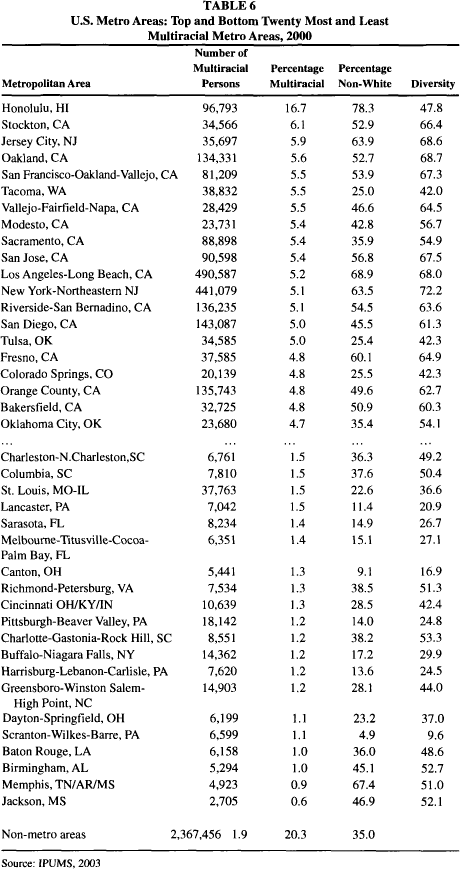
In essence, states and metropolitan areas with higher levels of racial/ethnic diversity (as reflected in the percent of the population that is not non-Hispanic white or non-Hispanic black) boast much larger multiracial populations than states that are less racially diverse. On the opposite end of the diversity spectrum are states like West Virginia and Maine that have low racial minority populations, and thereby exhibit very low levels of multiracial reporting. States like Mississippi, Alabama, South Carolina, and Louisiana, however, have relatively large black populations yet evince low levels of multiracial reporting. In these southern states, the strong traditional dividing line between blacks and whites appears to constrain multiracial identification, leading persons to identify monoracially as either white or black rather than adopting a multiracial identity (Bean and Stevens 2003; Davis 1991; Farley 2001; Harris and Sim 2002). We see similar patterns emerge at the metropolitan level as well; areas with greater levels of racial/ethnic diversity evince higher rates of multiracial reporting (see Table 6).
U.S. Metro Areas: Top and Bottom Twenty Most and Least Multiracial Metro Areas, 2000
Source: IPUMS, 2003
These patterns suggest that multiracial reporting is more likely in areas with greater levels of racial/ethnic diversity, which in turn have largely been brought about by the influx of post-1965 wave of immigrants, particularly Latinos and Asians. By racial/ethnic diversity we mean both the presence of multiple racial/ethnic groups and the relative absence of statistical predominance on the part of any single group. Thus, the more a single racial/ethnic group makes up all of the population of some social, political, economic, or geographic group or area, the less the diversity; conversely, the greater the number of groups and the more equally they are distributed within an area, the greater the diversity. Basically, as used here for racial/ethnic groups, diversity is equivalent to the idea of heterogeneity as often more broadly invoked in sociology (e.g., Blau 1977; Blau and Schwartz 1984; Laumann 1973).
All else equal, we expect greater diversity to lead to increased multiracial reporting because increased diversity (or heterogeneity, more broadly) tends to promote more frequent intergroup associations and greater tolerance, results often noted in the sociological literature (Allport 1954; Blalock 1967; Blau 1977; Massey, Hodson, and Sekulic 1999). In fact, it is precisely the lack of racial/ethnic tolerance in the Deep South that has tended to constrain the reporting of multiracial mixing, as noted above. In general, we expect increased tolerance and flexibility to generate increased multiracial reporting. Immigration increases the likelihood of multiracial identification because the greater diversity it fosters leads to the loosening of racial/ethnic boundaries, and consequently allows more flexibility in the identity options for multiracial persons.
The geography of multiracial reporting clearly indicates that the rate varies widely across the country, with the highest levels in states and metropolitan areas that exhibit the greatest racial/ethnic diversity brought about by the arrival of new immigrants to these areas. Hence, while national patterns in interracial marriage and multiracial identification indicate a loosening of racial boundaries, particularly for Latinos and Asians, these shifts appear to be taking place more rapidly in certain parts of the country and among certain groups.
Linking Diversity to Multiracial Identification and Group Position
Noting that a few areas with greater diversity appear to have higher multiracial reporting, however, does not provide as strong a basis for establishing a connection between growing diversity and the breakdown of racial/ethnic color lines. What is needed are research results demonstrating more systematically bases for such linkage. We have argued that the multiracial population is likely to continue to increase, and that its existence and growth may have broader implications. We have also argued that multiracial reporting is more likely among Asians and Latinos than among blacks, as a consequence of both higher rates of intermarriage and greater tendencies for the members of these groups to see themselves in multiracial terms. Places that have experienced more immigration may also reveal larger relative sizes of racial/ethnic minority groups (at least in the cases of Latinos and Asians) and increased diversity, with the latter in turn loosening racial/ethnic boundaries and increasing the likelihood of multiracial reporting.
But a countervailing tendency is suggested by the literature on minority group size. An appreciable body of research indicates that larger relative minority group size increases perceptions of threat to the majority group (Blalock 1967; Blumer 1958; Cohen 1999; Forbes 1999; Fossett and Kiecolt 1989; Schuman, Steeh, and Bobo 1985). Furthermore, under conditions of continuing immigration, a constant influx of new members of a given racial/ethnic group into areas containing concentrations of group members will not only add to the group's relative size, it may also reinforce the group's distinctive behavioral and cultural patterns (Massey 1995). In turn, this may increase and heighten the group's distinctive sense of ethnicity, foster ethnic insularity, and tighten racial/ethnic boundaries. As a result, increased relative racial/ethnic and immigrant group size, in addition to fostering diversity in a broad sense, may also make it less likely that the members of such groups will either come from multiracial backgrounds (due to declines in intermarriage) or come to perceive themselves in multiracial terms. In short, while larger relative group size may foster multiracial identification through one pathway, it may diminish intermarriage and multiracial identification through others.
Here we examine metropolitan-level data on multiracial identification available to provide an assessment of the effects of relative group size and diversity on multiracial reporting. For example,Table 6 presents basic data for metropolitan areas on multiracial identification and racial/ethnic composition. We should note that we exclude in our measure of multiracial reporting those Latinos who report in response to the U.S. Census question on race that they possess both “white” and “other” racial backgrounds. Some scholars have suggested that such persons should not be included as multiracials because they are Latinos whose responses may reflect confusion about what the race question meant. Alternatively, we would suggest that among many Latinos, the categories “white” and “other” reflect “white” and “mestizo” backgrounds (Rodríguez 2000; Rodgriguez 2003), suggesting, we would argue, that they indicate actual multiracial backgrounds. Whatever the case, we also reran the results we present below to include these persons and found that this did not affect the pattern of our findings.
We present in Figure 1 the estimates of a simple model of the effects of relative group size on diversity and multiracial identification focusing on three major racial/ethnic groups: blacks, Latinos, and Asians. The sizes of two of these, Latinos and Asians, have been substantially affected by immigration during the past decade. We use data from the 2000 Census, and we construct from these data a simple measure of diversity, defined as one minus the Herfindahl Index of Concentration. This index indicates the degree to which the members of a population are concentrated in one of several sub-groups. Thus, a high score on the Herfindahl Index indicates that one racial/ethnic group predominates in an area. A high score on the complement of the index signifies that no single group predominates.
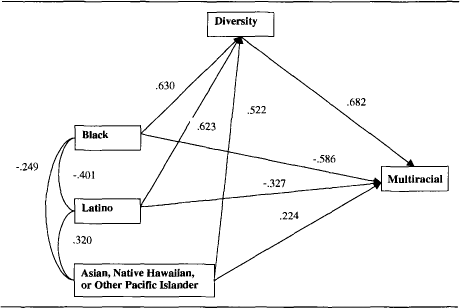
Metro Area-Level Standardized Coefficients for Regressions of Diversity and Multiraciality on Relative Racial-Ethnic Group Sizes
The findings make clear that metropolitan areas with relatively larger racial/ethnic groups (resulting in large part from immigration) have higher diversity scores and higher levels of multiracial identification. However, this positive effect of relative group size through diversity is partially offset to some extent by negative direct effects from relative group size in the cases of the Latino and (especially) black populations. But summing these direct and indirect effects together reveals that relative group size exerts an overall positive effect on multiracial identification for Asians and Latinos, with much of this effect operating through increases in diversity, but an overall negative effect for blacks. In other words, the Asian and Latino positive effect of relative group size through diversity is more than large enough to make up for the negative direct effect of relative group size. This pattern of findings thus provides further confirmation that the larger racial/ethnic groups resulting from higher immigration and generating greater racial/ethnic diversity appear also to lead to rising multiracial identification, lending additional weight to the idea that increasing diversity is operating to loosen traditional racial/ethnic group boundaries in the United States, but more so for Asians and Latinos than blacks.
The findings in the model also have implications for group position theory, which holds that the major impetus for racial prejudice is the manifest attempts by the dominant group to protect their group position vis-à-vis others in a racialized hierarchy, especially when this position is perceived as threatened. That the larger group size of Latinos and blacks has a negative direct effect on multiracial reporting suggests that the larger these populations (especially in the case of blacks), the more constrained these groups may be in adopting a multiracial identification. The more rigid racial/ethnic boundaries in these cases suggests that whites may feel more threatened and thereby may be more guarded about defending their sense of group position in metropolitan areas with relatively large black and Latino populations. However, when group size operates through diversity, not only do these findings suggest a loosening of racial/ethnic boundaries, but also a relaxing of group position. The findings imply that whites are less likely to feel threatened or feel a need to defend their group position in areas that exhibit high levels of racial/ethnic diversity, even if they have relatively large Latino and black populations (although more so in the case for Latinos than for blacks). In the case of Asians, higher levels of racial/ethnic diversity further operate to loosen whites' sense of group position and lead to greater levels of multiracial reporting.
In sum, greater levels of racial/ethnic diversity brought about by increased immigration in certain parts of the country loosens the reign of whites' sense of group position vis-à-vis all racial/ethnic groups, and especially in the case of Asians and Latinos and to a lesser extent in the case of blacks. However, before we reach overly optimistic conclusions about fading racial/ethnic boundaries for all groups and a waning of group position, it is important to underscore that increased diversity exerts a far greater effect on multiracial reporting for Asians and Latinos than for blacks. While increased diversity also leads to greater multiracial reporting among blacks, the effect is far less pronounced, indicating that the color lines are fading more rapidly for Asians and Latinos than for blacks.
Conclusion and Discussion
How do current debates about immigration and race/ethnicity inform our interpretations of the rise in intermarriage and the patterns of multiracial identification? And what are the implications of these patterns for America's color lines? Over the past few decades, the rate of intermarriage between whites and nonwhites increased tenfold, and its increase went hand in hand with the growth in the multiracial population. Recognizing the growth of America's multiracial population, the 2000 U.S. Census allowed Americans the option to mark more than one race to self-identify, reflecting the view that race is no longer conceived as a bounded category. Coinciding with rising intermarriage between whites and nonwhites was a new immigrant stream from Latin America and Asia, creating a nation that has moved from a largely black and white society to one that is more racially and ethnically diverse. Changes brought about by increasing immigration, intermarriage, and multiracial identification beg the question of how relevant the traditional black-white color line and the existing theories of race/ethnic relations and immigrant incorporation are for understanding today's multiracial and multiethnic America. If the black-white color line no longer characterizes America's multiethnic society, where will the line be drawn in the twenty-first century, and what are the implications of these changes for theories that are founded on the black-white model of race relations?
Rates of intermarriage between whites and nonwhites have risen dramatically, and as a consequence, the multiracial population has also increased. Because intermarriage and multiracial reporting indicate a reduction in social distance and racial prejudice, these patterns provide evidence of loosening racial/ethnic boundaries. At first glance, these patterns offer an optimistic portrait of a declining significance of race and a relaxing of group position. However, upon closer examination, we find that changes in intermarriage and multiracial identification are not proceeding apace for all groups. While the rate of intermarriage between whites and non whites has increased, the rate is substantially higher for Latinos and Asians than for blacks. Correlatively, the findings on multiracial identification mirror the patterns on intermarriage: Latinos and Asians are much more likely to report a multiracial identification than are blacks.
What is crucial here is how we interpret the findings for Latinos and Asians. For example, if we consider Latinos and Asians as racialized minorities, and thus on the black side of the traditional black-white divide, the patterns of intermarriage and multiracial identification offer an optimistic portrait of the declining significance of race and relaxing of group position. However, if we treat Latinos and Asians as new immigrants who have not completed their path of incorporation, the implications for changing color lines and race/ethnic relations is far less sanguine. This critical distinction helps us to differentiate whether color lines are shifting for all racial/ethnic minorities, or whether they are changing to mainly accommodate new immigrant groups.
Because a significant proportion of the Latinos and Asians in the United States are either immigrants or the children of immigrants, their understanding of race, racial/ethnic boundaries, and the black-white color divide is shaped by a different set of circumstances than those of African Americans. Moreover, their process of incorporation does not dictate full acculturation to achieve structural incorporation, meaning that Latino and Asian immigrants have more leeway in retaining cultural and ethnic distinctiveness than even their European counterparts of yore. Most importantly, what marks the experiences of Latinos and Asians apart from African Americans is that they are not rooted in the same historical legacy of slavery with its systematic and persistent patterns of legal and institutional discrimination and inequality from which the tenacious black-white divide was born and cemented. For these reasons, the racial/ethnic boundaries appear more fluid for the newest immigrants than for native-born blacks. Moreover, gauging from patterns of intermarriage and multiracial reporting, whites also seem less concerned with constraining Latino and Asian identities and boundaries. Hence, the black-white model of race relations does not appropriately capture the incorporation processes of the new immigrant groups, and to therefore make conclusions about the declining significance of race or group position for all racial/ethnic groups based on the patterns for Latinos and Asians would be a grave mistake.
The color line is shifting more readily to accommodate newer immigrant groups such as Latinos and Asians, and while the color line is also shifting for blacks, this shift is occurring much more slowly. Where do Asians and Latinos fit in this divide? At this time, America's changing color lines point to the emergence of a new split that replaces the old black-white divide with one that appears to separate blacks from nonblacks (Bean and Stevens 2003; Gans 1999; Lee and Bean 2003, 2004; Waters 1999). The emergence of a black-nonblack separation is even evident in areas with high concentrations of immigrants, high levels of racial/ethnic diversity, and high levels of multiracial reporting, although not to as strong a degree. But even in these high diversity states and metropolitan areas, a black-nonblack divide is emerging, with Latinos and Asians falling into the nonblack category. Hence, while America's color lines are breaking down, they are not fading at the same pace for all groups, nor are they fading in all areas of the country.
The emergence of a black-nonblack divide could be a disastrous outcome for many African Americans. Once again, they would find that newer nonwhite immigrant groups are able to jump ahead of them in a racialized hierarchy in which blacks, or at least those with less than a college degree, find themselves at the bottom. Based on patterns in immigration, intermarriage, and multiracial identification, however, it appears that Latinos and Asians may have the option to become almost white or even white, and consequently, participate in a new color line that continues to separate blacks from other groups. Hence, America's changing color lines could involve a new racial/ethnic divide that may continue to consign many blacks to disadvantaged positions that are not qualitatively different from those perpetuated by the traditional black-white divide. While rising rates of intermarriage and patterns of multiracial identification clearly indicate that boundaries are breaking down, that the erosion of boundaries is neither uniform nor unconditional indicates little basis for complacency about the degree to which opportunities are improving for all racial/ethnic groups in America, even though they be for many of the new immigrant groups.