






Abstract

Introduction
While evidence from many of the nation's leading immigration scholars suggests that contemporary immigration to the United States has had negligible or small positive social and economic effects in the aggregate during the past two decades (Smith and Edmonston 1997), some analysts stress that unauthorized and lower-skilled immigration may curtail economic outcomes for similarly skilled African-Americans and other minorities. The argument seems sensible enough, particularly given the segmentation of American labor markets and numerous case studies of ethnic succession in industries ranging from janitorial to hospitality (Cranford 2000; Waldinger 1996, 1997, 1999; Waldinger and Lichter 2003). These apparent adverse effects have given rise to a new chorus of restrictionist sentiment, with some moral justification provided by the need to address historic and contemporary racism directed specifically against American blacks.
Why then has immigration not arisen as a central issue for traditional leaders in the African American community? A recent provocative paper suggests that “the most basic explanation is that since the 1970s, and especially since Jesse Jackson's campaigns for the presidency, Black leaders have been seeking to build a ‘rainbow coalition’ of ‘people of color,’ including recent immigrants” (Shulman and Smith 2004). Putting coalition needs first, it is argued, has led to a downplaying of potentially divisive issues, including the economically corrosive impact of immigrants. Vernon Briggs (2003) seems to concur with this view, suggesting that the Congressional Black Caucus has not defended the interests of African Americans vis-à-vis unauthorized immigrant workers, partly to maintain an alliance with the Congressional Hispanic Caucus.
Some black leaders have spoken forcefully on the immigration issue. Barbara Jordan—a highly respected African American politician—endorsed reductions in legal immigration as chair of the U.S. Commission on Immigration Reform, but her untimely death occurred before the commission's mandate was fulfilled in 1997. Congress eventually decided to keep the “front door” of legal immigration open and to attempt to seal the “back door” of unauthorized immigration. Shulman and Smith (2004) suggest that bolder leadership such as Barbara Jordan's might make a difference for identifying, pursing, and realizing black interests in this arena.
What are the economic effects of immigration and is the “rainbow” coalition position of many black leaders—one that, it is argued, leads to muting opposition to immigration restrictions—actually counter to the broad aims of improving the lot of African Americans in the United States? In this chapter, we tackle these questions with a particular focus on what might be termed a true “hotspot” of the debate: undocumented immigration in one of the most rapidly changing states in the Union: California. We briefly review research findings on how immigration in general influences the employment and earnings of African Americans; our discussion in this regard is very short since much of this literature is covered elsewhere. We then turn to our own original work estimating the size and location of the unauthorized Mexican immigrant labor force in California, and consider whether this labor force is in competition with African Americans. The results are mixed: the geographic pattern suggests that there are few displacement effects but an occupational analysis does suggest some competition when there are exceptionally high numbers of undocumented migrants in the same field.
We then turn more directly to politics and policy. We begin this section with a dilemma: public opinion data suggest that blacks, many of whom are lower-skilled and seemingly in direct competition with Latino immigrants, are at least as, and often more, sympathetic toward immigrants than whites. This pattern shows up even in California where there has been well-publicized conflict over immigration issues and where black-Latino competition over economic and political space has often been sharp. A regression analysis of attitudes in Los Angeles suggests one reason for the pattern: African Americans are ambiguous in their views of immigrants as economic competitors but do see them as potential political allies.
To explain this, we eschew notions that African American sympathy is the result of ignorance or false consciousness, and instead discuss how the estimated gains from reducing any immigrant-induced wage penalty should be weighted by the probability that immigration enforcement technology can be effective and by the costs that such a political position might impose on forming coalitions around other issues of interest. Within such a calculus, it is rational for African Americans to be less restrictionist toward immigration than a simple competitive labor-market perspective might suggest, especially because such a restrictionist position would weaken coalitional possibilities on other issues and/or may fan prejudicial attitudes that will diminish political and policy gains later. We conclude by arguing that it may be useful to move away from debates around immigration (e.g., enforcement) policy per se and focus instead on immigrant (e.g., integration) policy that can lift up all communities.
Economic Impacts
Past Research
For several reasons (e.g., an increased demand for goods and services, an influx of capital, complementary skills or work attitudes), there exists no unambiguous theoretical expectation regarding how an increased supply of foreign-born labor will impact native-born labor market outcomes in the aggregate. Particular groups such as teenagers, women, and lower-skilled black men, however, have historically and conventionally been thought to be harmed by an influx of immigrant workers because the latter are often assumed to be lower-skilled and to have little or no capital that may be employed to augment the demand for lower-skilled labor (Bailey 1987; Borjas 1998).
Some recent empirical evidence indicates that the wages of lower-skilled black men in locations with relatively high concentrations of immigrants may be adversely affected (Stoll, Melendez, and Valenzuela 2002). On a national level, however, the most sophisticated research on African American labor market outcomes to date suggests that immigration during the 1980s had “a negative impact, not especially large, but clearly identifiable” on lower-skilled blacks' earnings and employment—or alternatively, “African Americans do not appear to have benefited economically from immigration to the same degree as native whites” (Hammermesh and Bean 1998: 9–13). The production of relatively weak evidence for the competition hypothesis has been attributed to a dearth of longitudinal data that would permit one to estimate whether displacement or replacement better describes black-immigrant occupational succession, increasing skill-complementarity between African Americans and immigrants, employer preferences, and ethno-racial social capital/closure (Waldinger and Lichter 2003).
One route some researchers have taken to determine effects involves turning attention to that group of immigrants that is thought to be especially harmful to lower-skilled Americans: unauthorized, undocumented, or illegal residents. Even then, only small effects have been detected (Bean, Lowell, and Taylor 1988; Bean, Telles, and Lowell 1987; Winegarden and Khor 1991; Marcelli et al. 1999). However, much of this work is based on the influx of the undocumented prior to 1990; it is quite possible that the changing structure of the economy and continuing increases in the size of the undocumented population could have led to larger effects in recent years.
Below we offer the first estimates from the 2000 Census on the geographic and labor market relationships of unauthorized Mexican immigrants and African Americans in California, a state that has experienced a continued inflow of relatively lower-skilled unauthorized Mexican immigrants over the past decade. The results are quite preliminary—we offer some descriptive measures here and leave the more detailed econometric work to a future piece—but they do set up our consideration of the public opinion and political dynamics that are at the heart of this paper.
Labor Market Impact Analysis: Data and Methods
As a first step in our analysis of how unauthorized Mexican immigrant workers may have affected African American male earnings and employment outcomes—and following Marcelli and Heer (1997) and Marcelli, Pastor, and Joassart (1999)—we develop two unauthorized immigrant residency status prediction equations from two surveys of Mexican immigrants in Los Angeles County. The 1994 Los Angeles County Mexican Immigrant Residency Status Survey (LAC-MIRSS) is a randomized foreign-born Mexican household survey that collected information on residency status and various other demographic and economic characteristics for 661 Mexican immigrants residing in 271 households (Marcelli and Heer 1997). The logistic regression equation [1] developed from these data predicted residency status (RS) accurately approximately 85 percent of the time using only four variables—AGE, SEX, educational attainment (EDUC), and time in the United States (YEARS).

The second survey, the 2001 LAC-MIRSS, is also a randomized foreign-born Mexican household survey that collected similar data for 829 Mexican immigrants from 456 households. Employing these data in equation [1] again accurately predicted RS about 82 percent of the time. Marcelli and Cornelius (2004) provide an overview of the 2001 LAC-MIRSS data.
A second step in our analysis takes the parameters generated from the 1994 and 2001 LAC-MIRSS data (β, through β4) and applies these to the foreign-born Mexican adult populations enumerated in the 5% 1990 and 2000 Public Use Microdata Samples (PUMS) to generate a probability of having been unauthorized to reside in the United States, and then to assign unauthorized residency status to those with relatively high estimates. 1 Past research has shown that this survey-based residency status estimation methodology produces estimated numbers of unauthorized Mexican (and other Latino) immigrants that are remarkably consistent with those interpolated from estimates produced using the more traditional residual methodology (Heer and Passel 1987; Marcelli 1999). Furthermore, recent work by Marcelli and Lowell (2004) using the 2001 LAC-MIRSS reports only a slightly higher number of Mexican immigrants in Los Angeles County than either the 2001 Current Population Survey or the 2000 PUMS, and it is noteworthy that the U.S. Immigration and Naturalization Service (2003) employed census under-coverage rates estimated from the 2001 LAC-MIRSS (Marcelli and Ong 2002) to adjust their national estimate of the number of unauthorized immigrants residing in the United States. The LAC-MIRSS thus appears to offer credible estimates of the number of legal and unauthorized Mexican immigrants that, when combined with census data, can be used to investigate how these populations impact the economic outcomes of other ethno-racial groups.
A third step in our labor market analysis draws our sample. We select only individuals aged sixteen to sixty-four who were in the civilian labor force (employed or unemployed) and not enrolled in school because we are initially concerned with labor market competition. California's labor force (as defined above) grew from approximately 12.2 to 13.0 million, or by 6.8 percent, between 1990 and 2000. And although the rise in the female component (9.9 percent) was larger than that of the male (4.5 percent), the latter population represents a significantly higher absolute number of workers (7.2 versus 5.7 million in 2000). For this reason, as well as the fact that male labor force participation is less likely to be influenced by informal household responsibilities, we focus the rest of the paper on males only. With this focus, we examine what happened to the employment and earnings of African American male workers in three different labor market segments characterized by high, medium, and low levels of unauthorized Mexican immigrants throughout the state during the same decade.
We also extend the estimation procedure to show the geography of the undocumented Mexican labor force in California and use that to determine whether changes in the locational distribution of unauthorized Mexican immigrant between 1990 and 2000 led to geographic displacement and mobility of African American labor force participants over the same period. For this latter task, we chose the 2000 PUMAs as the relevant geographic level. A PUMA is a Public Use Microdata Area; it is the lowest geographic area in which full individual responses from the Census (given in the Public Use Microdata Samples or PUMS discussed above) are tagged. They are much larger than Census tracts since attaching the tract location to a person might make it possible to identify the individual; the Census Bureau tries to balance respondent confidentiality and geographic characterization by locating the residence in a broader unit labeled a PUMA. There are two levels of PUMAs, with the larger (in terms of geographic area) coming from the 1 percent PUMS and the smaller from the 5 percent PUMAs.
In our analysis, we use the 1% PUMA shapes from 2000. We use the larger shapes primarily because we need to cross-walk the 1990 data into the 2000 shapes to do the geographic comparisons, and this is more easily and reliably done with the larger shapes. However, we use the 5% PUMA data from both 1990 and 2000 (with each observation retagged into the 1% PUMA boundaries) since that maximizes the numbers of observations and hence accuracy in our estimates. A glance at the 2000 PUMA shapes will suggest that they are very much like localized labor markets in California and hence seem to be an appropriate level for this sort of analysis.
Labor Market Impact: Empirical Results
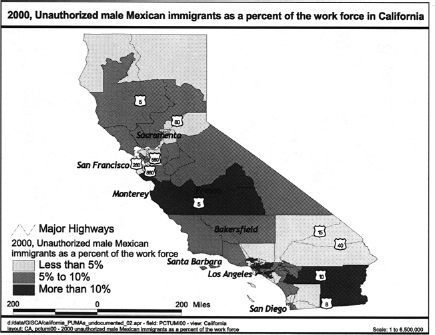
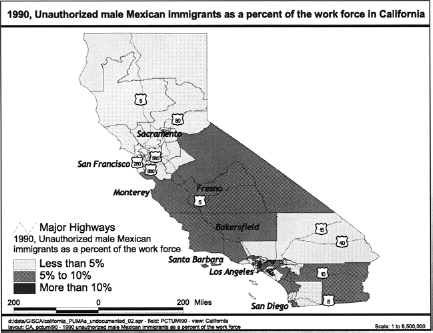
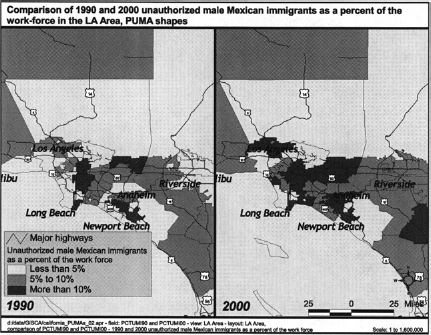
We start our analysis with the geographic overview. As can be seen in Figures 1 and 2, the geographic distribution of unauthorized Mexican immigrant male workers during the 1990s has become more dispersed. In 1990 this population was primarily concentrated in Los Angeles County, the central valley and central coast areas; by 2000, their residential concentration (that is, their share of the male labor force in the relevant PUMA) had surpassed 10 percent outside of Los Angeles County in Monterey, Fresno and Imperial County, and Northern California had also experienced an increase. In short, the population of unauthorized Mexican immigrant workers became more numerous and more dispersed throughout California during the previous decade, even as concentration continued in certain locations (see below).
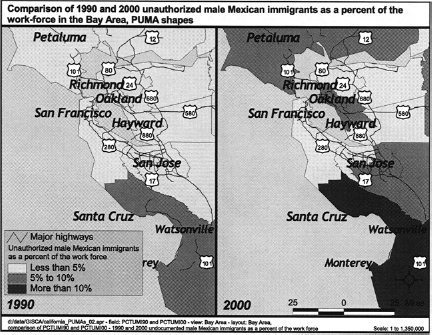
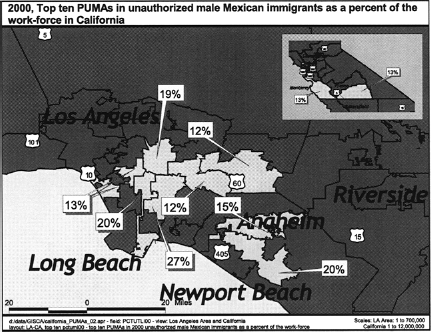
A closer look at two metropolitan areas within California—the San Francisco Bay Area and Los Angeles—provides a bit more insight on the changes and also suggests potential residential competition with African Americans. Figure 3 shows that unauthorized Mexican males have not only become more concentrated in the San Jose-Santa Cruz region, an area with very few blacks, but also in the more traditionally African American areas of Oakland and Richmond. Figure 4 indicates where the move-in has actually been the most dramatic—Los Angeles and Orange Counties, with significant increases in the South L.A. area, among others. Figure 5 rounds out the geographic picture by showing the top ten PUMAs in California with regard to the percent of undocumented Mexican male immigrants as a percent of the male workforce; aside from the rural areas pictured in the pop-up, we see that the main areas where unauthorized immigrants reside are to the east of the industrial corridor in Los Angeles, along the San Gabriel Valley, and in the Anaheim-Santa Ana area.
If significant displacement is going on in the workforce, we would expect that areas that experienced an increase in undocumented Mexican workers would have also experienced a decrease in, or at least a less rapid growth of, African American workers. Figure 6 tries to look at this question with a scatterplot of growth for both groups, with each growth rate calculated against the size of the overall 1990 workforce; this normalization avoids a problem with small base years (small numerical gains on a small initial starting point will yield large growth rates even when the population has grown unsubstantially) and also sidesteps the obvious fact that a larger share of one portion of the workforce in 2000 is likely to mean a smaller share of the other. As it turns out, unauthorized Mexican immigrant and black male labor force participants appear to have been moving into and out of the same areas in California between 1990 and 2000, perhaps because of job creation and loss in those areas, with this trend indicated by the scatterplot in general and the fitted regression line in particular. 2
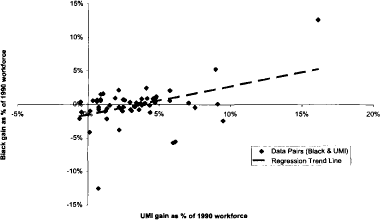
Growth in Black & Unauthorized Mexican Immigrant (UMI) Male Labor Forces
Geographic mobility patterns, while providing some evidence that the two populations of concern here are not competing with one another economically—or if they are, that it is not resulting in geographic displacement—are insufficient for answering the question of whether one lower-skilled immigrant group is impacting the fortunes of another U.S.-born minority group. Additional evidence may come from considering how the earnings and employment patterns of African American male workers were affected in occupations with different levels of unauthorized Mexican immigrants. In general, we should expect black earnings and/or employment to have fallen (or to have fallen more) in occupations with higher levels of unauthorized Mexicans between 1990 and 2000 if the two groups are competing with one another.
Although we do not attempt to formally model African American male employment or hourly wage outcomes here econometrically, descriptive statistics presented below suggest that the influx of unauthorized Mexican male workers may have had both negative and positive effects. It will be helpful to first define what is meant by low, medium, and high levels of unauthorized Mexican immigrant male occupational representation. Following past practice (Marcelli, Pastor, and Joassart 1999), we created three labor market segments distinguished by the proportion of unauthorized Mexican male workers. Based on the estimated occupational representation of unauthorized Mexican immigrant male workers in thirty-three categories defined for the 2000 Census (Figure 7) and analysis of relatively large “breaks” in this distribution, our occupational segment characterized by a low level of representation includes fifteen categories with less than 2.5 percent unauthorized Mexicans (e.g., air transportation, firefighter, architect). Our medium level or segment of occupations includes eleven occupations (e.g., healthcare support, motor vehicle driver) with less than 12 percent unauthorized Mexicans, and our high level or segment of occupations includes seven occupations with more than this threshold (e.g., material moving, food services).
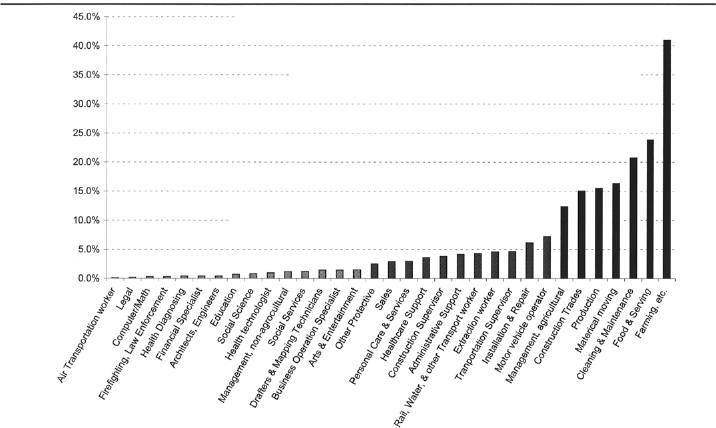
Proportion of Male Unauthorized Mexican Immigrant Workers by Occupation, California, 2000
Because the Bureau of the Census defined various occupation categories differently in 2000 than it did in 1990, it is impossible to compare changes in employment or wages by occupation directly. To analyze these for particular ethno-racial groups during the previous decade requires use of the Census Bureau's occupational “cross walk” tables. In general, the Bureau estimated employment changes in the thirty-three occupational categories shown in Figure 7 between 1990 and 2000 for the total U.S. labor force and has made available the conversion tables for linking the thirteen major occupational categories in 1990 to the thirty-three 2000 categories. The only method of estimating employment changes for individual groups thus requires application of the conversion algorithm developed for the entire U.S. labor force.
Table 1 reports employment and hourly wages estimates for unauthorized Mexican immigrant and African American males in 1990 and 2000 by California's three labor market segments as defined above. Although the number of black male workers aged sixteen to sixty-four employed in the occupational segments with low and medium levels of unauthorized Mexican immigrants rose between 1990 and 2000 (ΔBLK), it declined by approximately 38,000 or 30 percent in those occupations with relatively high proportions. And although black male wages (Wblk90, Wblk2k) were higher than the wages of unauthorized Mexican workers (Wumi90, Wumi2k) in all three labor market segments throughout the 1990s and rose in the low and medium segments, they fell by $1.82 or 10 percent even as those of Mexican workers rose by $1.53 in the segment with the highest proportion of unauthorized Mexican workers.
Unauthorized Mexican Immigrant and U.S.-Born Black Labor Market Outcomes from 1990 to 2000 by Level of Unauthorized Mexican Immigrant Male Workers in 2000, California
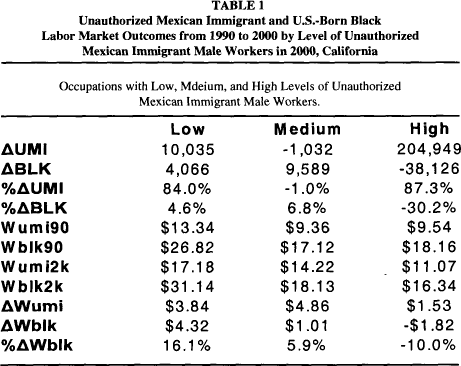
One may infer a labor market competition story from Table 1. However, it may also be the case that some black males moved from occupations with higher proportions of unauthorized Mexican workers to those with lower proportions, partly because of the effects of complementary migrant labor; this would be consistent with the sharp decline in African American workers in the high-UMI sector and the increases in the other segments, and would also square with the wage enhancement effects of immigrants on African Americans found by Ong and Valenzuela (1996) for a Los Angeles sample. Moreover, the negative association detected between an influx of unauthorized Mexican workers, on the one hand, and the employment and hourly earnings of blacks, on the other, may disappear once individual characteristics and other factors are controlled for in an econometric model; tied together with the possibility of African American occupational mobility, this may suggest that those left behind were those with the lowest human capital. We intend to investigate these complexities in future econometric work.
Still, while the geographic picture presents little evidence of displacement and the wage effects lack the proper controls, the data do suggest why some have been worried about the impacts on job loss and income. Historically, lower employment and lower wages in occupations filled by lower-skilled immigrant groups have helped to generate restrictionist immigrant sentiment in the United States. What have been the attitudes and political strategies of African Americans in the wake of these patterns, particularly in California, a state so affected by international migration of both the documented and the undocumented?
Public Opinion and Politics
The Public Opinion Dilemma
We began the chapter by noting that some authors wonder why a position in favor of immigration restrictions has not gained more ground among black civil rights leaders. In our view, the economic evidence is ambiguous and this explains part of the picture. But those who would suggest the relative silence on immigration is partly the result of black elites being out of touch with working-class constituents are missing an important fact: grassroots African Americans have also often been more sympathetic toward immigrants than their white counterparts.
For example, a recent Gallup poll (June 2003) indicates that 49 percent of whites say that immigration should be decreased while only 11 percent suggest that it should be increased; in contrast, 44 percent of blacks are in favor of a decrease in immigration while a full 20 percent would support an increase. The same poll finds income is a significant predictor of a more sympathetic attitude towards immigration, with 75 percent of those with incomes exceeding $75,000 agreeing that immigration is good for the country with the comparable figure being 46 percent for those with incomes below $30,000; given the skew toward the bottom end of the income distribution in the African American community, this makes the black support for increasing immigration all the more surprising. 3
In California, one of the states most deeply affected by immigration and one where Latinos are clearly in demographic ascendancy, sometimes to the seeming detriment of black political power, public opinion polls suggest that the state's African Americans, while not as sympathetic to immigrants as California's Latinos, are far more sympathetic than whites. For example, when asked to rank immigrants as a benefit or a burden, 53 percent of whites chose burden with 47 percent selecting benefit; blacks are a nearly polar opposite with 55 percent choosing benefit and 45 percent selecting burden (Hajnal and Baldarassare 2001: 10). The pattern is striking since whites are, according to most theory and empirics, far better positioned to benefit from the generalized economic gains from immigration.
As for the more vexing problem of undocumented immigration, the voting on Proposition 187, the controversial 1994 effort to restrict access of undocumented immigrants and their children to key public services, including education and health facilities, also showed a racial divide: while whites voted for the measure 63 percent to 37 percent, African Americans rejected it by the same proportions as did Asian Americans with only 47 percent voting yes and 53 percent voting no (Latinos, despite some early polls showing sympathy, rejected the measure 77 percent to 23 percent; Los Angeles Times exit poll, 1994). While the significant anti-187 vote by blacks was partly due to the nature of the proposition itself—by the time the election came, the measure was seen not as a dispassionate approach to stemming the local costs of immigration but rather a broader and racialized attack on Latinos—the voting differential is still significant and important, particularly given the likelihood that Latino immigrants and blacks were in the most direct competition for the health and education services to be restricted.
The pattern of black tolerance is even apparent in Los Angeles County, the acknowledged heart of undocumented immigration in the state (recall Figure 5) and a place where multiple instances of ethnic succession in neighborhoods, including throughout South Los Angeles and adjoining inner-ring suburbs (like Compton), have made for inter-ethnic conflict. Making use of the Los Angeles Survey of Urban Inequality, we ran a crosstabs of race with attitude on the impacts of immigrants on one's ethnic group; the results are depicted in Figures 8 and 9.4 African Americans do believe that continued immigration will diminish economic opportunity for their group at a rate higher than whites and seemingly feel more strongly about it than whites; at the same time, it is striking that a much higher percentage of blacks than whites also believe that continued immigration will, in fact, improve economic opportunity for blacks.
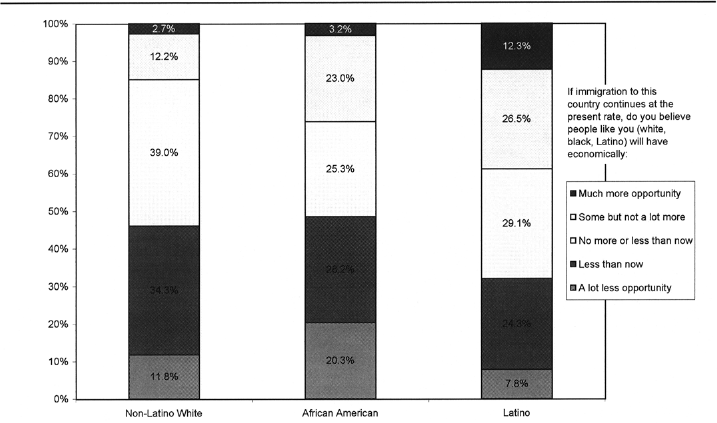
Attitudes Toward the Economic Impacts of Immigration in Los Angeles
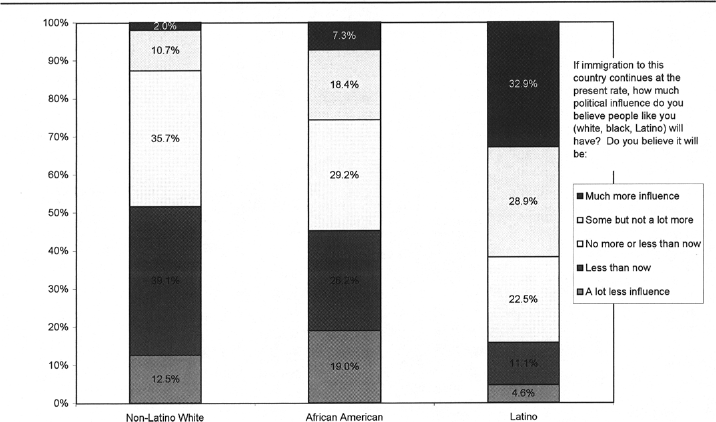
Attitudes Toward the Political Impacts of Immigration in Los Angeles
As for political attitudes, while a plurality of blacks believes that immigration will diminish black political strength, African Americans are also actually far more optimistic that immigration will improve their political prospects. It should be stressed that this survey was conducted around the time of the L. A. civil unrest when the area economy was also mired in its worst postwar recession and when ethnic tensions were at an all-time high, particularly with blacks and Latinos squabbling over monies for rebuilding and blacks and Koreans struggling over the reconstruction of liquors store in South Central Los Angeles (see Pastor 1995); that the attitudes are this positive is impressive.
Disentangling Public Opinion
Of course, one possibility is that immigration preferences do not reflect economic realities at all. Citrin et al. (1997), for example, makes use of the 1992 and 1994 National Election Surveys and finds that attitudes about immigration policy are largely shaped by deeper values than by current economic position and costs. Kessler (2001), however, has redone the work with the five of the NES surveys (1992 to 2000) and deployed a more sophisticated econometric procedure. 5 He attempts to control for both economic status and political positions (conservative versus liberal, Republican versus Democrat) and degree of prejudice (with the hypothesis being that those who are more prejudiced might be more predisposed to favor restrictions on immigration). He finds that prejudice is strongly and consistently related to restrictionist sentiment but also the economic variables do matter and in ways that would be predicted by the assumed economic effects: lower-skilled workers are more likely to wish for restrictions while higher-skill workers are less likely to favor reductions in immigration.
What about the particular attitudes of blacks? Kessler finds a positive disposition toward restriction but the effect is statistically insignificant. Does this contradict the favorable attitudes we describe above? Not really. The construction of Kessler's prejudice measure is almost entirely focused on the African American experience, with fifteen of the seventeen components of the composite prejudice measure focused on views of the legacy of slavery, the work ethic of blacks, and whether blacks have gotten more or less than is “deserved”; the two components that do not specifically refer to blacks are concerned with Affirmative Action and are asked in the context of another question on aid to blacks. It is highly unlikely that blacks score highly on this sort of prejudice measure—and that they are the only group for whom this test is unreliable suggests that it may not be a good test of general unease toward the “other.” This leaves the black dummy variable to absorb the statistical effects of any black prejudice towards other groups—something that case studies of black-Korean and black-Latino conflict suggest may be present—and, even under these circumstances, no significant results can be found.
To get at the issue more clearly, we decided to implement a Kesslerstyle model using data on attitudes from the Los Angeles Survey of Urban Inequality (LASUI), the broad results for which were recorded above. We focus on the two questions on immigration reviewed earlier, both of which asked respondents whether they felt that their particular ethnic group would be hurt or helped, and to what degree, if the current levels of immigration into the U.S. continued. Again, we wish to emphasize that the survey was conducted in the wake of the Los Angeles civil unrest, a time in which ethnic tensions were severe and the area economy was in its worst recession in the postwar period.
Following Kessler's (2001) strategy, we employ an ordered logit regression, structuring the dependent attitudinal variables such that a positive coefficient reflects a respondent belief that the effects on one's own group are more positive. The independent variables are all listed in Table 2, with the race, age, and gender variables being self-evident. Degree of Education is a categorical variable where respondents are broken into three groups: those with less than a high school degree, those with a high school degree, and those with a college degree or higher. The results we report are robust to other categorizations of education or to a variable that is a straightforward measure of years of schooling.
Attitudes in Los Angeles County on the Impacts of Immigration

Source: Los Angeles Survey of Urban Inequality
indicates significance at the .01 level
indicates significance at the .05 level
indicates significance at the .10 level
We also employ two variables reflecting attitudes toward race. As noted above, we were displeased with Kessler's approach since it empirically limited racism to only anti-black attitudes. Moreover, we are not sure that attitudes toward policy measures like Affirmative Action are strictly expressions of the degree of racism (just as restrictionist attitudes toward immigration are not necessarily signals of nativist impulses). We thus look at two variables that seem more rooted in prejudice per se: Racist Comment and Belief in Innate Inferiority.
Racist Comment is a dummy variable that takes the value of one when the respondent used a derogatory racial term somewhere in the interview process (these were multi-hour interviews in which interviewers were asked to record respondent attitudes as well as answers), and Belief in Innate Inferiority is a categorical variable recording to what degree the respondent agreed that worse economic and social outcomes for blacks or Latinos were due to an in-born inability to learn (half the group was asked about blacks and the other half was asked about Latinos, with individuals selected into the question pattern at random). The advantage of both these variables over Kessler's is that it allows us to capture black prejudice against others to the extent that it might exist.
Table 2 shows the results; over all the specifications reported, the number of observations is approximately 4,000 with the observations weighted in accordance with the instructions of the survey designers (for more details on weighting this dataset, see Pastor and Marcelli 2000). We should stress that all the results here are robust across modestly different specifications of the variables and attempts to enter the variables in various combinations than those shown, including runs with just the race variables; we offer the limited columns of results simply to conserve space.
Let us focus first on the race variables. Recalling that the omitted group is whites, we can see that Latinos and Asians are enthusiastic about both the economic and political impacts of immigrants, with political impacts enjoying larger coefficients. African Americans are actually slightly more optimistic than whites about the economic impacts but the result is not statistically significant; however, they are far more optimistic about the political impacts and that result is significant at the .01 level.
Degree of education is positively and significantly associated with believing that immigration will bring economic gains, a result which squares with economic theory that suggests those with higher levels of human capital have more to gain from complementary labor. There is a negative association of education with a sense that immigrants will contribute to political gains—suggesting that working class residents might feel more positive about political impacts—but the result is not significant. Older and U.S.-born workers are more pessimistic about both the economic impacts of immigration; males are more optimistic about economic impacts but only at the .20 level while there is a statistically significant concern about political impacts.
On the straight attitudinal variables, Racist Comment has a statistically significant negative association with views about the political benefits of immigration and a marginally negative association with economic benefits. Interestingly, a belief in innate inferiority has virtually no effect on views about the economic benefits but has a statistically significant impact on views about political prospects; in short, those who have a dim view of the natural skills of “the other” do not tend to see them as economic competition but worry about the political strength that might be gained by pure numbers.
The key result here for the purposes of this chapter is that African Americans are no more pessimistic than whites about the economic impacts of immigration despite the belief of many economists that they are the true losers. As for politics, blacks are more optimistic that immigration will bring gains. These are the makings of a “rainbow coalition,” although it is one that will very clearly need to address the desires for economic advancement by African Americans if it is to remain solid.
Thinking through the Policy Game
Of course, one potential explanation for the relatively sympathetic position of African Americans is that they are simply failing to express their own interests, perhaps motivated by core values around civil rights or perhaps driven by a form of “false consciousness.” Some might argue that whites are afflicted by the same challenge of accurately perceiving self-interest, since the expressed opinions and voting patterns evidenced by whites suggest a hostility toward immigrants that is inconsistent with the benefits received. By this measure, of course, Latinos would then seem to be the most deluded, since there is a remarkable empathy for immigrants despite the fact that many are most directly in line for competition in crowded and segmented urban labor markets (Marcelli and Heer 1997).
Economists, however, are usually bothered by explanations that rely on the irrationality of the actors in either economics or politics. White racism, for example, is not seen as an error by workers failing to perceive their class interest; it is instead seen as a rational individual response to a system of disproportionate benefits, and one only likely to change when the apparent gains from race are more clearly offset by the losses due to weakened class power. By the same token, we prefer an explanation of black attitudes toward immigration based on a notion of rational actors: African American empathies, we would argue, are actually in line with longer-run interests around exactly the “rainbow coalition” some have questioned. To develop this perspective requires understanding both the nature of tradeoffs and the off-stage dynamics of demographic change, factors we sketch out below.
To understand our perspective, consider the following political economy game. Let the world consist of three groups: native whites, native blacks, and a group of Latinos who are a mix of native and immigrant, with some share of the immigrant sub-group naturalized and enjoying full enfranchisement as citizens. Assume that wealth assets are disproportionately concentrated in the hands of whites, a fact well-documented by many authors (Oliver and Shapiro 1995; Wolff 2000), and that skill distributions, given racial disparities in access to educational opportunities, are such that human capital levels are significantly higher in the white community as well.
Let increased immigration of Latinos—under the assumption that such immigrants are relatively low-skilled or will, due to linguistic and documentation challenges, settle for wages below a usual award to human capital—raise the return to financial capital and highly-skilled labor but depress the overall wage. This is a “set-up” for black-immigrant competition à la Borjas (1998) as relative benefits will accrue to higher-skill and asset-rich whites, and the costs from the overall pressure on the wage will fall more strongly on lower-skill and asset-poor native blacks. The exact size of the “wage penalty” will depend on the initial distribution of financial and human capital, the size of the influx, and other factors, such as the state of the macroeconomy. 6
Under what circumstances would it make sense for native blacks to take a lead in opposing increased immigration? This would depend on the gains that could be had by shrinking the wage penalty versus the gains to be gotten from an alternative strategy, say, a tax on financial assets which, because of the current disproportionately low level of assets held by blacks, would yield a higher than average reward for African Americans, or an increase in the minimum wage which would also have disproportionately positive impacts for blacks. Importantly, the calculus of relative gains also depends on the relative certainty about each outcome, that is, the likelihood of obtaining necessary allies (political feasibility), and the available technology to enforce the desired course of action (that is, policy efficacy).
For the tax strategy, the technology of applying a new tax is well known and the assets are already in-country; the uncertainty here stems from whether a coalition can hold and also whether an excessively high tax might trigger a capital strike or flight. As for political feasibility, assuming generalized white resistance to a wealth tax (because of the racialized distribution of assets), the only feasible coalition for the new tax policy would be an alliance with Latinos and with asset-short whites—that is, a rainbow coalition. As for the minimum wage, enforcement seems to be largely effective, reinforced by social norms as well as government officials; indeed, even informal labor markets seem to have their floors set by the government-mandated minimum. Again, the coalition here is rainbow in nature: low-income workers of any race can benefit.
The immigrant restriction strategy, on the other hand, faces numerous problems. First, as indicated by the continuing debate, there are still some elements of uncertainty with regard to the size of the wage penalty and hence the potential gains (versus the clearer sense with regard to the minimum wage). The first source of uncertainty here is the ambiguity of the cross-effects of migrants on blacks, particularly as they vary by sector and degree of human capital. A second source of uncertainty stems from the macroeconomic effects that might wash out some of the cross-sectional losses, that is, the gains to the overall economy from immigration could have positive spillovers for African American communities and this has to be weighed against micro effects. A third source of uncertainty lies in whether any identified effects one might observe are actually coming from sources other than the immigrant competition per se, such as long-term declines in the quality of employment.
However, the real problem here may lie in the arenas of coalition building and policy efficacy. First, whites tend to gain less from restrictions and Latinos are not generally allies in these efforts. In fact, white attitudes, as noted above, seem to have more to do with cultural values than economics—whites are worried about losing cultural dominance while Latinos welcome the mix for this and other reasons explored below (especially a potential enhancement of political power). Seeking allies without resorting to the cultural arguments that appeal to some whites is a challenge.
Second, immigration “technology” seems to be quite problematic: It is, after all, unclear whether improved border control, employer sanctions, and related measures can actually do the restrictionist trick. Border enforcement has been enhanced in recent years but this has mostly resulted in a shift in the migration paths toward less safe strategies, including dangerous border crossing through the Arizona desert and a higher rate of fatalities for Mexican migrants (Cornelius 2000). The flow itself does not seem to have been diminished greatly, in part because labor demand for migrants has become “embedded” into the very structure of economies like California's (Cornelius 1998) and partly because extended social networks have resulted in a circular chain of migration in which the usual push and pull factors have been supplemented by the assumption of the transnational movement of labor (see Marcelli and Cornelius 2001 and Massey 1998). What has been altered by enforcement is the decision to return: migrants are now rationally recognizing that return costs are higher and are therefore pursuing longer stays in the United States (Massey 2003).
What about employer sanctions or a system of national identification cards? Employer sanctions are in effect but have not been effective; they have, however, helped to produce higher screening of Latino workers, raising concerns about discrimination. National identification systems may enjoy a resurgence in the wake of the September 11 attacks on New York and Washington but they have been fiercely opposed by civil libertarians on the right and the left. In short, we do not see either effectiveness or political viability for these policies and the very fact that there is such a significant presence of undocumented residents in our own frontline state of California suggests the difficulty of identification and removal. All this makes immigration restriction a less appealing strategy simply because it may be less feasible in the enforcement realm than, say, the aforementioned increase in asset taxes (for which there are escapes but also more viable technologies of detections) or an increase in the minimum wage (which, as noted, tends to be reinforced by social norms as well as government officials). 7
We also believe that a restrictionist approach could cause political problems for blacks themselves. Strategies today must be considered in the context of a repeated policy game. Suppose, as is realistic, that white and black birth rates are lower than those of Latinos. Suppose further that the mix of immigrant to citizen in the Latino population is to some degree a choice; after all, for years, Mexican immigrants, often dreaming of returning to Mexico after their migration sojourn, were the least likely to become naturalized U.S. citizens, but they are now going through the citizenship process in great numbers. This would suggest that whatever political calculus is conducted now about immigration policy will also have to consider what happens in light of a repeated game in which the share of Latinos is growing, citizenship and voting can be quite elastic, and memory matters.
This was an insight forgotten by California's former Republican governor, Pete Wilson, when he coupled his run for reelection with the fate of Proposition 187. The perception grew that the proposition was not simply about taming illegal immigration but was also aimed at taking political advantage of racial anxieties about the growing Latinization of the state. The result was a defensive burst in Latino naturalization, registration and voting, and by 2002, not a single statewide office was held by a Republican. The hemorrhaging of the Republican Party—a party whose attachment to traditional family values could have some appeal to Latino and immigrant constituents—was only arrested in 2003 by running a socially moderate movie star, Arnold Schwarzenegger, in the unusual terrain of a recall election.
Indeed, the projected growth of Latinos helps explain why this group has (beyond cultural reasons) concrete interests in enhanced immigration even though it seems to experience the most negative economic impacts from recently arrived immigrants (Catanzarite 2003): immigration raises their voting numbers into the future as new immigrants naturalize or give birth to U.S. citizens. Whites and blacks obviously have little interest in this and indeed might have a long-term interest in restricting the growth of this group. However, African Americans should be (and, in fact, are) concerned that restrictionist legislation could fuel other forms of prejudice, much as Proposition 187 in California became a precursor for Proposition 209, which banned Affirmative Action. The whole scenario implies that whatever gains might be made now through restriction may be undone later by anti-black backlash (perhaps by Latinos and perhaps by whites) on issues of central import.
Indeed, if we return to Kessler's complex econometric model of immigration policy preferences, we can identify one key political dilemma for black leadership: if, as seems to be the case, both economics and prejudice drive pro-restrictionist sentiment, then it is a challenge to initiate a policy that would use concern about immigrants to drive black economic improvement without fanning flames of prejudice that could crackle back on black political leadership and the African American community itself.
Conclusion
Coalitions evolve when groups are able to put multiple issues on the table, in the process finding areas of common concern and also areas where there are possible tradeoffs between competing priorities. African Americans and immigrants share multiple economic goals, including higher levels of employment, better mechanisms for accessing financial wealth, the need for higher wages and other standards at the bottom of the labor market, and the central role of education and job training to lift levels of human capital. There are also obvious conflicts around issues such as access to state resources and employment, funds for language accommodations, and, of course, immigration levels themselves. The art of coalition building involves judging which of these conflicts is important enough to test the limits of a broader political consensus, and around which one a group should strive to find reasonable tradeoffs in the spirit of mutual support.
The issue—one on which people may quite rationally disagree—is how immigration policy fits into this rubric. Our main point here is that it is important that African Americans determine a position that does not unnecessarily align with the nativist impulses that emerge more from prejudice than economic rationality. 8 Those impulses, after all, could erode coalitional possibilities even as they lead to other policies that will undercut black economic and political gains, making a victory on holding back competitive immigrants only a temporary lull in a long economic storm. 9
We actually believe that this is an issue ripe for compromise, and the relatively positive view of immigration amongst many African Americans reflected in the polling data above suggests a wellspring of sympathy and understanding on which to build such a compromise. We know, for example, that Latino demands for a “fair share” of public employment in some urban areas tend to directly challenge blacks for whom public sector jobs have been critical for economic advancement to the middle class (as were such jobs for many European immigrants). New immigrants are more rooted in the private sector; for them and for Latinos as a whole, avoiding the possible discriminatory impacts of employer sanctions may be a far more important issue. Can we hope to see African American leaders agree to resist restrictionist immigration policies in return for, say, more understanding by new immigrants and others of the unique role of public employment for the African American community?
In crafting their side of rainbow compromises, immigrants need to be far more conscious of what Zhou (2001: 221) terms the “shrunken territory of Blacks” and how this has given rise to a new sort of defensive politics. This shrinkage is partly a result of shared urban space: as Ethington, Frey, and Myers (2001) point out in the case of Los Angeles, even as African Americans remained relatively segregated from whites, blacks saw the probability of having a Latino neighbor rise from 11 percent in 1970 to 41 percent in 2000. But the shrinkage is also the result of a political system seeking to once again bypass African Americans and their interests. The sense of exclusion this induces is exacerbated by the fact that Latinos have now become America's largest minority group and by the celebratory tone in which the media assesses new immigrant drive and disparages persistent poverty in black urban neighborhoods.
In this light, Latinos must recognize that immigration is indeed a legitimate topic for discussion and that some restrictions may be feasible or desirable. After all, few wish for open borders; fewer still think that such openness is a politically realistic position. The policy issue is whether to reduce, maintain, or increase current levels of legal migration and whether to leave in the shadows those who are currently unauthorized within the country. Our view is that an orderly legalization is appropriate and we would also argue that a modest increase in legal immigration would actually be beneficial and would allow for better management of a flow that is only occasionally and quite imperfectly bottled up now. Aside from this area of sharp disagreement, we actually have much in common with Shulman and Smith (2004) who, while supportive of restrictions, are also explicit about the need to better incorporate, and raise the living standards for, immigrants who are already here, a strategy we and others have labeled immigrant versus immigration policy (Blackwell, Kwoh, and Pastor 2002; U.S. Commission on Immigration Reform 1997).
In fact, we think that there is actually a deeper commitment that we share: the advance of a progressive agenda in general and of black economic and political empowerment in particular. While we acknowledge that many of our own political projects and policy preferences are more in sync with those of immigrant advocates, we would suggest that all of us should be particularly concerned with the fate of African Americans in the contemporary economy. This is partly for reasons of historic redress and fairness but also because of the central role African Americans have played in the history of progressive change in the United States, including around the liberalization of immigration legislation itself. We are thus concerned that those suggesting that African American leaders take a more active stance on immigration policy—or better put, adopt a restrictionist position that is too easily painted as anti-immigrant—will both shipwreck needed alliances for years to come and in the process diminish rather than enhance black political power.
Footnotes
1.
Specifically, we sort all foreign-born Mexican adults by their estimated probability of having been unauthorized in descending order and then assign unauthorized residency status to a number (counting from top to bottom) close to the sum of all the probabilities.
2.
Since we were concerned about the potential for the outliers to distort the regression line, we eliminated two of the most extreme observations; the fitted line still sloped upward, albeit with a far lesser slope. At the best then, there is prima facie no relationship. The upward slope (which is consistent with the “no displacement” hypothesis) is stronger when one considers the changes in the levels of all undocumented Latino immigrants; in this chapter, we focus on the undocumented Mexicans since our estimates are a better fit for that group.
3.
In an earlier poll in the mid-1990s reported by Newsweek, 66 percent of whites and only 46 percent of blacks indicated that there should be decreases in the levels of immigration to the United States (see Johnson et al. 1997). While the polls are not comparable, this does suggest a decline in black receptivity to immigrants.
4.
We used the appropriate adjusted weights; unweighted results look very similar. Johnson et al. (1997) report a slightly different set of results, showing that more than half of blacks and a similar percent of whites believe that continued immigration will lead to a less or a lot less political influence for their group, with over 55 percent of blacks and over 45 percent of whites indicating that continued immigration would yield lower levels of economic opportunity for their group. This, however, is a somewhat selective reporting of the results (we report the range of responses) and those results, published relatively early in research use of the Survey of Urban Inequality also seem to not take account of sample weights, an approach which was increasingly clarified and standardized as use of the Survey increased overtime.
5.
A further advantage of the Kessler approach is the use of five surveys covering a range of macroeconomic conditions. There is a tendency for restrictionist sentiment to rise in a recession and observations for the early 1980s and the mid-1990s are somewhat anomalous.
6.
We understand that the debate is about more than labor market effects and includes concerns about fiscal shortfalls, service delivery problems, and other matters; we are trying to simplify the analysis here and would suggest that it could easily be applied to those other areas. For one attempt to estimate the wage penalty from a higher presence of recent Latino immigrants, see Catanzarite (2003); interestingly, after stressing the wage penalty in her analysis, Catanzarite does not support immigration restrictions as a primary strategy but rather argues for improving the social state of immigrants.
7.
This questioning of border control or employer sanctions does not rule out other strategies such as enforcement of wage laws such that immigrant workers are less able to undercut natives. The latter might be easier to enforce and is one of the approaches recommended by Shulman and Smith (2004); we return to this point in our conclusion.
8.
A restrictionist immigration policy stance, of course, does not automatically imply prejudice and may derive from perceived or actual economic competition with immigrants. Our point here is that in the absence of such evidence a restrictionist position may do more harm than good for both African Americans and immigrants.
9.
Briggs (2001) well understands the coalition game and cogently argues that this is not a good fit around immigration issues. Again, reasonable people may disagree on this issue of fit within coalitions.