







Abstract
Much debate from many political sides has ensued to raise attention to the struggle state legislatures face over school finance issues. This study examines the changes in academic achievement, before and after increases in funding occur, to show that money does matter. The uniqueness of this study is that it examines per pupil funding and academic achievement test scores, Texas Assessment of Academic Skills (TAAS), not at the aggregated school district level, but at the neighborhood school level. Using data from Dallas County public schools, we are able to see that even within school districts, as resources increase, achievement improves.
Introduction
School finance reform in Texas
In 1993, the 73rd Texas Legislature approved school finance reforms by passing Senate Bill 7 (SB 7), which is commonly known as the “Robin Hood Bill”. In order to increase the per pupil funding in districts that did not have enough tax base to improve funding for their students, SB 7, using a method of fiscal neutrality 1 , required wealthy school districts to share their wealth with poor districts. By assuming a fixed effects model we can examine the changes in academic achievement when state law forces a change in the funding amounts, and address the important policy issue. Do efforts of the legislature to bring about equity in funding to students actually make a difference in improving school quality as measured by academic achievement outcomes?
Fiscal neutrality is a standard that is used to a greater or lesser degree in most school finance cases. To meet the fiscal neutrality states would have to require that the tax effort among school districts yield equal revenue per pupil from state and local sources. This principle can be understood as ex post (equal revenue/expenditure for equal wealth) or ex ante (equal tax yield for equal tax effort). Fiscal neutrality (ex ante) involves transfer of payments so that, local districts are treated as though they had access to an equal amount of wealth per child.
Examination of the elementary schools within 14 school districts of Dallas County, allows us to see that when resources do increase, achievement improves. This study first investigates the inequities in Texas schools that led to school finance reform as legislated by SB 7. It describes and summarizes the data at both the district and the elementary school zone level. It presents the linkage between school quality, home values and the tax base they generate, and funding for students. It reports the findings of the changes in school quality after finance reform by school neighborhoods. It then draws conclusions and policy implications for states considering a fiscally neutral method of funding.
Literature on money matters
Whenever the issue of school finance is placed on the policy-making agenda, and allocation of limited resources is at stake, the question always arises, “Does money really matter?” Taken from the viewpoint that money is an input of the education production function (Hanushek 1986, 1996; Murnane and Levy 1996; Hedges and Greenwald 1996; Iatarola et al. 2002), it is understandable that society would debate the issue. Greater outputs of educational attainment are expected from greater inputs of resources. Student achievement and school finance has been a controversial topic for over 30 years with no concrete answers being discovered. Elizabeth Harter (1999) argued that the relationship between school expenditures and student achievement depends on how money is spent. She tested the relationship of money and achievement by using data from elementary schools in Texas and by holding constant student academic potential, student socioeconomic background, and school characteristics. Her results indicated that only certain types of expenditure play an important part in explaining student achievement. Even though Hanushek's early work found no positive relationship between money and achievement, he did conclude (1996) that it mattered how the districts spent their funds. More recently, Lopez (2007) suggests that the traditional educational production function used in these empirical studies is not an appropriate design to understand the relationship between resources and achievement. Hence, the literature does not provide a definitive answer as to whether money matters.
This paper uses the result of a state funding equalization plan in Dallas County, Texas to show that academic outputs did improve after implementing school finance reforms. Elementary school pass rates on the Texas Assessment of Academic Skills (TAAS) improved as per pupil funding increased.
School finance reform
The court case Changes in school funding in Texas were motivated by the 1971 court case, Rodriguez v San Antonio Independent School District 2 . The suit instigated by Demetrio Rodriguez alleged that the state was not providing his child an education that was equal to that of richer school districts. Rodriguez's child lived in the Edgewood Independent School District, which is located on the southwest side of San Antonio. Despite a property tax rate of $1.05 per $100 of assessed value, only $26 of school funding per pupil per year was generated because the property in the district was not very valuable. By contrast, the nearby wealthier district of Alamo Heights had a property tax rate of only $.85 per $100 of assessed property value, but managed to raise $333 per pupil each year. The average property value in Alamo Heights was $45,095 in 1970 while the average value in Edgewood was only $5,429. To make matters worse, Texas state law imposed a property tax ceiling of $1.50 per $100 in assessed value, meaning that Edgewood could never reach the funding level of $333 per pupil even if it wanted to raise the tax rate (Smith 1993).
A U.S. district court ruled Texas's education finance system unconstitutional in this case; however, the Supreme Court reversed that decision in 1973 with the San Antonio Independent School District v Rodriguez court case. It believed that even though the finance system did not violate the federal constitution, the method of allocation was “chaotic and unjust”.
Texas' program for providing additional funds to schools only exacerbated this funding inequity. The state provided an additional $225 per student to Alamo Heights, but only $222 per student in Edgewood. The federal government helped to remedy this imbalance of funding by providing $108 per pupil to Edgewood and only $26 per pupil at Alamo Heights (Smith 1993). However, this still resulted in $238 more per pupil in Alamo Heights than in Edgewood.
The educational resources afforded to the students were also different in each of the two districts. Forty percent of Alamo Heights' teachers had a master's degree while many teachers in Edgewood had just graduated from college and received emergency teaching certificates. The number of students a counselor advised was six times more at Edgewood than at Alamo Heights. These and other inequities were brought to public notice by the court case. Though the Supreme Court would eventually rule that Texas' system was not unconstitutional, it called the funding system “chaotic and unjust”, and set the stage for future education reform.
Local tax support
Despite disparities in funding, Texas has relied on local community tax revenues since the nineteenth century. In 1875 legislators reinstated a practice that had begun in 1846 giving cities authority over schools by financing construction of school buildings from cash reserves or issuance of bonds. This practice was simply incorporated into the new constitution of 1876. By the 1880's it appeared that the only way to address the needs of the many students within the wide borders of the state was to establish a system of local taxation.
In 1908 a constitutional amendment mandated the formation of school districts for elementary-aged children. This amendment required local communities to provide and pay for schools, establishing state-mandated education as a local responsibility. The Texas legislature first addressed the issue of equity in funding in 1915 by appropriating special equalization aid to encourage local tax efforts in rural school districts. To receive aid, the rural districts had to tax at the maximum legal tax rate of fifty cents per one hundred dollars. This amounted to the modern version of guaranteed tax yield. A constitutional amendment in 1918 authorized a state ad valorem tax of fifteen cents per one hundred dollars to finance free textbooks for all students, including those in rural areas. For the first time the Legislature was given authority under this amendment to appropriate funds directly from the state treasury for education purposes. By 1925, the disparities in local wealth and local effort for providing opportunities of education for all citizens were generally recognized. The parsimonious nature of state aid fueled this inequality.
Economic and social influences The history of Texas public school finance (Walker and Casey 1996) explains that Texans as a whole were not committed to public education, therefore local taxation continued to be limited until 1949. The expanded revenues from oil and gasoline taxes allowed the state to appropriate more money for education despite of the meagerness of the funding amount. The revised Equalization Aid of 1937 allowed payments to qualifying low-property-wealth districts based on a teacher unit formula and scheduled salary range. But World War II brought about a host of social and economic changes that were hard for the legislature to address. A debate over increases in teacher salaries became fierce during the 50th Legislature in 1947. The intensity over this issue ultimately led the legislature to reform the state's entire system of public school finance. These sweeping reforms were known as the Gilmer-Aikin proposal. This plan called for a minimum foundation program (MPF), which relied on a set of formulas for allocating state funds for personnel and operations. The state's role shifted from promoting local efforts to providing funding. A new concept for financing public schools was now in process, one that would guarantee each child an equal minimum educational opportunity. However, under this system, the predominately white and wealthy school districts still accrued much higher per pupil expenditures than property-poor districts.
By the sixties, the social ills of the nation compelled the federal government to pass the civil rights' laws, which placed new demands on state legislatures. These laws forced states to address laws on equality that were not congruent with the current federal law. During this same time, many school districts were facing changes in their students' demographic profile. This added to the troubling concept of equalization, due to migration patterns of white students leaving the city for the suburbs and of African-Americans and Hispanics students moving into the city. These patterns fueled the fluctuation in the property-tax base, thereby fueling disparate revenues for school districts.
Reform from Senate Bill 7 The state legislature never legislated the massive appropriations needed for an appropriate minimum education program, and until Senate Bill 7, many local areas chose to fund their district at a much higher level than that provided by the state foundation program. In 1993, with the passing of Senate Bill 7, Texas lawmakers eventually agreed to a system known as “recapture”. Funds collected at the state and local level were redistributed to districts in order to satisfy the Texas Supreme Court's ruling for equitable funding levels to all students. Wealthy school districts with more than $280,000 of wealth per weighted student were given a choice in the method of tax base reduction 3 . The bill also made changes to the basic allotment per student, which was lowered to $2,300 (Loubert 2000). The district's local share increased to 86 cents per $100 of property worth, and the guarantee yield programs had a tax rate coverage increase of 64 cents per $100. Property-poor districts 4 , which engaged in a prescribed tax effort, were guaranteed a minimum yield for their effort under the tier structures of Texas' Foundation School Program 5 , and they did experience funding increases as shown in the map in Fig. 1. This map of elementary school zone boundaries indicates that less than five percent of the zones did not receive at least a 5% increase in their funding.
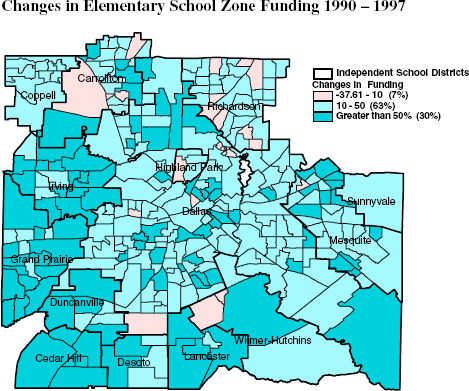
Changes in elementary school zone funding 1990–1997
The five options are: (1) consolidation with another district; (2) detachment of tax base and annexation to another district; (3) purchase of attendance credits from the state; (4) contracting for the education of nonresident students; and (5) tax base consolidation with another district.
Districts below $4,000 per pupil spending in 1990 are designated property-poor districts.
The model for financing Texas schools is the Foundation School Program (FSP). Part of this structure is the local share (Tier 1) and the guaranteed yield (Tier 2). Under Tier 1 of FSP, local school districts receive a basic allotment based on the number of students enrolled in their regular education program. Districts also receive funds based on the number of students enrolled in special programs. These additional funds are made available on the basis of “weights” or increases to the regular program. Tier 2 of the FSP supplies additional funds through a system of financing from local district tax efforts called the “guaranteed yield”. Senate Bill 7 altered the rates and limits on these two structures in 1993.
The data
To begin the analysis of whether money matters, I rely on data from Dallas County. The data come from the Texas Education Agency (TEA), which provides data on the school districts' elementary schools, students, and the 1998 elementary attendance zones 6 of the independent school districts (ISD) in Dallas County to examine school funding and Texas Assessment of Academic Skills (TAAS) before and after the 1993 legislation. While SB 7 applies to school districts, which are the responsible unit for disbursement of funds to all its schools, I am able to test what occurs at the elementary school zone level, since the data reveal each elementary school zone's proportion of funding. Neighborhoods within large districts similar to the Dallas Independent School District may vary greatly. Some areas may be more desirable than others for living, therefore doing an analysis at the elementary school level rather than the district level underscores the differences in school outcomes. The use of Geographical Information Systems (GIS) allows manual drawing of the elementary school boundaries and overlaying of school data in order to spatially represent the changes occurring within school districts. Since SB 7 took effect in 1993, I use data from 1990 and 1997 for an interrupted time series analysis (Mohr 1995).
Variation in the attendance zone did occur over the past 10 years. However, changes were not so drastic as to warrant the retrieval of every year's attendance zone, which were not available for use in this study.
The data for the school districts and the elementary schools, including students' overall performances, were obtained from the TEA. These data contain information on classroom-size; pass rates for the TAAS, financial information on funding and expenditure, and some demographic characteristics of the school children. TEA also provided the formulas for determining the portion of state and local student funding.
This study uses elementary school zones from fourteen of the fifteen independent school districts 7 in Dallas County to analyze the changes in school inputs and outputs. These school districts encompass over 300 elementary school attendance zones, and provide adequate variation for statistical analysis.
One school district does not have school attendance zones due to a desegregation court order from 1987.
Does funding improve school quality?
The effects of increases in school funding should show up in these data in several ways. First, student achievement should increase with increased funding. Previous literature has already documented the close relationship between school quality and a school district's ability to fund its schools (Kain and Quigley 1975; Jud and Watts 1981). If we hypothesize that the level of funding, independent of other differences in districts that may be correlated with funding, causes school quality, we should find that changes in funding within the same district also improves student achievement overall.
Funding per pupil and TAAS pass rates as summarized by the independent school districts in Dallas County are presented in Table 1 to underscore the significance in the funding and TAAS improvements. On the average districts enjoyed a 58% increase in funding while experiencing a 23% increase in TAAS.
Funding per pupil and TAAS pass rates by Independent school districts a
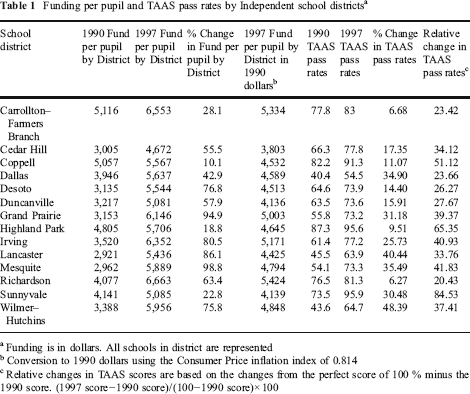
Funding is in dollars. All schools in district are represented
Conversion to 1990 dollars using the Consumer Price inflation index of 0.814
Relative changes in TAAS scores are based on the changes from the perfect score of 100% minus the 1990 score. (1997 score–1990 score)/(100–1990 score)×100
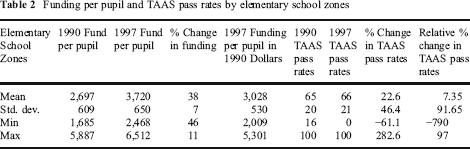
The funding and pass rates are not presented for the 315 elementary school neighborhoods, however, the mean values, are presented in Table 2. On the average schools had at least a 38% change in their funding amounts while showing at least 1% change in the TAAS pass rates from 1990 until 1997.
Funding per pupil and TAAS pass rates by elementary school zones
The neighborhood school zones reflect the school districts' improvement in funding and academic achievement, thus, it is easy to present the analysis at the neighborhood level. More than half (68%) of the school zones increased their TAAS pass rates by at least 1% and received a 10% increase or more in their funding as Fig. 2 demonstrates in the map.
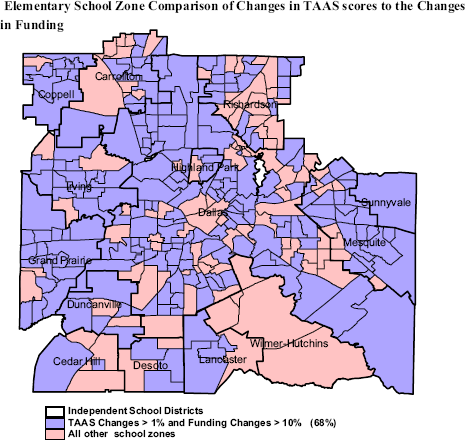
Elementary school zone comparison of changes in TAAS scores to the changes in funding
By comparing the percentage change in TAAS pass rates to the 1990 pass rates, we see there is a downward pattern for elementary school zones, which indicates convergence (see Fig. 3). Schools with the lowest TAAS pass rates in 1990 had a greater rate of change compared to those with high pass rates in 1990.
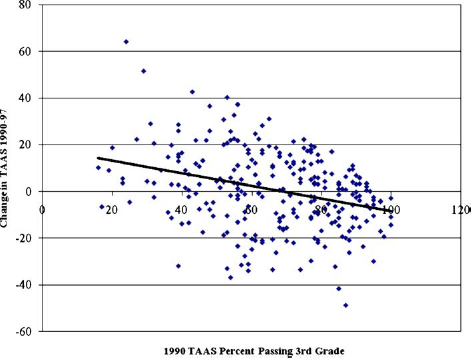
Scatterplot of the change in TAAS pass rates: elementary school zones
The map in Fig. 4 shows the spatial distributions of the changes in those rates. Over fifty percent of the school zones improved their scores from 1990 to 1997.
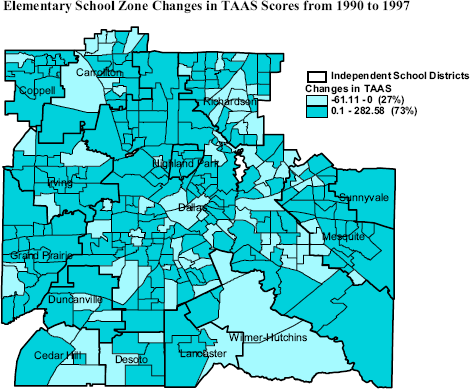
Elementary school zone changes in TAAS scores from 1990 to 1997
Quantitative analysis
Continuing with the hypothesis that money does matter, I run a regression of the change in TAAS pass rates on the change in funding per pupil. I use the relative change 8 in the TAAS pass rate as the indicator for school quality. The findings show that for every 1% increase in funding per pupil, there is 0.5% increase in TAAS scores. Dallas County schools exhibited a decrease in the percent of white students during the 1990s 9 and, interestingly, as the numbers of white students decreased, there was a decrease in the TAAS pass rates. While not statistically significant, for every 1% decrease in the white student population, there is a 3% drop in TAAS pass rates as shown in Table 3.
Relative changes in TAAS scores are based on the changes from the perfect score of 100% minus the 1990 score. (1997 score–1990 score)/(100–1990 score)X100
Based on data from the schools, there was an overall average of 12.1% drop in white students from 1990 to 1997.
Changes in the relative TAAS scores given changes in funding
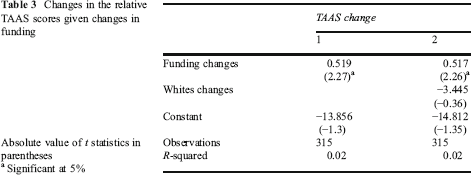
Absolute value of t statistics in parentheses
Significant at 5%
Conclusion
Texas' public school system was forced by the courts to make changes in the way in which it funded its students. That change resulted in wealthy school districts' relinquishing some of their funds so that property-poor districts could receive more money for their students. Because there is a rabid debate about whether more money spent on students yields academic improvement, I took advantage of this policy change to find out if increases in finances to school could make a difference in school quality as measured by academic achievement. I discovered it did matter in overall academic achievement, as witnessed in Dallas County schools. Future research will investigate to a larger degree the effect of the loss in white student population relationship on the funding as well as the achievement rates.
Other states still ponder whether increases in funding will help. However, if their goal is higher quality education for students, this evidence points to improved funding as a solution. The method by which states improve their funding is not at issue. There are perhaps other ways to increase funding that do not take from the rich to give to the poor as in Senate Bill 7. What is at issue is that if school quality is low, an increase in funding can help to improve that quality, as shown by this work.