







Abstract
Wacquant (2001) and others have argued that social control efforts directed at racial and ethnic minorities frequently shift institutional form and become more nuanced as societies modernize, even as the underlying function persists. This study examines the connection between southern lynching and housing segregation. We argue that legal, political, social and demographic changes in the south made lynching dysfunctional as a means of control. Among other more nuanced control mechanisms, modern housing segregation helped serve as a replacement. We test this proposition by relating historical southern black lynching rates to recent levels of segregation in southern MSAs. We find that an MSA's historical lynching rate is positively and significantly linked to the MSA's current segregation levels after accounting for standard determinants of segregation. Thus, segregation does not just occur generally throughout the south, but follows a very particular pattern based on past lynching rates. Our findings add to a growing literature on the legacy of lynching, such as studies examining contemporaneous variation in support for and use of capital punishment.
Introduction
Sociologist Loic Wacquant (2001) and others (e.g., Alexander 2010 and Perkinson 2010) have argued that social control efforts directed at racial and ethnic minorities frequently shift institutional form and become more nuanced as societies modernize. Changes in economic, political, legal and social structures can render previously effective strategies dysfunctional, requiring new approaches that support existing social hierarchies. While such transformed regimes may appear entirely new, the vestiges of previous eras, and the interests that created them, remain hidden at their core.
Wacquant (2001:95) identifies a “historical sequence of ‘peculiar institutions’ that have shouldered the task of defining and confining African Americans.” These include: slavery, the Jim Crow system, the ghetto, and the hyper-ghetto in conjunction with mass incarceration. According to Wacquant, the Jim Crow regime was replaced by the modern ghetto because it lacked the sophistication needed to manage inherent tensions between two institutional goals: (1) the ostracization of blacks from white society and (2) the exploitation of black labor for white profit. Arguably, terror through white mob violence was one of the most important control mechanisms during the post-emancipation period, extending as far as to the mid-1960s. This seems particularly true in the South, where the need to extract black labor was potentially most pressing and simultaneously most at odds with cultural traditions demanding racial separation. However, as Wacquant points out, the brutality of lynching played a prominent role in driving millions of blacks out of the rural South, and into urban areas perceived to be more tolerant (especially large Northern cities). Growing legal opposition and social sentiments hastened the system's end. Thus, the era of the urban ghetto began in part because the blatant brutality of Jim Crow sowed the seeds of the system's own destruction, or at least, transformation.
In this view, the breakdown of Jim Crow represented an organizational challenge. Racial animus remained; the question was how the racial hierarchy would be preserved in ways that were effective within new social and legal frameworks. This study examines one possibility, namely, racial housing segregation. The central question addressed is whether the racial tensions that were manifest by the violent regimes of lynching and Jim Crow are currently animated in the form of racially segregated housing markets.
We first review the use of lynching as a technique of social control and its demise in the face of demographic, social and legal change. We then explain how segregation can function as a replacement for lynching, effectively accomplishing the key goals of its more violent predecessor. Finally, we subject the hypothesized link between lynching and segregation to empirical examination. Specifically, we ask whether the current levels of segregation in southern metro areas are statistically correlated with the rates of black lynching in those metro areas between 1890 and 1960, controlling for a variety of factors normally thought to influence segregation. The noticeable variation in both black lynching rates and segregation levels permits a meaningful analysis of the data.
The results of the estimated random effects models, which account for unobserved cross-MSA heterogeneity, indicate that current segregation is significantly related to past lynching rates. Thus, southern segregation appears as more than simply a general phenomena observed throughout the south. 1 Instead, and consistent with the reasoning of Wacquant (2001), segregation appears at least partly as a direct outgrowth of lynching, a different technique to serve similar ends. These results add to previous social science research that has examined how the history of lynching in a state may be predictive of other ongoing methods of racial subordination, including the current number of death sentences for blacks as well as overall support for capital punishment (Jacobs et al. 2005; Zimring 2003; Messner et al. 2006). 2
Housing segregation is, of course, observed across the country. Indeed, recent studies indicate that it is most pronounced in the northeast and upper Midwest (Iceland et al. 2002). We focus on southern segregation because of the historically disproportionate use of lynching in the south and our particular interest in the way southern race relations have evolved.
In a related vein, Darity et al (2001) also uncover evidence of the historical continuity of racial inequality. They concluded that the human capital attributes and discrimination experienced by individuals near the turn of the 20th century continued to affect labor force outcomes of members of the same ethnic and racial groups one hundred years later. Similarly, Jefferson and Pryor (1999) find that hate groups are more likely to be located in former Confederate states.
Conceptual framework
The conceptual framework that informs the analysis is that of power and conflict, whereby unequal distributions of valued resources are created and maintained through the use of bureaucratic and state influence. Rather than arising naturally, inequality, especially that attaching to social groupings or categories such as race, results from exploitation, domination and exclusion. Although typically associated with traditions in sociology (e.g., Tilly 1999; Massey 2007), a conflict perspective is also strongly suggested by the emerging field of stratification economics (e.g., Darity 2001, 2005). 3
Darity (2005) notes, for example, that, “Stratification economics examines the structural and intentional processes generating hierarchy.” Particularly relevant for our analysis, he goes on to say, “… discriminatory practices to preserve privilege are likely to persist rather than fade out.” Our study emphasizes the notion that they will continue but change forms to best suit existing economic, political and social conditions.
In this framework actions such as lynching are used by elites to solve organizational problems, in particular, attempts by oppressed groups to disrupt current social relations and restructure rules and norms more in their favor. This entails defining reality to make inequality appear natural and justified or institutionalizing disparities via the writing, interpreting and enforcement of rules. Should problems remain, mechanisms for quelling dissent must be deployed. The particular methods will depend critically on their functionality given existing economic, political and social structures (Wacquant 2001). As these structures change and evolve, so will the methods of coercion and control.
The use of lynching to maintain a racial caste falls squarely within this paradigm. Concerns about the use of black slave labor were initially handled by defining the slaves as non-Christian heathens and hence, lesser beings worthy of restraint. 4 The instrumentality of this description became evident as slaves converted to Christianity, making the original justification obsolete. New rationales evolved centering on the supposedly inherent animalistic tendencies of blacks, their lack of intelligence and the need to control them for their own benefit. The construction of blacks as inferior, together with related laws that permitted slavery, effectively allowed their exploitation and domination to the clear economic, political and social advantage of whites.
The paper's discussion of the historical aspects of slavery, lynching and social control of African Americans (i.e., the Black Codes and Jim Crow) draws on Woodward (2002), Foner (2002), Ayers (2007), Tolnay and Beck (1992), and Gibson (http://www.yale.edu/ynhti/curriculum/units/1979/2/79.02.04.x.html, accessed November 3, 2010).
As slavery was abolished new approaches to control were required. The ideology of an inferior black race continued to have force, although expanded legal opportunities for blacks, such as the ability to own land and the right to wages and to vote, comprised significant challenges to the existing social order. The prospect of emergent economic, political and social power among blacks was sufficiently threatening to cause whites to redouble their efforts. And because the former system of legal institutionalized racial oppression (e.g., the Black Codes) had given way, new laws and rules were put in place such as state constitutional amendments that made voter registration harder (e.g., literacy tests, poll taxes, stiffer residency requirements) and effectively prevented blacks from servings as jurors, who had to be registered voters. Anti-miscegenation laws were also passed. Beginning in the 1890's, the Jim Crow laws had reestablished the legal framework and social norms necessary to subjugate blacks.
Perhaps most importantly for the current analysis, extralegal options were also pursued in the form of violence, including and especially lynching. Slave patrols, the Ku Klux Klan and less formally organized groups of whites used beatings, burnings and hangings to constantly remind blacks of their inferior status and to prevent the use of their newly acquired freedoms to work and vote. While lynchings have sometimes been explained as the irrational madness of crowds or a means to overcome perceived deficiencies in the official system of justice, clear evidence exists that emphasizes the role of lynching in denying blacks their basic rights and maintaining the social hierarchy. That is, lynching was a means of social control used in the face of racial threats to economic, political and social hegemony.
The frequency of lynchings, for example, has been found to be systematically related to variation in cotton profitability as well as other indicators of blacks' labor bargaining power (Tolnay and Beck 1992). Variations in lynchings also appeared to vary seasonally, rising in winter months when labor contracts between sharecroppers and land owners were settled and re-negotiated (Willis 2000). The ebb and flow of lynchings also has paralleled the introduction of other social controls. For instance, the creation of Jim Crow laws in the early 1890's was accompanied by a noticeable spike in the number of black lynchings (see Fig. 1).
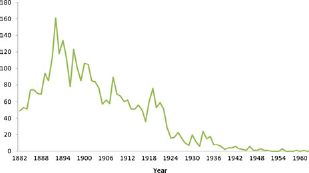
Number of black lynchings
Contemporary social commentator Ida B. Wells-Barnett likewise asserted that lynching was driven by the rational self-interest of people who wanted to stake out their claim to precious resources (even if those in the dominant group never consciously made the connection between their interests and their actions). Thus, it was suggested, lynching was a form of instrumental terror for Southern whites. She (1900:1) famously noted,
Our country's national crime is lynching. It is not the creature of an hour, the sudden outburst of uncontrolled fury, or the unspeakable brutality of an insane mob. It represents the cool, calculating deliberation of intelligent people…
In a similar vein, statements by political and economic elites clearly revealed the intention of lynching as a tool of social control to enforce a dominant social position. On March 23, 1900, for instance, Senator Benjamin Tillman of South Carolina proclaimed in a speech before the Senate:
We did not disfranchise the negroes until 1895. Then we had a constitutional convention convened which took the matter up calmly, deliberately, and avowedly with the purpose of disfranchising as many of them as we could under the fourteenth and fifteenth amendments. We adopted the educational qualification as the only means left to us, and the negro is as contented and as prosperous and as well protected in South Carolina to-day as in any State of the Union south of the Potomac. He is not meddling with politics, for he found that the more he meddled with them the worse off he got. As to his “rights”—I will not discuss them now. We of the South have never recognized the right of the negro to govern white men, and we never will. We have never believed him to be equal to the white man, and we will not submit to his gratifying his lust on our wives and daughters without lynching him. 5
http://historymatters.gmu.edu/d/55/ accessed September 8, 2010.
Further supporting the idea that lynching functioned as a technique of social control in the face of racial threat was the ways in which lynchings were publicized. Newspapers generally described lynchings and often the stories were accompanied by gruesome photos. Indeed, photos were also turned into postcards, which were used until the U.S. Post Office eventually prohibited their delivery. 6 The widespread dissemination of information about lynching magnified its impact well beyond whatever localized effects it had within the rural communities where it generally took place.
A collection of photographs and post cards depicting lynching events can be found at http://withoutsanctuary.org/ (accessed November 3, 2010).
Consistent with the power-conflict framework, the dialectical vacillation between force and resistance continued for decades. Opposition to lynching took various forms. While scholars have tended to focus on legal and political mobilization both by blacks (e.g., the NAACP) and whites (e.g., Association of Southern Women for the Prevention of Lynching) as well as the “Great Migration” from southern to northern states, armed self-help by blacks against whites intent on lynching was also an important form of resistance (Cha-Jua 2000). As the costs of using lynching to control blacks rose, and as its benefits in ensuring an available and docile labor force fell due to the Great migration, lynching became dysfunctional for supporting the existing racial hierarchy Always illegal, the use of lynching consequently began a sustained decrease in the early 1900s and was rarely seen in the fifties and sixties (Fig. 1).
A key point for the present analysis is that the demise of lynching as a strategy of social control did not mean that its basic underlying motivation had disappeared. Quite the contrary, a desire for social preeminence and a desire to exploit and exclude blacks from opportunity remained. In part, the desire for control was aided by the longstanding construction of blacks as inferior, which promoted a stigma that became partly self-sustaining (Loury 2002). But perceived racial threats to political and economic power suggested more active measures remained necessary.
The ongoing racial tensions thus continued to play out both at the macro-structural level (e.g., the exclusion of agricultural workers from minimum wage coverage that disproportionately affected blacks; see Katznelson 2005) as well as the micro level of everyday interactions (e.g., condescension of whites toward blacks, exclusion from social and business clubs). However, as conflict led to legal changes and new social pressures, and as economic restructuring occurred due to technological change, shifts in world markets and population movements, the forms of social control changed as well.
A claim of the present study, following the logic of Wacquant (2001), is that racial housing segregation in the south represented a transformation of lynching as a means of social control in response to the deeper economic, political and social shifts. Increased housing segregation quite naturally filled the social control void, as existing levels of housing segregation were partially a reflection of the need for blacks to band together to resist racist violence. Thus, whites could build on earlier segregation associated with black resistance for the purpose of heightening social control in a new era. Noting the complex duality of segregation's functions, Wacquant (2001:103) argued
For the ghetto in full-fledged form is, by its very makeup, a double-edged sociospatial formation: it operates as an instrument of exclusion from the standpoint of the dominant group; yet it also offers the subordinate group partial protection and a platform for succor and solidarity in the very movement whereby it sequesters it.
At first blush, historical data appear consistent with the Wacquant's theorizing regarding the transformation of social control mechanisms. In particular, housing segregation was used increasingly as a substitute for lynching. Figure 2 superimposes a measure of the degree of housing segregation in the south on the lynching data from Fig. 1. Historical values for the dissimilarity index, the most common measure of the degree of housing segregation, come from Cutler et al. (1999).
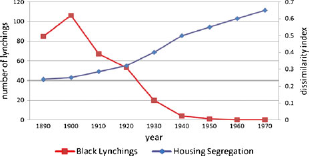
Black lynchings and the degree of housing segragation
As was mentioned previously, the number of black lynchings jumped between 1890 and 1900, most likely in response to the introduction of Jim Crow laws and the attendant efforts in enforcing them. The number of lynchings then began the long and sustained decline referenced earlier. The pattern of housing segregation displays a virtual mirror image of lynchings. After a small rise between 1890 and 1900, the increase accelerated until around 1940 in tandem with the steep drop in lynchings. After that, as the rate of decline in lynchings leveled off, the rise in housing segregation flattened as well. The correspondence of these trends carries the possibility that they are linked in a substantive way, that the technique for maintaining the racial hierarchy had shifted form.
Indeed, at least conceptually, housing segregation could effectively accomplish several of the economic, social and political objectives produced by lynching. Concerning the perceived economic racial threat, segregation helps to isolate blacks physically from jobs and social networks that carry information about employment opportunities. At the same time, segregated neighborhoods can warehouse surplus black labor to be drawn upon when needed. Segregated neighborhoods also keep blacks economically disadvantaged to the extent they promote types of cultural capital (e.g., tastes in music and clothing, speech patterns) that are not valued by dominant society. Furthermore, segregated communities often have less access to banking and financial institutions that can lead to wealth creation and greater life chances.
The social order defended by lynching is also supported by housing segregation. Social norms in the south prohibited inter-racial socializing and marriage, and created separations in eating establishments, schools, social clubs, churches and transportation. Without legal force or the threat of extra-legal violence like lynching to enforce that order, blacks were in a better position to break existing barriers. Housing segregation was an effective substitute as it greatly diminished the likelihood of inter-racial social interactions. And as blacks within segregated communities adapted their routines to the social exclusion they faced, the social isolation became even more durable. For instance, stores and restaurants that catered to the particular tastes of black customers naturally became more common in black segregated neighborhoods, as did barber shops, clothing stores and churches. As a result, interaction with whites became even less likely.
Finally, housing segregation can also handle perceived racial threats to political power. By physically isolating blacks in separate voting districts, whites can diminish the practical implications of black voting power. That is, black voting blocs can exert less influence on issues of concern to whites. Blacks, for example, would be less likely to be the “median voter” who can tip decisions one way or the other. In addition, the separation can inhibit social solidarity that might lead at least some whites to support policies that help blacks. The separation also means that black candidates for regional and national positions will be less known to whites and less trusted, further reducing their political influence.
As documented by Massey and Denton (1993), segregated urban ghettos were intentionally constructed in many ways. Some approaches which were legal at the time included the enactment of zoning restrictions, actions by neighborhood associations to boycott real estate agents and business who dealt with blacks, the use of restrictive mortgage covenants that prevented the sales of properties to blacks, urban renewal efforts, and the use of redlining by banks and insurance companies. Government policies themselves contributed directly and purposely to segregated neighborhoods. For example, the Home Owners Loan Corporation, which provides funds for refinancing urban mortgages in danger of default among other things, developed the system of redlining later used by banks (Massey 2008). Likewise, the Federal Housing Administration, which underwrote bank mortgage loans and helped finance the spread of suburbia, included in its manual instructions that, “if a neighborhood is to retain stability, it is necessary that properties shall continue to be occupied by the same social and racial classes” (Jackson 1985).
Even after some of these practices and others were made illegal, however, research shows that actions that maintain racially segregated neighborhoods continued in the form of real estate practices such as steering, the withholding of information regarding available properties, and the provision of less help in obtaining mortgages. Studies have also shown that racial discrimination has occurred in mortgage lending, decreasing blacks' abilities to move to better, more integrated neighborhoods. None of these procedures need to be conscious or intentional; they can simply be based on unconscious stigma or institutionalized procedures that increase the odds of discriminatory decisions. But they can be effective regardless. Moreover, these practices have continued both because they are subtle and hard to detect, and because the enforcement of anti-discrimination laws is left up to the individual who is neither positioned to see systematic patterns nor has the resources or knowledge to pursue claims of discrimination if problems come to light. Ultimately, these actions that support segregation have combined with “white flight” to keep segregated neighborhoods in place.
Although this study focuses on the south because of its greatly disproportionate use of lynching, some discussion of segregation in the north is appropriate. Indeed, recent estimates reveal that northern and upper mid-west cities are among the most racially segregated in the country (Iceland et al. 2002). Two points are relevant on the matter. First, there are several factors apart from the degree of lynching and a desire for social control that produce segregation, even in the south (discussed below in the empirical section). Thus, even absent lynching the observed degree of segregation in the north can be partly explained by such other factors. Second, although lynching itself was infrequent (but did occur) in the north, the desire for social control there can lead to a search for successful practices. As locales in both the north and south found segregation effective, the practice could spread via its decentralized emulation in both areas (Tilly 1999).
In sum, the general framework of power and conflict suggests the use of control techniques that evolve and adapt as social conditions change. As the acceptance and usefulness of lynching waned, housing segregation appeared as a potentially effective replacement. Moreover, at the aggregate level, data trends in lynching and housing segregation point toward the substitution of one strategy for the other. Given all this, we now turn to a more detailed empirical analysis that subjects the relationship to a more stringent test.
Specifically, our research design examines whether those metropolitan statistical areas (MSAs) in the south that historically experienced higher black lynching rates are the ones that eventually had higher rates of housing segregation. Although lynchings occurred throughout the south and segregation rose throughout the south, the rates of lynchings and segregation varied considerably from MSA to MSA within the south. If segregation was a replacement for lynchings, then we would expect to see those MSAs with higher lynching rates to eventually have higher segregation than those with lower lynching rates, other things equal. Thus, by exploiting the regional variation in both black lynching rates and racial housing segregation, we can provide a rigorous test of the hypothesized relationship.
In practical terms, we estimate standard statistical models of MSA housing segregation using Census data for the years 1990 and 2000. We then add the rates of black lynching during the period 1890 to 1960. To the extent the hypothesis is valid, we should find a significant positive relationship between the degree of past lynching and recent levels of housing segregation, after accounting for other factors that have been found to affect segregation.
Data, Variables, and Methods
The data used in this study are derived from the 1990 and 2000 decennial censuses (Geolyltics 2004) as well as the Historical American Lynching Data Collection Project (accessed at http://people.uncw.edu/hinese/HAL/HAL%20Web%20Page.htm). The sample consists of 127 MSAs located in the Southern region of the country (as defined by the U.S. Census Bureau) for each of the two decennial years. Thus, the total sample size for the panel is 254 (127×2). The object of the analyses is to explore how past lynching rates may account for recent levels of segregation, while holding constant other possible explanatory factors.
We use the two most commonly referenced measures of segregation between non-Hispanic Whites and Blacks: the dissimilarity and isolation indexes. The dissimilarity index has values between zero (no segregation) and one (complete segregation), and measures the evenness with which different groups are distributed across census tracts within an MSA. The index value can be interpreted as the percent of either group that must change neighborhoods in order for each neighborhood to achieve the average racial composition of the MSA. The isolation index measures the extent to which members of a minority group live in neighborhoods in which they are exposed only to other members of the group. The index value can be interpreted as the probability that a randomly drawn minority group member will live in the same neighborhood as another randomly drawn minority group member. It has a minimum value of zero, which occurs when a member of a minority group has no neighbors of the same minority group. It has a maximum value of one, in which case a minority group member has neighbors who are all in the same minority group.
The key independent variable, the black lynching rate, is calculated as the number of lynching events between 1882 and 1968 divided by the average black population for the period multiplied by 100,000. 7 MSAs were matched to their state, and then assigned the state-level black lynching rate. In cases where MSAs crossed state lines, a weighted average was taken, based on the size of each state's black population. The decision to use state-level lynching rates reflects concerns related to both data availability and the argument noted earlier that the social impact of lynching was felt far and wide, not just in the localities where they occurred.
An anonymous reviewer pointed out that there is considerable variability in the stated justifications for black lynching (e.g. murder of a white, rape of a white, etc.). While our present objective is to examine the general relationship between lynching and contemporary segregation, future research might consider disaggregating the black lynching rate by stated justification.
The models control for various MSA-level attributes found to be significant predictors of segregation in previous studies (i.e., Massey and Gross 1991; Farley and Frey 1994; Frey and Farley 1996; Krivo and Kaufman 1999; Logan et al. 2004). These include an MSA's functional specialization if any, the socioeconomic status of Blacks relative to that of Whites, the amount of new housing in an MSA, the MSA's population size, and the proportion Black.
MSAs differ significantly by functional specialization, or economic base. These differences can affect residential segregation patterns because functional specialization is associated with differences in the types of housing available and in the social and economic characteristics of the resident populations. Previous studies have found that the presence of military bases, retirement communities and universities significantly influence the levels of an MSA's segregation (Farley and Frey 1994; Frey and Farley 1996). Military bases can matter because racial and ethnic minorities in the armed services are assigned to integrated barracks or to apartments with demonstrated records of non-discrimination. Areas with a large military presence would thus be expected to have lower segregation levels, other things equal. Similarly, metropolitan areas with a prominent university presence might also be less segregated. Universities can be agents of progressive structural change, with diversity initiatives that bring in minority faculty, staff, and students, individuals that are more capable of living in White communities due to their higher social status and incomes (Wineberg 1983). Alternatively, MSAs with sizable retirement communities may be more segregated than others, potentially reflecting the norms and prejudices of a previous time (Fitzgerald 1981.)
A metro area's functional specialization is included using dummy variables that indicate an overrepresentation of those over age 64, military personnel, and individuals living in college dormitories. If the fraction of the population in a particular specialization exceeds the cross-MSA average fraction by one standard deviation, then the category takes a value of one for the MSA and 0 otherwise.
Since the cost of housing is a key determinant of access to particular communities, the income of racial and ethnic minorities relative to Whites is also expected to influence segregation levels. Consequently, we include the ratio of average African American to White income as an independent variable. We expect that increases in this ratio should lead to less segregation, as fewer African Americans will be “priced out” of White neighborhoods.
The age of the housing stock also likely influences an MSA's segregation. This is partly due to the Fair Housing Act of 1968, which made discrimination in residential housing illegal and undoubtedly contributed to greater integration of newer apartments and houses. Also, newer housing is to some extent located in developments that are less bound by historical patterns of racial tension and exclusion. Newer housing might also contribute to segregation, to the extent it constitutes gentrification that displaces lower income minorities deeper into the urban core. The amount of new housing in an MSA is represented by the fraction of the housing stock built during the 1990s. MSAs with higher fractions are expected to exhibit less segregation.
The natural log of MSA total population is also included as a control variable. Hwang and Murdock (1988) argue that the use of population size in segregation studies is justified theoretically on the basis of either subcultural or structural differentiation perspectives. The former predicts a positive relationship, while the latter a negative one. Empirically, previous research has consistently found population size to be significantly positively associated with metropolitan housing segregation (Farley and Frey 1994; Logan et al. 2004).
The proportion of an MSA's population that is Black and its square are included to control for what is commonly described as a potential “racial threat” effect. The initial formulation of the racial threat hypothesis is largely credited to Blalock (1956, 1957, 1967) who argued that an increasing minority presence can threaten the dominant group's economic, political, and social status advantages. Consequently, and consistent with general conflict theories of social control, a growing minority fraction may elicit an increase in repressive measures from Whites, including housing discrimination. The squared term allows for a non-linear response. Interestingly, while the bulk of segregation studies have indeed found a positive and significant effect of the proportion Black on segregation, one study reported that, when you break the results down by region, the racial threat effect is not statistically significant in the South (Emerson 1994).
Finally, we include a time period dummy (2000 = 1) to capture changes in segregation common to all MSAs.
Because the data are comprised of two cross-sections of southern MSAs (1990 and 2000), the estimation technique must account for any potential unobserved cross-MSA heterogeneity that would render the estimates biased and inconsistent. We use a random effects estimator, because it permits the estimation of coefficients on time-invariant variables, such as the key lynching rate variable. A least-squares dummy variable fixed effects estimator, by contrast, does not allow estimation of such coefficients.
The random effects estimator treats cross-MSA variation in mean segregation as a random variable as opposed to a fixed parameter to be estimated. As such, the variation is modeled as one component of a composite error term in the segregation index regressions. The model takes the form:

where α i is the random variation in the equation's constant α, ∊ i,t is a random error with the usual properties, and Cov(α i , ∊ i,t ) =0. Assuming that the random effects (the ai) are uncorrelated with any of the regressors, the model's estimated coefficients will be both consistent and efficient. Otherwise, the coefficients will be biased and inconsistent. Both the appropriateness of modeling the cross-MSA variation as a random variable and its lack of correlation with the regressors must be formally tested. These points will be developed more fully below. As a point of comparison, we present OLS estimates of the models in addition to the random effects estimates.
Empirical Results
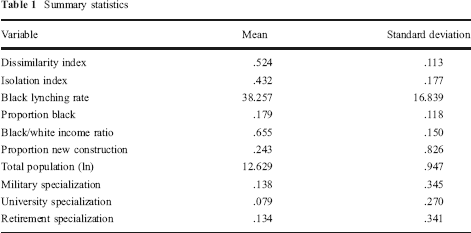
Table 1 displays summary statistics for the variables used in the analysis. The data reveal considerable variation in both the dissimilarity index and the isolation index across our sample of southern MSAs. The means and standard deviations of the demographic control variables are consistent with those found in earlier research (Frey and Farley 1996.)
Summary statistics
OLS estimates Table 2 contains the results of our regression analyses of segregation between non-Hispanic Blacks and non-Hispanic Whites using the dissimilarity and isolation indexes. The first two sets of results are the OLS estimates for the two segregation indexes. These do not account for potential unobserved heterogeneity, but they will provide insight into how the random effects estimator influences the findings, and thus how sensitive the findings are to the particular estimation technique used. Both models were relatively efficacious, with adjusted-R 2 values of .54 and .80.
Regression estimates for African American-NH white segregation indexes *
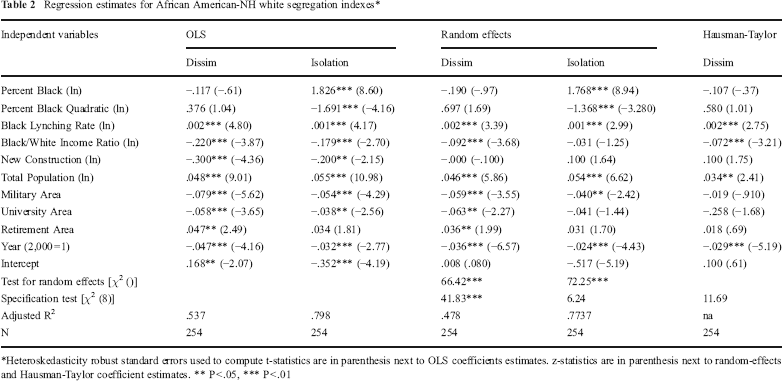
Heteroskedasticity robust standard errors used to compute t-statistics are in parenthesis next to OLS coefficients estimates, z-statistics are in parenthesis next to random-effects and Hausman-Taylor coefficient estimates.
P<.05
P<.01
Turning first to the results for the dissimilarity index, areas with a greater percentage of the population black did not appear to have significantly higher or lower levels of segregation. Furthermore, the quadratic term for the percent black was not significant, indicating no discernible evidence of nonlinearity in the relationship. While inconsistent with certain versions of the racial threat hypothesis (DeFina and Hannon 2009), this finding is not unprecedented, as Emerson (1994) also found that the percent black was unrelated to dissimilarity in the South (but significantly related in the non-southern regions).
Interestingly, while the relative size of the black population did not seem to affect segregation for the Southern MSAs in our sample, the rate of black lynching was highly significantly related. As predicted, the lynching rate estimate suggests that Southern areas with a pronounced history of black lynching tend to have higher levels of contemporary segregation in the years 1990 and 2000 (b=.002, p<.001).
In regard to the demographic control variables, the results were highly consistent with previous research in this area (Farley and Frey 1994; Frey and Farley 1996). On average (and ceteris paribus), Black-White segregation was significantly higher in larger metropolitan areas and in areas with a high proportion of retired residents. The results further suggested that Black-White segregation was generally lower in areas where the gap between the per capita income of Whites and that of Blacks was small, where a significant proportion of the housing stock was newly built, and where universities and military personnel were common. The time variable was negatively and significantly related to dissimilarity, suggesting that the dissimilarity index fell on average between 1990 and 2000.
While the dissimilarity index is undoubtedly the most commonly used measure of segregation, the isolation index has also been widely used. Massey and Denton (1988) have convincingly demonstrated that the two measures tap unique dimensions of the phenomenon of segregation. Therefore, we also perform our analysis using the isolation index as the dependent variable. These results are provided in column 3 of Table 2.
Central to the focus of the current study, and consistent with the results reported for the dissimilarity index, the black lynching rate was significantly related to the isolation index. Thus, again, the lynching rate estimate suggests that Southern areas with a history of high black lynching rates tend to have higher levels of contemporary segregation (b=.001, p<.001).
Although the percent black and its squared term were statistically insignificant in the models for the dissimilarity index, they displayed their theoretically expected relationship with segregation in the model for the isolation index. The percent black was significantly positively associated with isolation and displayed a significant decelerating slope consistent with certain versions of Blalock's (1956, 1957) threat hypothesis.
In regard to the other demographic control variables, the ratio of black to white per capita income, percent new construction, military specialization, university specialization and the time variable were significantly and negatively related to the isolation index. Total population size was strongly and positively related to isolation, while retirement specialization was positively but insignificantly related.
Random-effects estimates As mentioned earlier, the possibility of unobserved cross-MSA heterogeneity calls into question the validity of the OLS results. We thus re-estimated the models using a GLS random-effects framework (Greene 2003). The results are in the fourth and fifth columns of Table 2. For the approach to be appropriate the variance of α i must be non-zero; that is, the MSA-specific intercepts should exhibit random variation. We test this in a standard way, using Breusch and Pagan's (1980) Lagrange Multiplier test of the null hypothesis that var(α i )=0. 8 The test statistic is distributed as a chi-square, and the results show that the null can be rejected at high levels of confidence for both the dissimilarity and isolation index equations.
The GLS random effects estimates are generated using the xtreg command of Stata 11.1. The Bruesch-Pagan test is done using the xttest0 command.
The use of a random-effects estimator raises a second concern. That is, the α i also must be uncorrelated with any of the regressors. Any correlation signifies that the estimates are biased and inconsistent, and that an instrumental variables technique will be needed to surmount these shortcomings. Following Hausman and Taylor (1981) and Greene (2003), the possibility of correlation is tested using Hausman's (1978) specification test. In essence, the estimated parameters for the time-varying variables are compared to those from a fixed-effects estimator, which is guaranteed to be consistent (see, e.g., Greene 2003). If the estimated random-effects coefficients differ too much from the fixed-effects coefficients, then one concludes that the random-effects coefficients are biased. If not, one concludes that the random-effects estimates are both consistent and efficient.
Hausman's test formalizes the idea of the vectors of estimated coefficients being too different, using the deviations to form a chi-square statistic. Under the null hypothesis, the coefficient vectors do not differ. Our results indicate that the null is rejected for the dissimilarity random effects estimates, but not for the isolation index estimates. Therefore, we can have confidence that the isolation index estimates are both consistent and efficient, while those for the dissimilarity index are not.
To obtain reliable estimates for the dissimilarity equation, we use the instrumental variables technique of Hausman and Taylor (1981) that was specially developed for this circumstance. 9 The resulting estimates are shown in the last column of the table, and a new Hausman specification test indicates that the null of no correlation between the α i and the regressors cannot be rejected at standard levels of significance.
The Hausman-Taylor procedure requires ex-ante judgment about which regressors are likely endogenous and which are exogenous. Given a sufficient number of exogenous variables, these can serve as instruments for the endogenous variables, and no external exogenous instruments are needed as with a standard IV approach. See Hausman and Taylor (1981) or Greene (2003) for details. We conjectured that the functional specialization variables were endogenous, in that unmeasured forces driving an area's function specialization would also drive the form of its housing market. This conjecture was supported by the Hausman specification test discussed in the text, as instrumenting these removed measured correlation with the α i . The estimates are generated using the xthtaylor command of Stata 11.1.
Concerning the study's central hypothesis, the Hausman-Taylor estimates of the dissimilarity equation and the basic random-effects estimates of the isolation equation show that the lynching rate continues to be highly significant. Moreover, the magnitudes of the coefficients are quite close to the OLS estimates, suggesting that the relationship is robust to the choice of specification and estimation procedure. The coefficients on the control variables in the isolation and Hausman-Taylor dissimilarity equations are similar to the OLS estimates. A main difference in the dissimilarity equation is that neither the new construction variable nor the functional specialization variables are significant.
The literature on segregation has increasingly emphasized the importance of examining segregation patterns for other minority groups beyond black/white segregation (Frey and Farley 1996). Given recent trends in the growth of the Hispanic population, we also estimated dissimilarity and isolation models for Hispanic/white segregation. Our conceptual framework argued for a connection between black lynching and black/white segregation rooted in a socio-historical process specific to the south. As such, lynching rates need not be associated with contemporary patterns of Hispanic/white segregation. Still, it is possible that the practices of social control that proved so successful against one minority group would be emulated when addressing concerns about other groups as well.
We replicated the analysis followed for the black-white segregation index equations for the Hispanic white equations. Based on the Bruesch-Pagan test, we were able to easily reject the null hypothesis that Var(α i )=0, thus indicating the need for a random-effects estimator. Application of the Hausman specification tests revealed that the α i in each equation (dissimilarity and isolation) were correlated with the regressors. We thus re-estimated each using the Hausman and Taylor (1981) technique, which effectively handled the problem. The results indicate that the black lynching rate is not significantly connected to contemporary levels of Hispanic segregation, whether measured using the dissimilarity or isolation indexes. 10 This outcome could reflect the unique evolution of control mechanisms related to blacks as emphasized by Wacquant (2001).
We do not present the full results in the interest of space. However, they are available on request.
Conclusion
This study adds to a growing body of research on the importance of the history of racial oppression in the United States for understanding contemporary social problems. As Alexis de Tocqueville famously noted (1969:341), “The law can abolish servitude, but only God can obliterate its traces.” Previous research has linked historical lynching rates to contemporaneous variation in support for and use of capital punishment (Jacobs et al. 2005; Messner et al. 2006; Zimring 2003) as well as overall rates of violence, particularly in the South (Messner et al. 2005). Underlying such analyses is the belief that institutions of social control can evolve in such a way that they look completely different from their earlier predecessors, and yet fundamental similarities remain buried at their core. This point was well made by Wacquant (2001) who argued that, in the historical sequence of “peculiar institutions,” slavery gave way to the Jim Crow system when it was no longer functional or feasible. According to Wacquant, the Jim Crow system, which included the terror tactics of the Klu Klux Klan and mob lynching, became more sophisticated as time went on, evolving into the modern hyper-segregated ghetto.
The results from the present study are consistent with this viewpoint, as black lynching rates from many years ago continue be relevant for explaining variation in black metropolitan segregation (measured both in terms of dissimilarity and isolation). In addition to complementing existing research on how historical lynching patterns matter for the use of legitimate and illegitimate violence in the South (e.g. Messner et al. 2005, 2006), our results also may be useful in explaining why general models of segregation are less effective in accounting for variation in segregation within the Southern region (e.g. Emerson 1994). More specifically, researchers interested in understanding segregation in the “New South” need to take account of how the region's unique history of racial oppression may still matter.