







Abstract
The long history of institutional and historical racism found an explosive expression in the events around Katrina in New Orleans. Racial inequalities were evident in the actual destruction caused by the hurricane and even more significantly in the government response to the disaster. The Non-Governmental Organization (NGO) sector provided alternative approaches to recovery and reconstruction, but such alternatives were inadequate to counter the formidable forces of capitalism arrayed against them. NGOs provided substantial direct service to the most distressed residents of the city and, in some cases, provided important advocacy roles in addressing the inequities caused by government action and/or inaction. The specific initiatives of six NGOs are reviewed here, including the work of the New Orleans Habitat for Humanity, the Catholic Charities of the Archdiocese of New Orleans, the Common Ground Collective, the Association of Community Organizations for Reform Now, the Peoples Hurricane Relief Fund and Oversight Coalition, and the People's Organizing Committee. NGO initiatives were not structurally capable of generating a broad militant anti-racist mass movement of New Orleans’ working class for social change. Five years after the storm the working class of New Orleans faces deepened racial and economic distress. A return to the strategy of bold anti-racist mass movements confronting capital and the state would seem to be in order for the coming period of time.
Introduction: Racism and Hurricane Katrina
Natural disasters can expose underlying dimensions of social life (Elliot et al., 2006). Hurricanes do not racially discriminate but can deepen the social divides in societies with patterns of race and class inequality (Frymer et al., 2006). Such was the case with Katrina in New Orleans.
The long history of institutional and historical racism in New Orleans found an explosive expression in the events around Katrina. African Americans suffered disproportionately higher levels of trauma, death, and property loss than others during the storm and its immediate aftermath (Brookings, 2011; Liu 2007; Liu & Plyer, 2010a, 2010b; Logan, 2006; Campanella, 2007, 2010a, 2010b; Gillam et al. 2007; Kates et al. 2007). These disparities were further exacerbated by the government response to the disaster. The Non-Governmental Organization (NGO) sector attempted to chart alternative paths to recovery and conducted numerous worthy initiatives, but these efforts have proven inadequate to bridge these inequalities even many years after the events of August 2005. The limitations of NGOs and their strategies for dealing with the impacts of the hurricane suggest that a more fundamental challenge to capitalism, which thrives on and reinforces racial and social inequality, is required.
The NGOs respond
In the aftermath of Hurricane Katrina, grassroots and non-profit organizations came to the forefront of recovery efforts in New Orleans. Where the federal, state, and local governments failed hurricane victims (Frymer et al. 2006), these community-based organizations stepped in to help support the victims of the hurricane and advocate for equity in the return and rebuilding processes.
A non-random sample of six organizations is reviewed based on a series of original and follow up interviews with leaders of New Orleans NGOs, data from annual reports and NGO websites, and information gleaned from popular and scholarly writings. These data provide a sense of the dedication, successes, and ultimate limitations of the NGOs in restoring New Orleans.
NGOs have been hailed for over two decades as critical elements in expanding civic engagement and democratic action on behalf of the poor and disenfranchised (Sanyal, 1997, Feldman, 1997). However, some writers have argued that a strategy based upon NGOs as the political leadership against a malign state apparatus is unlikely to be successful (Morris-Suzuki, 2000). NGOs tend to be either too narrow in their mission or vision (Roman, 2004), too timid because of their financial requirements and entanglements, or too ideologically wedded to working within the system (Courville & Piper, 2004, Teegen et al. 2004) to play the role of independent revolutionary forces in confronting the capitalist state. Others have argued, to the contrary, that NGOs can be crucial elements bringing about social change. For instance, NGOs were mobilized horizontally in a “net swarm” by the Ejército Zapatista de Liberación Nacional (EZLN) political movement in Mexico in the 1990s to support the Zapatista struggle (Ronfeldt et al. 1998), suggesting that a revolutionary, independent political movement can help NGOs overcome their limitations in bringing about substantial social change. In the case of New Orleans, no political organization comparable to the EZLN existed after Katrina, limiting the potential for NGOs to “swarm” around such a force. Nevertheless, the NGOs worked hard both as service providers and advocates to cure the ills associated with the hurricane and New Orleans’ history of racial disparities.
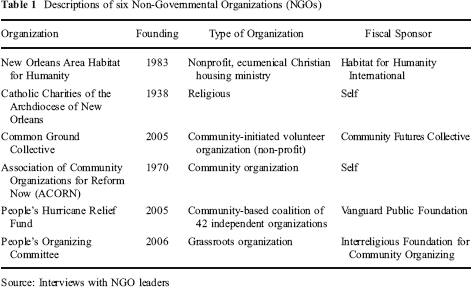
The six organizations examined include: the New Orleans Habitat for Humanity, the Catholic Charities of the Archdiocese of New Orleans, the Common Ground Collective, the Association of Community Organizations for Reform Now, the Peoples Hurricane Relief Fund and Oversight Coalition, and the People's Organizing Committee. Institutional information reported by each of the organizations is presented in Table 1.
Descriptions of six Non-Governmental Organizations (NGOs)
Source: Interviews with NGO leaders
The six groups had differing approaches for addressing the Katrina challenge, generally falling into the categories of service and advocacy. A service approach involved providing direct help to individuals in the devastated city through such activities as gutting housing, providing temporary shelter, and providing medical assistance. Advocacy approaches included traditional advocacy, such as pressuring governments to make and meet significant commitments to the population, and transformative advocacy, such as attempting to revolutionize society by empowering the most oppressed through survivors’ councils or other resident-based groupings. The advocacy organizations delivered some direct service to residents as well in the form of gutting houses and providing stopgap medical and social support, but did so within a much broader agenda than did the service NGOs.
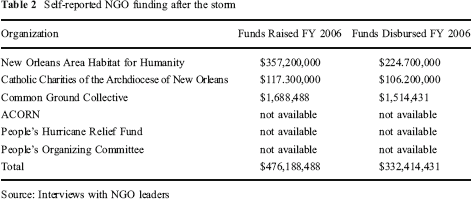
The six organizations tried to meet community needs but their capacities could not match the potential of government resources in conducting such activity. Mobilizing hundreds of local activists and thousands of volunteers from all over the country, the grassroots NGO sector (including faith- and community-based organizations in general, but excluding the major quasi-governmental groups like the Red Cross) provided housing support to thousands while the need was more than two orders of magnitude larger. The service contributions by the six organizations are summarized in Tables 2 and 3. The numbers include the NGOs’ activities that extended beyond Orleans Parish. These six organizations reported that they had gutted 7,675 homes and built a total of 260 homes overall two years after Katrina. Gutting was often the main task facing homeowners because the city threatened to bulldoze homes that had not been gutted by particular deadlines. Gutting could also be easily taught to volunteers, unlike the more skilled labor of reconstruction and environmental remediation. However, the 30:1 ratio of gutting to building suggests the limit of the grassroots NGO sector in substantially rebuilding the city. Assisting hundreds of thousands of people (often in minor ways) demonstrates remarkable dedication and effort, but such assistance could never match the potential capacity of government bodies that could legally call on the resources of the entire nation to offset the damage of Katrina.
Self-reported NGO funding after the storm
Source: Interviews with NGO leaders
Self-reported Katrina-related NGO activities, by 2007
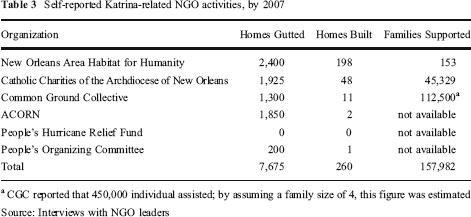
CGC reported that 450,000 individual assisted; by assuming a family size of 4, this figure was estimated
Source: Interviews with NGO leaders
Strategy and performance of two service NGOs
New Orleans Area Habitat for Humanity (NOAHH)
NOAHH was extremely active in the gutting and building of homes in the New Orleans region. It was incorporated in 1983 and annually built an average of 12–14 homes in the years before Katrina. It significantly increased production of homes and support to the affected areas after the storm. By July 2007, New Orleans Area Habitat for Humanity had built 59 homes with an additional 139 under construction in Orleans, Jefferson, Plaquemines, and St. Bernard parishes (Tusa, 2007; New Orleans Area Habitat for Humanity, 2009). They gutted over 2,400 homes, received the assistance of over 49,000 volunteers, began construction on 198 homes in four parishes, and distributed over 5,000 partner family applications. By January 2011, NOAHH had built 328 new homes post-Katrina with the assistance of 110,000 volunteers; 18 additional homes were under construction at that time (Tusa, 2011).
Applicants for Habitat homes, including the post-Katrina applications, are evaluated on three criteria: ability to pay, need for shelter, and willingness to partner. Habitat sells the houses for $75,000 paid over 30 years through a zero-interest loan. Instead of a down payment, families contribute 350 hours of “sweat equity” to the construction of their future homes and to those of other Habitat partner families. NOAHH believes that this activity prepares families for successful homeownership by providing them construction and repair skills necessary to maintain their homes. Children also are able to contribute to the family's equity, earning “Habitat hours” through good grades at school (Tusa, 2007).
Catholic Charities Archdiocese of New Orleans (CCANO)
CCANO has had the mission of serving the local population since its founding in 1938 by addressing such issues as hunger, poverty, unemployment, and education. After Hurricane Katrina, CCANO expanded their services by operating more than 40 programs, many of which were directed toward hurricane recovery (Knight, 2007a). One such program was Operation Helping Hands, which used local and national volunteers to rebuild homes for elderly and disabled hurricane victims. By two years after Katrina, Operation Helping Hands had gutted 1,900 homes with the assistance of 13,128 volunteers who contributed 358,197 hours of labor (Knight, 2007b). As of January 28, 2011, these numbers had risen to 26,466 volunteers (745,542 hours of volunteer labor), 1,983 homes gutted, 188 homes rebuilt since the hurricane, and 367 homes painted since the hurricane (Catholic Charities Archdiocese, 2011). Catholic Charities Archdiocese (2010) stated that, five years after the hurricane, it had in aggregate provided $55 million in direct assistance to Katrina survivors, distributed 250 million pounds of food through its affiliated ministry Second Harvest Food Bank, provided 335,000 nights of shelter through their homeless programs, provided counseling to 900,000 people, and gutted or rebuilt 3,200 homes (including both those from Operation Helping Hands and from Providence Community Housing). Catholic Charities reported an income of over $80 million from all sources (including $32 million from public sources) and estimated that it spent 94% of this income on program and goods (Catholic Charities Archdiocese 2009, 2010).
CCANO also supported displaced individuals and families for two years after Katrina through their targeted Katrina Aid Today/Louisiana Family Recovery Corps. By the time it ended in August 2007, the program served nearly 12,000 people. Families were provided case management and assistance for an average of four months. Qualified families were assigned a family liaison who helped them develop their own personal recovery plan that included emergency assistance, living accommodations, transportation, childcare, job skills training and development, outpatient substance abuse treatment, and mental health services (Dubuisson, 2007).
Strategy and performance of four advocacy NGOs
Common Ground Collective (CGC)
Immediately following Hurricane Katrina, CGC was formed with $50 and three volunteers (Drummer, 2007a). It grew to over 40 full-time staff members and hundreds of volunteers, raising over $2 million during its first 15 months in unsolicited donations that were divided fairly evenly among individual small donors, large donors, and foundations. CGC took no federal, state or local government funds as a matter of principle. Its fiscal sponsor, Community Futures Collective, noted that raising so much money so quickly was problematic in the absence of established organizational infrastructure, creating some inefficiencies (Drummer, 2007a). By its one-year anniversary, CGC had organized 10,000 volunteers to provide relief and assistance to hurricane survivors and had supported well over 100,000 people in seven parishes–Orleans, St. Bernard, Plaquemines, Terrebonne, St. Tammany, St. Charles and St. Mary's. It also had distributed food, water, cleaning supplies, protective gear, tools, building materials, and volunteer labor valued at several million dollars. CGC established the Common Ground Health Clinic, the first civilian run medical clinic, nine days after the hurricane. They cleaned and gutted over 1,000 homes, 12 churches, 4 daycare centers, and 12 schools. Common Ground also supported the residents of public housing projects in their fight to open up public housing, including the establishment of the Survivors’ Village at St. Bernard Housing Project (Drummer 2007b). They boldly carried out the gutting of the King School in the Lower Ninth Ward, risking arrest because of a government ban on such projects (Kone 2007).
The organization's second year of operation provided housing and meals to over 12,000 volunteers; 450,000 individuals through 9 distribution centers were supplied with food, water, clothing, hygiene and medical supplies, legal advocacy and numerous other benefits. Three free health clinics were established serving over 15,000 residents, workers, and volunteers. CGC cleaned and gutted over 750 homes and 128 daycare centers, schools, offices, business, non-profits, parks and streets. It set up free media centers for phone, fax, and internet access. It also established a “Kids & Community” project, providing after school programs, teen activities, childcare, summer camp and a free breakfast program. CGC also established green environmental programs including microorganism-based mold removal, wetlands restoration, soil bioremediation, and community garden restoration (Drummer 2007b).
By 2011, CGC had narrowed its focus to service to survivors through its Anita Roddick Advocacy Center. The Center provided meeting space for the Lower Nine School Development Ground and the Lower Ninth Stakeholders Coalition while also providing computer access for students, a legal clinic focused on issues related to Katrina (serving 300 clients annually), and a job training program in environmentally safe construction techniques. It coordinated 3,400 short and long-term volunteers in 2010 to advance this work (Common Ground Relief, 2010).
The Association for Community Organizations for Reform Now (ACORN)
Having served the New Orleans community for over 30 years, ACORN was one of the first organizations committed to rebuild (Butler, 2007). It counted more than 9,000 families as members, making it the largest grassroots membership organization in the city. ACORN immediately provided emergency assistance following the storm, housing evacuees in other cities and providing food and clothing. As they witnessed what the organization termed “the deadly results of government inaction” in the week following Katrina, events were organized around the country to demand rescue and relief for victims. ACORN members created the ACORN Katrina Survivors’ Association, which included more than 5,500 member families in over 10 cities, and was the first nationwide organization of displaced residents and survivors (Butler, 2007). Its five-point program included: “right of return; the means to take care of ourselves and our families; rebuilding the right way; accountability and honesty; and protection for the future.” It used direct action, public pressure, and regular negotiations with FEMA to maintain political pressure for housing assistance to displaced residents. Members rallied in Washington, D.C. and testified before the U.S. House of Representatives on rebuilding needs in New Orleans.
In December 2005, ACORN launched its Home Clean-Out Demonstration Program. Its crews “work[ed] to prevent the further deterioration of homes in neighborhoods that government agencies and other groups have made little effort to restore” (Butler, 2007). Crews cleaned out debris, gutted the interior of the homes, eradicated mold and provided roof repair. At the one-year mark, the program had cleaned and gutted over 1,450 homes with another 1,000 on the waiting list.
After playing an important role in mobilizing opposition to the initial Bring New Orleans Back (BNOB) plan that had threatened black neighborhoods with a “shrinking footprint” (BNOB, 2006) ACORN decided to play a bold interventionist role in the Unified New Orleans Plan process that replaced BNOB. Most of the planning processes relied on traditional professional planning and architecture firms to develop planning district plans for review by the city council. ACORN, instead, enlisted the aid of several universities including Cornell, Columbia, and the University of Illinois-Urbana to work under an ACORN planning strategy of community empowerment. They formed the ACORN and University Planning Partnership and competed for designation as the official District Consultants for Planning Districts 7 and 8, which encompassed the Lower 9th Ward and several other neighborhoods (see map). They were named to the role, in part because of substantial support from residents (ACORN, 2007).
Their planning methodology included numerous large and small hearings and interviews with residents as well as armies of students and faculty members preparing detailed analyses of the existing architecture and planning needs of the community. After their first deliverable on September 15, 2006, the Concordia Group (the primary contractor responsible for managing and coordinating the city-wide planning process) fired the team, alleging that there was a previously unrevealed conflict of interest because ACORN was bidding to redevelop 129 parcels in the Lower 9th Ward. Concordia asserted that an agency could not serve as both developer and planner. The Acorn-University partnership argued instead that Concordia's ruling was driven by the politics of “small white civic associations” that objected to the ACORN-University partnership's focus on the poor, black, traditionally under-served populations who were in danger of being denied the right to return (ACORN, 2007).
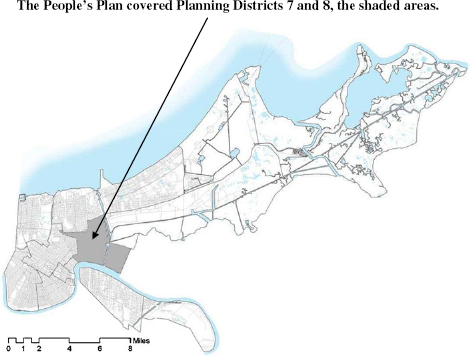
The ACORN-University partnership nevertheless completed their plan for the planning districts and published and disseminated them. ACORN ultimately prevailed upon the city council to adopt these plans in addition to the “official” plans. This accomplishment was a significant victory that went somewhat beyond traditional advocacy, although it still relied on the willingness of the city, state, and federal government to actually implement the plan (ACORN, 2007). The “People's Plan” kept the “right of return” in focus and presented arguments for transforming the community, not merely restoring the community, since the original community was mired in poverty, unemployment, crime, and other forms of dysfunction (ACORN, 2007).
One ACORN representative stated his belief that these efforts have “saved the 9th Ward” (Bradbury, 2007). Perhaps this claim is too broad. But considering that the BNOB plan originally foresaw the 9th Ward being returned to wetlands, ACORN's initiative was surely helpful.
ACORN continued its advocacy role in New Orleans until it lost its federal and foundation funding streams in the aftermath of a national scandal in which the Baltimore ACORN office allegedly advised conservative activists pretending to be a prostitution ring about how to obtain affordable housing for their supposed brothel (Fears, 2009; Trot, 2010). ACORN disbanded in 2010 (Stern, 2010).
People's Hurricane Relief Fund (PHRF)
The mission of the PHRF was to win the “right of return with equity and justice” for all those displaced as a result of Hurricanes Katrina and Rita by building a multinational mass movement (Akuno, 2007). It also sought to ensure that the civil and human rights of all New Orleans and Gulf Coast residents were respected and implemented throughout the United States. While they did not organizationally provide direct services to residents and evacuees, PHRF members participated in coalitions through which they helped meet some of the immediate needs of survivors. Executive Director Kali Akuno stated two years after the flood that “we [PHRF] stand for a reconstruction that values and preserves services and infrastructure for poor people who have always lived, worked, and struggled to survive in New Orleans, and who possess the right to return to the homes from which they fled or were forcibly removed more than two years ago” (Akuno, 2007).
PHRF campaigned to stop the demolition of public housing sites in New Orleans through the Coalition to Stop Demolition, arguing that the US government through the Department of Housing and Urban Development (HUD) was denying the vast majority of the residents of public housing the right to return to their homes. The organization claimed that “[u]nlike the vast majority of the housing stock in New Orleans, the majority of the public housing units received little to no flood or wind damage from the hurricane. Yet, as of October 2007 only one-fourth of the public housing units have been reopened and reoccupied” (Akuno, 2007).
The Tenant's Rights Working Group (TRW) was also a project of PHRF. The group was composed of public housing tenants, renters, and community organizers committed to winning housing rights for black and working class people in New Orleans and the Gulf Coast. The TRW was “organizing to build the grassroots organizational strength and political power needed to force the US government on all levels (federal, state, county/parish, and city) to provide housing and other fundamental human rights being denied Black and working class people in New Orleans and the Gulf Coast” (Akuno, 2007).
PHRF was the main organizer of what it termed an “International Tribunal on Hurricanes Katrina and Rita” during the second anniversary of the storm. Their goal, according to Malcolm Suber, national organizing coordinator for PHRF in 2007, was to expose “torture and abuse” by police and prison officials, “summary killings and executions” by Blackwater and other security companies during Katrina, the abandonment of black women by the city that had no evacuation plan, and to highlight the “right of return” as a fundamental human right (Democracy Now 2007a, 2007b). Since the tribunal, PHRF has not been organizationally evident in ongoing activity and engagement in New Orleans, although its members continue to participate in new organizational ventures. Malcolm Suber has campaigned for a seat on the New Orleans city council on an oppositional platform and Kali Akuno facilitated the launch of a national “Take Back the Land” movement with continuing local activity in New Orleans. In August 2010, Akuno's blog reported that
Take Back the Land Local Action Group Survivors Village held a community rally in the St. Bernard Community to “educate” President Obama about how new developments like Columbia Parc have worked to purge impoverished Black people from public housing projects on the 5th commemorative anniversary of Hurricane Katrina and Survivors Village was also successful in getting charges dropped against Sharon Jasper, member of Survivors Village and former resident of the St. Bernard Community. They were also successful in winning Ms. Jasper a Section 8 voucher that was revoked due to her being a presence at protest. (Land and Housing Action Group, 2011)
While PHRF seems to have faded organizationally, continuing activism in New Orleans appears to have grown out of its post-Katrina PHRF activity.
People's Organizing Committee (POC)
Curtis Muhammad and several others of the original organizers of the PHRF formed the People's Organizing Committee in April 2006, splitting from PHRF. The split involved advocacy strategy as well as allegations of financial impropriety. The POC disagreed with the PHRF decision to focus its energy on engaging in the parish planning activities and other more traditional venues for political activism. POC favored emphasizing the “beloved community” bottom-up organizing strategy of the original founders. POC remained apart from traditional politics, arguing that such activity tended to disempower Katrina survivors because it involved elite strategizing. It insisted on continuing its focus on survivors’ councils and “bottom-up” organizing to achieve the “beloved community” (Mosby, 2007).
POC advocated a strategy of direct action, including supporting public housing residents re-occupying their homes and former renters seizing blighted houses, repairing them and moving their families into the units. POC also planned to teach building trades to survivors so they could rebuild their homes and be qualified for skilled employment. POC organized low-income homeowners to rebuild their homes and, with the help of hundreds of volunteers, attempted to rebuild schools, churches, clinics, day care centers, and the levee surrounding the Lower 9th Ward. They also sought to organize an “anti-slavery” movement that challenged unscrupulous contractors seeking to take advantage of Katrina survivors. POC sought to build unity between blacks and Latino immigrants who, they argued, had been brought to New Orleans as cheap labor to handle clean up and construction. POC extended its work internationally; members visited Venezuela and received a visit from Venezuelan officials. Yet another of their many aims was to begin a leadership training institute to train poor blacks in the skills needed to run and manage their own organizations and to implement large development projects (Mosby, 2007).
POC argued, like PHRF and ACORN, that Katrina left 25,000 public housing residents without a home even though they estimated that over 80% of public housing was structurally undamaged. They contended that the Housing Authority of New Orleans and the Department of Housing and Urban Development locked public housing residents out of their homes to pursue a plan of demolition and redevelopment “aimed to create better communities by removing over two-thirds of the public housing population from their homes and replacing them with richer people.” (Jondrea, 2007; Mosby, 2007; People's Organizing Committee, 2006).
In February 2007, with the assistance of POC, residents of the C.J. Peete public housing development reoccupied their homes which the government had slated for demolition. Four days later, residents were told to vacate the site or lose their Section 8 vouchers. This work led to the formation of another organization: Residents of Public Housing (RPH), an organization of public housing residents from the various public housing developments throughout New Orleans. Their mission was to assist family, friends and neighbors with returning home, rebuilding and repairing their community and lives, and taking charge of their neighborhoods. RPH declared, “Our mission is to do for ourselves what the government won't” (Mosby, 2007).
In the fall of 2007, the group's founding member and key organizer Curtis Muhammad left POC to work among the poor in South America. In his farewell letter (Muhammad 2007), he wrote that though the past year had revealed further weakness and lack of vision in its movement, the New Orleans Survivors Council and Residents of Public Housing continued to work to put bottom-up leadership on the map and fight for the right of their community to return and control their own destiny. POC's goal was to “empower the entire community, and not just survivors to do for themselves” (Mosby, 2007). In 2011, there is no evidence of their continued work in New Orleans, although some individuals from this movement participate in the International School for Bottom-Up Organizing centered in Jamaica.
Strategic limitations of NGOs
Despite their admiral service and advocacy, NGOs suffer from a structural limitation. As a general rule, they serve as alternatives to mass struggle rather than as vehicles for confronting the capitalist state. Each NGO has its own narrow outlook and constituency and often is beholden to funders whose goals are anything but revolutionary. Catholic Charities and Habitat for Humanity each carried out a remarkable range of relief and rebuilding activities, although neither organization came within two orders of magnitude of what was needed to restore New Orleans. Both organizations refrained from direct confrontation or strong advocacy, operating strictly within their charitable missions.
Among the advocacy organizations, a considerable amount of relief and rehabilitation also occurred, but much less than was done by Catholic Charities and Habitat for Humanity. These organizations generally sought political change along with relief activities, but ran into challenges because of their reliance on their funders and the limits of their political perspectives. ACORN, for example, which was quite active in both relief and advocacy for political reform, relied on federal funds and foundation largesse. When it lost credibility in the eyes of its funders, ACORN collapsed. But even while it was engaged in advocacy efforts, its political perspective of working within the capitalist system limited its goals to those compatible in general terms with the system of capitalism by pressing for government recognition of its alternative plan for Planning Districts 7 and 8, including the Lower 9th Ward. Such a project, the success of which depended on appealing (albeit with an energized constituency) to the existing leadership of New Orleans, was not likely to be successful when the developers and political leaders were focused on remaking New Orleans as a profitable center for private investment. Common Ground, PHRF, and POC were less dependent on traditional funding streams and all carried out a reasonable amount of relief and recovery activity while pursuing political reform. These groups, in various ways, promoted direct action, but none had the perspective of attacking capitalism as the source of the challenges of racism, relief, and recovery. ACORN and PHRF both sought reform within the existing capitalist order, as reflected in their engagement in the planning process and in electoral activity. POC and Common Ground sought to create counter-institutions reminiscent of the utopian societies of the 19th century that sought to be exemplary rather than confrontational. Rather than confronting the capitalist system directly, they sought to model the superiority of new social arrangements they attempted to establish among survivors.
The needs of capital and the needs of the working class increasingly clash as the events around the hurricane gave way to the Great Recession which in turn has given way to the Great Stagnation. The continuing lack of recovery for the working class of New Orleans demonstrates the priorities of the capitalist state in bold relief. There was and is no EZLN-type political organization to attract a “swarm” of NGOs to join in a revolutionary challenge to the capitalist state, and NGO strategies in themselves do not challenge the dominance of capital in a revolutionary manner. They therefore divert the energy of many who seek social change from developing an independent revolutionary political movement that could galvanize the many oppressed elements of the working class into a cohesive and bold challenge to capitalism. Without such a political movement, the inertia of the status quo inevitably reasserts itself. This outcome has tended to demoralize activists who had hoped for a more vibrant long-term movement born of the energetic response of tens of thousands of people to the destruction of Katrina and the inadequate governmental response. Three of the advocacy NGOs have vanished, while Common Ground has remade itself as an exclusively service organization.
Whither the struggle in New Orleans and the nation?
There were two competing approaches in New Orleans for recovery: that of corporate capitalism led by developers and their partners in the federal and state governments and that of the non-profit NGO sector engaged in grassroots activism and direct people-to-people service. Neither strategy has met the needs of working class New Orleans. The corporate approach reflects the needs of capital, which rarely intersect with the needs of the working class. The NGO approach is narrow in character despite its good intentions; NGOs are always under-resourced compared to the state. Much of the NGO approach relies on the same structures of government that have emerged over decades in response to the needs of corporate capitalism rather than on an independent revolutionary alternative. Lacking such a revolutionary political anchor, it is not surprising that advocacy NGOs have vanished or retreated from the arena of struggle even though the needs of the New Orleans working class remain largely unmet more than five years after the storm.
Many of the students and other volunteers who engaged in the relief efforts through churches, universities, and local New Orleans organizations now are seeking a deeper approach to social change. Activists who traveled several times to New Orleans to assist with projects of the Peoples Organizing Committee, the Habitat for Humanity, ACORN, and Catholic Charities in gutting houses have been disillusioned when they find that certain houses that they gutted immediately after the hurricane remained as they left them two years later. Five years later, many homes are still unrepaired and unoccupied. A new consciousness seems to be dawning among some of these young activists who, having experienced one disappointing effort, are learning the longer history of the difficult struggle against racism and capitalism. They are beginning to think through approaches to more fundamental political transformation than can be achieved by the strategies and missions of NGOs.
Conclusion
Katrina revealed in bold relief the racial and economic inequalities of New Orleans and, by implication, much of urban America. It has become commonplace to refer to Detroit, devastated by the Great Recession, as having experienced “Katrina without the water.” Non-governmental organizations provided substantial direct service to the most distressed residents of the city and, in some cases, provided important advocacy roles in addressing the inequities caused by government action or inaction. The NGO strategy, however, was not structurally capable of generating a broad militant anti-racist mass movement of New Orleans’ working class for social change. The dominant capitalist structures were able to assert themselves in the reconstruction effort. Five years after the storm the working class of New Orleans faces deepened racial and economic distress. A return to the strategy of bold, revolutionary, anti-racist mass movements confronting capital and the state would seem to be in order for the coming period of time.