







Abstract
This paper reviews the presentations and discussions had at the conference on “Jobs And The Future of the US Economy: Possibilities and Limits” held at Howard University shortly after the late 2000's financial crisis. The paper begins with the historical context in which the conference was placed and reviews the various points made by topic. The paper concludes with an outline of potential alternative eventualities facing the economy were the US not to adopt the policies presented.
Keywords
Introduction
On October 1, 2010, the Economics Department of Howard University hosted a conference entitled “Jobs and the Future of the US Economy: Possibilities and Limits.” At the time of the conference, the 9% unemployment rate was in decline, but still significantly above pre-recession levels. Furthermore, when analyzed in more detail, the unemployment figures told a bleaker picture of labor markets. A racial decomposition of unemployment showed the unemployment rate among Whites was 8.1%, but among Blacks it was nearly twice as high at 15.2% (Bureau of Labor Statistics 2011a, b). And although the idea of a double-dip recession had lost appeal with the media, for the economists attending the conference, the threat of this scenario remained as real as ever. In the months following the conference, these fears seemed to be materializing, as the unemployment numbers began a slow rise once again.
On the political front, the conference was called at a time when the reactionary rhetoric of the Tea Party movement, budget deficit fear mongering, and veiled racist nationalism swept the airwaves. In other words, it was election season. The message of “tightening our belts” struck a chord with those disenchanted with the government response to the biggest economic crisis since the Great Depression, the so-called “Great Recession.” Conservative libertarianism dominated the politics of the Republican Party whose takeover of Congress in the upcoming elections was becoming increasingly certain.
While the GOP was able to harness this right-wing populism to great success, the Democratic party and other progressive voices were either unable or unwilling to effectively counter-message the government reduction slogans of the Tea Party. The landmark Supreme Court decision in Citizens United v. Federal Election Commission, allowing corporations to make undisclosed donations to 501(c)(4) organizations (non-profit lobbying groups), opened the floodgates for corporately-financed campaign ads through non-profits like Citizens United, Americans for Prosperity, and the U.S. Chamber of Commerce (US Supreme Court 2010). This, in addition to the national Tea Party organizations (funded by the likes of conservartives Dick Armey, Sal Russo, and Howard Kaloogian), provided a manufactured grassroots movement around fiscal conservatism. These ideas were often presented against a backdrop of hatred of immigrants and Muslims (Polman 2010).
These movements also managed to distort history to their advantage. In addition to lending Ronald Reagan a legacy of slashing deficits 30 years prior, they also managed to shift blame for the 2008 bailout of the financial system from George W Bush to Barack Obama (Cooper 2010). The war in Afghanistan was called Obama's war by Republican National Committee Chairman Michael Steele, despite the fact that it had started 7 years prior to Obama's term as president (Seifert 2010). America, it appeared, had become swept up in a collective amnesia, frenetically looking at the same unsuccessful tax plans instituted only 5 years prior with a significant degree of favor. The question of the budget was not one of whether to cut, but rather what to cut.
In response, the Chicago Political Economy Group in conjunction with the Howard University organized this conference to give a venue to the progressive voices in economics and political science. The purpose of the conference was not only to consider short-term policy prescriptions to alleviate the burden of mass unemployment, but also long-term structural changes to mitigate future economic crises.
The conference sought a fiscal policy expansion of Keynesian and Marxist principles, particularly in terms of employment. At the heart of these policies was the radical restructuring of labor markets to accommodate changes in the manufacturing and energy sectors, sharply opposing many of the fiscal and monetary policy approaches to the Great Recession such as the recent bailouts in the financial sector.
While the conference was aimed primarily at policy prescriptions for the present institutional system, it also was aimed at the mass overhaul of the capitalist system. For instance, members of the Progressive Labor Party and other attendees gave reference to growing wealth gap across race, gender and other social divisions. Specifically, there was a call for a massive restructuring of the United States’ economic system, stating that capitalism serves to continue a system of booms and busts that most negatively impacts working class Americans.
This paper summarizes the ideas presented at the conference, including a bill presented by Representative John Conyers (D-MI). In addition to a brief literature review of the papers and presentations discussed and introduced by the speakers, a summary matrix was developed to better present both the common elements and points of departure of the various policy prescriptions offered. The challenges to these policy options, both on the legislative floor and in the court of public opinion are considered and summarized
Literature Review
While most, if not all, presenters at the jobs conference represented ideals from the American political left, few were able to agree on every issue. They demonstrated a leaning to the Keynesian roots of macroeconomic analysis, but few could agree where the funds from a Keynesian-style stimulus package should go or how and when to pay for it.
Notwithstanding these disagreements, there was consensus that the main focal points of the recovery should be to create jobs. Furthermore, taking a cue from US history – particularly the history of the Great Depression – most agreed the quickest way to get back to full employment is to boost spending on infrastructure. And while some disagreed on the specifics of job creation plans, ultimately the aim was the same.
Helen Ginsburg of the National Jobs for All Coalition provides a historical perspective on fiscal policy with respect to job creation. Beginning with the Great Depression, Ginsburg discusses legislative policies that have been enacted over the last century in an effort to shed light on the types of policy needed today in the current U.S. crisis. She argues that the New Deal, set in place as a response to the economic hardships of the Great Depression, went against the doctrine of that time. The typical policy at that time was liberal in nature. Ginsburg argues that the New Deal broke away from the ideals of laissez faire and dove into a more Keynesian approach. However, lacking the support of conservatives and large businesses, the New Deal expenditures were not large enough to sustain the economy during such economically devastating times.
Ginsburg notes that, “Unemployment was still 10% in 1941, when the US entered World War II, but it fell rapidly to 2%, hitting an all-time low of 1.2% in 1944.” Also in 1944, Roosevelt proposed a second Bill of Rights. Roosevelt's Bill of Rights proposed the idea of a job as a right for all in search of employment. Ginsburg contrasts this idea with the concept of full employment presently supported by many economists (Ginsburg 2010). This idea of a “right to a job” is also expressed in the United Nations Charter and Article 23 of the Universal Declaration of Human Rights, and was a much-debated issue at the Jobs Conference.
Ginsburg recounts that just a year later the Full Employment Bill of 1945 was proposed. This bill supported Roosevelt's idea that all Americans seeking employment have a right to a job, rather than just the ability to seek one out. It stated “it is the policy of the United States to assure the existence at all times of sufficient employment opportunities to enable all Americans.” According to Ginsburg, the bill had the support of the American Federation of Labor, the Congress of Industrial Organizations, the National Association for the Advancement of Color People, and other social groups. Unfortunately, the bill, passed by the Senate, was defeated by the House at the end of 1945 (Ginsburg 2010).
Later, the Whittington-Taft Employment Act of 1946 was proposed. The goal of this bill sharply differed with that of the Full Employment Bill proposed just a year earlier. This bill traded the term “full employment” for “maximum employment” which yielded itself to the flexible phrase “the means consistent with the needs and obligation of national policy.” Ginsburg asserts that the changing of terminology from “full” to “maximum” shifted the existing paradigm of that time with regard to job creation and employment, as it was declared that “the function of the Government is to promote and not to assure or guarantee employment” (Ginsburg 2010).
Post World War II, job creation was still not at the forefront of legislative policy. It was not until 1973 that a jobs program was promoted to bring together a diverse group of constituents. This was the Comprehensive Employment and Training Act (CETA) of 1973. CETA, originally a program initiated for the poor, eventually became a program for other constituents as the recession of the 1970s increased unemployment (Ginsburg 2010).
Moving forward to the current economic crisis, Ginsburg notes there are still issues plaguing policy initiatives. She cites the words of economist William A. Darity, Jr. when he gives reference to the failure on the part of legislators to “undertake or even to consider more daring and imaginative policies to produce a healthy and equitable economy” (Darity 2010). According to Ginsburg this failure has deep roots in the 20th century U.S. history (Ginsburg 2010).
With this historical perspective in hand, we now move to the proposals addressing the current economics troubles. Most proposals can be classified into three categories: direct and indirect job creation, funding investment projects, and socioeconomic and political change. However, some proposals include elements of more than one category, so these categories are neither all inclusive nor mutually exclusive.
Direct job creation
The Chicago Political Economy Group (CPEG) asserts that the current situation is a direct result of the “collapse of neoliberal economic thinking and public policy that has shaped the contours of our society for the past three decades.” To ensure that the crisis never happens again, they advocate a permanent government jobs program that would receive a steady stream of funding for the 5 years that they predict it will be desperately needed. In particular, they recommend a focus on “industries of the future” in the areas of energy and agriculture. They suggest that the federal and state governments should create an explicit technology-intensive industrial policy. Bringing examples of Scandinavia and China, the study emphasizes the positive and forward-looking goal of these industrial policies. The energy sector should be prioritized as the core of the new policy (Baiman et al. 2010).
The Economic Policy Institute (EPI) takes a less intensive approach, asserting that the jobs program they recommend is temporary. Over the course of 3 years, they expect that the $40 billion they intend to spend on direct employment would solve our current jobs situation (Mishel et al. 2010).
Phillip Harvey of Rutgers-Camden and a member of the National Jobs For All Coalition (NJFAC) recommends a similar proposal to EPI's, but his paper primarily argues the that size of the government expenditure is not nearly as important as how and on what the stimulus should be spent. For instance, Harvey indicates that a direct jobs creation would have had a stronger multiplier effect for the private sector than the American Reinvestment and Recovery Act (Harvey 2010).
Explaining that public works programs would require materials and services from the private sector, Harvey estimates that for every 1 million directly created jobs, there would be an additional 500,000 private sector jobs supporting them. He also estimates that every 1 million directly created jobs would cost $32.9 million net of additional tax revenues and savings. Harvey's proposal is based on lessons from Roosevelt's New Deal, which he argues was based on social welfare considerations not macroeconomic ones (Harvey 2010).
Another member of the National Jobs for All Coalition, Gertrude S. Goldberg from Adelphi University, proposes that the government directly hire the unemployed for infrastructure projects or public works. For instance, employ people for repairing roads, bridges, providing elderly care and “whatever other work on behalf of the public is needed, including what would make the economy more sustainable” (Ginsburg 2010). The arguments brought to support this active job creation policy include aspects of being more consistent with strong work ethics and core American values.
According to Goldberg, under this active labor policy, creation of a new job will cost approximately $50,000. This amount is four times less than current estimates proposed by the government. The implementation of the active job creation policy involves redistribution of the government bailout funds (used as an economic stimulus package) toward the direct hiring of the unemployed. The author criticizes using almost $800 billion of federal funds for targeting the employment of only four million people. Goldberg, like several other presenters, proposes the use of a financial transaction tax for funding the active job creation policy. Another source of funding for the initiative is to redistribute money from the military budget and eliminate the “Bush tax cuts” (Goldberg 2010).
While Goldberg's proposal is yet another policy formulation grown upon the New Deal program philosophy, the author underlines several shortcomings of the New Deal. In particular, she accuses Great Depression programs of having sexist and racists attitudes, and of not being effective enough to “meet Roosevelt's goal of giving jobs to all who could work” (Goldberg 2010).
The Political Economic Research Institute (PERI) also recommends a direct jobs creation plan, but does not specify whether this plan should be permanent or temporary. They assert that direct jobs creation is a far better alternative to tax incentives, as tax incentives capture the effect on jobs and investments that would have otherwise occurred in neighboring regions. Therefore, the paper argues, if one region creates jobs through tax cuts at a neighbor's expenses, there is no net benefit for the entire country. Although they are concerned with the overall national employment problem, their plan focuses on New England. According to their metrics, for every $1 million spent in government job creation, they can create between 14.5 and 23.7 jobs (Thompson 2010).
In addition to calls for government to directly create infrastructure jobs, some proposals focused on what is termed “social employment.” Social employment, which focuses on health care and education, was one of the core priorities of CPEG and PERI papers. In particular, CPEG argues the publically funded jobs should include health care, elderly care and education. According to their paper there exists a drastic shortage of qualified health and education provides, nurses, home care aids, etc., and the only way to overcome the problem is to create many new jobs for highly qualified workers in these areas (Baiman et al. 2010).
As the part of CPEG's National Job Program, all jobs established under the initiative should provide training for new positions created. The group believes that to ensure high efficiency and productivity, training and upgrading of the workforce needs to be an integral part of the job program (Baiman et al. 2010).
Funding Investment Projects
Some proposals acknowledged the role of government in job creation, but also pointed out the need for government to invest in human and physical capital and to provide direct assistance to state and local governments and specific groups of individuals. It is in this area where proposals differ most, from funding mechanisms to incentive schemes.
According to PERI, one of the major tools of fighting growing unemployment is government investment in developing the skills of the current and future labor force. Citing different papers, they conclude that increased spending on education raises employment, boosts household income, and increases the gross state product.
They divide education spending into two main categories. The first category is K-12 and higher education, where $1 million invested can create 28 direct jobs. The second category is early childhood education, including preschool, Head Start and day care centers where the public spending creates even more jobs: 35 new positions for each $1 million invested. In addition, training of the workforce has a significantly positive effect on wages: A four-year training program in a community college increases the earnings of a worker by $400 per quarter on average (Thompson 2010).
EPI highlighted the burgeoning need for federal support of local and state governments. As a part of their “Five Point Plan,” EPI recommended a focus on aiding state and local governments (Mishel et al. 2010). The basic reasoning behind this proposal is that, unlike the federal government, state and local governments must maintain a balanced budget. In the midst of a recession, they often have to cut back on programs - destroying state and local jobs in the process and worsening the situation. Since their only means of revenue - taxes and bonds -become difficult to conjure when people are penny pinching, a sort of reverse tragedy of the commons takes root that can only be halted through external aid (Mishel et al. 2010). EPI estimates a $150 billion extension of the Recovery Act is needed in state and local relief. They estimate that this extension would create 1.04 million jobs (Mishel et al. 2010).
Asserting urgency for the private sector to increase payrolls, EPI recommends extending a one-year 15% tax cut for small businesses to expand their payrolls. After this one-year window, the tax cut would reduce to 10%, giving small businesses the incentive to hire sooner rather than later. Although they claim that the plan would cost $71–80 billion in tax revenues, the plan would create 1.4–2.8 million jobs, depending on how many businesses took advantage of the tax break (Mishel et al. 2010).
PERI disagrees with this approach on the basis that the incentives from tax cuts only pull from areas where tax incentives are not as low, causing a beggar-thy-neighbor problem of competing tax cuts. Although this argument does not directly oppose the EPI proposal, it is worth noting as a potential consequence of a tax-cuts based approach (Thompson 2010).
Some of the papers defended an increase in federal deficit spending by comparing the costs of current fiscal stimulus programs, and showing how the cost of the new proposals would be less than or equal to those of the current programs. For instance, according to the NJFAC paper, the proposal “would be no more expensive than the $1.3 trillion handout initially given to the investment banking community.” In fact, NJFAC argues the proposed program could employ all 15 million currently unemployed at a salary and benefits wage of $50,000 per year, for a total cost of $750 billion (Ginsburg 2010).
Other participants, while providing potential funding sources for their proposed programs, also defended the idea of a deficit-spending-only approach, based on the cost of current fiscal stimulus programs. For instance, Harvey compares the $789 billion cost of the American Reinvestment and Recovery Act of 2009 (ARRA) with his proposed program's cost of $56.6 million per million job created, and notes at that rate ARRA “could have created almost 7 million full-time equivalent jobs lasting 2 years each without reducing the indirect job-creation effect of the stimulus package an iota” (Harvey 2010).
Other proposal, however, insisted that any government program to deal with the crisis today must be paid now. One common means of financing the proposed expenditures was to simply reorganize the current budget allocations. CPEG, for instance, recommends pulling some $100 billion from excess military expenditures to cover the cost of their program (Baiman et al. 2010). In a similar vein, PERI recommends pulling the lost revenues from regional tax incentives to finance their programs (Thompson 2010).
Although they don't go into much detail in their paper, CPEG emphasizes that their programs will be focused on bringing American energy and industry into the 21st century “green” movement. To that end, they recommend financing their programs in part through taxes on pollution as opposed to a cap and trade program (Baiman et al. 2010).
A few researchers suggested increasing the money supply to fund the employment program. For instance, Goldberg believes that increased employment and new financial taxation will significantly reduce the overall debt (Goldberg 2010). CPEG argues that instead of paying down the national debt, the Fed should concentrate on financing job creation initiatives. The group estimated that $42 billion could be created for this purpose, which will have a much larger multiplier effect than a tax-based approach (Baiman et al. 2010). The NJFAC also made this point by saying,
The analogy between a family budget and a government budget is a false one and should be debunked. Private borrowers can and do default. With government the risk of non-payment doesn't exist. The U.S. government can spend money and pay interest simply by typing numbers into a computer (Goldberg 2010).
This point was later addressed in a question from the Howard University Students to the presenters. The point was reinforced that “the only time when deficits are too large is when the economy is at full employment” (Forstater 2010). Thus, fears of inflation were dispelled as worrying over a benign future issue, while ignoring a pressing present one.
PERI suggests local and state debt financing can be an additional funding source of the employment programs. More specifically, they propose to issue state bonds for infrastructure projects. These bonds might be a quite convenient source of income as the rating agencies give relatively high ratings for the New England states, which ensures low interest rates (Thompson 2010).
Despite the assertion by some presenters of the negative effect from new taxes, several innovative tax proposals were raised, mostly aimed at increasing wealth equality and decreasing negative externalities. Some advocated a financial tax to balance spending. The Economic Policy Institute's plan would see a 0.5% tax on all stock market transactions. They estimate that this would generate the $400 billion that their plan costs over the course of 10 years (Mishel et al. 2010). CPEG also advocates a financial transaction tax. As it is argued in the study, a new tax on financial transactions, a so-called Tobin's tax, can generate a significant portion of the funds needed for the program implementation. Tobin's tax revenue is estimated at $600 billion. Another benefit of this tax might be a reduction in the volume of high risk financial speculation (Baiman et al. 2010).
Another type of tax in the financial sector is proposed by PERI. The author argues about limiting exclusions of the capital gains and income or imposing new tax brackets for high income households. The paper states that even if new taxes will decrease the consumption the overall benefit of maintaining public expenditure will outweigh the loss of the consumption. They state,
Because states have regressive tax systems - with higher effective tax rates on those with lower incomes - the same households who have benefited most from economic growth are also paying the lowest effective tax rates. In each of the New England states, as in the rest of the country, the lowest-income fifth of house-holds now pays a larger share of their income for state and local taxes than do the highest-income 1% of households. In New Hampshire the lowest-income quintile pays 8.3% of its income for state and local government, while the highest-income 1% pays just 2.0% (Thompson 2010).
Using a tax on wealth as a source of financing the employment programs was introduced in two papers during the conference. In particular the CPEG paper suggests introducing a new wealth tax on the top 1% of households. According the estimation done by the author the wealth tax can rise another 50 billion USD (Baiman et al. 2010).
Socioeconomic and political change
Not all proposals were positive economic policy prescriptions. Many proposals explored normative changes to the social and economic system. For example, adjusting pay to living wages and ensuring race and gender equality were explicitly mentioned in the speeches of several presenters.
The CPEG program proposed that new jobs should be paid at least at the level of current median wage of $18 per hour. In addition, all the employees should benefit from the opportunities under the Employee Free Choice Act (Baiman et al. 2010).
Rothenberg (2010) argues against the traditional Keynesian stimuli as a resolution to the jobs crisis now plaguing the U.S. He offers instead a more radical approach that infuses legislative lobbying and policy with social revolution. He contends that whatever the differences within the economic community, “progressive economists and policy analysts” must think collectively in order to from a strategy that is beneficial to all constituents. However, Rothenberg does not set out to offer a strategy, but engage the reader by discussing some questions that will lay the framework for such a strategy.
Rothenberg brings to the forefront the depth and breadth of the current jobs crisis. He argues that the present crisis arose from the 2008–2009 recessions. Nobel Lauret Paul Krugman in his 2010 New York Times column agrees with this identification of where the problem began by his acknowledgement of the 8 million jobs (much more since then) lost during this same time period. Another Nobel Lauret, Joseph Stiglitz goes one step further by discussing the ills of the U.S. economy which lead to “too much capital flowing to the financial sector, a grossly unfair and distorted pay and income structure leading to the vast accumulation of wealth at the top, and massive impoverishment at the bottom.” However, according to Rothenberg, Stiglitz falls short of providing a thorough discussion of the implication of the capitalist system on the jobs market. Stiglitz does, however, propose an injection of funds into the market in order to stimulate demand (Rothenberg 2010).
Rothenberg's view is that the current crisis experienced by the U.S. economy is a ramification of the “economic order” proposed under capitalism. This is a shared belief by many neo-Marxists. Rothenberg along with other economists in the Chicago Political Economy Group sharply contrasts the solution proposed by Stiglitz, arguing that this proposal is only temporary and does not address the issue of a living wage. Rothenberg argues in favor of a much larger stimulus package that would be injected, primarily into the public sector. This approach contrasts with the “bail-out” programs proposed by the Bush and Obama Administrations, which yield a substantial proportion of economic stimuli funds to the financial sector. Rothenberg further argues “tens of millions of jobs” would have to be created in order to sustain the U.S. economy. He contends his investigative work has led him to the conclusion that “the failure to create adequate numbers of living wage jobs has been growing over the past two decades.” This is far more than evident in the past and present jobless recoveries experienced by the U.S. in the last 10 years (Rothenberg 2010).
When confronting the jobs crisis from a political perspective, Rothenberg again differs with those strategies of Stiglitz and Krugman. The Stiglitz-Krugman approach involves a massive lobbying attempt to persuade Congress and the White House that to avoid a double dip recession, they must pass legislation in support of a “substantive stimulus package.” This political strategy has the same repercussions as the economic solution proposed by Stiglitz to promote job creation; it fails to the address structural flaws already inherent in the U.S. economy. Additionally, it does not address the issue of sustainability, as this type of strategy would require continual injections in the economy in subsequent years (Rothenberg 2010).
Rothenberg's political strategy is built upon a mass movement of the workers, a more ground-up approach. He argues “a serious structural transformation involves large social/economic stakes.” Specifically, he is referring to a redistribution of wealth through policies aimed at changes in taxation and issues surrounding a livable wage. Core constituencies - African Americans who historically have been the most excluded from secure, living wage jobs, immigrants who now do much of the low wage, casual labor, and working women - will have to become reorganized around a need for jobs (Rothenberg 2010).
With respect to the breadth of the jobs crisis, Rothenberg discusses the transformation of the market that has already begun to take place. He supports a jobs program that will lead to the restructuring of the industrial and manufacturing sectors, combating change with change. His approach goes beyond the “current neo-liberal world economic order” by introducing a policy agenda that will provide initial funds for the reconstruction of such industries. Only then does he propose “letting market forces take over;” but only to a certain extent, since he also advocates for permanent forms of protectionism (Rothenberg 2010).
Some presenters, such as Green and Golash, argued for organization and mutual aid outside of the parliamentary capitalist system. In particular, they advocated for stronger union presence and agitation as a vehicle for social change. Golash made an emphatic call for unions to lead the country into communist revolution. Failing this, he expressed the desire to see union-led agitation of the political structure to lower the Medicare eligibility age, a shortening of the workweek, and free higher education and technical training (Golash 2010).
Green went a step further and recommended a unionization of the unemployed. Drawing on the historical experience of Russia in the early 1900's, as well as the United States in the early years of the Great Depression, he argued that such movements are integral for the extension of relief payments, free cafeterias, and (most importantly) public works employment (Green and Isaacson 2010). Green and Golash also made the point that most fundamental to their recommendations was an increased class-consciousness— particularly one that overcame the divisiveness of racism.
In the State of Black New York, David Banks and others specifically addressed occupational crowding as a method used to undermine the wages of minorities in New York's construction industry. The authors find that in jobs where blacks are underrepresented (i.e., crowded out of) are higher paid than the jobs where blacks are overrepresented; looking just at the New York construction industry.
Additionally, even accounting for education, black males are about 40% underrepresented in the industry. Those that are in the industry earn 67 cents on the dollar compared to whites. Looking at Latino foreign born workers (since it has been said that immigrants are absorbing many of the construction jobs), the authors find that this demographic indeed overrepresented in the industry by about 40%, but they are the lowest paid in the industry earning 57 cents on the “white” dollar (Banks et al. 2007). According to Darrick Hamilton, who presented on the content of the paper, blacks suffer both in crowding out and pay, while foreign-born Latinos are overrepresented in the industry but still grossly underpaid. In order to address the issue of occupational crowding, the authors suggest the creation of a special independent office, with a commissioner to oversee and audit the industry. This office would have access to data across union programs at the local and state level, so as to further facilitate monitoring of the industry. The main purpose of this office would be to ensure an increase in the representation of minorities into the construction industry (Hamilton 2010).
Lisa Saunders of the University of Massachusetts noted similar racial inequities in her analysis of the Detroit labor pool. She found that Black workers suffered a “wage penalty,” particularly when it came to non-manufacturing jobs. Additionally, she notes that in the non-manufacturing sectors, returns to education were significantly higher for Black workers, indicating that non-Black workers did not need to work as hard to achieve the highest wage in any given field. Additionally, Saunders found that the wage gap for women was higher among whites than blacks, signifying that wage rates were biased in the favor of white males (Saunders 2010).
According to Lorenzo Morris of Howard University, this type of discrimination is par for the course. He recounts the history of racism during the Great Depression, in which Southern Democrats forced the hand of Franklin D. Roosevelt to allow for racial and gender discrimination in the various public assistance legislation coming to the Congressional floor. Thus, the Southern Democrats ensured that the states, which ultimately administered the programs ranging from the public works projects to Social Security, were able to freely determine wages, benefits, distribution, etc. This racism, veiled under the guise of state's rights, Morris notes, has come to be veiled under the very notion of public assistance itself. Public spending, particularly in urban areas, has become code for, “money for Blacks.” This, combined with racist stereotypes of welfare queens and under-qualified affirmative action beneficiaries, provokes a knee-jerk opposition, particularly those who are ignorant of or who refuse to acknowledge the persistent gaps in wages, wealth, achievement, and opportunity (Morris 2010).
Hamilton further emphasizes the role of wealth accumulation on racial inequality in the U.S. For instance, in 2006 prior to the Great Recession, white median wealth was $122,000 versus $12,000 for blacks. More startling, black families would have to save 100% of their income for 3 years in order to close this gap. In terms of distribution, about 80% of black families have wealth below the median amount of white families. (Hamilton 2010)
In order to address this issue, Hamilton recommends incorporating child development accounts where 50–75% of all new-born babies would be eligible to receive a trust ranging from about twenty thousand to sixty thousand for the most wealth-poor. The account could grow at 1.5 to 2%, and could be received when the child turns 18 years of age and be used toward asset development activities. The cost of the program is about 60 billion dollars, or about 10% of non-war US defense spending. Hamilton proposes, a phase out schedule to avoid the crowding out private savings. Under this proposal, the federal government would reserve the right to detach future inheritance and bequests, to avoid any moral hazard that may occur when individuals delay leaving a bequest or inheritance (Hamilton 2010).
Summary Matrix
During the conference, Howard University Students from the Department of Economics prepared a summary matrix of all the proposals presented at the conference (Table 1). The matrix represents the brief overview of the papers submitted to the event. The aim of the matrix is to summarize all the policy recommendations, underlining the main ideas of an each paper, presenting final goals that are targeted by the policies, and different ways of financing these proposals.
Summary matrix of all the proposals
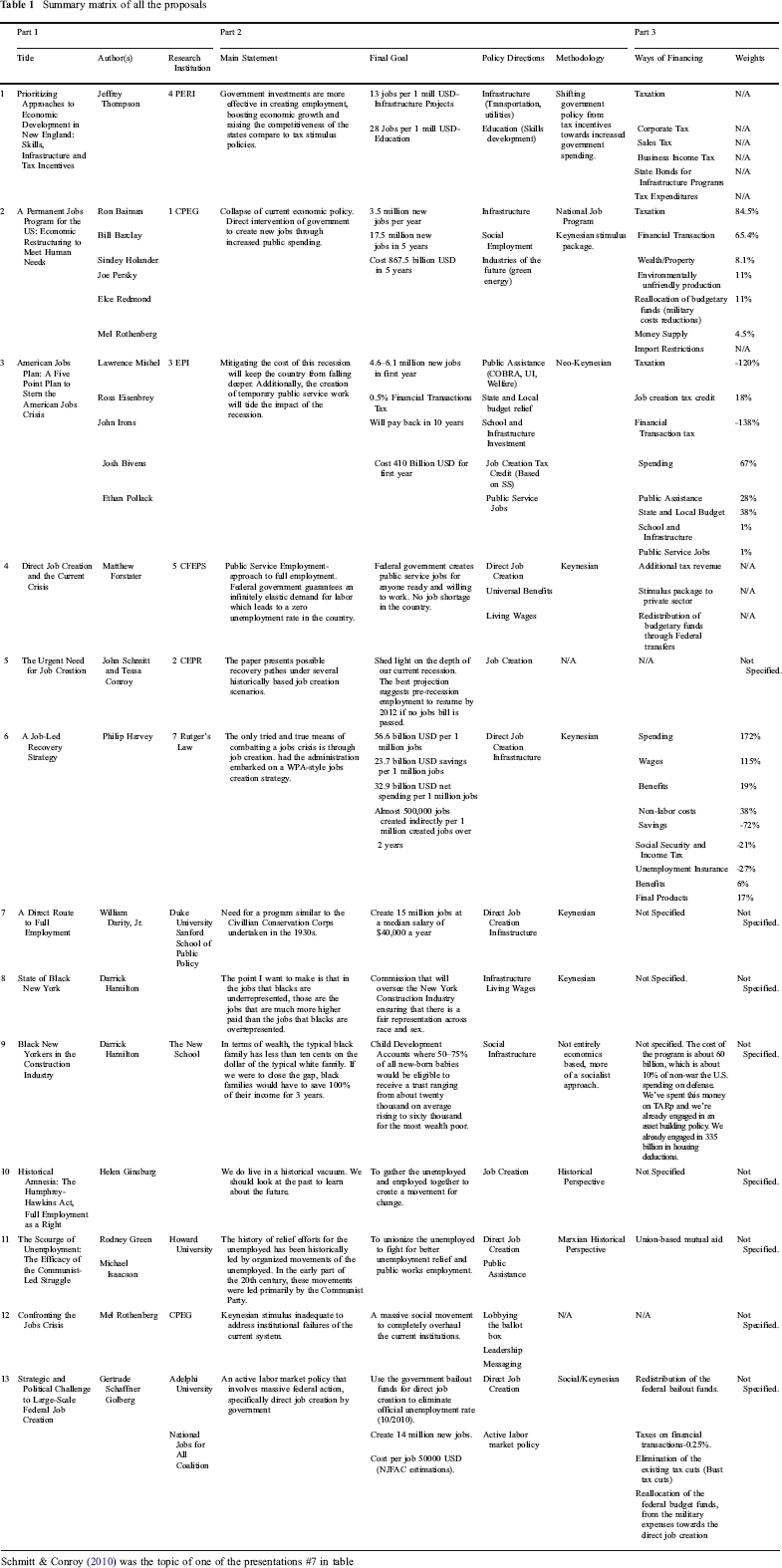
Schmitt & Conroy (2010) was the topic of one of the presentations #7 in table
The matrix consists of three parts: The first part contains information about the paper's title, authors and the organizations with which the authors are affiliated. The aim of this part is to show the diversity of the presenters from more than ten research institutes and number of universities. The second part of the matrix describes the concept of each paper. In order to provide the basis for credible comparison, this part was divided into the following four categories: main statement, final goal, policy direction and methodology. The core thesis of each paper appears under the main statement section. The section on final goals describes anticipated outcomes of each proposal, concentrating on number of new jobs created, the role of governments’ or labor unions. The next section, policy directions, shows what types of reforms are proposed to mitigate unemployment and achieve the final goals. The methodology section describes the nature of the proposed policies. For simplicity, the papers are classified by the schools of economic thought. The last part of the matrix describes different ways of financing proposed economic reforms.
The matrix should be a helpful and easy-to-understand tool for summarizing and comparing different economic policy proposals discussed during the conference.
The Jobs Bill
Representative John Conyers of Michigan discussed a bill he is sponsoring titled the 21st Century Full Employment and Training Act (H.R. 5204). The bill aims to ensure “full employment,” which it equates to a 4% unemployment rate. HR 5204 was introduced into the Congressional Record on May 4, 2010.
The bill calls for the Secretary of Labor to establishment a full employment national trust fund. This fund would be used to fund the existing Workforce Investment Act (33% of funds), and to fund a direct jobs program created under HR 5204 (67% of funds).
Funding for HR 5204 would come from a newly created tax on securities transactions. The amount of this tax is up to 0.25% of a covered securities transaction, and it would be levied on “the trading facility on which the transaction occurs.” Covered transaction securities include: stock transactions, futures contracts, swaps, credit default swaps, and other types of derivatives.
HR 5204 establishes employment grants contingent on the unemployment rate. If the unemployment rate is higher than the “applicable unemployment rate,” the Secretary of Labor would be required to make grants totaling 90% of funds available in trust fund to states, local governments, and Indian tribes. These funds will be used for direct job creation, such as restoration and revitalization of abandoned properties, repairing and refurbishing schools, and increased staffing in Head Start and other child care programs.
HR 5204 requires employers using employment grant funding to employ each worker for at least 12 months; pay a wage comparable to employees performing similar duties, but not funded with grant monies; and ensure workers hired under this program do not displace existing workers.
The bill also sets eligibility requirements for workers. For instance, to be eligible a worker must be unemployed for at least 26 weeks, unless the worker is a low income individual. If low income, the worker must be unemployed for at least 30 days prior to the receipt of the grant. In addition, the bill establishes various requirements and regulations on grant selection, as well as reporting and accounting requirements for recipient agencies.
Challenges
Throughout the course of the conference, there were constant references to themes of the Great Depression. Most of the fiscal policies stemmed from the ultimate solution to that two decade downturn. The conditions were not unlike those of today: A banking crisis, mass unemployment, a significant drop in GDP. The problems were far more severe, but the obstacles were similar. At the start of the Depression, there was a general sentiment in the media and in the public at large that the unemployed were unemployed due to laziness. This sentiment continues to the present day. Those who wished for public assistance were subject to a degrading means test and often put into just as degrading odd jobs (Harvey 2010).
As the Depression wore on - as unemployment climbed into the double-digits - it became clear that the problem of joblessness was institutional rather than individual. Slowly, the Federal Government began to allocate money to the states, with the hope that they would administer their own public works programs. Much to the chagrin of those in charge, the money primarily ended up in the hands of bond holders, state employees, and overdue bills. Whatever was left would go to municipalities, and if there were any money left over after that, it might go to poorly paying public works programs (Harvey 2010).
With the failure of the government at all levels to adequately provide public support, alternative institutions began to crop up to fill in the gap. The Communist Party of the United States, taking a cue from the Communist Party's efforts in Russia during its recession two decades earlier as well as contemporary efforts developing in Calgary, Canada and the United Kingdom, began unions for the unemployed. These unions provided a sort of unemployment insurance as well as meals and advocacy. They lobbied for similar official efforts from various levels of government. With the adoption of the Works Progress Administration (WPA) and similar agencies abroad, these unions, by and large, fell by the wayside (Green and Isaacson 2010).
The WPA faced some initial difficulties as well. Similar to the ARRA today, its sizable budget allocation was slow to reach the people, was often tied up in bureaucracy, and was criticized as being either too much or not enough. In addition, there was much racial discrimination, particularly in the South. African-Americans searching for work were often marked as being unskilled, regardless of their skill set. As a result, they were paid less than if they were skilled (Harvey 2010).
Even still, the public works programs served the double duty of getting us out of the Depression and rebuilding U.S. infrastructure. Despite the obvious benefits of the programs, some, even to this day, insist that it was World War II that pulled us out of the Depression. Still, war is not much more than a very violent public works program. Even with this fundamental shift in the role of American government, which had never before enacted such a large Federal program, there remained a significant anti-poor sentiment which continues to the present day.
Following the Great Depression, the Senate passed the Senate Full Employment Act 1945 which included the term “full employment” that emphasized the importance of allowing every person of working age the right to hold a job. The Employment Act of 1946 was later implemented and the term “full employment” taken out and there was a push toward maximum employment set at 4% unemployment (Ginsburg 2010).
Humphrey Hawkins introduced the Full Employment and Balance Act of 1978. Under this act full employment was considered, once again, at 4% unemployment. This act emphasized the importance of continuing to striving for employment for all individuals searching for a job. Therefore, after the 4% unemployment was achieved, there was a continuous effort toward lowering that figure until all who wanted a job were employed. That points out this warring of the minds for a consensual definition of full employment, which seems to have changed with not only each act, but with the individuals targeted during each of the specific time periods (Ginsburg 2010).
The largest problem with the aforementioned acts toward achieving full employment has been in enforcing the acts. Many people are not aware of acts such as the Full Employment and Balance Act of 1978. Those that are familiar with the act have called it a weak bill, but for others it was a step in the right direction. It was an act that was passed and could have been debated and changed had it had strong support and backing (Ginsburg 2010).
Roosevelt's Economic Bill of Rights acknowledged that the employed deserved a right to a living wage that was not only sustainable but continuous. However, neither CETA or the Bill of Rights had the backing needed to continue striving for “full employment” as both were soon washed out (Ginsburg 2010).
Owing to a hangover from the Reagan years, a major obstacle to financing the programs suggested at the conference is the mentality of “Starving the Beast.” Following the Neoliberal tradition, the Federal Government is inefficient by nature -except, apparently, in telling the rest of the world how to manage their international trade - and that therefore, funding of the government and its programs must be avoided at all costs.
Born from the dawn of Bush Senior's New World Order, the citizenry of the United States is competing directly with foreign labor. As a result, the median standard of living hasn't seen much real increase. One particular problem brought up by the Center for American Progress was the American “Wal-Mart mentality.” This belief that we don't need to raise our standard of living but rather lower the cost of everything is one of the prime sources of job outsourcing and wage cuts in the United States.
Despite this dire situation, a major setback in the implementation of many of the spending programs is the inculcated revulsion towards the welfare state. Those calling for increases in food stamps, unemployment insurance and health care coverage are vilified as favoring a “take care of me” state. This rhetoric is well accepted, embodied in Newt Gingrich's descriptive dichotomy of a party of food stamps versus a party of paychecks (Bakst 2010). So long as the rhetoric does not shift toward a rebuke of the “leave me to die” state, these vital programs are liable to be sullied in the waters of political compromise.
A usual objection to increasing taxes in order to pay for any sort of economic stimulus, is that the tax increase will at best dampen the economic benefit of the stimulus, and at worse will further deepen the economic downturn. This objection becomes more forceful, when the public views Congress unfavorably and with mistrust. Conference participants pointed this out, as they discussed the rising popularity of the Tea Party, which hearkened back to a misunderstanding of the significance of the Boston Tea Party. Owing to a rant by CNBC anchor Rick Santelli on the floor of Wall Street, the Tea Party - originally conceived in opposition to taxes that went to benefit those living in another land - was reborn into a movement that merely opposed taxes. Several candidates in the 2010 midterm elections have identified themselves as Tea Party candidates. Thus, their election into Congress would greatly diminish the possibility of tax increases as a funding source for any economic stimulus.
In addition to its anti-tax platform, the Tea Party also opposes increases in the national debt. Tea Party members view growth of the national debt as both a sign of economic decline and a threat to national security. Whether misguided or not, this platform seems to resonate well with the American public. Therefore, election of Tea Party candidates into Congress will also increase the challenges and obstacles of using debt-financing to fund any economic stimulus program.
The third leg in the Tea Party platform's stool is the overall size of government. Their view is that a small government is always better, and the current size of our government is way above their optimal point. This increases the challenges and obstacles, not only on the issue of financing the stimulus, but also on the approval of another stimulus program in the first place.
Given the popular front of the Tea Party in all its various 501(c) incarnations, the deadline to enact these programs to end the recession is fast approaching. The added hurdle of Senate filibusters also decreases the ability for a comprehensive Keynesian stimulus package to salve the exigencies of America's employment situation. With an inevitable increase in Republican leadership in congress, the current strategy of the GOP appears to be hunkering down in the trenches to wait until the Democrats have run out of bullets come January 3.
Even as needed social programs are legislated into existence, they remain hampered by layers of bureaucracy. To date, only half of the ARRA funds destined for federal contracts and grants have been doled out according to the Government Accountability Office. In addition, funding for any social program has been hard to come by. For instance, the James Zadroga 9/11 Health And Compensation Act 2010, which would provide for the health care costs of those suffering medical ailments due to their acts of heroism following the September 11 Pentagon and World Trade Center attacks, had been held up in the house for months, and if not passed in the Senate will need to be reintroduced in the new Congress.
Given our diminishing manufacturing sector, and the decreasing need for a service sector with Internet sales claiming a large chunk of retail clerk jobs, the last frontier of the American economy appears to be the financial industry. This is emphasized by how much slight dips in the stock market caused sporadic price shifts in commodities in the wake of the 2008 financial meltdown. Even still, major media outlets look to the status of the Dow Jones Industrial Average as a barometer of the health of our economy. As long as this trend continues, it will prove difficult to enact any tough comprehensive financial reform.
The comprehensive reform is ever more needed as the hegemony of “too big to fail” banking still reigns in American financial markets. So long as banks turn their profits by being in debt to each other - and ultimately, themselves - our financial services sector will remain unsustainable, continuing an ever widening boom-bust cycle as each niche market bubble rises to the surface and bursts. So long as the transactional economy is held hostage by the speculative economy - where goods and services are not valued based on how much there are but by how much their might be - the financial market will remain “too big to fail”.
Banks reserve and frequently exercise the right to refuse to lend money to people with poor credit history or no income. However, some would argue that greed became the catalyst for a new kind of banking system that lacked transparency across the board and led to the subprime mortgage crisis, which brought the global financial system to its knees, affecting the lives of many Americans regardless of race.
There was a very systematic chain of events that lead to crisis. Specifically, within the industry, it all starts with an individual's application for a loan. If that in individual is approved by a broker, then the broker will sell the mortgage to a bank. The bank then insures the mortgage and sells it to an investment firm on Wall Street. Firms then collect these mortgages. These mortgages were bundled together into collateralized mortgage obligations (CMOs) and represented a stream of monthly income that is supposed to continue for the life of the mortgages. The firm then sells shares of that income to investors who are willing to buy them. This seemed like a well-oiled machine.
Unfortunately, there were some underlying problems. Specifically, many of the recipients of these loans did have the credit or financial backing to be prime candidates. Lenders began attracting individuals with teaser rates set to reset to an adjustable rate. When the issue of the mortgage resets came up, the banks asserted that those who were unable to afford the higher adjustable rates would merely refinance. However, given the increased demand for home loans due to their availability to home buyers and their increased circulation in financial markets, home prices skyrocketed, making a new loan on the same house impossible to afford.
The recipients of these loans were not only unworthy based on their credit history, but they were uneducated about the ins and outs of home loans. With the prevalence of stated income loans, it was apparent that the banking industry, by and large, didn't care. For the individuals who received the adjustable mortgages, they could afford their mortgage payments until the rates ballooned. For many, this happened within as little as 2 years after receiving their loans.
The subprime mortgage crisis brought the issue of ethics to the forefront. One has to ask whether or not it is ethical to issue adjustable rate mortgages to individuals that are not credit-worthy. Additionally, how responsible were the homeowners in this situation knowing that their rates could rise at any time leaving them unable to afford their monthly payments? Where does the blame fall? Either way, this crisis, not only affected many of Americans, it affected the way in which the entire American banking system is viewed and emphasized the role of legislation. Lenders have expressed that pressure from the Community Reinvestment Act to give loans to those who may not have been credit worthy helped in leading to the subprime mortgage crisis. This reaffirms the need for legislative reform.
During this recession, the White unemployment rate reached about 9.5%, while the Black unemployment rate reached as high as 16.7% in the first quarter of 2010 (Bureau of Labor Statistics 2010a, b) During the conference, Darrick Hamilton demonstrated that the unemployment rate among Black folks has been consistently around twice that of the White unemployment rate. A large portion of this gap in employment among the races is believed to be due to occupational segregation. As a result, even those blacks that are able to find employment end up with lower paying jobs with fewer benefits and a higher likelihood of hour cuts (Hamilton 2010).
In the case of the New York construction industry, there is concern that Latino foreign-born residents are absorbing many of the available jobs within the industry. This was found to hold true for the industry. Foreign-born Latinos are the most overrepresented minority group in the industry and yet are the most underpaid. This becomes an even larger problem when individuals are marginalized out of union membership.
In spite of these facts, public opinion polls consistently show that White folks are oblivious to the disadvantages that Black folks face in the labor market. These polls show that White folks truly believe that Black folks have the same opportunities as they do, and have consistently shown this since prior to the passage of the Civil Rights Act in the mid-sixties (Wise 2007).
With the election of this country's first Black president, the idea of a post-racial society has permeated the mainstream social consciousness regarding race. This has allowed White folks to feel that American racism is over and that people of color simply need to catch up (Wise 2007). It has also made some White folks such as Glenn Beck feel comfortable to say that he understands the dream of Rev. Dr. Martin Luther King Jr. better than those civil rights leaders who worked with him in the SCLC (Norington 2010).
With so called, “Free Trade” agreements forcing American workers to compete directly with Mexican maquiladoras (manufacturing sweatshops located near the U. S.-Mexico border) in terms of wages, benefits, and unionization, no amount of stimulus will be able to stop the money from flowing out of the country.
With trade barriers falling faster than ever, one major concern about the lack of American jobs is whether they are gone due to decreased demand or because they are no longer American. As the flight of American manufacturing jobs is set to be matched by a flight of service sector jobs - particularly in the area of technical support - it becomes more difficult to discern what the basis of the American economy really is. As the jobs leave America, the country's capacity for unskilled workers significantly diminishes. And as this occupational flight ultimately results in lower prices for the end consumer, there shines no glimmer of hope for the jobs’ return.
Yet the biggest challenge of all the programs presented during the conference is the source of finance. As we discussed in the literature review number of different approaches were suggested. Some were arguing about imposing new taxes on financial transaction or on accumulated wealth. Another approach was to redistribute the existing funds from military expenses to job creation initiatives. However all the proposals one have common difficulty: How to make this initiatives into law.
Conclusion
Following the presentations, there was a lively question and answer session. Economists debated the potential and relevance of the possible inflationary effects of deficit-financed government spending. By and large, this was of minimal concern to all. Matthew Forstator reminded the audience that in times of high unemployment, the potential for present deflation is a far greater concern than the possibility of inflationary effects down the road.
Some took issue with such statements, insisting that the present need for fiscal stimulus does not mean that we can abrogate our responsibility to future generations. This sense of fiscal responsibility was reflected in numerous proposals which called for a plan, similar to the Humphrey-Hawkins Act, requiring fiscal stimulus in times of economic downturn and fiscal frugality during times of economic prosperity.
The majority of the proposals called for a structural shift in our economic system, from financial taxes to redistribution programs. Some participants even went as far as calling for communist or socialist revolution.
At the root, every presenter recognized the long overdue need for social equity. Despite the fact that everyone was clamoring to save the banks at the start of the Great Recession, there has been no widely considered proposal to save the poor and those historically oppressed. That was ultimately the focus of this conference.
In addition to proposals by economists, the various representatives from the political side of things – lobbying organizations, congressional representatives, and political scientists – reminded us what we were up against. The spate of spending to save Wall Street maligned the populace against spending to save Main Street. The problem isn't that the fiscal conservatives were right, but that they have stolen the frame of the debate (Morris 2010). Thus, all discussion required that political progressives first cut a hole in the existing box before they were able to build their own – a difficult task in a 3-minute slot on prime-time cable news.
By and large, regardless of the proposal considered at the conference, we must recognize that the battle facing the United States is not one of legislative exactitude. It is one of rhetoric.