






Abstract
This paper studies the formation mechanisms of the pattern of labor force migration in the ethnic minority area, based on a sample of 120 administrative villages in the Ningxia Hui Autonomous Region, and by means of questionnaire investigation and indoor interview. The formation mechanism of the pattern of labor force migration, in essence the decision-making mechanism of the rural labor migration, could be interpreted by two factors, i.e. the motives to migrate, and the condition of migration. The rural labor migration in Ningxia Hui Autonomous Region has its own characteristics. The research shows a tendency that a complex mixture of different motives to migrate is gradually replacing a single economic one; the pursuit of a better cultural and social life has become more important. With respect to the social condition (or the social capital factor) of the fulfillment of rural labor force migration in Ningxia, the help of relatives and friends of rural laborers still serves as the main bridge. The advent and development of rural labor broking, however, has become an important element to promote rural migration in Ningxia. Meanwhile, local governments are also making efforts to accelerate the rural labor migration.
Introduction
China's rural economic development in western ethnic minority areas focuses on two aspects: traditional agriculture and animal husbandry, and the growing labor economy based on labor migration. Due to the shortage of land and other resource constraints, labor economy has become an important channel for the transfer of surplus rural labor and the integration of western China into the national industrialization process.
Ningxia Hui Autonomous Region is located in western China. It has a population of 6.10 million, including 2.18 million Hui people, who account for 35.8 % of its total population. The rural population of Ningxia is 3.41 million, and accounts for 56 % of its total population. At the national level, the rural population accounts for 55.1 % of the total population (National Statistics Bureau 2008). In 2007, the per capita GDP of Ningxia was RMB 14,649, which is 22.6 % lower than the national average of RMB18, 934. The southern mountain area of Ningxia (also known as Xihaigu), is one of the three poorest areas in China, has half the region's total population, and is inhabited by a great number of Hui. Due to poor soil, the shortage of other natural resources, the underdevelopment of the industrial economy, and the rapid growth of the population, the labor supply always substantially exceeds the demand in this region. Since the reform and opening up, great changes have occurred in the rural management system; improved efficiency in the allocation of the rural, agricultural labor force has actually created a surplus of rural labor. In order to improve the incomes of their families and improve their individual development, it is necessary for many rural laborers to leave their homes for paid jobs in non-agricultural sectors. In recent years, Ningxia has seen rapid growth in rural labor migration, with about two-thirds of the rural labor employed in non-agricultural sectors, within or outside of their hometowns.
The data used in this paper come from a socioeconomic survey conducted in Ningxia Hui Autonomous Region by the Ningxia Survey Team of the National Bureau of Statistics for the research team from the Institute of Ethnology and Anthropology, Chinese Academy of Social Sciences, in 2007. This survey interviewed 1,190 rural households in 120 administrative villages, based on random sampling. The surveyed households have 3,362 people in the labor force, 1 and among them, 1,171 were rural migrant workers at the moment of the survey or had experienced migration before the survey. This paper will use sociological methods to analyze their patterns of migration and to explore the mechanisms behind their migration.
The labor force is defined as persons who have the capability to work and range in age from 16 to 50 for women and 16 to 55 for men.
Characteristics of rural labor migration from case villages in Ningxia
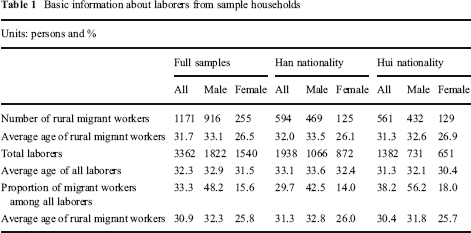
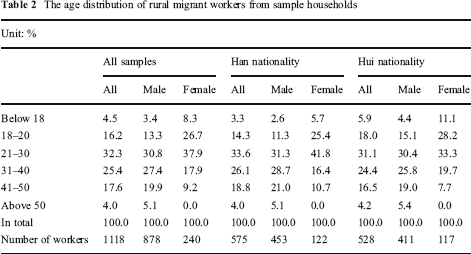
Based on the survey, we found some important characteristics of rural labor migration in the Ningxia Hui Autonomous Region. First, the young and middle-aged rural labor force constitutes the majority of rural migrant workers, while women under 30 years old are the majority of female migrant workers. The average age of rural migrant workers from the sample households is 30.9 years old; the average age of men is 32.3 years old and for women 25.8 years old (see Table 1). During the migration of the rural labor force from the surveyed villages in Ningxia, the 18 to 40 age group has constituted the majority of rural labor, which represents the real trend of migration (see Table 2).
Basic information about laborers from sample households
The age distribution of rural migrant workers from sample households
Second, men constitute the majority of the rural labor migration market. As shown in Table 1, one-third of the interviewed rural laborers are migrant workers. The percentage of male migrant workers among rural male laborers is higher than that of female migrant workers among rural female laborers. For Hui, the percentage of Hui migrant workers among Hui laborers is higher than that of Han migrant workers among Han laborers. In particular, among the male laborers, the proportion of Hui migrant workers is about 13.7 % more than that of Han migrant workers.
According to the related literature on rural migrant workers in China, among cross-regional rural migrant workers, male migrant workers make up the majority. At the national level, men account for 75.19 % of all migrant workers, and women 24.81 %. In eastern China, men account for 70.49 % of migrant workers while women are 29.51 %. Among rural migrant workers from the central and western regions, women account for 28.10 % and 17.70 % of the total, respectively (Gao 2006). Therefore, among rural migrant workers from the three regions, the proportion of women among western Chinese rural migrant workers is the smallest of the three regions. However, in the survey data collected from rural Ningxia, female migrant workers account for 21.8 % of rural migrant workers, which is lower than the national average, as well as the eastern and western region averages, but higher than the western average level.
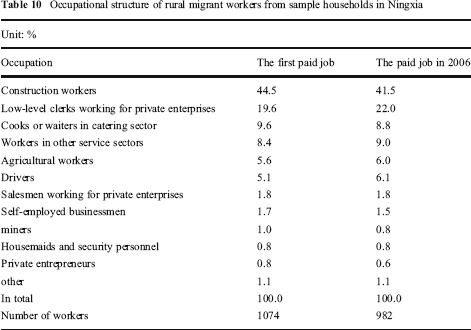
This finding shows that women's chances for finding paid jobs are less than those for men. This is a common phenomenon in China. There are various reasons for the formation of this phenomenon, including the industrial distribution of rural migrant workers, their education, their work experience and skills, and some kinds of labor divisions in families. Take the industrial distribution of rural migrant workers as an example. We find that, in the structure of employment of rural migrant workers from the studied villages, 41.5 % are employed in the construction industry. Obviously, in comparison with male rural migrant workers, it is more difficult for female migrant workers to enter the construction industry. Additionally, in rural areas, women take responsibility for caring for children and elders at home. To deal with these disadvantageous situations, we found that many female migrant workers from the studied Ningxia case villages tend to take short-term paid jobs in the agricultural industry, such as Chinese wolfberry (acai) picking in Zhongning county of Ningxia, dehydrated vegetable processing in Pingluo county of Ningxia, or cotton picking in Xinjiang Uyghur Autonomous Region—kinds of work that last 2 to 3 months a year.
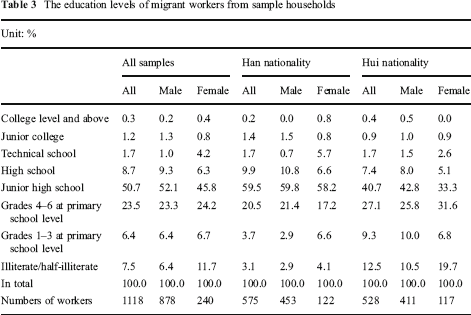
Third, rural migrant workers are often poorly educated and low-skilled. Our survey data show that more than 74 % of interviewed rural migrant workers had received a junior high school education or less (see Table 3). Nevertheless, among all migrant workers, Han migrant workers are more qualified than Hui migrant workers.
The education levels of migrant workers from sample households
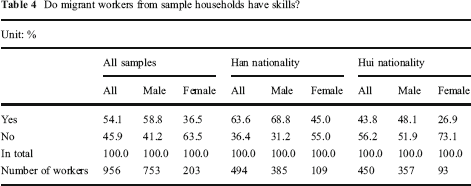
Meanwhile, Tables 4 and 5 show that many rural migrant workers are short in skills. According to Table 4, when our survey was conducted, 45.9 % of rural migrant workers from sample households were unskilled. The rest indicated that they had some skills or knowledge necessary for their paid jobs. However, Table 5 tells us that, among them, only 5.3 % acquired their skills or techniques before they began to go out for paid jobs, and the rest of them got their skills or knowledge through training programs they paid for themselves or other ways, during their migration. The growing emphasis of the labor market on the quality of the labor force will become a growing challenge for less educated and unskilled migrant workers as they seek work in non-agricultural sectors.
Do migrant workers from sample households have skills?
Ways by which migrant workers from sample households acquire skills
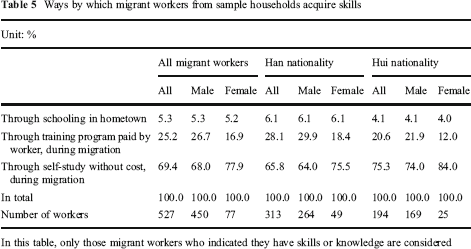
In this table, only those migrant workers who indicated they have skills or knowledge are considered
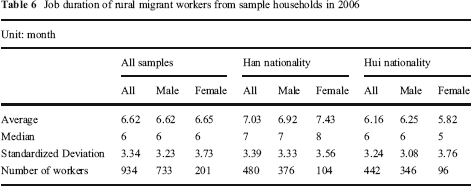
Fourth, the amount of time spent away from working home is longer than before. According to official statistics (Ma 2005), in 2002, among 450,000 rural migrant workers from Ningxia, only 180,000 migrant workers spent more than 6 months working in non-agricultural sectors, accounting for 40 % of the total. More and more rural migrant workers are choosing stable jobs over seasonal ones. According to our survey, and as shown in Table 6, in 2006, the average duration of a job for a rural migrant worker from a sample household was more than 6 months per year, and those migrant workers who for worked 6 months a year are 50 % of all rural migrant workers. Of course, there are also some differences between ethnic groups and between men and women. The average duration of a job for Han migrant workers is 0.87 of a month longer than for Hui per year. Among Han migrant workers, on average, female migrant workers work longer than male migrant workers during a single year. However, among Hui migrant workers, the case is reverse: male migrant workers work longer than female migrant workers Consequently, among female migrant workers, Han migrant workers work much longer than Hui migrant workers.
Job duration of rural migrant workers from sample households in 2006
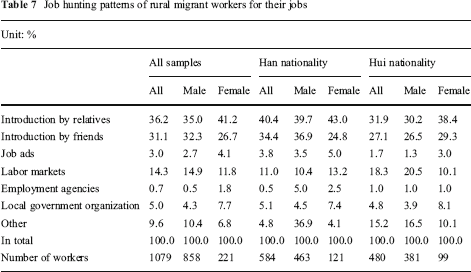
Fifth, among rural migrant workers, social networks, or so-called social capital, play a very important role in the process of finding a job. The survey data show us that most of the rural migrant workers from the sample households found their jobs with the help of relatives and friends (see Table 7). Usually, one rural migrant worker introduces or encourages his/her relatives and/or friends to work in the same or nearby factories, shops, or construction sites. The labor markets play a secondary role for rural migrant workers to find jobs. Here, the labor markets refer to those special places where the supply and demand of the labor force meet. The local governments also assist migrant workers. For example, they may organize rural laborers and send them to Xinjiang for cotton picking. In practice, however, the effect of local government action is not as significant as they reported when we interviewed them. As Table 7 shows, only 5 % of all rural migrant workers from sample households found work with the help of local government, although local government told us that this proportion reaches 30 %. Some ethnic and gender differences are noteworthy. As far as the ethnic differences are concerned, and as seen in Table 7, among Han migrant workers, those who find work with help from relatives or friends account for 74.8 %. However, among Hui migrant workers, this ratio is 59 %, 15.8%age less than the Han, which means that social capital is much more important for Han migrant workers than for Hui migrant workers. As for gender differences, an important tendency shown in Table 7 is that female migrant workers found work with help from relatives at a much higher rate than did male migrant workers.
Job hunting patterns of rural migrant workers for their jobs
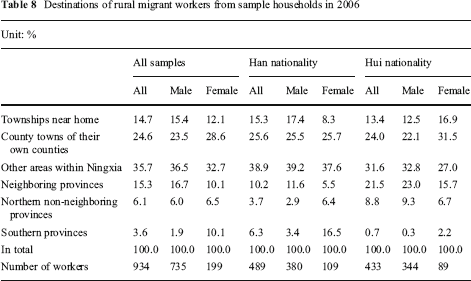
Sixth, the destinations of rural migrant workers are mostly confined to Ningxia and neighboring provinces. Generally speaking, most rural migrant workers choose to work within Ningxia Autonomous Region. However, the destination choices of Han and Hui migrant workers are somewhat different. Thirty-one percent of Hui migrant workers work outside of Ningxia, which is 10.8 percent higher than Han migrant workers (see Table 8).
Destinations of rural migrant workers from sample households in 2006
The destination choices are relatively stable. For two-thirds of rural migrant workers, their present work location is the place where they found their first paid jobs (see Table 9). This is particularly true for female migrant workers, with 78.7 % of them choosing to stay in the same location as their first job. Among male migrant workers, this proportion is 58.9 %. Thus, the rate for women is nearly 20 percentage higher than for men.
Whether present destination of migrant workers is the same destination as their first jobs
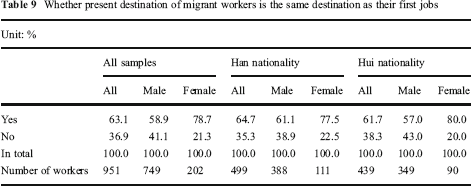
We also find that, among those migrant workers who are working in a different place than they did in their first jobs, most changed destinations within Ningxia. For example, 61.7 % always migrate to different areas within Ningxia. Meanwhile, 11.4 % switch from migrating within to other provinces, and another 11.4 % return to work in Ningxia from other provinces. Finally, 73.4 % found work within Ningxia in 2006.
Seventh, the majority of rural migrant workers from sample households in Ningxia are employed in low-end and labor-intensive industries such as the construction and service sectors. According to our survey data, among the types of occupations undertaken by rural migrant workers, construction workers rank first and clerks working for private enterprises are second. Working as cooks and waiters in the catering sector ranked third for people working in their first job or fourth among all workers. Workers in other service industries ranked fourth for those in their first jobs or third among all workers. Agricultural workers, drivers, salesmen working for private enterprises, self-employed businessmen, miners, housemaids and security personnel, and private entrepreneurs complete the list (see Table 10). The structure of their occupations shows that most rural migrant workers belong to the working class.
Occupational structure of rural migrant workers from sample households in Ningxia
Main mechanisms of the formation of migration patterns of rural laborers from case villages in Ningxia
Studies on rural labor migration are currently very popular in China. Many studies apply theories and models developed by western scholars to China, including the Petty-Clark Theorem, the Push-Pull Theory, and the Todaro Model. William Petty is the first scholar who proposed that the comparative advantage difference as a kind of basic motive force to drive agricultural laborers migrating from agricultural sectors to non-agricultural sectors (Petty 1672/2010). Based on Petty's theory, Colin Clark developed the famous Petty-Clark Theorem: in the process of a country's economic growth, as the national income per capita increases continuously, its labor force will transfer first from its primary industry to a secondary industry, and then from the secondary to a tertiary industry. According to Clark, the real reason for the transfer of the labor force from the primary to the secondary and tertiary industries is relative differences in incomes among different industries in the process of economic development (Clark 1957). D. J. Bogue developed his systematic Push-Pull theory of migration of population in the 1950s. In his theory, two kinds of opposite forces, the “push” force rooted in various disadvantageous conditions of rural economic development, and the “pull” force coming from advantageous socio-economic conditions in urban areas, are the driving forces which result in rural laborers’ migrations from the rural to the urban areas (Bogue 1959, 1969). Similarly, the basic implication of the Todaro Model is that the determinant factors of rural labor migration to urban areas includes structural differences between the rural and urban economies and the tradeoff of costs and benefits of migration, especially the differences of anticipated incomes (Todaro 1969, 1985).
Based in some of these classic migration theories, some western economists have recently developed some new ideas. Stark and Bloom (1985) believe that the migration decision is made as a result of family consultation, and the person who migrates will influence the migration of other family members, neighbors, and friends. This in turn creates a potential network of migration relationships that can help alleviate the unfamiliar feelings of migrant workers in cities and reduces the time and information cost of migration, so that migration is easier.
Based on our survey data and field work in Ningxia, we think that, though the above-mentioned theories reflect reasons, driving forces, and rules of rural-urban migration from different angles, not all the conditions that make these theories tenable are available in China. For instance, the classical Todaro migration model attributes the driving force of labor migration to the simple trade-off of expected incomes between urban and rural areas, which means migration without any costs and a unified labor market existing between the urban and rural areas. However, segregated labor markets and obstacles in labor migration still exist in China.
In view of this situation, Chinese scholars have made proper modifications to these theories and models. They developed new concepts and theories on the driving forces and determinant factors of labor migration of China. For instance, Chen and Hu (1994) established a Chinese Push-Pull model of rural-urban migration, in which the mechanisms of labor migration are explained by the trade-off of the supply created by the pushing forces from the agricultural sector and the demand created by the pulling forces from the non-agricultural sectors. Li and Wu (1999) think that the surplus and migration of the rural labor force is a regional phenomenon; the scale, speed, direction of the flow of cross-regional migrations depend on the supports of the forces driving them. Besides the pushing forces of the rural areas and pulling forces of the urban areas, frictions from the migration process also play an important role. All of these forces form a dynamic system supporting the process of rural-urban migration. Wen (2001) holds that the large-scale and long-time migration phenomenon of the rural population is the result of migrant workers’ subsistence pressures and rational choices. Jing and Chen (2004) believe that the driving forces of migration include exclusive forces from rural areas, impetuses from the industrialization and urbanization, and frictions from the migration process. Other Chinese scholars analyze the factors of rural-urban migration from other perspectives, including education, the household registration system, the level of industrialization, and socio-economic gaps between the rural and urban areas (Sheng 2007).
We think that, in contemporary China, The formation mechanism of the pattern of labor force migration, in essence the decision-making mechanism of the rural labor migration could be interpreted by two factors, i.e. the motives of migration, and the condition of migration. Our data, collected in Ningxia through survey and field work, will provide empirical evidence for this assumption.
The formation of motivations of labor migration in rural Ningxia Hui Autonomous Region
In continuously drought-hit Xihaigu (a mountainous area in south Ningxia), due to the shortage of resources, especially arable land, the rural labor force is the only reliable resource under the control of poverty-stricken families. Forced by the pressures of survival and development, most rural households will decide that, in order to escape poverty, some of their laborers should go to growing areas and in-demand sectors to find work. In rural Ningxia, and particularly in its southern mountainous areas, one of the main objectives of many migrant workers is to earn money for their families. In recent years, Xihaigu has been severely plagued by drought, so not only is the land hard to cultivate and the livestock hard to breed, but it is also hard to find drinking water, so that many rural households fell into extreme poverty. As a result, many people have migrated to find work, hence becoming rural migrant workers.
Beside the motive to earn money, we also find other motivations for migration among rural people in Ningxia. For example, for some young, educated, and skilled rural laborers believe working in urban areas is a good way grow and develop. The yearly income earned in urban areas almost equals those earned by several years of, and is enough to get escape poverty, or even afford a somewhat new lifestyle. The villages we visited have seen a lot of families improve their standard of living with the help of migrant workers. In addition, according to the statistics of the Labor Employment Office of Ningxia, in recent years, Xihaigu has exported 500,000 migrant workers with an annual per capita income of RMB 4000 yuan. This has helped young migrant workers achieve their goals of leaving poverty, increasing their incomes, and changing their lifestyles.
The Hui people, as a whole, have a history of owning their own businesses, so they have accumulated a lot of capacity and experience of running businesses, and inherited and formed the important habits for owning a business. During the era of the planned economy, this kind of capacity was strictly constrained by national policies. Since the reform and opening up, their potential for running businesses was reborn. In those counties with large Hui populations, such as Tongxin County and Wuzhong City, Ningxia, the Hui people often are “bellwethers” in local business activities. Tongxin County, where 80 % of the population is Hui people, was a poverty-stricken area in the past. In 1988, this county became a test zone for commercial circulation, and allowed workers to engage in the long-distance transport of goods for sale and other kinds of business activities. Today, more than 30,000 peasants in this county are involved in business activities. Seventy-five percent of rural households have built their own new houses, and have 1,700 motorcycles and hundreds of cars. The living standards of local workers have improved significantly. Most Hui are Muslims and have a tradition of sending their children to mosques and language schools to study Arabic scripture and language. With the frequent exchanges between China and Middle Eastern countries and the increasing demand for Arabic speakers, an Arabic interpreter is becoming a new career choice for young Hui. In Tongxin County, there are 700 young Arabic interpreters, and peasant Arabic interpreter is a new job in the local labor market. This story of Tongxin County tells us that a business-liked cultural tradition can play an active role in the process of transferring rural laborers from agriculture to non-agricultural industries.
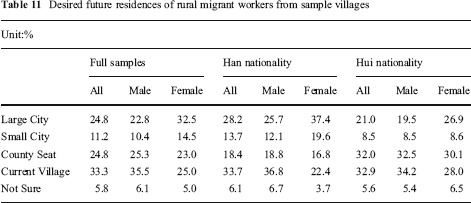
Based on our interviews and survey, we find that one of the important motivations behind migration of rural laborers in Ningxia is the desire for a better life. Adequate infrastructure and cultural and recreational facilities, better educational opportunities, and the urban lifestyle are extremely attractive to the rural labor force, especially the youth. As shown in Tables 11 and 12, about 60 % of rural migrant workers hope to live outside of their hometowns, and most of them also hope their children live in urban areas, especially big cities. This evidence indicates that rural migrant workers have adapted to and enjoy urban lifestyles, completely or partly. Not only have traditional ideas of never leaving their hometowns diminished, but the desire that children become urban dwellers have increased. By the way, we find no significant ethnic differences in this respect. However, in comparison with male migrant workers, female migrant workers have a stronger desire to live in large cities.
Desired future residences of rural migrant workers from sample villages
Migrant workers’ wishes for their children's future residence

In our analysis of rural migrant workers’ satisfaction about their migrant life, based on the same survey data (Liu 2010), I found that, though far from their homes and relatives and faced with tremendous difficulties, most of rural migrant workers are optimistic and satisfied with their migrant lives. In addition, rural people, especially migrant workers, used to comparing their lives to those living near them, increasingly make this comparison with those living in the county seats of their own or other counties. For example, among our respondents, about 30 % compare their life conditions with people living in the county seats. This shows that, by working outside their hometowns, rural migrant workers expand their vision and knowledge; they have new reference frames to evaluate their own jobs and lives. When we interviewed rural migrant workers in Ningxia, they would often talk about the lives of urban people and affluent areas, and ways by which urban people make money, with an attitude of admiration or envy. It can be anticipated that experiences with urban life strengthen rural people's motivations to find work and seek living opportunities in urban areas.
Objective conditions for rural labor migrations
Objective conditions for rural labor migrations in ethnic minority areas can be studied from two aspects: human resources, including the quantity and quality of rural laborers; and social and human capital, including migration knowledge, community associations with the outside world (the openness of the community), and social networks necessary to migration.
According to official statistics, the size of the rural labor force in Ningxia has steadily increased (see Table 13). From 1983 to 2005, the proportion of working members of the household grew from 47.5 % to 61.4 % in rural areas of Ningxia (see Table 13), which means a significant increase in the surplus labor force. For example, Haiyuan County has a rural population of 370,000, with a labor surplus of over 100,000. In addition, the quality of the rural labor force has also greatly improved, which can be seen in the vast decrease of illiterate and half-illiterate populations, dropping from 43.4 % of the population in 1985 to 15.8 % in 2004 (but rebounding in 2005). Meanwhile, the proportion of the labor force with a secondary school education increased steadily from 23.8 % in 1985 to 44.7 % in 2004 (but decreasing in 2005). Finally, though the proportion of workers with a high school or technical school education has gone up, it still remains low, especially compared with the national average level. In short, the rural labor force in Ningxia has the advantage of quantity, but the disadvantage of quality.
Basic information on rural households in Ningxia, 1983–2005
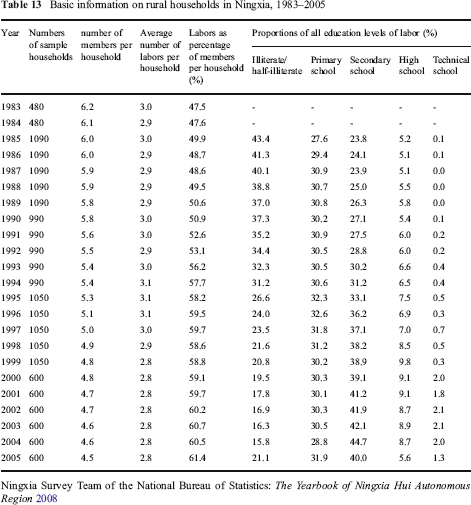
Ningxia Survey Team of the National Bureau of Statistics: The Yearbook of Ningxia Hui Autonomous Region 2008
The measurement of social capital is a complicated task. As mentioned above, in our survey data, most rural migrant workers are influenced by their relatives and friends who have already migrated for many years, and find their jobs with the help of these relatives and friends. Therefore, rural migrant workers comprise the primary social capital for rural laborers who will migrate. However, the quality of this kind of social capital is rather low, since the first migrant workers often enter low-level employment. It is very difficult for them to help newcomers to find better non-agricultural jobs. Therefore, as we mentioned above, among our interviewees, most migrant workers are employed in the construction and low-end service industries.
The second part of social capital is the labor brokers, who have grown up through all kinds of labor migration. In some villages we visited, we found that, with the help of such labor brokers, a lot of villagers found jobs. For example, there are about 600 labors in Lee village, Lianpanshan Town, Jinyuan County, Ningxia. Nearly half of them migrate to find work, and most do so with the help of a labor contractor (labor broker). With experiences hiring workers and knowing business, labor brokers have a better understanding of the labor market and play the role of intermediary and bridge for the rural labor. However, not all the villages in Ningxia have labor brokers, and labor brokers’ aim is to make profits when playing the part of intermediary and bridge.
The third part of social capital is the role played by local governments to encourage rural labor migration. In Ningxia, we observed that nearly all levels of local government are actively promoting rural labor migration. First, they formulate labor export plans with the necessary fiscal resources to maintain these plans, including rewards and punishments for plan managers. In 2005, Kaicheng Town of Haiyuan County organized disaster relief recipients and destitute households to go to Xinjiang Uyghur Autonomous Region to pick cotton. The town government provided 21 destitute households with RMB 100 and 2 sacks of flour, and every cotton picker received a bus ticket to a county city plus RMB 10 yuan for living expense on the day of departure. Second, they make efforts to gather information about the labor market, to contact labor export businesses, to set up bases for labor export in those areas needing migrant workers. Among these, the influential measures include cotton-picking and grape-picking in Xinjiang Uyghur Autonomous Region and non-agricultural employment in Fujian Province.
Third, local governments provide training programs for rural laborers and labor brokers. In 2007, Haiyuan County implemented a plan to upgrade the labor economy by providing training programs of basic skills and knowledge (e.g., legal knowledge) for 40,000 persons and technical training programs for 5,000 people, and aimed to export one skilled laborer per rural household. Providing training programs to labor brokers is another effort of local governments to promote rural labor migration. In 2006, Haiyuan County developed 600 labor brokers and 11 intermediary organizations. Under the leadership of labor brokers, 42,000 rural laborers became migrant workers, accounting for 40.8 % of the county's total migrant workers. Under this plan, in 2007, Haiyuan planned to establish three to five intermediary organizations, including at least two intermediary companies with an export capacity of 1,000 or more rural laborers at the county level. At the township level, each town or township needed to develop at least three labor brokers who could help more than 100 rural laborers migrate. At the administrative village level, every village needed to train at least three labor brokers who could help more than 30 rural laborers migrate. By these measures, this county wanted to build a new pattern of labor economy development in order to form the mechanisms of socialization and marketization of labor export. Undoubtedly, the involvement of local government is an important and organized force in rural labor migration. However, the role of local government is still limited and already faces difficulties. The shortage of fiscal resources and deviations from the implementation plan are the main areas of concern. For instance, the assignment of labor export plans to lower-level organizations and villages has become a burden for organizers and migrant workers. In Haiyuan County, the size of rural labor transfer organized by local governments has shrunk, since local governments have too many other responsibilities to carry out.
Conclusions
This research shows that rural labor migration has become an important element in the rural economic development of Ningxia Hui Autonomous Region. The labor export economy is a large portion of the local economy, in some areas rising to 50 % of the economy. In those areas of lagging non-agricultural development, such as Ningxia, the labor economy will be one important option for local economic development.
The rural labor migration in Ningxia Hui Autonomous Region has its own characteristics. The research shows a tendency that a complex mixture of different motives to migrate is gradually replacing a single economic one. The pursuit of a better cultural and social life has become more important, a fact not explained by some traditional migration theories. As far as migrant workers’ choices of destinations are concerned, though Ningxia and its neighboring provinces are still the main choices, some migrant workers go farther into other parts of China for better jobs and opportunities. As for the types of jobs migrant workers find, generally speaking, they are still low-skilled or even unskilled jobs. Although there are some signs of improvement, migrant workers’ low education and low skills still prevent them from getting better jobs. Meanwhile, the size of the surplus labor force is still rather large in some parts of rural Ningxia, and the so-called “Lewis’ Turning Point” in the process of rural labor transfer has not yet arrived. With respect to the social condition (or the social capital factor) of the fulfillment of rural labor force migration in Ningxia, the help of relatives and friends of rural laborers still serves as the main bridge. The advent and development of rural labor broking, however, has become an important element to promote rural migration in Ningxia. Meanwhile, local governments are also making efforts to accelerate the rural labor migration, a fact that can be viewed as an important organizational social condition of the rural labor migration in Ningxia.
Rural labor migration in Ningxia still faces challenges and certain issues should be given increased attention. First, the need for improved education and training for rural migrant workers will grow with social and economic development and increased numbers of labor migrants in rural areas. This kind of demand cannot be simply viewed as a growth in the quantity of education, which is limited due to changes in demographic reproduction patterns. More important is to improve the quality of education, which means increasing the skills of rural labors in general education and occupational training, which will be needed by the future labor market. Innovation in the support system for training rural laborers should be focused on the need to fit both the individual conditions of laborers and the demands of the labor market. Specifically, occupational training should be targeted toward personal specialties and different labor markets, but the quality also needs to be improved. Take Germany for example. While taking active measures to develop the training market, the German government issues coupons for training to those who meet basic conditions and have a need to be trained. Then, they go to the supply market to find a suitable training institution or project for better and well-targeted training.
Second, attention should be given to improve the mechanism of labor migration. The government should reduce direct interference with labor migration. Due to the immature intermediary market, it is necessary for the government to promote migration to some extent, but it would be wise for the government to gradually withdraw from direct involvement and to turn to the market of intermediaries of rural labor transfer. This research has shown that negative consequences come from direct interference after a short period of practice. However, it does not mean that the government should give up all efforts. Rather, it should take into account the training support for rural laborers who prepare to migrate for paid jobs and the protection of rights of rural migrant workers, and regulate the intermediary market so as to construct a multi-faceted winning situation.
Third, the government should speed up reforms of the urban and rural social management system to keep rural labor migration going successfully. On one hand, it is necessary to accelerate reforms of the social management systems of the areas receiving migrants in order to integrate rural migrant workers into these societies and to provide rural migrant workers with social security and training programs at lower costs. On the other hand, we need to accelerate the reforms on the household registration system and related welfare systems, which lead to the long-time separation of rural migrant workers from their families. This kind of separation is the very source of many social problems and impedes the migration of rural labors.