







Abstract
The Southern Homestead Act of 1866 was a large-scale effort by Congress to make land ownership accessible for recently freed slaves by opening 46 million acres of public land exclusively for homesteading. Using new micro-data from Louisiana, we examine the factors that led to successful homesteading. We compare homesteaders to the agricultural population, finding few differences other than wealth. A disproportionate percentage of homesteaders were white. We substantiate some of the claims put forth in the earlier literature, such as large amounts of fraud. Further, we present a more nuanced interpretation of a greater success rate for African-Americans. Being local or non-local had no meaningful impact on white success rates but had a large impact on African-Americans. Local African-Americans were more likely to obtain title to their land while non-local African-Americans were less likely to succeed. We hypothesize that regional knowledge, kinship networks, and white resistance to non-local African-Americans are possible explanations for this racial difference.
Keywords
Introduction
In 1866 the Southern Homestead Act (SHA, The Act) allocated 46 million acres of southern public lands exclusively for homesteading. The SHA's goal was to provide land for recently emancipated slaves. It was one of the first United States statutes to prohibit racial discrimination, stating “that no distinction or discrimination shall be made in the construction or execution of this act on account of race or color.” 1 Like the 1862 Homestead Act for Western territories, individuals received the title to their land after 5 years of living on and improving it. Notwithstanding the efforts of the Freedmen's Bureau to assist ex-slaves in their homesteading endeavors, the SHA failed to provide landownership for significant numbers of freed people. Congress repealed the SHA 10 years after its enactment.
United States Congress. Statutes at Large 14 (1865–1867), p. 67.
Conventional wisdom holds that the SHA was a failure. Scholars point to the overall poor quality of land available for homesteading; white resistance to black landownership; fraud; mismanagement by government officials; and homesteaders’ lack of adequate farm implements, other capital, and access to credit [See Gates (1940,1979), Pope (1970), Hoffnagle (1970), Oubre (1976,1978) and Lanza (1990)]. Little quantitative analysis has been done, as a lack of micro-data has hampered research. 2 Only Lanza examines micro-data, using a sample of homestead applications from Mississippi. 3 Lanza finds that blacks succeeded in obtaining title to their land 35 % of the time while whites succeeded in 25 % of attempts, which he attributes to blacks’ farming background on plantations and to a strong drive to attain some semblance of freedom (Lanza 1990, pp. 88–89). The data presented herein suggest that Lanza's attributions are only partially correct, at least as they apply to the determinants of success.
Libecap and Hansen (2002) quantitatively examine the falling rates of entry in the Great Plains under the 1862 Homestead Act. Lanza (1990) examines a sample of homesteaders in Mississippi.
Lanza sampled 640 records from the 8797 homestead applications from Mississippi, but could determine the race of only 367 homesteaders.
We use a new dataset of homestead entries in Louisiana to evaluate the factors influencing homesteaders’ success and to investigate how homesteaders differed from the overall population. A disproportionate percentage of homesteaders were white. Whites comprised 79 % of homestead attempts but only 50 % of Louisiana's population. One new finding is that in Louisiana, and perhaps in the rest of the South, homesteading was predominately a local phenomenon. Excluding claims that were likely fraudulent filings, which we discuss later, almost 90 % of homesteaders came from the homestead parish or from an adjacent parish or county. Furthermore, African-American settlers coming from beyond the local area were less likely to acquire title to their land.
Background of the Southern Homestead Act
After emancipation, former slaves were largely without either land or education. To help ex-slaves make the transition to freedom, in March 1865 Congress instructed the Freedmen's Bureau to rent forty acres of confiscated or abandoned land to each family of ex-slaves. Little was achieved as most of the confiscated and abandoned land had been returned to its pardoned former owners or sold to whites within a year of the war's end (Hoffnagle 1970, p. 612–613). Congress enacted the SHA in June 1866 to make land available to the freed people as well as whites. The Act opened 46 million acres of public domain lands in Alabama, Arkansas, Florida, Louisiana, and Mississippi for homesteading. Even though the South was more heavily settled than the West, these parcels were not highly desired. The federal government had been attempting for years to sell this land. Some of it had been offered for as little as 12.5 cents per acre as late as 1854 but had no takers (Gates 1940, p. 304 and Lanza 1990, p. 21).
To claim a homestead, the settler filed a claim at a land office. After 5 years of living on and improving the land the homesteader could patent, or receive title to, the land by paying a $5 registration fee. The maximum entry under the SHA was set at 80 acres until June 1868 and at 160 acres thereafter, at which time the filing fee was raised to $10 (Lanza 1990, pp 22, 39–41 and Oubre 1978, p. 87). The maximum acreages were halved for land located within six miles of a railroad or navigable waterway (“double minimum” land). These provisions were similar to those of the SHA's better-known predecessor, the Homestead Act of 1862. One difference is that the 1862 Act gave homesteaders the option to commute, or purchase, their land for the government's value of either $1.25 or $2.50 per acre after 6 months of residency (Gates and Swenson 1968, p. 394). The SHA did not permit this option.
The SHA gave a 6-month head start to freed people and loyal whites by barring entry by ex-Confederates until January 1867. This head start was not advantageous to the many freed people who had entered labor contracts that ran through January 1867. In Louisiana early entry was further hampered by severe flooding and closed land offices. 4
See Oubre (1976) for more on the turmoil hampering homesteading in Louisiana during the first few years of the SHA. In our Louisiana dataset, the earliest entry year is 1867. Furthermore, in 1867 there are only 63 entries, or less than 4 % of the total observations, and only nine with black homesteaders.
Congress handed the Freedmen's Bureau responsibility for assisting black homesteaders. 5 A month after the SHA's passage, Oliver O. Howard, the Freedman's Bureau commissioner, urged a collective effort to acquire and disseminate information regarding the land available for homesteading. In Louisiana, as in the other southern states, the Freedman's Bureau encountered numerous difficulties. The Assistant Commissioner, Major General Philip H. Sheridan, gave Howard a bleak assessment in October 1866. 6 Sheridan wrote about trespassers cutting and hauling timber, which may have hindered settlers’ efforts. A month later, Sheridan commented that Louisiana freed people “were having difficulties in homesteading because much of the land was either heavily wooded with no prairie, or it was prairie land remote from any timber—and not well watered” (Hoffnagle 1970, p. 620).
Hoffnagle (1970) provides more information about the Freedman's Bureau's activities to assist freed people homestead.
See Oubre (1976) for more details about the correspondence between Sheridan and Howard.
Timber interests were a thorn in the side of land officials. With the depletion of forests in Wisconsin, Minnesota and Michigan, the Southern pine forests became more valuable (Pope 1970, p. 209). As the SHA made these now-valuable timbered lands unavailable for purchase, the only ways to acquire them were either to trespass (on claimed or unclaimed land) or to have straw men file fraudulent claims. 7 Once the claim was filed, the timber would be cut down and the land abandoned. The problem was not unique to Louisiana. In 1869, the surveyor-general for Florida estimated that half of the timber sawed in that state was stolen off government land through preemptive claims (Robbins 1976, p. 244).
Gates (1940, 1979) discusses the activities of timber interests under the SHA. Millet (1966) discusses conflicts between federal agents and loggers in Louisiana. Timber reserves in the Great Lakes region were being depleted and northern lumber syndicates came to Louisiana in the 1870's. Claims could be entered for 3.25 cents per acre (160 acres tract for $5 filing fee) to harvest timber worth $25 per acre (Pope 1970, p. 209). Timber interests were also involved in fraudulent activity in parts of the western U.S. See Robbins (1939), Gates and Swenson (1968) and Libecap and Johnson (1979).
In 1876, 10 years after the Act's passage, the SHA was repealed. The public lands in the southern states became subject to the less restrictive provisions of the Homestead Act of 1862, thereby making the land available for purchase as well as for homesteading. Thus the timber interests finally had a legal way to acquire land. While the congressmen from the five affected states initially supported the SHA as a good way of disposing unoccupied lands, most of them voted for its repeal, recognizing that the land was more valuable for timber than for farming (Lanza 1990, pp. 117–118).
Construction of Dataset
This paper analyzes data on 1600 homesteaders who filed for entry under the SHA in Louisiana. The dataset is constructed from two primary sources: Ancestry.com's United States General Land Office (GLO) Records 1796–1907 database and a database provided by the State of Louisiana Land Office (SLO). 8 While the GLO database is relatively user friendly, it only contains entries for successful homesteaders. The SLO database contained entries for both successful and unsuccessful homesteaders. Therefore, entries for unsuccessful homesteaders were queried from the more cumbersome SLO database. We constructed the sample of successful homesteaders by randomly sampling 800 observations from the 2513 records returned from the GLO database for homestead patents filed in Louisiana from 1866 to 1886. Independently, we randomly sampled records from the SLO database until we had 800 observations of unsuccessful homesteaders. The SLO database contains 6583 entries in US tractbooks recording homestead claims filed from 1866 to 1876. After removing obvious duplicates 5551 observations remained. The total appears consistent with Donaldson (1884, pp. 351–354, 1284), who reported 6452 original entries in Louisiana from 1867 to 1876, and 2373 successful homestead patentings from 1872 to 1883, a 37 % success rate. 9 Louisiana is the only state for which unsuccessful homesteadentry records are available electronically.
The GLO database contains land patents (titles) and has information such as name of patentee, state, issue date, number of acres, and cadastral coordinates. The SLO database includes the above information plus entry date and fees paid.
The GLO database holds 2513 records matching our criteria, but includes multiple records for homestead certificates listing more than one name, such as for a husband and a wife. In our sampling, we ignored draws of homestead certificate numbers already pulled. It is difficult to obtain the exact number of unsuccessful entries in the Louisiana SLO database. We identified 5551 unique records in the SLO that appeared to meet our criteria. At first appearance it seemed as though the SLO records differ from Donaldson's estimate of 4079. Upon visual examination of the SLO ledger books many of these records were not for unsuccessful entries but rather were entries begun by land officials but crossed out (and usually completed elsewhere in the ledger books). Our sample does not include crossed-out entry records.
From primary data sources, we recorded homestead-specific information including the applicant names and Public Land Survey System (PLSS) coordinates. The homestead entries were compiled into a geocoded map containing parish and PLSS borders, railroads, navigable rivers, and pine forest cover. Parish and PLSS borders and water features were obtained from the National Historic Geographical Information System. The PLSS data for Louisiana include the township and range but not the section. Assuming that each township-range combination was divided into the standard grid of 36 sections, we estimated the homestead locations to the nearest section (one squaremile). We used Lockett (1970) to identify navigable waterways. Railroad locations were taken from Asher & Adams’ new commercial, topographical, and statistical atlas and gazetteer of the United States (1874). The pine forest cover was taken from the Map of Louisiana showing the distribution of pine forest with special reference to the lumber industry, compiled for the Tenth Census of the United States (1881).
Using the homesteaders’ names, we merged the entry records with socioeconomic information about the homesteaders (race, literacy, age, occupation, and wealth) from United States Bureau of the Census Census of Population Manuscript records and various other databases at Ancestry.com. 10 We attempted to find all the sampled homesteaders in the 1870 census, but we were unable to match several. 11 Socioeconomic data were taken from the 1880 census when the homesteader was a minor in 1870. We identified the applicant's race for 723 (91.5 %) of the unsuccessful entries and for 773 (96.5 %) of the successful entries. 12 The large percentage of settlers who homesteaded near where they already lived facilitated identification.
Other databases used to help identify homesteaders include ship passenger lists, personal genealogies, and military, birth, death, and marriage records. The non-census databases were sometimes useful for tracking homesteader migration between 1870 and 1880.
We found several people in the 1860 and 1880 censuses in a particular parish, but were unable to find them anywhere in 1870. In those instances we used information from the 1880 census.
Socio-economic information was merged with the homestead records by matching first and last names and when provided middle initials. For cases where the homestead records provided middle initials of homesteaders but the 1870 or 1880 population censuses did not, we tracked the individuals over time or used their ages and family members to complete the matches. Additionally, some liberties were taken for name variations and spelling. For example, an “Emanuel Jones” would be matched to a “Manuel Jones” if no residents were listed as “Emanuel Jones.”
Homesteads and Homesteaders
As shown in Fig. 1, most Louisiana homestead entries were made in either the south-central coastal plain or in the pine forests of the north, west, and southeast. As we mentioned previously, timber-related fraud was a persistent problem. We consider homestead entries to have been filed fraudulently if the homesteaders either worked in timber-related industries or resided outside of the homestead parish and had non-farming occupations. Almost all of the claims we categorize as fraudulent were filed by whites, many living in New Orleans, whom we suspect were paid by timber interests to file claims. These New Orleanians include government officials, wealthy merchants, bartenders, and immigrants of various trades from Ireland and Germany, along with relatives of individuals in these categories. While our classification of fraudulent claims identifies the more obvious cases, we almost certainly missed others.
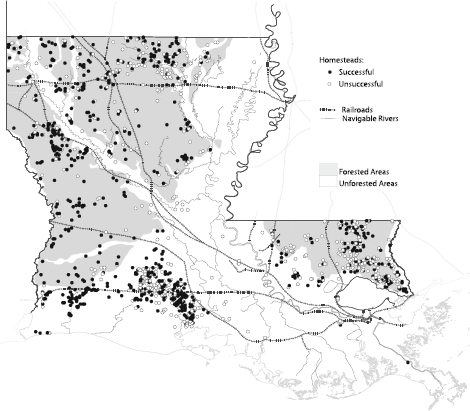
Sampled homesteads. Source: State boundaries and rivers from National Historic Geographical Information System (www.nhgis.org). Navigate rivers from Lockett (1970). Railroads from Asher & Adams (1874). Pine forest coverage from United States Bureau of the Census (1881)
Panel A of Table 1 summarizes the sample by race and by homesteading outcome. 13 Panel B summarizes our estimates of total homesteading activity in Louisiana. Columns (1) and (2) show information for all homesteaders and columns (3) and (4) exclude the 220 white and six black homesteaders meeting our fraud criteria. Blacks are underrepresented among the homesteaders. They comprised 50 % of Louisiana's 1870 population but only about 21 % of the homesteading attempts. 14
African Americans are people classified by census enumerators as “black” or “mulatto.” We do not make the distinction between these two groups, as the number of people classified “mulatto” is small in our sample and distinguishing blacks from mulattos in the empirical analysis does not change the main findings.
Even if every homesteader whose race we were unable to identify had been African American, the percentage of black homesteaders increases to only 26.6 %.
Homesteader by race and outcome
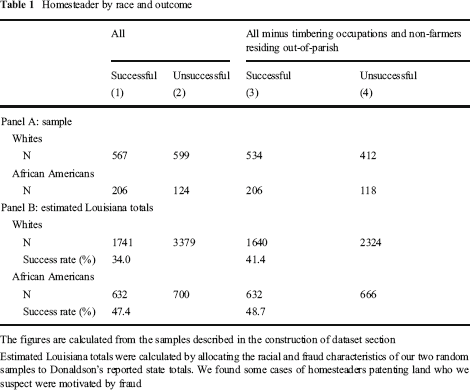
The figures are calculated from the samples described in the construction of dataset section
Estimated Louisiana totals were calculated by allocating the racial and fraud characteristics of our two random samples to Donaldson's reported state totals. We found some cases of homesteaders patenting land who we suspect were motivated by fraud
An initial analysis shows a higher success rate for blacks than for whites. White homesteaders succeeded 34 % of the time while blacks were successful in 47 % of their homesteading attempts. Lanza (1990) found a similar racial disparity for Mississippi. However, the gap narrows from 13 to 7 percentage points once seemingly fraudulent claims are excluded, as whites were more often involved with timber fraud.
Non-fraudulent homesteaders are compared with the state's agricultural populations in Table 2. As most individuals resided close to their homesteads prior to filing their claims (see below), the population statistics are for heads of households with agricultural occupations in the homesteading parishes. Virtually all of the homesteaders are men (92–96 %). 15 Homesteaders are somewhat younger in 1870 than their respective counterparts with a larger age difference for whites. African Americans are on average older than whites and successful homesteaders are older than unsuccessful ones.
By comparison, Lanza (1990) found that 12 % of the homesteaders were women. Our lower share of women homesteading is largely due to our attributing entries with female names to their husbands if they lived together in the homestead parish at the time of entry, as we often found these women were widows within a decade of entry. We suspect the husbands were the original homesteaders of record, but died after filing the claim but before receiving the patent. Female claimants were also slightly more prevalent among the fraudulent group.
Comparison of homesteaders with the agricultural population
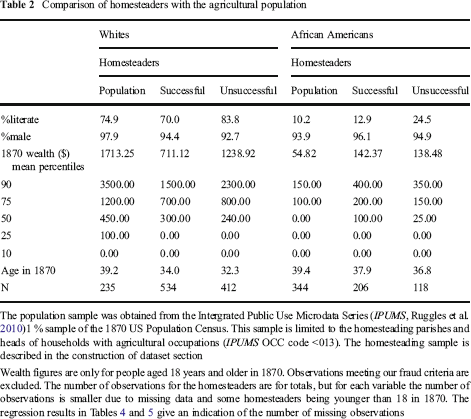
The population sample was obtained from the Intergrated Public Use Microdata Series (IPUMS, Ruggles et al. 2010)1 % sample of the 1870 US Population Census. This sample is limited to the homesteading parishes and heads of households with agricultural occupations (IPUMS OCC code <013). The homesteading sample is described in the construction of dataset section
Wealth figures are only for people aged 18 years and older in 1870. Observations meeting our fraud criteria are excluded. The number of observations for the homesteaders are for totals, but for each variable the number of observations is smaller due to missing data and some homesteaders being younger than 18 in 1870. The regression results in Tables 4 and 5 give an indication of the number of missing observations
White homesteaders have substantially less wealth, defined as the sum of personal wealth and real estate wealth reported in the 1870 census, while black homesteaders have more wealth than non-homesteaders. 16 This pattern is consistent with wealthy (white) farmers having had little need to homestead, while homesteading may have been out of reach for some of the very poor (blacks). Contemporary writers estimated a settler would need $600 to $1000 to relocate, register, sustain themselves and establish a farm (Deverell 1988). A lack of wealth, however, did not prevent some individuals from trying and succeeding, as many homesteaders reported no wealth in the 1870 census. Successful and unsuccessful African American homesteaders have similar mean wealth, although the successful had a higher median. By comparison, the median wealth of whites is also larger for successful homesteaders, but unsuccessful homesteaders had greater mean wealth. 17
Wealth comparisons are made only for people aged 18 and older in 1870. In 1870 the SHA had not been in operation long enough for any claimants to obtain title to their land, so reported wealth figures should exclude the value of the homestead.
Among whites, the greater mean wealth of successful homesteaders may result from some wealthy individuals having filed homesteading claims to clear timber with no intentions to homestead.
The literacy rates of homesteaders and of the population are similar for both races. However, successful homesteaders have lower rates of literacy than their unsuccessful counterparts. This disparity is more pronounced among African Americans where the literacy rate is almost twice as high for unsuccessful as successful homesteaders. We hypothesize two possible reasons for this counterintuitive result. Literate homesteaders may have abandoned their homesteads more readily because they had options besides homesteading; literate homesteaders may have had higher opportunity costs. Alternatively, literate homesteaders may have recognized the poor quality of the land faster than illiterate homesteaders and rationally abandoned it. Unfortunately, differentiating between these two hypotheses is beyond the scope of our data.
Hoffnagle (1970) writes of large groups of African Americans migrating long distances together through Florida in search of fulfilling their dreams of landownership. Such endeavors, at least in Louisiana, were not typical. Table 3 summarizes the locations of homesteaders in 1870 by race and by homesteading outcome, excluding those filings we define as fraudulent. Homesteaders filing before 1871 are excluded, removing about 15 % of the observations, because these people presumably would have been at their homestead location at the time of the census. 18
Since about 30 % of observations were not matched to the 1870 census, the sample may be biased. We do not believe this bias to be large, however, as we suspect that many of these unmatched homesteaders also lived near their homesteads prior to filing. Furthermore, the matched and unmatched groups have a similar racial composition, with comparable characteristics for age, success, and literacy in each group.
Location of homesteaders prior to entry (1870)
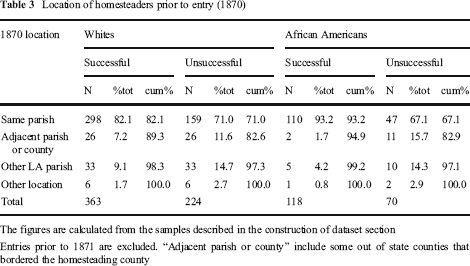
The figures are calculated from the samples described in the construction of dataset section
Entries prior to 1871 are excluded. “Adjacent parish or county” include some out of state counties that bordered the homesteading county
The large percentage of homesteaders residing close to their homesteads prior to filing suggests that the perceived quality of land available was not sufficiently high to induce many people to travel great distances. About 87 % of whites and 90 % of blacks came from either the homestead parish or from an adjacent parish or county. Settlers coming from the vicinity of their homesteads fared better than their far-travelling counterparts. Homesteaders coming from beyond the homestead parish comprise 29 and 33 % of the failures for whites and blacks, respectively, but only 18 and 9 % of the successes. While we can only speculate on the reasons for this greater success, two possibilities are that locals had better support networks and/or superior knowledge of the land.
Empirical Analysis of Patenting Success
Our empirical analysis examines the factors influencing the likelihood of homesteaders successfully patenting land under the SHA. As the patenting of land is a binary variable, we use a simple logit model. We define the latent variable, success*, as


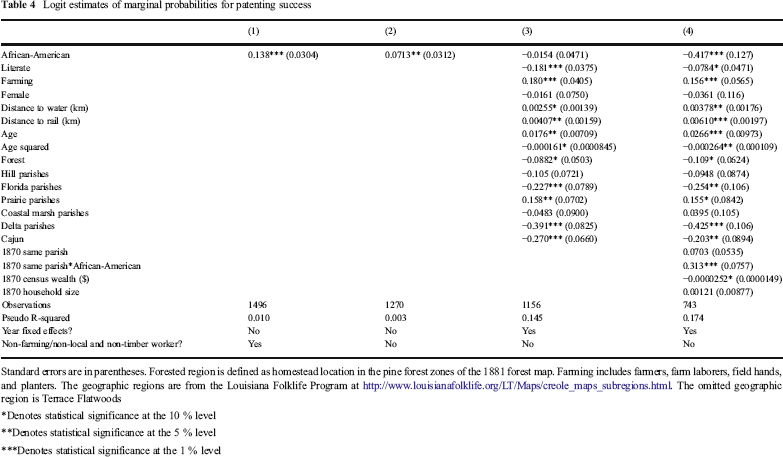
We first estimate models with both races pooled together and then estimate separate models for each race. Table 4 reports the marginal probabilities for success for a series of estimated logit models pooling both races. 19 Marginal probabilities are useful for examining the influence of dummy variables in logit estimation, as they represent the change in the probability of success resulting from a discrete change in the variable from zero to one.
Not shown in Table 4, applicants who filed in the first few and the latter years of the Act tended to have lower probabilities of success, although the differences are usually statistically insignificant.
Logit estimates of marginal probabilities for patenting success
Standard errors are in parentheses. Forested region is defined as homestead location in the pine forest zones of the 1881 forest map. Farming includes farmers, farm laborers, field hands, and planters. The geographic regions are from the Louisiana Folklife Program at http://www.louisianafolklife.org/LT/Maps/creole_maps_subregions.html. The omitted geographic region is Terrace Flatwoods
Denotes statistical significance at the 10 % level
Denotes statistical significance at the 5 % level
Denotes statistical significance at the 1 % level
In model (1) only race is regressed on patenting success. Here African Americans have a statistically-significant 13.8 percentage point larger probability of success than whites. By excluding the likely fraudulent applications in model (2), the African-American coefficient is still statistically significant, but smaller (7.1 percentage points).
Model (3) adds a series of control variables, including dummy variables for literacy, occupation (farming), and gender, distance to navigable waterways, distance to railways, the age and age squared of the applicant at the entry year, and dummy variables for Cajun parishes, region, and entry-year. The Cajun and regional variables provide broad controls for soil quality, culture, and racial composition. 20
Too few entries were made in some parishes to include all parish effects in the models without losing observations. Although we do not report the results, we examined a version of model (3), which included interaction terms between African-American and all other independent variables. Including the interaction terms did not alter the overall results of the model nor did it significantly affect coefficients on other variables. The only interaction terms which were statistically significant were Farming*African-American, Delta parishes*African-American, and Cajun*African-American.
The additional controls make the effects of race statistically insignificant, although this will change in model (4). Revisiting Lanza's view that African Americans were more successful homesteaders, this analysis shows that African Americans were more likely to have farming backgrounds and were less likely to be literate, both of which are associated with a higher probability of homesteading success. Among black homesteaders, 65.8 % had “farming” occupations while 55.4 % of whites had farming occupations. Controlling for occupation and literacy while eliminating the likely fraudulent filings eliminates the statistical significance of race. Gender is unrelated to success. Distance to navigable waterways and railways both have statistically positive effects. The seemingly counterintuitive effects of distance to rail and waterways may be because the only land available near transportation was of low quality. 21 A quadratic relationship with age is present with relatively young and old applicants having lower probabilities of success. The influence of literacy is oddly negative, statistically significant, and large (−0.181), but this effect decreases when additional variables are controlled for in the next model.
Maximum acreages were also halved for homesteads located within six miles of rail or waterways.
Model (4) adds four variables calculated from the 1870 census: a dummy variable equal to one if the homesteader resided in the homestead parish, this same dummy variable interacted with African-American, wealth, and household size. Our sample size is reduced as observations are limited to homesteaders 18 years of age and older in 1870 and to entries filed in 1871 or later. Since the census reports household wealth, including minors living with parents will upwardly bias wealth estimates. Settlers who homesteaded in 1870 or earlier would likely be listed in the 1870 census at the homestead location. Adding these four variables induces two qualitative changes. Literacy is now only marginally significant. 22 More important is that the marginal effect of African-American is now negative, significant, and large (−0.417). The effect of homesteading in the parish of prior residence is positive but insignificant. However, 1870 same parish*African-American is significant and positive. Homesteading near where one lived had no significant impact on white success although it significantly improved the likelihood of African-American success.
Including a race-literacy interaction term does not alter the results of the models.
Care must be taken in interpreting the impact of the variables African-American, 1870 same parish, and the interaction of the two. African-American and 1870 same parish*African-American have a correlation coefficient of 0.8795, raising the issue of multicollinearity. 23 In model (3) we found that when controlling for other variables, our sample of African-Americans succeeded at the same rate as whites. However, these aggregates mask heterogeneity within the African-American sample that is not present in the sample of whites homesteaders. This heterogeneity only becomes visible in model (4). The insignificance of 1870 same parish implies that migrating to a new parish to homestead had no impact on the success rate of whites. The significance of 1870 same parish*African-American implies that African-Americans were far more likely to succeed when they homesteaded in the parish where they lived. We believe that the interpretation of the large and significant marginal effect of African-American (−0.417) is that among those who relocated to homestead, i.e. observations where 1870 same parish*African-American = 0, blacks were 41.7 % less likely to succeed than were whites. For African-Americans the total beneficial effect of homesteading in the parish where one lived (0.0703+0.313=0.3833) largely counteracts the negative effect of race (−0.417). We attribute this location effect to locals having an information advantage when choosing a promising homestead site, to having a support network of family and friends close by, or a combination of the two. Furthermore, local whites may have resented an influx of African-American homesteaders from elsewhere. 24
In a version of model (4) which excludes the interaction term, African-American is statistically insignificant while 1870 same parish becomes significant and positive.
While we do not evaluate the effects of white resistance to black landownership, some areas of Louisiana exhibited higher levels of violence towards African Americans. See Vandal (1991, 1994).
The coefficient on household size is statistically insignificant. The influence of 1870 census wealth is statistically significant and negative, but small in size. We address the source of this wealth effect in the following regressions.
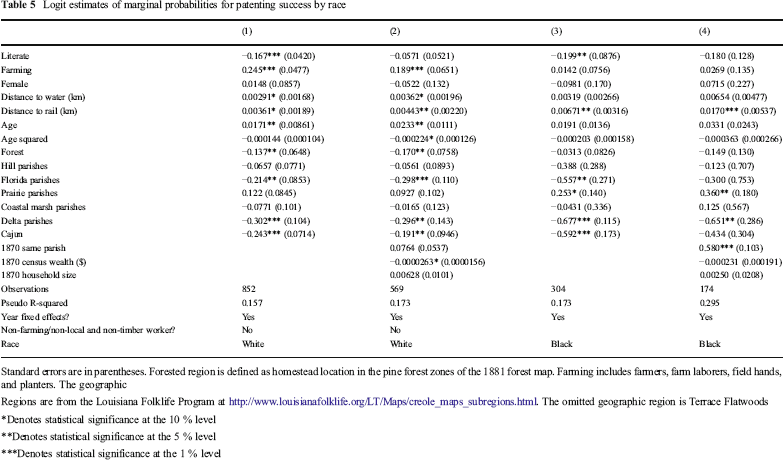
Race-specific models are presented in Table 5. The first two models are analogous to models (3) and (4) of Table 4 but with observations limited to white homesteaders. Models (3) and (4) use the same regressors as models (1) and (2), but are estimated for black homesteaders. The pattern of results is similar to the pooled results.
Logit estimates of marginal probabilities for patenting success by race
Standard errors are in parentheses. Forested region is defined as homestead location in the pine forest zones of the 1881 forest map. Farming includes farmers, farm laborers, field hands, and planters. The geographic
Regions are from the Louisiana Folklife Program at http://www.louisianafolklife.org/LT/Maps/creole_maps_subregions.html. The omitted geographic region is Terrace Flatwoods
Denotes statistical significance at the 10 % level
Denotes statistical significance at the 5 % level
Denotes statistical significance at the 1 % level
Among the demographic variables, farming, age, age squared, and wealth are significant for whites but not for blacks. Same parish is significant for blacks but not for whites. Farming may be significant for whites and not for blacks because white occupations appear to be more varied. Virtually all occupations held by blacks required manual labor. Many of the occupations of whites did not. Additionally, the significance of farming among whites may result from unidentified instances of fraud, as we believe that most of the fraudulent claims were from non-farmers and few of these fraudulent claimants patented their claims. Age and age squared may have been less important for African-Americans since most could rely on local kinship networks to supplement their own experience. Wealth has a statistically significant but economically small impact on whites but not on African Americans. A $1000 increase in wealth decreases the probability of white success by 2.6 %.
Conclusion
Our analysis is limited based on the sample from Louisiana. If the patterns we uncovered were echoed in the other four Southern states, then the success of the SHA in assisting ex-slaves in becoming landowners was not very effective. In Louisiana only 21 % of the homesteaders were African Americans, even though they comprised 50 % of the state's population in 1870. Thirty-seven percent of homesteaders succeeded in gaining title to their land. During this time period, settlers nationwide faired much better, with 69 % of entries receiving a patent. 25
Nationwide, a total of 285,272 entries were filed from 1867 to 1876. 197,621 homestead patents were awarded from 1872 to 1883, a success rate of 69.3 %. See Shanks (2005, p 27–29).
Although low levels of wealth did not significantly influence success, it likely deterred many African Americans from attempting to homestead in the first place. Lanza (1990) suspected African Americans were more successful because of their strong desire to find some semblance of freedom. Empirical analysis shows that most Louisianans homesteaded locally. Migrating from another parish had little noticeable effect on white success, but it had a significant impact on African-American success. Overall, whites and blacks had the same success rate. However, local African Americans were more likely to succeed than their local white counterparts and African Americans who relocated to homestead were less successful than relocating white homesteaders. Local African Americans may have had better information on land quality, stronger support networks, and they may have been less susceptibility to mismanagement and dishonesty by government officials. They may have also been subject to less hostility from local whites than were African Americans who came from elsewhere. Beyond race, farming experience and literacy were key.
Footnotes
Acknowledgments
We thank several anonymous reviewers and the participants of the 2010 Agricultural History Society Conference at Rollins College for their helpful comments. We are greatful to Elbie Bentley for excellent research assistance. Partial support for this research came from Teaching and Productive Scholarship Grants from USC Upstate.