







Abstract
We assess whether occupational segregation in metropolitan labor markets is associated with the wages of, and contributes to racial/ethnic wage disparities among, less-educated men. To measure occupational segregation in metropolitan low wage markets, we create a segregation index measuring segregation between white, black, and Latino male high school-only educated workers and high school dropouts in 95 metropolitan labor markets utilizing a unique dataset of the structural characteristics of the ninety-five largest US metropolitan labor markets. We use regression, fixed effects, and generalized least squares estimation techniques to test whether this index is associated with wages and racial wage inequality among these men. The analyses reveal that in metropolitan labor markets characterized by more racial and ethnic segmentation in the low wage market, wages are lower among black and Latino men in particular, and racial-ethnic wage disparities among similarly less-educated white, black, and Latino men are higher.
There has been widespread attention to the exclusion of workers with a high-school degree or less from well-paying jobs in the new economy (Holzer and Nightingale 2007). However, less attention is paid to the amply documented wage and employment differences among less-educated workers by race and ethnicity (Mishel et al. 2008), and the mechanisms underlying them. The unemployment rates among black male high school graduates and dropouts is twice that of white male high school graduates and dropouts (U.S. Bureau of Labor Statistics 2014).
There is significant mobility into and out of low wage work, even among those with less education. Holzer et al. (2004) find that a key way workers in the low wage sector increase their wages is through job change. Thus, who gets access to better-paying firms is as much a determinant of his/her wages than his/her individual characteristics. Evidence has pointed to the especially limited job availability for minority, high school dropouts in urban areas, indicating that minority workers in low wage labor markets are confined to even fewer opportunities (Holzer and Danziger 2001). For example, as occupational niches among black and Latino men grew over time, Liu (2012) observed increases in racial/ethnic occupational segregation in Atlanta's low-skilled labor market.
In this paper we propose that occupational segregation is a mechanism that hurts low wage workers generally, and in particular underlies a source of racial wage disparities among similarly credentialed men in metropolitan labor markets. This crowding may, in concert with other factors, exclude some job opportunities, and by narrowing job options for low wage workers, contribute to lowering their wage rates. To examine racial wage disparities among low-credentialed men, we map the phenomenon of occupational segregation in low-wage markets, or the extent to which less-educated men are segregated from one another in these markets, and analyze the relationship of occupational segregation to wages of different racial/ethnic groups and to racial wage disparities in metropolitan labor markets. We test this hypothesis in the largest 95 U.S. metropolitan labor markets by measuring crowding and other key characteristics of metropolitan labor markets and their effects on wage disparities among less-educated men.
We believe this work contributes to our understanding of the dynamics of wage setting in local labor markets. Examining group inequality across metropolitan labor markets, rather than at the national or individual level, allows us to tease out important variation across local labor markets. Conceptually, we are interested in group disparities, thus, the analyses are constructed at the group level with the goal of elucidating mechanisms that drive group inequality. Additionally, our approach draws from the notions of both occupational segregation and crowding: it asks, does a pattern of job isolation hurt low wage workers, and especially harm minority workers? Implicitly much of the social science research on wage inequality assumes occupational segregation of low-wage workers does not hurt wages and does not investigate further. This lens could offer an explanation for racial and ethnic differences among less educated workers, independent of worker productivity, and expand our understanding of wage-setting mechanisms, particularly for less-educated men in metropolitan labor markets.
Occupational Segregation, Crowding, and Group Disparities
A 2011 analysis of occupations held by men in the US labor market reveals that nearly 90% of occupations are racially segregated–that is, either over or under-representation of black males. Not surprisingly, the occupations in which they were underrepresented had higher wages, and conversely occupations in which they were overrepresented had lower wages (Hamilton et al. 2011). This study also found significant racial occupational segregation among occupations that have low degree requirements. “For example, black males tend to be under-represented in relatively high wage construction occupations, whereas they tend to be over-represented in substantially lower wage service occupations that require substantial customer contact.” (Hamilton et al. 2011:21).
Research on pay has demonstrated that the relative position of minority workers in the labor market to white workers across occupations is a key factor underlying racial earnings disparities (Mason 1999; Tomaskovic-Devey and Skaggs 1999). Racial composition of jobs has been connected to pay in those jobs for blacks and Latinos (Kmec 2003). An analysis of the impact of shifts in the race/gender composition of occupations on pay revealed that pay deteriorated over time in occupations with a large percentage of black men (Catanzarite 2003); the researcher found this same effect for Latino men as well (Catanzarite 2002). Other work has found a depressive effect of black composition on wages for both black and white incumbents of these jobs, albeit more strongly for black workers (Huffman and Cohen 2004).
Disciplinary Perspectives on Occupational Segregation and Crowding
Occupational segregation and crowding have been employed to explain group disparities in labor market outcomes in both sociology and economics, with somewhat different approaches. Occupational segregation is most commonly used in sociology, whereas occupational crowding is more commonly used in economics. While both measures seek to ascertain the extent to which groups are separated from one another among occupations, there are important differences. Occupational crowding is concerned with the concentration of one group across a set of occupations relative to another group, and is particularly interested in whether one group is over or under-represented among a set of occupations with respect to their expected representation given their educational credentials. Occupational segregation measures the differential distribution of two groups across an occupational structure and the extent to which the groups are evenly, or unevenly, distributed. The measure does not focus directly on underrepresentation or concentration of one particular group; its focus is on the relational position of the two groups in the structure. Occupational segregation does not explicitly account for education (we do so by using only less-educated men in the analysis), or traditionally focus on any particular stratum of the labor force. It determines whether each group's representation in each occupation is the same as its representation in the labor force, or more broadly if there is an association between occupation and group membership (Weeden 2007).
The goal of the current study is not to compare the two: segregation vs. crowding. We chose segregation because it is more appropriate to our question—how disparate are the jobs that less-credentialed men work in by race. However, conceptually we borrow from both measures in that we measure occupational segregation while explicitly controlling for education, by only looking at less-educated men, which is not typically the case in segregation studies. In their examination of workplace segregation, Hellerstein and Neumark find that there is a great deal of segregation of workers by education, but that differences in education levels do little to explain racial segregation of Black workers from whites. (Hellerstein and Neumark 2008).
A great deal of the social science research on wage inequality is focused on the premise that the most significant group differences are across educational categories and not within. Findings from studies that do investigate differences among workers with similar productivity characteristics, such as skill and education, are telling and highlight the importance of examining alternate mechanisms in labor markets that mediate access to different jobs and account for wage differences among workers. Coleman's (2003) study of employer ratings of the skills of black and white male workers (a more direct test of observed productivity) revealed an increased racial wage gap among men with the same employer rating, rather than a reduced gap. Given that we know from labor market data that there are significant group differences within educational categories, we investigate these differences and look to see if a particular mechanism, occupational segregation, helps explain these differences.
It is also possible for groups of workers to cluster because they have unequal access to job information. The effective use of networks in job search can theoretically lead to higher wages. (See for instance, (Calvo-Armengol and Jackson 2007)) But, there are instances when job networks do not lead to higher wages. (Loury 2006) (Falcon and Luis 1995) (Mouw 2002) Differences in job networks based on residential proximity can help explain differences in employment probabilities, especially for non-whites. (Hellerstein et al. 2008).
If different groups of workers have unequal access to jobs this may artificially restrict some workers’ competitive search from the larger labor market and crowd these workers into fewer occupations, and lower their wage price. According to monopsony theories employers benefit from this restricted labor supply because it effectively lowers their recruitment costs by narrowing the pool of candidates. Since employers are not observing a perfectly elastic labor supply curve at the market clearing wage from their perspective, they may behave like firms in monopsonistic competition and hire fewer workers than would be hired in a perfectly competitive labor market. This lowers the number of workers hired and their wages. Andersson et al. (2005) find that the employment of low wage workers is concentrated among a small subset of firms. This offers some preliminary evidence of the monopsony effect in that some employers particularly seek and recruit large forces of workers at low wages in metro labor markets. Relatedly, this complements the efficiency wage theory wherein low wage workers are sensitive to job opening information, and raise their wage expectations when there are more job options available, and lower them when job opportunities are more limited. We test for this in our analyses.
Scholars have argued that residential segregation of metropolitan labor markets acts as a mechanism that spatially facilitates racial and ethnic occupational segregation (Dickerson 2007; Dickerson 2002). Because of the isolating nature of residential segregation, groups of different races do not interact with one another, and as a consequence information about jobs is spatially confined (Hellerstein et al. 2008). Relatedly, researchers have found a relationship between residential segregation and black employment rates and earnings (Dickerson 2007; Cutler and Glaeser 1997). This evidence suggests that access to work is spatially bound and that residential segregation of racial and ethnic groups in metropolitan areas may facilitate occupational crowding. Thus, we examine the effect of residential segregation in addition to occupational segregation or crowding in metro areas.
In some metropolitan areas, the presence of ethnic enclaves, or insular labor markets, is another way space plays a role in employment outcomes for minority communities. Ethnic enclaves are characterized by a concentrated customer base served by a network of small businesses owned by ethnic entrepeneurs, and closed familial and ethnic networks that enable new immigrant workers to find jobs quickly in the enclave (Castles and Miller 2009; Portes and Rumbaut 2006). However, these jobs tend to be low-wage, sometimes lower than minimum wage, and do not readily serve as a portal to the mainstream economy for these workers. In this way, space acts as a structure that channels workers to specific jobs, facilitating crowding in local labor markets.
Data and Methods
To examine occupational sorting among low-credentialed workers, we create a dissimilarity index measuring segregation between white/non-white, black/non-black, and Latino/non-Latino men who worked and had a terminal high-school degree or less in occupation-industry clusters in 95 metropolitan labor markets. We also seek to determine if this index, along with other general local labor market info, significantly affects wage inequality among these men. We expect that racial wage inequality among them will be higher in metropolitan labor markets characterized by more segmentation by ethnicity in the low wage market. We use OLS regression and fixed effects estimation techniques to test our hypotheses. As a further robustness check, we use generalized least-squares regression (because of variations in MSA size) and to test for sensitivity of outliers.
The multivariate analyses involve a cross-section analysis of the cities in 2000 to determine if variations in these structural factors affect racial wage inequality as it varies across different labor markets and a fixed-effects analysis to determine if changes in these structural factors across time within the same labor market affect racial wage inequality. Fixed-effects analysis is a simple transformation of standard OLS regression that estimates variation within an individual unit (city) over time, as opposed to variation across individual units estimated in conventional OLS. In fixed effects, for each individual unit the mean of all the observations for that individual across time is subtracted from the value for each variable (Kennedy 2006).
This study utilizes a unique dataset of the structural characteristics of the ninety-five largest US cities. The demographic, employment, educational, occupational, and industrial characteristics of this panel of cities are drawn from the 1990 and 2000 decennial censuses’ 1% Public Use Microdata Sample data aggregated to the metropolitan level. The geographic unit of observation is a “metropolitan statistical area” (MSA) or the “primary metropolitan statistical area” (PMSA), defined on a consistent basis across the two successive Censuses. The Census’ changing definitions of the metropolitan areas over the two census years resulted in substantial changes to the number of cities that were comparable over time; many cities that existed in the 1990 census no longer existed by the 2000 census, usually because they had merged with a larger nearby metropolitan area. To this dataset of city characteristics we merged residential segregation indices for 1990 and 2000, created from Census data analyzed and published by the Housing and Household Economics Statistics (HHES) Division of the U.S. Census Bureau.
Measures
Spriggs and Klein (1994) specifically define the low-wage labor market by identifying the occupation-industry clusters of recent high school graduates to concentrate on movements in starting wages, and separating them into two wage contours—one wage contour where increases in starting wages cluster with the minimum wage; the other wage contour where increases in starting wages cluster with movements in the average wage of workers. We use this same operationalization of the low wage market, meaning those who have “minimum-wage”-like jobs fall on the minimum wage contour. To determine in which occupations less-educated men were concentrated, we created a table of the occupation/industry clusters of all the black, Latino, and white men aged 18–64 in the sample who worked and had a terminal high-school degree or less. 1 This procedure takes the values from the occupation and industry variables and groups all possible combinations into a new variable in which each combination is assigned a distinct value. 2 It is important to measure both industry and occupation because minorities tend to cluster in different industries than whites and the wage structure differs across industries, and because wages cluster differently within occupation and industry cells, than just between industries or just between occupations. 3 We limit ourselves to measuring segregation within those occupation/industry clusters where the wages follow most closely wage movements of the minimum wage, excluding those occupation/industry cells that cluster with movements in average wages. So, this is an analysis among lower wage work.
Because of limitations of the dataset, we do not distinguish between GED-holders and high-school graduates.
This index was created using the STATA command, egen newvar = group (occupationvar industryvar).
Because of changes in the industry and occupational coding in the more detailed categories between 1990 and 2000, we had to aggregate the 3-digit occupation and industry codes to 1-digit for comparability across the Census years. Previous research has found that greater occupational detail often reveals wider disparities (Bielby et al. 1986). Thus, testing these associations at lower levels of aggregation, as we do here, offers a more stringent and rigorous test and likely understates the effect.
We assessed how evenly (or unevenly) distributed Black, Latino and white men were across the cells of this occupation/industry matrix using the index of dissimilarity to measure job segregation. The index of dissimilarity is a linear function of segregation, meaning that the “cost” of reducing segregation is constant from more to less segregated environments. The function is also symmetric, so it reflects the share of workers in either group that would have to change occupations to achieve an equal distribution across all jobs.
Dissimilarity is calculated with respect to the occupation/industry cell (although from here on in the text, we will only refer to occupational segregation for the sake of brevity). The formula for the Duncan index is:

where
the number of occupational categories
the total population of occupation i
the sum of all ti (the total workforce)
the ratio of the xi to the ti (proportion of occupation i's incumbents that is minority)
the ratio of X to T (proportion of the workforce that is minority)
the sum of all ti in occupation 1 up to occupation n1
the sum of all ti in occupation n2 up to occupation n
A score of 0 indicates that the members of this minority group are represented in equal proportions in all occupations, and a score of 1 indicates that they are concentrated in one occupation. The score can be roughly interpreted as the percentage of a group's employees who would have to be shifted to different occupations to obtain equal representation in all occupations.
The outcome variables for the models are group-specific mean wage at the MSA-level (in the OLS models), and MSA-level wage inequality (in the fixed-effects models). We measure wage inequality using wage ratios (mean white wage divided by the mean minority wage in the same education group).
We control for residential segregation in the model using the dissimilarity index as well. The dissimilarity index calculates how evenly two groups are distributed among the census tracts in a metropolitan statistical area (MSA). We use the group-specific residential segregation index in the analyses for blacks and Latinos (i.e. black/white segregation and Latino/white segregation) and use black/white segregation in the white male analyses because it is the higher of the two, providing a more stringent test for detecting an effect of occupational segregation. Additionally, we include three other characteristics of metro areas thought to affect the economic situation of minorities: the percent of adults in the MSA with terminal high school degrees and the percent of high school dropouts, the percent of foreign-born residents in the MSA, and the share of minority population in the MSA (percent black or Latino depending on the group-specific outcome being estimated 4 ) to address the minority concentration thesis (Blalock 1956; Beggs et al. 1997). The minority concentration thesis describes the consistent inverse association between minimum population size and economic conditions found in metro areas. We include percent foreign born in the MSA to control for the widely debated substitution effect that immigrant labor is theorized to have, particularly on the employment of minority men in jobs that require less credentials.
Percent minority and residential segregation measure different phenomena and are not overlapping measures. (Massey and Denton 1988).
We also control for manufacturing and public sector employment density (percent in the MSA employed in that industry), as well as service and retail sector employment. We control for the presence of manufacturing and the public sector (which tend to employ workers using more formal hiring processes), both to allow for substitution effects between low and high wage workers across low and high wage sectors, but also to accommodate Lang et al. (2005) hypothesis that the presence and availability of jobs in an open formal labor market will affect the level of segregation in the labor market. In their model, if workers have different levels of risk aversion for accepting the longer job search that may be necessary in the formal labor market, then there will be different levels of job segregation in low wage labor markets. This would make our model a reduced form of their equations.
Our model uses the “wage curve” (the inverse relationship between unemployment rates and wages, Blanchflower and Oswald 2005) of race-specific metropolitan unemployment rates (log unemployment rate) and wages, and, an own-group supply measure to capture both supply effects and potential network size effects. Efficiency wage theory underlies the “wage curve,” and to the extent that the perception of job opportunities for black, white or Latino workers are different, and then in addition to unemployment rate differences, different levels of segregation will also be inversely related to wages. However, the primary characteristic of interest is low wage job segregation as measured by the index of dissimilarity.
Results
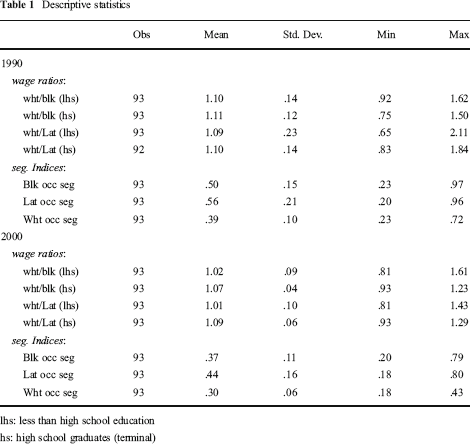
The descriptive statistics in Table 1 and Fig. 1 reveal that racial/ethnic occupational segregation and wage disparities among less-educated white, black, and Latino men in metro labor markets is prevalent and substantial in many of these markets.
Descriptive statistics
lhs: less than high school education
hs: high school graduates (terminal)
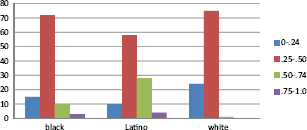
Level of occupational segregation
Table 1 reveals that both mean segregation and wage inequality among these men decreased between 1990 and 2000; however, the variation among markets is substantial. There is substantial variance in racial and ethnic occupational segregation in low wage metropolitan labor markets, with some highly segregated, and others showing modest to little segregation. Latino occupational segregation is highest, followed by blacks, and then whites who have the lowest. Occupational segregation indices for all groups decreased between 1990 and 2000 (that is, occupational segregation among less educated men overall decreased), however group order did not change. The white/black wage disparity is highest in 1990, and in 2000, the white/Latino disparity is the highest. In both years, the highest wage disparities are among high school graduates.
The standard deviation is sizeable as well. This variation in occupational segregation across MSAs points to the fact that racial/ethnic occupational crowding or segregation is not necessarily a standard, inevitable feature of metropolitan labor markets. Fig. 1 offers another way to look at the distribution of segregation across metro labor markets by showing the levels of segregation (low, moderate, high, and very high) distributed across metro areas. The modal category for all groups is moderate (dissimilarity index of 25–49). High and very high levels of Black and Latino segregation are more prevalent than levels of white segregation. The change in the D index from 1990 to 2000, indicates that racial/ethnic job segregation in low wage markets decreased during that period, likely driven by the boom of job growth during the 1990s. In tight labor markets firms tend to be more integrated, and are more likely to hire minorities (Moss and Tilly 2001; Darity 1975).
Our central question is whether or not occupational segregation affects mean wages for less-educated men and whether it affects white/minority wage disparities among these men in metro labor markets. To address these questions we conduct three sets of multivariate analyses. First, we examine the impact of occupational segregation on group mean wages at the metropolitan level using OLS to determine if and to what extent occupational segregation affects the mean wages of each racial/ethnic group. The goal of the second set of analyses is to assess whether different levels of occupational segregation across cities are associated with wage disparities between less-educated white and minority men across metro areas using OLS and generalized least squares. The third set of analyses, the fixed-effects analyses, ascertains whether changes over time in segregation within a city affect white/minority wage disparities. We conduct separate models for terminal high school graduates versus high school dropouts. Since our analysis is within levels of educational attainment, educational attainment is not a variable in our models. There is a strong relationship between residential segregation and occupational segregation (Pearson's r = –0.46 for black occupational and residential segregation), so the models are shown with and without residential segregation to show the effect of occupational segregation in both cases. In short, our findings show that occupational segregation impacts group wages and is significantly related to white/minority wage disparity; however, the patterns are different for black/white and Latino/white wage disparities, and across and within metro areas over time.
Tables 2 and 3 report the results of the ordinary least squares regressions which estimate the impact of the characteristics of MSAs on the mean wages of black, Latino, and white high school dropouts and terminal high school graduates. The coefficients on occupational segregation in Table 2 reveal that the mean wages of less-educated black, Latino and white males (the analyses are group-specific) are lower in metro areas where racial/ethnic occupational segregation in “minimum wage”-like jobs among less-educated men is higher. More specifically, lowering the D index by 10 points for black and Latino men would raise wages 38 and 30% respectively (using coefficients in model 2) 5 ; more specifically if only a small share of blacks or Latinos shifted jobs to make them more equally distributed relative to non-black and non-Latino workers in the low wage labor market it would improve wages substantially for these black and Latino men. This would be consistent with the occupational isolation following from monopsony labor markets. White men stand out from the other two groups in that occupational segregation does not significantly impact the wages of terminal white male high school graduates when controlling for residential segregation. In those cities where residential segregation is higher, white men's wages are higher; suggesting a positive effect that residential based job networks may have on job outcomes. This is also true for black men, where residential segregation does have a positive effect on wages, though measured with slightly less precision; again, suggesting that to the extent that occupational segregation is linked to residential based job networks it does help boost wages. That is, when blacks and whites are more segregated or crowded into separate neighborhoods, where much of job information is shared, white men's wages are higher. Dickerson (2007) finds a parallel result for employment. Although we do not directly test for it, social networks may be behind this association. Green et al. (1999) find that social networks tend to include neighbors, friends and family who live nearby. Research has shown that networks are defined by geographic proximity and have a significant influence on individual employment (Patel and Vella 2007; Bayer et al. 2005; Topa 2001; Laschever 2009). Small (2007) found that social networks are more constrained in high-poverty neighborhoods. Hellerstein et al. (2008) empirically linked occupational crowding at the establishment level to neighborhood-based networks, by comparing the percent of a worker's neighbors who work at the same establishment to the random probability of neighbors being co-workers. The authors speculate that neighbors inform each other of jobs at specific establishments near the neighborhood. This effect was more important for blacks than whites, for workers with less education of both races, and for Hispanics compared to whites and blacks, especially immigrants and those with poor English skills.
To calculate the percent change in the dependent variable in a semi-log model where Y (wages) is logged (natural log), we use the 100 * (eβ –1).
Effect of Occupational Segregation and other Metro Characteristics on Mean Wages of High School Graduates, OLS

Standard errors in parentheses
p < .01,
p < .05, + p < .1
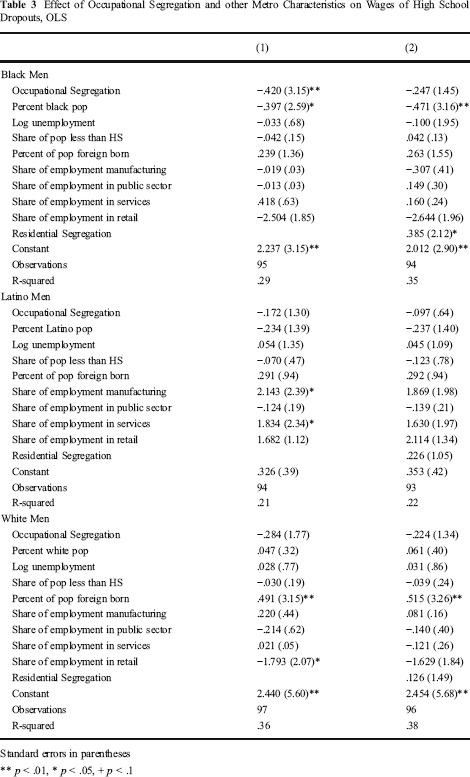
Effect of Occupational Segregation and other Metro Characteristics on Wages of High School Dropouts, OLS
Standard errors in parentheses
p < .01,
p < .05, + p < .1
Table 3 shows the same model for high school dropouts and reveals that occupational segregation is significantly related to mean wages only for black high school dropouts, but this effect is muted when controlling for residential segregation in model 2. That is, to the extent that occupational segregation is driven by residential segregation and therefore likely to reflect residential based job networks, black high school dropouts are helped, as the coefficient on residential segregation is positive and significant. Variation in occupational segregation across cities is not significantly related to wage levels of Latino and white high school dropouts across metro areas. We also used generalized least squares as a robustness check to these models; they corroborate these findings, with two exceptions (wages of white male high graduates are positively associated with occupational segregation, and white dropouts wages are negatively associated with segregation). For the sake of brevity here, we do not show these results, but can make them available.
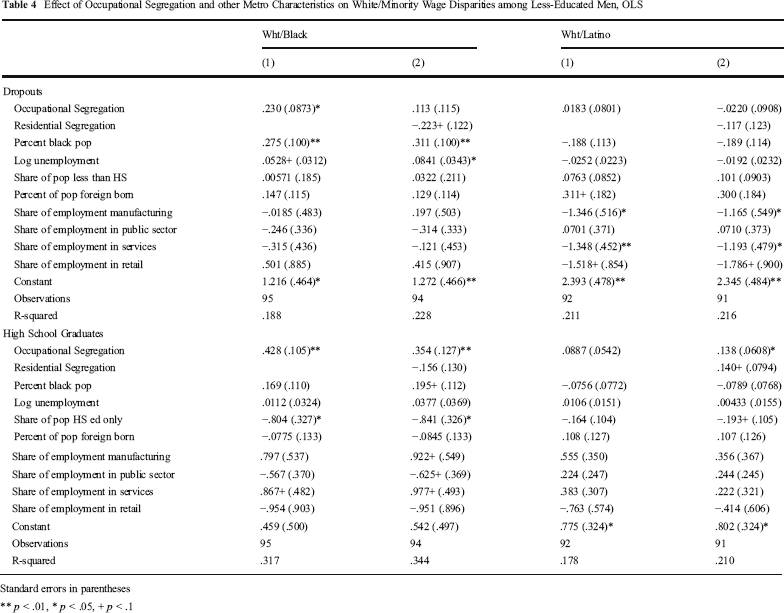
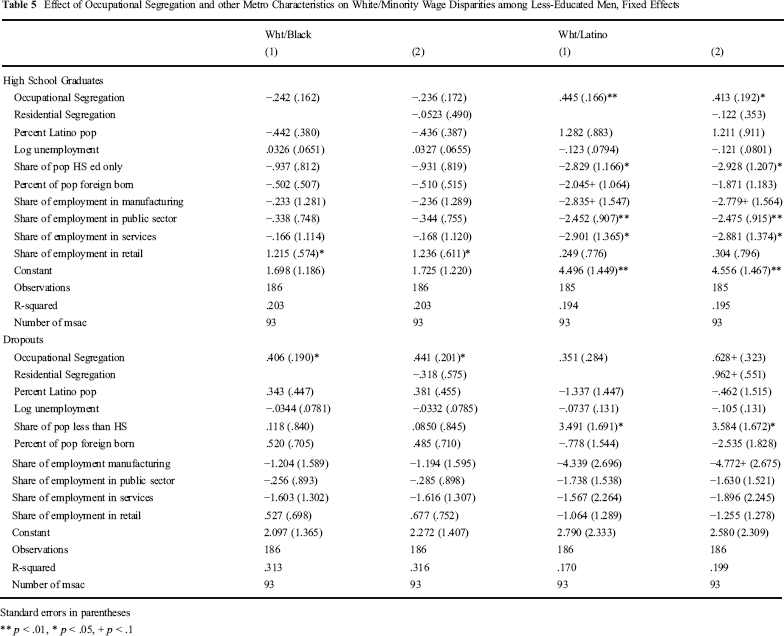
We address our second question, whether or not the depressive effect of occupational segregation on wages for minority men explains wage disparities between minority and white men, in the next set of analyses. The wage ratio analyses reported in Tables 4 and 5 are designed to determine if occupational segregation explains racial disparities in wages among similarly credentialed men across metropolitan labor markets. The analyses in Table 4 assess whether different levels of occupational segregation across cities are associated with wage disparities between less-educated white and minority men across metro areas using OLS. The fixed-effects analyses in Table 5, ascertain whether changes over time in segregation within a city affect white/minority wage disparities. First, in Table 4 the OLS analyses reveal that occupational segregation contributes to wage disparities between white and black men with terminal high school degrees; in cities with more segregation among similarly credentialed white and black men, wage disparities are higher. This means that lowering the D index by 10 points would decrease the black-white wage ratio by 0.35; again, if only a small share of blacks shifted jobs to make them more equally distributed relative to non-black workers in the low wage labor market it would lower wage disparity among men with the same credentials. Wage disparities between white and Latino high school graduates are also significantly affected by occupational segregation when residential segregation is included in the model.
Effect of Occupational Segregation and other Metro Characteristics on White/Minority Wage Disparities among Less-Educated Men, OLS
Standard errors in parentheses
p < .01,
p < .05, + p < .1
Effect of Occupational Segregation and other Metro Characteristics on White/Minority Wage Disparities among Less-Educated Men, Fixed Effects
Standard errors in parentheses
p .01,
p < .05, + p < .1
Occupational segregation is significantly related to wage disparities between white and black high school dropouts, but again when residential segregation is introduced, this effect disappears. Wage disparities between white and Latino male dropouts across metropolitan areas are not affected by occupational segregation.
Now we turn to the fixed effects models in Table 5. These models allow us to examine whether changes in occupational segregation over time affect racial wage inequality within a metro area and also serve as a robustness check to the OLS models. The fixed effects analyses in Table 5 reveal that occupational segregation is significantly related to wage inequality among white/Latino high school graduates and white/black dropouts, as well as white/Latino dropouts when controlling for residential segregation. This means that as occupational crowding increases in a metropolitan labor market over time, the wage disparity between white/Latino high school graduates and white/black and white/Latino high school dropouts increases.
The inclusion of residential segregation in the models in several instances moderated the effect of occupational segregation on wages and wage inequality. This effect was inconsistent and varied across the models. In the majority of these cases, the effect of occupational segregation was reduced but remained significant. Correlation analyses show that occupational segregation and residential segregation are correlated (R = –0.36 for black/white and R = –0.46 for Latino/white). Previous research offers some insight into possible reasons for this association. Dickerson (2008) finds that adults who lived in metro areas with high residential segregation as youth were more likely to work in occupations that had higher compositions of black workers, and hypothesizes that residential segregation facilitates the social closure of opportunity by channeling information about specific jobs in limited networks within neighborhoods.
The analyses are also consistent with our hypothesis that job segregation is associated with increased wage inequality among similarly-educated men by race, both across metro areas and within metro areas across time. The results are somewhat different for within city changes over time (shown in the fixed effects models) and are different than across city variations (the OLS models). Over time changes in occupational segregation affected white/minority wage inequality for Latino high school graduates and black high school dropouts. However, across city variations in occupational segregation affected white/minority wage inequality for black and Latino graduates and not dropouts. This could be because high school educated workers are more likely to compete in the formal sector of the labor market.
Conclusion
The goal of this study was to assess the association of occupational crowding to the wages of, and on wage inequality among, black, white, and Latino men in the less-educated sector of metropolitan labor markets. First, we found a substantial degree of racial and ethnic occupational segregation among similarly less-educated (terminal high-school degree or less) black, white, and Latino men in the low-wage sector. In fact, we found levels of segregation in the low-wage sector commensurate with levels of racial/ethnic segregation found in the overall labor market in previous studies (Kmec 2003). One of the primary explanations of racial/ethnic differences in wages is racial/ethnic disparities in education levels, but here we find wage gaps between workers of the same education levels. This suggests that there is something else driving occupational segregation than just education levels and that segregation works not just by sorting workers into low-status versus high-status jobs. For men with a terminal high school education, this effect lowers the wages of men, while for high school drop-outs segregation does not have a significant effect. Our central question is whether this segregation is related to their wages and contributes to racial wage inequality among these men.
The analyses revealed that occupational segregation is associated with lower wages for black, Latino, and white male high school graduates, and those of black dropouts (although, for white high school graduates and black dropouts, the effect becomes insignificant when controlling for residential segregation). Occupational segregation is associated with increased wage inequality across MSAs for white/black high school graduates, and within MSAs over time among white/black dropouts and white/Latino high school graduates. More specifically, wage inequality between white and black male high school graduates is higher in metropolitan labor markets characterized by more racial and ethnic segmentation in the less-educated wage market, and wage inequality among white/black dropouts and white/Latino high school graduates also increased in metropolitan labor markets where occupational segregation increased between 1990 and 2000. We argue that crowding is an instrumental mechanism that contributes to low wages in metropolitan labor markets. In many of the analyses, wage disparities and the depressive effect of occupational segregation on wages was more pronounced among dropouts than high school graduates. While there is significant racial disparity in unemployment among high school dropouts, perhaps among those who do have jobs, there seems to be less disparity in pay affected by occupational segregation in “minimum-wage”-like jobs. This could reflect that high school dropouts already have low wages and fewer prospects to bid up their wages as would take place for high school graduates in more competitive labor markets; that is, to the extent that the segregation of workers reflect the operation of monopsony. Also, the exceptionally high rate of incarceration among black and Latino dropouts absorbs many out of the labor market and out of these analyses, which examines only those who are employed.
A theoretical consideration we introduced in the beginning to explain the effect of job crowding on wages was efficiency wage theory. These findings are consistent with the efficiency wage theory in that we also find support for the wage curve—an inverse relationship between group-specific unemployment and wages. This complements the job segregation/network effect: low wage workers are sensitive to job opening information, raise their wage expectations when there are more job options available, and lower them when job opportunities are more limited. Social networks conduct information to job seekers, thus enabling the wage effects of this mechanism. While we do not test this directly, the results support this possible explanation.
We want to be careful in interpreting these results to emphasize the association between the variables of interest, and not necessarily a causal relationship. There are potentially other features of metropolitan labor markets that account for this relationship. We have included a number of metropolitan variables indicated in the literature as important to wages and wage inequality. Since the list of other factors that could be included is potentially limitless, we employ fixed effects analyses to control for unobserved effects. We think this association is important and adds insight to our understanding of wage dynamics in metro labor markets.
The racial/ethnic segregation we document within the low-wage labor market may be indicative of the operation of social networks, which themselves are segregated by race/ethnicity (Falcon and Melendez 2001), as groups crowd into a smaller set of jobs they learn about from personal contacts. However, network utilization can have negative consequences. Blacks who use predominantly black networks are less likely to be employed, and when employed, earn lower wages on average than blacks who have access to and use non-black networks (Lichter and Oliver 2000). Green et al. (1999) found a similar pattern for Latinos as well; however, they found the opposite is true for whites, suggesting that the quality of job information in the networks of different racial groups is vastly different. Whites and minorities have access to different networks and have access to information about different jobs, which is likely driving occupational segregation among workers who have the same education credentials. As a result, network use has different returns for different racial/ethnic groups. “Labor market networks may be race/ethnic-based so that reliance on informal referrals in predominantly white labor market benefits whites at the expense of other groups (Hellerstein et al. 2008:2).” We do not measure networks directly here. Residential segregation has been argued conceptually to structurally facilitate the segregation of social networks, specifically through spatial proximity (Dickerson 2007). We propose that our finding that occupational segregation is associated with decreased wages, after controlling for residential segregation, is suggestive evidence that monopsony power and networks act as a mechanism underlying this effect.
Poor information about jobs and weak networks are key mechanisms that determine access to good versus bad jobs for similarly less-educated workers (Katz 1986). These referral networks are appealing to employers because they lower recruitment costs and narrow the pool of similarly qualified candidates. Social networks may limit options for minority workers in the low wage market by effectively crowding these workers into fewer jobs as their networks generate information about fewer jobs than do similarly-educated white workers. This artificially increases the supply of minority workers over a smaller set of jobs, which consequently lowers the wage that employers pay to retain these workers.
Findings from a qualitative study of a similar group of workers complement and add some support to this proposition. Royster's (2003) study of the role of networks among blue-collar white and black young men qualitatively mirrors the findings here and suggests to us that networks underlie our findings. She followed black and white young men from a vocational high-school into post-high school employment and found that from the outset even though they had similar grades in the same classes, the white men earned higher wages and experienced less unemployment than their black counterparts. Her investigation revealed that this disparity was a result of networks; the white men received more instrumental and effective guidance and help from family and friends and from white male teachers at the school than the black men.
By quantitatively examining these patterns within and across numerous metropolitan areas, the current study adds another layer of insight to understanding how occupational crowding caused by networks contributes to racial wage inequality. The metropolitan-level analysis allows us to examine these dynamics at the local labor market level, allowing for variations across local labor markets that vary along different dimensions that we control for in the model. This expands our understanding of how the employment experience is shaped by the context and dynamics of the local labor market.
These fixed effects findings, which have a longitudinal component, also suggest that occupations within some industries in some metropolitan labor markets may become racialized over time. That is, as more workers of a particular race or ethnicity crowd into the job over time, the job gets labeled or associated with those workers and continues to grow with that group from both the supply side and the demand side. Employers seek workers of that race/ethnicity and workers of that group are drawn to it through social networks. Signaled by the growing composition of a certain race/ethnicity, outgroup workers tend to not seek work there[cites]. Evidence that blacks apply selectively to jobs by firm characteristics (Holzer and Reaser 2000), and the persistent finding that firms with black hiring agents are more likely to hire blacks than those with white hiring agents (Stoll et al. 2004), are consistent with the notion that different groups have access to different information about different jobs, which may result in segregation by firm. The researchers found that firm characteristics such as the predominant race of its customers and hiring agents, the firm's recruitment tactics, and its relative location to the central city, affect the number of blacks applying to the firm, leading the researchers to point to the significance of information in determining which workers apply to which firms.
With a better understanding of these mechanisms, policymakers can design more effective policies to deal with these problems: policies such as coordinated information distribution, which would formalize and coordinate the informal networks along which job information is passed and make it accessible to these communities, or the use of employment intermediaries to help make connections between potential workers and employers.
This study informs more broadly our understanding of how workers get allocated to jobs. Individual characteristics, such as education or experience are not the only mechanisms matching workers to jobs, but other dynamics and social processes such as job information networks and employer recruitment behavior serve to sort workers differently by race across low-wage jobs. This study adds insight into the wage effects of networks and more broadly how workers with less education experience work, revealing important racial differences among this group of similarly-educated workers.
Footnotes
Acknowledgments
The authors gratefully acknowledge the helpful suggestions of Darrick Hamilton and the research assistance of Makada Henry and Traci Cosmo.