







Abstract
Previous studies have analyzed compensation discrimination in the National Football League with mixed results. We examine the market for defensive players: defensive linemen, linebackers, and defensive backs and find some evidence of discrimination against Black linebackers. We do not find any evidence of discrimination against Black defensive linemen and defensive backs. Our results provide some support for the hypothesis that employers, employees, or customers discriminate against Black linebackers due to prejudice against Black players who have to make decisions that play a major role in the success of the entire defense.
Introduction
In the National Football League (NFL) linebackers are often the players on the defensive side of the football who make decisions that play a major role in the success of the entire defense. Linebackers are often given the responsibility of executing the plans of the defensive coordinator by making decisions that change the actions of other defensive players. Becker (1957) suggests that any team with employers, employees, or customers that are biased against Black players in general should lower the wages of all Black players. On the other hand, if the bias is only against defensive players who make important decisions that impact the team's defensive performance, this would cause only discrimination against Black linebackers and an ambiguous effect on the other defensive positions. Evidence of discrimination against Black players of all three defensive positions would suggest that there is rampant discrimination in the NFL against Black defensive players. Evidence of discrimination that indicates that only Black linebackers are discriminated against would suggest that teams only discriminate against the Black players who make decisions that play a significant role in the performance of the entire defense.
Several studies have examined the effect of race in the NFL with some studies finding evidence of discrimination against Blacks (Berri and Simmons 2009; Keefer 2013; Scully 1973; Volz 2015) and other studies finding little to no evidence of discrimination against Blacks (Burnett and Van Scyoc 2013, 2015a, b; Ducking et al. 2014; Ducking et al. 2015; Gius and Johnson 2000; Kahn 1991, 1992; Mogull 1973, 1981). Recently, Keefer (2013) finds White linebackers were paid a premium while Burnett and Van Scyoc (2015b) find no White premium for either rookie linebackers or rookie offensive linemen. Burnett and Van Scyoc (2013, 2015a) examine the positions of wide receiver and tight end and find no evidence of discrimination against Blacks. Ducking et al. (2014) examine career earnings for all NFL positions except for quarterbacks, kickers, and punters and find no evidence of discrimination against Blacks. Ducking et al. (2015) test for exit discrimination in the NFL and find that Blacks do not have shorter careers than Whites when controlling for productivity. Volz (2015) finds that Black quarterbacks are approximately two times as likely to be benched compared to other quarterbacks.
Keefer's (2013) findings of racial discrimination against Blacks in the NFL labor market for linebackers provide evidence of discrimination that motivates a further inquiry into discrimination against defensive players in the NFL. We seek to test the validity of Keefer's evidence of discrimination against Black linebackers. We also test whether there is evidence of discrimination against Black defensive linemen and defensive backs or if discrimination against Blacks only exists at the linebacker position. We include these three categories of positions because these players are quite different physically and their on-field performance differs widely. The primary roles of defensive linemen are to stop the other team from running the ball and to put pressure on the other team's quarterback to make it difficult for him to throw the football. The primary roles of defensive backs are to stop the other team's players from catching the football and to minimize the damage when the other team's players do catch the football. The primary roles of linebackers include the primary functions of defensive linemen and defensive backs. In addition to linebackers sharing responsibilities with defensive backs and defensive linemen, there alignment on the football field is often between the defensive linemen and defensive backs. These factors make linebackers the prime candidates to make decisions that lead to adjustments in the entire defense such as changes in alignment and changes in responsibility based on factors that are observed in the offense at the beginning of a play. In section two we discuss our data, in section three we report our results, and in section four we conclude.
Data
We use NFL data on linebackers, defensive linemen, and defensive backs from 2001 to 2008. We chose these three positional groups because performance statistics are available and can be used to control for productivity. In addition to the productivity variables we also control for player characteristics such as draft number and body mass index (BMI) in our analysis. We obtain data on player performance and BMI information from the NFL (2009) player database. The salary information used in this study is the salary cap value that is reported in the USA Today (2009) NFL salary database. Some players are not included in the sample for the following reasons: 1) their career started before the year 2000; 2) they played for more than one team in a season; 3) they have a missing season in the NFL player database or the USA Today NFL salary database.
In our model, defensive player productivity is measured by games played per season, tackles, sacks, passes defended, and interceptions. Tackles are defined as the total number of times a player tackles an opponent during a season. Sacks are defined as the total number of times a player tackles the opposing quarterback behind the line of scrimmage during a season. Passes defended and interceptions measure the total number of times a player breaks up a pass or catches a pass thrown by the opposing quarterback. Games played per season, tackles, sacks, passes defended, and interceptions are expected to have a positive impact on salary.
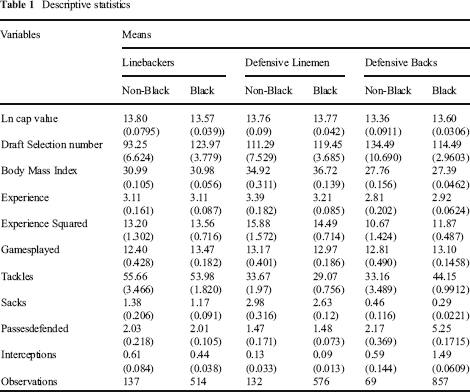
The linebacker sample contains 651 player years and Blacks represent 79% of the sample, the defensive lineman sample contains 708 player years and Blacks represent 81.4% of the sample, and the defensive back sample contains 926 player years and Blacks represent 92.5% of the sample. We report the means of the defensive players by position and race in Table 1. We find that on average, non-Black linebackers and defensive linemen have slightly higher tackles, sacks, and interceptions compared to their Black counterparts. Black defensive backs have more tackles, interceptions and passes defended than their non-Black counterparts.
Descriptive statistics
Results
Like Keefer (2013) and Burnett and Van Scyoc (2013, 2015a, b) we use ordinary least squares (OLS) and quantile regression analysis with a dummy variable for race to measure the effect of race on wages throughout the salary distribution. We also apply the Oaxaca Blinder decomposition technique developed by Oaxaca (1973) and Blinder (1973) to our OLS results. In Tables 2, 3, and 4 we use the dummy variable technique to measure racial discrimination for defensive players and report the OLS and quantile regression results for linebackers, defensive linemen, and defensive backs. The quantile regression results are reported for the 0.10, 0.25, 0.50, 0.75, and 0.90 quantiles. The dependent variable used in each model is the natural log of the player's salary cap value.
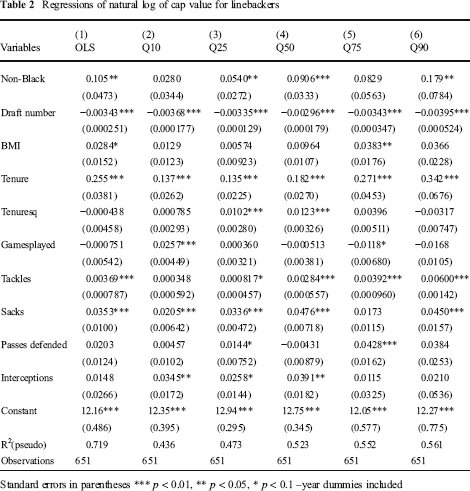
In Table 2, the coefficient on non-Black for the linebackers sample is positive and significant using OLS and the 0.25, 0.50, and 0.90 quantile regressions showing that non-Black players are paid a premium. The OLS and quantile regression coefficients on non-Black are transformed into percentage changes using 100*(exp(βNon-Black)-1). The OLS coefficient of 0.105 indicates that on average, holding all of the other explanatory variables constant, a non-Black linebacker earns 11.1% more than a Black linebacker. The 0.25 quantile regression coefficient of 0.0540 indicates that a non-Black linebacker in the 0.25 quantile earns 5.5% more than a Black linebacker. The 0.50 quantile regression coefficient of 0.0906 indicates that a non-Black linebacker in the 0.50 quantile earns 9.5% more than a Black linebacker. The 0.90 quantile regression coefficient of 0.179 indicates that a non-Black linebacker in the 0.90 quantile earns 19.6% more than a Black linebacker. These results provide evidence of discrimination against Black linebackers in the NFL.
Regressions of natural log of cap value for linebackers
Standard errors in parentheses
p < 0.1 –year dummies included
p < 0.05
p < 0.01
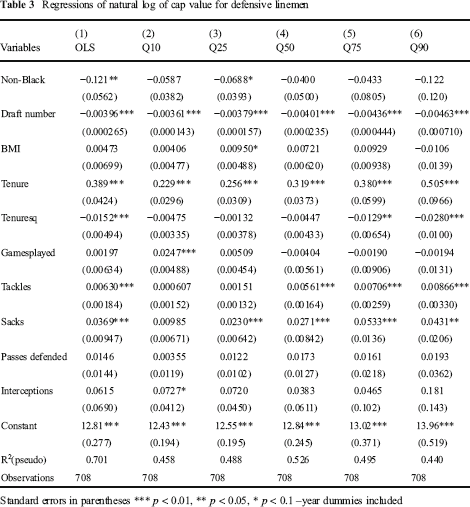
In Table 3, the OLS and 0.25 quantile coefficients on non-Black for the defensive linemen sample are negative and significant showing that Black defensive linemen are paid a premium. The OLS coefficient of –0.121 indicates that a non-Black defensive lineman earns 11.4% less than a Black defensive lineman. The 0.25 quantile regression coefficient of –0.0688 indicates that a non-Black defensive lineman in the 0.25 quantile earns 6.6% less than a Black defensive lineman. These results provide evidence of discrimination against non-Black defensive linemen counter to the results on linebackers.
Regressions of natural log of cap value for defensive linemen
Standard errors in parentheses
p < 0.1 –year dummies included
p < 0.05
p < 0.01
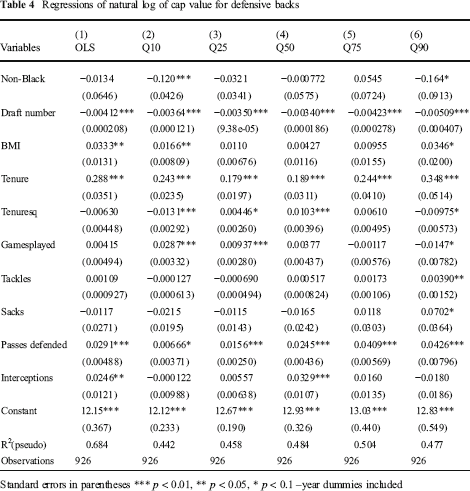
In Table 4, the quantile regression coefficients on non-Black for the defensive backs sample are negative and significant for the 0.10 and 0.90 quantiles providing evidence of discrimination against non-Black defensive backs. These results are also counter to the results on linebackers. The 0.10 quantile regression coefficient of –0.120 indicates that a non-Black defensive back in the 0.10 quantile earns 11.3% less than a Black defensive back. The 0.90 quantile regression coefficient of –0.164 indicates that a non-Black defensive back in the 0.90 quantile earns 15.1% less than a Black defensive back. We also find that the coefficient on draft number is significant for OLS and all quantile regressions for each defensive position.
Regressions of natural log of cap value for defensive backs
Standard errors in parentheses
p < 0.1 –year dummies included
p < 0.05
p < 0.01
In Table 5, we report the results from both the Oaxaca Blinder decomposition and quantile treatment effect (QTE) techniques to measure racial discrimination. We find that for the linebacker sample the endowment and the coefficient effect are significant in the majority of the quantile regression deciles. The coefficient effect for the 0.30 quantile indicates that Black linebackers earn 6.9% less than non-Black linebackers. The QTE decomposition shows that the discrimination occurs primarily in the upper deciles and ranges between earning 6.9% less in the thirtieth decile and 28.8% less at the eightieth decile. This result replicates Keefer (2013) and provides further evidence of discrimination against Black linebackers in the NFL.
Decomposition results: dependent variable = ln(salary cap value), from non-Black perspective
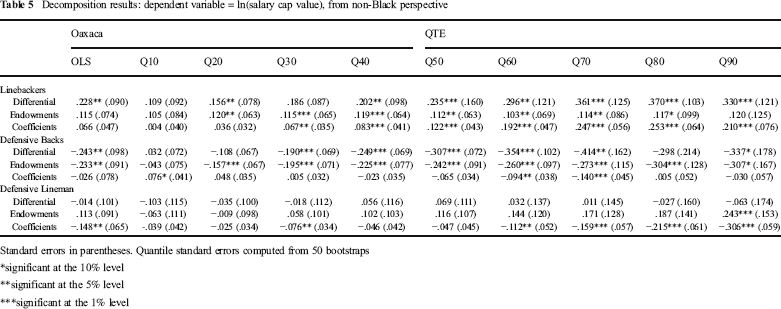
Standard errors in parentheses. Quantile standard errors computed from 50 bootstraps
significant at the 10% level
significant at the 5% level
significant at the 1% level
In the defensive linemen sample, we find that the coefficient effect is significant indicating that Black defensive linemen earn 15.9% more than non-Black defensive linemen due to differences in returns to the explanatory variables. This result provides further evidence of discrimination against non-Black defensive linemen in the NFL. The QTE decomposition results suggests discrimination occurs mostly in the upper deciles with only the sixtieth through ninetieth deciles being significant. We find that at the sixtieth decile Black players are paid an 10.6 % premium that rises to a 26.4% premium at the ninetieth decile.
In the defensive backs sample, we find the endowment effect is significant and the coefficient effect is not significant. This endowment effect indicates that Black defensive backs earn 21.6% more than non-Black defensive backs due to differences in the explanatory variables. We find little to no evidence that there is any consistent discrimination in this subsample. We find that black players are discriminated at the tenth decile but earn a premium in the fiftieth, sixtieth, and seventieth decile with the remainder of the deciles being statistically insignificant. We suggest that the small number of non-Black defensive backs might make discrimination difficult to detect if it is present.
Conclusion
Using OLS and quantile regression analysis for linebackers, defensive linemen, and defensive backs in the NFL we find evidence of discrimination. The discrimination is not solely against Blacks or non-Blacks. We find evidence of discrimination against Black linebackers and evidence of discrimination against non-Black defensive linemen. Unlike Ajilore (2014), our findings are similar to previous studies of sports markets that find some evidence of reverse discrimination (Gius and Johnson 2000; Groothuis and Hill 2013; Yang and Lin 2012). Our results suggest that racial discrimination is more nuanced than just discrimination against one group in general. Our results show that for defensive backs and defensive lineman there is no racial discrimination against Blacks and in fact Black players are paid a premium. Yet for linebackers we find that racial discrimination against Blacks exists. Linebackers are often referred to as the quarterback of the defense (Boyd 2014). This is because they must make decisions that impact all the players on the defense. Our results lend support to the hypothesis that employers, employees, or customers discriminate against the Black players who are the major decision makers on the football field. This type of discrimination is consistent with the result of Volz (2015) that indicates Black quarterbacks are more likely to be benched.
The discrimination against non-Black defensive linemen could be due to the perception of athleticism of non-Blacks compared to Blacks. We then use the Oaxaca and Blinder technique on both OLS and quantile regressions and the results confirm that there is discrimination against Black linebackers but not against either Black defensive linemen or defensive backs. These results along with the results of Volz (2015) and Keefer (2013) provide evidence of discrimination against Black players who make major decisions in the NFL.