







Abstract
The current study assesses the roles that political encouragement from clergy and lay involvement in political discussions play in the political and civic activism of varying racial/ethnic groups. Congregants are likely to participate in varying forms of activism when asked by clergy because of the high levels of trust that Americans have in their clergy and because political appeals are often communicated in a culturally relevant manner. In addition, participation in political discussions within houses of worship is likely to increase a sense of political agency and efficacy. For almost all groups, lay political deliberation is associated with activism. However, while political encouragement from clergy is associated with Black and Hispanic activism, it plays a negligible role in motivating Whites and Caribbean Blacks to action. Ideological symmetry between clergy and congregants may explain the degree to which political appeals from clergy motivate varying racial/ethnic groups to action.
Introduction
Over the course of a year, tens of thousands of Americans hear messages within houses of worship about their obligation as people of faith to take political action regarding a host of policy issues (Dudley and Roozen 2001; Wuthnow 2000; Jackson et al. 2004). The co-mingling of religion and politics in the US is an outgrowth of a religious-civic culture grounded in principles of religious freedom and guaranteed in the First Amendment of the U.S. Constitution (Wald and Calhoun-Brown 2006). Such freedoms allow for a free expression and interpretation of religion that contributes to a continuum of perspectives on the role of religion in public affairs. On one end of this continuum, religion is viewed as maintaining a distinct separation from public life. On the other end, social issues are viewed through a prism of moral teachings that calls some to politically act and encourage others to do the same (Lincoln and Mamiya 1990; Roozen et al. 1984). Americans tend to be divided on these perspectives as roughly half report being comfortable with their religious institutions involving themselves in politics (Pew 2008a). The big question concerning this study is as follows; when congregants are encouraged to engage in political activism, do they actually participate?
The answer to this question has important implications for activist clergy and laity, civic and political organizations, and other entities interested in politically mobilizing large groups of citizens. That roughly 85% of Americans claim membership in some religious faith and half report attending houses of worship at least once month speaks to the mobilization potential of such institutions (Pew 2008b). More Americans are members of, volunteer for, and donate money to religious congregations than any other non-profit (Independent Sector 2001). Religious institutions are also one of the top three organizations in which Americans hold a high level of confidence (Saad 2005). Moreover, it is somewhat understandable that in the US, religious congregations represent a key political context. The notion that religious congregations act as political contexts suggests that congregants’ self interest is not the only factor that informs their willingness to take political action. Rather, identification with the mission of one's religious congregation as well as the fellow members with whom congregants interact also shapes political attitudes and behaviors (Djupe and Gilbert 2009; Guth et al. 1997; Huckfeldt et al. 1993; Welch et al. 1993; Wald et al. 1988).
That being said, the potential influence of clergy and lay encouragement to engage in political activism on actual political behavior may partially link to the social capital resources of trust, reciprocity, and information sharing that exists within religious congregations. Essentially, social capital refers to the connections among individuals and the norms of reciprocity and trustworthiness that arise from them (Coleman 1988; Putnam 2000). These social networks increase awareness of opportunities that may improve individual and social group well-being. Because Americans are able to choose their congregations, congregations are often a source of friendships and social support with people of shared of interests and backgrounds. Moreover, to the extent that worship-goers are encouraged by their clergy and fellow congregants to become politically involved, many do so trusting that they are engaging in acts that are in their best interests as well as that of their religious community and larger society (Brown and Brown 2003; McDaniel 2008; Putnam and Campbell 2010; Smith and Harris 2005).
Inducements from fellow congregants to engage in varying political activities may also be effective because such appeals are often culturally relevant (Harris 1999; Pattillo-McCoy 1998). The cultural toolkit thesis suggests that group members utilize symbols, stories, beliefs and rituals to gain an understanding of their social reality (Swidler 1986). Such tools maintain the potential to connect group members to political causes by serving as a means to interpret and legitimize political goals. Politically astute clergy and lay activists rationalize the importance of voting, campaigning, demonstrating and other forms of activism by using common religious stories, analogies, songs, prayers and other cultural symbols that resonate with the group experiences of their congregation (Harris 1999; Pattillo-McCoy 1998). The fact that most members are unaware of the political stance of their house of worship before joining and select congregations for nonpolitical factors such as proximity, denomination, and a general sense of comfort speaks to the potential importance of political messages heard within houses of worship to political behavior (McKenzie 2002; Wald et al. 1988).
Past work on religion and politics has effectively assessed the importance of clergy on the political behavior of laity. Interest in the impact of clergy on lay political activism is understandable given the relatively high level of trust that Americans have in their religious leaders (Saad 2005; Kohut and Rogers 2002). Furthermore, senior clergy have a captive audience for at least once a week to discuss their perspective on religious doctrine and its application to pressing issues of the day. That being said, it is also important to investigate the role that laity may play in their own political mobilization. Nearly two centuries ago, French philosopher De Tocqueville (1873) argued that the democratic potential of American religious congregations lies in the free space it provides citizens to deliberate in small and informal groups about their roles in protecting and extending their freedoms and opportunities. Along these lines, a number of qualitative studies suggest that laity gain political efficacy when they are included in discussions about issues that should concern their congregations, strategies to mobilize others around such issues, and organizing meetings with political officials to address their concerns (Warren 2001; Wood 2002).
The current study attempts to build from previous studies on congregation-based political encouragement and political activism in two important ways. First, whereas previous studies have focused almost exclusively on either Whites or Blacks, the current study relies upon national samples of White, Black, Hispanic, Asian, and Afro-Caribbean Americans. Secondly, previous studies tend to use global political activism constructs that mask potential differences in the relationship between lay and clergy political messages on protest, campaign, and lobbying behavior. These studies also tend to exclude non-traditional political measures that assess group discussions about community concerns. Such discussions are often an initial step to collectively develop strategies to address such concerns (Owens 2009; Rosenstone and Hansen 1993). In response, the current study investigates the role that lay political deliberation and clergy political encouragement plays in the varying political and civic activities of a racial/ethnically diverse group of Americans. In doing so, the next three sections provide a review of past work on relationship exposure to political messages in houses of worship on the political behavior of native born Blacks, native born Whites, and immigrant populations.
Congregation-Based Political Messages and Black Political Activism
A history of racial discrimination and exclusion from civic and political institutions led many African Americans to use their churches as spaces to discuss political strategies and ultimately challenge a system of racial oppression (Calhoun-Brown 2003; Lincoln and Mamiya 1990; Morris 1984; Williams 2003). Black churches are important to African Americans for many reasons; African Americans share a memory of the activist Black church of the civil rights era and continue to recognize Black churches as one of few institutions wholly dedicated to the spiritual, emotional, and social-political betterment of Blacks (Billingsley 1999; Calhoun-Brown 2003; Lincoln and Mamiya 1990). In addition, the disproportionate number of Blacks outside of leadership roles in professional occupations and/or within civic and/or political networks has made churches important spaces for Blacks to build their civic skills (Verba et al. 1995). Serving in leadership roles on church boards, organizing events for congregants, presenting announcements at worships services, and other opportunities provide interested individuals with the skills and confidence to engage in democratic politics (Calhoun-Brown 2003; Harris 1999; Verba et al. 1995). Moreover, it is somewhat sensible that Blacks have consistently been more likely than have Whites to support their religious institutions engaging in varying forms of procedural and protest politics (Lincoln and Mamiya 1990; Kohut et al. 2000). Along these lines, a growing body of research suggests that attending congregations in which political matters are discussed contributes to heightened levels of voting, campaign activism, communication with elected officials, and engagement in protest politics among Blacks (Brown and Brown 2003; Brown and Wolford 1994; Calhoun-Brown 1996; Fitzgerald and Spohn 2005; McClerking and McDaniel 2005; Mckenzie 2004; Tate 1991).
Nonetheless, the relative roles of clergy and laity in politically mobilizing Black congregants are not entirely clear. For example, Brown and Brown (2003) and Fitzgerald and Spohn (2005) find that the more political messages that Blacks hear in their houses of worship, the more likely they are to vote, campaign, contact elected officials, and protest. However, by using a measure that combines lay and clergy political messages, they are unable to compare the relative effects of clergy and laity on congregant political activism. Other studies have included measures that assess the impact of clergy or of the religious congregation as a whole on Black political activism (Calhoun-Brown 1996; Tate 1991). Studies that have separated constructs of clergy political encouragement from lay political deliberation found that both constructs are associated with Black non-voting political activism (McClerking and McDaniel 2005; McKenzie 2004). While the referenced studies do not clarify the relative effects of lay deliberation and clergy encouragement on the individual political and civic behaviors of African Americans, they represent the only survey-based evidence of the relative importance of both clergy and laity to Black political mobilization. The relevance of both is likely linked to the fact that Black churches engaged in varying forms of political activism tend to frame political activism as being consistent with a prophetic mission to support policies aimed at bringing hope and opportunity to marginalized groups and opposing those that do not (Harris 1999; Warren 2001; Wood 2002). Such framing is particularly effective given that both Black clergy and laity overwhelmingly identify as and vote Democratic (McDaniel 2003; Putnam and Campbell 2010). Along these lines, Black clergy and their congregants share similar worldviews of what is required of religious institutions and government to address the most pressing issues facing Black communities as it relates to jobs, neighborhood crime, poverty, education, health care, and other quality of life issues (McDaniel 2003; Wald and Calhoun-Brown 2006).
Congregation-Based Political Messages and White Political Activism
While Whites attend worships services less often and report that religion provides them with less guidance than for Blacks, their churches maintain political infrastructures to pressure policy makers and recommend actions to local congregations (Olson 2002; Taylor et al. 1996; Wald and Calhoun-Brown 2006). For example, Evangelical Protestant organizations, such as Focus on the Family and the National Association of Evangelicals, have played an important role in shaping political discourse in regards to sexuality, abortion, decency in the media, and other conservative Christian values (Wald and Calhoun-Brown 2006). Similarly, for over 30 years, the United States Conference on Catholic Bishops (USCCB), which promotes and coordinates the agenda of the Catholic Church USA, has attempted to influence national and local policy to place tighter restrictions on abortion, euthanasia, the death penalty, and, more recently, stem cell research (Wald and Calhoun-Brown 2006). Mainline Protestant denominations and organizations, such as the National Council of Churches and the USCCB, have a history of pushing the federal government to more aggressively address civil rights, social welfare, immigration, human rights, war and peace, and other social justice concerns (Fowler et al. 2006; Wald and Calhoun-Brown 2006).
Nonetheless, because clergy and laity from these religious bodies tend to differ from one another ideologically and on specific policy issues, local clergy likely face difficulty in convincing laity to take political action. For example, Mainline Protestant, Evangelical Protestant, and Catholic Church tend to be more progressive on poverty, war, and racial justice issues than the majority of their predominantly white congregants (Cavendish 2004; Wald and Calhoun-Brown 2006). While Evangelical Protestant clergy and laity tend to resemble one another on issues, such as abortion, stem cell research, and gay rights, Mainline clergy tend to be more liberal and Catholic clergy tend to be more conservative on these issues than their congregants (Fowler et al. 2006; Wald and Calhoun-Brown 2006). In addition, research conducted on the largely white Episcopal and Evangelical Lutheran Churches suggests that most congregants do not believe that they share political beliefs or are of the same political party as the majority of their fellow congregants (Djupe and Gilbert 2009). If true across varying religious bodies within which Whites predominate, such disparate opinions may partially explain why laity are more hesitant than clergy of religious groups engaging in political activism. It may also explain why some clergy avoid political discussion altogether out of fear of alienating members of their flock. Such fears are not without merit given that congregants become less likely to engage in varying forms of non-voting activism when they are encouraged to do so by clergy of a different political party (Djupe and Gilbert 2009).
Differences in political opinions may also explain why Episcopal and Lutheran laity maintains a greater level of influence than do clergy over the issue positions and political behavior of their fellow congregants (Djupe and Gilbert 2009). Lay involvement in political discussions, particularly involving contentious subjects, may be more effective because they are playing a role in shaping their congregation's issue positions and potential political strategies. Moreover, the extent to which political discussions lead to White political activism, laity likely plays a key mobilizing role.
Religion and Politics among Immigrant Populations
The political influence of congregations outside the Black–white landscape is an increasing subject of empirical inquiry. The immigrant status of Hispanic, Asian, and Afro-Caribbean Americans is a key factor that distinguishes these groups from Black and White Americans. Forty percent of Hispanics, 69% of Asians, and over half of Afro-Caribbean Americans are first generation immigrants to the US (Lien et al. 2004; Ramirez and de la Cruz 2003; Jackson et al. 2004). Congregations with larger concentrations of these groups likely serve as assimilation centers where newcomers can join friendship networks with those who share their native culture and language (Ebaugh and Chafetz 2000). Such networks have the potential to provide individuals with both emotional support and practical information in applying for jobs, accessing social services, as well as introducing individuals to American democratic life (Ebaugh and Chafetz 2000; Cnaan et al. 1999; Lien et al. 2004).
The degree to which Asian, Hispanic, and Afro-Caribbean Americans go beyond helping fellow congregants to politically advocating for their larger interests are likely linked to the extent to which their congregations are affiliated with religious groups with a history of political activism and support their interests. Worship attendance is linked to citizenship and voter registration for both Asians and Hispanics (Espinosa et al. 2003; Lien 2004). However, while Hispanic congregations are over-represented among congregations affiliated with faith-based community organizing firms, Asian congregations are under-represented (Wood and Warren 2002). Community organizing often involves clergy and lay leaders receiving training from professional organizers on methods to discuss their common concerns with congregants and develop political strategies, such as lobbying, protesting, and voting to collectively address such concerns (Wood and Warren 2002). This form of activism also often involves religious groups developing political coalitions with racial/ethnic others in an effort to link the interest of working class and poor urban minorities to that of suburban and middle class groups (Warren 2001; Wood 2002). Hispanic involvement in such groups is, in part, a function of the Hispanic presence in the Catholic Church, which, as mentioned earlier, has a history of social justice activism and an infrastructure in place to connect local congregations to political causes. Along these lines, concerns for the poor and racial/ethnic inequality play a key role in the political activism of individual Catholic priests (Jelen 2003). Moreover, the fact that Hispanic Americans are disproportionately immigrant, poor, and live in poor communities likely contributes to Hispanic laity agreeing with their clergy's social justice oriented position, particularly as it relates to the plight of poor immigrants (Cadena 1989; Espinosa 2005). Ideological symmetry between Hispanic laity and their clergy may partially explain why, following, Black Protestants, Latino Catholics report more political activities in the form of political sermons, voter registration drives, and protest marches at their place of worship than do all other ethnic and faith groups (Putnam and Campbell 2010. As a result, it would not be too surprising if Hispanic Americans were responsive to the political appeals from their clergy and laity.
Conversely, while Southeast Asian Americans tend to affiliate with Protestant religions, Asian Indians tend to affiliate with non-Western religions that have of a relatively short history of political engagement and maintain limited access to political and community elites (Wuthnow and Hackett 2003). Such limited access may reflect the under-representation of Asian elected officials and Asian Americans’ subsequent lack of comfort in approaching elected officials about their unique concerns. Along these lines, because Asian Americans, particularly southeast Asians, are stereotyped as model minorities, some argue that elected officials downplay their concerns as they believe Asians are less interested in politics than in their own educational and economic mobility (Aptekar 2009). Such perceptions may weaken efficacy to the point that even if encouraged to participate by clergy and/or congregants, few may see the point of doing so. The under-representation of Asian American congregations in more time-consuming forms of political activism may also be a function of class and immigration status. Unlike Hispanic immigrants, Asian immigrants are largely documented immigrants of the professional and business class (Lien et al. 2004). Consequently, recruitment efforts by clergy or lay leaders to join political causes aimed at increasing rights for what are perceived as largely undocumented working class and poor immigrants may have little impact on the political behavior of Asian Americans, even if such efforts were communicated in a culturally relevant manner.
While both African Americans and Afro-Caribbean Americans are socially constructed as Black, it is unclear if congregational leaders and laity play a similar political mobilization role for these groups. On the one hand, Black Americans and Caribbean Blacks maintain similar levels of spirituality, the importance of religion in their lives, and church attendance (Chatters et al. 2009). Therefore, it may not be too surprising if both groups maintained a similar level of trust in clergy that would enable clergy to effectively mobilize congregants. In addition, Afro-Caribbean immigrants likely face forms of racial discrimination that may increase their receptivity to political appeals to join racial justice efforts. On the other hand, similar to Asian Americans, the selectivity of the documented immigration process lends itself to the migration of the most highly driven and resource rich individuals (Waters 1999). This contributes to Afro-Caribbeans being more highly educated, earning higher incomes, and living in more affluent communities than do native-born Blacks (Logan and Deane 2003). To that end, it is not clear that Afro Caribbean would be too receptive to political encouragement from their clergy, who tend to be connected to Black Protestant, Mainline, Catholic traditions and whose activism is often informed by social justice concerns, such as poverty and social-economic inequality (Barnes 2005; Brown 2008; Jelen 2003; McDaniel 2003; Smidt et al. 2003). This leads to the following research question: To what extent is political encouragement from clergy and congregant participation in political discussions associated with the political behavior of varying racial/ethnic groups?
Sample
This study utilizes the 2004 National Politics Study (NPS) to test the relationship between exposure to political discourse in houses of worship and political activism. The primary goal of the NPS is to gather comparative data about individuals’ political attitudes, beliefs, aspirations, and behaviors at the beginning of the twenty-first century. As such, this study is based on a national sample of individuals, aged 18 years or older, from a variety of different racial and ethnic groups. Interviews occurred throughout the US in urban and rural centers of the country where significant numbers of Black Americans reside. In total, 756 Black, 919 White, 757 Hispanic, 503 Asian, and 404 Afro-Caribbean Americans were interviewed. Each of the NPS racial/ethnic groups were sampled from separate weighted sampling frames. As a result, researchers must treat each racial/ethnic sample as a completely separate study and not include them within the same analyses. The Program for Research on Black Americans of the University of Michigan's Institute for Social Research went into the field in September of 2004 and concluded in February of 2005. All of the 3,309 interviews were conducted over the telephone. The interviews were conducted in either English or Spanish, depending on the preference of the respondent, and the overall response rate is 31%. 1
Dependent Variables: Political and Community Activism
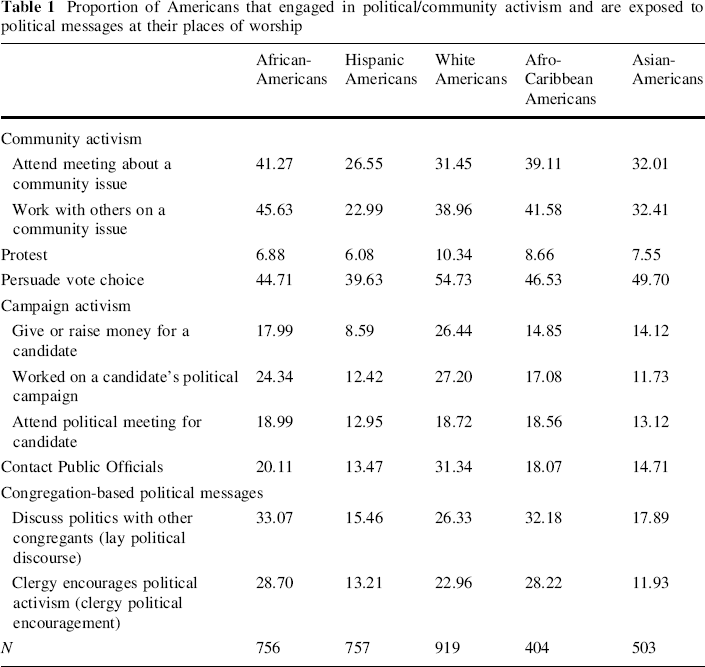
To assess levels of political activism, respondents were asked to report if they took part in protest demonstrations, participated in a political campaign, contacted an elected official about concerns on a public issue in the past 12 months. Respondents were also asked if they attempted to persuade the vote choice of others during the most recent election year. The protests, contact, and persuasion variables are all dichotomously measured. Campaign activism consists of a three item additive index that reports on whether or not during the past election year respondents had ever attended a political meeting or rally in support of a particular candidate, given any money to or helped raise money for a candidate, or worked for a political party or campaigned for a political candidate. In total, the campaign activism index ranges from 0 to 3 with three indicating that respondents are involved in all three types of campaign activism. 2 Finally, respondents’ level of community activism is measured by a two-item additive index that reports on whether or not during the past year respondents attended a meeting about an issue facing their community or schools, and if they worked with others to deal with some issue facing their community. In total, the community activism index ranges from 0 to 2 with two indicating that respondents are involved in both types of community activism.
Independent Variables: Lay Political Discourse and Clergy Political Encouragement
Proportion of Americans that engaged in political/community activism and are exposed to political messages at their places of worship
Control Variables
In an attempt to replicate the analytical approach of past studies on congregation-based political messages and political activism, the current study controls for frequency of worship attendance, 3 if people are in leadership position within their congregation, denominational affiliation, 4 college education, family income, employment status, gender, and residence in the South.
Statistical Methods
Because all of the dependent variables are either dichotomous or categorical, odds ratios for logit and ordered logit regression analyses are employed to investigate this study's central research question.
Results
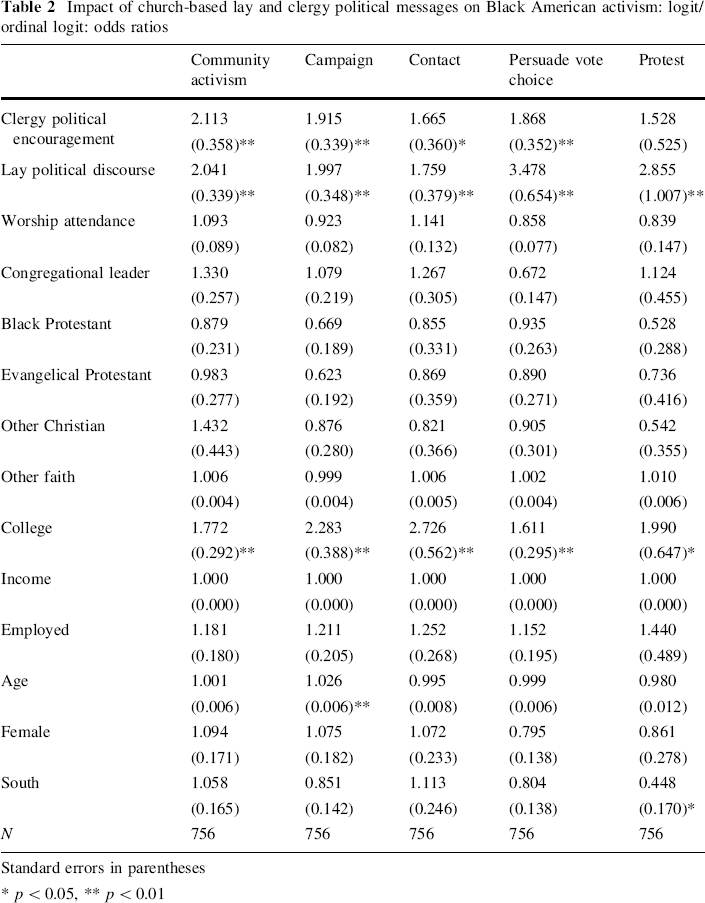
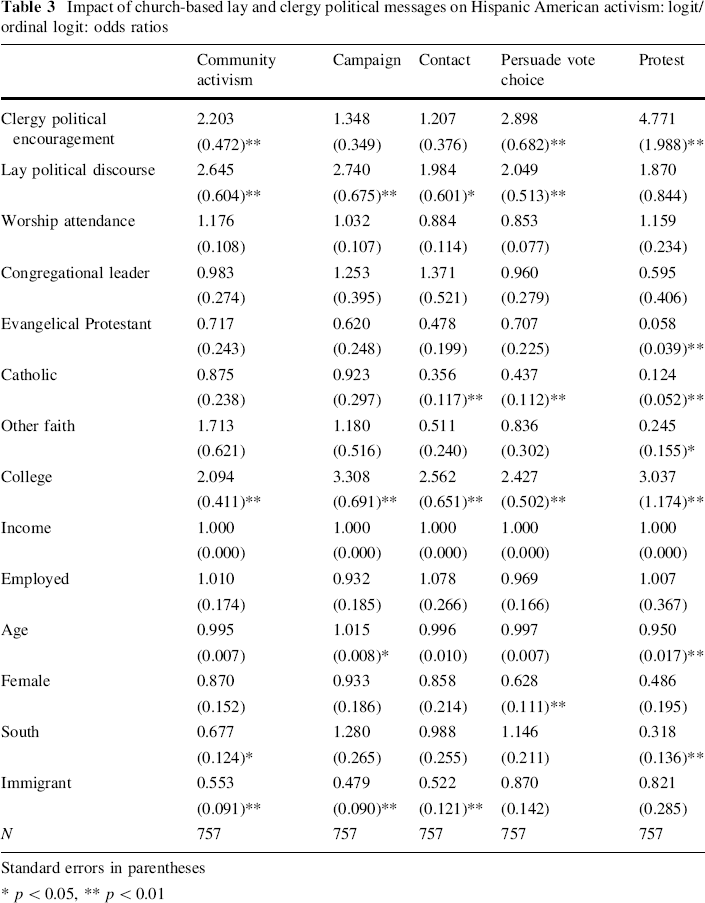
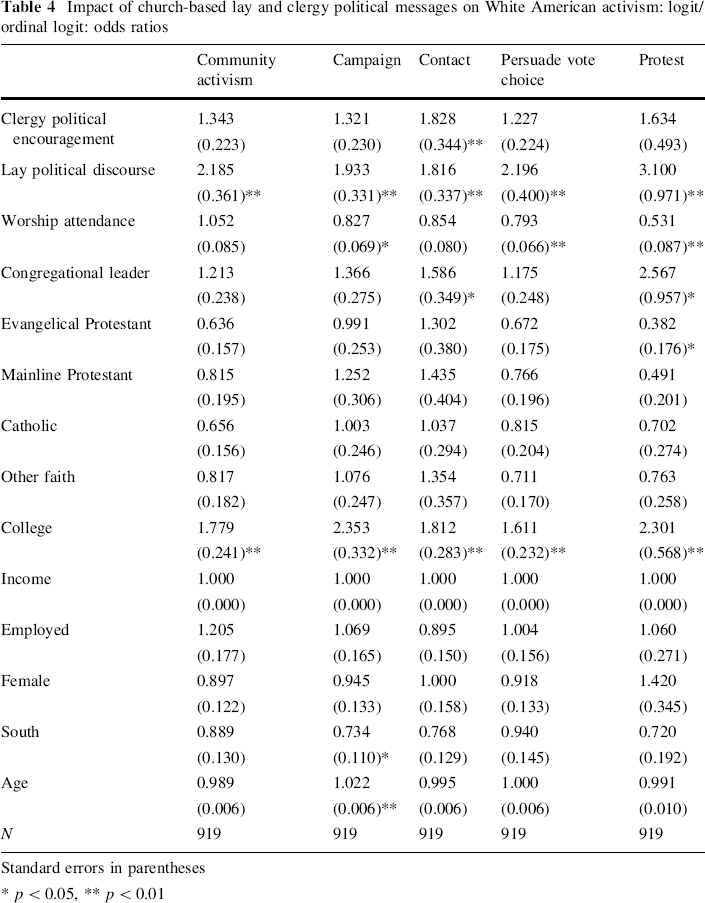
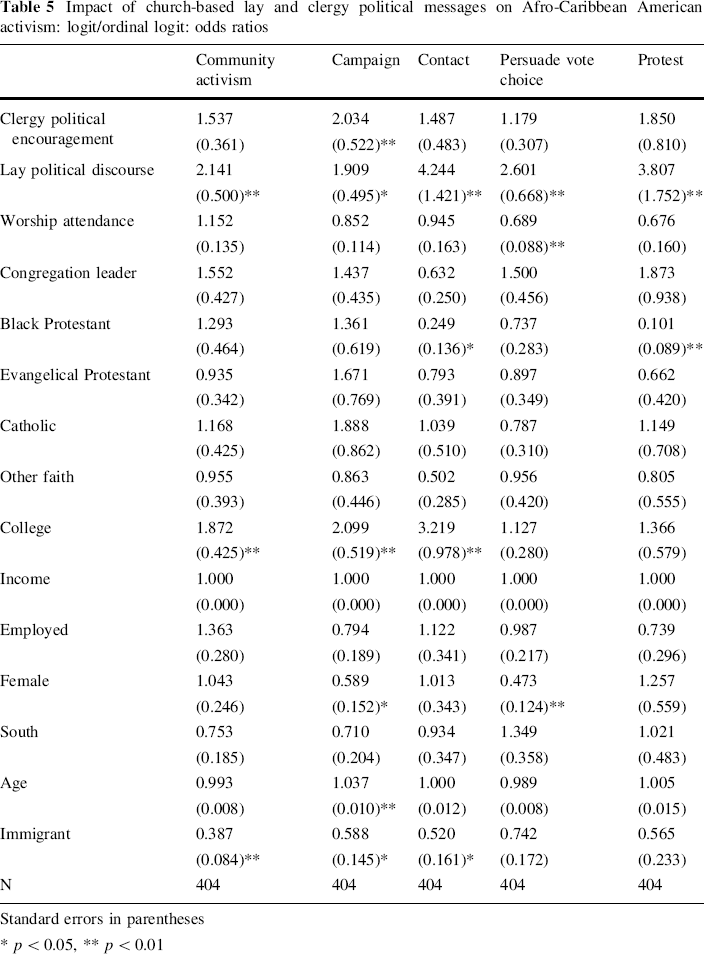
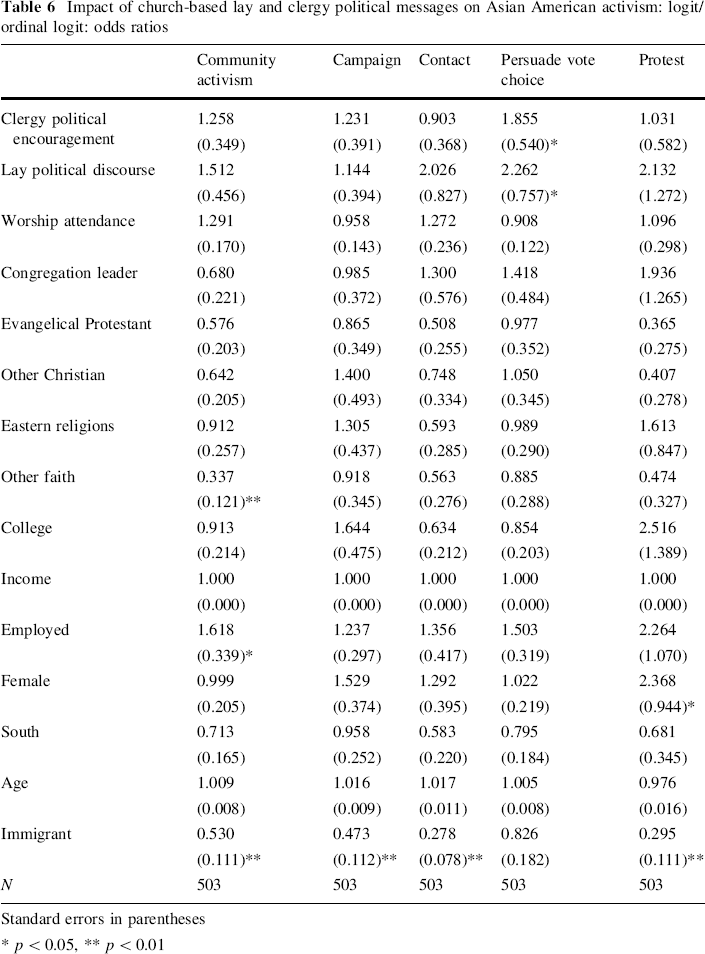
These analyses indicate that participating in political discussions in houses of worship and being encouraged by congregational leaders to become active is not uniformly associated with political activism for varying racial/ethnic groups. For African Americans and Hispanics, to a lesser extent, both participating in political discussions and being encouraged to participate contributes to heightened political activism. However, while participating in political discussions contributes to White and Afro-Caribbean political activism, being encouraged to do so by congregational leaders does not. In contrast, exposure to such worship-based political communication is largely unrelated to Asian American activism. The discussion below expounds upon these relationships.
Impact of church-based lay and clergy political messages on Black American activism: logit/ordinal logit: odds ratios
Standard errors in parentheses
* p < 0.05, ** p < 0.01
Impact of church-based lay and clergy political messages on Hispanic American activism: logit/ordinal logit: odds ratios
Standard errors in parentheses
* p < 0.05, ** p < 0.01
Impact of church-based lay and clergy political messages on White American activism: logit/ordinal logit: odds ratios
Standard errors in parentheses
* p < 0.05, ** p < 0.01
Impact of church-based lay and clergy political messages on Afro-Caribbean American activism: logit/ordinal logit: odds ratios
Standard errors in parentheses
* p < 0.05, ** p < 0.01
Impact of church-based lay and clergy political messages on Asian American activism: logit/ordinal logit: odds ratios
Standard errors in parentheses
* p < 0.05, ** p < 0.01
Discussion
The current study builds from previous work on religion and politics by assessing the relative roles that clergy political encouragement and lay political discourse have in motivating varying racial/ethnic groups to engage in political and civic activism. While lay deliberation tends to have a similar effect in motivating varying racial/ethnic groups to action, political encouragement from clergy does not. The degree to which clergy and laity share ideological perspectives may contribute to the effectiveness of clergy in using religious stories, prayers, and other cultural symbols to convince congregants to take political action (Djupe and Gilbert 2009). Laity that share similar worldviews with clergy likely trust that clergy have their best interests in mind when encouraging political action. Hispanic and African American clergy and laity largely share similar positions on the most pressing issues facing their communities (Wald and Calhoun-Brown 2006; Warren 2001; Wood 2002). That is, both clergy and laity tend to point to the role structural forces such as lack of jobs, poor educational systems, and other social constraints play in their relatively poor quality of life. Both clergy and laity also share fairly similar positions on the role of religious institutions and government in correcting these ills (Lincoln and Mamiya 1990; McDaniel 2003; Wald and Calhoun-Brown 2006). As a consequence, Blacks and Hispanics likely trust that their clergy are acting in their best interests when encouraging political action. Such trust may partially account for why, outside of Evangelical Protestants and Mormons, Black Protestants are more likely than other racial/ethnic and faith groups to rely upon their religion when making decisions about policy issues and political candidates (Putnam and Campbell 2010).
Conversely, laity that disagree with the policy perspectives of their clergy are likely wary of clergy political mobilization efforts. Past research suggests that White congregants of varying denominational backgrounds tend not share ideological perspectives with their religious leaders or fellow congregants (Djupe and Gilbert 2009; Wald and Calhoun-Brown 2006). Such differences of opinion may explain why their clergy play a limited role in motivating political action. These findings are consistent with past work that suggested that Mainline Protestant and Catholic clergy that went against White congregant preferences in encouraging action in support of civil rights and against the Vietnam War were largely ineffective in motivating action (Findlay 1993; Hadden 1970; McGreevy 1998). In some cases, Mainline and Catholic lay leaders instigated counter-movements aimed at having their clergy removed for encouraging such political action (Findlay 1993; Hadden 1970; Quinley 1974). Similar factors may be at play for Afro-Caribbean Americans. Although socially constructed as Black, class and cultural differences between Black Americans and Afro-Caribbean Americans contribute to these groups maintaining different perspectives on existing economic opportunities and, subsequently, the role of government and religious institutions in expanding opportunities for marginalized groups (Rogers 2004; Waters 1999). The fact that roughly 60% of Afro-Caribbean Americans religious persons attend congregations affiliated with Black Protestant, Mainline Protestant, and Catholic faiths makes it probable that their clergy take more of a social justice perspective when critiquing policy and encouraging political action (Jelen 2003; Smidt et al. 2003). It is somewhat understandable then, that appeals from clergy for Afro-Caribbeans to engage in political/civic acts would fall upon deaf ears.
However, at this point, the provided explanations for why clergy matter to the political behavior of Blacks and Hispanics and not to that of Whites, Asians, and Afro-Caribbean Americans are speculative. The current data, unfortunately, does not allow one to contrast the policy and ideological positions of clergy with that of their laity. This is an important limitation because clergy are more willing than are others to encourage their congregants to take stands on political issues if they believe their congregants support their political stances (Guth et al. 1997). That said, net of denominational affiliation, it is also plausible that Black and Hispanic clergy are made aware of more opportunities to become politically engaged in their houses of worship. However, because the NPS does not assess the number of political messages to which laypersons are exposed, it is unclear if individuals that hear messages in houses of worship hear them every worship service, once a year, or somewhere in between. This omission may have some bearing upon the current study given that Black and Hispanic religious congregations are over over-represented among faith-based community organizing firms while predominantly White congregations are under-represented (Wood and Warren 2002). As mentioned earlier, these firms operate as local social movement centers that mobilize congregations around salient issues (Wood 2002). Moreover, it is conceivable that clergy of affiliated congregations are more likely than are others to discuss and encourage their laity to take stands on social issues. Indeed, Putnam and Campbell (2010) find that Black Protestants followed by Latino Catholics are more likely than are other racial and faith groups to attend religious congregations that preach political sermons, host voter registration drives, and organize demonstrations and marches. Issues of clergy-lay ideological symmetry and possibly the number of worship-based political messages in which different racial/ethnic groups are exposed may account for the impact of clergy on the political behavior of Black and Hispanic Americans but not for White, Asian, and Afro-Caribbean Americans. However, because of data limitations, there is a need for future research to assess if this is indeed the case.
On the other hand, lay political deliberation contributes to all groups, save Asian Americans, engaging in political activism. Deliberation likely works because congregants are involved in the process of agreeing upon the position that their congregations as a whole and individual congregants should take. In doing so, differences of opinion are articulated and compromises made to accommodate such differences. To the extent that congregants are listening and allowed to speak, such discussions, particularly in small group settings, are likely to provide the time needed to build trust and for individuals to comfortably make political decisions that reflect their faith beliefs. This is not to dismiss the role that clergy play in informing the political behavior of congregants as politically interested clergy often provides a welcoming environment for congregants to discuss politics. Nevertheless, it is clear that if congregants are to politically mobilized, particularly in congregational settings in which partisan and ideological differences exist, congregants have to be part of the deliberative process.
Unlike all other groups, neither clergy political encouragement nor lay political discussions relate to Asian American political and/or civic activism. As mentioned earlier, the fact that Asian Americans tend to affiliate with non-Western faiths that are fairly disconnected from political leaders may play a role in the ineffectiveness of clergy and laity in encouraging Asian American activism. Similarly, stereotypes from elected officials that Asians are politically disinterested may also reduce political efficacy among Asians and render political appeals from clergy and laity ineffective. However, it is also possible that this study under-estimate the above relationships by excluding measures that assess involvement in the politics of countries in which Asian Americans have migrated. The 2001/2002 Pilot National Asian American Political Survey (PNAAPS) indicates that worship attendance increases contact between Asian migrants and persons in their home countries. Such contact may help immigrants, their friends, and family maintain interest in the political happenings of their native countries and, if so inclined, make informed decisions about individuals and/or organizations to support. Kurien (2001) reports that Hindu and Muslim Indian American expatriates have and continue to play a role in influencing politics in India by financing the campaigns of preferred leaders and organizations. While the current study is unable to make empirical make claims on this matter, it is not implausible that political discussions of clergy and laity contribute to heightened Asian American interests and involvement in the politics of their native countries. It is also possible that the role of clergy and laity on the political behavior of Hispanic and Afro-Caribbean Americans has been somewhat diminished by this study's lack of attention to international political involvement. Indeed, the more Mexican migrants attend worship services, the more likely they are to vote in their home country elections (Enrico and Wayne 2005).
In sum, this study suggests clergy play a negligible role in motivating Whites and Caribbean Blacks to civic and political action, but are more effective in motivating Blacks and Hispanic Americans. The greater level of clergy/lay ideological symmetry among Black and Hispanic Americans relative to other ethnic groups may account for such differences. However, as stated earlier, further research is needed to test this claim. For almost all racial/ethnic groups, however, lay political deliberation is associated with activism.
Footnotes
Appendix
1

2
See Appendix for α scores of the campaign and community activism indices for each racial/ethnic group.
3
Missing values for worship attendance, Clergy Political Encouragement, Congregant political discourse, age, and income are replaced by imputed regression scores. The imputed variables do not substantively or significantly change the outcomes of the analyses.
4
The coding scheme for denomination is included in Appendix.