







Abstract
This research contributes to increasing understanding of the ways in which Christians think about religious pluralism in the United States. It does so by empirically uncovering the relationship between inter-faith contact and the willingness of white Christians to support tenets of religious pluralism. To that end, this study largely intimates that religious identity reinforces a dualistic world view. For white Christians, it is likely that contact with Jews and not Muslims is salient to their religious pluralist understandings. Nonetheless, more so than other Christians, Evangelicals tend to embrace a theology that views their belief system as being in conflict and competition with non-Christians. To that end, it is plausible that even when Christians have positive contact experiences with Jews and Muslims, Evangelicals are less willing than are other Christians to recognize them as members of the American religious polity.
Introduction
This current study investigates the association between having friends of the Jewish and Islamic faith and the propensity of white American Christians to believe that all religious traditions are worthy of respect and recognition. The increasing diversity 1 of America's religious landscape along with 9-11, wars against the Islamic countries of Iraq and Afghanistan, and the more amorphous war on terror makes this study particularly salient. Indeed, the geo-political state of the world since 9-11 has undoubtedly increased suspicions and fears among fundamentalist Christians and American nationalists of Western Judeo-Christian culture being under assault. The increase in hate crimes against Muslims in the U.S. in the year following the terrorist attacks in New York City and Washington D.C. is plausibly a testament of such suspicions and fears (Paulson 2003; Schevitz 2002). It is particularly important to assess factors contributing to religious pluralism among white Christians specifically because, while they are a diverse group, they are numerically dominant and have views that policy makers largely consider in framing political debates and public policy (Fowler et al. 2004; Wald 2004).
By employing social categorization and inter-group contact theories to describe the relationship between inter-faith friendships and religious pluralism among white American Christians, the current study contributes to the on-going discussion among scholars about the relationship between Islam and western culture. Social categorization leads us to posit that American Christians that perceive the Islamic faith as a threat to their Christianity will use cognitive shortcuts that place all Muslims into the group threat category. Hence, rather than investigate each referent to Islam that enters into their respective social world, the group threat filter is used to classify all followers and leaders of this religion as members of threatening social group. The group threat referent category is evident in the analysis of prominent scholars, Lewis (1990) and Huntington (1997, 2004) who maintain that the roots of western culture-individual freedom and the separation of church and state-have their genesis in the Jewish and Christian faith traditions. In stark contrast, Islam is said to have low tolerance for individual autonomy and its leaders as being opposed to the separation of church and state. On more than one occasion fundamentalist Christian religious leaders in this country have espoused such notions. Protestant leaders, Pat Robertson and Jerry Falwell as well as Catholic leaders, Pope Benedict XVI have publicly articulated the threat that they perceive the Muslim faith poses to Judeo-Christian cultural values and spirituality (Durham 2004; Elie 2006; Lincoln 2003). These religious leaders are thus openly stating that Christians and Jews are in the “us” group while Muslims are in the “them” category.
A long history of strife, conflict, and competition among Christians and Muslims may contribute to American Christians viewing Muslims as being the source of strife and instability in the Middle East and to western culture in general. The monotheistic nature of Christianity and Islam likely further contributes to a sharp sense of in and out-group identity among Christians and Muslims (Huntington 1997; Massanari 1998). Monotheistic religious systems results in religious, and sometimes civic, leaders viewing the world through the dualistic prism of “us” versus “them” in which “them” are seen as the “other”. This contributes to believers viewing themselves in direct conflict with those that have different beliefs, rituals, customs, and behaviors. Thus, it is not implausible that some western Christians would categorize the Islamic religion and its followers as outsiders that are a threat to Christian hegemony.
Inter-group contact theory, however, suggests that equal status contact between individuals of competing social groups has the potential of reducing perceived threat and stereotypes (Allport 1954). More specifically, the more social contact that white American Christians have with Jews and Muslims, the more likely they should be to view those individuals and their religious groups as being part of the American religious landscape. Extensive social contact is expected to reduce the social stigmas that are attached to individuals from subordinate groups as one learns that people are essentially the same, hence the stereotypes that one develops should lessen. Moreover, social contact is expected to also reinforce a belief in social equality and a shared humanity. Hence, according to inter-group contact theory, for Christians, social contact with non-Christians should positively reinforce or be associated with religious pluralism.
The historical relationship between Christians, Jews, and Muslims may suggest that Jews are arguably much further along than are Muslims in being re-categorized by Christians as being part of the American religious milieu. This may contribute to contact with Jews being more salient than contact with Muslims in explaining the religious pluralistic attitudes of Christians. Indeed, television and newspaper images of rock throwing Palestinian children, Hollywood portrayals of Muslims as terrorists, and 9-11 may reinforce or even trigger negative cognitive images of Muslims among American Christians. In contrast, a general cultural acceptance of the evil and wrongness of the Holocaust along with television and print media portrayals of Israeli soldiers protecting themselves from what may be viewed as Palestinian terrorists may reinforce or trigger more sympathetic cognitive images of Judaism.
In sum, this paper utilizes social categorization and inter-group contact theories to investigate the relationship between interfaith friendship and religious pluralism among White American Christians. In the remainder of the essay, we discuss the relevance of social categorization and inter-group contact theory. We then employ two national surveys conducted in 2000 and 2002 to empirically test the relationship between interfaith contact and religious pluralism among white American Christians. The study concludes by discussing the theoretical and substantive implications of this work.
Social Categorization Theory and White Christians
As social beings, individuals tend to place others into social categories as a short cut for understanding, evaluating, and identifying members of in and out-groups (Turner et al. 1994). Such short cuts often constitute defining one's membership in a given group by an “other,” or by what one is not (Miller et al. 1981; Turner 1996; Hogg et al. 1995; Huntington 2004). Moreover, in many ways, Christian identity is defined by the presence of non-Christians. By keeping the “other” at a psychological distance, in-groups come to feel more secure and cohesive as a social-psychological group, thereby making it easier to make substantive comparisons between themselves and appropriate out-groups (Turner et al. 1994; Huntington 2004). Even if there are no discernable differences between social groups, humans often create differences in an attempt to differentiate themselves from others and define what group membership means. Such differentiation often reinforces in-group from out-group identities. Hence, the social norms governing Christians play a role in how they think about and interact with non-Christians.
Perceptions and recognition of in- and out-groups are often linked to the judgments of highly respected others (Turner et al. 1994). Religious, political or community leaders may make explicit the ways in which in-group's customs, rituals, and behaviors are superior to those of out-groups. Socialization and interaction within a religious body that perceives its worldview as more authentic than others may indeed lead to the promotion of a rigid-mindedness; we are right and they are wrong (Zerubavel 1997). Moreover, this rigid mindedness may lead to “discrimination towards out-groups even in the absence of any functional conflict of interests and solely on the perception either of discriminable social categories or of dissimilarity in the beliefs of in-group and out-group members (Miller et al. 1981, p. 496).”
The relative closeness that American Christians feel towards Jews in comparison to Muslims in countless public opinion polls is indicative of Jews being categorized as part of the “us” category and Muslims as part of the “them” category. This sense of closeness is, in part, linked to a theological connection that Christians feel towards Jews as being God's chosen people and Israel being the place in which Jesus will return. Indeed, data collected by a 2003 Pew Foundation poll suggests that a plurality of American Christians (44%) believe that God gave Israel to the Jewish people while a substantial minority (39%) believe that Israel is a fulfillment of the biblical prophecy about the second coming of Jesus (Kohut 2003).
In addition to the theological connection that Christians maintain with Jews, there is a long history of Jewish–Christian relations in this country. Civil Rights legislation of the 1960s deemed quotas that limited the number of non-whites and non-Christians in prestigious universities and restrictive covenants that placed restrictions on the neighborhoods in which non-whites and non-Christians could live as illegal (Stevenson 1988). These laws also provided Jews with full access to varying public accommodations. In sum, civil rights legislation allowed this relatively highly educated ethno-religious group to take advantage of social-economic and political opportunities that allowed for Jewish social mobility (Chanes 1997; Greenberg 2006; Shaw 1997; Stevenson 1988). Consequently, over the past 40 years, white Jews and white Christians have experienced greater equal status contact with one another in the workplace, classroom, and neighborhood (Chanes 1997; Shaw 1997).
In comparative terms, it is arguable that Christians and Muslims do not maintain as strong a relationship as do Christian and Jews. This is, in part, linked to the fact that only within the past 25 years has the Muslim religion experienced substantive growth in this country (Brittingham and Cruz 2005; Turner 1996). As such, there has been relatively little opportunity for Christians and Muslims to get to know one another through friendships and/or work relationships. Furthermore, as mentioned earlier, the threat Islam poses to the authenticity of Christianity likely serves as another barrier between the willingness of Christians to be tolerant and accepting of Muslims. That being said, it is unlikely that white Christians are as willing to extrapolate notions of religious pluralism from their interactions with white Jews as compared to Muslims.
Religious Categorization and Interfaith Contact
Inter-group contact theory may lead one to posit that Christians may come to re-categorize all non-Christians as being legitimate members of this country's religious polity through positive inter-faith contact experiences. That is, through extended positive inter-faith contact, religious bias and conflict can be reduced as people learn about their similarities with others and, subsequently, begin to think of themselves as members of a more inclusive religious in-group. With common in-group identity, the cognitive and motivational processes that initially produced in-group favoritism are redirected to benefit the common in-group, including former out-group members (Pettigrew 1998; Dovidio et al. 2003). From this perspective, inter-faith cooperative interaction enhances positive evaluations of religious out-group members, in part, because cooperation transforms perceptions from ‘us’ versus ‘infidels’ to a more inclusive ‘we’ (Pettigrew 1998; Dovidio et al. 2003).
Personal acquaintance between in and out-group members and inter-group friendships are significant determinates of tolerance towards racial out-groups (Ellison and Powers 1994; Pettigrew 1998; Sigelman and Welch 1993). This is largely because inter-group friendships tend to involve on-going rather than episodic contact, and therefore, provide more learning opportunities. Learning about out-groups, particularly in the contexts of friendships, provides opportunities to challenge unfounded stereotypes with real experiences (Dovidio et al. 2003; Ellison and Powers 1994; Pettigrew 1998). Ongoing contact via acquaintances and friends also tends to reduce hostility and anxiety in inter-group interactions, which tend to characterize initial encounters between groups (Dovidio et al. 2003; Ellison and Powers 1994; Pettigrew 1998). Equally important, inter-group friendships contribute to in-group members spending less time with members of their social group and more time with individuals from out-groups (Dovidio et al. 2003; Pettigrew 1998). This tends to have the effect of in-group members making less sweeping negative generalizations of out-group members and developing a more critical perception of their own group, particularly as it relates to their relationship with out-groups (Ellison and Powers 1994; Herek and Glunt 1993; Pettigrew 1997, 1998). Indeed, Merino (2010) finds that prior contact with Muslims, Buddhists, and Hindus is associated with more positive views of religious diversity.
While contact with diverse groups may contribute to a more favorable impression of out-groups, it is unlikely that inter-group contact will lead to perceptions of equality between groups or a willingness to tie one's interests to out-groups perceived as being a threat to cultural hegemony (see Skipworth et al. 2010). Concern about the threat that Islam poses to Christian's claim to authenticity and a sense of theological connection with Jews likely differentially informs Christians’ perceptions of religious pluralism. To the point, it is unlikely that friendships and acquaintances with Muslims are as salient as such contact with Jews to white Christians’ perceptions of religious pluralism.
Denominational Affiliation and Generalization from Contact
This study also recognizes that the theological orientation of Christian denominational bodies may influence and/or reinforce attitudes towards religious pluralism. As such, this study posits that, relative to other Christians, Evangelical Christians are less pluralistic and their contact with non-Christians is more weakly associated with their adherence to religious pluralist ideals. This paper makes this contention because Evangelical Protestants likely maintain the most rigid conception of in-group Christian identity of all Christians. The word evangelicalism itself means to spread the good news. The notion that one must convert non-believers is suggestive that other beliefs are without merit and are therefore false. This is not to suggest that all Evangelical Protestants are opposed to notions of religious pluralism. Indeed, Smith's (2000) study of Evangelical Protestants indicates that the majority, roughly 60%, of Evangelicals believe that individuals must have religious freedom. Yet, they are also more likely than other Christians to believe that they are called to either convert or isolate themselves from non-believers.
Evangelical Protestant congregations are more likely than Mainline Protestant and Catholic congregations to have ministries committed to converting non-believers (Dudley and Roozen 2000; Mitofsky 2002; Woolever and Wulff 2001). Along the same lines, at an almost six-to-one ratio, Evangelical Protestants are more likely than other Christians to believe that the main purpose of the church is to convert non-believers (Woolever and Wulff 2001). Conversely, Evangelical Protestant congregations are less likely than other Christian congregations to participate in joint worship and social service activities with non-Christians (Dudley and Roozen 2000). Evangelical congregations are also less likely than are Mainline and Catholic congregations to participate in programs that attempt to increase understandings between diverse faiths (Wuthnow 2000).
The greater commitment to conversion or isolation among Evangelical Protestants, relative to other Christians, is, in part, associated with a more orthodox theological orientation. Relative to other Christians, Evangelicals tend to place a greater emphasis on the divinity of Christ, the resurrection, and everlasting salvation or damnation (Fowler et. al 2004; Kohut et al. 2000; Wald 2004). Such a strong belief in these core Christian tenets is reflective of Evangelicals’ more absolutist Christian ethic, as compared to that of other Christians, in which the primacy of Christianity goes unquestioned. This is not to suggest that Mainline Protestants and Catholics do not ascribe to the main tenets of Christianity. However, for Mainline Protestants and Catholics, maintaining such beliefs and recognizing the authenticity of other faiths likely poses less of a problem than it does for their Evangelical Protestant brothers and sisters.
Contrary to Evangelicals denominations, the Mainline denominational bodies of the Presbyterian Church, the United Methodist Church, the United Church of Christ, and the Episcopal Church all have national boards committed to increasing tolerance through dialogue between Christians and non-Christians (UMC 2006; UPUSA 2006; UCC 2006; ECUSA 2006). Furthermore, Mainline Protestant congregations are more likely than are white Evangelical Protestants to be members of the World Council of Churches (WCC) (2006) and the National Council of Churches (NCC) (2011), both of which have commissions on Interfaith Relations that are committed to increasing understanding and tolerance among diverse faith traditions through dialogue. Mainline Christians’ greater commitment to religious pluralism is, in part, linked to their universalistic religious ethic. Such a religious ethic places less of an emphasis on the divine nature of Christ than on the primacy of engaging in the works of Christ, principally providing aide and a voice for the poor. Such a theology allows for Mainliners engaging in dialogue and participating in joint efforts with diverse religious bodies that share a commitment to social justice (Fowler et al. 2004; Wald 2004; Wuthnow 2002).
Like Mainliners, it is plausible that Catholics are less likely than Evangelicals to perceive contact with non-Christians as a threat to their Christian identity. The emphasis placed upon ecclesiology within Catholic social thought suggests that Christ's teachings and examples are available to all (Ariarajah 1991). To that end, Catholicism allows for the possibility of salvation to non-Catholics. Under the doctrine of “faith by intention”, it is possible to be incorporated into the sacrament of the paschal mystery, the church, by intention (Ariarajah 1991).” Through this doctrine, Catholics are called to recognize Christ-like spirits in all persons that practice love, peace, faithfulness. Indeed, the Nostra Aetate (1965) commissioned by Pope Paul VI during Vatican II in 1965 recognizes that Protestants, Jews, Muslims, and other world religion have contributed to holiness, truth, enlightenment, and peace in the world. The United States Conference of Catholic Bishops’ (USCCB) Committee of Ecumenical and Interreligious Affairs has remained committed to establishing stronger relationships with Protestants, Jews, Muslims, and other world religions (USCCB 2006).
To be clear, the authors are not arguing that Mainline and Catholic laity are wholly accepting of non-Christians. But rather, Mainline and Catholic laity are more accepting of diverse faiths than are Evangelicals. It is also conceivable that such contact is more salient to the religious pluralistic attitudes of Mainline Protestants and Catholics as compared to their Evangelical Protestant brothers and sisters. This leads to the following hypotheses.
Hypotheses
H1
Religious identity hypothesis—Having Jewish friends will be more salient than having Muslim friends to white Christians’ perceptions of religious pluralism.
H2
Denomination and pluralism hypotheses: Mainline Protestants and Catholics are more likely to espouse religious pluralistic attitudes than are Evangelicals.
H3
Denomination Interaction Hypothesis: Contact with Muslims and Jews are likely to have a stronger effect on support for religious pluralism among non-Evangelical Protestants than among Evangelical Protestant.
Sample
This study relies upon two surveys conducted in 2000 and 2002. These surveys were employed to test the above hypotheses because they all ask questions about whether or not respondents’ are friends with or know Jews and Muslims, and their perceptions of religious pluralism. Furthermore, by using these data sets, this study is able to asses the persistence of the relationship between interfaith contact and religious pluralism over a critical geo-political period that may have some bearing on individuals’ perceptions of religious out-groups, particularly Muslims and Jews. That is, these data span from 1 year prior to the September 11, 2001 terrorist attacks to the period in which Congress was debating and voting on whether to invade Iraq. A description of each survey is provided below.
The Religion and Politics Survey, 2000 (RPS) was funded by the Pew Charitable Trust and is part of the larger Public Role of Mainline Protestantism Project, which is coordinated through Princeton University's Survey Research Center. The survey data of 5,603 adults living in the contiguous United States was collected via random digit telephone dialing between January 6 and March 31. Interviewers gained a 64% cooperation rate of the adults they contacted. For a more detailed explanation of the survey see (Wuthnow 2000, 2002).
Exploring Religious America Survey, 2002 (ERAS) was funded by The Lilly Endowment, Inc, the Corporation for Public Broadcasting and Mutual of America Life Insurance Company. This survey was conducted under the direction of Warren Mitofsky of Mitofsky International and Joe Lenski of Edison Media Research. Between March 26 and April 4, 2002, telephone interviews were conducted with a random national sample of 2,002 non-institutionalized U.S. adults ages 18 and over, living in the 48 contiguous states. For a more detailed explanation of the survey see (Mitofsky 2002).
Measures
Dependent Variables: Religious Pluralism
The religious pluralism variables dichotomously assess respondents’ willingness to be tolerant of persons of diverse faiths, support for religious diversity in this country, a belief that this country can be united despite its religious diversity, and support for one's congregations joining alliances with congregations of different faith backgrounds.
Independent Variables: Interfaith Contact
Interfaith contact assesses whether or not respondents are friends with or know Jews and/or Muslims. The 2002 ERAS ask if respondents knew Jews and/or Muslims. The Religion and Politics Survey, 2000, however, asks if respondents had Jewish and/or Muslims friends. While these variables are not identical, they both measure a form of intimate contact with others. To that end, we felt comfortable using these measures as forms of intimate interfaith contact.
Control Variables
These analyses control for age, education, gender, and urbanicity. 2
Denominational Categories
As stated earlier, this study is constitutive of white Christians only. As such, this study is inclusive of white Evangelical, Catholics, and Mainline Protestants. The varying data sets relied upon denominational membership status in national religious organizations such as the National Council of Churches and the National Association of Evangelicals to classify various Baptist, Methodist, Lutheran, Presbyterian, and Episcopalian denominations into mainline and evangelical Protestant traditions. “Other Christians” are defined as individuals that identify with the Christian faith but do not identify with the above denominational groupings.
Statistical Methods
The dichotomous measurement properties of all of the dependent variables are the reason why logit regression analyses is employed to asses the afore-mentioned hypotheses (see Long 1997). The statistical package STATA is employed to estimate these multivariate equations by using maximum likelihood estimates. To be clear, this study is not attempting nor is it capable of asserting causality or directionality. Rather, these analytical techniques are employed to assess associations only.
Results
Interfaith Contact and Religious Pluralism: Bivariate Analyses
Relationship between interfaith contact and religious tolerance, diversity, and alliances: cross-tabulations
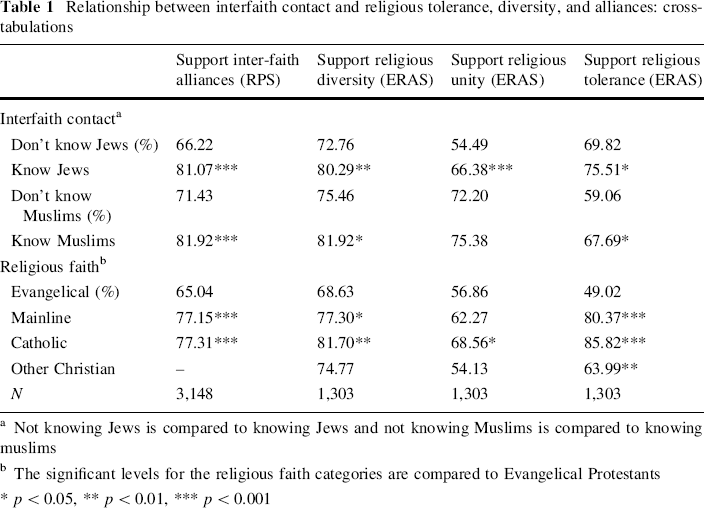
aNot knowing Jews is compared to knowing Jews and not knowing Muslims is compared to knowing muslims
bThe significant levels for the religious faith categories are compared to Evangelical Protestants
* p < 0.05, ** p < 0.01, *** p < 0.001
Interfaith Contact and Religious Pluralism: Multivariate Analyses
Relationship between interfaith contact and religious tolerance, diversity, and alliances: logit analyses: odds ratios
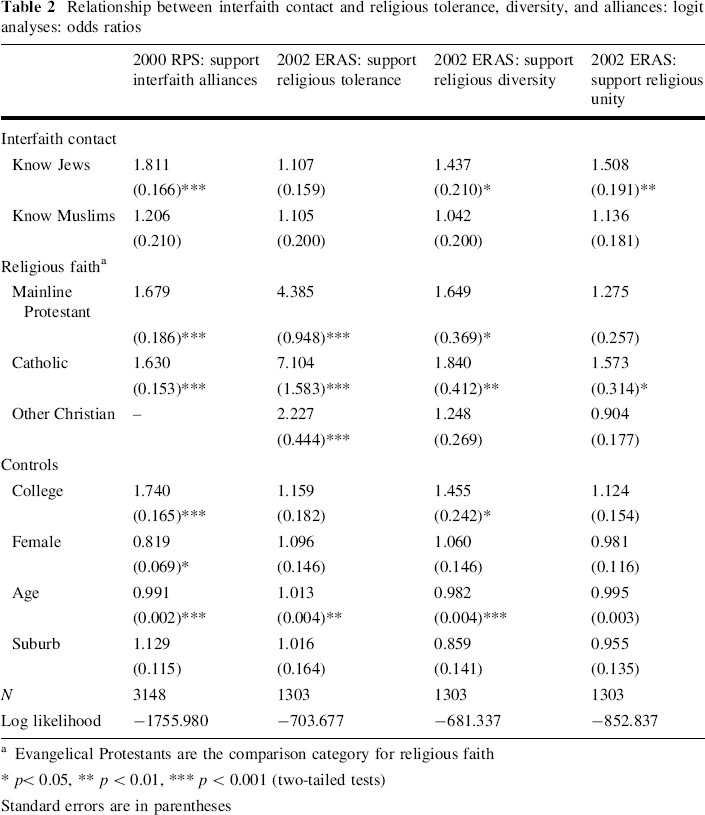
aEvangelical Protestants are the comparison category for religious faith
* p< 0.05, ** p < 0.01, *** p < 0.001 (two-tailed tests)
Standard errors are in parentheses
Religious tolerance is the only variable unassociated with knowing Jews. To the contrary, knowing or having Muslim friends is not statistically related to white Christians’ belief in any of the afore-mentioned measures of religious pluralism. The analyses displayed in Table 2 also provide support for the Denominational Affiliation and Pluralism Hypothesis (H2). That is, Mainline Protestants and Catholics are more likely than are Evangelical Christians to maintain the importance of religious tolerance, and diversity and supporting their congregations forming alliances with non-Christians. Catholics are also more likely than are Evangelicals to believe that diverse religions contribute to national unity. And, Other Christians are more likely than Evangelicals to maintain the importance of religious tolerance.
These analyses also indicate that college graduates tend to be more supportive of interfaith alliances and religious diversity. Women also tend to be more supportive of interfaith alliances. Older individuals tend to be less supportive of interfaith alliances, religious tolerance, and religious diversity.
Collectively, these findings indicate that contact with Jews is more salient than contact with Muslims to white Christians’ espousal of religious pluralism. These data also suggest that Evangelical Christians are less likely than are all other Christians to articulate support for religious pluralism. The analyses now move to assessing denominational differences in the relationship between interfaith contact and support for religious pluralism.
Interfaith Contact and Religious Pluralism: Interactive Relationship
Moderating impact of religious faith on the relationship between contact with Jews and religious tolerance, diversity, unity, and interfaith alliances: logit analyses: odds ratios
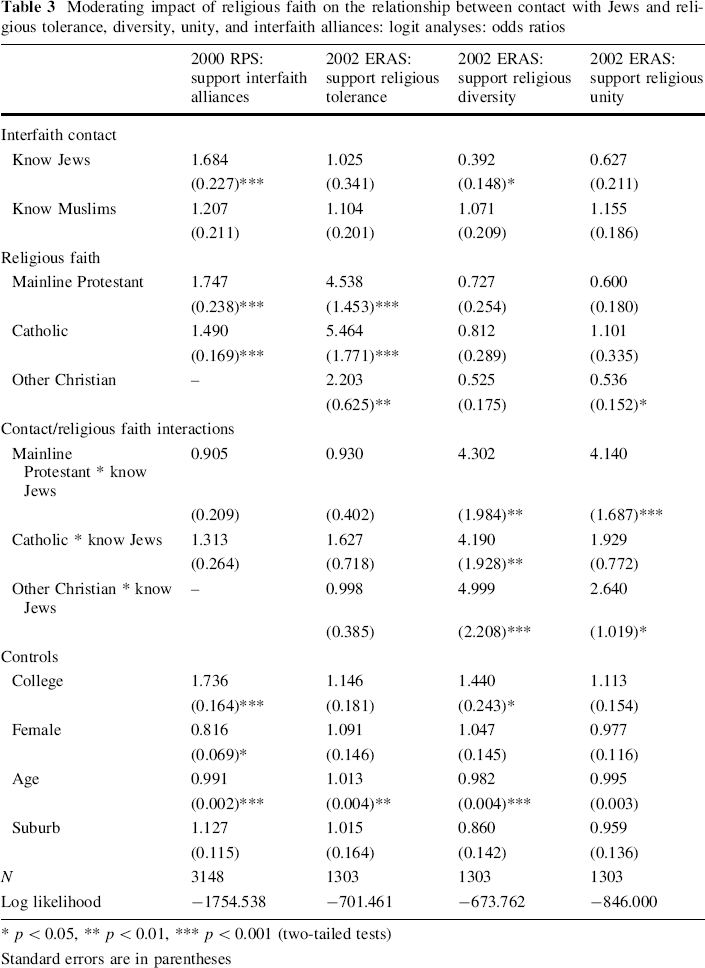
* p < 0.05, ** p < 0.01, *** p < 0.001 (two-tailed tests)
Standard errors are in parentheses
Moderating impact of religious faith on the relationship between contact with Muslims and religious tolerance, diversity, unity, and interfaith alliances: logit analyses: odds ratios
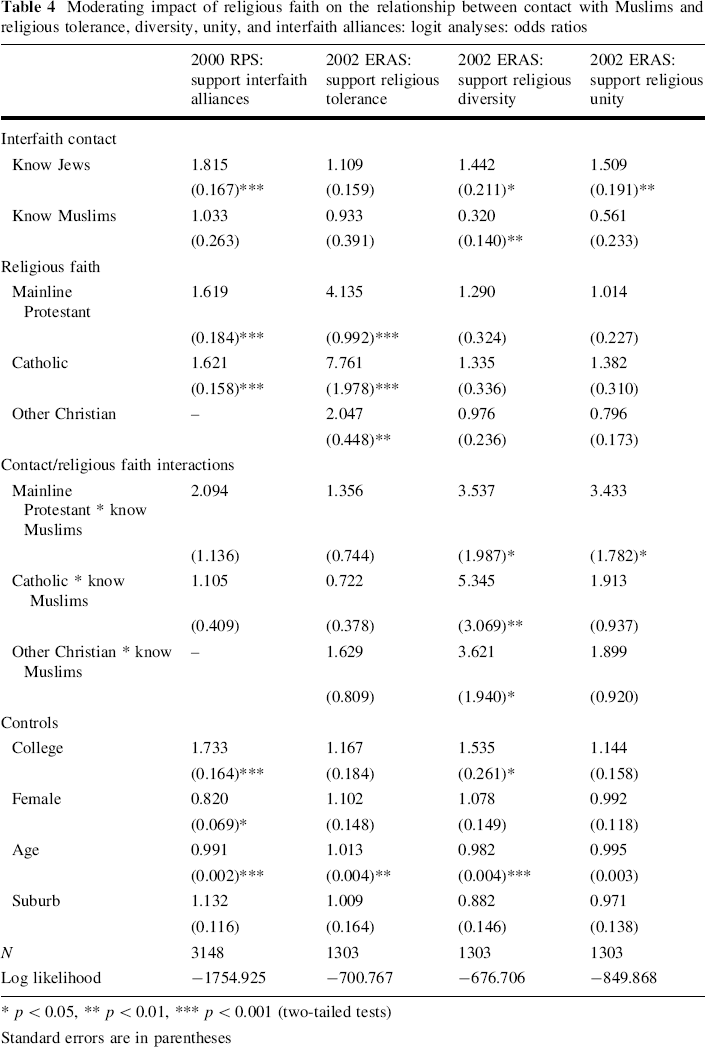
* p < 0.05, ** p < 0.01, *** p < 0.001 (two-tailed tests)
Standard errors are in parentheses
Discussion
The current study builds upon social categorization and inter-group contact theories by suggesting that religious group identities inform the saliency of interfaith contact to the willingness of white Christians to re-categorize non-Christians as part of their religious in-group. That is, contact with religious out-groups perceived as being relatively unthreatening to and/or close to one's own faith seemingly informs and/or reinforces perceptions or pluralism. Such is not the case, however, for religious out-groups perceived as threatening the authenticity of one's own religious beliefs. To the point, white Christians are arguably more likely to generalize their positive contact experiences with white Jews to their positive affect for Jews as a whole than is the case with Muslims. This finding is likely linked to a desire of Christians to protect Judea-Christian hegemony in this country. That is, the threat of non-western culture upon American cultural dominance in this country makes it difficult for white Christians, as a group, to extrapolate their equal-status and positive contact with non-white non-Judea-Christians to their conceptualization of religious pluralism for all religious groups, Muslims specifically.
The form of pluralism that white Christians seemingly exhibit is quite consistent with Massanari's (1998) depiction of a Westernized hierarchical dualistic form of pluralism. This is a form of pluralism that extends the benefits of in-group status to out-groups perceived as being relatively close to one's in-group. Moreover, when white Christians contemplate the meaning of religious pluralism, it is conceivable that they are initially and perhaps exclusively thinking about a form of religious pluralism that is inclusive of members of the Jewish faith only, white Jews in all likelihood. Contact with these individuals likely reinforces such perceptions.
The current study further builds upon social categorization and inter-group contact theories by suggesting that religious groups that believe that one's religious identity is linked to the absence of competing faiths tend to be less pluralistic than other religious groups. Such conservative theological outlooks may also weaken the role that interfaith contact can play in informing and/or reinforcing perceptions of the importance of religious pluralism. More specifically, white Evangelicals are less likely than all other white Christians to espouse religious pluralist ideals. There is also some evidence that contact with Jews and Muslims plays a greater role for Mainliners, Catholics, and Other Christians than for Evangelicals in re-categorizing both Jews and Muslims as part of a larger “Children of Abraham” grouping. This finding is plausibly linked to the fact that Evangelicals are more likely than other Christians to see all other religions as potential challengers to their religious dominance (Fowler et al. 2004; Kohut et al. 2000; Wald 2004).
In sum, this research contributes to increasing understanding of the ways in which Christians think about religious pluralism in the United States. It does so by empirically uncovering the relationship between inter-faith contact and the willingness of white Christians to support tenets of religious pluralism. To that end, this study largely intimates that religious identity reinforces a dualistic world view. Put plainly, for white Christians, it is likely that contact with Jews and not Muslims is salient to their religious pluralist understandings. The saliency of Jews and not Muslims to such pluralists understanding is plausibly linked to a sense that Jews are relatively closer to the Christian in-group than are Muslims. Nonetheless, more so than other Christians, Evangelicals tend to embrace a theology that views their belief system as being in conflict and competition with non-Christians. To that end, it is plausible that even when Christians have positive contact experiences with Jews that Evangelicals are less willing than are other Christians to recognize Jews as being members of a larger Judeo-Christian group. And, while contact with Muslims does not seem to reinforce a commitment to pluralist ideals among white Christians as a whole, there is some evidence that relative to other Christians such contact is less salient to the pluralist ideals of Evangelicals.
Conclusion
To be clear, this study is not suggesting that contact with Jews causes White Christians to be more pluralistic. Nor is this study suggesting that contact with Jews and Muslims cause non-Evangelicals to be more pluralistic than Evangelical Christians. Rather, without asserting, directionality, it is only suggesting that an association exists between such contact and pluralism. Nonetheless, to a large extent, this study's central findings suggests that Jewish-Christian interfaith contact is grounded in a set of similar experiences and a general consensus that American Christians and Jews have much in common. Indeed, American presidents, starting with President Truman, have largely been accepting of Jewish Americans. His and future president's recognition of the immorality of the genocide visited upon European Jews by Nazi Germany, the Jewish right to statehood, and the wrongness of educational and employment policies restricting American Jewish mobility in this country were instrumental in White Christians’ gradual acceptance of Jewish Americans as social equals. American Muslims have not had such a defining moment. The wars in Iraq and Afghanistan along with differences in customs, clothing, and languages among Middle Eastern immigrants and white Christian America may contribute to the view among white Christians that Islam is fundamentally different from their own religion. Furthermore, a majority of Arab-Americans are first and second generation Americans (Brittingham and de la Cruz 2005). This reality may also contribute to the social contact between whites and persons perceived as Muslims being characterized by misunderstanding, as opposed to tolerance and recognition of commonality.
Nonetheless, it is arguably the case that theology and the commitment of denominational bodies to act upon their theology impacts Christians’ commitment to a pluralism that allows one to re-categorize Muslims as legitimate members of the America's religious polity. The institutional commitment to pluralism at the national and local levels of the Catholic Church and Mainline organizations likely contributes to their laity participating in more learning opportunities and joint civic and religious projects with Muslims and Jews than do Evangelical lay persons. This likely contributes to the greater willingness of Mainline and Catholic laity, as compared to Evangelical lay persons, to recognize similarities in theology and mission between themselves and both Muslims and Jews.
All the same, ignorance, mistrust, and misunderstanding of cultural customs and values tend to characterize Christians’ relationships with Muslims (Kohut 2005). Such a relationship surely contributes to the uneasiness that white Christians feel toward American Muslims. The hope is that as successive generations of Muslims become “Americanized” the current social gulf will slowly melt away. This will only occur, however, if the nation continues to have open dialogues about the civil rights and liberties of all citizens, especially during times of crises.
Footnotes
1
A 1999 U.S. Census Bureau report indicates that 27% of American immigrants, nearly 7 million people, are from countries in which Christianity is not the dominant religion. Some estimates suggest there are up to 6.7 million American Muslims, and between 2.5 and 4 million American Buddhists. The number of persons of East Indian descent is estimated at approximately 2 million, of who as many as 1.3 million may be Hindu (Wuthnow  ). Furthermore, a National Opinion Research Center survey suggests that due to a precipitous drop over the past 10 years in the number of American Protestants, this country may no longer be a Protestant majority (Harms 2004).
2
Missing values for age was replaced with an imputed regression score. This procedure organizes its calculations by patterns of missing data so the missing-value regressions can be conducted more efficiently. The results reported below were not substantively or significantly altered by this analysis technique.