







Abstract
Research on women in gender-traditional religions has shown that women often exercise agency within the gendered confines of their religious institutions. This paper builds on the growing literature on women's agency in gender-traditional religions by exploring whether and why some active Mormon women resist the gendered expectations of their faith more strongly than others. Drawing on interviews with women members of the Church of Jesus Christ of Latter Day Saints (LDS Church, Mormon), we find that eight of the 30 women interviewed strongly resisted traditional Mormon gender expectations. We then explore their patterns of resistance and provide possible explanations for why they resist gender traditionalism more than the other participants. We discuss the wider implications of our findings, including a call for further examinations of the ways in which women's religious experiences include both accommodation and resistance to traditional ideas about gender.
Keywords
Interviewer: When you say “stereotypical Mormon girl” what do you mean by that? Bailey: …get married young, start a family, quit school —that's really stereotypical, but being from California, that's kinda what we thought (Mormon) Utah girls did. And that was not gonna be me.
This quote is from an interview with Bailey, a 26 year old mother who is pursuing a career and a graduate degree, and who is also a member of the LDS Church. Bailey is personally opposed to the general prescriptions for Mormon women as advocated by Church culture and teachings. Yet, she is still active in and committed to her faith.
Women like Bailey present a puzzle for gender scholars, sociologists of religion, and social scientists generally interested in the interplay between structure and agency. Why do some women adhere to religions that appear—at least to outsiders—to subordinate them? Particularly in societies where gender traditionalism is waning, why do some women remain committed to religions with traditional/conservative gender ideologies and organizational structures that limit their agency and power?
These questions have been termed “paradox” questions (Avishai 2008). Most studies that address such questions make sense of the paradox by describing how women exercise agency within confining religious structures, carving out space for autonomous action (see Avishai et al. 2015; Bartkowski 2001; Burke 2012; Korteweg 2008; Mahmood 2001; Mihelich and Storrs 2003; Zion-Waldoks 2015). By showing how religious women can work actively to promote their own interests, even in the context of constraints, such work makes the important point that religious women are not victims who blindly follow the gendered expectations of their religion. As some scholars note, attaining a religious identity—even within a gender-traditional religion—can be seen as agentic action (Rinaldo 2014). This paper adds to the broader literature on women's agency in gender-traditional religions by examining one particular type of agentic action: resistance, which is understood as oppositional action (Hollander and Einwohner 2004). We therefore focus on how religious women oppose gender-traditional religions (see Burke 2012), defying rather than working within the constraints of such systems. Our emphasis is on a category of resistant actions that lies between participation in formal, organized social movements and what has been termed “gender negotiation” where women engage in give and take patriarchal bargains within gender-traditional religions in order to exercise agency (see Bartkowski 2001). Specifically, we examine Mormon women's opposition to gender traditionalism in their everyday lives.
We turn again to Bailey as an illustration of the actions we analyze in this study. Bailey ignores LDS gender expectations for women as she understands them. She has a young child at home yet is pursuing a career and higher education, both for her own fulfillment and because she sees such efforts as beneficial for her family. She pursues her goals even though she keenly understands her actions contradict Mormon gendered expectations; however, she rejects the idea that doing so makes her less of a mother or an insincere Mormon. Bailey's actions and, indeed, her identity constitute a form of “everyday” resistance that opposes the gendered institution of the LDS church (see Bell 2001; Scott 1985).
Not all Mormon women are like Bailey, however. In fact, many of the women interviewed for this research did not strongly oppose aspects of gender traditionalism within Mormonism. We argue that this variation deserves in depth exploration. Why do some religious women resist the teachings and gender expectations of their faith while others do not? And why do some resist more strongly than others?
We begin by locating our study within the existing research on women's agency and resistance in gendered religious institutions. We then explain why the LDS Church is an ideal site to explore patterns of gendered resistance. Next, we describe the process used to conduct and analyze our interviews with Mormon women. We then present our findings. We conclude by discussing the relevance of our findings for the sociology of religion as well as broader sociological inquiries.
Women's Agency in Gender-Traditional Religions
The last three decades have witnessed a proliferation of studies that seek to understand the experience of women in gender-traditional religions (see also Avishai 2016 for a recent, theoretical review of this literature). This area of research examines: (1) how women engage in agentic action within religious structures and (2) how they make sense of their experience as conservative women who adhere to conventional gender ideologies concomitant with ideas about gender changing in the broader culture.
Researchers have identified several broad patterns that demonstrate how religious women exercise agency in the context of their religious lives: gender negotiation, cultural boundary work, subcultural identity, and religious fulfillment (see Burke 2012 for a review of this literature that uses different terminology). First, many scholars use the language of negotiation or gender negotiation to describe women's’ attempts to manage unequal gender relations in their religious groups and families (Bartkowski 1999, 2001, 2004; Beaman 2001; Chong 2008; Denton 2004; Mahmood 2005; Mihelich and Storrs 2003; Read and Bartkowski 2000; Rinaldo 2013; Rose 1987). These studies find that religiously conservative women are active agents within the gendered structures of their religious organizations and their families—even though from the view of outsiders it may appear they are mostly submitting to gender-traditional ideologies. Gender negotiation is defined as acts that involve both agency and accommodation to gendered structures; the term negotiation is appropriate here because most of these studies describe a “give and take” process (see Bartkowski 2004; Connell 1987; Rose 1987). For example, Rose (1987) describes how women in a charismatic Christian community accept traditional gender expectations, but also negotiate with their spouses to have the husbands assist in child rearing and housework more than traditional expectations would dictate.
Other studies highlight women's agency in gender-traditional religions by documenting women's cultural boundary work. As this label suggests, women engaged in such work do not draw solely from the gendered cultural schemas of their religion to define who they are as women; rather, their identity is also based on elements from the—often more progressive—gendered cultural schemas in the broader society. Drawing on the theoretical frameworks of the cultural toolkit (Swidler 1986) and boundary work (Lamont 1992, 2000), scholars who take this approach explain how gender ideologies become a site of contestation between religion and secular culture (Bartkowski 1997, 1998, 2000; Currie 1997; Gallagher 2004; Read and Bartkowski 2000, 2003; Rinaldo 2010; Wodak 1997). According to this research, religious women recognize these competing cultural ideas and borrow from the religious and the secular worlds—including feminism—in an attempt to meet the demands of both (Ecklund 2003; Gallagher 2004; Hanks 1992; Kaufman 1989; Manning 1999; Neitz and Dillon 2003; Stacey and Gerard 1990; Yadgar 2006).
Another way scholars have explained how conservative women display agency employs Christian Smith's subcultural identity theory (Smith 2002; Smith and Emerson 1998). Studies applying this approach argue that evangelical women derive value from the distinctiveness that comes from being part of a religious subculture. Thus, evangelical women often draw on the conventional ideologies of their religion when describing their opinions about gender ideologies and even defend these ideologies, even though their behavior is very similar to that of non-religious women (Denton 2004; Gallagher 2003, 2004; Gallagher and Smith 1999). As Gallagher and Smith (1999) explain, evangelicals are symbolically traditionalist, but pragmatically egalitarian.
Finally, some studies focus on the fulfillment and direction conservative women derive from adhering to their religious group's gendered ideology, which provides a bedrock gender identity in a postmodern world. We refer to this approach as religious fulfillment (see Ammerman 1987; Brasher 1997; Davidman 1991; Griffith 2000); it is in keeping with Burke's (2012) concept of “empowerment agency,” wherein women feel empowered by following the teachings of their faith. This approach is best elucidated in Brasher's (1997) study, which concludes that fundamentalist women feel empowered because of the meaning and direction the gendered teachings give them as well as the fellowship they feel in women's groups in their churches.
A Focus on Resistance
The body of research summarized above illustrates different approaches to understanding women's experiences as adherents of gender-traditional religions, but each arrives at the same point: they show that women in gender-traditional religions can exhibit agency. In this paper, we focus specifically on resistant actions that directly oppose religious patriarchy and try to understand variation in resistance; namely, why some of the women in our sample were more resistant toward Mormon gender ideologies than others.
We therefore focus on a specific subset of agency: resistance, or oppositional action (Hollander and Einwohner 2004). Researchers have shown that not all agentic acts push for change; in fact, agentic acts can occur within or even reinforce unequal power structures in religious contexts (see Chong 2008; Kandiyoti 1988; Kaufman 1989; Mahmood 2005; Ozorak 1996). For example, in her study of Korean evangelical women, Chong (2008) finds that women exercise agency by submitting to their husbands to an extreme extent—such as enduring emotional abuse—in the hope that these “supreme acts of submission” will reform the men into better husbands and fathers. Chong therefore argues that these acts, while agentic, reinforce the patriarchal power structure of evangelical churches and the broader Korean society. Such arguments mirror Campbell's (2009) distinction between “the power of agency” (i.e., the ability to act) and “agentic power” (i.e., the ability to act free of constraint).
By singling out resistant, oppositional forms of agency, we follow feminist researchers who study women in gender-traditional religions, along with those who advocate broadening the concept of agency (see Brink and Mencher 1997; Burke 2012; Charrad 2011; Emirbayer and Mische 1998; Mahmood 2001, 2005; Zion-Waldoks 2015). However, we still need to make our conceptual approach clear. While the term “resistance” has been applied to a vast array of political and social behaviors, ranging from armed uprisings to cultural trends in fashion and language, Hollander and Einwohner (2004) argue that there is scholarly agreement on two core dimensions of resistance: action and opposition (p. 538). Yet, it is widely accepted that resistance does not have to come in the form of social movements or even be organized at the group level. Rather, resistance can be enacted on the individual level and can be ideological and symbolic in nature, and can be either overt or covert (Bell 2001; Hollander and Einwohner 2004; Scott 1985).
Our study adopts Hollander and Einwohner's (2004) conceptualization of resistance as oppositional action, but seeks to explore the dynamics of religious women's “everyday” resistance as opposed to participation in formal resistance organizations.1 Further, we refer to religious women's everyday resistance as gendered resistance. In so doing, we draw on Hollander's (2002: 425) definition of gendered resistance, or “acts of opposition to conventional gender expectations or beliefs” that oppose the dominant, hegemonic discourse on gender.
Finally, Hollander and Einwohner (2004) note a point of scholarly disagreement on the treatment of resistance regarding intent. They show that while some conceptualizations of resistance reserve the term for intentional acts, others maintain that an actor can resist without necessarily intending to. We limit our inquiry to those actions that include intent on the part of the actor. Hence, for this research, gendered resistance is defined as women in the sample engaging in acts of overt opposition—including “everyday” acts of opposition such as life decisions and attitudes and opinions—to gender-traditional ideologies in the LDS Church with the intent to oppose the religion's prescriptions and proscriptions for women's behavior. This definition allows us to delineate which acts by women in our sample are genuinely opposing the institution, as contrasted with agentic acts that may be undertaken to make an unequal situation more bearable or seemingly resistant acts that lack intent on the part of the actor. However, as we explain further in our methods section, although we limit our focus to intentional acts, we allow for a subjective view of resistance on the part of the participants; thus, if the participant showed a clear intent to resist, we considered the act/attitude to be resistance. For instance, a participant who appeared to resist Mormon gender ideologies by working full time with young children, but rationalized their work status and did not demonstrate intent to resist, was not considered resistant.
A key aim of our study is to explore why some women in gender-traditional religions are more resistant than others. Thus, in addition to identifying acts of resistance in the interviews, we also delineate strong resisters from the rest of the sample. We describe how we accomplished this goal in the methods section.
Mormon Women's Resistance
Our empirical analyses focus on Mormon women, a population that we find to be especially useful for an examination of religious women's resistance. We consider the LDS Church to be a gender-traditional religion (also called a patriarchal religious institution; see Hoffmann and Bartkowski 2008). We define a gender-traditional religion as a religion that supports conventional gendered cultural schemas—including expectations, beliefs, customs, norms and ideologies that exacerbate gender inequality by making assumptions about what men and women need and can or cannot do, and to what they are entitled (see Giddens 1984; Messner 2002; Risman 2004; Sewell 1992). In fact, recent scholarship demonstrates how Mormon leaders have inscribed ideas pertaining to ideal womanhood into the institutional structure of the Church in ways that ensure the subordination of women (Sumerau and Cragun 2014). While other religious traditions (e.g., Christian evangelicalism) also support such gendered teachings, the LDS Church is distinct in several ways. For instance, only men can hold key decision-making positions in the Church's organizational hierarchy. Part of the uniqueness of the Church's organizational structure and culture is due to members’ belief that top-ranking leaders are prophets who receive revelation from God. As a consequence, the LDS Church maintains a tight grip on discourse for many topics, including gender and the family. While this discourse has changed over time, it is overwhelmingly in favor of conventional gender ideologies, including the viewpoint of women being relegated to the private sphere (Iannacone and Miles 1990; Sumerau and Cragun 2014; Vance 2002).
Unsurprisingly, given the gendered cultural schemas and gendered organization of the religion (Phillips 1998; Stark and Neilson 2005), Mormons consistently reveal themselves to be among the most committed, politically conservative, and theologically conservative Christian group in the United States (Heaton et al. 2004; Smith and Denton 2005; also see the Pew 2014 Religious Landscape Study for a more recent analysis). For example, one study found that 32% of Mormon women were housewives compared to 13% of women in the population as a whole (Phillips and Cragun 2011). In addition, because the gendered, hierarchical organizational structure and gendered cultural schema of the Church are well known and clearly communicated to Church members, any woman's intentional opposition to gendered expectations for women may be understood as an act of resistance (Sumerau and Cragun 2014). In fact, Sumerau and Cragun (2014: 15–16) in their analysis of LDS archival materials found that according to gender expectations in the Church, women are inextricably linked to the home and that the home is seen as important to the moral development of women. Thus, whereas there is some debate and confusion among scholars as to what “counts” as resistance (see Hollander and Einwohner 2004), we argue that patterns of resistance may be more easily identified among Mormon women due to the clear gender expectations of the religion. We turn now to a discussion of our data and methods, showing more clearly how we treat resistance empirically.
Data and Methods
Our analysis is based on interviews with 30 Mormon women. These interviews centered on a topic that is known to be a topic of contestation among Mormons: women with young children working outside of the home (Ammerman and Roof 1995; Stacey 1998). The first author conducted all the interviews. We purposely selected respondents who were likely to have varying opinions on this topic. Therefore, of the 30 respondents, 10 were women with young children who work more than 30 h a week, 10 were women with young children who are stay at home mothers (SAHMs) working less than 20 h per week, if at all, and 9 were women who have a career and have never been married. An additional interviewee was a woman who is career oriented and, at the time of the interview, was married without children. The sample was split between Mormons inside and outside of Utah because previous research shows differences in levels of activity and commitment—lower levels of activity, but higher levels of commitment—for Mormons outside of Utah (Phillips 1998).
Participant characteristics
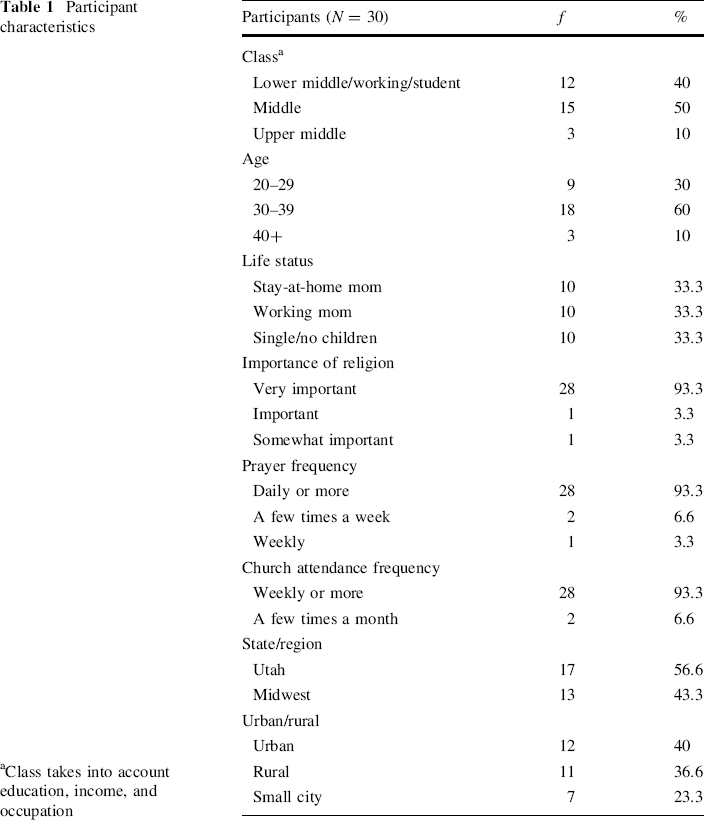
aClass takes into account education, income, and occupation
Interviews were conducted from the spring to fall months in 2012 and usually took place in the respondent's home or a public place such as a library or cafe. They usually lasted about 1 h. But ranged from 40 min to almost 3 h. All interviews were recorded with a digital recorder and transcribed. We use pseudonyms when quoting respondents by name.
It is essential to recognize the position of the first author as both an insider and outsider in this research. The first author is a man who has a Mormon background and was an active Mormon at the time of the interviews. The first author shares a cultural background with the participants, however, a Mormon man interviewing Mormon women presents some challenges. As a priesthood holder in the LDS Church the first author was diligently cognizant of the power differentials between men and women in the LDS Church and thus strived to create an open environment for the women interviewees to share their stories. As a scholar who focuses on the sociology of religion, the first author may have had insights into gender and religion that insiders were less likely to have. At the same time, an insider may also take certain patterns in the data for granted because of his closeness to the culture, which is why coauthors are especially helpful. In this respect, the second author (a non-Mormon, non-Christian) offered a useful perspective.
Following a similar strategy used by Mahmood (2001), the interview schedule focused on a topic of ideological significance (here, the appropriateness of employment for mothers of young children) and was designed to elicit respondents’ motivations for decisions related to the topic as well as more general opinions and attitudes about gender expectations.
In the first part of the interview, respondents were invited to share a narrative about how they came to their current life situation (i.e., stay-at-home-mother, working mother, or single career woman), focusing on aspects of their story that influenced their decisions with respect to work and family. The way participants interpret meaning in their everyday events is an effective technique used to understand how cultural schemas affect behavior (Packer 2010; Rubin and Rubin 2011). The next part of the interview, which we refer to as the conceptual portion, departed from the narrative approach. Questions asked during this portion of the interview aimed at understanding the respondent's attitudes and opinions on topics related to broader views on gender ideology and expectations, such as views on the idea that God created men and women differently to fulfill different familial obligations, gender equality, male headship of households, and the “breakdown” of the traditional family. The concluding portion of the interview employed vignettes, defined as, “short stories about hypothetical characters in specified circumstances, to whose situation the interviewee is invited to respond” (Finch 1987:105). The vignettes posited Mormon families in situations where difficult decisions concerning work and childcare had to be made. Participants were asked to react to the hypothetical situations, which provided additional insights into the extent to which the participants complied with or resisted gender traditionalism. Following oft-used methods of qualitative data collection and analysis, the first author took notes and wrote memos before and after each interview (Rubin and Rubin 2011).
The analysis combined both deductive and inductive methods of analysis (Packer 2010; Strauss 1987). Definitions and treatments of the concept of resistance informed and affected coding of the data (Packer 2010). Nonetheless, an inductive, grounded theory approach was also employed as one round of “open coding” was completed followed by four rounds of coding applying conceptual codes specifically looking for instances of resistance as defined above (Coffey and Atkinson 1996; Strauss 1987). The authors were also cognizant of themes and patterns emerging in the data during analysis. For the conceptual rounds of coding, process coding and structural coding techniques were applied (Saldaña 2009). We used the qualitative software package MAXQDA to assign the codes to the text.
Analytic Strategy
Most of our respondents exhibited gendered resistance in some way in their interviews. All but one of the interviews (29 of 30, or nearly 97%) contained resistance codes. But as noted above, the purpose of this paper is to examine whether and why some of the women in our sample were more resistant to gender traditionalism than others. We therefore needed a way to assess the strength of each respondent's resistance, and how that varied across our sample. We used two analytic techniques to accomplish this objective. First, after two rounds of coding the transcripts for instances of resistance, we created a new code labeled clear/strong resistance. Then, after filtering out the segments of text coded as resistance, we completed another round of coding applying the clear/strong resistance code to segments of text where the intent to resist gender traditionalism was clear and unambiguous. In other words, we coded attitudes and descriptions of behaviors that opposed Mormon gender ideologies as resistance in the context of the interviews, even if the participants were not explicit about whether they expressed these views in other settings. Second, we used a function in MAXQDA called “code matrix.” This function allowed us to compare how often we used the “clear/strong resistance” code in each transcript. We then compared the number of “strong resistance” codes across transcripts. Using these techniques, we found eight of the participants set themselves apart from the rest of the sample as strong resisters.
Below, we present our results. We find differences in the strength of resistance based on life status: working mothers were more likely to be strong resisters than single career women or stay-at-home moms. We then separately present patterns of resistance among the working mothers and single career women. Next, we present patterns of resistance from our sample that applied to both the working mothers and single career women. We finish by presenting evidence in the data that suggest explanations for why some women resisted more than others.
Results
Patterns of Resistance
Comparison of strong resisters and other participants by life status
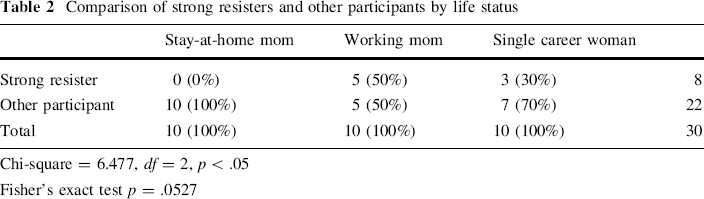
Chi-square = 6.477, df = 2, p < .05
Fisher's exact test p = .0527
Working Mothers
Because of the strong expectation in Mormon teachings and culture that women should focus primarily on their role as mothers, being a working mother can, in and of itself, be thought of as resistance. However, as stated above, we are interested in Mormon women's expressions of intentional opposition to traditional gender expectations. We found ample evidence of such resistance among the working mothers in our sample. These women opposed the idea that as Mormon women, they would find more fulfillment through motherhood than through employment. Instead, these working mothers asserted that they found value and fulfillment through employment. Moreover, they felt that finding fulfillment through working should be acceptable for young mothers in Mormon culture.
A good example was provided by Angie, a mother in her early thirties who has gone in and out of the workforce. At the time of the interview she was employed as a real estate agent. In her narrative, Angie described herself as enjoying work: And, it's not necessarily that I had to work to provide for our family, I just feel better when I'm contributing [financially]. I feel better when I have something to do, I guess is what you could say. I don't know. I'm just wired different. I don't, (laughter) I'm not a stay-at-home mom.
While many of the working mothers in our sample justified the fact that they worked by citing financial need as the main reason, others, such as Angie, described working for their own personal fulfillment, or even because they felt they were better mothers if they also worked. The key point here is that Angie and other resistant working mothers saw their fulfillment as working moms as something in opposition to Mormon gender expectations, which teach that women should find fulfillment through motherhood.
Single Women
We found evidence of opposition to gender expectations that related specifically to the single women in our sample as well. One of the questions asked of all single respondents was “What is it like to be single and have a career as a Mormon woman?” In their responses, some of the interviewees lamented not being married, while others did not. Nina (age 30) is a Human Resources manager who, as the youngest employee on her management team, has quickly climbed the ranks in her company. Like several of the other single women interviewed, Nina was forthright in her rejection of the Mormon idea that she should not put off marriage: …that's been my approach. It's just if it happens it'll happen…I never saw myself getting married young…I pictured being married probably around 24. I didn't want to get married young; there was too much that I wanted to do and to see that I knew once I had a family my life would dramatically change.
While these comments seem quite normal for a woman in her early thirties (and most people outside of the Mormon culture would find 24 a rather young age for marriage), for a Mormon woman, these comments oppose, and therefore display resistance to, LDS gender ideologies. LDS women are taught that being a wife and mother is their most important responsibility; further, they are taught that these steps in life should not be put off. To say that during this time in her life she was not concerned with starting family is quite a departure from the “ideal” life course trajectory of an LDS woman. Later, when Nina was asked about how influential Mormon beliefs and culture had been on her life decisions she said, “I wasn't raised that way; to be put into a mold. I picked my career based off what I was good at and what I liked to do. I've done what I want to do ever since.” In other words, Nina knows what the “Mormon mold” for women is, yet opposes it; she actively resists being molded.
Resisting Stigma and Rigidity of Gender Expectations
Both working mothers and single women participants showed signs of resistance to traditional Mormon gender ideologies by resisting the stigma they received when acting in ways that do not conform to those ideologies. This theme is represented by Karen, a woman in her early 30 s who, at the time of her interview, was working at a bank part time but hoping to be hired on full time. When asked if she felt pressure to be a stay-at-home mother, Karen responded: Oh, yeah. Yeah, you hear comments sometimes at church and when you go to Relief Society [the LDS Church's women's organization], if they're talking about something. Just a few comments, especially the older generation. They say things like, “Well, a woman's place, when she has kids, she should be a stay-at-home mom. You can make do without. You have to make sacrifices.” Interviewer: Does that bother you or is that something that— Karen: Oh, a little, but I just brush it off. I'm not going to quit my job over their comments. I enjoy working. I enjoy what I do, so I'm just, like, “Eh, whatever,” but you definitely hear it and it kinda gets to you, but I ignore them. Interviewer: Okay. How do you deal with the judging? Just let it roll off your back? Karen: I spoke up sometimes. I would say, “Oh, well, you know, sometimes people do need to work or want to work, and I don't think there's anything wrong with it.” [Laughter]
While Karen's laughter might downplay the seriousness of her words, it is important to note that she felt stigmatized by the comments being made in Relief Society and resisted this stigmatization during the meeting—where similar behavior is often sanctioned. The strong resisters in our study also framed their resistance in terms of opposing what they see to be rigid gender expectations in the LDS Church. Summer, a nurse who is the primary income earner while her husband is the primary caregiver in her family, and Ellen, a 24-year-old manager and mother of two who works longer hours and makes more money than her husband, both displayed resistance to what they felt to be a lack of acceptance for their families in Church culture due to the Church's rigid gender expectations. In fact, Summer's husband was not actively religious at the time of the interview because of the stigma he felt as a stay-at-home father. In Summer's words, I think we [as a Church] need to not make families who are non-traditional feel inferior for whatever reason they're nontraditional, whether it is an inactive parent, or a part member family [one or more parents are inactive], or a not-temple-sealed [have not been married in a Mormon temple], or divorced.
The most radical departures from Mormon gender expectations are found among the three single women we categorized as strong resisters. Most of the single women in the sample favored a traditional family arrangement and even held traditional ideas about gender expectations for women—many still hoped to marry and have children and even indicated that they would quit their careers if that were to happen. However, the three single career women categorized as strong resisters did show quite radical departures from traditional Mormon gender expectations. Tina, a graduate student in her early thirties, said she was content not to have children: I don't get, it's really weird, because I know a lot of girls in my situation who really ache to have a family. I don't. I would like a family, I feel like I am supposed to have a family, I would like to be married, but I am not dying to have kids. In fact, I do not even know if I want them at this point. But when those discussions come up, it's not that it's a sad thing, as I get frustrated that it's kind of a myopic view of things. That's all…honestly, I think I can do without kids, I'm good. I am just being honest.
Motherhood is a key aspect of Mormon teachings on expectations for women. Thus, Tina's revelation that she is fine with not having children is a compelling act of resistance to LDS gender expectations.
Taylor was another single career woman who saw Mormon gender expectations as too rigid. When asked if Mormon teachings on the family and gender expectations had impacted her, she said, Especially because I've had to be independent and do things on my own, I do not have the Mormon view as the barefoot wife in the kitchen with the apron. I mean that's offensive to me.
Taylor opposes what she sees as rigid gender expectations for Mormon women, to the point of finding them offensive. She went on to explain how she feels that her job has forced her to change her personality in ways that contradict Mormon ideals for femininity, I think it's made me be more proactive and more assertive than I would have been. I think before, I definitely was a lot more like my mom. She just doesn't want to create waves at all and would bend over backwards. I still want to be like that. I want that sweetness, but I think I've trained myself—or I've had to be just to survive professionally. You just have to be more assertive. I think I noticed—like when I first started at work, I always wanted—I would wait for someone to recognize what I did. I'd just work really hard to be a team player and do those things. I found that didn't work. My profession, for the most part, is pretty male dominated. I had to change my personality a lot to be a lot more assertive and saying look, this is what I did, this is how I've helped you, which at first just drove me crazy. That wasn't my personality. I think that's probably made me a lot more strong-willed.
Taylor's words do illustrate some mixed feelings about work; as we noted in a quote from her interview above, she strongly resists the expectations of being “barefoot and in the kitchen,” yet also seems to have some misgivings about changing aspects of her personality, at least on the job. Despite her misgivings, Taylor made the necessary—at least in her mind—adjustments to succeed in her career. Furthermore, she recognizes the appropriateness of work for Mormon mothers. When asked how Mormon teachings have impacted her decisions, she said, I've known a lot of really good women who feel like they're not at their best when they're just at home. If they have some kind of outsource or outside tasks and a lot of the achievements that you get through work they feel like they're more balanced and better mothers. I think I'm a lot more tolerant of that now than I was originally where I think in my mind it was just if you're a good Mormon mom then you don't work. You stay at home, unless financial needs—but not to buy a nicer car and not to do those things—but so you can eat or have those kind of opportunities. I think I've kind of loosened up on that quite a bit. I guess really it's just like having enough time to do what is your priority.
Thus, Taylor's words show how she has come to oppose the Mormon idea that a “good Mormon mom” does not work. She now sees this view as too rigid and has “loosened up” her views on appropriate expectations for Mormon women.
Explaining Resistance
Even though most of our respondents gave evidence of resistance in their interviews, less than a third (8 of 30, or 27%) were identified as strong resisters. Strong resisters were distinct from the others in how often they made clear statements of resistance to gender traditionalism throughout their interviews. It is perhaps understandable that only a minority of our respondents were strong resisters, given that all our interviewees were committed, active members of their congregations, but the strength of their resistance still needs explanation. Given that the LDS Church is a top-down organization that strives to control discourse on a broad range of topics related to gendered cultural schemas, how do some women find more room for resistance within this context? We suggest that differences in the strength of resistance across our respondents can be explained by a pattern of different social contexts that result in some women having the cultural toolkit needed to recognize and resist situations of inequality (Swidler 1986).
Four of five working mothers labeled as strong resisters came from families that did not meet the traditional Mormon ideal, a point of which these respondents were keenly aware. The archetypical Mormon family consists of a married couple with a man who is a primary breadwinner and head of household and a woman who is a primary caregiver. Past research shows that stigmatized individuals are sometimes motivated to resist rather than passively endure stigmatization (Reissman 2000). This seems to be the case with resisters in this study who attribute their opposition to Mormon gender ideologies—at least in part—to their experiences growing up in a non-ideal Mormon home. For instance, Summer described being “judged” by other Mormons because she comes from a divorced family and because she is now the primary breadwinner in her family instead of her husband. Summer's comments in response to how teachings from Church leadership have affected decisions in her life provide a good example of why growing up in a non-traditional home leads to resistance: It's hard to say. I mean I grew up, like I said, with the church and hearing all of the quotes about our roles [for men and women]. I don't know that I internalized them as much as some women just because of my home life experience as a child—because my parents were divorced, and both of them were working, and we were in child care all the time, and we were going back and forth to different houses…even though I was hearing those at church, all growing up my parents were giving messages—it's okay that our family's doing something different.
Another empirical clue that helps to explain how some women find room for resistance has to do with geography and the proportion of the population that is Mormon where the respondents lived. Notably, the analysis of the interviews showed that there were many more segments of text coded as resistant for those respondents living in Utah than in the Midwest. Further analysis showed that for the strong resisters, this pattern applied to women who had moved to Utah from another state, or had lived in Utah, then moved somewhere else before moving back to Utah. These strong resisters described Utah's culture as more confining and traditionally Mormon, which led them to display more resistance because they felt cultural pressures more acutely. This feeling of cultural pressure is substantiated by other empirical work—specifically, Phillips’ (1998) finding that cultural pressures lead to higher rates of activity in Utah because of the consolidation of religious and social ties. Ellen, a working mother who works longer hours and earns more than her husband, recounted this feeling in response to the question if she had ever felt pressured to be a stay-at-home mother or felt stigmatized because she worked: Living in Utah, yes. (laughter) And, let me kind of explain that - in, in Oregon, where I'm from, it's, I grew up with a working mom. My mom has worked my entire life. Most moms I know have worked their entire lives. Most church members I know, have worked their entire lives. And, then moving to Utah, it's completely the opposite. It's a very stay at home mom culture, and we live in a very young ward, here, and it's, I definitely feel like I get looked down upon in some ways because I work.
Finally, the participants’ views on the hegemony of the male career seemed to be key to understanding why some women resisted more than others. The hegemony of the male career is a concept that describes the cultural ideology that men should be breadwinners and the associated freedom and power awarded men based on this ideology (Pyke 1996). As a whole, the participants were more flexible on gendered expectations for Mormon women. When it came to gendered expectations for men, however, the women were much more prone to define men's gendered expectations in more rigid terms, especially when it came to providing materially for families. In other words, the interviews revealed that there was more flexibility for ideal Mormon womanhood than for ideal Mormon manhood. However, among the single women and working mothers who were identified as strong resistors, there were much more liberal views of Mormon manhood and a lack of support for the hegemony of the male career. For instance, Summer asserted that it is not important who provides financially for the family, so long as the interests and desires of each partner are accounted for. This less-dichotomous, more-progressive view of expectations for men and women within families was common among the strong resisters (six of eight or 75% of the strong resisters rejected the hegemony of the male career, while 27% of the rest of the sample expressed this view).
Discussion: Availability for Resistance
These three explanations for how and why some women resist suggest that to resist Mormon gendered cultural schemas, individual Mormons need to be able to draw on alternative discourses, such as those provided by non-traditional (in the Mormon sense) family upbringing. In addition, our data provide evidence for a more overarching premise: in a gender-traditional religion, where power is allocated along gendered lines, some actors are better equipped for resistance to the gendered ideologies and structures of their religious group because of the social locations they inhabit. By social location, we are referring to social categories individuals inhabit and how these categories locate them within social hierarchies and impact their lived experience (see Weber 2010: 6). This finding is in line with social movement research showing that certain biographical characteristics (such as age and employment and family status) and membership in activist networks can draw an individual in to movement participation (McAdam 1988).
Our data show that many of the women held views that seemed to be resistant, but lacked a key component of the definition of resistance used for this research: a sense of opposition to the gendered ideologies or gendered organizational structure of the religion with an intent to resist. Among the women in our sample, strong resistance only materializes in certain social contexts that provide an environment that is conducive to resistance. As agents operating in a gendered structure that tends to limit women at the expense of men, the participants engaged in a contested process of self-creation as Mormon women (see Choo and Ferree 2010: 134). The process is contested because of the power relations of the religious institution and because of the institution's contested status with the broader culture.
While some women stopped short of strong opposition to gender traditionalism in this process, other women met the contestation head on and resisted. Swidler's (1986) well-known theory of cultural toolkits is also instructive here. The resisters in our study tended to draw on symbols, world views, and narratives from a non-traditional Mormon childhood that allowed them to resist the unequal gendered structure around them rather than participate in gender negotiation. It is also of note that seven of the eight strong resistors had at least some college education. This experience also likely exposed the participants to alternative gender ideologies that contributed to their ability to draw on alternative narratives related to gender. Lastly, the resisters in this study also provide excellent examples of the temporal aspects of agency (Emirbayer and Mische 1998). Specifically, these women drew on past experiences (growing up in non-ideal Mormon families) and their contemporary context (finding themselves in a more hegemonic cultural setting in the Mormon stronghold of Utah) to oppose the gendered expectations of the religion. This finding is similar to Yeung et al.'s (2006) study of gay fraternity members, another study of individuals who engage in resistant acts from within an institution that espouses a hegemonic ideal (in their case, hegemonic masculinity). In sum, the strong resistors in our sample were exposed to a unique combination of alternative discourses and a constraining social context that led to the resistance described in their interviews.
One important question remains unanswered. Why are the working mother participants more resistant than the single career women? We posit that the answer lies in legitimation. Legitimation can be defined as, “a process by which acts in specific, concrete situations of action are justified in terms of the norms, values, beliefs, practices, and procedures of pre-given structure” (Zelditch 2001: 14). Working Mormon mothers satisfy the important Mormon ideal of motherhood, even if they do not fit the traditional ideal of the stay at home mother. Even though they work and are not apologizing for working, they see motherhood as very important. Thus, they are in a better position to feel justified in their opposition to Mormon gendered expectations. In contrast, single career women lack this legitimation and thus have less justification for resistance—i.e., they are more likely to be stigmatized and/or sanctioned for their resistance because they lack the legitimation of motherhood that the working mothers have.
We recognize, however, that our findings are limited to our sample, and that despite our attempt to interview Mormon women in different regions and at different life status points, our findings may not generalize to all Mormon women. Further, as stated earlier, it is important to recognize that the nature of the sample—particularly the life statuses of the women as SAHMs, working mothers, and single career-oriented women—very likely had an impact on the patterns of resistance found in the interviews. That is, the finding that strength of resistance is associated with life/employment status may be an artifact of the interview schedule, which focused on respondents explaining motivations and decisions about these life statuses. Interestingly, however, whereas we expected that the single career women would be the strongest resisters (because their life status seems to be less in line with LDS cultural expectations), we found instead that the working mothers were most likely to be strong resisters.
Summary and Conclusions
The purpose of this research was to explore patterns of religious women's resistance and to try to understand why some of the women in the study were more resistant than others. Focusing on oppositional acts and attitudes portrayed by study participants, we have shed light on some of the factors that contributed to some of the Mormon women interviewed resisting gender traditionalism more strongly than others.
Our research also has implications for the larger interplay between structure and resistance. Structures can act to enable or constrain individuals’ agency. In gender-traditional religions, the overall pattern is to constrain women at the expense of men. The gendered structure of conservative religions is especially insidious because the gendered cultural schemas are framed as natural, God-given, and essential to personhood (Sered 2000). Despite these structural constraints, many of the religiously active women interviewed showed some evidence of resistance. Our research suggests that certain social locations an individual inhabits converge to provide the social context and tools to resist even within very confining religious structures. These findings are compatible with Bloom's (2013) concept of “safe resistance,” which he describes not as a form of resistance that carries no risks, but as one that provides the resister a sense of “ontological security” in the form of a resistant identity. Indeed, the concept of a “safe,” resistant identity, one shaped by an individual's upbringing and social locations, may be key to understanding why it is that the Mormon women in our study can display oppositional views while they maintain strong, committed identities as Mormons.
A better understanding of how and to what extent conservative women resist can give researchers an indication of possible impending social changes in religious institutions. Future research should, therefore, look for patterns of resistance while also striving to ascertain the conditions that cause some women to resist gender traditionalism more than others.
Finally, although a sizable minority of the participants were “strong resisters,” most of the participants were not. In this vein, our research supports earlier studies that highlight the important role religion plays for providing meaning and direction for religious women. The participants not included in the “strong resisters” category were not individuals who unthinkingly followed the gendered expectations of their religious group. Rather, they noted the fulfillment and direction they found in being mothers and in being obedient to their religion's teachings. The point here is that religious institutions may not have to completely adapt to the broader culture's ideas on gender because the clear gender expectations are still attractive to many. This idea is supported by the fact that the LDS Church is a growing religion in the United States and globally. Future research should seek to better understand both resistance and compliance to gendered cultural schemas in religious institutions.
Footnotes
Acknowledgements
The authors would like to thank Dan Olson, Mangala Subramaniam, Kevin Stainback, Joey Marshall, Ben Pratt, Fanhao Nie, John Bartkowski and Jong Hyun for their comments, critiques, and encouragement on earlier drafts of this paper.
Funding
This work was supported by the following grants awarded to the first author: the 2012 Fichter Award from the Association for the Sociology of Religion, the 2012 Student Research Award from the Society for the Scientific Study of Religion, and the 2012 Jacquet Award from the Religious Research Association.
1
Some Mormon women have been active in formal social movements organizations, e.g., Ordain Women, a movement to allow women to be ordained as priests in the LDS Church. However, our focus is on Mormon women's everyday resistance.