







Abstract
This study uniquely examines the relationship between specific forms of discrimination and how Muslim young adults in the United States choose to identify. A survey was distributed to Muslim young adults in Genesee County, Michigan, where 2.6% of the population is Muslim. Some experiences of discrimination were significantly related to identifying as a Muslim and not also as an American. In particular, experiences of being accused or suspected of doing something wrong because of one's identity significantly predicted responses on the identity variable above and beyond other experiences of discrimination. The probability of a Muslim young adult identifying only as a Muslim when sometimes experiencing being accused of something wrong is 43.1%. This probability drops to 32.8% for those never experiencing this form of discrimination. The article discusses the implications of increasing discrimination on future generations of Muslims and their identity development.
Introduction
Within the United States the number of individuals who identity as Muslim is growing and expected to reach 8.1 million by the year 2050. Current estimates have the number of Muslim Americans around 3.45 million (Mohamad 2018). However, a precise number is unavailable due to the U.S. Census not including a religion category in its population statistics (Sirin et al. 2008). At this estimated rate, the Muslim population will soon become the second largest religion in America, after Christianity. Despite this trend, research on Muslim Americans and their identity development is lacking. Muslim Americans are racially, ethnically and linguistically diverse. Muslim Americans are comprised of three major groups these include African Americans consisting of 20–30% of the Muslim population, Arab Americans consisting of 25%, and South Asians comprising 30–33% of the population (Ahmed and Reddy 2007). The remaining percentage of Muslim Americans are comprised of various racial and ethnic groups. Furthermore, two-thirds of Muslims in the U.S. are immigrants and first or second-generation descendants of immigrants (Ross-Sheriff et al. 2007).
In the current U.S. context, Muslim American youth are constantly negotiating their national and religious identities (Sirin et al. 2008). Contextual factors such as, increasing size of the Muslim American community, the unique makeup of this population, the discrimination faced by Muslim Americans, and the unwelcoming political climate in the United States in relation to identity development warrant more attention. Specifically, an exploration of how these factors relate to religious and national identity is needed. Muslims have been in the United States for some time yet, research has neglected to focus on how young adult Muslims choose to identify. Moreover, there is little information in the literature regarding how environmental, social, and individual factors impact the identity of young adult Muslim Americans.
To address some of the gaps in the literature this study uniquely considers the relationship between specific instances of discrimination on identity for racially diverse Muslim Americans in a context in which Muslim Americans are a growing population in the community. Whereas samples outside the United States have addressed both ethnic and religious discrimination in relation to identity (Çelik 2015; Verkuyten and Yildiz 2007); previous research with Muslim Americans has assessed experiences with discrimination based only on religious identity (Herda 2018). This study uniquely assesses the relationship between racial, ethnic, and religious forms of discrimination and the propensity for young adult Muslims to identify as both Muslim and American. Attending to multiple forms of discrimination answers the call for research to address the intersectional identities of Muslims in the United States and their racialized religious identity (Cainker and Selod 2018). This study differs from previous research such as Kunst et al. (2012), Tabbah et al. (2016) and Saleem et al. (2018) in several notable ways. First, the age range is young adults. Second, both ethnic and racial discrimination are assessed. Third, the sample includes American Muslims only. Fourth, the sample is racially as well as ethnically diverse.
Muslims in the United States
The Muslim community in the United States has the youngest followers of any religious community in the country. More than 35% of the adult Muslims in the U.S. are between the ages of 18 and 29 (Chouhoud and Mogahed 2018). For this reason, this study focuses on Muslims who are in the young adult age range, 18–34 years of age (Deventer et al. 2019). Unlike previous generations of Muslims in the U.S., these millennial Muslims grew up in an environment where they had access to Islamic institutions like mosques and sources of knowledge about Islam such as, satellite television and the internet. Additionally, more than 75% of mosques in the United States have been built since 1980 (Bagby 2011). At the same time, young adult Muslims in the U.S. lack social support with issues related to identity formation and acculturation (Ahmed and Ezzeddine 2009).
The identity development of young Muslims’ is impacted by both the challenges of navigating multiple cultural points of reference and experiencing discrimination (Sirin and Fine 2007). Many have developed dual identities between their ethnic culture and the U.S. mainstream culture resulting in cognitive dissonance and frustration (Ahmed and Ezzeddine 2009). For example, Sirin et al. (2008) discussed the negotiation of Muslim and American identities among youth, finding that increased discrimination following the 9/11 attacks increased young adults’ tendency to identify as Muslims over their American identity. However, most participants in their study viewed their Muslim and American identities as integrated, not separate. As explained by the authors, “the more the participants saw themselves as members of the Muslim community, the more likely they were to also identify with mainstream American society” (Sirin et al. 2008, p. 271). Further, they observed that higher levels of discrimination and greater identification with their home country weakened their identity with U.S. culture.
Cainker and Selod (2018) propose that American Muslims have been racialized in the “terror threat” narrative as well as the narrative of White supremacy. The authors note that the racializing of Muslims is fluid and impacts people who are Middle Eastern, South Asian, and Black in the United States. Further subjects are identified in many ways such as with skin color, dress, religious beliefs and gender roles. Additionally, they point out that the racialization of Muslims in the United States began before 9/11 as American culture characterized Muslims as violent and misogynistic (Cainker and Selod 2018). The authors draw a parallel between the intersection of race and religion for Muslim Americans with the interaction of race and religion for Black Americans and identify how Muslim culture has become racialized in the U.S. The intersection of ethnicity, race and religion in the racialization of Muslims indicates that it is necessary for researchers to address discrimination targeted at all three identifies rather than focusing solely on religious identity.
In line with the racialization of Muslims, Islamophobia has come to mean more than religious discrimination and refers to racialized policies and practices toward Muslims and other minorities (Love 2009). This racialization has been developing in the U.S. over time beginning with cultural stereotypes, followed by discriminatory public policies and resulting in bigotry and hate crimes (Love 2009). Assessing how young Muslims in Sydney, Australia map their experiences of Islamophobia onto the geography of their cities, Itaoui (2016) found that their mental maps of Islamophobia were consistent with racial attitudes. These findings demonstrate that Muslims are forced to use a great deal of cognitive resources to navigate discrimination.
Reactive Identity Theory and the Impact of Discrimination
Research has defined the concept of ethnic retention as an unwillingness to assimilate (Heath 2014). However, reactive identity theory conceptualizes ethnic retention as a reaction to social exclusion that immigrants experience (Çelik 2015). For example, among second generation Latinx persons in the United States, research shows that experiences of discrimination are associated with a reactive ethnicity (Rumbaut 2008). This line of research builds upon previous findings that propose that as immigrants experience discrimination they increase their ethnic group identification (Portes and Rumbaut 2001). Review of the literature reveals that as ethnic minorities encounter oppression, consciousness of their ethnic group identity increases as well as solidarity to that ethnic group (Çelik 2015). Such solidarity can take the form of resistance toward the majority culture as well as an adversarial stance toward the majority culture (Portes and Rumbaut 2001).
Furthermore, reactive identity becomes oppositional when the mainstream culture devalues and denigrates the culture of origin (Çelik 2015; Nagra 2011). According to the group threat theory, as an outgroup, in this case Muslim Americans, increases the more threatening they become to the ingroup (Cuhadar and Dayton 2011). Intergroup conflict is argued to originate from a desire to maintain high levels of personal and group esteem. Naturally, this leads to more positive views being expressed towards one's group along with the degradation of outgroups (Cuhadar and Dayton 2011). The assumption is that as the minority group increases in size in reality or perception prejudice increases towards this group (Craig and Richeson 2014). This may in turn increase anti-Muslim prejudice therefore increasing reactive identity.
Reactive identity theory may explain why the divisive rhetoric of the U.S. political context may cause young adults Muslim Americans to identify more with their religious identity even though they may see their national and religious identities as integrated. For example, the rhetoric surrounding the Muslim ban has increased Muslim experiences of discrimination, with American Muslims reporting more discrimination than any other major religious group as of 2018 (Chouhoud and Mogahed 2018). Then in 2017, the U.S. President enacted executive orders banning individuals from several majority Muslim countries from entering the United States. Despite some opposition, individuals from a number of majority Muslim nations are still prohibited from entering the United States (Gerstein 2018). Though Muslim Americans appear to be retaining their cultural identity despite political exclusion, little research has examined the reactive ethnicity theory with Muslims in the United States.
Regardless of the increase in anti-Muslim rhetoric in the United States, Muslims have historically had an unfavorable image in the U.S. In a review of over 900 American films demonstrated that Hollywood has typically conflated Arab and Muslim identities while also showing both groups in an unfavorable manner (Shaheen 2001). These attitudes have only been strengthened by post-9/11 policies in the United States and world events associating American Muslims with political violence in the Middle East. The effects from 9/11 and its aftermath have resulted in the loss of identity among Muslims in the U.S. The loss of identity is particularly interesting as it is not the loss of their Muslim identity, but their American identity (Abu-Ras et al. 2013). Mir (2011) noted that the boundaries of ‘Americanness’ have constricted following the 9/11 attacks. Fine and Sirin (2007) added that after 9/11 Muslims were, “evicted from the moral community of psychological citizenship in the USA” (p. 18). This has led young Muslim Americans to question their identity or in some cases to declare it (Peek 2005).
This ‘eviction” has manifested itself in legal, cultural, social and psychological threats against the Muslim community in the United States. These threats have led to an increasing sense of alienation as the government and a number of media outlets target the Muslim community, leading many within this community to work to regain their psychological citizenship from mainstream society. In particular, Muslims who were born in the U.S. have felt the need to emphasize that they were from the U.S. This created dissatisfaction and shame. In the process, the “othering” of U.S. Muslims has also created solidarity within the U.S. Muslim community and a need to develop their identity as Muslims (Alsultany 2007; Muedini 2009; Zaman 2008).
The hyper media attention on Muslims in the U.S. have forced Muslims to critically think about what it means to be both Muslim and American. For example, a study found that terror attacks by Muslims received over 300% more coverage than similar attacks carried out by non-Muslims (Kearns et al. 2019). Consequently, and in line with reactive identity theory, increased negative media attention has also strengthened Muslims affinity with Islam and their desire to identify with their faith. Haddad (2007) noted this is a re-Islamization process that was ongoing before the 9/11 attacks, but was accelerated by these attacks.
Young Adult Identity Development
Emerging adulthood is the distinct period between adolescence and young adulthood in which an individual is no longer under parental or school supervision but is also not developmentally an adult (Gonidakis et al. 2018). This is viewed as a transitional period in which individuals develop more autonomy. Emerging adulthood is defined by the ability to focus on a self-determined exploration of one's own identity. This is followed by young adulthood a period in which identity and personality become more stable (Deventer et al. 2019). Research indicates that as people move through emerging to young adulthood their identity exploration decreases and identity commitment stabilizes (Mannerström et al. 2019).
Moreover, identity development is a critical milestone in young adulthood. Identity development models have emphasized the importance of establishing an individualized understanding of the self, one's own beliefs, and values (Erikson 1968). As young adults begin making their own decisions such as selecting hobbies, friends, or careers they become more aware of their own personalities. Furthermore, as young adults interact with others, they learn more about their similarities and differences as compared to their peers (Ketner et al. 2004). Thus, identity formation is impacted by both social and cognitive processes such as interacting with others and developing a self-concept. This process occurs within a sociocultural context in which the understanding of “self” is a product of social experiences (Rogoff 2003). Young adult Muslim Americans are moving through this identity process in a social context that may be prejudicial toward their identity. Furthermore, group norms and perspectives become internalized and also impact the development of one's identity (Rogoff 2003). For Muslim young adults in the U.S. this may include internalizing negative messages about Muslims.
Another component of identity development for young adults is identifying with collective group identities. Collective identity refers to group membership aspects of one's identity such as, race or religion (Ashmore et al. 2004). For instance, young adults go through the process of self-categorization i.e. intentionally selecting the membership group(s) they want to identify with. Research indicates that among Muslims, collective religious identity is very important (Fish 2011); however, research has neglected to focus primarily on young adult Muslims. This study focuses only on young adult Muslims as they are in the stage of identity development in which they are actively choosing and exploring which groups (e.g. race, religion, nationality etc.) they want to identity with and the importance of these groups to them.
Muslim Identity Development
Previous research has examined the relationship between discrimination, identity and self-concept for young adult Muslims in the U.S. (Casey 2017; Tabbah et al. 2016). The author identified that Muslims in the U.S. experience prejudice and discrimination from both non-Muslims and Muslims alike. Such that, Muslims experience Islamophobia from non-Muslims whereas some Muslims who are ‘non-traditional” experience prejudice from other more traditional Muslims and some Muslims experience prejudice from both groups (Casey 2017). With a sample of 60 Arab American adolescents, researchers concluded that experiences of discrimination may force adolescents to explore their ethnic identity. After they develop a sense of group ethnic identity, they report a high sense of belonging (Tabbah et al. 2016). Expanding this research to an ethnically diverse sample and including experiences of religious as well as ethnic discrimination can further the literature on Muslim identity development in the U.S. Moreover, research indicates that in response to discrimination, young adult Muslims engage in various activities that either hide or extenuate their Muslim identity (Casey 2017). Further, Muslims have had to define themselves within a dichotomy of ‘good Muslim’ versus ‘bad Muslim’ and have worked to achieve the ‘good minority’ status (McGinty 2012; Mills and Gökarıksel 2014; Mir 2009, 2011; Mishra and Shirazi 2010; Mohammed 2015; O'Brien 2011).
Research indicates that experiences of stigma and discrimination impact national identity for Muslims living in Norway and Germany (Kunst et al. 2012). Specifically, in Norway, Muslims reported identifying highly with both their national (Norwegian) and religious (Muslim) identity though they engaged less with their national identity and more with their religious identity in private (Kunst et al. 2012). However, in Germany, Muslims reported that their national and religious identities were incompatible. The authors concluded that experiences of stigma and discrimination can reinforce the tensions that Muslims experience between their national and religious identities making integrating them more strenuous for German Muslims (Kunst et al. 2012). Similarly, Saleem et al. (2018) reported that young Arabs and Muslims who experience discrimination find it difficult to integrate their religious and national identities.
Present Study
This study advances some of the previous research on this topic by specifically focusing on the relationships between aspects of discrimination and identity development for young adult Muslims in the United States. The focus of this study is on the relationship between discrimination and the development of a Muslim American identity. The research question for this study is: what is the relationship of specific forms of discrimination on young adult Muslim identity in the United States? Based on the literature, we hypothesized that an increase in discrimination would increase the likelihood that Muslim young adults chose to identify as Muslim but not American.
Participants
Muslim population and change in Michigan counties
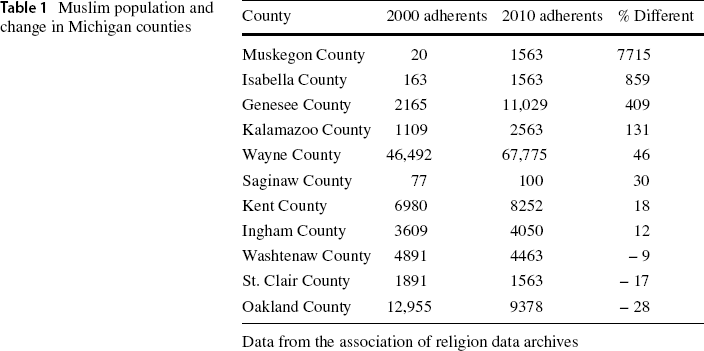
Data from the association of religion data archives
Although the size of the Muslim population in Genesee County vis-à-vis the total population in the county places it in the top 13% of counties in the United States, it is not an outlier. According to the Association of Statisticians of American Religious Bodies, the mean Muslim population percentage per county is 1.1 as of 2010. The county with the greatest percentage of Muslims that year was Goochland County in Virginia where 16% of the county is Muslim. In Genesee County this percentage was 2.6.
Frequencies for survey respondents
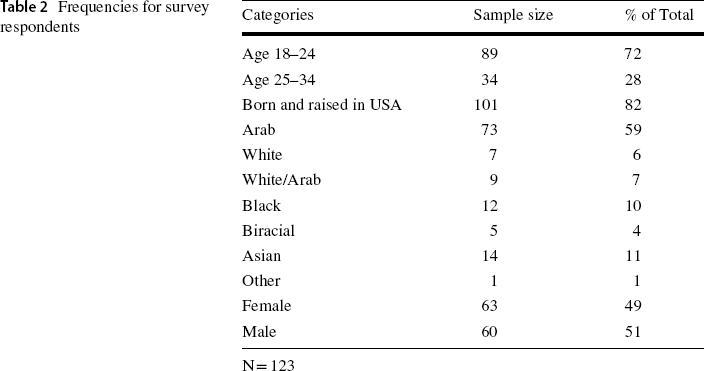
N = 123
Measures
Demographics
Age, gender, race, generational status and whether they were born in the U.S. were collected for each participant.
Identity
Most important identity
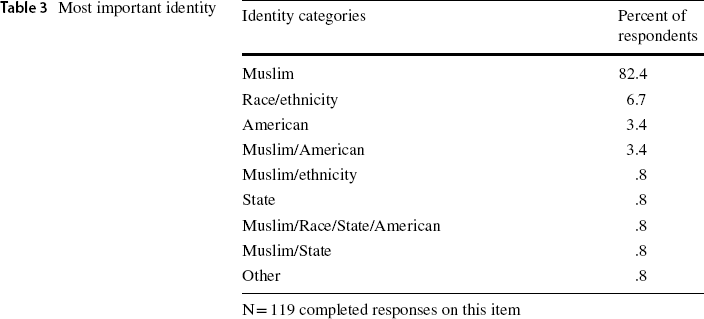
N = 119 completed responses on this item
Discrimination
The General Ethnic Discrimination Scale (GEDS) measures experiences of discrimination (Landrine et al. 2006). This study adapted the GEDS to measure different types of discrimination experienced by Muslims in the U.S. An example item includes “how often have you been treated unfairly by teachers and professors because of your primary identity?” This study added items to assess experiences of discrimination related to accent and name. The responses ranged from ‘never’ to ‘most of the time’. The Cronbach's alpha for this adapted scale is .895 indicating high internal consistency.
Discrimination variables experience percentage
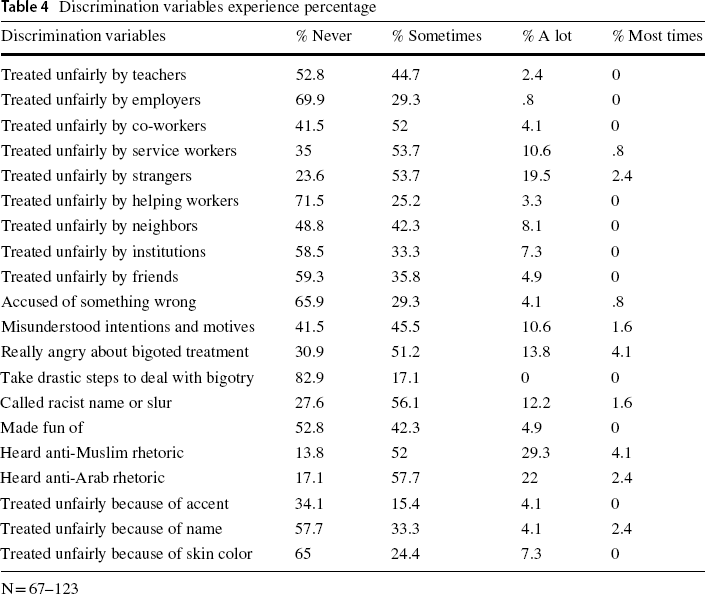
N = 67–123
Procedure
The survey was in paper and electronic form and distributed to Muslim young adults in Genesee County, Michigan. See the “Appendix” in Electronic Supplementary Material for a portion of the distributed survey. The survey targeted Muslim youth in the main mosques in Genesee County over the winter 2019. These mosques are significant because most of the youth that comprises the Muslim community frequent these mosques. The largest mosque in the Flint area is the Flint Islamic Center. Because of its size, it attracts the largest number of worshippers for the Friday communal prayer. In addition, this mosque has a number of youth activities that attract a large number of young people. The second most significant mosque is the Grand Blanc Islamic Center. It has similar youth activities. The bulk of the surveys come from these locations and represent a convenience sample. We also reached out to Muslim students who are members of the Muslim Students Association on the campus of a local university. Participants took the surveys in paper format and we collected them after Friday prayers or during youth activities and events at these locations. Participants had the option to complete the surveys online.
Data Analysis
Based on completed survey responses, a dichotomous outcome variable captured whether the respondent indicated that they identified as Muslim without also identifying as American or Muslim and American. Given the dichotomous construction of the outcome variable, we used a logistic regression to test the likelihood of identifying as Muslim, but not American. The different items of the discrimination scale served as the main variables. The variables on age, gender, race, generational status and born and raised served as control variables. Before we entered these variables into the full model, we tested them for significant association with the outcome variable. We excluded those variables that were not significant from the final model.
Mann–Whitney U test on discrimination variables
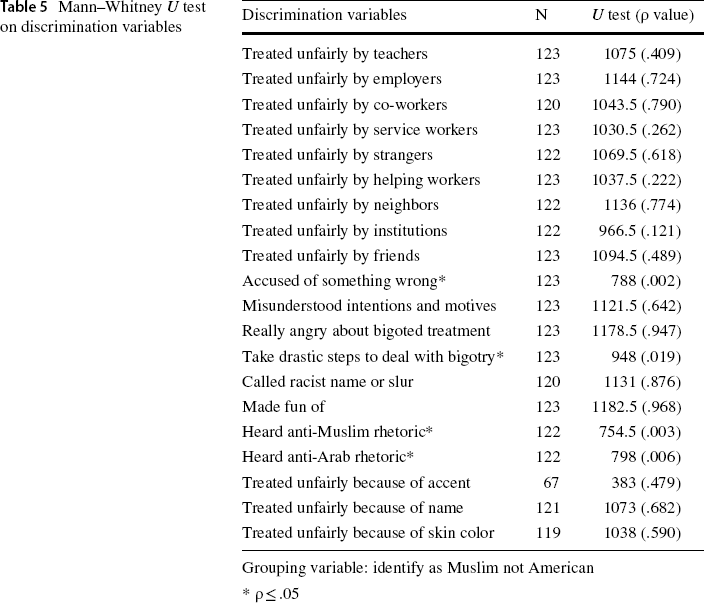
Grouping variable: identify as Muslim not American
* ρ ≤ .05
The final model did not include the race, gender, generational status and born and raised variables because they were not significantly related to the identity variable. The Pearson Chi square value for the born and raised variable was .176 (ρ = .675/N = 123) indicating no significant difference between those who identify as Muslim only and those who identify as Muslim and American and whether they were born and raised in the United States. The Pearson Chi square for gender was .018 (ρ = .894/N = 123) which is also not significant. The Cramer's V value for the race variable was .168 (ρ = .753/N = 121) indicating no significant correlation between the race and identity variables. The Cochran-Armitage value for the generational status variable was 2.023 (ρ = .15/N = 118) indicating no significant correlation with the identity variable.
The age variable was significantly different between the two groups of the outcome variable. The Mann–Whitney U test value was 818 (ρ = .018/N = 123) which indicates there was a significant difference in age between those that identify as Muslim only (median value = 20.5) and those that identify as Muslim and American (median value = 22). We included this variable in the final model.
Descriptive statistics for variables in model
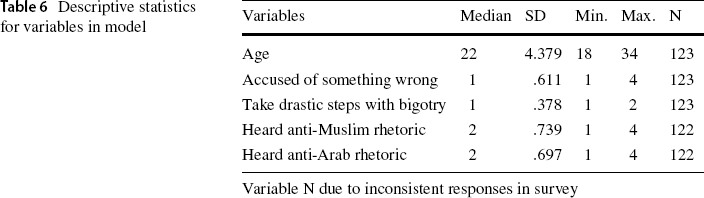
Variable N due to inconsistent responses in survey
Results
Cell frequency was low for the extreme responses on the discrimination scale (‘a lot’ or ‘most of the time’). For example, only one respondent indicated that they were accused of doing something wrong most of the time. On this same item only three respondents who identified as Muslim only noted that it occurred a lot. Two respondents who identified as Muslim and American experienced it a lot. Thus, results for these levels were not reliable. A check on over-dispersion in the data revealed some but not at levels considered a cause for concern. There were also some outliers in the sample, but given the small sample size, we chose not to remove them from the database. A check on the analysis with and without the outliers did not change the outcome of the analysis.
The full model improved the prediction of case classification over the null model. The null model (intercept only) correctly predicted the case classification 80.3% of the time. The full model (all variables plus the intercept) correctly predicted the case classification 82% of the time. Concordantly, the full model reduced the deviances over the null model. The full model was also a good fit as determined by the Hosmer and Lemeshow test (ρ = .597). Based on the results in the logistic regression, only age and being accused of something wrong were significant variables of whether the respondent identified as Muslim, but not American. The younger the respondent the more likely the respondent identified as Muslim only. This raised further questions about whether the younger respondents were part of a new group of respondents who were less likely to identify as Americans or whether this part of their identity had yet to develop like the older respondents.
Logistic regression results 1
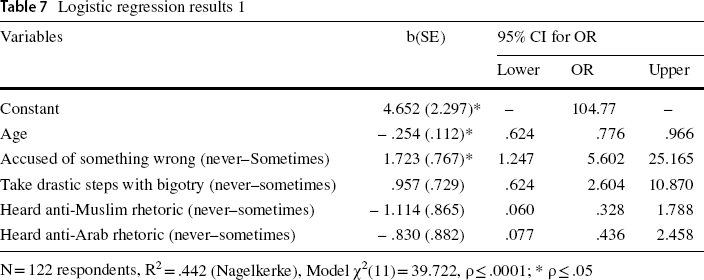
N = 122 respondents, R2 = .442 (Nagelkerke), Model χ2(11) = 39.722, ρ ≤ .0001; * ρ ≤ .05
Being accused of doing something wrong was significantly associated (ρ ≤ .05) with identifying only as a Muslim and not also American. The probability of a Muslim young adult identifying only as a Muslim when sometimes experiencing being accused of something wrong was 43.1%. The probability of a Muslim young adult identifying only as a Muslim when never experiencing this same discrimination was 32.8%. In terms of odds, the odds of identifying only as a Muslim increased 5.602 times from never experiencing this to experiencing it sometimes.
Logistic regression results 2
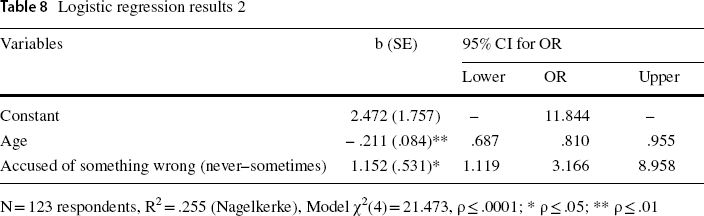
N = 123 respondents, R2 = .255 (Nagelkerke), Model χ2(4) = 21.473, ρ ≤ .0001; * ρ ≤ .05; ** ρ ≤ .01
Discussion
This study seeks to understand how young adult Muslims in the United States experience discrimination and how this experience relates to identity. It specifically examines whether discrimination is related to the way young adult Muslims choose to identify as both Muslim and American or Muslim only. Based on the literature, we hypothesized based on the literature that an increase in the perception of discrimination decreases the likelihood that a young adult Muslim identifies as both Muslim and American. We surveyed Muslim young adults in Genesee County, Michigan, a quickly growing Muslim population in the United States, at religious and non-religious settings in person and online.
There is a growing presence of Muslims in the United States with some places, such as Genesee County, having a larger population of Muslims than other places. This could increase the chances for discrimination according to group threat theory or reduce discrimination according to the intergroup contact hypothesis. At the same time, Muslims are also the youngest of the faith communities in the U.S. with many second and third generation community members (Chouhoud and Mogahed 2018; Ross-Sheriff et al. 2007). Many of them with immigrant parents have been born and raised in the United States. Discrimination impacts Muslim young adult's identity development especially because younger Muslims experience multiple cultural points of reference that can make their identity development complex and thereby less stable (Ketner et al. 2004; Kahani-Hopkins and Hopkins 2002; Khan 2000). The 9/11 attacks exacerbated an already prevalent anti-Muslim discrimination in the United States (Shaheen 2001). The rise of Donald Trump and groups like the Islamic State have made young Muslims’ Islamic identity even more difficult to express in the U.S. (Casey 2017; Tabbah et al. 2016). These trends have overshadowed the development of an identity for young adult Muslims as both Muslim and American.
The bulk of the survey respondents were between the ages of 18 and 24 and their responses on the discrimination scale indicated that most of them either never experienced or sometimes experienced discrimination. This is encouraging and may represent a refutation of the group threat theory in this case. Still, on some items the majority of respondents reflected that they experienced this discrimination sometimes including the prevalence of anti-Arab and anti-Muslim rhetoric. This rhetoric is not necessarily local and could be coming from various sources nationally and internationally.
Of equal concern is that the majority of respondents sometimes experienced discrimination in the form of being treated unequally by strangers and service workers and in some cases being called a name. In public, Muslim young adults may experience a number of indignities at restaurants, on transports or in other venues. This could include being called a derisive name by a stranger. This would occur locally and could impact the level of engagement with the wider population and possibly affect how these young adult Muslim Americans choose to identify. This would also raise the prospects for the propositions outlined in the reactive identity theory.
The analysis on these items in the discrimination scale revealed that most were not significantly related to identity with the exception of ‘being accused of doing something wrong’, ‘taking drastic steps to deal with bigotry’ and ‘hearing anti-Muslim and anti-Arab rhetoric’. The logistic regression further revealed that only being accused of doing something wrong was significantly related to the identity variables. Although, a little less than 6% of the respondents indicated they have experienced ‘being accused of doing something wrong’ a lot or most of the time, those who experienced being accused of doing something wrong ‘a lot’, ‘most of the time’ or ‘sometimes’ were more likely to identify as Muslim only than those who ‘never’ experienced this form of discrimination. This shows that even less frequent experiences of discrimination can affect how young adult Muslims identify.
In this analysis, the only control variable that was significant was age. The younger respondents were less likely to identify as American. The current political environment may be driving younger Muslims to forgo their American identity, which is much different than what the older respondents have experienced when they were their age. Furthermore, identity is also not static. As these younger respondents age, their American identity could develop as well. This is an interesting line of inquiry that is still open for interpretation.
These findings apply to all practitioners that interact with the Muslim community. A better understanding of how discrimination affects core elements of mental health like identity will assist practitioners in serving this community. A change in the political environment and the media that frames Muslims as ‘bad’ notwithstanding the development of approaches that can inculcate resiliency will produce better mental health outcomes. This knowledge will also assist the Muslim community to better allocate its resources to support its youth as they navigate these difficult situations.
Limitations and Future Directions
There are some shortcomings with this research. Besides concerns with the sample size, the sample is predominantly Arab American. A larger survey on this topic would have to target young adult Muslims across a wider spectrum of the Muslim American population. We may have missed another sub-population in this sample. This sub-group is Muslims who do not immediately identify as Muslim. This study targeted young adults who identified as Muslim, but there are others who are less forthcoming about their Muslim identity. This group is harder to locate let alone survey.
Additionally, this study is cross-sectional and there are various contextual factors such as the family unit, school system in Genesee County and engagement in other local organizations or institutions which remain unexamined in this study and should be addressed in future research through qualitative methods. A longitudinal study that tracks the same individuals over time would provide more robust findings. This would allow for controls on some latent factors that influence identity development.
Future research should also focus on additional factors that may impact young Muslims identity development in the U.S. such as ethnic identity. This research could also address the process of identity formation for Muslims in the U.S. as well as the factors that may increase positive religious identity formation. The majority of the respondents to the survey indicated that they identified as both Muslim and American. This reveals a large level of integration of these identities despite the recurrent discrimination. The current study did not assess how discrimination and identity relate to mental health for young adult Muslim Americans. Future research should explore how identity formation for young adult Muslim Americans is related to mental health and how practitioners can foster both positive identity development and mental health for this community.
Conclusion
This study considers the ways discrimination is related to identity of Muslim Americans. Specifically, this study explores how discrimination affects the propensity for young adult Muslims to identify as both Muslim and American. The article raises the issue of the implications of increasing discrimination on future generations of Muslims as their identity development is impacted by both the challenge of navigating multiple cultural points of reference and the challenge of experiencing discrimination. Even less frequent experiences of discrimination can affect how young adult Muslims identify.
While many have developed dual identities between their ethnic culture and the U.S. culture resulting in cognitive dissonance and frustration, increased discrimination following the 9/11 attacks had led young adults to identify as Muslims over their American identity. Resources in the Muslim community have developed over the years to support Muslim youth and the negotiation of their myriad identities. These resources notwithstanding discrimination will continue to shape how they see themselves in the United States. A major change that might lessen this pressure is to stop the collective shaming of Muslims for the acts of a few. However, this is unlikely to occur given the political incentive to do so. In the absence of this political will, Muslims will have to build resiliency to this and work to control the narrative about their own communities without falling into the trap of self-segregation and disengagement.
Footnotes
Electronic supplementary material
Below is the link to the electronic supplementary material.
Springer Nature remains neutral with regard to jurisdictional claims in published maps and institutional affiliations.
