







Abstract
Profound socio-economic disparities that exist among American religious groups are largely driven by the quantity and quality of education they receive. Furthermore, given the U.S. schooling system is rooted in Protestant ideals, it is possible that students with Protestant commitments have an academic advantage. This article synthesizes literature on how adolescents’ religious commitment and background are associated with their short- and long-term academic outcomes. A literature search identified 42 relevant studies published in 1990-present. These studies were reviewed to identify: (1) the mechanisms through which religion affects educational outcomes—moral, social, and cultural; (2) the main operationalized measures of religion—religious tradition and individual religiosity; and (3) the most frequent academic outcomes studied—secondary school grades, truancy, test scores, educational aspirations, and educational attainment. Of the 42 studies, 95% were based exclusively on quantitative survey data, 95% examined only religiosity or religious tradition, and 66% focused on educational attainment. There were three major findings. First, research has advanced from correlational studies to methodologically rigorous designs suggesting religion can play a causal role in academic success. Second, research reveals a religiosity-religious tradition paradox: Adolescents with stronger religiosity earn better grades, are less truant in secondary school, and complete more years of higher education. A large proportion of highly religious adolescents are likely to be conservative Protestants, but the research on religious tradition suggests that conservative Protestants are among the least educated religious groups. Third, it is unclear if religious adolescents only fare better on academic outcomes that reward their personality, such as grades, or whether they also perform better on more objective measures, such as standardized tests. This systematic review reveals a paradoxical “effect” of academic achievement and religiosity versus-religious tradition. The overall results indicate the need to: (a) identify the interaction between religious tradition and religiosity, (b) distinguish between subjective versus objective academic outcomes; (c) examine heterogeneity among non-religious adolescents; (d) study the interplay between institutional schooling and institutional religion; (e) investigate the religion/cultural match between teachers and students; (f) pursue qualitative research to better understand mechanisms; and (g) expand research about non-Christians.
Background
Profound socio-economic disparities exist among American religious groups (Keister and Sherkat 2014; Wilde et al. 2018). Education—both in terms of the quantity and quality of education one receives—is key driver of socio-economic inequality in America (Rivera and Stevens 2013). Thus, to understand why class differences persist among American religious groups, scholars of religion need to understand the current landscape of the literature on how adolescents’ individual religiosity and religious tradition are associated with their educational outcomes in the short and long term. The most recent review of literature on religion and academic outcomes was published almost two decades ago (Regnerus 2003), and several new studies have been conducted since then.
Examining how religion shapes academic outcomes is also warranted because religion and public schooling are not wholly independent institutions—even though they are legally separated. After all, the founding of the U.S. schooling system is rooted in religious ideals (Cohen 1987; Fraser 2016; Labaree 2012). Specifically, commitment to Protestant religion is a major factor that promoted schooling in colonial America. At the core of the Protestant faith is the belief that worshippers had a direct connection to God. As a result, the faithful could not afford to be left illiterate because then they would be dependent on the clergy to interpret and transmit Biblical teachings (Labaree 2012).
A less overt religious mission continued to infuse schools even after the separation of church and state (Fraser 2016; Labaree 2012). At that point, a key goal of public schooling (then called the common school) was to ameliorate the social turbulence that took place after the American Revolution and the formation of the United States. Common schools thus offered a school-based civic religion that could unite a diverse (albeit mostly Protestant) citizenry (Fraser 2016). Religion and the public schools had a similar mission: “To foster a homogenous society united in faith, morals, and forms of government” (Fraser 2016:9). Although churches, as institutions, were kept out of education, common schools still provided a general type of religious education. In fact, students were expected to read from the Protestant version of the King James Bible and pray up until the 1960s (Fraser 2016). The Protestant ethos also shaped the view that teachers—inside and outside religious settings—were a voice for authoritative knowledge (Cohen 1987). Although overt religious practices such as the reading of the King James Bible have left the public-school arena, it is possible that the values of Protestantism continue to infuse the mission and form of public schooling. It is plausible that students with strong religious commitments—especially Protestant commitments— might even have some advantage when they attend schools that were so deeply influenced by Protestantism in the first place.
Method
This article examines existing literature about the relationship between religion and educational outcomes. This review proceeds in four phases: (1) identifying the broad mechanisms through which religion may affect people's educational outcomes, (2) identifying how religion is commonly operationalized and measured (3) identifying commonly measured academic outcomes, and (4) searching the literature.
In the initial phase, I used Smith's (2003b) framework to identify three broad categories of mechanisms through which religion may affect people's educational outcomes: (1) moral (2), social and (3) cultural. The moral dimension refers to moral directives, which reflects religious texts and teachings that promote specific cultural and moral guidance, especially regarding self-control and personal virtue (e.g., “The golden rule”) (Smith 2003b). These directives are grounded in the authority of long historical traditions and narratives into which new members are inducted. Youth internalize these moral orders and use them to guide their life choices and ethical commitments. Children who have been given moral grounding of this sort are thought to be able to access commands and guidance like “Thou shall not lie” and then utilize them in decision making when confronting both moral dilemmas and ordinary day-to-day choices. As adolescents form practices and make decisions that shape their lives, “religion can provide them with substantive normative bearings, standards, and imperatives to guide those practices and choices” (Smith 2003b:20). These moral directives are legitimated and reinforced by both spiritual experiences and role models who exemplify life practices shaped by religious moral orders and who reinforce adolescents’ ideas of how to have a normatively approved life (Smith 2003b). Although Smith (2003b) does not explicitly link moral directives to academic success, it is possible that moral directives discourage risky behaviors like alcohol/drugs, which impede academic success. At the same time moral directives can encourage children to be conscientious and agreeable, which are traits linked with academic success (Hardy and Carlo 2005; Saroglou 2010; Shariff and Norenzayan 2007). For example, Hardy and Carlo (2005) found that individual religiosity was positively associated with three specific types of prosocial behaviors: (1) compliant prosocial behaviors (i.e., helping when asked), (2) altruistic prosocial behaviors (i.e., helping out of concern for others rather than anticipation of reward), and (3) anonymous prosocial behaviors (i.e., helping in situations when no one else is watching). In other words, deeply religious adolescents tend to be those who are eager to help.
The social dimension refers to social capital and network closure, which reflects the relational ties that young people develop with adults through their religious communities, including youth ministers, Sunday school teachers, choir directors, and the parents of friends (Burstein 2007; Carbonaro 1998; King and Furrow 2004; Smith 2003a). Social capital specifically refers to the opportunities, resources, and information that adolescents have access to when they have relational ties to those adults. Because of those ties, children are more likely to seek out opportunities and tap into resources that adults possess as well as be presented with opportunities. As a result, adolescents with adult ties are more likely to get help with homework, secure summer jobs, and learn about, and be recommended for, competitive programs. When kids have adults to turn to for homework help or other academic struggles, their grades are likely to improve. Network closure refers to the additional oversight and influence that non-parental adults provide. When parents and children participate in religious congregations, they have stronger network closure with friends, other parents, and teachers (Smith 2003b). Because of the social nature of religious congregations, parents can build relationships over time with their children's friends and the parents of their children's friends. Moreover, these relationships are likely to exist among people who share similar cultural and moral orders, facilitating higher levels of agreement and cooperation in collective oversight and social control. Thus, network closure creates conditions of increased support for and supervision of youth, encouraging behaviors that are generally considered as pro-social and positive for youth development. Although Smith (2003b) does not explicitly link social capital and network closure to academic success, it is likely that youth who form their social networks through religious organizations abide by the same moral directives. In other words, they reinforce conscientious and cooperative behavior among themselves.
The cultural dimension broadly refers to how religious cultures frame education. Some view culture as a “toolkit” that provides people the characteristic repertoire from which to “build lines of action” (Swidler 1986:284). Others see culture as “the interaction of shared cognitive structures and supra-individual cultural phenomena (material culture, media messages, or conversation, for example) that activate those structures” (DiMaggio 1997:264). For example, Uecker and Pearce (2017) examine how conservative Protestant culture frames college to understand how women make college choices. They note that people live “amid a web of (often conflicting) cultural schemas suggesting how life could and/or should be lived” (Vaisey 2010 as cited in Uecker and Pearce 2017 p.663). Cultural explanations for differences in educational outcomes often invoke gender ideologies because religious traditions tend to differ in their teachings about gender roles (Davis and Pearce 2016). Religiously conservative women tend to prioritize family over career, which manifests in early transitions into marriage and childbearing and earlier transitions out of educational institutions and the labor force (Glass and Jacobs 2005). When it comes to educational outcomes, gender ideologies matter because they shape people's views towards college as a human capital investment.
In the second phase, I devised a framework to identify how religion was operationalized and measured in each study. I found that studies usually focus on either one's religious tradition (e.g., Catholic, Conservative Protestant, Jewish) or one's individual religiosity (e.g., their religious beliefs and behaviors). To borrow Putnam and Campbell's analogy, religious tradition is the “flavor” of one's religion, and religiosity as the “intensity” of that flavor (Putnam and Campbell 2010). Studies interested in religious tradition consider how the cultural milieu of a specific religious tradition during adolescence shape educational outcomes downstream (e.g. how does the cultural milieu of Conservative Protestants affect young people's college aspirations?). In these studies, scholars generally operationalize religious tradition by looking at survey respondents’ answers to a question about what religion they were raised in (which scholars see as more important than one's religious tradition during adulthood). Some studies about religious tradition and academic outcomes rely on longitudinal surveys where religious tradition is captured during adolescence and educational attainment is captured in adulthood (Fitzgerald and Glass 2012; Uecker and Pearce 2017). However, most studies in this category are retrospective and ask adult respondents to indicate the religious tradition in which they were raised (Beyerlein 2004; Glass and Jacobs 2005; Lehrer 1999; Massengill 2008; Mazur 2016; Park and Reimer 2002).
Studies focused on individual religiosity tend measure the cognitive, affective, and behavioral components of private and public religious engagement. 1 Common measures include “How important is religion in your life?” “How often do you attend religious services?” and “How often do you pray?” Scholars either aggregate the components of one's self-reported religious beliefs and behaviors into an index that measures religiosity on a low-to-high continuum, or they use different components of religious engagement as distinct indicators in their models (e.g., what is the association between academic outcomes and religious service attendance). Studies that examine how individual religiosity predicts academic outcomes also tend to rely on surveys (Regnerus 2000; Tirre 2017; Toldson and Anderson 2010).
In the third phase, I identified five academic outcomes that are most common in educational research (Kao and Thompson 2003): Four outcomes are at the secondary school level: GPA, truancy, test scores, and educational aspirations, and the fifth outcome is downstream educational attainment. For a review of the research on how and under what conditions religion shapes other adolescent outcomes such as health, sexual behavior, and substance use, see (Pearce, Uecker, and Denton 2019).
In the fourth phase, I searched the literature systematically, looking for peer-reviewed journal articles published between 1990-present. I began my search in 1990 because that is the point at which research on religion and education regained momentum after several decades of dormancy (Keister and Sherkat 2014; Norris and Inglehart 2011; Sherkat and Ellison 1999). I located sources through Google Scholar and searched EBSCO Discovery Service, which is an aggregator of several databases. I used the following search terms: relig*, school, academic achievement, grades, GPA, test scores, truancy, aspirations, educational attainment, social capital, network closure, moral directives, and culture. From here, I used snowball techniques to search for related studies in the reference lists of articles. To narrow the scope of this review further, I focused on articles about the U.S. because adolescents outside the U.S. context may express their religiosity in different ways.
For the included articles, I created a matrix for studies, noting each article's authors and publication year, data sources and sample, empirical methodology, how religion was operationalized and measured, the academic outcome(s) of interest, and key findings. I then used this matrix to guide my review about the educational implications of religion.
Results and Discussion
These criteria yielded 42 empirical studies that serve as the basis for the systematic review of the literature. The studies are tabularized in Appendix Table 1 and visually depicted in Figs. 1a–e. This visual analysis highlights several trends about the state of the research on religion and academic outcomes. In the section that follows the visual representation, findings from the studies are organized based on what we learn about each academic outcome of interest: secondary school grades, truancy, test scores, aspirations, and downstream educational attainment.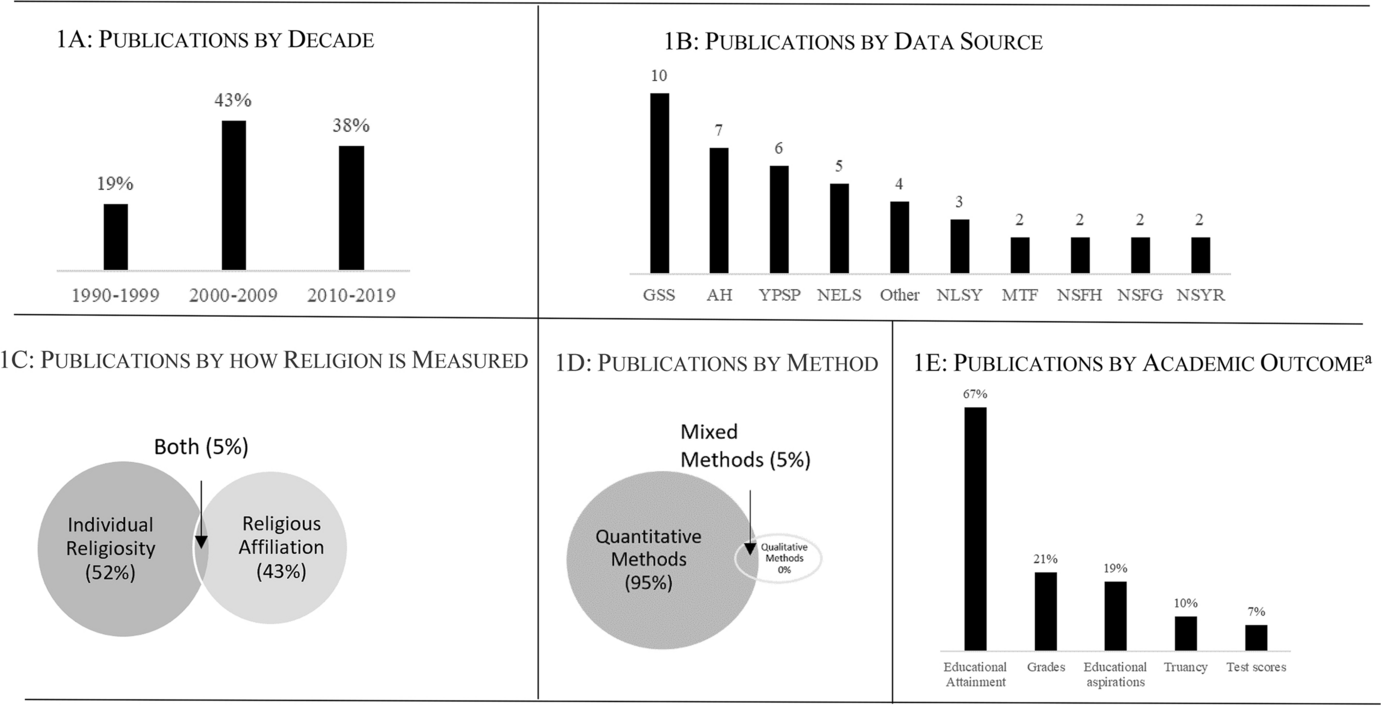
Figure 1a depicts these publications by decade. Of the 42 studies, 19% were published between 1990–1999, 43% between 2000–2009, and 38% between 2010-present. Thus, the period between 2000–2009 was the most prolific period thus far for research on religion and academic outcomes. Figure 1b depicts the publications by data source. 2 The General Social Survey (GSS) was the most common data source, used in about one of every four articles (n = 10). The next most common sources were the National Study of Adolescent to Adult Health (AH) (n = 7), the Youth Parent Socialization Panel Study (YPSP) (n = 6), and the National Education Longitudinal Study (NELS) (n = 5). The National Longitudinal Survey of Youth was used in 3 studies. The least common data sources, each been used in 2 studies, are Monitoring the Future (MTF), National Survey of Families and Households (NSFH), National Survey of Family Growth (NSFG), and the National Study of Youth and Religion (NSYR).
Figure 1c depicts the publications by how religion is primarily operationalized and measured in each study. In 52% of the studies (n = 22), religion was primarily measured as individual religiosity; in 43% of the studies (n = 18), religion was primarily measured as religious tradition. The remaining 5% (n = 2) examined both religiosity and religious tradition (Lehrer 2004b, 2010). Figure 1d depicts the publications by methods. In 95% of the studies, were based on survey analyses and used quantitative analytic tools such as multiple regression. I identified only two articles (5%) that used both quantitative and qualitative methods (Lee and Pearce 2019; Uecker and Pearce 2017). There is not a single article that relied solely on qualitative methods, such as interviews or ethnography. Figure 1e depicts the studies by outcomes of interest. The most common outcome of interest was educational attainment (67%), following by secondary school grades (21%), educational aspirations (19%), truancy (10%), and test scores (7%) (these numbers do not add to 100% because some studies examined multiple outcomes). 3 As will be discussed in greater detail below, studies of secondary school outcomes (grades, truancy, test scores) have thus far only considered the predictive power of individual religiosity—not religious tradition. The role of religious tradition is more prevalent in studies of educational attainment, and in some cases, educational aspirations.
Grades
Nine studies based on analyses of large scale data sets of middle and high school adolescents consistently show that individual religiosity is associated with better grades (Glanville et al. (2008); McKune and Hoffmann, 2009; Milot and Ludden 2009; Regnerus and Elder 2003; Tirre 2017; Toldson and Anderson 2010; Trusty and Watts 1999). 4 The effect of religiosity persists in all studies even after controls for background factors such as race, socioeconomic status, and gender.
For example, Glanville et al. (2008) used Add Health data (7–12th graders), in which GPA is the average of the respondent's grades in mathematics, English, history or social studies, and science based on transcript data. They found that religious attendance predicts higher GPA. Their results show that the GPA of a student with the highest levels of religious engagement is 0.144 GPA units higher than a student who is not at all religiously involved. To put the magnitude of the religiosity effect into perspective, Glanville et al. (2008) contrast it with the effect of a one-year increase in parent education, which is only 0.030.
In testing mechanisms, Glanville et al. (2008) found that intergenerational closure, friendship networks, and extracurricular participation explained only one-fifth of the effect of religious attendance on grades. Stokes (2008) also found that measures of social capital in Add Health (as measured by parental educational expectations, student educational expectations, network closure, parent–child relational quality, and parental involvement in the child's schooling) did not help explain why students with more religiously active parents were more likely to graduate high school. In a study published a year later, Mckune and Hoffmann (2009) also analyzed Add Health data and also found that more religiously engaged adolescents earned better grades. However, in testing mechanisms, they found that the positive association between student religiosity and grades was completely attenuated after controlling for family and community social capital. Their findings did not align with Glanville et al. (2008) or Stokes (2008), perhaps because the studies were operationalizing and measuring social capital differently.
While scholars like Glanville et al. (2008), Stokes (2008), and Mckune and Hoffmann (2009) have tested the role of social capital, Tirre (2017) examined the role of moral directives. As mentioned above, one of the key influences by which religion is thought to lead to better academic outcomes is by promoting cultural and moral directives of self-control and personal virtue. Thus, Tirre (2017) analyzed data from Project Talent, a 1960 study of 80,000 12th grade students in 987 high schools. Tirre (2017) found that students who espoused Christian beliefs and engaged in Christian practices (e.g. were more biblically literate) were more likely to be conscientious (e.g., orderly, self-disciplined, responsible, considerate). Furthermore, Tirre (2017) discovered that conscientiousness predicted students’ grades beyond cognitive ability; in other words, even after accounting for students’ cognitive abilities, students who were more conscientious earned better grades. Taken together, the studies by Glanville et al. (2008), Mckune and Hoffmann (2009), and Tirre (2017) suggest that some of the mechanisms that (Smith 2003b) proposed do indeed help explain why religious engagement predicts higher GPA.
While the evidence suggests that more religiously engaged students have better academic outcomes, questions remain as to how to interpret this evidence. The existing evidence has been derived from observational approaches that inherently limit the scope of inference; consequently, there is uncertainty about whether the “effect” of religiosity on academic outcomes is causal or spurious. This concern was at the heart of the most recent study on religiosity and grades conducted by Horwitz et al. (2020). They were concerned that the relationship observed in earlier studies linking religiosity and grades was spuriously driven by unmeasured family factors, such as parenting styles and childrearing practices. These unmeasured family factors are not adequately controlled for in existing studies but are related to both religiosity and academic outcomes. For example, parents who are more religiously engaged are more likely to supervise their children, interact with their children, and have meals together more often (Bartkowski and Xu 2000; Wilcox 2002). Children who are more closely supervised tend to be more academically successful. Thus, the types of parents who choose to be more religiously engaged may also be the type of parents who behave in ways that are conducive to their children's educational success. If so, the positive causal effect of religiosity on academic outcomes observed in prior studies would be overstated (Lehrer 2010). To examine whether associations between religiosity and academic success remain after accounting for unobserved family factors that affect both religiosity and academic outcomes, Horwitz et al. (2020) used the family structure of Add Health and exploited the availability of sibling clusters to introduce family fixed effects. Using sibling comparison to control for measured and unmeasured family background characteristics, they found that more religious adolescents still earned better GPAs in high school. In other words, religiosity positively predicts higher GPA (as well as aspirations and educational attainment, as described below) even after family environment is held constant.
Truancy
Four studies consistently show that more religious students are less truant. For example, Trusty and Watts (1999) and Muller and Ellison (2001) analyzed data from National Educational Longitudinal Study and found that religiously committed students were less likely to cut class. Sinha et al. (2007) found similar results after analyzing data from the University of Pennsylvania Center for the Study of Youth Policy, a 2000 study of 2,004 youth ages 11–18 and their parents. Regnerus and Elder (2003) analyzed Add Health data and found a similar relationship between increased religious involvement and truancy. Specifically, religiously involved adolescents in low-income neighborhoods were more likely to stay academically “on-track” (which includes not skipping class) than adolescents who were not religiously involved. In these four studies, the observed relationship between increased religiosity and decreased truancy is based on correlational (rather than causal) analyses. As far as mechanisms, it is likely that moral directives play a key role in explaining why more religious students are less likely to cut class. It is important to note that grades and truancy are related outcomes since students who earn better grades are also more likely to attend class regularly (Henry 2007).
Test scores
It is not clear whether more religious students perform better on national standardized tests because the three studies in which test scores were an outcome yielded different results. Jordan and Nettles (2000) used NELS data and did not find that students’ religiosity was associated with their math and science standardized test scores. However, Regnerus (2000) reached a different conclusion using the HSES, finding that increased involvement in church activities had a positive relationship with math and reading achievement among sophomores in public high schools. On average across schools, Regnerus (2000) found a 2.32 point gap in math/reading score between students who exhibit a high level of church involvement and those who do not (with religious students scoring higher). Like Regnerus (2000), Jeynes (2016) also found that religiously committed high school students had higher mathematics and reading test scores than their less religious peers.
Aspirations
The six studies in which educational aspirations have been an outcome suggest that more religious students tend to aspire to complete more education (Al-fadhli and Kersen 2010; Horwitz et al. 2020; Milot and Ludden 2009; Muller and Ellison 2001; Regnerus 2000; Trusty and Watts 1999). 5 For example, Regnerus (2000) found that involvement in church activities has a positive relationship with educational expectations among sophomores in metropolitan public high schools. Al-fadhli and Kersen (2010) found a similar trend, noting that students who regularly attended religious services and saw religion as salient had higher college aspirations than those who were less religiously engaged. In the most recent study, Horwitz et al. (2020) also found that increased religiosity leads young people to have higher educational aspirations. Compared with prior studies, the findings of Horwitz et al. (2020) provide much stronger evidence about the causal influence of adolescent religiosity on educational aspirations than earlier studies. As the authors explain, since more religious students have better grades, they are more likely to consider college as a realistic option for themselves.
It is unclear whether educational aspirations vary by religious tradition because there is a dearth of studies about academic variation by religious tradition at the secondary school level—almost all the studies focus on higher education. The one exception is studies of conservative Protestants, whose lower levels of educational attainment (see below) are thought to reflect their lower educational aspirations. As Darnell and Sherkat (1997) argue, youth who espouse fundamentalist beliefs and those who identify as conservative Protestant have comparable lower educational aspirations because they evaluate choices differently from other Americans and may shun traditional understandings of the “good life” as involving significant material gain. In other words, conservative Protestants’ cultural orientation restricts the feasible set of educational options that adolescents may consider (Sherkat and Darnell 1999).
Educational attainment
Several longitudinal studies using large national data sets show a consistent and positive relationship between religiosity during adolescence and educational attainment (Kim 2015; Lee and Pearce 2019; Lee et al. 2007; Lehrer 2004b, 2010; Loury 2004; Mohanty 2016; Stokes 2008) For example, using NLSY79 data, Loury (2004) found that white Mainline Christian adolescents who attended religious services more frequently attained more years of education in adulthood. Using the National Survey of Family Growth 1995, Lehrer (2010) also found that adolescents who frequently attended religious services had completed more schooling by adulthood. Lee et al. (2007) analyzed NELS:88 data and found that students who thought of themselves as religious in eighth grade were more likely to complete college, even after controlling for students’ standardized eighth grade mathematics and reading test scores.
These early studies of individual religiosity and educational attainment suffered from concerns about spuriousness versus causality, but methodological advancements in several recent studies are helping to illuminate the causal pathways. Using different data sources, both Kim (2015) and Mohanty (2016) used propensity score matching and found evidence that religious participation in adolescence led to increased educational attainment. In her analysis of the NLSY97, Kim (2015) found that higher religious service attendance at age 17 was positively associated with increased educational attainment by age 25. Specifically, individuals who frequently attend religious services complete 0.69 more years of schooling than similar individuals who do not frequently attend services. Mohanty's (2016) analysis of Christians and Jews in NLSY79 are consistent with Kim's. His study demonstrates more frequent religious attendance during youth causes people to acquire more years of schooling during adulthood. Horwitz et al. (2020) used a different analytic method (sibling fixed effects rather than propensity score matching) and reached a similar conclusion that religiosity in adolescence causes one to obtain additional years of schooling downstream. In families where siblings had different levels of religiosity, the more religious sibling completed more years of higher education than the less religious sibling. The Horwitz et al. (2020) study is also the first to explain why religiosity causes higher educational attainment. As the authors explain, high school grades fully mediated the relationship between religiosity and downstream educational attainment. Put simply, more religious adolescents had earned higher GPAs in high school and were better prepared for college.
There is also a great deal of evidence that educational attainment varies by the religious tradition in which one was raised, which is one of the most robust and consistent findings across the three decades of research (Beyerlein 2004; Brown and Gary 1991; Chiswick 1993; Darnell and Sherkat 1997; Eirich 2012; Fitzgerald and Glass 2008, 2012; Glass and Jacobs 2005; Keysar and Kosmin 1995; Lehrer 2004a, 2010, 1999; Massengill 2008; Massengill and MacGregor 2012; Park and Reimer 2002; Pyle 2006; Sander 2010; Scheitle and Smith 2012; Sherkat and Darnell 1999; Wilde et al. 2018). Although there is an abundance of evidence that educational attainment levels vary by religious tradition, there is much less research about why these differences exist and persist. The two religious traditions that have received the most scholarly attention are conservative Protestants and Jews. 6 This may reflect the fact that these two groups fall on two ends of the educational attainment spectrum: conservative Protestants have one of the lowest rates of educational attainment in the US while Jews have some of the highest (Beyerlein 2004; Burstein 2007; Fitzgerald and Glass 2014; Glass and Jacobs 2005; Keysar and Kosmin 1995; Lehrer 1999; Massengill 2008; Mazur 2016; Mohanty 2016; Sander 2010; Wilde et al. 2018). 7
Cultural differences between religious traditions are theorized to lead Jews and conservative Protestants to make different levels of investment in secular higher education. In general, the demand for secular higher education among conservative Protestants is low. As Darnell and Sherkat (1997) argue, conservative Protestants espouse theological beliefs that deemphasize material success, and are generally concerned about the secularizing effects of higher education. Given these fears, parents are less likely to encourage their children to attend college (especially a non-religious college). Most recently, Uecker and Pearce (2017) showed that part of the attainment gap for conservative Protestants is explained by cultural schemas that lead conservative Protestant women to attend less selective colleges. Although they are positioned to get into selective colleges, conservative Protestant women often choose colleges that are less selective because they don't see college as a human capital investment. In other words, conservative Protestant women prioritize other values such as parenthood and altruism rather than careers, and thus don't see attending elite colleges as necessary for attaining those ends. In addition, because conservative Protestants tend to espouse conservative religious beliefs, which perpetuate traditional gender roles, they tend to end their education earlier than other religious groups in order to form families (Fitzgerald and Glass 2008, 2012; Glass and Jacobs 2005). In sum, among conservative Protestants, there is low demand for higher education, as well as low supply of desirable institutions (Lehrer 1999).
The opposite is true among American Jews: there is high demand for higher education, and a high supply of desirable institutions. As economists have argued, American Jews tend to place a high priority on making investments in the human capital of their children (Brenner and Kiefer 1981). Furthermore, Jewish family size tends to be small, and large amounts of resources are invested in each child during the early formative years (Chiswick 1983, 1988; Lehrer 2004a). It's important to recognize that American Jews look quite different from conservative Protestants because most of them are not theologically or socially conservative. This difference is important for understanding why Jews do not have qualms about sending their children to secular higher education institutions like conservative Protestants. American Jews’ eagerness to invest in higher education is rooted in their history. For Jewish immigrants, formal education was the instrument to mobility in the first half of the twentieth century. Jewish immigrants flocked to K-12 and higher education institutions, so that by the mid-1930s, graduating high school was the norm for American Jews (Feingold 1992). Consequently, American Jews have had a longstanding positive relationship with higher education institutions and have continued to embrace them as an engine of social mobility. This historical explanation is an important departure from the commonly held belief that Jews have a cultural bias towards schooling.
Jews’ high rates of educational attainment might also reflect institutions and networks that facilitate access to social capital (Burstein 2007; Goldscheider 2004). Jewish adolescents are embedded in networks where almost everyone has graduated college and has professional high-status jobs. In turn, these adults can provide young people with resources and advice that facilitate an academic advantage. However, with the exception of Stryker (1981) and Fejgin (1995), no studies have empirically tested whether social capital explains Jews’ educational success. There is also no empirical evidence that conservative Protestants’ low levels of attainment reflect a lack of social capital. Furthermore, despite several studies about conservative Protestants’ gender ideologies and their views towards family formation, there is dearth of literature on Jews’ gender ideologies and their views towards family formation.
General Discussion
This review has examined what existing theory and research reveal about how young people's individual religiosity and religious tradition relate to academic outcomes. The evidence suggests that adolescents who are more religious tend to earn higher grades and are less truant (Horwitz et al. 2020), although it is not at all clear whether they fare better on standardized tests (Jordan and Nettles 2000). There is also no evidence whether adolescents from different religious traditions have comparable levels of academic success. What mediates the relationship between religiosity and academic outcomes? Moral directives and social capital appear to explain much of the relationship (Al-fadhli and Kersen 2010; Glanville et al. 2008; Tirre 2017), meaning that more religious youth appear to benefit from knowing more people, and from adhering to the morals of their religious teachings that deters them from risky behaviors. We could infer from studies like Tirre (2017) that religious teaching may encourage young people to be more conscientious, which might explain why they have better grades. Teachers who are often trying to manage large groups of boisterous students are likely judge this type of cooperative and compliant disposition favorably and might reward students who are cooperative through higher grades.
In addition to social capital/network closure and moral directives, Smith (2003b) suggests two additional mechanisms that could help explain why religious involvement is positively associated with academic success, but they have not been empirically tested. First, adolescents who are connected to religious organizations are linked to a vast array of summer camps, youth retreats, mission projects, teen conferences, and service programs. These “extra-community links” exposes adolescents to experiences that widen their aspirations and horizons, encourages developmental maturity, and increases their knowledge, confidence, and competencies. Second, youth who are involved in religious organizations develop have an opportunity to develop their leadership skills. They might organize a car wash, facilitate a Bible study, sit as a youth delegate on a church committee, help to coordinate a social justice march, or assist in a tutoring program. Leadership is among several non-cognitive skill that are thought to underpin school success (Gutman and Schoon 2013).
In the literature on academic outcomes at the secondary school level, there is a dearth of evidence on moderators. Thus, we know little about how the relationship between religiosity and academic outcomes varies by race, social class, gender, and religious tradition. In fact, while increased religiosity predicts academic success for Christians, there is no evidence to suggest that a similar relationship exists among non-Christians, such as Muslims, Jews, or Hindus. It is also important to note that we have no evidence about the relationship between one's religion (both individual religiosity and religious tradition) and academics in elementary school. Thus, we do not know how early the differences that we observe in secondary school emerge.
Second, let's take stock of the evidence about academic success at the post-secondary level, which is usually measured in terms of educational attainment. The evidence suggests that increased religiosity in adolescence predicts more years of education downstream (Kim 2015; Mohanty 2016). This relationship is primarily mediated by high school grades, meaning that more religious adolescents complete more years of college largely because they are more prepared for college in the first place (Horwitz et al. 2020).
The evidence is also clear that educational attainment rates vary vastly by religious tradition (Wilde et al. 2018), with conservative Protestants and Jews being the most highly studied groups (Burstein 2007; Fitzgerald and Glass 2008; Uecker and Pearce 2017). It appears that disparities in educational attainment rates between religious groups reflect different attitudes towards higher education and human capital investment (Lehrer 2010; Uecker and Pearce 2017). It is not clear how race, social class, gender, and religiosity moderate the relationship between religious tradition and educational attainment, although some evidence suggests that low-SES youth accrue more advantages from their religious involvement (Lee and Pearce 2019). It is noteworthy that very few studies have considered the interaction between religious tradition and religiosity (Lehrer 2004a, 2010). For example, Lehrer (2010) found that those who were conservative Protestant and high religiously fared better with regard to educational attainment than those who were Conservative Protestant and had low levels of religiosity.
How well do the three key mechanisms—moral, social, and cultural—explain educational differences among religious traditions? Unlike the literature on individual religiosity, where moral directives are a key mechanism explaining differences in academic outcomes, moral directives are not used to explain academic differences among religious traditions. Rather, the more common explanations are social (especially in the case of Jews) and cultural (especially in the case for conservative Protestants). However, outside of conservative Protestantism, there is a dearth of empirical evidence for any of these mechanisms.
The review of the literature on religious tradition also reveals that religious tradition tends to be treated as an ascribed characteristic, like race. Race is often seen as the “cause” of one's poor academic performance because findings are presented in language like this: “being Black is associated with a decrease in achievement by some number of percentage points”. Such simplified statements fail to recognize that there are a host of problems that certain Black students experience, such as stereotype threat, fewer access to resources, or poor-quality teachers. This is an important distinction because the former way of thinking about being Black in the context of educational outcomes reify the race as genetic rather than socially constructed and malleable (Zuberi 2000). A similar problem exists when educational success is attributed to being Jewish, which reifies the myth that Jews are culturally or genetically predisposed to educational success (Cochran et al. 2006). Going forward, scholars should shift the conversation away from seeing religious affiliation as an ascribed characteristic that causes educational success or failure, to identifying the mechanisms that facilitate and hinder academic success for people in a particular religious group.
Conclusion and Implications
The goal of this article was to synthesize literature on how adolescents’ religious commitment and background are associated with their short- and long-term academic outcomes. A literature search identified 42 relevant studies published in 1990-present. These studies were reviewed to identify: (1) the mechanisms through which religion affects educational outcomes—social capital/network closure, moral directives, and attitudes towards human capital investment; (2) the main operationalized measures of religion—religious tradition and individual religiosity; and (3) the most frequent academic outcomes studied—secondary school grades, truancy, test scores, educational aspirations, and educational attainment. Of the 42 studies, 95% were based exclusively on quantitative survey data, 95% examined only religiosity or religious tradition, and 67% focused on educational attainment.
There were three major findings. First, research has advanced from correlational studies to more methodologically rigorous designs that suggest religion may play a causal role in academic success. Second, research reveals a religiosity-religious tradition paradox: Adolescents with stronger religiosity earn better grades, are less truant in secondary school, and complete more years of higher education. A large proportion of highly religious adolescents are likely to be conservative Protestants, but the research on religious tradition suggests that conservative Protestants are among the least educated religious groups. Third, it is unclear if religious adolescents only fare better on academic outcomes that reward their personality, such as grades, or whether they also perform better on more objective measures, such as standardized tests.
The overall results point to important avenues of future research. First, future research needs to continue to examine mechanisms that might explain the relationship between religion and academic outcomes. One way forward is to pay closer attention to why schools serve as settings in which students’ religious commitments and backgrounds become salient. The existing research has been dominated by sociologists of religion who, by virtue of their interests, focus on how religious engagement motivates adolescent behavior and provides adolescents with resources. However, an account of why these beliefs, behaviors and resources are particularly valuable in school settings is absent from this conversation. This is a problem because behaviors and resources have differential value based on the social context. We know school personnel give unequal weight to children's actions based on their social class and racial backgrounds. Thus, it is possible that the resources and behaviors that stem from children's religious commitments is also differentially rewarded in schools. In other words, religion is likely to influence schooling outcomes if there are features of schooling that reward the particular resources or skills that religious kids demonstrate. Imagine a Velcro toss and catch game: a thrown ball will only stick if there is an adhesive material on the receiving end. Thus, scholars should investigate the interplay between the institution of religion and the institution of schooling.
For instance, if students with stronger religious commitments do better in school, what does that say about the cultural context of schools and the reward structure in schools? What is it about schools that makes religion relevant? Why might schools be receptive to students who demonstrate religious behaviors and dispositions? One possible direction for future research is to consider the “hidden curriculum” of schooling (Jackson 1968). By looking through the lens of values and norms transmitted in the classroom, we can consider how the implicit demands of schools align with students’ religious commitments. If the hidden curriculum is the moral component of the curriculum, which involves students learning respect for authority in particular (Durkheim 1961), then students with strong religious commitments might be at an advantage because they have already become accustomed to abiding by the authority of their religious leaders and God. If the hidden curriculum is the social control function of schools (Bowles and Gintis 1976; MacLeod 1987), then students with strong religious commitments might be at an advantage because they are already prone to being obedient. The aforementioned examples are meant to show how the hidden curriculum may help explicate the relationship between students’ religious commitments and their academic outcomes by revealing synergies between religious teachings and the implicit demands of schooling. Thus, this literature review suggests that a coherent theory of religion's role on academic achievement and attainment cannot solely rely on theories of how religion motivates youth behavior and provides youth with resources. Rather, such a theory must also account for how schools serve as sites in which young people's dispositions, shaped by their religious commitments, become legitimated and rewarded by institutional actors.
Second, future research needs to examine the relationship between religiosity/religious tradition and additional types of academic outcomes. As this review showed, almost all the existing research has focused on secondary school GPA, truancy rates, and educational aspirations. The next step is to expand the knowledge base by investigating whether religion is associated with test scores and other indicators of academic ability at the K-12 level. GPA is one way to assess ability, but it is a more subjective measure that reflects students’ dispositions and behaviors in the classroom. In other words, more religious students might get better grades because they behave in ways that teachers appreciate and reward. However, it is possible that on state tests, students’ religious background has no bearing on their performance. This is a particularly important line of inquiry given that some research shows that religiosity is linked with lower intelligence (Zuckerman et al. 2013). Future studies could also expand the knowledge base by looking at post-secondary outcomes aside from educational attainment. For example, to what extent is religion linked with students’ college GPAs, their choice of college, their choice of a college major, and their willingness to learn new perspectives? By broadening the scope of academic outcomes, we can learn much more about how and why religion matters in educational settings.
Third, future research should examine how religious tradition and individual religiosity interact as young people progress through the entire P-20 educational spectrum. The objective here is to identify how different forms of religion function in the academic lives of young people. As mentioned above, scholars tend to use individual religiosity as the main explanatory variable in studies of academic performance at the middle and high school levels, but they use religious tradition as the main explanatory variable in studies of long-term educational attainment. Almost no studies have looked at whether academic outcomes such as grades, test scores, or truancy rates during the middle/high school years vary by students’ religious tradition, and there is only one study of religiosity and academic outcomes at the elementary school level (Bartkowski et al. 2008). But primary school, secondary school and higher education are not isolated systems—students’ performance in elementary school paves the way for middle school, which subsequently affects their progression though high school, college and even graduate school. In addition, secondary school and higher education have different goals and value different traits. Thus, it is quite plausible that dispositions and forms of capital that benefit students in middle/high school do not have the same payoff in college. Thus, scholars need to examine how one's religious tradition and his/her individual religiosity reinforce or counteract one another across different educational contexts.
Fourth, future research should examine whether student–teacher religious matching matters. Research shows that when students of color are assigned to teachers of the same race or ethnicity, they have better educational experiences because there is a cultural fit between students and teachers (Redding 2019). The same question ought to be asked about the cultural fit that comes from students having teachers who share their religious beliefs, or who were raised in the same religious tradition. For example, do Jewish students benefit from having Jewish teachers since they possess cultural values that derive from a particular religious community? The cultural match may be particularly important if the Jewish student feels marginalized in his school or has experienced anti-Semitism, and thus feels a more acute sense of belonging when interacting with a Jewish teacher. The same analogy of cultural matching could be extended to students and teachers who both believe that the Bible is the literal word of God, or to teachers and students who both attend the same Black Protestant church.
Fifth, future research should consider the intersection of religion and race. Ample literature suggests that one's racial background is associated with a variety of resources that are important for educational success (Lareau 2002, 2011). However, almost no attention has been given to the interplay between race and religion. This is a problem because race and religion are not fundamentally distinct, clearly bounded categories. Rather, these categories of identity are oftentimes linked, co-constituted, and dependent on each other for their social existence and symbolic meaning (Goldschmidt and McAlister 2004). Some argue that religion even played a key role in making and preserving the social categories of “race” and “ethnicity” (Prentiss 2003). For example, some argue that Mexican identity itself is the product of religious life (Goizueta 2003), while it has long been observed that Euro-Americans used Judeo-Christian mythology and biblical stories to distinguish “blackness” from “whiteness” and to ascribe to the later a privileged status (Harvey 2003). Some even argue that religion has not just played a role in making and preserving the social categories of “race,” but that race was actually born out of religion (Carter 2008; Jennings 2010). As Carter explains, Christian theology contributed to the roots of modernity's racial imagination when Christianity decided to distinguish itself form its Jewish roots. But the notion that race and religion are co-constituted is certainly nonexistent in the theoretical or empirical sociology of education studies. If religion and race are inextricably linked, future research should investigate how religion and race affect academic outcomes.
Sixth, future research should examine the relationship between religion and academic outcomes who come from religious minority groups and to study differences within groups. Part of the reason why existing research has focused on Christians is because survey measures of religion reflect a Christian and even a Protestant religious bias—even though they are not intended as measures of Christian religion specifically (Hill and Hood 1999). For example, questions about “readings scriptures,” “talking with God,” or “having faith” are more conducive to a Protestant conception of religion than to a Catholic or Jewish conception. Survey research assumes that if standardized questions are put to a given class of respondents, the questions can be understood in a common framework and be meaningful to them. However, cross-cultural survey research remains problematic because common frameworks and understandings may vary across cultures. Current surveys are simply not designed for more robust or diverse conceptions of religiosity that are translatable across religions (e.g. non-theistic religions like Buddhism). Given the increasingly diverse landscape of the United States—and the outsized role that religious institutions play for immigrants—it is particularly important to examine whether religion matters for the educational journeys of students who identify as Muslim or Catholic Latinos (Guhin 2019). Accounting for gender differences in different religious traditions in an especially fruitful line of research since religion and gender ideologies are intertwined (Horwitz et al. 2019). It is also important for future research to consider variation within religious groups. For example, while there are a lot of studies on Jews, they almost always focus on the singular question of educational attainment. Future research could examine whether there is heterogeneity in academic outcomes among Jews by distinguishing between denominations within Judaism. Ultra-Orthodox, modern-Orthodox, Conservative, and Reform Jews espouse different theologies, have different expectations about the roles that men and women should play in the public and private sphere, and have different access to economic, social and cultural capital.
Seventh, future research should examine the academic outcomes of atheists and other religious “nones.” While being raised in no religious tradition was once predictive of higher odds of completing a college degree, the trend has reversed. For individuals born after 1960, being raised in no religious tradition is associated with lower odds of completing a 4-year college degree (relative to adults who were raised in any religious tradition and continue to claim a religious identity in adulthood) (Massengill and MacGregor 2012). Recent research also shows the heterogeneity of religious “nones,” which means that future research needs to disentangle different types of religious “nones”. The most drastic difference appears to be between atheists (adolescents who do not believe that God exists) and non-religious theists (adolescents who believe that God exists but don't engage in any religious practices or espouse any religious beliefs). Atheists appear to earn grades that are comparable to the grades earned by the most religious students, but non-religious theists earn very low grades (Horwitz and Schnabel 2020). Given that Atheists and non-religious theists are both religiously disengaged, we might expect them to have similar grades, especially after controlling for a host of other factors. But this does not hold true. Thus, conflating Atheists and non-religious theists, as other studies have done (by treating all religiously disengaged respondents as a homogeneous group) is highly problematic. Thus, much more research on Atheists’ attitudes towards, and behaviors in, educational institutions is needed. If atheists do perform just as well academically as the most religious adolescents, we ought to wonder why. Do highly religious students and atheists both have high GPAs because they are both willing to espouse a strong belief regarding the existence of God? Or are there demographic factors that contribute to atheists’ high GPAs, such as more educated parents? Further research should investigate how atheists’ belief systems or cultural surroundings might shape their educational outcomes, as well as into the underlying causes for the discrepancy in grades between atheists and other religious groups. Examining the outcomes of religious “nones” is particularly important because more and more Americans are identifying this way.
Eighth, the field would benefit from studies linking academics to alternative conceptions of religion at the individual, school, and community level. In this review, I focused on two religion measures at the individual-level: religiosity and religious tradition. Future research should examine whether the relationship between religion and academics might change when alternate specifications of religion are used. Future studies should also examine religious contexts, such as congregations, and how they might related to academic outcomes. For example, Stroope et al. (2015) found that congregational literalism decreases the likelihood of completing college. The field could also benefit from studies of religious schools from diverse religious traditions, such as Peshkin's (1986) ethnography of a Fundamentalist Christian school, or Pomson's and Schnoor's (2008) study of Jewish schools.
As scholars embark on studies to identify mechanisms, they should consider using more qualitative and mixed-methods approaches. This literature review shows that with two exceptions (Lee and Pearce 2019; Uecker and Pearce, 2017), all the existing studies have relied on large scale national surveys. These surveys have indeed been helpful in identifying and describing the associations between religion and educational outcomes. However, large-scale survey studies are not ideal for investigating the complex interactions between religion and schooling. Surveys are also limiting when it comes to studying religious groups outside of Christianity because the sample sizes of minority groups tend to be too small, and because survey measures of religion tend to be Christian-centric. Ethnographic studies of families and classrooms may be a particularly valuable next step since these types of studies have powerfully illustrated how social class shapes academic outcomes (Lareau 2011).
In sum, the evidence presented here suggests that the religious commitments of teens shape their educational outcomes. The review also complicates traditional narratives of educational inequality that focus exclusively on the role of race, social class and gender, without accounting for religion. Accounting for how religion impacts people's behaviors in (and attitudes towards) school is crucial given that profound socio-economic disparities that exist among American religious groups are largely driven by the quantity and quality of education they receive.
Footnotes
Appendix
Empirical studies conducted between 1990-present examining the relationship between religiosity, religious denomination, and academic outcomes in US samples (N = 42) aFor studies using longitudinal data, I list the first wave of data collection analyzed because that is when respondents’ religiosity and religious affiliation are usually measured (when respondents are only surveyed in adulthood, they are usually asked a retrospective question about their religious upbringing, such as “In which religion were you raised?”) bThis indicates the primary conception of religion, even though other measures of religion might be included in the covariate. For example, Eirich (2012) includes controls for religious affiliation, although the primary explanatory variable of interest in religiosity cComposite score including GPA, keeping up with homework, getting along with classmates, avoiding disciplinary action, and not skipping class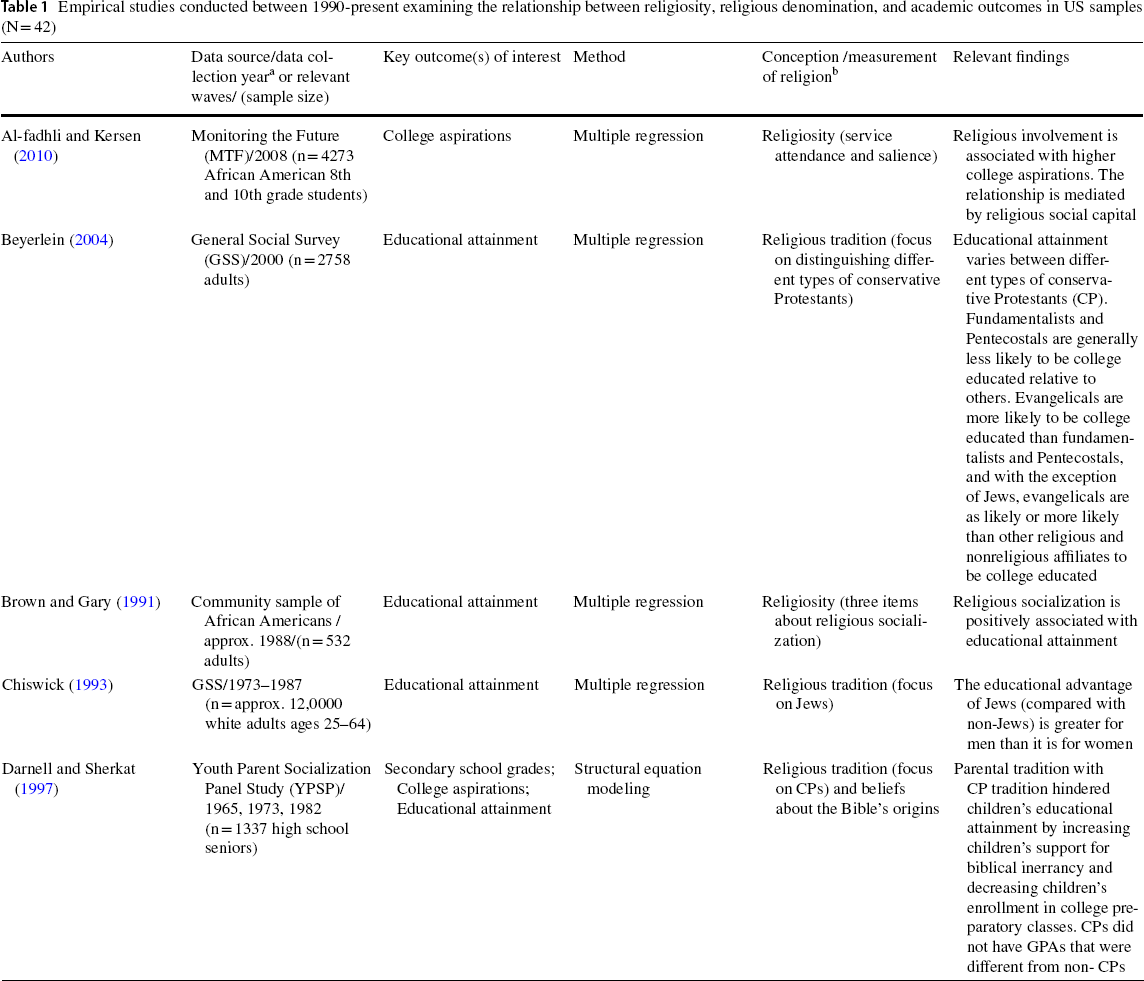
Authors
Data source/data collection yeara or relevant waves/ (sample size)
Key outcome(s) of interest
Method
Conception /measurement of religionb
Relevant findings
Al-fadhli and Kersen (2010)
Monitoring the Future (MTF)/2008 (n = 4273 African American 8th and 10th grade students)
College aspirations
Multiple regression
Religiosity (service attendance and salience)
Religious involvement is associated with higher college aspirations. The relationship is mediated by religious social capital
Beyerlein (2004)
General Social Survey (GSS)/2000 (n = 2758 adults)
Educational attainment
Multiple regression
Religious tradition (focus on distinguishing different types of conservative Protestants)
Educational attainment varies between different types of conservative Protestants (CP). Fundamentalists and Pentecostals are generally less likely to be college educated relative to others. Evangelicals are more likely to be college educated than fundamentalists and Pentecostals, and with the exception of Jews, evangelicals are as likely or more likely than other religious and nonreligious affiliates to be college educated
Brown and Gary (1991)
Community sample of African Americans /approx. 1988/(n = 532 adults)
Educational attainment
Multiple regression
Religiosity (three items about religious socialization)
Religious socialization is positively associated with educational attainment
Chiswick (1993)
GSS/1973–1987 (n = approx. 12,0000 white adults ages 25–64)
Educational attainment
Multiple regression
Religious tradition (focus on Jews)
The educational advantage of Jews (compared with non-Jews) is greater for men than it is for women
Darnell and Sherkat (1997)
Youth Parent Socialization Panel Study (YPSP)/ 1965, 1973, 1982 (n = 1337 high school seniors)
Secondary school grades; College aspirations; Educational attainment
Structural equation modeling
Religious tradition (focus on CPs) and beliefs about the Bible's origins
Parental tradition with CP tradition hindered children's educational attainment by increasing children's support for biblical inerrancy and decreasing children's enrollment in college preparatory classes. CPs did not have GPAs that were different from non- CPs
Eirich (2012)
National Longitudinal Survey of Youth (NLSY)/ 1997 (n = 2856 12–16 year olds)
Educational attainment
Various regression techniques
Religiosity (parent's and child's service attendance; parent's frequency of prayer)
Children whose parents attend religious services more often have an educational advantage. First, parental religious service attendance increases children's educational attainment. Second, parental religiosity becomes more valuable as the educational transitions become less automatic, more difficult, and more expensive. Parental religiosity improves education not only because it produces religiosity in children, but also because religious involvement enhances other parental resources conducive for education
Fitzgerald and Glass (2008)
National Survey of Families and Households (NSFH)/ 1987–88 (n = 8387 Black and white adults 25–65
Educational attainment
Multiple regression
Religious tradition
Being raised in a CP household is associated with lower educational attainment, especially for women. The reason is that they start to have families early in life. Men do not pay an education penalty for being raised CP. In addition, being raised with no religious tradition is associated with lower educational attainment for men
Fitzgerald and Glass (2012)
Add Health W1, W3, W4 (24–32 year olds; sample size not provided)
Educational attainment
Multiple regression
Religious tradition (focus on CPs) and religiosity (service attendance)
Religious cultures produce lower educational attainment via the life choices of CP youth, who end their education and assume adult responsibilities sooner than their social class peers
Glanville et al. (2008)
Add Health Wave 1 and 2 (n = 12,361 7th–12th grade students)
Secondary School Grades
Structural equation modeling
Religiosity (service attendance)
Religious service attendance is positively associated with better grades. This relationship is partly mediated by higher intergenerational closure, friendship networks with higher educational resources and norms, and extracurricular participation
Glass and Jacobs (2005)
NSFH/1987/ (n = 5901 adult women)
Educational attainment
Multiple regression
Religious tradition
Growing up in a religiously conservative household reduced educational attainment. Religious conservatism creates an ideological framework that guides important life course decisions such as when to quit schooling
Horwitz et al. (2020)
National Longitudinal Study of Adolescent to Adult Health (Add Health)/W1, W4 (n = 11,928 13–17 year-olds; 552 families)
Secondary school grades, college aspirations, educational attainment
Multiple regression with family fixed effects
Religiosity (service attendance, personal prayer, salience)
More religious adolescents earned higher GPAs in high school and were more interested in going to college, even after including family fixed effects. Because of their higher GPAs, more religious adolescents were more prepared for college and had completed more years of education 14 years after their religiosity was measured
Jeynes (2016)
National Education Longitudinal Study (NELS)/1992 (n = 18,726 12th graders)
Test scores
Multiple Regression
Religiosity (religious service attendance, youth group involvement, self-assessed religiosity) and religious tradition
Religiosity was associated with higher mathematics and reading test score, especially among urban students. There were no differences between Catholic and Protestant students, but there were differences between religious students of Christian faith versus students of other religious faiths
Jordan and Nettles (2000)
NELS/1988 (n = approx. 13,000 10th graders)
Test scores
Multiple regression
Religiosity (importance of religious activity, perceptions of religiousness, religious service attendance)
Religiosity was not associated with students’ math and science test scores
Keysar and Kosmin (1995)
CUNY Graduate Center's National Survey of Religious Identification/1989 (n = 19,274 women 18–45 years old)
Educational attainment
Multiple regression + Path analyses
Religious tradition
The odds of completing college are highest for Jewish women. Conservative Protestant and No Religion adherents have similar middle-order levels of educational attainment
Kim (2015)
National Longitudinal Survey of Youth (NLSY)/2000 (n = 3461 15–17 year olds)
Educational attainment
Propensity Score Matching
Religiosity (service attendance) and religious tradition
Higher religious service attendance during youth is positively associated with increased educational attainment in adulthood. Returns to attendance are greater for low-income students. There are no differences by religious tradition
Lee and Pearce (2019)
NSYR/ W1, W2, W4/ (n = 119 interviews with 16–21 year olds and n = 2137 23–28 year olds)
Educational attainment
Multiple regression and interview analysis
Religiosity (service attendance)
Religious involvement provides advantages to low-SES youth finishing high school and getting a 2-year degree, but not getting a 4-year degree. Making it to a graduate/professional degree, once one completes college, is also helped by having been a religiously involved adolescent. Transcendent and ideological resources are positively associated with educational outcomes, especially among youth from disadvantaged backgrounds, but social resources accessed through religious participation may not be all that valuable
Lee et al. (2007)
NELS /1988 (n = 11,551 10th graders)
Educational attainment
Multiple Regression
Religiosity (to what extent are you a religious person)
Students’ religiosity was significantly related to bachelor's degree attainment for students regardless of gender or socioeconomic status (though only for some ethnic and religious groups)
Lehrer (1999)
NSFH/ 1987–88 (n = 3144 white men and women)
Educational attainment
Multiple Regression
Religious tradition (Catholicism, Judaism, mainline Protestantism, and fundamentalist Protestantism)
Jews have the highest educational attainment and CPs have the lowest. Catholics and mainline Protestants are in the middle and are similar to each other
Lehrer (2004b)
National Survey of Family Growth (NSFG)/ 1995 (n = 974 CP white women over age 27
Educational attainment
Multiple Regression
Religiosity (service attendance) and religious tradition (focus on CPs)
Being in the high religiosity category is associated with substantial increases in the probability of completing high school and of attending college. Women raised as CPs who attended religious services frequently during adolescence complete eight tenths of a year more schooling than their less observant counterparts
Lehrer (2010)
NSFG/ 1995 (n = 4181 white women)
Educational attainment
Multiple Regression
Religiosity (service attendance) and religious tradition
Attending religious services more often in adolescence was associated with higher educational attainment downstream. The margin is substantial in the case of Catholics and CPs, and modest in the case of mainline Protestants
Loury (2004)
NLSY 1979, 1993/(n = 2748 Christian white 14–17 years old)
Educational attainment
2SLS models
Religiosity (service attendance)
Higher religious service attendance during youth is positively associated with increased educational attainment in adulthood
Massengill (2008)
GSS/1972–2004 (n = 30,637 white adults over 25)
Educational attainment
Multiple Regression
Religious tradition
First, for those born after 1960, individuals raised with no religious tradition were less likely than any other religious group – including Conservative Protestants – to complete 4-year college degrees. Second, for those born after 1940, Catholics and Mainliners are equally likely to complete college
Massengill and MacGregor (2012)
GSS/1972–2008 (n = 34,009 white adults over 25)
Educational attainment
Multiple Regression
Religious tradition (focus on religious “nones”)
Being raised in no religious tradition was once predictive of higher odds of completing a college degree. However, for individuals born after 1960, being raised in no religious tradition is associated with lower odds of completing a 4-year college degree relative to adults who were raised in any religious tradition and continue to claim a religious identity in adulthood
Mazur (2016)
GSS/1972–2014 (n = 58,297 adults)
Educational attainment
Path models
Religious tradition (focus on Jews)
Jews have two or more times the university-level degrees held by non-Jews. By the end of 1999, nearly two-thirds of Jewish adults had advanced degrees. Jews’ advantageous position is due at least partly to the relatively favorable socioeconomic status attained by their parents by the mid-twentieth century
McKune and Hoffmann (2009)
Add Health Wave 1 and 2 (n = 8051 7th–12th grade students)
Secondary school grades
Regression
Religiosity (service attendance; prayer frequency; salience; belief in biblical inerrancy) and beliefs about the Bible's origins
Increased religiosity predicts better grades, but the effect is attenuated when family and community social capital are accounted for
Milot and Ludden (2009)
Original data collection/year unknown/ (n = 683 8th and 9th grade students from 13 schools in rural areas in the Midwest)
Secondary school grades; College aspirations /expectations
Multiple hierarchical regressions
Religiosity (service attendance and salience)
Adolescents who reported that religion was important in their lives reported lower school misbehavior and higher motivation, and those with high religious attendance had higher grades. Interaction effects indicated that religious importance was particularly salient for males compared to females in terms of enhanced school bonding and self-efficacy
Mohanty (2016)
NLSY/1979, 1982, 2000 (n = approx. 6000 14–21 year olds)
Educational attainment
Propensity Score Matching
Religiosity (service attendance)
Higher religious service attendance during youth is positively associated with increased educational attainment in adulthood. This is a causal relationship
Muller and Ellison (2001)
NELS/W2 and W3 (10th graders in public schools; no sample size specified)
Truancy
Multiple regression
Religiosity (importance of religious activity, perceptions of religiousness, and service attendance)
Religious involvement is positively associated with several key academic outcomes (e.g., accumulation of advanced math credits, receipt of diploma), as well as compliance with norms and rules (e.g., more homework time, less class cutting). The effect of religion is largely mediated by family and community social capital
Park and Reimer (2002)
GSS/1972-1998 (n = 38,116 adults)
Educational attainment
Multiple regression
Religious tradition (focus on Christian groups)
Educational attainment among all religious traditions increases over time. Over the years, there is a consistent ranking in attainment; mainline Protestants are the most educated (12.89 years), followed by Catholicism (12.49), evangelical Protestantism (11.79), and black Protestantism (10.96). Traditions with the lowest average education have greater educational gains. The gap between the groups has narrowed over time
Pyle (2006)
GSS/1972–2000 (n = approx. 30,000 adults)
Educational attainment
Multiple regression
Religious tradition
Jews and Liberal Protestants had significantly higher educational attainment scores than Moderate Protestants during all periods. Black Protestants and Conservative Protestants scored significantly lower during all periods. Educational scores for Nonaffiliates declined after the 1970s. There were no significant differences between Catholics and Moderate Protestants on the educational measure during the 1980s and 1990s, although Catholics had significantly lower scores in the 1970s
Regnerus (2000)
High School Effectiveness Study linked with Common Core Data (n = 4434 10th grader public school students)
Educational expectations; Test-scores
Regression/Hierarchical linear modeling
Religiosity (participation in religious activities)
First, participation in church activities is related to heightened educational expectations and better scores on standardized math/reading tests. Second, the relationships don't vary across a neighborhood's poverty level
Regnerus and Elder (2003)
Add Health, W1 and W2 (n = approx. 9667 7th–12th graders)
Academic “on-track” performancec
Hierarchical linear modeling
Religiosity (service attendance, salience)
Church attendance among youth in high-risk neighborhoods contributed more to academic progress than it did among youth in higher-income neighborhoods
Sander (2010
GSS 1998–2008 (n = approx. 14,000 adults)
Educational attainment
Multiple regression
Religious tradition
Jews and Muslims acquire more education than do Protestants, Catholics, and those with no religious upbringing). The effect of Buddhism is not significant if immigrants are included and an adjustment is made for Asian ethnicity. However, if the sample is restricted to respondents living in the US at age sixteen and/or born in the US, the effect of Buddhism is positive and significant
Scheitle and Smith (2012)
GSS 1972–2008 (n = approx. 30,000 25 and older)
Educational attainment
Multiple regression
Religious tradition
Among early cohorts, those raised in and remaining in the Conservative Protestant (CP), black Protestant (BP), and Roman Catholic (RC) traditions are less likely than those raised and remaining religiously unaffiliated to obtain a college degree. However, switching out of those traditions is positively and significantly associated with college attainment. In the most recent cohort, however, those who are raised and remain in CP and RC traditions do not differ in college degree attainment from those raised and remaining unaffiliated. Furthermore, switching out of those traditions is no longer associated with an increased likelihood of having a college degree
Sherkat and Darnell (1999)
YPSP/ 1965, 1973, 1982 (n = 1337 high school seniors)
Educational attainment
Multiple regression
Religious tradition (focus on CPs) and beliefs about the Bible's origins
Fundamentalist parents hinder the educational attainment of their non-fundamentalist female children
Sinha et al. (2007)
UPenn Center for the Study of Youth Policy/2000 (n = 2004 11–18 year olds)
Truancy
Religiosity (salience and participation)
Both perception of importance of religion and participation in a religious youth group were negatively correlated with truancy
Stokes (2008)
Add Health, W1 and W3 (n = 8137 7th–11th graders)
Educational attainment
Multiple regression
Religiosity (parents’ and child's service attendance, parents’ and child's religious salience, child's group attendance)
Students whose parents attend religious services more often have greater odds of completing high school. The effect of parental religiosity appears to be relatively more important than the student's own religiosity
Tirre (2017)
Project Talent/ 1960 (n = approx. 80,000 12th graders)
Secondary school grades
Structural Equation Modeling
Religiosity (parents’ religious service attendance and number of religious books at home) and Biblical literacy
First, parental religiosity and Bible literacy were positively related to conscientiousness, which related positively to academic achievement. Second, parental religiosity and Bible literacy were also directly related to academic achievement independently of general cognitive ability and conscientiousness
Toldson and Anderson (2010)
MTF/2008 (n = 6795 8th and 10th grade students)
Secondary school grades
MANOVA
Religiosity (religious service attendance and salience)
Students who participated in more religious activities and who had stronger religious convictions were more likely to report higher grades. Among Black students, only religious participation (not religious salience) was associated with better grades
Trusty and Watts (1999)
NELS/1988, 1992 (n = 12,992 12th graders)
Secondary school grades; truancy; educational aspirations
Multiple regression
Religiosity (importance of religious activity, perceptions of religiousness, and attendance at religious services)
Positive perceptions of religion and frequent attendance at religious activities were related to positive attitudes toward academics, fewer school attendance problems, more time spent on homework, and recognition for good grades
Uecker and Pearce (2017)
Add Health W1 and W3 (N = 2093) and NSYR W2 and W3 (N = 46)
Educational aspirations
Multiple regression and interview analysis
Religious tradition (focus on CPs)
CP women attend less selective colleges than other women—a difference that is even larger among women with higher academic ability. These differences stem from young women's different understandings of the purposes of college (general self-betterment versus human capital investment), which relate to unique strategies for balancing work and family, enacting altruism, and achieving self-satisfaction
Wilde et al. (2018)
GSS 1990–2016 (n = approx. 35,000 ages 25–65) and Pew 2014 (n = approx. 35,000 ages 25–64)
Educational Attainment
Regression
Religious tradition
Jews and American Hindus are among the most highly educated, with ≥ 68% and 85% earning BAs, respectively. Among Mainline Protestants, almost 40% have ≥ BA. Evangelical Protestants have only half the proportion of members with BAs as Mainline Protestants. Among Catholics, approx. 30% hold ≥ BAs (although this is less for Latino Catholics). Among Black Protestants, only 15% have ≥ BAs. Among those with no religion, about 35% have ≥ BA
1
How scholars measure individual religiosity is highly contested. First, measures of religious attendance and salience do not necessarily reflect the ways individuals uniquely combine varying types and levels of religious practices and beliefs in their daily lives (Pearce et al. 2013; Storm 2009). Second, existing measures of religion are not designed for more robust or diverse conceptions of religiosity that are translatable across religions. Recently, scholars have tried to improve the measurement of individual religiosity by using latent class analysis (LCA) (Pearce et al., 2013; Pearce & Denton,  ).
).
3
4
Some may wonder if the positive effects of religiosity reflect social desirability bias. Regnerus and Uecker () found that although social desirability and embarrassment modestly diminishes the likelihood of self-reporting of some sensitive behaviors, they are neither associated with religiosity nor do they undermine apparent religious effects.
5
Some surveys ask students about aspirations (e.g., “how far would you like to go in school?”), and some ask about expectations (e.g., “how likely is it that you will graduate from college?”). In this paper, aspirations and expectations are combined into one category.
6
7
Conservative Protestants are generally comprised of Fundamentalists, Pentecostals, and Evangelicals. Although most studies group conservative Protestants together, scholars like (Beyerlein ) find significant variation within conservative Protestantism. For example, Evangelicals are more likely to be college educated than Fundamentalists and Pentecostals. It is likely that there is variation among different denominations in Judaism, but most national studies don't sample enough Jews from different denominations to identify these patterns.