







Abstract
Background
Although few studies have explored predictors of congregational vitality (i.e., ministry-oriented strengths, not attendance or growth) and sustainability, inter-organizational relationships matter for organizational wellbeing because of their impact on trust, cooperation, and information access. However, investigating the relationship between social capital and congregational vitality and sustainability has not previously been possible due to data limitations.
Purpose
This article investigates the extent to which brokerage, or bridging together otherwise disconnected congregations, predicts congregational vitality and sustainability in an inter-congregational network of religious congregations from eight counties encompassing and surrounding a major metropolitan area in the southeastern United States. Research on social networks between organizations suggests that brokerage can have positive, negative, and curvilinear relationships with organizational outcomes, and this literature does not provide a clear expectation for how brokerage might relate with congregational vitality and sustainability.
Methods
OLS regressions are used to predict three forms of vitality and two forms of sustainability using inverse network constraint, a measure of brokerage, as well as a variety of control variables. Statistical significance is estimated through permutation tests, which account for the relationships between congregations.
Results
Results indicate that brokerage is positively associated with community vitality and that staff/volunteer sustainability is highest for congregations with moderate levels of brokerage. Brokerage does not predict spiritual vitality, relational vitality, or financial sustainability.
Conclusions and Implications
This article has practical implications for congregations. Bridging together otherwise disconnected congregations can provide a wide range of ideas, resources, and opportunities, and these benefits can help congregations seeking to minister in their communities. In addition, moderate levels of brokerage can provide more diverse information and resources as well as a supportive, trusting, and cooperative environment. This combination of benefits may be helpful for congregations to disclose challenges with and to seek resources related to staff/volunteer sustainability. In addition, this article contributes to the fields of: congregational studies through exploring predictors of congregational vitality and sustainability; sociology of religion through expanding research using social network analysis; inter-organizational networks, whose research on social capital and organizational outcomes is both complicated and conflicting.
Keywords
Introduction
Due to recent trends in American religion (Chaves 2017), some congregations are finding that they are “calibrated for a world that no longer exists” (Cormode 2020, p. 1). Although these trends may appear threatening and adapting may provoke anxiety for some congregations (Steinke 2019), congregations seeking to “sustain organizational vitality must find avenues for developing and adapting organizational innovations” (Finke 2004, p. 19). Relational connections matter for understanding how congregations navigate this cultural moment because relationships impact organizations’ ability to learn, to adapt, and to innovate by encouraging or constraining trust, cooperation, autonomy, and access to information (Gargiulo and Benassi 2000; Ruef 2002; Kreiser 2011). Previous research has identified a variety of ways in which congregations connect through friendships and collaborations (Ammerman 2005; Chaves and Anderson 2008, p. 434; Marler et al. 2013; Fulton 2016), and recent research has begun to understand these relationships as part of a broader relational network between religious congregations, called an inter-congregational network (McClure 2020, 2021a, b). In analyzing an inter-congregational network of religious congregations from eight counties encompassing and surrounding a major metropolitan area in the southeastern United States, this article examines the extent to which congregations’ relationships with other congregations matter for understanding their vitality and sustainability. In this study, vitality is defined as multidimensional congregational health and can include spiritual, relational, organizational, and outward community-based components (Sterland et al. 2018). Sustainability concerns to what extent congregations can garner the finances, staff, and volunteers needed to engage in ministry (Chaves 2004, p. 17; see also Bobbitt 2015).
In predicting congregational vitality and sustainability, this article draws on insights from the field of interorganizational networks (IONs), which concerns relational “ties between organizations” (Zaheer et al. 2010, p. 62). In the ION literature, brokerage, or bridging between “two or more otherwise disconnected actors” (Kwon et al. 2020, p. 1093), is an important factor that can impact organizational outcomes. High brokerage is related to Ronald S. Burt's concept of structural holes (1992; see also Provan et al. 2007, pp. 484–485, Zaheer et al. 2010, p. 67, and Kwon et al. 2020, p. 1095); in IONs, structural holes exist when organizations are “otherwise disconnected in the network,” and brokerage involves bridging across these structural holes (Zaheer and Bell 2005, p. 810; see also Burt 1992, pp. 1–2, Kwon et al. 2020, p. 1093). Low brokerage is reflected in James S. Coleman's concept of network closure, which concerns the extent to which actors are positioned in a tight-knit group (Coleman 1988, pp. S106–S107) in which relationships are redundant with “each relationship put[ting] [an actor] in contact with the same [actors] reached through the other relationships” (Burt 1992, p. 17). This continuum from high brokerage (i.e., spanning structural holes) to low brokerage (i.e., network closure) is analogous, respectively, to Robert Putnam's bridging and bonding social capital (2000, pp. 22–23). Throughout this article, I will primarily use the terminology of brokerage, structural holes, and network closure; however, because these concepts are not commonly used in sociology of religion or congregational studies, bridging and bonding social capital will also be used at points.
When applied to an inter-congregational network, high levels of brokerage involve “bridg[ing] together otherwise disconnected congregations,” and low levels of brokerage involve “embedded[ness] in [a] tight-knit cluster” of congregations (McClure 2021b, p. 1; see also Coleman 1988, pp. S106–S107; Burt 2001, pp. 35, 37). Brokerage is hypothesized to impact organizational outcomes by facilitating or inhibiting trust, cooperation, and access to information, but the literature provides conflicting evidence about whether it has positive, negative, or curvilinear associations with organizational outcomes (Uzzi 1999; Ahuja 2000; Soda et al. 2004; Uzzi and Spiro 2005; Zaheer and Bell 2005; Balkundi et al. 2007; Shipilov and Li 2008; Zaheer and Soda 2009). This article investigates the extent to which brokerage has positive, negative, or curvilinear associations with congregational vitality and sustainability.
This article contributes to previous literature in three ways. First, by investigating a network-based predictor of vitality and sustainability, it contributes to research on congregational vitality and sustainability, which has focused more on identifying dimensions of vitality (e.g., Sterland et al. 2018) than on predicting levels of vitality and has tended to deemphasize financial dimensions (Theissen et al. 2019, p. 15). Second, social network research is rare within sociology of religion due to data limitations. Many studies that seek to understand relational dynamics in congregational life do not have actual network data, which involves specific relationships between specific actors. In the absence of network data, many studies rely on proxy measures like the extent to which one's closest friends are drawn from one's congregation (Everton 2018, pp. xvi–xvii; for examples, see Olson 1989; Stark and Finke 2000, p. 161; Scheitle and Adamczyk 2009; Stroope 2012; McClure 2015). However, there are small, growing literatures that are based on actual network data concerning intra-congregational networks (Lee et al. 2019; Todd et al. 2020; Stein et al. 2020; Corcoran et al. 2021) and inter-congregational networks (Chapman 2004; McClure 2020, 2021a, b), and this article contributes to the latter. Third, there is disagreement in the ION literature about the impact of brokerage on organizational outcomes, and this literature does not provide a clear expectation for how brokerage might impact congregational vitality and sustainability. This article provides evidence about how brokerage relates with congregational outcomes that have not previously been investigated in the ION literature.
Congregational Vitality and Sustainability
A significant amount of the research on congregational vitality has focused on describing dimensions of vitality that reflect the strengths, qualities, and ministry engagement of congregations, not congregation size, numerical growth or decline, or financial resources (Sterland et al. 2018, pp. 205–207). Natural Church Development presents eight characteristics of healthy Christian congregations: “empowering leadership; gift-oriented ministry; passionate spirituality; functional structures; inspiring worship service[s]; holistic small groups; need-oriented evangelism; loving relationships” (Schwarz 1996, p. 4). Cynthia Woolever and Deborah Bruce describe ten common congregational strengths: “growing spiritually; meaningful worship; participating in the congregation; having a sense of belonging; caring for children and youth; focusing on the community; sharing faith; welcoming new people; empowering leadership; looking to the future” (2004, p. v). Linda Bobbitt has identified three elements of vitality in Christian congregations: “connecting with God; connecting with each other; connecting with the world” (2014, p. 474). Sam Sterland and his colleagues condensed 12 different schemes of vitality, including those of Schwarz, Woolever and Bruce, and Bobbitt, into ten dimensions: “spirituality; worship; prayer; discipleship; community; faith-sharing; leadership; vision; structures; giving” (2018, pp. 212–215). Lastly, Joel Thiessen and his colleagues have defined three dimensions of flourishing among Canadian Christian congregations: “organizational ethos (clear self-identity, leadership, innovation, and structure and process), internal factors (discipleship, hospitable community, engaged laity, and diversity), and outward variables (evangelism, neighborhood involvement, and partnership)” (2019, p. 13). There is significant overlap between these schemes.
In the literature on congregational vitality, there has been hesitance in some circles to define vitality using resources and sustainability perhaps due to concerns about applying business metrics to congregations (Sterland et al. 2018, pp. 214–215; Thiessen et al. 2019, p. 15). However, finances, staff, and volunteers play critical roles in congregational life because “congregations need [them] to survive” (Chaves 2004, p. 17; see also Bobbitt 2015). Congregations’ financial resources come mostly from contributions from individual attenders and are used mostly to maintain current ministries; many congregations lack the additional resources needed to expand their ministries (Chaves 2004, pp. 36–37). In addition, ministers and staff members lead and organize many ministry activities in congregations (Carroll 2006, p. 102), while many individual attenders contribute at least a few hours a month to volunteering at their congregation (Hoge et al. 1998, p. 472). Because of volunteers’ unpaid time and effort, congregations do not need to hire as many staff members (Hoge et al. 1998). Estimates suggest that volunteers “are worth … about [40% of] the … monetary contributions” to the average congregation (Hoge et al. 1998, p. 479). Because finances, staff, and volunteers matter for understanding congregations’ ability to engage in ministry, this article examines sustainability alongside vitality.
Scholars have also devoted less attention to correlates of congregational vitality. Woolever and Bruce stand out for their work in this area, exploring differences by congregation size, religious tradition, and age of attenders (2004) as well as geographic contexts (2008). With additional colleagues, they also explored growth, gender composition, and orientations toward the future as correlates of vitality (Bruce et al. 2006; Woolever et al. 2006a, b). Building on recent research about an inter-congregational network (McClure 2020, 2021a, b), this article contributes to this research by investigating a network-based predictor of vitality and sustainability.
Brokerage, Structural Holes, and Network Closure
This article uses brokerage, understood through Burt's structural holes and Coleman's network closure, to predict congregational vitality and sustainability. Brokerage has advantages and disadvantages (Coleman 1988; Burt 2001; Bizzi 2013), and it has complex relationships with organizational outcomes.
High brokerage can have both positive and negative implications in networks. First, actors, whether people or organizations, who bridge across structural holes can experience numerous benefits, particularly in the areas of diffusion of information and controlling relational patterns (Burt 1992, 2001, 2004). They are more likely to learn about a greater variety of ideas and innovations (Burt 2004, p. 349–350; see also Burt 1992, p. 13–17, 2001, pp. 35–36), and they can also control whether other actors in the network connect (Burt 1992, pp. 30–34), increasing their own capability to “exercise control over more rewarding opportunities” (Burt 2001, p. 36). On the other hand, actors can use this form of social capital in ways that are harmful to the network. Ideally, actors spanning structural holes would use their position to share information with various parts of the network; however, they can obstruct the spread of information across the network in order to increase their own power, contributing to division in the network (Bizzi 2013, p. 1573).
Low brokerage similarly can be both advantageous and disadvantageous. Network closure's benefits include creating tight-knit social settings characterized by trust, “reliable communication channels,” shared norms, and cooperation (Burt 2001, p. 37–38; see also Coleman 1988; Gargiulo and Benassi 2000, p. 186; Bizzi 2013, p. 1558). In addition, it can also reduce the risk of “exploitation because [an actor] and [its] contacts are more able to act in concert against someone who violates their norms of conduct” (Burt 2001, p. 38; see also Coleman 1988, p. S105). However, network closure can constrain access to a wider variety of information (Burt 2001, pp. 47–49; Burt 2004, p. 354), and the close relationships facilitated by network closure can isolate actors by making it harder to develop relational ties outside of the cluster (Gargiulo and Benassi 2000, p. 186).
In the ION literature, there are conflicting findings about the impact of brokerage on organizational outcomes. Some studies indicate that high brokerage, or bridging social capital, is more advantageous for organizations. Bridging across structural holes can benefit organizations through “better access to resources (including information or knowledge) and better identification of and responses to emerging threats and opportunities” (Zaheer and Bell 2005, p. 814) as well as more relational autonomy to innovate (Gargiulo and Benassi 2000, p. 193). Congregations that bridge across structural holes or that have bridging social capital may experience higher levels of vitality and sustainability because of access to a wider range of resources about congregational life and of opportunities for ministry as well as more flexibility to innovate without as many relational constraints against doing so.
On the other hand, other studies argue that low brokerage, or bonding social capital, is more beneficial for organizations. Network closure creates a supportive, tight-knit environment that can “facilitate the development of trust and cooperation” (Ahuja 2000, p. 452), and it can enhance interorganizational collaborations through encouraging the development of shared understandings, norms, and expectations as well as providing strong social sanctions against violating the norms of the network (Shipilov and Li 2008, p. 432; Soda et al. 2004, p. 896). The trust and cooperation engendered by network closure can also promote organizational innovation and performance (Ahuja 2000; see also Shipilov and Li 2008). Congregations that experience network closure or bonding social capital may develop vitality and sustainability through cooperating and collaborating with other trusted congregations that have similar approaches to faith and ministry.
However, the literature on teams within organizations provides some evidence for curvilinear relationships between brokerage and organizational outcomes. One study suggests that both high and low brokerage may be beneficial for teams because high brokerage allows for a wider range of ideas while low brokerage strengthens trust and shared norms (Soda et al. 2004, p. 896). This study suggests that either strong bridging or strong bonding social capital might be beneficial for congregational vitality and sustainability but that a mix of bonding and bridging social capital might inhibit vitality and sustainability. In contrast, other research suggests that teams with moderate levels of brokerage “may gain the benefits of diverse thinking without the drawbacks of information distortion or poor coordination. People in such teams may find opportunities for some degree of clustering with like-minded others without having to suffer social isolation” (Balkundi et al. 2007, pp. 245–246; see additional inverse curvilinear relationships in Uzzi 1999; Uzzi and Spiro 2005). In an inter-congregational network, having a balance of bonding and bridging social capital might be ideal for vitality and sustainability because this balance might provide a wider range of information as well as some cooperation while also preventing sparse relational ties that impede coordination as well as tight-knit networks that isolate congregations.
There's also evidence that the impact of brokerage on organizational outcomes can vary by outcome. A study concerning structural holes within a network of financial banks indicates that bridging across structural holes is advantageous for banks’ status but disadvantageous for their market performance (Shipilov and Li 2008, p. 96). A firm's position in an open network [i.e., across structural holes] provides it with superior access to information about business opportunities, which makes the structural-hole spanner an attractive ally for higher-status partners and enables it to enhance its own status. But positions in open networks [i.e., brokering positions] also limit firms’ exposure to information about partners’ cooperativeness, which lowers their trust and ultimately dampens their efforts to generate revenues from collaborative activities. This … allows for the coexistence of both positive and negative effects of open networks [brokerage] on performance. (Shipilov and Li 2008, p. 101)
It is difficult to form hypotheses about to what extent and how brokerage might predict congregational vitality and sustainability for two reasons. First, the literature does not provide consistent results for how brokerage relates with organizational outcomes. Second, most of the theoretical mechanisms connecting brokerage to organizational outcomes have been identified through research on business, for-profit settings, and it is unclear to what extent the theoretical mechanisms will apply to congregations. For these reasons, this article examines three research questions:
Is brokerage related to congregational vitality and sustainability? If so, how is brokerage related with congregational vitality and sustainability? Is high, low, or medium brokerage associated with higher levels of congregational vitality and sustainability? Do the relationships between brokerage and congregational vitality and sustainability differ by type of vitality or sustainability?
Data and Methods
Data
The study population included congregations of all faith traditions in eight counties encompassing and surrounding a major metropolitan area in the southeastern United States; data were provided by a key informant, usually a minister. The first wave of data collection took place in the fall of 2017; 9% of the congregations that received a mailed questionnaire (171 of 1892) completed and returned it.1 “Congregations that returned questionnaires via mail tended to have a longer history, a smaller size, a greater percentage of regularly attending adults that were 60 or older, an older main minister, and a main minister with either a short or rather long tenure” (McClure 2020, p. 10). In 2018, additional congregations were invited to participate via phone interviews; non-participants became eligible when a participating congregation identified them as a connection (also called an alter; see Wasserman and Faust 1994, p. 42). Snowballing strategies (Borgatti et al. 2018, p. 40) are useful for “avoid[ing] the sparsity of connections” that can take place in network studies (Scott 2013, p. 50). In the second wave, almost 30% (267 of 906) of eligible congregations contributed data through phone interviews; 294 of these eligible congregations were not included in the original mailing list. “Analyses suggest that the [mailing list] was less representative of … nondenominational congregations, recently founded congregations, congregations with younger ministers who have shorter tenures, congregations with fewer resources, and rural congregations” (McClure 2020, p. 11). In total, 20% (438 of 2186) of the congregations that I am aware of in the eight-county study area (which include those in the original mailing list as well as congregations excluded from the mailing list that were mentioned as alters by participants) provided data,2 and another 29% (639 of 2186) were eligible as alters but did not participate (McClure 2020, p. 7). More details are available in the article that introduced the data collection (McClure 2020, p. 5–13).
The context of the participating congregations has been assessed using the 2012 National Congregations Study (Chaves et al. 2014) and information for the eight-county study area from the 2010 U.S. Religion Census (Grammich et al. 2012), and this information is available in the “Appendix”.
Outcomes
Two sets of questions are used to gauge congregational vitality in this article (Bobbitt 2015). The first set concerns to what extent certain “phrases describe [a] congregation:”
Worship nurtures people's faith Deepens people's spirituality/relationship with God A clear sense of mission Excitement about the congregation's future Always ready to try something new A positive force in the community Works for social justice/advocacy (Bobbitt 2015)
Responses to these questions were measured ordinally on a five-category scale, which was slightly modified from Bobbitt's (1 = Poor; 3 = Good; 5 = Very Good). A second set of questions focuses on to what extent congregations engage in different elements of ministry:
Incorporate new members into congregational life Seek out and use the gifts of members of all ages Build strong, healthy relationships among members Manage disagreements in a healthy, respectful manner Address community needs (helping those in need) Equip members to share their faith with others Interact with the local community Help members live out their faith in their daily lives (Bobbitt 2015)
Response categories were also slightly revised from Bobbitt's (1 = Poorly; 3 = Well; 5 = Very Well).
A factor analysis was performed on these items to identify underlying dimensions of vitality. This analysis indicated that there were three underlying factors.3 First, spiritual vitality was measured through two items (α = 0.762): worship nurtures people's faith; deepens people's spirituality/relationship with God. Second, community vitality was measured through four items (α = 0.789): a positive force in the community; works for social justice/advocacy; address community needs (helping those in need); interact with the local community. Lastly, relational vitality was measured through three items (α = 0.764): incorporate new members into congregational life; seek out and use the gifts of members of all ages; build strong, healthy relationships among members. Each scale was created by averaging key informants’ responses to the items. If data on any item in the scale was missing, the scale was coded as missing.
Sustainability is also measured through two variables that focus on congregations’ finances and staff/volunteers (Bobbitt 2015). For both of these items, congregations were given the following responses: (1) declining, not sustainable; (2) declining, but sustainable; (3) maintaining; (4) growing or increasing (Bobbitt 2015).
There have been concerns about the extent to which key informants can accurately describe their congregations, even for basic demographic characteristics (Schwadel and Dougherty 2010, p. 376).4 Although this 15-item vitality scale was piloted among attenders, not key informants (Bobbitt 2016, pp. 183–184), Bobbitt has also tested it among key informants. Even though some ministers reporting high vitality intentionally inflate their responses (Bobbitt et al. 2018, p. 423–424), this article uses the vitality and sustainability measures with key informants because pastors, on average, reported lower congregational vitality than lay people (Bobbitt 2014, p. 474).
Predictor
The predictor was calculated from congregations’ relational ties. Participating congregations identified at most ten congregations5 within the study area with whom they had a relationship (McClure 2020, p. 13). For each alter, or mentioned congregation, participants also classified the relationship as involving one or more of the following: “(1) joint events between congregations; (2) friendships with ministers from other congregations; (3) participation in ministerial groups with ministers from other congregations; (4) ministers exchanging pulpits with ministers from other congregations (i.e., speaking in another pulpit and/or inviting a minister to speak in theirs)” (McClure 2020, p. 14).6 This study considers: “ties to be present among a pair of congregations if one or both mentioned [any type of] tie; ties to be absent if neither congregation mentioned [any type of] tie” (McClure 2020, p. 14).7 Figure 1 depicts the social network of relational ties among participating congregations.8
Diagram of the social network.  Survey participants. Node size is based on inverse constraint. Created with NodeXL Basic (http://nodexl.codeplex.com) from the Social Media Research Foundation (http://www.smrfoundation.org). Clusters generated with Clauset–Newman–Moore Algorithm (Clauset et al. 2004)
I measure brokerage through the additive inverse of network constraint. Network constraint is based on congregations’ ego-networks. In an inter-congregational network, an ego network includes a “specific congregation (called ‘ego’), the other congregations to which that ‘ego’ congregation has direct relational ties (called ‘alters’), the relational ties between ‘ego’ and its alters, and the relational ties between alters (Borgatti et al. 2018:305)” (McClure 2021b, p. 6). Network constraint quantifies “the extent to which ego's alters have ties to each other” (Borgatti et al. 2018:320; see also Burt 1992:54–56) or, in other words, the extent to which a congregation is embedded in a tight-knit cluster. More specifically, constraint is measured through the following equation:
 ) the strength of a particular relationship between actors i and j as well as the strength of indirect relationships in which actors i and j have mutual friends, who are denoted as actor(s) q (Burt 1992:54–56; Crossley et al. 2015:85). Because network constraint measures the opposite of spanning structural holes (Crossley et al. 2015:85), one needs to use the additive inverse of constraint to measure brokerage. The additive inverse of constraint is calculated by subtracting each congregation's constraint score from the maximum constraint score, which in this case is 1.125. Congregations with no relationships or one relationship, who do not bridge otherwise disconnected congregations, are given a score of zero. For other ION studies that use the additive inverse of network constraint to measure structural holes or brokerage, see Ahuja (2000:439), Zaheer and Bell (2005:818), and Shipilov and Li (2008:89). This predictor was measured from the network that only includes survey participants (see Fig. 1) and was calculated using UCINET 6.695.9

Control Variables
The analyses control for six variables. The first involves religious tradition (Steensland et al. 2000): Black Protestant,10 Evangelical Protestant, Mainline Protestant, Roman Catholic, and other traditions.11 The second concerns average weekly attendance: (1) Under 50; (2) 50–99; (3) 100–199; (4) 200–349; (5) 350–499; (6) 500–999; (7) 1000–1999; (8) 2000 or more, and the third focuses on whether congregations are nondenominational (0 = denominational; 1 = nondenominational). The fourth measures the extent to which regularly attending adults are younger and newer and is calculated from the percentages of congregations’ regularly participating adults that are: 60 years old or older, less than 35 years old, and new in the past five years. The response categories for these questions are: (1) None or hardly any (0–10%); (2) Few (11–20%); (3) Some (21–40%); (4) Many (41–60%); (5) Most or nearly all (61–100%). To create the scale, the variable for the percentage of regularly attending adults that are 60 or older was reverse coded, all three variables were standardized [transformed into z-scores], and the three standardized variables were averaged. This scale has a Cronbach's alpha of 0.74. (McClure 2021a, p. 565)
Many of the control variables were selected not only because of bivariate associations with the outcomes but also because they are considered by some religious leaders to be markers or inhibitors of vitality. Some have perceived average weekly attendance and the presence of younger and newer attenders as evidence of vitality (see Sterland et al. 2018:205–206). Additionally, many congregations might perceive a lack of resources in the surrounding neighborhood or a series of short-term ministers that has prevented continuity in leadership as impediments to vitality.
Analytical Strategy
The analyses use ordinary least squares (OLS) regression to test to what extent and how brokerage, measured through inverse network constraint, relates with congregational vitality and sustainability. However, this study's network data break the OLS assumption that “observations are sampled independently” because of the snowball strategy used in the second wave of data collection (Fox 2008:101). A common procedure in social network analysis to address this issue is permutation testing (Prell 2012:200–201). The permutation test used in this article involves iteratively examining hundreds of different regression models where the values for the independent and control variables remain the same but the values for the dependent variable are randomly mixed across the congregations. Regression results are computed and compared across all of the regressions to see to what extent the results are due to random chance (Analytic Technologies). This approach does not change the regression coefficients but does impact the p values (Borgatti et al. 2018:157–158). The regression results with permutation tests were calculated using UCINET 6.695. In addition, in order to limit the number of models presented in tables, curvilinear results will only be reported when they are statistically significant at p < 0.05. Missing data is addressed through casewise deletion (N = 430).
There are two sensitivity analyses, which are presented in a footnote. First, the models predicting relational vitality, financial sustainability, and staff/volunteer sustainability are heteroskedastic, and supplemental models calculated with Stata use robust standard errors to estimate statistical significance (Allison 1999:127) to examine whether the results in the permutation-based models are impacted by the heteroskedasticity. Second, some might question whether relationships involving friendships between ministers and ministerial groups actually represent relationships between congregations, so an additional sensitivity analysis reproduces the results using a network that only includes relationships involving joint events and pulpit exchanges.
Results
Descriptive statistics
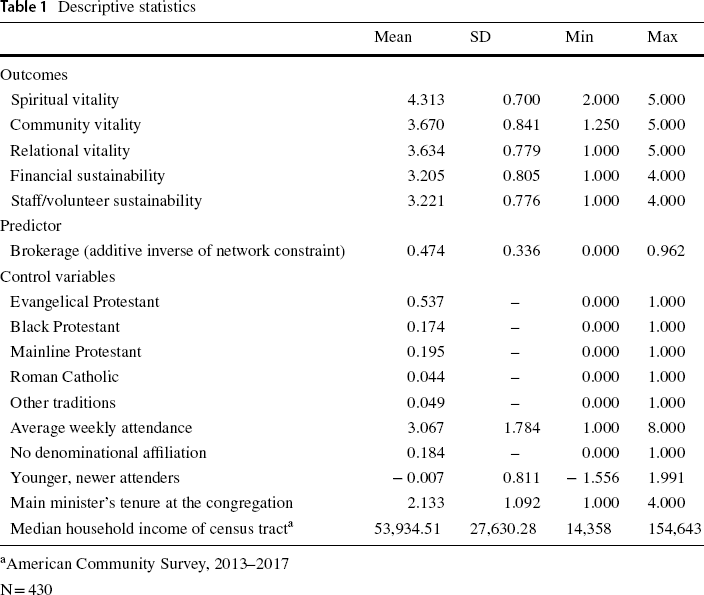
aAmerican Community Survey, 2013–2017
N = 430
Regressions predicting vitality and sustainability with brokerage and control variables
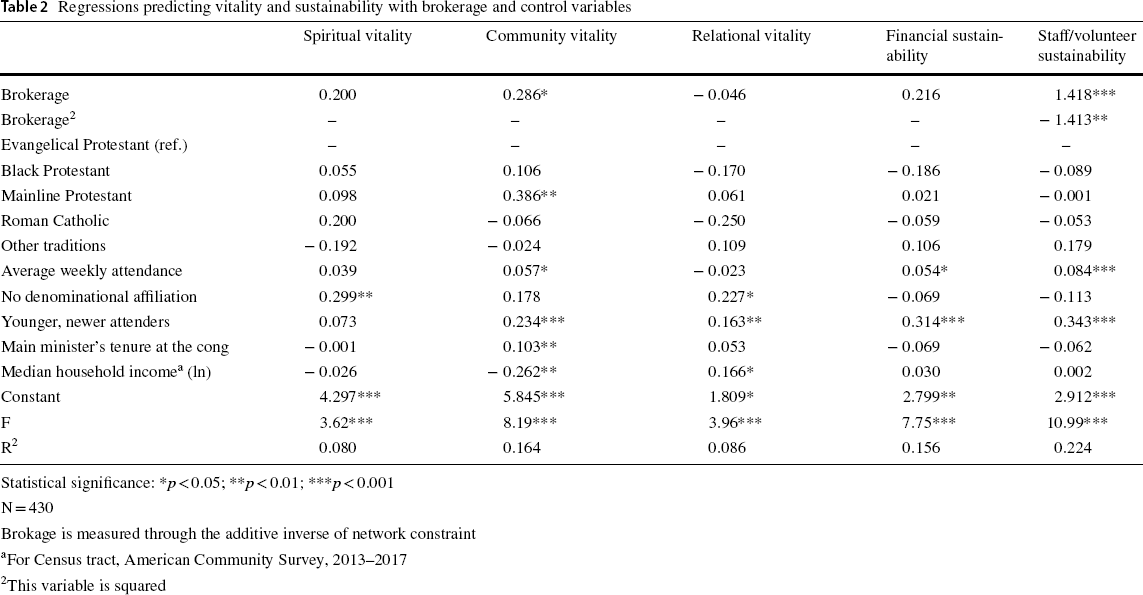
Statistical significance: *p < 0.05; **p < 0.01; ***p < 0.001
N = 430
Brokage is measured through the additive inverse of network constraint
aFor Census tract, American Community Survey, 2013–2017
2This variable is squared
Returning to the research questions, brokerage is related with two of the outcomes, and the nature of the relationship varies by type of vitality or sustainability. First, congregations that have higher brokerage levels, or that span more structural holes, report higher community vitality. Second, congregations with moderate brokerage levels report the highest staff/volunteer sustainability. However, brokerage is unrelated to congregations’ spiritual vitality, relational vitality, and financial sustainability.
Discussion
This article has investigated how congregations’ social capital relates with their vitality and sustainability. Results indicate that high levels of brokerage are advantageous for community vitality and that moderate levels of brokerage are beneficial for staff/volunteer sustainability. This section discusses the implications of these results for the ION and congregational studies literatures, the limitations of the study, and directions for future research.
First, congregations that broker between otherwise disconnected congregations, or that span more structural holes, tend to have higher community vitality. This result reflects previous ION research that links spanning structural holes with beneficial organizational outcomes (Soda et al. 2004; Zaheer and Bell 2005; Zaheer and Soda 2009) because bridging across structural holes facilitates “access [to] information” and “identification of … threats and opportunities” (Zaheer and Bell 2005:813, 814). Spanning structural holes might matter for community vitality in particular for two reasons. First, spanning structural holes facilitates adaptation (Gargiulo and Benassi 2000:192). Many congregations have experienced demographic changes in their neighborhoods, and some congregations have effectively responded through “adapt[ing] and reorient[ing]” their ministries (Ammerman 1997:45). In addition, many congregations are discovering that they need to adapt the ways in which they do ministry because of changes in the American religious landscape (Chaves 2017; Cormode 2020). Congregations that span more structural holes may be more likely to develop the relational autonomy needed for innovation (see Gargiulo and Benassi 2000:193). Second, partnerships are a primary way in which congregations engage in the community. Although most congregations have low engagement in providing social services, “congregations that engage more intensively in social services do so mainly in collaboration with a wide range of religious organizations, secular nonprofit organizations, and government agencies” (Chaves 2004:46; see also Fulton 2016). Congregations that span more structural holes may also be able to discover a wider variety of opportunities to serve in the community (see Gargiulo and Benassi 2000:193).
Second, congregations with moderate levels of brokerage have higher staff/volunteer sustainability. Prior studies indicate that a mix of bonding and bridging social capital can be advantageous for organizations and for teams within organizations. Some bridging and some embeddedness may be beneficial for congregations because they can access, if you will, the best of both worlds, including some cohesive, cooperative relationships as well as some opportunities to encounter new ideas and to innovate. This combination may protect congregations from the downsides of low and high brokerage, like low trust, isolation, and inability to innovate (Uzzi 1999:500; Uzzi and Spiro 2005:492–493; Balkundi et al. 2007:245–246, 253). Practically, many congregations face challenges with generating the staff and volunteers necessary to support their ministries (Chaves 2004:39–43). Such challenges, understandably, may be more easily disclosed to trusted congregations. Moderate levels of brokerage may be ideal for staff/volunteer sustainability because congregations can experience the benefits of access to new resources, develop trusting friendships in which they can strategize about how to address their challenges, and still innovate without jeopardizing these relationships.
This study has several limitations. The first involves questions about the potential causal direction between the predictors and the outcomes, which is not possible to address with cross-sectional data. There is theoretical support in the ION literature that network dynamics impact organizational outcomes, but it is also conceivable, for example, that congregations with high community vitality would then develop connections with additional congregations through their community engagement. Second, both the outcomes and predictors are more oriented toward congregational ministers than attenders because of the key informant strategy. The vitality and sustainability outcomes were originally intended to be measured among attenders (Bobbitt 2016:183–184), although studies have assessed their use among key informants (Bobbitt 2014:474; Bobbitt et al. 2018:423–424). For the predictors, two of the relationship types exclusively involve ministers (friendships and ministerial groups), while two involve a wider range of the congregations (joint events and pulpit exchanges). This article's sensitivity analyses partially address this limitation by indicating that the results are robust when tested in a network that only includes relationships involving joint events and pulpit exchanges. Third, the data collection has limited generalizability because of its small, eight-county geographic scope, in which there are numerous Evangelical Protestant and Baptist congregations (McClure 2020, p. 28). Lastly, “the data collection procedures resulted in additional limitations: requiring participating congregations to report at most ten alters to lessen respondent burden; probable missing data on congregational networks due to participants’ time restrictions; only allowing participants to report alters within the study area” (McClure 2021b, p. 16).
Future research is needed in three directions. First, many sociologists of religion have expressed interest in network dynamics and would profit from additional social network data collections and studies (Everton 2018:xvi–xvii). Second, congregational vitality and sustainability are important themes in congregational studies, and this field would benefit from additional studies about their predictors. Third, the ION literature about the relationship between brokerage and organizational outcomes is both complicated and conflicting. A review of this literature that synthesizes it and attempts to provide clarity would be helpful.
Conclusions and Implications
This study is the first to use congregations’ networks to predict vitality and sustainability, and its two main results have practical implications for congregations. First, for congregations seeking to expand their ministry in the broader community, building bridges with congregations who are not connected to each other may provide a wider range of information about the community and more opportunities to minister in the community through collaborations. Second, having connections with congregations among whom there are some but not dense connections may provide a valuable combination of support, resources, and flexibility for congregations to generate the staff and volunteers needed to sustain their ministries. These implications are presented somewhat tentatively because this study cannot determine causality or the direction of the relationships between brokerage, community vitality, and staff/volunteer sustainability.
In conclusion, the social capital experienced by congregations matters for understanding some types of vitality and sustainability. Community vitality is higher among congregations who bridge together otherwise disconnected congregations, and staff/volunteer sustainability is higher among congregations that experience some bridging and also some embeddedness in a cluster of congregations.
Footnotes
Acknowledgements
The author would like to thank Diane Felmlee, Nathaniel Porter, Jennifer Rahn, and Jonathan Fleming for their help and advice.
Funding
This work was supported by a Faculty Development Grant from Samford University and a Lilly Endowment grant awarded to Samford University's Center for Congregational Resources (#2014 0494-000).
Appendix
See Table 3.
Comparing the current study to the 2012 National Congregations Study and the 2010 U.S. Religion Census. Source: McClure 2020, p. 12 Congregation size† Community type‡ Some variables have lower Ns due to missing data 2012 NCS data weighted by WTA3CNGD *Encompassing this study's eight-county area †Congregation size measured as average weekly attendance in the current study and as number of regular participants in the 2012 NCS ‡Community type for current study determined using 2017 National Center for Education Statistics locale data (Geverdt 2015) in GIS. Community type for NCS based on 2010 U.S. Census designation for census tract Other notes N of current study = 438 N of 2012 NCS = 1331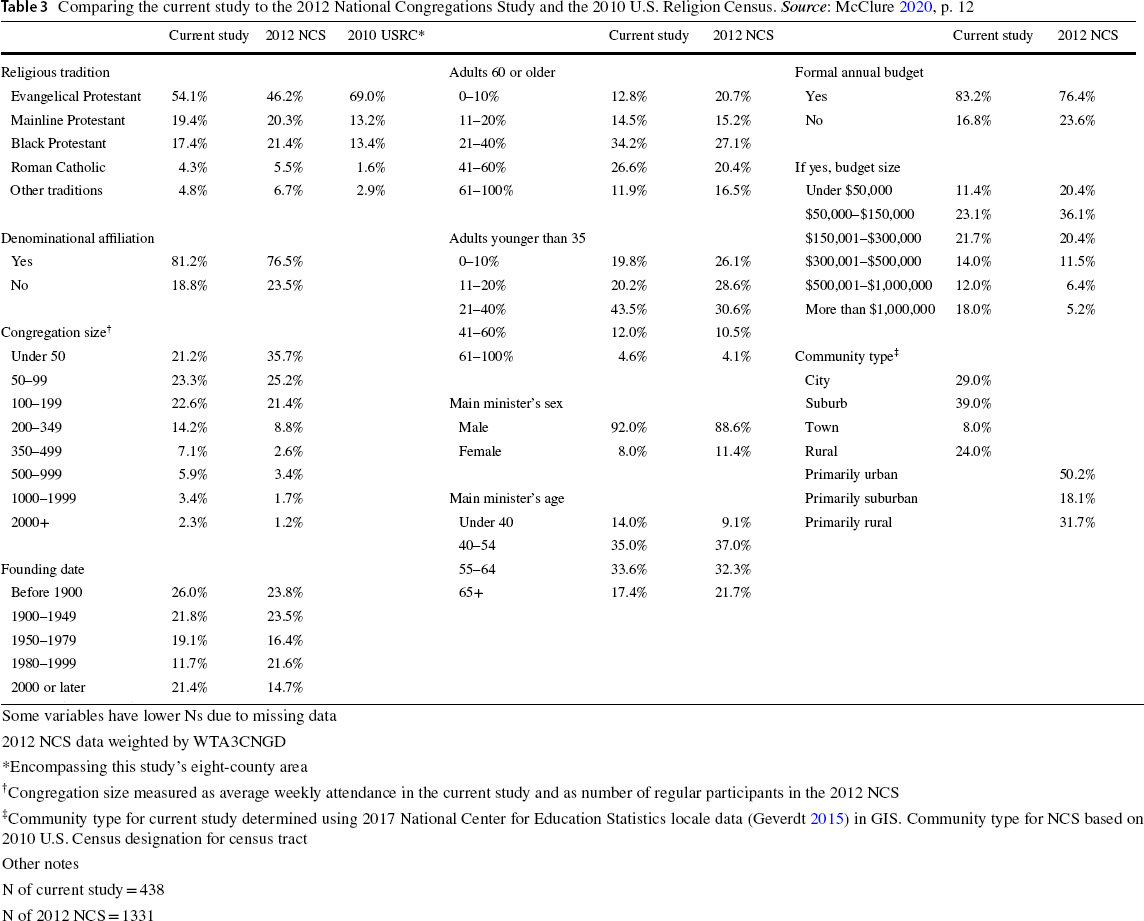
Current study
2012 NCS
2010 USRC*
Current study
2012 NCS
Current study
2012 NCS
Religious tradition
Adults 60 or older
Formal annual budget
Evangelical Protestant
54.1%
46.2%
69.0%
0–10%
12.8%
20.7%
Yes
83.2%
76.4%
Mainline Protestant
19.4%
20.3%
13.2%
11–20%
14.5%
15.2%
No
16.8%
23.6%
Black Protestant
17.4%
21.4%
13.4%
21–40%
34.2%
27.1%
Roman Catholic
4.3%
5.5%
1.6%
41–60%
26.6%
20.4%
If yes, budget size
Other traditions
4.8%
6.7%
2.9%
61–100%
11.9%
16.5%
Under $50,000
11.4%
20.4%
$50,000–$150,000
23.1%
36.1%
Denominational affiliation
Adults younger than 35
$150,001–$300,000
21.7%
20.4%
Yes
81.2%
76.5%
0–10%
19.8%
26.1%
$300,001–$500,000
14.0%
11.5%
No
18.8%
23.5%
11–20%
20.2%
28.6%
$500,001–$1,000,000
12.0%
6.4%
21–40%
43.5%
30.6%
More than $1,000,000
18.0%
5.2%
41–60%
12.0%
10.5%
Under 50
21.2%
35.7%
61–100%
4.6%
4.1%
50–99
23.3%
25.2%
City
29.0%
100–199
22.6%
21.4%
Main minister's sex
Suburb
39.0%
200–349
14.2%
8.8%
Male
92.0%
88.6%
Town
8.0%
350–499
7.1%
2.6%
Female
8.0%
11.4%
Rural
24.0%
500–999
5.9%
3.4%
Primarily urban
50.2%
1000–1999
3.4%
1.7%
Main minister's age
Primarily suburban
18.1%
2000+
2.3%
1.2%
Under 40
14.0%
9.1%
Primarily rural
31.7%
40–54
35.0%
37.0%
Founding date
55–64
33.6%
32.3%
Before 1900
26.0%
23.8%
65+
17.4%
21.7%
1900–1949
21.8%
23.5%
1950–1979
19.1%
16.4%
1980–1999
11.7%
21.6%
2000 or later
21.4%
14.7%
2
“This study's response rate is not an outlier vis-à-vis some other congregation-level data collections. This study's response rate is comparable to response rates for the two waves of the U.S. Congregational Life Survey; the first (2001) wave had a response rate of 35.7%, and the second (2008–2009) wave had a response rate of 14.7% (Woolever and Bruce 2010, p. 122). However, this study's response rate is much lower than the response rates for the four waves of the National Congregations Study, which range from 69 to 80% (Chaves et al. 1999, p. 462; Chaves and Anderson 2008, p. 419, 2014, p. 678–679; Chaves et al. 2020, p. 649)” (McClure  , p. 17).
3
4
Accuracy related to attenders’ demographics differs by: denominational affiliation with, for example, Roman Catholic priests having less accurate views and some Mainline Protestant ministers having more accurate views; work status of the minister, with full-time ministers having more accurate views on most demographic factors than part-time ministers; a variety of other factors, including average attendance, community type (urban or rural), and region of the country (Schwadel and Dougherty , pp. 372–374). There is not research on the types of key informants that give more or less accurate descriptions of their congregation's vitality and sustainability.
5
About 20% of the congregations reported ten alters. Some of them would have been happy to report more than ten, but congregations were limited to reporting ten to reduce the burden on the respondents, which can be greater in network studies due to the complexities of network-related questions (Borgatti et al. , p. 60–61).
6
In the numbers below, I am counting, for example, Congregation A mentioning a tie with Congregation B and Congregation B also mentioning a tie with Congregation A as two relationships. Of the 1,082 relationships depicted in Fig. 1, 965 (89%) involve friendships between ministers, 817 (76%) involve joint events, 646 (60%) involve ministerial groups, and 416 (38%) involve pulpit exchanges. Quadratic Assignment Procedure (QAP) correlations can be used to explore which pairs of relational types are more likely to co-occur (Prell :202). Here are the results, from most common to least common: friendships between ministers and joint events (QAP correlation = 0.821), friendships between ministers and ministerial groups (QAP correlation = 0.786), joint events and ministerial groups (QAP correlation = 0.732), friendships between ministers and pulpit exchanges (QAP correlation = 0.647), joint events and pulpit exchanges (QAP correlation = 0.603), and ministerial groups and pulpit exchanges (QAP correlation = 0.572).
7
“This study treats relational ties as undirected instead of directed, despite collecting directed data (Prell 2012:75), for one key reason. Participants were limited to ‘reporting at most ten alters in order to minimize respondent burden’ (McClure 2021a, p. 577), and some participants would have mentioned a greater number of alters if given the opportunity. Treating the data as undirected accounts for the chance that some unreciprocated ties might have actually been reciprocated if participants had been allowed to mention more than ten alters” (McClure 2021b, p. 17). Of the 1,082 relationships depicted in Fig. , 500 (46%) were only mentioned by one of the congregations. Of the 965 relationships involving friendships between ministers, 461 (48%) were only mentioned by one of the congregations. Of the 817 relationships involving joint events, 375 (46%) were only mentioned by one of the congregations. Of the 646 relationships involving ministerial groups, 336 (52%) were only mentioned by one of the congregations. Of the 416 relationships involving pulpit exchanges, 234 (56%) were only mentioned by one of the congregations.
8
9
“Calculating [network constraint] from a network including both participants (N = 438) and non-participants (N = 639) would, in most cases, result in … lower network constraint scores (average difference = − 0.20). When there are data missing not at random for nodes with many relational ties (e.g., a non-participating congregation mentioned frequently as an alter by participants), omitting these highly central non-participants when calculating the outcomes may bias the estimates (Smith et al. 2017:93). However, I prefer this approach to the following situation. Consider a triad [a group of three actors] where Congregation A participated and mentioned relational ties with Congregations B and C, both of which did not participate; this situation results in missing data about the relational tie between Congregations B and C. An approach measuring the outcomes from a network that includes both participants and non-participants would assume that the relational tie between Congregations B and C is missing, which suggests that Congregation A is bridging a structural hole. If Congregations B and C had provided data confirming a relational tie between them, however, the triad would be closed and would not involve a structural hole (Burt 1992:18; Coleman 1988:S105–S106). In a network including both participants and non-participants, missing relational data from non-participants would create too much uncertainty for” gauging the extent to which congregations span structural holes (McClure 2021b, p. 18). Although using a network that only includes participants to measure spanning structural holes results in some bias that inflates some congregations’ constraint scores, the risk of incorrectly measuring spanning structural holes is greater when using a network that includes both participants and non-participants. Congregations for whom a greater proportion of alters participated in the study have a smaller discrepancy in their constraint score when calculated from a network that only includes participants (N = 438) versus a network including both participants and non-participants (N = 1077); the correlation between the proportion of alters that participated in the study and the absolute difference in constraint scores is r = − 0.777 (p < 0.001; n = 400, which excludes alters, which lack participating alters). “The following characteristics correspond with congregations where, on average, at least 70% of their alters participated in the study (leading to more complete data on their similarity to or difference from alters [and their social capital]): Roman Catholic and other (not Protestant or Roman Catholic) traditions; Anglican, Latter-day Saint, and Roman Catholic families; multisite; average weekly attendance of 500 or more; budget of more than $1,000,000. The following characteristics correspond with congregations where, on average, about 55% or less of their alters participated in the study (leading to more incomplete data on their similarity to or difference from alters [and their social capital]): no denominational affiliation; Black Protestant tradition; Holiness, Pentecostal, and Restorationist families; African American racial composition; certificate or bachelor-level theological education; no budget” (McClure , p. 569).
10
“Black Protestant congregations include those from historically African American denominations, like the National Baptist Convention, USA, Inc. and the African Methodist Episcopal Church, as well as other congregations from the Methodist, Baptist, and nondenominational traditions where at least 80% of attenders are African American (Steensland et al. 2000:314)” (McClure , p. 12).
11
12
13
The median household income for each congregation's Census tract was ascertained through geolocating each congregation in GIS and matching each location with 2013–2017 American Community Survey data. This variable is positively skewed (skew = 1.22) and is transformed using a natural log.
14
The first supplemental analysis estimated the models predicting relational vitality, financial sustainability, and staff/volunteer sustainability with robust standard errors to examine if the heteroskedasticity of the models impacted the reported results. There were not substantive differences for relational vitality and staff/volunteer sustainability. However, in models using robust standard errors, there is an inverse curvilinear relationship between brokerage (measured through the additive inverse of network constraint) and financial sustainability (p = 0.036). Because permutation testing is important for addressing the relational interdependence in the data, I'm going to err on the side of concluding that inverse network constraint does not predict financial sustainability. The second supplemental analysis estimated the results using a measure of inverse network constraint that was calculated from a network that was only based on joint events and pulpit exchanges, in which there are more interactions between congregations (and not just their ministers). The results from this second supplemental analysis are substantively the same as what is presented in Table , except that average weekly attendance has a positive association with spiritual vitality (b = 0.43; p = 0.040). Results for both sensitivity analyses are not presented but are available upon request.
Springer Nature remains neutral with regard to jurisdictional claims in published maps and institutional affiliations.