







Abstract
Background
Human flourishing offers a more inclusive and comprehensive assessment of well-being beyond the absence of mental illness. Research on religion and well-being has generally focused on singular measure of mental or physical well-being and emphasized different stages rather than longer stretches of the life course. This study seeks to address these gaps.
Purpose
We focus on the interaction between transitions in religiosity and educational attainment in predicting flourishing in mid-life adults. By positioning the effects of transitions in religiosity across levels of education—a common axis of stratification for religious belief and behavior—we test the enhanced resource perspective that the better educated may benefit more from sustained or increased religiosity over the life course.
Methods
Data for this study come from MIDUS, a nationally representative sample of United States adults (N = 3030). We created a composite measure of flourishing across the psychological, social, and emotional domains and conducted a series of regression models.
Results
We observed that people with stable high religiosity between childhood and adulthood had the best flourishing profiles, suggesting that the association between religiosity and flourishing may begin to take shape in childhood. We found that both stable high or increases in religiosity between childhood and adulthood were found to be most beneficial for the flourishing scores of the college educated compared to those with less than a college degree. We found no support for the hypothesis that the less educated “substitute” religion as a compensatory mechanism for their deficiency in secular resources.
Conclusion and Implications
While flourishing has typically been excluded as an outcome of study in the burgeoning religion-health literature, the results of the current study suggest much could be learned from its inclusion. At the population level, studying flourishing—with attention to differences by educational and religious dimensions—might represent a more useful way to understand how people can achieve a state of happiness and come to realize more meaningful lives.
Introduction
Scholars have argued that mental health is too often conceptualized by the absence of indicators like depressive symptoms or mental disorders, which does not accurately capture the range of human well-being (Keyes 2007; VanderWeele 2017a). Rather, researchers have begun to acknowledge that positive indicators of well-being—happiness, life satisfaction, meaning and purpose, and close relationships—should also enter into the fold (Keyes and Simoes 2012). Indeed, while estimates suggest the majority of the United States population is free of mental disorder, only about one-fifth can be classified as flourishing (Keyes 2007). Human flourishing, a concept grounded in Aristotle's vision of eudaimonia as complete well-being, offers a more inclusive and comprehensive indication of well-being beyond the absence of mental illness. The foundation of flourishing is a “holistic state of optimism, drive, positive mood, thriving and engagement in the world brought about when basic human needs are nurtured” (Barwinski et al. 2018, p. 6). VanderWeele (2017a) offers a similar definition, where complete well-being or flourishing is conceived of as a state in which “all aspects of a person's life are good.” VanderWeele (2017a, b) expanded the definition of flourishing offered by Keyes (2002, 2007) to include not only commonly agreed upon domains of flourishing, such as life satisfaction, affect, meaning and purpose, and social relationships, but also fundamental pathways to flourishing that include, at a minimum, family, work, education, and religion/spirituality. It is the latter two domains that we argue contribute to this holistic state of well-being that represents the foundation of flourishing.
Scholars of education have argued that “the central purpose of education is to promote human flourishing” (Brighouse 2011, p. 3). Indeed, educational attainment predicts greater levels of flourishing because it affords access to greater human capital, more extensive social networks, and healthier lifestyles (Lee et al. 2021). Religiosity has also been associated with higher flourishing (Kent et al. 2021; Upenieks et al. 2021a, b). Some individuals may find useful tools to flourish through a religious community, the strength of their religious identity, or the set of beliefs that they hold. Longitudinal studies suggest that religious involvement is associated with a higher likelihood of receiving higher social support (Lim and Putnam 2010). Numerous studies have also indicated an association between religiosity and happiness and life satisfaction (Koenig et al. 2012; Hastings and Roeser 2020), as well as a greater sense of meaning and purpose in life (Krause and David Hayward 2012). There is also evidence that greater religiosity is associated with more generous charitable giving, volunteering, and civic engagement (Lim and MacGregor 2012). Therefore, elements of religiosity have been associated with the domains that comprise flourishing, but research on religiosity and flourishing over the life course is underdeveloped.
In this study, we take a life course approach to assess the association between religion, education, and flourishing in the United States. Research on religion and well-being has generally been marked by a focus on specific aspects of mental or physical well-being, and by an emphasis on different stages rather than longer stretches of the life course. We therefore focus on the combination of transitions in religiosity (how the importance of religion in one's life, hereafter termed religiosity, changes or remains constant from childhood to adulthood) and educational attainment in predicting flourishing in mid-life among a nationally representative sample of American adults. One of our focal research questions is: Does education moderate the ways that religious transitions over the life course shape flourishing? By testing the effects of transitions in religiosity across levels of education—a common axis of stratification for religious belief and behavior (Marx and Engels 1878/1964; Weber 1922/1963; McFarland et al. 2011; Schieman 2010)—we revisit and extend classic arguments about the efficacy of religiosity for well-being across different social classes. This echoes recent work on flourishing, which has illuminated the interrelatedness of social and institutional domains in promoting overall flourishing (Chen and VanderWeele 2018).
Background
The Importance of Flourishing in Studies of Well-Being
Scholars have become increasingly interested in the concept of flourishing (Diener et al. 2010; Huppert and So 2013; VanderWeele 2017a). Flourishing is defined as possessing high levels of both hedonic and eudaimonic well-being (Huppert 2009; Huppert and So 2013; Keyes 2002). Hedonic well-being comprises subjective or emotional well-being, which in turn is made up of happiness, life satisfaction, and a positive–negative affect balance (Diener 1984). Psychological and social well-being comprise eudaimonic well-being and include a wide variety of components such as meaning, engagement, purpose in life, positive relations, and personal growth (Keyes 2002; Ryff 1989).
In research on flourishing, mental well-being is typically examined on a dual continuum of mental health/illness and flourishing/languishing (Keyes 2002). Adults classified as flourishing do not simply experience an absence of depressive symptoms, but rather, experience a wide array of positive functioning which is superior to those classified as moderately healthy or languishing. Flourishers tend to have excellent mental and physical health and are found to be more resilient to vulnerabilities and challenges in life than non-flourishers (Bergsma et al. 2011; Huppert 2009; Lyubomirsky et al. 2005; Ryff and Singer 1998).
Past work by Keyes (2002) has found that flourishers tend to be older (between 45 and 64 years of age) and better educated than non-flourishers (see also Schotanus-Dijstrka et al. 2016). A host of studies have found that socio-demographics, such as female gender, high personal income, higher education, living with a partner, and paid employment associate favorably with subjective well-being (Diener et al. 1995; Deci and Ryan 2008) and psychological well-being (Ryff and Singer 2008). Higher educational attainment also shows a strong, positive relationship with social well-being, characterized by greater social integration, and feelings that one has contributed to the world, among other elements (Cicogani et al. 2008).
Yet despite the central focus of flourishing in positive psychology research (Huppert 2009; Seligman 2011), only a few studies have investigated the prevalence of flourishing in the general population and the characteristics of flourishers. Moreover, few studies have sought to integrate VanderWeele's (2017a) fundamental pathways of flourishing to examine the joint influence of any two pathways (e.g., see Chen et al. 2019 for an example of the intersection of family and religion). In what follows, we outline why explanatory insights might be revealed by assessing the complex interplay between two fundamental pathways of religiosity (measured in a life course approach, from childhood to adulthood) and educational attainment to predict mid-life flourishing scores of Americans.
Religiosity over the Life Course and Flourishing
There are reasons to expect religious experiences to enhance flourishing. Perceiving a personal relationship with a divine power engaged in human affairs is associated with enhanced feelings of intrinsic moral self-worth (Pargament 1997; Schieman et al. 2017). This could be essential for reducing the impact of stressors on flourishing for people experiencing stressful life events. Religious faith may also enhance well-being by offering a comprehensive framework for the interpretation of world events, which provides a sense of meaning amid the chaos and unpredictability of the world (Emmons et al. 1998). Some scholars also argue that religious attendance and belonging to a religious community exerts the strongest impacts on health and well-being (Ellison 1991; Krause 2006; VanderWeele 2017b). Religion can have this impact by socially integrating an individual into an entity larger than themselves, and by promoting a sense of connection to others who share similar worldviews and become reliable sources of social support (Lim and Putnam 2010).
While religiosity measured at any one particular point in time might be an important, and favorable, correlate of flourishing, recent studies have shown that consistent levels of religiosity over the life course are associated with the best outcomes. For instance, stable reports of high religious importance from childhood to adulthood and stable weekly attendance at religious services over the same period was associated with a lower mortality risk (Upenieks et al. 2021a, b), a lower likelihood of reporting chronic health conditions (Upenieks and Schafer 2020), a lower risk of depressive symptoms (Upenieks and Thomas 2021), and better cognitive health (Hill et al. 2020). Likewise, Hwang et al. (2022a, 2022b) find that later life well-being among a sample of Baby Boomers is influenced not only by childhood religiosity but also by stable high religiosity from childhood to adulthood. Some scholars have posited an accumulative mechanism, through which stable religiosity promotes the build-up of religious capital, which Iannaccone (1990, p. 299) defines as “familiarity with a religion's doctrines, rituals, traditions, and members that enhances the satisfaction one receives from participation in that religion.” In other words, stable high religious attendance in childhood and adulthood might exert additive influences on flourishing. Some research therefore suggests that the internalization of formal religious precepts and practices of religion becomes an investment that pays dividends for flourishing over time.
A focus on the evolution of religious capital necessarily implies understanding religiosity from a longitudinal perspective as a process of change and development (Hwang et al. 2022b; Upenieks 2021). Religious activities and understandings practiced over a lifetime might serve to both increase one's confidence in the truth of their religion as well as strengthening emotional ties to religion and one's religious community. We therefore see good reason to expect that the accumulation of religious capital, having strong religiosity through a significant part of the life course from childhood to adulthood, to be associated with higher flourishing. Religiosity might help believers make sense of life's certainties, become more socially connected, and promote optimism (Brown et al. 2004; Nooney and Woodrum 2002).
Research has drawn attention to the role of childhood and adolescence (7–20 years old) as crucial periods for the development of religious beliefs and practices (Hood et al. 2018). In early childhood, individuals are often introduced to religion by their primary caregivers (usually their parents) and become affiliated with a religious community (Myers 1996; Uecker et al. 2007). Religious socialization during childhood and adolescence appears to set the stage for the quality and content of religious beliefs and affiliation in adulthood (Tratner et al. 2020). Recent evidence has shown that children raised in households that place a high degree of importance on religion are likely to maintain religiosity as a primary source of identity in their lives in adulthood (Hwang et al. 2022a; Upenieks et al. 2021a, b; Upenieks and Schafer 2020). Another recent study by Upenieks et al. (2021a, b) found that childhood religiosity was associated with greater mid-life and later life flourishing, net of religiosity measured in adulthood.
Though parents may provide the foundation for children's religiosity by exposing them to religious groups and belief systems, these beliefs may be elaborated, strengthened, or diminished over time as people transition through the life course. As with any social behavior or source of identity, religiosity is not identical among parents and their children—especially as children become exposed to socialization from other sources and institutions. For instance, some scholars have observed the secularizing effects of higher education (Schwadel 2016; Uecker et al. 2007), which we describe below in our section outlining the intersection of religiosity and education. For now, we note that transitions in religiosity over the life course might matter for flourishing differently based on educational attainment.
Neither health nor life satisfaction is the primary goal of the world's major religious traditions. Religious doctrines outline a vision of a communion with God or some divine being as the primary goal of human life (e.g., Aquinas 1724/1948). According to VanderWeele (2017b, pp. 479–480), “[m]any religious communities teach that ultimate well-being extends beyond flourishing in this life and that these final ends of religion are to be given greater value…it is thus perhaps remarkable that participation in religious communities affects so many human flourishing outcomes in life, here and now, as well.” Integrating the life course component and informed by prior research, we propose the following hypotheses:
Hypothesis 1
Stable high religiosity from childhood to adulthood will be associated with the highest flourishing scores.
Life Course Religiosity: The Moderating Role of Education
Before describing our hypotheses related to education and religiosity, we discuss why education might be linked with flourishing on its own, as this might help articulate the different mechanisms through which religion enhances well-being. Education is a pivotal institution and source of socialization, often touted as a key to both individual and societal success. While education researchers note the ability of post-secondary education to shape engaged citizens, economists typically underscore the influence of education on earnings and prosperity (McMahon and Oketch 2013). It is likely that education has a multidimensional relationship with flourishing (Jongbloed 2018). For instance, many studies have documented a significant association between “satisfaction with life” and one's highest educational credential (Blanchflower and Oswald 2004; Dolan and White 2007; Salinas-Jiménez et al. 2013). Researchers argue that education affects well-being indirectly through enhanced occupational, financial, and social opportunities (Chen 2012; Helliwell et al. 2012). There is also some evidence that education changes an individual's subjective evaluation of their objective conditions and expectations (Huppert 2009), in the process promoting greater optimism.
Though life course religiosity might hold a direct, beneficial association with flourishing, it is possible that this relationship might be further contingent on core dimensions of stratification like educational attainment. Education is a well-established predictor of beliefs about the divine (Schieman 2010; Schieman and Jung 2012). Less educated individuals are more likely to believe in divine involvement in their life (Schieman 2010), regardless of whether they are actively practicing their religion (e.g., attending religious services or engaging in prayer) (Schieman and Bierman 2007). According to the tenets of the deprivation–compensation perspective, religiosity might matter more for the extent of flourishing among less educated Americans, as they might rely more heavily on religion in their daily lives to compensate for socio-economic disadvantages (Marx and Engels 1878/1964; Weber 1922/1963; Schieman 2011). For example, those with less material advantage have been found to benefit from stable religiosity in adulthood in terms of mental health, especially in the aftermath of stress (Upenieks and Schieman 2021; Upenieks et al. 2021a, b). The deprivation–compensation perspective, therefore, suggests that the less educated may rely on religion more to achieve flourishing because of their lack of alternative resources (Mirowsky and Ross 2003). However, recent research suggests that the college-educated tend to experience stronger benefits to well-being from maintaining high religiosity over the life course (Hwang et al. 2022a; Upenieks and Thomas 2021). This result would be consistent with the enhanced resources perspective, which argues that the well-educated should receive a stronger boost in flourishing from stable religiosity over time because they transform religious capital in ways that enhance their vast stock of resources.
Integrating this literature on education and flourishing, one approach suggests that religiosity over the life course might be more strongly associated with flourishing for those with less education. The tenets of the deprivation–compensation perspective are related to the idea of “resource substitution” (Mirowsky and Ross 2003), where the less educated “substitute” religion to compensate for their deficiency in secular resources (e.g., mastery, wealth). Krause (1995, p. 244) argues that individuals with less education may place a greater salience on religiosity in their lives because of “barriers to obtain self-validation elsewhere.” Recent studies have found support for this perspective. For instance, DeAngelis and Ellison (2018) found that higher levels of divine control (that God plays a causal role in human life) and religious attendance made the positive association between aspiration stress (the stress confronted when trying to achieve goals) and depression weaker, but only for Americans with less than a high school education. In another study, Upenieks et al. (2021a, b) found that the less educated were protected from the adverse effects of financial hardship if they increased their beliefs in divine control. A “substitution” process might be operating here, where the less educated substitute religion to compensate for their lack of secular resources.
However, if it is true that the less educated tend to be more reliant on religion in their daily lives, then any subsequent declines in religiosity could be more distressing and further undermine flourishing. At a general level, there is some evidence that religious apostasy or disaffiliation detracts from well-being (Fenelon and Danielsen 2016; Scheitle and Adamczyk 2010). The loss of social support might explain why this is the case, but it could also be that less educated individuals have more difficulty finding comparable resources in the secular world in instances when religiosity diminishes. It is also possible that the religious role is a more salient identity for them (Schieman 2008), one that could be especially protective in times of duress. Empirical studies have supported this claim: in the wake of the death of a loved one or personal illness (Upenieks and Schieman 2021) or financial hardship (Upenieks et al. 2021a, b), less educated Americans who experienced a decrease in personal religiosity reported higher depressive symptoms. Another study employing the life course perspective found that those without a college degree who decreased their religious involvement between adolescence and midlife were at an increased risk of depressive symptoms relative to their counterparts who had consistent and high religious involvement (Upenieks and Thomas 2021). Therefore, religiosity presents a double-edged sword for the less educated. On one hand, it is beneficial for flourishing if it remains stable and “accumulates” over the life course; on the other hand, it could be detrimental if it loses strength over time. According to the deprivation–compensation perspective, then, it is reasonable to expect that stable or increasing religiosity over the life course to be most beneficial for the flourishing scores of the less educated, with decreases in religiosity more detrimental.
Despite this case for why transitions in religiosity may matter more for the flourishing of the less educated, we argue that higher educated individuals may experience greater benefits to stable or increasing religiosity over the life course. These arguments form the basis of the enhanced resources perspective. Higher educated individuals typically possess other means outside of religiosity to attain self- or identity-validation and navigate the challenges of daily life (Mirowsky and Ross 2003). It is important to recognize that, though providing an additional source of socialization that generates critical thinking and offering alternative source of resilience, higher education does not predict the complete dismissal of religious beliefs or their integration in everyday life (Schieman 2011; Schieman and Jung 2012; Schwadel 2011). Individuals with more education might express more personal agency in how they weave religion into their daily decision-making processes (Schieman 2011). According to Schwadel (2011, p. 164), “highly educated Americans adhere to religious beliefs that do not overly conflict with the worldviews and strategies of action promoted through higher education.” The highly educated should presumably possess the cognitive skills and abilities needed to combine both religious and secular-based resources to achieve greater flourishing. If a college-educated individual chooses to make religion figure prominently in their lives, especially for a prolonged period of the life course, they may reap the dual benefits of high levels of education and a strong religious faith to promote higher flourishing scores.
Recent research has supported the tenets of the enhanced resources perspective over the deprivation–compensation perspective. For instance, recent findings from Upenieks and Schieman (2021) found that increasing beliefs in divine control (the belief that God is in control of daily life) after stress onset was associated with lower depressive symptoms for those with a college degree (see also Krause 2019). Another study by Upenieks and Thomas (2021) also found that increasing religious participation between childhood and adulthood bore a stronger association with depressive symptoms for the well-educated. The highly educated may be better equipped to use the skills and resources at their disposal in conjunction with their religiosity to achieve higher flourishing. Education is known to shape competence and cognitive abilities which may afford individuals the ability to extract from their religious experiences what they perceive would be beneficial to their lives. As each of these prior studies have also found, the well-educated who choose to decrease their religiosity over the life course are likewise spared from the negative impact on well-being compared to their less-educated counterparts because of the host of other secular resources and sources of identity they possess.
Taken together, this body of literature informing our arguments on the enhanced resource perspective lead us to propose the following three study hypotheses:
Hypothesis 2a
Stable high religiosity between childhood and adulthood will be more beneficial for the flourishing scores of the college educated compared to the less educated.
Hypothesis 2b
Increases in religiosity between childhood and adulthood will be more beneficial for the flourishing scores of the college educated compared to the less educated.
Hypothesis 2c
Decreases in religiosity between childhood and adulthood will be less detrimental for the flourishing scores of the college educated compared to the less educated.
Data and Methods
Sample
Data for this study come from the National Survey of Midlife Development in the United States (MIDUS). MIDUS is a nationally representative sample of non-institutionalized, English-speaking adults recruited through nationwide random digit dialing. The first wave (MIDUS 1) was conducted in 1995–1996 and consisted of 7108 respondents aged 25–74. Wave 2 was conducted both in 2004–2006 and Wave 3 in 2013–2014 with fairly high retention rates. For instance, over three-quarters of living participants responded to the Wave 3 survey. At the same time when the Wave 1 national sample was collected (N = 3032), the mean respondent age was 46 years with a range of 25–74. Of the initial respondents, 2257 (74%) participated in Wave 2 and 1414 people (47%) participated in Wave 3. All analyses employ the MIDUS sampling weights that represent the United States population and utilize data from Wave 1 of MIDUS, when a measure of childhood religiosity was included.
Dependent Variable: Composite Flourishing Score
Though many measures of flourishing have been proposed (Keyes 2002, 2007; Diener et al. 2010; Hupper and So 2013; Seligman 2011; VanderWeele 2017a, b), the measure available to us in the MIDUS data was developed by Keyes (2002). Taken together, the definitions of flourishing offered by Keyes (2002, 2007) and the pathways to flourishing (e.g., education, religion/spirituality) (VanderWeele 2017a, b) which formed the framework of our study, support the notion that flourishing measures are built on foundations of positive relationships, positive affect, and meaning and purpose in life (see Hone et al. 2014).
We use a procedure recently employed by Chen et al. (2019) to construct a composite index of flourishing, measured at Wave 1 of MIDUS based on the measure of flourishing created by Keyes (2002). We employ a continuous measure of flourishing in order to capture the full distribution of flourishing in the population. Past research has tended to rely on a binary indicator of flourishing based on being in the top tertile of the sample in flourishing (Keyes and Simoes 2012). Our main results were consistent with either measurement strategy. A full list of items comprising all scales can be found in Appendix 1: Online Supplementary Material.
Following the definition offered by Keyes (2002), flourishing was calculated across three subdomains of emotional, psychological, and social well-being that were measured at Wave 1 of MIDUS (Keyes 2002; Keyes and Simoes 2012). The first subdomain of the flourishing score was emotional well-being. Emotional well-being resides under the umbrella of hedonic well-being and refers to superiority of positive affect over negative affect, in accordance with overall satisfaction with life (Keyes 2007; Ryff 1989). The emotional well-being sub-scale consisted of (1) a six-item scale of positive affect (Crawford and Henry 2004) that was used to gauge positive feelings (e.g., full of life, happy, calm) over the past 30 days, and (2) a one-item measure of life satisfaction, which is a cognitive process that entails a person's perception of judgment of their quality of life as a whole (Diener 2006). We standardized both life satisfaction and positive affect because these scores were initially assessed with different scales. We then summed the standardized scores of these two measures to create a score of emotional well-being (α = 0.72).
The second subcomponent of the flourishing scale is psychological well-being, which employed the 18-item scale developed by Ryff (1989) that covers six domains. Ryff (1989) suggests a multidimensional model of psychological well-being, consisting of self-acceptance (a positive attitude towards the self and one's personality), personal growth (insight into one's potential to challenge and develop the self), purpose in life (an ability to form quality, trusting relationships with others), environmental mastery (the ability to choose, change, and manage one's environmental circumstances) and autonomy (independence and guidance of the self, according to internal values and standards) (Ryff and Keyes 1995; Ryff and Singer 2008) (α = 0.71).
Finally, the last subdomain of the flourishing scale was social well-being, which was assessed with a 15-item scale from Keyes (1998). Social well-being refers to people's positive functioning in society in such a way that individuals are seen as being of social value (Westerhof and Keyes 2010) and consists of five domains. These include (a) social acceptance (“I believe that people are kind”), (b) social contribution (“I have something valuable to give the world”), (c) social actualization (“The world is becoming a better place for everyone”), (d) social coherence (“I find it easy to predict what will happen in society”) and (e) social connection (“I feel close to people in my community”). We calculated an overall well-being score by summing the scores on all five subscales (α = 0.74).
Following the procedure outlined by Chen et al. (2019), we standardized scores on the emotional, psychological, and social well-being dimensions because they were measured on different scoring scales. We then summed the standardized emotional, psychological, and social well-being scores to create an overall flourishing scale. In our sample, the flourishing scale ranged from − 12.84 to 5.30. We considered the potential for skewness given the longer left-hand tail of this variable. However, less than 2% of cases fell outside of this range of 2 standard deviations from the mean. Therefore, following Chen et al. (2019), we treated the flourishing variable as normally distributed. We also note that results were also robust to an unstandardized measure of flourishing, calculated by taking the average score of the emotional, psychological, and social well-being score.
Focal Independent Variables
Life Course Religiosity
To assess childhood religiosity, respondents were asked, “How important was religion in your home when you were growing up?” Response options were: (1) “Very important” (high religiosity), (2) “Somewhat important” (moderate religiosity), and (3) “Not very important” and “Not at all important” (low religiosity); we combined these latter two groups into one category to obtain adequate cell sizes. We use “Low religiosity” as our reference category. A similar measure of religious importance in adulthood was also asked of respondents; we coded this variable according to the same three-category scheme the childhood measure. Using both childhood and adulthood measures, we then created a 5-category variable capturing all possible life course transitions in religiosity from childhood to adulthood. The first three categories capture stability in religiosity: stable low religiosity in childhood and adulthood (reference group), stable moderate religiosity, and stable high religiosity in both childhood and adulthood. The last two groups reflect changes in religious identity over the life span: a fourth group categorizes respondents who reported any decrease in religiosity between childhood and adulthood (e.g., from high to low), and a fifth group captures respondents who reported increasing levels of religiosity in adulthood than childhood.
Education
We use respondents’ highest level of achieved education to create a binary indicator contrasting those with a college degree (1) to those without a college degree (0) (see Upenieks and Schieman 2021; Upenieks and Thomas 2021 for a similar approach).
Covariates
Adulthood Covariates
Demographic covariates include the respondent's age (in years), gender (female = 1), and race ethnicity (White = 1, all else = 0). We also adjust for marital status (1 = married or in a marriage-like partnership, 0 = other). A measure of household income is also included, which adjusts for the number of adults 18 and over in the household. To adjust for the non-normality of the income variable, we categorized the household-size adjusted income into quintiles.
Childhood Covariates
Our analyses also adjust for childhood covariates. Parental education was considered for the household head (typically the father), with mother's education used if there was no measure of father's education available. Parental education may influence both the religiosity of children (Bader and Desmond 2006) as well as respondents’ future education level (Dubow et al. 2009). We also adjust for childhood urbanicity (0 for “rural” and “small town”, 1 for city, suburbs, or medium-sized town). A measure of parental divorce before the age of 16 (1 = yes, 0 = no) was also adjusted for, given the known long-term effects of divorce on well-being (Ross and Mirowsky 1999). A dummy variable also indicates whether the family was ever on welfare during the respondent's childhood (1 = yes, 0 = no), as economic hardship experienced during hardship is correlated with lower well-being over time (Hostinar and Miller 2019). Finally, we include a measure of the number of siblings a respondent had, following previous research by Chen et al. (2019) which has found this measure to be an important demographic correlate of mid-life flourishing.
Plan of Analyses
A series of ordinary least squares (OLS) regression models with robust standard errors were conducted. Multiple imputation with chained equations was used to handle missing data (Royston 2005) (m = 20). Our dependent variable—flourishing—was also included in the imputation procedure, but we excluded cases missing on it from the final analytic sample, leaving us with 3030 cases for analyses. We note that results were also consistent with using the listwise deletion method for handling missing data.
Results
Sample descriptive statistics, MIDUS study (N = 3030)
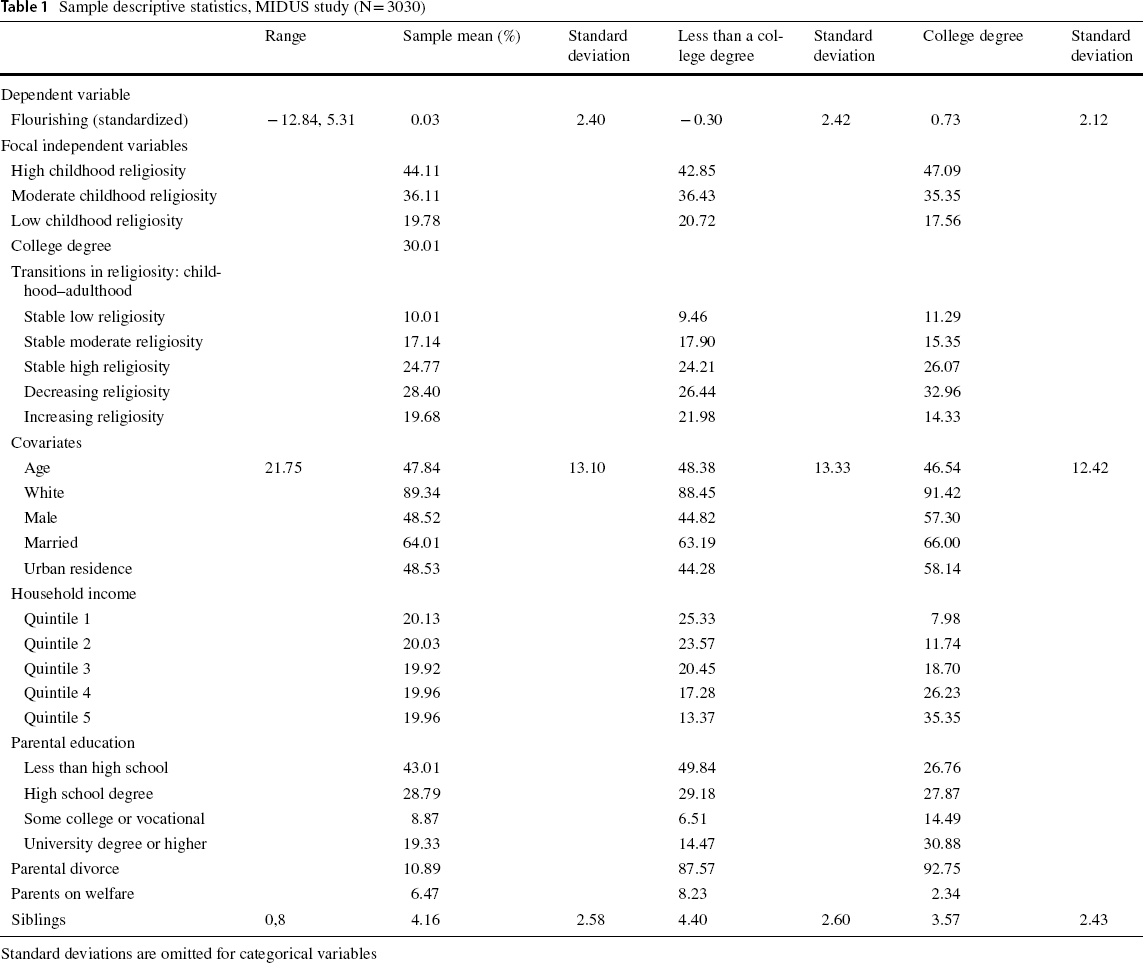
Standard deviations are omitted for categorical variables
Examining transitions in religiosity, the modal category was decreasing religiosity, as 28.40% of the sample reported religion being less important in adulthood than childhood. After that, the second most common category was stable high religiosity, representing roughly 25% of the sample. In addition, 10% of the sample reporting consistently low religiosity across time and 17.14% had moderate religiosity at both time points. Finally, almost 20% of the sample reported an increase in religiosity over time. Moreover, approximately 30% of MIDUS respondents have a college degree.
As for the bivariate association between transitions in religiosity and education shown in Table 1, those with a college degree are more likely to decrease their religiosity between childhood and adulthood than those without a college degree (32.96% versus 26.44%) and also less likely to increase their religiosity than their counterparts without a college degree (14.33% versus 21.98%, respectively). Results from a chi-square test show that those with a college degree are significantly more likely to be in the stable high religiosity (p < 0.05) and decreasing religiosity (p < 0.001) group and less likely to be in the stable low religiosity group (p < 0.05) than their less educated counterparts. Respondents without a college degree were more likely to increase their religious importance between childhood and adulthood (p < 0.001).
Multivariable Regression Results
Flourishing regressed on religious transitions and education, MIDUS sample (N = 3030)
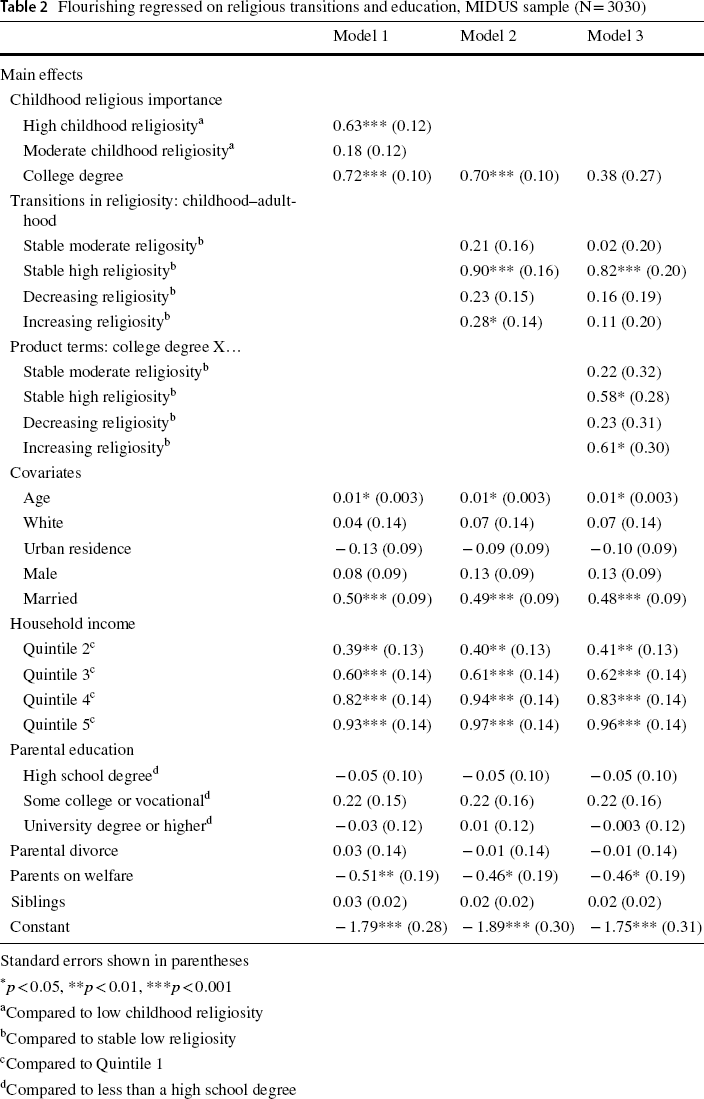
Standard errors shown in parentheses
*p < 0.05, **p < 0.01, ***p < 0.001
aCompared to low childhood religiosity
bCompared to stable low religiosity
cCompared to Quintile 1
dCompared to less than a high school degree
Model 2 of Table 2 serves as a test of Hypothesis 1, which assesses the association between transitions in religiosity between childhood and adulthood and flourishing scores in adulthood. As shown there, relative to stably low religiosity group, those with stable high religiosity had higher flourishing scores (b = 0.90, p < 0.001) as well as those who increased their religiosity over time (b = 0.28, p < 0.05). Since there were five categories of religious transitions that we examined, Fig. 1 shows the predicted flourishing scores across the five groups, with 95% confidence intervals shown. As shown there, respondents in the stably high religiosity group had, on average, flourishing scores of 0.65, which are 0.62 units above the sample mean (0.03) in flourishing. This is significantly higher than any other religious transition group. The increasing religiosity group had higher flourishing scores relative to the stable low religiosity (0.15 compared to − 0.25) but had flourishing scores that were on average 0.50 units lower compared to those with stable high religiosity. Therefore, based on the results shown in Model 2, we find support for Hypothesis 1: stable high religiosity from childhood to adulthood is associated with the highest flourishing scores relative to all other transition groups. Those with increasing religiosity had higher flourishing scores relative to the stable low religiosity group but fell short of the stable high religiosity group.
Transitions in religiosity between childhood and adulthood and flourishing scores.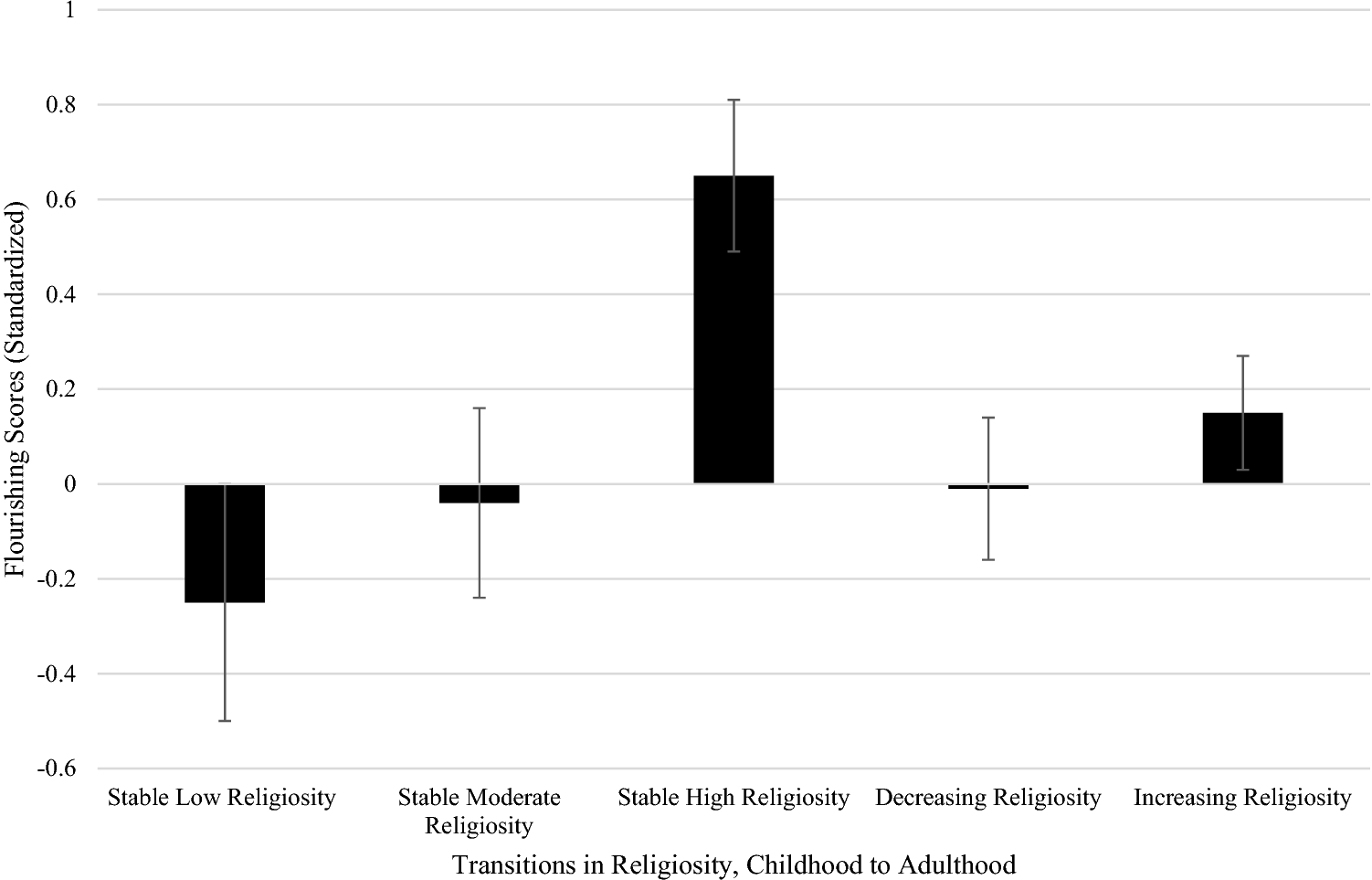
Model 3 presents results from an interaction term between transitions in religiosity and education (college degree). This serves as a test of Hypotheses 2a–c. We find evidence of two significant (positive) interaction terms: in the stable high religiosity group (b = 0.58, p < 0.05) and the increasing religiosity group (b = 0.61, p < 0.05). For ease of presentation, Fig. 2 plots the predicted flourishing scores for each of the five religious transition categories for those with (grey bars) and without (black bars) a college degree. Beginning with the third set of bars (stable high religiosity), the flourishing scores of the well-educated remain fairly high in this transition group (0.63) and are significantly lower among the less-educated (average = − 0.33). This represents a gap of 0.96 units on the standardized flourishing score between the less and well-educated increases in this group, meaning that the well-educated may benefit from holding stable high religiosity between childhood and adulthood.
Transitions in religiosity between childhood and adulthood and flourishing scores, by education level.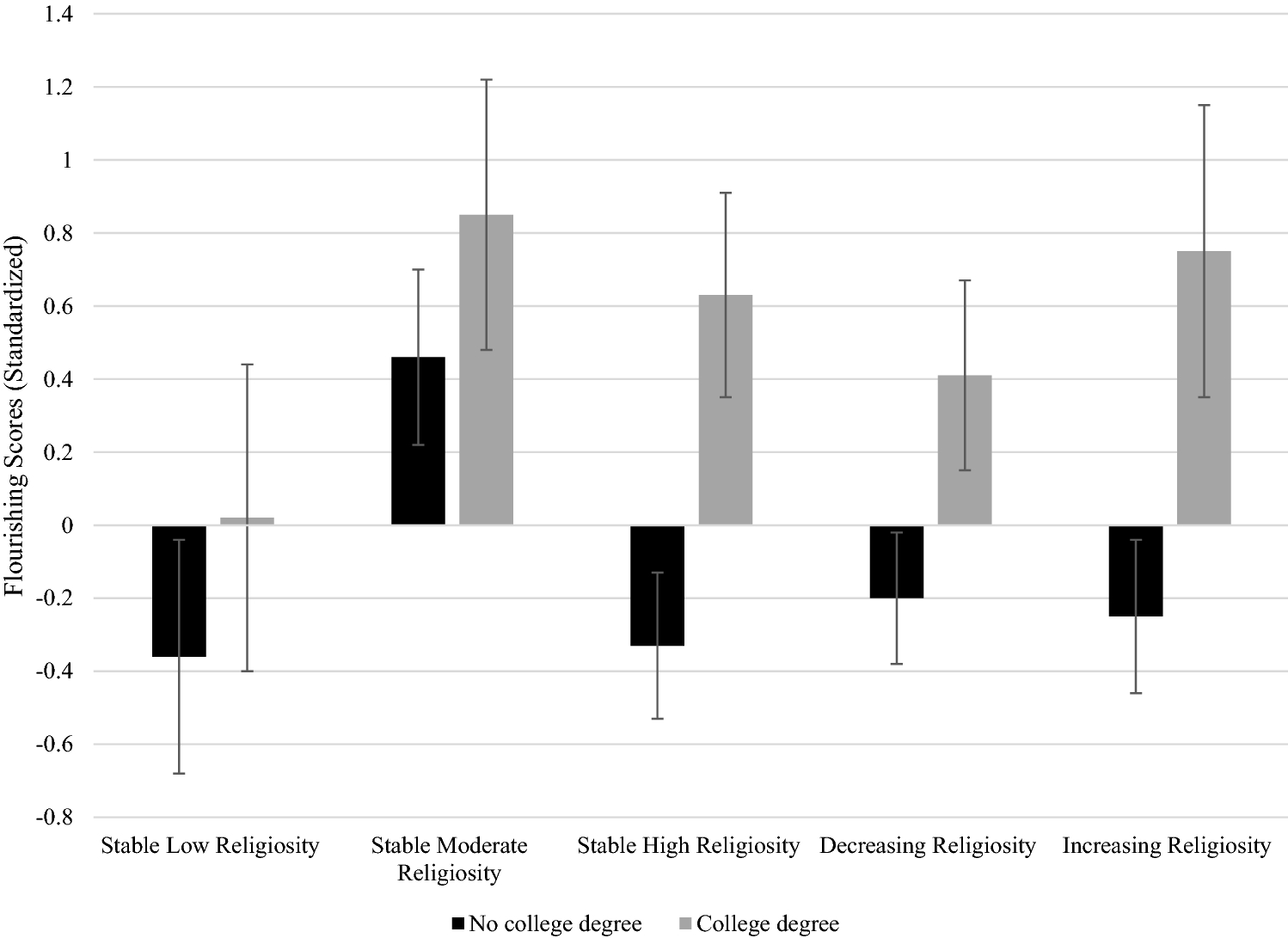
In addition, the last set of bars in Fig. 2 shows that the well-educated tend to benefit more from increasing in religiosity between childhood and adulthood. Indeed, the well-educated in this group have average flourishing scores of 0.75, compared to only − 0.25 for their less educated counterparts, representing a full 1.00 unit difference in standardized flourishing scores between these two groups who increased their religiosity. Taken together, results from Model 3 provide support for Hypotheses 2a and 2b: stable high and increases in religiosity between childhood and adulthood were found to be most beneficial for the flourishing scores of the college educated compared to the less educated. We return in the discussion section to interpret this finding, combining insights from the literature on positive psychology, religion, and stratification.
Discussion
Flourishing refers to the experience of life going well, the combination of feeling good and functioning effectively. For too long, mental health research has too exclusively been aimed at identifying the correlates of depression and anxiety, and to some extent, how to prevent mental health disparities. Flourishing, however, is synonymous with a high level of mental well-being, and epitomizes an optimal level of mental health (Huppert 2009; Keyes 2002), associated with positive emotions, enthusiasm for life, and productive contributions to the world (Keyes 2007). The objectives of this study were twofold. First, we sought to examine how religiosity, measured in a life course fashion, predicts levels of flourishing—an important goal because most prior research on religiosity and more holistic states of well-being have contained only singular aspects of well-being (Keyes 2002, 2007). Second, we sought to integrate two fundamental pathways that promote flourishing—religiosity and education (Chen and VanderWeele 2018; VanderWeele 2017a, 2017b)—and evaluate whether the associations between transitions in religiosity and flourishing are contingent on educational attainment; this is important because of prior evidence about the interplay between religiosity and education (Schwadel 2011, 2016; Schieman 2011).
To date, thousands of studies in the United States have linked specific facets of religiosity with higher levels of well-being (Koenig et al. 2012), whether via enhanced social support (Li et al. 2016), greater life satisfaction (Koenig et al. 2012), or an enhanced sense of meaning and purpose in life (Krause and David Hayward 2012). A first core finding of our study aligns with that tradition: people with stable high religiosity between childhood and adulthood had the best flourishing profiles. Ancillary analyses revealed that this association was not specific to one subdomain of flourishing (e.g., psychological, social, and emotional), suggesting that stable religiosity might serve as one type of foundation for well-being over the life course. Therefore, the association between religiosity and flourishing may begin to take shape in childhood, as we also observed in the current study by a significant positive association between high childhood importance and religiosity (see also Upenieks et al. 2021a, b). But this is also contingent on religiosity maintained into adulthood. By establishing this finding about the continuation of religiosity over time, we begin to describe a more complete portrait of how religion might predict well-being across the life course.
These findings also align with previous research which has demonstrated that stably high levels of religiosity from childhood to adulthood is optimal for singular dimensions of well-being relative to consistent non-involvement (Hill et al. 2020; Hwang et al. 2022a; Upenieks and Schafer 2020; Upenieks and Thomas 2021; Upenieks et al. 2021a, b). Holding consistently high religiosity might be beneficial to the extent that it bolsters self-esteem and self-efficacy (Schieman et al. 2017), provides greater access to social support within religious communities (Krause 2006; Li et al. 2016), or allows individuals to reframe stressful or trying circumstances as part of a broader divine plan (Pargament et al. 2000). An accumulation mechanism might also help to explain these findings, where religious investment pays a greater dividend over time. Indeed, the concept of religious capital proposed by Iannaccone (1990) suggests that religious activities and understandings—if made central in one's life—should enhance one's spiritual understanding of their faith, increase social connections within a religious community, and boost satisfaction from religious involvement.
Our second key finding leads us to suggest that the robust effects of transitions in religiosity on flourishing across midlife are likely also dependent on educational attainment. Overall, we found that those with a college education had higher flourishing scores than those without a degree, replicating the results of prior research (Lee et al. 2021; Schotanus-Dijkstra et al. 2016). Many studies have documented a beneficial relationship between educational credentials and life satisfaction (Blanchflower and Oswald 2004; Dolan and White 2007) and tend to show that education also affects well-being in an indirect fashion through enhanced financial, occupational, and social opportunities (Helliwell et al. 2012). But we were more interested in the interplay between life course religiosity and educational attainment. On that score, our results support the enhanced resources perspective, which proposed that those with a college education would benefit more from stable high or increases in religiosity over the life course. We observed that both stable high or increases in religious importance between childhood and adulthood were most beneficial for the flourishing scores of the college educated compared to the less educated. In other words, we found no support for the deprivation–compensation perspective, which predicted that the less educated would “substitute” religion as a compensatory mechanism for their deficiency in secular resources. We did not find evidence that the less educated experienced diminished flourishing scores from declines in religiosity relative to the well-educated. This latter finding is inconsistent with results by Upenieks and Thomas (2021), who observed that declines in formal religious attendance were more detrimental to the depression scores of the less educated. We suspect that the measure of religiosity used in that study (religious attendance) could be capturing a loss of communal dimensions of religiosity, which might be more consequential for the less educated than a subjective measure of religious importance (more in “Limitations” section). In addition, Upenieks and Thomas (2021) utilized a one-item measure of depressive symptoms, a less comprehensive measure than the flourishing index employed in the current study.
Instead, we observed that the benefits of stable high religiosity or increasing religiosity between childhood and adulthood for flourishing scores were stronger for respondents who possessed a college degree. It is worth noting that over one quarter (26%) of respondents with a college degree reported being stably highly religious over time, compared to 24% of those without a college degree, a descriptive difference that was statistically significant at the 0.05 α level (see Table 1 for a full distribution of religious transitions and educational attainment). This suggests that while at times educational attainment might correlate with lower levels of religiosity (e.g., because of exposure to diverse perspectives, emphasis on scientific evidence versus supernatural power), higher education is not predictive of a complete dismissal of religious/spiritual beliefs (see also Schwadel 2011; Schieman 2011). It is possible that the well-educated might have more agency in how they choose to integrate religiosity into their daily lives. Because of their higher cognitive skills and abilities, the well-educated might have more options at their disposal to integrate religiosity in with other important domains of flourishing identified by VanderWeele (2017a), including family and work. One might even surmise that if a well-educated person with a host of secular resources at their disposal chooses to maintain religious importance even after obtaining a college degree, they may experience the simultaneous benefits of both a high education and a strong religious faith.
Taken together, the findings of our study raise an additional point for further reflection. While flourishing has typically been excluded as an outcome of study in the burgeoning religion/health literature (see Kent et al. 2021; Upenieks et al. 2021a, b for exceptions), the results of the current study suggest that the breadth of outcomes that religiosity might positively affect could include this more comprehensive state of well-being. This begs the question of why flourishing has typically been excluded as an outcome in this body of work, which has focused on both objective and subjective mental and physical health outcomes, mortality, and biological indicators of allostatic load (see Hill et al. 2016; Hummer et al. 1999; Koenig et al. 2012; Page et al. 2020). Part of its exclusion might have to do with data availability, as many data sets that incorporate religion measures might not include scales to assess the three domains of flourishing. This makes the MIDUS data set unique in this regard, especially because it also contains religiosity measured at several points across the life course. Nevertheless, we would encourage future research to incorporate this more encompassing measure of well-being, if for the simple reason that high levels of flourishing are closely linked with other crucial indicators of health and physical functioning, such as improve immune function, cardiovascular recovery, lower health care costs, and an overall healthier lifestyle (Fredrickson and Losada 2005; Huppert and So 2013; Keyes 2007).
Limitations and Future Directions
There are several limitations of our current study which should be borne in mind. First and foremost, childhood religiosity is a retrospective measure in MIDUS, which have participants reflect on attitudes and behaviors from decades prior. This could result in the inaccurate recall of childhood religious preferences. For instance, an adult religious person could be more likely to recall religious experiences from childhood than a non-religious person because those memories may be more salient in light of their current beliefs. One prior study with the MIDUS twin sample suggests that the level of correspondence for childhood religiosity for twins raised in the same household was approximately 72%, which was similar to the level of correspondence for the recall of parental education (Upenieks et al. 2021a, b).
Second, it is important to acknowledge some of the characteristics of the MIDUS data. The MIDUS cohort that made up our analytic sample was primarily non-Hispanic white and raised in the first half of the twentieth century, when religion might have played a stronger role in socialization (Edgell et al. 2006). More recent cohorts of Americans tend to be less religious than prior generations, as beliefs in God, church attendance, and religious affiliation have all declined (Voas and Chaves 2016). Because MIDUS was based on a sample of midlife Americans, whether our findings are more generalizable to recent cohorts remains an open question.
Conclusion and Implications
Despite these limitations, ours is one of the first studies that examines how changes in religiosity over the life course relate to the multidimensional construct of flourishing, and how this relationship might differ by education, a crucial indicator of socioeconomic status. We would encourage future research to include more extensive measures of religiosity beyond the single-item measure of religious importance. This will help us achieve a more comprehensive understanding of when, and for whom, transitions in religiosity affect human flourishing. Future studies should seek to integrate other religious beliefs or practices, including beliefs in God's causal influence in daily life (divine control), attachment to God, private prayer, religious attendance, and measures of both positive religious coping and negative religious coping (e.g., doubt about one's faith or God's existence). However, even with these shortcomings, MIDUS is the only data set we are aware of that contains a comprehensive measure of flourishing as well as childhood and adulthood characteristics of religion.
It is also our hope that these distinctive findings will inform scholarly investigations of flourishing as well as social policy initiatives aimed at promoting this important element of the human experience. Adopting this more holistic approach will most assuredly require a deeper understanding of the social determinants of population-level flourishing, which can include favorable experiences across work, family, education, and religious domains (see VanderWeele 2017a, 2017b). At the population level, attention to flourishing might represent a more useful way to address inequalities in well-being. As Keyes (2007) argues, even if we could discover a cure for mental illness tomorrow, this would not equate with most people flourishing in life. Thus, rather than trying to “treat” our way out of mental illness, we must also seek to promote a life of balance where people can achieve a state of happiness and come to realize lives in which they can flourish. This study has shown that religious communities and educational attainment might be two ways of achieving such a state.
Footnotes
Springer Nature remains neutral with regard to jurisdictional claims in published maps and institutional affiliations.

Springer Nature or its licensor holds exclusive rights to this article under a publishing agreement with the author(s) or other rightsholder(s); author self-archiving of the accepted manuscript version of this article is solely governed by the terms of such publishing agreement and applicable law.