







Abstract
Background
When parents in the United States choose to send their children to religious schools or to home school, they are often motivated, at least in part, by a desire to transmit religious beliefs to their children. These religious beliefs may in some cases promote traditional gender roles that are built into religious tenets, practices, and subcultural identities.
Purpose
With this in mind, we examine whether religious schools act as distinct sites of religious gender socialization by considering the following questions: (1) do Americans who attend religious high schools and homeschools hold more conservative gender-role beliefs later in life compared to their public school peers? and (2) does attending a religious school have a differential effect on gender beliefs for men or women?
Methods
We use data from the Cardus Education Study—the largest nationally representative survey that includes religious high school and home school graduates as well as measures of religiosity—and logistic regression to explore the gender-role beliefs of 24–39 year olds who graduated from conservative Protestant, Catholic, public, and home schools.
Results
Graduates of the different religious school sectors we examined varied in their tendencies to hold more traditional gender-role beliefs. Specifically, we find that graduates of conservative Protestant schools and home schools held more conservative gender-role beliefs than graduates of other sectors. In contrast, Catholic school graduates—particularly female graduates—held more egalitarian beliefs compared to the other sectors.
Conclusions and Implications
In light of these findings, we discuss potential mechanisms within school environments that may contribute to the enactment of gender and religion. We extend empirical and theoretical knowledge about gender socialization, an area of critical importance given its ability to influence people's aspirations, choices, and life outcomes as well as social norms and policies.
Introduction
Many American parents see the transmission of religious beliefs as a core parenting responsibility (Smith and Adamcyk 2021; Smith et al. 2019). More religious parents have been found to choose religious schools for their children (Cohen-Zada and Sander 2008; Lockwood 2014; Lopez Arends 2021; Sander 2005) as a means to help them internalize religious beliefs and identity (Cohen-Zada 2006; Pennings et al. 2011; Rose 1988). Beliefs about gender and gender roles are often built into the religious tenets, practices, and subcultural identities of different religious groups (Avishai 2008; Darwin 2018; Gallagher 2003; Gallagher and Smith 1999; Griffith 1997; Schnabel 2016; Transby and Zulkowski 2012; Weaver-Swartz 2022). While variation exists, it is not surprising that across religious traditions, Americans who identify as more religious and who attend religious services more frequently tend to hold more conservative gender-role beliefs (Burn and Busso 2005; Davis and Greenstein 2009; Di 2020; Fan and Marini 2000). This raises several questions, including: (1) do Americans who attend religious high schools and home schools hold more conservative gender-role beliefs later in life compared to their public school peers? and (2) does attending a religious school have a differential association with gender beliefs for men or women? By investigating these questions, we consider whether or not religious schools act as distinct sites of religious gender socialization separate from the religious influence of their families.
These questions matter for several reasons. First, given that religious parents often choose religious schools to transmit their religious beliefs, it is important to know whether—after taking family religious characteristics into account—attending different religious schools is associated with conservative gender-role beliefs compared to attending a public school. Second, it matters as gender socialization can influence people's aspirations, choices, and life outcomes. For instance, taken-for-granted gender-role beliefs likely contributed to women shouldering a larger share of caregiving responsibilities during the recent Covid pandemic and their slower return to the workforce compared to men (Tucker 2022). Third, widely held gender-role beliefs can influence broad-scale cultural assumptions, laws, and funding allocations that perpetuate or alleviate gender-based inequalities. We can see this, for example, in widespread differences in employers’ assessments of mothers and fathers as employees (Correll et al. 2007) and in continuing differences in the status and pay for female-dominated fields and sports (Dworkin and Messner 2002; England 1992; Levanon et al. 2009). Fourth, few studies examine the long-term outcomes of attending religious schools. With increasing options for parental-choice funding in several states (EdChoice 2022), it is important to consider whether religious schools socialize students into more conservative gender-role beliefs, which has relevance for the public funding of religious schools and for parents as they choose a school for their children (Smith et al. 2014: 232). Finally, we include homeschool graduates in our analysis, thereby expanding knowledge about graduates of this school sector which has become larger and more mainstream in recent years.1
To answer our orienting questions, we analyze data from the 2014 U.S. Cardus Education Study (CES), the largest and most comprehensive nationally representative survey of people in the United States that includes information about the type of high school attended. Respondents (n = 1572) graduated high school between 1993 and 2008 and were between the ages of 24 and 39 at the time of study. CES includes rich information about respondents’ individual and family religious characteristics when they were in high school, making it particularly useful for our investigation. This additional information about graduates’ religious background allows us to move past more simplified analysis and to begin to separate the school's influence from that of the family.
Using these data, we consider religious schools as sites of overlapping religious and academic gender socialization and explore patterns in gender beliefs for religious and public school graduates. We find graduates of conservative Protestant (CP) high schools and home schools hold more traditional gender-role beliefs compared to graduates of public schools. In contrast, Catholic high school graduates hold more egalitarian beliefs compared to their public school counterparts. Through this investigation, we extend empirical knowledge of religious school graduates’ gender beliefs. We theorize about the relative role of religious schools and home schools as sites of gender socialization as well as the role religious high schools and home schools may play in shaping how men and women enact religion in gendered ways as adults (Avishai 2008; Avishai et al. 2015; Darwin 2018), thus demonstrating the need for further empirical investigation.
Background
Gender, as Ridgeway and Correll (2004) explain, is a socially constructed “system constituting people as two significantly different categories, men and women, and organizing social relations of inequality on the basis of that difference” (510). People's gender identities exist on a spectrum. However, both their identities and related gender expressions are situated within a broad, socially constructed “system” that filters the meaning they are given and “organiz[es] social relations of inequality” around the dominant man/woman binary. Given its socially constructed nature, gender is something people learn to perform through observation of the world around them (West and Zimmerman 1987). Gender socialization takes place within specific social relational contexts—such as churches, schools, and families—that can profoundly influence people's beliefs and behaviors (Bolzendahl and Myers 2004; Davis and Greenstein 2009; Lorber 1994). People's families of origin are one of the most influential sites of this gender-role-belief socialization (Davis and Greenstein 2009; Davis and Wills 2010; Eccles et al. 1990; Halpern and Perry-Jenkins 2016; Moen et al. 1997; Thornton et al. 1983; Witt 1997). However, religious and academic institutions are two other important settings that shape people's understandings of gender and gender roles (Davis 2007; Fan and Marini 2000; Guhin 2021; Molla 2016; Thorne 1993; Thornton et al. 1983).
The influence of religious traditions and institutions on gender-role attitudes has been widely demonstrated (Bryant 2009; Fan and Marini 2000; Gallagher 2003; Griffith 1997; Thornton et al. 1983; Weaver-Swartz 2022). As Bulanda (2011) highlights, “on average,” more conservative religious traditions and the “religious beliefs” they foster are “associated with more traditional gender-role attitudes” (181). Likewise, schools are important socialization settings that expose children and adolescents to gender-related stereotypes, as seen in studies that examine gender expectations in relation to the study of science and math (Adler et al. 1992; Copur-Gencturk et al. 2019; Correll 2001; Legewie and DiPrete 2014; Riegle-Crumb and Humphries 2012). Religious schools, including religious homeschools, function as both religious and academic institutions, and some scholars speculate that religious schools foster more traditional gender beliefs among their graduates compared to public schools (Dwyer 1988; Elsasser 2005; Peshkin 1986; Uecker and Hill 2014).
Gender-Role Beliefs
Gender-role beliefs are beliefs or assumptions people hold about the characteristics and behaviors appropriate to those identified with particular gender statuses. Past scholarship has primarily focused on gender-role beliefs associated with men and women. Given our data, we also limit our analysis to gender-role beliefs associated with men and women in this article. These beliefs range from more traditional to more egalitarian. Most commonly, people's gender-role beliefs are measured using their “levels of support for a division of paid work and family responsibilities that is based on belief in gendered separate spheres” (Davis and Greenstein 2009: 87) and levels of support for hierarchical differences in the innate authority men and women hold in marriage or other social institutions.
As noted above, these beliefs matter. Dominant beliefs about gender, including gender roles, are a critical mechanism in the reproduction of the gender system (Lorber 1994; Ridgeway and Correll 2004). At a more granular level, they also significantly influence people's viewpoints and behaviors. Gender beliefs can shape people's educational aspirations and choices (Rideway and Correll 2004; Davis and Pearce 2007; Dicke et al. 2019; Ridgeway and Correll 2004; Riegle-Crumb and Humphries 2012; Uecker and Pearce 2017) as well as their views and behaviors regarding employment (Bielby and Bielby 1992; Corrigall and Konrad 2007; Dicke et al. 2019; Eccles 1987, 1994; Stone 2007) and labor within the home (Davis and Greenstein 2009; Ellison and Bartkowski 2002). In addition, they influence other aspects of people's lives including relationship quality, marital happiness (Amato and Booth 1995; Wilcox 2004), and parenting (Chaffee and Plante 2022; Kuo et al. 2018; Moen et al. 1997; Thornton et al. 1983).
Sites of Gender-Role-Belief Socialization
How are gender-role beliefs formed? Socialization within influential social-relational contexts plays a critical role, and many researchers offer exposure-based explanations, suggesting gender-role beliefs can be shaped through “exposure” to “ideas and situations” (Bolzendahl and Myers 2004: 761; Davis 2007). According to Bolzendahl and Myers (2004), “exposure-based explanations” are one of the two primary ways sociological scholars account for people's gender-role beliefs. “Interest-based explanations” make up the other. However, as Davis (2007) argues, people's perceptions of their interests are also shaped by their exposure to different ideas and experiences. Given this, central institutions in which people are involved are critical in shaping gender-role beliefs. The families people grow up in are one of the most influential sites of gender-related socialization (Chafee and Plante 2022; Davis and Greenstein 2009; Davis and Wills 2010; Eccles et al. 1990; Endendijk and Portengen 2022; Moen et al. 1997; Thornton et al. 1983; Witt 1997).
Along with the family, past scholarship has found that religious communities and institutions can profoundly shape people's gender-role beliefs (Bulanda 2011; Davidman 1990; Gallagher 2003; Griffith 1997; Schnabel 2016; Weaver-Swartz 2022). The connection between religious-service attendance in Christian churches and more traditional gender-role beliefs illustrates this. Fan and Marini (2000) note: Regardless of the type of religious affiliation, those who attend religious services more often or who attach greater importance to religion have been found to have less egalitarian gender-role attitudes than those who attend religious services less or who attach less importance to religion (263).
High schools are also important contexts in which cultural beliefs about gender influence students’ behavior and self-evaluations. Teachers often hold gendered assumptions that affect their interactions with students, including their expectations and assessments (Dersche et al. 2022; Lindner et al. 2022; Riegle-Crumb and Humphries 2012; Sadker and Sadker 1994; Thorne 1993). Because of this, schools are key spaces in which students learn to enact, understand, and internalize gender roles and related beliefs (Connell 1996; Thorne 1993; Valls 2022). Religious schools are distinctive in that they combine religious and academic influences. This raises the question of whether they play unique roles in shaping religious gender-role-belief socialization.
Conservative Protestant, Catholic, and Home Schools
Differences exist between CP and Catholic schools, but as private institutions sponsored by faith communities and churches, both include religious classes and integrate religious values into other courses (Nuzzi et al. 2012; Uecker and Hill 2014). Research suggests that parents choose religious schools for both religious and academic reasons (Cohen-Zada and Sander 2008; Lockwood 2014; Lopez Arends 2021; Pelz and den Dulk 2017; Sander 2005) and parents who attended religious schools are more likely to send their own children to a religious school (Sikkink and Schwarz 2018).
Similarly, the majority of homeschool families are religious (Kunzman 2009, 2010; Kunzman and Gaither 2020; Stevens 2001) and religious or moral development is a motivating factor in many homeschooling parents’ decisions to homeschool. According to a report from the National Center for Educational Statistics, “religious or moral instruction” was a motivator for 83% of parents choosing to homeschool in 2007 (NCES 2008: 2; Uecker and Hill 2014: 193, referencing Planty et al. 2009). Likewise, in 2015–2016, 51.3% of homeschool parents homeschooled because of “[a] desire to provide religious instruction” and 66.9% did so because of “[a] desire to provide moral instruction” (Wang et al. 2019: 70). Although homeschool families are becoming more diverse, a majority continue to be religious conservatives, falling within the categories of fundamentalist or evangelical Christians (Kunzman 2009, 2010; Ray 2012).
Research on CP schools suggests these environments exist on a continuum (Carper 2012), ranging from tightly controlled total institutions (Peshkin 1986) to schools marked by varying levels of engagement with the world (Rose 1988) and with secular culture (Blosser 2019; Wagner 1990). CP schools are co-educational and often teach boys and girls together in the same classrooms with the same curriculum. Some use standardized Christian curriculum packages that incorporate teachings related to traditional gender roles (Carper 2012; Reese 1985; Rose 1988).
Catholic schools make up the largest system of private schools in the U.S., with Catholic schools incorporating religious instruction, ritual, and tradition within a Catholic environment and the academic structure of the school day (Bryk et al. 1993; Nuzzi et al. 2012). Although Catholic high schools were once primarily single-sex institutions, today the majority educate boys and girls together (Bryk et al. 1993). They also offer a more focused college preparatory curriculum, with fewer leveled and less rigid tracks compared to public schools (Bryk et al. 1993; Ellison and Hallinan 2004; Gamoran 1992). Catholic schools also educate a growing number of non-Catholic students as well as an increasing number of students who use state-funded scholarships and vouchers to cover the cost of tuition (Smith and Huber 2022).
Religious Schooling and Gender-Role Beliefs
Despite offering similar curriculum and instruction to both genders, aspects of the religious worldviews of conservative Protestantism and Catholicism place different emphasis on gender roles (Bulanda 2011), potentially contributing to their salience within CP and Catholic schools. Conservative Protestantism espouses traditional gender roles focused on men and women's roles within the nuclear family (Bulanda 2011; Gallagher 2003; Wilcox 2004). Patriarchal ideas of male headship place men at the head of the household with responsibility for both the family's spiritual and financial well-being. Women, in turn, are responsible for nurturing home and family, while supporting and submitting to their husbands (Gallagher 2003). These ideas are interpreted and enacted in a multitude of ways (Gallagher and Smith 1999; Stacey 1990; Weaver-Swartz 2022), but their continued prevalence suggests gender is still highly salient within this culture.
The Roman Catholic Church operates as a hierarchy in which men serve as the primary religious leaders. Only men can be ordained priests and fulfill many of the faith's sacred duties. Although women are now able to assist in the Mass as altar servers, lectors, and Eucharistic ministers, women's roles in the liturgy are still limited. The Catholic Church holds the vocation of motherhood in high esteem, reinforcing the importance of family life through teachings on birth control and abortion and defining distinct gender roles for both men and women within the faith (Bulanda 2011, referencing Christiano 2000). Some have argued that the Catholic Church's teachings regarding the distinct and complementary roles of men and women can be viewed as a form of benevolent sexism, which justifies the differences in roles and status through positive messaging (Glick et al. 2002). The distinction that the Catholic Church makes between the sexes has become more evident as one recent Church writing—authored by the papal organization that oversees Catholic schools and universities—affirms the inherent worth and dignity of individuals but resists acknowledgement of a possible disconnect between biological sex and gender (Congregation for Catholic Education 2019). The clear distinctions between the sexes and the fact that women are limited in their leadership positions in the Church may send implicit messages about gender roles that students may internalize.
Education in a homeschool environment may also enhance support for traditional gender-role attitudes connected to religious beliefs. As noted above, a majority of U.S. homeschool parents are religious conservatives. Homeschooling extends socialization within these family environments, while reducing students’ time in outside educational settings. In addition, religious homeschool families are usually networked within larger homeschool communities (Kunzman and Gaither 2020; Murphy 2014. Thus—similar to other forms of alternative religious education—homeschooling often provides students with exposure to a larger community that reinforces values and cultural schemas espoused by their families (Stevens 2001). Finally, given their roles as both parents and teachers, homeschooling amplifies the influence of homeschool parents’ gender-role practices, which are typically divided between a male breadwinner and a female homemaker-educator (Kunzman 2009; Kunzman and Gaither 2020; Lois 2017; Stevens 2001).
As a mother's work status influences her children's later beliefs about whether or not mothers should work (Endendijk and Portengen 2022; Herzog and Bachman 1982; Hoffman 1974; Starrels 1992), homeschooling may strengthen support for the belief that mothers should stay home with their children. Some research finds homeschooling and homeschool communities foster cultural schemas that provide mothers who want to stay home with their children justification for doing so (Stevens 2001, also Gaither 2009; Kunzman and Gaither 2020; Lois 2017). Homeschool students may internalize these cultural schemas.
Given their dual characteristics as religious and academic social relational contexts, religious schools may bring gender norms related to both religious belief and academics to bear on student identity, thereby affecting their evaluations of self in relation to gender. To the extent religious schools highlight differences between genders, they may further differentiate the attitudes and behaviors of women and men. On the one hand, we might expect education in religious schools and home schools to be associated with more traditional gender-role beliefs and behaviors compared to education in public high schools. Supporting this, a small number of case studies—most several decades old—have shown particular religious schools to encourage more traditional gender-role beliefs (Elsasser 2005; Mather 2018; Peshkin 1986; Rose 1988). On the other hand, the distinct religious ideologies orienting Protestant and Catholic schools, likely cause divergence in their emphases on differentiated gender roles (Dwyer 1988).
Along with this, religious school sectors vary in their focus on religious education (Baker et al. 1996; Baker and Riordan 1998; Sikkink 2012; Uecker 2008; Uecker and Hill 2014). Research suggests that fostering religious worldviews is a primary focus of most CP schools; Catholic schools, however, place a stronger emphasis on academics (Baker et al. 1996; Bryk et al. 1993) in the context of a distinctly Catholic school culture (Convey 2012; Ozar et al. 2019). Thus, Catholic schools may have “less overt and less severe” emphasis on hierarchically defined gender differences than CP schools (Dwyer 1998: 26).
Corner (2012) found evidence of this in her analysis of a teacher survey gathered as part of the Cardus Education Study. In this survey, American CP and Catholic high school teachers were asked how much they favored or opposed three statements that expressed aspects of conservative gender-role beliefs in their conversations with students.2 American CP high school teachers were more likely to say they favored each of these statements and less likely to oppose them than their Catholic school counterparts. This contrast was sharpest in response to the statement that “the husband is responsible for the spiritual direction of the family” (Corner 2012: 17–18).
In addition, market forces have pushed many conservative Protestant schools to become more ecumenical in their identities and instruction to attract a broader range of student enrollment (Carper 2012; Wagner 1990). Consequently, these schools may be less likely to support potentially controversial ideas about differentiated gender roles. In sum, to the extent religious high school environments highlight gender differences, we expect gender will become more salient within these environments and influence adult attitudes along traditional gender lines.
Methods
We analyzed data from the 2014 U.S. Cardus Education Study Graduate Survey (n = 1572), a nationally representative cross-sectional survey of U.S. high school graduates ages 24–39 with an oversample of graduates of religious high schools and home schools. GfK Group, a well-regarded data-collection firm formerly known as Knowledge Networks, collected these data in the spring of 2014. GfK Group randomly recruits respondents to participate in client-designed surveys using probability-based sampling techniques of random-digit dialing and address-based sampling. Respondents graduated from high school between 1993 and 2008 and provided information on a range of adult outcomes, including postsecondary education, occupation, religiosity, civic and political participation, social ties, and experiences in high school. They also provided detailed information about their religious backgrounds, including multiple measures of their families’ affiliation and level of religiosity, when they were in high school. We restrict our analysis to respondents who attended a public, Catholic, conservative Protestant (CP), secular private, or home school and who do not have missing information for the outcomes of interest, resulting in an analytic sample of 1532 high school graduates. We include home school as a distinct religious sector as families choosing to homeschool during this period were primarily motivated by religious reasons. We also include secular private schools as a reference point as some have argued that Catholic high schools are more like private schools than religious schools (Baker and Riordan 1998). Complete data were available for 79% of cases, and missing data were imputed, creating 20 model iterations.
Models and Outcomes
We investigated respondents’ adult levels of support for more traditional gender-role beliefs. To measure support, we analyzed two separate outcomes. The first was based on responses to the male “breadwinner” statement: “It is better if the man earns the main living and the woman takes care of the home and family.” The second was based on responses to the male “headship” statement: “If a husband and wife disagree about something important, the wife should give in to her husband.” Responses to these statements were originally measured on a seven-point Likert scale ranging from strongly disagree to strongly agree. After exploring ordered logistic regression, these outcome categories were reduced to two for analysis—agree and do not agree—as we were most interested in the probability of agreement overall rather than differing degrees of positive responses.
We estimated logistic regression models for both outcomes and included the same set of controls for each in a series of nested regressions. In the first model, we included only our indicators of interest: gender and school sector. The subsequent models included a set of individual, family, and religious community controls to better isolate the relationship between the outcomes and school sector. The final model included an interaction between gender and school sector.
As with any school sector analysis, selection into a type of school is a non-random event and there are both observable and unobservable differences between those who choose one type of schooling over another. The Cardus data provide a robust set of religious controls which enable us to control for the religiosity of the family but limited information on respondents’ socioeconomic status during high school, which factors into a family's ability to pay tuition at a religious school. Thus, we caution that our findings should be interpreted as descriptive associations rather than causal estimates.
Indicators of Interest
We focus on gender and the type of high school respondents primarily attended in high school as the main independent variables. Respondents provided self-reports of gender (male or female) and the type of high school attended. We grouped responses into the following five school-type categories: public, Catholic, CP, secular private, and homeschool. Based on our research questions and hypotheses, our analysis focused on students attending public, CP, and Catholic high schools along with students who were homeschooled, but we include estimates for secular private schools as an additional reference point. We included an interaction term between gender and school sector to determine whether attending a religious high school or home school resulted in a differential association with the outcomes by gender.
Controls
Individual Characteristics
We included controls for race/ethnicity, age, and postsecondary education level. These attributes have been found to influence gender-role beliefs (Akotia and Anum 2012; Eagly et al. 2019; Kane 2000). We also included a control for years spent in the high school of primary attendance. Using the high school religiosity measures, we created a retrospective scale of personal religiosity in high school (Cronbach's alpha = 0.79). The scale is a combined measure of how important faith was to the respondent during high school, how often faith was discussed at home during high school, and how often the respondent attended religious services during the high school years. Religiosity is a factor in selection into a religious school as more religious families choose to send their children to religious schools (Cohen-Zada and Sander 2008; Sander 2005) or to homeschool them (Kunzman 2010; NCES 2008; Stevens 2001; Wang et al. 2019) and the CES dataset allowed us to account for this.
Family Background
Children's exposure to parents’ gender beliefs and behaviors has been widely recognized to influence their own gender beliefs and behaviors (Davis and Greenstein 2009; Davis and Wills 2010; Eccles et al. 1990; Moen et al. 1997; Thornton et al. 1983; Witt 1997). We included parental marital status as a way to control for those who grew up in a traditional family structure. We also included mother's education level3 and whether or not the respondent's mother was a religious conservative. These factors help isolate the association with the school apart from the association with the family. In our analysis, we focused on characteristics related to mothers as their behaviors and attitudes have been found to influence the gender-role attitudes of children (Fan and Marini 2000; Thornton et al. 1983).4
Religious Community Involvement
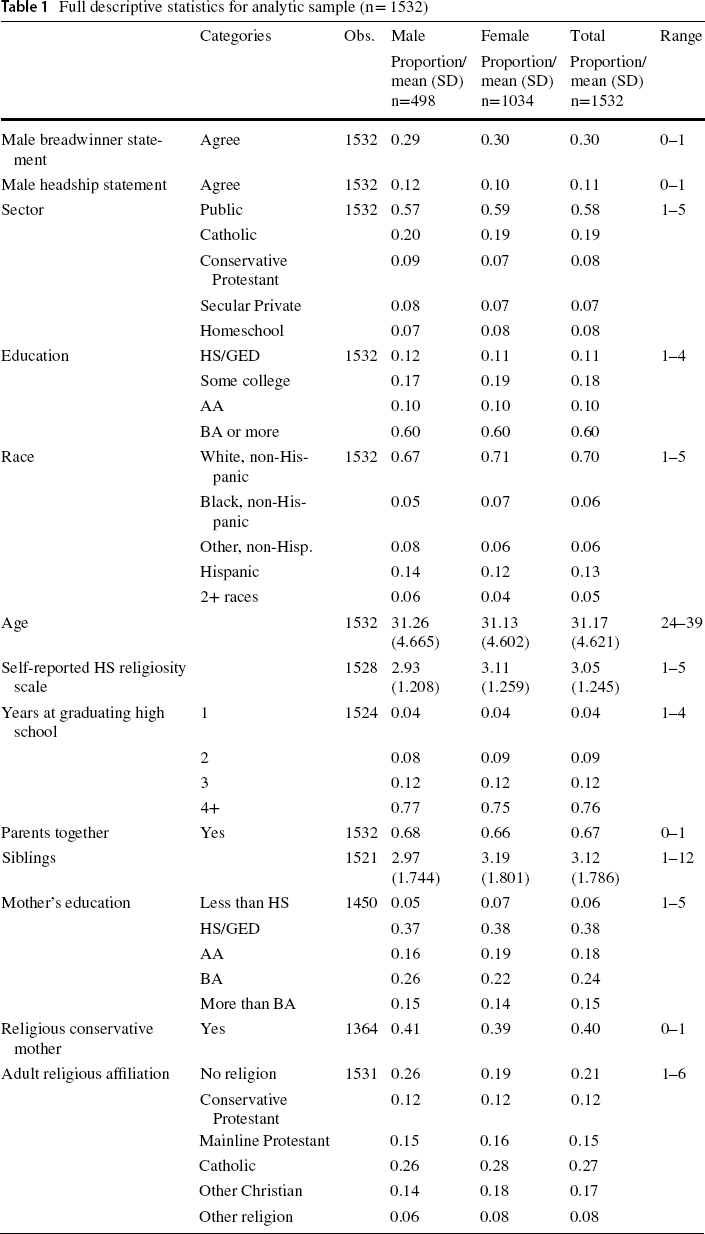
Full descriptive statistics for analytic sample (n = 1532)
Analysis
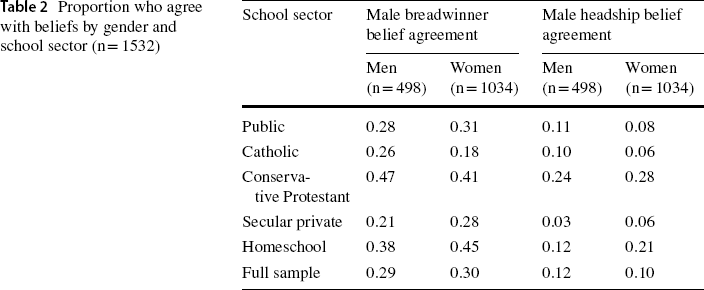
Proportion who agree with beliefs by gender and school sector (n = 1532)
Comparison of average marginal effects across models
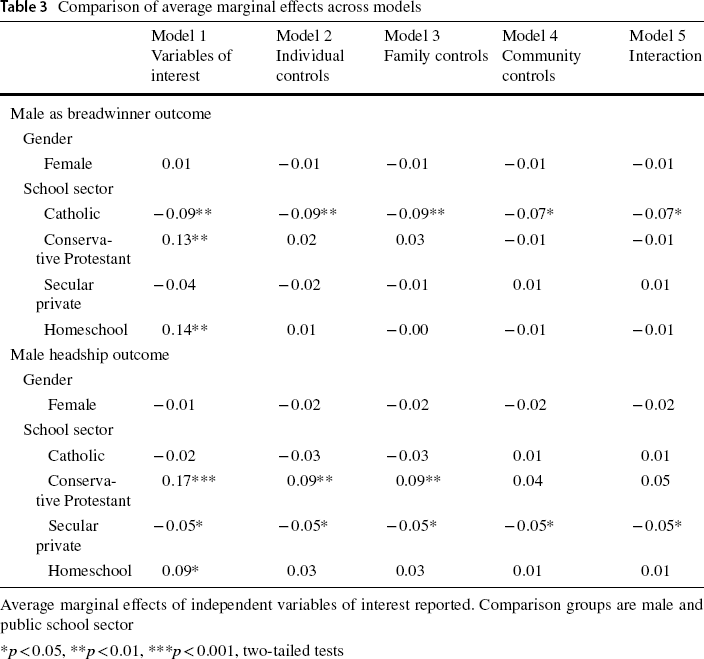
Average marginal effects of independent variables of interest reported. Comparison groups are male and public school sector
*p < 0.05, **p < 0.01, ***p < 0.001, two-tailed tests
Gender x Sector interaction: Probability of agreement with male as breadwinner belief
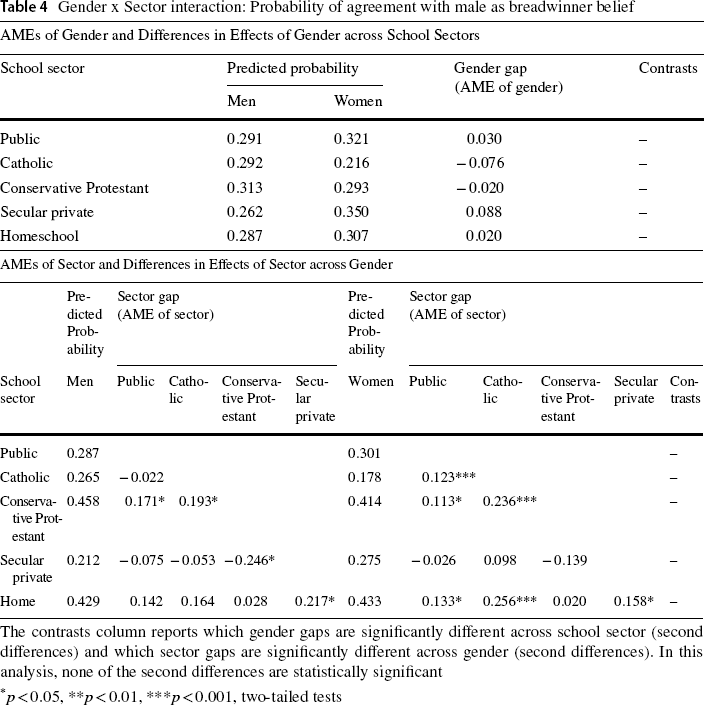
The contrasts column reports which gender gaps are significantly different across school sector (second differences) and which sector gaps are significantly different across gender (second differences). In this analysis, none of the second differences are statistically significant
*p < 0.05, **p < 0.01, ***p < 0.001, two-tailed tests
Gender x Sector interaction: Predicted probability of agreement with male headship belief
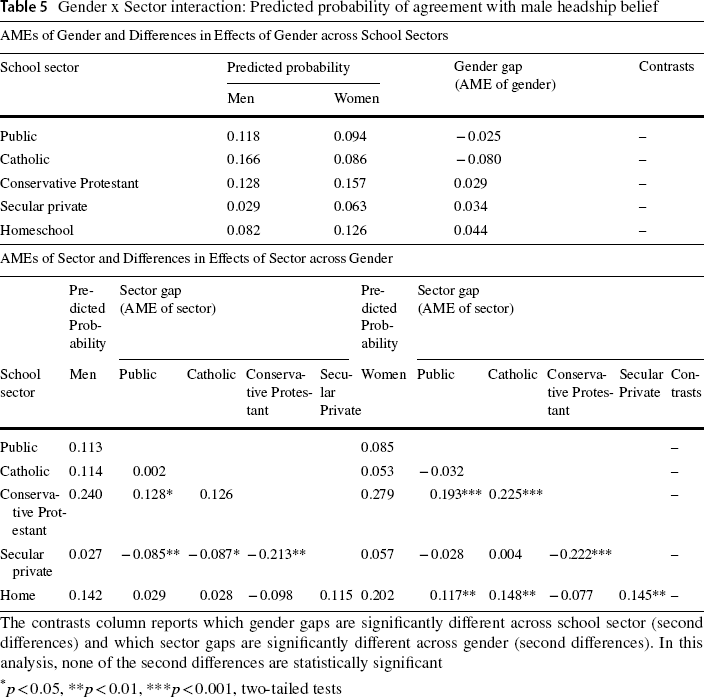
The contrasts column reports which gender gaps are significantly different across school sector (second differences) and which sector gaps are significantly different across gender (second differences). In this analysis, none of the second differences are statistically significant
*p < 0.05, **p < 0.01, ***p < 0.001, two-tailed tests
Results
Descriptive Statistics
Summary statistics suggest that similar proportions of men and women in the sample (roughly 0.30) agreed with the breadwinner statement. A smaller proportion of women than men, however, agreed with the headship statement (0.10 and 0.12 respectively). When we look within school sector (see Table 2), we found that women who attended Catholic high schools have the lowest proportion of agreement with the breadwinner statement (0.18) and the headship statement (0.06). Women who were homeschooled agreed with the breadwinner statement in the highest proportion (0.45) and women who attended conservative Protestant schools agreed with the headship statement in the highest proportion (0.28).
Inferential Statistics
Male as Breadwinner Role Belief
Results from the series of nested logistic regressions demonstrate that as additional controls at the individual, family, and religious community levels as well as an interaction between gender and sector are added to the model, Catholic school graduates are the only ones less likely than public school graduates to agree with the breadwinner statement (− 0.07, p < 0.05; see Table 3). When we examined the gender gap of the interaction model, we found that men and women within each sector were similarly likely to agree with the male as breadwinner statement as the differences in the average marginal effects (AMEs) of gender were small and not statistically significant (see Table 4). This means that within each school sector, men and women held similar levels of agreement with the statement.
When we examined the other side of the interaction and compared differences in predicted probabilities by high school sector separately for each gender (see Table 4), we found some differences for men as well as differences for women. Male graduates of CP schools were more likely to agree with the breadwinner statement when compared to public (0.171, p < 0.05), Catholic (0.193, p < 0.05), and secular private (0.246, p < 0.05) school male graduates. Male homeschool graduates were also more likely to agree with the breadwinner statement compared to secular private school graduates (0.217, p < 0.05). Male graduates of public, Catholic, and secular private schools, however, had a similar probability of agreement with the statement.
Among the female graduates, those who attended Catholic high schools had a lower probability of agreement with the breadwinner statement when compared to women who graduated from public (− 0.123, p < 0.001), CP (− 236, p < 0.001) and home schools (− 0.256, p < 0.001), but had a similar probability of agreement with women who graduated from secular private schools. Female homeschool graduates had a higher probability of agreement when compared to women who graduated from the other sector schools with the exception of CP school graduates (public: 0.133, p < 0.05, Catholic: 0.256, p < 0.001, secular private: 0.158, p < 0.05). Female graduates of CP schools also had a higher probability of agreement with the statement compared to public school women (0.113, p < 0.05).
When we tested the second differences between the AMEs of gender across sector and the AMEs of sector by gender, none of the second differences between were statistically significant. This means that although there are differences in the probability of agreement with the male breadwinner statement by gender and sector, there is not a differential association related to attending different sector schools for men or women.
Male Headship Belief
Logistic regression results for the male headship statement produced slightly different results. When we examine the AMEs for the series of nested logistic regressions, we find that CP high school graduates are the only ones more likely to agree with the male headship belief compared to public school graduates, but this effect is no longer present once controls for religious affiliation are included in the model (see Table 3). When we examined differences in the gender gap in each sector (see Table 5), we found that men and women within each school sector were similarly likely to agree with the headship statement.
When we examined differences in predicted probabilities by high school sector separately for men and women (see Table 5), we found that men who graduated from CP schools were more likely to agree with male headship compared to men who graduated from public schools (0.128, p < 0.05) and that there were no significant differences between males graduates of Catholic and public schools or Catholic and CP schools. Male graduates of secular private schools were less likely to agree with headship compared to male graduates in public (− 0.085, p < 0.01), CP (− 0.213, p < 0.01), and Catholic (− 0.087, p < 0.05) schools.
Females who attended Catholic high schools were less likely to agree with the male headship question compared to female graduates of CP (− 0.225, p < 0.001) and homeschools (− 0.148, p < 0.01). Females attending a CP high school, however, had a higher probability of agreement compared to women who attended public (0.193, p < 0.001), Catholic (0.225, p < 0.001) and secular private high schools (0.222, p < 0.001). Females attending a home school had a higher probability of agreement with the headship statement compared to women who attended public (0.117, p < 0.01), Catholic high schools (0.148, p < 0.01), and secular private schools (0.145, p < 0.01). Women who attended CP high schools and home schools were similarly likely to agree with the statement. Graduates of public, Catholic and secular private schools also were similarly likely to agree with the statement.
When we tested the second differences between the AMEs of gender across sector and the AMEs of sector by gender, none of the second differences between different sector schools were statistically significant. This means that although there are differences in the probability of agreement with the male headship statement by gender and sector, there is not a differential association for either men or women.
Discussion
What do these patterns tell us about the role of religious schools as sites of gender-role-belief socialization? Graduates of the religious school sectors we examined—especially female graduates—varied by sector in their tendencies to hold more traditional gender-role beliefs. These differences remained after accounting for several measures of graduates’ family religious background, including religiosity while in high school, but decrease slightly or disappear once current religious affiliation is added to the models. When we further examine the interaction between gender and sector by subgroups in these nonlinear models, while there are no within school sector effects, differences do exist when men are compared with men in other school sectors and similarly for women. Thus, our analyses suggest that differences in traditional gender-role beliefs do exist between graduates of different school sectors. Based on this, we theorize that these distinct school environments differ in how they socialize students with regard to gender-role expectations.
We suggest three possible mechanisms through which school sectors may socialize students to “do religion”—or perform religion—in particular gendered ways (Avishai 2008; Avishai et al. 2015; Darwin 2018; Schnabel 2018; Weaver-Swartz 2022), all of which should be investigated in future research. These mechanisms include the extent to which traditional gender beliefs are an important tenet within the associated religious tradition, the emphasis within the school sector on academic preparation for college and career, and the modeling of gender roles and support for institutionalized education fostered by the school sector's institutional structure.
Gender Beliefs as a Tenet of Religious Tradition
Religious school sectors appear to reinforce the traditional gender-role beliefs upheld by the religious tradition with which they are associated and the degree of salience the tradition places on them. This reinforcement may be direct—through explicit support of these beliefs—or indirect—by strengthening students’ embeddedness in their religious communities or shielding them from other environments in which they could be exposed to differing beliefs or behaviors.
Our analysis of CP and Catholic school graduates, for instance, illustrates this. Dynamics within Catholic schools do not encourage their graduates to hold more traditional gender-role beliefs later in life than public school graduates. The lack of connection between Catholic education and more traditional gender-role beliefs aligns with the lower level of emphasis American Catholicism, like mainline Protestantism, places on beliefs such as symbolic headship as a source of subcultural identity (Bulanda 2011; Gallagher 2003; Gallagher and Smith 1999; Smith et al. 1998; Wilcox 2004). The Catholic school graduates’ more egalitarian gender-role beliefs indicate that Catholic schools are not settings in which students are internalizing more traditional gender-role beliefs relative to public schools. Rather, they are associated with more egalitarian gender-role beliefs, especially for women. This may reflect cultural changes as Catholics have moved into mainstream society over the last several decades (McNamara 1992; Vaidyanathan 2011), now achieve higher education (Lehrer 1999) and income levels (McNamara 1992) at levels similar to mainline Protestants, and are delaying family formation in line with mainstream social norms (Pearce and Davis 2016).
In contrast, education in CP schools is associated with higher levels of support for traditional gender-role beliefs, particularly belief in male headship, compared to education in either public or Catholic schools. When we examine interactions and compare across sectors, the differences we find remain for female CP graduates for both outcomes and for male graduates in the breadwinner analysis and to a more limited extent in the headship analysis. Thus, in contrast to Catholic and public schools, it is likely that CP high schools provide support for the internalization of more traditional gender-role beliefs.
Emphasis on Academic Expectations
The more egalitarian attitudes that female Catholic school graduates hold may be related to academic expectations within Catholic high schools. Bryk et al. (1993) theorized that the Catholic school effect was directly related to the relationship between teachers and students in Catholic schools, who share the religious ideals that all students are equal and made in the image and likeness of God and thus should be held to similar standards with high expectations. Greeley (1982) found that Catholic schools were most successful at educating students who were disadvantaged by race and class, further suggesting a uniformity of expectation for all students that likely extends to gender. Bryk et al. (1993) also pointed to the limited curriculum in Catholic high schools that focuses on a core set of academic subjects in a college preparatory environment with less rigid tracking of students (Gamoran 1992). Rather than offer a remedial track, Catholic schools expect all students to perform at grade level and provide support to assist students in meeting these expectations in preparation for post-secondary education (Bryk et al. 1993; Ellison and Hallinan 2004). The focus on academic success and these common standards for all students may contribute to female Catholic school graduates’ expectation of a career outside of the home and of marriage as a shared partnership. Priorities within CP schools place religious education ahead of academics (Sikkink 2012; Uecker 2008; Uecker and Hill 2014) and thus seem to foster gender beliefs that are more in line with conservative Protestantism, particularly the belief in male headship, and that may not encourage women to consider careers outside of the family.
Differences in the Structure of Schooling
We find being homeschooled to be strongly correlated with more traditional gender-role beliefs for women compared to women in the other school sectors. These outcomes suggest a third mechanism is likely at work: whether and how the school's structure models and provides cognitive support for traditional gender roles. Unlike the other school sectors we examine, the distinct characteristics of homeschooling in the U.S. appear to support a particular gendered way of thinking and behaving that is encouraged by both homeschool students’ families and religious communities. These characteristics include day-to-day reinforcement of distinct gender roles within the family (Kunzman 2009; Stevens 2001), community narratives and cultural schema that support the importance of mothers as home-educators (Gaither 2009; Stevens 2001), and a rejection of traditional educational institutions in favor of more independent knowledge and skill acquisition. Additional research should further explore this potential mechanism, and data on current homeschool cohorts should be considered as homeschool families are becoming more diverse over time.
Limitations
Given the retrospective, cross-sectional nature of our data, we cannot fully disentangle family background influences from school influences. We acknowledge that the associational relationships we report may be influenced to some extent by selection. More devout religious families may be more likely to choose religious schools and to encourage their children to internalize more traditional gender-role beliefs (Fan and Marini 2000; Thornton et al. 1983) and more affluent parents may choose religious schools as a private schooling option. Thus, the relationship between religious schooling and gender beliefs we present should be considered descriptive rather than causal. Nevertheless, our analysis shows distinct differences in gender-role beliefs associated with graduates of the different types of religious schooling environments after controlling for several measures of respondents’ high school religiosity, family religious background, and current religious affiliation. This provides a measure of confidence that we are accounting for levels of past and present family religiosity to the extent possible using the data available. In addition, our sample had a greater proportion of women than men, which is a common occurrence in similar surveys as women are more likely to participate in online surveys compared to men (Becker 2022; Smith 2008, also see Green 1996). With a smaller proportion of men in the sample, it is possible that our results for men have been estimated with less precision than for women. Future research should investigate this question using additional data.
Conclusion and Implications
Our research provides additional evidence that religious and educational institutions are key sites of gender-related socialization. Previous scholarship has argued that religious schools may encourage more conservative gender-role beliefs and behaviors (e.g., Dwyer 1988; Uecker and Hill 2014). Yet, the limited number of studies conducted in this area are qualitative, case-based projects that are now several decades old. In an attempt to offer more empirical analysis, we draw on nationally representative data uniquely suited to these questions, with information on the types of high schools attended and extensive information on individual and family religious characteristics during high school, as well as self-reported beliefs and behaviors, that can be gendered in nature. This allows us to describe previously undocumented patterns about the relationship between education in different religious school sectors and later-in-life gender-role beliefs and behavior.
The finding that men and women hold similar beliefs within each religious sector suggests that men and women, within each sector, are receiving similar and consistent messaging about gender roles. However, the differences in beliefs that women hold when compared to women in other sectors suggests that messages about women's roles and careers do vary. For conservative Protestant parents seeking to share their faith and worldview with their children, our findings suggest that CP schools do assist in helping children internalize CP gender-role beliefs. For Catholic parents seeking a strong academic education in a cultural Catholic context, our findings suggest that Catholic schools foster academic success for all students and in doing so, encourage women to consider themselves equal to men in their pursuit of career and family to a greater extent than public schools. For families choosing to homeschool, the likely combination of CP gender-role beliefs and example of mother as educator in the home also seems to be successful in transmitting family values and beliefs. For parents seeking education in a religious school environment, these findings are important to take into account and highlight the need to consider whether the religious beliefs and mission of the specific sector and school align with their own personal beliefs and expectations for their children.
Together, our findings extend recent sociological scholarship that seeks to explore the interconnectedness of religion and gender. Like gender (West and Zimmerman 1987), religion is performed, and it can be performed in gendered ways (Avishai 2008; Avishai et al. 2015; Bulanda 2011; Darwin 2018; Weaver-Swartz 2022). Expanding knowledge in this area is critical because, as Avishai et al. (2015) argue, “gender and religion” are “mutually constitutive social categories” (8). From our analysis, we find evidence of patterns in the ways male and female graduates of different types of religious schools—in comparison to graduates of public schools—learn to think about and perform gender roles. The differing ways these religious school graduates “do gender” (West and Zimmerman 1987) mirrors differences in the religious high school environments in which they were educated.
Religious school environments are important spaces of religious and academic socialization. Our analysis provides a useful baseline illustrating empirical differences in how graduates of some religious school sectors engage more traditional gender-role beliefs compared to public school graduates and how, if at all, these behaviors are tied to gendered-ways they “do religion” (Avishai et al. 2015). Further investigation should attempt to examine the causal impact these schools may have on their students, and perhaps more qualitatively, explore the potential mechanisms through which we argue gender and religious socialization may occur. Future work should also consider whether or not education in these schools encourage traditional gender-role behaviors, such as differences in college selection and major (see Uecker and Pearce 2017), choices regarding whether or not to join the labor market after college, and differences in the types of careers pursued.
Footnotes
Acknowledgements
We would like to thank Christian Smith, David Sikkink, Karen Hooge Michalka, and Abigail Jorgensen for their comments on earlier versions of this paper. We would also like to thank Cardus and the University of Notre Dame's Center for the Study of Religion and Society for access to data used in this paper. An earlier version of this paper was presented at the American Sociological Association's 2021 meeting.
Funding
Funding was provided by the Global Religion Research Initiative.
Appendix 1
See Table 6.
Logistic regression models for agreement with male breadwinner statement Table reports odds ratios from multiple imputation estimates. Standard errors in parentheses *p < 0.05, **p < 0.01, ***p < 0.001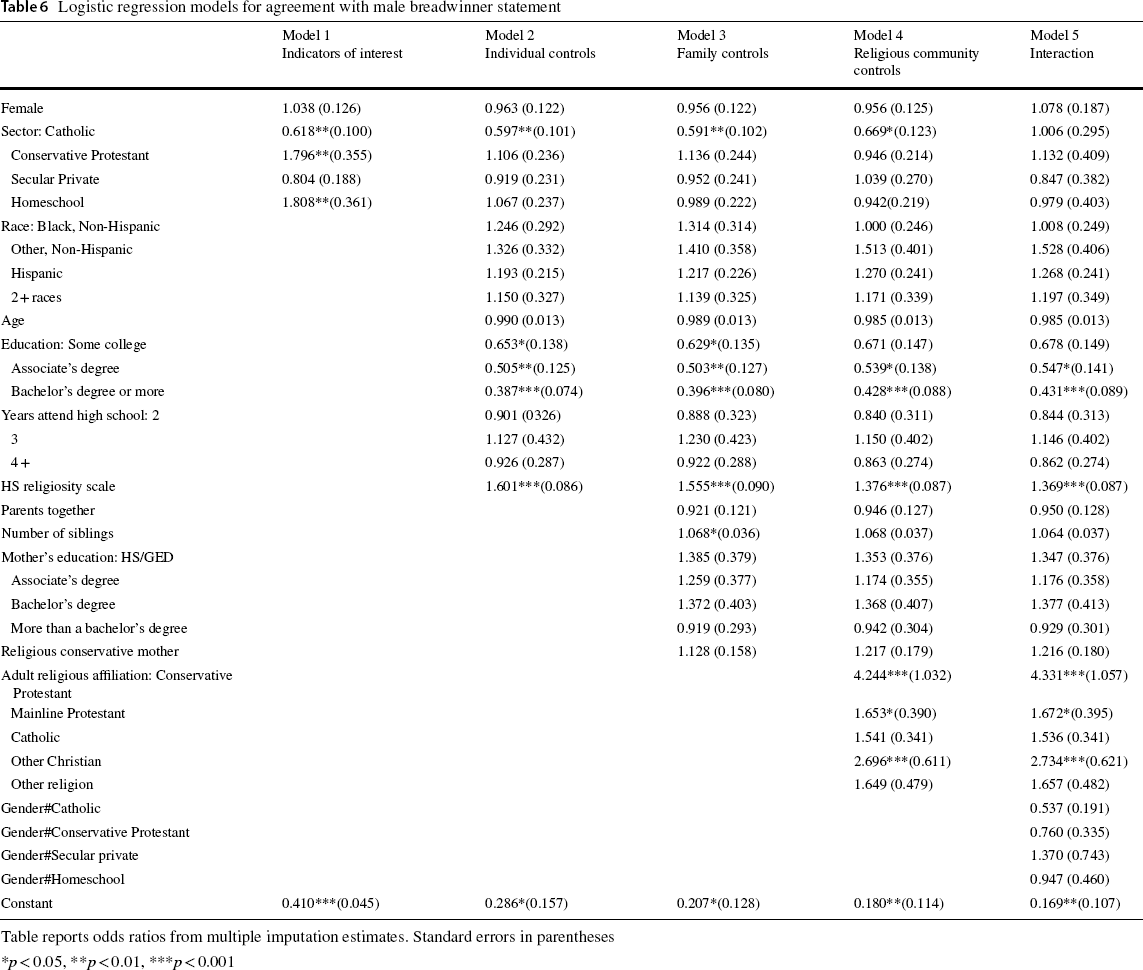
Model 1 Indicators of interest
Model 2 Individual controls
Model 3 Family controls
Model 4 Religious community controls
Model 5 Interaction
Female
1.038 (0.126)
0.963 (0.122)
0.956 (0.122)
0.956 (0.125)
1.078 (0.187)
Sector: Catholic
0.618**(0.100)
0.597**(0.101)
0.591**(0.102)
0.669*(0.123)
1.006 (0.295)
Conservative Protestant
1.796**(0.355)
1.106 (0.236)
1.136 (0.244)
0.946 (0.214)
1.132 (0.409)
Secular Private
0.804 (0.188)
0.919 (0.231)
0.952 (0.241)
1.039 (0.270)
0.847 (0.382)
Homeschool
1.808**(0.361)
1.067 (0.237)
0.989 (0.222)
0.942(0.219)
0.979 (0.403)
Race: Black, Non-Hispanic
1.246 (0.292)
1.314 (0.314)
1.000 (0.246)
1.008 (0.249)
Other, Non-Hispanic
1.326 (0.332)
1.410 (0.358)
1.513 (0.401)
1.528 (0.406)
Hispanic
1.193 (0.215)
1.217 (0.226)
1.270 (0.241)
1.268 (0.241)
2 + races
1.150 (0.327)
1.139 (0.325)
1.171 (0.339)
1.197 (0.349)
Age
0.990 (0.013)
0.989 (0.013)
0.985 (0.013)
0.985 (0.013)
Education: Some college
0.653*(0.138)
0.629*(0.135)
0.671 (0.147)
0.678 (0.149)
Associate's degree
0.505**(0.125)
0.503**(0.127)
0.539*(0.138)
0.547*(0.141)
Bachelor's degree or more
0.387***(0.074)
0.396***(0.080)
0.428***(0.088)
0.431***(0.089)
Years attend high school: 2
0.901 (0326)
0.888 (0.323)
0.840 (0.311)
0.844 (0.313)
3
1.127 (0.432)
1.230 (0.423)
1.150 (0.402)
1.146 (0.402)
4 +
0.926 (0.287)
0.922 (0.288)
0.863 (0.274)
0.862 (0.274)
HS religiosity scale
1.601***(0.086)
1.555***(0.090)
1.376***(0.087)
1.369***(0.087)
Parents together
0.921 (0.121)
0.946 (0.127)
0.950 (0.128)
Number of siblings
1.068*(0.036)
1.068 (0.037)
1.064 (0.037)
Mother's education: HS/GED
1.385 (0.379)
1.353 (0.376)
1.347 (0.376)
Associate's degree
1.259 (0.377)
1.174 (0.355)
1.176 (0.358)
Bachelor's degree
1.372 (0.403)
1.368 (0.407)
1.377 (0.413)
More than a bachelor's degree
0.919 (0.293)
0.942 (0.304)
0.929 (0.301)
Religious conservative mother
1.128 (0.158)
1.217 (0.179)
1.216 (0.180)
Adult religious affiliation: Conservative Protestant
4.244***(1.032)
4.331***(1.057)
Mainline Protestant
1.653*(0.390)
1.672*(0.395)
Catholic
1.541 (0.341)
1.536 (0.341)
Other Christian
2.696***(0.611)
2.734***(0.621)
Other religion
1.649 (0.479)
1.657 (0.482)
Gender#Catholic
0.537 (0.191)
Gender#Conservative Protestant
0.760 (0.335)
Gender#Secular private
1.370 (0.743)
Gender#Homeschool
0.947 (0.460)
Constant
0.410***(0.045)
0.286*(0.157)
0.207*(0.128)
0.180**(0.114)
0.169**(0.107)
Appendix 2
See Table 7.
Logistic regression models for agreement with male headship statement Table reports odds ratios from multiple imputation estimates. Standard errors in parentheses *p < 0.05, **p < 0.01, ***p < 0.001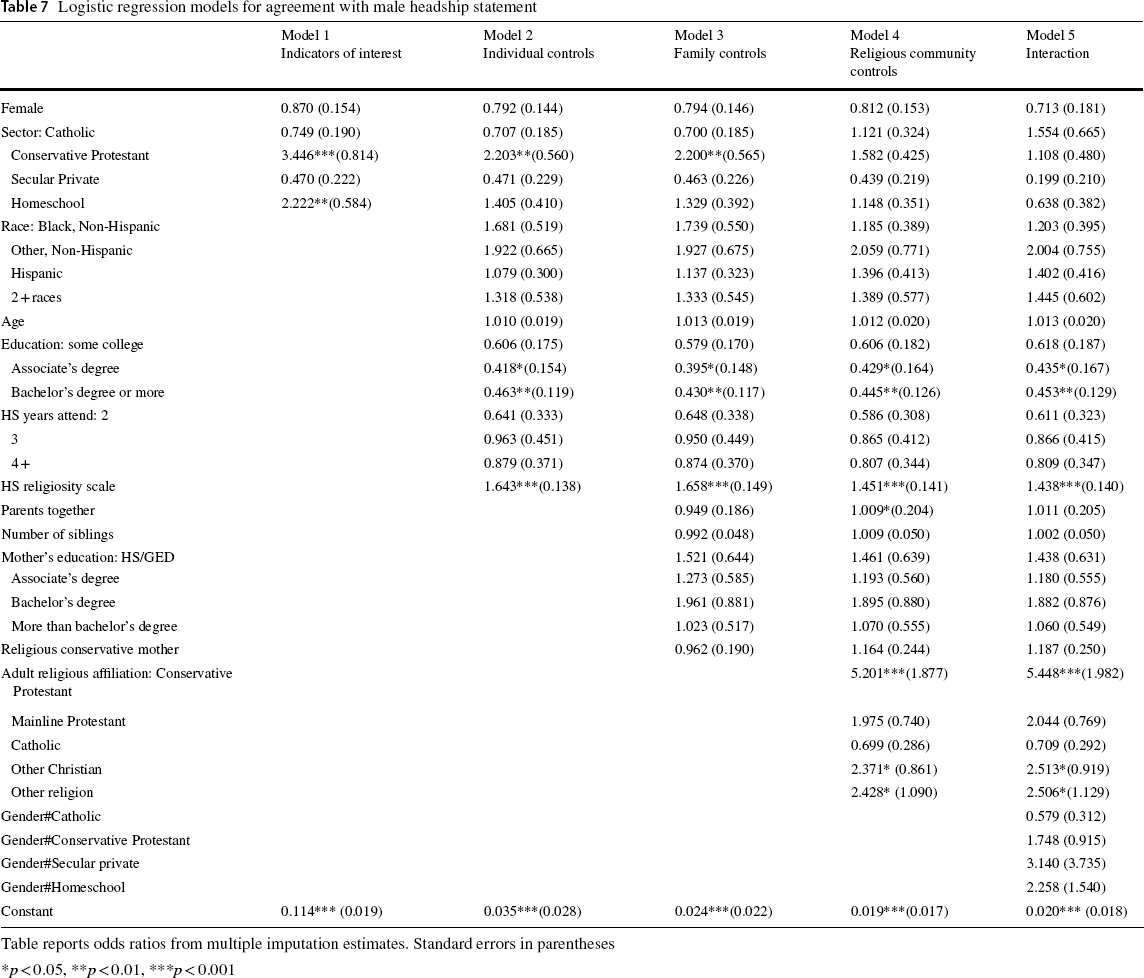
Model 1 Indicators of interest
Model 2 Individual controls
Model 3 Family controls
Model 4 Religious community controls
Model 5 Interaction
Female
0.870 (0.154)
0.792 (0.144)
0.794 (0.146)
0.812 (0.153)
0.713 (0.181)
Sector: Catholic
0.749 (0.190)
0.707 (0.185)
0.700 (0.185)
1.121 (0.324)
1.554 (0.665)
Conservative Protestant
3.446***(0.814)
2.203**(0.560)
2.200**(0.565)
1.582 (0.425)
1.108 (0.480)
Secular Private
0.470 (0.222)
0.471 (0.229)
0.463 (0.226)
0.439 (0.219)
0.199 (0.210)
Homeschool
2.222**(0.584)
1.405 (0.410)
1.329 (0.392)
1.148 (0.351)
0.638 (0.382)
Race: Black, Non-Hispanic
1.681 (0.519)
1.739 (0.550)
1.185 (0.389)
1.203 (0.395)
Other, Non-Hispanic
1.922 (0.665)
1.927 (0.675)
2.059 (0.771)
2.004 (0.755)
Hispanic
1.079 (0.300)
1.137 (0.323)
1.396 (0.413)
1.402 (0.416)
2 + races
1.318 (0.538)
1.333 (0.545)
1.389 (0.577)
1.445 (0.602)
Age
1.010 (0.019)
1.013 (0.019)
1.012 (0.020)
1.013 (0.020)
Education: some college
0.606 (0.175)
0.579 (0.170)
0.606 (0.182)
0.618 (0.187)
Associate's degree
0.418*(0.154)
0.395*(0.148)
0.429*(0.164)
0.435*(0.167)
Bachelor's degree or more
0.463**(0.119)
0.430**(0.117)
0.445**(0.126)
0.453**(0.129)
HS years attend: 2
0.641 (0.333)
0.648 (0.338)
0.586 (0.308)
0.611 (0.323)
3
0.963 (0.451)
0.950 (0.449)
0.865 (0.412)
0.866 (0.415)
4 +
0.879 (0.371)
0.874 (0.370)
0.807 (0.344)
0.809 (0.347)
HS religiosity scale
1.643***(0.138)
1.658***(0.149)
1.451***(0.141)
1.438***(0.140)
Parents together
0.949 (0.186)
1.009*(0.204)
1.011 (0.205)
Number of siblings
0.992 (0.048)
1.009 (0.050)
1.002 (0.050)
Mother's education: HS/GED
1.521 (0.644)
1.461 (0.639)
1.438 (0.631)
Associate's degree
1.273 (0.585)
1.193 (0.560)
1.180 (0.555)
Bachelor's degree
1.961 (0.881)
1.895 (0.880)
1.882 (0.876)
More than bachelor's degree
1.023 (0.517)
1.070 (0.555)
1.060 (0.549)
Religious conservative mother
0.962 (0.190)
1.164 (0.244)
1.187 (0.250)
Adult religious affiliation: Conservative Protestant
5.201***(1.877)
5.448***(1.982)
Mainline Protestant
1.975 (0.740)
2.044 (0.769)
Catholic
0.699 (0.286)
0.709 (0.292)
Other Christian
2.371* (0.861)
2.513*(0.919)
Other religion
2.428* (1.090)
2.506*(1.129)
Gender#Catholic
0.579 (0.312)
Gender#Conservative Protestant
1.748 (0.915)
Gender#Secular private
3.140 (3.735)
Gender#Homeschool
2.258 (1.540)
Constant
0.114*** (0.019)
0.035***(0.028)
0.024***(0.022)
0.019***(0.017)
0.020*** (0.018)
1
Over the last several decades, homeschooling has grown from a small, highly alternative form of non-public education to a relatively more common practice (e.g., Lines 1999; Stevens 2001; Ray 2012; Wang et al. 2019). As Stevens (2001) summarized: “U.S. Department of Education policy analyst Patricia Lines estimated that as many as one million American children were homeschools in the 1997–1998 academic year, up from an estimated three hundred thousand in 1988 and fifteen thousand in the early 1970s” (18, referencing Lines 1999). These numbers have continued to climb in the U.S. as evidenced in a 2019 report by the U.S. Department of Education's National Center for Educational Statistics (NCES) which found that: “the number of homeschooled students in 2016 (1.7 million) was almost double the number in 1999 (0.9 million)” (Wang et al. 2019: 12). 1.7 million students is approximately 3.3% of the students in the U.S. between the ages of 5–17 (Wang et al. 2019: 32). According to the NCES: “5.4 percent of students were reported to be homeschooled in 2020–2021” (NCES  : 6).
: 6).
2
These statements were: (1) “If a husband and wife disagree about something important, the wife should give in to her husband”, (2) “It is better if the man earns the main living and the woman takes care of the home and family”, and (3) “The husband is responsible for the spiritual direction of the family” (Corner : 18).
3
While measures of parental education are the only available indicator of respondents’ socioeconomic status in high school, this limitation in the CES dataset is offset by its nationally representative sample of graduates of different school sectors and the multiple measures of religiosity of respondents and their families during high school. These religious controls are central in the attempt to isolate a school influence from a family influence.
4
Ideally, we would have included mother's work status during high school in the model as well, but this information was not available in the CES dataset.
Springer Nature remains neutral with regard to jurisdictional claims in published maps and institutional affiliations.
Springer Nature or its licensor (e.g. a society or other partner) holds exclusive rights to this article under a publishing agreement with the author(s) or other rightsholder(s); author self-archiving of the accepted manuscript version of this article is solely governed by the terms of such publishing agreement and applicable law.