






Abstract
We report here the results of our evaluation of representative disease state assays on the Abbott ARCHITECT® i2000® analyzer. The ARCHITECT i-series is a family of immunoassay analyzers under development by Abbott Laboratories (North Chicago, IL, USA). The first instrument available from this family is the i2000 analyzer. The i2000 analyzer is a random access, modular instrument with a maximum throughput of 200 tests per hour and a time to first result of 29 minutes. 1 It is capable of running two step, one step, and automated pretreatment protocols. Modular instrument design allows multiple i2000 analyzers to be combined to form i4000®, i6000®, and i8000® analyzers with maximum throughputs of 400, 600, and 800 tests per hour, respectively. As either an individual module or multiple integrated modules, the instrument is run by one operator using a single system control center (SCC). The SCC has Windows NT based data management software that is touch screen driven. All assays utilize paramagnetic microparticles for analyte capture, and chemiluminescent detection based on a new class of acridinium compound (sulfonyl acridinium carboxamides) with improved aqueous solubility and stability. 2,3 The i2000 analyzer has onboard, refrigerated storage for up to 25 reagent kits per module, and reagents are available for a wide range of assays. The purpose of our study was to perform a laboratory evaluation of representative thyroid (TSH, Free T4), fertility (Total β-hCG, FSH, LH, Prolactin, Testosterone) and metabolic (Ferritin) assays on the i2000 analyzer. Our evaluation of these assays included sensitivity, precision, and method comparison testing. In addition, we performed a preliminary evaluation of three i2000 tumor marker assays (Total PSA, Free PSA, and CEA) by comparing specimen correlation to other commercially available methods.
METHODS
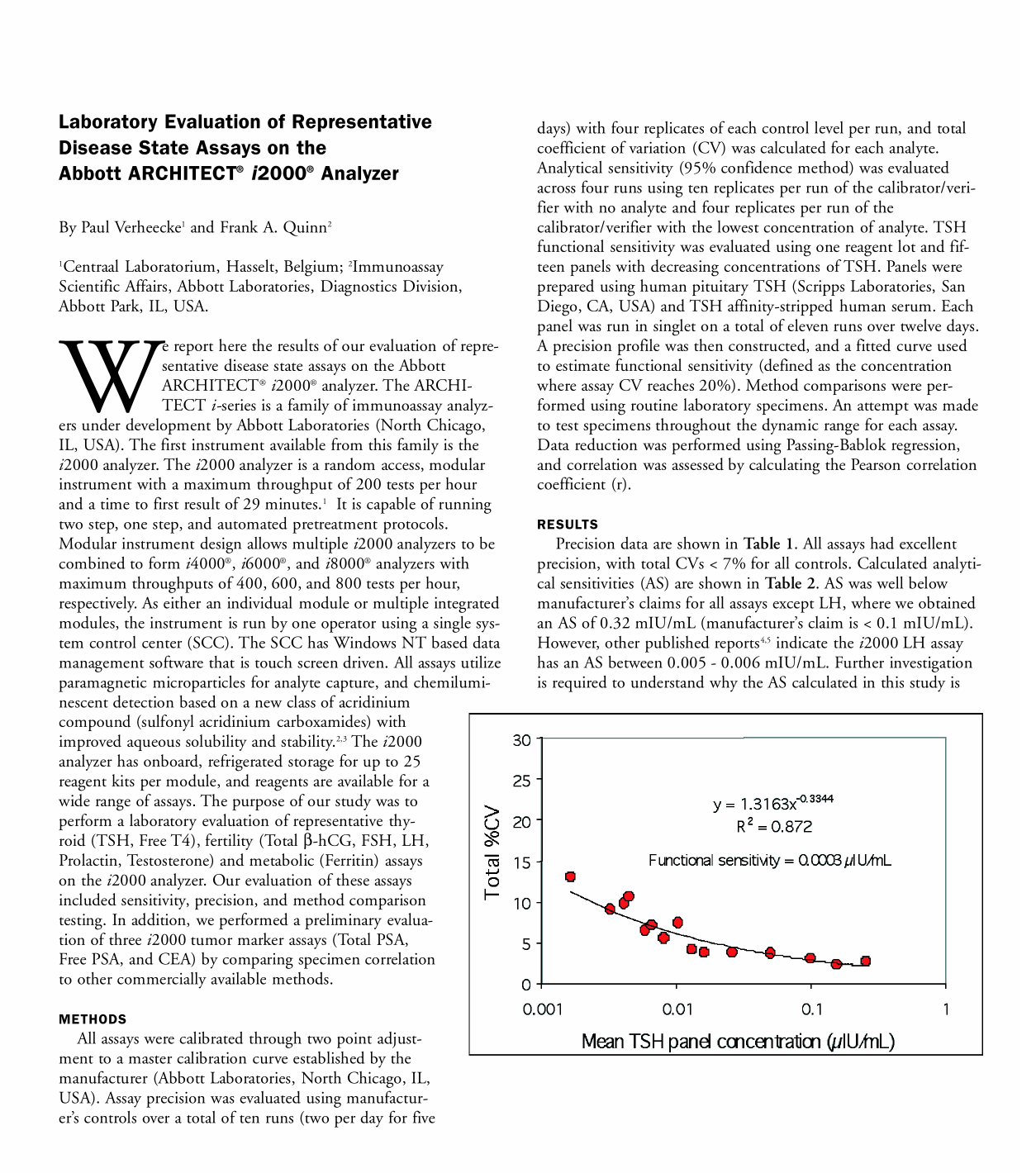
All assays were calibrated through two point adjustment to a master calibration curve established by the manufacturer (Abbott Laboratories, North Chicago, IL, USA). Assay precision was evaluated using manufacturer's controls over a total of ten runs (two per day for five days) with four replicates of each control level per run, and total coefficient of variation (CV) was calculated for each analyte. Analytical sensitivity (95% confidence method) was evaluated across four runs using ten replicates per run of the calibrator/verifier with no analyte and four replicates per run of the calibrator/verifier with the lowest concentration of analyte. TSH functional sensitivity was evaluated using one reagent lot and fifteen panels with decreasing concentrations of TSH. Panels were prepared using human pituitary TSH (Scripps Laboratories, San Diego, CA, USA) and TSH affinity-stripped human serum. Each panel was run in singlet on a total of eleven runs over twelve days. A precision profile was then constructed, and a fitted curve used to estimate functional sensitivity (defined as the concentration where assay CV reaches 20%). Method comparisons were performed using routine laboratory specimens. An attempt was made to test specimens throughout the dynamic range for each assay. Data reduction was performed using Passing-Bablok regression, and correlation was assessed by calculating the Pearson correlation coefficient (r).
RESULTS
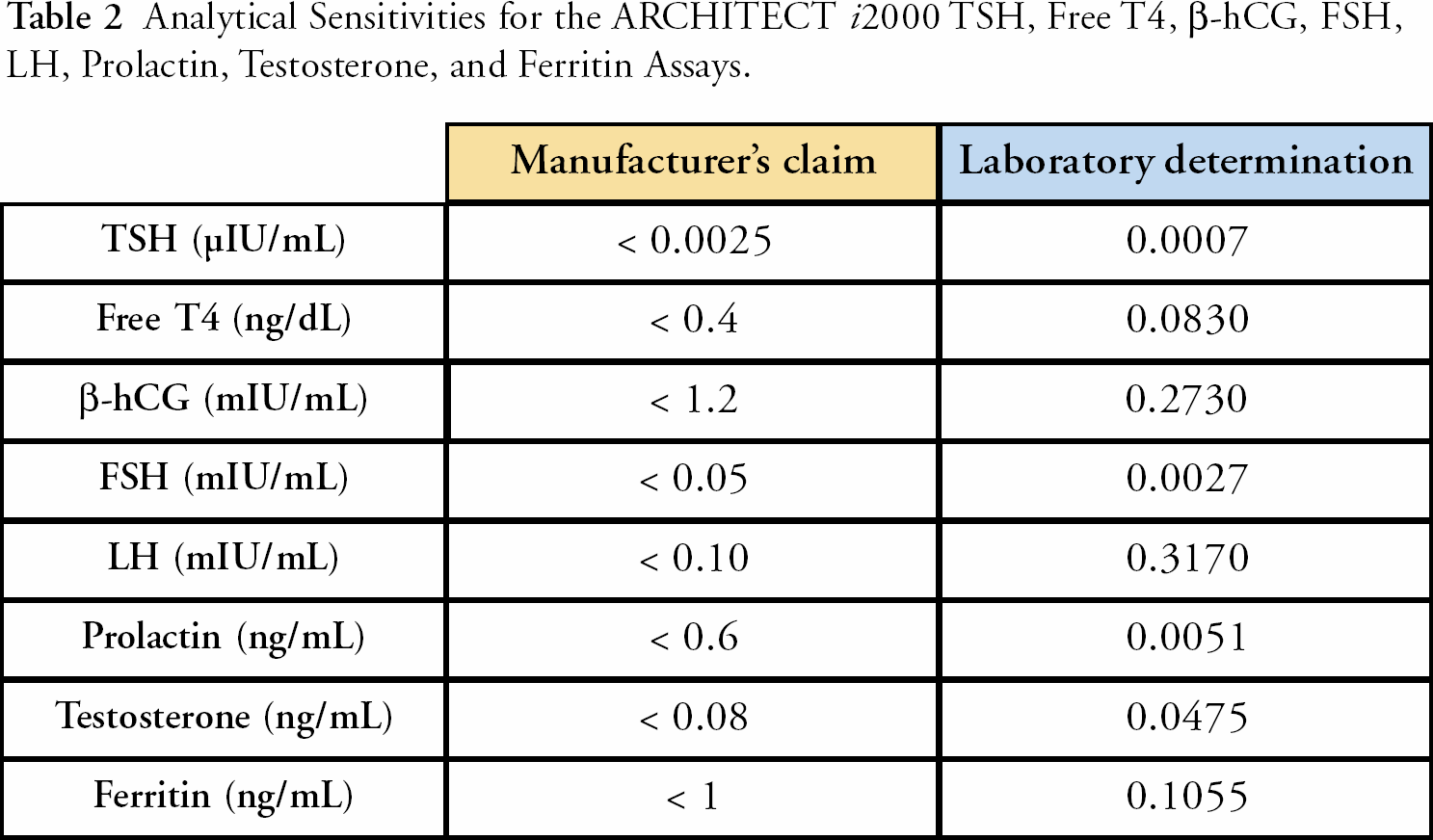
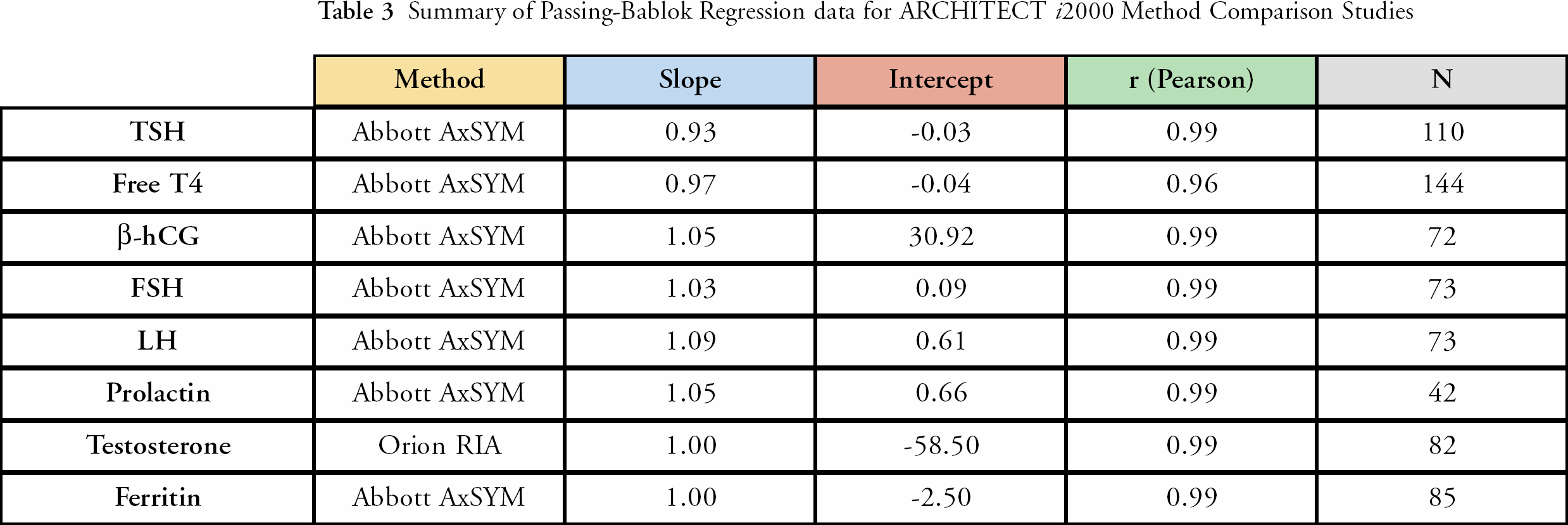
Precision data are shown in Table 1. All assays had excellent precision, with total CVs < 7% for all controls. Calculated analytical sensitivities (AS) are shown in Table 2. AS was well below manufacturer's claims for all assays except LH, where we obtained an AS of 0.32 mIU/mL (manufacturer's claim is < 0. 1 mIU/mL). However, other published reports 4,5 indicate the i2000 LH assay has an AS between 0.005 − 0.006 mIU/mL. Further investigation is required to understand why the AS calculated in this study is higher than those previously reported. Our analysis of functional sensitivity (FS) for the TSH assay yielded a value of 0.0003 μIU/mL. This functional sensitivity easily meets the definition of a third generation assay (20% interassay CVs between 0.01 and 0.02 μIU/mL), and is well below the manufacturer's claim (0.01 μIU/mL). Other investigators have seen similarly low functional sensitivities for this assay, 6,7 it is still more than three times below the manufacturer's claim of < 0.01 μIU/mL. Method comparison data are summarized in Table 3. In general, the i2000 assays had good agreement and correlation with our reference methods. Slopes ranged from 0.93 (TSH) to 1.09 (LH), and Pearson correlation coefficients were greater than 0.96 for all assays. Representative method comparison graphs for Total PSA, TSH, Total β-hCG, and Ferritin are shown in Figure 2.
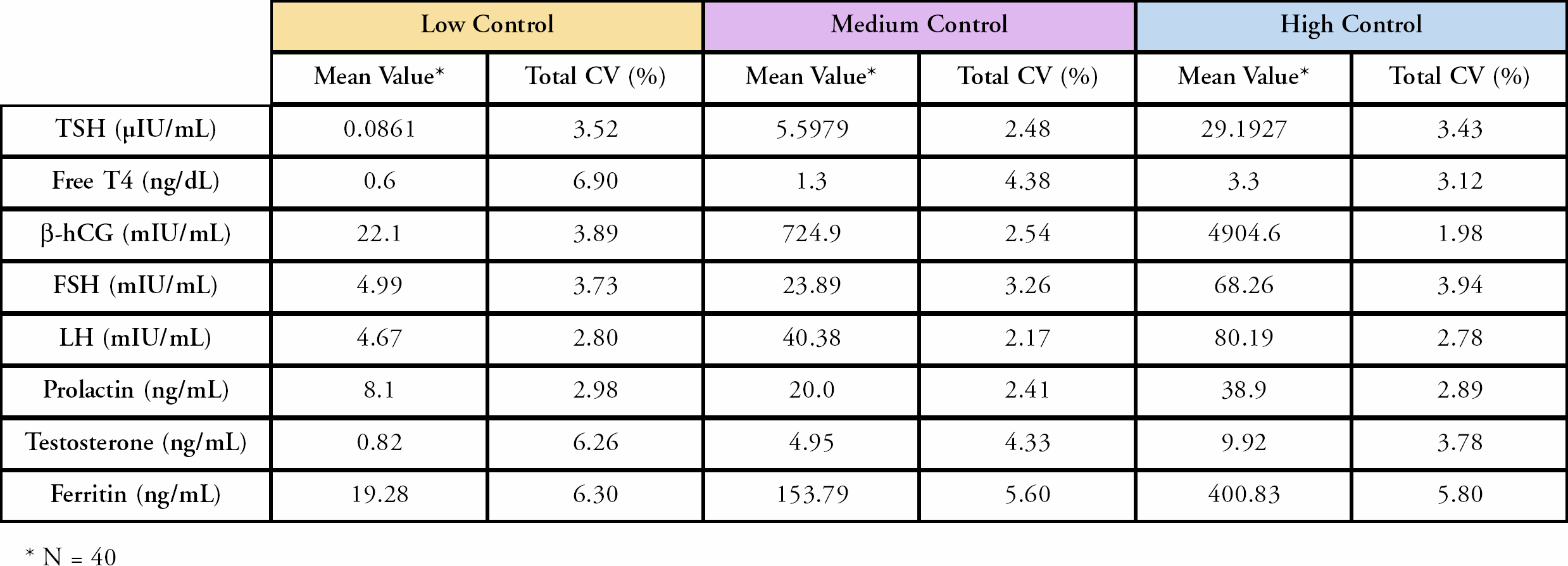
N = 40
Analytical Sensitivities for the ARCHITECT i2000 TSH, Free T4, β-hCG, FSH, LH, Prolactin, Testosterone, and Ferritin Assays.
Summary of Passing-Bablok Regression data for ARCHITECT i2000 Method Comparison Studies
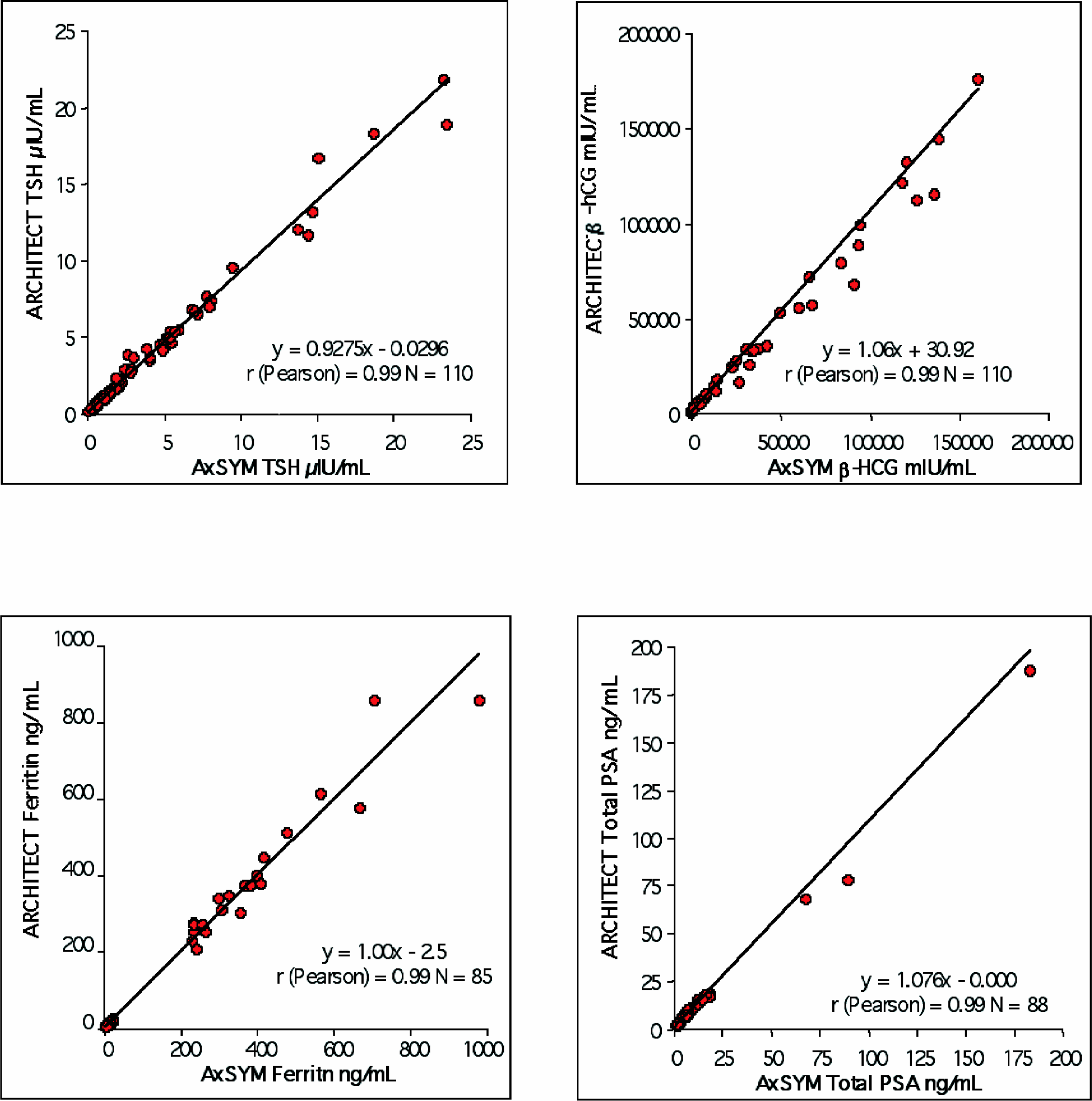
Representative Passing-Bablok Regression Graphs for ARCHITECT i2000 Method Comparison Studies
DISCUSSION
We report here the results of our performance evaluation for eight of the assays available on the Abbott ARCHITECT i2000 analyzer. This instrument represents a new approach in the automation of laboratory testing. It offers the flexibility of a modular instrument combined with high throughput and excellent assay performance. Depending on their testing volumes, laboratories have the option to integrate multiple instruments, giving throughputs ranging from 200 (i2000) to 800 (i8000) tests per hour. In addition, because the i2000 analyzer has direct track sampling capability, it is laboratory automation compatible. In this way, the i2000 analyzer can support a wide variety of laboratory configurations and management strategies. In the future, the ARCHITECT family will include the i500 and the i1000 immunoassay analyzers. These instruments will use the same reagents (with the same reportable ranges) as the i2000, and will provide STAT testing capabilities, with STAT test throughputs of 100 (i500) and 200 (i1000) tests per hour. The i2000 and i1000 analyzers are also designed to be integrated with the c8000, a chemistry analyzer currently being codeveloped by Abbott and Toshiba. This will ultimately allow the consolidation of immunoassay and clinical chemistry testing on to one instrument platform controlled by a single operator.
In this study, we found the i2000 assays to be extremely sensitive and precise, with good agreement and correlation to our current reference methods. These data, when combined with the instrument features, suggest the i2000 analyzer offers significant potential benefits for laboratories looking to consolidate immunoassay testing on to a high throughput analyzer.
Footnotes
Acknowledgements
If you are interested in seeing more articles like this in JALA, please email