







Abstract

Motorola's Life Sciences unit plans to enter 2001 ready to compete against more established players in the Life Science field by offering practical solutions and products. This article is an overview of the company, how it came to this market and where it sees itself progressing.
Motorola has a long history of adapting technology and applying it to uses for the general consumer. A pioneer of the car radio, where they first became widely known, Motorola has chronicled its achievements such as bringing the walkie-talkie into general use, producing color televisions, paging devices and cell phones. Motorola has maintained its competitive edge by being able to enter markets before the product need is anticipated. It is no surprise that genomics and the biotech market revolution factor heavily in Motorola's future plans.
Motorola Life Sciences' technology includes microarray-based systems for single nucleotide polymorphism and gene expression analysis. Their products primarily target life science research and pharmaceutical discovery. Among their products are integrated solutions, such as imaging systems, reagents, automation and imaging instrument systems as well as supporting image analysis software. Their ability to integrate biochips with instrumentation, bioinformatics and communications are among the areas in which Motorola believes itself best positioned to provide solutions. In the clinical diagnostics market, they market distributed point-of-care systems.
Motorola Life Sciences' proprietary array technology is centered around a three-dimensional gel pad format with high binding efficiency. Such integrated systems may be used to achieve high throughput or portability for sample preparation and a variety of diagnostic tests. The company's microarray-based integrated systems are intended to support a wide variety of applications including DNA and RNA analysis, microfluidics technology, and proteomics.
With the launch of such products in the new year Motorola feels it is building on not just its technical expertise, but also on a legacy of bridging the gap between scientific knowledge and the development and marketing of practical applications. Motorola Life Sciences was officially launched in 1998. It was formed, according to Vice President and General Manager Nicholas Naclerio, Ph.D., to fill the gap that “lies at the intersection between high-technology chip manufacturing, signal processing, software skills and more traditional molecular biology and genomics”. Dr. Naclerio told JALA about his appointment by Motorola four years ago as Director of Strategies, how the company built up its internal business unit. Scientists, chemists, engineers and new managers were, and continue to be hired, to expand the employee base. Their workforce currently consists of a large number of post graduate professionals, including a world class team of molecular biologists. The research and development operations take place in Tempe, Arizona, although the company's main office remains in Northbrook, Illinois. Dr. Naclerio sees the BioChip division as bringing an infusion of new skill sets and entrepreneurial abilities to Motorola's base competencies in wireless communications, miniaturization, semiconductors and advanced electronic systems.
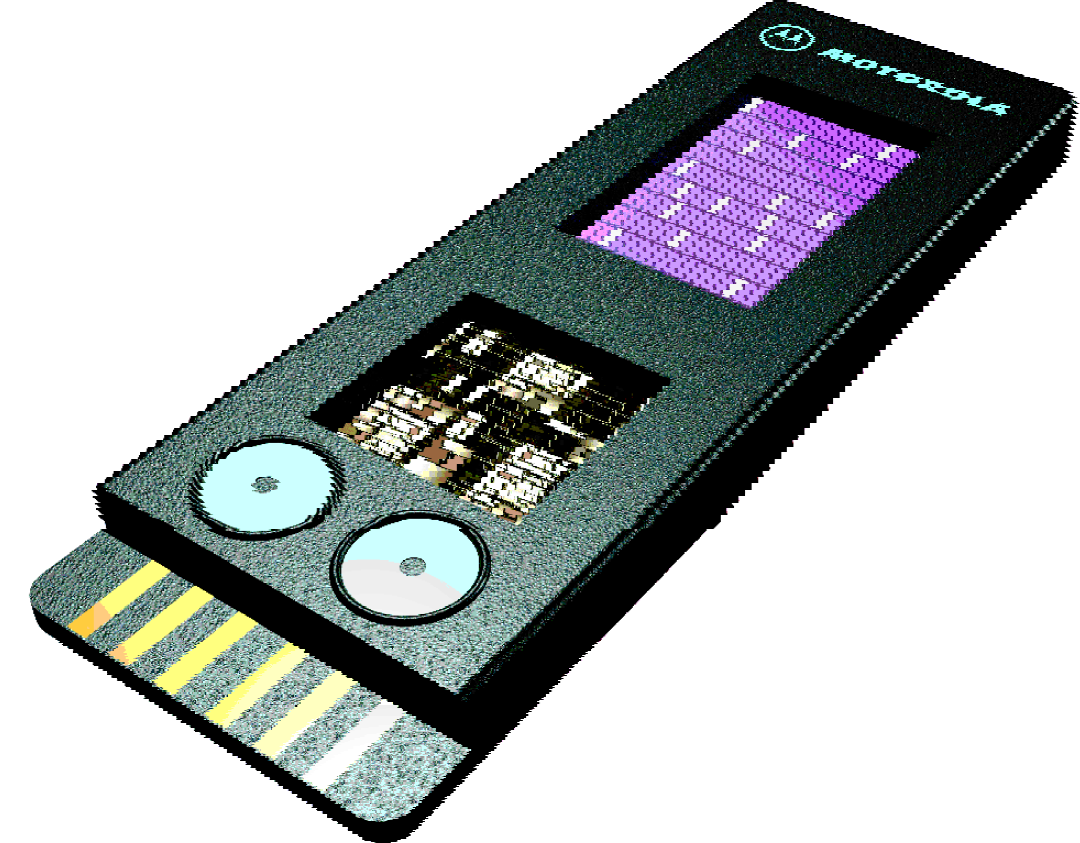
Another aspect of the development of Motorola Life Sciences was the adoption of strategic partnerships with academic institutions and industry. The new products are designed to insure more effective detection, diagnosis, treatment and prevention of diseases. Motorola has unique technologies that should allow it to be a major supplier of life sciences, genomics and emerging bioscience products. As with other companies in the life science field, Motorola Life Sciences ultimately believes that it can provide integrated solutions for the faster detection, diagnosis, and treatment and prevention of many illnesses. As with most biotechnology products, their initial customers will be research scientists until the products prove their clinical utility. In the short term their customers shall be genomics and pharmaceutical institutions, then clinical laboratories, and eventually point-of-care technologies for the use of patients in their home.
Fundamentally, Motorola Life Sciences intends to remain rooted in its traditional strength of supplying quality chips and quantitative instrumentation products to the biotech research industry. They do not perceive themselves as performing basic research, but rather those who supply the tools to make these discoveries. Their vision, according to Dr. Naclerio is providing “complete solutions” to those involved in research. This means the right automation, the necessary chips and software, and the support infrastructure. In some cases these may be general purpose analytical instrumentation, but they are also developing instruments for specific needs.
Although the most exciting technologies are “hand-held”, this is not where Motorola Life Sciences sees itself making the biggest impact in the short term. Desk-top units, suitable for labs, are still much more important in the life science arena than handheld devices.
Expectations are very high in Motorola Life Sciences that they shall make a hugely successful start to 2001. They are presently shipping to a beta customer, and getting technical feedback. By the end of the year they expect to initiate additional beta sites in order to generate the necessary clinical data for FDA approval. This shall allow them time to prepare for a major program of exhibiting and promoting their new products. To this end they are staffing up their marketing division to be prepared for an aggressive pitch in 2001. Motorola will also apply their well known customer service skills to the new biotechnology product lines. They are keenly aware that this is a competitive industry with numerous players. To that end they are determined to offer something new.
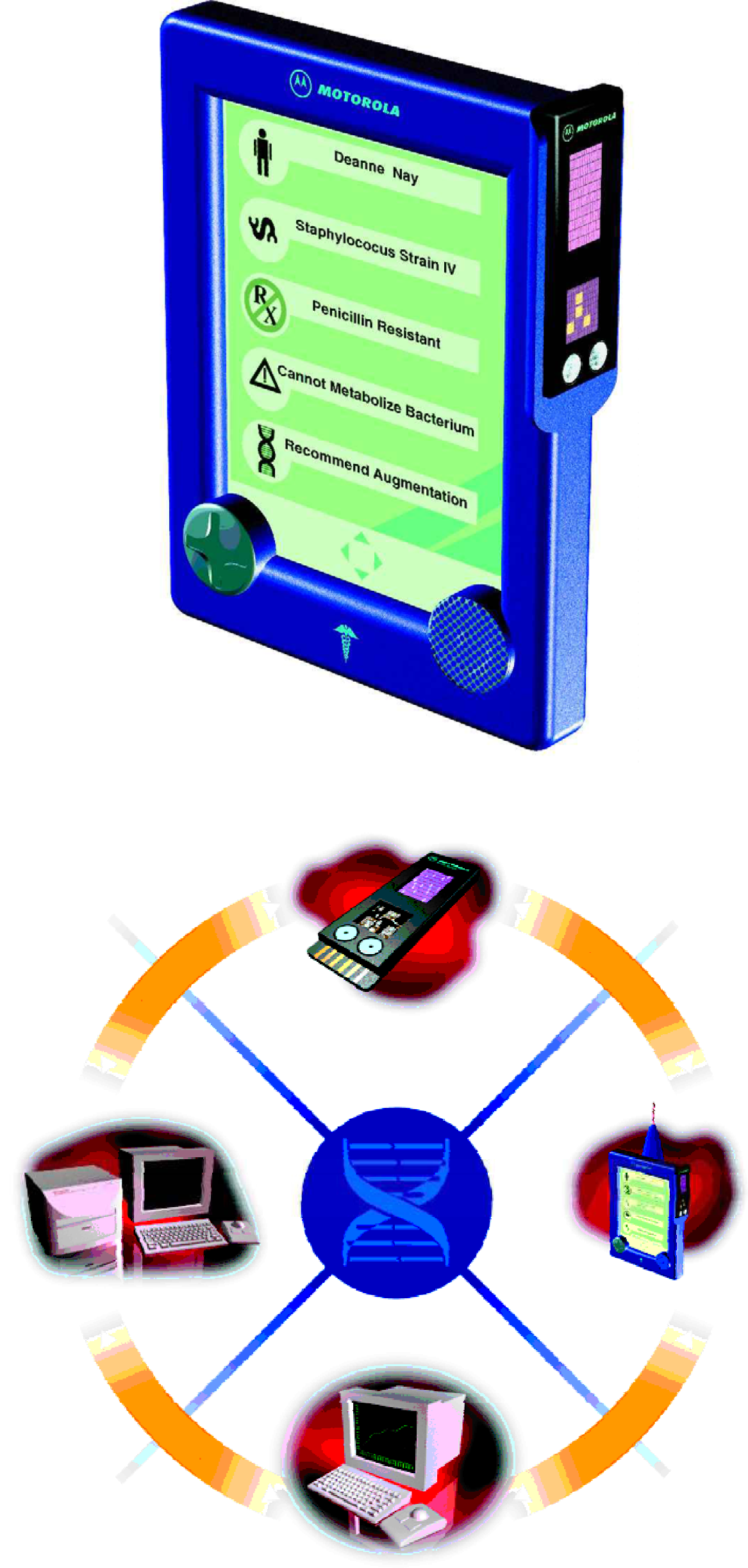
Critical to Motorola Life Sciences determination to be innovative are their collaborations, both with industry and the academic world. Motorola is an equity holder in Clinical Micro-Sensors (cover in JALA, Volume 4, Number 5). Formed in 1995 in Pasadena, California, it expanded on intellectual property in the area of bio-electronic detection of DNA. CMS launched its electronic detection product, eSensor™, at the November 2000 meeting of the Chips-to-Hits Conference in Philadelphia. CMS will continue its development of products for the diagnostics market.
Motorola holds an exclusive license agreement with Orchid Biocomputer related to its three-dimensional microfluidics technology. Motorola is a member of the SNP Consortium, whose mission is to construct a high-density, high-quality map of single nucleotide polymorphisms and to deliver it to the public domain. The use of the SNP database will allow Motorola to tap into the anticipated plethora of diagnostic polymorphisms that reside in the human genome.
The specific diagnostic targets Motorola Life Sciences hopes to offer shall become clear in 2001. Though initially the United States shall be the main focus, Motorola has plans to expand into Europe and to other parts of the world. If past success is the yard-stick by which Motorola is to be judged, we can expect to see them play an increasingly important role in the Life Science market. JALA looks forward to bringing its readers regular updates on the products and progress of Motorola Life Sciences.