







Abstract

Managing and safeguarding the productivity of all assets and the quality of your laboratory's results is the primary reason contingency planning is considered by any Laboratory Manager (LM) or Principal Investigator (PI). As identified in the recent article “Laboratory Management Contingency Planning - The New Paradigm”, 1 expecting optimal performance from key instrumentation systems is a futile effort if the environmental conditions of the instrumentation systems are not addressed and standardized. For those laboratories under the scrutiny of government regulation (cGCP, cGLP and cGMP), the FDA has addressed, in its guidance on 21 CFR Part 11 Electronic Records and Electronic Signatures compliance, that the key environmental conditions of cleanliness, temperature, humidity and electrical power/energy must be suited to meet the design requirements of the laboratory's instrumentation systems.
ASSESSING THE LABORATORY'S MACRO ENVIRONMENTAL CONDITIONS
While nearly all laboratories address temperature, humidity and cleanliness as macro environmental issues, an alarming number still do not adequately address their intrinsic electrical power quality and energy demand requirement. As noted in the EPRI (Electric Power Research Institute) 2 and the California Independent System Operator (CAISO) 3 Staged Power Emergency (USDOE) reports, the ubiquitous power disturbances associated with an over-demand upon power generation has forced regional utilities to supplement their energy grid requirements. Utilities and the power distributors are now obtaining power from any and all available sources, both domestic and international. For laboratory operators, this is a crucial issue. The EPRI reported to the US Congress' Subcommittee on Energy of the Committee on Science, 4 that the power from these sources has been recognized as not being regulated as closely as desired for sophisticated applications. The EPRI reports that short-term power interruptions of approximately 36 milliseconds, i.e., under two cycles, have caused an estimated loss of $119 billion in the United States alone. The DOE/CAISO reports that California Stage 2 and 3 outages (rotating/voluntary blackout) during the first half of 2001 increased to over 100. Including Stage 1 power emergencies, the outage and significant inability to deliver adequate energy was over 165 declared incidents. Clearly there exists a deficit in available energy on a national scale that requires attention within the laboratory. Like a nomad in a hostile desert environment seeking water, any reasonable watering source and quality will do. The nomad's trade off is short-term survival compared to the adverse affects of ingesting contaminated water. If laboratory instrumentation is subjected to similar energy distribution 1 and supply conditions as in the nomadic water analogy, the outcome may be catastrophic with analytical results being suspect and/or compromised, probable instrumentation system damage and clearly re-calibration being required. These are the first level artifacts of delivering suspect energy to instrumentation systems, not to mention analytes and controls lost due to re-testing and down time if the instrumentation system is used in production screening. The net result is clearly losses to the laboratory's productivity, operating margin, on-time performance reputation and possibly to the overall process, for production related instrumentation.
California, as a stand-alone example, has an internal electrical energy delivery and power production deficit of 14% (3.7 nominal and 5.0 Gigawatts peak), which automatically requires the state to fulfill the needs of its consumers by either going to any available energy source, including international (Mexico), or via adverse energy management measures, such as brown out (low line) or rotating blackout (involuntary power interrupt) conditions. But the inability of the utilities to provide the required energy reserves internally is not without a price for the laboratory operator. The power demand results in a less than optimal supply that strains the performance of all laboratory instrumentation, robotic automation and electrical equipment. The conditions identified above are from the macro power environment, which includes the power distributed to the laboratory's main power distribution panel. The energy and power delivered is usually noisy with surges, spikes, high line, low line, induced harmonics and transients. The analogy to the desired level in the laboratory power distribution system is a newly paved roadway. The driving surface is at its best condition before any initial traffic, time and weather have taken their toll. This is the reason shock absorbers are installed on all vehicle suspension systems, to provide stability and to smooth the ride. As we all know, vehicle shock absorbers are expendable and need to be periodically replaced.
The Reality of Laboratory Power
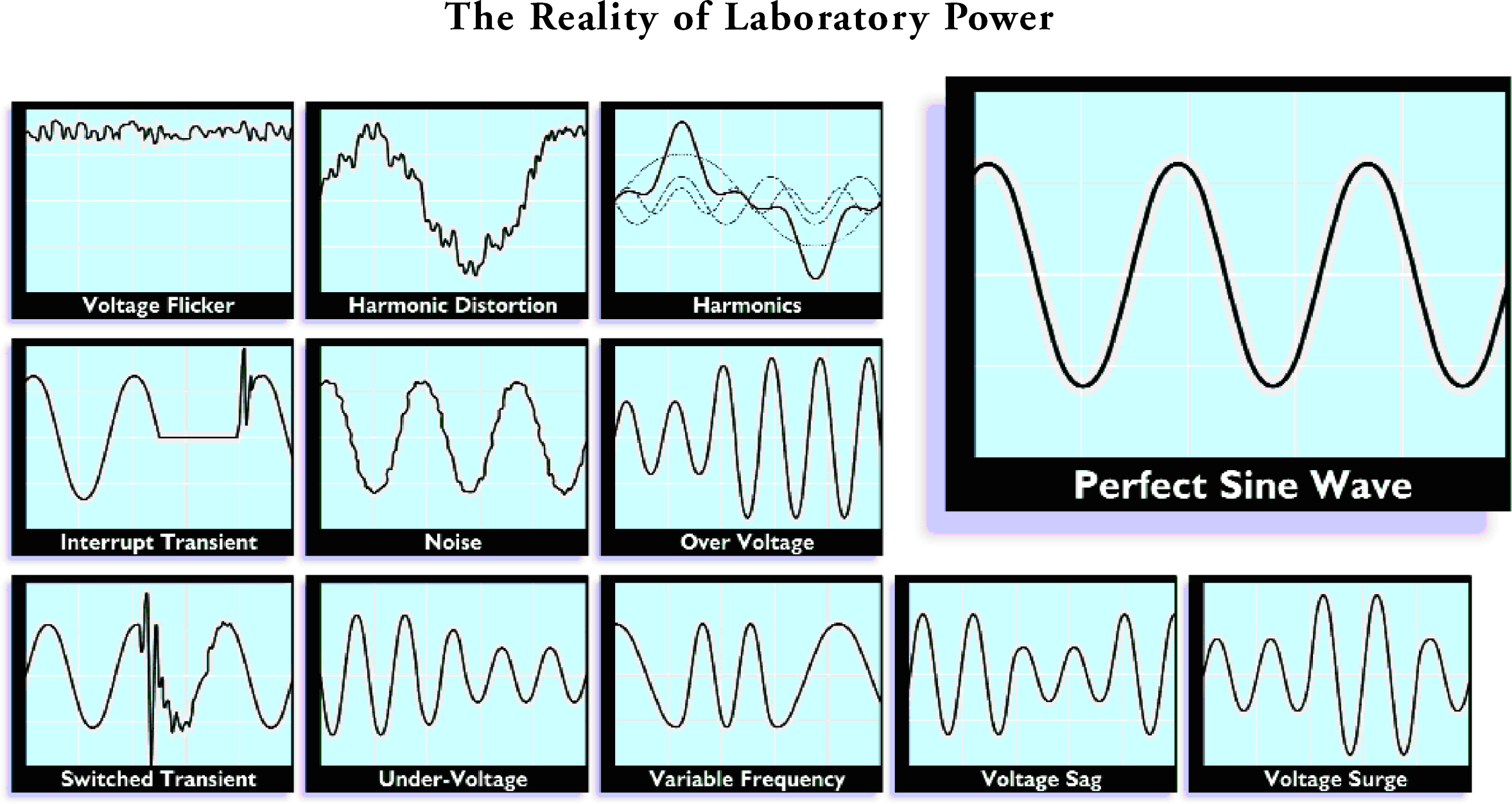
Similarly, subjecting instrumentation systems directly to the present power distribution environment (grid) is like operating a vehicle without shock absorbers. Damage will eventually result. This is the nature of the power grid and is the best that the utility and power distributors are able to deliver. The primary issue with this approach is that this solution for an enterprise laboratory operation is very costly and may exceed $25,000 5 per year in direct costs. This figure may be substantially higher for each instrumentation system with typically high utilization, or with a key on-demand response. The cost impact must also be tempered with specific instrumentation systems and their overall importance to the laboratory operation's economic value.
THE LABORATORY'S MICRO POWER ENVIRONMENT ASSESSMENT
The Consortium for Electric Infrastructure to Support a Digital Society (CEIDS) 6 , initiative was presented to Congress during the EPRI address 4 , which incorporates improved technologies and interface devices that are suited to specific high technology applications (analytical instrumentation, etc.). Scientific (healthcare, medical, research, etc.) and high technology production instrumentation systems represent one of the most difficult application challenges for these interface devices. But the need for improved power and specific interface devices begs the question of why these fixes are required at all.
WHY ARE IMPROVEMENTS IN LABORATORY POWER QUALITY REQUIRED?
While all instrumentation manufacturers develop their systems with the best components, latest circuit designs and intelligent control, they also compensate for a number of predictable variables in power and energy delivery (voltage, current, frequency, distortion, etc.) to maximize system performance under very hostile operating conditions. All items that are subjected to the power grid do have engineering specification requirements that must be met at a minimum and maximum level. Exceeding the performance tolerances of the system will cause it to fail. Nearly all non-reproducible and spurious instrumentation failures (glitches) are attributed to inadequate and out of tolerance power being provided to the system. As an example, it is obvious that if an insufficient amount of power, or no power, is delivered to a lamp, it will not “light” effectively. While an incandescent light can be regulated for brightness (dimmer control circuit on a resistive/linear load), if one applies the same dimmer control to a fluorescent light (ballast controlled/non-linear load), or an AC synchronous motor (non-linear load), the control device (dimmer) will keep it from energizing and functioning. Potentially a fire hazard may also exist due to an inappropriate electrical control device application. The same phenomena and rationale apply to instrumentation systems. No one should expect a system to operate effectively if the specifications for which it has been designed have been exceeded on the high or low side of power delivery. The laboratory must be appropriately conditioned to deliver the correct energy/power to its instrumentation systems. The main reason is that while under digital and auto-intelligence control, instrumentation systems are simply not computers, or similarly derived from computers, but highly sophisticated analytical and dedicated automation (robotic) engines with high degrees of sensitivity, accuracy and reproducibility. In particular, analytical instrumentation incorporating spectrographic, laser scanning, optical computing, micro- and nano-stepping, microliter pipetting or synchronous control, as well as highly regulated thermal cycling are adversely affected when their power and control circuits, transducers and sensors are not provided with adequate input energy. Additionally, the electrical energy loading profiles / response rise time of these instrumentation systems makes them truly unique, which requires a category of their own, namely “instrumentation grade”. With an appropriate category to differentiate instrumentation grade interface devices from other general purpose designs used for other digital (computer) applications, it is quite easy to understand why the telecommunications market with its fiber optic (laser) systems would not and does not consider protecting their network with computer grade devices. In the overall scope of protecting “digital” types of equipment, there are three main categories or grades of increasing asset sensitivity and required protection.
Computers
Telecommunications
Analytical Instrumentation
The appropriate interface devices required to protect analytical instrumentation systems require engineered applications and OEM qualification for a number of reasons. The principle factors include energy delivery and loading profile (non linear/reactive loading) and the overall value of the asset to the laboratory. These interface devices have been identified as Laboratory Productivity-Protection Systems (LPS) and are the most sophisticated of all dedicated online uninterruptible power protection devices. Category III LPS interface devices provide the necessary energy management and systems communications protocols to power the instrumentation systems they are designed to protect. The laboratory also produces a micro power environment of its own due to the equipment it is simultaneously operating. This environment consists of large power draw equipment, such as the ever present centrifuge, which has high current inrush and pulls a very high reactive (inductive) load due to its motor, in addition to other instrumentation, sample preparation, laser scanning and sample storage devices. Additionally, heating and cooling devices, pumps, filtration, solenoids and other electrical devices required within the laboratory do induce undesired switching transients and loading profiles which are fed back into instrumentation systems interconnected through the laboratory's power distribution system. These unwanted energy/power artifact generators must be identified and managed to maintain peak instrumentation performance and to obtain the desired results for all of the systems being operated within the laboratory. Identifying and managing critical instrumentation systems with appropriately designed “instrumentation grade” LPS interface devices will provide the necessary safeguards to protect the laboratory's assets, productivity and results. The goal of the LM or PI in contingency management is to identify the potential for and to reduce losses within the laboratory to levels acceptable to the enterprise. This simply means protecting the quality of the analysis, productivity, instrumentation and of course protecting the most valuable of all assets - the human resources of the laboratory staff.