







Abstract
Laboratory Information Management Systems - LIMS
The decision making process in today's business environment requires access to information scattered across a corporate enterprise. Laboratory information is critical to these business decisions, especially in pharmaceutical and chemical companies. Commercial Laboratory Information Management Systems (LIMS) have been available since the early 1980s, and have been very effective in increasing the productivity and sample throughput of modern laboratories.
LIMS APPLICATIONS - A MARKET OVERVIEW
Expectations for the functionality of Laboratory Information Management Systems depend on the company type, work profile and personal interests of people. Many LIM systems are established on the market. General tasks of LIM systems include: management of general data and access rights, sample registration, sample delivery, result acquisition, result calculation, data and system management, establishing and storing of data, etc. Since 1999 the requirement of workflow-support has been integrated into new LIM systems to ensure a process-oriented control of lab procedures.
Quality control in chemistry and pharmaceutical sciences are the main application focus of LIMS as these laboratories use clearly structured procedures (e.g. Complex IT Plant Solutions, Beckman Coulter, Creon Lab Control AG). Other systems are focused on environmental analysis (e.g. Advanced Technical Software). The complex requirements of research activities, however, can only be handled by highly specialized systems.
Beside the typical LIMS application, specialized systems for bio and gene technology have been developed within recent years. Their functionality is based on special types of sample handling using microtiter plates, arrays or robots. (e.g. Thermo Lab Systems, Integ Labordatensysteme GmbH)
All LIM systems have the ability to store raw and analytical data. A few systems specialize in delivering their own raw data archives or they enable the integration of the LIMS into specialized systems.
Typically LIMS is realized as a client/server solution supporting Windows NT, 2000 or XP. Many systems can also be used with UNIX. Oracle is the database most used in LIM systems, followed by SQLServer and other databases that can be addressed over SQL. A typical LIMS uses graphical user interface, but there is a new trend toward a browser-based user interface that allows intra- and Internet access to users without requiring any client-side software. (GIT, 46,
A representative overview about existing Laboratory Information Management Systems is given by J. Wagner (Labo trend,
ANALYTICAL INSTRUMENTATION AND LIMS: A FULLY INTEGRATED APPROACH
The majority of LIMS today have some kind of interface for directly reading results from instrument data systems, hence avoiding manual transcription errors. However, there are problems associated with losing the link to the original analytical data files. C. Culley et al. discussed progress toward an integrated system where the LIMS reads results directly from the instrument system, while at the same time gathering the corresponding data files and storing them in the same secure LIMS environment. (J. Aut. Methods & Management in Chem., 24 (5),
CONSTRUCTION OF LIMS SYSTEMS USING ANALYTICAL DATA SYSTEMS
The construction of LIMS systems often requires the development of custom-specific software components. On the other hand many automation features such as sample sequences, data export or OLE automation are integrated in today's analytical data systems. The user interface can be customized for a specific solution. One of the problems is lack of integrity of data from different instruments such as HPLC, GC, LC/MS, GC/MS or other. Shimadzu demonstrated a solution for this problem with the introduction of CLASS-Agent data management software using a back-end database on a network server (J. Aut. Methods & Management in Chem., 24 (6),
Raw data and calculation results from each instrument are stored to the database together with sample information. As data with the same sample information are easily queried, analysis results of the sample with multiple instruments can be browsed in the same platform. A generic interface to store data to the database is supported for multi-vendor instruments.
PERSONAL DIGITAL ASSISTANT (PDA) LIMS: THE INTEGRATION OF LIMS AND MOBILE TECHNOLOGY
As technology advances, more options become available for developers to create products that are both practical and functional for today's mobile generation. The integration of LIMS functionality on PDAs is thus of great importance for pharmaceutical, chemical and biotech companies. R. Vranken et al. describe the development of a system for automated sample login (J. Aut. Methods & Management in Chem., 24 (6),
The evolution of PDA technology and LIMS allows laboratories to become more efficient in all aspects of sample and data management. With the advancement in PDA technology the implementation of a full-featured LIMS is possible, allowing laboratories to become even more mobile and efficient.
Laboratory Automation and High-throughput Chemistry
A NEW AUTOMATION PLATFORM
MWG Biotech AG (Ebersberg, Germany) and Sias AG (Hombrechtikon, Switzerland) collaboratively developed a new automation platform called Theonyx (Simon May, GIT Labor-Fachzeitschrift 3,
A FULLY INTEGRATED HIGH-THROUGHPUT SCREENING METHODOLOGY FOR THE DISCOVERY OF NEW POLYOLEFIN CATALYSTS: DISCOVERY OF A NEW CLASS OF HIGH TEMPERATURE SINGLE-SITE GROUP (IV) COPOLYMERIZATION CATALYSTS
In a joint publication from Symyx Technologies and Dow Chemical, V. Murphy et al. (J. Am. Chem. Soc.,
NEW CATALYSTS FOR THE ASYMMETRIC HYDROSILYLATION OF KETONES DISCOVERED BY MASS SPECTROMETRY SCREENING
Asymmetric catalysis is a very important field of chemical research aiming for the large-scale production of enantiomerically pure substances. In the development of asymmetric catalytic reactions usually a lot of different conditions have to be tested and often the analytical determination of the enantiomeric excess (ee) of the desired product e.g. by chiral HPLC becomes the bottleneck of the experimental study. Therefore new methods for the rapid determination of ee-values is of great importance. M. G. Finn et al. developed a mass spectroscopy assay for the determination of enantiomeric excess and employed it to screen a family of chiral phosphite P, N-ligands for activity in the rhodium-catalyzed asymmetric hydrosilylation of ketones (J. Org. Chem.,
ELECTRONIC EFFECTS IN THE (DIIMINE)PALLADIUM(II)-CATALALYSED AEROBIC OXIDATION OF ALCOHOLS
In recent years many groups have investigated palladium-catalysed aerobic oxidations of alcohols as this is very attractive both from an economic as well as an environmental protection point of view. In a joint study from the Delft University of Technology and Avantium Technologies, Roger Sheldon et al. investigated the electronic effects in the (diimine)Pd(II)-catalysed aerobic oxidation of alcohols from the viewpoint of both the catalyst and the alcohol (Adv. Synth. Catal.,
PHASE-TRANSFER ALKYLATION REACTIONS USING MICROREACTORS
Recent microchip technology has enabled versatile applications in chemistry. In particular, applications in the field of analytical chemistry have been established as one of the promising research fields. Furthermore, applications in synthetic organic chemistry are getting more and more attention. Shu Kobayashi and coworkers studied phase-transfer alkylation reactions in a microchip reactor (Chem. Commun.,

They found that the reaction proceeded smoothly and that it was more efficient compared than that in a round-bottom flask with vigorous stirring. After 10 minutes the isolated yield in the microchip reactor was 96%. By an optical microscope study they observed that the interfacial area between organic and aqueous phases is more extended in a microreactor.
AUTOMATED CARBOHYDRATE SYNTHESIS TO DRIVE CHEMICAL GLYCOMICS
In a feature article by P. Seeberger (Massachusetts Institute of Technology) the development of the first automated solid-phase oligosaccharide synthesizer is described (Chem. Commun.,
Automation in Analytics
FLUOROPHORIC ASSAY FOR THE HIGH-THROUGHPUT DETERMINATION OF AMIDASE ACTIVITY
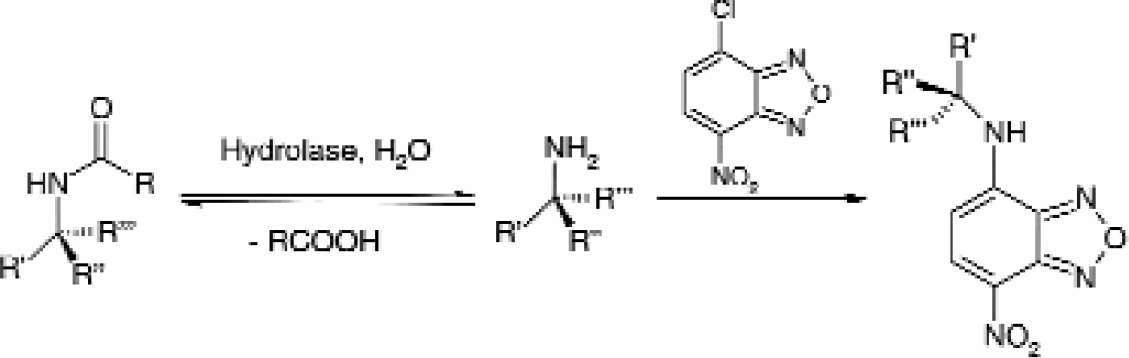
Modern biocatalysis research has generated a need for simple, inexpensive and fast assay systems for high-throughput screening of enzyme activity. E. Henke and U.T. Bornscheuer developed a method based on coupling the enzyme-released amines with 4-nitro-7-chloro-benzo-2-oxa-1, 3-diazole (Anal. Chem.
PRECISE PEPTIDE SEQUENCING AND PROTEIN QUANTIFICATION IN THE HUMAN PROTEOME THROUGH IN VIVO LYSINE-SPECIFIC MASS TAGGING
Proteomics studies demand new scalable and automatable MS-based methods for peptide sequencing and protein quantification with higher specificity and accuracy. The unique feature of the method from S. Gu et al. (J. Am. Soc. Mass Spectrom
MEMBRANE-BASED NANOSCALE PROTEOLYTIC REACTOR ENABLING PROTEIN DIGESTION, PEPTIDE SEPARATION AND PROTEIN IDENTIFICATION USING MASS SPECTROMETRY
Information such as protein molecular weight, isoelectric point, sequence and ultimately structure are of great importance in understanding the biological function of a protein. Identification of proteins is generally accomplished through proteolytic digestion and peptide mass mapping prior to electrospray ionisation mass spectrometry (ESI-MS) or matrix-assisted laser desorption/ionisation mass spectrometry. J. W. Cooper et al. (Anal. Chem.
High Throughput Structural Analysis of Proteins
FACILITIES AND METHODS FOR THE HIGH-THROUGHPUT CRYSTAL STRUCTURAL ANALYSIS OF HUMAN PROTEINS
The structure elucidation of proteins plays a crucial role in modern structure-based drug discovery and the rational design of new small molecule inhibitors. As structure determination of proteins in many cases is still a bottleneck in the drug discovery process, a lot of efforts are undertaken to achieve a higher throughput.
U. Heinemann et al. (Acc. Chem. Res.
THE SOUTHEAST COLLABORATORY FOR STRUCTURAL GENOMICS: A HIGH-THROUGHPUT GENE TO STRUCTURE FACTORY
B.C. Wang et al. (Acc. Chem. Res.
HIGH-THROUGHPUT CRYSTALLOGRAPHY AT AN AFFORDABLE COST: THE TB STRUCTURAL GENOMICS CONSORTIUM CRYSTALLIZATION FACILITY
In another paper B. Rupp (Acc. Chem. Res.
High Throughput Screening
COMPOUND MANAGEMENT COMES OF AGE
The changing role of compound management in recent years has seen an often under-valued and under-resourced function become recognized as a key part of the drug discovery process. In an interesting overview article Ian Yates examines the challenges faced by compound management teams, some of the solutions that are currently available, and those that may be available in the future (Drug Discovery World,